




Abstract
This study was conducted utilizing a quasi-experimental pre- and postgroup design to examine the effects of a phonologically based intervention aimed to improve phonological awareness (PA) and reading abilities in school-age children with language impairment (LI) in Grades 1 through 3. The intervention included instruction in PA and sound-symbol correspondence. Sixty-four school-age children with LI (Grades 1-3) were assigned to either an experimental (n = 34) or a control group (n = 30). Eleven kindergarten-age children with LI were then included as a comparison grade group to investigate whether the magnitude of treatment effect changed across grade level in the experimental group (K-3). Participants in the experimental group (Grades 1-3) made significantly greater gains in PA and reading (e.g., decoding and text comprehension) than the control group. Similar gains were observed across the varying grade levels (K-3). These results suggest that, despite being at risk of reading failure, school-age children with LI in Grades 1 through 3 have the potential to make accelerated gains in their reading development and in the PA skills that are essential to successful literacy acquisition.
An impressive body of research has documented that children with language impairment (LI) are at an increased risk for experiencing problems in achieving skilled reading (Catts, Bridges, Little, & Tomblin, 2008; Catts, Fey, Tomblin, & Zhang, 2002; Catts, Fey, Zhang, & Tomblin, 1999; Flax et al., 2003; Park, Lombardino, & Ritter, 2013; Pennington & Bishop, 2009; Rescorla, 2002; Wolter, Self, & Apel, 2011). In fact, according to some researchers, children with LI are as much as six times more likely than children with typical language development to have difficulties with learning to read (Catts et al., 1999; Catts et al., 2002). Children with LIs are known to struggle with the different areas of oral language including phonology, morphology, semantics, syntax, and pragmatics that mirror similar aspects of written language (Boudreau & Hedberg, 1999; Cabell, Justice, Zucker, & McGinty, 2009; Rescorla & Lee, 2000). This population of children can be distinguished from others as their primary impairment is language and is not attributable to any other condition, such as, neurological impairment, mental retardation, and hearing impairment (Law, Garrett, & Nye, 2004; Paul & Norbury, 2012). In regard to their oral LI, considerable evidence has accrued that phonological awareness (PA) is one of the most critical language components for children with LI in learning to read, which is not surprising considering PA is fundamental to the reading process (Adams, 1990; Castiglioni-Spalton & Ehri, 2003; Hammill, Mather, Allen, & Roberts, 2010; Lonigan, Burgess, Anthony, & Barker, 1998; National Early Literacy Panel [NELP], 2008).
Although PA has only recently passed its nascent stage, the preponderance of scientific studies have identified repeatedly, that PA is not only a crucial component in the reading process, but it is also highly predictive of later reading achievement and has a reciprocal relationship with reading itself (Adams, 1990; Castiglioni-Spalton & Ehri, 2003; Catts et al., 2008; Gillon, 2005; Hogan, Catts, & Little, 2005; Kamhi & Catts, 2002; National Reading Panel [NRP], 2000). According to Paul and Norbury (2012), PA is the ability to detect rhyme and alliteration; to segment words into smaller units, such as syllables and phonemes; to synthesize separated phonemes into words; and to understand that words are made up of sounds that can be represented by written symbols or letters. (p. 349)
A subcategory of PA, phonemic awareness, refers to the understanding that words are composed of phonemes or sounds that can be separated and manipulated (Anthony & Francis, 2005; Ehri et al., 2001; Torgesen, Al Otaiba, & Grek, 2005).
Investigators have linked the level of phonological/phonemic awareness attainment in children with LI to later difficulties with reading achievement (Boudreau & Hedberg, 1999; Catts et al., 2002; Lonigan, 2003; Lyon, Shaywitz, & Shaywitz, 2003) and have shown it to be one of the most stable indicators of later reading achievement in school-age children (Catts, Fey, Zhang, & Tomblin, 2001; Hogan et al., 2005; Lonigan, Burgess, & Anthony, 2000; Wolter et al., 2011). In addition, deficient phonological/phonemic awareness has been found to lead to difficulties in the acquisition of word decoding, which negatively impacts reading comprehension and fluency (Catts et al., 2001; Lyon et al., 2003; Stanovich, 2000). When the reader is using most of his or her cognitive resources for decoding, most likely there are few resources that can be allocated to reading comprehension (L. S. Fuchs, Fuchs, Hosp, & Jenkins, 2001; NRP, 2000). Moreover, when word decoding with accuracy and speed become relatively automatic, the reader’s attention and other cognitive resources can be channeled to the ultimate goal of comprehending the meaning of the text (NRP, 2000; Wolf & Katzir-Cohen, 2001). Research indicates that the more sensitive a child is to the phonological structure of words (e.g., syllables, phonemes), the more successful decoder and reader he or she will become (Lewis et al., 2006; Otaiba, Puranik, Ziolkowski, & Montgomery, 2009).
Evidence also indicates that children with LI are significantly slower than their age-matched peers in developing PA skills placing them at an additional disadvantage for developing successful reading skills (Boudreau & Hedberg, 1999; Nathan, Stackhouse, Goulandris, & Snowling, 2004). Importantly, research shows that children who are behind in their reading abilities fall further behind and rarely catch up to their peers without intervention (Juel, 1988; Lonigan et al., 2000; Torgesen, Rashotte, & Alexander, 2001; Torgesen, Wagner, Rashotte, Alexander, & Conway, 1997). Furthermore, these early literacy deficits in children with LI have been found to persist throughout the school years if they remain untreated (Catts, 1993; Catts et al., 1999; Catts et al., 2002; Flax et al., 2003; Rescorla, 2002).
Despite these important findings and the persistence of a reading impairment in children with LI, investigations involving children with LI in first grade and beyond often have been neglected. Much research has focused on and identified PA training as an efficacious intervention to facilitate early reading skills in preschool- and kindergarten-age children with LI, and other children struggling with learning to read (e.g., Bradley & Bryant, 1983; Gillon, 2000, 2002, 2005; Hindson et al., 2005; Justice, Kaderavek, Bowles, & Grimm, 2005; Koutsoftas, Harmon, & Gray, 2012; Laing & Espeland, 2005; Lonigan, 2003; Lundberg, Frost, & Peterson, 1988; McCutchen et al., 2002; Nancollis, Lawrie, & Dodd, 2005; Segers & Verhoeven, 2004; van Kleeck, Gillam, & McFadden, 1998; Zadeh, Farnia, & Geva, 2012). However, there is a scarcity of intervention research investigating whether phonological awareness intervention (PAI, hereafter) would be beneficial to this population of children with LI in Grades 1 through 3.
The aim of this study, then, is to contribute to and extend the previous PAI research by investigating the clinical efficacy of providing explicit PAI to school-age children with LI in Grades 1 through 3. The challenges faced by speech-language pathologists (SLPs) and educators as they encounter children with LI who are known to be particularly vulnerable for acquiring reading skills at the expected rate and level, are critical to explore to determine the potential benefits of PAI on reading achievement for this population.
PAI Studies
The intervention research suggests that training in the area of PA in preschool-age children and kindergarten-age children with poor early literacy skills creates a positive effect on their subsequent reading skills (Duff, Haylou-Thomas, & Hulme, 2012; Justice & Kaderavek, 2004; Lundberg et al., 1988; Schneider, Ennemoser, Roth, & Kuspert, 1999; Schuele & Boudreau, 2008; Ukrainetz, Ross, & Harm, 2009; Wagner, Torgesen, & Rashotte, 1994). Studies also have shown that children who are developing normally and receive PAI are more successful with developing reading skills than those who do not receive the intervention (e.g., Bradley & Bryant, 1983; Bus & van IJzendoorn, 1999; Hatcher, Hulme, & Snowling, 2004; Lewis et al., 2006; Lonigan, 2003; Lundberg et al., 1988; McCutchen et al., 2002).
Based on a major longitudinal and experimental training investigation, Bradley and Bryant (1983) presented some of the earliest evidence that established a positive relationship between PA and reading achievement in typically developing children. Their findings indicated that the kindergarten children (N = 368) who performed with the greatest amount of reading success were those who received PA and sound-symbol correspondence training when compared with the children who received PA training only. In another longitudinal study, Lundberg et al. (1988) isolated the effects of PA instruction from actual literacy instruction in 235 nonreading, kindergarten-aged children. By the end of first grade, children in the treatment group who received PAI prior to direct literacy instruction achieved significantly higher scores on reading and spelling than the control children (Lundberg et al., 1988).
Other studies have demonstrated the positive effect of PAI for kindergarten children who had been identified as struggling with learning to read (Schneider et al., 1999; Ukrainetz et al., 2009). Schneider et al. (1999) randomly selected 191 children for an experimental group and 151 children for a control group. Following intervention, the experimental group outperformed the control group on the posttest measures of reading abilities. In addition, the benefits of PAI with preschool-age children who were considered to be at risk for later reading problems due to difficulty acquiring early literacy skills (e.g., PA and alphabetic knowledge) were examined by Coyne, Kame’enui, Simmons, and Harn (2004). After receiving 30 min of PAI daily for a 7-month period, most children involved in this research received scores on PA and alphabetic knowledge that were similar to the children who were typically developing.
In a 1998 study, van Kleeck et al. investigated whether PA could be effectively taught in a general educational classroom setting to preschool-aged children with speech and language disorders. Sixteen preschool children who had a diagnosis of a speech and language disorder received PAI by a SLP over a 9-month period. The small group instruction emphasized rhyme and phonemic awareness (i.e., rhyme and sound identification, sound blending, and segmenting words into sounds). Results indicated that the PAI group had superior scores on the phonemic awareness measure compared with those in the control group (van Kleeck et al., 1998). Similarly, Gillon (2000) examined the effects of three different intervention conditions on 91 5- to 7-year old children who were identified with expressive phonological impairments. The conditions involved a PAI (i.e., phonological segmentation and manipulation, sound-symbol correspondence, and phoneme production), a traditional intervention that focused on phoneme production, and a minimal intervention group that consisted of monthly consultation with the educators and parents focusing on phoneme production. The findings revealed that the children in the PAI group (n = 30) made significantly more gains than the other two groups during the 4.5 months of intervention. The gains made included positive effects on PA abilities, reading performance (e.g., decoding), and speech production and were evident immediately following treatment and also apparent 1-year later (Gillon, 2002).
Gillon and Dodd’s (1995) research is one of the few studies that specifically involved the use of PAI with school-age children with oral language deficits associated with reading difficulties (e.g., age range = 10-12 years). Gillon and Dodd’s study compared a PAI and a semantic-syntactic language intervention in children who had been identified with below average scores for PA, semantic skills, syntactic skills, and reading. The 10 children involved in this study were randomly assigned into two intervention groups. Both groups received 12 hr of each type of intervention over a 6-week period using an alternating treatment design. Although both groups improved on reading, the results suggested that PAI had a greater impact on reading accuracy than the semantic-syntactic language intervention. The positive findings of this study provide evidence of the benefits of PAI on reading achievement with older school-age children with oral language deficits. The present investigation extends Gillon and Dodd’s study by exploring the efficacy of PAI in children in different grade groups (i.e., Grades 1-3) using more participants.
To summarize, there continues to be a paucity of research examining the treatment efficacy of PAI with school-age children with LI in Grades 1 through 3, and the extent to which PAI contributes to the advancement of PA and reading skills in children of varying grades continues to be unclear. Accordingly, questions must be answered as to whether there is a limited range of optimal time to provide PAI, and such questions make the research on the use of PAI with school-age children with LI across different grade levels critical to explore. In the same vein, research has demonstrated that children with LI are slower in PA acquisition, and thus, may need additional PA intervention to become skilled readers. The foundational PA skills, such as blending and segmenting, are critical to decoding and may be notably absent from the child’s instruction and/or intervention past kindergarten. Thus, to decide whether to provide direct PAI to children with LI in grades later than kindergarten may be critical to the success of the child who has been identified with LI.
The current study extends previous intervention research by exploring the impact of explicit PAI on reading achievement in school-age children with LI in Grades 1 through 3. We assessed the effect of PAI provided by public school, SLPs, on each of the three dependent variables: PA, word-level reading, and text comprehension. Specifically, two main questions were addressed in this study.
Method
The research for this study was conducted utilizing a quasi-experimental pre- and postgroup design to investigate the influence of PAI on PA, word-level reading, and text comprehension outcomes in school-age children with LI in Grades 1 through 3. Eight public schools that were members of an educational cooperative in the southwest part of the United States were considered for participation in this study. Only three of the eight schools met the inclusionary criteria for this investigation that involved (a) similar student populations according to socioeconomic status (SES) and ethnic groups, and (b) similar credentials and experience of the SLPs who would be providing the language intervention. These three public schools were then randomly assigned to either the experimental or control group by an assistant who was blind to the contents of the study and the schools involved in this investigation.
Participants
Participants were recruited from three suburban school districts that serve a similar student population in terms of SES and ethnic groups in the southwest region of the United States. Participants recruited included children referred by their SLP. Referrals requested were those children who were currently on the SLP’s existing caseload and those who had been identified with receptive/expressive LI. Furthermore, for the schools that were randomly assigned to either the experimental or the control group, the participating SLPs reported that PAI had not been provided, prior to this investigation, to any child on their caseload that included all participants involved in this study.
To participate in the study, each student was required to (a) use English as their primary language and be identified as monolingual; (b) be enrolled in kindergarten, first, second, or third grade; (c) pass a standard audiometric and vision screening as determined by educational records within 1 year; (d) be identified as having a LI (receptive and expressive), as determined by SLP report; (e) have an individualized education plan (IEP) in place; (f) exhibit cognitive abilities within typical limits (>80) as determined by the Test of Nonverbal Intelligence–2 (TONI-2; Brown, Sherbenou, & Johnsen, 1990); (g) have no known emotional/psychological disability; and (h) have no known neurological involvement (e.g., epilepsy) per parent report.
All of the children participating had been evaluated by their school district’s licensed SLP and were identified as having receptive/expressive LI with no evident speech (e.g., articulation) impairment present. Specific standard scores (SSs) were not able to be attained due to confidentiality issues; however, the licensed SLP of each school district reported that all participants referred to this study met the inclusionary assessment criteria for establishing eligibility for this study as follows: (a) a SS at or below 85 on the Receptive and the Expressive Language Composites, or on the Core Composite of the Clinical Evaluation of Language Fundamentals–3 (CELF-3; Semel, Wiig, & Secord, 2002); or (b) a SS at or below 85 on the Listening and Speaking Composites, or on the Spoken Language Composite of the Test of Language Development–Primary, Third Edition (TOLD-3; Newcomer & Hammill, 1997). The participating children’s parents were contacted by letter and signed an informed consent that was consistent with the university internal review board (IRB) granting permission for their child to participate in this study.
Participants were 75 children with LI who ranged in age from 67 to 120 months (grade range = K to 3rd) from public elementary schools. There were 58 males and 17 females. This substantially unbalanced gender distribution is common in an LI population (Leonard, 1998). Of these, 64 were school-age children with LI (M age = 96 months, SD = 14.09) in 1st through 3rd grades, and 11 were kindergarteners with LI (M age = 72 months, SD = 3.5). To answer our first research question, we compared pre- and postintervention scores of the 64 school-age children in Grades 1 through 3 assigned to either the experimental or control (i.e., no PAI) group. The experimental group (7 female and 27 male) consisted of 34 school-age children (M age = 97 months, SD = 12.04) who received PAI for two, 15-min sessions per week for a total of 12 weeks as an adjuvant to their traditional language therapy that took place during their regularly scheduled language therapy time (30 min). The grade level of children in the experimental group was 12 first grade, 11 second grade, and 11 third grade. The ethnic representation of this group was 81% Caucasian, 17% African American, and 2% other ethnic backgrounds. The remaining 30 participants (6 female and 24 male) who received traditional language therapy only served as the control group (M age = 96 months, SD = 12.17). There was no significant statistical difference of chronological age between the experimental and control groups, t(62) = 0.349, p = .728 (See Table 1).
Participants’ Demographics by Experimental and Control Groups at Pretesting (N = 75).
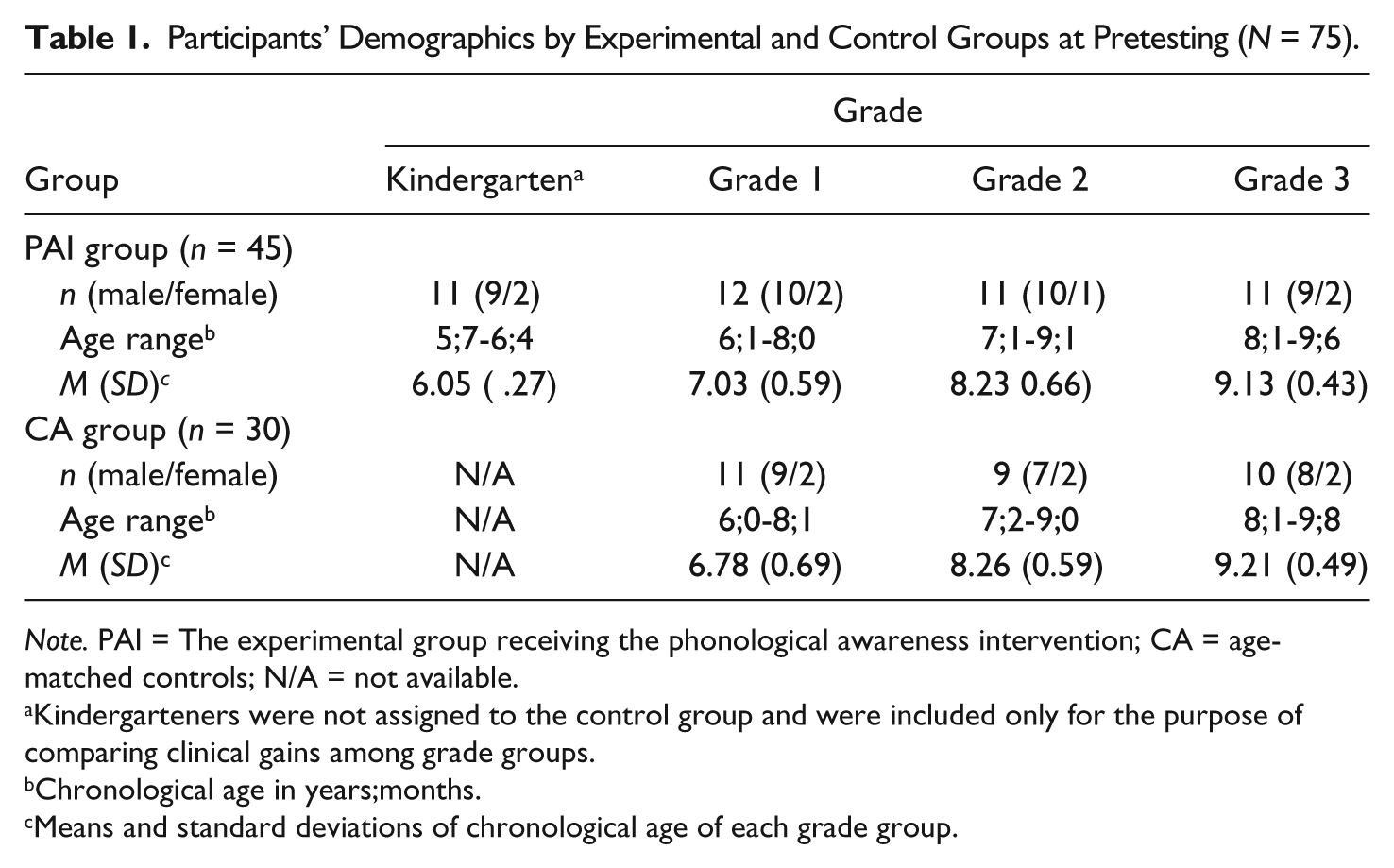
Note. PAI = The experimental group receiving the phonological awareness intervention; CA = age-matched controls; N/A = not available.
Kindergarteners were not assigned to the control group and were included only for the purpose of comparing clinical gains among grade groups.
Chronological age in years;months.
Means and standard deviations of chronological age of each grade group.
The grade level of children representing the control group was 11 first grade, 9 second grade, and 10 third grade. The ethnic representation of this group was 84% Caucasian, 15% African American, and 1% other ethnic backgrounds. For the experimental and control group, 14.6% and 15.4%, respectively, qualified for free and/or reduced lunch rates suggesting a similar range in SES.
In addition, to answer our second question, we included 11 kindergarteners’ pre- and posttest data who also received 24, 15-min of PAI, over a 12-week period, during their regularly scheduled language therapy time (30 min), as a comparison grade group to investigate whether the magnitude of treatment effect changed across grade level in the experimental group (e.g., K through 3).
The SLPs invited to participate in the study met the criteria for this study that included holding (a) a state license in speech-language pathology and (b) a Certificate of Clinical Competence in Speech-Language Pathology from the American Speech-Language Hearing Association (ASHA), and having (c) a minimum of 10 years of experience working in public schools as a SLP. The SLPs exceeded the third criterion by having a minimum of 20 years of experience working in the public school setting (M years of service = 23.2, SD = 2.6). The two SLPs assigned to the experimental condition received: (a) training in a 1-day workshop by the first author of this study regarding the implementation of the explicit PAI utilizing a narrative-based platform, (b) demonstration of each intervention activity, and (c) materials and storybooks required for the implementation of the PAI. It should be noted that the public school SLP assigned to the controlled trial did not receive the intervention materials and the PAI training until after the study was completed.
Procedures
The three research assistants conducted all testing and were blind to which group was the control versus the experimental. The research assistants were graduate students who were pursuing their Master’s degree in communication sciences and disorders and had completed a course on assessments. In addition, they had attended a full-day training session conducted by the first author on test administration and scoring prior to initiating this investigation. During test administration, the research assistants were supervised by a faculty member holding a state license and Certificate of Clinical Competence from ASHA.
Pretest administration took place during the 3 weeks prior to the beginning of the study; posttesting was administered during the 3 weeks following the conclusion of the 12 weeks of intervention. Presentation order of the assessments was randomized to prevent an order effect. All participating children were seen individually for a testing session lasting approximately 30 to 45 min. Selected subtests of the Woodcock Diagnostic Reading Battery–Revised (WDRB-R; Woodcock, 1997) and the Comprehensive Test of Phonological Processing (CTOPP; Wagner, Torgesen, & Rashotte, 1999) were the assessment measures used for each participant’s pre- and posttest performances. All of the assessment measures were administered and scored using standard procedures and guidelines as stated in their respective assessment manuals. The same procedures used in the pretesting were also followed during the posttesting to ensure the validity of the study, including a random order of test administration. The examiners for the assessment and test scoring were blind to the participants’ assigned groups, and each child was assigned a number that was used in place of their name on all test forms.
Dependent Measures
On the WDRB-R (Woodcock, 1997), the Letter-Word Identification, Word Attack, and Passage Comprehension subtests were administered to assess the accuracy of letter identification, reading real words and nonwords, as well as reading comprehension. These subtests involve stimuli of increasing difficulty and without context clues present. The Letter-Word Identification subtest from the WDRB-R (Woodcock, 1997) examines the participant’s ability to read individually presented letters and words. In this particular subtest, letters and words were presented to the child in various typefaces to assess the participant’s ability to name letters and words involving lower and upper case letters of the alphabet. The words begin with highly frequent words and move to the less frequent words. The Letter-Word Identification subtest has a median internal consistency of .94 for children aged 5 to 9 years (Woodcock, 1997). The Word Attack subtest of the WDRB-R (Woodcock, 1997) assesses the participant’s ability to use phonic and structural analysis skills. The participants were required to orally decode nonwords of increasing length and complexity. The Word Attack subtest has a median internal consistency of .91 for the same age range. The Passage Comprehension subtest assesses reading comprehension using a cloze task procedure and requires the child to read a short passage and identify the word missing from the passage. The median internal consistency for this subtest is .90. Test–retest reliability coefficients for the three subtests were .94 (Letter-Word Identification), .93 (Word Attack), and .90 (Passage Comprehension), respectively.
Two subtests from the Comprehensive Test of Phonological Processing (CTOPP; Wagner et al., 1999) were used to assess PA (i.e., Blending Words and Blending Nonwords) in all participants. The Blending Words subtest examines the ability to blend orally presented words, syllables, and phonemes to create words. The Cronbach’s estimate of internal consistency for this subtest is .92. The Blending Nonword subtest determines the ability to blend syllables and phonemes together to form nonsense words. The Cronbach’s estimate of internal consistency for this subtest is .89. Coefficient alphas for the test–retest reliability for age 5 to 9 years ranged from .72 to .82 for Blending Words and .76 to .77 for Blending Nonwords, respectively.
Scoring Reliability
The reliability for scoring was calculated for each measure for the pre- and postassessment battery. All test scores were rechecked for accuracy by the first author. For each test, an agreement percentage was calculated by dividing the total number of agreements by the total number of agreements plus disagreements and multiplying by 100. Agreement scores for individual tests ranged from 92% to 100% with a mean of 96%. Any discrepancies in calculating scores were changed accordingly for accuracy. In addition, 30% of the pre- and posttest measures were supervised by the first author and simultaneously scored along with the research assistants to ensure reliability of the assessment results. Interrater agreement for the CTOPP (Wagner et al., 1999), Blending Words and Blending Nonwords subtests averaged 98% and 92%, respectively, and 96%, 94%, and 95% for the WDRB-R (Woodcock, 1997), Letter-Word Identification, Word Attack, and Passage Comprehension subtests, respectively. A consensus was reached following a discussion of the areas of disagreement.
PAI
The children in the experimental group received explicit PAI for two, 15-min sessions per week for a total of 12 weeks by a licensed SLP in a small group setting (two to three children). The control group received no explicit PAI for these 12 weeks. During this 12-week study, both groups received their typical classroom instruction and their scheduled language intervention as designated in the IEP; with the exception of the experimental group receiving 15 min of PAI as part of their traditional language intervention over these 12 weeks. In other words, both groups received language therapy two times per week for 30 min each session at their regularly scheduled language therapy times The only difference was that the PAI group received explicit PAI for half of each session (15 min; 30 min total each week).
The PAI was implemented using specific research-based principles that addressed PA skills developmentally and focused on the skills at the phoneme level (Anthony, Lonigan, Driscoll, Phillips, & Burgess, 2003; Byrne & Fielding-Barnsley, 1995; Carroll, Snowling, Hulme, & Stevenson, 2003; Gillon, 2000, 2004; Gillon & Dodd, 1995; Justice & Kaderavek, 2004; Kaderavek & Justice, 2004; Lundberg et al., 1988; Torgesen, Wagner, & Rashotte, 1994). The guiding principles used in the current study were as follows. First, in line with previous research, the PAI focused on the explicit analysis and synthesis of phonemes (Gillon, 2000, 2005), and sound manipulation tasks (Bradley & Bryant, 1983; Gillon & Dodd, 1995; Gillon, 2000). The explicit PAI was utilized to directly guide the participants in increasing their awareness to and reflection on the phonological structure of language and to facilitate the participants’ gains in reading.
Second, the PAI was designed to reflect the structural hierarchy of PA development. The PAI progressed from syllable segmentation/blending and syllable manipulation to phoneme blending/segmentation and phoneme manipulation. Third, sound-symbol correspondence tasks were integrated into the PAI (Gillon, 2000, 2004; Lundberg et al., 1988). Sound-symbol correspondence activities were integrated with the PAI to establish the link between the phoneme and grapheme, thus promoting the understanding of the alphabetic principle. Research indicates that interventions that are more successful in enhancing reading ability are those that make explicit connections or links between the sounds and graphemes (Gillon, 2000, 2002; Hatcher et al., 2004).
Finally, research findings suggest that teaching PA within the context of meaningful text provides positive benefits to the child due to the reciprocal nature of PA and literacy (van Kleeck et al., 1998). Thus, the intervention stimuli included 12 narratives; one story was read aloud by the SLP each week and selected words from the text were used as part of the PAI. The storybook/narrative context was used as a platform to increase the child’s attention toward the relationship between print and spoken language, thereby further fostering the child’s alphabetic knowledge, PA, grapheme–phoneme mapping, and reading comprehension (Catts et al., 2001; Justice & Ezell, 2000; Lovelace & Stewart, 2007; Share, 2005).
Specifically, 15 min of PAI was implemented during each session focusing on the phoneme level; however, the syllable and phoneme level were addressed during each session. The Appendix contains examples of the PAI. For all levels of the PAI, two sets of ten stimuli (e.g., 20 different words) were provided and targeted for each individual objective. To progress to the next level in the developmental hierarchy of PAI, each participant was required to meet a minimum criterion level of 80% with provision of the level of support (i.e., maximal) needed by the participant to be successful on the specific task. In addition, mastery of the individual PAI objective was not considered to be present until all levels of support were withdrawn, and the participant attained a performance level of 90% accuracy over two sets of the targeted objective. An explanation of the individual tasks is as follows:
Syllable tasks (segmentation, blending, and manipulating)
A variety of tasks were implemented initially using compound words gradually increasing complexity by using multisyllabic words. The child was asked to segment the syllables in words when verbally pronounced by the SLP. For the blending tasks, the child was required to blend the syllables, pronounced by the SLP, to form the stimulus word. For the manipulation tasks, the child was required to delete or manipulate the syllables in targeted words pronounced by the SLP to form the new stimulus word or nonword.
Phoneme tasks (blending, segmenting, and manipulating)
The child was required to blend individual phonemes, pronounced by the SLP at 1-s intervals, to form the targeted word or nonword. The segmentation tasks require phonological analysis of the target word; the child was asked to count the number of phonemes and verbalize the individual sounds in the stimulus word or nonword. For the manipulation tasks, the child was required to delete or manipulate the individual phonemes in targeted words pronounced by the SLP to form the new stimulus word or nonword.
Sound-symbol correspondence
A variety of tasks were implemented using individual phonemes relating to letter-sound correspondence tasks. Research has demonstrated that that sound-symbol correspondence and combining sounds to form words are critical components when learning to read (Catts et al., 1999; Gillon, 2000, 2005; Schuele & Boudreau, 2008). Letter tiles were used to link the phoneme(s) with the grapheme(s) during manipulation tasks using word families (e.g., -at, -un), thus extending the PA task to written language.
Scaffolds
To maximize successful performance, the SLP provided modeling, multiple exemplars, and verbal feedback using a think-aloud strategy to enhance performance and facilitate the child’s analysis of the sound structure of language. Additional supports or scaffolds were implemented by the SLP using error analysis to facilitate the learning process (Vigil & van Kleeck, 1996). These supports or scaffolds included slowing of speech rate, visual prompts, manipulatives (e.g., colored blocks), stressing of individual sounds, tapping, clapping and/or whole body motions (e.g., tapping head, shoulders, knees, and toes for each syllable), and repetition of stimuli. As the accuracy level increased and reached 80% or greater, the scaffolds or supports were faded or withdrawn based on the individual needs of the participant.
Treatment fidelity
For the purpose of monitoring the quality and consistency of the intervention, the primary investigator observed each of the professional SLP’s implementation of the PAI for a minimum of two, 2-hr onsite visits during the study. Daily notes (e.g., specific tasks implemented, performance accuracy, and levels of support used) were recorded for each child by the SLP following every intervention session and were later reviewed by the first author. In addition, the first author conducted a minimum of 12 weekly communications mediated by telephone and/or electronic mail with each of the participating SLPs. The results demonstrated that professional SLPs provided consistent and explicit PAI and used appropriate systematic supports on the specific objectives being addressed. For 30% of the intervention sessions, the primary investigator assessed the fidelity and quality of the implementation of the program components, using a 6-point Likert-type scale (poor to exemplary). Ratings of the implementation quality were: syllable-level tasks (M = 5.5, SD = 0.75), phonemic-level tasks (M = 5.7, SD = 0.57), sound-symbol correspondence (M = 5.9, SD = 0.67), and the overall PAI program (M = 5.8, SD = 0.58).
Analyses
The purpose of the study was to assess the effects of the independent variable, PA intervention, on each of the components of dependent variables measuring the participants’ PA (blending words and nonwords) and reading skills (word-level reading and reading comprehension). Analyses of the data involved two separate comparisons. In the first analysis, the experimental and control group were compared on posttest measures following 12 weeks of PAI. In the second analysis, the experimental group’s data were separated according to their grade, and their measures for each of the posttests were compared to determine if each grade group made similar progress on the PA, word-level reading, and reading comprehension following the PAI. For this set of analyses, the data of a group of 11 kindergarteners who received the same PAI were merged with the data of the experimental group to show the magnitude of intervention efficacy across grade level.
Statistical considerations
The data for the experimental and control group comparison were analyzed using multiple repeated mixed-model factorial analyses of variance (ANOVAs). Effect size of statistically significant results in the ANOVAs is reported using the partial eta squared statistic (ηp2) to reflect the strength of the significance. According to the general guidelines for interpreting partial ηp2, values between 0 and .25 are considered small, values between .26 and .50 are considered moderately large, and values above .50 are considered large (Cohen, 1988). Similarly, Cohen’s d was used to compare effect sizes of pairwise comparisons, for which 0.2 is small, 0.5 is medium, and 0.8 is large (Cohen, 1988).
Results
Preintervention Group Comparisons
Multiple one-way analyses of variance (ANOVAs) were conducted to verify overall preintervention differences between the two groups on the five dependent variables. The results confirmed nonsignificant pretreatment differences between the groups for all five variables: (a) Blending Words, F(1, 62) = .088, p = .767, ηp2 = .001; (b) Blending Nonwords, F(1, 62) = .058, p = .810, ηp2 = .001; (c) Letter-Word Identification, F(1, 62) = .186, p = .668, ηp2 = .003; (d) Word Attack, F(1, 62) = 1.23, p = .272, ηp2 = .019; and (e) Passage Comprehension, F(1, 62) = .941, p = .336, ηp2 = .015. Thus, the groups had equivalent measures at baseline for all five dependent variables (see Table 2).
Group Performances on the Five Dependent Variables at Pre- and Postintervention Assessments.
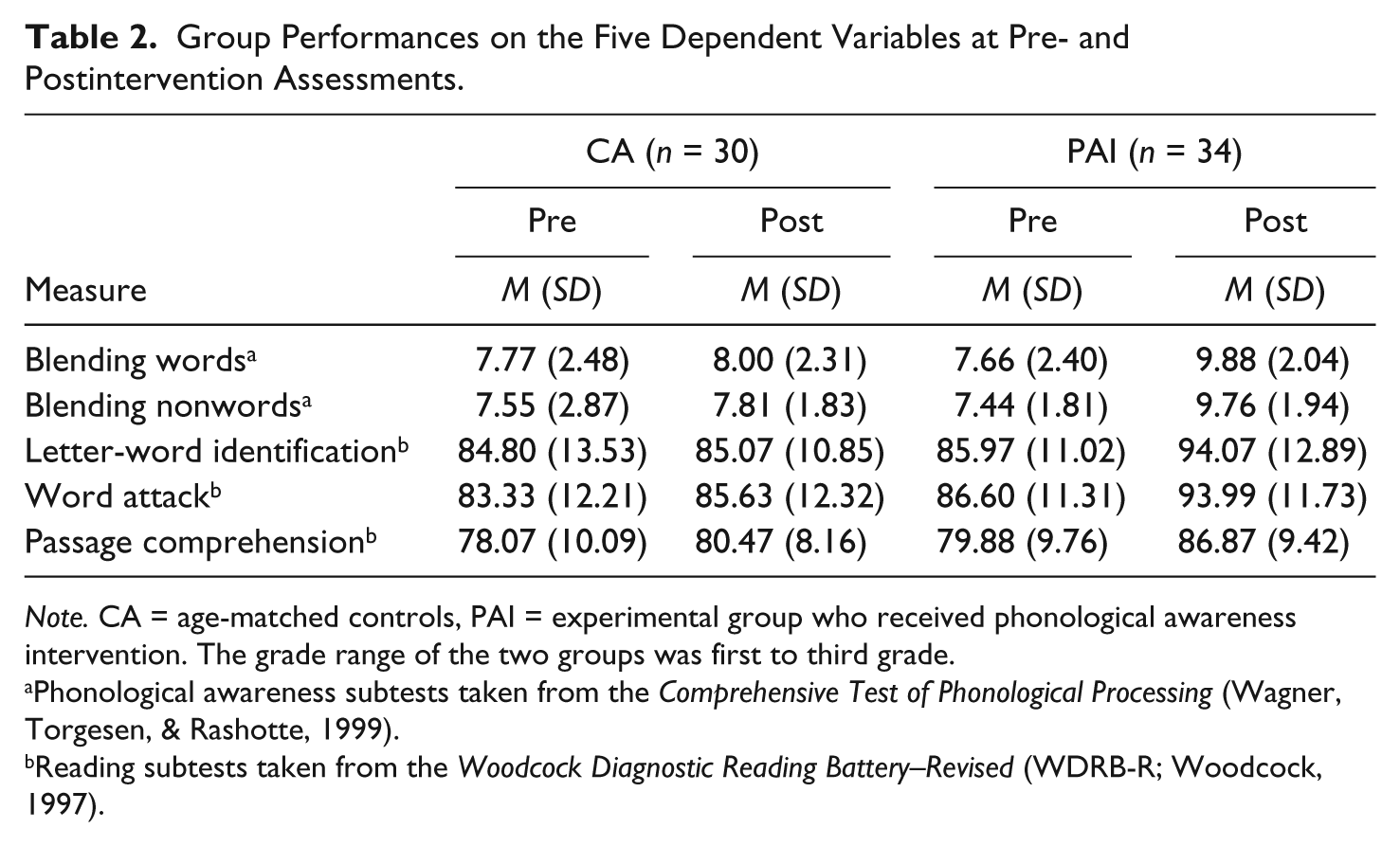
Note. CA = age-matched controls, PAI = experimental group who received phonological awareness intervention. The grade range of the two groups was first to third grade.
Phonological awareness subtests taken from the Comprehensive Test of Phonological Processing (Wagner, Torgesen, & Rashotte, 1999).
Reading subtests taken from the Woodcock Diagnostic Reading Battery–Revised (WDRB-R; Woodcock, 1997).
Overall Program Effects
Our primary research goal was to examine the effect that explicit PAI would have on the children’s subsequent performance on PA, word-level reading, and passage comprehension tasks. Table 2 provides an overview of group performances at pre- and postintervention assessments. First, two mixed-factorial analyses of variance (ANOVAs) with group membership (PAI vs. CA) as the between-subjects factor and time (pre vs. post) as the within-subjects factor were conducted on the Blending Words and Blending Nonwords subtests. For the Blending Words subtest, a significant main effect was found for group, F(1, 62) = 6.814, p = .011, ηp2 = .099, for time, F(1, 62) = 34.527, p < .001, ηp2 = .358, and for the Group × Time interaction, F(1, 62) = 22.643, p < .001, ηp2 = .268. Follow-up testing of the interaction revealed a significant pre- to posttest difference for the PAI group, F(1, 33) = 42.898, p < .001, ηp2 = .57, but not for the control group, F(1,29) = 1.092, p = .305, ηp2 = .09. Thus, the Blending Word subtest scores increased significantly in the PAI group only. Next, examination of the Blending Nonwords scores revealed a similar result. A significant main group effect was found, F(1, 62) = 4.842, p = .032, ηp2 = .72, for time, F(1, 62) = 36.965, p < .001, ηp2 = .374 and for Group × Time interaction, F(1, 62) = 23.413, p < .001, ηp2 = .274. Post hoc tests revealed no significant pre- to post-PAI difference for the control group, F(1, 29) = 0.958, p = .336, ηp2 = .003, but a significant pre- to posttest difference for the PAI group, F(1, 33) = 52.381, p < .001, ηp2 = .61, indicating that a significant clinical gain was noted for the PAI group only.
Next, three two-way repeated ANOVAs were performed for the reading measures. For the Letter-Word Identification subtest, a mixed-model ANOVA revealed a significant main effect for time, F(1, 62) = 44.23, p < .001, ηp2 = .416 and Group × Time interaction, F(1, 62) = 38.771, p < .001, ηp2 = .385. To examine the details of the interaction, a post hoc repeated measure ANOVA was conducted for each group. No significant pre- to post-PAI difference was found for the control group, F(1, 29) = .093, p = .762, ηp2 = .003, but a significant pre- to posttest difference was revealed for the PAI group, F(1, 33) = 81.794, p < .001, ηp2 = .51, indicating that treatment gain was significantly positive only for the PAI group.
Examination of the Word Attack scores with an ANOVA revealed a significant main effect for Time, F(1, 62) = 25.838, p < .001, ηp2 = .294, a significant Group × Time interaction effect, F(1, 62) = 7.136, p = .010, ηp2 = .103, but a nonsignificant group main effect, F(1, 62) = 2.87, p = .094, ηp2 = .034. Follow-up univariate ANOVAs testing of the interaction using simple main effect for Time factor revealed a significant pre- to posttest difference for the PAI group only, F(1, 44) = 45.316,p < .001, ηp2 = .58.
Last, a mixed-model repeated ANOVA was performed for the Passage Comprehension subtest, revealing significant Group × Time interaction main effect, F(1, 62) = 64.416, p < .001, ηp2 = .443, Time main effect, F(1, 62) = 59.551, p < .001, ηp2 = .490, and group main effect, F(1, 62) = 5.159, p = .027, ηp2 = .187. That is, there was a significant difference between the two groups in terms of treatment efficacy for passage comprehension scores. Univariate post hoc analyses revealed that a significant pre- to posttest difference for the PAI group only, F(1, 33) = 49.552, p < .001, ηp2 = .400.
Differential Treatment Gains Over Four Grades
The second research question asked whether similar treatment gains of PAI would be evident across grade levels in the experimental group. To address this question, a series of mixed-factorial repeated ANOVAs were conducted for the four dependent variables. Students’ school Grade was the between-subjects factor (four levels) and Time (pre- vs. posttreatment) was the within-subjects factor (two levels). The pre- and posttest data of kindergarteners were included for these analyses to show the change of clinical effect across grade level. Post hoc comparisons were conducted using the Wilcoxon signed-rank test because of their appropriateness for small sample sizes, which pertained to the present study. The Wilcoxon test is the nonparametric test that is equivalent to the dependent t-test. Table 3 presents means (pre- and posttest), standard deviations, z-scores, and Cohen’s d for the five dependent variables of each grade level. Figure 1 displays the pre- and posttest scores of the participants in each grade group (i.e., K to 3rd) on the PA measures. Figure 2 displays the pre- and posttest scores of the participants in each grade group on the three reading measures.
Means, Standard Deviations, and the Results of Comparisons of Pre- and Posttest Scores for Each Dependent Variable (Z-Scores and Cohen’s d Values).
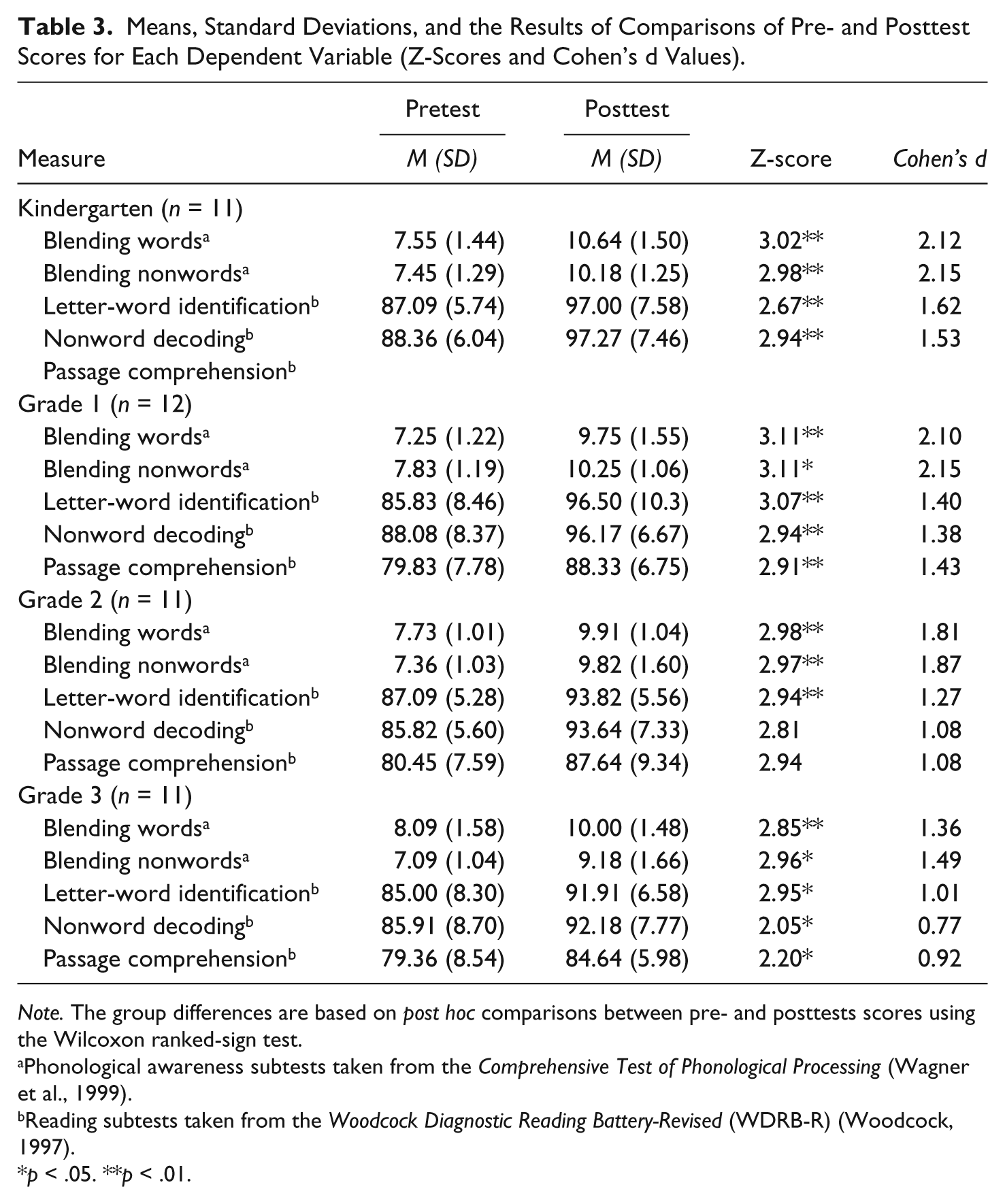
Note. The group differences are based on post hoc comparisons between pre- and posttests scores using the Wilcoxon ranked-sign test.
Phonological awareness subtests taken from the Comprehensive Test of Phonological Processing (Wagner et al., 1999).
Reading subtests taken from the Woodcock Diagnostic Reading Battery-Revised (WDRB-R) (Woodcock, 1997).
p < .05. **p < .01.
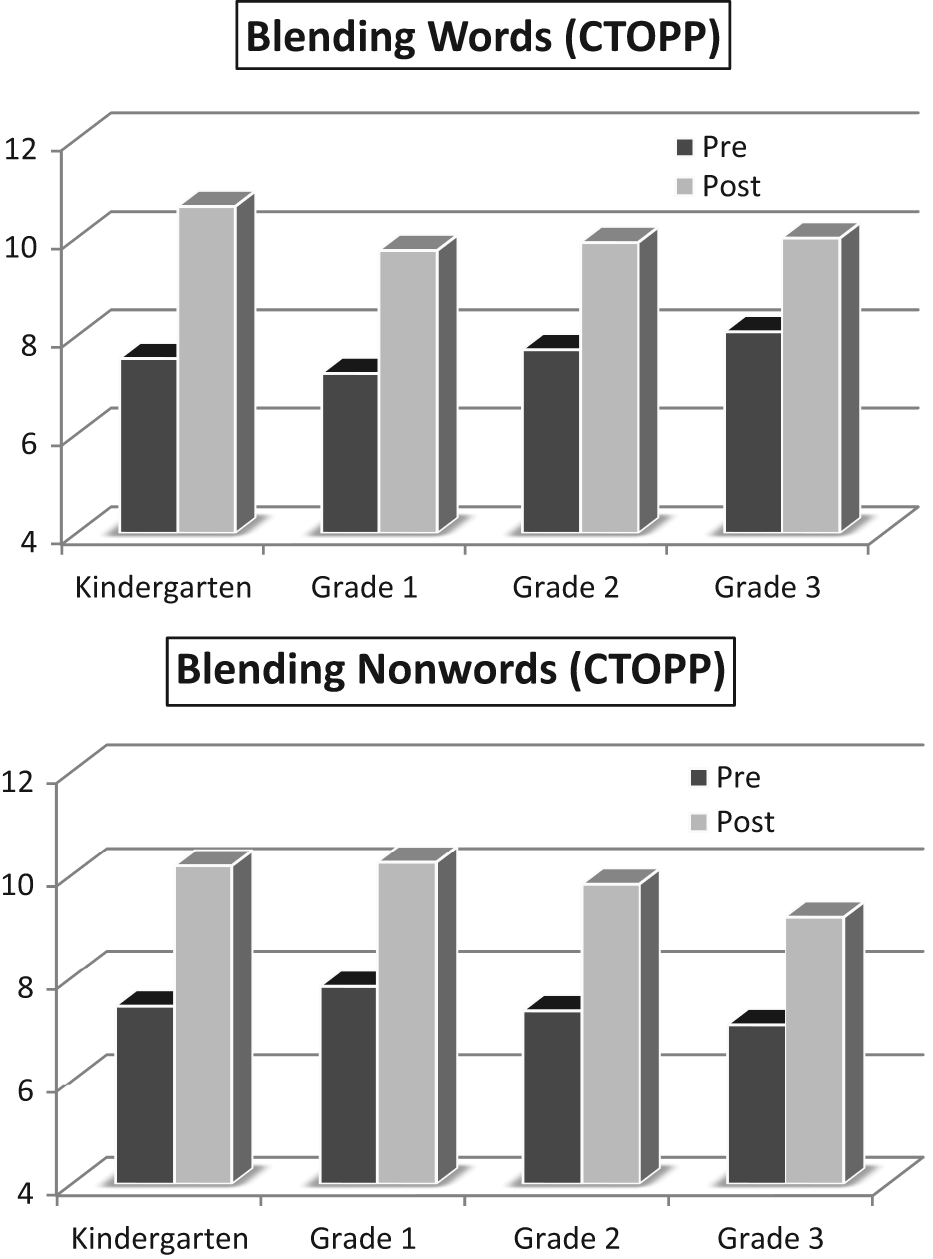
Pre- and postintervention performances of the intervention group on the two subtests of PA taken from the CTOPP (N = 45). Eleven Kindergarteners were included in the analysis to show the magnitude of efficacy across grade.
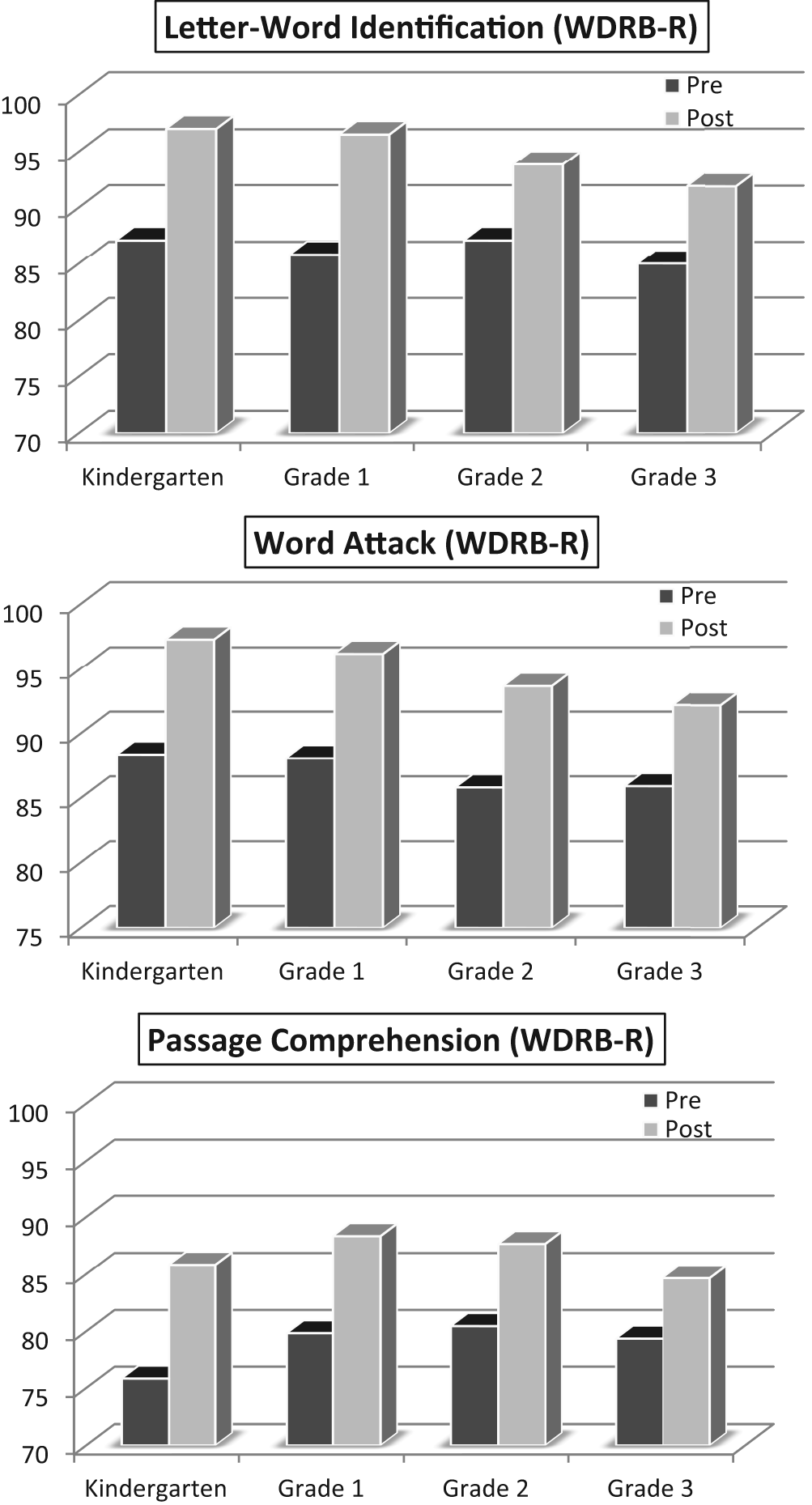
Pre- and postintervention group performances on the three subtests of reading measures taken from the WDRB-R.
Phonological awareness measures
The mixed-factorial ANOVA for the first dependent variable, Blending Words, showed a significant interaction (Grade × Time), F(3,41) = 3.591, p = .021, ηp2 = .208; a significant main effect of Time, F(1,41) = 289.1, p < .001; and a nonsignificant grade group effect, F(3,41) = .261, p = .853. The results of the Wilcoxon signed-rank test revealed a significant difference pre- and post-PAI for all grades: Grade K (Z = 3.019, p < .01, Cohen’s d = 2.12), Grade 1 (Z = 3.114, p = .01, Cohen’s d = 2.10), Grade 2 (Z = 2.976, p < .01, Cohen’s d = 1.81), and Grade 3 (Z = 2.85, p ≤ .01, Cohen’s d = 1.36). It is noteworthy that effect sizes were large and significant treatment gains were identified in all grade groups. Thus, the performance of the kindergarteners as well as the children in Grades 1 through 3 who received PAI was improved. The interaction was due to the differing effect sizes across grades. That is, the younger subjects (e.g., Grade K) made slightly greater improvements than subjects in Grades 1 through 3. A mixed-factorial ANOVA on the scores for the Blending Nonword subtest revealed nonsignificant effects of Grade × Time interaction, F(3, 41) = .936, p = .432 and Grade, F(3, 41) = 1.173, p = .332. However, there was a significant main effect of Time, F(1, 41) = 330.3, p < .001, ηp2 = .89. A series of post hoc pairwise tests of this significant Time main effect were conducted for each grade using the Wilcoxon signed-rank tests. Similar to the Blending Words test, the PAI produced significant gains for the nonword blending task in all grade groups: Grade K (Z = 2.98, p < .01, Cohen’s d = 2.15), Grade 1 (Z = 3.11, p = .01, Cohen’s d = 2.15), Grade 2 (Z = 2.971, p < .01, Cohen’s d = 1.87), and Grade 3 (Z = 2.96, p ≤ .01, Cohen’s d = 1.49). Again, all effect sizes were large and incrementally decreased from Grade K to 3.
Reading measures
The mixed-model ANOVA for the Letter-Words Identification scores revealed a significant main effect for the Time factor, F(1, 41) = 143.0, p < .001, ηp2 = .78, but the main effect for Grade was not statistically significant, F(3,41) = 1.03, p = 0.39, nor was the Grade × Time interaction, F(3,41) = 2.37, p = .089. Follow-up Wilcoxon signed-rank tests were conducted for each grade: Grade K (Z = 2.67, p < .01, Cohen’s d = 1.62), Grade 1 (Z = 3.07, p < .01, Cohen’s d = 1.40), Grade 2 (Z = 2.94, p < .01, Cohen’s d = 1.27), and Grade 3 (Z = 2.95, p < .01, Cohen’s d = 1.01). Effect sizes decreased as a function of grade; however, they were large, ranging from 1.01 for Grade 3 to 1.62 for Kindergarten level (Cohen, 1988). Next, a mixed-factorial ANOVA for the Nonword Decoding revealed a significant Grade × Time interaction, F(3,41) = 5.497, p = .003, ηp2 = .287; a significant main effect of Time, F(1,41) = 101.1, p < .001, ηp2 = .711; and a nonsignificant grade group effect, F(3,41) = 1.401, p = .256. Follow-up Wilcoxon signed-rank tests were conducted for pre- and posttest scores of each grade: Grade K (Z = 2.94, p < .01, Cohen’s d = 1.53), Grade 1 (Z = 2.94, p < .01, Cohen’s d = 1.38), Grade 2 (Z = 2.81, p < .01, Cohen’s d = 1.08), and Grade 3 (Z = 2.05, p < .05, Cohen’s d = 0.77). Again, PAI improved the participants’ nonword decoding significantly in all grades with large effect sizes (range of Cohen’s d = 0.77 to 1.53), but the Cohen’s d of the Grade 3 group was the smallest of all grade groups. As evidenced by incrementally reduced effect sizes, the interaction was caused by the different treatment gains in the four grade groups. Lastly, a mixed-factorial ANOVA for the Passage Comprehension subtest revealed a significant Grade Group × Time interaction, F(3,41) = 2.852, p = .049, ηp2 = .173; a significant main effect of Time, F(1,41) = 135.958, p < .001, ηp2 = .173; and a nonsignificant grade group effect, F(3,41) = .330, p = .804, ηp2 = .024. Follow-up Wilcoxon signed-rank tests were conducted for pre- and posttest scores of each grade: Grade K (Z = 2.94, p = .003, Cohen’s d = 1.89), Grade 1 (Z = 2.91, p = .004, Cohen’s d = 1.43), Grade 2 (Z = 2.94, p = .003, Cohen’s d = 1.08), and Grade 3 (Z = 2.20, p = .028, Cohen’s d = 0.92; see Table 3). Similar to other reading measures, all effect sizes were large and incrementally reduced from Grade K to 3.
Discussion
The findings of this research provide direct empirical evidence that systematic PAI integrated with sound-symbol correspondence using a narrative platform for two, 15-min sessions per week for a total of 12 weeks in a small-group setting fosters PA, word-level reading, and passage comprehension skill development in school-age children with LI in Grades 1 through 3. Results support and extend previous research that PAI has greater benefits for a child’s PA and reading skills than a traditional language intervention alone (Gillon, 2000, 2005; Gillon & Dodd, 1995).
Specifically, the children who received the PAI demonstrated superior scores compared with the control group on the selected subtests of PA skills (blending words and nonwords) and the effect sizes were medium (ES range = 0.57-0.72). The same is true for the differences seen on the subtests of word-level reading skills where the differences in both measures reached statistical significance (ES range = 0.51-0.58). Likewise, a significant pre- to posttest improvement on the passage comprehension measure was noted for the experimental group with a medium effect size (i.e., 0.40). It is important to note here that significant pre- to posttest differences were revealed only for the PAI group. This suggests that, despite being at risk of reading failure, school-age children with LI in Grades 1 through 3 also have the potential to make accelerated gains in their reading development and in the PA skills that are essential to successful literacy acquisition.
Furthermore, the effectiveness of the PAI was evidenced not only by the participants’ superior performance on the posttests compared with the controls but also by the significant gains made by the participants at all four grade levels. Notably, effect sizes decreased incrementally as a function of grade level as the younger children outperformed children in higher grade levels. One explanation for the decrease in effect sizes across the grade levels may be the result of older children with LI needing a more intensive treatment regime over a longer time period to experience the same benefits as those of younger children, but this decrease in effect sizes does not negate the significant results associated with providing PAI to school-age children older than kindergarten age. Indeed, it is noteworthy that all effect sizes were medium to large (ES range = 0.77-2.12; Cohen, 1988). For example, in their meta-analysis, Ehri and colleagues (2001) reported that effect sizes for PA intervention were found to be large at posttest and medium at maintenance. Similarly, studies involving children at-risk had large effect sizes and studies with children with reading impairments had a medium effect size. Thus, the effect sizes in the current study compare favorably with those reported for children with reading impairments in the meta-analysis.
Furthermore, a closer examination of results showed that effect sizes for word-level and passage-level reading were smaller than those for PA across the grade levels. This finding suggests that PAI implemented in a short period of time has more robust and faster effects on PA tasks than word- and passage-level reading skills, and it indicates that more time is needed on intervention to transfer benefits at the PA level to word- and passage-level reading for school-age children who are in first grade and above. Thus, structuralized narrative-based PAI delivered in a small group environment by a school-based SLP should be a viable approach for improving PA, word-level reading, and passage comprehension in school-age children of varied grade levels with LI.
In sum, previous research has demonstrated that PAI is beneficial in preschool and kindergarten age children; however, it is necessary to consider the needs of school-age children with LI in Grades 1 through 3 who may be slower to develop PA and who may have more difficulty acquiring PA skills and understanding phoneme–grapheme relationships (Boudreau & Hedberg, 1999; Nathan et al., 2004). There is ample evidence that these deficit areas in children with LI are persistent and may cause difficulty in the reading process throughout the school years. Implications for educators and SLPs include (a) Closely monitoring progress in children with LI for signs of difficulties in reading achievement (e.g., PA, decoding, and sound-symbol correspondence). Because PA and word-level reading are essential components for learning to read, it is critical to identify children with LI who are advanced to higher grade levels without the prerequisite skills needed for becoming a skilled reader. (b) Collaboration among educators, parents, and SLPs should expedite the identification of children with LI who may need a differentiated classroom instruction and/or specific intervention related to their language/reading needs (D. Fuchs et al., 2002).
For school-age children with LI, who are known to have specific difficulties with PA, PAI may provide a means for this population to progress toward the goal of becoming a successful reader. The current study extends and makes a direct contribution to the findings of previous researchers by suggesting that PAI leads to a greater ability in reading words and decoding which positively impacts reading comprehension beyond the preschool and kindergarten years in school (Gillon, 2000, 2005; Gillon & Dodd, 1995; van Kleeck et al., 1998).
Limitations and Further Research
This study establishes that school-age children in Grades 1 through 3 with LI do benefit from explicit PAI using a narrative platform, but there were a few limitations. The greatest of these was the small sample sizes for each grade level, which led to limited statistical powers. Replication of the findings of this exploratory study with a larger group of participants would be useful to further explore the benefits of explicit PAI at various grade levels. Second, the participating SLPs had not provided explicit PAI to any student on their caseloads nor any participant involved in this study prior to this investigation; however, exposure to PA activities provided in the regular classrooms was not measured nor controlled. Third, it is possible that the type of intervention used in this study, PAI using a narrative/storybook platform, may have indirectly and positively affected the results of the reading comprehension outcomes, which could prevent attributing the comprehension improvement solely to the PAI (Justice & Ezell, 2000; Lovelace & Stewart, 2007; Share, 2005). The results are also likely limited by the lack of follow-up of the participants’ performances on PA and reading skills. Postintervention measures were taken only once after completion of the program. Consequently, questions are raised regarding the generalization of the learned skills over an extended time period. Longitudinal studies should continue to explore PAI outcomes by expanding the investigation to include children with LI in middle-school and high school.
Time is critical for school-age children with LI for meeting the reading demands of school, and it is imperative that additional replication studies be conducted to further determine the range of grade levels for which PAI would produce significant improvement in reading achievement.
Footnotes
Appendix
Declaration of Conflicting Interests
The author(s) declared no potential conflicts of interest with respect to the research, authorship, and/or publication of this article.
Funding
The author(s) received no financial support for the research, authorship, and/or publication of this article.
Author Biographies
References
Supplementary Material
Please find the following supplemental material available below.
For Open Access articles published under a Creative Commons License, all supplemental material carries the same license as the article it is associated with.
For non-Open Access articles published, all supplemental material carries a non-exclusive license, and permission requests for re-use of supplemental material or any part of supplemental material shall be sent directly to the copyright owner as specified in the copyright notice associated with the article.
