




Abstract
Unlike previous research on computer-mediated discussions that has focused analysis on the final conversation as a completed product, this study was focused on the process by which the conversation was created. Using screen-capturing software, the on-screen actions of the nine participants in an online classroom discussion were recorded and analyzed for evidence of reading, writing, and thinking processes. Retrospective interviews were conducted with three of the student participants for additional insights into these processes. A triangulation of data sources revealed participants engaged in at least three distinct patterns of reading, writing, and thinking, with some participants fluidly moving between these patterns throughout the conversation. The three patterns were described as follows: (a) a methodical reading of most messages, and composing of responses occurring as the reader/writer thinks of it; (b) a coordination of reading, thinking, and writing, with careful revisiting of messages already read and deliberate crafting of responses; and (c) a complex orchestration of processes, with several reading resources consulted in addition to the conversation’s unfolding messages as well as composing processes that were interleaved with thinking and reading. This study provides clear evidence that the experiences of individuals in the same online conversation can vary considerably even as they contribute to a co-constructed publicly shared conversation.
Interacting with others in the fast-paced environment of an online classroom discussion involves participating in a social practice consisting of multiple literacy processes. In such an environment, reading, writing, initiating, and responding converge and vie for attention, with reading and writing reflecting and influencing one’s thinking processes. The need that online classroom discussion creates for students to shift quickly among these processes, or even engage in them simultaneously, is unlike the ways in which traditional literacy events have typically been described.
Although previous research, including our own, has addressed many aspects of classroom-based computer-mediated communication (CMC; for example, Adlina, Mansor, & Zakaria, 2008; Herring, 2001; Luppicini, 2007; Lee et al., 2011; Schallert et al., 1996; Schallert, Reed, & the D-Team, 2003-2004; Wade & Fauske, 2004), few have examined the processes students engage as they read and write their way into a better understanding of their course assignments, co-constructing meaning with fellow class members. To fill this gap, we examined students’ actions as they participated in a synchronous online classroom discussion, using a new literacies perspective (Coiro, Knobel, Lankshear, & Leu, 2008; Lankshear & Knobel, 2006; Leu, 2006). Like others working from this perspective, we were interested in whether the reading and writing required by an online discussion represented similar processes that had been enjoined for centuries (and investigated for decades) or whether the literacy practices required in a computer-mediated discussion (CMD) environment represent something new that needs new theoretical frames to encourage new understandings of what it means to be literate in the 21st century (Coiro et al., 2008; Leu, O’Byrne, Zawilinski, McVerry, & Everett-Cacopardo, 2009). Our particular interest was to provide a close description, a genetic analysis in the Vygotskian tradition, of the microprocesses involved when students participate in an online discussion. Like Vygotsky (1978), we were interested in understanding the ways in which meaning is created by graduate students and their teacher as they interact in a scholarly conversation mediated by a synchronous online tool.
From a new literacies perspective, such CMC discussions represent a rich setting in which to study social practice and the mediation that language use affords for the participants’ developing understanding. We are attracted to study students’ experiences when engaged in CMC because online classroom discussions represent a language-based social practice that encourages text making that is twice dynamic, both in the public and private spheres. In the public sphere, the interpsychological plane, the text is continuously evolving, being created throughout the exchange and presenting to participants a challenge in sense making (Lapdat, 2002; Leu, 2006). In the private sphere, the intrapsychological plane, the text is similarly continuously evolving. Participants “as readers” encounter a dynamically changing text in the exchange and participants “as writers” are continuously influenced in what they may want to write by the evolving text in the public space. Because text is being created, in the moment, by multiple participants, we saw CMC as affording a place to study the dynamic unfolding of literacy processes situated in a learning setting. In this study, we were guided by the following research question:
Research Question 1: What are the ways that students coordinate the processes involved when they engage with the ideas of others through the words they share in an online discussion for the purpose of making meaning?
That is, we wanted to capture, through microgenetic analysis, the coordination of the different processes that students engaged as they read messages, deliberated upon postings, and created their own contributions to an evolving co-constructed conversation.
In what follows, we explain the theoretical basis of the study before moving to a review of previous research on the processes involved in online and offline literacies.
A New Literacies Perspective as a Theoretical Framework
As a way to frame our study, we began with the proposition posed by Coiro et al. (2008) in the opening paragraph of the Handbook of Research on New Literacies, that the Internet and information/communication technologies are altering the very nature of literacy. Although it is tempting to equate reading and writing online with offline literacy processes, the dynamic nature of the online context introduces multiple layers of quickly evolving text, images, and sounds that are explored, expanded, and interpreted in multiple ways by each person who meets the online context. Indeed, “new communications media are reshaping the way we use language” (New London Group, 1996, p. 64). Such a view of what it means to be literate necessitates an examination of how new digital technologies are changing students’ literacy processes.
Online contexts provide us with aspects of literacy not previously existent. As new digital technologies have brought changes to literacy practices, schools and workplaces have tried to rearrange their environments to incorporate these new technologies as critical tools (Lankshear & Knobel, 2006; Leu, Kinzer, Coiro, & Cammack, 2004). However, new technological environments present challenges, bringing with them new problems. Individuals adept at new literacy practices construct creative solutions for problems they encounter using the knowledge, skills, and strategies they have developed in other literacy contexts, reinventing communication practices that will afford them effective participation. For those who are not as adept in such contexts, full participation may be fraught with missteps.
It is important to acknowledge that such “new literacies” practices refer not only to how one navigates through such new contexts, using known strategies in new ways, but also how one thinks about these new contexts: “the ‘stuff’ of what we think of as new literacies reflects a different mindset from the stuff of which conventional literacies are largely composed” (Lankshear & Knobel, 2006, p. 25). In their view, such literacy contexts are more participatory, collaborative, and distributed than traditional texts.
One example of a learning context that requires new literacies is the use of online discussion forums, either synchronous or asynchronous in nature. Even though individuals may bring their old practices to this new forum, the ever-changing and dynamic nature of the conversation means that static literacy practices will not survive, and new practices will by necessity emerge within a dynamically changing literacy context. Although a synchronous discussion might reasonably be compared with a face-to-face discussion, that it is online and text-based means that students will likely need to negotiate their reading, writing, and participating processes in different ways. (See Figure 1 for a screen shot of an unfolding synchronous discussion.) When they do so, they may initially draw on their past experiences, skills, and strategies to participate in the academic discussion, but they are likely to find they must modify the ways in which they use their literacy skills to interact effectively with others in this ever-changing literacy environment (Faigley, 1992; Kelsey & St. Amant, 2008).
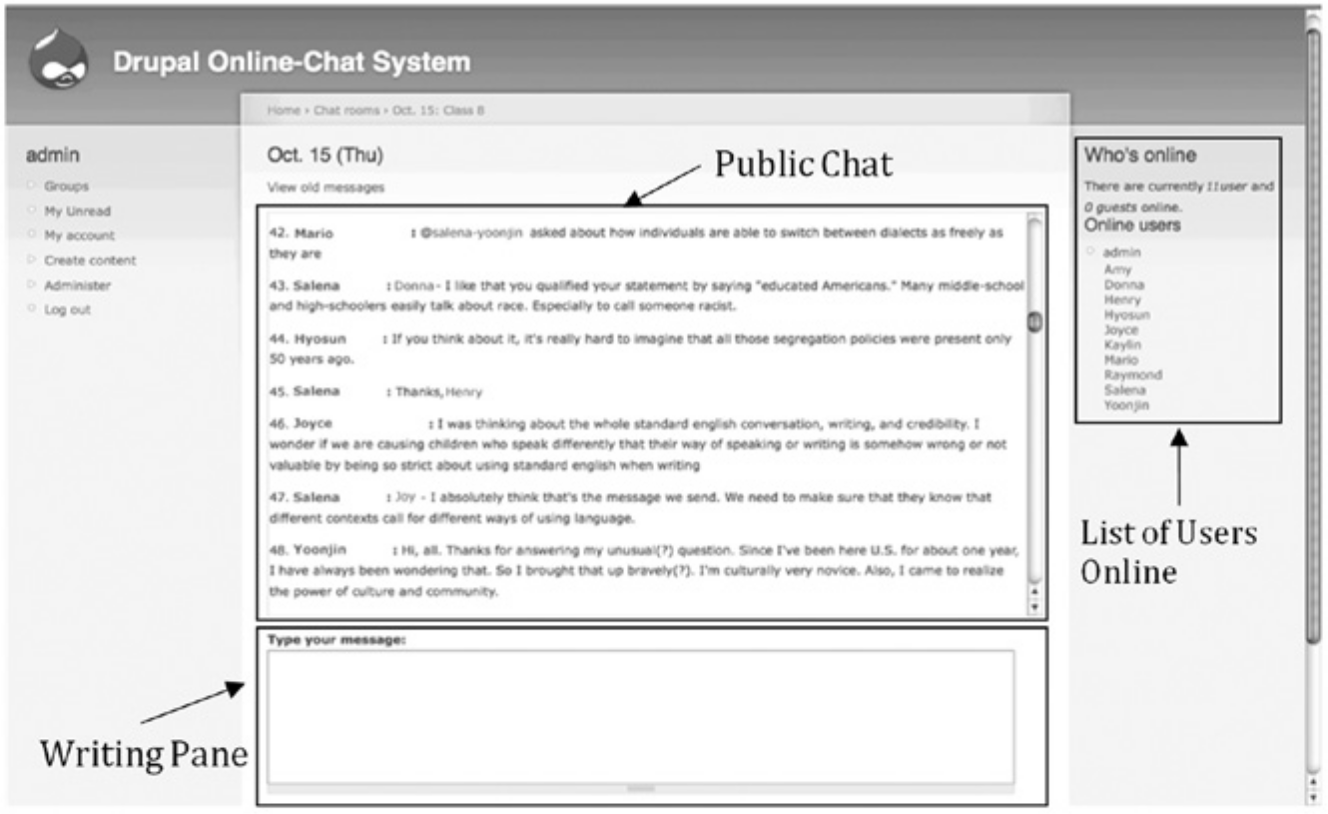
A screenshot of the online context for CMD.
Research on Literacy Processes
We turn next to reviewing investigations that informed our focus on literacy processes relevant to online communication, to the rich literatures on the processes involved in writing and reading traditional offline materials and to a smaller but growing literature on the processes involved when interacting with information technologies. As Dalton and Proctor (2008) acknowledged, “A logical place to start when thinking about reading comprehension [and production] of digital text is to consider print-based reading comprehension [and writing]” (p. 303). In what follows, we review the work on writing processes, on reading processes, and on processes involved within online contexts.
Literature on writing processes
In his influential review of writing theories, Faigley (1986) pointed to the near-paradigm shift that occurred when writing researchers moved from a focus on writing as product to writing as process. In terms of influence on literacy research more broadly, the prolific work of Flower and Hayes (1980, 1984) served to renew an appreciation of how literacy inherently involves processes of meaning making, be it in reading or in writing text. Flower and Hayes described writing as a complex set of processes involving multiple symbolic ways of constructing and representing meaning, first to oneself and ultimately to an audience. Approaching writing as a problem-solving process, they described the heuristic procedures of the writing process (i.e., Plan, Generate, Construct) as nonlinear and iterative in nature. Following their initial global model, these researchers built detailed descriptions of each aspect of writing processes involved. For example, in considering how a writer encounters and deals with the challenges involved in going from idea to words “on a page,” Flower and Hayes (1984) drew from the work on knowledge representation to present a coherent explanation of why ideas can be more or less difficult to fashion into a written text. Another example came from their description of the subprocesses involved as a writer reads his or her newly minted text and makes decisions about how it can be better aligned with the goals that motivated the writing in the first place (Flower, Hayes, Carey, Schriver, & Stratman, 1986).
As Faigley (1986) argued, the process description of writing that emerged in this scholarship did not remain above criticism. Because attention had not been specifically drawn to how writing processes may differ for diverse writers when writing for different purposes, it was easy to interpret this first model presented by Flower and Hayes (1980, 1984) as an unfounded universalist attempt to depict writing extracted from the influences of context and culture. Nevertheless, their contribution influenced a generation of literacy researchers to focus on process and to adopt different techniques for getting at process, such as the think aloud protocol (e.g., Swarts, Flower, & Hayes, 1984), the retrospective text-based interview (e.g., Odell & Goswami, 1985), and the close analysis of text to reveal the writer’s strategies (e.g., van Wijk & Sanders, 1999).
Literature on reading processes
The dynamic nature of CMC text is one aspect first-time participants in an online discussion often point out, particularly when involved in the fast-moving exchanges of a synchronous discussion. Reading processes are taxed as the reader sees others’ comments fill the screen and attempts to digest and identify to which topic each message contributes as the conversation unfolds (e.g., Kern, 1995; Schallert et al., 2003-2004). When such a discussion is part of a course, time constraints on the conversation compel students to devote themselves to the CMC task, concentrating on grasping several lines of new disciplinary knowledge.
This description of reading in CMC directs our attention to the rich theoretical and empirical literature on reading processes. When describing reading as a meaning-making process, a natural place to start is with a schema-based explanation of how students construct an understanding from what they bring to the text (their schemata or background knowledge) and what the text offers (cf. Alexander et al., 1991; Anderson et al., 1977; Anderson & Pearson, 1984; Kintsch, 1988). In this view, reading is not a matter of extracting meaning from a text but of constructing a coherent sense of a text, one that is influenced as much by the reader’s prior experiences as by the text. In addition, these views came to encompass the importance of a reader’s goals and purposes in directing meaning making (Bazerman, 1985).
Thus, literacy researchers were ripe for Tierney and Pearson’s (1983) insight that reading and writing both share the same underlying processes of construction and are more alike than had been previously assumed. Rather than describing writing as an encoding process and reading as a decoding process, Tierney and Pearson proposed a “composing” model of reading with subprocesses that echoed Flower and Hayes’ (1980) writing model: The reader makes a plan for reading a text by setting goals and mobilizing knowledge, drafts an initial sense of the text by selecting background knowledge that seems appropriate, revises the developing meaning of the text as more text is read, and monitors the whole process for what needs to be done to accomplish goals successfully. Tierney and Pearson maintained that, as with writers, readers seek textual coherence. Reading processes are not sequential steps through which the reader moves systematically to construct meaning, they argued, but rather processes that may be engaged simultaneously as a reader constructs a coherent understanding.
In addition, literacy researchers have come to appreciate that “real” occasions of reading and writing frequently co-occur to fulfill literacy goals. For example, when one does research before writing a piece that synthesizes what one has read, the reading precedes and serves writing goals. In Spivey’s (1990) description of such reading-to-write situations, the reader/writer is involved in organizing, selecting, and connecting information in an attempt to construct meaning. Other times, reading follows writing, as when a writer becomes his or her own first reader, representing to himself or herself the imagined audience to whom the text is being written. Another context that involves frequent interleaving of reading and writing processes is the online CMC environment. Researchers of CMD have noted the complexities introduced when writing and reading occur in quickly interleaved succession, as participants in a conversation move between putting words to their emerging independent ideas, reading what others have posted, and composing responses to these messages, in a continual mix of reading and writing (e.g., Albright, Purohit, & Walsh, 2002; Chandler-Olcott & Mahar, 2003; Jordan et al., 2007; Lee et al., 2011; Leu et al., 2009; Schallert et al., 2003-2004; Vandergriff, 2006; Wade & Fauske, 2004).
Research on literacy processes in online environments
In descriptions of online literacy environments, a distinction is typically made between the Internet as an information repository, as a “read-only” environment to use the words of Greenhow, Robelia, and Hughes (2009, p. 247; even though content access is user-driven, hypertextual, and easily changed), and the online environment as a communication medium, a “read-and-write” environment. In studies of reading online, the first context was originally described in Reinking’s (1997) clever depiction of the hypertextual nature of online reading. More recently, Coiro and Dobler (2007) presented a detailed analysis of processes that took place when sixth graders were searching for information online to fulfill a reading goal. Although online reading included some of the same complex processes involved in paper-based reading (e.g., self-regulation, goal-monitoring, a reliance on prior knowledge), it also was shown to depend on particular kinds of knowledge and strategies that reflected web-based affordances (e.g., keeping track of the interconnection between texts). Similarly, Afflerbach and Cho (2010) concluded that although some of the same strategies that help readers with offline tasks are relevant to managing online contexts, online reading requires more. One such set of strategies included “realizing and constructing potential texts to read” (Afflerbach & Cho, 2010, p. 208), which are unique to, and necessary for, reading in online contexts due to their hypertextual nature.
It is, however, the second context of online environments, the Internet as a communication medium, that is more relevant to our study. With the evolution of the Internet to Web 2.0, the emphasis on individuals generating their own content for the web and interacting with others through blogs, wikis, and online forums has highlighted how reading and writing processes are even more entangled, as individuals engage text by alternating between the roles of reader and writer (Greenhow et al., 2009; Leu et al., 2009). When an instructor includes CMC as a classroom activity, as many instructors continue to do at all levels of education (Bonk & Cunningham, 1998; Lee et al., 2011; Schallert et al., 2003-2004), the online environment becomes an intentional communication tool that offers the possibility for students to come to new understandings as they co-construct an intellectual conversation of new ideas through the words they read and write. Thus, online discussion depends on a blending of the processes involved in comprehending and composing (Albright, Purohit, & Walsh, 2002; Alvermann, 2008; Schallert et al., 1996).
This brings us to the most immediate rationale for the current study, the work on CMD as a tool to facilitate discussion by allowing all participants to share ideas, thoughts, and understandings within a common online space. Although this instructional tool allows students to “more easily exchange their ideas, build new knowledge, and negotiate meanings” (Bonk & Cunningham, 1998, p. 41), it also can create a sense of chaos, uncertainty, and incoherence (Faigley, 1992; Jordan et al., 2007). CMD allows participants to contribute to the conversation at their discretion, and readily ignore, read, or reread each comment at will (Herring, 2001; Wade & Fauske, 2004). Thus, the discussion that results, what we have previously called the publicly shared conversation (Schallert et al., 1998), may suggest a universal experience that is quite different from the individual experiences of each participant. Clearly, process and product differ radically.
Although a few researchers have analyzed the processes that occur within groups of students engaged in various collaborative literacy practices (e.g., Christoph & Nystrand, 2001; Dyson, 1995; Leander & Rowe, 2006; Na, 2004), we nevertheless believe that process has been understudied. Even when researchers have examined face-to-face conversation, the focus is often on what was said, and analysis centered on the transcribed dialogue seen as a product (e.g., Cazden, 2001; Erickson, 1996; Maloch, 2002). Such analysis often serves as a basis from which inferences are made about thinking and identity-making processes, and conclusions are drawn about what was learned, just as analyzing the musical structure of a symphony might be used to draw conclusions about how it was composed. What the end product, the conversation itself, does not reveal, however, is how individuals involved in it have arrived at each contribution. Such analysis belies the complex processes involved as each participant reacts to what others have said and considers whether to construct an utterance to reflect a current understanding, situated in a particular moment in time and contributing to a developing, dynamic conversation. Our project was focused on this complexity, the reading, writing, and constructive processes that individuals in an online discussion engaged as they collaborated to deepen their understanding of the assigned articles.
Method
Participants and setting
Except for one student who was absent on the day data were collected, all the students enrolled in a graduate-level seminar (five women, three men), along with the teacher of the class, participated. All were in education-related fields. Two were international students (from South Korea), with well-developed skills in speaking, reading, and writing English, though identifiable as nonnative speakers of the language by their somewhat limited knowledge of American culture. Their ages ranged from the mid-20s to late 30s. All participants were given pseudonyms.
Focused on the literature on writing informed by rhetoric, composition studies, and educational research, the course was organized as a seminar discussion of four or five articles each week. The 3-hr meetings were divided into an oral discussion of the readings, followed by a synchronous CMD that continued the face-to-face conversation. These online discussions took place in a computer lab during the last hour of class. In both class segments, the teacher encouraged students to introduce topics or questions about the readings but it was nevertheless clear that she was more a coequal participant in the online than in the face-to-face conversation. The teacher had used synchronous CMD for more than 10 years because she valued the contrast it offered to face-to-face discussion, and the opportunity it gave to students to develop and explore different conversational contexts. She saw online discussion as allowing for a more democratic access to the “floor” and the possibility of pursuing several different aspects of a topic simultaneously. Thus, she devoted class time to CMD to legitimize it to the same degree as face-to-face small group work that is often included in instruction.
As shown in Figure 1, the online program consisted of a window divided into two main sections. At the top of the screen was a public chat space in which posted messages appeared in chronological order for all participants to read, reread, or skip. There was a smaller space at the bottom of the screen (i.e., the writing pane) where a student could compose in private. Only once a student had hit the “enter” key would the comment appear in the public chat for others to read.
Six students had taken a previous course with this teacher and therefore had some experience with her use of CMD in her courses. Our study made use of data collected in one class session that occurred late in the semester, by which time all eight students were familiar with the experience of participating in synchronous CMD.
Procedure
For this CMD session, four video cameras were set up in the computer lab. Each video camera was able to capture two or three participants, allowing us to record the overt actions of all student participants as they engaged in the online discussion. Members of our research team also sat unobtrusively behind students, noting actions such as eye gaze, body movements, and accessing of offline materials. Each computer had been prepared with software (Camtasia) that captured all changes to the screen display such as typing, deleting, and opening documents or programs. To indicate which comments they were reading, we asked participants to track words with their mouse, a procedure they had practiced at the two previous class sessions. Otherwise, this session mirrored other class sessions, with the teacher and students introducing comments, asking questions, and responding to each other’s ideas.
Subsequently, three students were chosen for an individual interview because an initial review of the Camtasia recordings had indicated what seemed to be different patterns of actions within the online discussion. For each of these interviews, the student was asked to review a paper transcript of the conversation and to give general impressions of the conversation as a whole, as well as his or her own contributions to the conversation, comparing it with other CMD sessions in the class. Then, the student watched the Camtasia recording of his or her own on-screen actions during the discussion, reporting out loud anything that came to mind. Occasionally, we prompted the think aloud by asking about why the student had taken certain actions and what may have triggered his or her actions. In addition, we asked what effect participating in the reading and writing of messages had on the student’s own thinking.
Our use of stimulated recall with these three students followed the well-established protocol from the field of teacher education (Bloom, 1953; Parker & Gehrke, 1986) for reconstructing thought processes guided by a recording of a past event. Such protocols are subject to all the limitations of interview data, with the individual not being able always to recall fully his or her original thinking or with the person changing the reporting of what is recalled because of social desirability constraints. However, the cues provided by the recording help mitigate these limitations. Furthermore, stimulated recall interviews are considered useful when triangulating conclusions from other data sources, and they represent one of the few methods for capturing process data without interfering with ongoing processes (Schumacher, Klare, Cronin, & Moses, 1984).
Data Sources and Analysis
Situated in an interpretivist and constructivist epistemological stance (Kamberelis & Dimitriadis, 2005), data analysis took the form of a microgenetic focus on processes and discourse. We chose this qualitative approach because we were seeking to understand rather than to test hypotheses regarding the processes. In terms of analytic approach, the part focused on processes represented an inductive analysis of the moment-to-moment evolution in process whereas the part focused on discourse data involved an interactional sociolinguistic and psycholinguistic approach (Bloome et al., 2008) aimed at showing how an individual’s discourse acts were contingent on previous socially shared discourse acts. Our approach borrowed from Vygotsky’s (1978) genetic focus on change, a radical departure from the typical focus on achieved learning, in which he emphasized the value of taking a microgenetic look at how the process of learning unfolds as revealed in the language a learner and tutor share moment-by-moment. Similarly, we described the intra and interpsychological evolution of students learning together through the words they shared in the context of an online discussion.
To provide such a microgenetic description, we approached our analysis and our presentation of results by focusing on (a) the conversation as product, based on an analysis of the transcript of the posted messages, and (b) the processes by which participants constructed the publicly shared conversation, based primarily on all other data sources. The fact that most studies of CMD have relied on posted transcripts has meant that the conversation as product has previously been the focus of analysis. With the additional data source of the Camtasia video, we had information regarding what parts of the online conversation had influenced individuals’ literacy processes; that is, what messages each person had read, as well as what constructive moves each had engaged (including word-level and phrase-level editing, partially composed messages, deleted messages, etc.). Contributing to our process description, additional data sources included the video recordings, observation notes, and interview data.
Analyzing the conversation as product
Our first step was to make a word document, a transcript of the day’s online discussion, thereby producing a written record of the conversation in its entirety, including the name of each comment’s author and the time it had been posted (hour:minute:second). From the transcript, we created a coherence graph (see Figure 2) showing how individual comments were connected and how the conversation progressed from topic to topic (see Schallert et al., 1996). Because postings appeared in the public space in chronological order with no marking to identify to which topic they “belonged,” the coherence graph was useful in displaying how postings contributed to unfolding topics in the conversation. Moreover, it made it easier to identify which posting was being addressed by a comment, how many comments made up each topic and how “long” each topic was (how many comments were spanned from first comment to last), and how many comments to each topic each student had posted.
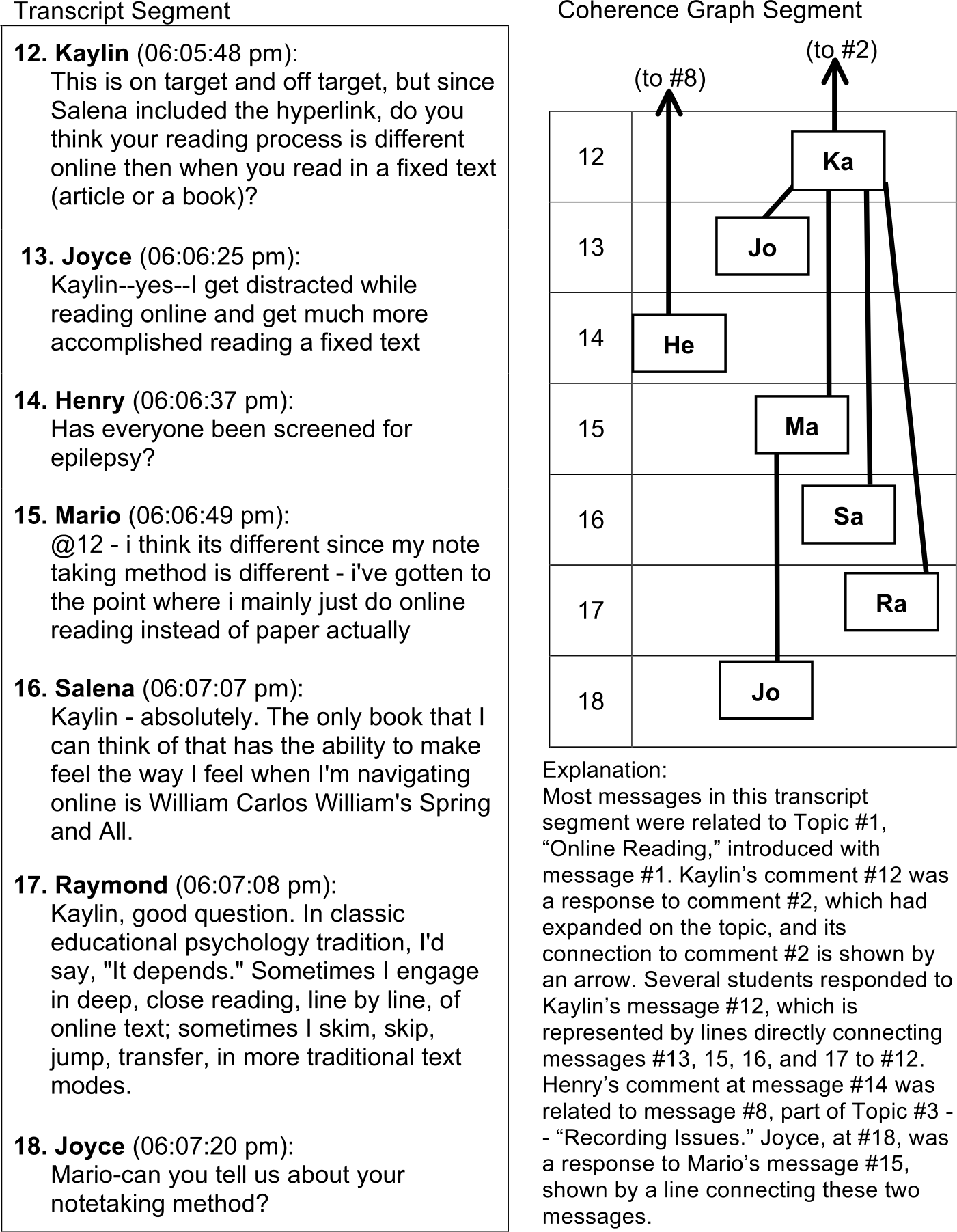
A segment of the coherence graph and corresponding segment of the transcript.
Analyzing the conversation as process
Process analysis was informed by several data sources. Most important was the video recording of each participant’s computer screen (using Camtasia software) that provided a record of what each individual had done at his or her computer throughout the conversation (e.g., comments read, any writing that might not have survived to posting). Following an analytical approach to qualitative data set forth by Corbin and Strauss (2008), we used open and axial coding to derive our response themes. First, we each viewed one Camtesia video, making notations on the written transcript of any on-screen actions we saw. Initial analysis of these notations led us to identify specific on-screen actions in the synchronous discussion in which the construction of a written posting seemed to be influenced by various sources (i.e., others’ online postings, assigned readings), thus allowing for potential insight into the processes involved during an online discussion. Our final coding protocol included the following actions to be tracked: (a) typing, (b) tracking with the cursor (indicative of reading), (c) erasing or deleting text (noting whether it was a spelling correction/editing, revision of idea, entire response deleted), (d) scrolling up or down the screen (noting which comments were displayed on-screen and which of these were being read), (e) delayed response (e.g., whenever a message that was itself a response to a previous message was read and the person then responded to the original posting), (f) rereading (indicating which words in a posting were reread), and (g) any other behavior not listed above that might be of interest.
Additional data sources were the video recordings and observation notes of what students were doing during the session not captured by the Camtasia screen-capture software. We synchronized the video recording of their overt, off-screen actions with the Camtasia video of their on-screen actions so that we could identify what students were doing when there was no on-screen action. This synchronization also allowed us to identify what was occurring within the computer lab environment that might have distracted students, as when one of the students stood up to leave near the end of the session. A final data source contributing to data triangulation came from observation notes. From these data sources, we particularly noted such actions as direction of eye gaze (which could indicate reading when a student forgot to track the text), referencing reading material and notes from class, and whether the students appeared to be attending to the task or whether they had become distracted (which was remarkably rare).
Following a similar protocol, the interview transcripts were coded and reviewed for how well they aligned with the interpretations we had formed from an analysis of the Camtasia recordings, video recordings, and the transcript of the conversation. For example, we were interested in understanding why a student had responded to some messages and not others, whether it was the content of a posting, or its author, or something else that had triggered a response. We also queried whether they had read deeply or simply skimmed messages. In our analysis of these interview transcripts, we looked for support as well as counterevidence of our emerging conclusions.
Ensuring trustworthiness of our conclusions about conversation as product and process
Having checked the coherence graph of the conversation through team consensus, we next focused on coming to an understanding of each student’s experience of the CMD session. As a team, we each took one student’s Camtasia video with the task of tracking all actions observed on-screen. These initial notes were expanded by watching the video recording of off-screen actions and reading available observation notes. These notes were then summarized in a memo that was shared with the whole team. At this point, we identified three students who seemed to represent different approaches to the conversation and scheduled interviews with each.
The next step involved a confirmation session, at which the Camtasia recordings were projected on the walls of a large room, synchronized to begin at the same point in time. Each individual’s recording was reviewed by two team members and checked against the initial memo for anything that had not been noted. Throughout these research team discussions, three patterns of actions began to emerge, either within an individual or across individuals. The interviewed students seemed to exemplify more purely each of these patterns, with other students showing a mixing of these patterns.
In sum, issues of trustworthiness were addressed by checking our conclusions across multiple data sources. The interviews with three of the students acted as a form of member checking on the emerging conclusions derived from analysis of Camtasia recordings. The multiple perspectives represented across our research team, with individuals representing expertise from different disciplines such as literacy, technology, and educational psychology, helped establish the trustworthiness of our conclusions.
Results
Conversation as Product
As indicated in the transcript and coherence graph, the discussion lasted 32 min and consisted of 119 comments. As defined by Schallert et al., (1996), a topic in a conversation is not created simply by a message stating or announcing a topic, but when it receives some response from others. We have habitually used as a rule that there must be at least three connected comments to form a topic. In this conversation, there were two comments, a clarification question from one student and an answer by the teacher, connected to each other but attracting no other contribution. The other 117 comments were organized into six topics, with two involving “hellos” and “good-byes” (Topics 2 and 6) and another comprised of 7 comments about students’ annoyance with their strobing cursor due to the Camtasia software (Topic 3, see Table 1). These non-content-related comments, mostly short phrases or one-word messages, represent 19% of the 119-comment conversation (greetings: 13%; technical issues: 6%).
Number of Messages Contributed to Each Topic by Each Participant.
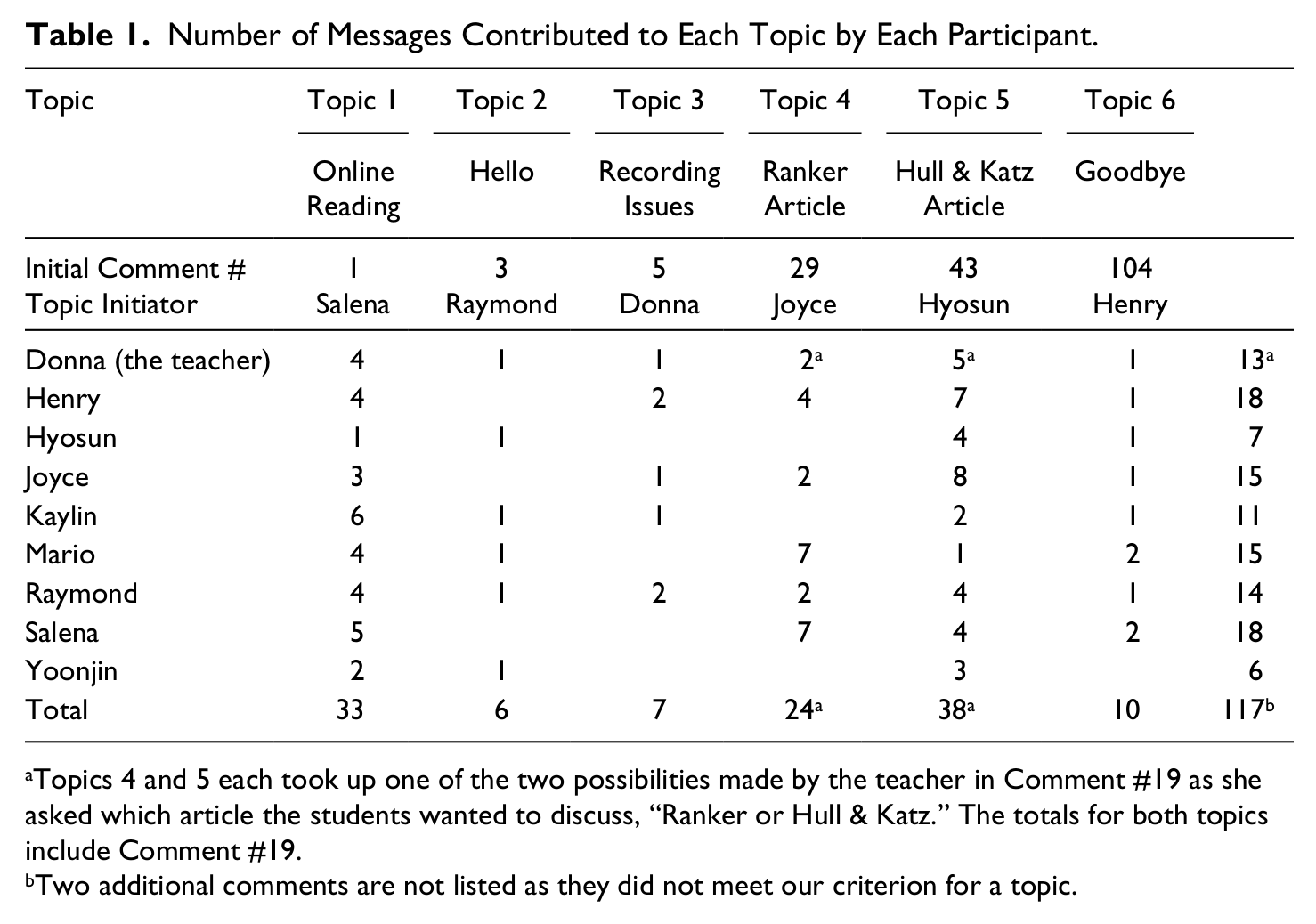
Topics 4 and 5 each took up one of the two possibilities made by the teacher in Comment #19 as she asked which article the students wanted to discuss, “Ranker or Hull & Katz.” The totals for both topics include Comment #19.
Two additional comments are not listed as they did not meet our criterion for a topic.
The remaining three topics were related to the articles assigned for that class meeting. Topic 1 began with two comments (Comments 1 and 2) by the same individual, an unusual practice as most conversations began with a flurry of “hellos.” This topic lasted for another 27 min, was joined by all nine participants, and was made up of 33 comments. The next two substantive topics, Topics 4 and 5, were prompted by a single comment from the teacher (Comment 19) that asked whether they wanted to discuss one of two articles. Topic 4 included 23 additional comments, lasted 24 min, and had six contributors. Topic 5 consisted of 38 comments (including Comment 19), lasted 25 min, and also received comments from everyone. For 17 min, all three substantive topics were in play and could potentially attract participants’ reading, thinking, or responding.
Conversation as Process
Although the conversation once completed and printed out appears as a sequential set of messages, the experiences of the participants reading, deliberating, and writing as they co-created the conversation differed in several ways. In what follows, we concentrate on three patterns of coordination of the subprocesses involved and illustrate these with data from three students, acknowledging that no single participant will always follow only one pattern. These three patterns are certainly not the only patterns we saw, and most students in the class demonstrated a blend of these patterns in opportunistic response to the unfolding conversation. However, for purposes of clarifying the processes involved in online discussions, we chose to start with a description of three students’ patterns that afforded interesting contrasts, labeled using a movement metaphor: a sequential procession, a coordinated dance, and an orchestrated performance. We conclude with a description of the ways that students blended varying aspects of these patterns in a section on mixing moves.
A sequential procession
When reading a discussion’s final transcript, one easily assumes that the conversation’s participants read each message chronologically, and if a comment elicits a response from a reader, he or she begins composing immediately. Although this pattern was not predominant in this group, Raymond was a canonical example of this pattern. He read every message (except for his own 14 postings), and his scrolling generally displayed only one new message at a time. If he chose to respond, he left the posting on his screen as he constructed his message.
Of all our participants, Raymond was particularly diligent about indicating what he was reading by tracking the online posting with his cursor, revealing on his screen new messages to be read one at a time. Whenever he wrote a response, his composing seemed to proceed smoothly and quickly. Occasionally, Raymond paused with his hands on the keyboard before starting to type a response, which we interpreted as an indication that he was mentally composing a comment. Only rarely did he erase or add in phrases as he constructed his response, although he sometimes rewrote parts of misspelled words. After writing, he usually read through his post, sometimes adding adjectives or other clarifying language before posting the message for others to read.
Near the end of the session, as other students started to leave, he began to display several new messages at a time, deviating somewhat from his usual habit of revealing only one new message at a time. Thus, overall, his process seemed linear, a sequence of reading, thinking, and writing. The subsequent interview with Raymond confirmed our general impression regarding the pattern of his construction processes:
Let’s watch a little bit of your video and tell me what you notice.
Well, one thing I notice is that I read very fast, which I’ve always known. And you can see in my typing production, I deliberate at points . . . You can see pausing where I’m waiting to compose . . . I don’t read all the way [to the end of the conversation as far as it has gone so far] and then type. I will read to a point at which I then find myself recognizing the need to attend to something before I move on, lest I forget it . . .
However, Raymond also displayed a sense of awareness of how his comments would fit in with the developing conversation, as shown in his next comment:
The other thing that I know that I’m doing psychologically while I’m writing is I’m making a decision about whether I’m actually going to enter the text . . . So, one of the things I’m doing during the process is I’m reading other people’s comments, I’m composing my own comments, but I’m also making a decision about whether to actually submit that comment to the conversation . . . .
Thus, although we are characterizing his overall pattern of participation in the conversation as sequential, his thinking itself was not linear. And, although we never saw him erase a comment in this conversation, he claimed to consider, at least on occasion, the effect a posting might have before deciding to submit his message.
A coordinated dance
Other participants departed from the pattern that Raymond consistently displayed. A second pattern involved a deliberate coordination of reading messages, composing a response, rereading, and “word-smithing” before final posting. Hyosun, for instance, wrote only seven postings in all, two of which were remarkable for the interweaving of processes she displayed. For example, even though her message at #86 referred explicitly to #54, she seemed to intermingle the processes of reading, rereading, composing, editing, and meaning making throughout her response construction. In Figure 3, we have attempted to capture what the Camtasia video showed us as she composed posting #86.
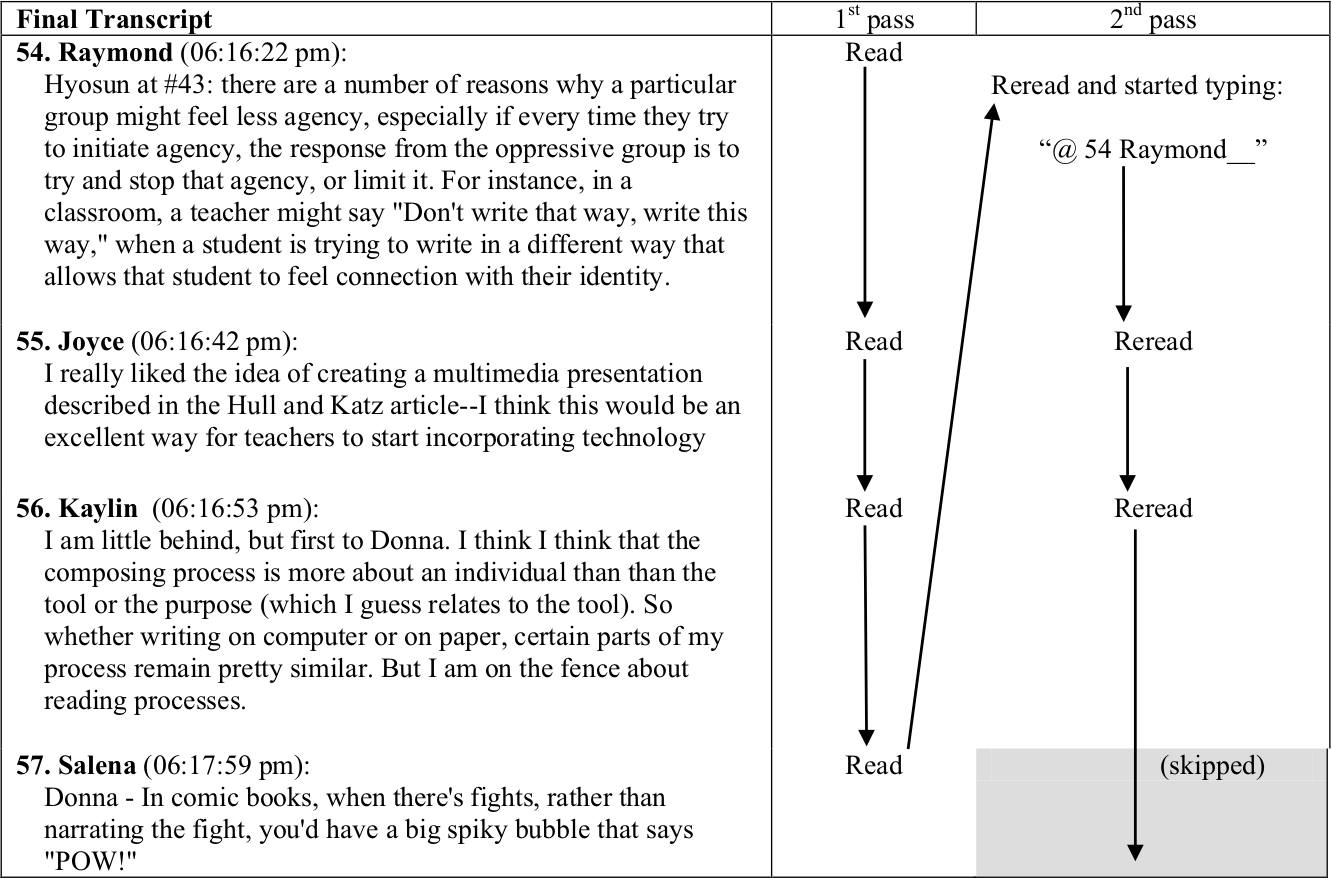
Construction processes involved in Hyosun’s writing of message #86: Part 1.
As shown in the second column of the figure, Hyosun first read #54, and as she reported in her retrospective interview when she saw herself come to that message on Camtasia, “Well, 54 was addressed to me . . . So I guess as I read it, I felt like I wanted to respond to it maybe.” Despite this initial recognition of a possible wish to respond, Hyosun instead went on to read well beyond #54, reading posts #55, #56, and #57, as she explained in her interview:
But instead of responding to it immediately, I probably thought there might be something else coming up, and I want to read the whole idea before I respond, . . . and also [to] see if anybody else was responding.
She then scrolled back to reread part of #54 because, as she stated in her interview, “I figured that probably there’s not so much more I need to read to respond to 54, so maybe that’s why, at that point, I started responding.” As shown in Figure 3, she began her message by typing “@ 54 Raymond__,” paused, and returned to the public conversation to reread #55, part of #56, and skipped #57 (which she had already read).
As shown in Figure 4, Hyosun then continued to read #58, #59, and part of #60, all the while showing on her screen the message she had begun to type, “@54 – Raymond.” She scrolled down to reveal more text on the screen, skipping posts #61 and #62, but reading #63 which referred to her by name.
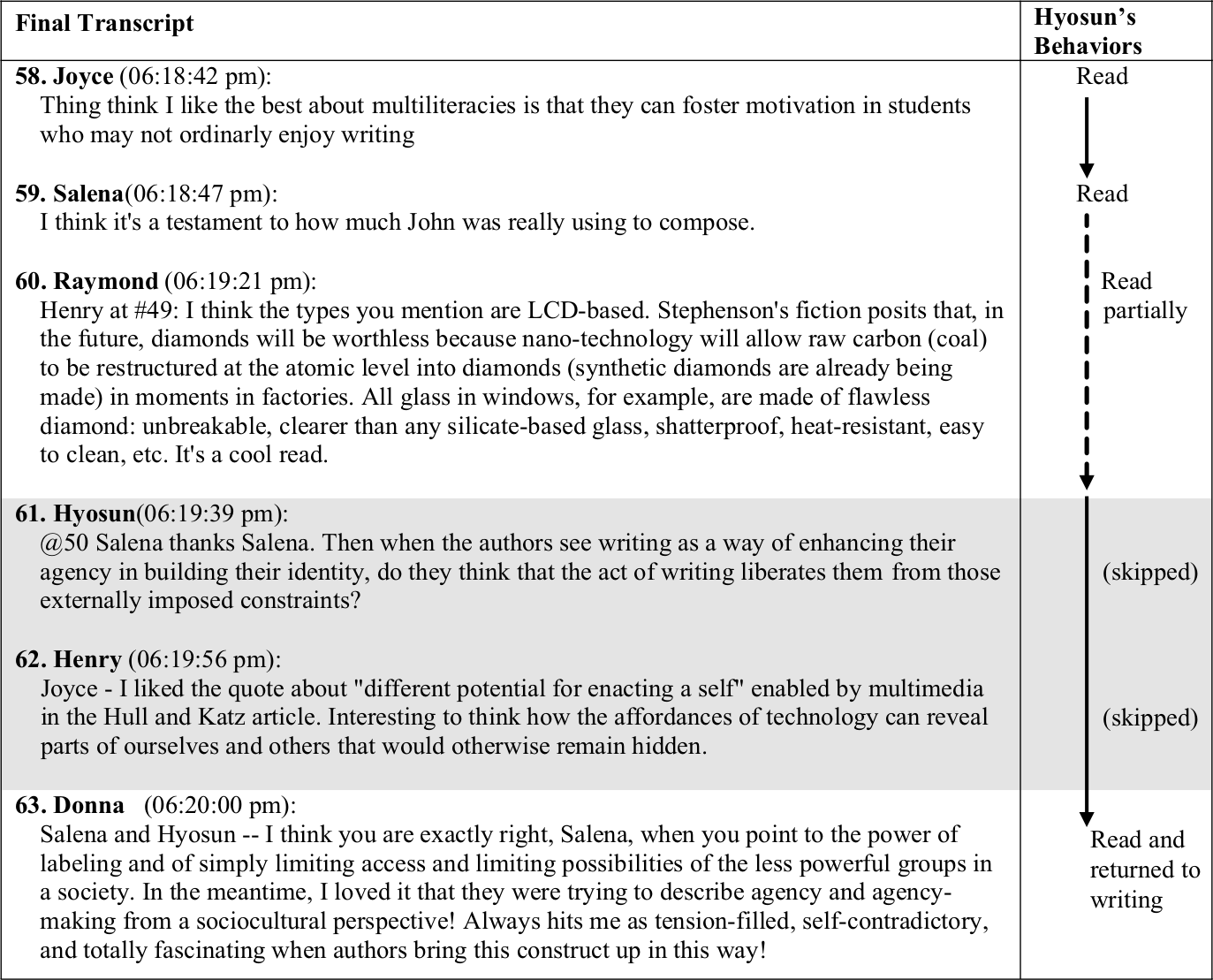
Construction processes involved in Hyosun’s writing of message #86: Part 2.
Having read #63, Hyosun returned to constructing her own post, showing extensive revision (note that we use italics to show new text and the changes she is making with each iteration):
@ 54 Raymond & Donna __ so it feels that
@ 54 Raymond & Donna __ so it might be that the opportunity to create a multimedia
@ 54 Raymond & Donna __ to me it seemed that what helped the multimedia writers gain agency was a lot
@ 54 Raymond & Donna __ to me it seemed that much of what enabled the multimedia writers gain agency came from the support and relationship they had with the support group who also were
@ 54 Raymond & Donna __ to me it seemed that much of what enabled the multimedia writers gain agency came from the support and relationship they had with the supportive audience group they worked with. So would working with multimedia be very much different from just
@ 54 Raymond & Donna __ to me it seemed that much of what enabled the multimedia writers gain agency came from the support and relationship they had with the supportive audience group they worked with. So working with multimedia gave them more opportunity to interact and take agency in their creation I suppose. compared to traditional writings
She then made one final revision in her private writing pane by inserting a long qualifying phrase, and posted to the public conversation what became #86:
@54 Raymond & Donna __ to me it seems like much of what enabled the multimedia writers gain agency came from the support and relationship they had with the supportive audience group they worked with. So working with multimedia gave them more opportunity to interact with their supportive readers and the multifaceted nature of the multimedia gave them more choices and enhance their agency in their creation I suppose, compared to traditional writings.
In total, this coordination of reading, reflecting, and composing took about 5 min, or nearly one sixth of the time for the total conversation. For Hyosun, this complex coordination of thinking, writing, and reading was evident throughout her participation in the discussion, though like Raymond, she switched to a more hurried and sequential skimming of the last 20 messages as the end of the session neared.
As Hyosun was an international student, the question arose as to whether her extensive revisions might indicate second-language issues beyond an indication of thinking through writing. In the follow-up interview, these two possibilities were pursued:
So would you say that the actual process of writing, in that moment, you’re also creating meaning in your mind?
Sometimes as I write I start off with a vague idea of what I want to write but as I write, it becomes more clearer and also in terms of the phrases and words that I want to put in, I don’t have it all in my head when I start writing, but as I write I think it becomes more clear what I want to say, and I just move around and try things differently maybe.
Do you feel like you would do that regardless of what language you were writing in? If it were Korean you were writing in [as opposed to English]
Probably I would do it, [maybe] not as much, but if I’m writing something a little bit complex, I think I would still do it. But I’m not sure if I’d change the expressions as much. So I think the reorganizing the ideas or clarifying the ideas, I think that would still happen in my first language, but like, changing the verbs, or specific words, I think that’s probably because English is my second language.
We interpreted her interview responses as supporting our description of her processes based on the Camtasia recording. Although her status as a second-language user may have played a part in how deliberate she seemed in her reading and writing, her processes seemed driven by ongoing meaning making rather than language issues.
An orchestrated performance
The two patterns we have described above were characteristic of Raymond and Hyosun and were displayed by all students at some points during the discussion. However, at least two of the students displayed a particularly heightened coordination of the online environment’s affordances, showing an ability to read every message, post many responses to all topics, and use other resources such as search engines as resources for constructing their own posting. For example, immediately upon logging in, Henry opened electronic copies of the assigned readings and referred to them throughout the online conversation, especially when prompted by fellow classmates’ references to specific articles.
After reading Joyce’s comment at #55, for example, he referred back to the electronic version of the Hull and Katz article he had previously opened, skimmed the article’s text, copied a quote, returned to the online conversation, read Messages #57, #58, and #59, and finally began to construct his response to Comment #55 (into which he inserted the quote he had copied from the article itself), which became #62. When interviewed, as he watched his Camtasia recording, Henry explained:
. . . When I came back to the conversation, I wanted to check and make sure that what I wanted to talk about was still relevant, was still going to fit. So, before starting my comment, I caught back up with Kaylin’s and Salena’s and Joyce’s comments . . . then decided that it was still going to make sense to use that quote.
The elapsed time from Reading #55 to Posting #62, with various reading, scrolling, and moving throughout the text, was at most 3 min, not unusual for Henry. These processes occurred fluidly and quickly, causing little to no interference with his ability to keep up with the ongoing conversation as shown by the fact that he habitually displayed all of the conversation’s available comments (by moving the scroll bar to the bottom).
Henry’s extremely active orchestration of processes stood in stark contrast to the more systematic pattern Raymond displayed. It also contrasted with Hyosun’s interleaving of processes that seemed more focused on constructing what she wanted to express in her message. Instead, Henry’s primary concern seemed to be to ensure that he was keeping up with the posted messages appearing on the screen and that his posting fit in well with the latest messages in the conversation.
Such coordinated reading and writing behaviors were not atypical for Henry. As shown in Table 1, participants contributed to the six topics to different degrees, with Henry making substantial contributions to all but the “hello” thread, during which time he was opening electronic versions of the assigned articles via the course management website. It was not his presence in these threads that was so unusual, as Raymond and Donna also appeared in all threads of this conversation, and Mario and Joyce, like Henry, contributed to five of the six topics. What was remarkable about Henry’s thread-hopping is how he interspersed his contributions to several topics at once, keeping open the possibility of influencing and being influenced by all topics being discussed.
Thus, his 18 comments in the discussion were distributed across topics as shown in Figure 5. Note that the figure displays the number of Henry’s message in the discussion with the number of the message to which he was responding in parentheses. For him, the mean span between reading a message and responding to it was four messages, indicating how quickly he could respond in the public conversation. He first posted in Topic 3, then Topic 1, and then went back to Topic 3. He then posted two messages in Topic 1, moved to Topic 4, and returned to Topic 1. He then posted three comments in Topic 5, returned to Topic 4 for two comments, moved back to Topic 5 for three more comments, before returning to Topic 4 yet again. Having at this point posted 16 messages, more than anyone else in the discussion, he then posted a goodbye message (Topic 6), and though the video shows him gathering his belongings getting ready to leave, he was still monitoring the conversation and posted a final message to Topic 5, writing from a standing position stooped over the keyboard. The lines in Figure 5 connecting messages illustrate how he hopped from topic to topic in his postings even as he read all messages that appeared on his screen, referred to his articles, and checked other online references. As Henry reflected in his interview:
. . . It wasn’t unusual for me to be kind of straddling several different threads—going back and forth in a span of less than three minutes: commenting on three different threads, and a fourth thread shortly thereafter . . .
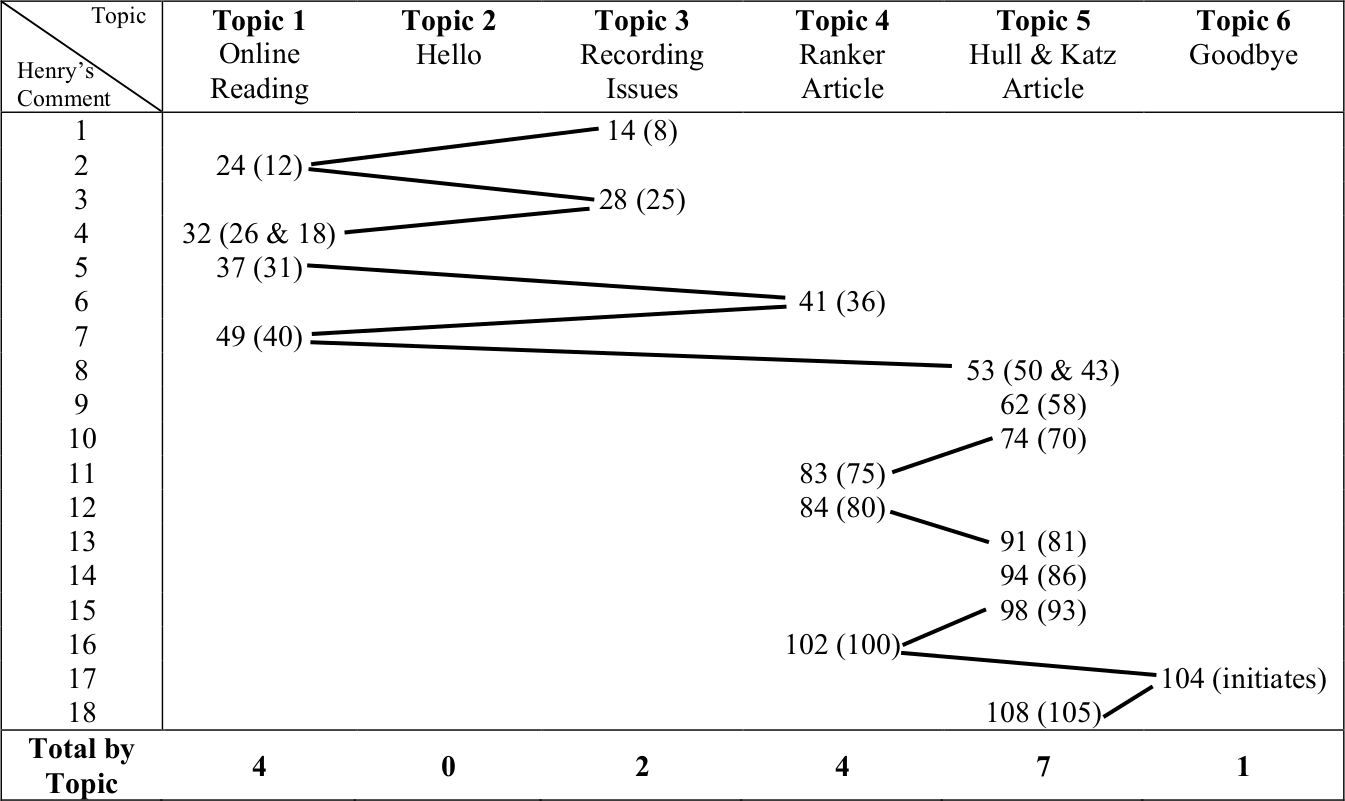
Henry’s comments (and the message(s) to which it is in response) by topic.
Finally, as we noted for Raymond and Hyosun, Henry also showed some deviation from the pattern we are ascribing to him: a fluid, quick reader and writer, anxious to keep up with the conversation. Such a pattern did not stop him from occasionally spending precious extra seconds editing his comment to achieve the intellectual work that he saw as important in this class activity. As he watched the Camtasia recording of his start at writing #62, he stated:
And this one I’m going to do some self-editing because, this one, I feel a little bit more pressure to make it fit. I want this to actually stand out, be noticed, be relevant, be academic.
We chose to describe the three preceding patterns because they were distinct and presented interesting contrasts for one another. We identified these three participants because overall, their behavior in this online discussion consistently exemplified one of these patterns. Although Raymond, Hyosun, and Henry generally displayed tendencies ascribed to one pattern, we would be remiss not to acknowledge that their behaviors might vary from one conversation to the next, or even across time within the same conversation. That being said, the other participants showed a clearer intermingling of these patterns within this conversation, to which we turn next.
Mixing moves
Other participants in the discussion displayed an intermingling of these patterns. For example, Kaylin was like Raymond in that she seemed to follow a sequential procession of systematically reading each message and, at least sometimes, starting to construct a response to a posted message immediately upon reading it. However, at least three times, her Camtasia recording showed that she read all available messages and only then returned to an earlier message to start constructing a response. Like Hyosun, Kaylin took a long time crafting and editing her messages before posting them, demonstrating coordinated moves between reading, thinking, and writing. The video recording showed her looking at her paper copies of the articles, similar to Henry’s behavior of referring to these sources, though it seemed to serve a different purpose, as she did so only when she had read all available messages and seemed to be looking for some inspiration about what to write next.
Another student who seemed to blend discourse patterns was Salena. She also read all messages, usually in order (like Raymond) but with interesting recursions, demonstrating a heightened sense of coordination in her reading, writing, and thinking processes. For example, even though she had read from #31 to #38 in order, she scrolled back to message #31 and constructed her response to it (similar to Hyosun’s behavior in constructing her response to post #54). She also seemed to mirror Henry’s orchestrated performance after reading message #61, which had been addressed specifically to her. She began composing what became message #69, and as she finished the message, she wrote, “like Raymond was saying.” Before posting the message for others to read, however, she scrolled to find Raymond’s message. As she did so, she stopped to read his most recent posting (#60), but continued scrolling further back before locating the one she wanted. She then went back to composing her response and added, “in #54” before posting it to the public chat.
Some patterns were difficult to identify. Yoonjin, for example, seemed aware that there were newly posted messages to read and would often scroll to the end of the available messages. However, she would often scroll back and highlight portions of preceding messages. As her tracking behavior was inconsistent, it was difficult to discern if she had read all of the messages during her first pass through the text and was returning to reread some of the postings (as Hyosun had) or if she had originally skipped over these messages and was returning to read some of them for the first time.
Discussion
Like other researchers investigating CMC phenomena, our own previous research had focused on the final transcript of online classroom discussions, supplemented by interviews and self-reflection essays as data sources for understanding what participants experience in CMD. In this study, our use of additional data sources, including video recordings and screen-capture software, allowed us to provide a more fine-grained analysis of participants’ engagement than previously. With the added capacity to monitor students throughout the online conversation, our methodology allowed us to examine and analyze the processes involved as each person contributed to one final product. We were able to observe what participants were doing as they wrote a message, as well as to capture other actions during the times between postings, revealing different ways in which individuals’ reading, thinking, and writing processes intermingled to create the final product that became the written conversation. That is, our results indicated that, although participants may vary in their literacy processes, there are many available paths to contribute effectively and to develop understandings from a classroom discussion that takes place online.
Thus, our findings demonstrated the variety of ways in which participants in an online discussion work to co-construct what becomes a publically shared conversation. As the transcript of a completed online discussion linearly displays the messages in chronological order, it is easy to be seduced into thinking that production of the conversation similarly follows a sequential pattern. One student in this study displayed such a pattern; however, the other participants showed other ways of interweaving literacy processes. This finding allows us to appreciate these participants’ remarkable abilities for interweaving literacy processes in such a dynamic manner.
The millennial era seems to have nurtured fluidity in moving across literacies within a single literacy experience. One reason we offer for the impressive abilities of our participants to coordinate their reading and thinking while co-creating an intellectually stimulating conversation is that they have been immersed in cultural practices that enable them to maximize the affordances provided in computer-mediated discussions. Our fine-grained process analysis provided evidence of what we had previously conjectured was happening, that the participants were engaged in a complex interleaving of processes when engaged in CMD. As graduate students, these participants displayed sophisticated control of literacy practices, representing perhaps the pinnacle of what literacy educators have as an ultimate objective for younger students. Although we acknowledge that today’s young students may already have developed many of these literacy practices, we recognize that teachers may not appreciate fully what their students can already do and need still to develop. In the words of Warshauer and Ware (2008), “ . . . educators must look for ways to acknowledge and even appropriate for themselves the creative and complex literacy practices that youth bring into schools” (p. 234). In fact, it is common to decry the shallow sort of processing involved as individuals text, email, and “facebook,” all the while engaged in an oral conversation. One aspect of classroom discussion taking place online that students nearly always notice is how much concentration and focused energy such discussion needs. Providing students with more opportunities to practice how well they can coordinate relevant processes could help foster literacy development and prepare students for making use of an online forum as part of online or hybrid instruction.
Our analysis clearly showed that students experienced the online discussion in their own ways depending, in part, on which posting they chose to read and how they chose to respond. These differing experiences may come from several sources including varying language proficiencies and cultural backgrounds, as well as different conceptions about participating in an online discussion and different goals as they engage in such a literacy rich activity. It is possible, for example, that Hyosun’s persistent reworking of her written contributions was driven as much by her need to display accuracy as by her evolving comprehension. Future research may want to consider how differences in participants’ goals for the discussion may influence their processes as well as how these processes might reflect different cultural backgrounds or varying levels of proficiency in a second language. Thus, the different patterns we observed may as likely have come from students’ different conceptions of and goals in the discussion as from their ability to manage such a dynamic experience. Although it may seem as though we favored the patterns that demonstrated blended movements across different literacy processes, we appreciated every pattern we saw, including the more linear, sequential pattern, as such patterns may be grounded in different views of what CMD is about and different goals for one’s actions in such a literacy context.
Furthermore, we noted that no one pattern seemed to provide the conversation with messages that were more substantive, robust, or in some other way “better” than any other pattern. Even as Henry fluidly moved in and out of various literacy processes, contributing more comments to this discussion than Hyosun, he was able to include messages that were acknowledged by other participants and propelled the conversation forward in a thoughtful manner. Further analysis of each message might be able to establish specific qualities that may lead to realizations about the ways in which one manages literacy processes and the messages one produces. However, we would discourage researchers from using characteristics of individual messages as a way to assess student outcomes within a CMD context. To do so might skew a conversation to becoming more of a forum for monologic displays of knowledge than an organic dialogic co-construction of meaning (Dodson, 2000). Managing the processes of new literacies within the complex and dynamic context of an online discussion may mean learning how to use a variety of messages to lubricate the intellectual work of a group.
Before concluding, we want to note explicitly the very real limitations that constrain our conclusions, identifying future research pursuits that would allow for further insights and generalizations to be made. First, with only nine people enrolled in this graduate-level seminar class, our sample was limited in size as well as focus. However, for this class, CMD was a well-established course component and thus our data were collected as part of an authentic learning task. Furthermore, the class, which typically enrolled 8 to 12 students, represented what we felt to be the ideal size for productive classroom discussions that are online. Based on our own previous research experiences on CMD, we have found that too few students, less than 6, often produce a conversation that is somewhat stymied by a lack of diverse ideas whereas too many students, more than 14, present too many topics that compete for participants’ attention, with ideas not fully explored or developed. Although this setting did provide us with a class size that was appropriate and advantageous in terms of exploring an online discussion that was robust and cohesive in a microgenetic way, we must still recognize that a singular conversation does not allow for generalizations or theory development with widespread implications. We would encourage further examination of online discussions from different disciplines and educational settings in an effort to verify the patterns we identified here as well as to identify other patterns of literacy processes. It is possible, with further study, one might start to identify a developmental nature to these processes, with those less proficient in these new literacies demonstrating certain patterns more often than others.
We also acknowledge that, even though we had been present at two class meetings prior to data collection day, our presence as observers may have led students to alter their performance in some ways. Asking students to track what they read with their mouse, while very helpful in coding students’ reading processes, might also have made students less inclined to skip any messages. An alternative to asking students to track with their mouse could have been to ask students in retrospective interviews to identify which messages they had read. We felt that the inherent limitations of retrospection, including memory loss or social desirability, made this option less viable.
In addition, the Camtasia screen-capture software had an unexpected side effect that caused the cursor to strobe when it was running. As we had not had the software running prior to data collection, we were unaware this would occur and had not prepared students for it. That one of the first topics students discussed related to these “recording issues” means that it did not go unnoticed. Still, the fact that the topic was short-lived would seem to indicate that students quickly adapted to this strobing and were able to refocus their attention to the content of each posted message.
Finally, we recognize that the processes leading one to post a message are different from the processes triggered when one reads the comment in the on-screen public chat. Online discussion is an auspicious site for studying literacy practices in their richest forms because it affords individuals opportunities to engage in several valued practices: (a) Participants can read at their own pace their group members’ messages, pondering those that intrigue them and skimming over those that are less interesting or too difficult to deal with in the moment; (b) having read several messages, a student can begin to formulate a response to reflect emerging ideas created from what has been read; (c) the student can then engage in composing processes with a goal to make clear and to communicate an idea that is still new, triggered by an earlier posting; (d) once posted, a message takes on a life of its own as it now becomes part of the collaboratively created text influencing any other student who reads it; and (e) all of these processes can occur in different orders, making online discussions particularly free carnivalesque spaces for meaning making. In short, what a message represents for its author is one kind of literacy experience; what it means for the conversation itself and for anyone who reads it is a different kind of literacy experience.
Footnotes
Declaration of Conflicting Interests
The author(s) declared no potential conflicts of interest with respect to the research, authorship, and/or publication of this article.
Funding
The author(s) received no financial support for the research, authorship, and/or publication of this article.
Author Biographies
References
Supplementary Material
Please find the following supplemental material available below.
For Open Access articles published under a Creative Commons License, all supplemental material carries the same license as the article it is associated with.
For non-Open Access articles published, all supplemental material carries a non-exclusive license, and permission requests for re-use of supplemental material or any part of supplemental material shall be sent directly to the copyright owner as specified in the copyright notice associated with the article.
