




Abstract
The relation between preschoolers’ phonological awareness and the frequency and quality of parents’ book-reading and reminiscing practices were examined in 54 low-income and ethnically diverse families. Children’s phonological awareness was assessed at the beginning and end of preschool. Mothers reported the frequency with which they read books and reminisced with their children at the beginning of preschool using a questionnaire. They were also videotaped while reading a book and talking about a past event with their preschoolers. The quality of book-reading and reminiscing practices was measured via these videotapes by the number of open-ended questions mothers asked to extend the reading or conversation. Children’s receptive and expressive vocabulary skills were assessed at the beginning of preschool as a control variable. Quality of reminiscing, but not book-reading practices, predicted preschoolers’ phonological awareness skills at the end of preschool, even after controlling for beginning-of-preschool phonological and vocabulary skills and demographic variables. Reported frequency of book-reading and reminiscing practices bore no relation to phonological awareness skills. The link between quality of reminiscing practices and phonological awareness deserves further exploration, but might be explained by indirect links with other linguistic and cognitive skills.
Phonological awareness plays a central role in learning to read (e.g., Bryant, MacLean, Bradley, & Crossland, 1990; Lonigan, Burgess, Anthony, & Barker, 1998; Wagner & Torgesen, 1987). Phonological awareness is the ability to recognize and manipulate the discrete sound units from which words are constructed. Children progress from an awareness that words can be segmented into smaller parts. As their phonological awareness increases, children are able to parse words into syllables and eventually into the individual sounds (phonemes) of words. Thus, phonological awareness involves abilities at different levels of complexity including detection of onsets and rimes, as well as deletion (elision) and blending of phonemes, syllables, and words (Anthony et al., 2002). Phonological awareness is one aspect of children’s metalinguistic awareness that emerges during the preschool years, prior to the development of reading, and continues to develop into the elementary school years (Blachman, 2000; Farrar & Ashwell, 2008; McBride-Chang, 1995). Both correlational and experimental studies have shown that phonological awareness is foundational to later reading success from the first and second grade into the later elementary grades (Anthony & Lonigan, 2004; Brady, Fowler, Stone, & Winbury, 1994; Bryant et al., 1990; McBride-Chang, Wagner, & Chang, 1997; Wagner & Torgesen, 1987; Whitehurst & Lonigan, 1998).
Vocabulary is strongly linked to phonological awareness and is also a strong predictor of children’s reading abilities. Children with larger vocabularies have better phonological awareness skills (Avons, Wragg, Cupples, & Lovegrove, 1998; Bowey, 2001; Gathercole, Service, Hitch, Adams, & Martin, 1999; Jusczyk, 1993; McBride-Chang et al., 2005; Metsala, 1999; Wise, Sevcik, Morris, Lovett, & Wolf, 2007). As vocabulary expands, there is growing pressure to discriminate among similar sounding words, which leads to increasingly segmented lexical representations (Metsala & Walley, 1998). Furthermore, numerous studies have found that children with larger vocabularies have better reading skills (see Whitehurst & Lonigan, 2001, for a review) and, in particular, better reading comprehension. Many children are able to decode a text but fail to understand its content because they might not be familiar with the vocabulary and the structure of written language (Snow, Burns, & Griffin, 1998). Hence, phonological awareness and vocabulary are interrelated and are essential components of learning to read (Dickinson, McCabe, Anastasopoulos, Peisner-Feinberg, & Poe, 2003).
One factor that may influence the development of children’s phonological awareness is family practices. In this study, we examined the association between two family practices: book reading and reminiscing and preschoolers’ phonological awareness in children attending Head Start centers. We focus on family practices in low-income families because children living in these households are less likely to experience language- and literacy-rich environments (Heath, 1983) and subsequently are more likely to have reading difficulties later on in school (Snow et al., 1998). Because phonological awareness and vocabulary are strongly associated, it was important to control for vocabulary in the examination of a potential link between phonological awareness and these two family practices. To our knowledge, no other study has determined whether the frequency and quality of book-reading and reminiscing practices in low-income and ethnically diverse households have unique effects on phonological awareness above and beyond vocabulary.
Book-Reading Practices, Phonological Awareness, and Vocabulary
The relation between book-reading practices at home and children’s phonological and vocabulary skills has been studied thoroughly (e.g., Bus, van IJzendoorn, & Pellegrini, 1995; Raikes et al., 2006; Scarborough & Dobrich, 1994; Sénéchal & LeFevre, 2002; Sénéchal, LeFevre, Thomas, & Daley, 1998). Raz and Bryant (1990) compared the links between book-reading practices and phonological awareness in low-income and middle-income samples. Parents’ self-reported frequency of book-reading practices and library visits with their children was related to children’s phonological awareness, in both low- and middle-income samples, after controlling for children’s IQ. In a longitudinal study, Sénéchal and LeFevre (2002) found no effect for book-reading practices on children’s phonological awareness from kindergarten to Grade 3. However, book-reading practices predicted receptive vocabulary skills, which were directly related to reading performance in Grade 3. It is important that this study was conducted with families who were mostly middle and upper-middle class and of Caucasian descent. Less is known about the relation between book reading and phonological awareness in children from low-income and ethnically diverse families.
It is critical to study family practices in low-income and ethnically diverse households for several reasons. First, our ability to generalize the findings of the current literature on middle-class and Caucasian family practices and its link to children’s phonological awareness depends on including families from other ethnicities and socioeconomic background. Second, children living in poverty are at a higher risk of exposure to ecological stressors that may affect their school achievement (Georges, Brooks-Gunn, & Malone, 2012). Thus, having a better understanding of family practices in low-income and ethnically diverse households allows researchers and practitioners to capitalize on what families are already doing to support children’s language and literacy development. It also helps researchers and practitioners design and implement better intervention programs at home and school to improve children’s school readiness (Edwards, 1992).
In a meta-analysis conducted by Bus et al. (1995), frequency of shared book reading during the preschool years accounted for 8% of unique variance in emergent literacy skills (including phonological skills such as phoneme blending), language growth (which included receptive vocabulary), and reading achievement. Shared book reading was more effective for language growth than for emergent literacy or reading achievement. In addition, this effect was present regardless of the socioeconomic status of the families and the methodology used to measure book-reading practices (i.e., composite vs. single measures of frequency of book reading). More recently, Raikes et al. (2006) found that maternal book-reading practices were positively related to growth in vocabulary (both expressive and receptive) in young children ages 14 to 36 months. These effects were found in both English- and Spanish-speaking children attending Early Head Start centers.
Many other studies have focused on the quality of book-reading practices at home. Typically, quality of book-reading practices is reflected in the extratextual comments such as open-ended questions provided by the adult that extend the reading and invite children to participate in the interaction. For example, parents who ask open-ended questions and expand the child’s utterances while reading (a set of practices called dialogic reading; e.g., Whitehurst et al., 1994) have children with increased expressive vocabulary skills (for a review, see Mol, Bus, de Jong, & Smeets, 2008; Reese, Sparks, & Leyva, 2010). Taken together, numerous studies show a consistent link between frequency and quality of book reading and vocabulary development. The relation between frequency of book-reading practices and phonological awareness is less clear, with some studies supporting this link (Bus et al., 1995; Raz & Bryant, 1990), but others failing to do so (Sénéchal & LeFevre, 2002). To our knowledge, no study has examined the association between the quality of book-reading practices and phonological awareness.
Reminiscing Practices, Phonological Awareness, and Vocabulary
The amount and quality of parents’ conversations with children plays a role in the development of children’s vocabulary. Seminal studies conducted by Hart and Risley (1995), Snow, Dickinson, and Tabors (Dickinson & Tabors, 2001; Snow & Dickinson, 1990), and Pan, Rowe, Singer, and Snow (2005) with low-income families demonstrated a positive association between the amount of parents’ talk and/or the quality of this talk (e.g., number of different words, initiations, use of rare words, and explanations) and a variety of abilities, including vocabulary and story comprehension. Amount and quality of parents’ talk is also associated with faster vocabulary growth in children over time (Huttenlocher, Haight, Bryk, Seltzer, & Lyons, 1991). Less is known about the relation between parents’ talk and children’s phonological skills. In one study, low-income mothers whose talk included high-quality features (e.g., explanatory and narrative talk) had kindergarten children with larger vocabulary and narrative skills, but not phonological skills (Jordan, Snow, & Porche, 2000). Taken together, studies of conversational practices show that they are important for children’s vocabulary and narrative development.
Previous studies of conversational practices and their relation to vocabulary and phonological skills have included talk about present, past, and future events, actions, and feelings. In this study, we compared book-reading practices to a particular conversational context: reminiscing, which involves talking about past events. Our rationale was that both reminiscing and book reading are powerful contexts for engaging parents in high-quality conversations. In this article, we use the term high-quality talk to refer to speech features such as complex sentences, higher frequency of questions, and talk about language (metalinguistic talk) which are typically associated with academic language and school literacy (Snow & Beals, 2006; Westby, 2010). An established body of research has shown that parents use more high-quality talk when reminiscing (for a review, see Fivush, Haden, & Reese, 2006) and book reading with their children (for a review, see Hoff, 2006) compared to everyday talk with their children about ongoing activities. Moreover, these quality talk features in reminiscing and book reading are associated with children’s language and early literacy development (Fivush et al., 2006; Hoff, 2006). One important difference between book-reading and reminiscing practices is that, in the former talk has the support of print and/or pictures, whereas in latter talk is focused on spoken words. However, in both contexts talk is removed from the here and now. By choosing reminiscing practices, we aim to make quality of maternal talk more comparable across practices.
Typically, quality of reminiscing practices is measured by the number of open-ended questions asked by the mother extending the conversation (a set of practices known as maternal elaboration; Fivush et al., 2006; also see Laible, 2004). In the appendix, we include an excerpt of a sample mother–child reminiscing conversation about an unshared event. This excerpt illustrates the ways in which the mother’s open-ended questions extending the conversation foster the child’s ability to contribute to the conversation with new pieces of information about the past event. Prior research shows similarities and differences in reminiscing practices across ethnicities and socioeconomic backgrounds. Overall, mothers from diverse communities use open-ended questions when reminiscing with their children (Mullen & Yi, 1995; Wang, 2001). However, the extent to which mothers use more open-ended questions depends on the specific past event discussed. For example, low-income Hispanic mothers use similar number of open-ended questions than their European American and African American counterparts when discussing shared and unshared events and a child’s past good behavior. However, low-income Hispanic mothers typically use fewer open-ended questions and their children contribute with fewer pieces of new information when discussing a child’s past misbehavior (Leyva, Reese, Grolnick, & Price, 2008). Māori mothers use more open-ended questions than do European New Zealand mothers when discussing significant life events such as the child’s birth, relative to discussions of shared past events (Reese, Hayne, & MacDonald, 2008).
To date, no study has examined whether the frequency and quality of reminiscing practices are related to phonological awareness. As a “rich talk” context in which the focus is solely on conversation (i.e., not on objects in the here and now), it is conceivable that there would be a link between reminiscing and phonological awareness. If found, this link may be direct or may be indirect via children’s vocabulary and higher-order language skills. Some experimental studies have demonstrated benefits of mothers who use elaborative reminiscing for children’s vocabulary and narrative skills, particularly in younger children with lower language skills (Reese & Newcombe, 2007) and preschoolers from low socioeconomic backgrounds (Peterson, Jesso, & McCabe, 1999). Moreover, prior research suggests that quality of book-reading and reminiscing practices (based on number of open-ended questions extending the reading or conversation) is related to children’s narrative skills (Tabors, Snow, & Dickinson, 2001), which are foundational for school success (Griffin, Hemphill, Camp, & Wolf, 2004; O’Neill, Pearce, & Pick, 2004).
The Present Study
In this study, we investigated the unique links between children’s phonological awareness and mothers’ book-reading and reminiscing practices in a sample of low-income families from ethnically diverse backgrounds. We assessed children’s phonological awareness at the beginning and end of preschool. Phonological awareness was examined using a blending and an elision task. Blending involves combining syllables, phonemes and/or simple words to form compound words (e.g., sea + weed = seaweed), and elision involves segmenting words into smaller parts (e.g., hotdog = hot/dog; Lonigan, Burgess, & Anthony, 2000). At the beginning of preschool, mothers reported in a questionnaire the frequency with which they engaged in book-reading, reminiscing, and literacy instruction practices with their children. Mothers and children were also videotaped reading a book and talking about a past event. The quality of book-reading and reminiscing practices was based on the number of open-ended questions asked by the mother extending the reading or conversation. In addition, children’s receptive and expressive vocabulary skills were assessed at the beginning of preschool and used as a control variable.
Our research question was this: Do book-reading and reminiscing practices at the beginning of preschool predict children’s phonological awareness at the end of preschool? We investigated both the frequency and quality of these practices. In our statistical analyses, we controlled for children’s expressive and receptive vocabulary and phonological awareness at the beginning of preschool, as well as for frequency of literacy instruction, conversational practices, and demographic variables (i.e., maternal education and ethnicity and whether child was bilingual). Children’s expressive and receptive vocabulary and phonological awareness were directly assessed using standardized tests. Quality of parental talk was also assessed directly via videotapes of mother–child book-reading and reminiscing sessions. Frequency of literacy instruction, conversational practices, and demographic practices were assessed indirectly using a questionnaire. It was possible that a positive link between frequency and quality of book-reading and reminiscing practices and children’s phonological awareness would be present after controlling for vocabulary in statistical analyses. This would mean that there are other mechanisms, besides vocabulary, through which family practices such as book reading and rich conversations about the past influence the development of phonological awareness. However, it was also possible that once we accounted for vocabulary, this link would disappear if the effects on phonological awareness were mediated through vocabulary.
Method
Participants
Participants were part of a larger longitudinal study of mothers and their children attending Head Start centers in central Massachusetts. For this study, we drew a subsample of 54 mother–child dyads based on completeness of the following target measures: reported and observed book-reading and reminiscing practices, and elision, blending, receptive, and expressive vocabulary skills at the beginning of preschool. Children’s age at preschool entry ranged from 46 to 61 months (M = 51.13, SD = 3.91); there were 26 girls and 28 boys. All adult participants were primary caregivers. Mothers were recruited at four Head Start centers. All participants reported feeling comfortable talking and reading with their children in English; 52% of mothers reported speaking a second language at home; 37% of the mothers identified themselves as Hispanic, 35.2% as non-Hispanic White, and 27.8% as non-Hispanic Black. In all, 28 mothers participated in a literacy program after the measures were collected at the beginning of preschool.
Measures, Procedure, and Scoring
Data collection in the larger longitudinal study included a battery of language and literacy assessments at three time points: at the beginning of preschool, and two posttests completed at the end of preschool and the end of kindergarten. Beginning-of-preschool assessments were conducted in September or October, and end-of-preschool assessments were conducted in May or June. Thus, on average, assessments were 8 months apart. Children’s vocabulary and phonological awareness skills were assessed either at home or in preschool at the beginning of preschool; at the subsequent two time points, all testing was completed at school. Maternal interviews and questionnaires and observations of mother–child book-reading and reminiscing practices were completed at the beginning of preschool. In this study, we included children’s phonological awareness and receptive and expressive vocabulary at the beginning and end of preschool; mothers’ demographic information and their reported and observed book-reading and reminiscing practices were measured at the beginning of preschool.
Children’s phonological awareness
Two subtests from a larger battery were used to assess children’s phonological awareness at the beginning and end of preschool (Lonigan et al., 2000). 1 The Elision subtest consisted of 18 items and required the child to segment words into smaller parts (e.g., say “batman” without “bat”) or sounds (say “sat” without /s/). The Blending subtest consisted of 21 items and required the child to combine single-syllable words to form compound words (e.g., What do you get when you say “bat” and “man” together?) and syllables or phonemes (e.g., say /s/ and “at” together). Children were given one credit for each correct response. Testing was discontinued after the child missed five consecutive items.
Composite measures of children’s scores in the Elision and the Blending tests were used in subsequent analyses (r = .50, p < .001; Cronbach’s alpha coefficient = .64; principal component analysis: eigenvalue = 1.41, accounts for 71% of variance at the beginning of preschool; r = .45, p < .001; Cronbach’s alpha coefficient = .62; principal component analysis: eigenvalue = 1.59, accounts for 80% of variance at the end of preschool).
Quality of book-reading practices
Mothers were given the book Just Shopping With Mom by Mercer Meyer (1989) and asked to read it with their children. This was not a rhyming book or a book that included a lot of play with language. We videotaped the mother–child book-reading session and transcribed it. Using a 5-point scale (adapted from Laible, 2004), we scored mothers’ extratextual comments. A score of 1 was given to mothers who introduced information in the form of yes–no questions, or repeated the same information that was presented in the book, and asked no open-ended elaborative questions. By open-ended elaborative questions, we mean questions that extend the information in the book (e.g., What would happen if mom left the store? Why was she scared?). A score of 2 was given if mothers asked more yes–no questions or statements (about 70% to 80% of the time) than open-ended elaborative questions. A score of 3 was given when mothers asked a balance of yes–no and open-ended elaborative questions (about 50% of the time). A score of 4 was given if mothers asked more open-ended elaborative questions (about 70% to 80% of the time) than yes–no questions. Finally, a score of 5 was given when mothers asked mostly or only open-ended elaborative questions that extended the reading by elaborating on a topic presented in the book.
Quality of reminiscing practices
Mothers were asked to choose an unshared past event (something that the child experienced without the mother present, e.g., sleep-over at grandma’s house) and to talk about it with their child as they would normally do. We chose unshared events over other types of events (e.g., shared) because the unshared event was the most decontextualized event, as the mother was not there and did not know what happened (also see Flannagan, 1997; Peterson & McCabe, 1994; a similar distinction was made by Snow, 1983, regarding accounts and recounts). We videotaped the mother–child past-event conversation, transcribed it, and coded mothers’ turns using the same 5-point scale described in quality of book-reading practices. In this context, open-ended elaborative questions were questions that extended the conversation and required the child to elaborate on the past event (e.g., Who went to the zoo with you? Where did you go after visiting grandpa’s house?). A score of 1 reflected mothers who only used yes–no questions during the conversation, repeated the same questions or comments, and asked no open-ended elaborative questions. A score of 2 reflected mothers who used more yes–no than open-ended elaborative questions. A score of 3 indicated a balance of yes–no and open-ended elaborative questions. A score of 4 reflected a greater number of open-ended elaborative than yes–no questions. A score of 5 reflected mothers who, throughout the conversation, used mostly or exclusively open-ended elaborative questions discussing different pieces of information about the past event. Mothers were also asked to talk about other specific past events, but these data were not included in this study based on incompleteness of data and relevance for the study’s aim.
Frequency of book-reading practices
Mothers estimated the number of times they read to the child in a typical week (numbers from 0 to 7 were provided; if it was more than 7, a blank space was provided to write the number). In addition, mothers indicated in a 5-point scale (1 = never and 5 = very often) whether they went to the library with their child during a typical week. Given that 76% of mothers reported never or seldom visiting the library, we did not include this question in further analyses. Because frequency of book-reading practices used a different scale than frequency of other practices (reminiscing and literacy instruction), standardized scores were used in statistical analyses.
Frequency of reminiscing practices
Using the same 5-point scale, mothers indicated whether they engaged in talk during a typical week about special past events such as birthday parties, field trips at school, and family trips. Standardized scores were used in subsequent analyses.
Covariates
One of our main covariates was children’s vocabulary at the beginning of preschool. The Peabody Picture Vocabulary Test (PPVT; Dunn & Dunn, 1997) and the Expressive Vocabulary Test (EVT; Williams, 1997) were used to assess children’s receptive and expressive vocabulary skills. A composite measure of standard scores in EVT and PPVT was used as a covariate for vocabulary (r = .60, p < .001; Cronbach’s alpha coefficient = .75; principal component analysis: eigenvalue = 1.60, accounts for 80% of variance).
We also controlled for frequency of literacy instruction practices. Following the same 5-point scale used to assess frequency of book-reading and reminiscing practices, mothers indicated the frequency with which they taught their child (a) to print words and (b) to read words during a typical week. Given the moderately strong association between frequency scores in these two literacy instruction practices (r = .67, p < .001), we averaged scores, standardized them, and used them in subsequent analyses.
Other covariates included maternal education and ethnicity, child gender, and whether the child was bilingual. Maternal education was measured in years of education. Three categories were used in maternal ethnicity: non-Hispanic White, Hispanic, and non-Hispanic Black. Categories were provided by the federal funding agency. Participants chose from the categories provided. Bilingual status was based on maternal report, with 1 being another language or more than one language spoken at home, and 0 being only English spoken at home.
Results
Preliminary Analysis
Missing data and normality
All 54 families completed the mother and child assessments at the beginning of preschool; however, 32% did not complete the phonological awareness assessments at the end of preschool. Reasons for missing data included families moving out of town and technical problems recording responses. A series of t tests were conducted to determine whether there were differences in covariates and pretest scores between the families that stayed in the study and those who left. These analyses yielded non–statistically significant differences between these two groups of participants (all ps > .10).
We used multiple imputation techniques (Rubin, 1976, 1987; Schafer, 1997) to generate 100 data sets based on the available information on the parameters of interest and used them in subsequent analyses. The variables in the imputation were elision and blending scores at the end of preschool. The multiple imputation procedure consists of replacing each missing data point with a set of plausible values to generate a number of complete data sets. These data sets are analyzed and their results combined to yield parameter estimates and standard errors. This procedure is based on the assumption that data are missing at random. Hence, it is assumed that the other variables in the imputation model contain sufficient information, which allows a reasonable estimation of missing data (Little & Rubin, 2002). One of the advantages of multiple imputation is that it takes into account the uncertainty resulting from the missing data values. When comparing the results of the data set using multiple imputation techniques with those of the data set with listwise deletion, we find that the strength and significance of the predictions are similar. We report here the results based on the multiple imputation data sets because a growing literature shows that multiple imputation is better way to deal with missing data than more traditional approaches such as listwise deletion, which can lead to biased analysis and incorrect inferences (Schafer & Graham, 2002; Widaman, 2006; also see Little, Schnabel, & Baumert, 2000; Sinharay, Stern, & Russell, 2001).
All data were normally distributed. Table 1 shows the means, standard deviations, and ranges for our outcome (children’s blending and elision scores at the end of preschool), predictors (quality and frequency of book-reading and reminiscing practices), and covariates (children’s blending, elision, and vocabulary scores at the beginning of preschool, maternal education, whether the child was bilingual, and child age).
Descriptive Statistics for Child Outcome, Family Predictors, and Covariates
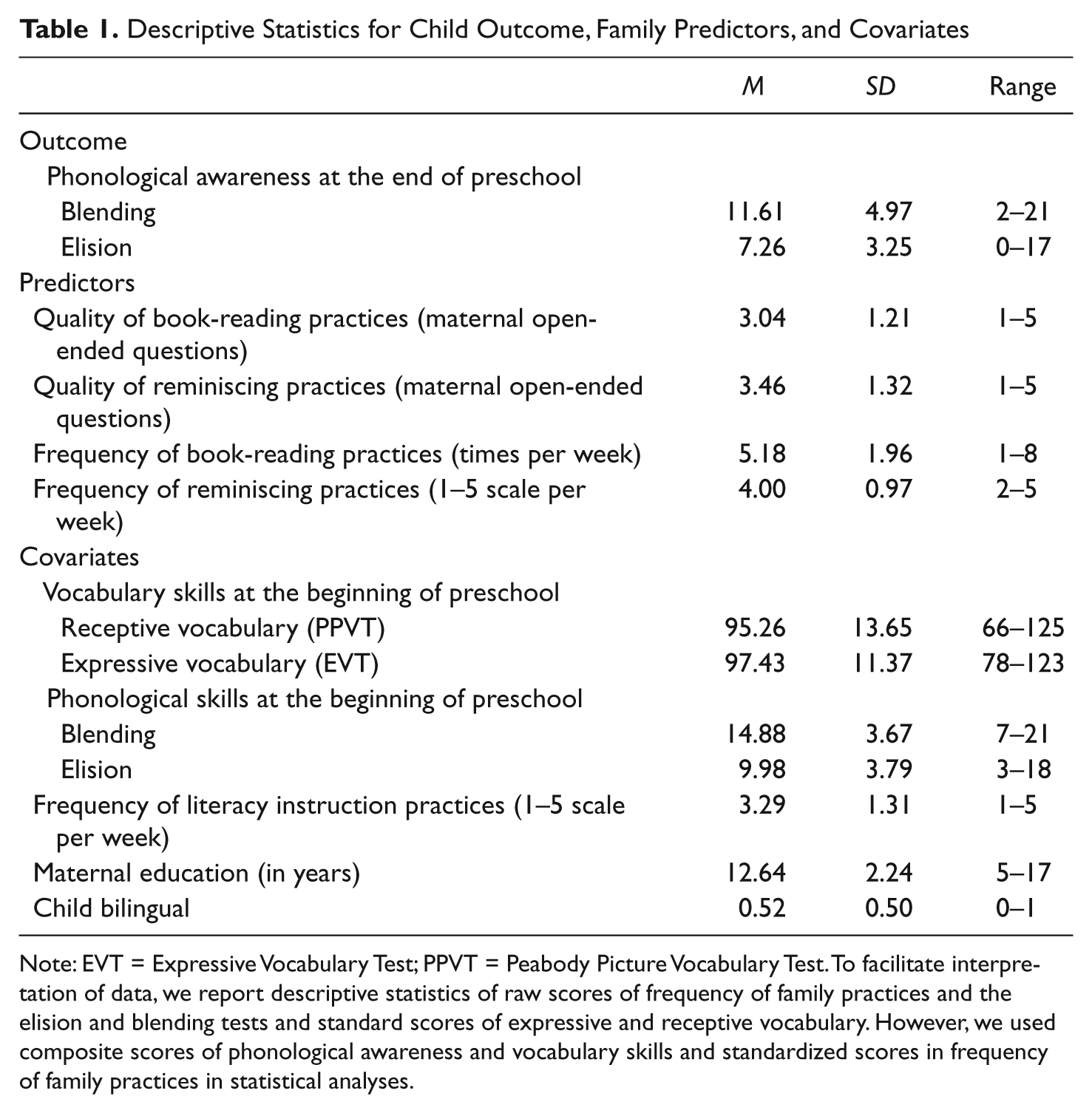
Note: EVT = Expressive Vocabulary Test; PPVT = Peabody Picture Vocabulary Test. To facilitate interpretation of data, we report descriptive statistics of raw scores of frequency of family practices and the elision and blending tests and standard scores of expressive and receptive vocabulary. However, we used composite scores of phonological awareness and vocabulary skills and standardized scores in frequency of family practices in statistical analyses.
Program effects
Some mothers participated in a literacy program after beginning-of-preschool assessments. It is important that this program did not target children’s phonological awareness. We tested whether mothers and children who participated in the program were different from those who did not in frequency and quality of book-reading and reminiscing practices, children’s vocabulary at the beginning of preschool, and children’s phonological awareness at the beginning and end of preschool. A series of t tests yielded no statistically significant differences between these two groups for children’s phonological awareness (all ps > .10). Thus, we clustered all mothers and children into a single group for subsequent analysis.
Child assessment settings at the beginning of preschool
Because 27.7% of children’s assessments at the beginning of preschool were collected at home whereas the remaining 72.3% were collected at school, t tests were conducted to examine differences between these two groups. These analyses yielded no significant differences between children who were assessed at home and those who were assessed at school in their phonological, t(52)= 1.42, p > .10, and vocabulary skills, t(52)= 0.22, p > .10, at the beginning of preschool. Thus, we collapsed them into a single group for subsequent analyses.
Ethnicity, gender, and bilingual status effects
We examined the effects of our main categorical covariates (mother’s ethnicity, child gender, and child bilingual status) on our main predictors and outcome using a series of analyses of variance (ANOVAs). We found no significant differences among non-Hispanic White, Hispanic, and non-Hispanic Black mothers, boys and girls, and bilingual and monolingual children for the following variables: phonological awareness at the beginning and end of preschool, vocabulary at the beginning of preschool, and frequency and quality of mothers’ book-reading and reminiscing practices (all ps > .10). Hence, mother’s ethnicity, child gender, and bilingual status were not included in further analyses.
Associations among predictors and covariates
Mothers who reported frequently reading books with their children also reported frequently reminiscing with their children (r = .32, p < .05). However, mothers who engaged in more high-quality talk during reminiscing did not necessarily engage in high-quality talk during book reading (r = .14, p > .10). Moreover, mothers’ quality of talk tended to be higher in reminiscing than in book-reading practices, t(52)= −1.86, p = .06. There were no significant associations between frequency and quality within family practice. Mothers who reported frequently reading books with their children did not necessarily ask more open-ended questions extending the reading (r = –.17, p > .10). Similarly, mothers who reported frequently engaging in past-event conversations with their children did not necessarily ask more open-ended questions extending the conversation (r = .16, p > .10). Maternal education was associated only with quality of book-reading practices (r = .29, p < .05).
Relation Between Maternal Practices and Children’s Phonological Awareness
We fitted several multilevel models to examine the effects of maternal predictors and covariates on phonological awareness. Table 2 shows the standardized parameter estimates and goodness-of-fit statistics for several models describing the relation between children’s phonological awareness and maternal predictors and selected covariates. In Model 1, we included the effects of beginning-of-preschool skills (vocabulary and phonological skills) on children’s phonological awareness at the end of preschool. Vocabulary and phonological skills at the beginning of preschool were positively related to phonological awareness at the end of preschool. In Model 2, we added the main effects for our demographic variable: maternal education. We found that the effects for vocabulary and phonological skills at the beginning of preschool remained significant, but there was no effect for maternal education on phonological awareness. In Model 3, we added the main effects of our predictors, frequency of book-reading and reminiscing practices, and the covariate, frequency of literacy instruction practices. None of these significantly predicted children’s phonological awareness after controlling for the effects of vocabulary and phonological skills at the beginning of preschool. A general linear hypothesis test showed that the fit of Model 3 (37% of variance) was not any better than the fit of Model 2 (33% of variance), F(2, 50) = 2.1, p > .10. Thus, we dropped the frequency variables from the model. In Model 4, our final model, we added the main effects of quality of book-reading and reminiscing practices. We found that quality of reminiscing, but not of book reading, was positively related to children’s phonological awareness even after accounting for the significant effects of vocabulary and the effects of phonological skills at the beginning of preschool. Our final model accounted for 42% of variance in phonological awareness. In a subsequent model we tested for the interactive effects of vocabulary and quality of reminiscing practices and found that they were not statistically significant (β = .08, p > .10). Taken together, these findings suggest that mothers who asked more open-ended questions in their conversations with their children about past events at the beginning of preschool had children with better phonological awareness at the end of preschool. Children’s vocabulary at the beginning of preschool was also uniquely associated with phonological awareness at the end of preschool.
Taxonomy of Multilevel Models Describing the Effects of Book-Reading and Reminiscing Practices on Children’s Phonological Awareness Controlling for Covariates
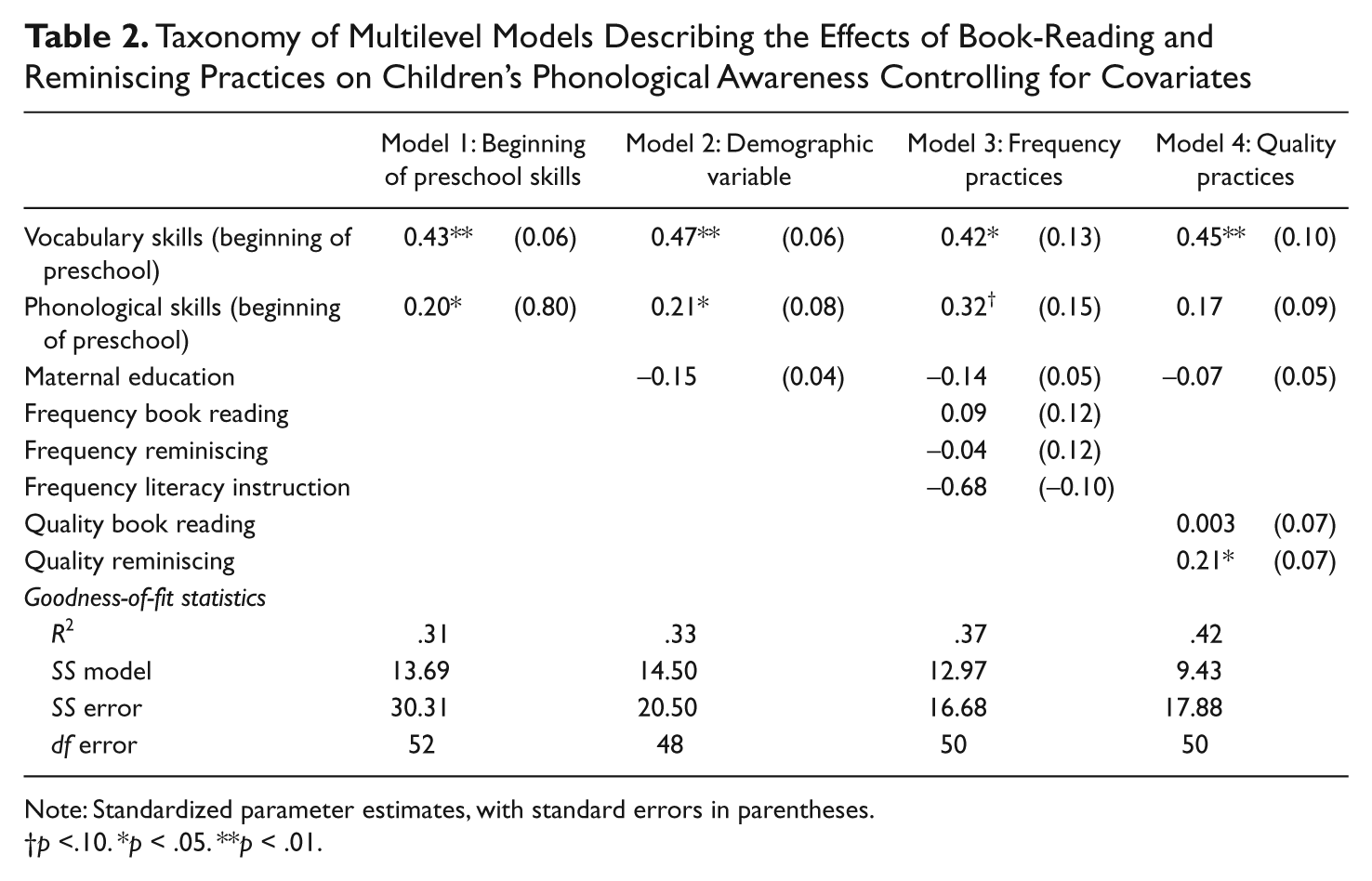
Note: Standardized parameter estimates, with standard errors in parentheses.
p <.10. *p < .05. **p < .01.
Discussion
In this study, we examined whether mothers’ frequency and quality of book-reading and reminiscing practices were associated with preschool children’s phonological awareness skills when controlling for vocabulary. Frequency and quality of book reading were not related to children’s phonological awareness once vocabulary and phonological skills at the beginning of preschool were taken into account. Mothers who read more books to their children and those who asked more questions extending the reading did not necessarily have children with greater phonological awareness at the end of preschool. Given the well-documented link between phonological awareness and vocabulary skills (Avons et al., 1998; Bowey, 2001; Gathercole et al., 1999; Jusczyk, 1993; McBride-Chang et al., 2005; Metsala, 1999; Wise et al., 2007), this study contributes to the literature on reading acquisition by determining that, at least for this low-income and ethnically diverse group of families, frequency and quality of book-reading practices are not directly linked to development of phonological awareness even when controlling for children’s vocabulary. In the past, studies that found a link between phonological awareness and book-reading practices (Raz & Bryant, 1990) did not control for vocabulary.
Our results are also in line with Sénéchal and LeFevre’s (2002) longitudinal study showing no links of parental book-reading practices to children’s phonological awareness. Despite the differences in demographic characteristics of the samples and methodologies measuring book-reading practices, both studies showed this home literacy practice around print is not directly associated with children’s development of phonological awareness. In Bus et al.’s (1995) meta-analysis, book-reading practices, measured as frequency or composites, were related to phoneme blending, but not segmenting. In this study, a composite measure of phonological awareness, which included both deletion and blending skills, was not related to the frequency or quality of low-income mothers’ book-reading practices. It is important to note, however, that book-reading practices might be linked to other aspects of phonological awareness (i.e., rhyming) not included in this study. In addition, our findings do not rule out the positive links of specific book-reading practices to phonological awareness. Other studies have shown that it is possible for parents to practice book reading in ways that promote phonological awareness (Chow & McBride-Chang, 2003; Ezell, Justice, & Parsons, 2000).
Quality of reminiscing, on the other hand, was related to children’s phonological awareness, even after controlling for vocabulary and phonological skills at the beginning of preschool. Mothers who asked more open-ended questions elaborating on the past event had preschool children with increased phonological awareness. The unique link between quality of reminiscing, but not of book-reading practices, and phonological awareness indicates that parent–child conversations focusing on family experiences and not on print are associated with children’s emerging ability to discriminate and manipulate sound units in the structure of language. How can we explain the specific link between quality of reminiscing practices and phonological awareness? Several potential explanations might be considered. At face value, reminiscing and phonological awareness seem to be conceptually unrelated. Phonological awareness involves metacognitive abilities, which are fairly abstract, requiring an appreciation of the relation between the formal aspects of language and meaning (Doherty & Perner, 1998; Farrar & Ashwell, 2008). In the phonological awareness tasks we used in this study, that is, elision and blending, the child must attend to the sounds of words, not just their meaning. Indeed, phonological awareness reflects the quality of phonological representation (Brady, 1997; Goswami, 2000; Metsala & Walley, 1998; Snowling, 2001). In contrast, reminiscing is a powerful language and meaning-making context, in which children learn about narrative structures, vocabulary, and memory processes. When the mother and the child recount and reconstruct personal experiences, the focus is on the content of these words. The child acquires narrative structure through meaning-making processes, which parents facilitate by posing questions to the child.
One way to explain the relation between quality of reminiscing and phonological awareness is through the discrepancy principle (A. McCabe, personal communication, October 15, 2011). It might be that early and regular exposure to rich conversations about the past strengthens children’s speech perception and that developmental advances in these speech-processing skills are associated with children’s phonological awareness skills. Specifically, mothers who engage in high-quality reminiscing practices typically restate what the child said previously (Haden, 1998) and then follow up by asking an open-ended question that adds new information about the past event (see Fivush et al., 2006). Thus, the child who is engaged in high-quality reminiscing must distinguish familiar sounds (mother’s restatement of what the child just said) from novel sounds (mother’s elaboration in the form of an open-ended question). This ability to discriminate sounds that is fostered in reminiscing might be associated with children’s ability to discriminate discrete units of speech in tasks assessing phonological awareness such as blending and elision (see Cazden, 1972).
Another related explanation is based on a body of research demonstrating the complex and significant interrelations among the various strands that contribute to language and literacy acquisition, including oral language and print skills related to learning to read and write (the French braid metaphor; Dickinson & McCabe, 1991; Scarborough, 2001). According to the comprehensive language approach to early literacy (see Dickinson et al., 2003), oral language and print-related skills are interdependent systems that become increasingly intercorrelated over the preschool and into the elementary years. They share common cognitive processes but also have unique cognitive components. For example, there is strong evidence for the facilitative relation among children’s oral language, phonological abilities, and knowledge about print (Dickinson et al., 2003). These connections emerge before the child receives formal instruction in reading and writing and continue throughout the school years. Past-event conversations are a rich source for learning complex language—including syntax, requiring the use of a diverse set of verb forms, semantics, by way of conveying what happened, and pragmatics, with the focus on the speakers’ perspectives and internal states (Fivush & Nelson, 2006). Hence, from this theoretical perspective, it is possible that reminiscing supports children’s higher-order language skills and that these abilities, in turn, are associated with phonological awareness.
It is important that the two alternative explanations to the link between reminiscing and phonological skills previously discussed have a correlational rather than causal nature and are not mutually exclusive; reminiscing practices could simultaneously be associated with children’s phonological awareness directly via speech perception and, indirectly, via their vocabulary and higher-order language skills. More research is needed to understand the specific mechanisms through which quality of reminiscing conversations is linked to phonological awareness.
A third possibility is that mothers who use high-quality language features in reminiscing are also engaging in more explicit or implicit teaching of sounds in other contexts and that it is this practice that is associated with phonological awareness (Reese, Divers, & Robertson, 2011). In our study, we included a self-reported measure of literacy instruction practices at home. This measure involved frequency of teaching children to print words and to read words. Similar to Sénéchal and LeFevre (2002), we did not find that frequency of teaching practices was related to children’s phonological awareness. It is important, however, that we used only a self-reported measure, and we did not assess quality of these teaching practices. It is possible that, similar to reminiscing, it is the quality of these teaching practices and not the amount that matters in supporting phonological awareness skills. It is also possible that frequency of teaching practices does matter, but that a self-reported measure is not adequate for the task. Self-reported assessments about teaching at home depend on whether parents see themselves as teachers explicitly. Thus, they might not capture the full picture of the frequency with which literacy instruction practices occur are at home. Some parents might teach but do it in an implicit manner and do not consider themselves as engaging in “teaching practices” and, hence, do not report it (Stipek, Milburn, Clements, & Daniels, 1992; also see DeBaryshe, 1995; DeBaryshe, Binder, & Buell, 2000). Future research should address whether frequency and quality of teaching practices are related to children’s phonological skills.
We acknowledge that other factors at home for which we did not control may also mediate the relation between reminiscing practices and the development of phonological awareness, particularly in this low-income and ethnically diverse sample. For example, we did not ask whether parents and children engaged in daily routines that involve playing with language and singing rhyming songs or interacting around rhyming books and/or other books that include wordplay or playing with language. These and other characteristics of the home environment may account for variation and growth in preschool children’s phonological awareness.
It is important to note that mothers who reported a high frequency of book reading were not necessarily using high-quality features of language as measured by the number of open-ended questions extending on the reading. Similarly, mothers who reported frequently engaging in reminiscing practices were not necessarily using high-quality features of language, as demonstrated in the number of open-ended questions elaborating on the conversation. Future research should examine whether quality and frequency of mother–child past event conversation are related to mother–child conversations about the present and future (Atance & O’Neill, 2005).
Our findings have important implications for supporting school readiness in children from low-income and ethnically diverse families. Many teachers and practitioners who serve this population are encouraged to focus primarily on book reading as a means of preparing children for school. Results from this study indicate that focusing on the richness of the language environment that children are exposed to at home, particularly their conversations about past events, might also play an important role in school readiness (Sparks & Reese, 2012). The fact that mothers in this sample tended to engage in more high-quality talk during reminiscing than book reading might suggest that reminiscing is a privileged and underexplored family practice supporting children’s language and early literacy development.
Footnotes
Appendix
Acknowledgements
We thank all the members of the Preschool Language Project team, the Head Start Centers, the Head Start Administration, and the parents and children who participated. We are also thankful to Catherine Snow, John Willett, and the participants of the “snowcats’ meetings.”
Declaration of Conflicting Interests
The author(s) declared no potential conflicts of interest with respect to the research, authorship, and/or publication of this article.
Funding
The author(s) disclosed receipt of the following financial support for the research, authorship, and/or publication of this article: This research was funded by a National Institute of Child Health and Human Development grant to the third author.
Notes
Bios
References
Supplementary Material
Please find the following supplemental material available below.
For Open Access articles published under a Creative Commons License, all supplemental material carries the same license as the article it is associated with.
For non-Open Access articles published, all supplemental material carries a non-exclusive license, and permission requests for re-use of supplemental material or any part of supplemental material shall be sent directly to the copyright owner as specified in the copyright notice associated with the article.
