




Abstract
This article provides micro analysis of one representative incident from a larger qualitative study to examine how third-grade bilingual students and their teacher negotiated academic disciplinary and popular culture discourses in a social studies unit on Jamestown and Pocahontas. Informed by discourse and linguistic analyses, this study explores the competing dominant and nondominant discourses as they intersected and overlapped in the complex literacy practices in this classroom. Ms. Montclair’s instruction was shaped by the textbook’s approach to social studies and accountability pressures of testing and content coverage. Yet the students drew from everyday popular resources in their thinking, taking up nonacademic discourses to understand content. This research explores the following questions: (a) What are the predominant discourses evident in the official curricular text and teacher’s enactment of it? (b) What are the discourses evident in children’s everyday resources drawn on to make sense of the school text? (c) How do specific linguistic features make possible these discourses and perspectives? Findings demonstrate that students navigated across multiple discourses that were different but represented dominant culture. As discourses intersected in class, participants provided a level of critical analyses but did not deeply take up nondominant perspectives despite their own positioning from linguistically and culturally nondominant backgrounds. By showing the complexity of literate and discursive practice, this article contributes to understandings of how bilingual and English language learner students confront the demands of academic disciplinary language, draw on their own resources to make sense of content, and require explicit instruction on language and social justice.
In diverse classrooms where multiple languages and cultures intersect, students encounter overlapping and conflicting discourses—ways of talking and thinking that include value and belief systems—from the academic curriculum and instruction, the specific discipline, and their own resources that come into contact and place demands on teaching and learning (Moje, Collazo, Carrillo, & Marx, 2001). As students navigate across these varied discourses, they negotiate particular ways of thinking and talking and bring together various partial and biased sources of knowledge. Since academic discourses are privileged in schools and broader society, students need to learn academic ways of talking and thinking to be successful in school and to open doors for future professional opportunities. Yet the study of academic discourses alone may provide an incomplete picture since students’ everyday discourses are important in their lives and in social contexts (Barton & Tan, 2009; Lee, Spencer, & Harpalani, 2003; Orellana, 2001). This study analyzes the overlapping and diverging discourses in a social studies unit on Pocahontas experienced by bilingual third-graders and their teacher including the language forms and functions selected by authors that may have biased students’ readings and the lack of critical perspectives in these discourses.
It is important for teachers to understand the varied discourses of narratives, especially when working with English language learners (ELLs) and students from nondominant language backgrounds who may need apprenticeship in the ways of thinking and talking that are highly valued in U.S. schools and society (Gee, 2007). In today’s assessment-centered educational environment in which No Child Left Behind requires that all students take high-stakes tests in English, Bale (2010) argues, “Obviously, if you don’t understand academic English you’re not going to pass” (p. 38). Although learning to use academic English in school is a pressing problem, it is also a complex one for a variety of reasons. Despite the imperative issue of academic English in testing, educators must be cautious of how urgency can limit careful investigation and deep understanding (Florio-Ruane, 2002). A singular focus on academic language may misrepresent the contact zone that is today’s classroom—replete with rich literacy practices, complex teaching contexts, and overlapping, competing, and changing discourses. Beyond developing academic language, it is also vital for children to understand the partiality of privileged literate practices and to value a range of not only dominant but also nondominant discourses (Moje et al., 2001). Through linguistic and discourse analyses, nuanced research can articulate how students navigate across academic and everyday texts in ways that reveal issues of privilege and power as they intersect in school literacy practices.
This article presents findings from a study about bilingual third-graders and how they read across linguistic, social, and cultural features of academic and everyday texts in social studies. The purpose is to present findings focused on a micro analysis of one particular representative incident from a larger study. The research questions are the following: (a) What are the dominant discourses evident in the official curricular text and teacher’s enactment of it? (b) What are the discourses evident in children’s everyday text and its enactment during their content area literacy practices? (c) How do specific linguistic features make possible these discourses and perspectives?
Theoretical Framework
In this article, I draw from the following three approaches to explore a study on third-grade content literacy in a bilingual social studies class: (a) academic discourses and ELL/bilingual learners, (b) functional linguistics and the content area of history, and (c) sociocultural contexts of language and content learning.
Academic Discourses and ELL/Bilingual Learners
In this research, I draw from discourse theoretical perspectives to explore how a third-grade bilingual teacher and her students navigated across multiple discourses to enact particular types of knowledge in social studies classes. In particular, I take up discourse analytic approaches (Gee, 2001, 2011c) and functional linguistics (Schleppegrell, 2004), which provide ways of uncovering how English structures are situated and positioned in particular social and cultural contexts.
Discourses are ways of speaking, reading, writing, viewing, valuing, believing, and presenting oneself (Gee, 2007). They are “ways of being” that bring together beliefs, values, attitudes, words, acts, and social identities in addition to visual cues, gestures, body positions, and appearance or apparel (Gee, 2001, p. 526). Gee’s method of discourse analysis recognizes that all language use is political and therefore all discourse analysis is critical, but he does not call his approach critical discourse analysis (Gee, 2011a). His approach explicitly recognizes multiple modes of communication and their interconnectedness. Discourses in a classroom may include, for example, multiple modes of representation such as written texts, films, movie storybooks, attire, graphics or drawings, conversations, and utterances. This multistrand approach to analysis of discourse lends itself to the study of classrooms, which are contact zones of many voices, identities, and artifacts.
Gee (2001) points out that individuals are not particularly consistent or well integrated in terms of bringing discourses together. There is always some degree of conflict or tension—for example, between dominant and nondominant discourses—which can at times affect the acquisition of discourses. Dominant discourses may bring acquisition of social “goods” such as money, prestige, or status when mastered at the appropriate place and time, such as discourses of academic disciplines or Hollywood film industry. Nondominant discourses that tend to bring solidarity with specific social networks but not wider status or social goods in the broader society, such as discourses of native tribes or feminist movements. Gee (2001) claims that discourses cannot be overtly taught but instead must be apprenticed while scaffolding the novice’s growing ability to work within the discourse.
Delpit (2001) takes issue with the idea that discourses cannot be overtly taught because it indicates that those who wish to get access to goods and status from dominant discourses cannot explicitly learn the “rules” for acceptance into certain discourses but must have been socialized or born into them. However, because discourse is related to tacit cultural knowledge and social identity, it is not easily reduced to rules for appropriate ways of communicating appropriate to particular situations. Thus, teachers can feel powerless to structure teaching around analysis of discursive parts or provide explicit explanation to make these dominant ways of talking accessible to all children. In addition, Delpit critiques the suggestion that adopting secondary dominant discourses will necessarily conflict with primary home discourses or that students would have to deny or negate their primary discourses to acquire the status discourses. Are conflict and tension always part of learning privileged and high-status dominant discourses? If so, would it further oppress nondominant students to teach them dominant discourses? Can students take up dominant discourses and repurpose them for their own ends? This study seeks to complicate the dichotomy of dominant and nondominant, explore complexities in how students take up dominant discourses for their own purposes, and examine opportunities for teachers to explicitly help students navigate the conflicting discourses and potentially acquire multiple discourses in the classroom.
Gee (2007) claims multiple discourses are simultaneously at work in schools and that these stand in complex relation to each other. This makes it challenging to figure out which discourses are privileged in certain educational situations and how to navigate across them successfully in an academic setting. For example, there are various discourses of evaluation (that sort students into categories such as good, bad, disabled, linguistically proficient or not) and membership in the specific cultures of classroom, program, school, and “exterior” disciplines or professions as they are enacted outside the school (p. 174). These academic discourses and the “culture of public education” are typically more familiar to mainstream (White, middle class, native English speakers) students than to ELLs and, thus, are often navigated more smoothly and skillfully (Mays, 2008). Heath says in that regard that “[t]extbook questions that require straightforward answers often draw inappropriate responses from children whose primary Discourse has taught them to value metaphor, imagination, and hypothesized answers” (Heath, 2000, cited in Mays, 2008, p. 416).
In public schools, replete with restrictive curriculum and high-stakes testing, teachers and students are challenged to reconcile and negotiate conflicting and intersecting academic and everyday discourses, not leaving students’ rich home and community discourses at the door yet helping students fulfill academic expectations. However, since the teaching and learning of ELLs/bilinguals involves power, social class, and language status, educators seriously question how easily or in what ways academic discourses can be taught. Valdés (2004) argues, “The type of language that is valued in academia is part of an identity kit acquired as a result of legitimate participation in the practices of the dominant” (p. 120). Thus, academic discourses involve not only grammatically correct use of language or stylistic variations in written and oral texts but also negotiation of the social contexts of school, involvement in power-laden relationships, and appropriation of new identities and ways of being. Bilingual students benefit from instruction in which literacy events allow practice of extended discourse, engage students in authentic dialogue with others (both native and nonnative speakers), embed language practice in deeply meaningful and rich content contexts, and explicitly discuss the multiple dominant and nondominant discourses that clash and comingle in social contexts of school (Bartolomé, 1998).
Gee’s theory of “social languages” highlights functions of language and grammar as social practice. “That is, grammar is not something that people inherit, but something they design to create certain identities and relationships” (Gee, 2011a, p. 11). One of the theoretical perspectives that influenced Gee’s work was Halliday’s theory of grammar and systemic functional linguistics (Halliday & Hasan, 1989). In this theory language users are viewed as agents who make decisions about how to use language in socially functional ways, thereby focusing on the choice and agency of writers and speakers (Rogers, 2005, 2011). Functional linguistics is closely related to Gee’s perspective on discourse analysis (Gee, 2001, 2002, 2007), in which he specifically views all language use as political and therefore highlights identity, status, relationships, distribution of social goods, and power as essential features of discourse analysis that, he says, “ought to be critical” and attend to “political” aspects (Gee, 2011a, p. 29). Discourse involves much more than written or spoken language, as it is constructed through nonverbal, visual, and other means (e.g., gestures, images, pictures, spatial arrangement); however, language is central to how meanings and values are conveyed, thereby requiring close examination of linguistic structures and how they are used in subtle and implicit ways to put forth particular meanings. Therefore, in the next section, functional linguistics is discussed as an approach, used along with discourse analysis, for delving deeper into how specific perspectives and understandings are carried out through written text.
Functional Linguistics in the Content Area of History
Functional linguistics is useful for studying specific language forms in context and for understanding how speakers and authors utilize linguistic features as tools to enable certain kinds of meanings. Taking this approach, Schleppegrell (2004) describes how students encounter general school-based language demands across subjects and grade levels, but they also face discipline-specific language demands in subjects such as history in which language features are “functional for realizing the purposes of these and other disciplines” (p. xi). History, in particular, is a rich example of the heavy literacy demands posed by discipline-specific texts because knowledge is often garnered through texts and cannot be easily constructed through hands-on means. English learners, in particular, are challenged by unfamiliar uses of language that often obscure agency and condense information into densely constructed texts. Schleppegrell, Achugar, and Oteíza (2004) focused on creating linguistic analysis tools for use by teachers and students in middle school classrooms to scaffold ELLs in developing English proficiency in specific disciplinary contexts. Using the tools of functional linguistics, students can gain access to academic English “while critically assessing the explanations of events and participants that constitute the discourse of history” to “recognize the positions that the historians expect them to take in reading the text, giving them the choice to accept or resist these positionings” (Schleppegrell et al., 2004, p. 76). An author’s language choices shape what students learn about history, and analyses of their linguistic decisions can reveal how power is infused in relationships between dominant and nondominant groups.
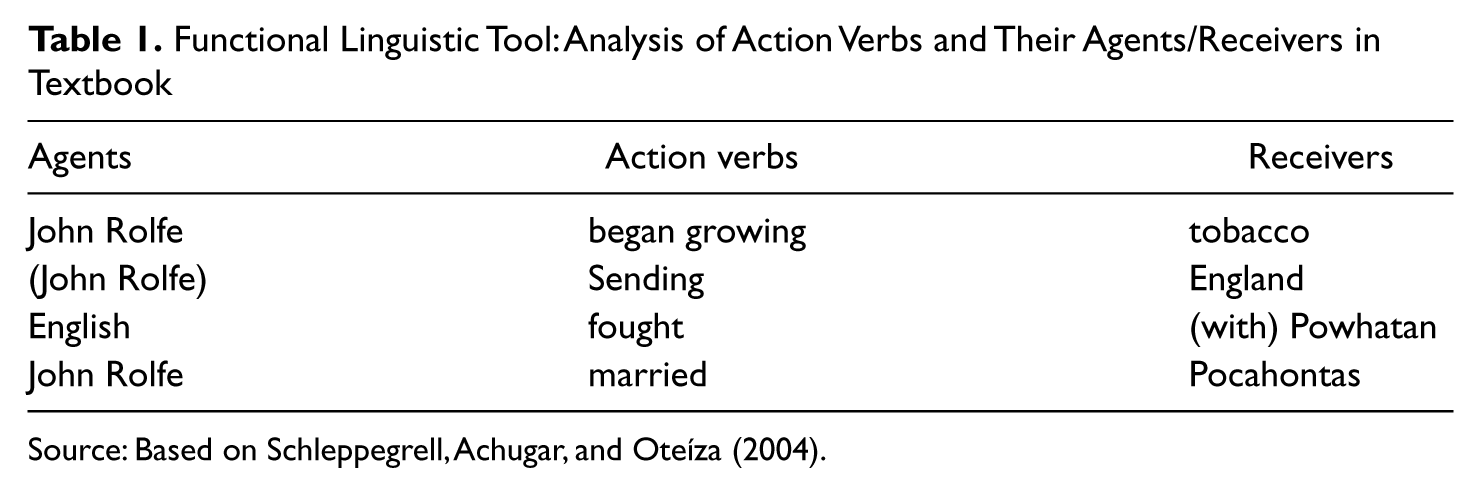
Schleppegrell et al. (2004) propose, “Recent trends in L2 research suggest that a focus on form can be important for students’ language development . . . [but] should be done in ways that are not isolated from the communicative context” (p. 70). Their work focuses directly on ELLs and middle school history textbooks, exploring instructional approaches for teachers to explicitly attend to linguistic forms in functional contexts of the content area. Rather than making content less difficult for ELLs, they recommend functional linguistic tools (see Table 1 and 2 as examples) to scaffold reading of grade-level text. In another example, although focused on science as a content area, Ciechanowski (2009) also focuses on the textbook but demonstrates how disciplinary and popular culture discourses intersected in a third-grade classroom. Using a functional linguistic perspective, the author analyzed the curricular text in a unit on glaciers uncovering language forms employed to enact scientific ways of thinking emphasizing precision, objectivity, naming processes or nominalization, and classifying and the popular culture text Ice Age, shedding light on the entertainment discourses involving high-speed action, emotion and suspense, and character animation. Ciechanowski suggests using children’s self-chosen popular culture stories in the content area classroom as a potential asset to understanding discourses at school.
Functional Linguistic Tool: Analysis of Action Verbs and Their Agents/Receivers in Textbook
Source: Based on Schleppegrell, Achugar, and Oteíza (2004).
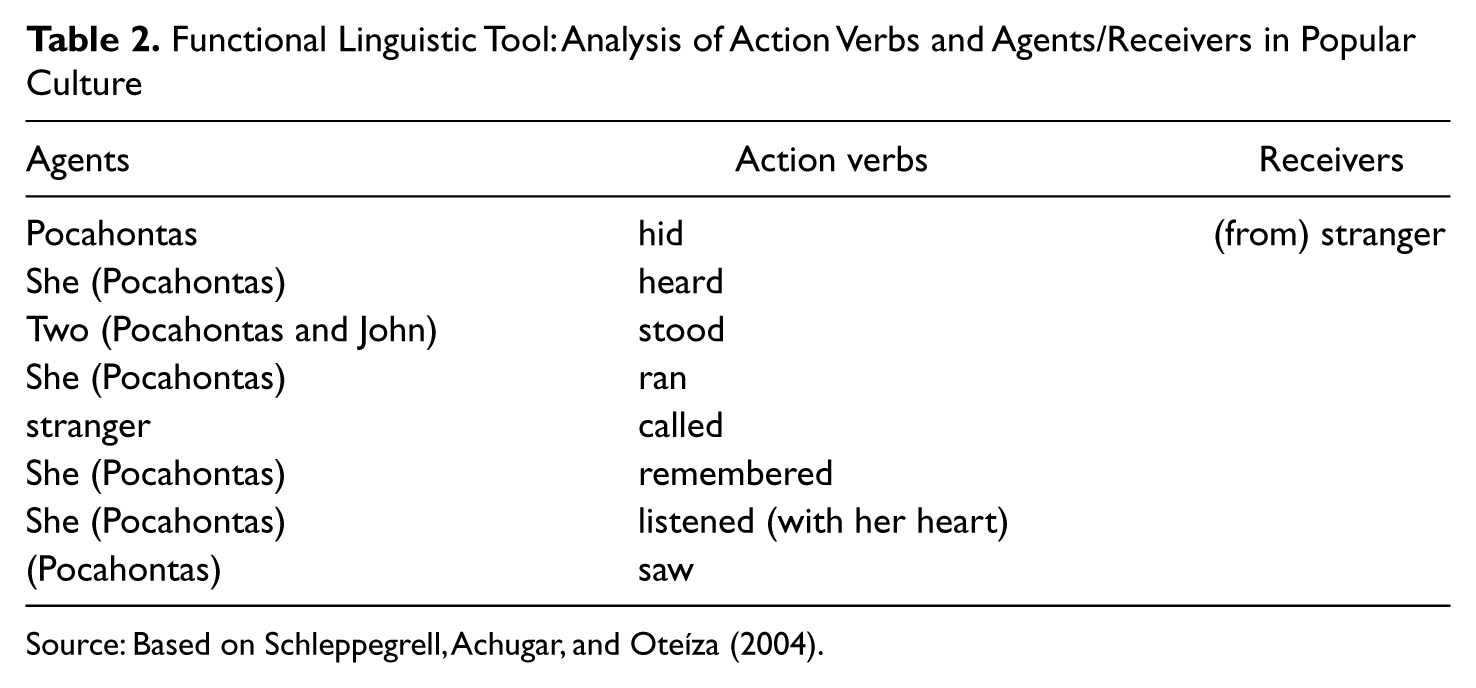
Functional Linguistic Tool: Analysis of Action Verbs and Agents/Receivers in Popular Culture
Source: Based on Schleppegrell, Achugar, and Oteíza (2004).
Levstik (1989) describes the importance of story or narrative to children, especially in their learning of history. Her case study centers on a fifth grader’s learning from historical fiction that extends beyond the textbook. Levstik develops five conclusions from her study: (a) a well-crafted narrative provided a sense of wholeness, (b) the structure of narrative, with its crisis and conflict, represented alternative ways of understanding history, (c) narrative provided a sense of truth that outweighed a need for historical accuracy, (d) narrative connected to young readers because of its emphasis on humanness, and (e) the subjective response called up by narrative served as a frame of reference for evaluating the textbook. In other words, historical narrative is a powerful force in children’s thinking and shapes their comprehension of academic texts. Wineburg, Mosborg, Porat, and Duncan (2007) also describe the powerful force of children’s popular cultural narrative such as Forrest Gump in students’ understanding of history. They urge teachers to unpack these texts with students and carefully analyze the ways of thinking and talking behind popular culture and school historical texts.
Through functional linguistic analyses, Martin (2002) describes a set of distinctive features of history discourse using student written work and published texts. In this subject area, historical writing includes “packaging time—moving from a series of events to phases, which can then be further compartmentalized through naming—giving us a more technical, ‘thing-ised’ history” (p. 91). In addition to marking time, history tends to be abstract because of the use of linguistic tools that turn activities into things. Describing both scientific and historical discourses, Unsworth (1999) claims history is less technical but more abstract than science. Abstraction comes from historians’ use of grammatical metaphor in which people as agents are effaced and event sequences are nominalized (becoming noun groups) so that noun groups relate to other noun groups (e.g., “Their marriage led to a long time of peace between the Powhatan and the English”; Banks et al., 1997; italicized words are nominal groups). Clustering events together and depicting them as abstract “things” (i.e., noun groups) through their uses of nominalization as linguistic tools enables historians to functionally use language in the subject area to extend description, classify, and qualify concepts in history (Unsworth, 1999). Historians also focus on why events occurred and use grammatical tools to express causality, for example, conjunctions such as therefore, nouns such as reason, and verbs such as lead to. This type of language “allows writers to manipulate agency” and requires readers to “fill in material that was not made explicit” (Martin, 2002, p. 97). Cause and effect can be hidden and obscured through nominalized language so that historians can reframe discussions in their own ways. “In grand narratives, they are elided and submerged, to give a naturalized trajectory of inevitability to mainstream readings of the past” (p. 99). History authors gain control over meaning potentials through skillful and eloquent use of linguistic tools at their disposal, yet readers of such texts such as ELLs may not be fluent or native in their reading of history texts, making the content area opaque and difficult to access.
Sociocultural Contexts of Bilingual Language and Content Learning
A sociocultural approach explores not only the rote or isolated features required for advanced academic language but also the social contexts in which it is taught and learned and how they are infused with power relations and shaped by forces in the immediate and broader contexts (Gutierrez, 1995). Ciechanowski (2011) describes the bureaucratic and political context that shaped third-grade content area instruction in which opportunities for bilingual students to draw from their family, community, and popular culture resources were limited by district mandates and pressure to cover curriculum. Teachers of culturally and linguistically diverse students are often caught in a double bind as they try to draw on students’ cultural resources and engage in culturally relevant instruction, meanwhile facing tension to standardize, transmit knowledge, and administer tests (Achinstein & Ogawa, 2011). Sociocultural theories suggest that educators expand a narrow focus on academic literacy to move beyond restrictive classroom literacy practices and expand singular sources of knowledge “needed to display right answers” in test-like activities (Gutierrez, 1995, p. 22). Singular academic perspectives offer a partial and incomplete picture, whereas if teachers make space for students’ own perspectives and resources, they provide multiple vantage points that can intersect and create new understandings (Banks, 2009).
Children have many experiences in their family and communities that provide knowledge about how the world works, what is important, and how to communicate with others. They gain a wealth of knowledge and strategies that come from their experiences in families, communities, schools, and elsewhere. Moll, Amanti, Neff, and Gonzalez (1992) focus on children’s involvement in and learning from cultural practices within their family, community, and close social networks, highlighting the students’ roles as active, strategic users of funds of knowledge in reading, writing, and thinking. In addition to family and community cultural practices that shape educational experiences, ethnic cultural practices also mediate what and how people learn. Guerra (1998) describes some of the educational experiences of Chicano/as or Mexicano/as in our society. He reports on how several families’ immigration stories affect their children’s opportunities for an advanced education. Furthermore, he remarks, “Unlike most immigrants who come to the United States from countries an ocean away, Mexicanos in this country are never more than a car or bus ride from their original homes” (p. 41). So many Mexican-origin families often visit Mexico each year, sometimes for prolonged periods of time, imposing difficulties but also contributing to youngsters’ funds of knowledge about the world, providing knowledge about two countries, multiple physical and social spaces, and various ways of living (see Ciechanowski, 2011, for an example). As Mexicano/as, many of their ways of thinking and acting are shaped by experiences of immigration, transnational travel, accommodation, resistance, and education in two countries, which may mediate how Mexicano/as (and other Latinos) read, write, and learn in school.
Likewise, bilingual knowledge mediates students’ reading and writing experiences, whether the knowledge is helpful or causes challenges in any particular instance. Mercado (2001) demonstrated through her work with bilingual youth that multiple languages have an undeniable presence in the youths’ literacy practices. She explained, “The written texts produced by students . . . were, in effect, a means of representing themselves within the various social worlds in which they interacted, and in all of these worlds Spanish had an undeniable presence” (p. 172). One of her participants, 12-year-old Indio, used his bilingualism to learn and to create relationships, as he interacted in both Spanish and English. He used Spanish during an English presentation to socialize with peers, explain ideas, and discuss writings. Although his conference participation showed a sophisticated use of academic Spanish even during a presentation in English, his writing sometimes showed that the use of his Spanish led to lack of conventionality in his English. Mercado describes how bilinguals’ multiple languages influence one another, “Spanish is in our English, as English is in our Spanish” (p. 170). Students’ everyday linguistic knowledge includes a rich repertoire of languages and discourses that could be drawn on in literacy tasks in and out of school. Indeed, this study focuses on students who were becoming bilingual and learning academic discourses in both English and Spanish.
The sociocultural contexts of a student’s life interact to create a contact zone in the classroom in which a multitude of discourses overlap and conflict to open opportunities for learning. This study explores the dominant and nondominant discourses surrounding a specific history unit on Pocahontas in which students drew from academic, popular culture, and other discourses. Achieving proficiency in reading and writing disciplinary texts, such as history, is critical for mastering English (and, in this case, Spanish also) in ways that provide access to higher levels of education and to multiple career opportunities at all levels of society. However, much of the research in content area literacy and advanced literacy has focused on middle and high school and beyond (Hinchman & Zalewski, 1996; Lee, 1995; Moje, 2000; Schleppegrell & Colombi, 2002), with fewer studies on discipline-specific language addressing early to middle elementary grades, such as the present study (for examples of science, see Brice, 2006; Gallas, 1995; Varelas, Pappas, Barry, & O’Neill, 2001).
This research focuses on third-grade social studies and explores the discursive and linguistic features of third-grade bilingual students’ understandings of Pocahontas. These analyses of the language and literacy practices shed light on what counts as knowledge in the third-grade social studies classes.
Data Collection and Analysis Method
To study the language and literacy practices of third-grade bilingual students and their teacher, I employed the following methods to gain multiple data sources and used primarily qualitative analytic methods (although quantitative methods were used in the larger study with pre- and postunit tests).
Participants, Site, and Data Sources
Data collection took place in two third-grade bilingual content area classes in a bilingual school in a large urban center in the Midwest. According to its mission statement, Community School (pseudonym) promotes multiculturalism, biliteracy, and academic success through the use of Spanish and English. This is a dual-language immersion school of choice that enrolled 735 students in K−8 grades, with 644 students of Hispanic origin (4% Black, 3% White), 548 limited English proficient or bilingual students, and 611 economically disadvantaged students. The school’s goal is for all students to become literate in Spanish and English, using a 90–10 model in kindergarten (90% instruction in Spanish), decreasing throughout primary to 50–50 by third-grade. In third-grade, students received first and second language literacy, but in science and social studies, the teacher used simultaneous translation in which they read English textbooks with preview and review and simple translation in Spanish. Nearly all handwritten texts were bilingual with side-by-side translations. As the result of my own bilingualism, I could engage fully in English or Spanish with the students or teacher, following the lead of the participant in the moment of interaction.
The study involved a European American bilingual female teacher, Ms. Montclair, who lived in the school’s neighborhood and shared with me her desire to visit students’ homes, connect with their culture, and do relevant hands-on projects in school. I collected data for 6 months, ranging from three to five times per week, resulting in 22 weeks of observation (67 visits and 134 hours of observation). I observed two third-grade classes (of 22 students each, 44 total) of science and social studies taught by the same teacher, with 35 who were participants in the study. Each afternoon, Ms. Montclair instructed one third-grade class while her homeroom class received math instruction from her partner third-grade teacher. The next hour, the classes switched and the teacher repeated the lesson with her homeroom, thus allowing me to observe two classes each visit. Ms. Montclair covered a unit in social studies then switched to science, alternating after each unit, which each lasted approximately 3 weeks. A total of 12 focal students were selected, and I typically sat next to one or two focal students each visit, engaging them in in-process interviews and alternating each visit (but the whole class was observed each time). I observed all children in both classes with varied literacy proficiencies in Spanish and English, engagement levels, and social characteristics but selected focal children (n = 12) for more focused observation and artifact collection in an effort to represent a full spectrum of social and demographic characteristics as they were represented in the general school population (see Appendix A). Focal participants were chosen based on purposive sampling to ensure that I had a sampling of levels and backgrounds (see Appendix A). With the teacher’s input, I selected children from a range of observed ability levels, genders, socioeconomic levels, language dominance, and ethnic groups. I targeted a demographically representative sample with three literacy ability levels (high, middle, and low; four at each level), based on my observations, teacher judgment, and analysis of schoolwork. I also focused on visible participation levels (i.e., contributing to class conversations, being engaged in assigned tasks, or volunteering input) at three levels, high, middle, and low, as depicted in Appendix A.
This study focuses on field notes from in-class observations and transcripts from teacher interviews in addition to analysis of artifacts (i.e., curricular texts, student-chosen texts). Data were gathered using the following sources: (a) classroom observations recorded as field notes, (b) in-process reading and writing interviews with students, (c) interviews with classroom teacher, (d) collection of primary classroom texts, and (e) student artifacts using photocopies and photographs (e.g., class mural).
During each session in the classroom, I not only studied the whole class but also sat at the table with two or three focal students, alternating each visit, and observed what students said or did within the instructional context, recording jottings in the moment, then writing full ethnographic field notes later that day (Emerson, Fretz, & Shaw, 1995). As students worked in small groups or independently, I conducted in-process interviews with questions from a protocol (see Appendix B) that honed in on how students made meaning of texts, from where they drew knowledge, and how they talked about their literacy tasks.
For instance, in the unit of focus in this study, I observed the class discussions around the topic of the Jamestown colony and how many students frequently drew from their own popular culture resources to make sense of it. I examined the pre- and posttest scores of the larger group and had conversations with the teacher about the whole class. Thus, larger patterns about use of texts and sources of everyday knowledge were evident across both classes of students.
Analysis Method
In this project, multiple methods were used including constant comparative analysis (CCA; Glaser & Strauss, 1967), discourse analysis (Gee, 2007, 2011b, 2011c), and functional linguistic analysis of texts (Derewianka, 1990; Halliday, 1973; Schleppegrell, 2004). CCA was used to articulate broad patterns across data in the larger study, then discourse and functional linguistic analyses were employed to more closely analyze how conversation and texts shaped instruction and learning. I used discourse analysis (Gee, 2007) to analyze oral and written data (i.e., transcripts of teacher interview, published curricular texts, student-chosen texts, written field notes of student talk, and artifacts) to explore teacher, student, and author perspectives underlying their literacy and language practices. Functional linguistic analysis entailed careful analysis of syntactic structure, including nouns, verbs, subjects, and objects. According to Derewianka (1990),
[A] functional approach looks at how language enables us to do things—to share information, to enquire, to express attitudes, to entertain, to argue, to get our needs met, to reflect, to construct ideas, to order our experience and to make sense of the world. (p. 4)
This study is situated in a larger study that focuses on literacy in the content areas of science and social studies to analyze children’s use of sociocultural resources to make sense of content texts and school curriculum and instruction (Ciechanowski, 2009, 2011). It addressed the following questions: What is the nature of third-grade science and social studies? Are disciplinary discourses evident in instruction and content texts? What sociocultural resources do students draw on in science and social studies, and how do these shape their content literacy practices? Within the larger study, first CCA was used to code field notes, artifacts, pre- and postunit assessments, and transcripts to identify dominant themes across the data. For example, the following codes were used: instructional frameworks, dominant texts, cross-disciplinary experiences, challenges of textbook, instructional methodology, discourses of the natural and social sciences, how scientists/historians work, scientific processes, popular culture, family experiences, ethnicity/homelands, church, children’s literature, and Spanish/English use. To code data and build theory using CCA, I did the following: (a) coded across the data with multiple categories and compared incidents within each category (e.g., students drew from many categories of resources, largely popular culture and family, yet many cartoon resources had inaccuracies or romanticized ideas); (b) integrated many properties of the category into unified whole to create some theoretical sense (e.g., not all popular culture resources were the same, as fictional and comedic ones were marginalized in class); (c) pared down the categories into a smaller number of higher-level concepts with tight and focused names for categories (e.g., popular culture resources were situated in informational/nonfiction or comedic/fictional discourses); (d) Wrote theoretical assertions and subassertions that captured the range of incidents (e.g., content area contexts were a contact zone of multiple academic and popular culture discourses across which students navigated and of which the teacher made use or not). I used key linkage charts (Erickson, 1986) to organize the data and construct general assertions and subassertions. As I analyzed dominant themes or patterns, I purposively chose written data excerpts to analyze discursively as a way of both testing and expanding on or further analyzing the themes and patterns.
As these broad patterns became articulated, discourse analysis was employed to confirm or disconfirm the patterns, by closely focusing on oral discussions and written texts to describe how social practices, identity, power and agency in relationships, politics and distribution of social goods, ways of thinking, forms of knowledge, and connections to disciplines and student lives were evident in specific incidents and passages (Gee, 2011c). One primary theme found in the data was the dominance of popular cultural texts as sources of knowledge in children’s thinking about social studies topics and the marginalization of these sources in the classroom given the presence of discourses of accountability and curriculum coverage (see Ciechanowski, 2011). For example, the children had repeated discussions about the movie Ice Age and the curricular topic of glaciers, so these incidents and related popular culture and textbook passages were discursively analyzed to reveal the disciplinary and Hollywood discourses and intersections as students navigated across them (see Ciechanowski, 2009). I systematically considered the sources of constraint on the discourse and analyzed why the texts had specific forms and functions.
In addition, functional linguistics was used to identify particular grammatical forms (i.e., verbs, nouns) that carried out the author’s intentions and purposes in a functional way. Following the methodology of Schleppegrell et al. (2004), in a unit on Jamestown in which popular culture and academic resources intersected, for example, I analyzed the verbs in the textbook passage about the historical figures Pocahontas and John Rolfe, categorizing them as action, saying, thinking/feeling, and relating verbs. Then I described participants in the historical passage and, by focusing on action verbs, explored the relationship between the doers and recipients of the actions (see Table 1), thereby uncovering power relations and agency among participants and their historical actions. A passage from the student’s self-chosen popular culture Disney text was also selected—an excerpt was purposively selected that represented the focal relationship between Pocahontas and John Smith because students specifically talked about their romantic relationship and love for each other—and analyzed using functional analysis employing the methodology of Schleppegrell et al. (2004), as described above (see Table 2). Through detailed exploration of language, I analyzed various discourses across which students navigated and the complex linguistic demands and functional contexts in each content area. By analyzing language forms in focal selections of text—both from academic and student-selected texts—this study provides insight into the kinds of language that children navigated in their daily literacy practices and how these particular linguistic features expressed particular meanings that are implicit within the text. A close and careful analysis of key texts demonstrated various discourses and sources of knowledge from which students drew in their content area literacy practices.
Findings
The findings from the larger study and the case reported here indicate that the textbook (and Ms. Montclair’s use of it) espoused dominant academic and disciplinary perspectives, whereas students also drew from other perspectives, particularly nonacademic popular narratives, in their interpretations of content texts. This particular case provides data on the neutralized textbook passages on the Jamestown colony in juxtaposition with student-chosen Disney narratives of Pocahontas. Both types of texts drew from mainstream dominant perspectives, albeit different ones (i.e., academic school-based and popular Hollywood-based ones), with particular language choices that enabled these positionings. Student and teacher discussion and recognition of multiple perspectives centered on the two dominant mainstream viewpoints that were evident in class.
This study primarily focuses on one particular unit of study as an exemplar of various content area units studied, centered on Pocahontas and the building of the colony at Jamestown, although similar themes around academic and popular narratives were present in the larger study. In this section, the following patterns are addressed: (a) the instructional context, (b) ways of thinking in social studies, (c) ways of thinking in a popular princess love story, and (d) intersections across the multiple perspectives and how these relate to discourse practices and identity. In the first section below, the instructional context is described, reflecting the tensions of a teacher who believed that effective multicultural teaching involved tapping into students’ cultural knowledge but who also faced accountability measures that shaped her practice.
Instructional Context: Discourses of High-Stakes Testing
Ms. Montclair demonstrated keen awareness of accountability and high-stakes testing, especially in middle- and upper-elementary grades. One of Ms. Montclair’s regular practices was to administer postunit tests after each social studies or science unit, which primarily consisted of multiple-choice and short-answer-response questions drawn from material from the textbook chapters. One of her stated purposes for the tests was to prepare students for the standardized tests they would encounter as they proceeded through their school years. In this particular exemplar, on a postunit test about the Jamestown colony and the marriage of Pocahontas to John Rolfe, the students were given a constructed-response question in which their responses were expected to mirror the textbook as the source of knowledge. However, many students responded in ways that were based not on knowledge from the curriculum but on their own sources. On the unit posttest, when some students answered a question with knowledge not in line with the academic expectations, the teacher claimed that students were not thinking in the appropriate “mode,” which indicated that there were specific requirements for how to think in this specific academic context.
The pressures of accountability were experienced by Ms. Montclair from the district level as well. Ms. Montclair felt tension between having to stay on pace with curriculum and the desire to provide instruction based on projects and student-centered interests. In an end-of-year interview about her approach to teaching, she said, “When you go to these [district] meetings some people will be sitting there like, ‘What page are you on?’. . . They’ll be like, ‘Everybody is in the theme dah, dah, dah,’ or ‘You should be in Theme 2 by now, right?’” This pressure to cover the curriculum in part led to limitations on what counted as knowledge and what student-selected resources became part of the academic discourses of the classes. The discourse of social studies is discussed in detail below followed by examination of popular culture discourse and how these conflicting discourses intersected for teacher and students in the classroom.
“Thinking in Social Studies Mode”: The Discourses of History Textbook
In this section, the discussion sheds light on the curriculum and teacher’s version of social studies, the discourses of history as a school discipline, the authors’ linguistic choices that biased their construction of history, and what counts as knowledge in this social studies class.
Ms. Montclair seemed to have expectations for how the students should think and talk about social studies content, although she did not elaborate on what it means to engage in the discourses of social studies, as illustrated in this informal comment by Ms. Montclair:
I thought it was funny how several students—mostly girls—answered the question on the test, “Why was it so important that Pocahontas married John Rolfe?” with the answer “because she loved him so much.” They’re not thinking in the social studies mode.
The students in this case were drawing knowledge from other discourses, especially ones that focused on romantic love. They were resourceful in their thinking but did not navigate across discourses in the way expected of them to be successful in school. Although this is only one documented instance of the teacher’s explicit mention of the notion of “social studies mode,” this and other statements are suggestive of her expectations that students talk and think in ways that closely resemble the content and discourses used in class, namely, the discursive framework evident in their social studies textbook. In addition, she had previously commented that students should work realistically like a natural or social scientist when asked to draw, “Como hacen los científicos. No una caricatura, lo más real que puedan [Like scientists do. Not a cartoon, the most real possible].” She demonstrated an awareness of a discursive framework of the discipline within which the students should work. As the history example above demonstrates, this realistic academic discourse, or “social studies mode,” did not highly value romantic relationships. Indeed, the textbook described peace as the important outcome of the marriage of Pocahontas and John Rolfe, which would have been the privileged and expected way of thinking and writing about this union in this academic context. This evidence demonstrates the specific demands on students in terms of school reading and testing with expectations of mastery of one privileged discourse despite many competing and overlapping ones.
The language of the social studies textbook (Banks et al., 1997) reveals certain values that are typical within the disciplines of the social sciences (e.g., effacing agency to focus on general events, figures, and eras). An excerpt about the historical union between Pocahontas and John Rolfe describes the people and events in this way:
A colonist named
This excerpt demonstrates how the authors used particular language structures to portray certain values that are important to historians and academics. Certain phrases such as “in 1614,” “until this time,” and “a long time of peace” demonstrate a value on time and on situating particular significant events into their historical chronology. Furthermore, the writing does not focus on individuals as much as it focuses on groups (i.e., the English, the Powhatan, and the colony), and at times it uses the individual to falsely represent the group. These kinds of word choices that emphasize whole groups instead of individuals “downplay the human actors in history by presenting them as generalized classes of participants (Southerners, settlers)” (Schleppegrell, 2004, p. 130). In addition, the textbook demonstrates the disciplinary writing style of historians through words that situate events through causal or other logical relationships. For example, in this exemplar, the authors chose the words “led to” to demonstrate how Pocahontas and Rolfe’s marriage was the cause of a significant period of peace between the settler and the Powhatan. Their wording demonstrates the causal relationship between the marriage and the peaceful outcome. In all, the textbook uses particular language that signals certain values (e.g., time, generalization of actors, and causality) that are typical of historians’ writing and thinking.
What is more, using the tools of functional linguistics (Schleppegrell et al., 2004), a closer analysis of the verbs and agents in the textbook passage demonstrates particular “doers” or agents who are dominant in this perspective of history. This type of analyses sheds light on how power is embedded in the relationships between historical groups and figures. An analysis of the action verbs in the one-page text about Pocahontas demonstrates the following agents and receivers of actions, as shown in Table 1.
For the most part, the authors position the colonists and the English as the “doers” of the actions, whereas Native Americans appear to be passive and be “done to” by the English. The colonists such as John Rolfe also were the agents who acted on the land in America to gain riches on behalf of England. According to the authors’ word choices and positioning of the historical figures, the English colonists held the power and were dominant over not only the Native Americans but also the land itself. Analyses of the linguistic maneuvers demonstrate the power dynamics in the relationship between the colonists and native peoples and land.
What counted as knowledge in this third-grade social studies class were the academic discourses based in the curricular textbook and taken up by the teacher in her instructional and assessment practices. The academic ways of thinking focused on the importance of figures or events to the historical era, generalized beyond individuals by highlighting groups, sequenced events and dates in chronological time, and expressed causal relationships. These discursive features, which are common to the discipline of history, were carried out by particular linguistic choices made by the authors. Their use of language enacted a dominant perspective in which the White male English colonists were powerful and agentive. They were the “doers” who acted on the native tribe and the land itself. The preferred and accepted knowledge in this academic context represented the disciplinary discourses of history and espoused traditional Euro-centric perspectives on the colonizing of America.
“They’re So in Love”: The Discourses of a Popular Princess Love Story
Below, the discussion considers the students’ own resources used to make sense of content, the popular cultural discourses taken up in social studies, the author’s linguistic choices, and what counts as knowledge for students in social studies.
What counted as valuable knowledge for students often was based in their viewing, reading, consuming, or critiquing popular cultural texts and products. For example, a particular Disney princess movie (Pentecost, Gabriel, & Goldberg, 1995) was drawn from as a source of knowledge in this unit, and a Disney princess anthology (Parent, 1998) was brought to school for free reading. During the focal social studies unit about Jamestown and Pocahontas, the students often talked about the cartoon movie Pocahontas by Disney, and at least one student read the story from a Disney anthology. My field notes recorded how Ms. Montclair talked about showing part of the movie to the classes because the students had been talking so much about it:
Tomorrow they’ll take a test and then we’ll watch the first part of Pocahontas because kids have been bringing it up and talking about it during this unit. The next day I will talk about the movie and compare it to our unit.
Although Ms. Montclair did show a small part of the movie, she did not talk at length about the movie or lead the class in critical analysis. The students watched the clip of the movie during a pizza party to celebrate their success in collecting recyclable cans, thus becoming part of a fun celebration rather than a serious course of study. One might wonder whether, through the hectic day, there were missed opportunities to use the film as an adjunct to critical thinking, as a discourse that might illuminate biases of the textbook. Could there have been an opportunity to teach the students to become critical consumers of entertainment about Native people (though not created by Native people)?
To capitalize on the potential of multiple discourses in the classroom, it would be important for educators to understand how analyses of Disney’s Pocahontas (both the movie and the princess book) reveal different discourses than the discourses of social science. In a Disney representation in the text version, the writing shows distinct values through its author’s choices of words, as demonstrated in this quote from Pocahontas:
Pocahontas hid from the stranger. But when she heard rustling in the bushes, she knew someone was there. Finally the two stood face-to-face. Pocahontas was scared; she ran to her canoe to get away. But the stranger called after her, “Don’t go! I won’t hurt you!” Pocahontas did not understand what John Smith was saying, but she remembered Grandmother Willow’s words. When she listened with her heart, she saw that he was kind. (Parent, 1998, p. 261)
In this case, the choice of words illustrates the value placed on emotion, romance, suspense, individual characters, and their relationships. For example, the way the authors wrote about how Pocahontas “hid,” “heard rustling,” and “knew someone was there” builds suspense and leads to the climax of this scene when the two characters stood face-to-face to meet for the first time. Likewise, the wording highlights the emotion in this scene with words like “scared,” “hurt,” and “listened with her heart.” This discourse places value on romantic love and the passion between the two primary figures. What is more, the individuals are of central importance in this text as they “stood face-to-face” and engaged in dialogue with one another (e.g., “the stranger called after her, ‘Don’t go! I won’t hurt you!’). In this piece, the characters are not referred to as groups (i.e., Powhatan or settlers) but, instead, are referred to by name and are characterized as feeling, thinking, and unique individuals. In fact, the Disney story inaccurately portrays Pocahontas’s relationship with John Smith, changing the generally accepted version of history in which Rolfe is the one who married Pocahontas. In functional linguistic analysis, the narrative included discursive features such as anthropomorphism, adjectives and verbs of emotion, and quotations, which pointed to the value on emotional drama, action-oriented plot, and romance.
Both text and movie gloss over the historical importance of the marriage (i.e., the consequence of peace), and their depictions contain inaccuracies in historical detail. What is more, the authors of the anthology and screenplay utilize anthropomorphism in which inanimate objects such as a willow tree become talking and feeling human-like characters. Character development in these entertainment-oriented media is of primary importance; thus, individuals and their emotions are central to carrying out the story line. In this romanticized version, the relationship between Pocahontas and John Smith is important because it is a love story and a princess tale, regardless of historical accuracy or significance. Thus, analyses demonstrated that students navigated across a range of ways of thinking and talking, yet only certain kinds of knowledge were considered “correct” in the context of their classroom instruction and assessment. Although the teacher did not privilege the Disney knowledge in the third-grade class, this knowledge nonetheless espoused traditional, mainstream, and dominant perspectives on the Native Americans and colonists.
In the anthology text, verb analyses (Schleppegrell et al., 2004), as illustrated in Table 2, demonstrate that Pocahontas is the primary agent in this Disney excerpt. Although in the above textbook passage the Native Americans and the land were often the receivers of the colonists’ actions, in the Disney excerpt many of the action verbs are orientated to building the drama and emotion without clear recipients of the actions. In this passage, Pocahontas is the one who carries forward the story line.
The Disney text implies that emotions were the overriding impulse that drove Pocahontas’s actions, as “she listened with her heart” (Parent, 1998, p. 261). Both the text and movie depict how she overcame her fear and was drawn to him anyway, although John Smith was a stranger. He was unknown and seemed strange with his blond hair and blue eyes, but she did not run away. Pocahontas did not understand what he was saying to her, but by being guided by the willow tree and listening to her heart she approached him. Neither the stranger’s appearance nor the unfamiliar tongue could assuage her strong emotions that drew her to him. The historian Takaki (1993) described the supposed difference between Europeans and the natives: “Unlike Europeans, Indians were allegedly dominated by their passions, especially their sexuality” (p. 31). The research literature explains the stereotype of native people as “‘libidinous beyond measure, and the women far more than the men’” (Takaki, 1993, pp. 31-32). In a similar vein, the Disney versions represent a female Pocahontas who was predominantly influenced by her emotions and in which romantic love was a primary story line, which is in stark contrast to the portrayal in the academic textbook in which the focus was the political and historical effect of long-lasting peace. The Disney versions use romance—and the popular princess narrative—as a distraction for audiences from the harsh realities of the real story and as further justification for the dominant national myth that the romance between the two individuals brokered peace for the two cultures (Crazy Horse, n.d.).
In the Disney anthology’s words, “Her father wanted her to marry Kocoum, a brave warrior. But Pocahontas did not believe that this was the right path for her” (Parent, 1998, p. 258); here the reader views Pocahontas as an independent daughter. In going to meet Captain John Smith, she disobeys her father. However, Pewewardy (1996) claims, “This most likely would not have happened during the time period in the movie, as it was a cultural norm for all tribal members to adhere to any strict directive from a parent” (p. 3). But in both Disney versions Pocahontas is free-spirited and takes it on herself to show the captain the beauty of the forest and harmony in nature. In contrast, the district-adopted textbook shared few details about the character of Pocahontas. Instead, it described how John Rolfe married her and that she was the daughter of Chief Powhatan.
In the student-selected versions of Pocahontas, the plot revolves around romance and the bond between two individuals despite all odds. What counts as knowledge in the students’ resources is based on the discourses of Disney princess stories and popular cultural ways of thinking. These discourses are distinct from the privileged academic ones that shape the teacher’s instruction and assessment, but they nonetheless espouse dominant cultural perspectives. At the same time, the princess story is both dominant and marginalized; it presents mainstream values but is pushed to the sidelines of the classroom in favor of academic and curricular texts. The evidence demonstrates the need to recognize the competing discourses, not to eliminate one over the other but to demonstrate the need to read across them and to evaluate them in academic terms and in ways that might be assessed in particular formats (e.g., on exams when questions are related to the textbook).
“Bring It All Together”: How Teacher and Students Navigated Across Discourses
As children navigated across these two kinds of texts, they encountered discourses that held power in the school setting, whereas other common discourses were powerful in their thinking but less valued in the academic context. As these discourses met in the class, both teacher and students discussed their problematic nature as they coincided and contradicted each other. During brief conversations, Ms. Montclair described a level of awareness of the drawbacks and potentials of using both types of text in class. Likewise, in informal in situ interviews and class conversations, students revealed how they navigated across discourses and had moments of critical analyses. Field notes of these conversations reveal the following themes in their thinking about the intersection of the two: (a) partiality of knowledge, (b) inaccuracy of historical figures, (c) stereotypical images, (d) softening and neutralizing colonialism, and (e) passive roles for nondominant groups.
Partiality of Knowledge Across the Curriculum and Teacher
The teacher noted that Disney’s Pocahontas was ever present in the talk and minds of the students. She saw a lack of connection between the movie content and curricular content. Midway through the unit we discussed the issue, demonstrated by the Ms. Montclair’s voice in the excerpt below, as she showed an awareness of the differences between Disney’s and the curriculum’s portrayals.
In the movie, Pocahontas marries John Smith instead of John Rolfe as in reality. I plan to engage the kids in some kind of discussion about the inaccuracies of the movie and also show the movie to give them a sense of the larger “narrative” and how it all fits together. I don’t know enough about historical details to engage them in an intricate and detailed analysis of the movie. But I need to help kids bring it all together.
Perhaps because of the social studies textbook’s brief discussion of John Rolfe and Pocahontas that was limited to three short paragraphs, Ms. Montclair saw the need for students to hear the larger story (i.e., “narrative”) of the how these figures fit into history and why they were important. She planned to show a part of the Disney movie to help students gain a fuller picture of these historical figures and events and also to engage students in some critical analysis of the movie’s inaccuracies. Yet the teacher did not end up doing these instructional activities, and the students themselves made sense of the various sources of knowledge without teacher guidance.
In the above quote, Ms. Montclair described her own lack of knowledge about history that made her uncomfortable leading a deep analysis of the movie. What is more, her educational training most likely did not provide her with a model of how to guide students in analyzing and critiquing popular cultural sources. Thus, her academic resources (i.e., “historical details”) did not come together with the students’ resources in a way that promoted a “intricate and detailed” understanding of the differences and similarities between popular cultural and academic resources. Although the teacher never engaged students in this analysis or discussed the larger historical narrative with them, she envisioned a way to merge this popular cultural resource with their social studies curriculum to enhance student learning, which potentially could have been enhanced with further professional development opportunities.
Inaccuracy About Historical Figures
Both Ms. Montclair and the students were puzzled by the historical inconsistencies between the academic textbook and the popular Disney story. Some students were aware of inaccuracies and the mismatch between the textbook and the popular media version, as depicted in the following exemplar:
Can we watch the Pocahontas movie [because Nicole brought one]?
We will watch it tomorrow.
The second movie makes more sense to the book. There are two movies and the second one matches the book more closely.
[to Alexis] Are any differences between the movie Pocahontas and the textbook’s version?
It’s hard to tell because we haven’t seen the rest of movie #1 or movie #2. [Students at the table tell me that Disney has produced a two-part series on Pocahontas.] In the movie, but not in the book, the father tells Pocahontas to stay with the Indians.
In the textbook Pocahontas marries John Rolfe and she’s only friends with John Smith [but in the movie she marries John Smith].
The movie Pocahontas puts John Rolfe and John Smith together [to be the same person].
These children make their own interpretations about the meanings conveyed by both the textbook and the Disney versions. Alexis comments that there may have been tension and disagreement about Pocahontas venturing away from the tribe to meet strangers, which was not discussed in the textbook’s peaceful rendition of the story. Adriana suggests that Pocahontas was friends with John Smith, yet the textbook discusses only Chief Powhatan’s meeting and dealings with John Smith. Pocahontas plays a minimal role in that the authors provided only three sentences about her (provided above). However, Adriana accurately recognized the juxtaposition of the names John Smith and John Rolfe. Mickey, on the other hand, determined that both Johns were the same person in the Disney narrative. He figured that the movie creators had merged the two real-life figures into one animated fictional character. The students were able to think critically and recognize important inaccuracies about the two portrayals that were resources for them, with further complications by a movie series made in two parts; yet, these resources did not paint a full picture and provided little or no information about the kidnapping, captivity, or harsh struggles of the Native Americans. According to the Native American scholar Pewewardy (1996), Pocahontas “the daughter of Tidewater Virginia’s legendary chief Powhatan, was lured aboard a British ship in the Jamestown area and held captive for more than a year. . . . In 1615, Pocahontas married British colonist, John Rolfe” (p. 2). But the textbook does not articulate any notion of the kidnapping and captivity, although it accurately describes the marriage between Pocahontas and Rolfe. The Disney version not only does not include the kidnapping but also puts forth the idea that she married John Smith instead. What counted as knowledge for students was based on information from two dominant partial sources: school and popular culture.
Stereotypical Images
Visual images (i.e., drawings, paintings, frames from the motion picture) are a significant source of knowledge in the textbook, Disney book, and motion picture. In fact, the juxtaposition of pictures and artist portrayals highlights the stark contrast in physical appearance between the Powhatan and the colonists. Below, Adriana and Eduardo draw from multiple discourses in making meaning of visuals.
Modern popular culture images
The Disney storybook and movie portrayed the main White character Captain Smith in a modern image of male beauty—for example, youthfulness, light skin and hair, and physical fitness—whereas the curricular text provided a dated and historical image. In the field notes below, Adriana describes her impression of the portrait of Smith in the textbook:
[Reading aloud the caption about John Smith by the picture on p. 103] He’s in the Disney movie Pocahontas but he’s younger, “a lot younger.”
Adriana remarked that the 1995 movie made John Smith appear younger, perhaps because of his long hair, lack of facial hair, or less ornate and dated clothing. Certainly, the textbook’s photos she viewed on page 103 are historical portraits and paintings that represent an era long ago. Indeed, the portrait of John Smith provided in the textbook shows light White skin, long mustache and beard, and blue eyes in addition to an armor-like outfit with a sword. From a multicultural historical lens, Takaki (1993) explains early reports by the English: “The native people were struck by the ‘ugliness’ and ‘deformity’ of the strangers—their ‘white’ complexions, hair around their mouths, the eyes with ‘the color of the blue sky’” (p. 24). In the Disney versions, John Smith does not have facial hair, but he has long blond hair, light skin, and blue eyes, and he has a less-ornate and relaxed outfit and satchel on his side. Disney created a modern Hollywood movie that is meant to appeal to consumers in this day and age. Pewewardy (1996) comments, “Disney has created a marketable ‘New Age’ Pocahontas to embody our millennial dreams for wholeness and harmony, while banishing our nightmares of savagery and emptiness” (p. 3). In her comments, the third-grader may be approximating this notion of John Smith as a modern and softer character than those represented in the historical documents. Clearly, in her analysis, she drew from both discourses—the historical and dated artistic renderings in addition to Hollywood modernized popular narratives.
Images of Indians
Likewise, other students created their own approximations by drawing from multiple discourses from textbook and popular culture. Given the gaps in the school textbook, students approximated an understanding of the Powhatan’s way of life, partly by drawing from their own cartoonish resources and familiar images of Native Americans. In the following field note excerpt and Figure 1, Eduardo had interpreted a statement from the textbook, “They also hunted deer and other animals” (Banks et al., 1997, p. 100), using knowledge from cartoons salient in his thinking:
[Eduardo is finishing drawings for the Powhatan mural.]
Where did you get the idea for the pig roasting upside down on a stick?
They hunt animals. [He flips to a page in the textbook. The page does not show a pig roasting but has a sentence about hunting.]
Is it [the pig roasting] in the book?
No.
Have you seen that before?
Yah, on cartoons.
Eduardo had drawn on a traditional and popular image of Native Americans, including feathers on their head, half dress, face painting, and pig roasting on a stick. He admitted to seeing this image—that was not present in the textbook—in a cartoon. Students navigated across academic and popular discourses and brought them together in particular activities or opportunities to make meaning. One on hand, Eduardo was quite strategic in his use of resources to add detail to the unspecified “hunt animals” of the textbook. On the other hand, the intersection between resources in this mural was uncritical and possibly nonfactual (although it would take further research to verify), demonstrating how a student may not solely work in “social studies mode” and may work within a contact zone in uncritical ways.
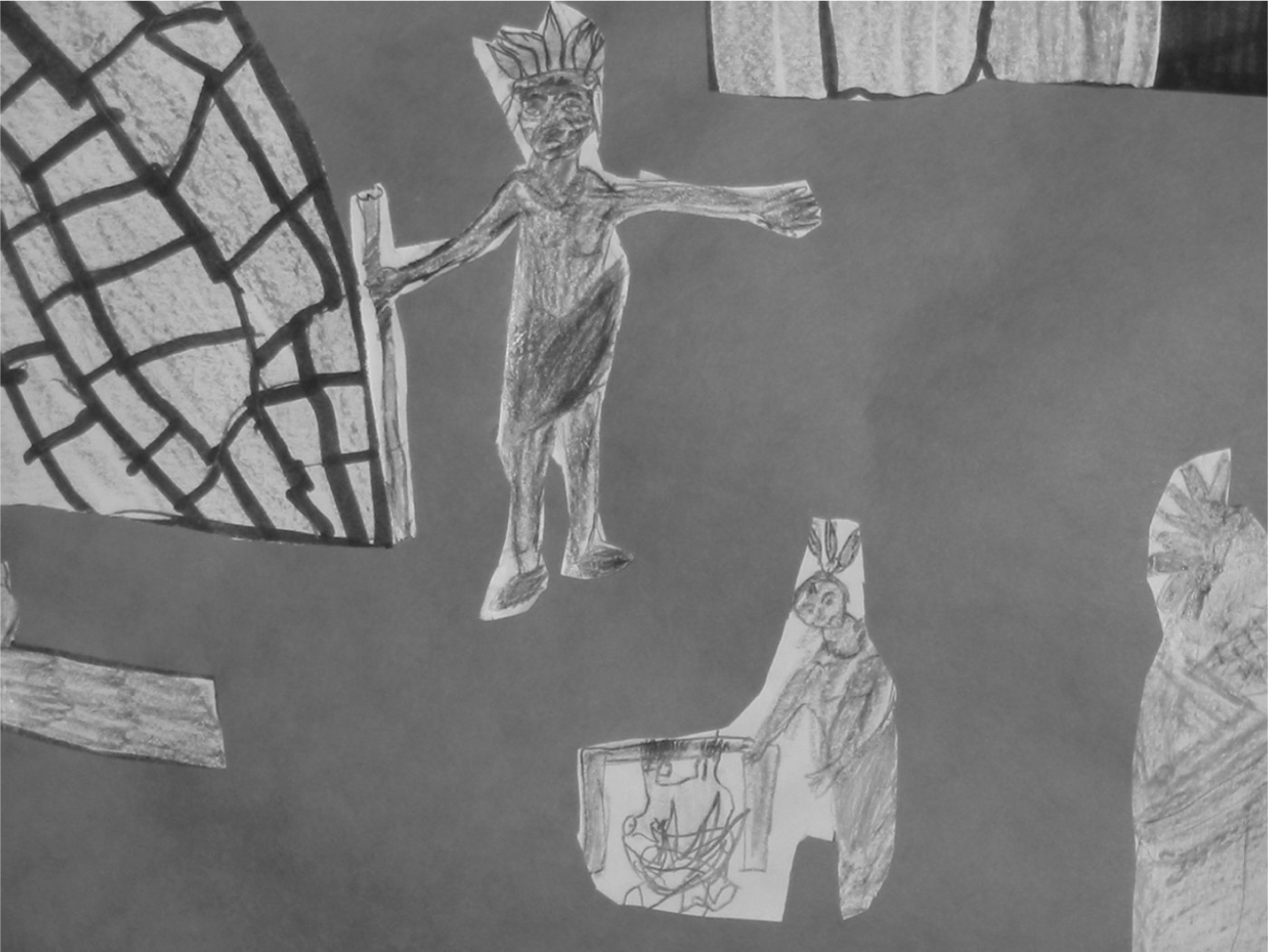
Textbook and cartoon intersections: Eduardo’s drawing for Powhatan class mural. Used with permission.
Softening and Neutralizing Colonialism
Student analysis pointed to the cruelty and violence that characterized the relationship between the Powhatan and the English colonists. Indeed, this third-grader’s analysis included a sense of the meanness that was part of the English’s colonizing.
The Disney movie says that John Smith has a boss who is mean and does the “legal stuff.” On the ship, he [Governor Ratcliffe] comes and he’s the one that found Jamestown. It’s not John Smith who found Jamestown.
However, Adriana did not speak of the ruthlessness or the gruesome violence that was part of the relationship between colonists and Powhatan. To her, the governor is mean and oversees the business or legal aspects of the colony. Yet the Disney narrative depicts this violence in its rendition:
Meanwhile, at Governor Ratcliffe’s orders, John Smith’s crew began digging up the new land in search of gold. When the Indians from Pocahontas’s tribe approached the settlers, the Governor called them “savages.” He ordered his men to draw their guns and fire. (Parent, 1998, pp. 262-263)
The use of the word savages dates back to the 1600s, when the English colonists used this word as they wrote about their interactions with the native people. Takaki (1993) reports, “In 1622, the natives tried to drive out the intruders, killing some three hundred colonists. John Smith denounced the ‘massacre’ and described the ‘savages’ as ‘cruel beasts,’ who possessed ‘a more unnatural brutishness’ than wild animals” (p. 35). To retaliate, the colonists poisoned and killed 250 Powhatan natives. Likewise, the large-scale killing and ruthless pursuit of gold are central to the Disney versions. The story line addresses the tense relations between factions and violently dramatizes the struggle over riches, land, and human resources.
Yet in the academic textbook there is barely an inkling of violence or cruelty and the overall emphasis is on peace. In the four pages about Jamestown, the publishers provided two paintings that showed both the colonists and the Powhatan calmly coexisting on the same beach and at the same marriage ceremony. Banks et al. (1997) claim, “Men like John Smith were sent by England to start a colony at Jamestown. . . . The English hoped that the colony would provide resources and riches like gold for people back in England” (p. 103). The academic rendition is a softened and optimistic version of events that omits any notion of brutality, violence, or cruelty to discuss in a seemingly neutral way the overall ramifications of the colonists’ and Powhatan tribe actions in history.
Similarly, in a unit about another Native American group, the Coahuiltecan in the Southwest, the textbook’s authors wrote the passage in a softened and apparently neutral type of language that omits any notion of coercion or brutality. Without a sense of direct agency from the text, students created their own interpretations about how Natives were forced to learn colonial ways, language, and assimilation.
Please turn to p. 126. [Text says, “Some Native American groups kept their culture. But many groups like the Coahuiltecan lost their old way of life.”]
What’s that about? . . .
They became bilingual, learned Spanish because of the priest, became Hispanic.
They became part of the U.S. and had to do things their way. . . .
They were becoming bilingual like you guys.
In this exemplar, with the text’s portrayal of “lost” ways of life, Mona attributed the native’s forced conversion to the Spanish language to their becoming Hispanic and shifting their ethnic identity, demonstrating her belief in the social nature of ethnicity. On the other hand, Dana considered their assimilation to American life and subservience to the United States. Ms. Montclair related the native’s linguistic conversion to the students’ own process of becoming bilingual, using the Coahuiltecan unit to discuss bilingualism and the forced move from indigenous languages to Spanish. However, she did not discuss issues of power or choice in their second language learning. The textbook’s passive tone opened space for student approximations and (mis)understandings of agency and power in relationships in history.
Student talk about the historical figures demonstrates various dominant discourses—that is, textbook, popular culture, and cultural identities—that were evident in the unit of study and their problematic nature for trying to understand history and its important actors. The representations of Pocahontas (and Coahuiltecan) were partial in that the renditions of times past did not include the perspectives of the historically disenfranchised Native American groups, which would be especially important for bilingual students whose families and backgrounds also may represent the perspectives of nondominant linguistic and cultural groups.
Passive Roles for Nondominant Groups
In the social studies textbook, Banks et al. (1997) describe Pocahontas only as daughter of Chief Powhatan and the role of her marriage in bringing about peace, but do not mention her individual wishes, struggles as a young Native American female, or a sense of her independence. In contrast, the Disney versions portray Pocahontas’s defiance of her father when he tells her to marry another Powhatan warrior and her remarkable independence as she chooses to follow a different path, problematic because it appears to portray a happy colonial past. Again, in field notes the third-grader critiques this difference between the textbook and movie:
In the movie the father tells Pocahontas that she has to marry another Indian, but it’s not in the textbook.
Adriana brought up the fact that the textbook discusses their marriage as unproblematic and passive (i.e., no discussion of difference of opinion between father and daughter) when, indeed, it was fraught with tension, strife, and hostility. The Disney version takes up the image of an “Indian Princess” who is deeply committed to the White man and powerfully symbolic. It is likely, however, that her relationship with John Rolfe was embattled within power dynamics and deeply troubling for her. Indeed, other accounts of Pocahontas provide additional details about her kidnapping, captivity, conversion to Christianity, role as a translator, and early death (Pewewardy, 1996). According to these other accounts, she probably felt caught in between different worlds, which Adriana seemed to allude to in her comment about cultural norms to marry another native.
Likewise, another student, Daisy, recounted Pocahontas’s story in her report on a famous person (i.e., students had to choose a famous person from the 1600–1700s and do independent research; see Figure 2). Her report, written in Spanish, retells the main ideas of the Powhatan woman’s story, highlighting various points of power and subservience throughout her life. She wrote (see Figure 2),
La Persona Famosa es Pocahontas Pocahontas, era una india muy buena y su cabello era negro su piel café. Ella era hija de un jefe de indios, ella le pido por vida de john smith. Ella salvó la vida de los colonizadores de Jamestown. Cuando ella tenia 16 años ella acepto a Jesucristo fue bautizado con el nombre Rebecca. Ella murió en 1617 y enterraron en Inglaterra. [The Famous Person is Pocahontas Pocahontas was a very good Indian and her hair was black her skin brown. She was the daughter of the Indian chief, she asked for the life of john smith. She saved the life of colonists of Jamestown. When she was 16 years old she accepted Jesus Christ was baptized with the name Rebecca. She died in 1617 and they buried [her] in England.]
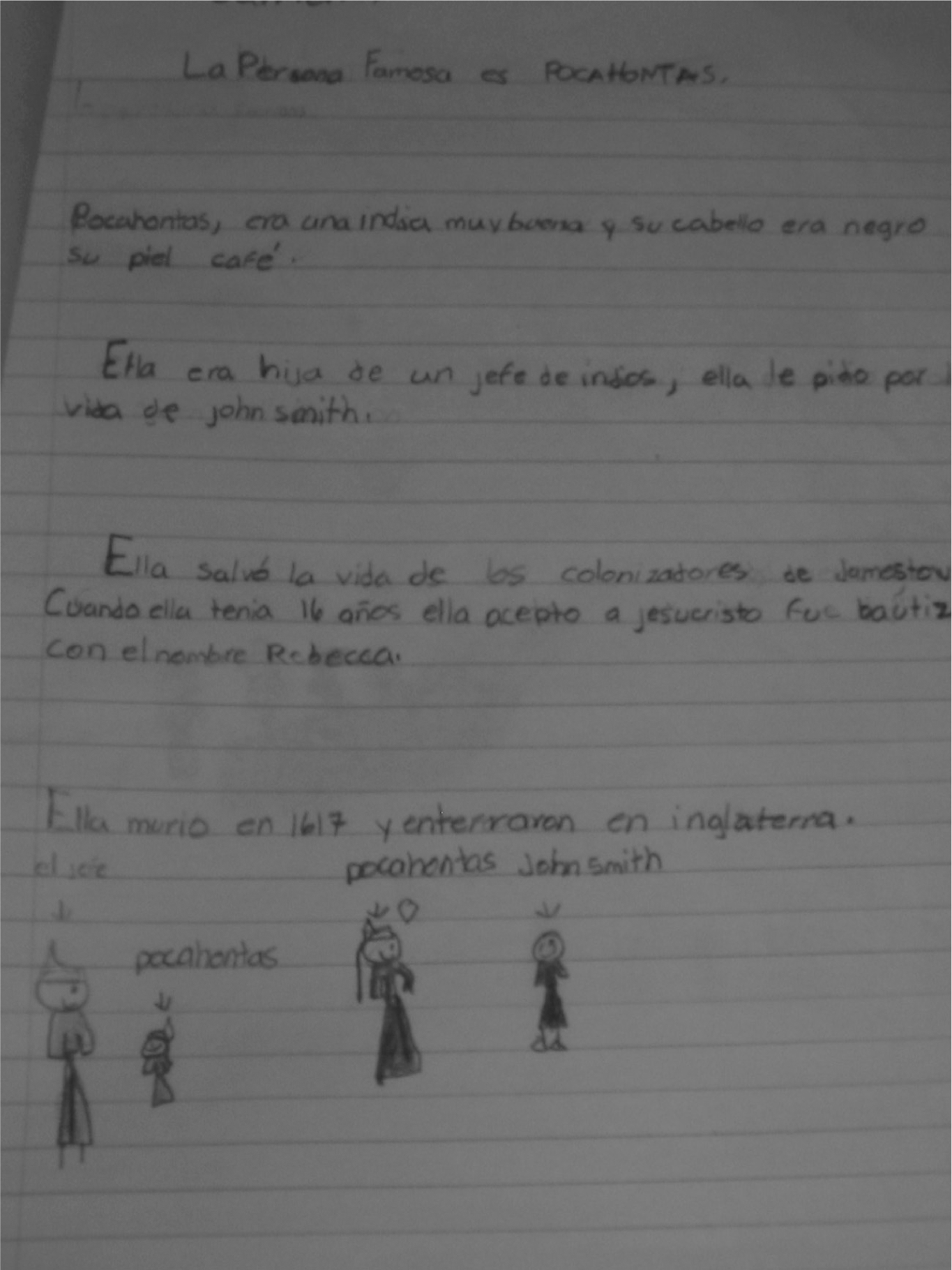
Multiple and dominant discourses: Daisy’s report in Spanish about Pocahontas. Used with permission.
Daisy began her report by describing the “goodness” of Pocahontas and her physical appearance. Then, pointing out her position as the Chief’s daughter, Daisy described a powerful role for Pocahontas as she begged for Captain Smith’s life and saved Jamestown colonists. The next sentence, however, alludes to the dominance of the English and their Christianity, by explaining her “acceptance” of the religion and her process of baptism. Again, the final sentence shows her eventual disconnection to her tribe and the claim over her by England, where she was buried. Daisy’s pictures in Figure 2 show a heart colored red showing the importance to this student of romantic love between the two figures. In her work, Daisy referred to the love between John Smith and Pocahontas (as in the Disney versions), although historians (as in the textbook) widely accept the idea that it was John Rolfe who married her. Clearly, Daisy’s report shows a contact zone of various sources of information about Pocahontas in which multiple discourses intersected around issues of gender, color, religion, family status, colonialism, and marriage.
What counted as knowledge for these third-graders were different renditions of Pocahontas, which were quite different but primarily represented dominant cultural perspectives. Teacher and student conversation and critical thinking about intersections between textbook and Disney sources revealed that each was problematic (i.e., neutralized, romanticized), partial and incomplete in its representation of this historical figure and era in U.S. history. Although students recognized these multiple perspectives, their analysis was in the early stages with little scaffolding or explicit guidance. Although the students were navigating across academic and popular culture discourses throughout their study of social studies, the teacher was trying to negotiate accountability and testing discourses, which seemed to suppress her genuine interest in the children’s personal lives and cultural contributions.
Conclusions
This study documented the following patterns in the data: (a) students navigated across various discourses, (b) linguistic analyses shed light on the biases embedded in the written text, (c) both types of resources represented dominant cultural perspectives, and (d) when resources intersected for students and teacher, they revealed their problematic and partial nature.
Navigating Across Discourses
Data in this study demonstrated that students were not unilaterally focused on the academic textbook in their study of Pocahontas and the Jamestown colony; rather, they drew knowledge from multiple sources. What counted as knowledge involved information not only from the curricular text but also from the Disney text and movie of Pocahontas. They navigated across these resources as they tried to make sense of the content topic and drew from these various resources as they answered postunit test questions. The teacher, however, believed they were not thinking in “social studies mode,” which would mean almost an exclusive focus on knowledge from the adopted textbook. The textbook authors centered attention on a generalized and simplified (and perhaps uncontroversial) historical account in which the focus was not on individuals but on groups and the ramifications of specific events (i.e., a marriage) in history. In contrast, the Disney authors focused on individuals and their close relationships as part of character development. The story line was built around suspenseful and emotion-filled moments as the characters interacted with each other. The texts and movie represented distinct discourses—academic school-based and nonacademic popular cultural ones. Navigating across these discourses was a natural and regular part of their literacy practices.
Linguistics Analyses of Subtle Biases in Text
As students negotiated various texts, they read across multiple linguistic structures that were tools for constructing particular meanings for specific purposes. The topics of linguistic construction and author choice are central to understanding how children face specific demands in academic language. As authors, Banks et al. (1997) chose to construct sentences in which the European American male colonists were the agents of action and Native Americans were passive recipients. This choice suggests possible conflicting discourses among authors in the writing of this text in which traditional disciplinary and critical multicultural discourses were at odds in how they would portray Pocahontas. Historians traditionally aim to paint the new American colonies with a broad stroke that points to the general events and their ramifications for U.S. history overall. On the other hand, multiculturalists endeavor to highlight marginalized groups (i.e., the Native peoples) and give voice to traditionally unheard perspectives such as those of women or people of color. This passage represents a case in which the dominant disciplinary discourses prevailed, as it relegated the native Powhatans to a role of nonagency and lack of voice. This was surprising in light of the authors’ contributions to the multicultural literature. Awareness for authors of how language shapes discourse is necessary for developing more fair texts in particular academic areas.
Dominant Cultural Perspectives
Through critical discourse analyses, examination revealed that linguistic features enacted a dominant European American perspective in which Native Americans are misrepresented and subjected to stereotypes both in the academic textbook and the popular narrative. Although the students in this study primarily came from nondominant groups (i.e., Mexican, Puerto Rican, Dominican, Spanish dominant, bilingual), their resources drawn on during this Pocahontas unit principally represented dominant cultural perspectives. When mainstream authors portray marginalized groups like in this case, they may stereotype or miss opportunities to affirm the identity of children from nondominant backgrounds through appropriate depictions of characters like themselves or to allow the reader to see into the lives of others for accurate images of people unlike themselves (Mendoza & Reese, 2001). For instance, in the documented texts the authors omitted the Native American perspective or discussion of how Pocahontas might have felt as a young female from the colonized group. Although student resources were marginalized in favor of the academic text in this class, in the larger cultural and societal context the Disney story was part of mainstream dominant culture. These students were Spanish–English speakers and predominantly Latino/a and were becoming aware of themselves as bilingual and potentially having some aspects in common with the colonized natives, but they were not evidently guided in a critical analysis of their social positioning or status. Perhaps with further awareness of how authors’ choices constructed these perspectives, students could choose to accept or reject the stereotypical and unfair ways that nondominant groups were portrayed, which was an empowering insight and competency for students who also primarily came from disenfranchised backgrounds.
Problematic Nature of the Resources
Data demonstrated Ms. Montclair’s tension between staying in tune with accountability measures and following her own expertise about how to engage children and make connections to their lives. Although she recognized student-chosen resources and identified contradictions, the testing and pacing pressures kept her from pursuing critical conversations about inaccuracies and a broader narrative about history. Yet in the brief moments when their resources interconnected, students and the teacher were able to refer to the partial and incomplete nature of the sources as well as allude to issues around stereotypical images, cruelty, and colonial relationships. These moments highlight the potentially rich sites of innovation and discovery that exist at the juncture of these academic and nonacademic resources. The participants’ awareness of these contested and contradictory facts and figures demonstrate how these could be possible points of leverage to enhance content and language instruction and to lead to teaching for social justice.
Implications
Careful analyses of the multiple social meanings enacted during school literacy practices examine how students, particular ELLs and children from underrepresented groups, bring to bear sources of knowledge and powerful discourses that may be either overlooked or harnessed as potential assets in learning. This study employs discourse and functional linguistic approaches to articulate particular ways that students cope with different sociocultural demands in content classes. The implications for this research are articulated in the following sections: (a) research in education, (b) policy and curriculum development, and (c) teacher education.
Research in Language and Literacy Education
During an era of restrictive language and literacy practices (George, Raphael, & Florio-Ruane, 2003), it is incumbent on researchers to engage in nuanced and sophisticated research to demonstrate the complexity of children’s literate worlds. Youngsters bring a multitude of resources to bear on their thinking about school topics, and they navigate across many discourses and a range of text types (Ciechanowski, 2009). Research ought to provide rich descriptive accounts of what resources students take up and how they utilize them to make sense of in- and out-of-school texts. Future studies should document and analyze the ongoing nature of students’ negotiation of meaning and appropriation of knowledge from many sources (i.e., Moll et al., 1992), which can be expanded to include many varied classroom contexts and a wider range of content areas. For example, how are students’ resources in social studies similar or different than their resources in science? How are students’ resources interconnected and networked across not only school subjects but also across cultural contexts and peer groups? Current research must continue to push back on contrived and one-sided curricular programs to reveal the natural and organic nature of children’s literacy inherently rich and complex.
Evidence indicates that a restrictive or singular focus on academics may leave other valuable and powerful types of language and textual resources at the door. Recent focus has been on how underrepresented or ELL students develop academic literacy and acquire academic discourse (Celce-Murcia, 2001; Colombi, 2002; Scarcella, 2003), but scholars and textbook authors need to develop a nuanced understanding of academic language and how this comes together in significant ways with the language that children bring to bear on their study of content. Since academic language is the key to success in advanced schooling and employment, research must explicate how children learn it within the context of different discourses and sources of knowledge, which may provide important connections to build on in school.
In addition to student learning, research should focus on language and literacy teaching practices and how they are enacted in this era of restrictive language practices. On one hand, teachers receive mandates from local, state, and national governmental agencies about how to teach, what to cover, and how and when student learning will be assessed. On the other hand, teachers draw from their own personal and professional knowledge to craft their instructional practice and devise programs. Sometimes, as in Ms. Montclair’s case, a teacher experiences tension as part of these instructional processes. Research should explore how these contradictory pressures are negotiated in the teaching profession and what these mandates and multiple sources of knowledge mean for teaching practice.
Policy and Curriculum Development
Teachers like Ms. Montclair intuitively know how their students could be engaged and what could be an important learning moment. Yet they hold back and change course because of the tensions around keeping on pace, preparing for frequent and extensive testing, and living up to accountability measures. Teachers make instructional decisions in a context of fear and stress that comes from various levels including the state, district, administration, and peers. What counts as knowledge in this context is strictly limited and dictated by decision makers at the highest ranks, whether district personnel or textbook publishers. There is little room for exploring these powerful student resources, leaving them at the door when they could be highly valuable for engaging, instructing, and making connections with students. “Curriculum that is responsive to the needs of all children in our schools and seeks the betterment of society has diversity or pluralism at its center” (George et al., 2003, p. 325). Administrators and curriculum developers should recognize a teacher’s craft and own sense of best practices to allow space for instructional decisions to take up and use diverse student resources.
Teacher Education
As the teacher in this study mentioned, she was not comfortable engaging students in a critical analysis of the popular cultural narrative. Not only did she feel unsure about historical facts but she also likely did not have much experience critically analyzing multiple sources for historical study. Often, teachers shy away from disharmony in the classroom and feel discomfort with issues of social justice. Instead, teachers need to develop a stance in which they regularly draw from multiple discourses and engage children in discussion around how to make sense of them. As Gee (2001) points out, discourses are almost always inconsistent and tension is a part of life. If we mine these sites of conflict, teachers might explain how authors use language as a tool to carry out certain ends and how privilege and power are at work in texts. Lemke (1990) suggests exploiting the contact zone and providing opportunities for students to translate across discourses, from scientific to everyday and back again. Students can write about a particular topic by appropriating a particular discourse (e.g., academic science, popular science, or local community) and working together as apprentices to finesse and take up apt linguistic features.
Teachers should learn to recognize and embrace multiple discourses, analyze power in relationships, and understand how language can portray particular viewpoints and privileges (Bomer & Bomer, 2001). University instructors can engage preservice and in-service teachers in these critical conversations and help them practice how to take up these concepts in their teaching. For example, in my class for preservice teachers, we analyzed four different texts on Pocahontas (i.e., textbook, movie storybook, native-authored article, vintage traditional children’s picture book), using functional linguistic analysis to uncover meanings behind the language choices (Schleppegrell et al., 2004) and attribute charts to list out and organize the critical concepts to guide our analysis of texts (Herrell & Jordan, 2008). With a grimace on his face, one student claimed, “It’s just that I have to go back and question everything I ever learned in social studies.” He realized that he had learned primarily White European and mostly male-dominated discourses of history. This awareness is what can help teachers guide students in negotiating multiple discourses and navigating across various power-laden texts and resources.
As such, teacher education programs are pivotal in developing language and literacy pedagogical competence in pre- and in-service teachers. Schleppegrell et al. (2004) claim that linguistic structures are tools for making meaning and teachers need to empower and explicitly instruct students to “unpack” these structures to develop the academic proficiency necessary to experience success in advanced schooling. For example, a local teacher involved in my research project explicitly taught adjectives that modify number to analyze how authors make generalizations about culture (e.g., all Americans play baseball). Through her lessons on few, some, many, most, and all, the class explored the difference between stereotypes and generalizations and closely examined how the English forms enable certain functions in social studies text. Her masterful unit wove together social justice, content, and English language development. Along these lines, all teachers need to gain knowledge of how English and linguistic systems work to communicate particular cultural and disciplinary meanings.
Delpit (2001) worries that teachers will feel powerless if (dominant) discourses cannot be learned in school (i.e., Will a student be locked into “his or her place” based on where or to whom he or she was born?). She wonders whether teachers will feel as though they will oppress students if they teach dominant discourses to the self-deprecation of home or nondominant discourses. Yet Delpit provides testimonials of teachers who successfully taught the “superficial features” of dominant discourses (including grammar, mechanics, and style) and of students who learned them with the right kind of support to “make it” (pp. 549-550). Furthermore, learning the dominant discourse does not necessarily mean one has to reject home identity and values because discourses are not static and can be transformed in liberating ways. The teacher can preserve a sense of student identity by converting dominant texts to make a space for their selves, thereby imbuing the dominant discourses with new meanings and claiming them for students. In short, students should not only learn surface-level and subtle aspects of dominant discourses but also take up their discursive power to accept or resist the embedded (perhaps hidden) biases and perspectives. When their teachers choose to instruct them in this way, they can appropriate these discourses for their own purposes and transform unequal power structures to give voice to people otherwise left unheard.
Footnotes
Appendix A
Appendix B
Declaration of Conflicting Interests
The author(s) declared no potential conflicts of interest with respect to the research, authorship, and/or publication of this article.
Funding
The author(s) received no financial support for the research, authorship, and/or publication of this article.
Bio
References
Supplementary Material
Please find the following supplemental material available below.
For Open Access articles published under a Creative Commons License, all supplemental material carries the same license as the article it is associated with.
For non-Open Access articles published, all supplemental material carries a non-exclusive license, and permission requests for re-use of supplemental material or any part of supplemental material shall be sent directly to the copyright owner as specified in the copyright notice associated with the article.
