




Abstract
This study draws from a number of researchers who push for critical literacy and a critical stance to question power, inequality, and the status quo; to understand scholars’ own participation in power structures; and to reframe and retheorize scholars’ beliefs and understandings. In this article, the author uses the critical stance framework to analyze preservice English language arts teachers multigenre inquiry projects, projects that were meant to engage them in reflection, critical thinking, and action. The qualitative analysis of classroom-based work is guided by the following questions: To what extent do preservice teachers go beyond answering a question of interest to adopting a critical stance, and what does this critical stance look like?
Keywords
When I first began my work in this placement, I was really surprised by the students in my classes. They all wanted to succeed, but I just did not see the actions from them. One of the students told me that he knew he needed to do better in school, but it was hard for him to apply himself because he felt as if school was just too boring. I felt as if he truly did value his education, then he would apply himself regardless. . . . This encounter led to my essential question—Do students truly value their education? (Hannah) Dear Future Students, As your future teacher, I am trying to think of innovative ways to motivate young adult readers. If teachers can make the reading more interesting, more students will read and comprehend. . . . It is our responsibility as educators to present literature in the most accessible way to students. . . . This may require us to go outside of our comfort zone at times. . . . Like language, literature is constantly evolving. There are now graphic novels, blogs, movies, songs, videogames, comic books, TV shows, speeches, e-mail correspondence, and sporting events which all have the potential to possess literary merit. It is my calling to present literature to you in these contemporary forms with appropriate, incorporated technology. Your Friend, Troy
The passages from Hannah and Troy, from the introductory pieces in their multigenre inquiry projects, a culminating assignment in my language arts methods course, represent the range of critical stances taken by the preservice teachers. Hannah’s essential question (Do students truly value their education?) assumes that there are no valid reasons why students might not seem to be engaged with schooling other than their own inherent flaw(s) or deficiency(ies). Troy, on the other hand, begins his inquiry with the perspective that it is his misstep (and fault) if students are not motivated, engaged, and successful. The difference between the positions of these two inquiry projects is also, to an extent, indicative of the struggle I sometimes face as a teacher educator in trying to promote critical literacy instruction with preservice English teachers. Although some students embrace and attempt critical practices during their coursework and field placements, others struggle and some resist altogether.
White (2009) echoes this struggle, noting three difficulties in teaching critical literacy: our preservice teachers have frequently never experienced critical literacy in their K–12 education; practicing teachers (our students’ models) are asked to teach critical literacy, but not given the tools necessary for the task; and the critical literacy we teach often goes against our students’ backgrounds and cultures. Moreover, as McDaniel (2004) noted, children in the United States are commonly “taught to not question the status quo and to accept and obey the voice of authority” (p. 473). Lee (2011) presents several myths about critical literacy preservice teachers often hold: Critical literacy is critical thinking, critical literacy is only for high-ability students, critical literacy is an instructional strategy, critical literacy is only about reading and writing. These beliefs, rather than deterring literacy educators, should motivate us to find more ways to make critical literacy integral to our courses. There is no greater time to do this than now, when an increasingly diverse student population will be required to meet one common set of instructional and assessment standards.
One tool to infuse in courses and instruction is the model of critical literacy (Lewison, Leland, & Harste, 2008), in particular the critical stance, which Lewison et al. (2008) understand as the center of critical literacy instruction. The critical stance “consists of the attitudes and dispositions we take on that enable us to become critically literate beings” (p. 13). Lewison et al. view critical literacy instruction as
a transaction among the personal and cultural resources we use, the critical social practices we enact, and the critical stance that we and our students take on in classrooms and in the world . . . we can use it as a planning tool and also as a lens from which to examine our teaching. (p. 5)
Although many researchers (e.g., Behrman, 2006; Comber & Simpson, 2001; Janks, 2010; Lewison, Flint, & Van Sluys, 2002; Luke & Freebody, 1999; Stevens & Bean, 2007) have examined critical social practices (i.e., critical literacy), the critical stance is newer territory. Therefore, we need to investigate and explain what exactly that critical stance might look like not only in our courses but also in the work our students produce.
I draw from a number of researchers (e.g., Beach & Myers, 2001; Cochran-Smith & Lytle, 2009; Fecho, 2004; Lewison et al., 2002) who push for critical literacy and a critical stance to question power, inequality, and the status quo; to understand our own participation in power structures; and to reframe and retheorize our beliefs and understandings. In this article, I use Lewison et al.’s (2008; see also Heffernan & Lewison, 2009) critical stance as a framework to analyze my students’ inquiry projects, projects that were meant to engage them in reflection, critical thinking, and action. Similar to the work of Heffernan and Lewison (2009), my analysis of classroom-based work is guided by the following questions: To what extent do preservice teachers go beyond answering a question of interest to adopting a critical stance, and what does this critical stance look like? In answering these questions, I first present broad, descriptive findings and then pieces from teachers’ inquiry projects that depict different aspects of the critical stance.
Theoretical Perspectives
Critical Literacy
Although it is not explicitly a part of the inquiry project, a brief discussion of the role of critical literacy is warranted because it is both foundational to and a central aspect of Lewison et al.’s (2008) critical literacy model. Since the pioneering work of Freire (1970/1993), many educational researchers and theorists have worked to define and describe what we now consider to be the essential tenets of critical literacy, such as raising critical consciousness (Freire & Macedo, 1987; hooks, 1994), literacy as a social and political practice (Gee, 1996; Stevens & Bean, 2007; Street & Lefstein, 2007), learning the “codes” to fully participate in schooling and “mainstream American life” (Delpit, 1995, p. 45), using “literacy for social justice” (Luke, 2012, p. 5), the questioning of texts (Luke & Freebody, 1999), and the power to change the status quo (Christensen, 2000; Shor, 1999).
Luke and Woods (2009) offer a foundational primer on critical literacies, providing a lineage of the term critical to critical pedagogy and text analytic models, two present approaches to critical literacy. Working from Freire to current poststructuralist models, Luke and Woods offer these tenets for critical literacy: (a) ideology critique and cultural analysis as significant parts of education against domination and marginalization, (b) a commitment to the inclusion of those frequently marginalized by schooling (e.g., working class, minorities, girls), and (c) an engagement with the importance of text, ideology, and dialogue in all aspects of life (pp. 11-12).
All of these ideas were foundational to my methods course. Taken by most preservice English teachers the semester before they student teach, the class is meant to pull together all of the courses they have taken to that point—foundations, diversity, teaching writing, and so on—and tie them together both theoretically and practically. The course’s readings and its assignments are grounded in Lewison et al.’s (2008) definition of critical literacy:
Critical literacy practices encourage students to use language to question the everyday world, to interrogate the relationship between language and power, to analyze popular culture and media, to understand how power relationships are socially constructed, and to consider actions that can be taken to promote social justice. (p. 3)
This approach informed my work in the class. I saw my role as helping students become aware of the numerous in- and out-of-school contexts in which language(s) and literacy(ies)—in any textual form—of power function (Morrell, 2008) and helping them “to rewrite themselves and their local situations by helping them to pose problems and to act, often in small ways, to make the world a fairer place” (Janks, 2010, p. 19). In short, I wanted to promote a critical literacy of teaching.
The Critical Stance
A critical inquiry stance does not just mean “getting something done” but considers “what is to be done, why to get it done, who decides, and whose interests are served” (Cochran-Smith & Lytle, 2009, p. 121). A critical stance allows preservice teachers to create a sense of agency: having the capacity, understanding, self-belief, and capability to generate change (Fecho, 2004). Lewison et al. (2008) identified “four dimensions of adopting a critical stance, and they occur in a cyclical fashion, leading to renaming (Freire, 1970) and retheorizing, which reactivate the critical stance cycle” (p. 13). The critical stance is the core of their instructional model of critical literacy (see Figure 1) and “consists of the attitudes and dispositions we take on that enable us to become critically literate beings” (p. 13).
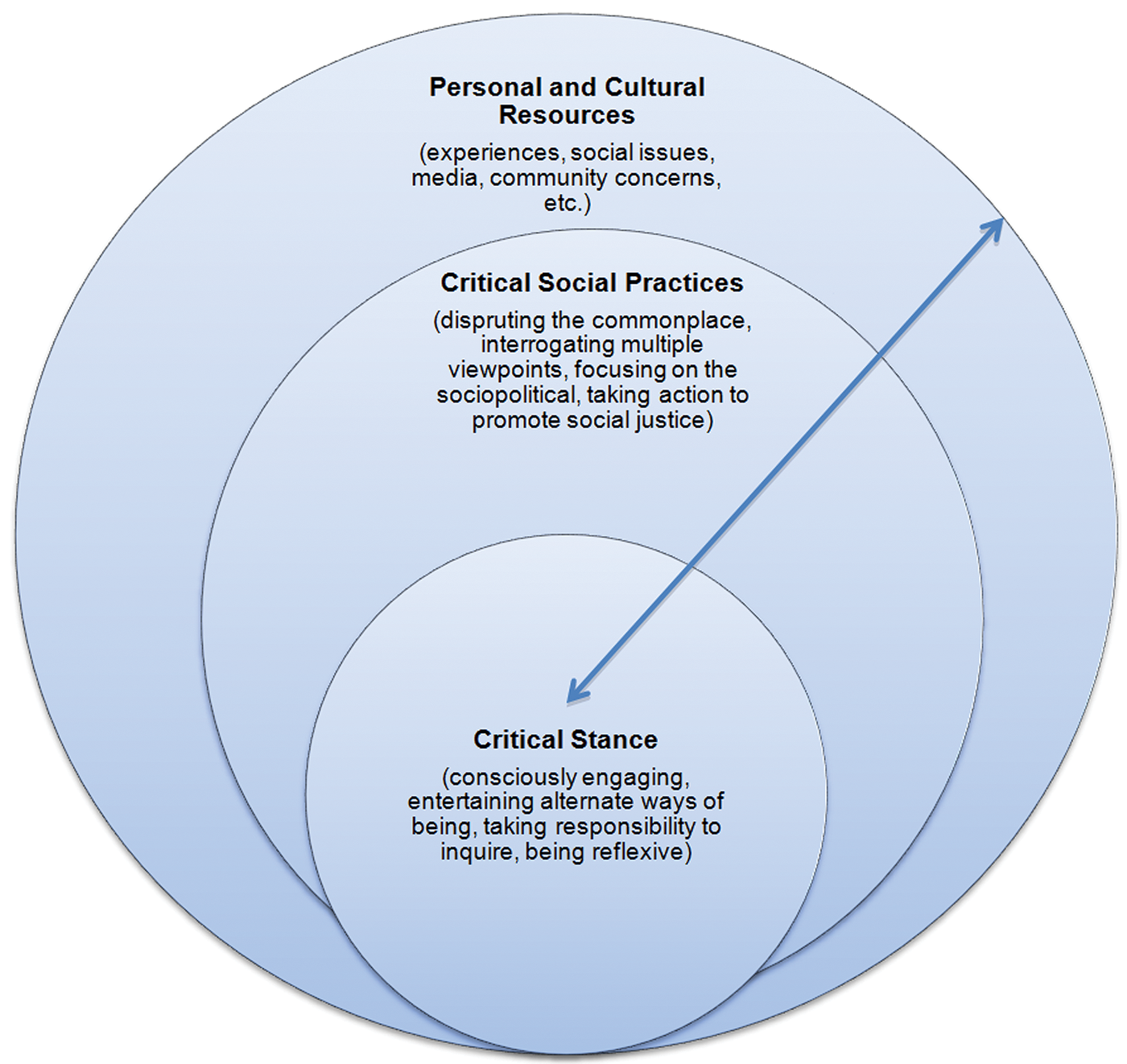
Instructional model of critical literacy that represents the transaction among personal and cultural resources, critical social practices, and the critical stance. Adapted from Lewison et al. (2008).
Consciously engaging means going beyond simply responding to events in our lives, but “thoughtfully” deciding how to respond (Lewison et al., 2008, p. 13). Lewison et al. (2008) suggest one way to respond is through naming (Freire, 1970/1993), whereas another is reframing (Lakoff, 2004). Entertaining alternate ways of being is the second aspect of a critical stance and “involves creating and trying on new discourses” (Lewison et al., 2008, p. 16). This process involves risk taking and tension, but both support a critical stance. Taking responsibility to inquire means making sure that inquiry, interrogation, and investigation “are always at the forefront in the third dimension of the critical stance” (p. 17). The fourth aspect of the critical stance, being reflective, “means being aware of our own complicity in maintaining the status quo or systems of injustice” (p. 18). Figure 2 presents a summary of the four aspects of the critical stance.
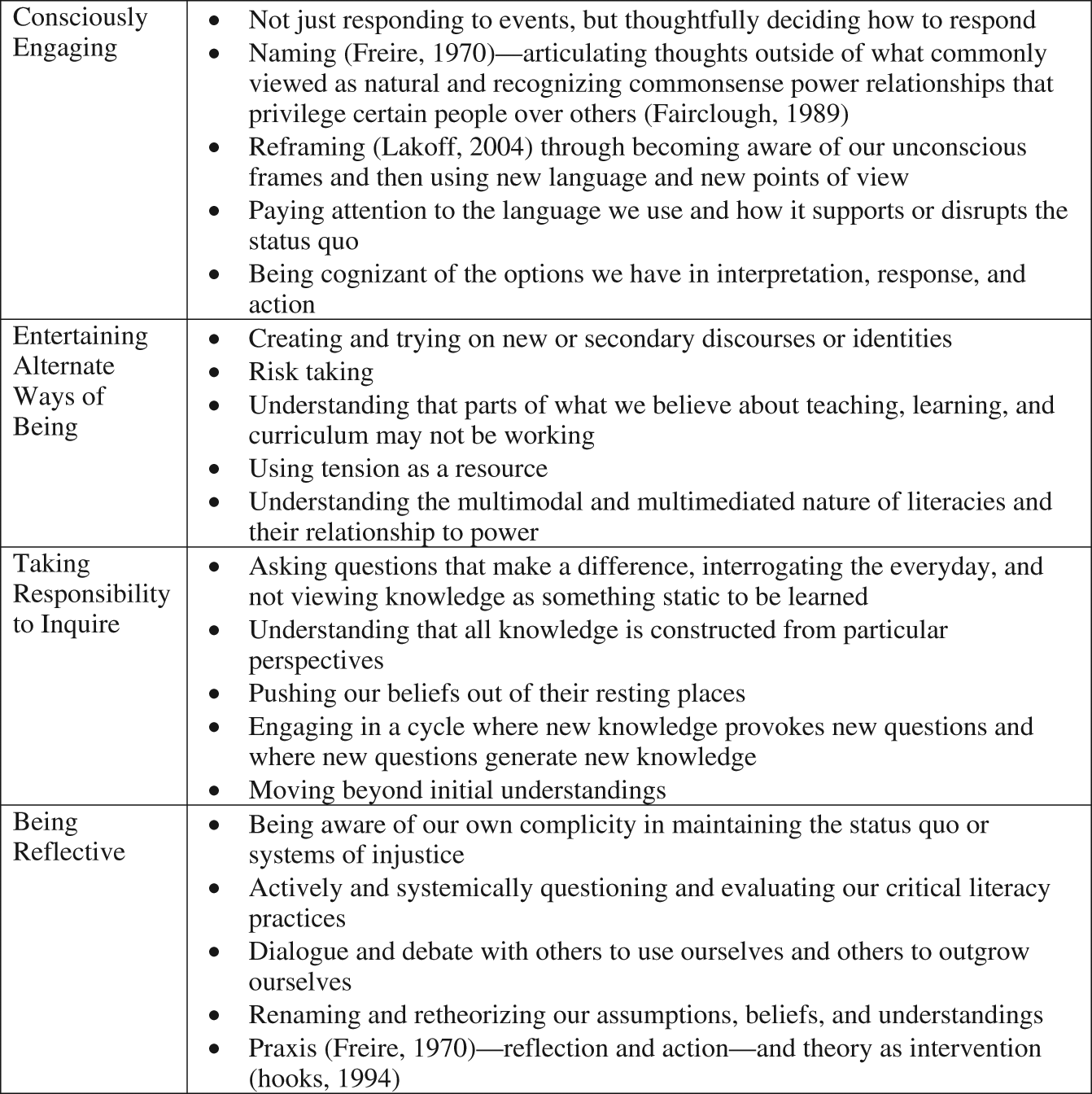
The four dimensions of taking a critical stance, the beliefs and stances we adopt that allow us to be “critically literate”
For me, the arrow that moves between the personal and the social is akin to Fecho’s (2004) recognition of “reconnecting the academic to the personal and using our practice of language to raise new questions and develop theory” (p. 56) in critical inquiry. Jeffrey Wilhelm (2009) called for a “critical literacy of teaching” that could be achieved by “teaching through an inquiry context” and “taking on a teacher-researcher stance to think both reflectively and reflexively about our teaching, which means, among other things, always learning from our students how best to teach them” (p. 36). In other words, while we are working to develop critical literacy practices with students, we also need to simultaneously be critically thinking about and inquiring into our own practices. Moreover, the process is equivalent to Cochran-Smith and Lytle’s (2009) notion of inquiry as stance:
Fundamental to the notion of inquiry as stance is the idea that educational practice is not simply instrumental in the sense of figuring out how to get things done, but also and more importantly, it is social and political in the sense of deliberating about what to get done, why to get it done, who decides, and whose interests are served. Working from and with an inquiry stance, then, involves a continual process of making current arrangements problematic; questioning the ways knowledge and practice are constructed, evaluated, and used; and assuming that part of the work of practitioners individually and collectively is to participate in educational and social change. (p. 121)
In sum, a critical stance allows preservice teachers to create a sense of agency: having the capacity, understanding, self-belief, and capability to generate change (Fecho, 2004). And once preservice teachers realize that their actions have the potential to and can change the status quo, they become more confident in their capacities as change agents (Beach, Campano, Edmiston, & Borgmann, 2010). It is more important that this critical stance is the heart of the critical literacy model and is necessary for teachers to enact a critical literacy curriculum. This holds the most potential in preservice teacher education because it is more expansive and inherently more political, rooted in issues of fairness and social justice (Bullough & Gitlin, 1991). When teachers are willing and open to trying new ways of thinking and doing, they go beyond easy answers or accepting the status quo, beliefs they should be instilling in their students.
Research With the Critical Stance and Critical Inquiry
The research on critical literacy in K–12 classrooms (e.g., Comber & Simpson, 2001; Duncan-Andrade & Morrell, 2008; Morrell, 2002, 2008), critical literacy with teachers and students (Groenke, 2008), and critical inquiry or critical stance (e.g., Beach et al., 2010; Cochran-Smith & Lytle, 2009; Heffernan & Lewison, 2009; Simon, 2007; Skerrett, 2010) shows its potential to improve teaching and learning, (re)theorize practice, examine power and relationships, and promote emancipation (Beach et al., 2010; Lewison et al., 2008; Morrell, 2008)—but it takes a conscious effort and time. Heffernan and Lewison (2009), for example, found that after highlighting critical stances sixth grade students “asked questions about themselves and others” (p. 27). In her work with preservice teachers, Skerrett (2010) concluded through critical inquiry that her students developed dispositions to teach critical literacy.
Most germane to the present study is Lisa Simon’s (2007) work on teachers’ multigenre inquiry projects. Simon incorporated the inquiry projects in her foundations of literacy course as a way to help students see the assistance the projects could provide in terms of using literacy strategies to increase their self-understanding and offer access to information. What Simon (and her students) discovered is that the projects encouraged them to question widely held and promoted beliefs and assumptions. Through Donna’s inquiry, for example, the entire class questioned a “History of Mathematics” poster that hung in their college’s hallway—a poster that had “no recognition of any contributions made by women” (Simon, 2007, p. 153). The students’ end products showed the project’s potential to identify, address, and challenge inequitable structures and framings. In other words, through a critical inquiry stance, preservice teachers experience something similar to what Fecho, Graham, and Hudson-Ross (2005) refer to as the “wobble”—“a space of uncertainty” (p. 175) “where they consider new ideas that call their old beliefs into question” (p. 180). This questioning stance is something I want my preservice teachers to learn to embrace and own early in their program so that it, hopefully, stays with them when they have their own classrooms.
Background on the Inquiry Project
I began this work in a methods class for preservice secondary English teachers. I had taught this class several times before and each time had attempted to incorporate aspects of action research and reflective thinking through students’ generation of case studies and action research proposals. Although the case studies in nearly all instances showed fairly deep levels of reflection, the action research proposals were stilted, with students’ supporting articles chosen and printed off at the last minute to complete the assignment. I was looking for something that required students to think deeply about what they were seeing and experiencing in their placements, challenged them to think about an issue from multiple angles, prompted them to seek solutions, and would engender the type of critical reflection that would remain with them once they graduated and became classroom teachers. In short, I wanted them to develop a critical inquiry stance.
Early in the course, we read and discussed texts by Fecho (2004) and Wilhelm (2007) to understand the notion of critical inquiry and essential questions and their theoretical and pedagogical underpinnings; likewise, we spent the first few class sessions reading, exploring, discussing, and trying out critical literacy(ies). Lewison et al.’s (2008) Creating Critical Classrooms: K–8 Reading and Writing With an Edge was one of the assigned texts in the course. Throughout the course, we studied and tried out the lessons in the book, discussing how they could be modified for high school students. We also studied the dimensions of critical literacy and how they had been used in teacher education and in middle and high school classrooms. Thus, throughout the semester, students had a critical literacy framework to guide their reading, thinking, and classroom observations.
My ideas about inquiry were heavily influenced by several scholars who have written about and used inquiry for teaching and learning: Romano (n.d.) for multigenre research, Simon (2007) for multigenre inquiry, Fecho (2004) for critical inquiry, and Wilhelm (2007) for essential questions. After reading about Simon’s (2007) successful use of multigenre inquiry research projects, I thought it might fit the goals of the course and promote deeper levels of reflection and challenge students’ thinking. In particular, the power of the multigenre project to “identify . . . address and transform inequities” (Simon, 2007, p. 171) appealed to me. We discussed the inquiry project assignment (see the appendix) the first night of class and had a brainstorming session a few weeks later, once students had been in their practicum placements long enough to identify concerns, issues, and questions that arose.
Method
As stated earlier, the inquiry project assignment was part of my secondary language arts methods course (fall 2009) taught at a large public university in the southeastern United States. At this institution students usually take this class the semester before student teaching along with two other required courses—an assessment course and a content area reading course—and a 90-hour field placement in a local middle or high school English language arts classroom. 1 There were 37 students enrolled in the course (35 undergraduate, 2 alternative master’s) with an average age of around 21. Quite typical of the national demographics of preservice English teachers (e.g., Hancock & Scherff, 2010; Scherff & Hahs-Vaughn, 2008), 33 students were White and 4 Black, 32 were female and 5 were male. Nearly all of the students grew up in the state, most within a 2- to 3-hour drive of the university.
I am a White, middle-class female in my early 40s. At the time of the study I had taught the language arts methods course 4 out of my 6 years in teacher education—at both this and another institution (also located in the Southeast). I was raised in Florida, where I received my teaching credentials and completed my teaching, so I was not a “native” to the area. I regularly examine my own teaching practices through self-study methods, and I submitted a request to my Institutional Review Board to study several aspects of the course including students’ online discussions and reflections on their teaching. Thus, on the first night of the course, a colleague distributed and collected consent forms that were held until the course was finished and final grades were submitted.
Data Collection and Analysis
The primary data for this study included multigenre inquiry projects from the 33 students who consented to participate in the study. For the projects, students had to develop an inquiry question stemming from an issue or question that emerged during their field placement. Students were required to include at least seven different genres, one of which had to include a multimedia component. Students were given class time and a brainstorming template to assist them in identifying and selecting a topic and question. The use of multiple genres in one product was meant to address all the following four dimensions in that it (a) would disrupt the commonplace in that students came up with a question and then answered it outside of traditional ways of presenting information, (b) interrogate multiple viewpoints and present other points of view by nature of its design, (c) focus on sociopolitical issues through the inquiry question and the genre of “the other side of the issue,” and (d) compel students to take action because they were, as critical inquirers, agents rather than third-party information summarizers. All projects were scanned and saved as PDF documents. The digital aspects of the projects (blogs, photos, iMovies, etc.) were saved as individual files on my computer. Secondary data included students’ responses to an email I sent to the class a year after the course ended (fall 2010) asking them to provide feedback on the inquiry project assignment (the process, easy and hard parts, what they learned or did not learn, if doing that sort of work had an impact on them now). I wanted to learn about the long-term impact, if any, the inquiry process had on their teaching practices.
Data analysis began inductively (Patton, 1990). Initially, on my first reading of the data, I created a matrix to identify and note the topics of students’ inquiry projects, the genres they chose to incorporate to answer their questions, and key words and phrases that emerged. Students posed questions such as “What causes student misbehavior?” “Why teach the classics ‘classically’?” and “How can educators motivate reluctant readers?” During a second reading with analytic memos, however, another organizing question emerged: “Who is the agent?” In other words, was the inquiry question posed so that students were responsible for change (“Why don’t students do homework?”), or was the preservice teacher the agent of change (“How can I get through to my students?”)? A third reading of the data actually revealed a complex merging of the topic and agent. The questions that drove the preservice teachers’ projects and the methods and genres they employed to answer them created “positions” for themselves, their students, and others. I labeled these on the matrix as student as agent, teacher as agent, and system as agent.
It was after this third round of reading and coding that I returned to the literature to revise my analysis procedures. Originally, my plan was to identify what topics were of most interest to the preservice teachers and what that might mean not only for their use of reflection and problem solving (action-research-oriented thinking) but also once they were classroom teachers. However, after noticing different levels of agency that were enacted and suggested by the inquiry projects, I reframed my focus to explore the extent to which preservice teachers went beyond answering a question to adopting a critical stance as espoused by Lewison et al. (2008). 2
Thus, I shifted from inductive to deductive analysis, using an existing framework, or typologies, to guide my analysis. “Typologies are those created by the researcher that are grounded in the data but not necessarily used explicitly by the participants. . . . As with all analysis, this process entails uncovering patterns, themes, and categories” (Marshall & Rossman, 2011, p. 215). Such frames can emerge from theory, experience, or research; these frames then become the basis for dividing and grouping data (Hatch, 2002). Related specifically to critical literacy practices, Van Sluys, Lewison, and Flint (2006) used the four resources model (Luke & Freebody, 1999; Rush, 2004) and the four dimensions of critical literacy (Lewison et al., 2002) as typologies, which allowed them to study participants’ practices and the levels of frequency. They claimed,
Because critical literacy is about interrogating textual practices, researching critical literacies should involve methodological actions that push researchers to consider multiple ways of seeing, interpreting, and understanding data. Frameworks provide questions or points of inquiry that researchers may not have considered asking on their own. (Van Sluys et al., 2006, p. 214)
Similarly, my research process meant first establishing aspects of the critical stance and creating a framework to study the inquiry projects. Figure 3 presents the four dimensions of taking a critical stance I created based on Lewison et al.’s (2008) critical stance (see Figure 2) and Wilhelm’s (2009) critical literacy of teaching. I then used this framework to “define qualities that distinguish more from less meaningful” (Ward & McCotter, 2004, p. 249). Each inquiry project was read and coded according to the extent to which its contents addressed the four dimensions; from there I selected example projects that particularly exemplified each dimension. Table 1 represents the coding system for the inquiry projects (all names are pseudonyms). Five students’ projects did not address the dimensions well, and I chose to not include them in the table. Because this is the first time that the critical stance framework has been used to make sense of preservice teachers’ inquiries, the present study is exploratory and not a definitive analysis (for similar research on the critical stance with middle school students, see Heffernan & Lewison, 2009).
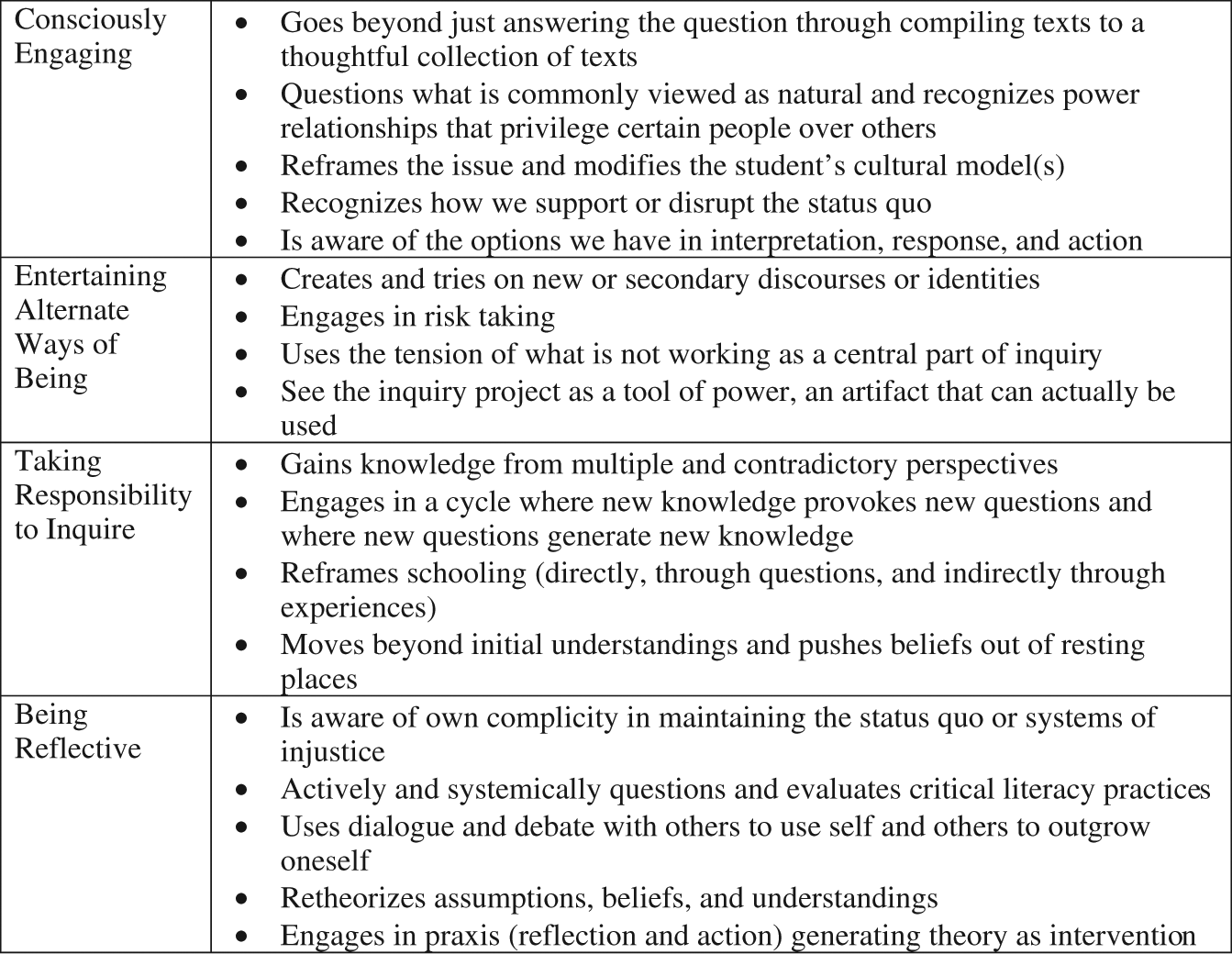
Four dimensions of the critical stance in inquiry used to code the multigenre inquiry projects
Inquiry Project Coding

Findings
The guiding questions for this study were, To what extent do preservice teachers go beyond answering a question of interest to adopting a critical stance, and what does this critical stance look like? Because I was interested in how the preservice teachers internalized our work with critical literacy, I first wanted to get an overall picture of their level of responsibility and ownership. In short, I wanted to discover where or with whom they thought an issue laid: Was an issue or problem attributed to the student, or was it within their power or responsibility?
Nearly half of the inquiry projects I labeled as “student as agent.” Almost all of these related to reading. Common inquiry questions were, “Why don’t students like to read?” and “Is reading really that boring?” Another popular topic related to motivation: “Why do they just not care?” Although most student as agent inquiry projects collected data to learn how teachers can help students, a few positioned students as the problem.
Slightly fewer than half of the projects I labeled “teacher as agent”; these inquiries began with questions such as “How do you survive the first 5 years?” and “How can I help students become lifelong readers?” Projects under this classification put the onus of action (or inaction) on the teacher—he or she was responsible for what was occurring, or not, in the classroom. The remaining projects focused on the school as an organization (“What is a good school?”), a group of stakeholders (“What factors determine student success?”), or the broader social context (“Is there an achievement gap between poor and rich students?”).
The Four Dimensions of Taking a Critical Stance
As stated earlier, I used the four dimensions of the critical stance in inquiry (see Figure 3) to guide my analysis of the inquiry projects. Like Heffernan and Lewison (2009), I do not see the four categories as distinct, nor does someone need to progress through them lockstep; however, they do provide a way to examine and understand better how the critical stance is taken up in teacher inquiry. In the discussion that follows, I present excerpts from students’ multigenre inquiry projects that illustrate particularly well each of the four dimensions of the critical stance. Note that many of the examples that follow could fall under several of the dimensions; I selected particular samples to illustrate the nuances of each.
Consciously Engaging
To engage consciously means going beyond simple inquiry to thoughtfully question, reframe, and rethink the issue at hand. For example, Kasey, who self-admittedly spoke with a strong Southern accent, became interested in code switching because of readings completed in the content area reading class. In her introductory piece she wrote, “I noticed that I participated in code switching unconsciously, and soon after, I became fascinated with the concept. . . . Do my students know what code switching is? How to do it? Why it is important?” Here, Kasey asks not just if code switching is important but if her students know why it is important. In other words, she recognizes the social, political, and cultural impact of code switching and believes and teaches in support of students’ right to code switch (i.e., right to their own language; e.g., Delpit & Dowdy, 2002; Wheeler, 2009). From the inquiry process she concluded,
I began to notice the crucial role teachers play in teaching our community’s future productive citizens about code switching! . . . There is no such thing as “perfect” English. . . . I am determined that my students will know about code switching and that it can be used by everyone.
One of the best examples of conscious engagement came from Lora, who, in trying to discover why a majority of her students slept in class nearly every day of the week, asked them to write down their reasons, but in a thoughtful and potent way. Her “Chain of Excuses” (Figure 4) was a powerful genre for her (and for me) and the only three-dimensional piece created by a student. In their answers, some of the students implicated themselves (stayed up late on the phone, procrastination, etc.), some blamed the content or teacher (hate reading literature, boring class, monotone speaking voice, etc.), and others revealed the extent to which a range of internal and external factors affected their sleeping (amount of homework, sports, jobs, medications, etc.).
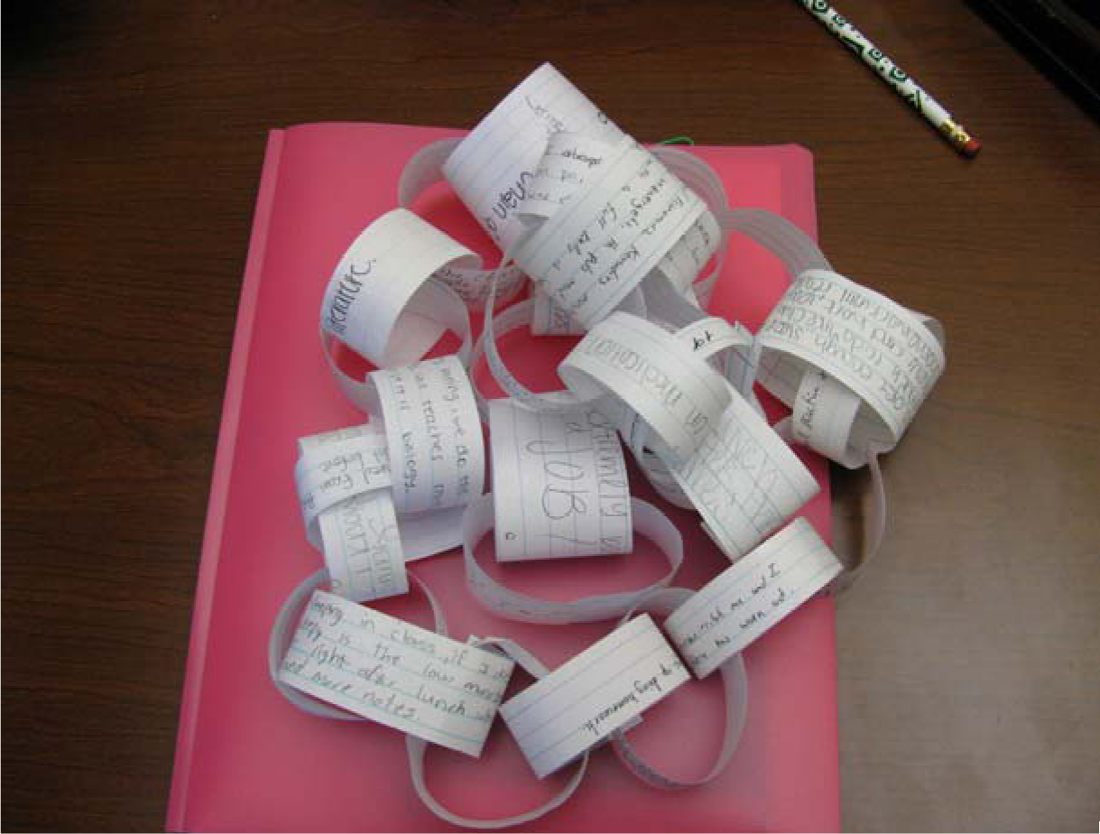
Lora’s chain of excuses, an exemplar for consciously engaging, which represents the students’ reasons for sleeping in class. Used with permission.
Adopting a critical stance fostered a sense of agency in Lora, having the capacity, understanding, self-belief, and capability to generate change (Fecho, 2004), a point she made in her reflection a full year later:
I wasn’t naive enough to think that my research project would produce a magical answer that would wake my kids up and get them engaged in class, but that was the point of the project, right? We had to wrestle with unanswerable questions to see what WE could find. Even though I didn’t get a magic solution, the research process made me more aware of what affected my students. Most of them weren’t sleeping to be rude or to make me upset; they were reacting to their workload, their after school schedules (I found out some of my students were working to pay for younger siblings’ clothes, etc.), or their own struggles with motivation. Some of the students in my standard class told me they slept because they’d rather sleep than feel confused by challenging class material. The most frustrating part of the research—being connected to my “subjects”—was also the most enlightening part. I was frustrated because I thought they were reacting to me, but their answers helped me tailor my teaching a bit to wake them up. Basically, my project didn’t give me a magic solution, but I discovered that an awareness of my students’ motivations and struggles makes it easier for me to plan lessons that discourage sleeping. It’s not a cure all—sometimes they just sleep anyway—but my awareness has made me a more flexible and accommodating student teacher. I’ll take their feedback and use it to tweak my teaching so that it suits my students’ needs, even if that need is just something to keep their eyes open.
Lora’s reflection shows how consciously engaging can lead to a productive “wobble” (Fecho et al., 2005), where preservice teachers mull over new philosophies that demand they question their beliefs. Through consciously engaging, Lora recognized that her students’ sleeping was not just “them” but part of a broader system that involved their families, their social networks, and her. She acknowledged how she could support them through readjusting her teaching strategies.
One facet of conscious engagement is being aware of how we can interpret and respond to situations. I hoped that the preservice teachers would not think of the inquiry project as just a course assignment but internalize the inquiry process and use it later in their teaching as a process to solve problems and interrogate external social, political, and cultural forces that affect their teaching (Behrman, 2006; Fecho et al., 2005). When asked a year later about the inquiry project, Caroline, another student in the class, reflected,
My inquiry project was on the cause of discipline problems in the classroom and why students misbehave. The hardest part was trying to find a solitary answer when in reality; there were so many answers that they could never be narrowed down to one. The funny part is that thousands and thousands of people have this same question and seem to be on a never-ending search to find the perfect answer when there may not be one. The most important thing I learned was that although curiosity and research may not lead to the exact answer, the research process itself taught me more than if I would have only found one answer. Now, I am also more sympathetic when I think of my students and have learned to assess THEN address all issues!
In this last sentence, Caroline expresses the important idea of studying classroom events, thinking about their causes, and then coming up with an action plan, validating a key point of Atwell’s (1987): When teachers engage in inquiry, they become learners, able to look at their classrooms, schools, and pedagogical practices in new ways.
The examples from Kasey, Lora, and Caroline exemplify going beyond answering a question of interest and trying to consciously and thoughtfully engage with it. Kasey’s project reframed the issue of language use and privileged the students’ perspective. Lora selected genres that worked together; her “Chain of Excuses,” by title alone, would seem to place blame on students. However, she explicitly put the responsibility on teachers: “The Chain of Excuses is a visual representation of the barriers teachers must break through to reach the sleepers.” Caroline’s reflection suggests that being forced to look at a question of interest through several genres led to her seeing that there was more than one answer. It is more important that the process of inquiry teaches more than finding an answer. All three of these inquiries show a deliberate and thoughtful attempt to really learn about an issue.
Thinking Alternatively
Integral to thinking alternatively is using the tension(s) of inquiry to take risks, think differently, or take on new identities. The multigenre inquiry project promoted these improvisations among students. For Reece, a lack of textbooks (there were not enough for students to take home to use outside of class) prompted her inquiry project. Her project included two genres where she took on new identities and discourses: The first was a letter to the school board from herself, writing not as a teacher but as a “citizen” (see Figure 5), and the second was a letter to the editor from the anonymous “Moving Society Forward” who advocated money spent on technology rather than textbooks to provide more current, authentic learning opportunities for students.
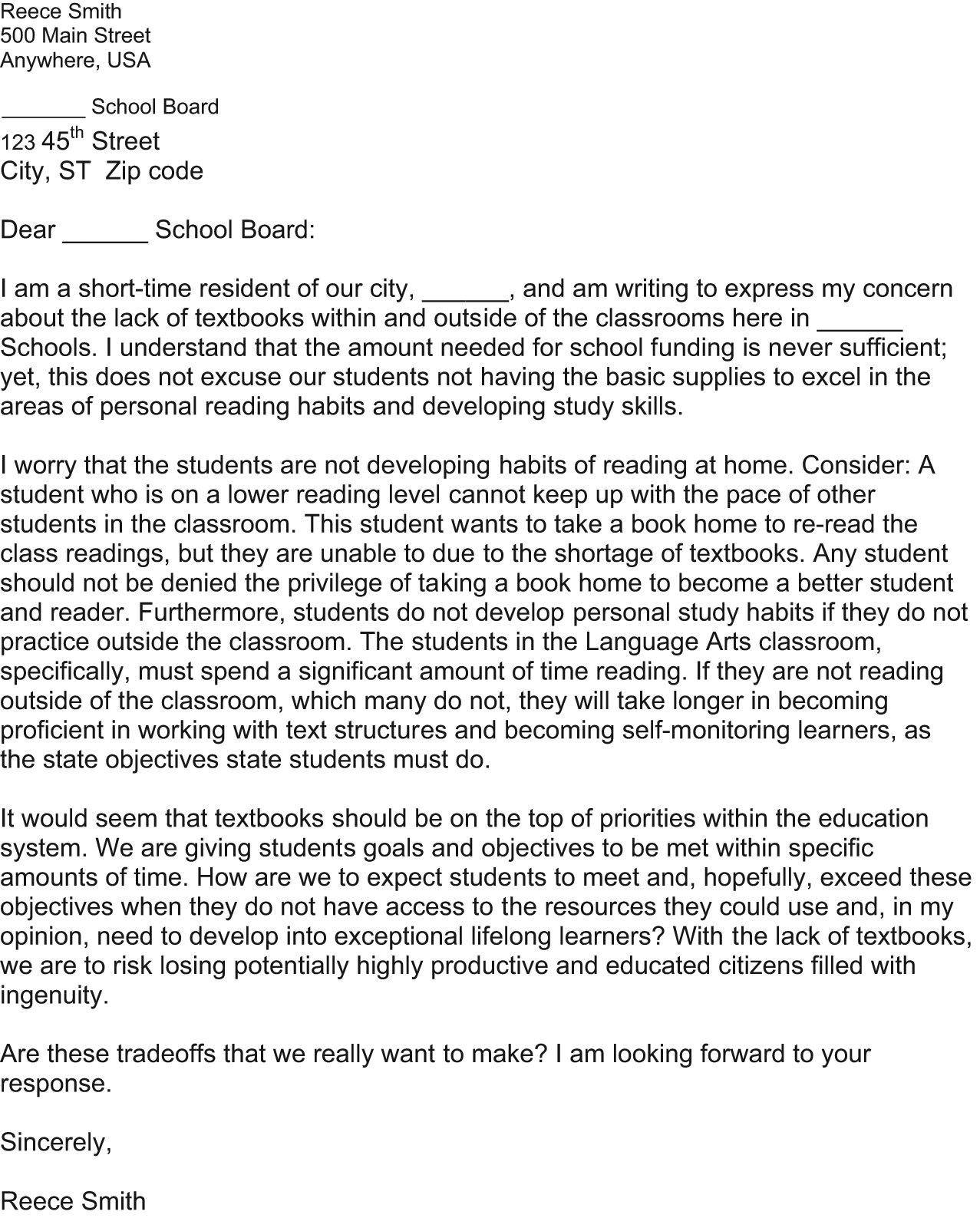
Reece’s letter to the school board, an example of thinking alternatively. Used with permission.
Even as Reece tries on a new identity and discourse, of note is her attention to aspects of critical literacy (Lewison et al., 2002): showing how students are positioned because of a lack of textbooks (disrupting the commonplace), paying attention to those marginalized (interrogating multiple viewpoints), redefining literacy as a form of cultural citizenship (focusing on sociopolitical issues), and using language to exercise power (taking action and promoting social justice).
This letter also portrays the tension between perceptions and reality about students and learning. If students do not read at home, a common view is that they do not care about their education or do not want to do homework. Reece’s letter serves to dispel the notion that many outsiders have about students’ lack of motivation. Another perception is that teachers are to blame for students being “behind” where they should be academically. Do arguments for or against something in education carry more weight when they come from the citizenry and not teachers? Although perhaps not a conscious decision on Reece’s part, choosing to write as “resident” and not future teacher was still a choice she made as a writer and made the genre that much more powerful.
Sam, a White male who grew up in public housing in a very diverse city in the South and was completing his field placement at a nearly all-White school 15 miles outside of town, was another student who enacted critical literacy practices as he was adopting the critical stance. His inquiry project, centering on the question “How can I get through to my students?” incorporated genres that showed risk taking and thinking alternatively and drew from his experiences as a student and youth coach and his field placement. His self-selected genres included several where he created new or secondary discourses and identities: a letter to the U.S. Department of Education from the standpoint of a “curious student/concerned teacher,” a journal entry written from a student’s perspective, a double-voiced poem from his and a student’s point of view, a personal essay and analysis of school culture, and a letter to the editor from an “English-only” advocate; he used the tension between formal and informal language in a lesson plan regarding language and perspective in Huckleberry Finn. In Figure 6 I juxtapose two of his genres: the student journal entry and the letter to the editor.
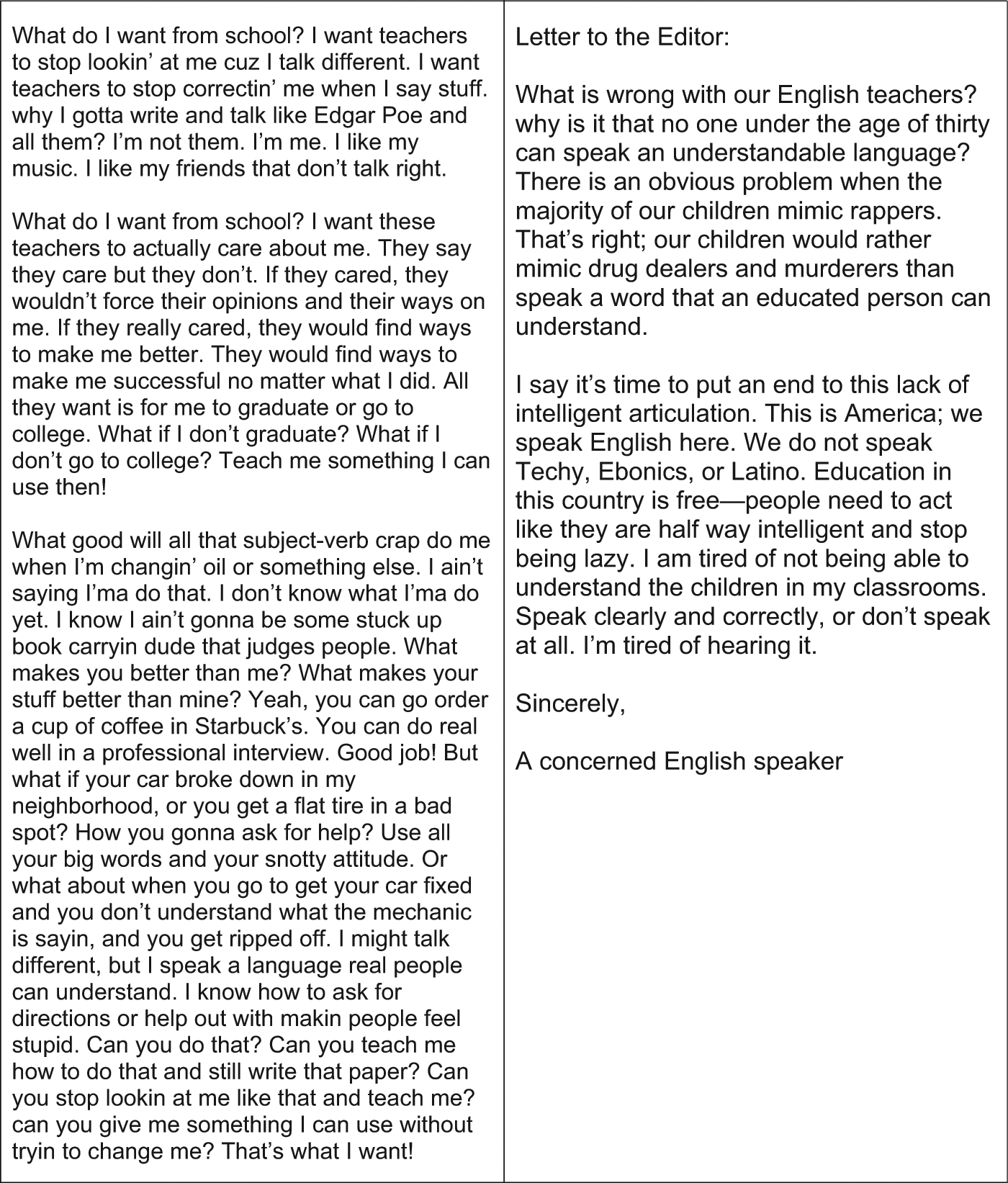
Student’s and community member’s perspectives created by Sam to show the tensions between viewpoints regarding language use. Used with permission.
Each of the two perspectives above is powerful, but when put side by side, they show how the pieces in an inquiry project can work together. The student journal is a reaction to what my students and I have found to be a deep-rooted curriculum and pedagogy in local schools—an adherence to canonical literature, surface-level language learning, and standard English and formal features of language—what Lea and Street (2006) referred to as a study skills model. What this model does not take into account are the literacies that students bring with them, such as Web 2.0 skills and, as pointed out above, understanding how cars work. Aside from traditional literacies, the student journal shows the reality that many of Sam’s students faced: feeling insecure because of race, ethnicity, or socioeconomic status; feelings of failure and insecurity; wanting to be respected by their teachers.
The letter to the editor, written from the perspective of a “concerned English speaker,” is an amalgamation of several viewpoints often heard in the area in which we live. For the community’s historic base—White, middle- to upper-class citizens who have seen changes to the “traditions” they owned and controlled—difference and change are to be regarded with suspicion and fear. As preservice teachers, the students were often between the world of their families and communities and the students they interacted with on a daily basis. Spending time in this borderland (Alsup, 2006), they began to understand and respect students’ vernacular literacies (Paris & Kirkland, 2011) and what these literacies offered in terms of pedagogy. In Sam’s pieces, he purposefully explored these borderlands.
Another key dimension of the critical stance and thinking alternatively is using the inquiry project as a tool of power, an artifact that can actually be used in the classroom. Johnna, for example, wanted to understand better why bullying was such a problem in her school. As one element of her project, she created a lesson plan around “Priscilla and the Wimps” (Peck, 1984), a short story about how a school bully is outsmarted by those he picks on. Although she could have fulfilled the assignment by just creating a lesson plan and including it, she chose to actually act on the problem and teach the lesson.
Although nearly every inquiry project, in essence, originated in what was not working in the preservice teacher’s classroom or school, in some cases that tension was prominently featured in the final product itself. This was evident in Roberta’s inquiry project, which she called “Going from ‘Whatever’ to ‘Yes Ma’am’: A Study on Student Motivation and Classroom Management.” In an effort to learn how to motivate her students, Roberta conducted two surveys, giving the second after the first one did not yield the information or change she hoped for. Although she could have accepted the results of the first survey—and used it as a genre in her project—she instead utilized the tension as a resource. Regarding the survey she wrote,
To say the least, I was very discouraged. I had been looking forward to hearing from my students’ responses, but ended up feeling like I was slapped in the face—dismissed. I pulled myself together and analyzed what I could, but then realized that the fact that so few students responded to my survey was a response I needed to listen to! Because of what I learned the first time, I was able to revise my survey and try again.
From the results of the second survey she later designed a “Hogwarts Houses” classroom plan based on her and the students’ love of Harry Potter. Dividing the whole class into smaller learning groups increased motivation and student collaboration. In her multigenre project’s conclusion, Roberta reflected,
Over the course of this inquiry project, I have discovered three main elements that contribute to successfully motivating students to participate in class.
Students must be extrinsically motivated, and teachers must take the time to get to know the students’ preferences.
Teachers can contribute to motivation by treating the students with respect, by challenging them, and by incorporating the students’ interests into the curriculum.
Students enjoy and excel in group work activities. The team or “family” mentality allows students to draw on each other’s strengths for overall success.
As teacher educators, it might be easy to look at Roberta’s three conclusions and decide there is nothing new to learn: extrinsic and intrinsic motivation work, teachers need to show respect to students, students like group work. However, what is significant is that her inquiry project took place over a semester in which she spent 90 hours in her cooperating teacher’s classroom. If Roberta discovered that teachers need to get to know their students and challenge them and that students benefit from group activities, what do those findings reveal about the classroom she was in and the teacher she was learning from?
All three teachers featured here used a tension in their placement—lack of textbooks, academic English, and motivation—as a driving force of their inquiry. And as the excerpts from their projects show, inquiry became a tool for them to process their experience, reflect on their teaching, and think about their future classrooms and students.
Actively Inquiring
To actively inquire means that preservice teachers go beyond asking questions and researching to critiquing what they find and what they think about it. One required genre in the project required them to think about their question or issue from “the other side.” An example of this is from Janine, who was placed in a classroom with a very traditional teacher who followed a regimented schedule. In her practicum, Janine experienced resistance from the teacher when she tried to bring in popular culture and media, one dimension of critical literacy, to engage the students. Janine’s inquiry project centered around the disconnect between the assigned readings in middle school and what students actually want to read. She created the cartoon in Figure 7, where tradition and new ways of thinking argue.
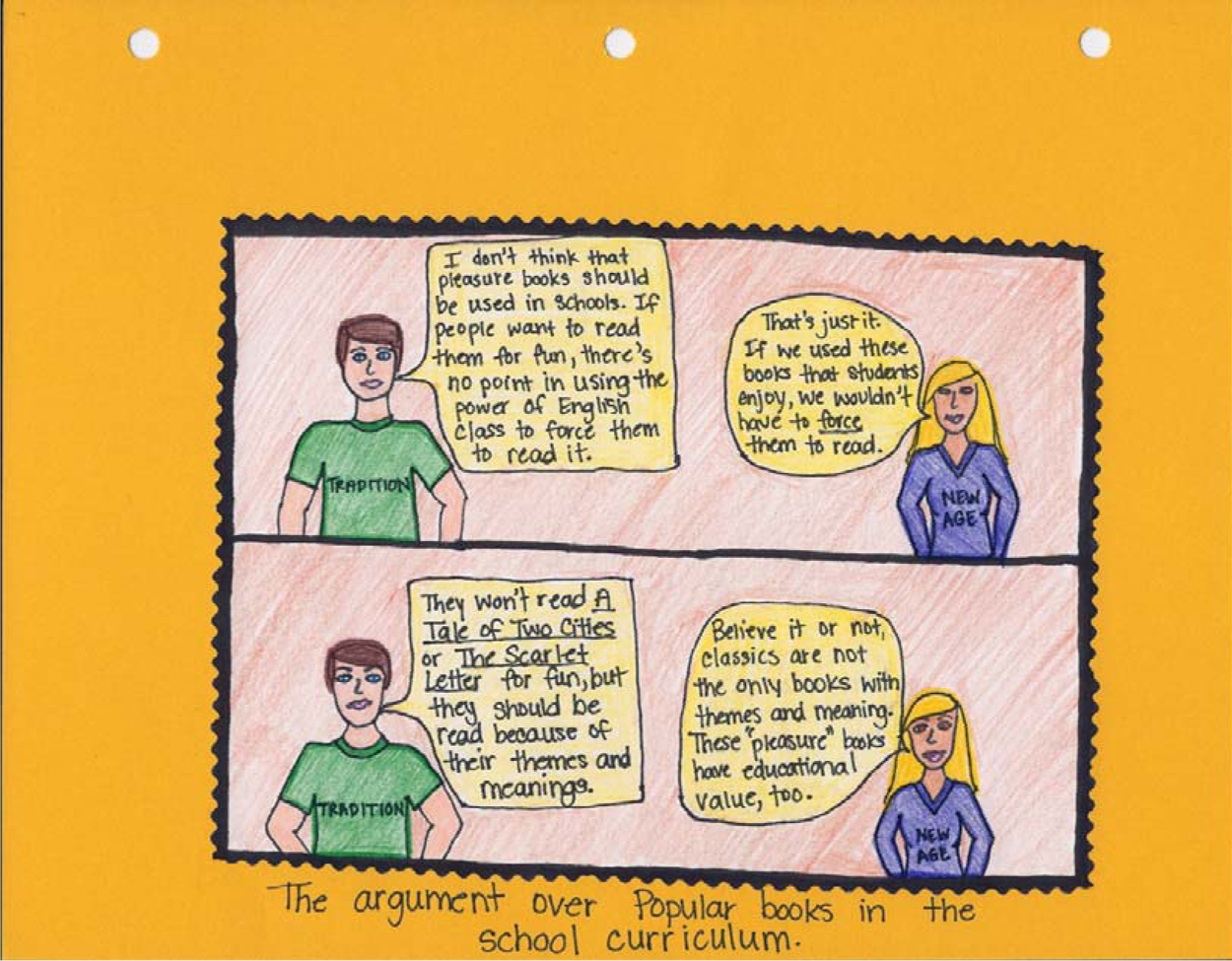
Tradition versus new age is an example of Janine’s actively inquiring from the other side of the issue. Used with permission.
Looking at the top half, the comic begins with “Tradition,” who thinks that school reading should not include pleasure books. Janine chooses to have Tradition state, “There’s no point in using the power of English to force them to read it.” New Age’s perspective is that reading should not have to be forced. Janine takes the contradictory perspectives she is experiencing in her classroom and reframes them. What is also interesting is that Janine seems to represent herself as New Age, when she could have used New Literacies or a similar term. The Southeast is traditionally a deeply religious (Christian, particularly Southern Baptist) locale, and the term New Age has negative connotations (i.e., non-Christian) for some. Did Janine’s teacher, explicitly or implicitly, position her as New Age or view them as pedagogically opposite?
The bottom half of the comic becomes more specific in terms of reading material. Tradition positions itself (interestingly as a White male) as superior; reading canonical texts with only a new critical lens is superior. New Age defends herself, stating that pleasure books (most likely young adult literature) do have pedagogical value. As recent research shows, many teachers prefer the classics because they are familiar and safe and honor tradition (Stallworth, Gibbons, & Fauber, 2006). What Janine seems to be trying to say is that timeless themes and meaning do not exist in canonical literature solely because they are “classics”; it is up to teachers to take texts that students like and then use them with sound pedagogical practices.
Mercedes, a Black female, also complicated this dimension, interrogating a source to answer her inquiry question regarding student participation in class. The film Freedom Writers (2007) was popular among students in our teacher education program, often cited as the reason they wanted to become English teachers. In class many students would say that they wanted to work with “minority” students and help students through their problems. Yet Mercedes criticized this approach with a short excerpt from the movie.
This video clip from Freedom Writers shows the “other side of the issue” regarding encouraging all students to participate. In this touching scene, a student who rarely spoke in class asks to share his story. Although the students in the video clip were choked-up and holding back tears, in the real world not all classmates will be so sensitive to others. While a teacher may encourage or even require all students to participate, some students may have comments on particular issues or experiences that are too personal to share. Moreover, some students do not want to expose themselves to other students and leave themselves susceptible to scrutiny or ridicule outside of the classroom by peers. So is it really necessary to make all students participate in class?
Mercedes’s reflection on the movie clip brings up a question raised by Sperling (2003), one we had discussed early in the semester when I showed a satire of the movie created by the show MADtv called “Nice White Lady” (http://www.youtube.com/watch?v=ZVF-nirSq5s): “Why should African American students (and other racial and cultural ‘minority’ students) be expected to be self-aware in their literacy learning when students in the suburbs are expected to achieve in more conventional ways?” (p. 145).
Some inquiry projects, as a whole, served to move students beyond their initial understandings and into new ways of thinking. Hannah’s inquiry focused on the question “Do students truly value their education?” and positioned her students as the problem because she did not see behaviors in them that she associated with caring about school and success. Hannah—a White female from a rural area—was placed in a school whose student body was 99.9% Black. However, through the inquiry process she transformed her thinking and language about the students. After reading through students’ journal responses to the question “Do you value your education and why or why not?” Hannah was pushed beyond her starting point. “What I found out really surprised me. I honestly felt as if these students could care less about school, but the results I found differed from my thoughts greatly.” Although movement from a deficit thinking perspective to a realization that students do care is not groundbreaking, it is nonetheless important: What would have been the result if Hannah’s assumptions had not been challenged or changed?
As the selections show, the inquiry process promoted active inquiring in these students as well as many others. The three women and other classmates’ projects showed knowledge gained from pedagogical and cultural contradictions that emerged in the field placement.
Being Reflective
In teacher education, students are often asked to reflect: on classroom observations, on the reading assignments, on teaching episodes. Being reflective means more than thinking back on, even if that thinking is critical. To me, although this fourth dimension can stand on its own, it is a sort of synthesis of the three other aspects of the critical stance. It is through self-examination, question posing, and dialogue with others that we take on a critical stance.
As I read through the inquiry projects, I noticed that most students retheorized their assumptions and beliefs and that quite a few actively tried to generate theories as part of their attempts to answer the question posed. Tessa, for example, wanted to learn why her students were not engaged in classroom activities. In her introductory piece, Tessa wrote,
The result of my research, first-hand observation, and third person experience through others’ writings, offers a threefold theory. Students are disengaged in the classroom because they are distracted by other aspects of life, motivated to attend school by some factor other than learning, or simply uninterested and bored.
What is noteworthy about Tessa’s statement is the fact that she is aware that she gathered and reflected on various perspectives and then articulated that. From this she generated her own theory. Theory was not something someone else produced; theory was something that she could construct. More important than the theories she developed is their long-term impact on her teaching. A year later Tessa wrote the following in response to my request for feedback:
Through my inquiry project, I wanted to find out, or at least get a better idea, as to why my students were so bored by English. . . . It was a chance for me to change my perspective in the classroom. Since I have been in the College of Education, I have been trying to create my persona as a teacher. However, through this project I asked myself, “What are they thinking?” Trying to sympathize with student attitudes toward English and school in general forced me to think critically. . . . One thing I really enjoyed about the project was the chance to show my findings in so many different ways. I was able to express what I learned in creative ways that came easily to me, but was also challenged by some of the genres you asked us to use to present our facts. The inquiry project was definitely helpful in helping me develop better teaching practices. I’m in my internship now, and my kids can’t seem to find enough motivation to keep their heads up. Literally. They put their heads down and attempt to sleep every single day. . . . When they seem bored, I start watching them more closely as people, not just students. What do they like to do? What can I add to my lessons that will bring them back to me? I would credit this largely to the process that I went through creating the inquiry project.
Jessalyn, a White female from a city noted for its science and technology innovations, was completing her field experience in a middle school with a large population of Black students living in poverty. Jessalyn had participated in a summer program I created and had worked with demographically similar students on a one-on-one basis. In their early field placements, preservice teachers spend most of their time observing what occurs in classrooms and do not get to interact with students. As they progress through their program, they have opportunities to teach lessons—but, again, interacting with individual students does not occur often. The summer experience provided Jessalyn with opportunities to talk to and teach students in close proximity.
The experience still resonated with her, and thus she debated and retheorized not only all semester long, but literally into the night. The questions that guided her inquiry were “What are some of the everyday struggles our students face, and how do these struggles influence classroom performance?” Figure 8 presents the first genre, the introductory essay, from her inquiry project.
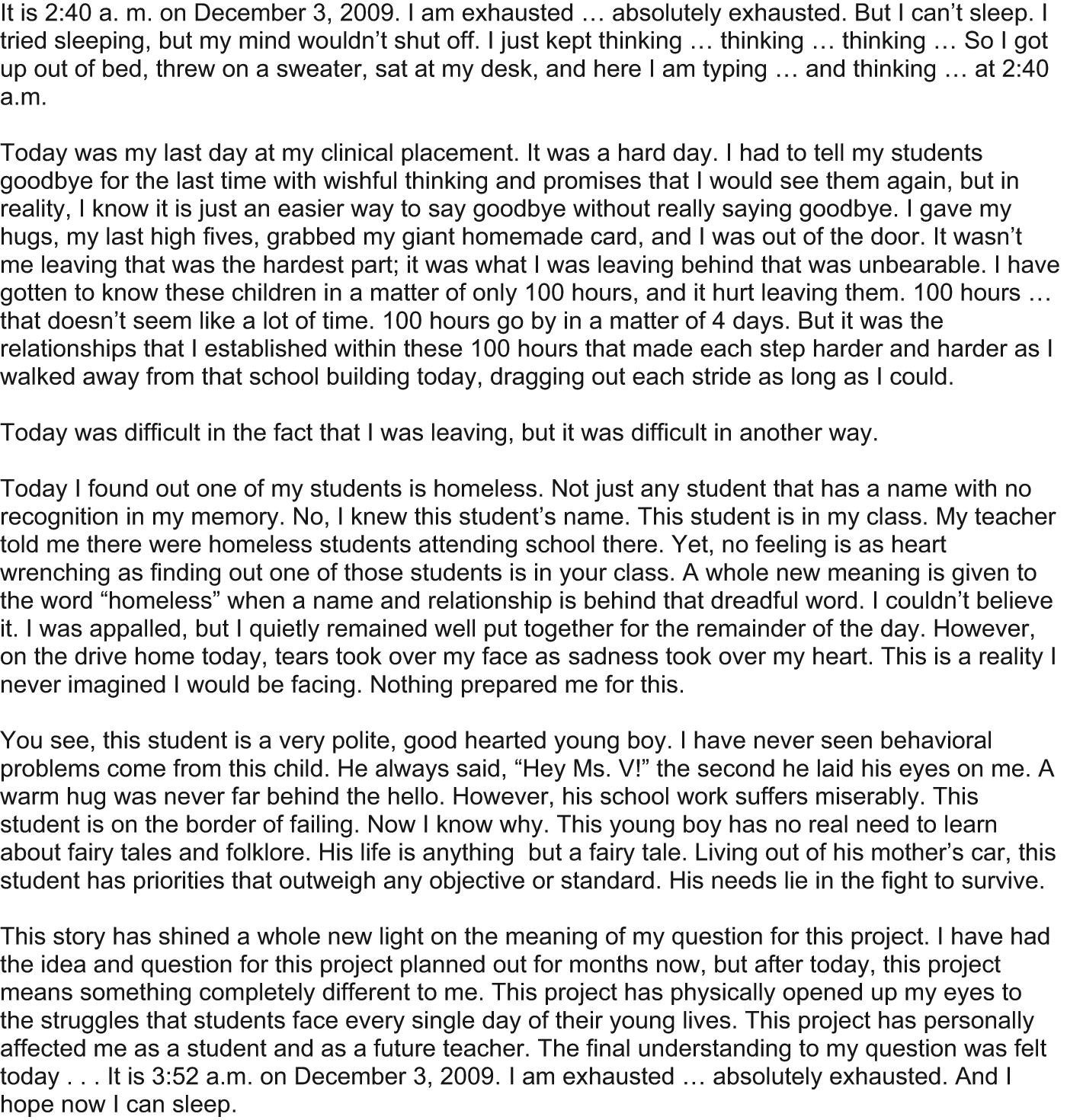
Jessalyn’s introductory piece illustrating the impact of being reflective. Used with permission.
Although Jessalyn thought she knew her inquiry subject, the revelation about her homeless student pushed her to go beyond the struggles she saw or thought she saw. Doing the inquiry forced her to really look deeply at her students and their lives.
Tessa’s and Jessalyn’s genres show their understanding of their complicity in the educational system and the wider social system to which they belong. They both synthesized their prior educational experiences and used them as a collective reflective tool. Throughout their teacher education programs, our students are trying to find out who they are, not only as human beings and adults but also as teachers. Tessa summarizes this viewpoint by stating, “Since I have been in the College of Education, I have been trying to create my persona as a teacher.” Doing this project encouraged her and her classmates to reflect like students and ask, “What are they thinking?” Doing so “forced her to think critically.”
Discussion
In discussing the multigenre inquiry projects, I return to the instructional model of critical literacy presented earlier in this article (Figure 1) because Lewison et al. (2008) note its use as both an instrument for instructional planning and a self-study tool. At the same time, I must also acknowledge the issues that invariably emerge when teachers (and teacher educators) attempt critical literacy in their classes. Thus, while discussing the outcomes from the inquiry projects, I must also take a “critical approach” when stating my conclusions (White, 2009, p. 55).
Personal and Cultural Resources
The preservice teachers had a range of personal and social resources to draw from in both coming up with an inquiry question and creating their texts: personal experience, social issues, popular culture, print and nonprint texts, hopes, school concerns, and community concerns (Lewison et al., 2008). Although these many resources offered a wide range of options, they could also be constraining. As with many English education programs around the country, nearly all of the preservice teachers were White, middle-class females (Hancock & Scherff, 2010; Scherff & Hahs-Vaughn, 2008); from my experience teaching at my university, I knew they drew heavily from their White, middle-class (and I would add religious, conservative) values, and this often was borne out in their inquiry questions that positioned students as deficient.
Returning to Hannah’s question, “Do you value your education and why or why not?” suggests that although her intentions were good, even the way she phrased the question implied a certain positioning of her students. To answer no would mean they did not value their education, but as she was defining value. She was “amazed” at the students’ responses. However, why would they not value education in itself? What did not appear in Hannah’s inquiry project were pieces that focused on the overall schooling experiences for students of color. What was also missing was a critique of how that high school—which had been more racially mixed less than 10 years earlier—changed in demographics so much in such a short time. Hannah’s White, middle-class background, where education is “valued” because it leads students to postsecondary opportunities, was very different from her students’ reality, where success in high school still did not guarantee that they had equal opportunities once they graduated. Yet other students, like Jessalyn and Sam, moved between the personal and cultural much more easily.
Hannah and Jessalyn had both participated in the summer teaching program, both were White females from middle-class backgrounds, both had field placements in schools where a majority of the students were of color. Yet Hannah approached her inquiry from a deficit perspective, and Jessalyn came to hers viewing students as co-contributors. Beliefs and values—cultural, pedagogical, religious, and so on—are deeply held—and although some preservice teachers can be affected profoundly by one experience, for others it takes several, and for others there are not enough to create change.
The implications for literacy educators, then, are that we need to try to ensure that prospective teachers have the greatest depth and breadth of readings, assignments, and experiences in our programs to help them approach their students as having much to offer rather than as inadequate beings. Assignments like the multigenre inquiry project (Simon, 2007), the equity audit (Groenke, 2010), community mapping (Jocson, 2011), and service learning (Hallman & Burdick, 2011) serve not only to open preservice teachers’ eyes but also to strengthen their own literacy skills. Moreover, as I have learned, these types of assignments might need to come earlier in courses and the program. Although the insights learned at the end were valuable for students, if I could have known about some of the issues earlier, I could have modified the course, readings, and in-class discussions.
Critical Social Practices
In the Lewison et al. (2008) instructional model of critical literacy, critical social practices are the “specific social practices in which students and teachers engage as they create critical curricula” (p. xxv), and they use the four dimensions as synthesized by Lewison et al. (2002): disrupting the commonplace, interrogating multiple viewpoints, focusing on sociopolitical issues, and taking action and promoting social justice. Thinking about these dimensions, it is clear that the multigenre inquiry project promoted the adoption of critical practices among many of the preservice teachers.
As Simon (2007) reflected on her use of inquiry projects, “The projects that teachers created involved not only the big, complex, and puzzling questions that are crucial for genuine inquiry (Bruning & Schweiger, 1997; Harvey, 1998), but they often sought to challenge marginalized stories and inequitable presentations” (p. 150). I found the same to be true in my students’ projects. Although there were few instances of genres that seemed to be used just to check one off the list or were presented superficially, in nearly all cases the students dug deeper and deeper as they engaged in the inquiry.
Moving Between the Personal and the Social
Lewison et al. (2008) note that in terms of curriculum, moving between the personal and social means recognizing that students are contributors to the educational process—their out-of-school lives have much to add to what occurs in classrooms. However, in this negotiation between the personal or the social and schooling, there are other factors at work (e.g., cultural influences, social structures, economic dynamics). Moving between the personal and the social is akin to Fecho’s (2004) recognition of “reconnecting the academic to the personal and using our practice of language to raise new questions and develop theory” (p. 56) in critical inquiry.
Thinking about the multigenre inquiry project as part of the curriculum of the course, my students were active contributors to their education through generating questions of interest that arose in their field placements. Some of the questions had them interrogate their own practices and roles as educators, whereas others questioned the wider educational and political systems. In these interrogations, the students asked new questions and generated theory. Incorporating multigenre inquiry instead of the action research that I had attempted in earlier versions of the course yielded much better results. Not having their own classrooms to teach in made attempts at action research superficial. However, multigenre inquiry projects worked well because the question of interest could originate from what the preservice teachers saw and experienced not only in their cooperating teacher’s classroom but also in the school as a whole.
Situating the Critical Inquiry Stance
To be sure, not all students will complete thoughtful inquiries, let alone adopt aspects of the critical stance. And as Simon (2007) and others (e.g., Bickmore, Smagorinsky, & O’Donnell-Allen, 2005; Smagorinsky, Wilson, & Moore, 2011) have pointed out, there is no guarantee whether or how an assignment or course will affect preservice teachers once they are working in schools. However, as the follow-up responses showed, the project did seem to have an impact on their practices a year later. The common theme was that through the inquiry process the teachers learned to see their students as multidimensional individuals. That, in turn, meant that they needed to see where they stood in terms of how to improve their teaching. In other words, without formally thinking about it, they were treating the entire teaching and learning situation with ongoing formative assessments—whether those assessments were tangible or not, or formal or not.
Conclusion: Situating Critical Literacy in Context
Lewison et al. (2008) write that critical literacy instruction “does not take place in a vacuum . . . the context in which we work can support or hinder critical teaching” (pp. 20-21). Although they are referring to K–12 classrooms, the statement also applies to literacy education. As literacy educators, we must be aware of the internal and external forces that guide our pedagogy. As teachers and students are affected by high-stakes testing and mandated curricula, literacy educators are affected by state and national accreditation bodies and procedures that impose assignments to be data sources. Just as my students drew heavily from their personal, cultural, and educational backgrounds, other literacy educators and I also pull from our experiences and beliefs. These external and internal factors guide how we plan, teach, and evaluate our teacher candidates.
Although I was pleased, overall, with the inquiry projects, not all students were as thoughtful in their work or level of critical reflection—but where does that fault lie? How much did I, as an instructor, affect the students’ work? Although critical literacy is concerned with language and power (Janks, 2008), when assigning the multigenre inquiry project, its language came from me, and I had the power of grading it. Although I allowed for choice, it was still bound by form—there were mandatory genres (see the appendix)—and function—it was part of their overall course grade. And even though it was meant to empower the preservice teachers, its ideology originated from me (Locke, 2010). Although ideologies can be a “challenging perspective,” they can also become “hegemonic” (Kellner, 1978, as cited in Burbles & Berk, 1999, p. 61). Was I imposing my brand of critical thinking and inquiry on my students, or was I fostering critical thinking in them? I would like to think the latter. As Sam wrote in his opening piece,
This letter is not written to ask why students are resistant to our education. This letter is to ask how I can get through to my students. This letter is to ask for support as I try to accept that my students are different. My students need this education.
Despite any risks in assigning a project like this, I firmly believe in its power to challenge and transform inequities.
Footnotes
Appendix
Acknowledgements
I would like to thank the anonymous reviewers and Lisa Simon, Leslie Rush, Nancy Singer, and Alison Heron-Hruby for their feedback on this article.
The author(s) declared no potential conflicts of interest with respect to the research, authorship, and/or publication of this article.
The author(s) received no financial support for the research, authorship, and/or publication of this article.
Notes
References
Supplementary Material
Please find the following supplemental material available below.
For Open Access articles published under a Creative Commons License, all supplemental material carries the same license as the article it is associated with.
For non-Open Access articles published, all supplemental material carries a non-exclusive license, and permission requests for re-use of supplemental material or any part of supplemental material shall be sent directly to the copyright owner as specified in the copyright notice associated with the article.
