




Abstract
This mixed-methods study explored (a) the purposes for which teachers selected video clips of their own literacy teaching and assessment practices to share and discuss with peers, (b) how these purposes were related to the content of the discussions, and (c) what variables were related to teachers’ generation of new ideas and future actions that they considered. Data included 39 transcribed video events, in which 14 in-service teachers engaged in discussions of their video clips. Emergent coding and constant comparative method were used for analyses. The authors found three purposes for sharing clips—explicit problems, implicit problems, and successes. Three issues were addressed—methods/materials, reader engagement, and reader processes. Six themes described how teachers’ purposes were related to their discussion content. First, sharing one problem led to one conversational focus. Second, sharing multiple problems led to multiple conversational foci. Third, sharing a problem and then a success resulted in peers focusing on the success. Fourth, sharing a success and then a problem resulted in peers focusing on the problem. Fifth, sharing a success related to methods/materials or reader engagement bred peers’ interest in how to apply these ideas to their own practice. Sixth, sharing a success related to reader processing led to peers focusing on other issues in the video. Based on the statistical model, teachers’ generation of new ideas was related to purposes and issues for clip sharing, and future actions considered were related to the clip type (instructional clips yielded more future actions).
Keywords
As university professors who teach reading methods courses, we are particularly concerned by the fact that only 34% of U.S. fourth graders were proficient readers in 2011 (National Assessment of Educational Progress, 2011, p. 10). The less-than-proficient readers are usually the ones who attend our university reading clinics to receive instruction from our master’s students who are studying to become reading specialists. Rooted in our knowledge that ineffective reading instruction contributes to low student achievement (Strickland, Kamil, Walberg, & Manning, 2003), and that teacher education that is dynamic and engaging can improve literacy instruction (National Reading Panel, 2000), we sought to identify and try new methods, such as using video discussions, in our teacher education courses to prepare teachers to assess and teach these readers who were experiencing literacy difficulty.
We chose to use video to support teachers’ development of literacy practices for two reasons. First, previous research has suggested several benefits of using video as part of literacy teacher preparation (e.g., Copeland & Decker, 1996; Hughes, Packard, & Pearson, 2000b; Kinzer, Cammack, Labbo, Teale, & Sanny, 2006). Second, rooted in a sociocultural perspective, collaborative video discussion could potentially extend the content, ideas, and future actions considered by teachers beyond that which occurs when teachers view their own videos independently (e.g., Cole & Wertsch, 1996; Kozulin, 2003; Vygotsky, 1978). Given these considerations, we had in-service teachers select video clips of their literacy teaching and assessment practices to collaboratively discuss with their peers. We refer to this process as collaborative peer video analysis (CPVA).
These CPVA events offered several potential foci for study. In this article, we explore the purposes for which the teachers selected video clips to share with their peers, how these purposes were related to the content of the CPVA discussions, and what variables were related to teachers’ generation of new ideas and consideration of future actions during CPVA.
Sociocultural Theory
Teachers’ engagement in CPVA is informed by two tenets of sociocultural theory: (a) learning is an interactive process and (b) physical artifacts mediate the learning process. Socioconstructivist scholars argue that learning and development originate in the social plane and are a result of an “interactive process” (Cole & Wertsch, 1996; Litowitz, 1993; Vygotsky, 1978). The interactive process occurs as a psychological function twice—first, it occurs in the form of actual interactions between people, and then it occurs as an internalized form of interaction within an individual (Kozulin, 2003; Vygotsky, 1978). Through the interactive process, individuals extend and transform the knowledge they bring to a situation through interaction with others (Cobb, 1996). In addition, cultural artifacts mediate the interactive learning process (Wertsch, 1991). Cole and Wertsch (1996) describe the interactive process of learning as taking “place in an artifact-saturated medium” (p. 254). Based on these theoretical tenets, we expect the following to occur: (a) interactions that occur between teachers will facilitate their first layer of learning and provide opportunities for teachers to extend and transform their knowledge of literacy teaching practices, and (b) reading assessment and instruction video clips will act as cultural artifacts that mediate these conversations.
Use of Video in Teacher Education
Broadly, research in which video has been used as part of teacher education practices suggests that video has several benefits for facilitating teachers’ learning. First, viewing a video of teaching practices provides a shared experience that teachers can discuss (Kinzer et al., 2006). Second, the use of shared videos facilitates teachers’ understandings of their own teaching practices (Baker & Wedman, 2000). Third, the ability to replay video allows for recursive learning (Kinzer et al., 2006). Fourth, teachers can use videos to support their learning based on their individual learning styles and learning purposes (Hughes et al., 2000b; Hughes, Packard, & Pearson, 1997). Fifth, considering multiple perspectives via videos is advantageous (Schrader et al., 2003) because it provides opportunities “to analyze teaching from a variety of perspectives” (Copeland & Decker, 1996, p. 469). Considering multiple perspectives challenges prior beliefs about teaching (Boling, 2004; Harrison, Pead, & Sheard, 2006; Hughes, Packard, & Pearson, 2000a) and leads to opportunities for teachers to shift or expand their views of classroom literacy practices (Copeland & Decker, 1996). Sixth, videos provide opportunities for teachers to consider the particular advantages and disadvantages of different practices in different contexts (Hughes et al., 2000a). Considering different practices in different contexts results in teachers being better able to analyze and respond to specific instructional situations (Anders, Hoffman, & Duffy, 2000). Seventh, this process of video discussion and analysis helps teachers understand the complexities of classroom literacy instruction (Sanny & Teale, 2008). Although many of these benefits stem from research in which video was used as a model of teaching practices (e.g., Copeland & Decker, 1996) or within a multimedia context (e.g., Hughes et al., 2000a; Kinzer et al., 2006), we expect that many of the same benefits will apply to CPVA as well.
Previous research that examined discussions of teachers’ video-recorded practices used one of three discussion formats: collaborative discussions with peers in study group formats discussing video transcripts (Ballenger, 2004; Herbel-Eisenmann, Drake, & Cirillo, 2009), collaborative discussions with a mentor in which the mentor views the video (Calandra, Brantley-Dias, & Dias, 2006; Sewall, 2009), and collaborative discussions with peers in which peers view the video (Harford & MacRuairc, 2008; Miller, 2009; Sherin & van Es, 2005). Based on our analysis of these studies, we hypothesize that the content of video-based discussions may be related to the purposes for which the videos are shared. For example, when teachers shared a problem related to their teaching that was illustrated by the video, their peers helped them develop understandings about their teaching related to this problem (Harford & MacRuairc, 2008). When preservice teachers chose exemplary video clips to share, less deep reflective statements resulted from the video discussion with a mentor than had occurred during the preservice teacher’s previous self-reflection (Calandra et al., 2006). Further research is warranted to understand how the purpose for sharing clips may be related to the content of video discussions.
In addition, previous collaborative peer video discussions have focused on clips of instruction (Calandra et al., 2006; Harford & MacRuairc, 2008; Herbel-Eisenmann et al., 2009; Miller, 2009; Sewall, 2009; Sherin & van Es, 2005), not assessment. So we wondered what relation, if any, the type of clip (assessment or instruction) might have on teachers’ generation of new ideas and the future actions that they consider during CPVA.
Finally, previous studies have situated their work related to research on problem-based learning (Miller, 2009); development of teacher expertise (Sherin & van Es, 2005); development of reflective practice (Calandra et al., 2006); or a combination of research, such as reflective practice, pedagogical development, and expert-novice relationships (Sewall, 2009). One previous study used Wenger’s (1998) community of practice model to position their study (Harford & MacRuairc, 2008). The ways in which previous researchers framed their studies did not result in their explicit examination of how the interactive process and video as a mediating artifact affected discussions. Thus, our study extends previous analyses of peer video discussions to analyze them through the lens of these two sociocultural tenets. This analysis may provide new insights into the roles of the interactive process and use of video artifacts in CPVA discussions.
Understanding the purposes for which teachers select clips to share and discuss with peers, how these purposes are related to the content of discussions, and what variables are related to teachers’ extension of their current understandings of literacy pedagogy—such as generating new ideas and considering future actions—may have implications for how literacy professors construct CPVA events. To explore these issues, we address the following research questions:
For what purposes do in-service teachers select video clips of their own literacy teaching practices to share and discuss with peers?
How are these purposes related to the content of the discussions?
What variables are related to teachers’ generation of new ideas and their consideration of future actions during CPVA events?
Method
Setting and Participants
This study was conducted at two Midwestern universities, with the approval of both universities’ Institutional Review Boards. The participants were 14 master’s level in-service teachers enrolled in a two-course literacy teacher education practicum. The eight in-service teachers at Site A were Caucasian, middle and upper socioeconomic status (SES), and between 25 and 35 years old. They taught kindergarten to 5th grades. The six teachers at Site B were predominantly African American, middle SES, and between 25 and 40 years old and taught kindergarten to 11th grades. They were all certified teachers and taught in different kinds of communities (urban and suburban) and in different kinds of schools (elementary, middle, high; public, charter). All 14 teachers were female.
This was a convenience sample rather than a representative one. As instructors teaching courses with similar goals and elements, we decided to collaborate as a team and explore how teachers in our respective university practica constructed understandings about literacy assessment and instruction during CPVA. Our intent was not to study the similarities or differences across the two groups of teachers. Nevertheless, we tested whether the two sites differed statistically, across all outcomes, with Zellner’s method (Kennedy, 2008). They did not differ significantly on any of the outcomes.
Instructional Context
At both universities, teachers participated in a yearlong capstone literacy practicum toward the end of their master’s in reading program with one of the first two authors. Thus, we were participant observers in this research. The goal of these courses was to help teachers better understand and implement literacy assessment and instruction for children struggling with reading. In the first semester, teachers learned how to administer, analyze, interpret, and summarize the results of several reading assessment methods. Then, they learned to design assessment-based instruction to facilitate these children’s literacy development. In addition to course readings, the teachers watched exemplar video cases that depicted literacy assessment practices used in K–12 classrooms and engaged in whole-class discussions about them. During the discussions, teachers collaboratively commented on, posed questions about, made connections about, and critiqued the information presented in the videos. This practice of watching the exemplar video cases and engaging in critical discussions not only informed the teachers about how to support children’s literacy development but also provided them with a foundation for thinking and talking about literacy pedagogy during CPVA discussions.
In the second semester, teachers applied the skills learned in the first semester during supervised tutoring sessions, gaining valuable hands-on experiences working with students experiencing difficulty with literacy. The teachers video-recorded these sessions and selected clips to share with their peers in CPVA sessions, thereby continuing the practice of social dialogue and ongoing conversations begun in the first semester. Our participation in these CPVA events was too minimal to adequately analyze for this article. However, we participated more in the discussions of exemplar videos cases, which preceded CPVA events, and so we plan to analyze our facilitation of the exemplar video cases in another paper.
Data Sources and Collection
Data were gathered during literacy education classes at both of the sites between November 2009 and April 2010. In-service teachers were directed to “select a clip to share with peers” from their videos of themselves teaching or assessing a child experiencing difficulty reading during the university practicum. For example, an instruction clip might show a teacher guiding a child’s engagement in making and checking predictions to monitor comprehension while reading. Likewise, an assessment clip might show a teacher administering an Informal Reading Inventory. Teachers were asked to “introduce the clip and explain why you selected it” before showing it to their peers. The task was purposely constructed broadly to allow teachers to engage in various purposes for selecting clips to share. For example, a teacher might share an instruction clip of her guiding a child to monitor comprehension while reading because she was pleased with the support that she provided or because she wondered whether she provided too much support. Likewise, a teacher might share an assessment clip of a child reading an assessment passage because she wondered about the child’s processing during reading or because she wondered if she should have helped the child when he struggled with a particular word. There were myriad reasons that teachers could choose to share particular clips. Broadly allowing the teachers to choose clips that they found meaningful to share with peers allowed us to examine for what purposes teachers chose to select clips and how this related to their CPVA discussion content, new ideas, and future actions that they considered.
In-service teachers took turns presenting their clips during the seminar portion of the course each week. Clips were 9 minutes long, on average. Peers in each course watched the videos as a class and shared their observations and comments about the literacy teaching practices. Each sharing and discussion of a particular video clip constituted an event. Each in-service teacher shared at least one instructional clip and one assessment clip, for a total of 39 CPVA events. All CPVA discussion events in the seminar were video-recorded and transcribed.
Data Coding and Analyses
For each CPVA event, we entered the following descriptive information into a database: (a) site at which the clip was shared, (b) presenter who selected and shared the clip, (c) date on which the clip was shared, and (d) whether the clip depicted a literacy assessment or a literacy instruction practice.
To identify for what purposes teachers shared clips, we began by using open coding. Based on previous research, we coded whether teachers shared successes (Calandra et al., 2006) or posed problems to be discussed (Miller, 2009). Through the use of emergent coding, we identified two categories of problems that were posed—implicit and explicit. Across all purposes, we used emergent coding to identify the literacy assessment or instruction issues to which each purpose was related. This resulted in the following codes: materials, methods, readers’ word recognition, readers’ comprehension, readers’ vocabulary knowledge, readers’ fluency, readers’ motivation, and readers’ engagement. We combined the codes that were interrelated to create three subcategories that reflected the issues to which teachers’ purposes were related: methods/materials, reader processes (this included readers’ word recognition, comprehension, vocabulary knowledge, and fluency), and reader engagement (this subcategory included issues of motivation). In some CPVA events there was only one purpose, and in other events there were multiple purposes. Similarly, some purposes were related to just one issue, whereas other purposes related to multiple issues. All purposes and the subcategories were coded for each CPVA event and entered into a database.
To answer Research Question 2, we used the constant comparative method of analysis (Strauss & Corbin, 1998) to identify how the purposes or issues identified through the preceding analysis were related to the content of the CPVA discussion. First, we began by coding the comments made within each CPVA discussion to identify whether they related to any of the problems or successes that were posed. For example, if the teacher posed an explicit problem (e.g., “How do I help the student learn word family patterns?”) and a peer provided a suggestion during the discussion (e.g., “Try using word sorts”), this comment was coded as addressing the explicit problem. Second, we used the same codes that identified issues related to each purpose for sharing the clip (i.e., method/materials, reader processing, or reader engagement) to code the content of each comment made by peers during the discussion. For example, if a peer suggested modeling a reading strategy, then this content was coded as a method/material. Third, through an iterative process, we examined the relation between the purposes or issues of clips selected for sharing and the discussion content to develop axial codes that described the patterns in our data.
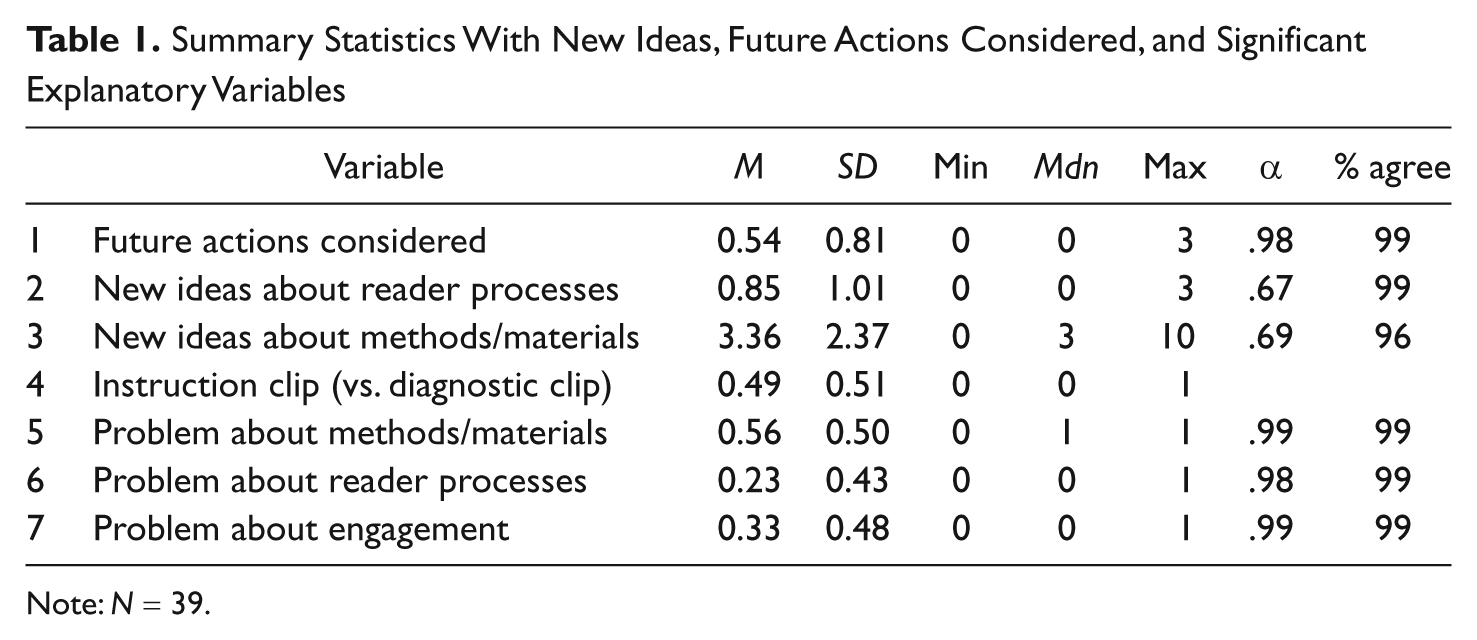
Across the coding for Research Questions 1 and 2, codes were tested, revised, and retested by two authors through iterative coding, comparison of codes, and revision of codes until agreement was achieved. After this process was complete, two authors independently coded all video transcripts (see Table 1 for interrater reliability and percentage agreement by variable). Any coding discrepancies were discussed to establish consensus.
Summary Statistics With New Ideas, Future Actions Considered, and Significant Explanatory Variables
Note: N = 39.
To answer Research Question 3, we statistically tested what variables (purposes for sharing clips, types of clips shared, or teacher demographics) were related to teachers’ generation of new ideas or their consideration of future actions. Specifically, the statistical analyses tested whether these relations were idiosyncratic, limited to a few examples, or represented significant relationships throughout the data set. These understandings could not be gleaned from qualitative analysis alone.
Statistically analyzing these data required addressing difficulties involving (a) the entire data set, (b) the outcome variables, and (c) the explanatory model (see Table 2). The data set was missing data (grade level or SES of school district in which some teachers taught), which can reduce estimation efficiency, complicate data analyses, and bias results. Thus, we used Markov chain Monte Carlo multiple imputation to estimate values for the missing data, which addresses missing data issues more effectively than deletion, mean substitution, or simple imputation according to computer simulations (Peugh & Enders, 2004).
Statistical Strategies for Addressing Analytical Difficulties
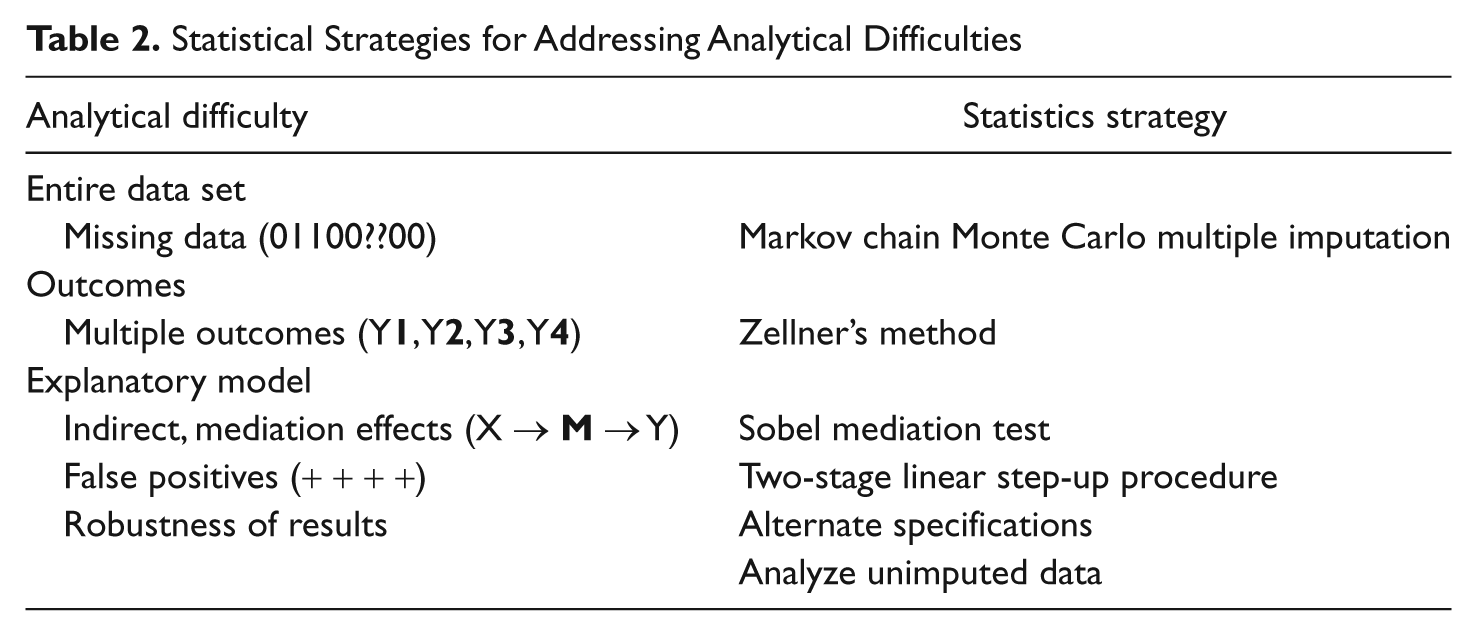
Second, we were interested in several outcomes. Analyzing the outcomes separately ignores relations among the outcomes. Thus, we modeled the outcome variables simultaneously, using a system of equations, specifically Zellner’s method (Kennedy, 2008) via Eviews software (Lilien, Startz, Ellsworth, Noh, & Engle, 1995).
Difficulties related to the explanatory model included indirect, mediation effects; false positives; and robustness of results. As some relations might occur indirectly with a mediating variable, we used sequential sets of explanatory variables and mediation tests to test for indirect effects (Sobel, 1982). As testing hypotheses with several explanatory variables can yield false significant results (false positives), we controlled this false discovery rate with a two-stage linear step-up procedure. This procedure outperformed 13 other methods, according to computer simulations (Benjamini, Krieger, & Yekutieli, 2006). Last, we tested whether our results were robust by testing alternate regression specifications and through analyses of the original data (without estimated values for missing data). After Markov chain Monte Carlo multiple imputation (Peugh & Enders, 2004) of the missing data (less than 1% of the database), we modeled the outcomes with multivariate outcome regressions (Zellner’s method; Kennedy, 2008).

β0y values are the grand mean intercepts of

We entered four sequential sets of explanatory variables: type of video clip, teacher demographics, teacher purpose for sharing the video clip, and interaction terms. First, we entered whether the clip was an Instruction_Clip (vs. an assessment clip). We tested each set of predictors for significance with a nested hypothesis test (χ2 log likelihood; Kennedy, 2008). Next, we entered w variables regarding the demographics of the teacher in the video: attendance at a teacher education program at one university (vs. the other university), ethnicity, grade of students in her class, and whether or not she was currently a full-time teacher with her own classes (
The Sobel (1982) test identified mediation effects. For significant mediators, we computed the proportional change, 1 – (b’/b), where b’ and b were the regression coefficients of the explanatory variable, with and without the mediator in the model, respectively.
An alpha level of .05 was used. To control for false positives, we used the two-stage linear step-up procedure, (Benjamini et al., 2006). The small sample size (n = 39) limits the statistical power of this analysis only to identify nonsignificant results (power = 0.73 for an effect size of 0.40; Cohen, West, Aiken, & Cohen, 2003), so significant results remain statistically valid. Like standard regressions, the methods described above meet both assumptions of a linear explanatory model and residuals that are independent and identically distributed (IID; Kennedy, 2008). We used a linear combination of explanatory variables, and externally studentized residuals showed that they were IID (Kennedy, 2008).
Finally, we did additional analyses to test the robustness of these results. We replaced the three problem variables (involving methods/materials, reader processes, or reader engagement) with three pairs of explicit problem and implicit problem variables. Within each pair of explicit and implicit problem variables, χ2 log likelihood tests indicated whether the regression coefficients differed (Kennedy, 2008). Then, we did all of the above analyses with the original data.
Findings
Purposes for Selecting Video Clips to Share
There were three broad purposes for which teachers chose to share clips with peers: to share a problem explicitly, to share a problem implicitly, and to share a success. These purposes were related to three issues: methods/materials, reader processes, or reader engagement. Purposes, and the issues that they addressed, were used in various combinations: 46% of CPVA events focused on one problem (explicit or implicit), 15% focused on one success, and 38% focused on multiple purposes (i.e., multiple problems, or a combination of problems and successes).
In-service teachers at both sites often explicitly posed a question or stated a problem that they wanted their peers to focus on during CPVA. These problems most frequently were related to methods and materials (73.3%). For example, while sharing a clip from her instruction, Lori explicitly asked her peers for feedback about how to use word sorts as an instructional method: “I guess what I’m mainly looking for are suggestions. How would you have done it differently?” Although in-service teachers also focused on explicit problems that addressed reader engagement during literacy assessment and instruction, this occurred far less frequently (26.6%). For example, Jenny said, “I want you to notice just her personality, her behavior in general. And I want you to give me feedback—if I handled it appropriately.” None of the in-service teachers posed explicit problems addressing reader processes during CPVA events.
In contrast, teachers predominantly implied the existence of problems related to reader processes (38.9%). For example, in one CVPA event, Sharon said, “It’s hard for me because I know he has the capability, because I see him reading with his eyes, but it’s just like every once in awhile he skips over whole sections.” A slightly smaller proportion (33.3%) of CPVA events implied problems related to reader engagement. Karen’s introduction to her video clip exemplifies this: “I really struggle, and it’s every time we start [that] he’s like this, and I cannot get him to talk to me. I don’t know what to do because I’m not sure if he’s not understanding or he’s just not talking to me.” Purposes were implied least frequently when issues were related to methods/materials (27.8%). For example, Lucy said,
I have to come up with ten reading passages for this student, and last week he told me he loves sports, and now he hates sports. So I was very frustrated after that because I thought, what on earth am I gonna give to this kid to read?
It seems that although teachers are generally able to explicitly articulate their need for methods/materials, they are less able to articulate their need for assistance understanding reader processing. This might be the case for several reasons: (a) Teacher preparation programs may emphasize methods/materials more than reader processing, (b) teachers may have more prior experience identifying a need for methods/materials to meet curriculum goals and less experience analyzing the processing of individual readers, and (c) issues related to methods/materials may be easier to articulate than issues related to reader processing. Therefore, allowing teachers opportunities to identify problems implicitly or explicitly is important, so as to not limit the content of the discussions.
In addition to selecting clips to share problems, teachers also selected clips to share their successes. Half of the clips in which a success was shared were related to methods/materials. For example, Sarah shared a successful teaching method that involved a decoding game:
At the end of the [sight word] list, I go back and ask him, “Do you know that word?” He says, “yes,” and he gets it right on the second chance. I said, “Good job!” He said, “How many points is that worth?” I’m like, oh, cool, “It’s worth ten points.” You know, so now it’s a fun game. And it was amazing how much better he did on those tougher words when he thought there was a point assignment.
The other half of the clips in which a success was shared related to reader processes. For example, Carrie shared her student’s success: “He’s making really good progress [using the prediction strategy independently] which is why I am showing this.” No teachers chose clips to share successes related to reader engagement. This may have been the case because successes related to children’s engagement were attributed to either the methods/materials or the readers’ abilities to process the text.
Sharing successes related to methods/materials provided an opportunity for a teacher to share something that might be of use to her peers. These successes were likely selected to be of benefit to others in the discussion group. For example, several other teachers could potentially have made use of the decoding game with their students. Teacher interviews would corroborate our conjectures about teachers’ intentions for sharing successes, and we plan to collect such data in our future research to clarify this issue.
Purposes and CPVA Discussion Content
Across CPVA events, peers tried to address the purposes and issues identified by the teacher who shared her clip. The content discussed by peers during CPVA was related to the purposes in six ways: (a) identifying one problem led to one conversational focus, (b) identifying multiple problems led to multiple conversational foci, (c) identifying a problem and then a success resulted in peers focusing on the success, (d) identifying a success and then a problem resulted in peers focusing on the problem, (e) identifying a success related to methods/materials or reader engagement bred peers’ interest in how they might apply these ideas to their own practice, and (f) identifying a success related to reader processing led to peers focusing on other issues in the video.
One problem
When only one problem (either implicit or explicit) was posed for CPVA (54% of the time), all of the peers’ discussion related to this problem. For example, Lucy showed her peers a clip of her and her student using Internet searching to find information for a report. She asked her peers to provide suggestions for Internet searching. They made several suggestions:
Use Google [but] Wikipedia is—can be—made up. . . . That’s one of the things that they have a very hard time understanding . . . distinguishing fact from like what [is not true].
I use discovery.com a lot. . . . Because we do a lot of, like if we’re doing research projects, it’s usually social studies or science.
[adds] Encyclopedia.com, dictionary.com are good ones, too. [For] looking for specifics.
But the biggest thing for that age group is . . . getting them to realize that you have to cite anything that you use and you can’t just copy and paste it.
All of the new ideas generated during this conversation were related to Lucy’s problem—how to help a student conduct Internet research. Jointly, through the interactive process, Karen, Sharon, and Darcy generated many new ideas about how to help children use the Internet to search for information. Karen began with several ideas, using the Google search engine and being cautious of Wikipedia.com, and related to that helping children distinguish fact from what is not true. Sharon extended these ideas by sharing another website, discovery.com, and this in turn seemed to prompt Karen to suggest two more—using encyclopedia.com and dictionary.com. Likewise, Darcy added to Karen’s cautions about using the Internet by adding that students need to be aware that they cannot copy and paste content into reports. Through the interactive process, teachers seemed to respond to one another’s ideas by thinking of more new ideas themselves.
Multiple problems
Multiple problems were identified in 46% of the events. Multiple problems reflected the dynamic interaction that occurred during CPVA discussions. It was the comments made by peers that seemed to evoke a teacher’s identification of new problems. For example, Darcy began her CPVA event by sharing an implicit problem: “[My student] tries the short vowel sound for every single word that she doesn’t know.” Laila responded, “I’m working with this [too] . . . he’s just starting to realize that it’s not always a short vowel sound.” This response seemed to help Darcy clarify her problem, because she then identified her purpose explicitly: “So any ideas that you have for me to work with her or practice?” Through the interactive process, Darcy was able to move from expressing her problem implicitly to explicitly.
Her peers generated several new ideas, all related to addressing this problem. Karen suggested having the child use a mirror to see how their mouth looked when pronouncing different vowel sounds. She had previously used this technique with success in her kindergarten classroom. Sharon suggested trying “Words Their Way long vowel sorts,” which she used regularly with success in her fifth grade classroom. Laila extended this idea by explaining how she used sorts with her first grade student in clinic:
We talked about the difference between the short sound and the long sound. I had a little vowel chart that I bought, and showed him. And so then I told him, now sometimes long “A”—here’s the different patterns that it is—that it has to make the sound like “A” with “E,” or “A” with “Y.” . . . I told him exactly what patterns he was gonna be looking for. And I had him read the words [as he sorted]. Then he found the words in a poem. He highlighted them to practice reading them in a real short poem. I think it’s just like a matter of repetition. You know, you can’t expect that you did one lesson [and that the student will learn it completely].
Although teachers generated many ideas based on their previous classroom experiences, some new ideas were rooted in the analysis of the video clip. For example, Lucy said,
I noticed in this example with her [in the video clip], too, and I know this is just like one little snippet, but it didn’t even seem with that tool that she was having as much trouble with the vowel sound as that she was trying to make that “L” part of a blend. She kept saying /fl/, /fl/, and “L” is a difficult consonant anyway, particularly if she’s not really steady with all of her consonants and word endings.
Based on noticing what the student did in the clip, she suggested that Darcy try “some easier words with ‘N’ endings or ‘T’ endings” so that “everything else would be easy for her except the vowel sound.” In this instance, the video mediated the discussion content. Lucy was able to notice the reader’s processing based on viewing the video, and this was related to her subsequent instructional suggestion. What Lucy noticed was not an issue identified in the problem stated by Darcy. Thus, without having viewed the video, this issue would never have been discussed, and Lucy’s novel explanation and suggestion related to the problem would have been missed. Through the video-mediated interactive process, Lucy transformed Darcy’s knowledge related to the situation.
Later in this same event, Carrie suggested that a Making Words Activity (using letter cards or tiles to make words) might “keep her attention a little bit more.” The mention of the issue of attention seemed to spur Darcy’s articulation of another problem that she noticed while she watched the video again with her peers:
Her attention—I was just watching this [in the video]—she literally rocks back in her chair for four minutes straight. . . . I don’t know that she can stay focused. . . . She doesn’t like when I point to the words on the page, but she doesn’t want to use anything [herself].
Thus, the interactive process, mediated by the video clip, resulted in the identification of another problem that Darcy had not yet articulated when she prepared the video to share with the CPVA group.
Across this event, the purpose for viewing and discussing the video and the issues to be addressed were transformed through the interactive process. In addition, these multiple purposes resulted in breadth of conversation content, including difficulties that first graders had differentiating vowel sounds, how the reader processed blends, and difficulties the reader had with attention and tracking. For each of these, peers generated new ideas that extended and transformed Darcy’s knowledge related to the problem.
A problem and then a success
When a problem was shared first, followed by a success, peers focused on the success. For example, Darcy shared a video clip in which she had difficulty getting her student to read the text during assessment: “The problem was I was doing her testing, so I needed her to read this story for me.” However, she immediately shifted to focus on sharing her success: “Karen helped me out and we got her to read it.” No suggestions from peers regarding methods followed this sharing. Instead, peers complimented the solution. For example, Lucy complimented, “Well, I liked what Karen did because it gave her another purpose to read.”
Although peers provided support by generating new ideas through the interactive process when the teacher identified a problem, they simply applauded the solution when the problem was already solved. Again, this follows the general pattern of CPVA events—peers responded to their peer’s need for support. When a need for support was not evident, no support was provided. In such events, the video artifact did not generate broader content of discussion, and the interactive process did not generate new ideas or consideration of future actions.
A success and then a problem
When the purpose shifted from sharing a success to posing a problem, peers focused on responding to the problem. Typically, when this pattern occurred, the problems were related to methods/materials or reader engagement. For example, Sharon began her CPVA event by saying that her purpose was to share a success: “I want to focus on his oral reading . . . he’s definitely improved . . . so that’s what I’m showing.” However, after viewing the clip again with her peers, she identified a problem: “One thing stumps me about the way he reads—sometimes he reads the bigger sections with bigger words [at an adequate rate] and then he really slows down.” The re-viewing of her clip seemed to spur her to consider other aspects of the child’s reading and instigated new thinking about the clip. Thus, the video mediated the content of the discussion by stimulating new thinking about the clip content as the teacher watched it again.
Sharon’s peers focused on addressing the problem. Lucy suggested, “It’s almost like he gets the hang of it, and when he knows it’s easy for him he slumps.” Her comment was rooted in her viewing of the video, in which she watches this occur. Likewise, Darcy noticed that in the video, “He’s making longer pauses after every period.” Based on this information she concluded, “He is paying attention to the punctuation. Every space is a pause.” Both of these comments demonstrate the importance of viewing the video for understanding and commenting on reader processing. The video clip mediated the conversation by providing verbal, nonverbal, and visual information about what the student did in the clip. The presence of this information in the video made it easier for teachers to discuss the student’s fluency.
Sharing a success related to methods/materials or reader engagement
When the teachers shared a success related to methods/materials or reader engagement, peers frequently asked questions, extended ideas, and expressed interest in trying the ideas presented. For example, Darcy articulated her purpose for sharing a successful teaching material: “I just want to share this because I found this game and I thought it was a fun game to practice ending sounds.” Amy, whose clinic student was also learning word patterns demonstrated interest in this method. She asked, “Where’d you find that game?” Amy’s response demonstrated that she was interested in gaining ideas for methods/materials through viewing the videos of peers’ practices. In fact, as mentioned previously, sharing such successes were likely intended for that purpose.
Frequently, teachers suggested ways to modify successful practices. For example, Lori responded to Amy’s clip by making a suggestion about the use of the game in the video clip:
You know, you said, “I’m gonna give you an example.” And then you said, stamp, and she went right away for the “ST.” I wonder if you could’ve used a think aloud? [For example, say,] “When I listen to that word, stamp—/st/-/a/-/m/-/p/—at the end, I hear. . . .” And then actually show her where to put it. And then she would’ve had a model to do it.
Lori provided this suggestion based on watching what Darcy did in the video and considering how it could be improved. In this case, the video mediated the discussion content related to methods/materials. Although, as evidenced in previous examples, teachers are often able to generate ideas related to methods/materials based on their prior knowledge, viewing the video allowed peers to suggest ideas to explicitly extend or improve on exactly what happened in the event. Thus, the interactive process, mediated by the video artifact, acted to extend and transform teachers’ knowledge about what occurred in the video.
Sharing a success related to reader processing
In contrast, when the in-service teachers shared a success related to reader processes, peers engaged in little or no discussion related to the success. Instead, peers focused on other aspects of teacher or student behaviors from the video clip. For example, Sarah shared a success related to her student’s use of a decoding strategy:
Okay, so this is a very proud moment for me, this clip. My student struggles with reading strategies. When he’s stuck on a word, he really does not know what to do. So for the past—ever since Carrie introduced those animal clues to us, we have used the Slither-Sound-It-Out-Snake, the Rocky-the-Picture-Clue-Raccoon, and the Chunk-the-Skunk [reading strategy cards]. And you know, he’s always kinda struggled, remembering when to use what, and so finally, [in this clip] he gets stuck on a word and he looks at the picture and figures it out.
Teachers’ sharing of successes related to reader processing seemed more oriented toward celebrating their accomplishments—for example, “This was a proud moment for me.” However, it resulted in discussion shifts toward issues noticed by peers as they viewed the video. For example, Karen noticed that the student looked unenthusiastic in the video clip and asked, “Does he ever get excited?” This shifted the focus away from the success, and generated another purpose for considering the clip—engagement. It seems that since there was not a problem to address, nor a method or materials to expand on, Karen generated another purpose for considering the clip. This new purpose was mediated by Karen’s viewing of the video. That is, she noticed that the student was unenthusiastic and wondered about this. Thus, through the video-mediated interactive social process, the discussion content was broadened.
Generation of New Ideas
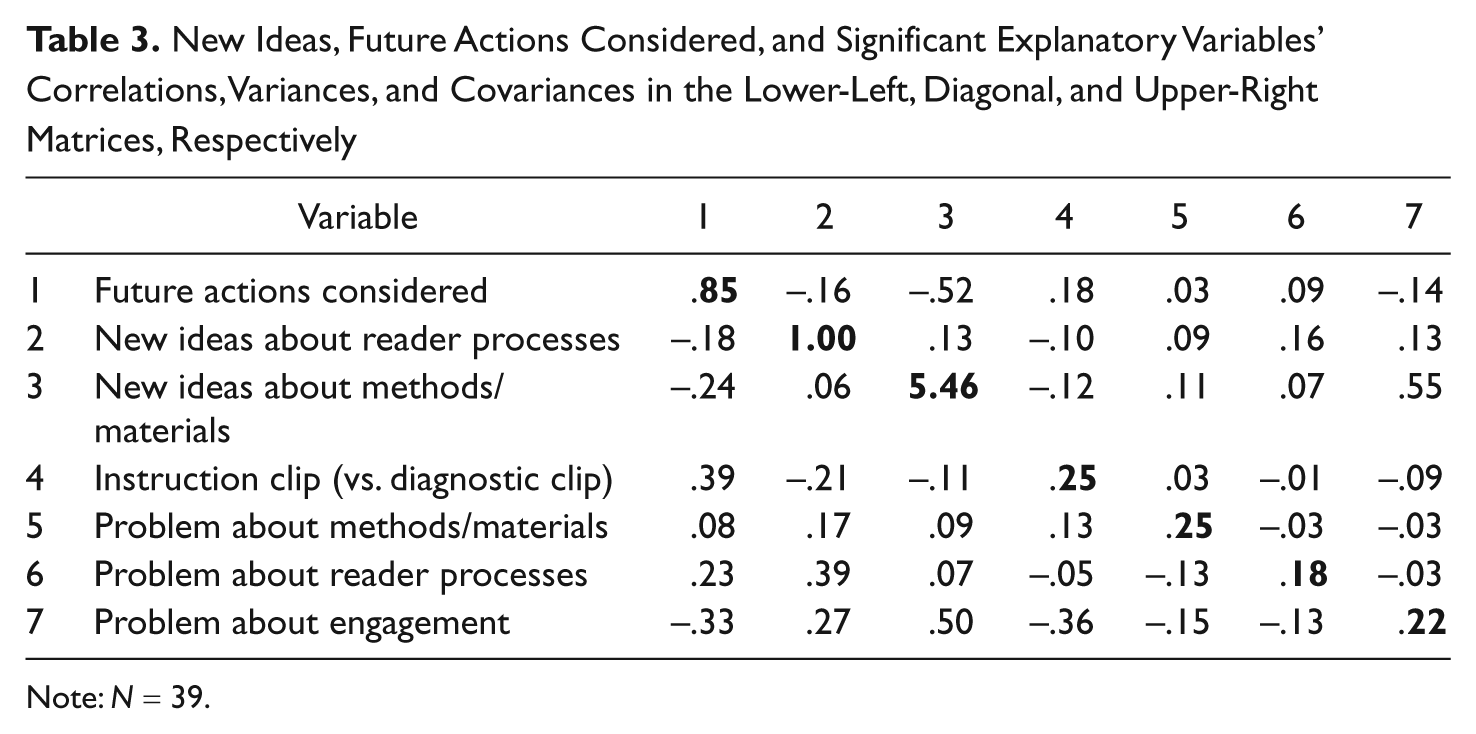
Among the 39 CPVA events, the mean numbers of new ideas about methods/materials and new ideas about reader processes generated by peers per event were 3.36 and 0.85, respectively (see Table 2). No new ideas were related to reader engagement, possibly because to address engagement issues peers shared ideas related to methods/materials or reader processing. The number of new ideas about methods/materials showed the most variance (75% of the total), whereas the number of new ideas about reader processes showed less variance (13%; see variances along the diagonal matrix in Table 3).
New Ideas, Future Actions Considered, and Significant Explanatory Variables’ Correlations, Variances, and Covariances in the Lower-Left, Diagonal, and Upper-Right Matrices, Respectively
Note: N = 39.
The results of the explanatory model showed that “purpose” for sharing clips was the only variable that was significantly related to teachers’ generation of new ideas. Specifically, “purpose” was related to generation of new ideas about methods/ materials and new ideas about reader processing. The type of clip (i.e., assessment or instruction), teacher demographics, and interaction effects among these variables were not significantly related to teachers’ generation of new ideas.
New ideas about methods/materials
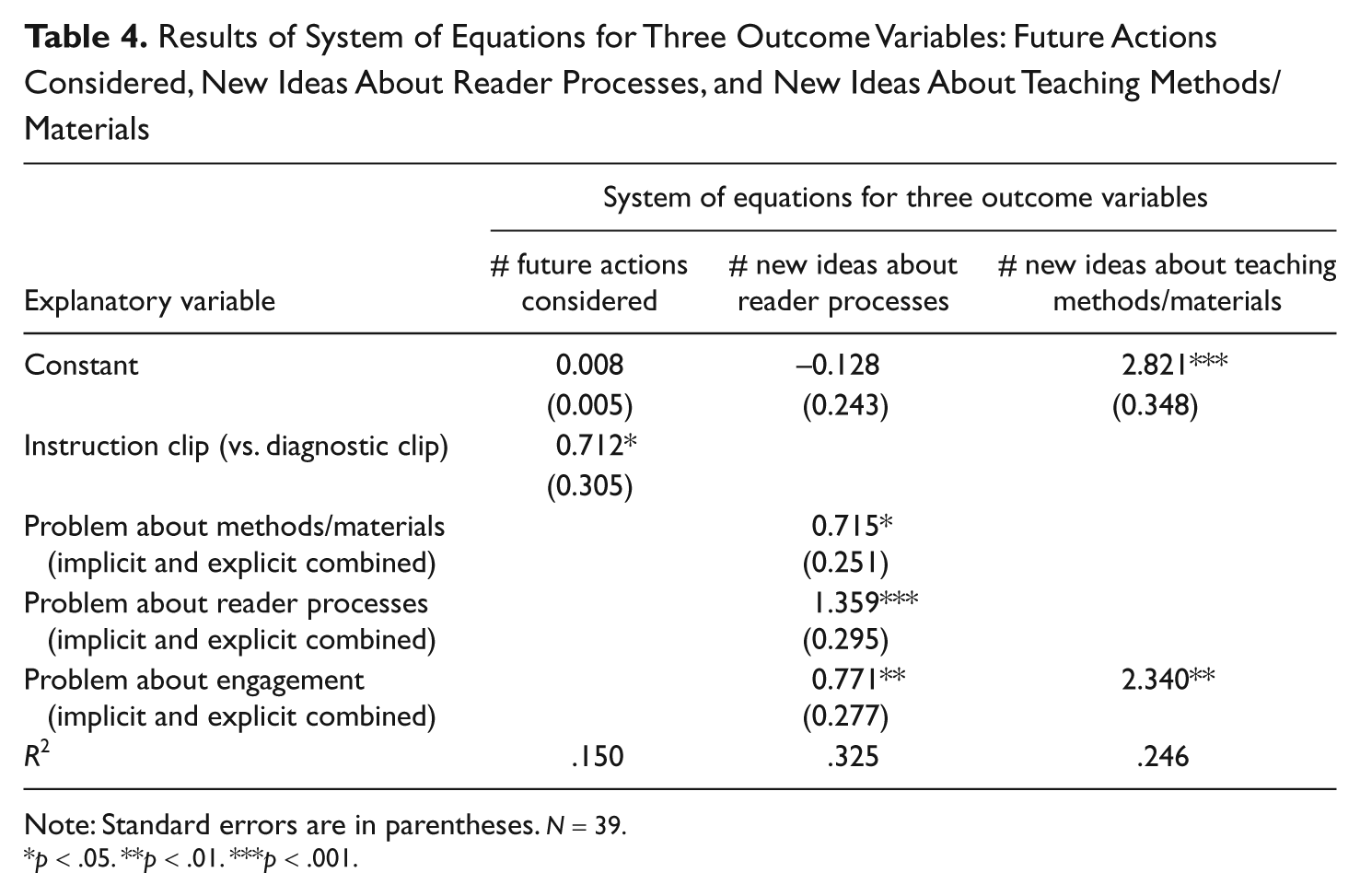
Based on the explanatory model, events that included a problem about reader engagement yielded significantly more new ideas about methods/materials than other video clips (+2.34; see Figure 1 and Table 4). This may have occurred because problems of reader engagement can often be addressed through careful selection of appropriate methods and materials. For example, Erica identified the following problem related to her student’s engagement in her lesson: “Two minutes prior to this, she was complaining she was cold. I asked her if she wanted to get her jacket, and she said no. Watch her demeanor. And then also watch how I handle it.” To address this problem, her peers generated several new ideas related to methods that could be used to address the student’s lack of engagement. Linda suggested, “[You] could change your responses [to her].” Sheila extended this idea by suggesting a new way of responding to the student: “Just redirect . . . [say] okay, we’ll do that in a few minutes—tell me more about your book. Always bring it back to the lesson.” Then, Chelsea offered another method: “Maybe [try] stopping after every couple pages and sharing what they wrote. Cuz she seems like she just, she’s dying for your attention.” Thus, the connection between a clip that was shared for the purpose of discussing a problem about reader engagement and the new ideas generated by peers about methods/materials was that suggestions for methods/materials were needed to address problems pertaining to reader engagement. The purpose for sharing video clips accounted for 25% of the variance in number of new ideas about methods/materials during CPVA events.
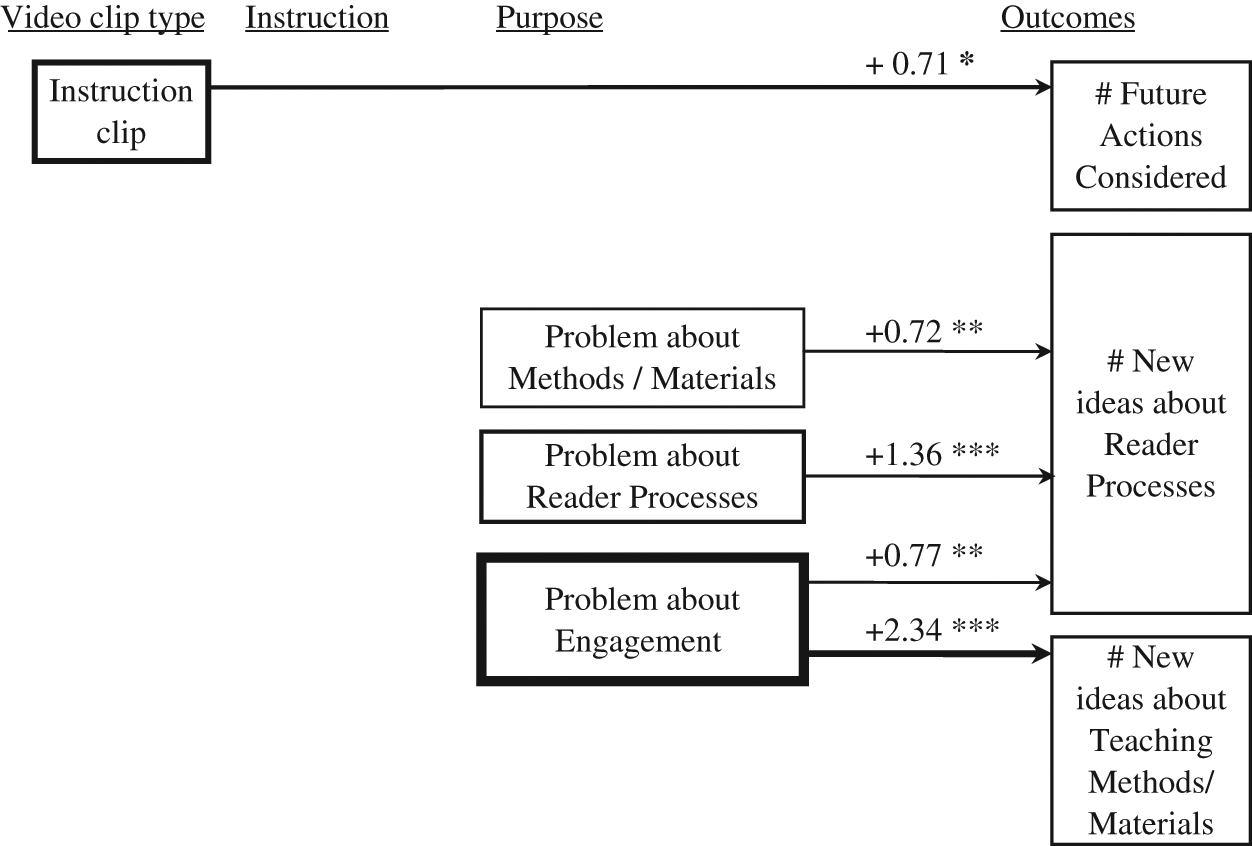
Path diagram of system of equations for new ideas and future actions considered, in which thicker lines indicate proportionately larger effect sizes
Results of System of Equations for Three Outcome Variables: Future Actions Considered, New Ideas About Reader Processes, and New Ideas About Teaching Methods/Materials
Note: Standard errors are in parentheses. N = 39.
p < .05. **p < .01. ***p < .001.
New ideas about reader processes
Based on the explanatory model, problems related to reader processes, methods/materials, and reader engagement were all significantly related to peers’ generation of new ideas about reader processing (see Figure 1 and Table 4).
Compared to other events, events that included a problem about reader processes yielded 1.36 more new ideas about reader processes. For example, Chelsea identified the following implicit problem:
Her mom, she told me that they switched schools because they wanted to retain her. So I was thinking that she was going to have all these reading issues—[that] we’re gonna focus on decoding . . . and then I was blown away by her reading.
After watching and analyzing the video clip, Jane suggested, “She is good at decoding [but] she doesn’t get the meaning. She probably doesn’t understand what reading really is.” The video mediated the discussion content by allowing Jane to view and analyze what happened in the event to interpret and comment on the reader’s processing. This comment presented a new perspective and had the potential for transforming Chelsea’s understanding of what happened—that the student could decode well but did not attend to the text’s meaning. Chelsea’s comment that she was “blown away by her reading” suggests that she may not have understood that the child was not reading for meaning.
Compared to other events, events that included a problem about methods/materials yielded 0.72 more new ideas about reader processes. For example, Sharon shared a problem related to teaching methods for fluency: “I don’t know how to instruct him to try to apply that [expression that he uses when pretending to be a character] to his regular voice.” After much discussion, Karen suggested that maybe he does not read with expression when he is not pretending to be a character “because that’s how he talks.” Through the interactive process, Karen extended and transformed Sharon’s understanding of the problem by suggesting that the solution may not just be about finding a better teaching method, but rather may be rooted in the reader’s processing. The connection between problems related to methods/materials and new ideas about reader processing may be rooted in teachers’ attempts to understand why particular teaching attempts failed.
Compared to other events, events that included a problem about reader engagement yielded 0.77 more new ideas about reader processes. For example, Karen shared the following problem related to reader engagement: “He’s very shy. . . . I really struggle and it’s every time, like every time we start, he’s like this and I cannot get him to talk to me.” In response to this problem, Laila suggested that the student may have had difficulty connecting to the text. The text was about a child and his grandma. Laila explained, “You obviously have a different connection with your grandma [than the student does]. . . . I’m thinking about [choosing] something more interesting [to which he can connect].” Again, through the interactive process, a new idea is generated that explains why the reader may not be engaged. Reader processing—that is, not being able to connect to the text—provides one explanation for this.
We conjecture that all kinds of problems were related to reader processing because a reader’s processing of text is at the core of literacy instruction. That is, when a teacher is confused about a reader’s processing of text, she needs new ideas to understand how the reader is processing text; when a teacher needs help to select appropriate methods and materials, these new ideas must be rooted in an understanding of how the reader is processing text; and when a teacher needs help to understand a child’s lack of engagement, these new ideas often require understanding the reader’s difficulty with processing text, as difficulty reading is often the cause of disengagement. Overall, the purpose for sharing video clips accounted for 33% of the variance in number of new ideas about reader processes.
Future Actions Considered
Among the 39 CPVA events, the mean number of future actions that were considered by teachers per event was 0.54 (see Table 2). The number of future actions considered varied widely across sessions (ranging from 0 to 3, SD = 0.81).
The results of the explanatory model showed that “clip type” (i.e., an assessment clip or an instruction clip) was the only variable that was significantly related to teachers’ consideration of future actions. Specifically, based on the explanatory model, participants considered future actions more frequently (+0.71) when they discussed an instruction video, rather than an assessment video (see Figure 1 and Table 4). The type of video clip (i.e., assessment or instruction) accounted for 15% of the variance in number of future actions considered. We are not sure why there were significantly more actions considered in instruction versus assessment clips, possibly because future actions were easier to imagine within the instruction context. Future research using larger sample sizes might test whether any of the following are related to these differences: length of CPVA events, number of new ideas generated during CPVA events, or number of purposes posed during CPVA events. Purposes for sharing clips, teacher demographics, and interaction effects were not significantly related to teachers’ consideration of future actions.
Teachers’ consideration of future actions suggested the potential for applying ideas from CPVA to pedagogical practices. For example, consider the following:
What if you had the post its, but . . . yellow would be predict, this would be something else [another comprehension monitoring strategy] . . . but he has, say try to use this many [set number] during the reading.
I could use those with both of my [students]. . . . Even today, I just feel like I’m holding their hand too much. I have to . . . let them predict on their own or know when to stop on their own.
Carrie’s knowledge related to teaching comprehension monitoring strategies was extended through her interactions with Karen. Her comments that she could “use those” and was going to “let them predict on their own . . .” suggested that she was considering future actions—that is, using the strategies in her subsequent instruction.
Likewise, Darcy suggested a method to help Sharon’s student increase his expression when reading aloud: “Record his voice, and then playing it back for him, to let him listen to how it sounds.” Sharon responded, “I’ll try the recording if I have time.” Although Sharon’s response about trying this method is tentative, it still provides evidence that she is considering future instructional action based of the ideas that were generated by her peer during the CPVA discussion.
Through the interactive process, teachers’ knowledge was extended or transformed, providing opportunities for them to consider implementing new ideas in their future instruction. Across all 39 events, we identified 22 instances in which teachers expressed that they would consider using an idea from CPVA in their future assessment or instruction. In future research, we plan to collect data to assess whether or not such ideas were actually applied in the lessons.
Other Variables
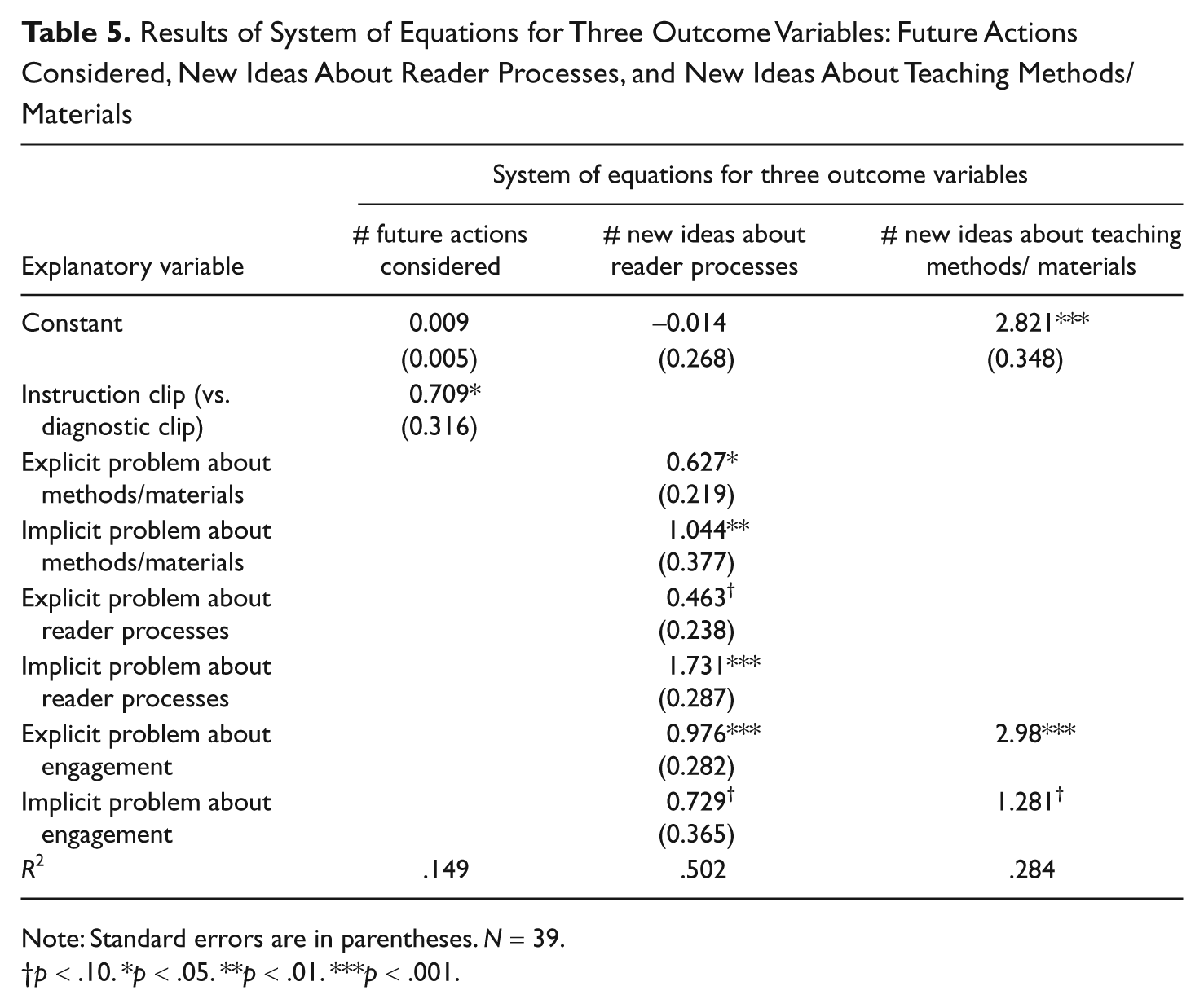
All other variables, all mediation effects, and all moderation effects were not significant. For example, no significant differences were found across sites or student demographic characteristics. In addition, no differences were found between new ideas or actions considered based on the purposes for sharing clips being implicit versus explicit. Parallel analyses for robustness yielded similar results (see Table 5). Implicit and explicit regression coefficients for each problem did not differ significantly (as shown by Wald tests; Kennedy, 2008).
Results of System of Equations for Three Outcome Variables: Future Actions Considered, New Ideas About Reader Processes, and New Ideas About Teaching Methods/Materials
Note: Standard errors are in parentheses. N = 39.
p < .10. *p < .05. **p < .01. ***p < .001.
Discussion
Our study’s findings extend the existing research literature in four important ways. First, CPVA has several benefits that are related to those found in previous studies in which video was used for case study discussion or in multimedia environments. Our findings extend the existing literature by identifying how some of these benefits found when video was used in other contexts also apply to CPVA. For example, Kinzer and his peers (2006) suggested the importance of viewing video to provide a shared experience that teachers can discuss. Our findings corroborate the importance of the video artifact for providing this shared experience for CPVA and provide examples of its role in mediating the content of discussions. This was particularly the case for new ideas generated about reader processing. Video mediated the generation of new ideas about reader processing because it was through viewing the video clips that teachers were able to observe, analyze, and interpret a student’s reading processes to generate new ideas to share through CPVA discussions. Reader processing, in particular, is something that is understood through observation and then analysis of these observations. Without observation, accurate analysis is difficult, if not impossible. Thus, other teachers’ viewing an instructional event via video clip—so that they can observe and analyze the event—is critical to their abilities to generate meaningful new ideas concerning a reader’s processing that can be shared through CPVA.
Also, Kinzer and his peers (2006) also suggested the benefit of being able to replay video events. Our findings demonstrated that being able to re-view the video was important, particularly related to generating and clarifying purposes for sharing the clip, as was the case when Darcy and Sharon shared and discussed their clips. It was through the observation of their own teaching that teachers identified purposes for sharing clips and through the second viewing of their video when they shared the clip during CPVA that they sharpened their purposes. Each re-viewing of the video clip seemed to add a layer of understanding of what was observed about their own teaching. Thus, as Kinzer and his colleagues suggested, our findings support the proposition that the ability to re-view video is a benefit—and extend it by identifying that reviewing is specifically beneficial in that it can sharpen a teacher’s observations about her own teaching.
In addition, our findings support previous researchers’ contentions that using video is advantageous because it provides opportunities “to analyze teaching from a variety of perspectives” (Copeland & Decker, 1996, p. 469; also see Ballenger, 2004; Schrader et al., 2003). Recall, for example, how Chelsea wondered how her student could read so well, given that her mother expressed that the student had reading difficulty, and how Jane provided a new perspective on the student’s reading—that is, she decodes well but does not understand what she reads. When teachers provide new perspectives through the interactive process, an opportunity occurs for a teacher to transform her understanding of the literacy event. This is possible, however, only when other teachers can observe and interpret the events for themselves through viewing the video. For example, had Jane not seen the video, she would not have been able to observe Chelsea’s student’s reading and thus would not have been able to analyze what she saw to conclude that the student decoded well but did not understand what she read. These conclusions were based on an analysis of what she had observed in the video. So the video played a critical mediating role in the conversation by providing a detailed picture of what occurred during the event, which could be analyzed to draw conclusions to generate new ideas to share during CPVA discussions.
The second way that our findings extend previous research is that most studies of collaborative peer video reflection have focused on content areas such as math (Sherin & van Es, 2005) and science (Calandra et al., 2006), whereas our study focuses on literacy. It is important to have discipline-specific research on CPVA to consider how the interactive video-mediated process occurs in relation to aspects of literacy pedagogy. For example, based on our qualitative analyses, teachers’ generation of different kinds of new ideas about literacy pedagogy uniquely related to the interactive process and video artifacts during CPVA. New ideas concerning methods/materials were generated and extended through the interactive process. Based on the examples in our findings section, most of these ideas stemmed from teachers’ prior knowledge—rooted in practices they had previously used in their classrooms.
Only occasionally did new ideas about methods/materials stem from viewing the video, such as was the case when Lucy suggested using words that ended in “N” or “T” instead of words ending in blends to teach short vowel patterns. In contrast, most new ideas related to reader processes stemmed directly from viewing the video. Thus, using the video artifact seemed important for supporting teachers’ generation of ideas about reader processing. That is, teachers had to see what the reader did in the video to analyze and comment on the reader’s processing during the event. Although both the interactive process and mediating role of video were critical to teachers’ generations of new ideas, their importance depended on the information that was needed by the teachers to address the various issues. Although issues related to methods/materials could often be addressed based on teachers’ prior knowledge and were stimulated through the social process with their peers, issues related to reader processing relied on the observations and analysis of complex details portrayed through the video to inform discussion. That is, teachers had to see what the reader was doing while reading, via the video, to analyze and draw conclusions about the reader’s processing to share during CPVA discussions. Thus, the video artifact was critical in mediating discussions of reader processing. Without having viewed the video, so that they could observe what the reader did while reading, teachers could not have analyzed the reader’s processing and provided new ideas for the teacher sharing her video to consider.
The third way that our findings extend previous research is that although prior studies suggested that purposes for sharing video clips (e.g., problems or successes) might potentially be related to the subsequent discussions, the results from our explanatory model provided evidence that this is the case. As was suggested by Calandra and her peers’ (2006) research, our study found that sharing a success was not significantly related to the generation of new ideas during CPVA. We found that only sharing problems was significantly related to teachers’ generation of new ideas related to methods/materials and reader processes. This finding could provide support for Miller’s (2009) approach to collaborative video events—directing teachers to identify a problem to discuss related to their video clip. In light of these findings, one might draw the conclusion that only problems should be used as the purpose of CPVA discussions. However, we urge caution about this conclusion. Providing models of successful methods/materials and reader processing could have been beneficial to teachers in ways other than helping them generate new ideas and considering future actions. For example, teachers in Harford and MacRuairc’s (2008) study “noted that seeing methodologies in operation was more useful to them than hearing a list of recommended strategies in a lecture format” (p. 1888). In addition, if teachers were taught to engage in analysis of what made these events successful during video viewing and CPVA discussions, more new ideas and future actions considered might be generated. Therefore, exploring the potential benefits of teachers sharing successes from video of their own teaching practices should be further explored.
Finally, our findings extend Sewall’s (2009) proposition that sharing video clips with peers enhanced the breadth and depth of issues discussed by identifying that multiple problems tended to result in breadth of content discussed and a single problem resulted in depth of discussion. This was the case because teachers tended to analyze the content of the video that pertained to the problems posed by the teacher sharing her clip. When the problem posed by the teacher sharing her clip was narrow, teachers engaged in a narrow analysis and discussion of the video content, yielding more narrow content in the discussion, whereas when the problems posed by the teacher sharing her video were broad, teachers engaged in a broader analysis of the video content, yielding broader content included in the discussion. Thus, the attention paid to the content of the video was mediated by the purpose for which the teacher said she was sharing the clip and affected the breadth or depth of the CPVA discussion content.
In addition, the interactive video-mediated process was key to broad discussions. Both comments made by peers and re-viewing the video in the presence of peers stimulated teachers’ transformation of purposes (e.g., an implicit problem restated as an explicit problem) and identification of new purposes as they shared their clips. Teachers’ ability to transform implicit statements of the problem to explicit statements of the problem was particularly important. It suggests that through the processes of re-viewing the video and engaging in the interactive process of others viewing and discussing the video, the teacher was able to clarify the problem that occurred in her clip. In addition, when teachers shared a success but then identified a problem, they seemed to have noticed something new as they re-viewed their clip. Without both the video artifact and interactive process of others viewing and discussing the video, purposes that were transformed through this process probably would not have been addressed in these conversations. Thus, both teachers viewing their own videos and others viewing and discussing these videos expand the content of pedagogical conversations.
Implications
Based on our analysis of the findings, we identified five implications for the use of CVPA in literacy teacher education. As we present these, we discuss how our findings fit with our initial theoretical expectations: (a) that interactions that occur between teachers would facilitate their learning and provide opportunities for teachers to extend and transform their pedagogical knowledge and (b) that reading assessment and instruction video clips would act as cultural artifacts that mediate these conversations.
First, our findings suggest that it is important for teacher educators to allow CPVA discussions to unfold to effectuate the potential of video-mediated interactive discussions. Allowing CPVA purposes to unfold during the discussions was important for allowing both depth and breadth in the conversations. Although some conversations were deep and remained focused on the initial purpose identified by the teacher, the interactive process allowed purposes for sharing clips to be extended and transformed as they unfolded during the conversations. If a facilitator had insisted on teachers discussing only the predetermined purpose for sharing, this would have limited the breadth of the CPVA content. Also, teachers might have discussed only issues that they could recognize independently—other issues that emerged through the interactive process or the viewing of the video clips might not have been included in discussions, thereby limiting teachers’ opportunities to extend and transform their knowledge of literacy pedagogy.
Second, our findings suggest that it is important for teachers not only to engage in interactive reflection with colleagues in teacher education courses but also to use video to mediate this reflective process, particularly for developing understandings of pedagogy that must be observed and analyzed, such as reader processing. Particularly, teachers generated new ideas about reader processing by relying heavily on the rich detail provided by the video artifact. Without having viewed and analyzed the video, many of the new ideas pertaining to reader processing likely would not have been generated. Artifact-saturated interactive discussions provided an opportunity for teachers to suggest new ideas about reader processing, thereby providing opportunities for teachers in CPVA discussions to raise awareness and broaden their pedagogical understandings. In addition, since teachers’ consideration of future actions was predicated on their peers’ generation of new ideas, the video-mediated interactive process was necessary to support the consideration of future actions that would extend this first layer of learning through conversation as well.
However, in some instances the interactive process and use of videos as artifacts fell short of our expectations. For instance, teachers generated new ideas about methods/materials based mostly on their prior knowledge and experiences in the classroom. Though teachers sometimes generated new ideas about methods/materials based on their observations made from viewing the video of instruction, the video was not typically critical for mediating ideas about methods/materials and developing deeper pedagogical understanding among teachers. That is, the mediating role of video that we expected was inconsistent—although it was critical for mediating discussions of reader processing, it was less critical for mediating discussions of methods/materials. Thus, teacher educators’ use of CPVA discussions might be more important for facilitating learning about specific kinds of pedagogical content, such as reader processing in literacy coursework.
Third, CPVA should address issues in literacy pedagogy broadly to support teachers’ ability to respond to the problems identified by their peers and to generate new ideas. This suggestion is rooted in our finding that problems about a particular issue did not always result in teachers generating new ideas about that issue. For example, a problem about methods/materials did not result in teachers generating new ideas about methods/materials. In fact, we found quite different results. Problems about methods/materials, reader processing, and reader engagement were all related to teachers generating new ideas about reader processing. Only problems related to engagement were related to teachers generating new ideas about methods/materials. It seems that the problems and solutions related to various pedagogical issues are intertwined. For example, to address a problem concerning methods/materials (e.g., what method/material to use), you would likely need to understand issues about the reader’s processing (i.e., how he or she engages in reading). This can be achieved by teachers engaging in interactive conversations and viewing videos to see the complexity and richness of the learning environment along with the student’s voice, body language, and interactions with a text. Therefore, we do not think that trying to limit the focus of CPVA discussions to a single issue (i.e., just methods/materials, reader processing, or reader engagement) would be a fruitful approach.
Fourth, even though, based on our findings, more new ideas were generated when teachers focused on problems during CPVA discussions, teachers’ sharing of successes should not be ignored. When CPVA discussions focused on problems, teachers more effectively engaged, through a socioconstructivist mode mediated by the video artifact, to support one another’s learning and develop deeper understandings about literacy teaching practices. However, when sharing successes, the teachers did not fully exploit the interactive process to generate new ideas. Instead, they tended to simply applaud the success or focus on other aspects of the teacher or student in the video. Potentially, helping teachers analyze why successes occurred and how they could apply successful aspects of pedagogy to their teaching practices in the future might lead to greater benefits from sharing successes. Therefore, we are unsure whether limiting CVPA purposes to only sharing problems would be beneficial. To better inform this issue, future research should examine whether there are other benefits of sharing successes in CPVA and whether helping teachers to analyze why successes occurred might help teachers to learn what they could or should do as part of their pedagogy. Thus, at this time, we would suggest that although the dominant focus of CPVA events might be to address problems, some successes might also be shared.
Finally, teachers might more effectively engage in CPVA if we helped them develop metacognition concerning their use of video to mediate discussions and engagement in the interactive process. For example, if teachers became more aware of the connections among their purposes for sharing clips, the content of the clip, and how it potentially mediates the discussion, then teachers might be able to be more strategic in their identification of purposes for sharing clips and the content of clips they select to share. Likewise, being cognizant of how their own and others’ engagement in the interactive process during CPVA discussions potentially affects the outcomes of these conversations, such as generating new ideas and considering future actions, might help guide their strategic approach to engaging in the interactive process to maximize their desired learning outcomes. Thus, encouraging and facilitating teachers’ engagement in metacognition concerning their CPVA process may improve learning outcomes. This issue should be explored in future research.
Footnotes
The author(s) declared no potential conflicts of interest with respect to the research, authorship, and/or publication of this article.
The author(s) disclosed receipt of the following financial support for the research, authorship, and/or publication of this article: This research was generously supported by a grant from the Oakland University School of Education and Human Services Research Support Committee, through the Office of Dean Gallien.
References
Supplementary Material
Please find the following supplemental material available below.
For Open Access articles published under a Creative Commons License, all supplemental material carries the same license as the article it is associated with.
For non-Open Access articles published, all supplemental material carries a non-exclusive license, and permission requests for re-use of supplemental material or any part of supplemental material shall be sent directly to the copyright owner as specified in the copyright notice associated with the article.
