




Abstract
Researchers frequently suggest that effective teachers adapt their teaching to navigate the complexity of classroom literacy instruction. However, little research has examined how teachers adapt their instruction, teachers’ reflections on their adaptations, or the instructional conditions in which they adapt. To address this gap in the research literature, the study reported here used instrumental case studies to examine two third grade teachers’ literacy instruction. Specifically, this study explored teachers’ adaptations, their reflections on adapting, and the openness of the tasks they implemented. Observations and interviews illustrated the metacognition teachers use to adapt their instruction within the complexity of classroom instruction. Moreover, findings revealed that teachers adapted with greater frequency when using open tasks.
Teaching school is a complex endeavor. Teachers are expected to educate an increasingly diverse student population to world-class levels. In 2009, for example, 21% of children ages 5–17 spoke a language other than English at home (up from 10% in 1980) and 19% lived in poverty (Aud et al., 2011). Teaching involves human interactions and relations, and therefore teachers consistently face unanticipated situations (Lin, Schwartz, & Hatano, 2005). In addition, the current accountability context presents high stakes for teachers and students as important educational decisions are based on standardized test performance (Afflerbach, 2007). Researchers claim that, in this context, teachers must adapt their instruction to the students with whom they work and the situations in which they find themselves (Corno, 2008; Darling-Hammond & Bransford, 2005; Fairbanks et al., 2010; Gambrell, Malloy, & Mazzoni, 2011; Pearson, 2007; Snow, Griffin, & Burns, 2005). Moreover, researchers claim that adaptive teaching is particularly necessary when teaching reading (Anders, Hoffman, & Duffy, 2000) and when implementing open-ended tasks (Maloch, 2004; Randi & Corno, 2000; Sawyer, 2004).
Although adaptive teaching is intuitively appealing and is frequently discussed in the literature, overall it lacks an empirical base (Duffy, Miller, Parsons, & Meloth, 2009; Fairbanks et al., 2010). As a result, little is known about (a) how teachers adapt their instruction, (b) teachers’ reflections on their adaptations, or (c) the instructional conditions in which teachers adapt. This study provides an in-depth description of how two teachers adapted their instruction, their reflections on their adaptations, and the tasks students were completing when adaptations occurred. The following research questions guided this study:
How do these teachers adapt their literacy instruction?
What are these teachers’ reflections on their adaptations?
How are these teachers’ adaptations associated with particular types of literacy tasks?
For this research, an adaptation was defined as a teacher action that was a response to an unanticipated student contribution, a diversion from the lesson plan, or a public statement of change. For example, during a vocabulary lesson, students struggled to use context clues to figure out unknown words. The teacher adapted by describing how to use context clues and by modeling the process using a passage from the story. To document teachers’ reflections on their adaptations, the researcher asked, “Why did you make that change?” in postobservation interviews. For the adaptation described above, the teacher reflected that students’ reactions showed the need for more explicitness in how to use context clues, further noting that it had been a week since they last worked on it.
Theoretical Framework
Social constructivism and teacher metacognition informed this research. Central to social constructivism is the idea that learners actively construct knowledge based on what they already know (Piaget, 1954). The construction of knowledge occurs through experiences and social interactions within a particular context (Au, 1998; Vygotsky, 1978). Furthermore, social constructivism includes the concepts of zone of proximal development (ZPD) and scaffolding. Vygotsky (1978) presented the ZPD as the zone between what students can accomplish alone and with assistance. Scaffolding is the assistance provided to students within their ZPD. Adaptive teaching parallels these concepts. That is, to scaffold students’ learning within their ZPD, teachers adapt their instruction to the particular student(s) with whom they are working and to the particular situations in which they find themselves.
Teacher metacognition provides a lens for studying teacher adaptations. Metacognition typically emphasizes thinking about and regulating one’s thinking (Flavell, 1976). Teachers engage in complex mental activity as they monitor and regulate their thinking during instruction (Bransford, Darling-Hammond, & LePage, 2005; Zohar, 1999). In addition, teachers are strategic as they apply instruction, solve problems, and make adjustments (Duffy et al., 2009). This perspective indicates that (a) teachers are aware of their cognitions, (b) their actions are a result of their cognitions, and (c) they are able to articulate how their cognitions influenced their behavior. This perspective also distinguishes adaptations from instructional responses that teachers may not necessarily plan but routinely make.
Related Theory and Research
Researchers have long suggested that effective teachers adapt their teaching to navigate the complexity of classroom instruction. Schon (1983) referred to this ability as reflection-in-action. He distinguished reflection-in-action, which occurs during the course of instruction, from reflection-on-action, which includes reflective thinking that occurs after instruction. Borko and Livingston (1989) and Sawyer (2004) described teaching as improvisation. The course of classroom instruction cannot be entirely preplanned, they argued. Therefore, teachers must improvise to navigate the unpredictability of classroom teaching. Darling-Hammond and Bransford (2005) described adaptive expertise as the pinnacle of teacher development. Adaptive expertise balances efficiency and innovation. Teachers need to be efficient in establishing routines and procedures but must also be innovative to be effective in the complexity of classroom instruction.
Similarly, Lin and his colleagues (2005) discussed adaptive metacognition. They contended that teaching is metacognitive because it is unpredictable. They argued that teachers “confront highly variable situations from student to student and class to class. One solution does not fill all, and teachers need metacognitive approaches that support adaptation and not just improved efficiency for completing recurrent cognitive tasks” (p. 245). Corno and Snow (1986) distinguished two levels of adaptive teaching: macro and micro. Macro adaptations are large-scale instructional adjustments that are made based on information such as formal assessments. Micro adaptations are adaptations made within the moment-by-moment occurrences of the classroom. From this perspective, the research described in this article conceptualizes adaptations as micro adaptations.
Researchers have argued that teaching reading, especially, requires teachers to be adaptive:
Dilemmas characterize the nature of classroom teaching generally and the teaching of reading in particular; creative responsiveness, rather than technical compliance, characterizes the nature of effective teachers. In short, classrooms are complex places, and the best teachers are successful because they are thoughtful opportunists who create instructional practices to meet situational demands. (Anders et al., 2000, p. 732)
Similarly, researchers have observed exemplary reading teachers to document how highly effective teachers teach. This research repeatedly identified adaptability as a characteristic of effective teachers (Allington & Johnston, 2002; Pressley, Allington, Wharton-McDonald, Block, & Morrow, 2001; Taylor & Pearson, 2002; Williams & Baumann, 2008). However, these researchers did not analyze teachers’ adaptations or their reflections on adaptations; rather, they simply noted that exemplary teachers were, indeed, adaptive.
Researchers have also suggested that teachers must be more adaptive when implementing open-ended tasks (Maloch, 2004; Randi & Corno, 2000; Sawyer, 2004). The task assigned to students is the central feature of classroom instruction (Blumenfeld, Mergendoller, & Swarthout, 1987; Doyle, 1983; Perry, Turner, & Meyer, 2006). From a social constructivist perspective, the task is an important unit of study because the teacher and students co-construct classroom activity (Au, 1998; Vygotsky, 1978). Therefore, students inevitably influence the direction of the task, which requires teacher adaptation (Sawyer, 2004). For example, Randi and Corno (2000) maintained, “No instruction is ever implemented exactly as developers intend, and teachers’ own adaptations to instructional innovations become critical components of their outcome effectiveness” (p. 662).
At the same time, many researchers have promoted the use of open-ended literacy tasks (Guthrie & Humenick, 2004; Parsons & Ward, 2011; Pearson, Cervetti, & Tilson, 2008; Purcell-Gates, Duke, & Martineau, 2007; Teale & Gambrell, 2007). It is important, then, to analyze adaptations in light of the type of task taking place. For the purposes of this research, a task is defined as an assignment in which students complete a written product. Although this definition is limiting, it is derived from the emphasis researchers place on the role of writing in a task (Lutz, Guthrie, & Davis, 2006; Miller & Meece, 1999). These researchers argued that the cognitive demand of writing is the distinguishing aspect of a task. In the current study, the openness of a task refers to the degree to which the assignment is authentic, collaborative, challenging, student directed, and sustained (see Appendix A).
Previous research on adaptive teaching has studied how teachers adapted their literacy instruction and their reflections on their adaptations (Duffy et al., 2008). This previous research included more than 240 observations and interviews to document more than 40 teachers’ adaptations and reflections (Parsons, Davis, Scales, Williams, & Kear, 2010). The researchers used grounded theory and constant comparative analysis (Glaser & Strauss, 1967) to create coding systems for teacher adaptations and reflections (see Appendix B). However, these previous reports of adaptive teaching used frequency counts to describe many teachers’ adaptations and reflections. The current report complements and builds on these previous studies by (a) describing two teachers’ adaptations and reflections in detail and (b) examining adaptations in light of the tasks in which they occur to examine how teachers adapt in different instructional conditions.
Method
Case studies are appropriate for examining complex phenomena (Stake, 2006). The research reported here used instrumental case studies to examine the phenomenon of adaptive teaching. Stake (2000) described instrumental case studies as follows: “The case is of secondary interest, it plays a supportive role, and facilitates our understandings of something else” (p. 437). A multiple case study approach allowed for the study of adaptive teaching in two different contexts (Stake, 2006).
Setting
This research took place at a high-performing Title I school in the Southeast. The student population is reflected in the following demographics: 86% free or reduced-price lunch, 92% minority students, and 35% English language learners (ELLs). The students in this school performed well on standardized reading tests over the past 7 years: The school raised its reading scores on the state test from a 50% passage rate to 79% during this time. This improvement led to numerous honors such as “School of Progress,” “School of Distinction,” and “Title I Distinguished School.”
After experiencing this success, the school’s high-stakes test scores remained stagnant in the 3 years prior to this study. In the 2005–2006 school year, the school failed to meet No Child Left Behind’s adequate yearly progress in reading. School leaders initiated discussions in faculty meetings exploring how to break the trend. The teachers decided to focus on “project-based” literacy instruction. They described project-based instruction as authentic, interactive, experience based, problem based, student directed, constructive, and challenging. Although the study reported here did not examine the efficacy of project-based literacy instruction, it did serve as the context for this research.
Participants
The participants in this study were two third grade teachers. They were selected using purposeful sampling, intentionally selecting individuals to understand a central phenomenon (Creswell, 2005). These particular teachers were purposefully selected because of their qualifications: Both teachers had taken strides to improve their instruction through National Board Certification or graduate work. In addition, school leaders deemed these teachers to be excellent based on classroom observations and their history of enhancing student performance. Taken together, these qualifications indicated it was likely that these teachers would be reflective professionals who would adapt their instruction to meet their students’ needs.
Ms. Kim (all names are pseudonyms) was in her eighth year teaching. She was a National Board Certified teacher, who taught second grade at this school for the previous 7 years. This research coincided with her first year teaching third grade. Because she moved from second grade to third grade, Ms. Kim looped with her students. Therefore, she taught the same group of students she taught the previous year.
Ms. Mathews was in her fourth year teaching. She taught first grade the first 3 years, moving to third grade the year of this study. At this time, she was about halfway through her coursework toward a master’s degree in reading education, which certifies reading specialists. Ms. Mathews was also working toward National Board Certification.
Data Collection
To address the research questions, the researcher collected (a) observations of teachers’ literacy instruction, (b) teachers’ lesson plans, and (c) interviews with teachers after each observed lesson. The researcher studied the teachers one at a time. That is, the researcher observed one teacher’s literacy instruction nine times across 3 consecutive weeks and then observed the second teacher nine times across 3 weeks. This observation format allowed the researcher to become familiar with the environment, routines, and culture of the classroom and allowed the teacher and the class to become familiar with the observer’s presence (Creswell, 2005). The teacher was interviewed after each observation for a total of 18 observations (more than 22 hours of observed instruction) and 18 interviews. Table 1 provides an overview of the observations of each teacher.
The Amount of Time Spent Observing in Each Teacher’s Classroom
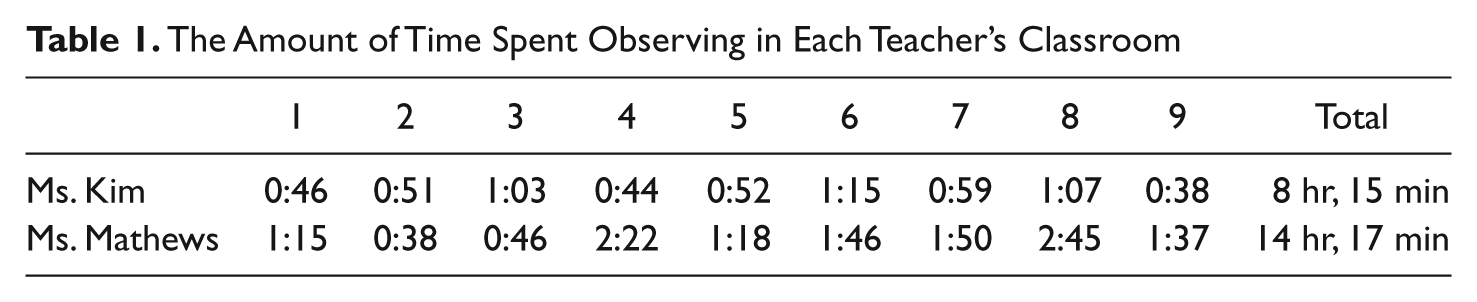
Observations occurred during what the teachers described as their literacy instruction. The variation in the amount of time spent in each classroom corresponds to the different amount of time each teacher devoted to literacy. Ms. Mathews experimented with a new format for literacy instruction based on the school’s focus on project-based instruction. She was very flexible in its implementation, often continuing literacy instruction later in the day (e.g., after lunch and recess) if they did not finish during the allotted time. This situation likely contributed to the disparate amount of time devoted to literacy in these two classrooms. Observations enabled the researcher to identify the adaptations teachers made and the tasks they assigned. The researcher obtained a copy of teachers’ lesson plans prior to each observation. All observations were audiotaped, which allowed classroom proceedings to be revisited. Observations typically took place on Monday, Wednesday, and Friday but were occasionally altered when conflicts occurred. Observation notes documented adaptations teachers made and tasks they assigned.
After each observed lesson, the teacher was interviewed. Interviews occurred on the same day as the observation and were audiotaped and transcribed for analysis. Interviews verified that adaptations were indeed spontaneous changes: The researcher asked, “When I saw you (describe adaptation) during the lesson, was that a spontaneous change, something you had not planned?” If the teacher indicated it was an adaptation, the researcher asked, “Why did you make that change?” The teacher’s response to this question demonstrated her reflection on that adaptation.
Data Analysis
The author collected the data reported in this article. However, to enhance reliability of the study, a research team coded all adaptations and reflections together—a process Merriam (2009) referred to as “investigator triangulation” (p. 216). The research team was led by an endowed professor and was composed of five advanced doctoral students. The team used previously established coding systems to code adaptations and reflections (Duffy et al., 2008; Parsons et al., 2010; Appendix B). The author read each adaptation and reflection aloud, and the team assigned a code for each. For an adaptation or reflection to be coded, all researchers had to agree on the code (Merriam, 2009). Following constant comparative analysis, discrepancies in codes were discussed and codes were refined as needed (Glaser & Strauss, 1967).
The openness of each task was determined using a rubric (see Appendix A) to rate five task components: authenticity, collaboration, challenge level, student choice, and length of the task. Using this rubric, tasks were classified as closed (total score of 5–8), moderately open (9–11), or open (12–15). Spearman’s rho, a correlation coefficient for rank-order scales (Creswell, 2005), was used to determine the interrater reliability of the task rubric. Three researchers independently rated 30 tasks at the beginning of analysis. The results indicated an interrater reliability of .83, thereby establishing appropriate reliability in using the rubric to rate the openness of tasks. Creswell (2005) presented guidelines for correlation strength: correlations less than .65 are useful only for limited prediction, correlations between .65 and .85 are very good, and correlations .86 and greater are extremely high and infrequently found (Cohen & Manion, 1994).
Findings
To report the findings, the two cases are described separately. Each case description includes an overview of the teacher’s tasks, adaptations, and reflections and then provides detailed examples from their instruction. Finally, the combined frequency counts of adaptations that occurred in different types of tasks are reported.
Ms. Kim
Ms. Kim embraced the school’s movement toward project-based literacy instruction, and she integrated literacy with content in the projects she designed. Throughout the observations of Ms. Kim, her literacy instruction revolved around an interdisciplinary project. The purpose of this project was to integrate the social studies standard of “Communities” with literacy instruction. In this long-term assignment, the students created communities in small groups. The final product was a brochure to advertise the community. At the conclusion of the project, the brochures were presented to their grade-level peers, school personnel, and parents. Their brochures included a map of the community, the community’s symbols, and paragraphs explaining the symbols. In this project, each student wrote an explanation of a symbol and a script for his or her presentation. Students developed both of these pieces through the writing process and published their work on the computer for inclusion on the group’s brochure. Therefore, both of these written assignments were authentic, were collaborative, offered students choices, and spanned across several days. Accordingly, this task was rated as open.
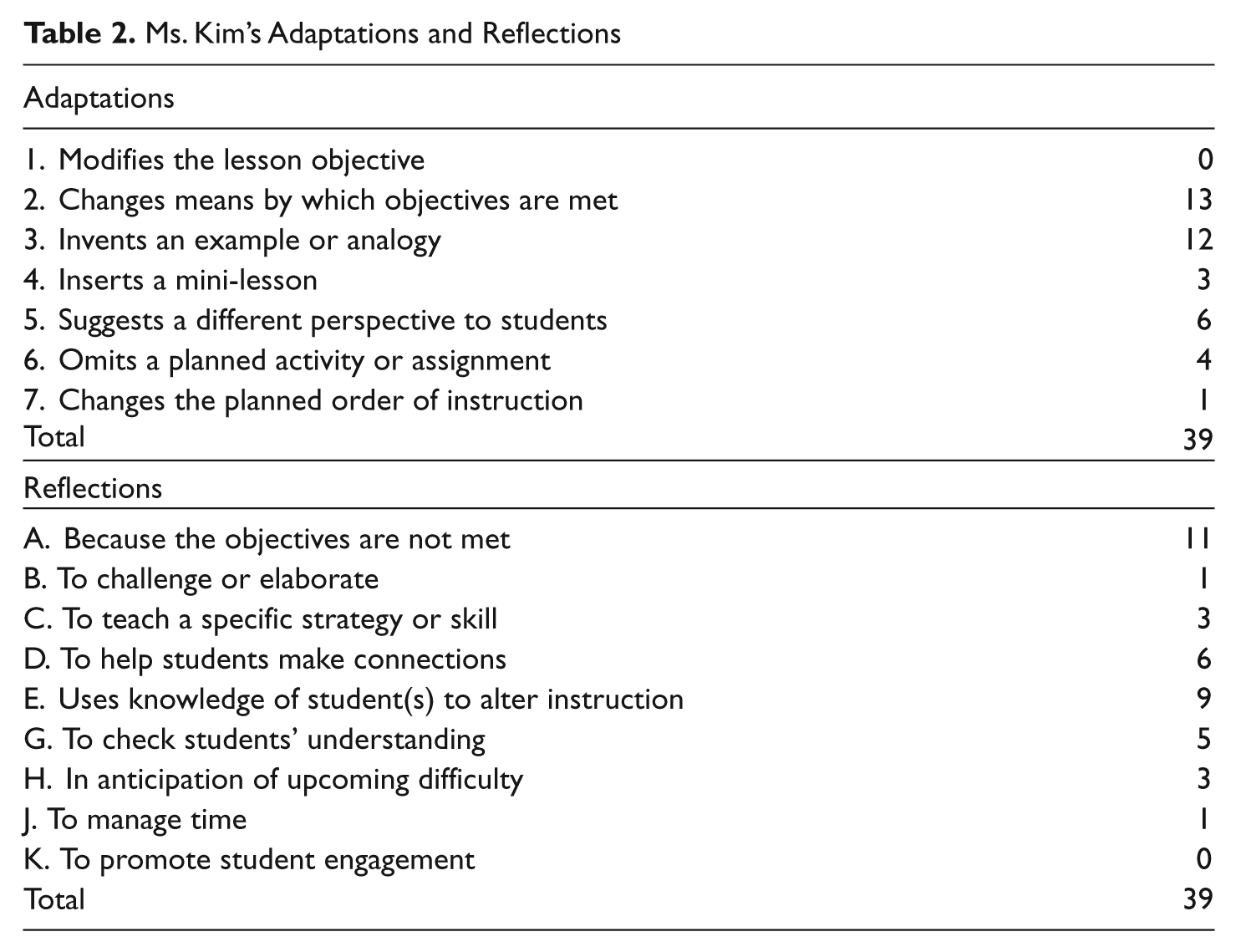
Ms. Kim adapted her instruction 39 times in nine tasks as she was observed. Of the nine tasks she implemented, two were closed, two were moderately open, and five were open. An overview of Ms. Kim’s adaptations and reflections is displayed in Table 2.
Ms. Kim’s Adaptations and Reflections
When the researcher began observing Ms. Kim, she had recently initiated the community project. Instruction began with a mini-lesson on concepts related to the project. Then students had time to work on their brochures. A focus of the project was the concept of symbols. Understanding this concept proved to be particularly difficult for students, so many of the lessons focused on symbols.
In the first observation, the class had previously discussed symbols, and this lesson was designed to help students solidify their understanding of this concept. In groups, students completed a Frayer map on symbols. This map is composed of the definition, characteristics, examples, and nonexamples (Frayer, Frederick, & Klausmeier, 1969). This task was rated as closed. Conferring with several groups, the teacher recognized that students struggled to create examples of a symbol. She called the students together: “We’re going to switch it up. . . . We’re going to do this differently.” She then referred back to a previous lesson on state symbols, and they brainstormed examples as a whole class rather than in small groups. This adaptation was coded as “changes the means by which the objectives are met” because the teacher changed the format of the lesson to accomplish the same objective. Her reflection on this adaptation was, “I knew they were not getting any of the examples, and I figured if we got everybody back together, maybe they would ask each other. . . . Maybe they would rekindle each other’s memory.” This reflection was coded as “because the objectives were not met” since the teacher adapted in response to students’ confusion.
The fourth observed lesson began with a mini-lesson on brochures. Ms. Kim modeled what a brochure looks like with a large piece of poster board. She planned to model the trifold format, but she adapted by also modeling where the name of the community might go, where a picture might go, and where they might choose to put the map. She did this by actually writing on the poster board. This adaptation was coded as “inserting a mini-lesson” because the teacher explained and modeled for the students how to complete their work. In the postlesson interview, the teacher explained, “It was because . . . I had a lot of blank stares looking at me, which I know there are lots of times if I start them and I think they understand, then they go back and they still don’t have it.” Therefore, this reflection was coded as “in anticipation of upcoming difficulty.”
Later in this same observation, Ms. Kim adapted in response to group dynamics as students worked on the project. She adapted by discussing with a group how to best communicate with a student who was an ELL. When this student was out of the room, she told the group, “Don’t yell at him; he is not hard of hearing; he just speaks another language. Don’t speak so fast.” This adaptation was coded as “suggests a different perspective to students.” Ms. Kim provided the following reflection on this adaptation: “I wanted [the students] to understand that he didn’t have a hard time hearing. He just didn’t understand. And I think the ESL Spanish kids understand more of that than the child who has always spoken in English.” This reflection was coded as “to teach a specific strategy or skill” because she taught these students a strategy for communicating with speakers of other languages.
During the seventh observation, students worked with their groups to plan their presentation. Ms. Kim allotted time at the end of the lesson for groups to practice their presentation in front of the class. None of the groups progressed enough to be able to practice, so Ms. Kim instead had each group share what they had accomplished in their planning. This adaptation was coded “omits a planned activity.” Her reflection on this adaptation was as follows: “I thought, ‘All right, we’ll back up and we’ll talk about how they organized their printing. Maybe when they show something, they’ll get an idea from each other.’” This reflection was coded as “to help students make connections” because she hoped students would connect with and learn from what other groups had planned.
In the final observation near the completion of the project, students practiced their speeches for the presentation of their communities, an open task. A student in one of the groups was still drafting his speech. Ms. Kim adapted her instruction by having the student say aloud what he wanted to report in his presentation while she wrote it down for him. She scaffolded the student’s progress by reminding him of the components he needed to include: “Now you need a closing sentence.” This adaptation was coded as “changes the means by which the objective is met” because the teacher altered how the student worked on the assignment. He completed the objective, composing a speech, but she changed the manner in which he completed it by having him orally compose the speech while she wrote it down. Ms. Kim reflected on this adaptation as follows:
I had not planned on scribing for anybody because I wanted it to be their work, but he’s been struggling for a couple of days trying to get something down on his card. And he’s not a bad kid, and he’s a very good auditory learner and oral. So it’s the writing and the reading and all that. It’s the academic part. So I thought “all right, if he can tell me” because a couple of times he has told me what he wanted to say but he can’t get it down. So I thought, “if he could tell me, I’ll write it and we’ll go from there because then at least he could do the presentation.”
This reflection was coded as “uses knowledge of students to alter instruction” because Ms. Kim used her knowledge of this particular student’s strengths and weaknesses to adapt her instruction, allowing the student to complete the assignment.
As these classroom examples illustrate, Ms. Kim implemented a variety of tasks as the students completed a sustained project that integrated language arts and social studies standards. Within her instruction, she adapted her teaching in many ways and for various reasons. For example, she pulled the class together from small-group work because they appeared lost. She elaborated on her modeling after judging from the looks on students’ faces that they did not understand the example. She gave students strategies for working with an ELL student when she observed poor group communication.
Ms. Mathews
Ms. Mathews’s instruction embodied what is frequently called a balanced approach to literacy instruction (e.g., Duffy-Hester, 1999). That is, she taught guided reading and word study in small groups that were organized by reading and spelling level, providing explicit instruction in comprehension strategies, vocabulary, phonics, and decoding. She also included authentic literacy activities daily in the form of sustained silent reading and writer’s workshop. Throughout observations of Ms. Mathews, she aligned instruction with the school’s movement toward project-based literacy instruction. In response to professional development on this topic, she reorganized her classroom to include a “literacy block.” That is, rather than having a distinct time for guided reading, word study, sustained silent reading, and writer’s workshop, she created “workshop time” organized around a project. During this block, the students read or wrote to work on the project, and the teacher conferred with individual students about their reading and writing and pulled small groups for individualized instruction.
During the bulk of the observations, Ms. Mathews implemented a conservation project. In groups, students decided whether they wanted to (a) write a letter to another grade level, asking for their support in recycling paper; (b) write a letter to the principal, requesting more recycling bins for their classroom; or (c) write essays about the benefits of recycling to be posted around the school. During class, students discussed with their group members the project they would complete, they read various texts about recycling and conservation, and they took their writing through the writing process. The teacher met with individual students as they read and wrote, asking questions and providing instruction. She also taught small-group and whole-class lessons and facilitated guided reading and word study groups.
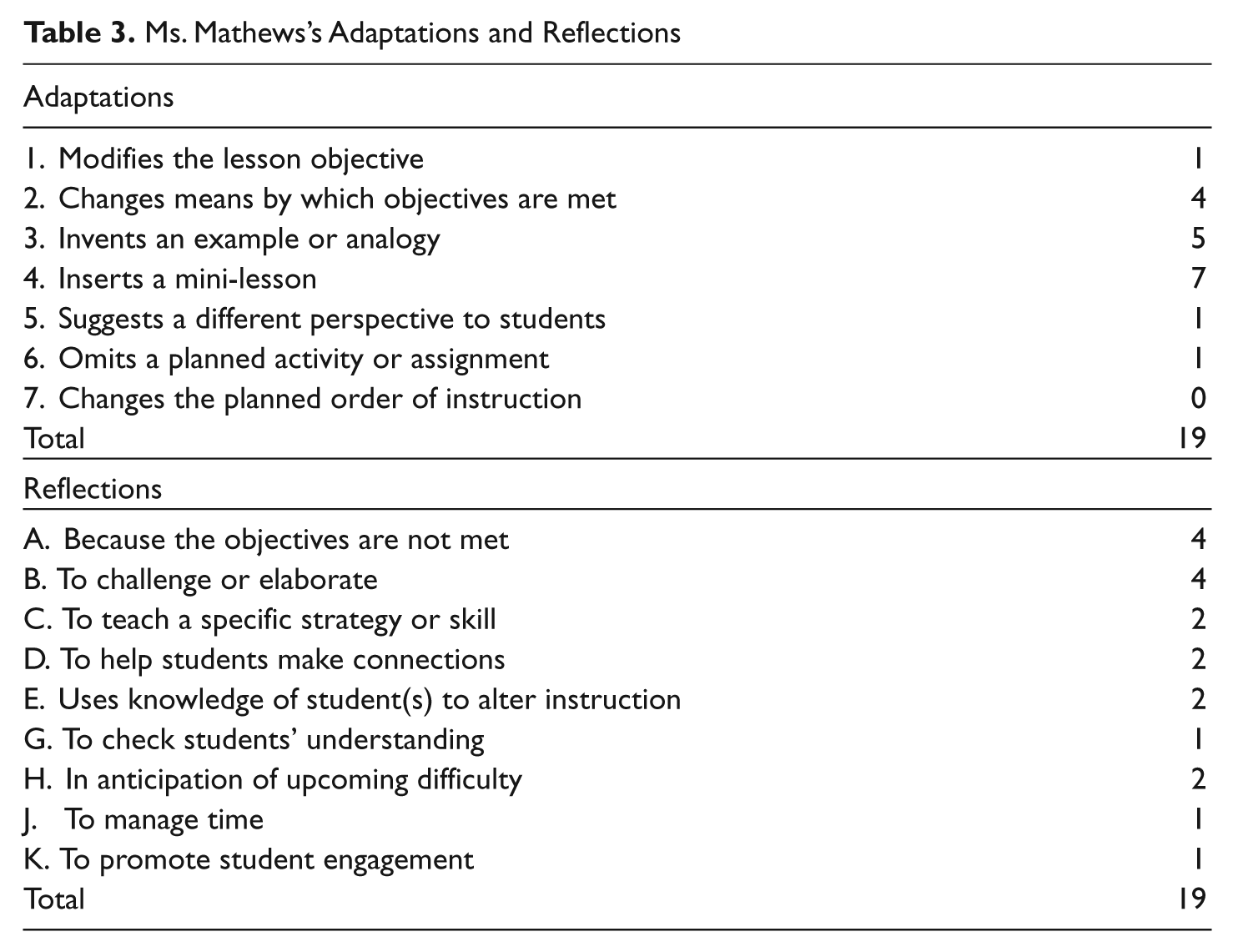
Across observations, Ms. Mathews implemented 16 tasks. Of the tasks she implemented, 8 were rated as closed, 4 were rated as moderately open, and 4 were rated as open. Ms. Mathews adapted her instruction 19 times in these observations. An overview of how she adapted her instruction and her reflections on adapting is displayed in Table 3.
Ms. Mathews’s Adaptations and Reflections
In the first several observations, the class transitioned between projects, so some students finished designing a community (the same project described above in Ms. Kim’s class) while others completed the task. The teacher maintained a workshop framework, during which she met with guided reading and word study groups. Meanwhile, the other students worked to finish their project or read or wrote independently. When not working with groups, Ms. Mathews conferred with students on their independent reading or writing.
During the first observation, Ms. Mathews adapted by extending workshop time. The completion of the previous project was delayed because the classroom had only two computers for the students to publish their work. Therefore, instead of proceeding with the social studies lesson, she adapted by continuing with workshop time. This adaptation was coded as “changing the means by which the objectives are met” because she altered the course of the instruction while maintaining the objective of finishing the previous project. The reflection she offered on this adaptation was coded as “to manage time.” She lamented that there was not enough instructional time in the school day and explained that she knew the workshop time for that day was less teacher directed, so she believed that extending the time would be appropriate.
During this transition between projects, Ms. Mathews also prepared students for the upcoming conservation unit. For example, one of the options for students in the next project was to write an essay about the benefits of recycling. Therefore, in the second observation, Ms. Mathews conducted a mini-lesson on essays. In this lesson, she read an example to the class, pausing to think aloud. She then allowed time for students to “turn to a partner and share your ideas” regarding potential writing topics. The teacher finished the lesson by modeling how to brainstorm writing ideas.
In the fourth observation, Ms. Mathews met with a student as he worked on his conservation letter. This task was rated as open because the students had choices within an authentic piece of writing that was sustained over time. That is, students could choose the type of piece they wanted to write, and there was a real audience for their writing. In the conference, she noticed the student using “and” to separate a list of several items. Therefore, Ms. Mathews inserted a quick lesson on using commas when listing three or more items. She explained how to use commas in a list and helped the student change his sentence. This adaptation was coded as “inserts a mini-lesson” because the adaptation followed the format of a mini-lesson: The teacher described the concept and supported the student as he worked. Ms. Mathews provided the following reflection on this adaptation:
He connects run-on sentences with and, and, and. I’m at the point with him that I’m going to put “and” on vacation, and he cannot use it unless he’s using it to connect thoughts. I think, too, ESL disconnect between how we speak and how we write. There is a definite difference speaking “and this and this and this,” and then writing it.
This reflection was coded as “uses knowledge of students to alter instruction” because Ms. Mathews used her knowledge of this student, considering that English is his second language, to guide her instruction.
During the conservation project in the fifth observation, Ms. Mathews asked students to brainstorm examples and nonexamples of conserving energy. This task was rated as moderately open because the students collaborated for an authentic purpose. The students provided many examples, but struggled to think of nonexamples. Accordingly, the teacher adapted by providing a nonexample of conserving energy: leaving the lights on when they left the classroom. This adaptation was coded as “invents an example or an analogy.” She provided the following reflection on this adaptation:
I was trying to get them to think outside of the simple views of recycling. Recycling is just a piece of it under the umbrella, but there are so many other facets of conservation that I hope we’ll get to.
This reflection was coded as “to challenge or elaborate” because she adapted her instruction to challenge students to expand their thinking.
Another adaptation occurred in the seventh observation while students were writing their essays or letters, tasks rated as open. A student asked if it was stealing to write an essay that is similar to another essay. The teacher adapted to this unanticipated question by explaining to the entire class that it is great to borrow from other writers, but it is not okay to copy writing word-for-word. She explained that in research writing, it is important to cite where you get information. She then described a citation and gave an example. This adaptation was coded as “inserting a mini-lesson” because she explained the concept and provided an example. Her reflection on this adaptation was as follows:
I thought, “do I go there or do I not go there?” But since we’re moving into more research writing and that sort of thing, go ahead and tell them. Obviously I’m not going to model it for them until we get more into research writing. I can tell them about it.
This reflection was coded as “to challenge or elaborate” because the teacher, prompted by a student, elaborated on the conventions of research writing.
In the eighth observation, a student worked on a letter to the principal as part of the conservation project, a task rated as open. While conferring with a student as he read, Ms. Mathews adapted her instruction by modeling how to make an inference and explained how she did it: “I used my schema and the text to read between the lines.” This adaptation was coded as “inserting a mini-lesson” because she described the strategy to the student and thought out loud to model the strategy. The teacher provided the following reflection:
That’s what I like about this literacy block and throwing in reader’s workshop. They all know—and I know this from their first and second grade curriculum—they all know schema. They all know inferencing. They all know mental images. They all make connections, but I think it’s using it fluently and being aware that they’re using it. So while I know that I have a base for what those strategies are and how to use them, I want them to see you’re using them daily and multiple strategies at once. So I don’t set out with a specific comprehension strategy in mind. As I see the text lending itself well to the strategy, I pull it out and say “this is what you’re doing as you’re thinking.” And I hope that will transfer as we start moving to test passages and to more difficult text.
This reflection was coded as “teaching a specific strategy or skill” because she taught students to be metacognitive about their strategy use.
As these examples illustrate, Ms. Mathews implemented a variety of tasks and adapted her instruction in various ways for different reasons. For example, she reconfigured a lesson to allow more time for students to complete their final projects. She provided whole-class lessons with examples to illustrate a concept that students did not quite grasp. She provided explicit, individual mini-lessons for students who demonstrated the need for support. These examples show the complexity of classroom instruction and the thoughtfulness required of teachers. These scenarios also illustrate the coding and rating systems used in this study.
How These Teachers Adapted in Different Types of Tasks
This section describes the frequency of these teachers’ adaptations within different types of tasks. Tasks were rated using a rubric that is composed of five task components: authenticity, collaboration, challenge, student direction, and sustained learning (see Appendix A). The total rating on the rubric categorizes the task as closed (5–8), moderately open (9–11), or open (12–15). For example, the Frayer map activity in Ms. Kim’s classroom (definition, characteristics, examples, and nonexamples of symbols) was a closed task. The task did not mimic real-world reading or writing, students had few choices, and it was a discrete assignment completed in one sitting. The conservation task in Ms. Mathews’s classroom was an example of an open task. Students wrote for an authentic audience (e.g., other classes or the principal), they had a choice of what they wanted to write, and it was sustained over the period of time. When these teachers provided students with choices, they often offered a menu of choices. For example, in Ms. Mathews’s conservation assignment, students had three choices of what to write. This type of choice differs from other instructional situations where students have open choice and the goal of instruction is to support students in regulating their own learning experiences (Brophy, 2010).
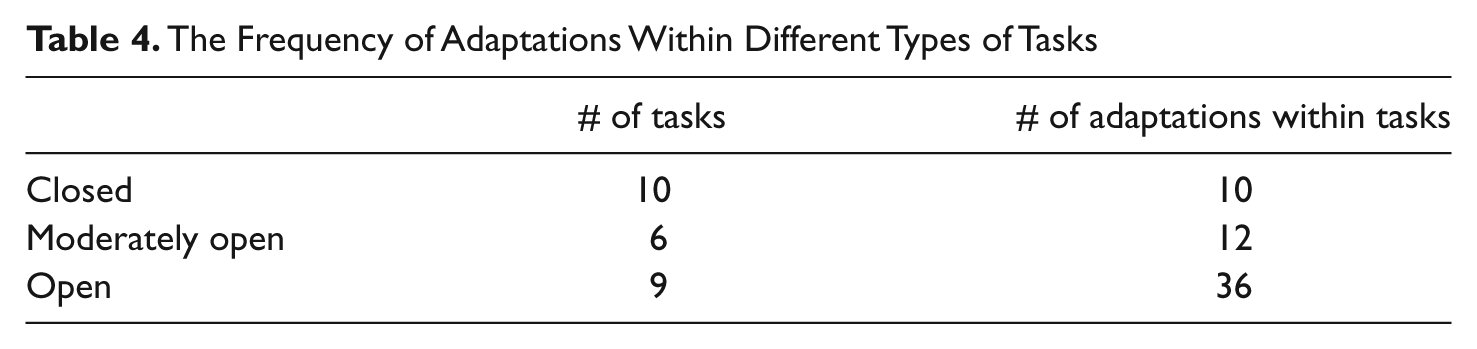
It is important to note that this study does not privilege a type of task. Indeed, closed and open tasks have their place in the classroom: Both the examples above, for example, were appropriate for the objectives for that lesson. Rather, this study sought to document how teachers adapted in different types of tasks. As displayed in Table 4, these two teachers adapted their instruction more frequently when implementing more open tasks. This finding is in line with previous theory that teachers must be more adaptive when implementing open tasks (Maloch, 2004; Randi & Corno, 2000; Sawyer, 2004).
The Frequency of Adaptations Within Different Types of Tasks
Discussion
This research examined two third grade teachers’ literacy instruction through the lens of adaptive teaching. This study adds to the research literature by providing rich description of adaptive teaching, an understudied aspect of literacy instruction. Therefore, this report, in combination with other reports describing the cumulative data from this research agenda (Duffy et al., 2008; Parsons et al., 2010), provides a research base for future studies of adaptive teaching. This systematic accrual of various data embodies the social science research process, illuminating complex phenomena (Yin, 2009). This research used multiple observations of and interviews with the teachers to answer the research questions:
How do these teachers adapt their literacy instruction?
What are these teachers’ reflections on their adaptations?
How are these teachers’ adaptations associated with particular types of literacy tasks?
These teachers adapted their literacy instruction in a variety of ways. Sometimes adaptations were minor, such as when Ms. Kim omitted an activity students were not prepared to complete. Other adaptations were substantial. For instance, Ms. Kim stopped students’ work and restructured the lesson as a whole-group activity instead of a small-group activity. These teachers’ adaptations were almost entirely in response to students. This finding exemplifies the interactive process of teaching and learning. The study also illustrates the concepts of ZPD and scaffolding. Consider the example where Ms. Kim worked with a student who struggled to write his presentation script. The student knew what he wanted to say but had trouble getting it on the paper (he was working within his ZPD and needed support). Ms. Kim adapted her instruction by scribing for him, providing the scaffold that allowed the student to complete the task that alone he could not.
These teachers differed in the frequency of their adaptations. Throughout nine observations of each teacher, Ms. Kim adapted 39 times and Ms. Mathews 19 times. One possible explanation for this difference is the context of the observations. Observations of Ms. Kim included a unit of study from beginning to end. Conversely, the first several observations of Ms. Mathews occurred during a transition period when some students completed the previous project and when she taught foundational knowledge for the next project. In the first three observations, Ms. Mathews adapted her instruction only twice. However, she adapted more frequently when the new project was up and running. Both teachers adapted more when students were working—that is, actively reading, writing, or collaborating. Adaptations during teacher-directed activities were less frequent.
Another possible explanation for the discrepancy in the number of adaptations could be the teachers’ knowledge of their students. This study took place in the first half of the school year. Ms. Kim looped with her students, so she already knew them well. Ms. Mathews did not have previous experience with her students. It may have been this increased knowledge of her students that allowed Ms. Kim to adapt her instruction more frequently. Indeed, 9 of her 39 reflections (the second most common reflection code) indicated that she adapted based on her knowledge of students. Conversely, only two of Ms. Mathews’s reflections were coded in this way. It seems logical, then, that Ms. Kim’s extended experience with her students facilitated more adaptations to meet their needs.
It is evident from this research that these teachers were monitoring student progress and adapting their instruction accordingly. These actions demonstrate metacognition. For example, Ms. Mathews demonstrated metacognitive thought when a student asked her if it is stealing to write an essay that is similar to another essay. Presented with this unanticipated question, she had to consider, instantaneously, many factors before she responded, including students’ levels (Are they ready to discuss plagiarism and citing work?), the objective of her lesson, and the direction her instruction was headed. When reflecting on this adaptation in the postobservation interview, Ms. Mathews said, “I thought, ‘do I go there or do I not go there?’” This statement illustrates metacognition. Her metacognition is further illustrated as she continued her reflection: “Since we’re moving into more research writing and that sort of thing, go ahead and tell them.” She was considering not only her students’ readiness and the current situation but also future curriculum.
Both teachers offered varied reflections on their adaptations that illustrate metacognition. Sometimes they adapted to stretch students’ thinking: “I was trying to get them to think outside of the simple views.” At other times adaptations were made to enhance students’ metacognition: “I want them to see you’re using them [comprehension strategies] daily and multiple strategies at once.” Sometimes these teachers adapted to promote cooperation: “Maybe they would ask each other . . . maybe they would rekindle each other’s memory.” These teachers adapted to meet individual student’s needs: “I know what’s on his ESL testing. Listening is one of his highest traits.” Therefore, these case studies provide further evidence for the complexity of classroom literacy instruction: the co-construction of classroom teaching and learning and the metacognitive thought required to navigate this co-construction. To help all students succeed, teachers need to be responsive to students, adapting their instruction to provide appropriate support for the students they teach.
The teachers in this study adapted their instruction more frequently in open-ended tasks and less frequently in closed tasks. This finding must be considered with caution because of the unique setting and participants of this study: a successful Title I school that was emphasizing project-based instruction and purposefully selected experienced teachers. Nonetheless, it is important to consider how these teachers adapted within different types of tasks. Education reform has long supported the use of open-ended, student-centered tasks (Dewey, 1938; Kilpatrick, 1918). Scholars, recognizing the benefit of open tasks on students’ literacy learning and motivation (Guthrie & Humenick, 2004; Miller & Meece, 1999; Purcell-Gates et al., 2007; Teale & Gambrell, 2007), continue to push for open literacy tasks (Parsons & Ward, 2011; Pearson et al., 2008).
Why teachers adapted more frequently in open tasks is not clear. A simple answer is that open tasks, by definition, last longer and therefore allow more instructional time in which to adapt. Social constructivist researchers have hypothesized that teachers are more adaptive in open tasks because students have more control of the course of the lesson (Sawyer, 2004). Maloch’s (2004) research on literature circles produced similar findings: “When students are engaged in more student-centered activities, the need for explicit support and guidance in the processes of learning is even more critical” (p. 17). Both of these explanations likely contributed to teachers adapting more frequently when implementing open tasks. Nevertheless, this study corroborates previous theory and research indicating that open tasks require more teacher adaptation (Maloch, 2004; Randi & Corno, 2000; Sawyer, 2004). This finding is particularly significant in light of reform movements calling for more open tasks (Parsons & Ward, 2011; Pearson et al., 2008).
Last, this study has methodological implications. The methods and measures used in this research provide tools for systematically studying the complexity of classroom instruction. The coding systems allow researchers to document how teachers adapt and their reflections on their adaptations, and the rubric for rating the openness of tasks documents the types of activities being implemented. This study revealed some shortcomings in its methods, though, and the research team made adjustments accordingly. For example, the interview question “Why did you make that change?” provided insights into these teachers’ reflections. However, this operationalization of teacher reflection is somewhat narrow because it is limited to their reason for adapting and does not probe the knowledge they accessed to adapt or their evaluation of the effectiveness of the adaptation. Therefore, the research team is exploring additional interview questions to more holistically capture teachers’ reflective thinking about adaptations. A study currently under way, for example, added the following questions to the postlesson interview regarding adaptations: “How did you know to do that?” and “Was the adaptation effective?” These questions dig deeper into teachers’ reflective thinking regarding instructional moves.
Also, the definition of tasks used in this study—when students complete a written product—though derived from the research literature (Lutz et al., 2006; Miller & Meece, 1999), was limiting. During observations, academic work that did not include writing occurred and could have been informative. Therefore, the research team has reconsidered this definition of tasks to allow our future study to be more inclusive of the academic work that takes place in elementary classrooms.
Future Directions
Researchers associate adaptive teaching with teacher effectiveness (Anders et al., 2000; Corno, 2008; Darling-Hammond & Bransford, 2005; Fairbanks et al., 2010; Gambrell et al., 2011; Pearson, 2007; Snow et al., 2005). Although this position resonates with educators’ understandings of instruction and learning, there are limited data connecting teachers’ adaptations and student outcomes. Studying this relationship is a necessary next step in the research on adaptive teaching. One particularly valuable approach to studying teacher adaptations and student outcomes would be to examine the effect of adaptations on students’ self-regulated learning. Corno (2008) suggested that the ultimate goal of teachers’ adaptive instruction is to help students become more self-regulating. She argued that students who are self-regulating adapt the instruction they are given to themselves, which is instrumental to academic achievement. Therefore, systematically examining the effect of teachers’ adaptations on students’ self-regulated learning is a primary goal in this research agenda.
Footnotes
Appendix
Coding System for Reflections
| A. Because the objectives are not met |
| B. To challenge or elaborate |
| C. To teach a specific strategy or skill |
| D. To help students make connections |
| E. Uses knowledge of student(s) to alter instruction |
| G. To check students’ understanding |
| H. In anticipation of upcoming difficulty |
| J. To manage time |
| K. To promote student engagement |
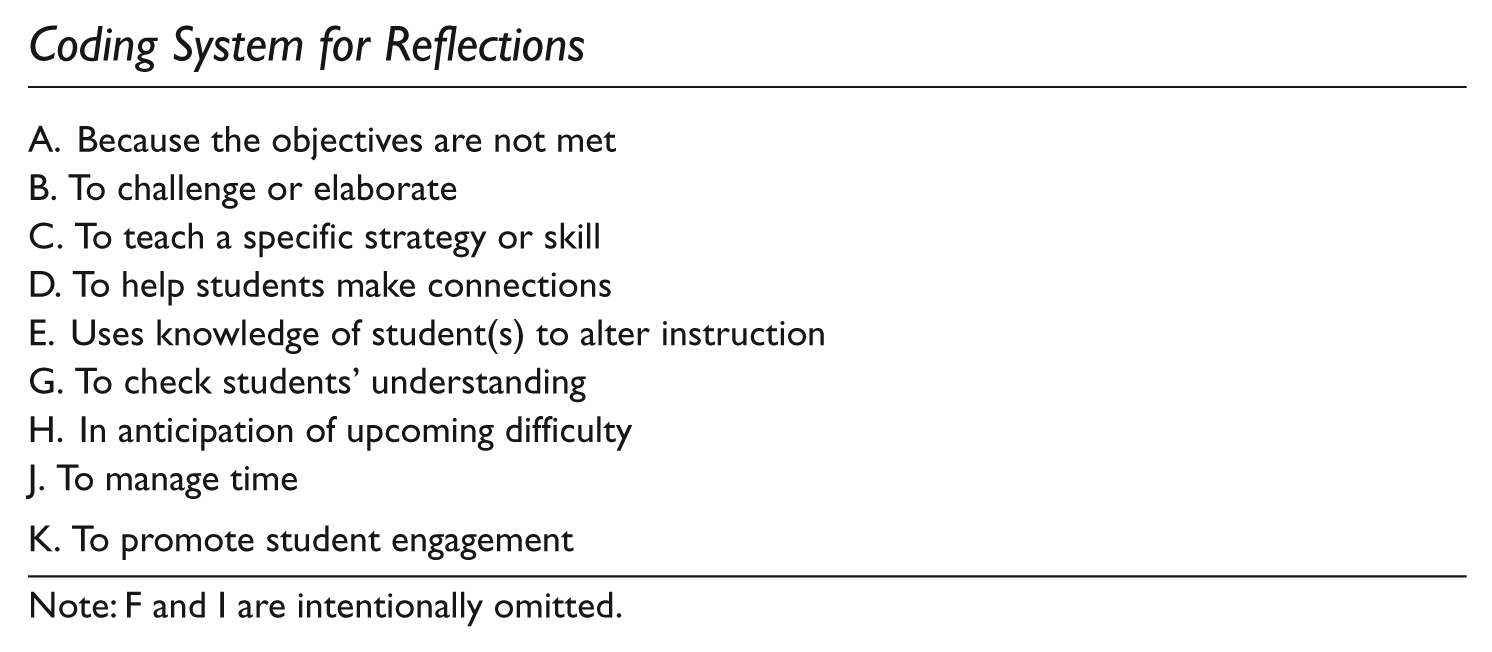
Note: F and I are intentionally omitted.
The author(s) declared no potential conflicts of interest with respect to the research, authorship, and/or publication of this article.
The author(s) received no financial support for the research, authorship, and/or publication of this article.
References
Supplementary Material
Please find the following supplemental material available below.
For Open Access articles published under a Creative Commons License, all supplemental material carries the same license as the article it is associated with.
For non-Open Access articles published, all supplemental material carries a non-exclusive license, and permission requests for re-use of supplemental material or any part of supplemental material shall be sent directly to the copyright owner as specified in the copyright notice associated with the article.
