




Abstract
This study examined elementary school students’ perceived support for recreational reading from their mothers, fathers, and friends. Participants, including 130 fourth graders and 172 fifth graders, completed the researcher-developed Reading Support Survey, which assesses how often children experience and how greatly they enjoy multiple types of reading-supportive behaviors. The survey was based on a synthesis of quantitative, qualitative, and mixed-methods research on older children’s experiences of support for recreational reading. Theories emphasizing the importance of social factors in the development of reading motivation and attitudes and domain-general theories of motivation and social support also influenced the survey design and study hypotheses. Perceived reading support showed four underlying dimensions, two reflecting source of support and two reflecting type of support as the organizing element. Hierarchical multiple regression analyses demonstrated that perceived parent and friend support each contributed uniquely to the prediction of multiple dimensions of self-reported reading motivation and frequency, controlling for reading achievement, gender, and grade level. Children perceived greater reading support from their mothers than from their fathers or friends. There were few differences in perceived reading support, reading motivation, or habits by gender or grade level. The findings of this study expand the research base on the relations of children’s experiences of parental support for reading with reading motivation and activity, which has largely focused on preschool and primary-grade children, to older children.
Strengthening older children’s reading motivation and achievement is currently on the agenda of many educators, education researchers, and policy makers (Heller & Greenleaf, 2007; V. A. Jacobs, 2008). Children who engage frequently in reading tend to be higher achievers; unfortunately, many children’s motivation for reading declines across the school years (J. E. Jacobs, Lanza, Osgood, Eccles, & Wigfield, 2002; McKenna, Kear, & Ellsworth, 1995). In the present study we focused on a topic relevant to this issue that to date has received limited attention—the role of parents in supporting older children’s reading motivation and habits, specifically with respect to the domain of recreational reading. Substantial research illustrates how parental actions and beliefs play a key role in supporting preschool and primary-grade children’s development of reading motivation as well as reading skills (Baker & Scher, 2002; Baker, Scher, & Mackler, 1997; Sénéchal & Young, 2008). However, little is known about the ways or extent to which parents support older children’s reading or how such support relates to older children’s reading motivation (Klauda, 2009). Specifically, we addressed gaps in extant research on this topic by comparing support from parents and friends and by independently assessing support from mothers and fathers. We did so by developing the Reading Support Survey, which is distinct from measures used previously to study social factors in children’s reading in that it inquires about support from multiple, individual sources and taps children’s perceptions of support rather than individuals’ reports of the support they provide.
The study focused on children living with both their mothers and fathers, or other male and female caretakers. Although 26.6% of children in the United States currently live in single-parent households (U.S. Census Bureau, 2010), we were particularly interested in whether the roles that parents played in their children’s reading systematically differed by parent gender. Children from single-parent households would probably, on average, have less opportunity to interact with nonresident parents in the ways inquired about in the study and have less knowledge of nonresident parents’ reading habits, which were also a focus of several survey items. Therefore, it would have been inappropriate to include children with different family structures within a single sample; because a large majority of students in the current study lived with two heterosexual parents, we centered on that family structure.
Theoretical Models Regarding the Importance of Social Factors in Reading
The study was broadly grounded by two models specific to the reading domain that present social factors as one of a few major contributors to individuals’ reading motivation and activity. First, the reading engagement model (Guthrie & Wigfield, 2000; Guthrie, Wigfield, & Perencevich, 2004) posits that social interaction in reading is one of four defining characteristics of engaged readers, along with cognitive, behavioral, and emotional involvement in literacy activities. Engaged readers “connect their reading with their friendships and their leisure time . . . engagement is a network of bonds among skills, strategies, knowledge, and motivation, in the social community” (Guthrie et al., 2000, p. 209). This model implies that to fully understand how children become thoughtful, avid, willing readers, it is beneficial to examine who children interact with around reading and how these interactions relate to their reading motivation and activity.
Second, the model of reading attitude acquisition (McKenna, 1994; McKenna et al., 1995) depicts individuals’ perceptions of how much significant others in their lives value reading as one of three direct influences on their feelings toward reading, which in turn affect the decision to read or continue reading. According to this model, whether an individual generally tends to conform with another’s values and beliefs is an important consideration. This stipulation undergirds our attention to the comparative role of parents and peers, particularly at an age when general peer influence is increasing, whereas parental involvement and support may be declining (Wigfield, Eccles, Scheifele, Roeser, & Davis-Kean, 2006). The reading attitude acquisition model also positions the environment, including, for example, the accessibility of interesting reading materials, as an indirect influence; accordingly, we inquired about ways that socialization agents may not directly interact with the focal students but still encourage reading, such as by reading themselves in their spare time.
Defining Reading Support and Reading Motivation
Reading support
We conceptualized reading support as behaviors and statements reflecting involvement in and approval or encouragement of another individual’s reading activities, emitted with or without the intention of promoting that individual’s reading motivation and activity. Baker (2003) noted that “parental support [for reading] includes such factors as the availability of reading materials in the home, parental reading behavior, and the frequency of reading to the child” (p. 89); however, the term reading support previously has not been formally defined in the reading literature. Based on an extensive review of prior research concerning parent involvement in older children’s reading (Klauda, 2008) and studies that examined more general social factors in children’s reading (Mucherah & Yoder, 2008; Palmer, Codling, & Gambrell, 1994), we identified seven categories of reading support: recommendation of or assistance in selecting reading materials, reading together, general encouragement to read, discussion of particular reading materials, serving as a reading model, provision of reading materials, and provision of space or opportunity for reading.
Our conception of reading support was also influenced by domain-general typologies of social support and theories of motivation. In terms of social support typologies, we primarily examined instrumental support, although the “approval” and “encouragement” aspects of our definition are also representative of emotional support (Malecki & Demaray, 2002; Tardy, 1985). With regard to motivation theories, our reading support definition was particularly influenced by self-determination theory’s (SDT) presentation of ways in which socialization agents may facilitate others’ internalization of motivation for activities (Ryan & Deci, 2009). SDT specifies that socialization agents’ warm, active involvement in children’s activities helps facilitate children’s internalization of motivation for those activities by fulfilling the basic psychological need of relatedness (Grolnick, Gurland, Jacob, & Decourcey, 2002). Accordingly, we inquired about several ways that parents and friends may be active in the focal children’s reading, such as by discussing reading materials and actually reading with them. As SDT emphasizes the importance of positive affect in these interactions, and as research with young children emphasizes the importance of affect in joint reading activities (Baker et al., 1997), we also inquired about children’s enjoyment of such interactions. Reading support may also less directly reflect support for fulfillment of the two other basic psychological needs specified in SDT, autonomy and competence. For example, book discussions may stimulate children to think more deeply about what they read (or the book someone else is telling them about), an experience that may make them want to read more on their own. Book discussions with others on a regular basis might also promote children’s reading comprehension and thereby their sense of competence as readers.
Reading motivation
Previous research identifying reading motivation as a multidimensional construct (e.g., Baker & Wigfield, 1999; Wigfield & Guthrie, 1997) provided the basis for our conceptualization of reading motivation. This research suggests that children have a variety of intrinsic and extrinsic motivations for reading (or not reading), including but not limited to their beliefs about reading and themselves as readers, how valuable they find reading, the kinds of goals they might satisfy through reading, and the desire to be recognized for reading. Positive forms of motivation increase reading amount, which in turn increases reading comprehension (Cunningham & Stanovich, 1997; Guthrie, Wigfield, Metsala, & Cox, 1999). However, substantial research suggests that children’s motivation for reading and language arts, including their values and competence beliefs, as well as their reading attitudes and recreational and academic reading activity decline with age, especially during the elementary years (J. E. Jacobs et al., 2002; McKenna et al., 1995). Thus, better understanding how reading support and reading motivation and frequency are connected may offer insight into how parents and friends might help sustain or stimulate older children’s reading motivation.
The present study focused on six reading motivation constructs previously included in studies with a multidimensional perspective on reading motivation (Baker & Wigfield, 1999; Guthrie et al., 2007; Wigfield & Guthrie, 1997). The first two dimensions are motivations that both fall within the category of competence beliefs for reading (Baker & Wigfield, 1999). First, efficacy represents children’s beliefs that they are skilled readers. Second, challenge represents children’s willingness to engage in difficult reading activities. These dimensions are distinct theoretically in that, for example, some children may feel efficacious as readers but not read particularly challenging books because they do not value that activity highly. They are also distinct empirically, as they have typically factored separately and correlated moderately in previous research (Baker & Wigfield, 1999; Mucherah & Yoder, 2008; Wigfield & Guthrie, 1997).
The third dimension of motivation is knowledge goals, which represents the extent to which children read for the purpose of learning facts and concepts. Knowledge goals constitute a dimension that refers to reading for the inherent satisfaction that comes from gaining new information. It is very similar in meaning to the construct of curiosity studied by Wigfield and Guthrie (1997) and Baker and Wigfield (1999), defined in those studies as the desire to read about topics of interest to the reader. The construct emphasizes reading for the purpose of learning, as opposed, for example, to the purposes of entertainment and escape.
Fourth, perceived autonomy represents a sense of control over one’s reading activities and preference for having this control, as opposed, for example, to having parents or teachers make decisions about one’s reading. Guthrie et al. (2007) studied this construct, which they also described as perceived control, through interviews with fourth- grade children. In the interviews, children high in perceived autonomy asserted that they would rather pick their own books than have adults choose them and described strategies for finding their own books.
Whereas the first four constructs represent internal or intrinsic aspects of motivation, the last two constructs reflect extrinsic aspects of motivation, which we include because of their prevalence in school and other settings. More specifically, they each reflect a performance goal orientation, or a desire to read to impress others (Wigfield & Guthrie, 1997). Specifically, competition represents engaging in reading to demonstrate superiority to others in reading. Last, recognition represents the desire to have others such as teachers or parents positively acknowledge one’s reading.
We expected the reading motivation constructs to relate differentially to perceived reading support based on premises in SDT (Ryan & Deci, 2009). First, having strong knowledge goals that one aims to fulfill through reading reflects either true intrinsic motivation or deep internalization of value for reading. Ryan and Deci (2009) assert that support from socialization agents catalyzes intrinsic motivation or facilitates internalization; therefore, we hypothesized that reading support would relate positively to this motivation dimension. Similarly, we predicted that reading support would relate positively to the two competence belief-related constructs of efficacy and challenge and to the construct of perceived autonomy, as SDT posits that competence and autonomy are psychological needs that interactions with socialization agents play a key role in satisfying. On the other hand, we predicted that competition and recognition would relate negatively to reading support, as self-determination theorists posit that extrinsic motivations are characteristic of individuals whose psychological needs are not being well met. We also, however, considered that recognition might relate positively to reading support, especially as we were assessing perceived reading support; that is, the constructs of recognition and perceived reading support both reflect awareness of others’ thoughts and behaviors relevant to one’s reading.
Prior Empirical Research on Reading Support Experienced by Older Children
Previous quantitative studies of aspects of parent support for older children’s reading in relation to children’s reading motivation and habits have primarily employed parent questionnaires to assess reading support. Like the present study, these studies primarily focused on recreational rather than school reading. For example, Hansen (1969) found that a composite measure of parents’ supportive behaviors had a strong, positive relationship (partial r = .60) with fourth-grade students’ self-reported commitment to independent reading, controlling for father’s occupation and education and children’s IQ. In contrast, Pagan and Sénéchal (2009) found not even a significant zero-order correlation between parents’ reports of how they currently support literacy at home and third to fifth-grade children’s reading motivation (intrinsic, self-concept, and attitude); there was, however, a weak positive correlation (r = .19) between the parent support composite and children’s reading activity (measured by frequency of reading for pleasure and author or book title recognition tests). Two other studies involving fifth graders and their parents indicated weak to moderate zero-order correlations of parent support composites with children’s amount of leisure reading (Neuman, 1986) and with children’s reading attitudes and purpose of reading for enjoyment (Greaney & Hegarty, 1987).
A possible reason that stronger relationships were not obtained between parent support and children’s reading motivation and activity in some studies is that parent reports of the reading support they offer may be particularly biased by social desirability (Baker et al., 1997; Neuman, 1986). Children’s reports of their parents’ behavior might be less affected by a desire to present their families in a positive light and therefore show more variability. Furthermore, although children’s perceptions may not mesh with objective reality, they represent reality as the children see it and therefore may be more closely linked to their motivations and behavior (Bouchey & Harter, 2005). In one quantitative study that employed child reports of parent reading support, fourth graders categorized as avid leisure readers reported greater reading support than infrequent readers in four of seven regards about which they were surveyed: receiving books as presents, encouragement to read, being taken to the library, and reading aloud with their parents until an older age (Shapiro & Whitney, 1997). In addition, several qualitative studies have documented that many older children, particularly avid readers, perceive their parents as a key influence on their reading habits and motivations and enjoy their involvement and encouragement (e.g., Chandler, 1996; Edmunds & Bauserman, 2006; Strommen & Mates, 2004; see Klauda, 2009, for a review). Employing child self-report measures of reading support as well as reading motivation and habits may, however, create bias because the information comes from the same source and is collected by means of one method, what we call “monomethod bias.” We believe, though, that the use of child reports for reading support, motivation, and habits is warranted because it permits an analysis of information not previously collected in quantitative studies.
Few quantitative studies of reading support have compared different sources of that support. Two studies compared parent and teacher support for reading, one using a combination of student and parent questionnaires (Chen, 2008) and the other employing a student questionnaire (Wells, 1978). Apparently only one study has statistically analyzed an aspect of support from parents and peers: Lau and Cheung (1988) found that student reports of their parents’ and peers’ reading habits (the only aspect of support they studied) were strongly associated with their own. Several qualitative and mixed-method studies, however, have inquired broadly about multiple influences on children’s reading. These studies particularly highlight the role that peers play in each other’s recreational reading. Friends and classmates especially seem to influence each other’s choice of reading materials, discuss reading with each other, and engage in joint reading, especially of magazines and other materials besides books (e.g., Cherland, 1994; Finders, 1997; Smith & Wilhelm, 2002). Furthermore, Edmunds and Bauserman (2006) reported that, of all potential sources of support, fourth graders most frequently cited peers as their source of book recommendations. Likewise, Moje, Overby, Tysvaer, and Morris (2008) found that although the vast majority of the 79 sixth to ninth graders they interviewed mentioned peers as a source of their reading materials, very few cited parents.
In addition, scant research has explicitly compared support for reading from mothers and fathers. In one qualitative study of 11- to 17-year-old boys identified as committed recreational readers, the younger boys perceived their mothers as having the most influence on their reading, whereas the older boys found the greatest support from their fathers, with whom they frequently swapped and discussed materials on traditionally masculine topics such as military history (Love & Hamston, 2001). In a study involving these same boys along with a sample of reluctant readers, mothers and fathers alike reported that mothers were more involved in the boys’ reading (Love & Hamston, 2004). Similarly, the fourth graders studied by Edmunds and Bauserman (2006) most frequently cited their mothers out of all possible influences on their motivation when asked who gets them interested in and excited about reading.
The Reading Support Survey and Study Hypotheses
Because previous quantitative studies of reading support used limited measures that did not assess support provided by multiple socialization agents and were designed to be answered by parents, new measures of reading support are needed. The Reading Support Survey (RSS) developed for this study includes items assessing children’s perceptions of the following kinds of reading support: assistance in selecting reading materials, encouragement to read, modeling of reading, discussion of particular reading materials, reading together, and provision of reading materials. Children were asked how often they received these kinds of support from mothers, fathers, and friends. In addition, the survey asks how much children enjoy talking with others about what they read, reading together, and receiving books as presents. Another distinctive facet of the RSS is its attention to support for reading in general as well as with respect to multiple, specific kinds of reading materials: books, magazines and newspapers, and websites. Some qualitative and mixed-method studies suggest that older children and adolescents experience varying degrees of support for different kinds of reading materials (Finders, 1997; Lee, 2007; Love & Hamston, 2004; Smith & Wilhelm, 2002), but statistical analyses of material-specific support are greatly limited. Finally, the focus of the RSS on recreational rather than school reading enables the results of the present study to build closely on previous studies.
Based on research described in the previous section, the age group and forms of reading support studied, and research on children’s perceived support in other domains (Bouchey & Harter, 2005; Robinson, 1995), we predicted that overall students would report greater support from their mothers than from their fathers or friends. We did not make a hypothesis regarding level of support perceived from fathers versus friends. We were also curious whether differences would occur in all aspects of support. In addition, we predicted that mother, father, and friend support would represent different dimensions of perceived reading support based on studies concerning children’s experiences of social support in general, which suggest that the specific source of support (e.g., parent, teacher, classmate, friend) is a stronger organizing element than the general source of support (e.g., adults, peers) or type of support (Malecki & Demaray, 2002; Malecki & Elliott, 1999; Robinson, 1995). If analyses showed that reading support was indeed composed of dimensions reflecting different sources of support, we planned to examine the unique relations of support from each source with children’s reading motivations and habits. Based on research in other domains (Murdock & Miller, 2003; Wentzel, 1998) we hypothesized that support from each source would contribute additively to some aspects of reading motivation and activity and distinctively to others. In addition, we predicted that reading support would relate positively to students’ reading habits and, as described earlier in the sections defining reading support and reading motivation, made specific hypotheses about how reading support would relate to each of the six dimensions of reading motivation under study. Namely, we predicted that it would relate positively to efficacy, challenge, knowledge goals, and perceived autonomy but negatively to competition and recognition.
We also examined whether child gender affects perceived reading support and whether it affects how reading support relates to children’s reading motivation and habits. Several studies that inquired about children’s interactions in reading without respect to specific socialization agents indicate that girls are more social in their reading than boys (Baker & Wigfield, 1999; Mucherah & Yoder, 2008; Wigfield & Guthrie, 1997). Shapiro and Whitney (1997) also found that girls who read avidly experienced particularly high levels of some aspects of parent reading support, and Harold, Eccles, Yoon, Aberbach, and Freedman-Doan (1991, as cited in Eccles, 1993) found that parents of elementary school girls, versus boys, encouraged their children to read more and had them read to them more frequently. Furthermore, Cherland (1994) and Millard (1997) contended that reading is broadly construed by society to be a feminine activity and that parents tend both intentionally and unintentionally to encourage daughters but discourage sons to read. Thus, we predicted that girls would report greater perceived reading support, from both parents and friends. Still, we recognize that some work suggests that boys greatly enjoy social interaction in their reading both in and out of school (Smith & Wilhelm, 2002). We also predicted that girls would show a more positive profile of reading motivation and frequency, which would especially be expected if they perceived greater reading support and aligns with several previous studies (e.g., Baker & Wigfield, 1999; J. E. Jacobs et al., 2002; McKenna et al., 1995). In addition, we investigated potential grade-level differences in perceived reading support, motivation, and frequency, but did not form hypotheses about them. Although children’s reading motivation and activity appear generally to decline during the elementary years, we were studying children only one grade level apart. Likewise, we suspect that many parents offer less reading support as children grow older and become more skilled readers (and hence that children decline in perceived support) but did not have a basis for expecting a significant shift between fourth and fifth grade, the grade levels studied, nor did we have a basis for predicting a grade-level difference in perceived support from peers.
Summary of Research Questions and Hypotheses
In sum, we addressed five questions concerning upper-elementary children’s perceived reading support, reading motivations, and reading activity and their interrelations:
1. Do children perceive different levels of reading support from mothers, fathers, and friends?
Hypothesis: Children will perceive higher levels of reading support from their mothers than from their fathers or friends.
2. How is the construct of perceived reading support structured?
Hypothesis: Mother, father, and friend support will appear as distinct dimensions.
3. To what extent are there gender and grade-level differences in perceived reading support, reading motivations, and reading habits?
Hypothesis: Girls will show a more positive profile of reading support, motivations, and habits than boys. (No hypothesis was made regarding grade-level differences.)
4. In what direction and to what extent does perceived reading support correlate with students’ reading motivations and habits?
Hypotheses: Perceived reading support will correlate positively with the motivations of efficacy, challenge, knowledge goals, and perceived autonomy and with reading habits. It will correlate negatively with recognition and competition. (No hypotheses were made regarding the magnitude of correlations.)
5. To what extent does perceived reading support from different sources uniquely relate to children’s reading motivations and habits?
Hypothesis: If dimensions of support representing distinct sources of support are identified in analyses for Question 2, each support source will show unique relations with children’s reading motivations and habits.
Method
Participants
The sample comprised 130 fourth graders and 172 fifth graders from three public elementary schools in a rural area of a mid-Atlantic state. As shown in Table 1, the participants were 54% female and predominantly European American. The sample mirrored the population of the three participating schools in demographic characteristics, except the percentage of fourth-grade male participants was somewhat low. Generally, students were from working- and middle-class socioeconomic backgrounds; individual socioeconomic status (SES) data were unavailable.
Demographic Characteristics of Students in Final Sample and in Participating Schools
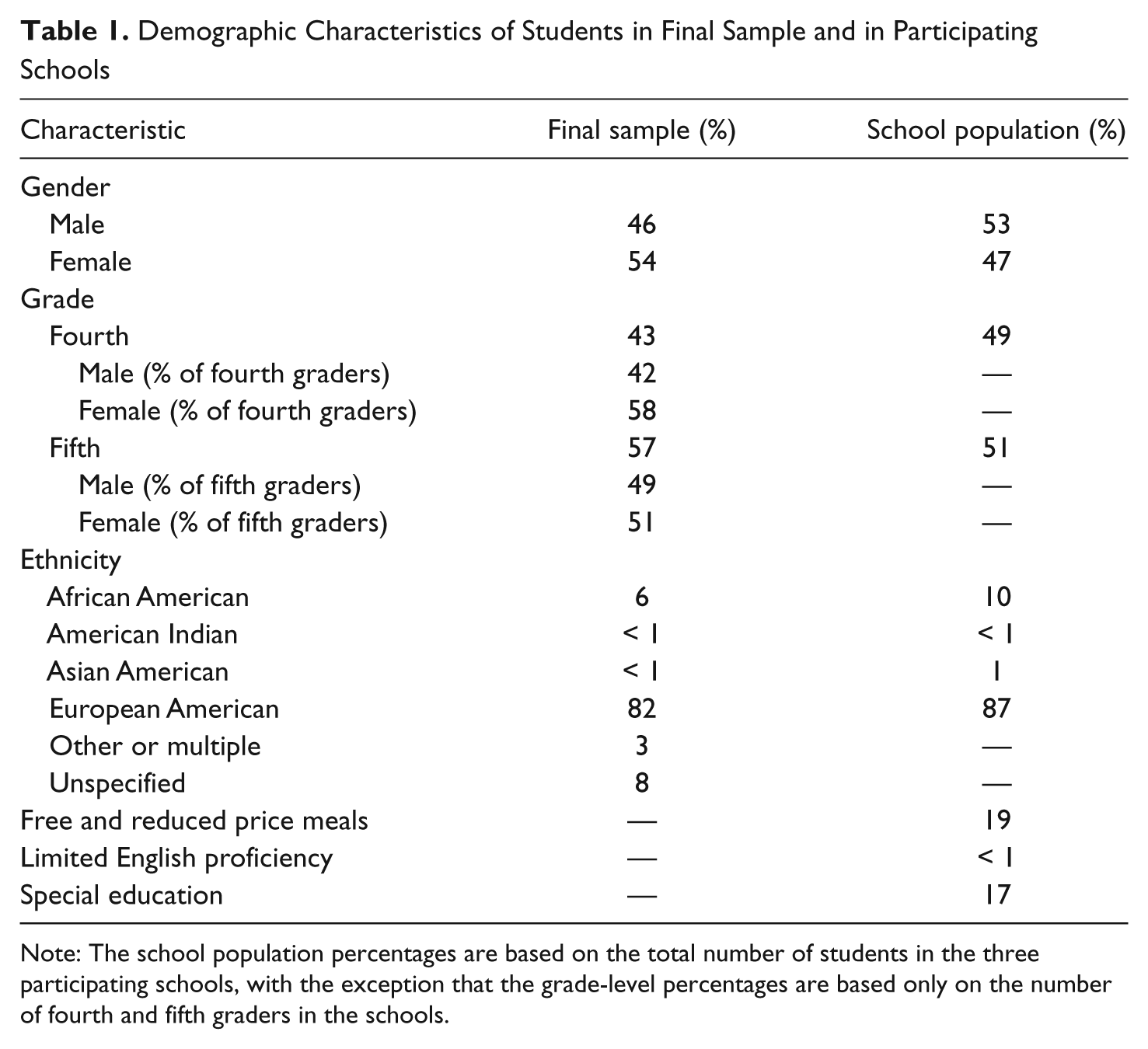
Note: The school population percentages are based on the total number of students in the three participating schools, with the exception that the grade-level percentages are based only on the number of fourth and fifth graders in the schools.
An additional 32 students who lived in single-parent households completed all study measures. These students’ data were excluded from all analyses, given, as described earlier, the focus on comparing support from mothers and fathers. All but one child from a single-parent household indicated that their caretaker was female, so items pertaining to fathers might unduly be affected if these students were included.
The study took place in two sessions in each participating classroom, with 285 of the 302 students completing Session 1 and 292 students completing Session 2. For both sessions, 275 students were present; that is, 27 students missed one of the two sessions. The sample size for each analysis varies depending on whether it involved measures from Session 1 or Session 2, or both.
All participants returned a signed parent or guardian consent form and signed an assent form read aloud to them by the researcher prior to data collection in each classroom.
Measures
Perceived reading support
For the study, we constructed the RSS. Based on extensive review of quantitative, qualitative, and mixed-method research on older children’s experiences of support for recreational reading, we developed a preliminary version of the RSS that was piloted with 55 fifth graders in a different school district from the main study (see Klauda, 2008, for more detail on the pilot). The RSS items were designed to be answered with respect to one’s mother (or primary female caretaker), father (or primary male caretaker), and a good friend. The pilot version of the RSS contained eight main items, seven with the response options of never (0), rarely/less than once a month (1), sometimes/a couple times a month (2), often/a couple times a week (3), and very often/everyday (4), and one, concerning the receipt of books as presents within the past year, with the options of 0, 1–3, 4–6, 7–9, and 10 or more for the number of books. Six of the items represented one of the categories of reading support identified earlier (recommendation of or assistance in selecting reading materials, reading together, general encouragement to read, discussion of particular reading materials, serving as a reading model, provision of reading materials); the category of provision of space or opportunity for reading was excluded because it is not something children’s friends would be able to provide. In addition, one item concerned how often children play word games and do word puzzles with other people; although this form of reading support emerged in only one previous study (Hamston & Love, 2003), it seemed like another potentially important category. Finally, one item tapped children’s perceived discouragement for reading, based on several studies that considered how socialization agents may sometimes undermine children’s reading motivation by discouraging them from reading certain types of materials or by generally dismissing the value of reading as a leisure activity (e.g., Chandler, 1999; Hamston & Love, 2003; Smith & Wilhelm, 2002). The preliminary RSS items also included two subparts. One asked children whether their response to the main item applied to books, magazines, websites, and/or another type of reading material, which they could write in. For this part of each item, students could circle as many of the items that applied for them. In addition, to verify responses of often and very often to the main items and to offer insight into the specific reading materials children were sharing with others, the second subpart of each item asked students to list up to three example titles or topics of books, magazines, websites, or other reading materials if they had circled one of those two response options for the item.
The item content of the preliminary RSS was revised in five main ways after the pilot study; the final survey items are listed in the appendix. As summarized here and explained further in Klauda (2008), the revisions to the pilot survey were as follows: First, the items concerning discouragement of reading and frequency of playing word games and puzzles were eliminated because of time constraints and unusual functioning in preliminary analyses. Second, a second question in the category of general encouragement to read was added (Question 8: “How do each of these people act when they see or hear about you reading in your free time?”). It was included to capture a way that a child’s nonprimary caretaker has the opportunity to show his or her support or lack thereof for the child’s reading. The response options for this item are very unhappy (1), sort of unhappy (2), sort of happy (3), and very happy (4). Third, the items concerning how often others help the child pick things to read and how frequently each socialization agent reads in his or her free time were each divided into three items, so that children would be asked how often each person does these things with regard to (a) books, (b) magazines and newspapers, and (c) websites. Correspondingly, the subpart of each item on the original survey that asked children to indicate the type of reading material to which their response to the main question applied was eliminated to reduce the survey’s complexity and its administration time. For the same reasons, the revised version asks for examples for just two items (Questions 1 and 10) but asks all students (except those who answered never to the main item) to offer examples, not just those who said often or very often. Fourth, subparts were added to three questions (Questions 9–11, which concerned talking about reading, reading with others, and receiving books) that asked participants to rate their enjoyment of the interaction in question. These subparts were included as studies of both young children’s reading interactions and SDT emphasize that positive affect in interactions, not just the frequency of interactions, plays an important role in children’s development of motivation. The subpart took the form of “How much do you enjoy ____________?” and employed four response options: not at all, not very much, a little, a lot. Students were directed to skip the subpart if their answer for the corresponding main part was never or 0. Fifth, a question was added that asked children to respond yes or no to the statement, “Other people say and do things that lead me to read in my free time” (Question 12). If yes, students were directed to select which person “does this the most” from eight options: father or male caretaker, mother or female caretaker, brother, sister, the friend I had in mind as I did the survey, a different friend, one of my teachers, someone else (Who? _________). This item was included to obtain a general sense of whether the participants viewed people that they know as an important influence on their reading and how different individuals ranked relative to each other. It also was added to provide insight into whether the three socialization agents that are the focus of the survey are the figures that children would most often cite as the greatest influences on their reading.
In addition, a number of minor changes were made to the original RSS questions based on questions participants asked during the pilot and to make each question represent a highly specific situation. For example, the item “How frequently do you and each of these people spend time reading together?” became “How frequently do you and each of these people read out loud together?” (Question 10) to specify that the item concerns reading aloud with someone else from the same material instead of, for instance, silently reading different materials in the same room. Also, the question that concerned the receipt of books as presents also asked students to respond with respect to parents jointly (Question 11), as in the pilot study several students indicated that a book was a present from both their parents.
Last, after the pilot the RSS directions were revised to direct students to think about specific kinds of reading materials, for which definitions were provided on the cover page, rather than broadly about all the different materials they might read. Also, although the pilot instructions told students to think about their “best friend” when responding to the friend items, the revised instructions directed students to “think about the friend that you spend the most time with. It should not be your sister or brother.” Students were asked to write down the first name of their friend, to reinforce that they should keep that person in mind throughout the survey.
In sum, the pilot study demonstrated the feasibility of the RSS format and led to refinements of items and directions. The RSS employed in the current study included 12 main questions, with the first 11 questions each representing a form of reading support identified in the review conducted prior to the pilot. The 12th question simply asked, yes or no, whether others say and do things that lead the participant to read in his or her free time.
Scales from the RSS were created through analyses conducted to address Research Question 2, as described in the results section.
Reading motivation
We employed the Perceptions of Reading Motivations Questionnaire (PRMQ; Guthrie, Wigfield, Coddington, & Klauda, 2005), an updated, abbreviated form of the Motivations for Reading Questionnaire (MRQ; Wigfield & Guthrie, 1997). The PRMQ consists of 20 items divided into scales representing the constructs of perceived autonomy (a new construct, measured with four items, e.g., “It’s important to me to choose what I read”), efficacy (two items from the MRQ and two new items, e.g., “I am not a good reader”), challenge (one item from the MRQ and two new items, e.g., “I enjoy the challenge of reading a hard book”), and knowledge goals (one item from the MRQ curiosity scale and eight new items, e.g., “I read to learn new things”). Previously, the PRMQ has been used in research on fifth graders experiencing Concept-Oriented Reading Instruction, a classroom intervention based on the reading engagement model that integrates reading and science instruction, and it has been shown to have strong psychometric properties (Klauda & Wigfield, 2007). We removed two of three items from the knowledge goals scale that referred to science reading so as not to overemphasize this subject. To assess students’ extrinsic motivations for reading, we also administered the MRQ’s recognition scale (five items, e.g., “I like to get compliments for my reading”) and the competition scale (four items, e.g., “I am willing to work hard to read better than my friends”; Baker & Wigfield, 1999). The response options for all motivation items were very different from me (1), a little different from me (2), a little like me (3), and a lot like me (4).
After reverse coding three negatively worded items, students’ responses to the items composing each motivation scale were summed. Internal-consistency reliability (Cronbach’s alpha) was .62 for perceived autonomy, .75 for efficacy, .79 for challenge, knowledge goals and competition, and .72 for recognition. The relatively low reliability for perceived autonomy should be kept in mind when interpreting analyses involving this variable.
Reading activity
Participants rated how frequently they read four types of materials: information books (defined for the participants as “books that tell about real people, animals, objects, places, and events”), storybooks (defined as “mysteries, fantasies, science-fiction, and all other kinds of made-up stories”), magazines and newspapers (including “paper copies of these kinds of materials. It does not include any magazines or newspapers that you look at on the Internet”), and websites (including “web sites that you read for information or entertainment. It does NOT include email or instant messaging or game web sites.”) on the same 5-point scale used for most of the RSS items (0 = never to 4 = very often/everyday). These items were treated as individual variables in the analyses because responses to them were not highly correlated (specifically, the correlations were .18 or lower) and therefore would not form reliable scales if combined.
Reading achievement
Participants completed the Reading Fluency Test from the Woodcock–Johnson–III (WJ III) Diagnostic Reading Battery (Woodcock, Mather, & Schrank, 2004), which measures accuracy and speed in silently reading simple sentences; a total of 3 min is allotted for students to read as many as possible of the 98 sentences composing the test, marking whether each one is true or false as they read. We modified the test instructions so that it could be administered to a whole class at once, rather than on an individual or small group basis. Specifically, the administrator reviewed the answers to the practice exercises with the students as a group rather than individually and added three reminders for students to keep their test booklets closed until instructed to begin. The classroom teachers also helped ensure that students closed the test booklets when the time limit was up. Given these minimal modifications to the standard testing procedure, we converted raw scores to standardized scores for analysis using those provided by the test authors, which are based on an average of 100 and a standard deviation of 15. Supporting performance on the modified WJ III Fluency Test at least as an appropriate rank indicator of students’ reading skill, in two previous group administrations with fifth graders (Klauda & Guthrie, 2008) scores correlated .71 and .75 with the Gates-MacGinitie Reading Comprehension Test (MacGinitie, MacGinitie, Maria, & Dreyer, 2000).
Demographics
Participants reported their gender and ethnicity. They also selected the “grown-ups that you live with all or most of the time.” The options were mother (or stepmother), father (or stepfather), grandmother, grandmother, and “other grown-up who helps take care of you” (followed by a line to write in someone more specific). This item was used to check students’ adherence to the instructions to skip items on the RSS pertaining to mothers and fathers if they did not live with them or another female or male caretaker.
Procedure
The first author administered the measures in each classroom in two sessions. Session 1 included the reading frequency survey followed by the RSS. Session 2 included the demographic survey, reading motivations survey, and WJ III Fluency. The researcher read aloud all directions and survey items. Administration time for Session 1 ranged from 30 to 40 min; for Session 2 it ranged from 25 to 30 min. The sessions occurred 1 to 5 days apart.
Results
Descriptive Statistics
Table 2 displays the means and standard deviations of the reading motivation and frequency scales and the achievement variables. Mean scores for the full sample on the motivation dimensions were in the middle to high range of each scale, and mean scores on the reading frequency items were in the low-middle to high-middle range (1.78 to 2.90 on 0–4 scales). The sample performed slightly above the average for midyear fourth and fifth graders on WJ III Fluency.
Descriptive Statistics for Reading Motivations, Habits, and Achievement
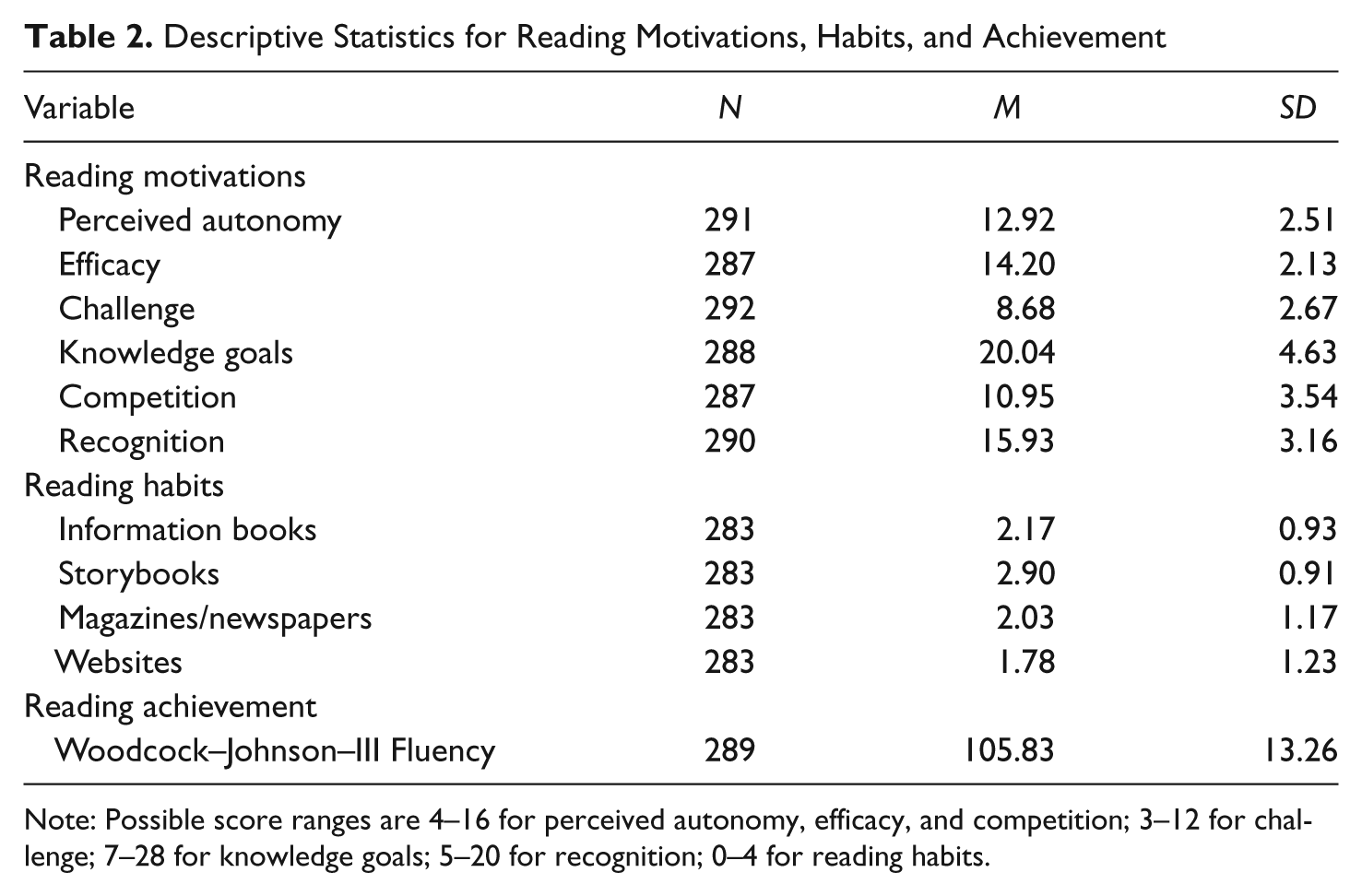
Note: Possible score ranges are 4–16 for perceived autonomy, efficacy, and competition; 3–12 for challenge; 7–28 for knowledge goals; 5–20 for recognition; 0–4 for reading habits.
Table 3 contains the means and standard deviations for the main items of the RSS (10 questions × 3 socialization agents plus 1 question × 4 socialization agents = 34 items) and the subquestions pertaining to enjoyment of reading interactions (2 subquestions × 3 socialization agents plus 1 subquestion × 4 socialization agents = 10 items). For the main RSS items for which scores could range between 0 and 4, four item means for the full sample fell below 1.00, 17 fell between 1.00 and 2.00, and 10 fell between 2.00 and 3.00, indicating that students perceived low to moderate levels of support in most regards. For the three main items that had a possible range of 1–4 and the enjoyment items, which had the same possible range, the means were toward the high end of the scale, ranging from 2.97 to 3.80, indicating that students perceived that others were quite happy when they noticed the students reading and that they much enjoyed reading interactions.
Descriptive Statistics and Summary of Paired Sample Comparisons for the Reading Support Survey Items
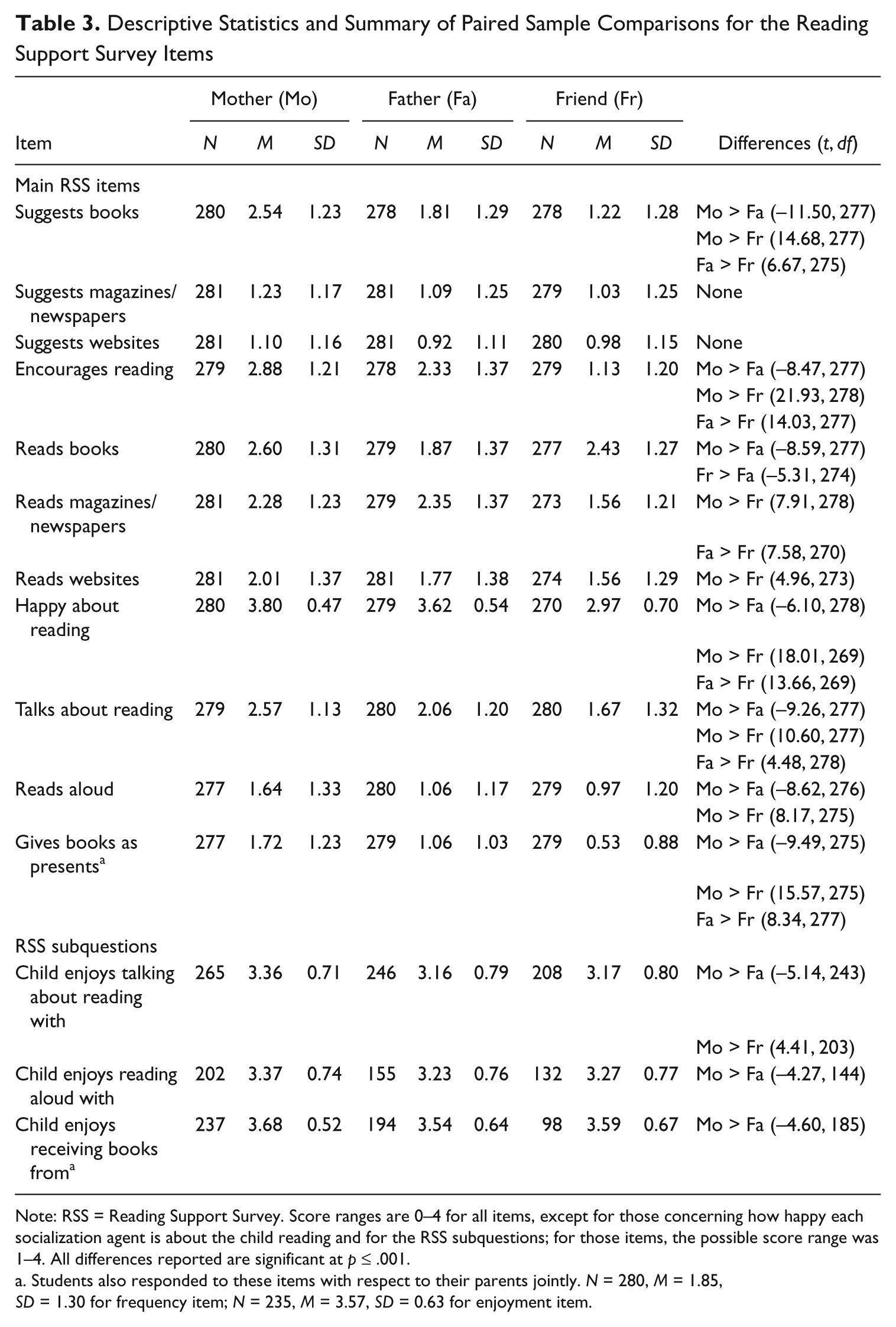
Note: RSS = Reading Support Survey. Score ranges are 0–4 for all items, except for those concerning how happy each socialization agent is about the child reading and for the RSS subquestions; for those items, the possible score range was 1–4. All differences reported are significant at p ≤ .001.
Students also responded to these items with respect to their parents jointly. N = 280, M = 1.85, SD = 1.30 for frequency item; N = 235, M = 3.57, SD = 0.63 for enjoyment item.
Question 1
We compared perceived reading support from the three socialization agents through paired sample t tests comparing participants’ ratings of (a) mothers and fathers, (b) mothers and friends, and (c) fathers and friends on each of the 11 main questions of the RSS, as well as the three subquestions concerning enjoyment of reading-related interactions. To control for the increased probability of Type I error because of the large number of comparisons, only differences significant at p ≤ .001 are reported. Participants rated mothers significantly higher than fathers on 10 of the 14 items and higher than friends on nine items. On 6 items, participants also rated their fathers higher than their friends. Participants rated friends higher than fathers on 1 item, reads books, and on no items did they rate friends higher than mothers or fathers higher than mothers. Table 4 includes the results of all comparisons.
It is also relevant here to consider children’s responses to the final item on the RSS, which asked whether or not others lead them to read in their free time: Of the participants, 78.5% selected yes. As shown in Table 4, 39.9% who responded positively selected their mother as the person who leads them to read the most, whereas 13.0% selected their father and 12.1% selected either the friend they had in mind as they did the RSS or another friend. A chi-square test indicated no association between children’s gender and the selection of their greatest influence.
Response Frequencies to RSS Item Concerning Most Positive Influence on Reading Habits
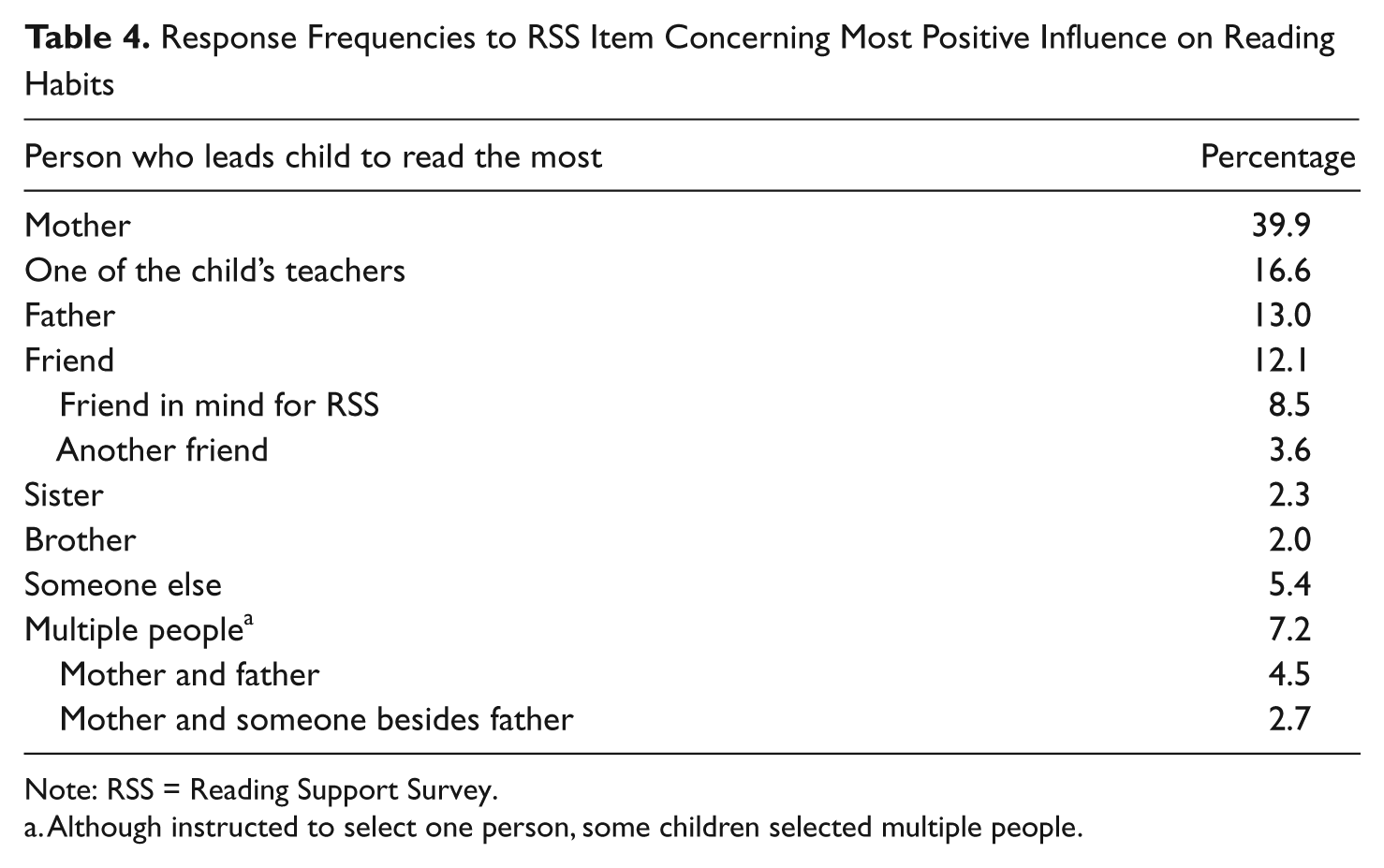
Note: RSS = Reading Support Survey.
Although instructed to select one person, some children selected multiple people.
Question 2
We addressed the question of how perceived reading support is structured with exploratory factor analysis (EFA), specifically principal axis factoring (PAF). We used an EFA method rather than principal components analysis (PCA) because our interest was in whether there was a set of latent constructs underlying the items of the RSS, as opposed simply to data reduction, which is the purpose of PCA (Pett, Lackey, & Sullivan, 2003).
We examined the RSS data for multivariate outliers and missing data according to procedures outlined by Hair, Black, Babin, Anderson, and Tatham (2006). There were no outliers, and the amount of missing data was 1.2%, or 116 of 9,690 potential responses (34 items × 285 participants). Four cases were eliminated because of systematic item skipping. Mean imputation was used to fill in all other missing data because a complete data set was needed for two of the tests used to determine the number of factors to extract and because factor analysis with an incomplete data set sometimes produces out-of-range values for correlations and Eigen values (Hair et al., 2006).
Procedures to determine the number of factors to extract were conducted on the basis of an initial PCA because this procedure, unlike PAF, permits as many components to be extracted as there are variables (Pett et al., 2003). First, Velicer’s original (Velicer, 1976) and revised (Velicer, Eaton, & Fava, 2000) minimum average partial procedures were run, using O’Connor’s (2000, n.d.) SPSS syntax. The original test indicated that three factors should be extracted, whereas the revised version indicated four. Parallel analysis (Horn, 1965), also run with SPSS syntax developed by O’Connor (n.d.), indicated that six factors should be extracted. Last, a scree plot and the Cattell–Nelson–Gorsuch objective scree technique (Cattell, 1966; Gorsuch, 1983) both suggested that either three or six factors were appropriate. The scree plot consists of points, connected by a line, that indicate the variance (represented as an Eigen value) accounted for by each component. At one or multiple points there may be a noticeable break, or change in slope of the line; the number of points to the left of the break(s) indicates the likely number of meaningful factors (Pett et al., 2003). Similarly, the objective scree technique involves mathematically computing slopes associated with adjacent components and identifying the point(s) at which substantial differences occur. Given the inconsistency across these factor tests, we decided to compare PAF solutions obtained with three, four, and six factors. We also extracted a solution with five factors, based on findings that when PA errs, it tends to overestimate, most often by one factor (Silverstein, 1987), and that the earlier version of the MAP test tends to underestimate when it errs (O’Connor, 2000). To improve the interpretability of the initial solutions, direct oblimin rotation was employed. This is an oblique method of rotating the reference axes of the factors, which, contrary to orthogonal methods, is based on the assumption that factors are correlated (Pett et al., 2003); accordingly, we expected the factors in the present study to be moderately correlated. We used this oblique method rather than the other (promax) method available in SPSS because it provided a clearer solution in the analysis of pilot data.
To select the most appropriate PAF solution, several criteria were employed, with the most important consideration being the overall clarity and meaningfulness of each factor in the solution, that is, the extent to which the items that loaded significantly on a factor were conceptually related to each other. In addition, the numbers of items that loaded on each factor were considered and, in line with Thurstone’s (1947) simple structure criteria, the number of items that did not load on any factor and the number that loaded on multiple factors. In interpreting each solution, we focused on the factor pattern matrix, in which the loadings represent the relations of the items to the factors having controlled for the relations among the factors as recommended by Hair et al. (2006) and Tabachnick and Fidell (2001), rather than the structure matrix, which shows the zero-order correlations of the items with the factors.
Loadings of .30 or greater were considered the minimum for significance, which according to Hair et al. (2006) is the minimum value for practical significance when the sample size is 100 or larger. For statistical significance with a sample between 250 and 349, however, loadings of .35 or greater are required (Hair et al., 2006). As detailed below, all loadings met the criteria for both practical and statistical significance, except for three loadings on Factor 1, which met only the former.
Ultimately, we selected the four-factor solution. Table 5 contains the pattern matrix for this solution. Across the four solutions considered, Factors 1 and 3 remained highly similar in content. In addition, Factor 4 was highly consistent across the three solutions that included at least four factors, suggesting that the selected solution should include at least four factors. Hence, the three-factor solution, which was identical to the four-factor solution, except for folding the items of Factors 3 and 4 together into one factor, was eliminated from consideration. The four-factor solution also satisfied the “best solution” criterion better than either the five- or six-factor solutions. The five- and six-factor solutions each had three to four items that did not load on any factors and five to six items with multiple loadings, whereas in the four-factor solution each item loaded significantly on a factor, and there were three items with multiple loadings. The four factors, which correlated +/–.27 to +/–.36, were as follows:
Pattern Matrix Obtained With Extraction of Four Factors Using Principal Axis Factoring and Direct Oblimin Rotation
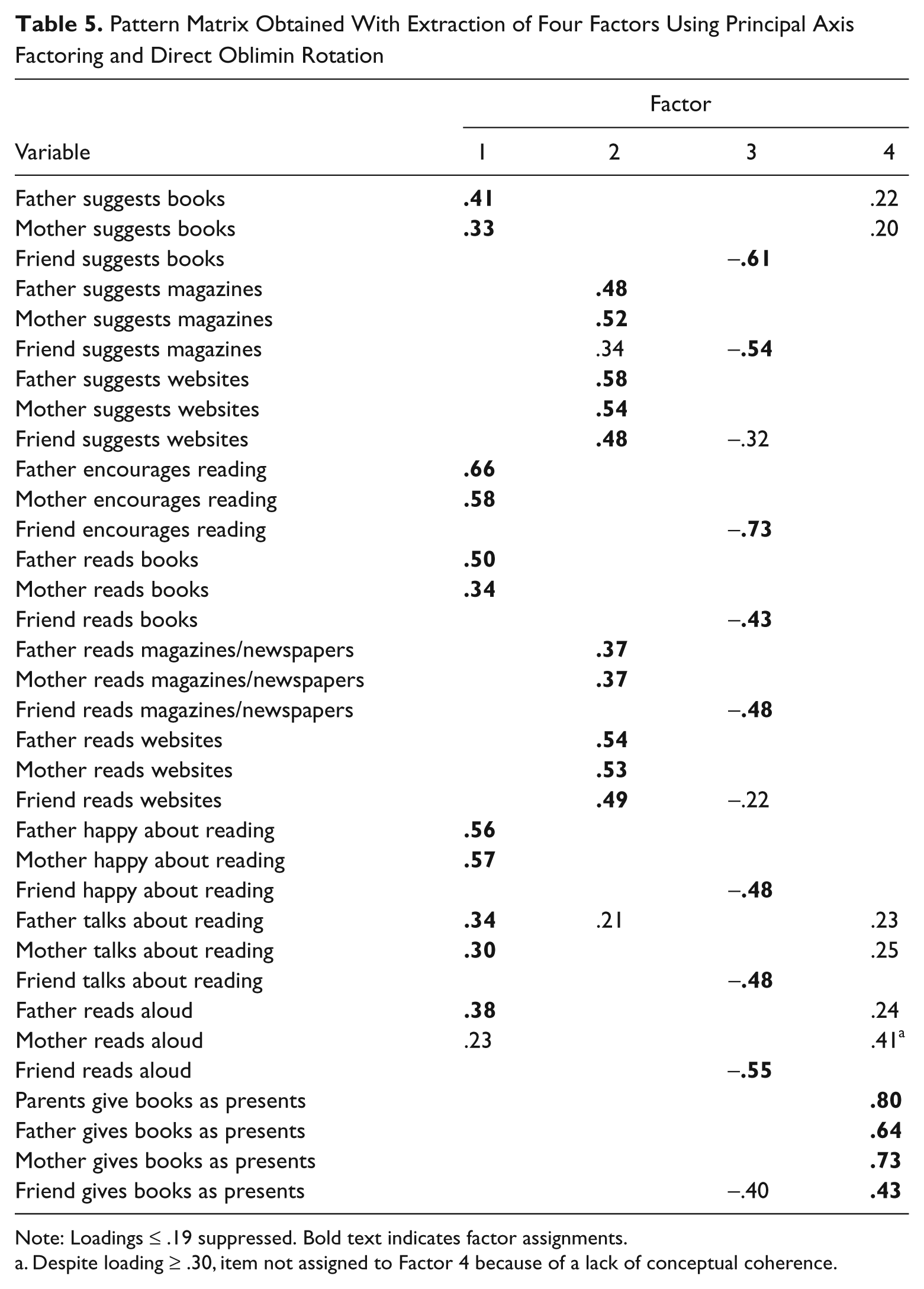
Note: Loadings ≤ .19 suppressed. Bold text indicates factor assignments.
Despite loading ≥ .30, item not assigned to Factor 4 because of a lack of conceptual coherence.
Factor 1
A total of 11 items representing mothers’ and fathers’ support for reading books and reading in general (i.e., items not referencing a particular type of reading material) loaded on Factor 1. Of these items, 8 had loadings greater than .35, but 3 had loadings between .30 and .34; though not statistically significant, they met the criteria for practical significance and were conceptually coherent with the rest of the items on this factor, so they were also included. None of the items associated with Factor 1 loaded significantly on any other factor. We named this factor parent general/book support.
Factor 2
A total of 11 items representing mothers’, fathers’, and friends’ support for website and magazine/newspaper reading loaded on Factor 2. Of these items, 2 also loaded on Factor 3. One—friend suggest websites—was assigned to Factor 2 because it had a substantially higher loading on Factor 2 (.48) than on Factor 3 (.32) and because the other item concerning friends and websites (friend reads websites) also loaded on Factor 2. In contrast, we assigned friend suggests magazines to Factor 3 because it loaded on that item at –.54, compared to .34 on Factor 2, and because the other item concerning friends and magazines also loaded on Factor 3. We named Factor 2 other media support; because it included items concerning parents’ support of magazine/newspaper and website reading and friends’ support of website reading, a source of support is not included in the factor name.
Factor 3
A total of 10 items representing friends’ support for reading books and magazines/newspapers and friends’ support for reading in general loaded significantly on Factor 3, 3 of which had multiple loadings. As just discussed, 2 items loaded on Factors 2 and 3, with 1 item ultimately assigned to Factor 2 and 1 to Factor 3. In addition, 1 item—friend gives books as presents—loaded on Factors 3 and 4. Conceptually, an argument could be made for placing this item on either factor; however, it had a slightly stronger loading on Factor 4 (.43 compared to .40), and it was desirable to increase the number of items on Factor 4, so we grouped it with that factor. Thus, after deciding on the placement of items with multiple loadings, Factor 3 included 8 items concerning friends, so we named the factor friend support.
Factor 4
A total of 5 items loaded significantly on Factor 4. Of these items, 4, including the one that also loaded on Factor 3, referred to receiving books as presents. The other item concerned mothers’ frequency of reading aloud with the focal child. Because this item did not mesh conceptually with the other 4 items of the scale, it was eliminated. We named Factor 4 books as presents.
We next constructed a scale representing each factor by summing responses to the items composing it. As shown in Table 6, each scale had good internal consistency reliability, as all Cronbach’s alpha values exceeded the minimum desirable value of .70 by at least .09. Furthermore, each item correlated moderately to strongly with all other items composing the same scale, and none of the alpha values would increase substantially by deleting items (at most, α would increase by .03).
RSS Scale Properties
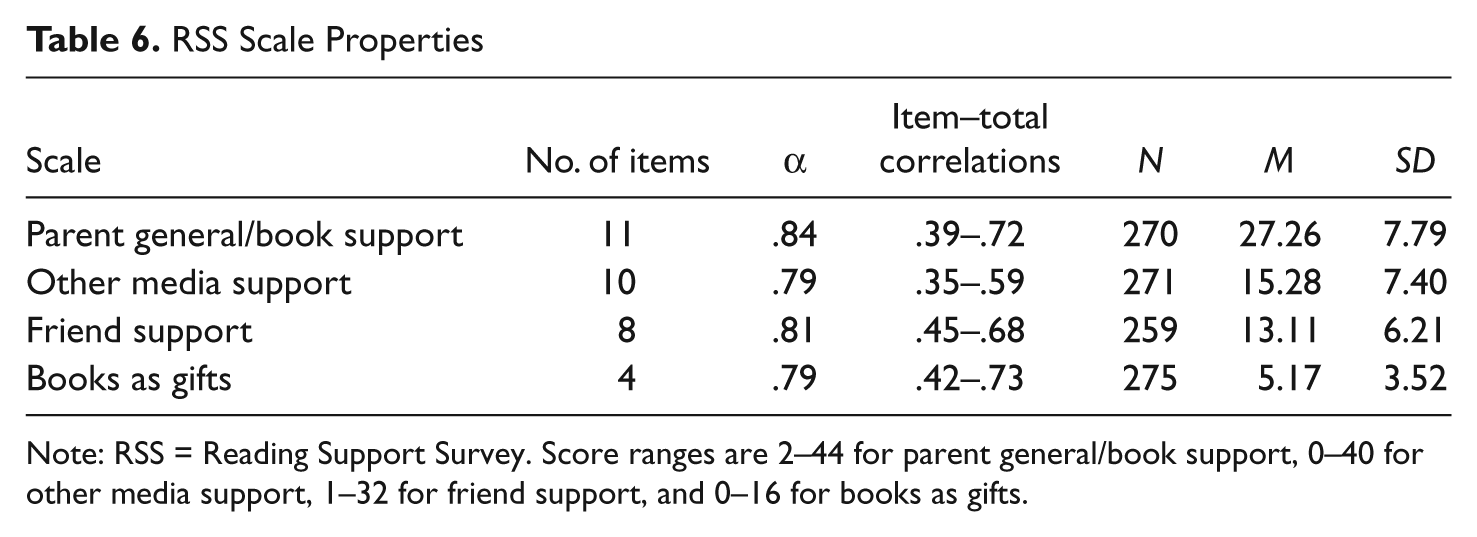
Note: RSS = Reading Support Survey. Score ranges are 2–44 for parent general/book support, 0–40 for other media support, 1–32 for friend support, and 0–16 for books as gifts.
Question 3
The third question concerned gender and grade-level differences in perceived reading support, reading motivation, and reading habits. To address this question, four sets of 2 (gender) × 2 (grade level) ANOVAs were conducted with the (a) 4 reading support dimensions, (b) 10 RSS enjoyment items, (c) 6 reading motivation dimensions, and (d) 4 recreational reading frequency items as the sets of dependent variables. Table 7 displays descriptive statistics for each of these variables by gender and grade level. To accommodate for the likelihood of familywise error, a Bonferroni correction was applied to the standard alpha of .05 in each set of analyses.
Descriptive Statistics by Gender and Grade Level for Key Study Variables
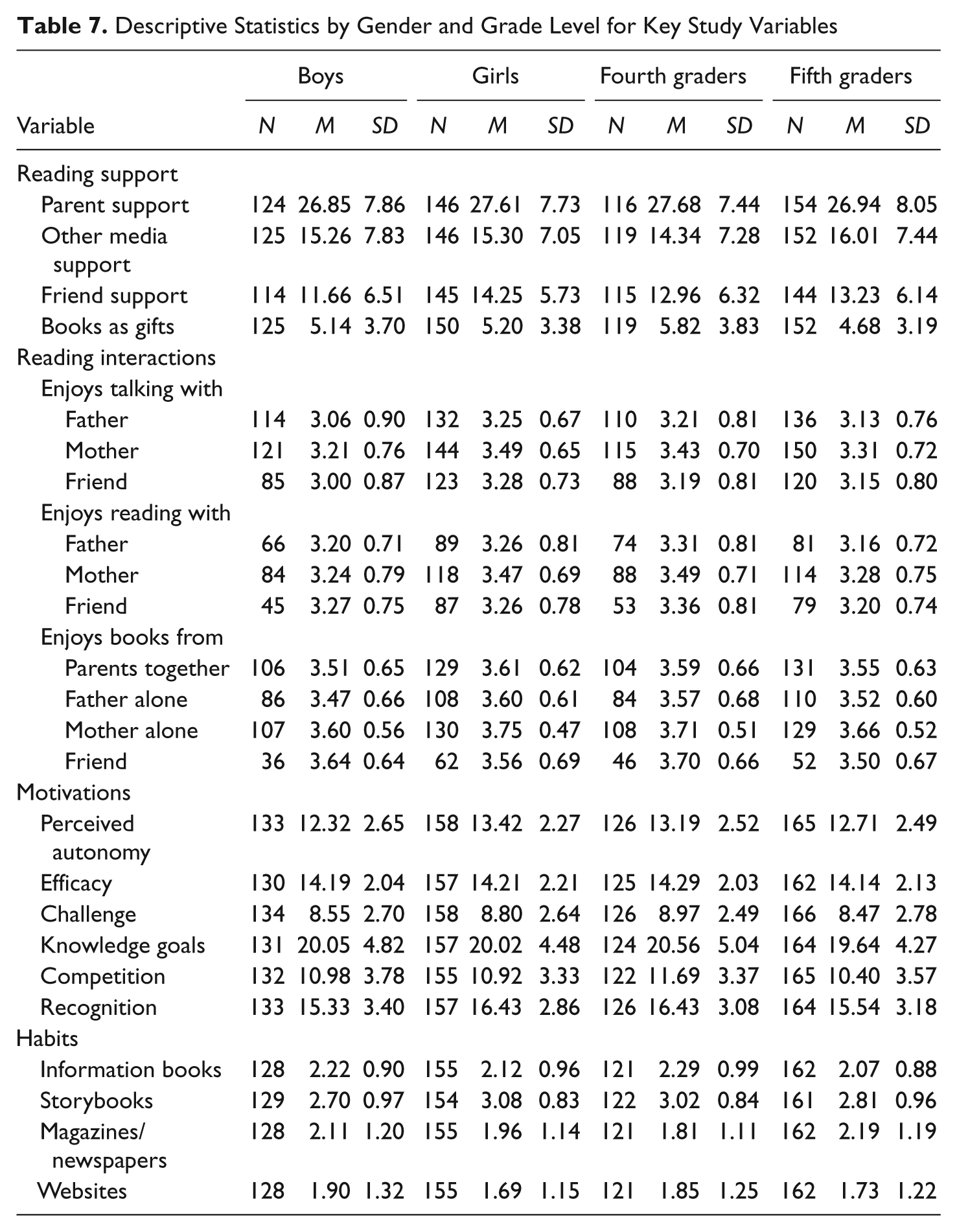
The first set of ANOVAs indicated one gender difference and one grade-level difference in perceived reading support, significant according to the Bonferroni-adjusted alpha level of .0125: Girls perceived greater friend support than boys, F(1, 255) = 10.74, p ≤ .001, partial η2 = .04, and fourth graders reported receiving more books as presents than fifth graders, F(1, 271) = 7.57, p ≤ .01, partial η2 = .03.
According to the next set of ANOVAs, which used the Bonferroni-adjusted alpha of .005, there was only one gender difference in scores on the 10 RSS enjoyment items: Girls reported greater enjoyment of talking about reading with their mothers than did boys, F(1, 261) = 9.41, p ≤ .005. There were no significant main effects for grade level. There was, however, a significant interaction for enjoyment of reading aloud with friends, with the Bonferroni-adjusted alpha, F(1, 128) = 8.51, p ≤ .005, partial η2 = .06. Fourth-grade boys (M = 3.71, SD = 0.47) reported greater enjoyment of reading aloud with their friends than did all other groups, with fifth-grade boys reporting the least enjoyment (M = 3.00, SD = 0.77), followed by fourth-grade girls (M = 3.19, SD = 0.89) and fifth-grade girls (M = 3.31, SD = 0.71). In considering all analyses involving the enjoyment items, it is important to keep in mind that students responded to these items only if they responded more frequently than never to the corresponding frequency items; therefore, the differences reported here do not represent the full sample.
With respect to reading motivation, the third set of ANOVAs indicated that girls were significantly higher than boys on two dimensions, with the Bonferroni-adjusted alpha level of .008: perceived autonomy, F(1, 287) = 12.72, p ≤ .001, partial η2 = .04, and recognition, F(1, 286) = 7.09, p ≤ .008, partial η2 = .02. Fourth graders were higher than fifth graders on one dimension, competition, F(1, 283) = 9.42, p ≤ .008.
Last, with respect to recreational reading habits, there was one gender difference and one grade-level difference significant with the Bonferroni-adjusted alpha of .0125. Girls reported more frequent storybook reading than boys, F(1, 279) = 11.35, p ≤ .001, partial η2 = .04, and fifth graders reported reading magazines and newspapers more often than fourth graders, F(1, 279) = 6.78, p ≤ .01, partial η2 = .02.
Question 4
Next we examined how each dimension of perceived reading support related to reading motivations and habits, using both zero-order correlations and partial correlations controlling for reading achievement. As predicted, each perceived reading support dimension showed a significant, positive zero-order correlation with the motivations of perceived autonomy, efficacy, challenge, knowledge goals, and the four reading frequency variables, with five exceptions: Other media support did not correlate with perceived autonomy, efficacy, or storybook reading, and books as presents did not correlate with efficacy or storybook reading (see Table 8). The correlations of parent general/book support and friend support with the motivation variables were generally moderate in magnitude, whereas the correlations of other media support and books as presents with the motivations were generally weak. The correlations of the reading support variables with the reading frequency variables were also generally weak, with the exception that other media support correlated .43 (p ≤ .001) with website reading. In contrast to predictions, however, none of the dimensions of perceived reading support correlated significantly with competition, and each dimension correlated significantly and positively with recognition at a weak to moderate magnitude.
Correlations of Perceived Reading Support With Reading Motivations and Frequencies
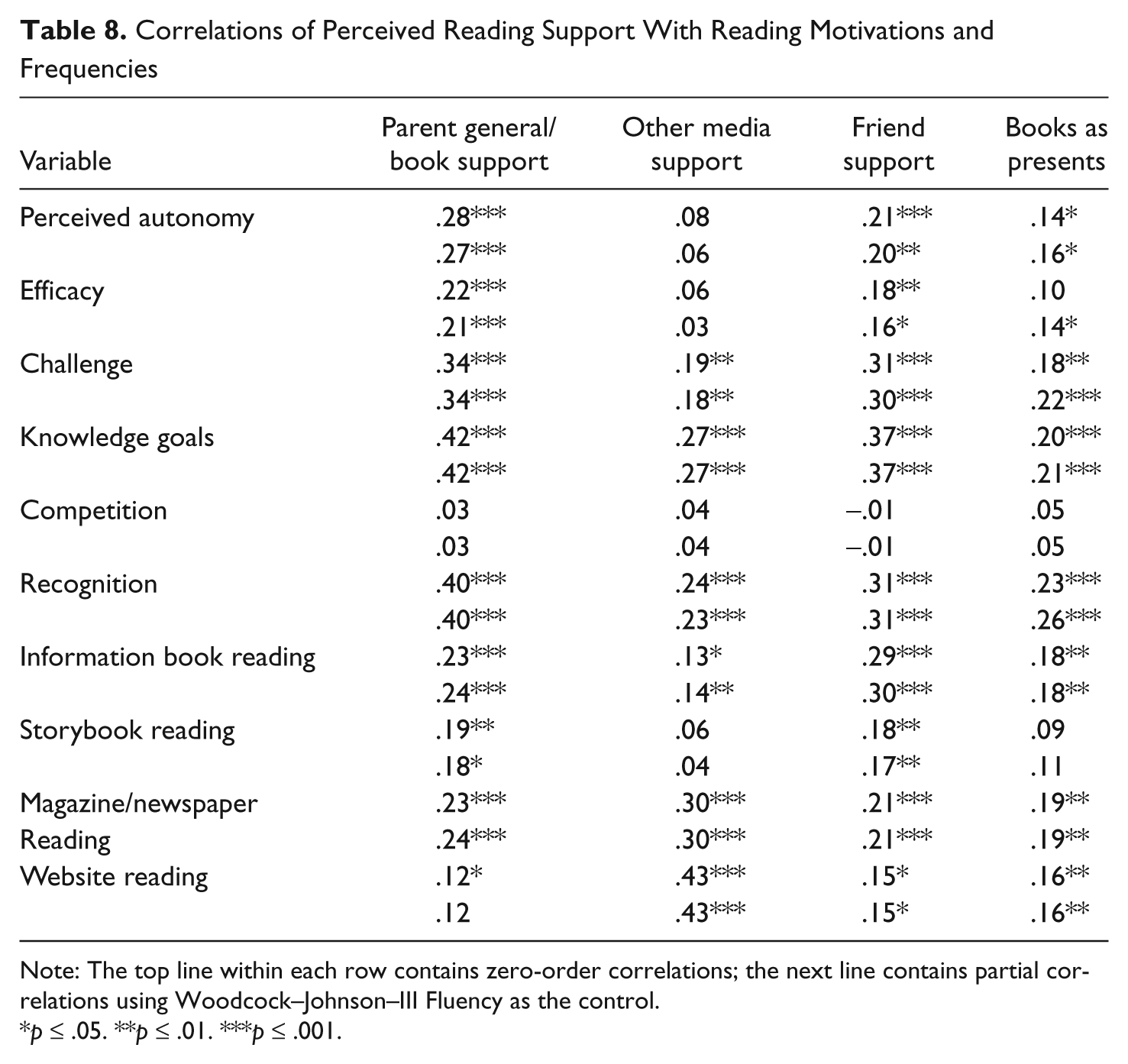
Note: The top line within each row contains zero-order correlations; the next line contains partial correlations using Woodcock–Johnson–III Fluency as the control.
p ≤ .05. **p ≤ .01. ***p ≤ .001.
The partial correlations employed WJ III Fluency scores as controls. These partial correlations were of interest given that much research indicates that reading achievement and motivation are positively related (e.g., Cunningham & Stanovich, 1997; Guthrie et al., 1999) and some research has shown that reading achievement is related to parent support of older children’s reading (e.g., Greaney & Hegarty, 1987; Hansen, 1969). As shown in Table 8, the partial correlations differed very little from the zero-order correlations.
Question 5
Description of analysis
The final question concerned the extent to which different sources of support uniquely predicted children’s reading motivations and habits. A series of hierarchical multiple regressions with each reading motivation except competition (because it did not correlate with perceived reading support) and each reading frequency item as a dependent variable addressed this question. In each regression, five independent variables were entered in separate blocks in the following order: WJ III Fluency, grade level, gender, parent general/book support, friend support. The variables in the first three blocks were considered controls and therefore entered ahead of the reading support variables. Parent general/book support and friend support were the only support variables included because we were interested in whether different sources of support contributed distinctively to the dependent variables; the other two support variables included mixtures of parent and friend items.
In addition, two interaction terms were created, gender × parent general/book support and gender × friend support, and entered, respectively, as Blocks 6 and 7. These interaction terms were included given the overall interest in the role that gender might play in the relationship between perceived reading support and reading motivation and frequency. In line with Frazier, Tix, and Barron’s (2004) guidelines for investigating moderator effects, gender was coded such that 0 represented boys and 1 represented girls; these codes were then multiplied by the parent general/book support and friend support scale scores, which were standardized to have means of 0 and standard deviations of 1. These interaction terms, however, were not significant in any of the models predicting reading motivation and in only one of the four models predicting reading frequency. For this reason, as well as because there was not a strong theoretical basis for expecting significant interactions, the presented models do not include interaction terms, except in the one instance where they were significant (Aiken & West, 1991).
Prediction of reading motivations
As shown in Table 9, after accounting for the contributions of WJ III Fluency, grade level, and gender, parent general/book support significantly added to the prediction of each reading motivation under study, with p ≤ .001. Specifically, its contributed variance ranged from .04 for efficacy to .17 for knowledge goals. Moreover, in the full models for perceived autonomy, knowledge goals, and recognition, the betas associated with parent general/book support were greater in magnitude than those of all other variables in each model. For efficacy and challenge WJ III Fluency was the strongest predictor, followed by parent general/book support.
Summary of Hierarchical Regressions Predicting Reading Motivations (Five-Block Models)
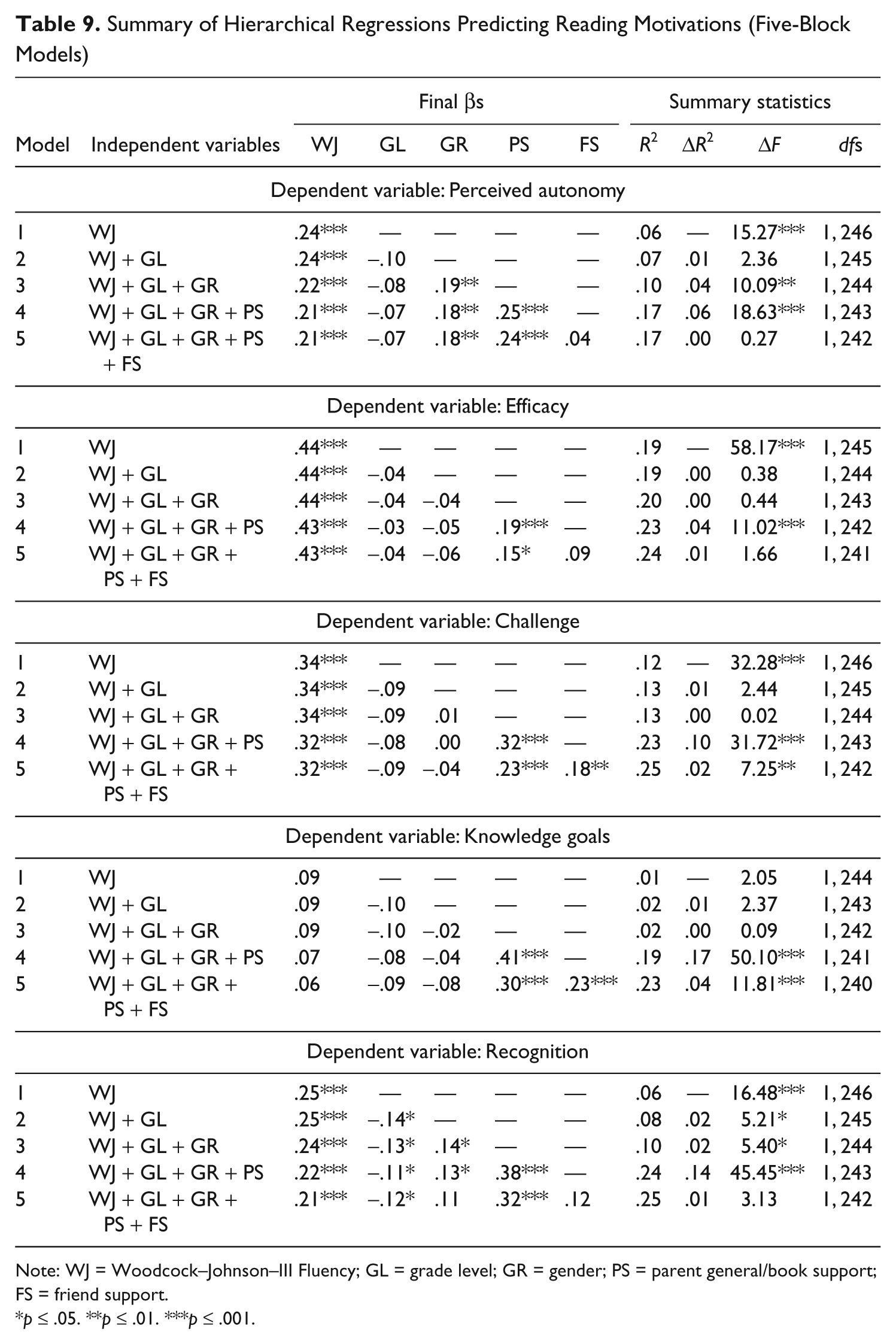
Note: WJ = Woodcock–Johnson–III Fluency; GL = grade level; GR = gender; PS = parent general/book support; FS = friend support.
p ≤ .05. **p ≤ .01. ***p ≤ .001.
Friend support, when added last in each model, significantly added to the prediction of variance in two motivations: challenge, ΔR2 = .02, p ≤ .01, and knowledge goals, ΔR2 = .04, p ≤ .05. Notably, in the models for challenge and knowledge goals, the betas for friend support were smaller than those for parent general/book support, respectively, by .05 and .07. However, in the model predicting knowledge goals, the friend support beta was greater than the betas associated with WJ III Fluency, grade level, and gender, and in the model predicting challenge it was greater than those for grade level and gender.
Prediction of reading frequency
As shown in Table 10, parent general/book support added significantly beyond WJ III Fluency, grade level, and gender to the variance explained in two types of reading: information book reading, ΔR2 = .05, p ≤ .001, and storybook reading, ΔR2 = .03, p ≤ .01; however, the parent general/book support betas were not significant in the final models that included friend support. Friend support contributed significantly beyond the four variables already in the model to the prediction of variance in website reading, ΔR2 = .02, p ≤ .05, and was the only significant predictor in the full model for this dependent variable, β = .16, p ≤ .05. Friend support also added significantly to the prediction of variance in information book reading, ΔR2 = .05, p ≤ .001, and was the strongest predictor in this variable’s final model, β = .28, p ≤ .001, in which the only other positive predictor was being in fourth grade.
Summary of Hierarchical Regressions Predicting Information, Storybook, and Website Reading Frequency (Five-Block Models)
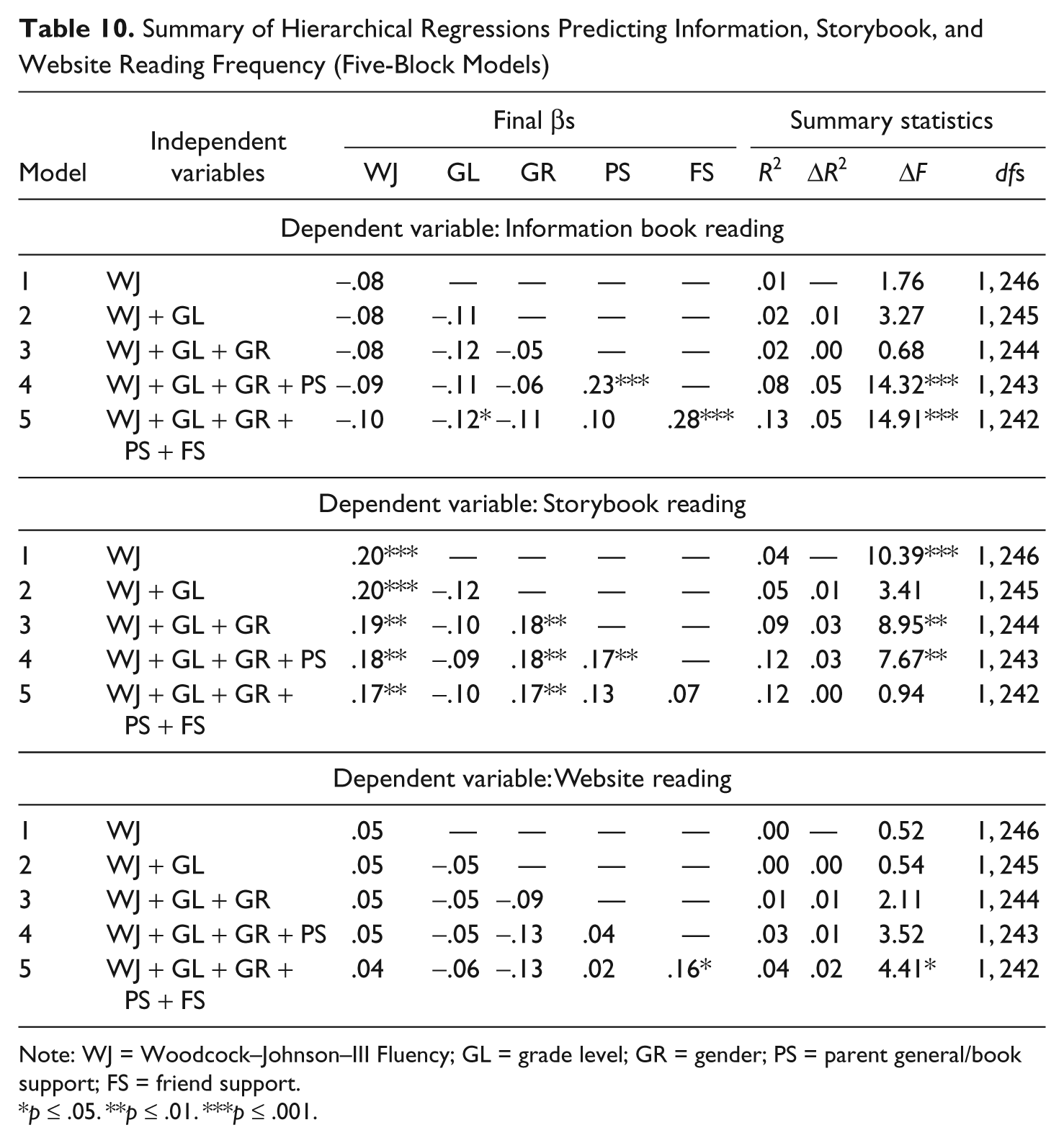
Note: WJ = Woodcock–Johnson–III Fluency; GL = grade level; GR = gender; PS = parent general/book support; FS = friend support.
p ≤ .05. **p ≤ .01. ***p ≤ .001.
Last, as shown in Table 11, the regression of magazine/newspaper reading was complicated by significant interaction terms. To investigate these interactions, a second regression for magazine/newspaper reading was run, with the dummy codes for boys and girls reversed. The second regression, in which girls were coded 0, thus represented the effects of the independent variable for girls, whereas the first regression represented their effects for boys (for further explanation of how to interpret regression models with significant interaction terms, see Frazier et al., 2004; West, Aiken, & Krull, 1996). These analyses indicated, then, that parent general/book support was a significant predictor of magazine/newspaper reading for boys, β = .37, p ≤ .01, whereas friend support was not. Conversely, for girls, friend support significantly predicted magazine/newspaper reading, β = .34, p ≤ .001, whereas parent general/book support did not. We report unstandardized regression coefficients because beta coefficients for the interaction terms are not properly standardized (Aiken & West, 1991; Frazier et al., 2004).
Summary of Hierarchical Regressions Predicting Magazine or Newspaper Reading
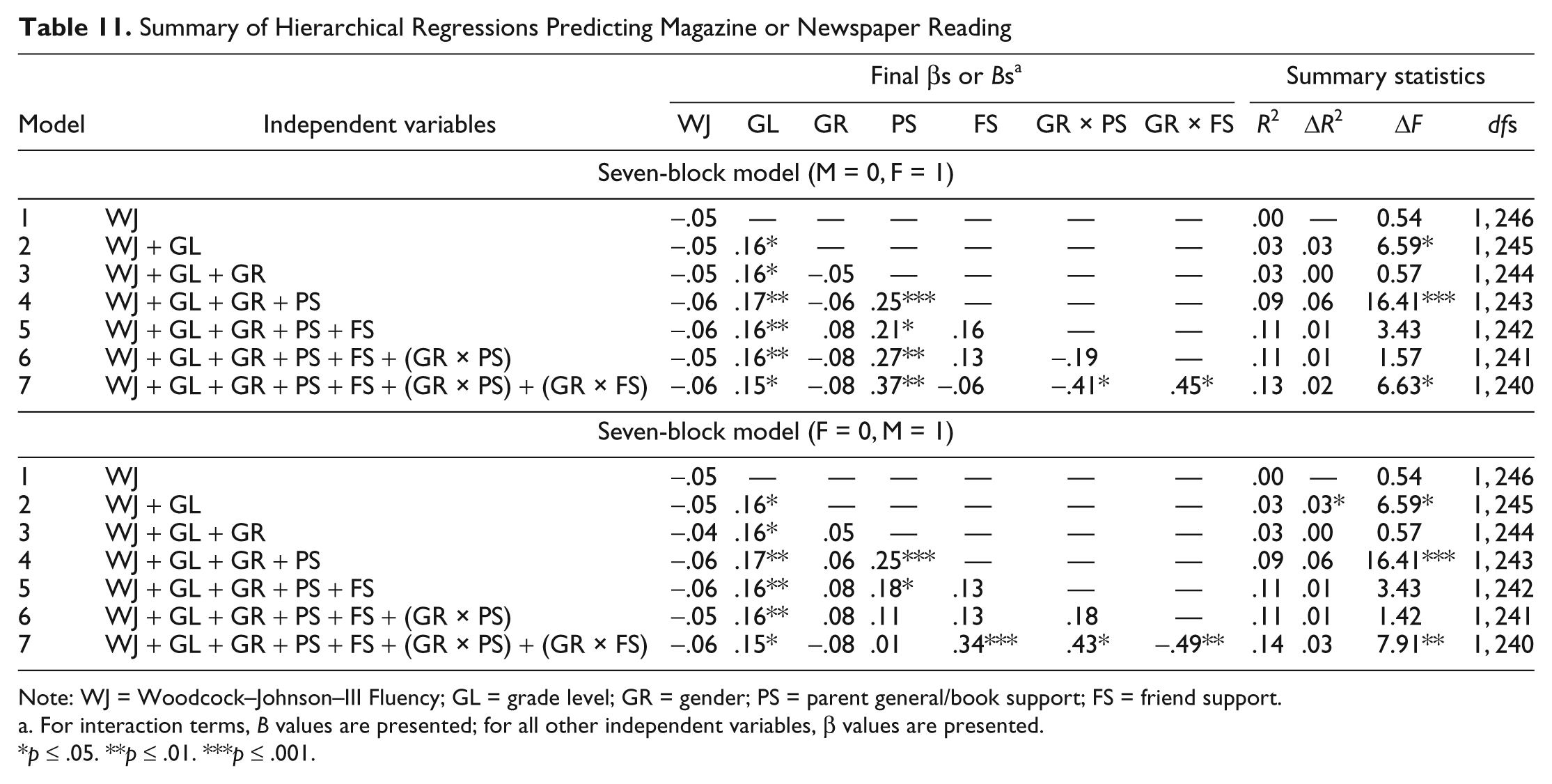
Note: WJ = Woodcock–Johnson–III Fluency; GL = grade level; GR = gender; PS = parent general/book support; FS = friend support.
For interaction terms, B values are presented; for all other independent variables, β values are presented.
p ≤ .05. **p ≤ .01. ***p ≤ .001.
Discussion
Much of the research on how socializers support children’s reading focuses on younger children and on socializers’ reports of the support they provide. The present study is among the first quantitative studies to address how older children perceive support for their reading from different socializers. Also, it is the first to examine the relations of this perceived support to multiple dimensions of children’s motivation for reading. A major finding from the study is that perceived support from parents and perceived support from friends contributed above and beyond reading achievement, gender, and grade level to multiple aspects of students’ reading motivation and habits. Thus, older children’s perceptions that parents and peers support their reading is an important variable to examine when considering factors that may augment older children’s motivation for and actual engagement in recreational reading. The study also suggests that the newly developed RSS shows promise as a tool for learning about children’s experiences of support for reading from key individuals in their lives. In the following discussion, we first consider the reliability and validity of the RSS and then the results pertaining to each hypothesis.
The Reading Support Survey
A key contribution of this study was information on the reliability and validity of the RSS. First, Cronbach’s alpha values and item-total correlations offered evidence that each of the four scales derived from the RSS represented a singular construct. The strong alpha values—which ranged from .79 to .84—also help dispel concerns that the RSS was constructed with a single item representing most of the six categories of reading support that the survey was designed to tap. Because of time constraints for survey administration and our primary interest being the extent to which source of support influenced the factor structure of the survey, we designed the RSS items to represent the breadth of categories of reading support rather than focusing on a select subset of those categories. Ideally, future studies of the RSS itself would include multiple items representing each category of reading support.
In addition, the consistency with which students rated mothers higher than fathers and friends with respect to both specific forms of support and overall support provides some evidence of convergent validity. With respect to discriminant validity, or the evidence that the perceived support dimensions were indeed separate entities, it is notable that they correlated moderately with each other, suggesting they represented distinct but related aspects of support. Also, the dimensions tended to correlate weakly with students’ ratings of their own reading habits; if they correlated very strongly it could be an indicator that children were making assumptions about the normal frequency of behaviors based on their own frequency of closely related behaviors, rather than on their reflections about others’ behaviors.
Furthermore, as a self-report measure of children’s perceptions, the RSS may be considered generally valid if it can be assumed that children were responding honestly to the items. The pattern of individual item means supports this assumption; for example, it makes sense that by fourth- and fifth-grade children would be reading aloud with their parents somewhat less frequently than receiving parental encouragement to read. Still, further investigation of the psychometric properties of the RSS would be beneficial. In particular, further examination of the RSS properties and its factor structure based on administration to larger samples more diverse in ethnicity, SES, achievement level, and family structure is needed. Also, its test–retest reliability needs to be assessed.
We should emphasize that the RSS was designed as a research tool rather than as an information-gathering survey for classroom teachers. Teachers can learn much about their students and how they might more effectively enlist others in helping build their reading motivation by inquiring about their students’ reading-related interactions with their family and friends. It may be more practical and insightful, however, for them to do so through personal conversations rather than a systematic survey that asks only about the role of parents and one friend and about rather specific forms of support.
Perceived Reading Support: Levels and Dimensions
The first study hypothesis, which stated that children would perceive higher levels of reading support from their mothers than from either their fathers or their friends, received substantial support. This was the case with respect to the RSS item that inquired in general about the strongest influence on students’ engagement in recreational reading, as well as with respect to most specific forms of reading support (e.g., discussing reading, recommending books). These findings thus complement and extend Edmunds and Bauserman’s (2006) finding that fourth graders most frequently cited their mother as the person who most gets them interested in reading. They also build on Love and Hamston’s (2004) work by demonstrating not only that parents recognize differences in the extent to which mothers and fathers encourage children’s reading but also that children at least as young as fourth and fifth graders do. These analyses also represented, to our knowledge, the first comparisons of specific forms of support provided by mothers versus friends and fathers versus friends. Although the findings that children rated both their mothers and fathers higher than their friends in several regards may be unsurprising, given that children’s engagement in reading is generally more of a concern to their parents than their friends, they raise the question of whether educators should encourage more peer social interaction around reading, an issue that will be considered in more detail when the relations between perceived reading support and motivation are discussed.
The second hypothesis, which asserted that mother, father, and friend support would comprise distinct dimensions of perceived support, was only partly substantiated. Although a separate friend support factor emerged, a combined mother and father factor emerged. Furthermore, two additional factors emerged that each included a mixture of parent and friend items (other media support and books as presents). Thus, perceived reading support appeared to have an underlying structure defined by source of support as much as by type of support. Although this factor structure conflicts with some studies of the structure of children’s perceived support for life in general (Malecki & Demaray, 2002; Malecki & Elliott, 1999), the particular factors that emerged make sense when considered relevant to other research in the reading domain. For instance, the finding that corresponding mother and father items always emerged on the same factor (except the reads aloud items) supports qualitative studies suggesting that there is sometimes a general culture of literacy, or aliteracy, in the family (Chandler, 1999; Strommen & Mates, 2004). With regard to this finding of mother and father items consistently factoring together, it is also important to consider that children still perceived different levels of support from each of these socialization agents, suggesting that they do differentiate between them in certain ways.
Also, consider the loadings of (a) parent items about magazines/newspapers and websites on other media support, separate from other parent items, (b) friend items about websites on other media support, and (c) friend items about magazines/newspapers on friend support. Perhaps magazine/newspaper reading factored with general and book reading support for friends but not parents because parents (and other adults) tend to convey to children that they do not consider magazine and newspaper reading as important as book reading (Love & Hamston, 2004; Smith & Wilhelm, 2002); children may know that when their parents encourage them to read, they mean read books, even if their parents do not explicitly say so. To children and their friends, however, reading magazines and newspapers may seem as worthwhile as reading books. In addition, the factoring of friend items concerning websites apart from friend items concerning magazines and newspapers might reflect a perception among the participants that viewing websites is a very different activity from other kinds of reading.
Why did books as presents emerge as a separate dimension of reading support? This finding coheres with Edmunds and Bauserman’s (2006) identification of buying or giving books as one of three categories of fourth graders’ responses to the open-ended question of how others excite them about reading. That is, it seems that receiving books is an event that stands out to children and, based on the emergence of books as presents as a separate factor here, an experience that may be largely unrelated to other aspects of reading support. On the other hand, this factor might be a methodological artifact as the items concerning books as presents employed a different set of answer choices than all other RSS items.
The third hypothesis concerned gender differences in perceptions of support. Notably, few significant gender differences appeared in the perceived support dimensions, or other key study variables. In terms of the four perceived support dimensions, girls differed from boys only in indicating greater friend support. Thus, it is possible that gender differences previously found in social interaction in reading, where social interaction scales included items referring to family and friends, were primarily the result of differences in interactions with friends (Baker & Wigfield, 1999; Wigfield & Guthrie, 1997). Girls also reported greater enjoyment of discussing reading with their mothers, greater motivation on two of the six dimensions assessed (perceived autonomy and recognition), and more frequent storybook reading than boys. These limited gender differences are somewhat surprising, given the clear differences in perceived support from mothers versus fathers and the more extensive gender differences found in reading motivation and habits in past studies (Baker & Wigfield, 1999; McKenna et al., 1995). Perhaps currently, at least in the community studied, children are receiving strong messages from other sources (e.g., teachers, librarians) that recreational reading is important and appropriate for all students.
Grade-level differences were likewise limited. The only difference in the perceived support dimensions—that fourth graders were higher on books as presents than fifth graders—might reflect a difference in children’s ability to recollect or estimate the number of books they received in the past year; it seems unlikely that fourth graders would actually receive more books. To better understand the extent to which children’s perceptions of reading support change with age, and how any changes might affect children’s reading motivation, studies that compare students more than one grade level apart are needed.
The Relations of Perceived Reading Support With Reading Motivations and Habits
As hypothesized, perceived reading support correlated positively with the reading motivations of knowledge goals, perceived autonomy, efficacy, and challenge and with reading habits; specifically, 27 of 32 relevant correlations (4 support dimensions × 8 motivation and frequency variables) were positive, though weak to moderate in magnitude. These correlations complement previous findings that social interaction in reading, as measured with a scale that mixed items pertaining to family and friends, correlated weakly to moderately with reading efficacy, challenge, curiosity (highly similar to knowledge goals), and reading amount (Baker & Wigfield, 1999; Wigfield & Guthrie, 1997) by showing that multiple dimensions of support relate positively to multiple reading motivation and frequency variables.
Contrary, however, to hypotheses predicting negative relations, each perceived support dimension related positively to recognition and was unrelated to competition. One interpretation of the recognition correlations is that it is natural for parents and others who act in ways that promote recreational reading to offer recognition in the form of compliments and tangible rewards for children’s efforts and successes in reading; both encouraging reading and recognizing reading reflect high value for the activity and active caring about a child’s reading, which would, in SDT terms, be a way of promoting a sense of relatedness in reading. The lack of significant correlations involving competition suggests that perceived reading support from parents and friends has no bearing on children’s desire to compete with others through reading; rather, competition might be related to whether schools and teachers foster or permit competition in reading.
It is important that zero-order correlations and partial correlations controlling for reading achievement were highly similar, suggesting that perceived reading support relates similarly to the reading motivations and habits of children at varying achievement levels.
Moreover, the present study demonstrated how parent support and friend support uniquely related to children’s reading motivation and reading frequency, controlling for reading fluency, grade level, and gender. These analyses represent a key contribution of the present study because previous quantitative studies of the relations between children’s social interactions/support and aspects of reading engagement focused either solely on parent variables or a social interaction variable that was not source specific. Also, unlike the present study, few past studies examined how socializers support multiple aspects of motivation. Although some qualitative studies offered examples of how parents and friends encourage children’s reading, they did not offer much insight into their relative roles or whether their support was linked with the same or different aspects of reading motivation and activity.
Why did both parent support and friend support uniquely predict some aspects of reading motivation and habits, whereas only one source of support uniquely predicted others? For example, both parent and friend support uniquely predicted knowledge goals. This finding meshes well with several qualitative and mixed-method studies that showed that students’ interactions about reading with both parents and friends are often centered on and may arise from the desire to share knowledge and understanding of certain topics, such as sports news (e.g., Love & Hamston, 2001; Smith & Wilhelm, 2002). It is interesting, however, that friend support but not parent support uniquely predicted information book reading and website reading, forms of reading especially appropriate for fulfilling knowledge goals. Perhaps, therefore, connections between friends are more powerful in actually facilitating reading, or, alternatively, upper elementary children who read to gain knowledge particularly enjoy sharing and discussing that reading with their friends.
Both parent and friend support also uniquely predicted the motivation of challenge. Reading interactions with both parents and friends may foster children’s desire to read relatively difficult materials, although perhaps in different ways. For instance, interactions with friends, particularly those who are strong, avid readers who delight in reading challenging materials, might compel children to read more challenging materials to share an interest or keep up with their friends. With regard to parent support, consider that it uniquely predicted efficacy as well as challenge. Interactions with parents might especially create opportunities for children to practice and receive feedback on their reading skills. This may improve both children’s actual reading and their confidence in their reading, thereby making challenging materials seem more appealing and worthwhile to attempt. In addition, perhaps parent support but not friend support related significantly to efficacy because parents are more purposeful about trying to build children’s reading skills and about offering positive feedback. In the other direction of causality, feeling efficacious about and enjoying challenges in reading might compel children to seek reading-supportive interactions with family and friends.
Parents being more purposeful about engaging in reading supportive behaviors might also explain why only parent support contributed uniquely to the predictions of perceived autonomy and recognition. If parents hold the goal of their children becoming avid, independent readers and provide sufficient and effective reading support that promotes internalization of the value of reading, their children should report high perceived autonomy in reading, in line with predictions from SDT (Ryan & Deci, 2009). Such children should also probably experience more recognition for their reading, from their parents as well as others. The lack of contribution of friend support beyond parent support to perceived autonomy also coheres with the qualitative findings of Strommen and Mates (2004) that early adolescent readers reported indifference to what their peers thought about their enjoyment of reading; that is, friend support for reading, or the lack thereof, may have little bearing on whether children present themselves as autonomous readers.
Finally, friend support but not parent support significantly predicted magazine/newspaper reading for girls, whereas parent support but not friend support significantly predicted this type of reading for boys. This finding is a further indicator of how girls connect their reading and their friendship to a greater extent than boys. It also raises the question of whether parent reading support, perhaps because of a relative lack of perceived friend support, is more important for boys in some respects.
Earlier the issue of whether it is worthwhile for educators to encourage friend support for reading was mentioned. Although the present analyses suggest that parent support is somewhat more strongly linked to children’s reading motivation, friend support contributed above and beyond parent support to two motivations and was linked in more ways to children’s reading habits. Although longitudinal and experimental studies are needed to examine whether reading support (actual or perceived) is feasible to increase and if increases would affect children’s reading motivation and habits, the current results suggest that attention should be given to both parent and friend support in any such endeavors.
Limitations and Future Research Directions
As just noted, key directions for future research include longitudinal and experimental investigations. Results from the current study, and similar correlational research, may offer guidance as to which sources and types of reading support are most positively linked with which dimensions of reading motivation and habits, and thus which may be particularly beneficial to work to increase. Focusing on the impact of increasing the actual frequency of reading support on older children’s perceptions of support, especially how much they enjoy reading-related interactions, may be especially important for understanding how others can be involved in older children’s reading lives without being perceived as intrusive. Furthermore, as Eccles (1993) cautioned, the relationship between activity encouragement from others and children’s valuing of that activity may be curvilinear; that is, extreme encouragement (or that which is perceived as extreme) may backfire by undermining a child’s motivation. The impact of increased parent support compared to increased friend support for reading would be particularly important to examine, as research on social support in general suggests that as children grow older, peers become an especially powerful influence on children’s engagement in activities, with both positive and negative potential (Wigfield et al., 2006).
As also previously suggested, there is a need for samples representing a greater range of grade levels. Extending this work to even older children is important given the paucity of information about how socializers support (or do not support) adolescent readers. Combined with longitudinal data collection, this extension would help to evaluate changes in perceived support with age and causal relations among perceived reading support, reading motivation, and reading activity—and achievement. Specifically, a next step would be to examine whether perceived reading support facilitates motivation and whether motivation, in turn, facilitates reading achievement using structural equation modeling. It is also feasible, however, that more motivated children perceive (and receive) greater support, which directly bolsters reading achievement.
Also, as noted earlier, larger and more diverse samples should be employed to further validate the RSS as well as to examine whether the relations of perceived reading support with other variables observed in the present study generalize to other populations. A key limitation of the present sample is that most participants were European American, from working- or middle-class backgrounds, and reading above grade level. Furthermore, the sample excluded students from single-parent families. It is an empirical question, for instance, whether single parents might provide extra reading support to compensate for that which may have been provided by the absent parent. Last, the ratio of participants to items in the factor analysis was 8:1, satisfying Gorsuch’s (1983) recommendation of 5:1 but not meeting Nunnally’s (1978) recommendation of 10:1, so it is important to replicate the current findings regarding the dimensions of reading support simply using a larger sample.
In addition, future research might examine whether parent and peer perceptions of the support they provide are consistent with student perceptions of the support they perceive. Also, the investigation of the role of affect in reading interactions was limited in this study to assessing students’ enjoyment when experiencing three types of reading support.
In sum, the present study is distinct from previous studies of the role of social interaction and the home environment in older children’s recreational reading because of its attention to the role of support from particular sources and of particular types in relation to multiple dimensions of children’s reading motivation and habits. The findings suggest that perceived parent support and friend support for reading are both important variables to consider when aiming to understand and strengthen older children’s reading engagement.
Footnotes
Appendix
Items of the Reading Support Survey
| Question a | Subparts | Reading support construct | |
|---|---|---|---|
| Stem for Questions 1–7: How frequently do each of these people . . . | |||
| 1. Suggest books for you to read in your free time? | Provide an example of a book title, author, or topic each person has suggested. | Recommendation of/assistance in selecting reading materials | |
| 2. Suggest magazines or newspapers for you to read in your free time? | Recommendation of/assistance in selecting reading materials | ||
| 3. Suggest web sites for you to read in your free time? | Recommendation of/assistance in selecting reading materials | ||
| 4. Encourage you to read in your free time? | General encouragement to read | ||
| 5. Read books during their free time? | Modeling reading | ||
| 6. Read books or newspapers during their free time? | Modeling reading | ||
| 7. Read web sites during their free time? | Modeling reading | ||
| 8. How do each of these people act when they see or hear about you reading in your free time? | General encouragement to read | ||
| 9. How frequently do you talk with each of these people about things you have read in your free time? | How much do you enjoy talking with _______ about things you have read? b | Discussion of particular reading materials | |
| 10. How frequently do you and each of these people read out loud together? | Provide an example of a title, author, or topic you have read out loud together. How much do you enjoy reading out loud with _______ ? b | Reading together | |
| 11. How many books have you received as presents in the past year from each of the following people? | How much do you enjoy receiving a book from _______ as a present? b | Provision of reading materials | |
| 12. Do you agree with the following statement? Other people say and do things that lead me to read in my free time? | If you circled yes, who would you say has done this the most? Circle one. c | ||

Response options for Questions 1–7 and 9–10 were never, rarely/less than once a month, sometimes/a couple times a month, often/a couple times a week, very often/everyday. For Question 8, they were very unhappy, sort of unhappy, sort of happy, very happy. For Question 11 they were 0, 1–3, 4–6, 7–9, 10 or more. For Question 12, they were yes, no.
Participants were directed to skip these items if their answer to the main question was never. The response options for these subparts were not at all, not very much, a little, a lot.
There were 8 response options: father or male caretaker, mother or female caretaker, brother, sister, the friend I had in mind as I did the survey, a different friend, one of my teachers, someone else (Who? _________).
Acknowledgements
This article is based on the first author’s dissertation; the second author was her doctoral advisor. Portions of this study were presented at the 2009 meetings of the Society for Research in Child Development and the Society for the Scientific Study of Reading. The authors greatly appreciate recommendations from the dissertation committee—Linda Baker, Mariam Jean Dreher, John T. Guthrie, and Kathryn Wentzel—on the design and presentation of this study.
The author(s) declared no potential conflicts of interest with respect to the research, authorship, and/or publication of this article.
The author(s) received no financial support for the research, authorship, and/or publication of this article.
References
Supplementary Material
Please find the following supplemental material available below.
For Open Access articles published under a Creative Commons License, all supplemental material carries the same license as the article it is associated with.
For non-Open Access articles published, all supplemental material carries a non-exclusive license, and permission requests for re-use of supplemental material or any part of supplemental material shall be sent directly to the copyright owner as specified in the copyright notice associated with the article.
