




Abstract
How proficiency in reading the first language (L1) influences proficiency in reading in the second language (L2) was explored in this study. Reading scores in Mandarin Chinese (L1) and in English (L2) for 30,000 Taiwanese ninth-grade students were randomly selected from all who took the national Basic Competency Test during a 6-year period in Taiwan. Results of regression analyses showed that proficiency in L1 reading predicts with statistical significance the L2 reading proficiency of those whose scores were analyzed. In addition, participants’ gender and school district also played small but statistically significant roles affecting the cross-language transfer of reading ability. The results are discussed in light of Cummins’s linguistic interdependence hypothesis.
Keywords
Reading is a complex process with a goal of understanding texts (Snow, 2002) and is perhaps the most important medium for acquiring skills and knowledge. Reading involves mastering the orthography to decode words to extract meaning from texts, and comprehension relies on background knowledge, cognitive strategies for comprehending, and vocabulary knowledge. A student is severely handicapped by low reading achievement, which results in low overall academic achievement (Collins, Onwuegbuzie, & Jiao, 2008; Mayes, Calhoun, Bixler, & Zimmerman, 2009; Savolainen, Ahonen, Aro, Tolvanen, & Holopainen, 2008). Reading in a first language (L1), in general, shares numerous basic elements, such as converting symbols to sounds, sounds to words, and words to meaning, with reading in a second language (L2; Genessee, Geva, Dressler, & Kamil, 2006). Furthermore, Brantmeier (2005) recommended that reading, in either an L1 or L2 context, involves the reader, the text, and the interaction between the reader and text to gain comprehension. A prominent hypothesis regarding the L1–L2 relationship is the linguistic interdependence hypothesis (LIH; Cummins, 1979, 1980, 1981), which assumes that two languages are distinct but are supported by shared concepts and knowledge derived from learning, experience, and the cognitive and language abilities of learners. That is, if a learner has an initial high level of L1 development, a similar level of competence is possible in L2, but the opposite would also be true: Stronger L2 development could help support L1 development. For instance, Yamashita (2002) compared English as a foreign language (EFL) readers with different reading proficiency levels in their L1 Japanese and L2 English and found that L2 readers with a higher L1 reading ability were able to achieve better L2 reading proficiency. Conversely, poor L1 reading skills led to poor L2 abilities. However, Keung and Ho (2009) stated that if L2 readers attempt to use Mandarin Chinese orthographic skills as a basis of learning to read English, it may cause interference to their development in English reading because of their different orthographic systems. Even though Cummins (1979, 1980, 1981) proposed that some reading processes might be universal, Wurr (2003) suggested that reading in L2 might require additional demands on the reader, such as proficiency in L2 and previous literacy experiences and knowledge.
The relationship between L1 proficiency and L2 reading has certain linguistic elements, such as phonological awareness and morphological awareness, that strongly affect the transfer of L1 reading ability to L2 reading (Figueredo, 2006; Lee & Schallert, 1997; Yamashita, 2001, 2004). Background knowledge clearly can be shared across languages, and some cognitive strategies can also be used in either language. However, students with lower L2 background or vocabulary knowledge could be limited in their comprehension of L2 texts, and lack of such knowledge may impede the transfer of reading comprehension skill from L1 to L2. However, how much proficiency in reading in L1 is needed to take advantage of a transfer effect in L2 reading is not well understood. The current study addressed this question by examining the link between L1 and L2 reading in 14-year-old students with 3 to 5 years of L2 English instruction. The current study involved participants whose L1 was Mandarin Chinese and were studying English. First a brief outline of the orthography of Mandarin Chinese and of English is given followed by an explanation of LIH and a review of recent studies on transfer of L1 to L2.
Mandarin Chinese Orthographic System
Each Chinese character represents a syllable; thus, the letter to phoneme mapping system does not apply to Chinese reading (Ho, 2003; McBride-Chang & Ho, 2005; Wang, Cheng, & Chen, 2006). Unlike the English morphophonemic writing system, Mandarin Chinese is expressed as morphosyllabic units (Cheung, McBride-Chang, & Chow, 2006; Keung & Ho, 2009; Leong, Tan, Cheng, & Hau, 2005; Wang, Yang, & Chen, 2009), in which each Chinese character represents a morpheme and a syllable.
The majority of Chinese characters are compound characters consisting of one phonetic radical and one semantic radical, which play important roles in representing word pronunciation and meaning, respectively (H.-C. Chen, 1992; M. J. Chen & Weekes, 2004; Ho, 2003; Ho, Ng, & Ng, 2003; Hsiao & Shillcock, 2006). The phonetic radical is a unique feature of Chinese compound characters, which often represents the approximate pronunciation of the character (H.-C. Chen, 1992; M. J. Chen & Weekes, 2004; Cheung et al., 2006; Ho et al., 2003; Hsiao & Shillcock, 2006); for instance, the characters for lake (湖), coral (瑚), glue (糊), and butterfly (蝴) all share the phonetic radical of reckless (胡), which is pronounced as /ㄏㄨ/ / (hu2). These four characters are also pronounced as /hu/, but with different meanings. Semantic radicals, another component of most Chinese characters, express a clue to the meaning of the character (H.-C. Chen, 1992; M. J. Chen & Weekes, 2004; Ho et al., 2003; Hsiao & Shillcock, 2006). For example, the characters 曦 (sunlight), 明 (tomorrow), 曬 (sun-dried), and 暇 (leisure) are classified as sharing the semantic radical 日, which means “sun, day, or daytime”; however, they are not pronounced the same way as the semantic radical is pronounced in isolation: 日 (ㄖ\ / ri4). Readers are sometimes able to pronounce or define a character based on the functions of the two elements in Mandarin Chinese.
Chinese-speaking children learn to read Chinese characters via Zhuyin Fuhao (Mandarin phonetic symbols in a subsyllabic phonetic system, each of which has its own sound) in Taiwan and Pinyin (Latin letters in an alphabetic phonetic system) in China (DeFrancis, 1950; Ho et al., 2003; McBride-Chang & Ho, 2005). In addition, there are two sets of Chinese character systems widely used among native Chinese-speaking communities: traditional Chinese, which has been consistent with the original form of Chinese ideographic characters since the fifth century, and simplified Chinese, which was created by decreasing the number of strokes and simplifying some proportions of the traditional Chinese characters. Traditional Chinese characters are primarily used in Taiwan, Hong Kong, and Macau and were also used in China before the 1960s; simplified characters are currently prevalent in China, Singapore, and Malaysia (DeFrancis, 1984).
The English Orthographic System
The English orthographic system consists of 26 letters of the Roman alphabet used in combination to represent 44 to 46 phonemes (smallest meaningful units of sound) with approximately 210 graphemes (smallest units of writing; Moats, 2000; Port, 2007). For example, coach has five letters, c, o, a, c, h, three phonemes, /k/, /o/, /t∫/, and three graphemes, c, oa, ch. English is considered a morphophonemic writing system because its spelling represents both sound (phonemes) and meaning (morphemes; Aro, 2006; Geva, Wade-Woolley, & Shany, 1993; Gleitman & Rozin, 1977; Moats, 2000). For instance, the plural morpheme s has the same written form, such as cups, chairs, cases, but different phoneme patterns (e.g., cups - /s/, chairs - /z/, cases - /Ιs/). In general, English letters and sounds do not have a one-to-one correspondence, and the orthographic system is more representative of a deep level of morphology than of phonology. The phonological regularity in English is often lost for the sake of morphology. For instance, although heal and health, sign and signature share the same spelling, heal and sign, respectively, their pronunciation is very different (e.g., Geva et al., 1993; Katz & Frost, 1992; Landerl, 2006).
Cross-Language Transfer in Reading Ability
Among alphabetic languages
The transfer of reading skills and abilities across a variety of alphabetic languages has been extensively examined, and the results are highly consistent with the LIH. Studies in Spanish–English transfer showed that higher reading skills and abilities from L1 had a slightly easier conversion to L2 reading (Carrell, 1991; Jiang & Kuehn, 2001; Lopez & Greenfield, 2004) with the range of r2 from .15 to .35, p < .05. The relationship occurs not only between Spanish and English but also in other alphabetic languages (L1) to English (L2): Finnish–English (e.g., r2 = .41, p < .01; Dufva & Voeten, 1999), Hmong–English (e.g., r2 = .15, p < .05; Jiang & Kuehn, 2001), Russian–English (e.g., r2 = .15, p < .05; Jiang & Kuehn, 2001), and Dutch–English (e.g., r2 = .71, p = .014; van Gelderen, Schoonen, Stoel, de Glopper, & Hulstijn, 2007). Similarly, a study by Sparks, Patton, Ganschow, Humbach, and Javorsky (2008) found that L1 word decoding, spelling, reading comprehension, phonological awareness, receptive vocabulary, and listening comprehension affected L2 reading (word decoding and comprehension) among 54 English-speaking high school students who learned Spanish, German, or French as their L2 (R2 = .19, p < .01).
Between Mandarin Chinese and English
Unlike Spanish reading, which shares the alphabetic principle with English, Mandarin Chinese may be the most distant language from English in terms of reading. To read Mandarin Chinese and English, children have to learn dissimilar orthographic systems. Studies by Bialystok, McBride-Chang, and Luk (2005), Keung and Ho (2009), and Wang, Perfetti, and Liu (2005) showed the relationship in component reading skill across these two different writing systems (e.g., R2 ranged from .01 to .53, p < .05). Morphological awareness, including compound structure tasks and derivational morphology tasks, was also shown to transfer across Mandarin Chinese and English reading skill (e.g., R2 = .37, p < .01; Wang et al., 2006). The transfer was also from L2 to L1 as the participants were English as a second language learners in the United States, thus supporting Cummins’s LIH.
In summary, many researchers have investigated the reading processes and relationships between L1 and L2 reading when both L1 and L2 orthographies are similar (Cummins, 1991; Durgunoğlu, 2002; Figueredo, 2006; Jiang & Kuehn, 2001; Lee & Schallert, 1997; Lopez & Greenfield, 2004; Sparks et al., 2008). These studies have shown that cross-reading transfer among alphabetic languages is more reliable, whereas language transfer in reading ability between two different orthographic systems (e.g., Mandarin Chinese and English) is less reliable. Some studies supported positive transfer in reading between the two languages (Haynes & Carr, 1990; Keung & Ho, 2009; Wang et al., 2006), whereas other studies indicated that reading ability across languages occurs only when both languages share a similar orthographic system. Studies indicate that reading comprehension strategies transfer between two different writing system languages but word recognition skill does not, that phonological awareness transfers at the syllable level but not at the phoneme level, and that morphological awareness transfers but orthographic knowledge does not (Bialystok, Luk, & Kwan, 2005; Bialystok, McBride-Chang, et al., 2005; Wang et al., 2005).
The orthographic systems of Chinese and English, as indicated earlier, are very different. If L2 readers attempt to use Chinese orthographic skills as a basis of learning to read English, it may cause interference to their development in English reading (Keung & Ho, 2009). Chinese involves a large number of recurring stroke patterns, whereas English is visually simple and sequential because of the use of an alphabet. Therefore, if an L2 learner has a certain level of L2 proficiency but still lacks comprehensive L2 skills (the holistic combination of reading, writing, listening, and speaking in English) compared to his or her L1 ability, the transfer of his or her L1 and L2 reading will not have a statistically significant correlation.
English Learning Context in Taiwan and the Present Study
In Taiwan, the significance of English has been acknowledged since 1945 by the language-in-education policy (Tsao, 1999), which mandated English to be taught as a school subject from junior high school onward (Chang, 2008; Taga, 1976; Tsao, 1999). For six decades, EFL was not introduced until the first year of junior high school, when students were generally 11 or 12 years old. An acceptable score on the English section of the national entrance exam was one of the major prerequisites to be admitted to senior high school, college, and graduate school. During that period of time, English was taught as an academic subject rather than as a communicative tool, and English teaching primarily focused on form (grammar) and on reading (e.g., grammar-translation method; Brown, 2001) and less on its practical use as a spoken language. Taiwanese EFL students often focused their studies more on basic components of English texts instead of comprehensive meaning of the texts. However, in response to globalization and the need to provide equal opportunities for students to receive quality English education and to raise Taiwanese students’ communicative competence in English, the Ministry of Education in Taiwan officially enacted a new educational policy in 2001—what is called 9-year curriculum educational reform—which requires the study of EFL in elementary schools in Taiwan. This reform has affected the style of English education and mandated starting English instruction at fifth grade in the 2001 school year and at third grade in the 2005 academic year.
Although the relationship between L1 and L2 reading processes has been discussed in the existing literature, the current study is the first examination of the relationship between Chinese and English reading that employed a large sample. Few studies have focused on readers whose L1 orthographic system is sharply different from their L2 in an EFL setting where English is not used in daily life. Moreover, although Haynes and Carr (1990), Wakabayashi (2002), and Yamashita (2002) found that reading ability transfer occurred among learners of EFL, the participants were college-level and senior high school students. Therefore, little evidence exists to indicate whether younger English learners (e.g., ninth graders), who have less L1 reading knowledge and experience as well as less L2 proficiency transfer reading skills from L1 to learning Mandarin Chinese in EFL contexts. In addition to being younger with presumably lower L1 and L2 proficiency, the current study’s sample is more broadly representative of the Taiwanese population at large. Although virtually every student completes junior high school and takes the senior high school entrance exam, only a select group enters high school, and an even smaller group enters college. Thus, this study examined the influence of L1 reading ability on L2 academic performance for ninth-grade Taiwanese students from the general population. 1
The current study also tests Cummins’s LIH, whether reading development shares a common base regardless of language and therefore skill built up in one language can transfer to another, in a large sample. Although all of the participants in this study had a certain level of L2 proficiency (at least 3 years of formal instruction in English), they still lacked comprehensive L2 skills (the holistic combination of reading, writing, listening, and speaking in English), compared to their L1 ability. Thus, this study predicted that L1 and L2 reading would not show a statistically significant correlation. However, if the findings indicated better L1 reading was related to better L2 reading, the LIH would be supported, providing additional evidence that when learners’ L1 reading skills are well established, they will acquire stronger L2 reading skills as well.
The current study was conducted to address the following research questions:
What is the relationship between Taiwanese ninth-grade Mandarin Chinese reading ability (L1) and English reading ability (L2), controlling for other factors?
What is the degree of predictability of L2 reading ability based on L1 reading ability?
What is the effect of length of time in L2 exposure on the relationship between L1 and L2 reading abilities?
Method
Participants
To examine the relationship between academic examination achievement in L1 and L2 among EFL learners, a secondary analysis of existing quantitative Basic Competency Test (BCT) 2 data from 30,000 students, 14 years old, from 18 city districts in Taiwan was conducted. 3 Ninth graders were selected because they had at least 3 years of formal English reading instruction and thus were hypothesized to be proficient enough in English for transfer of their L1 reading skills to be possible.
In Taiwan, almost all of the 300,000 junior high school graduates take the BCT every year. Each year, the Taiwanese government randomly selects 5,000 examination results to be included in a publicly available data set. The data were obtained via an application process to the Committee of the Basic Competence Test for Junior High School Students, a government unit composed of the Ministry of Education in Taiwan, the Department of Education of the Taipei City Government, and the Education Bureau of the Kaohsiung City Government. After the application was approved, the government sent a CD-ROM with the data. This study included data from 2002 to 2007.
For the current quantitative study, six cohorts of BCT examinees were selected, starting from the year the BCT was implemented, for a total sample of 30,000 students’ test scores in both Mandarin Chinese and English as reported by all 18 city districts in Taiwan (see Table 1). 4 The 18 districts constitute all the districts in Taiwan. Students are allowed to take the exam twice (May and July) and use the better of the two scores for their senior high school admission application. The July tests are usually considered easier than the May ones, and some questions might have been similar. For these reasons, only May results were utilized in this study. Because the test changes from year to year, the scores are valid only for the year in which the test is taken and are not comparable across years.
Descriptions of Participants Formed Into Six Groups
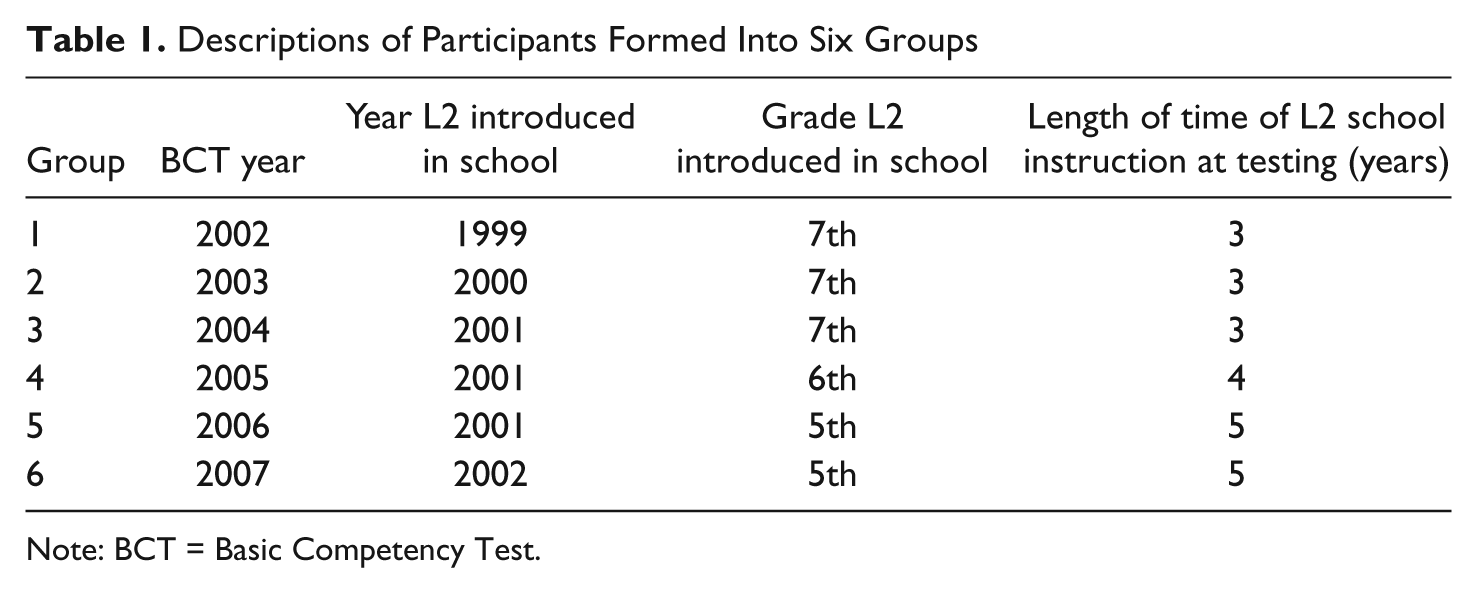
Note: BCT = Basic Competency Test.
In addition to test scores in L1 and L2, participants’ length of exposure to L2 and frequencies and percentages of participants’ gender and school districts are listed in Table 2. Every participant had at least 3 years of English instruction in school. There were slightly more male than female participants in each group, and every year there was a smaller participant pool from urban than rural school districts. Because of the random selection, the participants are from all income levels and all types of middle schools in Taiwan.
Frequencies and Percentages of Years Spent Learning L2, Gender, and School District for All Groups
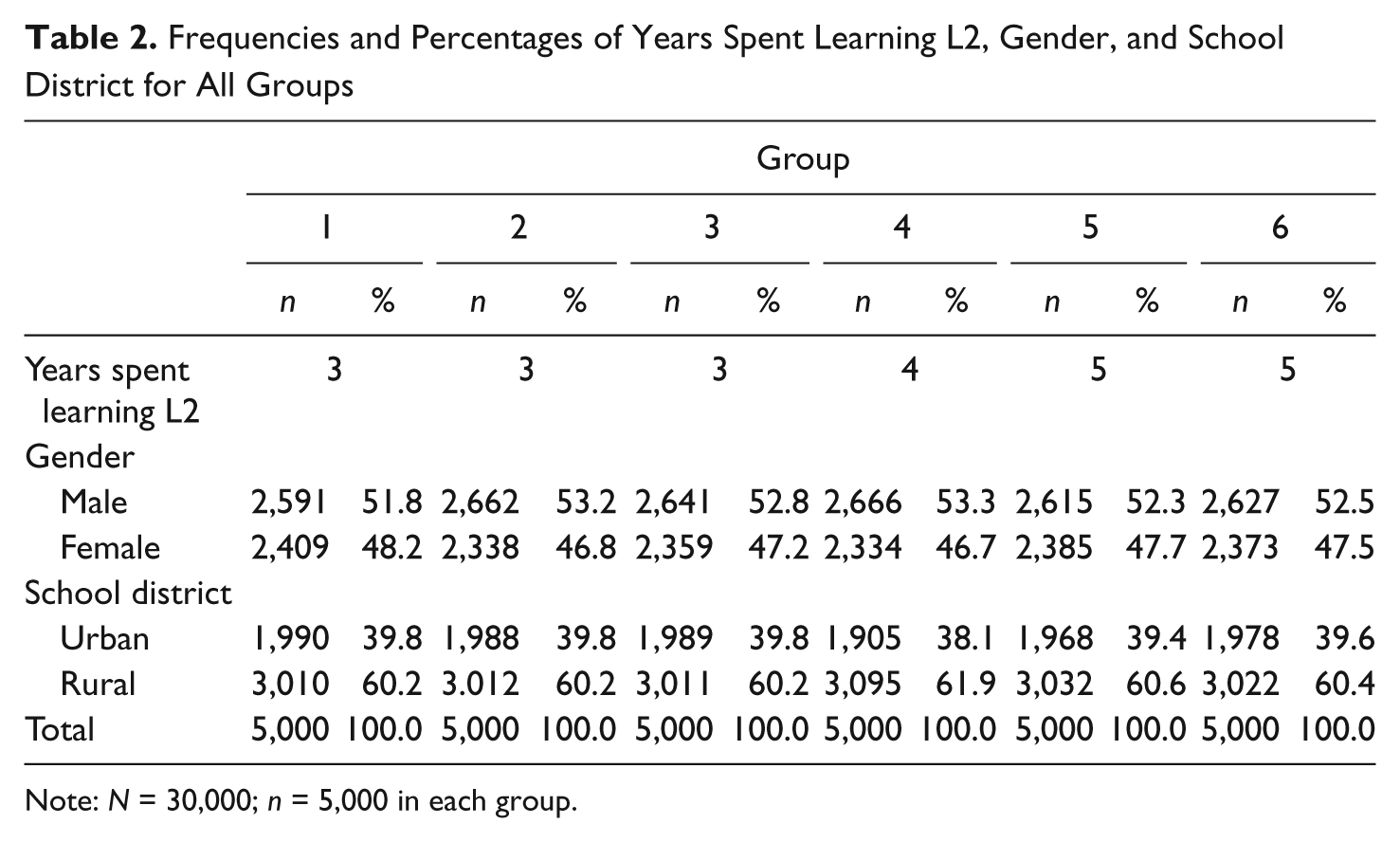
Note: N = 30,000; n = 5,000 in each group.
To investigate the effect of years spent in English learning on English reading ability, participants were divided into six groups based on their length of time of school exposure to English. Although participants across groups varied by length of time studying the L2, the students within each group did not have different amounts of time in L2 learning, and the raw scores were not comparable across groups. Thus, students’ scores across different groups could not be compared because a score of 40 for Group 1 did not have the same meaning as a score of 40 for any of the other groups. However, once the students’ scores were converted to standard scores, variation that might have been from differences in English exposure were obliterated because each student’s standardized score represented his or her performance on the test in comparison to the other students in his or her group. Therefore, the L2 exposure variable was unable to be used as a direct predictor of L2 reading ability. However, for EFL students who learn English as L2 in a school setting and have few opportunities for L2 exposure outside of class, length of L2 exposure would be a proxy for L2 proficiency. Thus, an interaction term was created by multiplying L1 reading competence by length of time in L2 exposure to see whether more time studying English could result in a stronger effect of L1 reading on L2 reading; that is, with more exposure to English, more of a student’s reading knowledge and strategies might transfer to L2.
Instruments
For the years 2002 to 2007, the English part of the BCT had 45 multiple-choice questions, including 25 fill-in-the-blank vocabulary and grammatical concepts and 20 reading comprehension questions, whereas the Mandarin Chinese part of the BCT assessment had 48 to 50 multiple-choice questions consisting of knowledge of Chinese characters, grammar, and reading comprehension in both Baihua (vernacular) and Wenyen (classical) Chinese literature.
English vocabulary and grammar
The fill-in-the-blank grammatical concept test offered four choices or responses for each question. The participants were expected to provide the best answer for the target grammatical item or word in the blank. A sample question is, “Lucy looks _____ in pants than in a dress (pretty, prettily, prettier, or the prettiest).” In this example, the anticipated choice for the question is “prettier.”
English reading comprehension
Several short paragraphs were provided, and multiple-choice questions were then asked to test the students’ reading comprehension of the excerpt. The reading comprehension section measured the participants’ reading ability and vocabulary knowledge in English.
Vernacular and Classical Chinese
Based on ancient forms of Chinese in variance with spoken Chinese, Classical Chinese (also called Literary Chinese) was the standard written form of Chinese until the 1920s (Hung, 1980; Tsao, 1999). After that time, Standard Mandarin, from the spoken vernacular, overtook Classical Chinese as the standard written form. The BCT includes questions regarding comprehension of both Classical and Standard Chinese texts, with the focus on Standard Chinese texts. Each year, the examination questions were different. Scores from six tests in Mandarin Chinese and six tests in English were selected for analysis in the present study. Approximately 60 minutes is required to complete each of the Chinese and English tests. The reliabilities of the raw scores for each Mandarin Chinese and English exam were around .92 and .96, respectively. According to National Taiwan Normal University (2007), the distribution of the raw scores on all 12 tests was considered to be normal. 5
Data were analyzed using statistical procedures, including descriptive analyses, correlations, and regression analyses. These analyses were appropriate given the research questions looking for a relationship between L1 reading and L2 academic achievement and the quantitative nature of the data.
Results
Measures of central tendency and variance were calculated for the ninth graders’ Chinese and English scores on the BCT. Because the data were across 6 different years and the examination questions were different every year, all raw scores were transformed to standardized scores. The Pearson product–moment correlation, which was used to answer the first research question, was adopted to measure the degree of association among Mandarin Chinese, English reading performance, and other control variables (length of time in English exposure, gender, and school district). A simple linear regression, which was used for the second research question, then was used to model the relationship between two variables by fitting a linear equation to observed data. Mandarin Chinese reading performance was considered to be an explanatory variable, and scores in English reading were considered to be the dependent variable. To understand the transfer relationship between L1 and L2, a linear regression line was created to examine the function. In general, the goal of a simple linear regression is to find the line that best predicts L2 reading ability from L1 reading competence. Finally, multiple linear regression analyses were applied to find out answers to the third question. This computation allowed the simultaneous testing and modeling of multiple independent variables (L1, gender, school district, and interaction of L2 exposure and L1). Using more than one variable to test hypotheses helped clarify and strengthen the reading ability in L2.
Participants were from all English and Mandarin Chinese proficiency levels. Means and standard deviations for the test differences between L1 and L2 scores in individual groups as well as reliabilities for all of the measures are listed in Table 3. All of the measures had good reliability (Cronbach’s α > .90). All descriptive analyses were conducted using raw scores from a simple sum of questions that students answered correctly. Participants who had more correct answers than on average received admission. For instance, a student who had 24 out of 45 correct answers on the 2002 English exam received a “good” score. On the other hand, the rather large standard deviations indicate quite a bit of variation in English and Mandarin Chinese scores. However, comparisons of Taiwanese ninth graders’ performance on Mandarin Chinese and English examinations on the BCT were not meaningful because of the use of raw scores in this descriptive analysis. In this study, the data spanned a consecutive 6-year period (2002–2007), and examination questions were not identical each year. Therefore, it was important to apply standardized scores for analysis rather than using raw data that were not consistent across the 6-year time frame.
Reliability Coefficients, Means, Standard Deviations, Ranges, and Correlations Between English and Mandarin Examination Results for All Groups
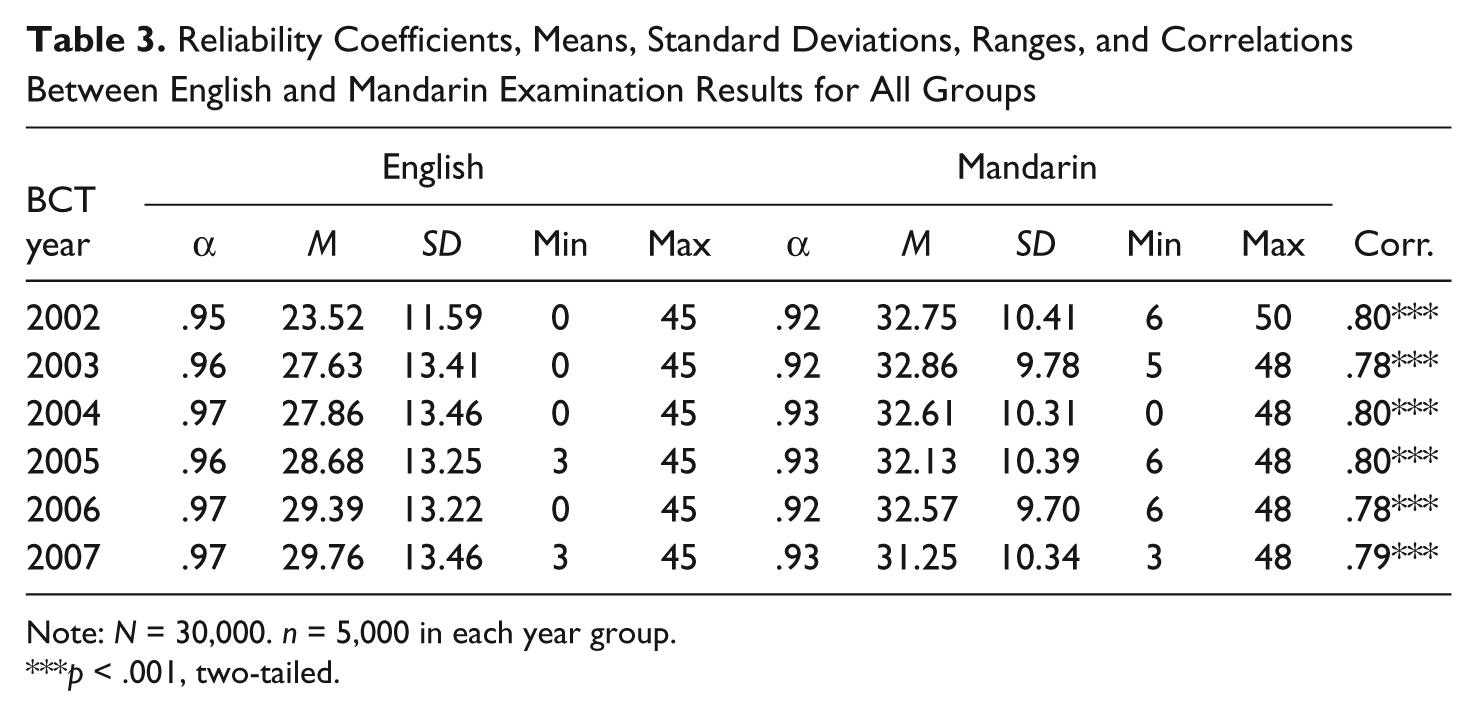
Note: N = 30,000. n = 5,000 in each year group.
p < .001, two-tailed.
In addition, a preliminary relationship between L2 reading scores and demographic backgrounds including gender and school district is displayed in Tables 4 and 5. Adolescents’ performance on both English and Mandarin Chinese reading comprehension tasks between genders and between school district types was statistically significantly above the chance level based on t test analysis, ts(29,999) > –13.91, ts(29,999) > 5.12, ps < .001, respectively. In summary, female participants on both English and Mandarin Chinese examinations performed statistically significantly better than did males, and students in urban school districts on both examinations achieved statistically significantly better scores than did those in rural school districts.
Score Means, Standard Deviations, and Differences Between Genders in English and Mandarin Results for All Groups
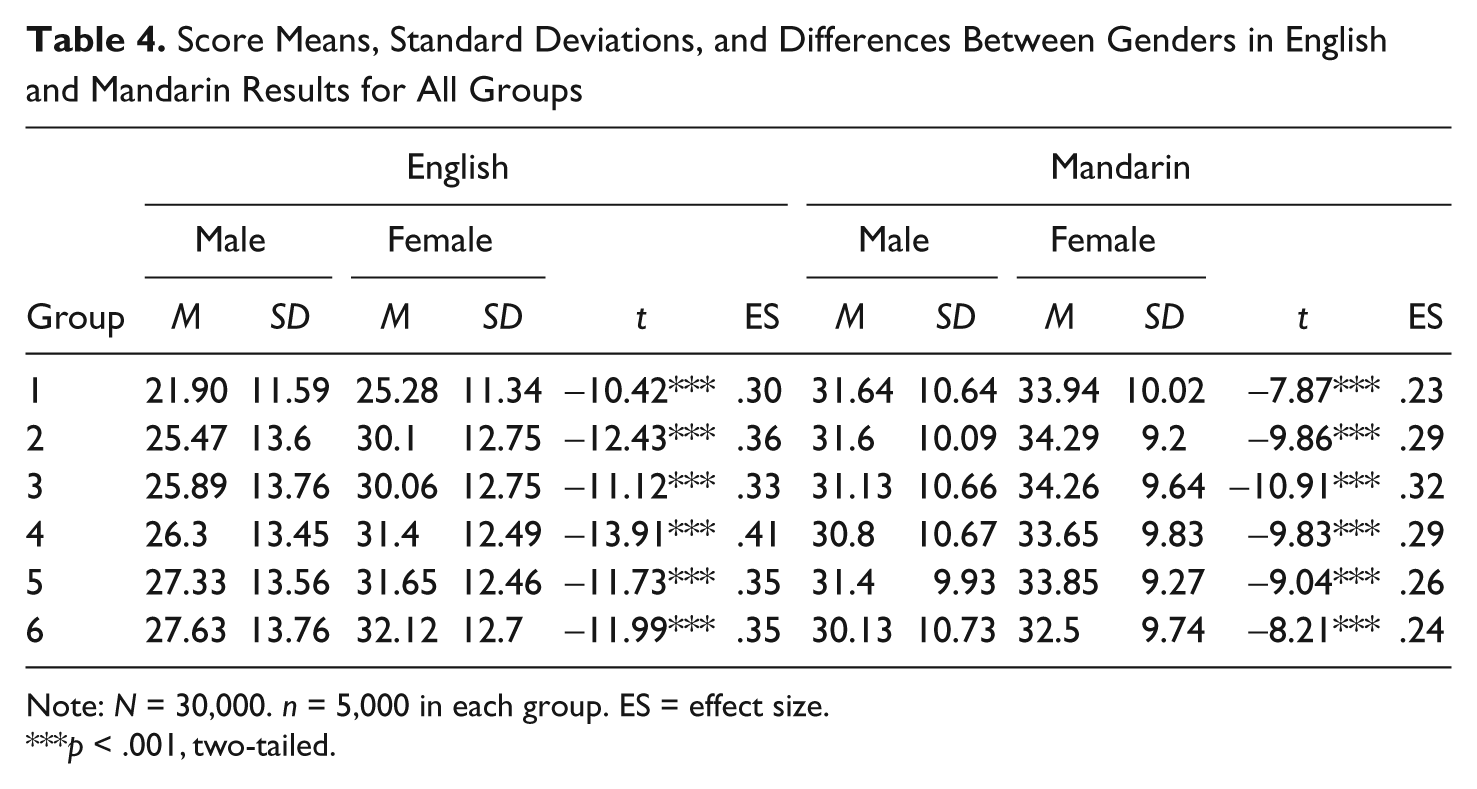
Note: N = 30,000. n = 5,000 in each group. ES = effect size.
p < .001, two-tailed.
Score Means, Standard Deviations, and Differences Between School Districts in English and Mandarin Results for All Groups
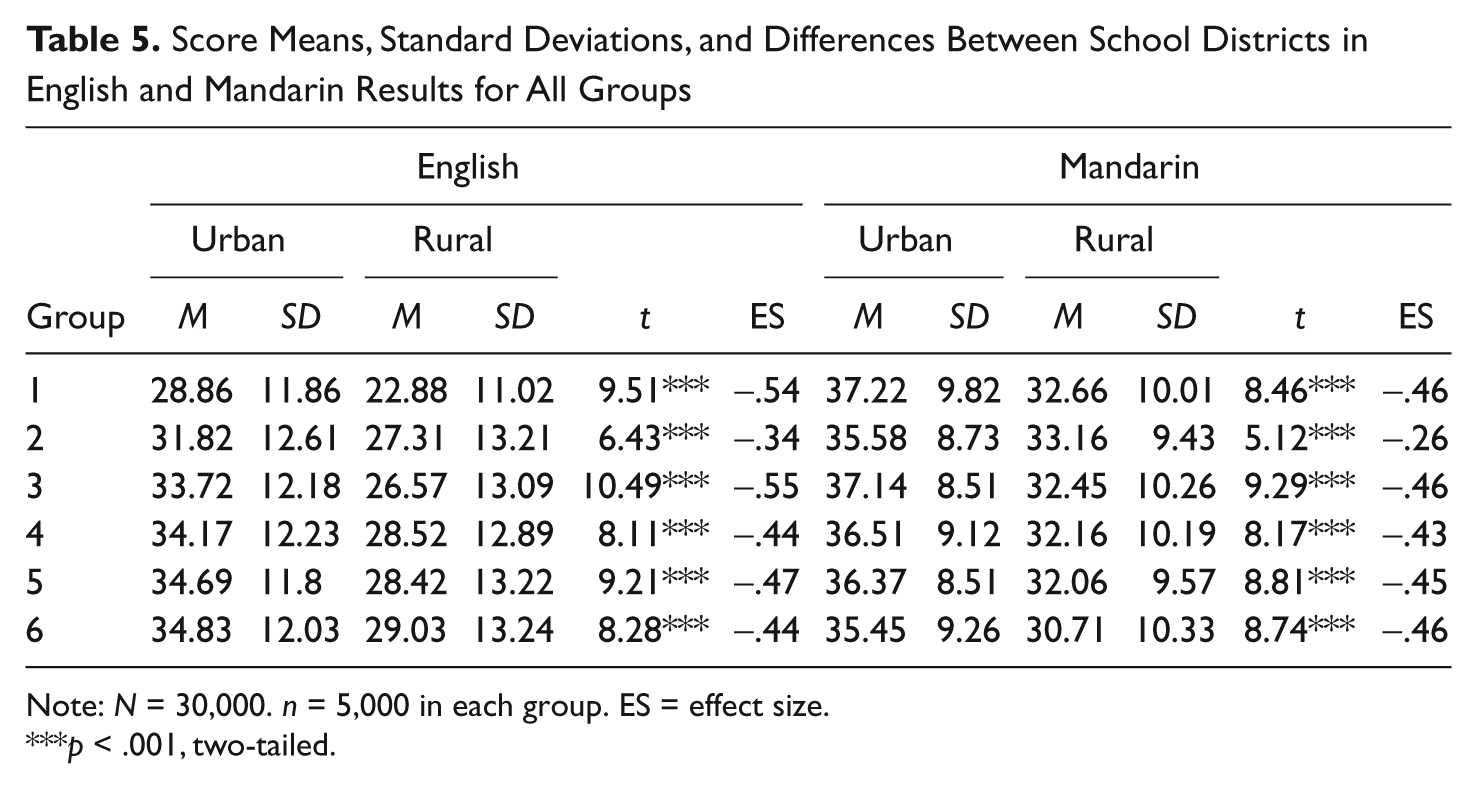
Note: N = 30,000. n = 5,000 in each group. ES = effect size.
p < .001, two-tailed.
Correlations Among All Variables
The accuracy of correlations involving two variables requires the variables to be (a) normally distributed, (b) linearly related, and (c) independent. To ensure that none of these assumptions were violated, score distributions for the two reading tests were examined. Scores on both English and Mandarin Chinese reading tests in the series of 6-year data were shown to be normally distributed. To find the correlations among all variables in this study, a Pearson product–moment correlation coefficient was calculated.
Bivariate correlations among the Mandarin Chinese and English reading tasks, including gender and school district, are shown in Table 6. The value of the correlation coefficient between overall scores of the Mandarin Chinese and the English reading comprehension tests was .793 (p < .001). In addition, gender was significantly and positively correlated with both L1 and L2 reading performance; however, the correlation coefficient was positive but weak (r = .130 and r = .166, respectively, ps < .001). Girls tended to perform better than boys on both reading exams, but not by a large amount. In addition, rural districts had lower performance than urban districts in L1 reading ability (r = –.074, p < .001) and L2 reading ability (r = –.072, p < .001), but the correlation was very small. However, the correlations between years spent in learning L2 and other factors could not be measured because of the use of standard scores in which no students within a group varied by number of years of L2 exposure.
Correlations Among English and Mandarin Chinese Reading Scores, Gender, and School District
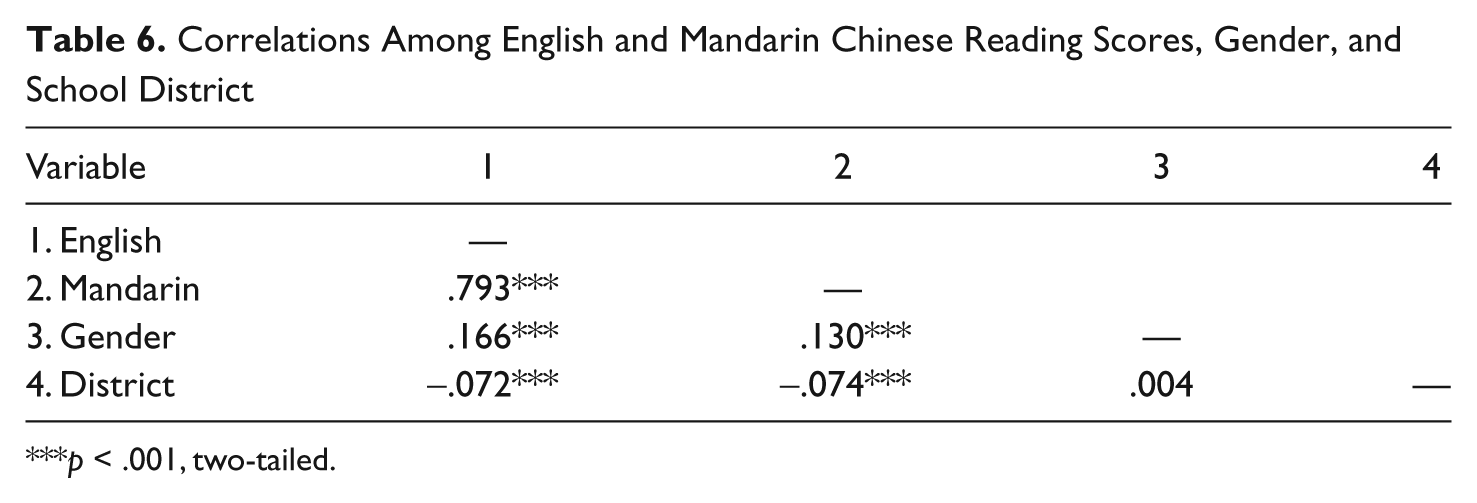
p < .001, two-tailed.
Results of Cross-Language Reading Ability Predictions
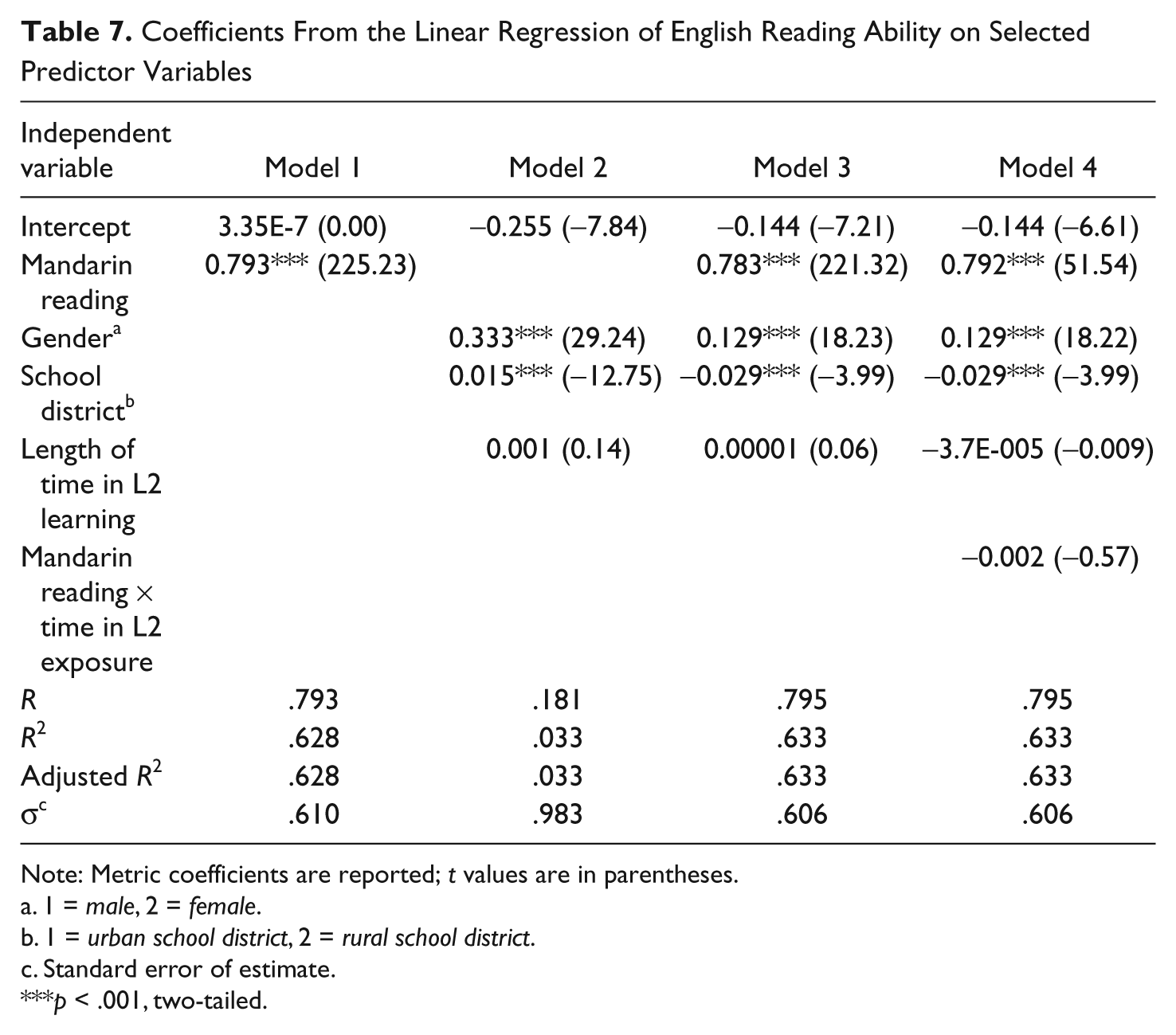
Table 7 reports the four linear regression models conducted for evaluating English reading acquisition. Model 1 demonstrated that, without controlling for other factors, every one standard deviation difference in Mandarin Chinese reading score corresponded to a 0.793 standard deviation difference in English reading score, R2 = .628, F(1, 29,998) = 50,729.53, p < .001. 6 The high R2 indicates that scores from Mandarin Chinese reading tests positively and significantly accounted for 62.8% of the variation in performance on the English reading test.
Coefficients From the Linear Regression of English Reading Ability on Selected Predictor Variables
Note: Metric coefficients are reported; t values are in parentheses.
1 = male, 2 = female.
1 = urban school district, 2 = rural school district.
Standard error of estimate.
p < .001, two-tailed.
In Model 2, participants’ background factors such as gender and school district were included to establish their effects on the L2–English reading performance. The relationship between English reading ability and a combination of the independent variables was significant at the .001 level, R2 = .033, F(3, 29,996) = 338.26, p < .001. Although predictions of the background variables were statistically significant, these two variables accounted for only 3.3% of the variance in English reading ability. Length of time in learning L2 was also included as a predictor variable in Model 2, but it was not statistically significant (β = .001, p > .001).
Results of Model 3 showed that the background variables and Mandarin Chinese reading ability together accounted for 63.3% of the variation in English reading scores, R2 = .633, F(4, 29,995) = 12,914.05, p < .001. The combination of all independent factors was associated with an additional 0.5% of the variation in L2 reading achievement beyond what was accounted for by only L1 reading ability. Conversely, adding L1 reading ability to the model with all the other independent variables accounted for an additional 60% of the variance in L2 reading achievement. Overall, the L1–Mandarin Chinese reading ability accounted for a large amount of variation in L2 reading achievement, whereas participants’ gender and their school district played a very small role in L2 English reading ability.
In Model 4, an interaction term was created by multiplying L1 reading ability by length of time in L2 exposure to see whether the effect of students’ L1 reading ability on L2 reading ability varied across different lengths of time in L2 learning. For language transfer to occur, some level of L2 proficiency must be achieved; however, the information with respect to students’ L2 proficiency level is unknown in this study. For these EFL students who learn L2 English in a classroom setting with few opportunities for L2 exposure outside of class, length of L2 school exposure acted as a proxy for L2 proficiency. We could not examine a direct effect of length of L2 exposure on L2 reading ability because the only variability in L2 exposure was in different year cohorts, and scores across the cohorts were not directly comparable. Within each cohort, z scores were used, which compare each student’s score only to the other scores within his or her cohort (i.e., Student A performed one standard deviation better than the mean score for his or her cohort). However, we could examine whether length of L2 exposure changed the way L1 reading ability predicted L2 reading ability. That is, did L1 reading ability of students who performed one standard deviation better than their cohort predict more of the students’ L2 reading ability when they had 5 years of L2 exposure as opposed to 3 or 4 years? This study assumed that more time studying English could result in a stronger effect of L1 reading on L2 reading; that is, with more exposure to English, more of a student’s reading knowledge and strategies might be able to apply to L2 reading. However, including the interaction term in the regression model indicated that the amount of time in L2 learning did not change the influence of L1 reading ability on L2 reading ability (see Model 4 in Table 7). This finding can be interpreted as indicating that a student who does one standard deviation better than others in his or her cohort on L1 reading would be predicted to have the same L2 z score as someone in another cohort (with more or fewer years of L1 exposure) who also performed one standard deviation better than others in his or her cohort on L1 reading. Thus, the interrelationship formula in this study was refined to
Predicted L2 reading = −0.144 + .792 × (L1 reading) + .129 × (female) – .029 × (rural)
To check if the linear regression models were reasonable fits and if possible assumption violations and outliers may have affected the results, residuals and influence statistics were examined. No problems were measured with the assumptions of the regression analyses; that is, the residuals were normally distributed at each level of English reading ability and constant in variance across levels of L2 reading ability (e.g., Cook’s distance ≈ 0). Thus, the final model is displayed in Figure 1. Because the correlation between gender and school district was not statistically significant and the difference in L2 English reading ability between each group (e.g., males in urban area, males in rural area, females in urban area, and females in rural areas) was extremely small, the four parallel lines were too close to display separately. Therefore, only the largest group, male participants in rural areas, is represented (n = 9,549) in this figure.
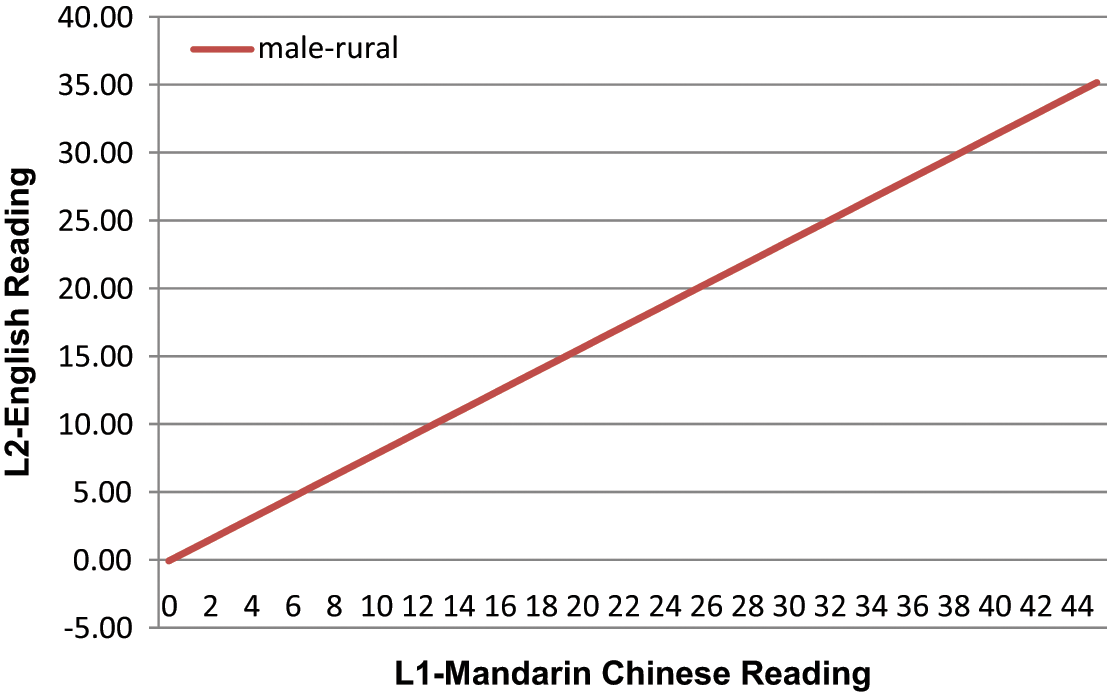
English reading score predicted by Mandarin Chinese reading score, controlling for gender and school district
Discussion
The present study set out to examine the role of L1 reading ability in the cross-language transfer to L2 reading ability in two languages with sharply different orthographies—Mandarin Chinese and English. Although some previous studies reported a transfer relationship between L1 Mandarin Chinese and L2 English reading processes, the field lacked studies with readers at the junior high school age in an EFL context (Crystal, 2003; McKay, 2002). In addition, the current study took advantage of a large sample size with a substantial range of proficiency scores to investigate possible transfer. Thus, the first intent of the current study was to address the gap in the research by investigating whether ninth-grade Taiwanese readers’ L1 ability could transfer to their L2 reading ability, controlling for their demographic background, and the second intent was to examine whether L2 exposure had an effect on the transfer of L1 reading to L2 reading.
Many studies have demonstrated that L2 reading ability relies on L1 reading ability, as outlined by Cummins’s LIH, and the current study provides further empirical evidence supporting the hypothesis. Among a large-scale sample with a range of proficiency levels in Chinese and English, Taiwanese ninth-grade students’ L1 ability showed a strong, positive, statistically significant association with their L2 reading ability. These findings suggest that students with higher Mandarin Chinese reading ability tended to acquire good English (L2) reading ability.
Notable in the current study is also the strength of the association between Chinese reading and English reading; even after controlling for gender and type of school district (rural or urban), more than 60% of the variance in English reading could be accounted for by Chinese reading. Studies of transfer of reading skills between alphabetic languages have shown a range of correlations, from R2 = .15 to .71 (Carrell, 1991; Dufva & Voeten, 1999; Jiang & Kuehn, 2001; Lopez & Greenfield, 2004; Sparks et al., 2008; van Gelderen et al., 2007), with the highest correlation between Dutch and English, two closely related languages. The correlation found in the current study (R2 = .606) is thus higher than that found in most studies of transfer across alphabetic languages and higher than those found in previous studies of transfer between Chinese and English reading, R2 = ranged from .01 to .53, p < .05 (Bialystok, Luk, et al., 2005; Bialystok, McBride-Chang, et al., 2005; Keung & Ho, 2009; Wang et al., 2005; Wang et al., 2006), although those studies generally examined one specific component of reading skill rather than overall reading performance.
The current study’s results are consistent with Haynes and Carr’s (1990) finding of reading proficiency transfer between Mandarin Chinese and English languages in Taiwanese English language learners. However, Haynes and Carr focused on college-level EFL students, whereas the current study examined junior high school students. Thus, the finding of the current study has increased the range of ages as well as proficiency levels in which reading ability has been shown to transfer to EFL learners. Furthermore, female students and those in urban schools were more likely to achieve higher L1 and L2 reading scores.
The current study’s findings suggest that overall reading achievement may be more closely linked across differing orthographies than previously thought, probably through transfer of comprehension strategies or meaning-making processes. Teachers in settings in which students learn to read in two languages should take note that improving reading comprehension in one language may well help the student in reading in the other language. Instruction in L1, thus, can emphasize meaning-making processes, comprehension strategies, and other aspects of reading that are more likely to transfer to L2 for efficient use of instructional time. Alignment of reading instruction in L1 and L2 might also help facilitate transfer. That is, when a teacher introduces a particular comprehension strategy in the L1 reading class, the teacher in the L2 class could call on students to use that strategy in their L2 reading as well.
However, the current study also examined whether length of time studying L2 influenced the relationship of L1 to L2 reading, that is, whether more time studying L2, for example, strengthened the relationship between L1 and L2 reading. The results showed that the influence of L1 reading ability on L2 reading ability was not modified by amount of time studying L2, which varied between 3 and 5 years in the current analysis. The reasons may be that either all the students had reached a minimum level of L2 proficiency needed for transfer of L1 skills or the relationship between L1 and L2 reading does not vary according to whether a student has 3, 4, or 5 years of L2 study (leaving open the possibility that a difference could appear at 6 or more years of L2 study, or at less than 3 years). Alternatively, the relationship between L1 and L2 reading comprehension could remain constant despite varying lengths of time studying the L2. That is, those with poor L1 reading skills may develop poor L2 reading skills, no matter how long they study L2, whereas strong L1 readers may always develop better L2 reading skills, relative to their peers with poor L1 reading skills. Thus, although all L2 learners may perform better overall in L2 reading the longer they study L2 (something that could not be measured in this study), the most important predictor for explaining who did better or worse at L2 reading may still be L1 reading ability, rather than that relationship changing according to whether the student studied L2 for 3, 4, or 5 years.
The current study’s finding that L2 school exposure in interaction with L1 reading ability was not significantly predictive of the transfer process is consistent with earlier studies by Cummins (2000) and Ramirez (1992), which found that an increase in time of exposure to English did not necessarily facilitate acquisition of English proficiency. They revealed that children who had been in L2 English-only instruction acquired English language skills equivalent to those exposed to the L1 and L2 English bilingual instruction. The findings are also similar to Chou’s (1991), which showed that Taiwanese senior high school students with earlier English exposure performed better at listening than those with later English exposure, whereas the reading ability had no significant difference between the two groups.
Language transfer can take place not only among alphabetic languages but also between nonalphabetic and alphabetic languages (Haynes & Carr, 1990; Keung & Ho, 2009; Wang et al., 2005; Wang et al., 2006). Because of the significantly positive correlation and prediction between L1 and L2 reading abilities, the current study concluded that reading transfer across morphosyllabic languages and morphophonemic languages can occur. If two markedly different languages such as Mandarin Chinese and English have a certain level of language reading ability transfer, there exists a high probability that transfer of reading ability between other languages (e.g., African languages) and English can occur.
Limitations and Future Research
Although the results of this study add credence to the existing literature on the influence of L1 knowledge on L2 reading ability, it is important to acknowledge the limitations of the current research and mention recommendations for future research. Because the data were secondary data retrieved from the Committee of the Basic Competence Test for Junior High School Students, independent variables in this study were limited. Because reading is a complex process, results may be less comprehensive if only a few predicting variables are considered. Future research should include more explanatory factors, such as participants’ socioeconomic status, students’ overall academic achievement, cognitive skills, number of Mandarin Chinese and English books at home, hours of television viewing, parental literacy, and so on.
In addition, there were no students within a group varying by time in L2 exposure, and also there was no way to measure whether different groups with varying years of L2 learning actually performed differently overall since each group took different exams. To learn more about whether the amount of time spent in L2 learning has an influence on L2 reading comprehension acquisition, future research needs to include time of L2 learning in cram school, a private institute that provides organized lessons after regular school hours and on weekends. In addition, time in bilingual kindergarten should be considered as well if the information can be obtained. With English learning time in both cram school and bilingual kindergarten added, the amount of L2 exposure will be more accurate. Moreover, researchers should try to compare groups with differing amounts of time studying the L2 using the same test.
Finally, there is a need to continue this line of investigation. The population of this study was limited to Taiwanese junior high school students and their performance on the BCT at one point in time, with no follow-up. A longitudinal study would help address whether students’ test scores on the BCT led them to achieve higher L1 and L2 reading abilities in their subsequent educational level (e.g., senior high school, college). A longitudinal study can also examine whether reading ability in L1 and L2 remains stable or changes over time. In addition, a qualitative method such as interviews with participants or classroom observation should be included in the longitudinal study to elaborate on the impact of L1 Mandarin Chinese ability actually on acquiring the L2 English reading ability.
In conclusion, the results of this study suggest that Taiwanese students’ L1 reading ability plays a significant role during the process of L2 reading comprehension acquisition. Thus, the findings of this study can contribute information to Taiwanese educational policy makers to implement more applicable English educational policies for Taiwanese junior high school adolescents. First of all, the Ministry of Education in Taiwan should know that emphasizing students’ L1 reading skills can potentially help students develop their L2 reading abilities more easily. Second, the Ministry of Education in Taiwan should examine whether English language materials (e.g., textbooks) support teaching and learning appropriately and whether the past and current instructional methods were and still are appropriate to Taiwanese teenagers’ English reading comprehension capacity. Simply put, other teaching approaches and techniques should be considered and added to the English curriculum for learners to have a variety of ways to acquire reading skills. The Ministry of Education in Taiwan also can tailor L2 reading instruction to capitalize on reading knowledge and strategies already familiar to students through the L1 learning process. The implication is that L1 reading knowledge may be able to be exploited as a resource for building L2 skills; and perhaps if the English (and/or Mandarin Chinese reading) curriculum and materials capitalize on this relationship, an even stronger transfer effect could be seen.
Footnotes
The author(s) declared no potential conflicts of interest with respect to the research, authorship, and/or publication of this article.
The author(s) received no financial support for the research, authorship, and/or publication of this article.
Notes
References
Supplementary Material
Please find the following supplemental material available below.
For Open Access articles published under a Creative Commons License, all supplemental material carries the same license as the article it is associated with.
For non-Open Access articles published, all supplemental material carries a non-exclusive license, and permission requests for re-use of supplemental material or any part of supplemental material shall be sent directly to the copyright owner as specified in the copyright notice associated with the article.
