




Abstract
Sustainability work requires continuous reflection in a complex system of interconnected and competing demands. To shed light on the complexity and tensions of sustainability work in a controversial field, such as the textile industry, a narrative approach to sustainability work is utilised. The research data consist of individual interviews (21 participants) and four focus-group interviews (16 participants). The use of a narrative analysis reveals three prevailing organisational narratives that illustrate how sustainability work is constantly co-constructed through different organisational representatives and how they act in organisations: (1) the consolidating narrative of prestige, (2) the surrendering narrative of powerlessness and (3) the obscuring narrative of idealism. The study contributes to the extant literature by offering an understanding of sustainability work as consisting polyphonically and as constantly negotiated and evolving, and shows how narrative structures are constitutive of action in this field. It foregrounds the constitutive role of narrative structures, not merely as representational devices but as dynamic spaces through which organisational actors can generate and reduce enduring ambiguities and contradictions.
Introduction
Working towards sustainability in business is a complex issue that requires companies to simultaneously address heterogeneous concerns, demands and objectives (Haffar & Searcy, 2020; Hahn et al., 2018; Reinecke & Ansari, 2016) that can often be in contraposition (Hahn et al., 2018). In light of the challenges posed by climate change, loss of biodiversity, inequality, injustice, poverty and inhumane working conditions in the global economy, there is an increasing need to understand how businesses operate within ever more complex human and ecospheric systems (Bansal & Song, 2017; Mitra & Buzzanell, 2017). This has resulted in growing academic interest in sustainability work that includes opposing elements (or contradicting ideas) and the disputed ways these are understood and reacted to under different conditions (Hengst et al., 2020; Jamali & Mirshak, 2007).
This study focusses on the tensional nature of sustainability work in business organisations and its connections to organisational members’ agency. It utilises a narrative methodological approach that advances the understanding of how narration matters and is acted upon in sustainability work, by which we mean the daily organisational activities and practices that aim to achieve sustainability in organisations and require the ability to act both individually and collectively (Pelenc et al., 2015). As explained by Houtbeckers et al. (2025), sustainability work entails a variety of daily practices to transform processes and actions in organisations into more sustainable ones. We take sustainability work as an inherently tensional phenomenon (Hahn et al., 2018; Houtbeckers et al., 2025; Lankoski, 2016; Luo et al., 2020; Van der Byl & Slawinski, 2015), meaning that it is shaped by contextually emerging and evolving competing and/or contradictory demands (Smith & Lewis, 2011). These tensions may either hinder changes towards sustainability or spark new processes and practices (Houtbeckers et al. 2025). Sustainability work then does not necessarily culminate into a unified form of collective agency; rather, it manifests through differences of voices and practices that shape the organisation’s capacity to act for sustainability (Pelenc et al., 2015; Teerikangas et al., 2021).
Companies face various demands to achieve societal-level objectives that may appear desirable and acceptable in isolation and are also ‘inextricably connected and internally interdependent’ (Bansal, 2002, p. 123). Addressing such demands requires that not only managers but also all organisational members take desirable actions that may entail often competing outcomes in the environmental and social dimensions of business results (Van der Byl & Slawinski, 2015) and lead business organisations to rethink and reorganise themselves. However, such engagement does not occur without conflicts, contestations and negotiations that evolve dynamically over time and in different contexts (Hahn et al., 2018). Acknowledging this situation is important because different responsibilities in sustainability work, many with competing goals, continue to proliferate (Hengst et al., 2020; Mitra & Buzzanell, 2017) and sustainability work in organisations is essentially polyphonic: each member of the organisation has a unique voice with varying levels of power and acting requires negotiations between different groups (Hazen, 1993).
There is strong research evidence that sustainability within organisations entails multifarious tensions (Hahn et al., 2018; Luo et al., 2020; Van der Byl & Slawinski, 2015) and that strategies to resolve these tensions must be developed (Hahn et al., 2015; Van der Byl & Slawinski, 2015; Wannags & Gold, 2020). However, little attention has been paid to how the tensional nature of sustainability work in relation to the collective (in)ability to take actions is shaped by the plurality of narrations produced by multiple organisational member voices. This study argues that this understanding is important because narratives may generate or reduce action in organisations (Czarniawska, 1995; Sonenshein, 2010; Vaara & Rantakari, 2024) We advance an organisational-level investigation on how narratives are creating spaces for sustainability work, focussing on how inherent tensions and collective agency are entwined. Specifically, we investigate how organisational narratives on sustainability work may constitute and (re)construct agency and action towards sustainability. Our research question is as follows:
To address this research question, we adopted a narrative research methodology, drawing on 21 individual and four focus-group interviews conducted in textile companies. This approach enabled us to explore how sustainability work is enacted, constrained or advanced through the narratives circulating within these organisations.
The textile industry is controversial because of its significant environmental and social impacts and the relative lack of solutions to offset such impacts (Niinimäki et al., 2020; Peters et al., 2021). The empirical focus of this study is the Finnish textile industry, which is increasingly concerned with the sustainability of its operations (e.g. Lumme, 2020). The companies that participated in this study were selected for their strong commitment to sustainability and endeavours to engage in thoughtful leadership by seeking and providing solutions for sustainability problems in the industry. However, controversy in this sector is inevitable, as the inherent business logic of ensuring economic growth by increasing textile consumption remains strong, which may lead to a disconnect between stated goals and actions. In addition, most companies in this sector are small- to medium-sized and may thus be ill-equipped to cope with different tensions in sustainability work due to a lack of resources and practices suitable to their particular context (Berti & Simpson, 2021).
Narratives within organisations are recognised as attempts to impose order and, therefore, as integral elements of organising (Currie & Brown, 2003; Weick, 1979). Our premise is that ambiguous and interwoven narratives about sustainability work involving tensions enable or disrupt collective agency by fostering shared interpretive understanding, where organisational members co-construct stories that both disrupt and reaffirm the organisation’s sustainability strategy and related goals. Narratives may serve to define who we are as individuals and also empower social actors by giving their work a sense of meaning, purpose and coherence (Wright et al., 2012). Through narratives, collectives can engage in a dynamic process of meaning-making that simultaneously ‘unfreezes’ dominant assumptions and ‘refreezes’ new or revised understandings (Sonenshein, 2010; Vaara et al., 2016). Our results evoke three organisational narratives of sustainability work and inherent tensions in organisations: (1) the consolidating narrative of prestige, (2) the surrendering narrative of powerlessness and (3) the obscuring narrative of idealism. In doing so, these narratives can support collective (in)action through change, allowing the organisation to evolve while preserving a sense of coherence and continuity.
This study contributes to the extant literature by offering an understanding of sustainability work as consisting polyphonically and constantly negotiated and evolving, and shows how narrative structures are constitutive of action in this field. It offers an enlightened understanding of the tensional nature of sustainability work as a polyphonic and evolving process – collectively shaped through continuous negotiation, reflexivity and with situated meaning-making. It foregrounds the constitutive role of narrative structures, not merely as representational devices but as dynamic spaces through which organisational actors can enact and contest enduring ambiguities and contradictions. The study advances the debate on the performative nature of sustainability talk – and its role in shaping agency – by showing the complex ways organisational narratives on sustainability intersect, rely on and undermine one another. It demonstrates how such narration, entangled with sustainability work-related tensions, can continuously maintain, fragment, confuse and reduce collective agency sustainability work through different narrative directions. The article proceeds by outlining the theoretical framework and narrative approach, presenting the research data and context, discussing the findings and concluding with implications and directions for future research.
Sustainability Work With Tensions Within Organisations
Tensions in sustainability work entail competing but interdependent entities constantly negotiating their social relations (Hahn & Knight, 2021; Jarzabkowski et al., 2013). Theorisation in this area fundamentally focusses on understanding processual organisational transformation (Smith & Lewis, 2011). The paradoxical perspective has offered a lens for organisational studies to analyse the types of tensions within organisations, such as competing and/or contradictory demands (Lewis, 2000; Smith & Lewis, 2011) that may exist separately or simultaneously during temporal or spatial change (Putnam, 2004; Putnam et al., 2016). More precisely, tensions are opposing concepts or behaviours that ‘push and pull against one another’ (Putnam et al., 2016, p. 416) and are derived from a ‘clash of ideas or principles or actions’ (Stohl & Cheney, 2001, p. 353). The concept of tensions has been viewed through paradox theory in management science and differentiated from such concepts as contradictions and conflicts (Carmine & De Marchi, 2023; Schad et al., 2016, 2019). For example, conflicts arise from disagreements or dissonances in the interactive processes of individuals, groups and organisations, whereas tensions are more dynamic and often not tied to particular social entities.
The paradoxical perspective offers a lens for understanding how tensions are interrelated (Schad et al., 2019), how they coexist and coevolve over time, and how managers’ responses shift from defensive to active (Jarzabkowski et al., 2013). Tensions are primarily viewed as a collective and organisational-level phenomenon (Schad et al., 2016; Waldman et al., 2019), although tensions at the individual level have also been identified (Miron-Spektor et al., 2018). At the organisational level, tensions arise from multiple sources, such as the degree of change, collectiveness, structure and performance, and result from senses of belonging, learning, organising and performing (Smith & Lewis, 2011). In addition, tensions between standardisation and flexibility (Canales, 2014), exploitation and exploration (Andriopoulos & Lewis, 2009), and profits and purpose (Vazquez-Maguirre & Portales, 2018) have been identified. At the individual level, responses to tensions vary and lead to different levels of acceptance (Miron-Spektor et al., 2018), and individuals’ social interactions influence how organisational-level tensions evolve (Waldman et al., 2019).
Sustainability work is often labelled as tensional primarily because it stands in stark contrast with business logic (Hahn et al., 2018) and sustainability-related tensions evolve in organisations (Hahn & Knight, 2021). The paradox perspective on sustainability work aims to explain how to address interrelated yet conflicting goals to find workable solutions for sustainability (Hahn et al., 2018). Mapping previous literature on tensions in sustainability work identifies three strands of research: descriptive, strategic and narrative.
The descriptive strand of studies on tensions in sustainability work has focussed on how sustainability tensions evolve and exist within organisations. An emerging body of research has explained that tensions emerge from the need to balance different social, economic and environmental goals (Hahn et al., 2018; Luo et al., 2020; Van der Byl & Slawinski, 2015). Such goals often have contradictory requirements, and it can be very challenging to strike a successful balance between them. However, merely viewing tensions as trade-offs between existing sustainability dimensions prevented a nuanced understanding of their depth and extent. Hence, a broader perspective was required, especially regarding related contextual meaning systems, organisations and individuals (Hahn et al., 2015). Consequently, sustainability work-related tensions were categorised as learning, belonging and performing paradoxes (Hahn et al., 2018) temporally emerging between short- and long-term goals (Slawinski & Bansal, 2015), and in relation to economic, structural, psychological or behavioural tensions (Tura et al., 2019). Carollo and Guerci (2018) and Mitra and Buzzanell (2017) connected tensions to multilevel meaning-making work, and sustainability tensions at the organisational level can be understood as complex and collective (Schad et al., 2016).
The strategic strand has analysed responses of business actors to resolving sustainability tensions. These studies view tensions from a rather negative perspective, arguing that they may hinder the achievement of certain goals, create negative emotional experiences and arouse emotions, such as anxiety, uncertainty or discomfort (Putnam et al., 2016). Hence, this body of research treats them as situations that require management and solutions (Canales, 2014; Siltaloppi et al., 2021). Strategies for the successful management of competing economic, social and environmental goals can be proactive and defensive (Luo et al., 2020), proactive and reactive (Daddi et al., 2019), and entail acceptance or resolution, which, in turn, can entail both separation and synthesis (Hahn et al., 2015). Moreover, analyses have stressed how such tensions can be avoided or result in defensive responses of regression, fantasy and projection when tensions are encountered (Ferns et al., 2019). Generally, such strategies may involve reconciling conflicting goals and decisions (Van der Byl & Slawinski, 2015). Strategic studies have advanced understanding at both the organisational and individual levels. For the former, analyses have focussed on problems related to disclosing tensional experiences (Haffar & Searcy, 2020) and on how legitimacy tension must be addressed when standards are created (Haack & Rasche, 2021), while for the latter, research has addressed how sustainability tensions are negotiated and engagement in such tensions is justified (Shin et al., 2022), differences in managerial responses to tension management (Joseph et al., 2020) and cognitive framing for managing tensions between individuals (Sharma & Jaiswal, 2018). An emerging research strand on tensions in sustainability work can be labelled as ‘narrative’, emphasising its polyphonic and inescapably evolving nature, where multiple often conflicting voices and temporalities shape a dynamic and tension-laden focus. This strand adheres to the view that tensions cannot be dissipated or fundamentally resolved in sustainability work, a conclusion derived from the social constructionist view of tensions that perceives them as constantly constructed in language use in social interactions (Hahn & Knight, 2021). The narrative strand emphasises the role of narrating and the use of narratives that affect how tensions are perceived and acted upon in the organisation. Such research has created an understanding of the different discursive and rhetorical tools used to cope with tensions in business organisations (Ghadiri et al., 2015) and has shown how tensions are created and recreated in language use between, for example, the ideal and practice (Høvring et al., 2018), and can be discursively constituted and denied (Hoffmann, 2018). This research has contributed to the understanding of sustainability work as temporal and socially constructed (or denied and hidden), and of narratively managing and coping with tensions.
When sustainability work-related tensions are viewed through narratives, certain actions and processes become relevant for analysis. The foci of narrative research in this area are negotiating and giving meaning to sustainability work, creating a sense of purpose, refocussing organisations’ transitions and simultaneously enabling and constraining ongoing activities within organisations (Fenton & Langley, 2011). To further this understanding, we build on Czarniawska’s (1995) study to link agency to the narrative turn in tension research. Czarniawska argued that narrative not only describes action but is also generating and reducing action (Vaara & Rantakari, 2024). Stories shape the organisational landscape, as individuals and organisations become actors in their own stories (Cooren, 1999). Narratives are then voiced by authors for a particular point of view and audience and are thus imbued with motive (Burke, 1945) – they are told by and are ‘product(s) of contingent human construction’ (Tsoukas & Hatch, 2001). Narrative emplotment arises from the interaction of voices at multiple levels, forming an overall push and direction for the activities of an organisation (Brown, 2006).
Overall, a narrative approach to sustainability work emphasises its inherent complexity and polyphony, and offers rich insights into the multiple voices and perspectives that shape organisational storytelling (Hazen, 1993). However, while polyphony reveals the diversity of narratives within an organisation, it also presents challenges in achieving coherence and unity. We recognise that no organisation begins its storytelling from scratch, and narratives are never entirely fixed or unchanging over time (Brown, 2006; Vaara et al., 2016). Organisational narratives are co-constructed and shaped by the participants involved (Sonenshein, 2010; Tsoukas & Hatch, 2001).
Organisational Narratives and the Co-Construction of Collective Agency
The narrative approach offers a powerful lens for examining organisations, focussing on how organisational realities are constructed and the roles of agents within them (Boje, 2014; Feix & Philippe, 2020; Heizmann & Liu, 2018; Hengst et al., 2020; Rantakari & Vaara, 2017; Williams et al., 2021). In sustainability work, narrative research proves invaluable for navigating uncertainty and tensions, as it enables people to create, repair and sustain a sense of coherence and identity amid organisational complexity (Hahn et al., 2018; Hahn & Knight, 2021; Molecke et al., 2024). Narratives in organisations facilitate sense-making by linking and bonding people, actions, events and outcomes over time by explaining the typical content patterns of events and describing variation and selective retention (Chase, 2011; Van de Ven & Poole, 1995). A narrative approach allows sustainability work to be reframed by integrating multiple voices and settings, thus offering theoretical insights that question and destabilise entrenched assumptions (Feix & Philippe, 2020; Molecke et al., 2024; Williams et al., 2021). We see that sustainability work can be better understood through a processual lens, which emphasises the ongoing, dynamic nature of organisational narratives (Van Hulst & Ybema, 2020). From our perspective on sustainability work, organisational actions are not isolated events but part of an unfolding narrative that evolves over time. The deep-level narrative structure proposed by Pentland (1999) – including a temporal sequence, focal actors, narrative voice and evaluative shifts – offers a framework for understanding how sustainability work and practices emerge, contradict, transform and are legitimised within organisations (Molecke et al., 2024). In particular, the temporal sequence provides a chronological lens through which the progression of sustainability efforts can be traced, highlighting how decisions and actions are interwoven into a continuous flow of organisational change. The concept of focal actors emphasises the roles of key individuals within the narrative, acknowledging that most narrative processes are collective and the questions of who is involved and what actions are taken are therefore vital to understanding the perspectives and agency of participants in organisational storytelling (Van Hulst & Ybema, 2020). In addition, the narrative voice often functions as a moral compass guiding the ethical dimensions of action and inaction (Whittle & Mueller, 2012). Examining the sequence in which these actions occur yields insight into how sustainability work is shaped and reshaped over time, influenced by the interplay of various organisational processes and external pressures (Pentland, 1999), and how sustainability work is inherently dynamic rather than static, thus providing insight into its contextualised, multidimensional reality (Feix & Philippe, 2020; Hengst et al., 2020; Molecke et al., 2024; Williams et al., 2021).
Understanding the narrative emplotment that organises events and actions into coherent wholes is crucial for attributing meaning to collective effects (Polkinghorne, 1995), particularly in the context of sustainability work (Williams et al., 2021). This approach is valuable, as it allows directionality to be identified within narratives, framed by a good–bad evaluative dimension (Gergen & Gergen, 1997), while also recognising different types of storylines, such as progressive, regressive and stability narratives (Gergen & Gergen, 1997; Sonenshein, 2010). Emplotment in progressive narratives connects experiences or events by moving them towards a ‘good’ evaluative dimension, often reflecting organisational progress in adopting sustainable practices or strategies. These narratives commonly take the form of success stories that celebrate positive organisational transformations, such as shifts towards greener practices or the adoption of social responsibility initiatives (e.g. Barry & Elmes, 1997). In contrast, regressive narratives highlight resistance, portraying sustainability efforts as leading to negative consequences or conflicts, where employees or stakeholders perceive change as disruptive to established practices or values. These narratives often reflect tensions in the implementation of sustainability policies, revealing resistance to new directions and practices (e.g. Nadler, 1981).
Gergen and Gergen (1997) identified a third type of narrative often overlooked in sustainability discourse: stability narratives. Through the emplotment of stability, these narratives maintain a consistent evaluative dimension, reinforcing either progressive or regressive trajectories, but ultimately preserving continuity and stability. In sustainability work, stability narratives play a crucial role in managing uncertainty, often portraying sustainability efforts as upholding organisational values or reducing resistance to change by cultivating familiarity with the goals and practices involved (Sonenshein, 2010). Stability narratives can be pivotal during periods of uncertainty or disruption to provide a sense of security and legitimacy, allowing organisational actors to navigate the contradictions and tensions that arise from the controversy; that is, organisational values or competing sustainability goals. The interplay of progressive, regressive and stability narratives highlights the diverse ways organisational members emplot their experiences and navigate the tensions of sustainability work, reflecting the complex relationship between change and continuity, environmental goals and socio-political dynamics within organisations.
The value of narrative methodology lies in its capacity to reveal how organisational members interpret their actions as emerging from the complex interplay of beliefs, competing objectives and strategies inherent in sustainability work. Through these narratives, different groups not only construct their identities but also forge collective understandings of their roles and actions within the organisation (Feix & Philippe, 2020; Heizmann & Liu, 2018; Williams et al., 2021). Existing research has demonstrated that such narratives serve to uncover the dynamics of individual identities, change, stagnation and resistance (Feix & Philippe, 2020; Hengst et al., 2020; Williams et al., 2021). Within the context of sustainability work, narratives thus function as a critical tool for exploring not only the multiple meanings attached to these actions but also the agency that propels them.
Viewing collective agency through a narrative lens shifts the focus from individual decision-making to the processes through which organisational members co-construct their actions and commitments. Agency, in this sense, is not merely the capacity of the individual to act but rather a relational and shared capacity that emerges from the collective dynamics within an organisation. This perspective provides a valuable understanding of how organisational members align their actions with sustainability objectives and how their collective narratives can either facilitate or obstruct progress (Davies, 1990). Rantakari and Vaara (2017) assert that narratives possess ontological power as mechanisms that produce real-world consequences for organisations. The collective narratives we craft influence how we engage with the world, not just as individuals but also as a collective entity. By altering these narratives, we can reshape the moral and political frameworks within the organisation and, by extension, in society at large (Bandura, 2006; Boje, 2001; M. L. Bruner, 2002). These collective narratives have the potential to either disrupt or reinforce organisational trajectories – serving not only as a tool for analysis but also as a mechanism for transformation in sustainability – and to gain a deeper understanding of how collective agency shapes and is shaped by organisational processes.
Research Data and Analysis
Sustainability Work in the Finnish Textile Industry
The textile industry has faced many sustainability allegations in recent years and causes severe environmental problems, such as water overuse, pollution and CO2 emissions (Niinimäki et al., 2020). These allegations relate not only to the environment but also to employees in textile factories, which often have poor working conditions, including the use of child and sweatshop labour, and occupational health and safety issues due to an overriding profit motive (Peters et al., 2021). Moving manufacturing to lower-cost countries in which environmental and social regulations are often poorer aggravates these problems (Niinimäki, 2018; Niinimäki et al., 2020). Offering alternative approaches to fast fashion, local industries and small actors focussed on the circular economy and more sustainable technologies argue that the industry should concentrate on producing clothes that remain in use for longer than is currently the case and designing clothes to ease material recycling, for example, by not using fibre blends. Consequently, production and workplaces have been relocated from low-cost countries to more domestic or partially domestic production – closer to consumers – a development that may, in turn, be disputed from the standpoint of a just sustainability transition (Finnwatch, 2022).
The Finnish textile industry offers an example of aiming for more sustainable and circular, partially domestic boutique-type textile production. Finland, a Nordic country in the Global North, has 5.5 million inhabitants and a small but lively textile industry that aims to compete in global markets by increasing the sustainability of its products and the transparency of its operations by emphasising high-quality materials and in-house production, thereby contributing to a specific niche in textile markets (Kamppuri et al., 2021). Although Finnish textile companies are small (more than 80% have four employees or fewer) (Finnish Textile and Fashion, 2021), they produce textiles for use in households and various industries, knitted fabrics, clothes, non-woven fabrics and yarns. Industry sales amounted to 620 million euros in 2020, with 70% of sales being domestic and 30% coming from exports (Finnish Textile and Fashion, 2021). These smaller companies, inspired by sustainability work, have led the way in their industry. For example, when a Finnish non-governmental organisation, Pro Ethical Trade Finland (Eetti), introduced sustainability ratings for the Finnish textile industry in 2019 (Lumme, 2020), the industry established a road map to become a leading example in producing sustainable and knowledge-based textiles (Kamppuri et al., 2021).
Nonetheless, the industry is not immune to global societal impacts (Finnish Textile and Fashion, 2021). Hence, most Finnish companies have only kept their design and marketing operations in Finland and moved other parts of the supply chain to other EU countries, such as Estonia, Lithuania or Portugal, or even to China. Despite substantial efforts to raise awareness about the industry, textile companies still face negative public perceptions and struggle to produce a comprehensive understanding of the manifold array of sustainability issues. The reality is that they are forced to address tensions between sustainability and a desire for steady financial growth (Finnwatch, 2022). Sustainability work in an industry with global supply chains has unique challenges. Upstream environmental and social challenges emerge in different geographical contexts than those of downstream consumption and its impacts, a fact that often runs counter to managerial and design needs to minimise harmful impacts in many different regions.
Research Data
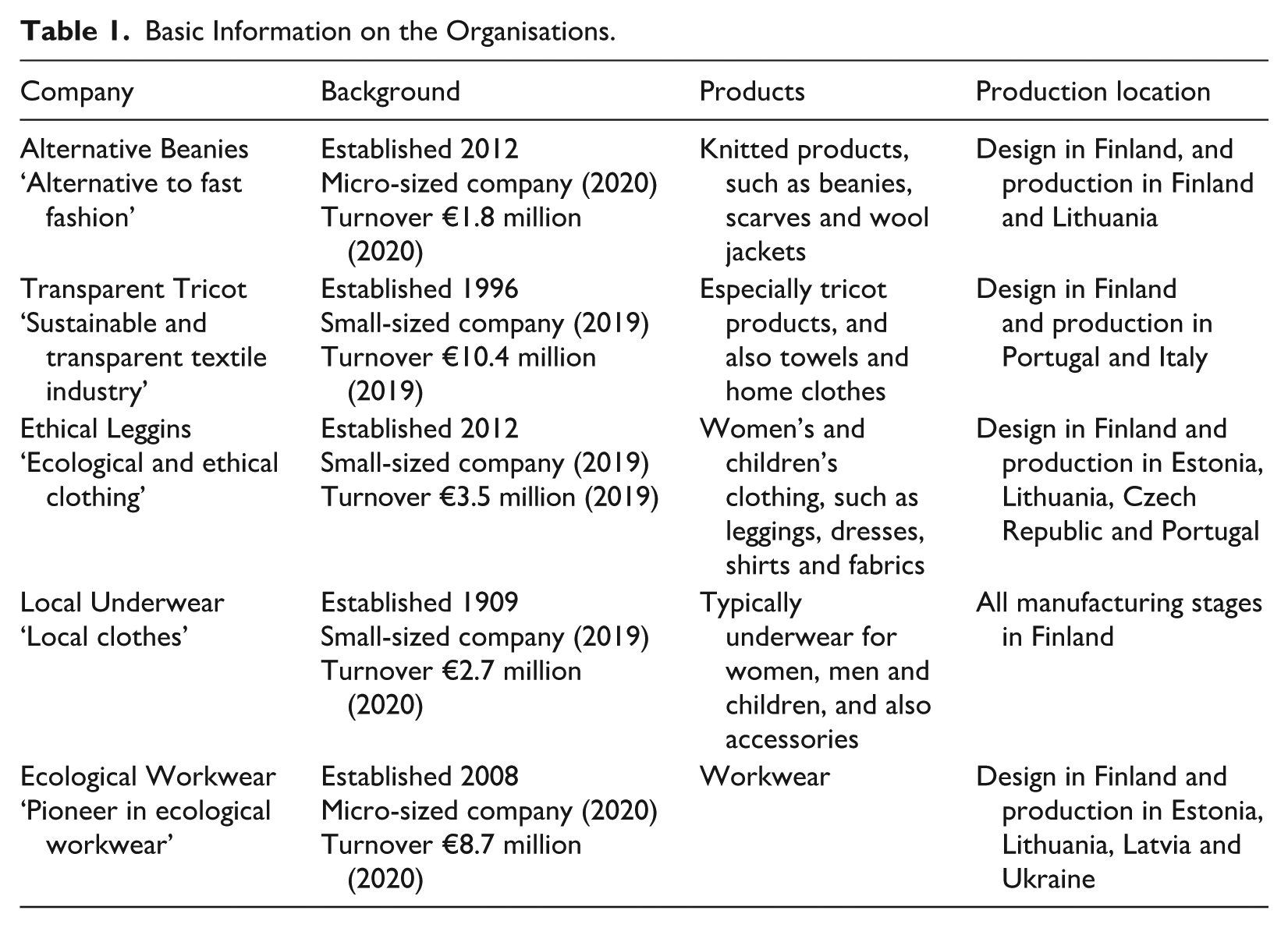
Several criteria were used to select the companies for empirical investigation. First, small textile companies (in terms of number of employees and sales) with several years of experience operating in the field were selected. Maturity is a typical feature of this industry in Finland, and we wanted to focus on established companies that survived the early financial struggles of start-ups. Moreover, we chose companies that identified themselves as sustainability pioneers in the Finnish textile industry. While familiarising ourselves with the Finnish textile industry, we noticed that the smaller companies tended to focus more on sustainability issues and be more sustainability value-driven than the larger ones. Based on these criteria, we focussed on five companies that were willing to participate in the study, referred to by the pseudonyms Alternative Beanies, Transparent Tricot, Ethical Leggins, Local Underwear and Ecological Workwear to ensure their anonymity. The companies’ strategies emphasised an alternative to fast fashion by underlining sustainable decision-making in their products and production. Local Underwear was peculiar in that its manufacturing operations were still located in Finland. Ecological Workwear targeted business-to-business markets while producing ecological workwear and the other companies targeted business-to-customer markets. The companies’ small size implies that they have the agility to quickly change their operations and sustainability goals but limited power to influence the operational logic of the whole industry (Berti & Simpson, 2021). Table 1 provides more detailed information on the companies.
Basic Information on the Organisations.
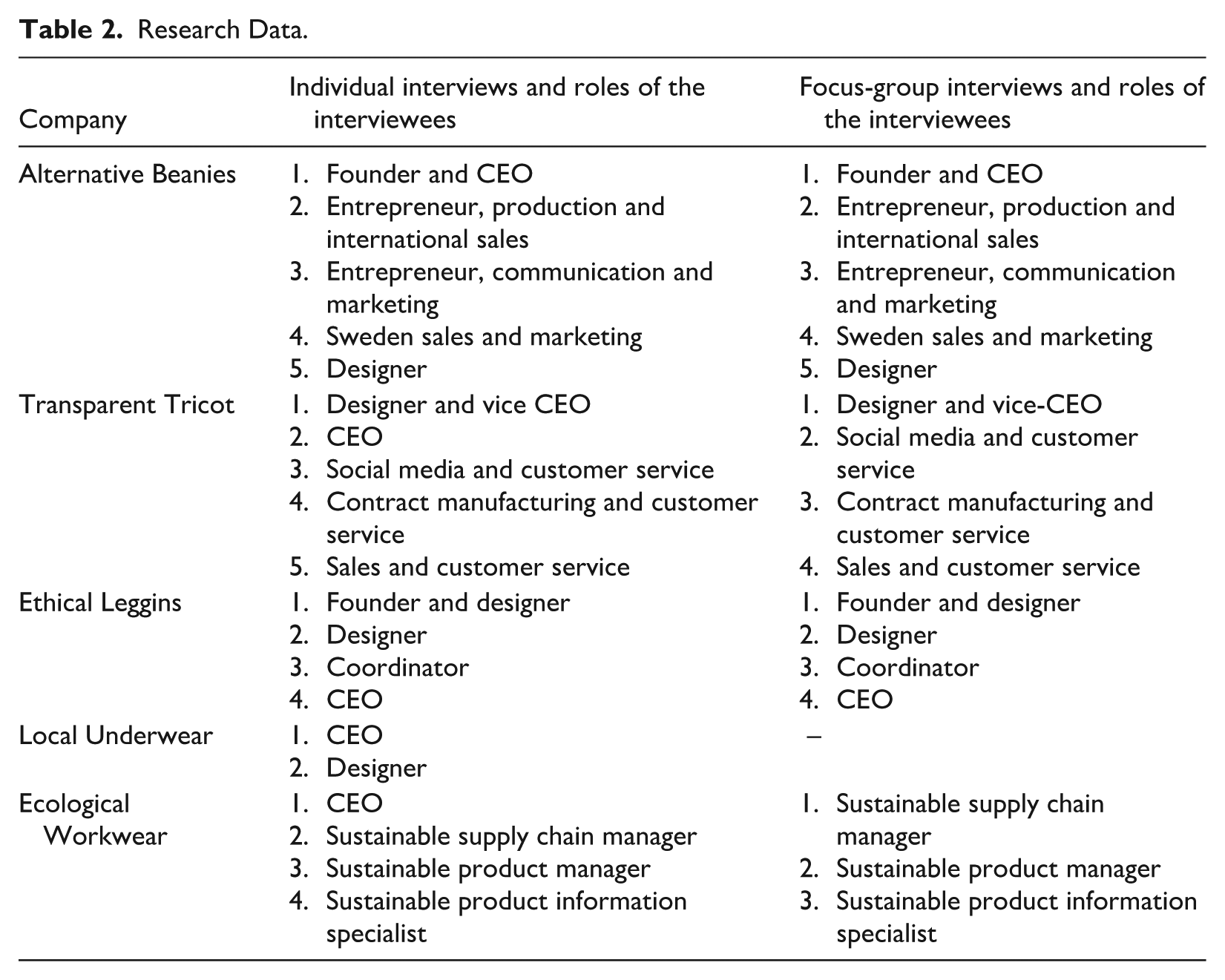
Many types of data may have narrative qualities, and the definition of a narrative may vary (Czarniawska, 1995). In our data, the narrative accounts related to sustainability work are as told by the research participants. Meanings in organisational life are those created and discovered through people’s narration. Consequently, narratives create a space for the representation of the organisations within which people find themselves (Phillips, 1995). Empirically, we conducted individual interviews with 21 participants working in different roles in the companies. These interviews were a narrative co-creation between the interviewee and interviewer that made sense of and narrated sustainability work and related tensions. To complement the emerging issues, four focus-group interviews (16 participants) were organised with those who agreed to elaborate on their ideas in a collective setting. The focus-group setting was considered to enable collective sense-making of sustainability work. We decided to conduct the individual interviews first, followed by focus groups within the next 3 months, to achieve a layered understanding of the topic. Individual interviews allowed participants to articulate their personal perspectives and experiences without being influenced by group dynamics. Hence, they provided a foundation for exploring key themes and individual-level insights that might be overshadowed in a collective setting. Subsequently, focus-group interviews aimed to investigate how these individual viewpoints interacted within a group context, illuminating the processes by which meanings are collectively negotiated and constructed, and offering a richer understanding of the topic as a social phenomenon in the studied companies. Focus groups are particularly valuable for uncovering group dynamics, such as the emergence of opinion leaders and the negotiation of conflicting views. They also provide an opportunity to see how individuals align with or contest each other’s perspectives, highlighting power dynamics and revealing whose voices carry the most weight within the group (Bell et al., 2022).
The research participants worked at different levels in the companies, from CEO to designers to those responsible for sales, marketing and customer service. Despite their variety of job titles, the interviewees were identified by the companies as persons with practical experience in sustainability work within their organisations. Most often, the participants were interviewed in both sessions. In narration, sense-making largely depends on the ability to think in narrative terms, which emphasises that connecting events in the context of narrating is critical for understanding events (J. Bruner, 1991), and interactions in the focus groups allowed for a more nuanced perspective on diversity and consensus (Morgan, 1996). The primary goal of this method was to understand the interaction resulting from discussions among the participants (e.g. questioning one another, sharing experiences and commenting on each other’s experiences) to deepen our enquiry and reveal aspects of the phenomenon that might otherwise be less accessible. Table 2 provides more detailed information on the research participants.
Research Data.
The individual interviews lasted between 35 and 67 min (53 min on average). To collect the interview data, a semi-structured interview protocol with the following themes was utilised (Bell et al., 2022): background questions relating to the job description and relevance of sustainability, information on how the interviewees made sense of their roles in the company’s sustainability work, sustainability practices within the organisations that generate information on collective sustainability work and any tensions resulting from sustainability work in their organisations.
To collect focus-group data, four focus groups were formed consisting of participants (three–five) from single companies because of the sensitive nature of sustainability issues and the need to examine each organisation’s narration separately. The focus-group discussions lasted from 45 to 63 min. One company refused to participate in the focus-group discussion because of the ongoing COVID-19 pandemic and its effects on businesses. Some individually interviewed participants did not have time to participate in the focus groups, leaving 16 respondents in these groups. The focus-group discussions were built around six themes: (1) introducing sustainability, (2) understanding sustainability, (3) sustainability work in the company, (4) (dis)agreement regarding sustainability work goals, (5) practical examples of tensions or problematic issues related to sustainability in the company and (6) reviewing the emphasis on different sustainability dimensions (economic, social and environmental) in the company. In the focus groups, the researcher introduced the themes and the participants were then allowed to comment, discuss and argue freely about the theme and others’ comments and viewpoints. Owing to the COVID-19 pandemic, all focus groups were conducted via Zoom. The data collection was conducted in Finnish. The discussions were recorded and later transcribed verbatim. The quotations presented in this article have been translated into English by the authors and proofread by a professional editor.
Data Analysis
The analysis proceeded in four iterative rounds involving all authors to spark insight and develop meaning (Srivastava & Hopwood, 2009). The analytical process and engaged in continuous reflection and dialogue rather than seeking hasty consensus at various stages of the study. After an initial immersion in the data through repeated readings, the first phase involved the thematic coding of how sustainability-related issues were made meaningful by the research participants. All authors participated to the coding. This phase focussed on identifying themes connected to sustainability work, including organisational strategies (e.g. prioritising circular economy models), strategic orientations (e.g. risk minimisation, value creations, and short- and long-term horizons), key actors (e.g. managers, employees, units, supply chain actors and external stakeholders), core organisational values (e.g. domesticity, integrity, authenticity and innovation), as well as perceived sustainability challenges (e.g. balancing short-term profitability with long-term environmental goals) and the degree of transparency in sustainability standards, practices and actions. Our analysis was informed by an interest in how language constructs and negotiates sustainability. In particular, we examined how sustainability concerns were acknowledged, activated, foregrounded or resisted in participants’ discursive practices and sense-making processes (Schoeneborn et al., 2019). For example, references to greenwashing often signalled critical reflection on the gap between stated values and actual practices.
The second round of analysis, namely, a narrative reading of the data, focussed on the narration and the forms it took in the studied organisations. We analysed the structure, tone and content of individual accounts within each of the five organisations, paying attention to the kinds of narrative forms that emerged (e.g. heroic, tragic and restorative). For instance, in one organisation, a senior manager framed sustainability work as a ‘battle against the odds’, invoking a narrative of struggle and perseverance, while another described it as a ‘journey of awakening’, suggesting personal and organisational transformation. We traced how these narrative forms gave shape to organisational events and how they reflected broader tensions, such as between compliance and innovation or between individual commitment and organisational coherence. This phase also considered how actors positioned themselves and others, and how agency was distributed, contested or missing in relation to temporal sequences (past failures, present actions and future aspirations) and relational dynamics (e.g. partnerships, silos and stakeholder pressures).
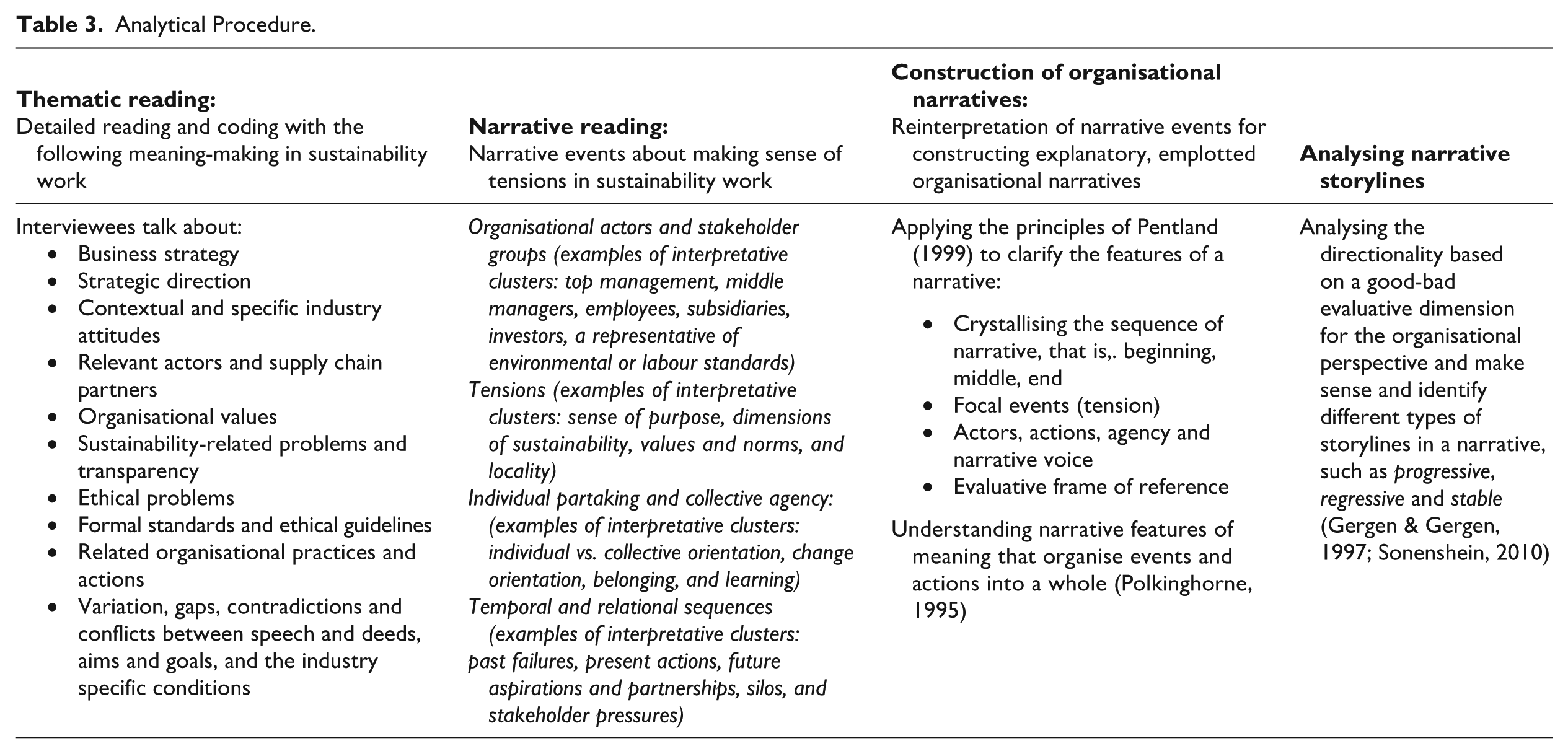
In the third round of analysis, we reinterpreted narrative events to construct more coherent organisational-level narratives. Drawing on Pentland’s (1999) narrative principles, we sought to clarify the sequence of events by identifying their beginnings, middles and ends while also mapping the key actors, narrative voices and focal events. We further assessed the evaluative frames of reference to produce meaningful trajectories that rendered the tensional nature of sustainability work from an organisational perspective. Our analytical approach is informed by the distinction between paradigmatic and narrative cognition, as articulated by J. Bruner (1986) and later elaborated by Polkinghorne (1995). In his original work, Bruner stated that paradigmatic cognition operates by recognising elements as members of a category, while narrative cognition operates by combining elements into a narrative that is structured and meaningful. Our research aligns with narrative inquiry, which focusses on combining events and happenings into a coherent, emplotted narrative. In our study, we gathered events and happenings told by the research participants. These events were not analysed in isolation or categorised into taxonomies but were interpreted and connected into more emplotted narratives that explain the phenomena under investigation at the organisational level. The details of the analytical procedure can be found in Table 3.
Analytical Procedure.
In the fourth round of analysis, we applied Gergen and Gergen’s (1997) narrative framework to identify valued outcomes within organisational narratives and to examine the underlying storylines. This approach enabled us to analyse the narratives’ directionality through an evaluative lens, following the logic of a good–bad continuum. In this framework, a positive storyline was associated with perceived satisfaction or success, while a negative one reflected failure, disappointment or stagnation. MacIntyre (1985) argues that narratives necessarily operate within an evaluative structure, wherein notions of what is and is not preferred to contribute to the unfolding of either unfortunate or happy outcomes. Here, our evaluative structure meant the jointly negotiated state and preferred outcome for the organisation. Storylines in narratives can fluctuate over time (Ricoeur, 1983). Consequently, all narrative plots may be converted into varying stable, progressive or regressive linear (Sonenshein, 2010) forms in terms of their evaluative shifts over time, creating narrative forms, such as success, tragedy or stable narratives (or other, more complex, variations). This realisation guided our study of the narratives and enabled us to identify the evaluative shifts and desired outcomes of sustainability work and related tensions. The analysis also examined how the narratives served to enable, confuse or decrease collective agency, as analysed through descriptions of the collective (in)ability to act for sustainability (Bandura, 2006). This analytical procedure identified evaluative shifts in the desired outcomes of sustainability work. As a result, three types of organisational narratives were identified with sustainability work, which focus on how inherent tensions and collective agency are entangled therein: (1) the consolidating narrative of prestige, (2) the surrendering narrative of powerlessness and (3) the obscuring narrative of idealism. These are explained in detail below.
Findings
The Consolidating Narrative of Prestige
The first organisational narrative, the consolidating narrative of prestige, portrays the textile company as a prestigious pioneer in sustainability within the industry. This dominant narrative is co-constructed across all five studied companies, and originates from a deep sense of pride in the company’s pioneering status coupled with a responsibility to lead by example in navigating the complex sustainability transitions faced by the industry. This pride is explicitly expressed in achievements, such as developing fair taxation practices (Alternative Beanies Interview 2).
As the most prevalent organisational narrative in the research data, it is narrated across all levels and departments within the organisations, from employees to management. However, it frequently amplifies the managerial perspective, emphasising the need to maintain an internally coherent view of sustainability work. The multiple voices and their dominance underscore the pressure to maintain coherence across hierarchical and functional boundaries in organisations when performing sustainability work. For management, this means fostering a shared vision while navigating the complexities of implementing sustainability initiatives in an industry characterised by evolving standards and expectations. For employees, it is voiced as reconciling daily operational demands with broader sustainability commitments, which may not always align seamlessly. This bonding is constructed as critical in facilitating negotiations among organisational members and as working towards the sustainability identity of the companies. For example, a CEO described the work as requiring ‘forcing and pushing through [of] changes’ while continuously envisioning future transitions (Ecological Workwear Interviewee 1).
Although the organisational narrative concerns mobilising prestige and pride in sustainability work, it is noteworthy that the narrative meaning-making on tensions is primarily inward-focussed rather than directed at external stakeholders. This inward orientation interpellates organisational members to develop a specific understanding of themselves and their roles within the company’s sustainability efforts. This inward-focussed organisational narrative thus fosters a collective sense of responsibility, reinforcing the notion that the company is a pioneer in sustainability and is necessary to create innovative sustainability solutions when no comprehensive industry standards exist. One interviewee, for instance, linked the lack of such standards to the uncertainties in sustainability work: Yes, it’s probably related to what we already discussed; that there are no industry standards. Then, of course, maybe we should also think about [the fact] that not everybody is such a frontrunner and so [will adopt] sustainable [measures] as quickly as we would like them to. So every now and then, we have to take a few steps back, but that is our job (Ecological Workwear Interviewee 4).
In this organisational narrative, the initial ostentatious portrayal of the company’s pioneering sustainability efforts gradually gives way to deeper questions about the feasibility and nature of responsibility, highlighting the evolution in the perceptions of tensions within sustainability work. The tension between individualism and collectivism becomes a central theme in the narrative’s development. The former is reflected in personal views and varying levels of engagement with sustainability work, shaped by factors such as job descriptions, personal values and individual interpretations of sustainability. While distinct, these voices are interwoven into the fabric of the companies’ sustainability identities, reflecting a variety of interpretations and practices that stem from different parts of the company. Hence, there is a fragmented understanding of the core logic behind sustainability efforts, with different employees interpreting and prioritising sustainability in ways that align with their own roles and perspectives.
In contrast, collectivism emerges as shared values and common perspectives on sustainability within the organisation. The middle section of the organisational narrative delves into the relationship between individual and collective values, revealing a pronounced tension between the two that manifests in divergent approaches to sustainability across departments. For instance, one interviewee juxtaposed the sustainability practices of the sales and marketing departments with those of her own, illustrating how differing departmental priorities and perspectives often lead to inconsistent interpretations and implementations of sustainability objectives. This discrepancy not only highlights the challenges inherent in achieving a unified organisational approach but also underscores the complexity of aligning diverse departmental practices with overarching sustainability goals. Then, the organisational narrative conveys the difficulty of reconciling individual motivations with collective organisational imperatives, illustrating the ongoing struggle and process of sense-making to establish a coherent and integrated sustainability strategy. This process involves navigating diverse perspectives and finding common ground, ensuring collective agency while simultaneously honouring the diverse personal values and aspirations that inform and enrich individual roles within it: It’s the kind of internal communication (between units) where we always have to think about how to do it in such a way that the information is passed on and that it’s there. And then [in such a manner] that sales, for example, could own it, in a way. So, when a salesperson goes to sell the product to a chain, they would feel strongly and confidently about the big picture (Ethical Leggins Interviewee 2).
In the narrative, the view is created that sustainability work entails the complex meaning-making of tensions from the perspectives of individuals. However, in the organisational narrative, this fragmentation is incorporated into collective sense-making to work towards a solution and the creation of joint values and identities. As individuals from different groups and units engage in discussions and reflect on their own perspectives, they become increasingly attuned to the views of others within the organisation. This dialogic yet counteractive process allows for the gradual construction of a more coherent collective vision of sustainability despite initial divergence. For example, during the focus-group discussions, the participants noted how sustainability thinking became more ingrained in the organisation over time, leading to a shared understanding of sustainability principles (Alternative Beanies focus-group discussion). This process of convergence constitutes an ongoing, dynamic negotiation – rather than a singular event – characterised by periodic setbacks and the continuous rearticulation of individual perspectives in pursuit of alignment with collective aspirations.
By the end of the narrative, the previously discordant voices converge into a unified collective action, but not through the silencing of individual contributions. Rather, collective agency emerges as a product of the process itself, where multiple voices are actively integrated, negotiated and reinterpreted in the pursuit of common goals. This process highlights the importance of a collective vision in developing an understanding of sustainability work as inherently tensional, and enables organisations to maintain momentum and adapt their approaches to the complexity of sustainability efforts, ensuring that the voices of all members are meaningfully integrated into a continuous, dynamic process of organisational transformation.
Overall, this positive narration promotes the ability to collectively engage in sustainability work and produce solutions within an organisation. However, individual orientations are then somewhat pushed aside by the collective orientation to provide solutions that enhance sustainability work. As the narrative ends with a desired outcome, namely, a jointly negotiated and discussed solution to resolve the constructed tensions, it can be interpreted as a ‘success’ narrative (Sonenshein, 2010), which implies a readiness to confront challenges and overcome obstacles, often portraying individuals or organisations as not fully equipped to navigate complex issues: At least for me, if there’s a situation that hasn’t occurred before, then there isn’t necessarily a clear procedure, but I feel that this is a situation where we need to act sustainably and that maybe it’s a difficult issue. Then, we usually have a meeting, find common ground, and make a decision about what to do (Alternative Beanies focus group interviewee).
The consolidating narrative of prestige is characterised by a pervasive sense of contentment, which ultimately cultivates a progressive trajectory with an envisioned, yet constrained, outcome (Gergen & Gergen, 1997). Despite the tensions subtly manifesting within the narrative, a recurring feature is the collective readiness to act and generate ostensibly viable solutions. While such an organisational narrative may facilitate collective agency in sustaining and reinforcing sustainability initiatives, it simultaneously limits space for alternative or dissenting voices to emerge. Consequently, it serves to legitimise existing practices, yet bears the inherent risk of subtly manipulating individuals within the organisation (Whittle & Mueller, 2012). This narrative emplotment, in turn, risks engendering an illusory sense of being ‘sufficiently proficient’, thereby entrenching a complacency that inhibits the pursuit of more radical, systemic change. The implications of this are profound, as it may effectively marginalise the critical need for more radical transformations in response to the urgent sustainability challenges facing the textile industry.
The Surrendering Narrative of Powerlessness
The second organisational narrative, referred to as the surrendering narrative of powerlessness, begins by framing the company’s sustainability efforts as constrained and limited, emphasising the boundaries within which it operates. It presents sustainability goals as distant or beyond the company’s influence, highlighting the challenges the organisation faces in effecting meaningful change. This narrative positions sustainability issues, such as mass production, waste management and the circular economy, as inherent to the textile industry, and its sustainability work with complexities. Sustainability issues are set largely outside the company’s control due to factors, such as geographical or social distance. This narrative was prominent in all companies, except Local Underwear. It contrasts with the first organisational narrative by emphasising the external orientation to the external challenges faced by the company, particularly those related to its supply chains, which are often seen as the primary locus of tensions in sustainability work with far-reaching sustainability problems.
The narrative centres on the tensions between the different dimensions of sustainability – economic, social and environmental – which form the core of the storyline. These tensions are framed as both internal challenges and reflections of broader societal issues. The organisational narrative is externally focussed, with a prominent role given to experts, particularly those in manufacturing and supply chain management, who are tasked with navigating the complex and morally laden decisions that arise from the clash among social, environmental and economic goals. For example, several interviewees highlighted the limitations they faced in tracing the conditions of raw material production (Alternative Beanies Interviewee 4) and the challenges in obtaining reliable data for sustainability reporting (Transparent Tricot Interviewee 5). Within this organisational narrative, sustainability work is portrayed as necessitating compromises and trade-offs. Decisions are often framed as balancing competing demands, such as material costs, customer willingness to pay premium prices, conflicts with prevailing industrial norms and regulations, and the financial risks involved. This narrative underscores the inherent tension in trying to achieve sustainability goals within the context of broader industry practices, as illustrated by the interviewee from Ecological Workwear: Then, on the other hand, we are always struggling with the fact that we don’t produce our fabric or material ourselves, and so we are at the mercy of our fabric suppliers. Sometimes, we have to push them a little bit so that we can get ecological materials that would have even a little bit of Spandex so that we could do those things (Ecological Workwear Interviewee 4).
The middle section of this narrative indicates that workers were inspired to evaluate the tensions in terms of consequences for the company. The narration problematises the time and space in tensions (Molecke et al., 2024), and explains the impact of the country or geographical location on narrated tensions. For example, one interviewee described a challenging situation in which the legal system and infrastructure do not allow the same sustainability solutions as the Finnish system (Transparent Tricot Interviewee 2). Here, the narration mobilises collective agency and expands beyond individual actions, recognising that sustainability issues go beyond organisational boundaries. It emphasises the importance of cross-departmental collaboration and external partnerships in navigating these tensions, fostering shared accountability for living with the tensional nature of sustainability work. The complex narration about living with the tensions also enables the use of economic performance rhetoric, which is often used as an argument against making more radical changes in relation to sustainability work.
A juxtaposition between mass production and degrowth objectives was constructed as a central problem. The middle part of the narrative is characterised by a sense of confusion within the organisations, with little guidance on how they can respond to these complex challenges in a way that leads to satisfactory resolution. It then shifts towards an emphasis on the need for moral reasoning for management and employees in navigating these problems, concluding by categorising sustainability decisions as either good or bad, as illustrated in the following example: Or [the question] of whether I would rather get it from China, where I can get high-quality recycled polyester; so these kinds of considerations [are important], and because there isn’t an absolute solution that one thing is right and the other one is wrong or the other one is . . . (Ethical Leggins Interviewee 1).
Despite a clear desire among the interviewees for stakeholder dialogue, their efforts were largely ineffective in achieving meaningful sustainability outcomes. This portrayal of powerlessness reflects a broader frustration, particularly in the latter stages of the organisational narrative, where the inability to enact meaningful change becomes central. The tensions inherent in sustainability work are presented as stemming from external sources – primarily societal structures or supply chains – and positioned as forces beyond the organisation’s control. Within this narrative, the interviewees stressed how these external factors inhibited their ability to access crucial sustainability information. One particularly striking example was an interviewee’s frustration with their inability to obtain objective data on the sustainability of materials used, instead relying on potentially biased marketing materials provided by suppliers.
This organisational narrative highlights a perceived disconnect between the organisation’s aspirations for sustainability and the structural, informational and systemic barriers that undermine its ability to act effectively. The general lack of consensus and, in many cases, the company’s small size created a sense of powerlessness. It is important to note that collective agency, strongly narrated in the first narrative, is portrayed as unattainable in this narrative. The interviewee felt frustrated and irritated that no common solution could be found or was even desired, resulting in their voicing a ‘tragedy’ narrative ending in undesirable outcomes (Gergen & Gergen, 1997).
Forces outside organisations (fast fashion and degrowth) influence how sustainability is acted upon, leaving organisations and the people within them with a sense of powerlessness in their sustainability work. This narrative emplotment then suggests a disconnect between intent and impact, producing a sense of stagnation and an inability for influence, thereby leaving very little space for collective agency in sustainability work. This organisational narrative has many negative consequences because it not only legitimises current modes of action but also poses the danger of alienation from one’s own actions and those of others in the organisation (Whittle & Mueller, 2012). This opens the way for distancing sustainability work and related tensions in organisations, as if they were merely passive recipients of external forces, thus obfuscating their agency.
The Obscuring Narrative of Idealism
The third organisational narrative, characterised as the obscuring narrative of idealism, begins with a recognition of the disconnect between aspirational sustainability goals and the practical realities of implementing them within the organisation. This narrative is marked by uncertainty and confusion, and highlights the ambiguity surrounding the definition, scope and objectives of sustainability within the organisational context, as these are often influenced by the knowledge and information available about sustainability practices. The organisational narrative grapples with the complexities and interpretative challenges that arise in aligning idealistic visions with organisational capabilities. Here, sustainability work is often portrayed with limited visibility and its potential impact within the organisation. This narrative is least common in the data and was mainly co-constructed in the Ethical Leggins and Ecological Workwear companies.
This organisational narrative exposes the inherent tension between embeddedness and decoupling, as multiple voices clearly demonstrate how conflicting perspectives on sustainability and integration actively disrupt and challenge the pursuit of sustainability work. One voice, representing a more optimistic view, argues that sustainability should be deeply embedded within an organisation’s systems – its strategy, structure, processes and operations. A contrasting voice highlights the decoupling of sustainability from organisational processes, raising concerns about the disconnection between sustainability goals and actual practices within the organisation. For instance, an interviewee at Ethical Leggins voiced doubts about the ability of the marketing team to effectively address sustainability, questioning whether their efforts align with the broader organisational strategy (Ethical Leggins Interviewee 1).
The narrative also brings in voices that reflect the tension between idealistic goals and practical limitations. These often-disruptive voices highlight the challenges of translating sustainability aspirations into concrete actions. The divergent interpretations do not merely reflect differences but enact the contested terrain of tensions inherent in sustainability, revealing how organisational practices are simultaneously shaped by normative commitments and strategic decoupling. One interviewee, for example, questioned whether sustainability, as a concept, is even achievable, demonstrating the uncertainty and complexity that surround sustainability efforts within the organisation. This diversity of voices illustrates the interpretative nature of sustainability, where different individuals within the organisation perceive, enact and question sustainability in varied ways, complicating the path towards meaningful change. For example, one interviewee questioned whether the concept of sustainability is even an achievable goal: If you talk about sustainability, it has to be looked at from every single aspect. There might be situations where we think about whether something is sustainable or not. There might be a situation where we must use an airplane for cargo because it has to be shipped, and it takes much longer with a train or a ship. Then, sometimes, you must sit down and look at the facts that this [alternative] is not ecological, but (it) has to be done (Ecological Workwear focus group interviewee).
The organisational narrative builds on complicating the commitment and recklessness in sustainability work by asking if organisational members are engaged in such work and, if so, to what degree and what meaning each individual gives it. This is illustrated in the following quotation: Maybe, if we think about ethical, ecological, and economic sustainability, they are divided differently for different people, which relates to your earlier question about how it is visible to different people. Everybody looks for it from their own perspective, and then there are such broad [solutions] – it’s such a broad concept – and so much has to be taken into account. Everybody is bound to have their own perspective on it (Ecological Workwear Interviewee 5).
However, unlike the two previous organisational narratives, this one did not follow a clear structure of beginning–middle–end. After stating the mismatch between sayings and doings, the narrative is fluctuating and unstable, focusses on discussing difficulties in actively promoting sustainability changes and is filled with both positive and negative narrations. This narrative’s characteristic is that it includes uncertainty about the results and the influence of such actions. One interviewee highlighted the plurality of the process and that it is affected by multiple employees, and, for example, temporal time constraints: About what doesn’t work well, the challenge we have now is that they are quite large processes. With respect to the number of employees, everybody has quite big areas of responsibility. We are making a sustainability plan. It’s a three-year plan. Sometimes the practical implementation is hard because of our schedule (Ethical Leggins Interviewee 2).
Although the interviewees mentioned that the companies actively promoted sustainability, the extent to which they could do so and the end results remained highly unclear in this narrative. This resulted in a narrative with ups and downs and a fluctuating and unstable storyline (Gergen & Gergen, 1997), presenting a disconcertingly blurred space for collective agency in relation to tensions in sustainability work, thus contributing to a lasting sense of confusion. In contrast to earlier narratives, this one is notably characterised by its lack of a definitive conclusion, as it remains conspicuously unfinished and unresolved. A clear consensus on appropriate courses of action is absent. As such, collective agency is notably absent from the narrative emplotment.
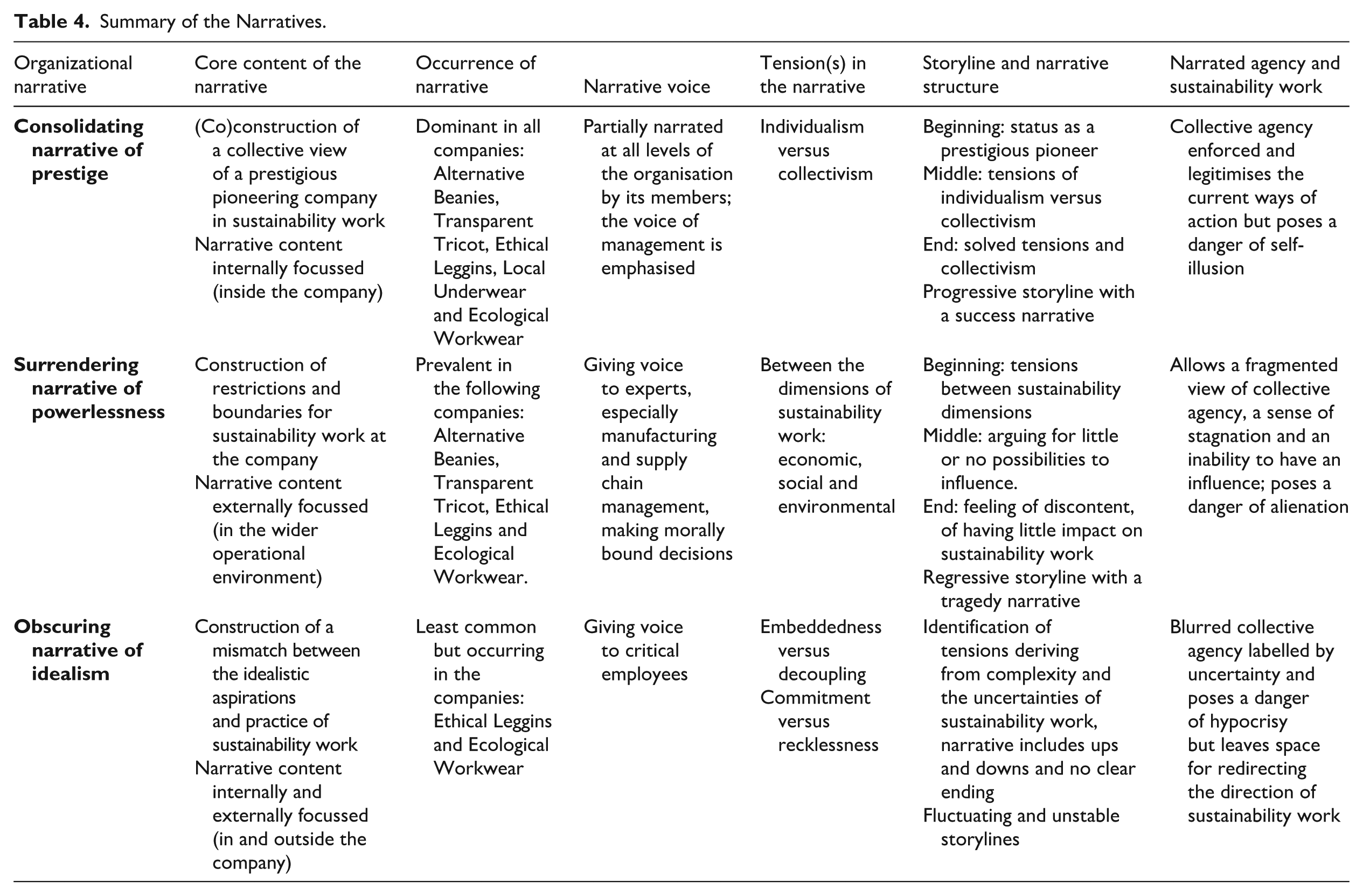
This lack of resolution has two consequences: on one hand, it provides space for critical voices to emerge, which may, in turn, propel sustainability work towards more radical transformations. On the other hand, it introduces a risk of hypocrisy (Whittle & Mueller, 2012). Within this organisational narrative, hypocrisy often manifests in the portrayal of certain tensions as ostensibly ‘resolved’ despite the persistent contradictions that remain embedded in organisational practices. The narrative therefore functions as a space in which the complexities of sustainability are both acknowledged and obfuscated, creating a tension between the potential for meaningful change and the risk of superficial resolutions. Table 4 provides a comparative summary of the key elements of each of the analysed organisational narratives.
Summary of the Narratives.
In summary, the consequences of the organisational narratives are equivocal. The first was the most optimistic, reconstructing an empowering and active yet collective desire for action. However, the dominance of this type of narrative can leave little room for a critical evaluation of what such narratives can mean for an organisation’s own sustainability work. By silencing alternative voices, they can blind organisational members to the complexity and ambiguity of tensions and how tensionality is perceived. However, through the narrative approach, tensions and alternative voices are a critical starting point for sustainability work and necessary for it to advance. The second organisational narrative is characterised by negative storytelling, based on the idea that there is little space to negotiate tensions and related solutions, which, according to the narrative, may result in the fragmentation of collective agency. Moreover, it gives organisational members a chance to distance themselves from tensions and sustainability work, and ultimately even reduce or suppress their interest in committing to sustainability work. The third organisational narrative, despite being the least prominent within the companies, is marked by a notable sense of ambiguity and disorientation. Despite these inherent difficulties, the third narrative argues that occupying a leading position in sustainability can serve to illuminate the multifaceted tensions at the cutting edge of industry practices.
Discussion and Conclusion
In this study, a narrative approach to sustainability work with tensions was utilised to shed light on the complexity of sustainability work in the controversial field of the textile industry. The study aimed to investigate how organisational narratives on sustainability work and the tensions inherent therein shape collective agency. It showed how narrative structures are constitutive of action in the constantly evolving sustainability work of organisations by introducing three prevailing narratives from the empirical data: (1) the consolidating narrative of prestige, (2) the surrendering narrative of powerlessness and (3) the obscuring narrative of idealism. This study addressed how tensionality and emplotment resulted in progressive, regressive or unstable storylines that may serve to maintain, fragment or confuse and reduce collective agency in sustainability work within these organisations. Each narrative ascribed different meanings to tensions in sustainability work, and the narratives’ evolution had implications for collective agency by reconfiguring it.
This study extends the narrative approach to sustainability work and related tensions therein by offering an understanding of sustainability work as consisting of multiple voices and constantly negotiated and evolving and shows how narrative structures are constitutive of action in this field. It further creates an understanding of the tensional nature of sustainability work as a polyphonic and evolving process – collectively shaped through continuous negotiation, reflexivity and situated meaning-making. It foregrounds the constitutive role of narrative structures, not merely as representational devices but also as dynamic spaces through which organisational actors can generate and reduce enduring ambiguities and contradictions.
Importance of sustainability work as talked and narrated in creating and shaping action has been established in sustainable business research especially as performative nature of language use that has a potential to stimulate sustainability improvements (Christensen et al., 2013), extent the dynamics between talk and action (Christensen et al., 2021) and even cultivate progressive performance for sustainability (Penttilä, 2020). While the performative nature of sustainability talk is often found to have positive features by catalysing sustainability practices, it may also cause misrecognition when interpreted as merely ceremonial (Trittin-Ulbrich, 2023).
Situated within this body of research, our study expands from existing research by foregrounding the role of tensions in organisational narratives of sustainability work. Rather than viewing sustainability talk as either a catalyst for change or a vehicle for symbolic action, we put forward that tensions embedded in narratives are themselves constitutive of organisational life. In doing so, our study contributes to a more fine-grained understanding of the performative nature of sustainability talk, one that highlights its ambivalent, contested and dynamic qualities in the everyday practices of organisations. While prior research on tensions in organisation’s sustainability work is dominated by how tensions evolve and exists (Hahn et al., 2018; Luo et al., 2020; Van der Byl & Slawinski, 2015), and shows how they are strategically managed and solved successfully (Canales, 2014; Daddi et al., 2019; Luo et al., 2020; Siltaloppi et al., 2021), our narrative approach stresses them as constantly evolving in language use by multiple voices and role of polyphony in organisational narratives on sustainability work. Narratives create spaces for people to have representation and give meanings to the organisations within which they find themselves (Phillips, 1995). Those allow organisational actors can enact and contest enduring ambiguities and contradictions and may allow the creation and maintenance of jointly negotiated realities and understandings of sustainability work with tensions. Narration may add consistency and harmony for action within organisations, as it gives room for all voices to be heard and ensures that no single powerful voice, such as that of management, dominates (Rantakari & Vaara, 2017; Sonenshein, 2010).
Our study advances the debate on the performative nature of sustainability talk – and its role in shaping agency – by examining the complex ways organisational narratives on sustainability intersect, rely on and undermine one another. These narrative entanglements are far from harmonious: they can as easily propel collective agency as they can reduce it. Such dynamics are not always mutually exclusive, but the interrelation of co-existence and evolvement has the potential to shape the collective agency. While previous studies in the narrative strand of tensions related to sustainability work have shown how such tensions are created in language use (Høvring et al., 2018) and are discursively constituted and denied (Hoffmann, 2018), this study demonstrates how such narration, entangled with sustainability work-related tensions, can continuously maintain, fragment, confuse and reduce collective agency sustainability work through different narrative directions. As such narratives simultaneously exist and evolve in organisations, their complex relationships are meaningful for how sustainability work is acted upon and (re)developed in organisations. That is, narration and related tensions can have a serious impact on freezing, challenging and/or making visible individual and collective beliefs and action models on what is to be included in sustainability work and how it should be developed ethically in the organisation (Carmine & De Marchi, 2023). For example, in our study, as the consolidating narrative of prestige may create sense of success and legitimise the current ways of action, simultaneously evolving surrendering narrative of prestige may create sense of stagnation through due to inability to influence. In addition, obscuring narrative of idealism may fluctuate to create uncertainty and thus blur and reduce the potential for collective agency for sustainability in organisations.
The impact of organisational narratives on collective agency for sustainability is neither straightforward nor uniform, but rather convoluted. Constantly evolving and co-existing organisational narratives may confuse sustainability work, as they can function as mechanisms for framing sustainability goals as either (in)comprehensible or (il)legitimate, both within the organisation and among its stakeholders. This means that these narratives have the power to transform emerging situations into ambiguous or equivocal ones, potentially fostering problem-solving strategies that appear to be at odds with the core demands of sustainability work. While such narratives may introduce certain constraints, they also offer flexibility in social interactions by presenting information, ideas or practices in ways that evoke varied interpretations (Bartel & Garud, 2009). This was evident in the research data, where interviewees expressed similar points yet simultaneously conveyed different patterns within organisational narratives, highlighting the tensions and complexities inherent in sustainability work (Bartel & Garud, 2009).
By considering how far the studied textile companies wish to be pioneers and role models in sustainability work, the empirical analysis also showed some dangers in the narratives’ constitutive nature to action. For example, a consolidating narrative of prestige as a strong success narrative, related tension between individualism and collectivism, created the possibility of freezing or restricting collective agency by enforcing and maintaining the status quo in sustainability work, thus legitimising incremental change. This type of narrative may also prevent or retard organisational storytelling and self-reflection on the need for more radical change. Given that most organisations still lack solutions to meet current global sustainability challenges (Hahn et al., 2018), sustainability work within pioneering organisations in different industries would benefit from adequately engaging in a constant narration with a reflective, change-seeking and renewing aim. To date, the empirical data have mainly yielded unstable narratives (the obscuring narrative of idealism) in this sort of narration.
The study highlights several limitations that needs to be considered and may open avenues for future research. First, a deeper exploration is needed into how organisational members at different career stages interact with sustainability narratives and what it reveals about individual and collective agency in organisations. Narratives, whether stories, sagas, legends or myths, are central to organisational cultures and act as crucial vehicles for socialisation (Trice & Beyer, 1993). Future research could investigate how these narratives influence individuals during the early stages of their careers, particularly how such individuals are socialised into sustainability practices amid the tensions inherent in sustainability work.
Second, while this study focussed on organisations striving to be sustainability pioneers within a controversial industry, it is equally important to understand the sustainability efforts of organisations that lag in this area. These laggards may exhibit resistance or alternative forms of engagement with sustainability, and understanding their approach is essential in fostering broader systemic change. This means that labellings like ‘pioneers’, for example – that prevail in the institutional environment and are adopted in organisational narratives can imply a variety of meanings and interpretations. Narrative approaches could uncover how tensions around sustainability pioneering or resistance are framed and maintained within these organisations, shedding light on the barriers to progress or to the illusions kept alive in sustainability work. This opens also a possibility to study the ways the narratives related to sustainability work are listened and heard in organisations.
Finally, the study’s theoretical framework was primarily grounded in the inherent tensions characterising sustainability work. Our analysis of these multiple and conflicting tensions – and their organisational implications – suggests a need for further narrative analysis. We identified dimensions that warrant examination at the individual level to enhance integration in sustainability work in organisations. These include narrative structures that evoke sense of alienation and confusion among organisational members, and their influence on both sustainability work and individual agency.
Footnotes
Acknowledgements
The authors are grateful to research assistant Hanna Kämäräinen for her responsibilities in empirical data collection.

Funding
The authors disclosed receipt of the following financial support for the research, authorship and/or publication of this article: They wish to thank Academy of Finland, Strategic Research council, projects number 346635 and 345885 for the funding of this research.
Declaration of Conflicting Interests
The authors declared no potential conflicts of interest with respect to the research, authorship and/or publication of this article.