



Abstract
“Social ecological systems” (SES) are circumstances where human activity and the natural world are interconnected and reciprocally influential. Ensuring these systems benefit the broader social and ecological communities is increasingly important as human activity grows. We aimed to provide novel insights about how workers make decisions about intervening in SES. We examined 32 SES fisheries interventions in British Columbia, Canada, through interviews and archival sources. We uncovered a narrative structure to those descriptions, wherein workers who were experts in fisheries management decided which purpose or purposes a system should serve, whether the system was serving those purposes, and what was causing any problems. These decisions then informed recommended interventions. We uncovered novel dimensions of those interventions, as well as what we termed “narratives of clashes,” where other stakeholders put forward differing accounts of what was happening in a SES. These clashes often forestalled the implementation of recommended interventions, with implications for the functioning of SES and how these workers felt about their jobs.
We all exist within multiple and overlapping “social ecological systems” (SES): Systems where human activity and the natural world are interconnected and reciprocally influential (Muñoz & Branzei, 2021; Ostrom, 2009; Virapongse et al., 2016; Williams et al., 2017). For example, a river has many ecological communities that include aquatic vegetation, invertebrates, fish, birds, and other animals. In addition to affecting one another through activities like consumption and predation, these communities are also affected by the people and organizations that interact with them (Hahn & Tampe, 2021; Rahman et al., 2024). Such activities often have profound effects on SES and the species, regions, and human communities that depend on them (Baudoin & Arenas, 2020; Quarshie et al., 2021; Whiteman et al., 2013; Williams et al., 2024). If organizations are to become more socially and environmentally sustainable, they must attend to how their operations influence—and are influenced by—these systems (Williams et al., 2017).
Within organizational studies, a relatively new but growing stream of research explores how organizations can enhance the functioning of SES (Hahn & Tampe, 2021; Muñoz & Branzei, 2021; Vlasov, 2021; Whiteman et al., 2013; Williams et al., 2017). For example, recent studies have explored organizational activities intended to improve the SES in an island community whose economy was devastated by the collapse of an important fishery (Slawinski et al., 2021); among Swedish entrepreneurs seeking to develop forest gardens (Vlasov, 2021); and in a group of organic farms seeking to improve their financial and ecological sustainability (Rahman et al., 2024). While these and other studies provide useful illustrations about how organizations can shape SES, they also do not address two critically important issues. First, organizations must decide what constitutes an effectively functioning SES. While one might argue that the ideal state for a system would be its “natural” ecological state, researchers in restorative ecology have found that most, if not all, natural systems have been so profoundly affected by human activity that they cannot be fully restored to their original states (Duarte et al., 2015). Thus, when assessing SES, organizations will need to make subjective decisions about what end state is desirable, which will inevitably involve difficult choices about what flora, fauna, and human stakeholders will be winners and losers. For example, the return of predatory birds to a location (Hahn & Tampe, 2021) may be bad news for other predators or prey species; more tourists visiting a town may mean heightened economic activity (Slawinski et al., 2021), but also dissatisfaction among residents who prefer a quieter life. Second, once organizations have determined what constitutes an effectively functioning SES, they must decide how to steer the system toward that goal. Even a relatively simple SES such as a small lake involves multiple variables, such as size, depth, and altitude; proximity to other lakes and to urban centers; and popularity among recreational anglers and other users. Managing other SES, such as larger lakes, or rivers with variations in ecological conditions and human dependence along their length, necessitates considering many more factors. This complexity means that even if organizations wish to influence an SES toward a desired end state, identifying the correct action and predicting all its impacts is extraordinarily difficult (Arlinghaus et al., 2017).
Ultimately, organizations that want to have positive effects on SES must rely on individual workers to make subjective, challenging, and consequential decisions about the means and ends of organizational activities (Holl & Aide, 2011). The question of how these individuals make sense of such decisions has been largely neglected, despite their critical role in how organizations interact with their environments. We set out to understand the decision-making process from the perspective of workers, using the term “SES interventions” to capture organizational actions geared toward changing the functioning of aspects of SES, such as stocking fish into a river or restricting fishing behaviors on a lake. Our guiding research question was: How do individuals approach decisions about intervening in social-ecological systems?
We selected freshwater recreational fisheries in British Columbia (B.C.), Canada, as the context for our research. Our informants, whom we hereinafter refer to as “SES workers,” are fisheries management experts, with duties that range from raising and stocking fish in hatcheries to conducting rigorous studies of SES and their biota. These workers are often trained as biologists and therefore have formal ecological knowledge, and many have learned a great deal about the social system through experience. They are an apt population for answering our guiding question because, in addition to generating knowledge about and assessing the status of SES, they have primary responsibility for recommending interventions when they believe the systems are not functioning as they should. Further, the SES they oversee range in complexity and can stretch across large geographic expanses; for example, two informants were jointly responsible for all the lakes and rivers in a region roughly the size of Greece. As the research proceeded, we noticed that informants were structuring their descriptions of interventions as narratives. This discovery led us to abductively shift our focus (Tavory & Timmermans, 2014) to these narratives of interventions, which we supplemented with archival data where available.
Our research makes several contributions to the literature. First, by uncovering a structure that underlies workers’ narratives of SES interventions, we address the need to develop theory about how individuals make sense of SES intervention decisions (Baudoin & Arenas, 2020). That structure involved three phases, beginning with determining the purpose(s) of the system (“purposing”), then evaluating whether it was being achieved (“problematizing”). If workers determine there is a problem, they then strive to uncover its cause (“untangling”), which informs whether and how to intervene in the system. We also add to previous research that has found that the interconnection between individuals, organizations, and SES can be communicated to stakeholders through macro narratives in the media and public documents (Morehouse & Sonnett, 2010; Welcomer, 2010), by extending the relevance of narratives to the micro level.
Second, our research sheds light on the dimensions of SES interventions themselves. Interventions vary in their “holism” (the extent to which multiple aspects of the system are targeted), “seriality” (whether recommended interventions are one-offs, or intended to be repeated over time), and “adaptiveness” (referring to whether the workers change a serial intervention over time as they learn more). These concepts provide a useful theoretical structure for SES interventions, with implications for the emerging literature on regenerative organizing. Regeneration has been conceptualized as a process of taking action that shapes system-wide structures and dynamics (Muñoz & Branzei, 2021) to produce new, resilient, self-sustaining states (Arjaliès & Banerjee, 2024; Das & Bocken, 2024). Regenerative activity will often be holistic, serial in nature, and adaptive, and according to our informants, such interventions are by their nature unpredictable, require ongoing attention, and struggle to achieve their intended outcomes. Our findings, therefore, suggest a fundamental challenge lies at the heart of regenerative organizational activities, one that merits further attention from researchers and practitioners.
Our third area of contribution lies in the contestation that was often present after informants had made decisions about interventions. In some cases, they needed to seek approval from higher-ups before enacting a recommended intervention, and reported what we term “narratives of clashes,” where they believed that other actors with competing interests in the SES had interjected their own accounts of purposing, problematizing, or untangling, which at times led decision-makers to ignore workers’ recommended interventions. While researchers have documented how tensions can emerge among stakeholders in sustainability initiatives (Slawinski et al., 2021; Whiteman et al., 2013), our discovery of the importance of narratives, as well as the processes and considerations underlying them, points to new ways of theorizing about why tensions occur and how one might bridge them. We relatedly identify a novel challenge for SES workers: when their recommended interventions are not implemented, but there is no evident reason why. In these circumstances, workers intuit the existence of a “covert narrative,” one that is being kept from them but is influencing decision-makers. Workers who inferred covert narratives expressed frustration and cynicism about the overall system of SES governance.
Theoretical Background
Social Ecological Systems
The welfare of human societies and the natural world depends upon the effective functioning of SES. Human activities can have far-reaching effects on ecosystems, such as decimating species (Longo & Clausen, 2011) and causing biodiversity loss (Quarshie et al., 2021), which can in turn reduce the benefits of these systems for humans (Ostfeld & LoGiudice, 2003). Historically, human and ecological systems were studied in isolation from distinct disciplinary perspectives (Liu et al., 2007), with a focus on developing insights into one system or the other. That approach has begun to change as scholars recognize that understanding ecological systems necessitates consideration of human systems, and vice versa (Ostrom, 2009).
There are many individuals whose work involves assessing the functioning of SES and deciding whether to act in response. These SES workers must endeavor to unpack the dynamics of these intricate systems, often with resources that are disproportionate to the task. They also operate in complex organizational and political settings. While SES workers typically have some discretion in how they influence the systems they oversee, they are also constrained by numerous factors, including overarching objectives for management decisions (Lockwood et al., 2010) embodied in organizational policies and government mandates, as well as informal objectives and goals that may not be documented in policies but have very real impacts on their decisions.
SES interventions involve workers attempting to alter the functioning of an ecological system (e.g., stocking a lake with fish), a social system (e.g., limiting angling), or both simultaneously. An intervention into one system will often spill over to the other (e.g., anglers moving to another waterbody when a nearby one is closed), illustrating how the ecological and social aspects of SES are intertwined (Ward et al., 2016). Sometimes interventions require approval from higher-ups (e.g., senior government officials) before they can be enacted, making social and political constraints more difficult to navigate. Officials may not have the experience or time to fully consider the information scientists provide (Evans et al., 2017), other stakeholders can wield influence (Turnhout et al., 2020), and scientific investigations do not always produce clear answers about what interventions are warranted (Apitz, 2023; Virapongse et al., 2016). This can leave workers struggling to make persuasive arguments, and policymakers reluctant to approve interventions. Much remains to be learned about the individual, social, and organizational influences in SES decision processes (Baudoin & Arenas, 2020).
Organizational Activity and SES
In the face of clear and growing evidence of how corporate activity has contributed to the disruption of SES across the planet (Whiteman et al., 2013), a growing number of scholars are turning their attention to the question of how organizations can structure their activities to have a positive impact on those systems (Hahn & Tampe, 2021). Munoz and Branzei (2021, p. 509) introduced the term regenerative organizing and defined it as organizational processes, decisions, and actions that allow for “ecosystems to regenerate, build resilience, and sustain life” (see also Albareda & Branzei, 2024). Similarly, Das and Bocken (2024) describe regeneration as an ability for systems to remake or renew themselves continuously. In these and other definitions (e.g., Morseletto, 2020), the goal of regenerative activity is the creation of a self-sustaining system. What remains unclear, however, is the desired nature of that self-sustaining system. A SES could be resilient and life-sustaining for some flora and fauna and not others, or economically and socially beneficial for some human communities and destructive for others.
While one might argue that the correct answer to the question of “What is the desired state of an SES?” is “One that is consistent with its original natural state,” as we noted earlier, in many cases, this is simply not possible. A meta-analysis of efforts to restore and repair damaged ecosystems found that while many initiatives led to some improvement in functioning, none returned to their original states (Jones et al., 2018). Writing about coastal ecosystems, Duarte et al. (2015) noted that most recovery efforts, even after multiple decades, are incomplete, and suggested that ecological restoration should aim to create habitats that “approximate but [do] not replicate that which was originally lost” (p. 1203). Similarly, Jones et al. (2018, p. 5) encourage those attempting to restore ecological systems to “consider other endpoints that might be more attainable” than returning them to an original state. In sum, the endpoint of regenerative activity is not self-evident (Holl & Aide, 2011) and given the complexity of SES (Anderies et al., 2004), it is difficult to know how to alter the functioning of a system toward a desired end.
What does this all mean for organizational activity that is intended to have a positive impact on SES? It means that the people who make decisions about what to do have a remarkably difficult task. They must make subjective judgments about the desired state of an SES, and decide which actions are most likely to move a system from where it is, to—or at least toward—that state. Then at times, they may have to cope with social and political constraints to get their recommendations approved. How individuals approach these issues is critical to our understanding of how organizational activity influences SES (Albareda & Branzei, 2024; Baudoin & Arenas, 2020), and this is what we investigated in our research.
Research Methods
As noted earlier, recreational fisheries, which encompass fish, ecosystems, anglers, and management, are representative of the complexity and dynamism characteristic of many SES (Arlinghaus et al., 2017), making it an appropriate setting for our research. Our overall approach to inquiry was qualitative and abductive (Sætre & Van de Ven, 2021), which Ariño et al. (2016, p. 110) describe as appropriate when “researchers know what they are looking for in a general sense and they use observations, interviews, and allied methods to discover it and document it more fully.” We set out with the general goal of understanding the lived experience of SES management, and an intention to use abductive reasoning to develop concepts and theories that would plausibly account for that experience (Richardson & Kramer, 2006; Timmermans & Tavory, 2012). As the research proceeded, we concluded that workers were describing their work in a narrative form, so we incorporated a narrative approach because we believed that it provided the best fit between method, data, and research question (Howard-Grenville et al., 2021).
Research Context and Data Collection
In B.C., fisheries are governed by three organizations. Fisheries and Oceans Canada is a department of the federal government with ultimate responsibility for managing fisheries across the country. It delegates authority over freshwater fisheries (except for salmon) to the provincial governments. B.C.’s fisheries management is separated into nine regions, each with its own staff, which operate semi-autonomously with flexibility to determine priorities and some policies, while remaining subject to the province’s laws and regulations and provincial ministry oversight.
Provincial staff include biologists and managers with somewhat higher levels of decision-making authority who liaise with senior officials at the top of the hierarchical structure. Many managers began their careers as biologists. Finally, the Freshwater Fisheries Society of B.C. is a non-profit agency that operates B.C.’s hatchery program (i.e., raising and stocking freshwater fish in waterbodies across the province), as well as marketing fishing to the public. Its employees often refer to provincial fishery managers as their “customers.” These organizations collectively manage the river and lake systems in a 950,000 km2 area.
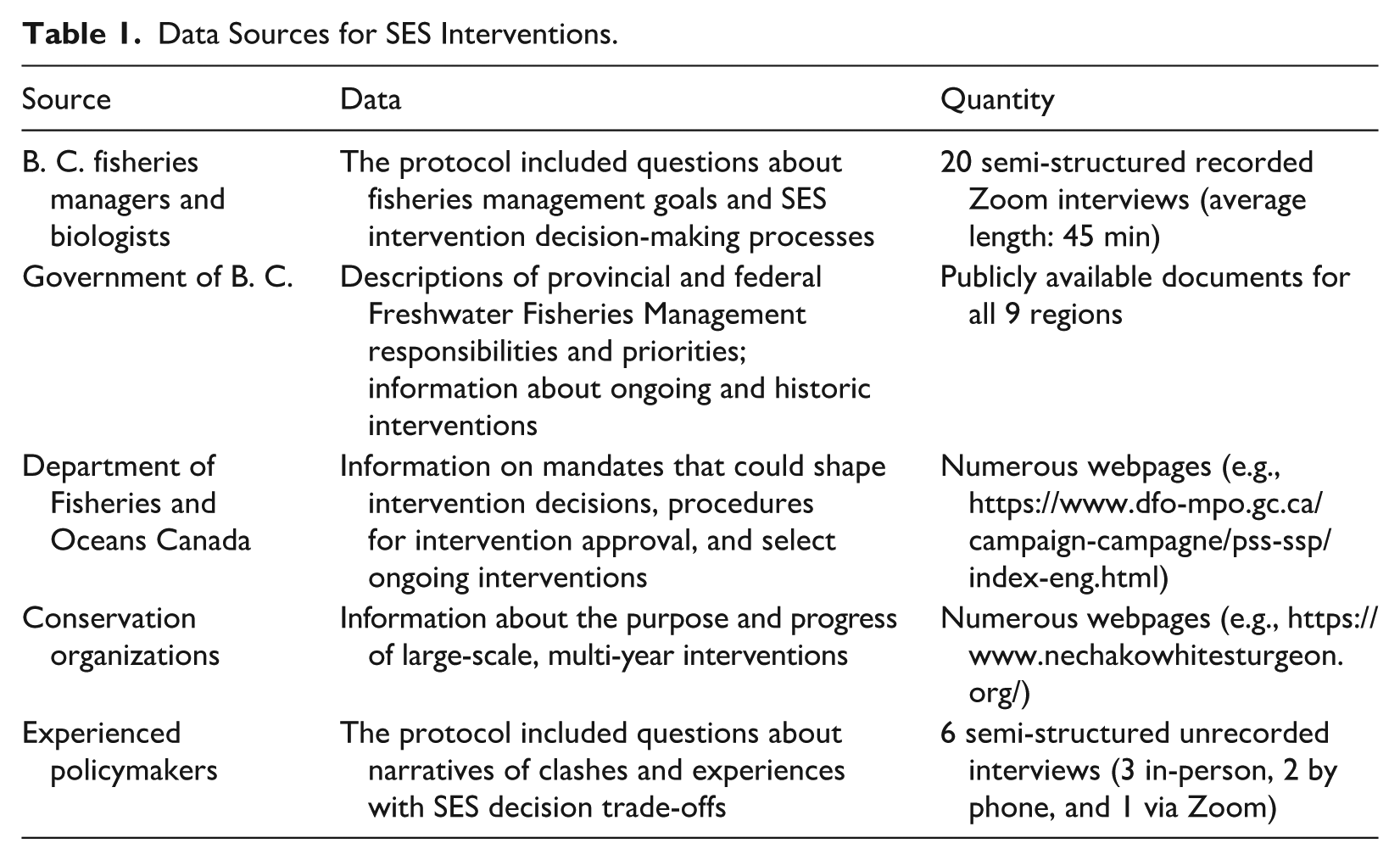
Our data were obtained through interviews and archival sources (see Table 1). The study was open to all individuals working in the provincial organizations responsible for fisheries management, and we worked with senior leaders to get in touch with potential informants. Fourteen of our initial informants worked for the Government of B.C. and were assigned to one of the nine regions, either overseeing the region in general or a sub-area or waterbody. The remaining six informants worked for the Freshwater Fisheries Society of B.C. In our findings, we identify each informant by a unique number. 1 The interviews were semi-structured, meaning that while we had a list of questions that we asked of all informants, we also were flexible in discussing topics that arose unexpectedly, including challenges and stories that seemed particularly important (Brinkmann, 2020). All initial interviews were conducted via Zoom and were recorded and transcribed verbatim. Two of our six post-analysis informants, which were primarily carried out in-person or by phone, worked for Fisheries and Oceans Canada and the other four were experts in fisheries policymaking. These post-analysis interviews were conducted to explore and understand the narratives developed based on initial interviews and to provide further perspectives on some interventions. We did not record these interviews due to the sensitivity of the issues discussed, but took detailed notes.
Data Sources for SES Interventions.
Data Analysis
Our goal was to understand SES intervention decisions through the eyes of the workers making them. We considered our informants to be “knowledgeable agents” (Gioia et al., 2013) capable of thoughtful and informed reflection on their work and their decisions, so when we realized workers were describing those decisions in a narrative form, we strived to capture their narratives in ways that were faithful to their interpretations. However, we also acknowledge that we brought our own perspectives and biases to the research, so to paraphrase Geertz’s (1973) famous description of the product of anthropological writing, these narratives are our constructions of our interviewee’s constructions of their interventions into SES.
Identifying Narratives of Interventions
To identify a narrative about an SES intervention, we applied two necessary criteria. First, there had to be an intervention involved: an occasion where actions intended to change the functioning of one or more aspects of a SES were recommended and sometimes enacted, a distinction we will explore in more detail in the findings section. Second, descriptions of the interventions had to include all five of the components of narratives identified by Pentland (1999): sequential order (the series of events in the intervention), focal actors (the workers, other decision-makers, and interested parties), narrative voice (provided by the worker) an evaluative frame of reference (the analysis of the system’s purpose[s] and the associated goals of the intervention), and indicators of context (the region and other social, political, and economic considerations). We identified a total of 32 narratives of distinct interventions.
Once we identified an intervention, we labeled (e.g., regulations for keeping burbot in western river; restocking fish in eastern lake) and developed a complete description of it by analyzing all related comments from our interviews. In most cases, these were from a single informant, but sometimes more than one discussed an intervention. We also collected additional archival data that helped us to flesh out and validate the narratives (Bamberger, 2019). The B.C. Government’s (Government of British Columbia, 2023) Freshwater Fisheries Management webpages and other online archival sources (e.g., Neufeld et al., 2024) included information about some of the interventions that our informants recounted. We did not find factual discrepancies between informants’ and archival descriptions of interventions. Finally, we also reviewed material that helped us understand issues that arose in the narratives, including relevant federal and provincial legislation.
Analyzing Narratives of Interventions
The intervention narratives served as the data for the next phase of our analysis. As we reviewed them, it became evident that there were patterns in the sequence of events, in that we saw similar types of activities being described by our informants, and in a similar order. We tried various ways of labeling these steps until settling on the labels of “purposing,” “problematizing,” and “untangling.” We felt these labels were apt, and the steps encapsulated all the workers’ narratives. We also examined the nature of the interventions that were recommended, and identified three dimensions, which, as noted earlier, we termed “holistic,” “serial,” and “adaptive.”
When workers recounted that other stakeholders were advancing differing narratives that had come to the attention of decision-makers, they were sharing what we labeled “narratives of clashes.” While on occasion we were able to verify our informants’ accounts of multiple narratives about an SES through archival data, in the main, we relied on their perspectives, wherein we identified 19 narratives of clashes. We conducted our post-analysis interviews to further understand what happened after a worker’s recommendation ran into difficulties.
Findings
Our informants affirmed the complexity of intervening in SES. One described their work as “black box science” because “there’s so much diversity there and there’s so many parameters to try and account for that almost inevitably there’s always these responses that you didn’t anticipate” (17). Resource constraints around generating knowledge about the systems compounded these difficulties. Many informants believed that the accuracy of their assessments was hindered by the limited amount and quality of data they were able to collect. They recounted sometimes being forced to recommend SES interventions that were not “truly informed” (14).
Narratives of Recommended Interventions
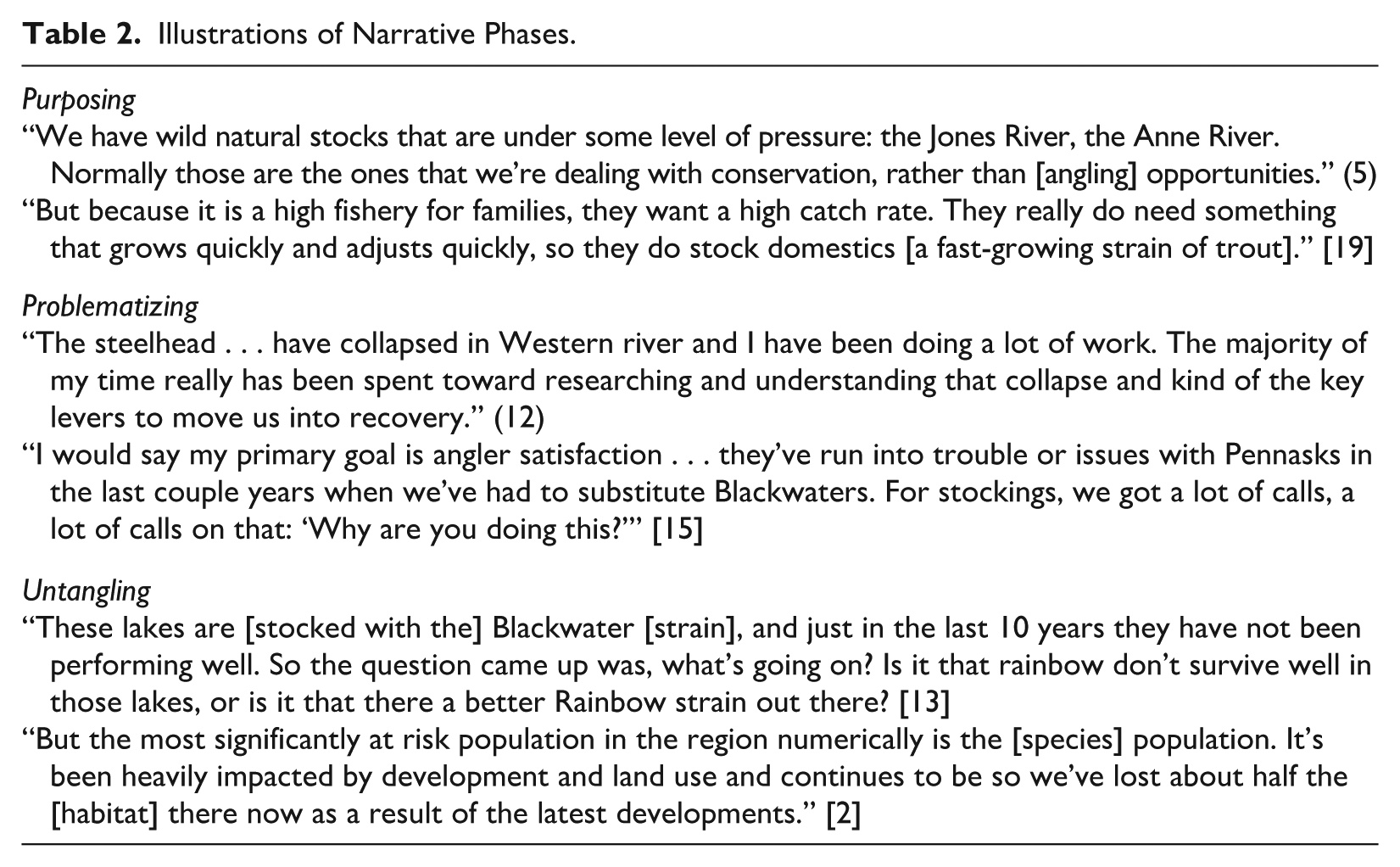
Workers faced tensions between, on the one hand, believing it was their job to assess these systems and recommend interventions when necessary and, on the other, acknowledging that the high stakes and imperfect data made it difficult to know what to do. We learned that workers determined their “recommended intervention”—a specific action or set of actions intended to change the functioning of a SES—by proceeding through three distinct narrative stages. Next, we explicate each stage and include additional examples in Table 2.
Illustrations of Narrative Phases.
Purposing
Our informants began by engaging in purposing. SES often have multiple ecological and social purposes, which can sometimes be pursued simultaneously but in other cases work against each other. For instance, the ecological purpose of increasing the population of a certain fish to ensure predators have a sufficient food source could contradict the social purpose of allowing anglers to catch and keep as many fish as they desire. The purposing phase involves identifying and determining which purposes workers will prioritize.
A prominent factor that workers considered when purposing was the federal and provincial regulations related to fisheries, at risk species, and environmental management (e.g., Canada’s Fisheries Act and B.C. Wildlife Act). The regulations are numerous: the so-called “synopsis” of the freshwater fishing regulations in B.C. is 88 pages long. But according to our informants, there is a core principle, embedded in multiple regulations, that had a powerful bearing on their determinations of the purposes of fisheries systems: Fish conservation trumps First Nations interests, trumps recreational opportunities. (14) Always choose conservation over opportunity if there is a question. (12)
Conservation was therefore a common concern when workers were deciding on the purposes of SES. When a species was formally designated “at risk” or “endangered,” conservation was paramount because workers were expected to promote its welfare. In addition, if there was a threat to a native species, such as when workers detected an invasive species in a body of water, they would act immediately, even if they had been focusing on other issues. One interviewee who had just learned that an invasive fish had been introduced into a lake in his region lamented that they and their staff would “have to kick something off the to-do list” (2) to free up time.
While one might expect that this formal prioritization of conservation would make the determination of the purposes of SES straightforward, our informants’ responses indicated that the realities of purposing were more complicated. Despite the official stance, workers often found themselves weighing conservation concerns against other issues. One informant went so far as to describe “competing mandates” that “don’t necessarily fit together very well in certain cases” (2). Our sense was that workers generally navigated these situations by prioritizing ecological purposes, but with an eye to the problems this could cause later in the approval process. For example, if many local anglers engaged in a particular fishery, and chose to organize and to exert influence on political figures, they could make workers’ lives difficult: the interviewee quoted above explained that a local group had disagreed with a proposed change to fishing regulations, “And so they did an end around with the minister and that scuttled the process” (2). We delve further into these issues below.
Another factor that made purposing especially challenging in B.C. was the flexibility that the nine regions had to make decisions. In some jurisdictions (like the neighboring province of Alberta), governments are more directive about fisheries purposes, which informants believed made it easier for workers to align their priorities with the overarching governmental ones. While in theory B.C.’s approach could provide workers with welcome leeway to adapt their purposing to local circumstances, they tended to emphasize the attendant downsides: There is lacking these common mandates, or common values or standards, that people could use to guide their decision making, and it seems like you get every region doing things in their own way, which causes, I think, just a lot of frustration for people around transparency and clarity. (9)
Problematizing
Purposing decisions set the scene for the subsequent problematizing narrative phase, where workers evaluated whether the system was achieving the chosen purpose or purposes. Most of our informants were trained biologists who emphasized gathering data about the purposes and using it to make evidence-based inferences about whether the system was functioning properly. For example, if workers focused on whether a system was helping a specific fish species to thrive, they would identify indicators of the species’ health, decide what the desired situation should be, gather data, and make a comparison of that data to an ideal state. In the example below, the worker’s analyses led them to conclude that a problem existed: The results of that study were fairly clear, those fish have a pretty high annual mortality rate, which on top of being already at risk, is a concern. It’s the highest natural mortality rate that I could find in the published literature for whitefish so that’s something that’s just on its face of it, concerning. And then you stack it on top of the risk assessment, and it makes you go, “Wow this is a problem.” (2)
Workers might turn to local angling groups to gather data about how many fish their members had seen or caught, which some groups systematically collected, and others could anecdotally provide. This “citizen science” was viewed favorably by certain informants, whereas others preferred to stick to their own methods and data and to avoid direct interactions. However, when a social purpose like angler satisfaction was the priority, liaising with “stakeholder groups, local angling groups, and others” (18) to gauge their attitudes and experiences was important.
When it came to determining whether there was a problem with a given system, informants were not always confident in their conclusions. When workers were uncertain, they often referred to the guiding “precautionary principle” of the Canadian Environmental Protection Act (Government of Canada, 1999), which states that “where there are threats of serious or irreversible damage, lack of full scientific certainty shall not be used as a reason for postponing cost-effective measures to prevent environmental degradation.” As noted above, workers believed in choosing “conservation over opportunity, if there is a question” (12). Another noted that when “dealing with wild stock fish, we do tend to take a conservative approach if there’s an issue of data deficiency” (17). Thus, when it came to problematizing, the precautionary principle held that if there might be a problem with the SES, the workers should act as if there was a problem. As we explain later, this principle could cause problems getting a recommended intervention approved.
Untangling
If workers concluded that there was a problem—that the system was not serving a chosen purpose—they would turn their attention to why this was happening. We term this narrative phase untangling to capture the complexity involved in teasing apart cause-and-effect relationships in SES. As with problematizing, it involved evidence-based assessments. For example, a worker described a lake that “has a collapsed [fish] population that we have been trying to recover for almost a decade” (11). They determined the problem was caused by insufficient young fish surviving to reproductive maturity. Another example involved workers noticing the stocking numbers for a strain of trout had been unusually high in certain lakes over a 5-year period, suggesting they were not thriving as expected. In setting out to understand why, workers discovered that at some point a decision was made to move the trout from the hatchery to the lakes when they weighed 15 grams, even though research suggested waiting until they were at least 20 grams. They concluded that the survival problem was caused by stocking undersized trout.
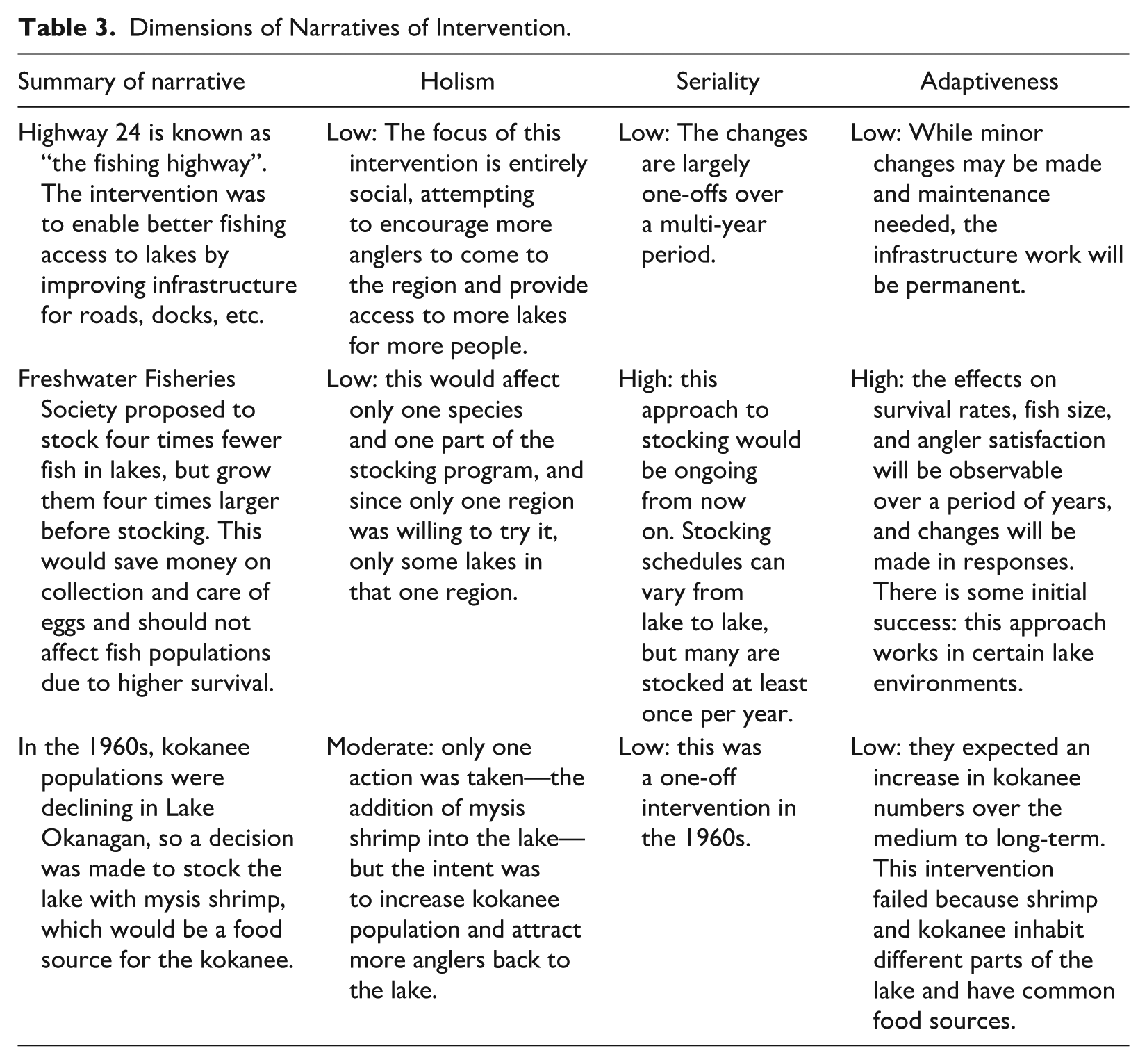
Informants’ comments illustrated how challenging untangling was. There were often many possible causes for a problem, including “angling pressure” (too many anglers catching fish in a body of water), habitat destruction, changes in water temperature or water chemistry, the introduction of a competing strain of fish, a natural event such as a rockslide, and predation. On occasion, informants were highly confident about their untangling (e.g., several described the cause of a fish population decline in one body of water, and the subsequently recommended interventions, as “bulletproof”), but in many cases, they were less certain. Workers’ level of confidence in their untangling affected the interventions they recommended, which we conceptualize in terms of “holism,” “seriality,” and “adaptiveness.” Next, we describe each dimension and include further illustrations in Table 3.
Dimensions of Narratives of Intervention.
Dimensions of Interventions
Holism
When assessing a problem with a system, sometimes workers concluded that there was a singular cause (such as the example above, where they believed they were stocking the wrong size of trout), and on other occasions, workers determined that there were multiple causes. That assessment influenced a key aspect of interventions, which we refer to as “holism.” The more causes that workers identified for a problem, the more likely they were to recommend an intervention that impacted multiple aspects of an SES: It would be more holistic. The most holistic intervention we learned about concerned ongoing efforts to rebuild the population of kokanee in Kootenay Lake. Over a multi-year period, workers recommended and received approval for interventions on several fronts, including banning fishing for kokanee; increasing the stocking of kokanee; removing predators from the lake by netting them; and incentivizing anglers to catch predators like bull trout (Neufeld et al., 2024).
There were, however, cases where workers believed it was impractical to address certain causes. For example, an interviewee explained that they had been trying to restore a decimated fish population in a section of a river. He and his colleagues had been working on the issue for years and concluded that habitat destruction from dams and development was a key cause. However, he did not believe it was practical to restore these habitats to a more supportive state because “the cost will be colossal and the reasonability of it is probably very low” so “the only thing they could do to recover [the species was] conservation recovery programs through supplementation [of existing populations of fish with stocked fish]” (18). In this case, the ideal intervention would have involved multiple actions aimed at restoring the habitat to an original state, but since this was implausible, the recommended intervention was less holistic.
Seriality
By “seriality,” we mean whether an intervention is intended to be repeated at regular intervals (high seriality), or whether it is a one-off (low seriality). Workers will typically recommend a low seriality intervention when they are confident in their untangling of a SES: They believe they know the cause of a problem and know how to address it. An example is chemically treating a lake to kill all the fish in it, an intervention used as a last resort. When an invasive species is introduced into a lake, it can sometimes out-compete resident fish by consuming common food sources or feeding directly on residents, sealing the latter’s fate. Since it is virtually impossible to remove a specific fish species from a lake, the only option left is to exterminate all the fish by treating the lake with a chemical called rotenone and restoring it from a blank slate.
In contrast, many stocking interventions were high in seriality, which is intended to involve multiple actions over a period. Lake stocking was an example. In urban settings with high angling pressures, lakes could be managed like free “grocery stores” for anglers: the lakes would be stocked, anglers would visit shortly after stocking and catch and take home some stocked fish. The newly stocked population would be depleted over the coming days and weeks, then replenished according to a pre-planned (and publicly available) schedule.
Adaptiveness
The third dimension operates in conjunction with seriality and is the extent to which each planned intervention in the series is similar (low adaptiveness) or intended to be changed (high adaptiveness) over time because of ongoing monitoring and/or learning. Like an intervention with low seriality, when workers recommend a low adaptiveness intervention, they are likely to have a high degree of confidence in untangling. With high adaptiveness interventions, by contrast, workers tend to be less confident in their understanding of a system, and more open to learning and changing their approaches. This difference was summarized by an informant in the following terms: “One, is almost like it’s a circle it keeps going back, and the other ones just are constantly expanding decision trees about what you do next” (15).
Some highly adaptive interventions are “pre-planned” meaning that the actions and reasons underlying them are laid out in advance, such as “coming up with a document that says, ‘If we’re here [at this level of fish abundance] then this is what we’re going to do’” (12). An example is in the Skeena River, where catch data about steelhead salmon is gathered annually at test fisheries, and those results inform interventions about how much fishing to allow (Skeena Steelhead Advisory Group, 2023). If early data from test fisheries reveal a very low population of steelhead, then fishing may be banned; higher counts will lead to more liberal fishing seasons. Because these plans are almost always approved by management in advance, workers can proceed with the interventions in the series without seeking further permission.
With the second type of adaptive intervention, termed “trial-and-error,” workers adjust each intervention in the series as they deem necessary and without following a set-out plan. To do so, they often need to seek approval from management at multiple points. As an illustration, consider an intervention concerning the “Horsefly” strain of rainbow trout. The problem was low survival rates of stocked rainbow trout in lakes with high populations of multiple fish species, and resultantly dissatisfied anglers. In 2014, workers started exploring a solution: Stocking Horsefly trout, which due to the conditions in the Horsefly River from where they evolved, would be well-adapted to “high-density, multi-species” environments. Workers embarked on a multi-year testing process involving different lakes and types of stocked Horsefly trout: A single lake is a minimum of three years before you can go evaluate. And you’re looking at diploids [fertile trout] and trying to compare them to other strains and then trying to get a good sample size so you want as many lakes as possible. (13)
Given the inherent complexity of SES and the frequent dearth of data, some informants suggested that adaptive trial-and-error interventions were the norm.
Another difference between pre-planned and trial-and-error adaptive interventions is that the latter involves workers revisiting the narrative phases. They might ask themselves whether the system is now achieving its purpose (problematizing) and if not, whether their understanding of why needs to be reconsidered (untangling). An informant described unanticipated outcomes from trial-and-error adaptive interventions as follows: “You pull the lever, and you’re looking for the facts but then something else happens that can have a big impact too. Right, so it’s hard to isolate the effect of the changes you’ve made on the [fish] stock” (16).
Summarizing to this point, our informants’ narratives reflected a structured process of purposing, problematizing, and untangling related to the SES they oversaw. This allowed them to make decisions about recommended interventions, referring to the actions that the workers believed should be taken to alter the functioning of the system. Those recommendations—and the interventions that could follow—varied in terms of holism, seriality, and adaptiveness.
In some cases, workers had the authority to implement recommended interventions without seeking approval. But in other situations, they could only recommend a change and hope that it received the support of higher-ups. As one informant put it, “I’m really not what I would call a decision maker. So I really provide recommendations, I did not make decisions. Yeah, so the only place where I would say that I do make decisions are kind of small-scale stuff” (17). We distinguish between “recommended” interventions—actions workers believed should be taken—and “enacted” ones where those actions in fact are carried out. In practice, this distinction created fertile ground for the issue we discuss next, which we term “narratives of clashes.”
Narratives of Clashes
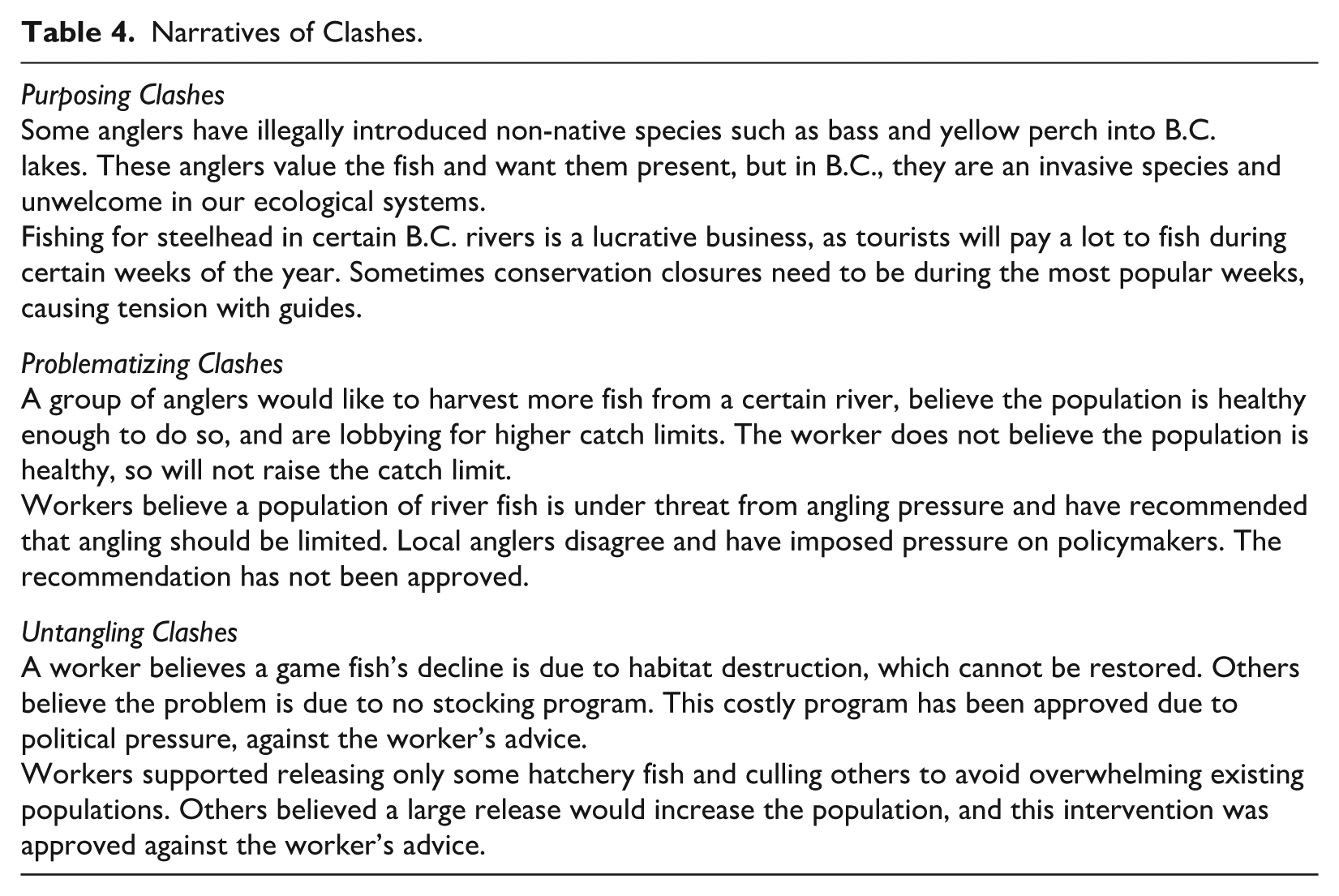
At times, other actors disagreed with workers’ recommended interventions and instead advanced their own narratives about SES. If persuasive, these alternative accounts could lead higher-ups to turn down workers’ recommended interventions in favor of a different course of action. We documented 19 narratives of clashes and explore them further below and in Table 4.
Narratives of Clashes.
Purposing Narrative Clashes
When other actors disagreed with workers’ purposing, they framed the recommended intervention as addressing a purpose that was less important than others, or not valid at all. One example involves anglers illegally introducing non-native species like yellow perch—literally carrying the fish to B.C. lakes and putting them in. Having a lake full of these fish will satisfy anglers who see the lake’s purpose as providing habitat for a species that is easy to catch and tasty to eat. However, because perch reproduce quickly and feed aggressively, they endanger native species and make stocking of small trout impractical. Since informants prioritized conserving native strains, they conceptualized this situation as a clash of purposes. So far, workers’ purposing appears to be winning out, as their interventions to protect non-native species have generally been supported by their superiors.
Purposing clashes were most likely to emerge when SES had many purposes and multiple interested stakeholders. For example, when managing salmon runs (when salmon return to rivers to spawn), workers typically set a target range for how many fish they want to return. Each year managers from Fisheries and Oceans Canada estimate the abundance of the sockeye salmon run in the Fraser River and, considering the ideal level of return, decide on allowable catch numbers which they then allocate to differing groups, including commercial fishers, Indigenous groups, and recreational anglers. Some of our informants believed those allocations should be done to achieve the best “bang for the buck,” meaning having the greatest economic impact for the lowest number of fish harvested, thus balancing economic and conservation purposes. However, they also believed that the decision makers in Fisheries and Oceans Canada prioritize commercial interests and ignore recommendations to allocate more fish to anglers: If you look at how many sockeye are taken in a year, you’ll know that commercial is in the millions, First Nations is in the millions, recreational anglers is, I think, 180,000. So really, in terms of numbers next to none. But if you look at the economic contribution of that sport fisheries, it is in the hundreds of millions of dollars. So not only are you getting the highest value economic returns, you’re having the lowest impact on the fishery. But that’s the fishery that’s closed first. . .Because if you’ve been in this business long enough you know the Department of Fisheries and Oceans represents commercial interests. (5)
Problematizing Narrative Clashes
Problematizing clashes were present when workers believed that other stakeholders contested their conclusions that there was a problem with a SES. In a nutshell, the argument was “there is no problem to solve, so the intervention is not necessary.” One example occurred with respect to a popular sport fish in a lake. The interviewee believed the population of that fish was declining, and action should be taken to prevent it. They also noted that some local anglers had a different narrative, arguing that when they fished in that lake, they were catching high numbers of large fish of that species, so there was no need for the interventions. Thus, the worker felt that there was a clash of narratives, with him asserting there was a problem that needed intervention, while the other side claimed there was no problem, so intervening would be a waste.
Some informants attributed the prevalence of this type of clash to differing perspectives on the precautionary principle. As noted earlier, if workers felt there might be a conservation concern, they believed that they should act as if there is one. Other actors disagreed, arguing that decisions that harmed their interests must be supported by strong evidence. The upshot, according to informants, is that they faced a higher burden of scientific proof in convincing policymakers that an intervention was warranted: “If there’s a really important economic fishery, then folks would be saying, ‘well, you better make sure you have very strong evidence that’s supportive of whatever restriction you’re advocating” (16). This was frustrating to workers, many of whom felt that this elevated burden was a recent development: We used to manage these stocks on the precautionary principle, so you didn’t need hard fast science, there was common sense and there was science that indicated this was likely the problem. And that switched a full 180 now, where people say, we are not [supporting the intervention] until you can prove that what you do will impact the run. (5)
Untangling Narrative Clashes
The third type of clash occurred when workers believed that others were advocating for differing solutions to problems in a SES. In these cases, workers and stakeholders concurred about the purpose of a system and the presence of a problem, but disagreed about its causes and, therefore, which interventions were appropriate. Consider the case of an economically significant fishery that saw a substantial decline in the numbers of a valued fish species over a multi-year period. The workers and other stakeholders agreed that an important purpose of that system was conservation of the species, and that a problem (the population decline) was happening. The clash, however, occurred when it came to figuring out why. Workers believed there were multiple causes, with one of them being overharvest, and recommended a more holistic intervention that included limitations on angling. However, some anglers and fishing guides put forth an alternative explanation that the decline was caused by an abundance of non-human predators, so an intervention focused on reducing those predators would be sufficient to solve the problem. One of our policy experts noted that a published paper had indeed identified pinniped predation (mostly seals) as the “leading” cause of the fishery’s decline, although this finding was sometimes misleadingly represented as the only cause. Over the past few years, policymakers had been sympathetic to anglers’ narrative and had not approved fishing restrictions, a decision that our informants believed was contributing to a continued decline in the fish population. One frustrated informant summed up the situation: “it’s [the fish population] fallen off a cliff before anyone’s been willing to do something about it” (18).
There were two characteristics of recommended interventions associated with untangling clashes: holism and trial-and-error adaptiveness. When it came to the former, the existence of more possible causes for a problem enabled stakeholders to argue for interventions that were aligned with their interests. To illustrate, consider the above example of pinniped predation. For anglers and guides who did not want fishing to be restricted, the presence of an alternative cause for the decline enabled them to advocate for an intervention that would not interfere with their interests. In essence, having more causes allows for a wider variety of arguments about causality. There were two reasons why trial-and-error interventions were susceptible to untangling clashes. First, these interventions were generally enacted when workers had insufficient data to predict the outcomes of an intervention with certainty, which created opportunities for other stakeholders to question its justifiability. As one interviewee put it, paraphrasing feedback from local anglers, “Wait minute, how can you tell us that we shouldn’t go angle here at this time when your data is 20 years old?” (12). Second, it could take years to discern the effectiveness of these interventions. Stakeholders could therefore argue that interventions with little short-term effect were a failure. As one interviewee described: The stakeholders are usually operating on a very quick timeline, where “We notice Lake X is doing poorly now, we want you to change it, will be almost expect it to be better next year.” So, if we do implement something that could take three four or five years to manifest itself, by way of a recovery. I think those timelines definitely would get lost in our stakeholders’ desires to have the course correct almost immediately. (8)
Covert Narrative Clashes
While sometimes workers believed that they knew what other considerations had trumped the concerns underlying their recommendations, there were also times when they only knew that their recommendations had not been supported: alternative interventions had been implemented, or their recommended intervention had been blocked, for reasons that they could not comprehend. In these cases, they inferred the presence of an alternative narrative about what was happening in the SES, despite not knowing what it was, nor why it derailed the approval of their recommendations, which we refer to as the presence of a “covert narrative clash.” One informant outlined an intervention that had gone through “significant stakeholder engagement”: We made some, I feel pretty significant amendments in their direction, so you would think at that point that we’ve got a pretty strong regulation package to go forward . . . and they’ve [the decision-makers] spent the last three or four months pretty much telling us that it’s no good. And for reasons that aren’t really explained. (16)
In another case, the informant inferred (without knowing for sure) that someone with political clout had gotten involved to question a planned change to lake stocking: If somebody gets an MLA [an elected provincial politician] or the right political person on the phone, right, all of a sudden all hell breaks loose. Like these people are powerful. And that comes down to them, and they get asked by their boss’s boss, why they stopped the stocking on Lake X because their friend has a cottage on it. (9)
These circumstances were exasperating for workers. In the absence of an explanation for why their recommendations were being ignored, they were left to reach their own conclusions. The worker quoted next described how some of their co-workers would “fill in the blanks”: It’s like, well, us why you decided against this. Because if there was a political consideration, we understand that sometimes that happens, so tell us why. And it’s when people don’t hear anything at all that it gets particularly frustrating because then you hear from someone’s friend, “oh the decision-maker’s friend loves to fish there and told them everything is great.” . . . [P]eople are trying to fill in the blanks . . . so they grab on to gossip . . . which may be totally wrong, but yeah it’s your own narrative, right? And without any kind of explicit information or answer, you’re going to do that. (12)
Several informants felt that this kind of speculation could be avoided if the organizations they worked for were more explicit about how recommended interventions would be assessed. That way “we’re not sitting here wasting a whole bunch of time, staff time, managers’ time, biologists’ time, you know, doing this thing that isn’t going to happen” (2). Covert narrative clashes also caused cynicism when workers believed they emerged from decision-makers hiding a new emphasis on the social side of fisheries, while paying lip service to prioritizing ecology: “When I started, it was primarily developing fisheries and maintaining fisheries, now it’s maintaining other interests and hoping we have fisheries at the end” (5).
Our informants, who were experts in fisheries policymaking, concurred that at times decision-makers overemphasized the social side of systems but differed on how common this was. One described fisheries management as exclusively “political decisions based on political repercussions,” and had told government officials: “I’m following the science and you guys aren’t.” Another echoed how: “It seems like, more often than not, biases and politics influence how the science is characterized and considered and how policies are implemented.” In contrast, a different expert noted that decision-makers were accountable to many people and groups, and so, they had to consider differing views. He felt that the trade-offs made were usually valid, but acknowledged that at times decisions could go “off the rails” when they “become purely about politics.” The insights of these experts affirm that workers will at times be asked to enact interventions that go against their understanding of the systems. When this happens—as in cases where their expertise was devalued and dismissed—workers are likely to be saddened and demotivated.
Discussion
In this research, we set out to answer the question: How do workers approach decisions about intervening in social-ecological systems? By analyzing narratives of 32 SES interventions, we answer this question and reveal new insights into how individuals make sense of the challenging decisions involved in managing these systems. We illustrate our theory in Figure 1.
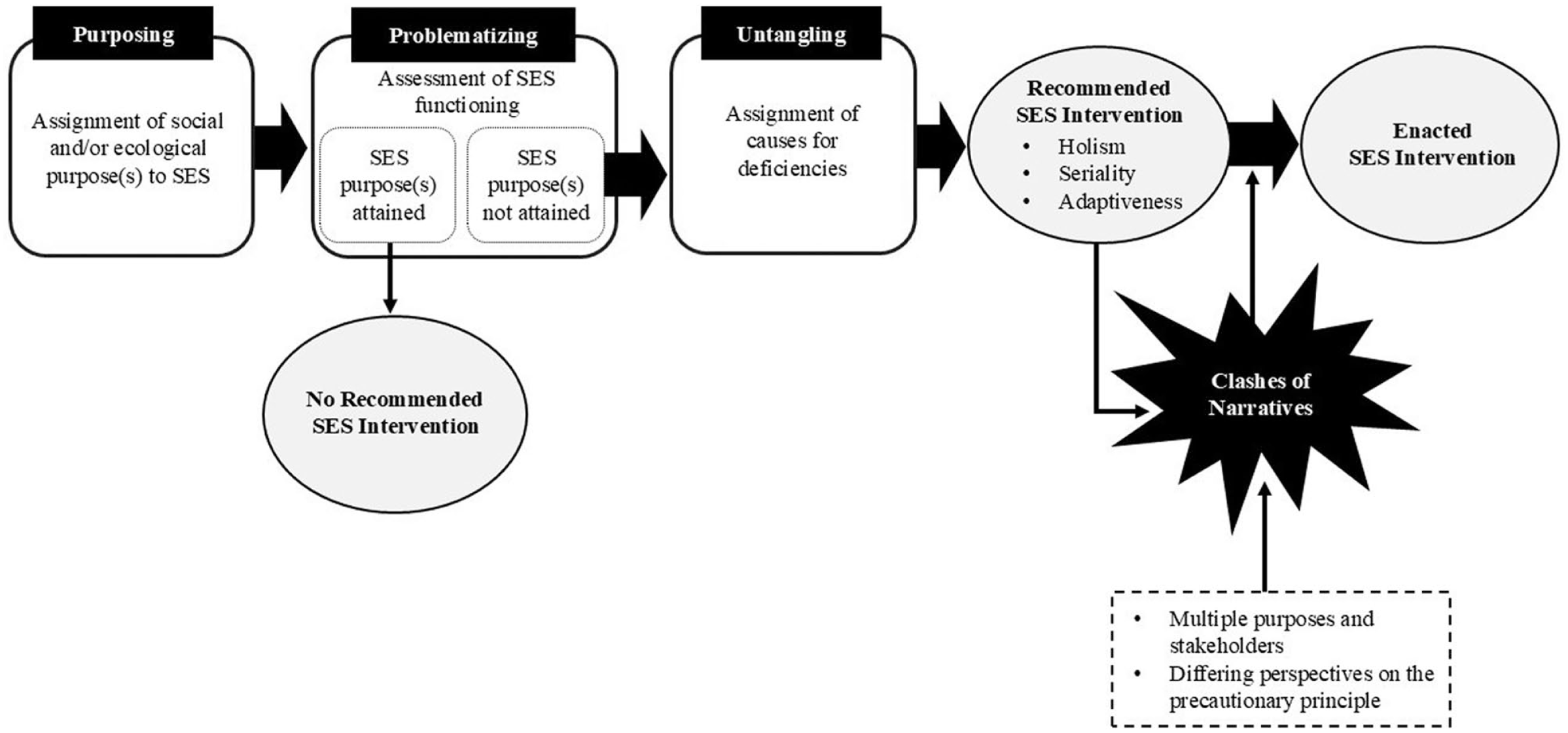
Process Model of SES Intervention Narratives: How Intervention Decisions Are Made.
The first narrative phase of purposing is followed by problematizing, at which point workers either determine that the system is functioning in line with its purpose and no intervention is necessary, or they move to untangling the causes of deficiencies and recommending an intervention to address them (varying in terms of holism, seriality, and adaptiveness). Narratives of clashes, when they emerge, can hinder a recommended intervention from being enacted. Untangling clashes can be enabled by highly holistic and adaptive trial-and-error interventions (see the arrow connecting interventions to clashes in Figure 1), while purposing and problematizing clashes can be triggered by factors that include the presence of multiple stakeholders with vested interests in the system, and differing perspectives on the precautionary principle (see dashed box in Figure 1). Although for visual simplicity we do not depict the feedback loops, workers who do not recommend an intervention will return to monitoring and potentially re-problematizing, while adaptive trial-and-error interventions also involve revisiting problematizing and untangling.
Theoretical Contributions
Our research addresses the call to improve our understanding of how individuals at work think about SES (Baudoin & Arenas, 2020), by elucidating a narrative process through which workers determine the need for and nature of SES interventions. This is critical for organizational activities, as decisions about how to influence these systems depend upon the knowledge, skills, and prior experience of individual workers. Their narratives will, in many cases, provide an important practical function for the workers making these decisions. As noted earlier, decisions about SES interventions are made in suboptimal circumstances, with workers striving to understand complex, unpredictable systems with limited time and data, and then having to justify these decisions to other stakeholders who could question and derail their recommendations. Given these challenges, an overly prescriptive “one size fits all” approach is unlikely to succeed (van Poorten & Camp, 2019). However, it is similarly impractical to consider every SES decision-making scenario de novo, as workers could face overwhelming uncertainty. Narratives provide a structure for approaching each intervention, while allowing for variation in how workers apply and adapt that structure to the situation. They therefore represent a practical way for workers to make SES decisions, and merit further attention from researchers to understand the structure and processes involved. Our findings also contribute to research in ecological fields, helping with the important task of adding to knowledge of the social side of SES management (Ward et al., 2016).
Next, our discovery of these narratives also contributes to the emerging body of research that has identified the influence of rhetoric on how people characterize and react to the natural world (Albareda & Branzei, 2024; Barter, 2016; Morehouse & Sonnett, 2010; Welcomer, 2010). Our findings emphasize that rhetoric can play an important role in the work of the people doing the challenging work of SES management. Since intervening in SES is fraught with uncertainty and complexity (Lockwood et al., 2010; Virapongse et al., 2016) and often highly politicized, workers may find it difficult to advance claims that are convincing in the eyes of internal and external stakeholders, particularly because those stakeholders may be making their own arguments about what should be done about a SES. Many of our informants were aware that they needed to “sell” their narratives to others (especially higher-ups) to get their recommendations approved. This illustrates the value of conceptualizing SES management as a place where rhetorical contestation is often present. Our findings about the narrative phases of purposing, problematizing, and untangling, and the intervention dimensions of holism, seriality, and adaptiveness, provide insights into the nature of that contestation.
Next, we turn our attention to the actual interventions. In our context, most were non-holistic, focusing on species or subsystems rather than the broader SES. Of the five interventions that aimed to change entire systems, according to our workers’ narratives (and to publicly available information) one of them had failed, and two that were in progress appeared to be failing. The two remaining regenerative interventions were the result of clashing narratives, so were not the recommendations of our informants, who expected that neither intervention would achieve its purposes. While our sample size was limited, we believe it is noteworthy that not only did we not uncover a single intervention that was regenerative and successful, but our informants also believed that the two impending regenerative interventions were going to fail.
What can we conclude about regenerative organizing, based on these findings? Theories of regenerative organizing emphasize helping entire systems [emphasis ours] to “regenerate, build resilience, and sustain life” (Muñoz & Branzei, 2021, p. 510). According to this conceptualization, organizations should attend to how their activities influence all aspects of a SES, so that, for example, harms to an ecological subsystem are not justified by economic gains accruing within part of the social system. However, our findings—and other research that points out the shortcomings of efforts to restore ecological systems (Duarte et al., 2015; Jones et al., 2018)—illustrate that it is incredibly difficult to alter the functioning of entire systems in desired ways. As we alluded to earlier, perhaps conceptualizations of regenerative organizing should not focus on entire ecosystems, but instead, in the words of some ecological restoration researchers, “consider other endpoints that might be more attainable” (Jones et al., 2018, p. 5). Another approach could be to embrace the paradoxical nature of regenerative organizational activity, accepting that it is both extremely important and very difficult to fully achieve. A “both/and” approach (Smith & Lewis, 2011) could accommodate the necessity of regenerative organizing and the intractability of SES. It could involve taking patient, long-term approaches (Slawinski et al., 2021) and understanding that endpoints may be difficult or impossible to predetermine.
Our findings about narratives of clashes also extend previous research about how people respond to arguments about environmentalism. Onkila (2017) found that employees constructed rhetorical representations that either embraced or rejected corporate environmentalism and described an “argumentation process” that included elements of narratives. We suggest that many people have pre-existing narratives about the natural world, and about their own and others’ related obligations and responsibilities. When individuals are introduced to new narratives, their perceptions about the (mis)alignment between their existing narratives and the new ones will influence their reactions. In the context of SES management, we uncovered clashes in the processes of purposing, problematizing, and untangling. In alternative environmental and organizational contexts, other aspects of narratives might be more relevant and hence become fertile ground upon which narratives of clashes will emerge.
Implications for the Work of SES Management
A core practical implication of our findings concerns how to build trust in SES management systems. All our informants understood that fisheries science was complex, and that there were many parties involved whose interests would often not align. They also appreciated that disagreements were inevitable and would occasionally result in decisions being made that went against their recommendations. However, they were most frustrated when they could not understand how or why approval decisions were made. If decision-makers could explain the reasoning and processes employed when making intervention decisions, this could increase acceptance of decisions. It might also reduce the frequency of clashes of narratives or make them easier to resolve. Starting with the “how” of SES management decisions, this could be addressed with clear guidelines for who should be involved in decisions and how to assess a recommended intervention.
Providing transparency around the “why” is arguably more complex. We believe that it will require government authorities to clarify the priorities in SES management. For example, one of the more common themes in narratives of clashes was the tension between conservation and economic returns, despite the official stance that the former should trump the latter. This tension provoked skepticism and frustration among workers because they disliked the duplicity inherent in claiming that conservation was the most important purpose, when it often appeared not to be. Even worse was when an intervention was rejected by decision-makers for no apparent reason. A clear, overarching set of priorities could reduce confusion for workers and be viewed favorably by other stakeholders who, at times, could be understandably puzzled by seeing one purpose receiving greater emphasis in one region than another.
As to the SES workers, they might benefit from a broader educational umbrella so they equally understand the theory and practice of ecological and social aspects of the SES and how they might interact. This would help them to not only reach more accurate conclusions when they are assessing SES but also be more mindful about how they are presenting their narratives to audiences. Some informants were aware of the importance of consulting with multiple stakeholders and of presenting information to decision-makers in ways that were clear and relevant. Others preferred to focus on the ecological side and chose to neglect the social side; an approach that overlooks the fact that the work of SES management involves telling stories. When they are proposing to intervene in an SES, workers have constructed a story about what is happening and what should be done. It is in their interests to craft persuasive stories. Marketing researchers have found that people will be more persuaded by comprehensible and personally relatable narratives (Hamby & Escalas, 2024; Van Laer et al., 2014). A fellow scientist might be convinced by tables of data and detailed analyses, but fishing club members might be persuaded by descriptions of days spent on their favorite lakes or rivers, and a senior government official might be influenced by evidence of the involvement and support of influential stakeholders.
Limitations and Conclusions
Our data does not allow us to draw conclusions about whether the narratives and clashes we identified will generalize to other SES, or to other environmental contexts where multiple parties are interested in decisions. However, the work of managing SES will usually involve choices about what purpose a system should serve, meaning that processes akin to purposing will be prevalent. We also anticipate that SES management entails comparing some preferred state of functioning to the current one amid considerable uncertainty, and that in cases of discrepancies workers will need to have some justifiable way of deciding how to intervene. However, different occupational, organizational, and system contexts may change how these narrative processes unfold. Even within recreational fisheries, it would be interesting to see if this decision structure holds up in situations with more or less political pressure or system monitoring. It would therefore be valuable to test our model (Figure 1) against other SES contexts, which would help validate or further develop our proposed structure for SES intervention.
To conclude, the workers who manage these extraordinarily complicated systems have both our best wishes and our admiration. They must regularly make consequential recommendations, often without all the data that they would like to have, and navigate opaque approval processes that can result in their proposed interventions being stymied. We hope that by conceptualizing this work in terms of narratives, we have not only shed light on how the work takes place, but also on how it can be more productive and less frustrating. Ultimately, we all have an interest in well-managed SES, and if our research has even a small positive impact in this domain, then it will have been worthwhile.
Footnotes
Acknowledgements
We would like to thank our editor Minna Halme and our two reviewers for their constructive and supportive feedback. We also received valuable input from attendees at the 2024 Western Academy of Management conference and the 2024 Academy of Management meetings, as well as the members of the “Write Club” at the Beedie School of Business: Rekha Krishnan, Mila Lazarova, Andrew von Nordenflycht, Jeff Yip, and Natalie Zhao. Most importantly, we want to thank our participants for their time and their insights; their passion for fisheries management was inspirational.

Funding
The authors received no financial support for the research, authorship, and/or publication of this article.
Declaration of Conflicting Interests
The authors declared no potential conflicts of interest with respect to the research, authorship, and/or publication of this article.