




Abstract
Despite the emotional nature of environmental issues for many individuals, the role of affect as a potential predictor and outcome of employee green behavior has been largely neglected. Drawing from dynamic theorizing on affect and work behavior, we investigate reciprocal within-person relations between positive and negative work-related affect and citizenship and counterproductive green behavior. Data were collected at five monthly measurement points among n = 2,738 employees in Germany. Results of random intercept cross-lagged panel models indicated that higher levels of positive affect predicted a subsequent increase in citizenship green behavior, and that this effect was stronger among employees with stronger (vs. weaker) biospheric values. In addition, higher levels of negative affect predicted a subsequent increase in counterproductive green behavior, and vice versa. These findings advance the understanding of the dynamic ways in which work-related affect influences, and is influenced by, the engagement in environmentally friendly and harmful work behaviors.
Keywords
In line with the United Nations Sustainable Development Goals (SDGs; United Nations, 2015), organizations are increasingly expected to advance environmental sustainability. Research on corporate sustainability and employee green behavior emphasizes that achieving this goal largely depends on individuals across different hierarchical levels and various roles, who can act as change agents in leading environmental sustainability from within the organization (Ones & Dilchert, 2012; Schaltegger et al., 2024). Discretionary forms of employee green behavior are particularly important in this context, as they involve actions that go beyond formal job responsibilities to either support or undermine environmental sustainability (Lülfs & Hahn, 2014; Norton, Parker, et al., 2015; Zacher et al., 2023). On one hand, employees may engage in citizenship green behavior, which entails active, discretionary environmentally friendly actions, such as implementing environmentally sustainable work processes and advocating environmental practices (Boiral & Paillé, 2012; Robertson & Barling, 2017). On the other hand, employees may also engage in counterproductive green behavior, which includes discretionary environmentally harmful actions, such as wasting resources or polluting (Dilchert, 2018).
Given their importance for organizational environmental sustainability, much research has explored factors that may influence employee engagement in citizenship and counterproductive green behavior (Zacher et al., 2023). These studies have mainly focused on stable individual characteristics, such as environmental attitudes and values (Katz et al., 2022). However, such factors cannot account for the dynamic within-person fluctuations in employee green behavior over time (Katz et al., 2023; Stein, Kühner, Katz, & Zacher, 2025). Moreover, little is known about how engaging in green behavior may affect employees themselves (Zacher et al., 2023), which limits understanding of the motivations underlying such behavior.
Research on work behavior more broadly suggests that positive and negative work-related affect (i.e., the experience of pleasant and unpleasant emotions at work) may impact citizenship and counterproductive work behavior, and vice versa (Brief & Weiss, 2002; Rodell & Judge, 2009). Empirical insights into such effects are currently limited, as most studies have focused on static between-person relations between affect and work behavior (e.g., Kaplan et al., 2009; Ng & Sorensen, 2009; Shockley et al., 2012). Importantly, general citizenship and counterproductive work behavior differ from their green counterparts, with the former primarily targeting interpersonal relationships and organizational functioning (Spector & Fox, 2002), and the latter targeting the natural environment. This distinction is important because the natural environment may be less salient to employees as a target of work behavior, as personal environmental impacts are not immediately visible and typically underestimated (Geiger et al., 2017; Wynes et al., 2020).
These considerations emphasize the need to specifically examine how affect and citizenship and counterproductive green behavior are related to one another within individuals over time. As one of the few studies on this topic, a daily diary study found that positive, but not negative, affect was associated with daily pro-environmental work behavior (Bissing-Olson et al., 2013). However, this study focused only on short-term, unidirectional effects of affect on positive forms of employee green behavior.
According to the principle of affect symmetry (Bono et al., 2013; Spector & Fox, 2002; Thoresen et al., 2003), positive affect tends to promote positive work behavior (i.e., “feeling good → doing good”), and vice versa (i.e., “doing good → feeling good”), whereas negative affect tends to promote negative work behavior (i.e., “feeling bad → doing bad”), and vice versa (i.e., “doing bad → feeling bad”). Research further emphasizes the importance of sustained, rather than occasional, affect in influencing work behavior (Spector & Fox, 2002). This suggests that enduring experiences of positive affect may increase citizenship green behavior over time, and vice versa, whereas enduring negative affect may increase counterproductive green behavior over time, and vice versa.
In this study, we aim to provide insights into the within-person relations between work-related affect and employee green behavior. Integrating theorizing on affect and work behavior (e.g., Fredrickson, 2000; Ryan & Deci, 2000; Spector & Fox, 2002), we propose reciprocal relationships between positive and negative affect and corresponding employee green behaviors (i.e., citizenship green behavior and counterproductive green behavior, respectively). Drawing on value theories (Schwartz, 1992; Stern et al., 1999), we further examine how biospheric values (i.e., an individual’s concern for the natural environment; de Groot & Steg, 2008; Stern & Dietz, 1994) moderate the relationships between affect and employee green behavior. Figure 1 shows our conceptual model. We test this model using longitudinal data from n = 2,738 employees in Germany, collected at five monthly measurement points. We use random intercept cross-lagged panel models (RI-CLPM; Hamaker et al., 2015; Mulder & Hamaker, 2021) to disentangle stable between-person differences from dynamic within-person fluctuations and test reciprocal effects between affect and employee green behavior over time.
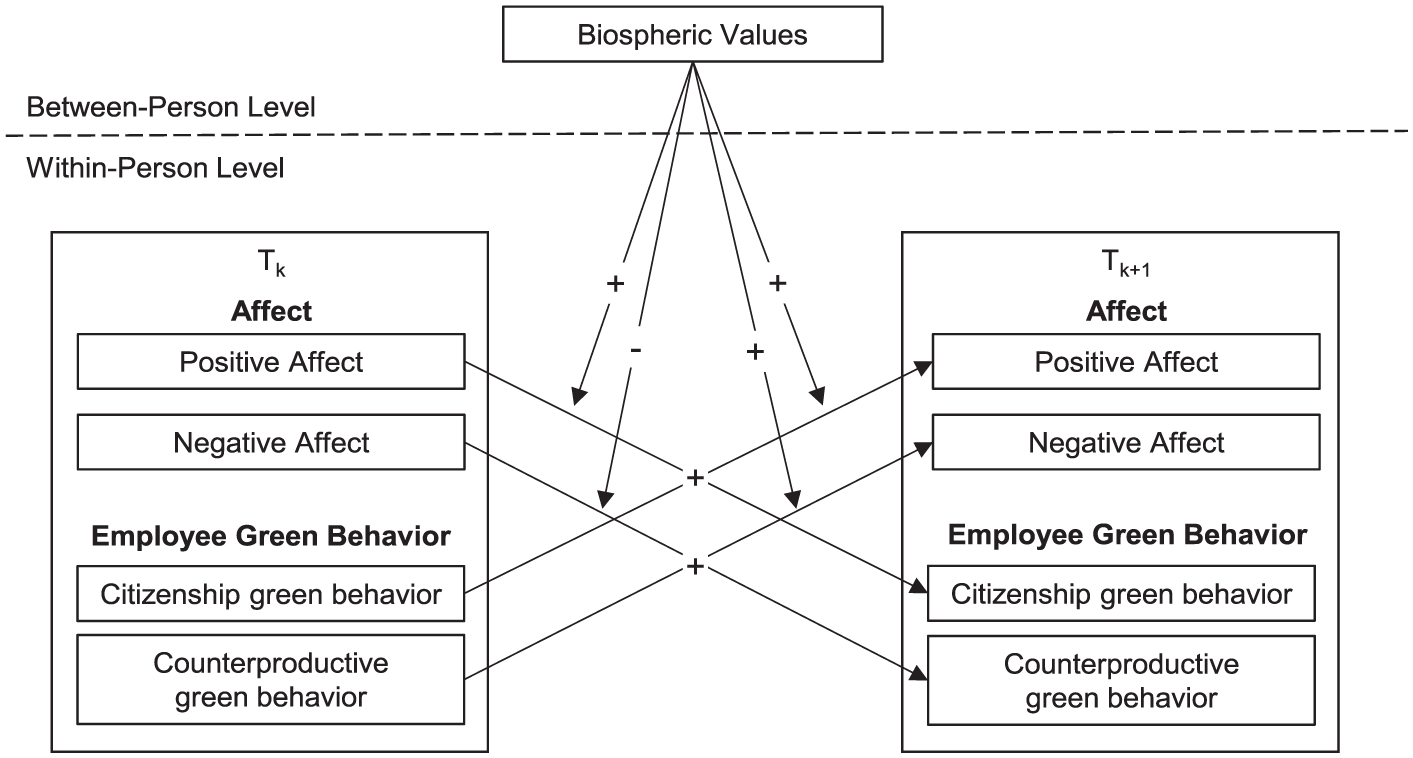
Conceptual Model.
This study contributes to research in the domains of corporate sustainability and employee green behavior in several ways. First, we advance the understanding of the individual-level predictors and outcomes of environmentally relevant behavior performed by employees, who act as critical change agents in the organizational transition toward environmental sustainability (Schaltegger et al., 2024; Zacher et al., 2023). Despite the emotional salience of environmental issues for many individuals (Clayton & Ogunbode, 2023), the relations between affect and employee green behavior are so far not well understood (Russell & Friedrich, 2015; Zacher et al., 2023). The few studies on these relations have used cross-sectional or nondynamic within-person designs (e.g., Bissing-Olson et al., 2013; Yang et al., 2023), which impede conclusions regarding the directionality of effects. By adopting a longitudinal panel design and applying random intercept cross-lagged panel modeling, we address the possibility that affect and employee green behavior may influence one another reciprocally over time and advance the understanding of the temporal processes involved in the relations between these variables. We also contribute to multilevel theorizing on employee green behavior (Norton, Parker, et al., 2015) by examining how biospheric values interact with within-person fluctuations in affect and employee green behavior. This helps clarify how stable individual differences influence the direction and strength of dynamic within-person relations involved in employee green behavior (Zacher & Bissing-Olson, 2018).
Second, we consider counterproductive green behavior as an important, yet hitherto neglected, form of employee green behavior (Zacher et al., 2023). Unlike the mere absence of pro-environmental behaviors, counterproductive green behavior involves active harm to the environment (Dilchert, 2018). Since such behavior is only moderately negatively correlated with pro-environmental work behavior (Katz et al., 2023), it is important to examine their potentially unique predictors and outcomes. By examining how within-person fluctuations in negative affect are related to subsequent counterproductive green behavior, we extend research that has mainly focused on relatively stable antecedents of counterproductive green behavior, such as personality and environmental commitment (Dilchert, 2018; Paillé et al., 2019).
Third, we contribute to research on the business case for sustainability, which explores how organizations can promote synergies between environmental, social, and economic goals to create value for multiple stakeholders (e.g., Hörisch et al., 2014; Schaltegger et al., 2019). While much of this research has focused on strategic decisions and contextual factors at the organizational level, we aim to shed light on the emotional and behavioral foundations of corporate sustainability at the individual level. Affect is closely linked to employee well-being and job performance (e.g., Brief & Weiss, 2002; Sonnentag, 2015), and these outcomes support both social and economic organizational goals. Hence, our study contributes to integrating individual-level experiences and behaviors into the broader business case for sustainability. Considering practical implications, these insights can inform the design of interventions (e.g., work design, leadership training) that help organizations align environmental, social, and economic goals in day-to-day operations.
Positive and Negative Affect and Employee Green Behavior
The concept of citizenship green behavior is derived from research on organizational citizenship behavior, which encompasses discretionary actions that support the social and psychological environment in the workplace beyond formal task performance (Rotundo & Sackett, 2002). The most prominent examples of organizational citizenship behavior are altruism (i.e., helping others) and compliance (i.e., being a conscientious organizational citizen; Smith et al., 1983). Altruism and compliance entail behaviors intended to benefit an employee’s relationships with other people and organizational functioning, respectively. In contrast, citizenship green behavior includes various active and discretionary behaviors that are primarily intended to benefit the natural environment and support organizational environmental sustainability goals, such as implementing environmentally sustainable work processes and advocating environmental practices (Lamm et al., 2013; Robertson & Barling, 2017).
Counterproductive green behavior extends from broader research on counterproductive work behavior, which refers to volitional acts that harm an organization or its stakeholders and violate legitimate organizational interests (Rotundo & Sackett, 2002; Spector & Fox, 2005). Typically considered the opposite of organizational citizenship behavior (e.g., Dalal, 2005), counterproductive work behavior has been adapted to the environmental domain through the concept of counterproductive green behavior (Dilchert, 2018). This concept encompasses discretionary employee behaviors that harm the environment, such as wasting resources and polluting the environment, which are counterproductive to organizational environmental goals (Dilchert, 2018; Zacher et al., 2023).
The emotion-centered model of voluntary work behavior (Spector & Fox, 2002) emphasizes affect as both an antecedent and consequence of work behavior. Based on the affect symmetry principle, this model highlights the unique relations that positive and negative affect have with corresponding forms of work behavior. Drawing from this perspective, we propose that experiencing higher levels of positive affect than usual increases subsequent engagement in citizenship green behavior, and vice versa. In contrast, higher levels of negative affect than usual should increase subsequent engagement in counterproductive green behavior, and vice versa.
This study focuses on high-activated affect. Compared to low-activated affect (e.g., calmness, sadness), high-activated affect has been proposed to be particularly important in influencing work behavior (Warr et al., 2014). High-activated positive affect refers to the experience of pleasant feelings of high levels of arousal, such as excitement, inspiration, and alertness, whereas high-activated negative affect refers to the experience of unpleasant feelings of high levels of arousal, such as anger, fear, and distress (Watson et al., 1988). 1
Positive and Negative Affect as Predictors of Employee Green Behavior
The emotion-centered model of voluntary work behavior and its affect symmetry principle (Spector & Fox, 2002) help to explain how positive and negative affect and general citizenship and counterproductive work behavior are related to one another over time. Although this model underpins our hypotheses, it is not specific to employee green behavior, and, therefore, additional theorizing focusing on within-person dynamics needs to be integrated into this model. To explain why within-person deviations in positive and negative work-related affect may influence within-person deviations in citizenship green behavior and counterproductive green behavior, respectively, we integrate the emotion-centered model of voluntary work behavior with broaden-and-build theory (Fredrickson, 2000).
According to broaden-and-build theory (Fredrickson, 2000), positive affective experiences expand an individual’s thought and action repertoire, encouraging them to consider and adopt positive and alternative forms of behavior. When individuals experience higher levels of positive affect than usual, they process information more broadly, think more creatively, are more willing to take risks, and develop more optimistic expectations (Diener et al., 2020; Erez & Isen, 2002; Schwarz, 1990). In the context of employee green behavior, the broadened perspective due to increased positive affect may make employees more receptive to environmental issues in their workplace and enable them to develop creative solutions for addressing these issues. Research also indicates that employees often face constraints that may hinder engagement in positive forms of employee green behavior, such as lack of autonomy and environmental knowledge (Yuriev et al., 2018). When employees experience increased positive affect, they may feel more optimistic about overcoming these constraints and become more willing to take the risk and invest the time and effort required for citizenship green behavior.
Drawing from the emotion-centered model of voluntary work behavior and broaden-and-build theory, we also expect that experiencing higher levels of negative affect than usual increases the likelihood of employees engaging in counterproductive green behavior. The experience of negative affect in the workplace can lead employees to disengage from organizational goals and engage in behaviors that harm the organization as the perceived source of their negative feelings (Spector & Fox, 2002). In the context of employee green behavior, increased negative work-related affect may lead employees to engage in counterproductive green behavior as an expression of their frustration with the organization. This behavior can harm the organization by undermining organizational environmental sustainability and posing risks to economic performance, as wasted resources (e.g., energy, water, materials) translate into financial losses.
Broaden-and-build theory suggests that negative affect narrows attention to immediate threats and leads to prioritizing short-term concerns over long-term goals (Fredrickson, 2001). Research indeed suggests that negative affective experiences can increase self-concern and decrease concern for others (Yip & Lee, 2022). A potential personal benefit of engaging in counterproductive green behavior for employees is that such behavior can be less costly and effortful and more pleasant than alternative behaviors that cause less environmental harm. For example, using disposable bottles produces waste but saves the effort of cleaning or returning reusable bottles. Similarly, adjusting climate control to extreme levels increases energy use but provides physical comfort. When employees experience higher levels of negative affect than usual, they may prioritize these personal benefits over environmental considerations and, over time, develop work behaviors that harm the natural environment.
Positive and Negative Affect as Outcomes of Employee Green Behavior
Consistent with the emotion-centered model of voluntary work behavior (Spector & Fox, 2002), we propose that positive and negative affect may also constitute outcomes of citizenship and counterproductive green behavior. Pro-environmental behavior represents a form of morally valued behavior (i.e., “the right thing to do”) because it benefits the natural environment and, ultimately, the well-being of others (van der Werff et al., 2013). As people are generally motivated to act in morally right ways, engaging in pro-environmental behaviors can make them feel good about themselves, thereby increasing positive affect (Venhoeven et al., 2016, 2020). Employees may also feel greater control over their work environment and a sense of accomplishment when they engage in citizenship green behavior, as this often requires overcoming individual and contextual barriers (Yuriev et al., 2018). These experiences can fulfill psychological needs for autonomy and competence, thereby leading to increased positive affect (Ryan & Deci, 2000).
Counterproductive green behavior reflects unethical conduct, as harming the natural environment violates moral standards (Ruepert et al., 2015). Because unethical behavior conflicts with the desire to uphold a positive moral self-image, individuals tend to feel bad about themselves and experience negative affect when they engage in such behavior (Zhong & Robinson, 2021). When employees engage in more counterproductive green behavior than usual, they may experience increased negative affect, as they recognize that they violated moral standards. Repeated engagement in such behavior can also diminish their sense of competence, as they begin to see themselves as less able to contribute to organizational and environmental goals. This frustration of the need for competence may lead to increased negative affect (Olafsen et al., 2025; Vansteenkiste et al., 2020).
The Moderating Role of Biospheric Values
Personal values represent relatively stable goal orientations that guide behavior across different situations (Schwartz, 1992). According to the value-belief-norm theory of environmentalism (Stern et al., 1999), personal values shape engagement in environmentally relevant behavior by influencing awareness of environmental issues and the sense of personal responsibility to address these issues. Compared to other personal values, biospheric values are particularly important for understanding environmentally relevant behavior (de Groot & Steg, 2008; Steg et al., 2014). Individuals with strong biospheric values are more concerned about environmental health and the perceived environmental impact of their actions, rather than personal benefits and costs (Steg & de Groot, 2012).
Although individuals with strong biospheric values already prioritize environmental issues, broaden-and-build theory suggests that positive affect can further increase engagement in citizenship green behavior. Biospheric values focus concern on the environment (Steg et al., 2014; Stern & Dietz, 1994), whereas positive affect improves cognitive processing and behavioral flexibility (Fredrickson, 2001). For employees with stronger biospheric values, increased positive affect may not increase the salience of environmental issues per se, but it can expand their ability to identify and act on opportunities for citizenship green behavior. In contrast, employees with weaker biospheric values are less likely to link positive affect to citizenship green behavior because environmental issues are less personally meaningful to them. The cognitive and motivational benefits of increased positive affect may be directed toward other goals, rather than toward recognizing and acting on opportunities for citizenship green behavior.
We also propose that employees with strong biospheric values may be less likely to engage in counterproductive green behavior when experiencing increased negative work-related affect. Biospheric values foster a sense of moral obligation to act in environmentally sustainable ways (Steg et al., 2014). This moral obligation may serve as an internal barrier to environmentally harmful actions and reduce the likelihood that negative affect results in counterproductive green behavior.
We further expect that employees with stronger biospheric values experience greater positive affect from engaging in citizenship green behavior than those with weaker biospheric values. According to value theory, behavior that aligns with personal values elicits positive affect (Schwartz & Sortheix, 2018). For employees with strong biospheric values, citizenship green behavior aligns with their concern for the natural environment. Perceiving alignment between one’s values and behavior may also enhance the sense of control over one’s actions, which can fulfill the need for autonomy and promote positive affect (Ryan & Deci, 2000).
In contrast, counterproductive green behavior is more likely to elicit negative affect among employees with strong biospheric values. These employees are likely aware of the adverse environmental impact of such actions (Steg et al., 2014), which may lead them to feel bad about themselves for engaging in such behavior. Moreover, the misalignment between personal values and behavior can create cognitive dissonance and discomfort (Festinger, 1957).
Method
Transparency and Openness
Data, statistical code to reproduce the analyses, and complete results can be found in the online supplemental materials: https://osf.io/xq8a3/. Data for this study were collected as part of a larger longitudinal data collection effort. Based on this data set, eight other studies with completely different research questions and completely different substantive variables than the current study have been published (Guenthner et al., 2025; Kühner, Stein, Zacher, & Weiss, 2025; Kühner, Rudolph, & Zacher, 2024; Kühner, Stein, & Zacher, 2024; Reindl & Zacher, 2025; Stein, Kühner, Katz, & Zacher, 2025; Stein, Weiss et al., 2025; Zacher & Rudolph, 2023). A data transparency table can be found in the online supplemental materials.
Study Design, Participants, and Procedure
This study was approved by the ethics advisory board of Leipzig University (Protocol ID “2023.0801.eb_vv_7” and study title: “Environmental Sustainability at Work”). The data considered in this study were collected at five monthly measurement points, with a complete panel design. Time 1 (T1) data were collected at the beginning of August 2022, and T2 to T5 data were collected at one-month intervals thereafter (i.e., September—December 2022). Given the currently limited theoretical guidance regarding the time frames over which the reciprocal within-person effects between positive and negative affect and employee green behavior may unfold, we followed recommendations to use relatively short time lags in longitudinal panel studies (Dormann & Griffin, 2015) and used time lags of 1 month between the measurement points. In addition, the use of 1-month time lags instead of shorter (e.g., daily) time intervals is consistent with theoretical arguments from the emotion-centered model of voluntary work behavior, which suggests that occasional emotional experiences are unlikely to substantially influence employee behavior (Spector & Fox, 2002).
We considered 1-month time lags appropriate for processes through which positive and negative affect may influence citizenship and counterproductive green behavior to unfold (e.g., developing the necessary knowledge and skills to engage in citizenship green behavior, motivational processes related to setting goals to improve organizational environmental sustainability, and withdrawing from the organization’s goals). Similarly, 1 month was considered appropriate for processes through which citizenship and counterproductive green behavior may influence positive and negative affect to unfold. Specifically, the positive effects of several forms of citizenship green behavior, such as suggesting improvements for organizational environmental practices, on positive affect may take some time to emerge, as changes in the work environment typically require time for planning, coordination, and successful implementation. In addition, higher levels of counterproductive green behavior than usual could increase negative affect in the following month because employees may not be able to rationalize their behavior over such an extended period and, consequently, may feel bad about themselves.
A panel company was commissioned to recruit participants from a nationally representative online panel in Germany. The company is ISO 20252:2019 certified, which ensures fair payment of participants and high quality of the data. To be eligible to participate, participants had to be at least 18 years old and be working at least 20 hours per week.
At T1, a total of 3,566 persons initiated the survey, of whom 2,948 persons were eligible to participate. The sample considered in this study comprises n = 2,738 employees who provided complete data on biospheric values at T1, as well as at least partial responses to the other substantive variables at T1 and correctly answered the two instructed response items embedded in the T1 survey (e.g., “Please select ‘strongly agree.’). These items are recommended to identify careless responders in online survey studies (Meade & Craig, 2012). Of the 2,738 individuals considered in our study, a total of n = 2,738 provided complete data on the substantive variables at T1, n = 2,207 provided complete data at T2, n = 1,871 provided complete data at T3, n = 1,707 provided complete data at T4, and n = 1,488 provided complete data at T5. Demographic characteristics of the sample can be found in Table 1.
Descriptive Statistics of Demographics and Substantive Variables at T1 and Comparisons of Complete and Incomplete Responders.

To examine the patterns of attrition, incomplete responders (n = 1,250) were compared to complete panel responders (i.e., employees who provided complete data at all five measurement waves; n = 1,488). As shown in Table 1, complete responders slightly differed from incomplete responders in terms of age, gender, education, and positive and negative affect. To further address attrition, we conducted a binary logistic regression analysis, in which demographic characteristics and T1 substantive variables predicted attrition. The results showed that demographic characteristics and substantive variables at T1 contributed minimally to explaining attrition (McFadden Adjusted Pseudo R2 = 0.027). In the analyses, full information maximum likelihood (FIML) was used to account for observed missingness.
Measures
Positive and negative affect, as well as citizenship and counterproductive green behavior, were assessed at all five measurement points. Biospheric values were assessed at T1 only. Unless otherwise noted, items were scored on five-point response scales, ranging from 1 = never to 5 = very often. Reliabilities for the measures collected at T1–T5 are reported as average values and as ranges across measurement waves.
Positive and Negative Affect
Positive and negative affect were assessed with five items each from the short form of the positive and negative affect schedule (PANAS; Mackinnon et al., 1999; Watson et al., 1988). Participants were asked to indicate how they have felt in the work context over the past 4 weeks. For positive affect, the items were “inspired,” “alert,” “excited,” “enthusiastic,” and “determined.” For negative affect, the items were “afraid,” “upset,” “nervous,” “scared,” and “distressed.” Reliabilities were acceptable for both positive affect (αMean = .886, αrange = .874–.898, ωMean = .914, ωrange = .902–.924) and negative affect (αMean = .881, αrange = .864–.894, ωMean = .913, ωrange = .904–.926).
Employee Green Behavior
Citizenship green behavior was assessed with four items adapted from Ones and Dilchert (2012). Example items include “In the past four weeks at work, I put environmental interests first” and “In the past four weeks at work, I behaved in an environmentally responsible way even when it was inconvenient.” Reliabilities were acceptable (αMean = .799, αrange = .788–.811, ωMean = .840, ωrange = .835–.846).
Counterproductive green behavior was assessed using the four-item scale developed by Dilchert (2018). Example items include “In the past four weeks at work, I wasted resources” and “In the past four weeks at work, I ignored the environmental impact of my own actions.” Reliabilities were acceptable (αMean = .789, αrange = .769–.769, ωMean = .854, ωrange = .833–.877).
Biospheric Values
Biospheric values were assessed using four items developed by de Groot and Steg (2008). Participants were asked, “How important are the following values as guiding principles in your life?” Example items include “respecting the earth” and “protecting the environment.” Responses were scored on a five-point response scale ranging from 1 = not important at all to 5 = very important. Reliability was acceptable (α = .918, ω = .935).
Analytical Strategy
Confirmatory factor analyses (CFAs) were conducted to evaluate longitudinal measurement invariance. In these analyses, we found support for metric invariance across models with respect to relative fit indices (see Table 2; Chen, 2007; Cheung & Rensvold, 2002). Complete results of these CFAs, as well as additional measurement models, are available in the online supplemental materials.
Summary of Measurement Invariance Tests.
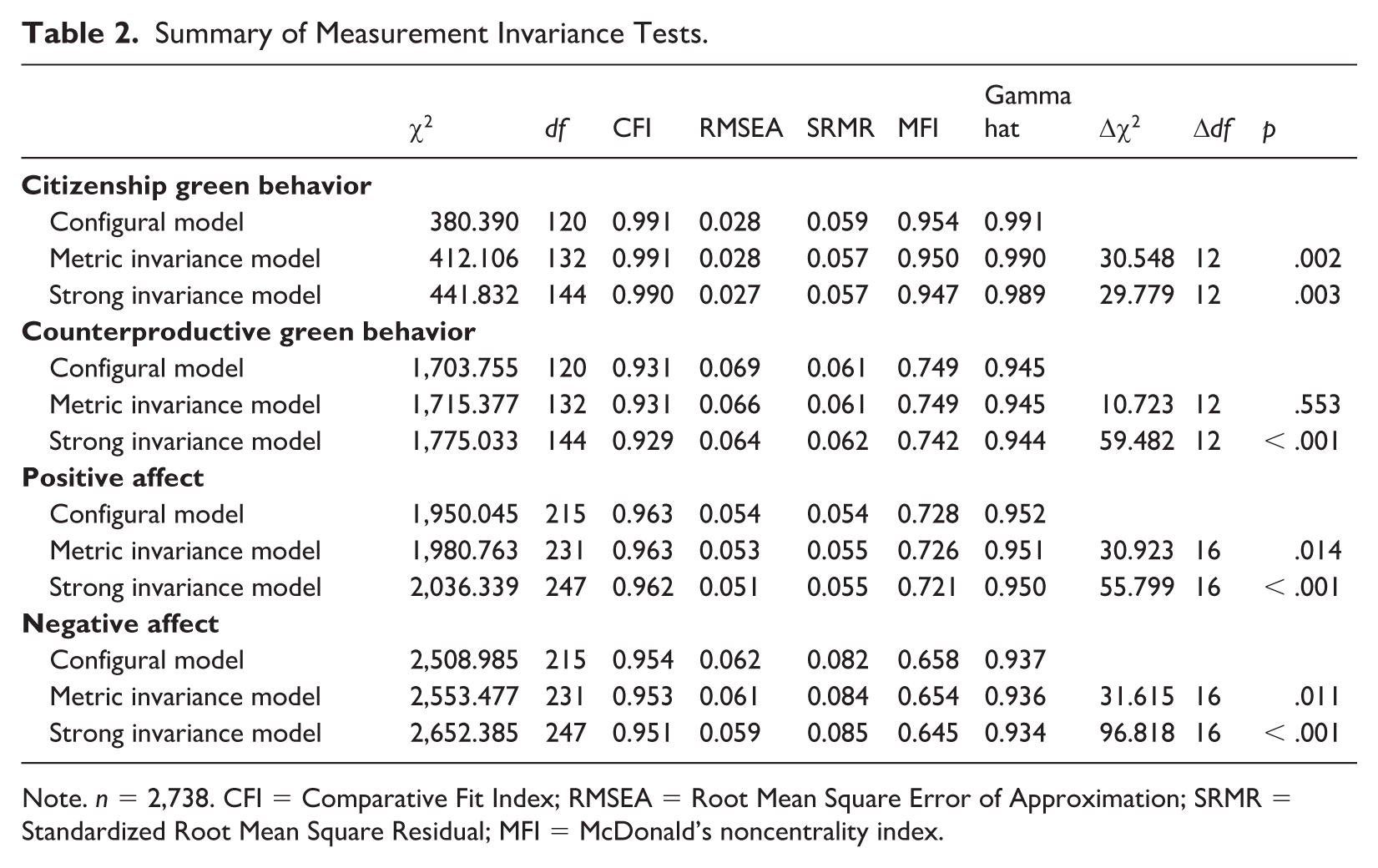
Note. n = 2,738. CFI = Comparative Fit Index; RMSEA = Root Mean Square Error of Approximation; SRMR = Standardized Root Mean Square Residual; MFI = McDonald’s noncentrality index.
RI-CLPMs were used to test the hypotheses. RI-CLPMs allow for concurrently modeling within-person autoregressive and cross-lagged effects while accounting for stable differences between individuals (Hamaker et al., 2015). In these models, the within-person cross-lagged effects reflect the extent to which deviations from an individual’s average value in one variable predict subsequent deviations in another variable. Following recommendations for testing interactions in RI-CLPM (Speyer et al., 2023), we first specified a baseline RI-CLPM without interaction effects included. This model included positive and negative affect and citizenship and counterproductive green behavior to test Hypotheses 1–4 simultaneously. We estimated the model with a maximum-likelihood estimator using the lavaan package (Rosseel, 2012) in R (R Core Team, 2025) version 4.4.0.
In the focal RI-CLPM, autoregressive and cross-lagged effects were fixed to equality over time. This RI-CLPM fit the data well: χ2(134) = 242.599, p < .001, comparative fit index (CFI) = 0.996, Tucker–Lewis index (TLI) = 0.995, root mean square error of approximation (RMSEA) = 0.017, and standardized root mean square residual (SRMR) = 0.023. We compared this model to an alternative RI-CLPM with freely estimated overtime parameters, finding improvements in overall model fit for the unconstrained model, as indicated by chi-square difference tests, but equivalent relative indices between the models. For the sake of parsimony and consistent with our theorizing and hypotheses, we report the results of the RI-CLPM with cross-lagged and autoregressive effects fixed to equality over time. Complete results are available in the online supplemental materials.
Second, we specified a series of RI-CLPMs that included latent interactions between biospheric values at the between-person level and the within-person variables. Due to the high computational intensity of these analyses (Speyer et al., 2023), we used bivariate models in which we included positive and negative affect, as well as the different forms of employee green behavior separately. To further reduce computational burden and facilitate estimation, we constrained the overtime parameters to equality and fixed the measurement error variances to 0.01. As there are currently no R packages available that support Bayesian estimation of models with latent interactions, we conducted these analyses using Mplus version 8.11 (Muthén & Muthén, 2017). We used default noninformative priors and 4,000 iterations, and we assessed convergence using posterior scale reduction (PSR) values < 1.05 as the convergence criterion. For these RI-CLPMs, we report unstandardized regression weights, posterior standard deviations (PSDs), and 95% Bayesian credible intervals. Complete results of these analyses are available in the online supplemental materials.
Results
Descriptive statistics and correlations can be found in Tables 1 and 3, respectively. A notable proportion of variance in the study variables resided at the within-person level (31% for citizenship green behavior, 45% for counterproductive green behavior, 26% for positive affect, and 28% for negative affect). Table 4 summarizes the results of the baseline RI-CLPM.
ICC1 Values and Correlations Among Substantive Variables.

Note. Between-person (within-person) correlations are below (above) the diagonal. nbetween = 2,738, nwithin = 10,890. At the between-person level of analysis rxy ≥ |.07| are p < .05; at the within-person level of analysis rxy ≥ |.06| are p < .05.
Summary of the Baseline RI-CLPM.

Note. n = 2,738. Braw = unstandardized regression weight, SE = standard error of unstandardized regression weight; 95% CI = 95% confidence interval. Bstd = standardized regression weight based on T1-T2 effects. Note that standardized regression weights for the other time lags differ slightly, as the overtime equality constraints do not apply to standardized effects (see online supplemental materials). Hypothesized effects are in boldface font.
At the between-person level of analysis, positive affect was positively correlated with citizenship green behavior (rxy = 0.289, p < .001) and negatively correlated with counterproductive green behavior (rxy = −0.116, p < .001). Negative affect was negatively correlated with citizenship green behavior (rxy = −0.045, p = .045) and positively correlated with counterproductive green behavior (rxy = 0.227, p < .001).
At the within-person level of analysis, positive affect at Tk was positively associated with citizenship green behavior at Tk+1 (B = 0.040, SE = 0. 019, p = .041). Thus, Hypothesis 1 was supported. In addition, negative affect at Tk was positively associated with counterproductive green behavior at Tk+1 (B = 0.083, SE = 0.022, p < .001), supporting Hypothesis 2. Importantly, the effect of negative affect on subsequent counterproductive green behavior was stronger than the effect of positive affect on subsequent citizenship green behavior. Although we did not propose hypotheses for these effects based on the affect symmetry principle, we note that positive affect at Tk was not significantly related to counterproductive green behavior at Tk+1 and negative affect at Tk was not significantly related to citizenship green behavior at Tk+1.
Citizenship green behavior at Tk was not significantly associated with positive affect at Tk+1 (B = 0.002, SE = 0.012, p = .834). Thus, Hypothesis 3 was not supported. However, counterproductive green behavior at Tk was positively associated with negative affect at Tk+1 (B = 0.037, SE = 0.011, p = .001), supporting Hypothesis 4. For the sake of completeness, citizenship green behavior at Tk was not significantly related to negative affect at Tk+1 and counterproductive green behavior at Tk was not significantly related to positive affect at Tk+1.
Table 5 presents the relevant parameters of the bivariate RI-CLPMs for testing the proposed moderating effects. We found a significant moderating effect of biospheric values on the within-person relation between positive affect at Tk and citizenship green behavior at Tk+1 (B = 0.044, PSD = 0.021, 95% confidence interval [CI] = [0.002, 0.086]). As shown in Figure 2, the positive effect was stronger for employees with stronger (vs. weaker) biospheric values. Thus, Hypothesis 5 was supported. However, no significant moderating effects of biospheric values were found for the within-person relations between negative affect and subsequent counterproductive green behavior (B = 0.025, PSD = 0.023, 95% CI = [−0.020, 0.070]), citizenship green behavior and subsequent positive affect (B = 0.010, PSD = 0.013, 95% CI = [−0.016, 0.036]), and counterproductive green behavior and subsequent negative affect (B = 0.012, PSD = 0.010, 95% CI = [−0.008, 0.032]). Thus, Hypotheses 6–8 were not supported.
Summary of the Bivariate RI-CLPMs Including Cross-Level Interaction Effects.

Note. n = 2,738. Braw = unstandardized regression weight, PSD = posterior standard deviation, 95% CI = Bayesian 95% credible interval. ✓ = Hypothesis supported. × = Hypothesis not supported. Please note that the estimates of the hypothesized effects in this table are derived from bivariate models. Estimates for the effects proposed in H1–H4 from the baseline RI-CLPM, which includes all study variables, differ slightly (see Table 4). However, the results of the hypothesis tests are the same.

Effect of Positive Affect on Subsequent Citizenship Green Behavior as Moderated by T1 Biospheric Values.
Additional Analyses
To reduce model complexity, we also estimated bivariate baseline RI-CLPMs without interaction effects. In the first model, we included positive affect and citizenship green behavior. In the second model, we included negative affect and counterproductive green behavior. In these models, the patterns of associations were consistent with the results of our focal RI-CLPM.
We also conducted exploratory analyses to examine whether biospheric values moderate the within-person relations between positive affect and counterproductive green behavior and between negative affect and citizenship green behavior. Results showed a significant and negative moderating effect of biospheric values on the within-person relation between positive affect at Tk and counterproductive green behavior at Tk+1 (B = −0.060, PSD = 0.024, 95% CI = [−0.106, −0.015]), such that the negative relation was stronger when biospheric values were stronger (vs. weaker). In contrast, biospheric values did not significantly moderate the within-person relation between negative affect at Tk and citizenship green behavior at Tk+1.
Given that our attrition analysis showed slight differences between complete and incomplete responders regarding age, gender, and education, we specified an additional baseline RI-CLPM in which we accounted for these differences. In this model, we included age, gender, and education as predictors of the random intercepts and used FIML to address missing data. 2 The results of this model were consistent with those of the focal baseline RI-CLPM. Complete results of these analyses are available in the online supplemental materials.
Discussion
Based on an integration of theories on affect, work behavior, and personal values, the aim of this study was to provide insights into the reciprocal within-person relations between positive and negative affect and employee green behavior. Using monthly data collected across five measurement waves from employees in Germany, we found that positive affect positively predicted citizenship green behavior. This suggests that when employees experience higher levels of positive affect than usual, they engage in more citizenship green behavior in the following month. This result extends findings from daily diary research (Bissing-Olson et al., 2013) by indicating that the effects of positive affect on pro-environmental work behavior can manifest over longer time frames of 1 month. This aligns with broaden-and-build theory (Fredrickson, 2001), which suggests that the expanded momentary thought-action repertoires associated with positive affect build enduring personal resources that facilitate the engagement in positive and alternative forms of behavior. For example, positive affect may motivate employees to engage with environmental issues and expand their knowledge and skills for addressing these issues, which, over time, facilitates citizenship green behavior.
Consistent with expectations, we also found that the positive within-person relation between positive affect and subsequent citizenship green behavior was stronger for employees with stronger (vs. weaker) biospheric values. Biospheric values focus attention on environmental concerns (Steg et al., 2014; Stern & Dietz, 1994), which may direct the broadened attention resulting from increased positive affect toward environmental issues in the workplace and opportunities to address them. Employees with strong biospheric values may therefore be more likely to translate positive affect into citizenship green behavior.
This finding stands in contrast with research suggesting that daily positive affect is positively related to pro-environmental work behavior among employees with less positive environmental attitudes (Bissing-Olson et al., 2013). Since biospheric values predict environmental attitudes (Steg et al., 2014), one possible explanation for these conflicting results is undetected reverse causality in Bissing-Olson et al.’s (2013) study. Daily engagement in pro-environmental behavior at work might also increase positive affect, particularly for employees with weaker environmental attitudes, for whom such behavior may feel novel and fulfilling. This interpretation aligns with self-determination theory (Ryan & Deci, 2000), which suggests that individuals experience positive affect when engaging in activities that promote feelings of autonomy and competence.
We did not find evidence that citizenship green behavior predicted positive affect in the following month, which may be due to the 1-month time interval considered in our study. According to affective events theory (Weiss & Cropanzano, 1996), positive affect may emerge as an immediate response to specific positive events, such as goal achievement or receiving positive feedback. This suggests that the affective benefits of citizenship green behavior may occur over shorter time frames, such as daily, rather than monthly.
Another potential explanation is that engagement in citizenship green behavior may also involve personal costs. Both theory and empirical research suggest that such behavior can lead to citizenship fatigue and performance trade-offs (Bolino et al., 2013; Lamm et al., 2013) and may provoke negative reactions from coworkers and supervisors who hold less favorable environmental values and attitudes (Zacher et al., 2023). These adverse effects could outweigh the potential positive affective consequences of citizenship green behavior.
Consistent with expectations, negative affect was positively related to subsequent counterproductive green behavior, and vice versa. This indicates that when employees experience higher levels of negative affect than usual, they tend to engage in more counterproductive green behavior in the following month. Conversely, when employees engage in more counterproductive green behavior than usual, they experience increased negative affect in the following month. These findings align with the emotion-centered model of voluntary work behavior (Spector & Fox, 2002) and empirical findings (Koopman et al., 2021), which suggest that negative affect and counterproductive work behavior are linked through feedback loops.
Although the within-person effect of citizenship green behavior on next-month positive affect was not significant in our study, counterproductive green behavior predicted increased negative affect. This asymmetry may reflect the stronger and longer-lasting impact of negative experiences, consistent with the “bad-is-stronger-than-good” principle (Baumeister et al., 2001). Engaging in counterproductive green behavior may trigger self-directed negative evaluations, which, in turn, may contribute to sustained negative affect. In contrast, the positive affective consequences of citizenship green behavior may be less pronounced or more short-lived.
We found no evidence that biospheric values moderated the negative within-person relation between negative affect and subsequent counterproductive green behavior. This suggests that when employees experience higher levels of negative affect than usual, they tend to engage in more counterproductive green behavior in the following month, regardless of their biospheric values. One possible explanation is that personal values need to be mentally accessible to influence behavior (Sagiv & Roccas, 2021). Negative affect may narrow attention (Fredrickson, 2000), decrease other-concern, and increase self-concern (Yip & Lee, 2022), thereby reducing the accessibility of biospheric values and leading employees to disregard the environmental impact of their actions.
Based on the affect symmetry principle (Spector & Fox, 2002), we did not propose hypotheses for within-person effects between negative affect and citizenship green behavior or between positive affect and counterproductive green behavior. At the between-person level, we found that employees who generally experience higher levels of negative (positive) affect than others tend to engage less in citizenship (counterproductive) green behavior. Nevertheless, these findings cannot provide insights into the temporal dynamics and directionality of effects and may instead reflect third variables, such as organizational environmental climate.
At the within-person level, most relations that stand in contrast with the affect symmetry principle were not significant, except for the negative relation between positive affect and subsequent counterproductive green behavior, which was stronger among employees with stronger biospheric values. Although this general pattern could be interpreted as supporting the affect symmetry principle, it is also possible that these relations unfold over different time frames than the 1-month interval used in our study, as we discuss further in the section on limitations and future research below.
Theoretical and Practical Implications
This study has important implications for theory on corporate sustainability and employee green behavior. First, we advance theorizing on both the predictors and outcomes of employee green behavior (Norton, Parker, et al., 2015; Zacher et al., 2023). Regarding predictors, our findings highlight the distinct roles of positive and negative affect in influencing engagement in employee green behavior. Specifically, positive affect may increase engagement in pro-environmental behavior, such as citizenship green behavior, whereas negative affect may increase engagement in environmentally harmful behavior, such as counterproductive green behavior. These findings challenge the broader environmental psychology perspective that negative affect (e.g., climate anxiety) can motivate pro-environmental behavior (e.g., Kühner et al., 2025). Instead, our results support the assumption that work-related negative affect lacks this motivational function (Bissing-Olson et al., 2013) and may even promote environmentally harmful behavior in organizational contexts. Regarding outcomes, we extend previous research emphasizing the harmful effects of counterproductive green behavior on environmental and organizational outcomes (Dilchert, 2018) by demonstrating that such behavior can also harm individuals themselves by increasing the aversive state of negative affect.
Second, we contribute to theory development by providing insights into the dynamic nature of the relationship between affect and employee green behavior. Although established frameworks acknowledge these dynamics by proposing that individual-level predictors of employee green behavior may also serve as outcomes (Norton, Parker, et al., 2015; Zacher et al., 2023), our findings emphasize the complexity of these reciprocal relations and the importance of focusing on within-person variability. Specifically, the distinct associations between positive and negative affect and their corresponding forms of employee green behavior emerged only at the within-person level. At the between-person level, both types of affect were correlated with both types of behavior. Distinguishing between between-person differences and within-person variability is theoretically important, as the relationship between affect and behavior fundamentally unfolds within individuals, and both affect (N. P. Podsakoff et al., 2019) and employee green behavior (Katz et al., 2023; Stein, Kühner, Katz, & Zacher, 2025) exhibit substantial within-person fluctuations.
Moreover, our finding that biospheric values moderate the within-person relation between positive affect and subsequent citizenship green behavior contributes to further multilevel theorizing on employee green behavior (Norton, Parker, et al., 2015; Zacher & Bissing-Olson, 2018). Research has highlighted the central role of values in environmentally relevant behavior (Steg et al., 2014). We support this perspective by showing that stable individual differences in personal values not only explain variation between individuals in their engagement in employee green behavior but also influence how dynamic, within-person affective experiences are related to such behavior.
Third, we contribute to theory development by emphasizing the conceptual and empirical distinction between positive and negative forms of employee green behavior (Zacher et al., 2023). Our findings suggest that citizenship and counterproductive green behavior are not mutually exclusive; employees may engage in both types of behavior within the same month. This co-occurrence underscores the need to conceptualize and examine citizenship and counterproductive green behavior as distinct constructs. The differing within-person associations of these behaviors with positive and negative affect further support this distinction by highlighting that each form of behavior has unique predictors and outcomes. Overall, our findings highlight the need for refined multilevel models that integrate within-person affective dynamics, interindividual differences in personal values, and the dual pathways of pro-environmental and environmentally harmful behavior to capture the complexity of employee green behavior in organizational settings.
The results of our study also offer several important implications for management practice aimed at creating synergies between environmental, social, and economic goals, consistent with the business case for sustainability perspective (e.g., Hörisch et al., 2014; Schaltegger et al., 2019). First, our findings suggest that promoting favorable affective experiences among employees can increase engagement in citizenship green behavior and reduce engagement in counterproductive green behavior. Organizations could support citizenship green behavior by implementing individual-focused interventions that promote positive affect, such as job crafting (van den Heuvel et al., 2015) or positive work reflection (Bono et al., 2013), and through work design interventions that increase job autonomy, task variety, and social support (Parker & Ohly, 2008). Our results also indicate that negative affect increases the likelihood of counterproductive green behavior. This underscores the need for organizations to reduce work-related stressors, not only to improve employee well-being but also to support the natural environment. To this end, organizations could implement interventions that promote supportive leadership (Stein et al., 2021), offer flexible work arrangements, and adapt jobs and tasks to better align with employees’ needs and capabilities (Fox et al., 2022).
Second, because individuals generally tend to avoid behaviors they expect to evoke negative emotions (Baumeister et al., 2007), organizations may reduce counterproductive green behavior by raising awareness of its aversive emotional consequences. Training programs could emphasize the link between such behavior and increased negative affect, encouraging employees to reflect on how their work behavior influences their emotional experiences. These efforts may support the development of self-regulatory capacities that discourage engagement in environmentally harmful behavior.
Third, our results highlight the importance of biospheric values in translating positive affect into citizenship green behavior. Organizations could activate these values in daily work by embedding environmental sustainability into formal policies and practices. Examples include developing “green” purchasing policies (Schillebeeckx et al., 2022), setting environmental performance goals, and integrating environmental sustainability into resource allocation decisions (Ones et al., 2018; Ramus & Steger, 2000). Recruitment practices that foreground environmental sustainability may help attract and select candidates with strong biospheric values (Pham & Paillé, 2019). For example, organizations can emphasize their commitment to environmental sustainability in recruitment materials and train hiring personnel to identify and prioritize applicants whose values align with the organization’s environmental mission.
Finally, our finding that biospheric values did not moderate the relationship between negative affect and counterproductive green behavior may reflect the narrowing effect of negative affect on employees’ attentional focus. When experiencing negative affect, employees may become preoccupied with immediate, self-focused concerns, reducing the salience of broader environmental considerations. To counter this effect, organizations could implement interventions that strengthen the perceived personal relevance of pro-environmental behavior. For example, self-concordance interventions, which encourage employees to reflect on how environmentally friendly behaviors align with their personal goals and values, can increase intentions to act in environmentally friendly ways at work (Unsworth & McNeill, 2017).
Limitations and Directions for Future Research
Although the longitudinal design and relatively large sample size constitute strengths of our study, several limitations should be addressed in future research. First, both affect and employee green behavior were assessed using employee self-reports. This raises concerns about biases, such as self-enhancement tendencies and common method variance. To mitigate these concerns, we followed methodological recommendations (P. M. Podsakoff et al., 2012) by temporally separating measurements and modeling within- and between-person components. Because our analyses focused on within-person deviations from individual averages over time, participants served as their own “control group,” which helps address concerns about self-enhancement tendencies and common method variance. Nevertheless, future research should incorporate multi-source data, including supervisor and coworker ratings, as well as objective indicators of employee green behavior (e.g., energy use metrics and observational assessments).
Second, although our longitudinal modeling approach sheds light on the temporal ordering of variables, it does not permit causal inference. Unmeasured time-varying variables may account for the observed effects between affect and employee green behavior. For example, dynamic job characteristics, such as job autonomy and social support, are linked to both affective experiences (Armon et al., 2012) and engagement in employee green behavior (Katz et al., 2023; Stein, Kühner, Katz, & Zacher, 2025). Future research could use experimental designs that manipulate affect to examine its causal impact on employee green behavior (see Shipley & van Riper, 2022, for an overview of such approaches in research on pro-environmental behavior).
Third, we employed 1-month time lags, following recommendations to use “shortitudinal” designs to examine reciprocal effects in panel studies (Dormann & Griffin, 2015), as well as theoretical considerations about the psychological processes underlying the effects between affect and employee green behavior (e.g., Fredrickson, 2001; Spector & Fox, 2002). However, different time lags might yield different results. According to affective events theory (Weiss & Cropanzano, 1996), citizenship green behavior may immediately increase positive affect when recognized and appreciated by others. Similarly, counterproductive work behavior may temporarily reduce negative affect as a form of cathartic release (Koopman et al., 2021). The absence of such “reparative” effects in our study may reflect the longer time frame used. Future research should compare findings across shorter (e.g., daily) and longer (e.g., weekly, monthly) time lags to better understand these temporal dynamics.
Fourth, in addition to our arguments based on the moral nature of environmentally relevant behavior, we theorized that employee green behavior influences affect via basic psychological need satisfaction. Although this explanation aligns with recent theoretical perspectives (Stein, Kühner, & Zacher, 2025), we did not directly assess the fulfillment of needs for autonomy, competence, and relatedness. Future research could include such measures to better understand the mechanisms through which employee green behavior influences affect.
Fifth, we focused on high-activated affect due to its relevance for work behavior (Warr et al., 2014). However, research indicates that daily low-activated positive affect can encourage employees to complete required work tasks in environmentally sustainable ways (Bissing-Olson et al., 2013). Future research could investigate different activation levels and specific emotions (e.g., joy, pride, shame, guilt, and anger), as evidence suggests that distinct emotions have unique effects on pro-environmental behavior (e.g., Bissing-Olson et al., 2016; Stanley et al., 2021).
Sixth, although our measures of citizenship and counterproductive green behavior presumably capture voluntary action (Dilchert, 2018; Norton, Parker, et al., 2015), some of the behaviors described in the items may also be performed as part of formal job responsibilities. This distinction is important, as the relationships between such behaviors and affect are likely weaker for employees whose job responsibilities formally include such actions. For example, employees in formal sustainability roles, such as sustainability managers, may attribute their engagement in pro-environmental behavior primarily to role expectations rather than personal values, which may weaken the affective benefits typically associated with value-congruent actions. In contrast, informal change agents for sustainability may derive stronger affective benefits, as their actions are more likely to reflect an expression of their personal values and commitment toward environmental sustainability (e.g., Heucher et al., 2024; Schaltegger et al., 2024). Moreover, required behaviors, such as adhering to recycling protocols, may even elicit negative affect when perceived as restricting autonomy. Future research could more explicitly distinguish between formal and informal roles in corporate sustainability and differentiate between discretionary and required employee green behavior to better understand their potentially distinct associations with affect.
Finally, contextual factors may moderate the relations between affect and employee green behavior. For example, limited autonomy and lack of organizational, supervisor, and coworker support for environmental sustainability are important barriers to employee green behavior (Yuriev et al., 2018). Future research could investigate whether such barriers may reduce the likelihood that positive affect leads to citizenship green behavior. Future research could also examine contextual factors that reduce the likelihood that negative affect leads to counterproductive green behavior. For example, pro-environmental organizational climate may prevent counterproductive green behavior by reinforcing social norms for environmental responsibility (Norton, Zacher, & Ashkanasy, 2015).
Conclusion
This study contributes to the literature on corporate sustainability and employee green behavior by investigating reciprocal within-person relations between work-related affect and employee green behavior over time. Based on a five-wave longitudinal study with monthly measurement points, we found that increased positive affect predicted a subsequent increase in citizenship green behavior, and that this effect was stronger among employees with stronger biospheric values. In contrast, increased negative affect predicted a subsequent increase in counterproductive green behavior, and vice versa. These findings advance the understanding of the individual-level predictors and outcomes of employee green behavior and highlight the dynamic ways in which work-related affect influences, and is influenced by, the engagement in environmentally friendly and harmful work behaviors.
Footnotes

Ethical Considerations
This study was approved by the ethics advisory board of Leipzig University (Protocol ID: “2023.0801_eb_vv_7” and study title: “Environmental Sustainability at Work”).
Consent to Participate
Participants provided written informed consent prior to participating.
Funding
The author(s) disclosed receipt of the following financial support for the research, authorship, and/or publication of this article: This research was funded by Volkswagen Foundation (Az. 96 849, “The Role of Work in the Development of Civilization Diseases”). Data collection for this research was funded by the German Federal Ministry of Labor and Social Affairs, the European Social Fund, and the Federal State of Saxony represented by the Saxon State Ministry of Economy, Labor, and Transportation.
Declaration of Conflicting Interests
The author(s) declared no potential conflicts of interest with respect to the research, authorship, and/or publication of this article.