




Abstract
By showcasing Sri Lanka’s repatriation of hazardous hospital waste to the United Kingdom, this paper explores how the transboundary movement of waste management business model functions in the Global South. It builds on a framework that integrates the market and legal modes of accountability, regulatory capture, and an ethic of accountability. Data were collected using online ethnography and an interpretive case study method. The study demonstrates how the adherence to market and legal modes of accountability and the violation of an ethic of accountability have created loopholes for actors to capture regulatory and institutional provisions, making the transboundary waste management business redundant in the Global South. The traditional business model pursued in waste management has proved inadequate in realizing reciprocal societal rights and responsibilities and promoting public well-being. This has resulted in an erosion of public trust in government and state agencies. Thus, we argue that accountability-based accounting and the ethic of accountability can potentially mitigate the opportunities for regulatory capture, serve the public interests, and protect the ecosystem.
Keywords
Introduction
On July 24, 2019, the BBC reported that “Sri Lankans are up in arms over the alleged dumping of hazardous waste from Britain, including syringes and suspected human remains from mortuaries” (Ethirajan, 2019). The aforementioned news story raises several complex questions about who is accountable, and about the ethicality of illegally importing hazardous hospital waste, including human remains, in the name of waste management. This article stems from an interest in understanding the extent to which organizations involved in transboundary movements of solid waste from the Global North to the Global South are accountable (e.g., Cotta, 2020; Thapa et al., 2023).
A recent World Bank report estimates that the world generates around 2 billion tons of municipal solid waste every year, and the figure is expected to reach 3.4 billion tons by 2050 (Kaza et al., 2018). While per capita waste generation by the Global South appears to be relatively low so far (although it is expected to increase in the forthcoming years), almost half of the total waste is generated by countries in the Global North as pointed out in the United Nations Environment Programme (UNEP, 2015): 1 “In 2010, the traditional high-income countries accounted for around half of all waste generation.”
To address the issue of increasing waste and its potentially severe consequences waste management has emerged as an innovative approach that has attracted increasing attention from businesses, governments, non-governmental organizations, international organizations, and the general public (see Kaza et al., 2018; Organisation for Economic Co-operation and Development, 2023; UNEP, 2015; Wilson & Velis, 2015). However, some countries in the Global North have tended to take the easier option, in view of the complexity and cost (i.e., collection, transportation, treatment, and disposal) involved in the process of waste management and accompanying strict environmental regulations, and export their solid waste to developing countries in the Global South, making them hot spots for the transboundary movement of solid waste dumping (Cotta, 2020; Thapa et al., 2023). Innovative solutions to waste management involve extensive financial commitments, thereby leaving space for illegal and unethical solutions. The prevailing international and local laws, institutional structures, and public policies governing transboundary movements of solid waste are somewhat vague, creating an incentive for actors to misinterpret legal definitions and lobby government policies (Cotta, 2020; Liu et al., 2018; Thapa et al., 2023).
Despite these persistent challenges, as part of the resource recovery business, solid waste transportation from the Global North to the Global South is regarded as an important aspect of transboundary waste flows (Cotta, 2020; Thapa et al., 2023). Low-processing costs, flexible environmental regulations, and resource vulnerabilities have made countries in the Global South popular destinations for waste generated in the Global North (Liu et al., 2018). For example, more than one million tons of plastic waste are shipped every year from America alone to the world’s poorest developing countries such as Bangladesh, Laos, Ethiopia, and Senegal (The Guardian, 2019). 2 Meanwhile, plastic trade exports from the European Union, which is the largest plastic waste exporter, to non-OECD countries increased dramatically in late 2022 and early 2023. 3 Thapa et al. (2023, p. 52) claim that “the transboundary movement of all waste, remains a societal challenge globally, frequently surfacing as an ethical question on the one hand and a story of resource management/trade on the other.” While an unprecedented increase in transboundary movements of solid waste from North to South raises questions about transparency, accountability, and ethical implications in relation to global waste management, there is also evidence to suggest that some companies are using the market for trade in illegal waste (waste transfer), due to the lack of regulations governing the global waste trade, which is now believed to be a multi-billion dollar industry (Cotta, 2020).
Having recognized the long-term damage being caused to the ecosystem and human well-being, some countries in the Global South have recently implemented initiatives designed to minimize waste imports (Cotta, 2020; Qu et al., 2019; Walker, 2018). For instance, in 2017, China, the largest solid waste importer in the world, banned imports of 24 types of recyclable and solid waste (Qu et al., 2019; Walker, 2018). Illustrative examples include the Philippines shipping 69 containers of rubbish back to Canada; 4 and Malaysia, which has become one of the main alternative destinations for plastic waste after China banned plastic waste imports, returning five containers of smuggled plastic waste to Spain. 5 India has also now banned solid plastic waste imports. 6 However, financial vulnerability caused by a lack of resources limits the power of other poor Asian countries to resist, making them emerging destinations for the circulation of solid waste from Northern companies and institutions. In particular, some countries in South Asia and Africa have evolved into new “pollution heavens” and, the practice of dumping waste on such destinations, despite their limited resources and capacity to process hazardous waste exported from the Global North, has been described as “toxic colonialism” (Thapa et al., 2023). The transboundary movement of hazardous waste to poorer destinations in the Global South that lack the necessary capacity and technological know-how inevitably leads to social and environmental injustice and creates health issues, especially among marginalized informal communities. Beyond the ethical concerns involved, in blatant violation of the Basel Convention, 7 illegal waste exports from the Global North to these countries have increased significantly in recent years (see Cotta, 2020; Thapa et al., 2023). Our research setting, Sri Lanka, exemplifies this phenomenon.
Sri Lanka’s Court of Appeal ruled that the importation of hospital waste from the United Kingdom violated local and international legislation on transboundary movements of hazardous waste. By February 2022, Sri Lanka Customs had repatriated all of the 263 illegally imported hazardous waste containers to the United Kingdom. The Sri Lankan case is just one example, and existing research provides little empirical evidence to show how organizations that subscribe to a waste management business model capture regulatory provisions and, in so doing, violate the ethic of accountability (see Cotta, 2020; Thapa et al., 2023). To address this research gap, we propose the following two research questions:
Integrating market and legal modes of accountability, the notion of the ethic of accountability (Dillard, 2008; Dillard & Brown, 2015), and regulatory capture theory (Posner, 1974; Stigler, 1971), we propose an analytical framework designed to better understand the unethical and illegal transboundary movement of waste from countries in the Global North to those in the Global South. Drawing on the case of Sri Lanka as an empirical basis, this study contributes to the limited but growing academic literature on the ethical and regulatory implications of the transboundary movement of hazardous waste management.
Background Literature and Theory
Transboundary Movements of Solid Waste in the Global Supply Chain
Waste management has come to be regarded as a global issue due to the increasing production and generation of waste around the world (Kaza et al., 2018; UNEP, 2015; Wilson & Velis, 2015). Many countries have already developed policies, plans, and strategies and are taking action to address the issue of waste generation and management; however, the collection, treatment, and disposal of increasing amounts of waste remains a challenge at both the national and the global levels due to the complexity of the process and the huge costs involved (Kaza et al., 2018). As a recent OECD 8 report notes, the production of plastic waste has doubled in the last two decades, most of which ends up in landfill sites, gets incinerated, or leaks into the environment, while only a small proportion (9%) is recycled. In 2020, around 367 million metric tons of plastic waste was generated, out of which 8 to 12 million metric tons ended up in the oceans (United Nations Conference on Trade and Development, 2021). 9 Discarded electrical and electronic equipment (or e-waste) constitutes the fastest-growing sector of waste in developed countries but its recorded recycling rate also remains low (20%) (Cotta, 2020). In fact, the proportion of waste recycled on a global scale, in general, is still very low, as the World Bank report confirms: “Globally, about 19 percent [of waste] undergoes materials recovery through recycling and composting, and 11 percent is treated through modern incineration” (Kaza et al., 2018, p. 18). This suggests that there are serious concerns about the sustainability of the current “production, consumption, and trade” model, which has been the subject of much discussion and debate in the extant literature (see Eikelenboom & de Jong, 2022; Piila et al., 2022).
The waste management business model has evolved as a key approach through which to address the issues relating to environmental impacts and climate change, reduce the use of finite material resources, and achieve sustainable economic growth and has attracted increasing attention from academics, practitioners, and policy makers (Eikelenboom & de Jong, 2022; Piila et al., 2022; Thapa et al., 2023; Wilson & Velis, 2015). Among many other proposed solutions (see Kaza et al., 2018; UNEP, 2015), the waste recycling business model is envisaged as a suitable alternative, whereby waste produced by one industrial process or goods that are at the end of their life cycle can be used (or recycled to use) by another industry or another country/region in the form of raw materials or as second hand goods. This would not only ensure that the resources are re-used and kept within the loop of production and consumption but also help extend the duration of product use, reduce the use of resources and energy consumption, and minimize or eliminate waste. This implies that waste recycling has the potential to engender similar benefits in other parts of the world in terms of reducing waste and creating economic benefits and job opportunities. Extant evidence suggests that discarded goods or products in the Global North can be repaired, processed, or treated, which in turn could generate employment opportunities and support the livelihoods of those involved in such activities (see Cotta, 2020; Thapa et al., 2023). Due to the cost and benefits of the recycling model, transporting solid waste from countries in the Global North to those in the Global South is seen as a viable option and an important aspect of transboundary waste flows (Cotta, 2020; Thapa et al., 2023). Our focus in this study is on the transboundary movements of solid waste from the Global North to the Global South which has received scant attention in extant literature.
Previous studies have highlighted various economic motives for transboundary movements of solid waste (see Cotta, 2020; Thapa et al., 2023). First, cheap labor in the Global South facilitates the separation of solid waste, making the job economically attractive and financially viable. Second, loose and flexible environmental regulations in these countries often create a competitive platform that countries in the Global North find difficult to resist. Third, countries in the Global South provide lucrative markets for secondhand and relatively low-quality products made from recycled materials. Fourth, many countries in the Global South, such as China, Malaysia, and Vietnam, have become manufacturing hubs, creating cheap, viable production facilities for recycled materials. Finally, importers of solid waste have realized the potential to create employment opportunities for less educated people in countries in the Global South.
Recent evidence shows that stakeholders involved in transboundary movements of hazardous waste to developing countries tend to compromise both the ecosystem and human well-being in pursuit of narrowly focused, purely economic motives (Cotta, 2020; Thapa et al., 2023). Violations of the provisions of the Basel Convention on transboundary movements of hazardous waste between nations have been highlighted (Thapa et al., 2023; K. Wang, Qian, & Liu, 2020). In addition to controlling transboundary movements of waste, the Based Convention contains provisions for minimizing waste generation, promoting environmentally friendly waste management practices, and preventing and combatting illegal traffic. The Basel Convention is intended to facilitate fair and transparent transboundary movements of hazardous waste. However, evidence shows that some companies are using this model for illegal waste trade in violation of the Basel Convention and existing international and local regulations (Cotta, 2020; Liu et al., 2018; Thapa et al., 2023; K. Wang, Qian, & Liu, 2020). This raises serious questions about the existing waste export system, the extent to which this smuggled waste is recycled, and more importantly who is accountable for dumping the exported toxic waste which can have severe consequences for public health, social justice, and the environment in Global South countries (see Cotta, 2020; Godwin, 2020; Thapa et al., 2023; K. Wang, Qian, & Liu, 2020). While these economic motives dominate discussions about transboundary movements of waste in the Global South, little is known about the underlying ethical, regulatory, and accountability concerns associated with these movements. In responding to these concerns, in the next section, we propose a framework for ethical accountability for the development of sustainable transboundary movement of solid waste.
Regulatory Capture Through Market and Legal Accountability: A Framework for Ethical Accountability in Waste Management
We developed our theoretical framework by integrating the ideas of the ethic of accountability, regulatory capture, and market and legal modes of accountability. This framework has enabled us to address questions about how and why organizations involved in transboundary movements of solid waste, mainly from the Global North to the Global South, violate their accountabilities to wider society, by adhering to the provisions laid down by markets and regulators. In doing so, we demonstrate how an ethic of accountability can offer a fruitful way forward for maintaining and evaluating the reciprocal rights and responsibilities of two primary constituency groups involved in waste management—businesses and wider society. While a considerable body of research has examined corporate responsibility and sustainability reporting (Dillard & Brown, 2015; Dillard & Layzell, 2014; Dillard & Vinnari, 2019), rarely have studies theorized about how the ethic of accountability can provide a contextual basis for assessing businesses’ behavior in relation to waste management, gaps which this study intends to address.
Market and Legal Accountability
The ways in which organizations discharge accountability, as part of their responsibility to provide an account of their actions and the co-existence of multiple forms of accountabilities, have been extensively discussed in prior accounting work (Baudot et al., 2022; Dillard & Layzell, 2014; Mai & Hoque, 2023). Traditionally, in relation to accounting-based accountability (see e.g., Dillard & Vinnari, 2019), organizations, as power holders, are required to justify and explain their actions to account holders, who entrust their economic resources for operations such as the managers at financial and economic constituents (financiers) and markets, how well the resources have been used, and the demands met (Baudot et al., 2022). Grant and Keohane (2005) proposed seven different modes of accountability—market, legal, supervisory, fiscal, hierarchical, peer, and public reputation accountability—taking into consideration the criteria specified for holding the powerful accountable. However, given the increasing power of international corporations and the widespread consequences of their actions, market, and legal accountabilities have come to be the dominant modes of accountability, and this is particularly striking in relation to the transboundary movement of solid waste through the global supply chain.
Market accountability refers to an organization’s responsibility to its investors, customers, and consumers to enhance profitability and ensure value for money. Under this mode of accountability, account holders are directly involved in, and restricted to, making resource allocation decisions relating to acquiring a product or service. Investors and financiers constitute two other key groups of account holders due to their possession of the required resources, and their participation in the market is determined by the financial outcomes produced by the management’s actions. It has therefore been asserted that the self-interested decisions of the participants influence the market, and thus resources should be allocated fairly and efficiently, with consequences for the failure to discharge accountability. Dillard and Vinnari (2019) claim that the justification for the dominance of market accountability is premised on a “functionalist, utilitarian form of accountability within a neoliberal framing” (p. 26). It is therefore argued that collective norms and community values are rarely accommodated in this mode of accountability and so distortions resulting from power asymmetries, institutional and structural bias, and social inequalities remain outside the remit of the accountability relationship (Dillard & Layzell, 2014; Dillard & Vinnari, 2019).
In a similar vein, legal accountability entails confirming compliance with specific rules and regulatory provisions. Under this mode of accountability, the power holders are required to justify their actions to those institutions, for instance, courts, which are entrusted with the authority to enforce the rules. Dillard and Vinnari (2019) argue that, in an ideal world, both the rules and the institutions enforcing them would be established through the democratic process. Rules therefore provide the legitimacy with which to exercise power, and the actions for which the power holders are held accountable are codified in such rules. However, in a situation in which the operation of democratic institutions and practices is limited, for instance, in the case of multinational corporations (see e.g., Dillard & Vinnari, 2019), the evaluation criteria specifying the required actions and decisions may be dominated by powerful interests, thereby making the existing provisions for noncompliance and its consequences redundant. It has also been argued that the financiers (capitalists) who have emerged as the primary users of accounting systems may have a tendency to exert their influence by identifying certain sets of relevant evaluation criteria that ensure investment potential and codifying these into laws, regulations, and standards. It is therefore unsurprising that legal accountability privileges financiers’ (capitalists) interests over those of all other constituents (Dillard & Vinnari, 2019), thereby enabling financiers to pursue accounting systems that could further reinforce the accountability criteria associated with the needs of financial constituents and markets (Malsch, 2013).
In this regard, both the market and the legal modes of accountability are vertically oriented, because they ensure power holders’ accountabilities to financial constituents and regulators. It has been observed that the inadequacies associated with these modes of accountability, in particular the way these are deployed for facilitating and obscuring regulatory capture and privileging the needs and interests of financial constituents, have become key factors in triggering discussions about the need for other modes of accountability, for instance, an ethic of accountability, to protect the public interest and restore trust in organizations’ activities (see Baudot et al., 2022).
Regulatory Capture
The ideas underlying regulatory capture suggest that regulations are frequently enacted with a view to safeguarding the interests of organizations and capital providers (financiers) instead of protecting the well-being of the general public (Posner, 1974). Stigler (1971, p. 3), who coined the term “regulatory capture,” highlights the fact that, “as a rule, regulation is acquired by the industry and is designed and operated primarily for its benefit.” In a similar vein, Hardy (2006, p. 102), an advocate of the common good perspective, asserts that regulatory capture “acts primarily in the interests of the regulatees, rather than in accordance with their putative mandate to promote the common good.” Regulatory agencies that are supposed to protect the public interest are therefore captured and controlled by the industry actors who are meant to be regulated by these agencies (Posner, 1974; Stigler, 1971).
In their study of water governance in the Murray-Darling Basin, Grafton and Williams (2020) illustrated that regulatory capture not only occurs in authoritarian states but is also widespread in well-established and high-functioning democracies. The authors argue that regulatory capture often occurs in a situation in which “the benefits of regulation are highly concentrated, because interested parties have a strong incentive to affect decision making or undertake entrepreneurial politics” (Grafton & Williams, 2020, p. 487). In addition, various other mechanisms have been highlighted in the literature which has led to regulatory agencies acting in favor of industry actors, for instance, intense lobbying by actors, actors taking up appointments within the industry and regulatory institutions, and through the exercise of excessive political influence (Grafton & Williams, 2020; Hardy, 2006; Posner, 1974). It has long been acknowledged that states and regulators have either failed to identify or overlooked the hidden intentions of organizations operating in the market economy, thereby creating a context in which they themselves can be held captive to those they are supposed to regulate (e.g., Posner, 1974). Noah et al. (2021) observe that such practices are perhaps more striking in emerging economies where “the fabrication and manipulation of corporations” activities are a recurring issue (p. 75).
Regulatory capture can therefore be deliberate, and several examples have been presented in prior work delineating how businesses are likely to exploit regulations in their attempt to maximize financial gains, thereby compromising the interests of broader societal constituents (Duso, 2005; Mitnick, 1980; Potter et al., 2014; Uche, 2001). In addition, a number of accounting scholars have discussed how financiers (capitalists) have set the trajectory for contemporary accounting and accountability systems—accounting-based accountability (see e.g., Dillard & Vinnari, 2019)—lobbying the standard setters such as the Financial Accounting Standards Board and the International Accounting Standards Board (IASB), and how the systems have been developed to meet the needs of the financiers (Dillard & Vinnari, 2019). For instance, Cortese (2011) discussed the FASB’s attempt to standardize the oil and gas industry and, in so doing, illustrated how, by means of intense lobbying, the industry succeeded in capturing the regulatory process and ensuring its preferred outcomes. In the context of emerging economies, Noah et al. (2021) have demonstrated how the mechanisms of corruption that permeate down to the government have allowed oil and gas companies operating in Nigeria to capture the enforcement of regulations and thwart the monitoring of their environmental activities and accountability.
Other studies have highlighted how the disclosures for reporting and accountability have been determined by the financiers, due to the power asymmetries created, and how deficiencies identified by them have led to modifications in the accounting systems on an iterative and ongoing basis (Dillard & Layzell, 2014). It has been suggested that accounting practices and accountability systems should be designed in a way that moves beyond the “accounting-based accountability” approach, by embedding the underlying ideas of “accountability-based accounting” in which the rights and responsibilities of the constellation of constituencies—human and non-human—affected by the actions of account providers are incorporated, and in which multiple criteria are set forth for the evaluation of accountability (Dillard & Vinnari, 2019). An ethic of accountability has therefore been proposed as a corollary to “accountability-based accounting,” which is built on the notion of representing pluralism and acting in the public interest (Dillard, 2008; Dillard & Layzell, 2014).
An Ethic of Accountability
The notion of an ethic of accountability, initially developed and applied by Dillard (see e.g., Dillard, 2008), has been proposed as a means through which to address the limitations of “accounting-based accountability,” the disclosures of which privilege and are exclusively determined by the financiers (markets) and regulators (Dillard & Vinnari, 2019). Prior work has demonstrated how accounting-based accountability has enabled businesses and corporations to act as economic subjects and avoid their wider societal responsibilities (Baudot et al., 2022; Roberts, 1991). The proponents of an ethic of accountability maintain that corporations/businesses’ (power holders) excessive focus on maximizing the value of financiers (capitalists) diverts them away from their role as socially responsible economic entities (Dillard & Brown, 2015). For instance, Dillard and Layzell (2014, p. 214) state that the central role of business lies “in ensuring the long-term viability of a democratically governed society grounded in justice, equality, and trust and supported by sustainable nature, social, and economic systems.” It has therefore been argued that the objectives of businesses should be set out and their actions evaluated within the ambit of these wider premises and not confined to the narrow remit of financiers’ interests.
In research discussing an ethic of accountability, scholars have proposed a broader “community-centred approach” involving “supra—contractual obligations” to a community of others, calling for businesses to accept their obligations to employees, customers, suppliers, and other parties that they directly or indirectly deal with and address wider socio-environmental concerns (Shearer, 2002). In particular, the community-centered approach emphasizes that businesses only exist in society because they have been provided with the necessary infrastructure by the state, including, among other facets, security, regulation, judicial systems, conflict resolution, and contract enforcement mechanisms. Society then enables these businesses to continue operating and sustain their activities by forging some sort of property ownership arrangements with them (see e.g., Dillard & Layzell, 2014). Through such arrangements, businesses are granted the rights to extract and use society’s economic assets—natural, human, financial, and technical—which enable them to provide goods and services to citizens as well as create employment and investment opportunities. In this way, businesses end up in a fiduciary relationship with society, arising from the rights being granted to use these assets. Giving an account of and being held accountable for the actions that they undertake are central to maintaining such relationships (Dillard & Layzell, 2014). Businesses are therefore obliged to provide society with an accurate, timely, and comprehensive account of their performance and help facilitate an informed judgment and evaluation of their actions (Dillard, 2008).
Implicit within the ethic of accountability is the view that society also has a responsibility for specifying the evaluation and accountability criteria and elucidating to the businesses the dimensions upon which their performance is to be assessed. These reciprocal sets of rights and responsibilities imply that both the businesses and the members of society have an inherently equal role to play in executing the ethic of accountability. For instance, Dillard and Brown (2015) argue that members of society should be able to make businesses aware of the fact that different groups of people, for instance, workers, could prioritize reporting and evaluation criteria differently from members of other groups, for instance, investors. However, scholars have argued that the existence of “accounting-based accountability” has proved to be inadequate both in terms of enabling society to realize such reciprocal rights and responsibilities and making businesses aware of their failure to fulfill their obligations and act in the public interest (Baudot et al., 2022; Dillard & Vinnari, 2019).
An ethic of accountability therefore proposes a form of plurality in terms of accountability, by engaging members of society and businesses through continuous discussions and debates. This may play an important role in limiting the domination of market and legal modes of accountability premised on “accounting-based accountability” and minimizing the potential avenues for regulatory capture. The transboundary movement of solid waste has been envisaged as a complex field in which multiple interests collude, involving businesses (both local and global), governments at different levels, and members of society. The pluralistic nature of the need for information and accountability is more evident in the field of waste management and the circular economy (Cotta, 2020; Thapa et al., 2023). However, given the power of businesses and the focus on regulatory compliance, it is perhaps unsurprising to observe the domination of market and legal modes of accountability, the capturing of regulations by businesses at different levels using various mechanisms, and the non-functioning of community-based approaches and accountability-based accounting systems. However, the consequences of non-adherence to an ethic of accountability could be devastating in the Global South in light of the continuing ascendency of transboundary waste flows and the gradual emergence of countries in the Global South as new “pollution heavens” and the phenomenon of “toxic colonialism” (Thapa et al., 2023). Although this aspect has been discussed widely in the literature (Baudot et al., 2022; Dillard, 2008; Dillard & Brown, 2015; Dillard & Vinnari, 2019), studies theorizing about how the absence of an ethic of accountability has contributed to transforming poor and vulnerable countries into a waste dumping site are scarce, a theoretical gap that this study intends to address by delineating the dumping of waste in Sri Lanka by countries in the Global North.
Method
In this study, an interpretive case study approach was adopted, based on online ethnography undertaken between July 2019 and February 2022. This period covered Sri Lanka Customs’ detection of imported illegal waste and the repatriation of the containers to the United Kingdom. Given the nature of the event, an interpretive case study approach provided a suitable lens through which to explore accountability and regulatory failure in the transboundary movement of solid waste to the Global South. With the increasing availability of digital data sources, online ethnography (also referred to as Netnography and digital or virtual ethnography) has become a popular, internet-based approach to studying mundane practices (e.g., Kozinets, 2002; Yu, 2021). As Kozinets (2002) argues, online ethnography does not merely consist of downloading online data but also involves exploring mundane practices through online communities.
An online ethnography provides a suitable approach to examine the research underpinning this study for several reasons. First, as the case reflects accountability concerns within the broader public visibility, the study analyses public discourses shared by different stakeholder groups. Second, online sources (e.g., social media) provide a useful platform for stakeholder groups to express their views, reflect negotiations and compromises, and reveal the societal myths involved in this process, directly and indirectly. In recent times, social media has played a critical role in understanding different views about controversies. Next, Netnography facilitates a wide range of detailed and descriptive opinions and viewpoints on a given case scenario.
Following Hine (2011), we explored the sequence of events from the detection of illegally imported containers to the Government of Sri Lanka’s repatriation of the containers to the United Kingdom. To explore the actions and reactions of different stakeholder groups, we collected data from several interested online communities such as Facebook, YouTube, and Twitter. We observed that online users/viewers who have a common interest in safeguarding society from the illegal waste business use these platforms to comment and provide feedback on this particular case. Moreover, key stakeholders, such as waste-importing companies in Sri Lanka, use social media to justify their acts using YouTube videos, comments, and posting. Our focus in this study is aligned with “symbolic Netnography” which uses social media information to build a portrait of particular people or sites that can inform decision-making in relation to mundane activities (Kozinets, 2002). In terms of data sources, our study uses “archival” online data (Costello et al., 2017). This approach is considered a form of “passive Netnography” as the researcher does not actively engage with the online community. Instead, the researcher observes and monitors online communities without participating in them.
Despite its relevance and usefulness in examining the case under investigation, online ethnography has its own limitations, which raise questions about the validity and the reliability of findings. For instance, as contradictory views are reflected by different stakeholder groups, data sources could have been deliberately manipulated to frame an alternative agenda (Scheufele & Tewksbury, 2007). Moreover, researchers also encounter challenges when attempting to translate meanings and the contextual use of different symbols such as emojis or memes. To minimize these limitations, we employed several measures. First, we carefully referred to balanced and widely recognized local and international media publications (e.g., government media sources, local and international news, and official reports/publications). Second, we verified the same information from multiple sources. This included, for instance, cross-checking written reports with original video sources and having informal conversations with local activists who have been continuously following the case. Next, we also refer to court hearings, parliamentary debates, government investigations, public protests, media conferences, company announcements, and political interventions that occurred in the period between when the illegal waste was detected and the repatriation of the waste. Finally, we archived the collected data sources in terms of web links and captured screenshots of news records. Table 1 provides an overview of the research design.
Research Design.
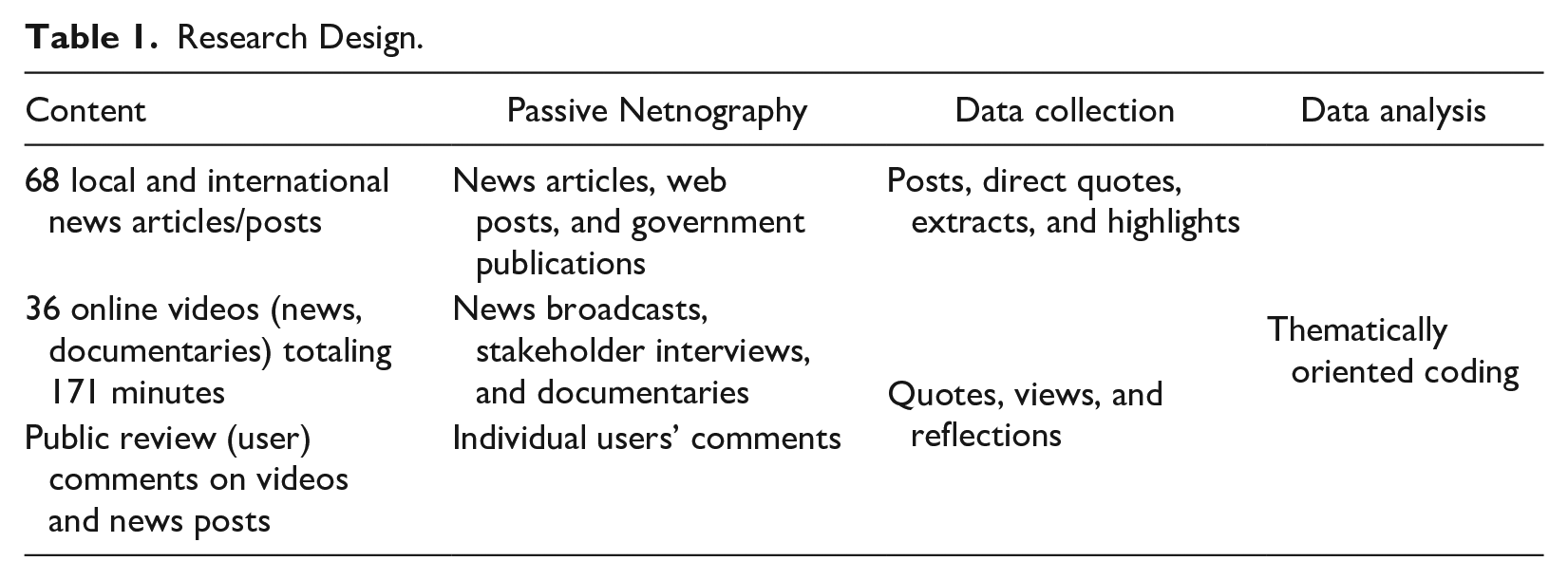
We referred to opinions expressed by members of the public in videos and news articles and analyzed responses to news articles and posts published by news agencies on social media sites such as Facebook, YouTube, and Twitter. These publicly available data sources incorporated the views of various stakeholder groups, including U.K. regulatory agencies and Sri Lankan import companies, government authorities, community participants, the media, environmental activists, and professional experts. Social media platforms enable users to express their views freely and interact socially with others. These comments revealed how members of the general public perceived the market and legal accountability of organizations and government institutions involved in transboundary movements of hazardous waste. While most comments criticized companies’ actions and reflected negative impressions, a small number of comments also expressed a balanced perspective, suggesting that there were benefits to countries in both the Global South and the Global North. Moreover, while this study focused on an incident that involved Sri Lanka and the United Kingdom, the comments revealed various examples from countries around the globe. For instance, the BBC posted two articles on Facebook, one immediately after the incident was revealed, and the other after the waste was repatriated to the United Kingdom. The first article (Ethirajan, 2019), posted to Facebook on July 25, 2019, received 7,862 reactions, 1,494 comments, and 1,894 shares. 10 The second (BBC News, 2020), posted to Facebook on September 27, 2020, received 9,987 reactions, 1,064 comments, and 1,190 shares. 11
Comments on YouTube videos also provided useful insights into how the general public perceived disputed waste imports into Sri Lanka, and from the Global North to the Global South more generally. As of January 15, 2021, 296,599 public comments had been posted on this topic in response to 36 videos. Interestingly, public comments had been disabled for 14 videos, possibly owing to the nature of comments posted on the matter. Appendix B provides a summary of YouTube videos analyzed in this study. This sensitive story also received considerable attention in various Twitter posts.
Data Analysis
As the case evolved over several months, we started undertaking data analysis in parallel to the data collection. We analyzed the data using manual thematic analysis, and in so doing we adopted an a priori (provisional) coding approach (Miles et al., 2020). More specifically, we sought to integrate a diverse group of online community members’ public discourses (e.g., the general public, civil activists, scientists, key stakeholders, and the authorities) to gain a deeper understanding of accountability concerns from different perspectives. Due to the availability and relevance of data sources, we analyzed both textual and non-textual data (e.g., visual and audio data). In the case of non-textual data, the authors transcribed (and translated where necessary) the relevant quotes from the recordings. After selecting relevant quotes from the collected data, the co-authors discussed the initial codes which were mainly derived from the background literature and theoretical frameworks applied in this study, and new codes that emerged during the data analysis process to reach an agreement on the coding process. In line with the coding rules and procedures, and after discussion with the co-authors, some of the overlapping codes were removed as certain pieces of evidence relating to market and legal accountability were repeated. Next, we shifted our attention back and forth between the data, relevant literature, and theories to finalize the codes and the structure of key findings. Finally, following the iterative process (see Miles et al., 2020), we arranged our findings into three main themes: (a) a reflection of the transboundary movements of solid waste from Global North to Global South; (b) capturing regulatory provisions by undermining market accountability; and (c) creating a regulatory capture by compromising legal accountability (see Figure 1).
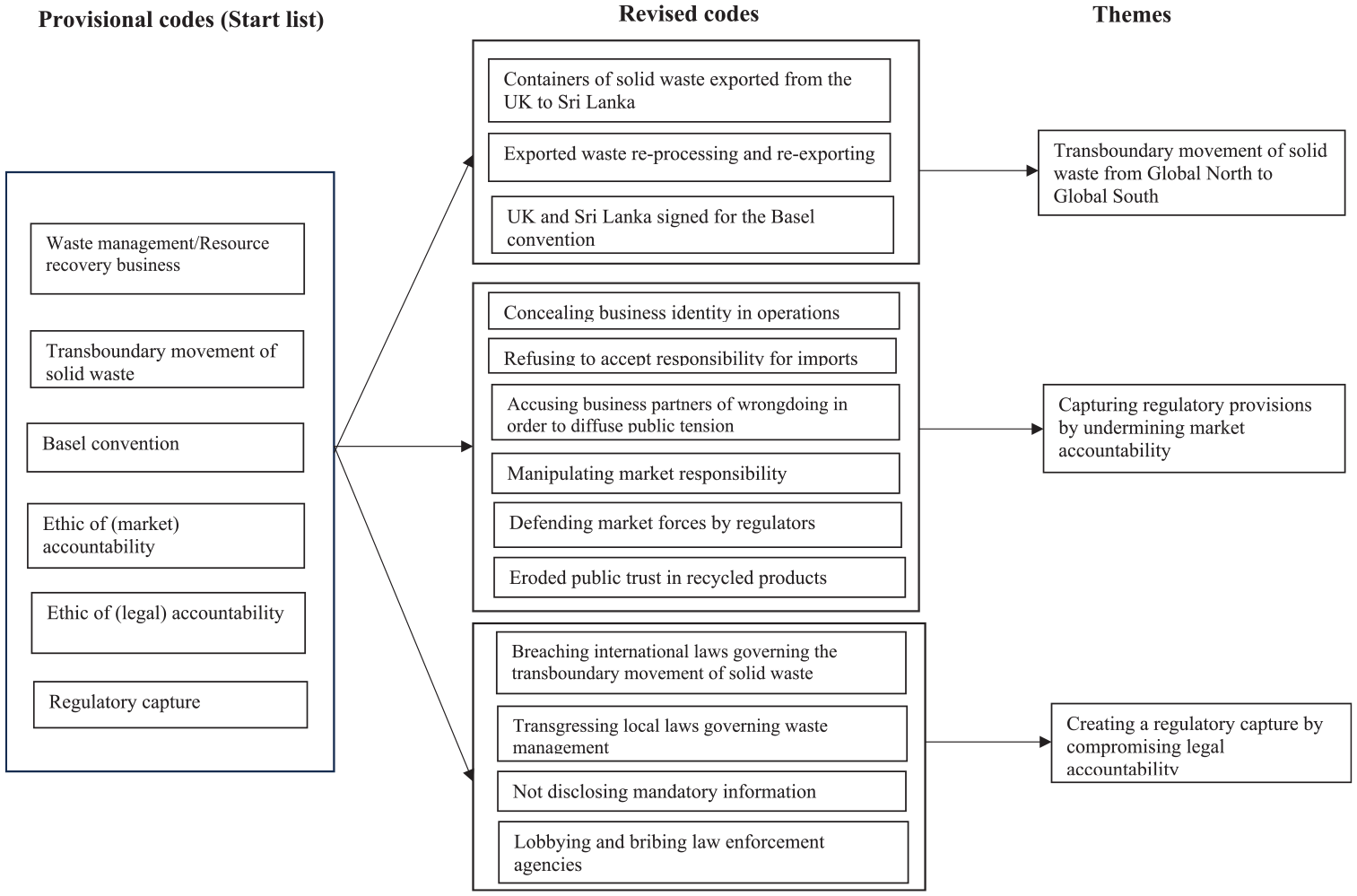
Summary of Provisional and Revised Codes and Themes.
As depicted in Figure 1, we undertook the analysis in three stages. The first stage involved understanding how the waste-importing companies justify their actions as resource recovery businesses within the transboundary movement of waste from the Global South to the Global North. The second and third stages focused on how the practice of deliberate regulatory capture undermined market and legal accountability in the transboundary movement of solid waste from the Global North to the Global South, respectively.
Analysis of Stage 1: First we aimed to frame the U.K.’s export of waste to Sri Lanka within the scope of the transboundary movement of solid waste, as recognized in the Basel convention. Second, referring to the views expressed by the Ceylon Metal Processing Corporation, the waste-importing company in Sri Lanka, we explore how the company attempted to position its business case within the resource recovery model.
Analysis of Stage 2: During Stage 2, we explored the ways and means by which regulatory capture has undermined market accountability. We employed a narrative analysis to better understand expectations about the nature of organizations’ accountability (Denzin, 1989; Silverman, 1993/2015). Informed by the ethic of accountability (Dillard & Vinnari, 2019) and regulatory capture, our analysis identified empirical themes relating to market accountability: concealing the business’s identity, refusing to accept the import of waste, deliberately passing the responsibility onto others, and manipulating market responsibility.
Analysis of Stage 3: In the final stage, we focused on gaining insight into how regulatory capture has undermined legal accountability. Our critical thematic analysis further explored how business organizations attempted to capture regulatory and institutional provisions, by taking control of discharging legal accountability (Braun & Clarke, 2006). In particular, the analysis suggested several means by which business organizations captured regulatory and institutional provisions, including breaching international laws governing the transboundary movement of solid waste (e.g., Basel Convention), transgressing local laws governing waste management, lobbying and bribing regulatory agencies, and failing to reveal mandatory information required by law. The next section explains the findings of the study in detail.
U.K. Waste Export to Sri Lanka: A Reflection of the Transboundary Movements of Solid Waste From Global North to Global South
In July 2019, Sri Lanka Customs revealed that, between September 2017 and February 2018, 263 containers of illegal waste had been imported from the United Kingdom as municipal and household waste for re-processing and re-export. It reported that 130 containers were located at the Colombo International Container Terminals in Colombo Port, and 133 had been transferred to the Katunayake Free Trade Export Processing Zone, the country’s largest industrial zone managed by the Board of Investment. A detailed investigation revealed that these containers were filled with illegal toxic materials, including hospital waste (e.g., clinical waste, toxic chemicals, human remains, and mattresses), plastic, glass, and carpets, which could not be re-used under any circumstances. These consignments of illegal waste had been stored in the free-trade zone for 16 months without any investigation, potentially damaging the ecosystem and exposing people to disease. After months of legal wrangling, on 27 September 2020, the Court of Appeal ordered the repatriation of 21 containers to the United Kingdom. The authorities found that 17 containers had been re-exported to India and Dubai, with sponge and iron simply having been segregated from the used mattresses (BBC News, 2019). All the remaining containers were repatriated in several shipments to the sender by the end of February 2022. Figure 2 depicts the timeline of activities and the actors’ respective responses.
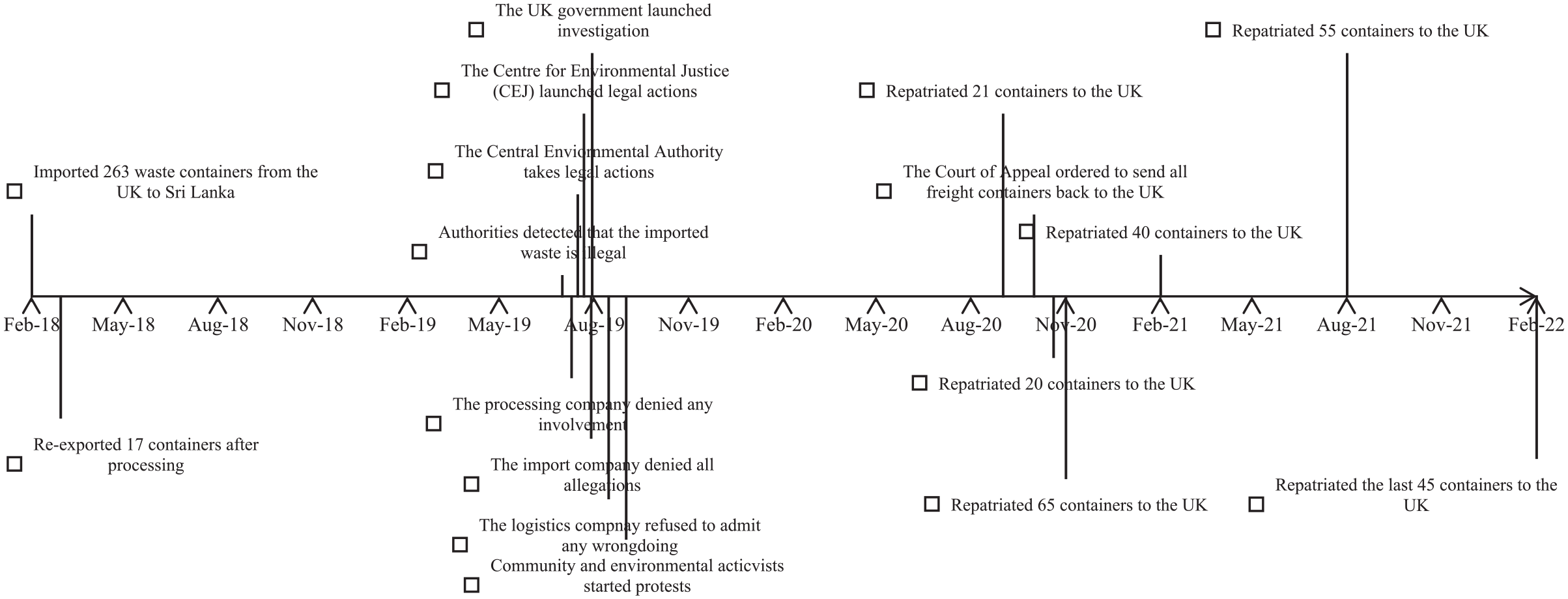
Timeline of the Waste Import From the UK to Sri Lanka and the Subsequent Events.
Justifying the Import of Hazardous Solid Waste: A Distorted Resource Recovery Business
In response to various legal and ethical claims, a director of the Ceylon Metal Processing Corporation, the waste import company in Sri Lanka, explicitly admitted that the business was closely aligned with the resource recovery business model. Denying any wrongdoings, the director clarified the nature of his business: We represent an industry which is emerging in the global arena, what we call resource recovery . . . The resource recovery business is not the same as the waste disposal business. The resource recovery business is one of the fastest growing businesses in the world, and is most admired for the reason that it saves the environment by using resources which have been recovered instead of using or exploiting natural resources (Sirinaga, 2019).
The Ceylon Metal Processing Corporation claimed that the resource recovery business has a promising future that makes it better able to serve the ecosystem and human well-being, such as by creating employment opportunities. However, the director claimed that the concept of a resource recovery business has been misunderstood, and insisted that the media and government authorities should provide support by promoting foreign resource recovery businesses rather than discouraging entrepreneurs: We want the Sri Lankan government and relevant authorities to study this emerging industry and nurture and help entrepreneurs to do well by doing good, so that Sri Lanka can earn valuable foreign exchange and can also provide a lot of work opportunities. The resource recovery industry is here to stay, whether we like it or not. That’s going to be the future. What we expect from the media is to do the right thing (Sirinaga, 2019).
The director of the Ceylon Metal Processing Corporation also commented that Sri Lanka has a promising opportunity to develop a global waste management business model, in light of increasing awareness, knowledge and potential benefits to the economy: Due to the attention the media has given this story, Sri Lanka now has the knowledge and awareness to explore possibilities and exploit opportunities for the good of the world and the benefit of the Sri Lankan economy. I must take this opportunity to thank the media for giving this uninteresting subject the attention needed to attract the interest of the authorities, the private sector and the general public (Sirinaga, 2019).
While the company’s justification aligns with the normative assumptions of the waste management industry within the global supply chain, as reflected in the case study, the real-life implementation of such practices has been widely criticized. A waste management business model should focus on safeguarding both the ecosystem and human well-being. Moreover, the effective implementation of a waste management business model would enable a balance to be achieved between environmental, social, and economic goals. However, as illustrated throughout the study, it was found that both exporters and importers of waste had purposely neglected their responsibility to the ecosystem and human well-being in various ways. The case study analysis revealed that organizations have compromised not only their responsibility to society but also business ethics and morals. More specifically, the businesses involved in this case have undermined and blatantly violated the rights granted to them to operate and use society’s resources in providing goods and services. Figure 3 shows the actors involved in the transboundary movement of waste from the United Kingdom to Sri Lanka, and auxiliary service providers’ fiduciary responsibilities to society through the government and regulatory authorities. Appendix A summarizes various actors’ specific responsibilities in the transboundary movement of waste from the United Kingdom to Sri Lanka.
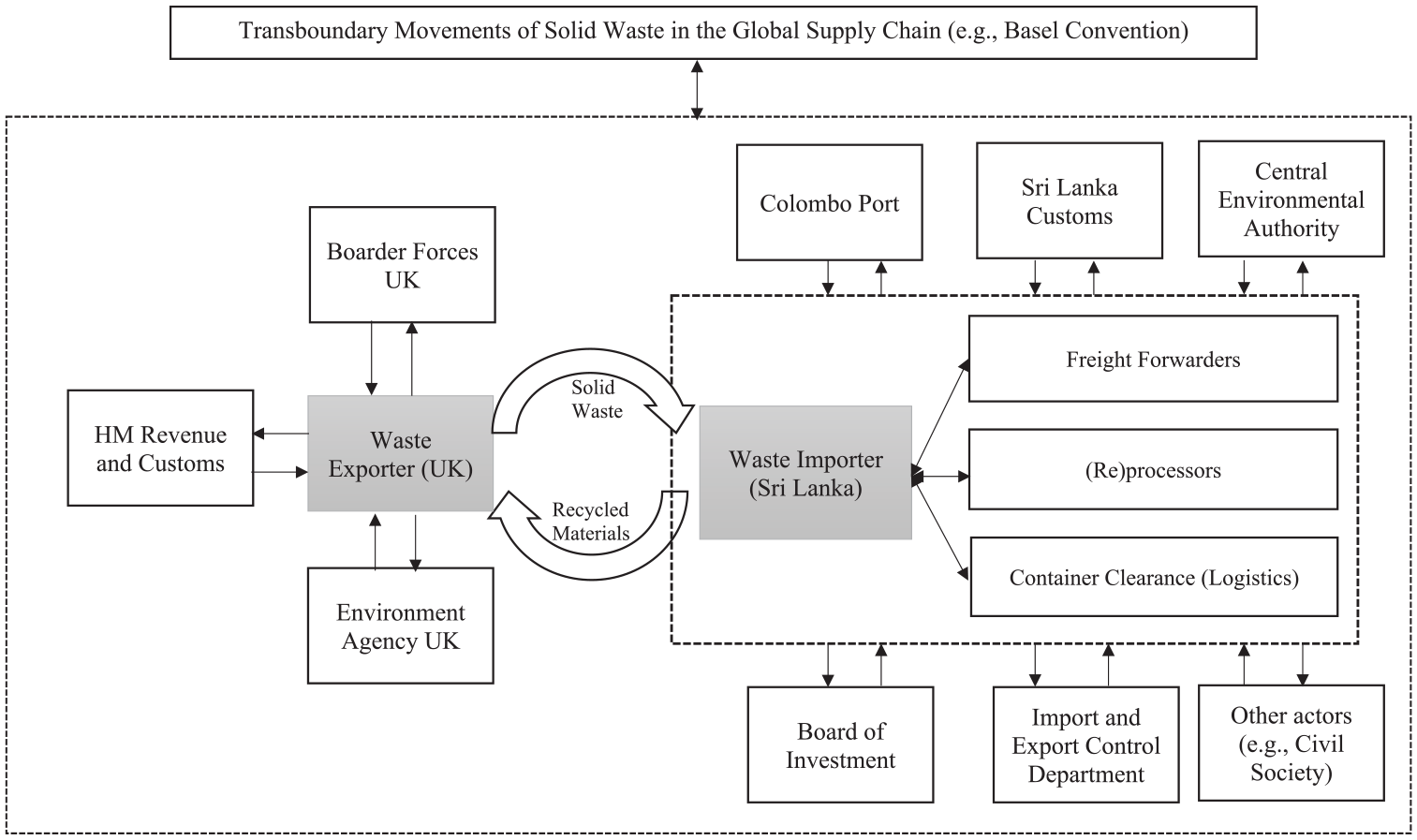
Actors Involved in the Transboundary Movement of Solid Waste From the United Kingdom to Sri Lanka.
The next sections discuss how the undermining of the market and legal accountability led to the capture of regulatory and institutional provisions, thereby weakening the operationalization of the transboundary waste management business model in the Global South.
Capturing Regulatory Provisions by Undermining Market Accountability
Upholding market accountability is imperative for the successful continuation of any business. The case under investigation reveals explicit evidence that regulatory provisions were deliberately captured by undermining market accountability.
Concealing Organizational Identity in Operations
It was found that the companies involved in this incident were not prepared to reveal their identity as set out in regulatory and institutional provisions. The owner of Sein Logistics Ltd, a logistics company responsible for port clearances, noted: . . . my company is responsible for port clearing and nothing to do with garbage. We do not see what’s inside the containers. We are not involved in the transportation of these containers either. The company that imported the waste was also responsible for transportation . . . I cannot reveal the importing company’s name. From my knowledge, only two or three companies were permitted this licence in Sri Lanka. It is a large company (Newsfirst Sri Lanka, 2019a).
None of the Sri Lankan companies involved in importing the illegal waste containers revealed their identity until the media did so. According to Sri Lanka Customs, the three Sri Lankan companies involved in importing the illegal waste containers were Hayleys Free Zone Private Limited, ETL Colombo (Pvt) Ltd., and Ceylon Metal Processing (Pvt) Ltd. However, at several media conferences and in published newspaper interviews, these three companies all accused each other of wrongdoing to try to establish their own innocence. The media reported several allegations, for instance: The CEO of the Ceylon Metal Processing Corporation stated that the contents of the containers were brought in for reprocessing and it was the responsibility of Hayleys Free Zone Private Limited to carry out the processing on their behalf (Fernando, 2019).
While media and civil society organizations demanded information relating to the import and export companies, the Sri Lankan companies consistently protected the identity of their U.K. counterpart, thereby undermining market accountability. They also reported a direct connection between the export company and the import company: Perhaps they were trying to hide the fact that an individual named Vengadesa Muthuramar, Director of Ceylon Metal Processing Corporation (Pvt) Ltd, who as per company documents serves as a shareholder of Vengaads Limited [in the UK]. Hayleys Free Zone Limited denied having any involvement in the issue, despite the evident increase in the number of garbage containers on their premises from 2017 to 2019. The Director of Hayleys Free Zone, Asanka Ratnayake, identified ETL Colombo (Pvt) Ltd as the freight forwarder as an associate company of Ceylon Metal Processing Corporation (Fernando, 2019).
Refusing to Accept Responsibility for the Import
A director of the Ceylon Metal Processing Corporation clarified that, after they heard the news from the media, the company asked Sri Lanka Customs and the Central Environmental Authority to conduct an unbiased inquiry into the matter. The director also noted that, as the importer, his company had no access to these containers and was unaware of what they contained. He stressed that his company dealt with a reputable local re-processing company that maintained the highest ethical standards: These containers are destined for re-processing and re-export. Therefore, we don’t have direct access to these containers. The only parties who have access to these containers are the customs authorities and the free zone operators. We work with Advantis Free Zone Limited, part of Hayleys Group of Companies of Sri Lanka, which is one of Sri Lanka’s most reputable companies and an ethical company. In fact, that’s the reason why we want to work with such a company, which has a clean record of high ethical standards (Sirinaga, 2019).
Accusing Business Partners to Diffuse the Public Tension
Once the media had revealed their involvement, all the parties involved started to accuse each other and deny their own legal responsibility. The deliberate tension created by the three companies led the general public and civil society organizations to question the transparency of the process and the credibility of the government’s regulatory intervention. The general public and civil society activists alleged that the government’s regulatory agencies colluded with the companies to conceal the truth. A local media outlet reported the following: The President of the Lawyers’ Collective said that these three organizations are now passing the buck to each other and that there seems to be no proper owner of these containers. He sarcastically questioned if it was the general public who brought these containers to the country (Newsfirst Sri Lanka, 2019c).
The media also exposed details of insider trading by all the parties involved, revealing that shareholders of Vengaads Ltd were also directors of Ceylon Metal Processing Corporation. It was later found that two brothers were running both the Sri Lankan and U.K. companies. The local media revealed the owners’ identity: The supplier, that these individuals refrained from revealing during the media briefing, is a UK-based company named Vengaads Limited. Company documents confirm that an individual named Vegadasan Muthukumar, a shareholder of Vengaads Limited, also serves as the Director of Ceylon Metal Processing Corporation (Pvt) Ltd (Newsfirst Sri Lanka, 2019c).
Manipulating Market Responsibility
In response to these alarming allegations, a director of Ceylon Metal Processing Corporation (Pvt) Ltd., claimed that, “we do not help foreign countries to bring hazardous waste and dump it in Sri Lanka.” This reveals that market accountability was seriously impaired as companies deliberately neglected to maintain minimum levels of market responsibility. For instance, the director General of Sri Lanka Customs commented: The company, whether it was HFZL [Hayleys Free Zone Limited] or someone else, was responsible for abandoning huge piles of waste, which were emitting an unbearable stench and causing damage to the environment as well as human health (Sriyananda, 2019).
Reflecting upon the companies’ deliberate attempts to capture regulatory provisions, the director general of Sri Lanka Customs revealed that the companies did not request the release of the containers from Colombo Port, despite the import companies’ names being recorded in shipping documents and having been made public (Sriyananda, 2019). The evidence shows that the import procedures were driven by a hidden agenda designed to maximize economic gains. As reflected in the ethic of accountability, the power holders’ failure to reveal the information in response to rights granted to them to operate businesses raises serious questions about their fiduciary market responsibility. For instance, a senior Sri Lanka Customs representative commented on the nature of the waste containers that could not even be opened for investigation: Actually, what has happened here is some garbage has been sent to Sri Lanka under the name of used mattresses. Within these mattresses, there are various stinky, unusable things such as carpets, plastics and hospital waste. We simply cannot open them even for an investigation (BBC News, 2019).
Several environmental scientists commented that the open dumping of hazardous chemicals and hospital waste would severely pollute underground water resources and the surrounding environment (Sriyananda, 2019). For instance, an environmentalist elaborated on the environmental and social impact of compromising the market accountability through the government’s regulatory negligence in relation to hazardous waste imports, as follows: With the import of this hazardous waste which has been dumped by hospitals and medical centres in the UK, we believe that our environment is at greater risk. Our water sources might be contaminated, our water resources are polluted, and our neighbourhoods are polluted . . . it is the responsibility of the Sri Lankan government to prevent these waste imports (Oxygen for Future, 2019).
Defending Market Forces by Regulatory Agencies
Immediately after the news was revealed, several civil society organizations protested, urging the government to repatriate the containers to their country of origin. The demands from civil society and the community for justification from the operating businesses of their mysterious agenda pose serious questions about the market responsibility of those who pretend to safeguard a society that follows a resource recovery business model. Various complaints were made, highlighting the severe damage to the environment, the threat to the public health of thousands of people working in the free-trade zone and neighboring villages, and the loss of biodiversity. As the Sri Lankan regulatory bodies did not take action in response to public protests, a civil society activist explained their demands to the U.K. government: We requested the British High Commissioner at Colombo to take action against these companies exporting from their side, who are believed to be private entities. The British Government is also responsible for this hazardous waste export, as a signatory to the Basel Convention 1989. The British Government should take the responsibility for not disclosing illegal waste traffic to other countries that originated from their land. Under the same convention, the British Government is obliged to re-import this waste (Oxygen for Future, 2019).
Civil society activists also accused the government of allowing chains of money laundering to occur, concealed behind imports of illegal waste into the country. For example, the President of a national environmental movement stated that “behind this scam . . . money laundering in trillions of rupees has taken place” (Newsfirst Sri Lanka, 2019c). Moreover, environmental activists raised concerns about whether the government would accept ownership of the waste containers if the companies refused to do so (Newsfirst Sri Lanka, 2019c). Media reports noted that government authorities had attempted to hide the real facts about the incident for political and financial reasons. Various claims were made that the authorities and government regulators were purposely neglecting their official responsibilities, having been captured by a hidden business agenda. For instance, the Attorney-at-Law Janaka Edirisinghe, questioned the regulatory provisions that govern waste imports: . . .the gazette has not permitted the Customs to accept foreign garbage into the country. He further noted that accepting waste from foreign countries is a blatant violation of the Customs Ordinance. In addition to the re-exportation of the current garbage consignment, the respective companies who provided Customs with false information and its Board of Directors should be held legally responsible (Fernando, 2019)
The Chairman of the Central Environmental Authority condemned the company’s claim that it did not own the waste, as it was stored on its business premises, and claimed that the government would take legal action (Sriyananda, 2019). However, several Senior government officials protected the illegal importers by providing various questionable excuses, and even claiming that the containers had been dispatched to Sri Lanka in error. The aforementioned evidence reveals that the regulators had become captive to those they were supposed to regulate. The findings also reveal a misunderstanding among the general public that it was the U.K. government that had sent the waste to Sri Lanka. This misperception led to public criticism of the governments of both countries, rather than the private organizations accountable for these malpractices. Readers commented on a BBC news article published on Facebook:
The only accountability here with regards to the UK would be the private company that originally bought the waste from the Government and then sold it onto the Sri Lankan businessman—they should have checked due diligence that who they were passing the waste onto had the capabilities and intentions to dispose of it safely . . . But the UK government would definitely not be responsible. . . (See Note 11)
Erosion of Public Trust in Recycled Products
However, in response, members of the public also claimed that it was ultimately the government’s responsibility as the outsourcing authority. A reader asked, “but, don’t the government outsource waste management to private companies now? Isn’t it still their responsibility to engage with ethical business?.” Similarly, many readers criticized private waste management companies for acting immorally and unethically by dumping waste in the cheapest locations without considering the social and environmental impact. Public concerns were also expressed about the quality of recycling products generated by countries in the Global South. While it was unclear what the outcome of these recycled materials would be, a reader alleged that people’s health would be harmed by products made from hazardous waste: From now on I have to check the words “made in sri**” [Sri Lanka] before I buy a mattress from the market. This is ridiculous. They charge us money in order to sleep on garbage.
Another reader shared a personal experience of companies changing their public identity after violating the law:
Unfortunately, people pay recognised companies to dispose of their waste. Having paid for that service, they are no longer interested . . . I had the joy of tracing some of these companies and bringing them to justice. Unfortunately, they set up under a different name, and started all over again (See Note 11).
These comments and the views expressed show that the general public was left with no clear evidence of who was responsible for the misconduct; whether it was the import or export companies, or the Sri Lankan or U.K. governments. The limited emphasis on market accountability by those directly responsible for damaging societal constituents resulted in a temporary reprieve at the expense of the governments’ reputation. The fact that the government was obliged to reveal the identity of relevant stakeholders and take legal action to safeguard the ecosystem and human well-being was ignored and showed the gravity of the capture of regulators by market forces. More specifically, public opinion held that steps should be undertaken to strengthen market accountability, as a moral practice catering to the interests of broader societal constituents rather than narrow economic benefits.
Creating a Regulatory Capture by Compromising Legal Accountability
As discussed in the previous section, it is clear that the actors who were involved and responsible for importing waste failed to uphold market accountability in carrying out their waste management business. More specifically, the power holders failed to undertake their operations in line with the minimum pre-set legal standards. Waste import and export companies, including owners, managers, and employees, are held accountable if a business violates the waste management regulatory provisions that apply to them. If they breach the law, organizations are subject to legal procedures, and a court determines the extent to which they have obeyed the laws in facilitating their activities. The power holders should justify their actions in line with prespecified rules and regulations. The case under investigation reveals evidence as to how the compromise of legal accountability created a space for regulatory capture.
Breaching International Laws Governing the Transboundary Movement of Solid Waste
Our findings reveal that the export and import companies involved appeared to violate local and international laws governing transboundary movements of hazardous waste, thereby undermining legal accountability. The importation of 263 containers of hazardous waste clearly breached not only local regulatory provisions, but also the Basel Convention, which governs transboundary movements of hazardous waste from developed to developing nations, and to which both the United Kingdom and Sri Lanka are signatories. According to the Basel Convention, the exporting parties should have gained approval from the destination. However, Sri Lanka’s Central Environmental Authority confirmed that it had not authorized this import. A senior customs superintendent explained: The importation of such freight containers is a violation of the “Basel Convention on the Control of Transboundary Movements of Hazardous Wastes and Their Disposal,” and rules and regulations of the European Union as well (Hapuarachchi, 2020).
In response, the Central Environmental Authority complained to the United Nations under the Basel Convention, claiming that the import of garbage violated the provisions of the international treaty on transboundary movements of hazardous waste materials. The Government of Sri Lanka lodged a 1.649 billion rupee claim against the U.K. government through the Basel Convention seeking compensation for the damage resulting from the import of illegal waste (Biz, 2020), claiming that the Sri Lankan environmental authorities had not been informed by any parties involved in the import. For instance, the customs authorities alleged that the importing company, as the responsible business entity, should have informed the relevant government agencies if it had encountered any issues, rather than silently storing the waste on its premises. A deputy director of Sri Lanka Customs commented: If Sri Lanka has not consented to the exporting country to export the goods, then it will be violating the Convention and also the law of Sri Lanka. If some party or individual is exporting used material, according to existing laws they should get a valid licence from the Import and Export Controller Department (IECD) as it has restricted used materials coming into the country (Sriyananda, 2019).
The Government of Sri Lanka also asked the U.K. government about the authorization of the export. In response, the U.K. government stated its commitment to preventing illegal waste exportation and taking legal action against those who illegally export waste to other countries. The Head of Waste Regulation at the Environment Agency in the United Kingdom stressed: We are determined to stop this illegal trade and we have officers inspecting waste shipments at ports across England every day . . . Those exporting waste should be under no illusion—if we find waste being shipped illegally then we will take action (Environment Agency, 2020).
The Environment Agency in the United Kingdom also clarified the consequences of failure to comply with legal provisions set out under the waste export regulations: “Individuals found to be exporting incorrectly described waste can face a two-year jail term or an unlimited fine” (Ethirajan, 2019).
Transgressing Local Laws Governing Waste Management
Extending its commitment to addressing sustainability challenges, the Government of Sri Lanka is a signatory to the 2015 Paris Agreement and submits its nationally determined contributions in accordance with the United Nations Framework Convention on Climate Change. Waste management is a key priority in the country’s National Adaptation Plan, in line with “Sustainable Sri Lanka—2030 Vision and Strategic Path.” The Sustainable Development Act No. 19 (2017) sets out legal provisions and national policy to achieve the UN’s Sustainable Development Goals (Government of Sri Lanka, 2016). To support the nationally determined contributions, Sri Lanka’s National Solid Waste Management Strategy has set specific targets for minimizing waste, recovering resources, and sanitizing landfills. In addition, the 16th, 17th, and 18th amendments to Sri Lanka’s Finance Act on Commercial Hub Regulations facilitate imports of waste for re-processing (Government of Sri Lanka, 2013). The Commercial Hub Regulation No. 1 of 2013 (Government of Sri Lanka, 2013, pp. 1A–2A) permits specific business operations, namely: (a) entreport trade involving an import, minor processing and re-export; (b) off-shore business where goods can be procured from one country or manufactured in one country and shipped to another country without bringing the same into Sri Lanka; (c) providing front end services to clients abroad; (d) operations of the Headquarters of leading buyers for the management of the finance supply chain and billing operations;(e) logistic services such as a bonded warehouse or in the case of operation of multi-country consolidation in Sri Lanka.
Other regulatory provisions relating to customs, foreign exchange, and export control are managed by Sri Lanka’s Board of Investment (BBC News, 2019). In 2013, the Katunayake Free Trade Export Processing Zone in Sri Lanka was nominated as a bonded area to facilitate re-exports of value-added products (Government of Sri Lanka, 2013). Sri Lanka Customs referred to the aforementioned regulatory provisions in confirming that the waste containers had been imported: Under the provisions of a gazette issued in 2013, a total of 263 freight containers of waste material were imported to the country from the UK, in 2017; with the intention of enhancing the commercial value of the material and re-exporting (Hapuarachchi, 2020).
Surprisingly, according to the 2013 gazette, Sri Lanka Customs officers are not permitted to open and check imported containers. Instead, all clearance processes must be undertaken within the regulatory provisions laid down by the Board of Investment (BBC News, 2019). Challenging these unorthodox regulatory provisions, environmental lawyers claimed that Sri Lanka’s Commercial Hub Regulations that enable waste management businesses are illegal, as the Parliament has deliberately vested power in only two institutions, namely, the Board of Investment and the Import and Export Control Department. Furthermore, legal experts condemned the government authorities and businessmen involved in these illegal imports for collectively misinterpreting, misusing and deliberately capturing the legal provisions to hide the basic facts of the operations. An environmental legal expert disputed the provision on waste imports and highlighted that the companies involved in the import of waste have captured the regulatory provision as a means of compromising legal accountability: Gazette notification issued on 13 July 2013 does not allow the Customs to accept garbage to the country. Therefore, we cannot stop re-exporting these containers. Even the board of directors of this company must accept the responsibility, and the law must be enforced against this matter. For failure to do so, Customs also must take the responsibility. The company responsible has provided Customs with false information. This is a clear violation of the Customs Act and it is a punishable offence (Newsfirst Sri Lanka, 2019a).
The imported waste was stored on the factory premises of the local processing company located in the Export Processing Zones, but the Central Environmental Authority confirmed that the company did not have an environmental permit to import or process hazardous waste materials (Newsfirst Sri Lanka, 2019b). The Director General of the Central Environmental Authority stated that the garbage was being stored in an unsafe environment, violating the Central Environmental Authority’s regulations: Officials from the Central Environmental Authority who inspected the site discovered that liquid and solid waste piled up at the location is being released into the environment. 27,685 tonnes of waste have been piled up at the site over an area that spans across 50,000 square feet (Newsfirst Sri Lanka, 2019b).
Not Disclosing Mandatory Information
The import and export companies, by using the resources provided by the state to operate their businesses, have a fiduciary duty regarding the responsible use of resources, and a key component of that fiduciary responsibility is disclosing true information by which judgments can be made as to the employment of the resources. However, as illustrated earlier, the power holders have deliberately and purposively prevented essential and compulsory legal information from being revealed. In turn, such malpractices have led to various unintended consequences.
In addition to the governmental authorities, civil-society organizations independently filed cases against the import of illegal waste. The Centre for Environmental Justice filed a writ application (Case No. CA/WRT/303/19) to the Court of Appeal of Sri Lanka on July 22, 2019 (eJustice, 2020). In response, the Court of Appeal ordered several government authorities, including the Atomic Energy Agency, the Medical Research Institute, the Government Analyst’s Department, Sri Lanka Customs, and the Central Environmental Authority, to conduct independent investigations and report accordingly (Sriyananda, 2019). For instance, while the Atomic Energy Agency investigated whether these hazardous containers contained any radioactive components, the Medical Research Institute examined them for any pathogens, and the Government Analysts’ Department examined them for clinical waste and human remains. Legal and civil-society activists claimed that this import of illegal waste clearly violated the terms and conditions of National Environmental Act No. 47 of 1980, and its subsequent amendments (Government of Sri Lanka, 1980).
Lobbying and Bribing Law Enforcement Agencies
Civil society activists also claimed that public law enforcement authorities had been bribed by the parties involved in these activities. Interestingly, environmental activists alleged that while the U.K. government had already commenced its investigations, the Sri Lankan authorities had intentionally been delaying the investigation process for no valid reason. They condemned the fact that the law enforcement authorities had been bribed with money by the import and export companies, which had forced them to remain silent: The lawyer said that although an investigation is under way in the UK on the matter, that ironically a proper investigation has not yet commenced in Sri Lanka . . .their suspicion is that the only reason for the Central Environmental Authority and the relevant law enforcement institutions to remain silent on the matter is because they have been intimidated with money (Newsfirst Sri Lanka, 2019c).
Throughout the case, the evidence shows that legal accountability seemed to be subverted by the parties involved in importing illegal hazardous waste. Several responsible government agencies deliberately kept silent, defending the importing companies rather than taking legal action against them. However, a director of the waste import company in Sri Lanka denied all the allegations claiming that the company has followed the accepted procedures and complied with the rules governing the resource recovery business: According to the law, used and discarded material cannot be brought into the country except for processing and re-export, and even then, they can only enter a country’s Export Processing Zones or Free Zone. . .no we do not help foreign countries to dump garbage in Sri Lanka (Sirinaga, 2019).
Moreover, criticizing the impact of regulatory capture on the enactment of environmental laws against violators, the National Movement for Consumer Rights Protection claimed that only the general public would be subject to punishment, not large-scale businessmen who are involved in mega scandals: If an average person dumps garbage opposite his house, they [the government] will fine him about 5,000.00 to 10,000.00 Rupees. They will even take him to court. However, 263 containers with garbage have been brought into this country. They have not taken any steps to address this matter yet. The Central Environmental Authority says the containers with garbage were brought accidentally. Why are they not taking any legal action against this matter? It’s because a prominent businessman is responsible for this matter (Newsfirst Sri Lanka, 2019a).
The investigators found that while the import company had declared to Sri Lanka Customs that municipal and household waste was being imported for re-processing and re-export, the company had no facilities to undertake such recycling operations. Thus, the importers manipulated the regulations to import prohibited items, threatening the ecosystem and public well-being. Condemning the companies’ irresponsible behavior, various lobby groups claimed that exporting international waste to countries such as Sri Lanka, which is struggling even to dispose of local waste, should be seen as an attempt to make the country a dumping ground: “We are struggling to dispose of our own garbage; Sri Lanka is not a dustbin for other countries” (Sriyananda, 2019). However, in refuting these allegations, the managing director of the processing company commented that the company followed transparent and responsible business practices for the betterment of society.
Discussion
In this study we have explored: (a) how the regulatory and institutional structures governing transboundary movements of solid waste in Global South countries are captured; and (b) how organizations involved in transboundary movements of solid waste in the Global South violate the ethic of accountability. Overall, our findings demonstrate organizations exploiting weak regulatory and oversight mechanisms in the transboundary movement of solid waste to the Global South; the breaching of local and international regulations; and the adherence to “the accounting-based-accountability” that prioritizes the market and legal modes of accountability and subsequent regulatory capture, and, more importantly, the absence of an ethic of accountability. In so doing, the study makes several contributions in terms of delineating how regulations governing waste management in the Global South are captured and highlighting why the ethic of accountability should be placed at the center of the waste management business model to embed pluralism and ensure that the parties involved act in the public interest (see e.g., Baudot et al., 2022; Dillard & Layzell, 2014; Dillard & Vinnari, 2019). Our contributions to the theory and the literature on the transboundary movement of solid waste management are outlined below.
Contributions to the Regulatory Capture and the Ethic of Accountability
Extant work has treated the notions of regulatory capture and an ethic of accountability as separate, thereby blurring the interrelationship between them at the operational level (see Cortese, 2011; Dillard & Vinnari, 2019; Hardy, 2006; Noah et al., 2020; Potter et al., 2014; Uche, 2001). First, we have contributed to these studies by showing how the two concepts can be viewed as interrelated when explored through the lens of market and legal modes of accountability (Dillard & Vinnari, 2019). This enabled us to propose an integrated framework through which to gain deeper insights into the functioning of the transboundary movement of waste from the Global North to the Global South, highlighting the challenges and complexities involved and discussing how the pursuance of an ethic of accountability can offer an alternative waste management model.
As the empirical findings illustrate, adherence to market and legal modes of accountability and the violation of an ethic of accountability could lead to the capturing of regulatory and institutional provisions governing the transboundary movement of solid waste from the Global North to the Global South in at least two different ways (e.g., Dillard & Vinnari, 2019). First, as our findings have revealed, the actors involved can directly reap the benefits of the absence of rules and regulations both at local and at international levels as well as the limited monitoring and evaluation mechanisms. For instance, it is evident from our study that the actors involved in the import of hazardous hospital waste to Sri Lanka were guilty of (a) concealing organizational identities in their operations; (b) refusing to accept responsibility for the imports; (c) accusing their business partners of wrongdoing to diffuse public tension; (d) manipulating market responsibility; (e) defending market forces using regulatory agencies; and (f) eroding public trust in recycled products. These actors also engaged in regulatory capture by compromising legal accountability, through (a) breaching international laws governing the transboundary movement of solid waste; (b) transgressing local laws governing waste management; (c) not disclosing mandatory information; and (d) lobbying and bribing law enforcement agencies. The persistent adherence to conventional accounting-based accountability has enabled them to comply with the requirements of market and legal modes of accountability in which the focus is placed on engendering benefits to financiers and their allies (Dillard & Layzell, 2014). The dominance of financiers (capitalists) in the development of accounting-based accountability systems and the setting of disclosure requirements has been discussed in prior work (Dillard & Vinnari, 2019). Regulatory capture took a more indirect form in this situation because the actors were able to marginalize provisions relating to the public interest in favor of the financiers’ needs and interests by adhering to the evaluation and accountability criteria set by the latter.
In doing so, we have discussed the potential of an ethic of accountability to mitigate the possibility of creating a regulatory capture through conventional accounting-based accountability mechanisms (Baudot et al., 2022; Dillard & Vinnari, 2019). The extant literature suggests that key issues relating to transboundary movements of solid waste are linked to unethical and illegal practices and resource mismanagement issues that lead to social injustice in the Global South (Cotta, 2020; Thapa et al., 2023). As a corollary to the ethic of accountability, accountability-based accounting promotes the use of community-based pluralistic approaches that allow the actors involved in the transboundary movement of solid waste to the Global South to actively participate in ongoing public discussions and debates (Baudot et al., 2022; Dillard, 2008; Dillard & Brown, 2015; Dillard & Vinnari, 2019). As pointed out by Dillard and Vinnari (2019), the account holders, particularly those who are affected by organizations’ actions, need to be empowered so that they are capable of asking for necessary information, specifying the criteria for evaluation, and rendering consequences for the actions of the power holders in a timely manner (Dillard & Layzell, 2014). As a means of mitigating regulatory capture, our study reinforces the need for a pluralistic mechanism, as outlined in the accountability-based approach to accounting, that holds organizations involved in the transboundary movement of solid waste accountable. In this way, we have demonstrated the potential of an ethic of accountability to mitigate the practice of regulatory capture in the transboundary movement of solid waste (Baudot et al., 2022; Dillard, 2008; Dillard & Brown, 2015; Dillard & Vinnari, 2019). In the absence of an ethic of accountability, the current waste management business model is likely to fail in the Global South, with Sri Lanka serving as just one example.
Contributions to the Transboundary Movement of Solid Waste Management Literature
Our contribution to the literature on the transboundary movement of solid waste is twofold. First, by providing empirical evidence on transboundary movements of waste from the Global North to the Global South, this study extends the current understanding of the waste management process within the global supply chain (Cotta, 2020; Thapa et al., 2023). When organizations in the Global North eschew a broader community-centered approach (e.g., Cotta, 2020; Thapa et al., 2023), and an ethic of accountability that promotes social justice, fairness, equality, respect, and trust, the waste management business model may offer more scope and opportunity for regulatory capture and dysfunctional accountability than any other field, owing to its increasing complexities. Increasingly, countries in the Global South have been promoted as well-suited for redesigning production processes and recycling materials (Cotta, 2020; Thapa et al., 2023). However, the true environmental costs of such movements are often undisclosed, as are the social and accountability issues associated with them (Liu et al., 2018). The realization of reciprocal rights and responsibilities appears to be absent at the societal level (Dillard & Brown, 2015), offering more leeway to organizations involved in these movements, in both the Global North and the Global South, and putting the former in a favorable position to exploit the latter. For instance, our findings provide evidence that public trust in government and state agencies has eroded, due to their failure to protect public well-being and the ecosystem, and that waste management has become another domain in which corrupt practices have come to proliferate. Rather than responding to the failure of organizations to fulfill their obligations, government officials defend themselves by arbitrarily claiming that illegal waste containers have been dispatched to the country by mistake.
Our second key contribution lies in revealing the reality faced by countries in the Global South, where the concept of the waste management business is narrowly defined and understood, thereby limiting the scope for redesigning products and processes and recycling materials. Regulatory, monitoring, and institutional arrangements, which are pivotal to facilitating the transition toward a sustainable waste management business model, are largely marginalized in the Global South. Waste management activities have continued to adhere to the traditional business model built on accounting-based accountability, which has proved to be incapable not only of tracking material flows but also of pursuing efficient and pluralistic performance measurement systems that might help organizations institutionalize a life cycle perspective and contribute to acting in the public interest. This continued domination of accounting-based accountability in the Global South has become, as Dillard and Vinnari (2019, p. 25) have outlined, “counterproductive, leading to undemocratic or pluralistic outcomes.” Achieving sustainability goals through responsible waste management, resource recovery, and recycling is therefore regarded as an elusive goal rather than a reality in the Global South.
Practical and Policy Implications
Our study highlights several important implications for policymakers. Policymakers, and particularly law enforcement authorities, should take steps to strengthen the existing regulatory provisions and implement new ones, acknowledging reciprocal sets of rights and responsibilities (Dillard & Brown, 2015) and making organizations aware of their fiduciary relationship with society (Dillard & Layzell, 2014). Privileging an ethic of accountability and accountability-based accounting could offer an effective way for them to address the continually evolving and increasingly complex area of waste management. This could help not only to safeguard the ecosystem and human wellbeing in Global South countries but also to restore public trust in government and state agencies. Regulatory compliance has been manipulated, and the evidence shows that some government officials have attempted to defend themselves by claiming that illegal waste containers have been dispatched to the country by mistake. Our study delineates how the waste management industry, when premised on the weak foundation of the ethic of accountability and accounting-based accountability, could be a source of social distrust and governance problems such as corruption, rather than a step toward achieving the UN’s SDGs. To restore trust in the transboundary movement of solid waste in the Global South, we also call for urgent policy reforms that highlight the importance of global recycling networks, which require global cooperation and cross-border collaboration between businesses, governments, and policymakers as well as international actors such as the Basel Convention and the United Nations (e.g., Cotta, 2020; Thapa et al., 2023). We urge policy makers and governing bodies involved in transboundary movements of solid waste to continually review public policies and ethical guidelines that (a) identify possibilities for regulatory capture; (b) ensure independence and transparency; (c) reinforce regulatory oversight; (d) ensure public engagement; and (e) encourage ethical leadership and professionalism within regulatory agencies.
Conclusion
The normative assumptions underpinning the transboundary movement of solid waste provide excellent opportunities to facilitate global waste management, thereby making progress toward achieving sustainable development goals linked to global greenhouse emissions. However, as reflected in our study, the unethical and illegal nature of the transboundary movement of solid waste from the Global North to the Global South has created unintended consequences, leading to social injustice and promoting “toxic colonialism” (e.g., Cotta, 2020; Thapa et al., 2023). The prevailing regulatory and institutional provisions embedded within accounting-based accountability appear to be inadequate to address the complex issues surrounding the transboundary movement of solid waste from the Global North to the Global South. By integrating the ethic of accountability, we envisage a system with the potential to make power holders accountable for their actions within this process, as well as to enable society to realize reciprocal sets of rights and responsibilities.
Finally, two important avenues have been identified for further research. First, when discussing accountability-based accounting, several other modes of accountability have also been suggested, in which the concept of the ethic of accountability is explicitly or implicitly embedded, such as hierarchical, supervisory, fiscal, peer, and public reputation accountability (see e.g., Baudot et al., 2022). Given that our focus in this study is on the market and legal modes of accountability, the interconnection between these other modes of accountability and the ethic of accountability perhaps represents an area in which further research is warranted. Second, the scope of the study could be broadened by exploring a wider circular economy business model. The circular economy model has been recognized as a key approach through which to address these issues relating to environmental impacts and climate change, reduce the use of finite material resources, and achieve sustainable economic growth (e.g., Eikelenboom & de Jong, 2022; Piila et al., 2022). Being part of the resource recovery business, solid waste transportation from the North to the South is regarded as an important international circular activity (Cotta, 2020). Investigating how the circular economy business model operates within the transboundary movement of solid waste in the global supply chain would provide important avenues to explore the implications of the ethic of accountability and regulatory capture.
Footnotes
Appendices
Video Sources Referred in the Study.
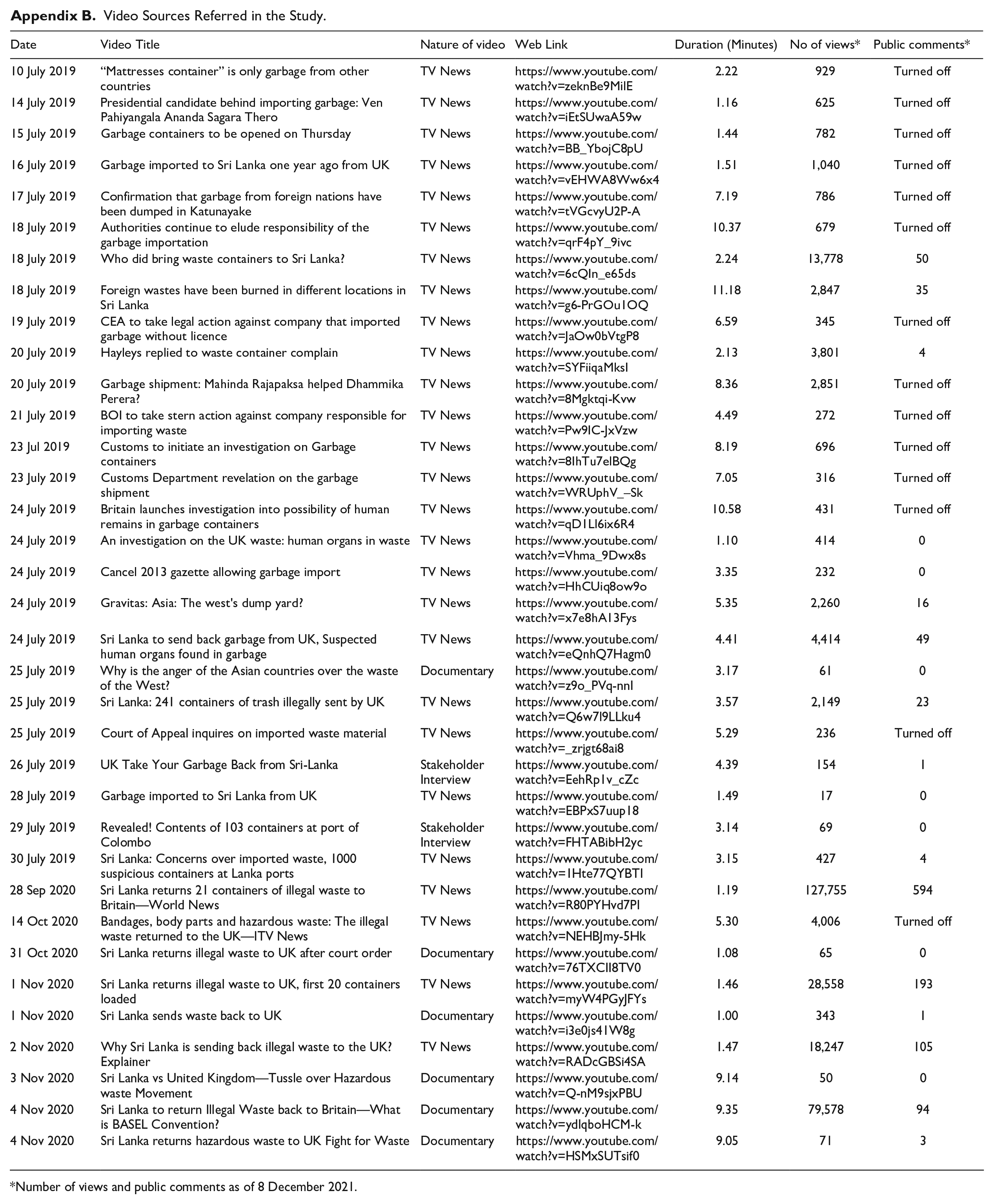
| Date | Video Title | Nature of video | Web Link | Duration (Minutes) | No of views* | Public comments* |
|---|---|---|---|---|---|---|
| 10 July 2019 | “Mattresses container” is only garbage from other countries | TV News | https://www.youtube.com/watch?v=zeknBe9MilE | 2.22 | 929 | Turned off |
| 14 July 2019 | Presidential candidate behind importing garbage: Ven Pahiyangala Ananda Sagara Thero | TV News | https://www.youtube.com/watch?v=iEtSUwaA59w | 1.16 | 625 | Turned off |
| 15 July 2019 | Garbage containers to be opened on Thursday | TV News | https://www.youtube.com/watch?v=BB_YbojC8pU | 1.44 | 782 | Turned off |
| 16 July 2019 | Garbage imported to Sri Lanka one year ago from UK | TV News | https://www.youtube.com/watch?v=vEHWA8Ww6x4 | 1.51 | 1,040 | Turned off |
| 17 July 2019 | Confirmation that garbage from foreign nations have been dumped in Katunayake | TV News | https://www.youtube.com/watch?v=tVGcvyU2P-A | 7.19 | 786 | Turned off |
| 18 July 2019 | Authorities continue to elude responsibility of the garbage importation | TV News | https://www.youtube.com/watch?v=qrF4pY_9ivc | 10.37 | 679 | Turned off |
| 18 July 2019 | Who did bring waste containers to Sri Lanka? | TV News | https://www.youtube.com/watch?v=6cQIn_e65ds | 2.24 | 13,778 | 50 |
| 18 July 2019 | Foreign wastes have been burned in different locations in Sri Lanka | TV News | https://www.youtube.com/watch?v=g6-PrGOu1OQ | 11.18 | 2,847 | 35 |
| 19 July 2019 | CEA to take legal action against company that imported garbage without licence | TV News | https://www.youtube.com/watch?v=JaOw0bVtgP8 | 6.59 | 345 | Turned off |
| 20 July 2019 | Hayleys replied to waste container complain | TV News | https://www.youtube.com/watch?v=SYFiiqaMksI | 2.13 | 3,801 | 4 |
| 20 July 2019 | Garbage shipment: Mahinda Rajapaksa helped Dhammika Perera? | TV News | https://www.youtube.com/watch?v=8Mgktqi-Kvw | 8.36 | 2,851 | Turned off |
| 21 July 2019 | BOI to take stern action against company responsible for importing waste | TV News | https://www.youtube.com/watch?v=Pw9IC-JxVzw | 4.49 | 272 | Turned off |
| 23 Jul 2019 | Customs to initiate an investigation on Garbage containers | TV News | https://www.youtube.com/watch?v=8IhTu7elBQg | 8.19 | 696 | Turned off |
| 23 July 2019 | Customs Department revelation on the garbage shipment | TV News | https://www.youtube.com/watch?v=WRUphV_–Sk | 7.05 | 316 | Turned off |
| 24 July 2019 | Britain launches investigation into possibility of human remains in garbage containers | TV News | https://www.youtube.com/watch?v=qD1Ll6ix6R4 | 10.58 | 431 | Turned off |
| 24 July 2019 | An investigation on the UK waste: human organs in waste | TV News | https://www.youtube.com/watch?v=Vhma_9Dwx8s | 1.10 | 414 | 0 |
| 24 July 2019 | Cancel 2013 gazette allowing garbage import | TV News | https://www.youtube.com/watch?v=HhCUiq8ow9o | 3.35 | 232 | 0 |
| 24 July 2019 | Gravitas: Asia: The west's dump yard? | TV News | https://www.youtube.com/watch?v=x7e8hA13Fys | 5.35 | 2,260 | 16 |
| 24 July 2019 | Sri Lanka to send back garbage from UK, Suspected human organs found in garbage | TV News | https://www.youtube.com/watch?v=eQnhQ7Hagm0 | 4.41 | 4,414 | 49 |
| 25 July 2019 | Why is the anger of the Asian countries over the waste of the West? | Documentary | https://www.youtube.com/watch?v=z9o_PVq-nnI | 3.17 | 61 | 0 |
| 25 July 2019 | Sri Lanka: 241 containers of trash illegally sent by UK | TV News | https://www.youtube.com/watch?v=Q6w7l9LLku4 | 3.57 | 2,149 | 23 |
| 25 July 2019 | Court of Appeal inquires on imported waste material | TV News | https://www.youtube.com/watch?v=_zrjgt68ai8 | 5.29 | 236 | Turned off |
| 26 July 2019 | UK Take Your Garbage Back from Sri-Lanka | Stakeholder Interview | https://www.youtube.com/watch?v=EehRp1v_cZc | 4.39 | 154 | 1 |
| 28 July 2019 | Garbage imported to Sri Lanka from UK | TV News | https://www.youtube.com/watch?v=EBPxS7uup18 | 1.49 | 17 | 0 |
| 29 July 2019 | Revealed! Contents of 103 containers at port of Colombo | Stakeholder Interview | https://www.youtube.com/watch?v=FHTABibH2yc | 3.14 | 69 | 0 |
| 30 July 2019 | Sri Lanka: Concerns over imported waste, 1000 suspicious containers at Lanka ports | TV News | https://www.youtube.com/watch?v=1Hte77QYBTI | 3.15 | 427 | 4 |
| 28 Sep 2020 | Sri Lanka returns 21 containers of illegal waste to Britain—World News | TV News | https://www.youtube.com/watch?v=R80PYHvd7PI | 1.19 | 127,755 | 594 |
| 14 Oct 2020 | Bandages, body parts and hazardous waste: The illegal waste returned to the UK—ITV News | TV News | https://www.youtube.com/watch?v=NEHBJmy-5Hk | 5.30 | 4,006 | Turned off |
| 31 Oct 2020 | Sri Lanka returns illegal waste to UK after court order | Documentary | https://www.youtube.com/watch?v=76TXCII8TV0 | 1.08 | 65 | 0 |
| 1 Nov 2020 | Sri Lanka returns illegal waste to UK, first 20 containers loaded | TV News | https://www.youtube.com/watch?v=myW4PGyJFYs | 1.46 | 28,558 | 193 |
| 1 Nov 2020 | Sri Lanka sends waste back to UK | Documentary | https://www.youtube.com/watch?v=i3e0js41W8g | 1.00 | 343 | 1 |
| 2 Nov 2020 | Why Sri Lanka is sending back illegal waste to the UK? Explainer | TV News | https://www.youtube.com/watch?v=RADcGBSi4SA | 1.47 | 18,247 | 105 |
| 3 Nov 2020 | Sri Lanka vs United Kingdom—Tussle over Hazardous waste Movement | Documentary | https://www.youtube.com/watch?v=Q-nM9sjxPBU | 9.14 | 50 | 0 |
| 4 Nov 2020 | Sri Lanka to return Illegal Waste back to Britain—What is BASEL Convention? | Documentary | https://www.youtube.com/watch?v=ydlqboHCM-k | 9.35 | 79,578 | 94 |
| 4 Nov 2020 | Sri Lanka returns hazardous waste to UK Fight for Waste | Documentary | https://www.youtube.com/watch?v=HSMxSUTsif0 | 9.05 | 71 | 3 |
Number of views and public comments as of 8 December 2021.
Declaration of Conflicting Interests
The author(s) declared no potential conflicts of interest with respect to the research, authorship, and/or publication of this article.
Funding
The author(s) received no financial support for the research, authorship, and/or publication of this article.
