




Abstract
Managers must make critical disaster preparation decisions to protect firm assets from the threat of wildfire activity. Prior literature stresses the importance of past disaster experience as a key driver of disaster preparation. The article finds that, while experience with disasters is a critical condition, it is insufficient to explain disaster preparation activities by firms. Managerial perceptions including belief in anthropogenic climate change and the perception of increasing wildfires can substitute for direct negative wildfire experience. The article builds configural theory to explain how the psychological “closeness” of wildfire hazards can influence managerial decisions to prepare for disasters in the presence of key organizational characteristics. This study adopts a qualitative comparative analytical approach, drawing on manager surveys and biophysical wildfire data from 20 Canadian mining and resource extraction sites. The article also contrasts manager perceptions of wildfire risk with those of experts and captures a gap in risk perception.
Keywords
Ongoing changes in precipitation and temperature regimes in Canada’s forests are creating drier conditions leading to increased wildfire activity. Recent wildfire seasons in Canada (e.g., 2017, 2018, and 2021 in British Columbia and 2016, 2019, and 2022 in Alberta) have caused massive environmental, economic, and societal impacts and garnered worldwide attention (Jain et al., 2022). These detrimental effects of climate change differ regionally. For instance, the southern border of Canada’s boreal forest has experienced less forest fire activity during the 20th century, in part due to increased precipitation and shifts in the composition and diversity of regional biomes associated with warmer temperatures (Boulanger et al., 2017; Natural Resources Canada, 2019). On the contrary, the annual amount of forest area burned in northwestern boreal regions has increased gradually since the second half of the 20th century (Hanes et al., 2019; Natural Resources Canada, 2019). Wildfire activity stems from a complex mixture of natural and anthropogenic factors: topography, vegetation, climate, land use, and suppression efforts all influence wildfire spatial and temporal patterns—better known as fire regimes (Natural Resources Canada, 2019). The diversity of these factors to such a vast extent as Canada, coupled with the uncertainty of climate change impacts, creates challenging conditions for decision-makers to assess and prepare for disaster risks in fire-prone areas (Coogan et al., 2019; Erni et al., 2019; Tymstra et al., 2020).
An increasing body of literature focuses on the vulnerability of Canadian communities to wildfire hazards and the potential for disaster (Erni et al., 2021; McGee & Healey, 2022; McKnight & Linnenluecke, 2016; Parisien et al., 2020; Tepley et al., 2022). However, studies focusing on, or incorporating, industrial activities addressing wildfire risk in Canada remain rare (see Johnston & Flannigan, 2017; Khakzad, 2018, 2019; Khakzad et al., 2018 for important exceptions). In this research, we explore how conditions related to a firm’s experience with wildfire, and the perceptions that managers have regarding wildfire, configure or combine toward a propensity to prepare for a disaster.
This is an important question because whether a hazard becomes a disaster is tightly connected to whether and how firms engage in preparation activities such as training, creating emergency plans, and reducing nearby fuel sources (Oetzel & Oh, 2021). Avoiding disasters is important as Canada is economically dependent on the extractive activities taking place in forested areas (Erdozain et al., 2019). The 2016 Horse River fire in the oil sands region of Alberta resulted in a 20% loss in gross domestic product for the oil industry the month of the fire due to the interruption of operations—mostly as workers needed to evacuate—illustrating the need for a better understanding of the vulnerability of extractive activities to wildfires in Canada (Statistics Canada, 2017). No oil and gas (infra)structures were lost during the 2016 Horse River fire as industries had implemented effective fuel reduction strategies around their facilities and were able to react appropriately as the situation evolved, even sending firefighting material and personnel to the town of Fort McMurray (Kovacs et al., 2019). Although the preparedness and response of the oil and gas industry during this fire might become a textbook case, it is the only one documented in Canada thus far and cannot be generalized to the whole country and other extractive activities. Several provinces have made it mandatory for industries to provide a wildfire management plan on a yearly basis, but the level of details of these plans, their precision, and their utility during an emergency are unknown. Disaster risk reduction (DRR)—including preparedness—is an arduous task.
In this paper, we define disaster preparedness as the attainment of the skills and capabilities necessary to mitigate damage to the business activities of a firm (Oetzel & Oh, 2021). On top of technical challenges to adequately evaluate risk indicators (Gaillard & Mercer, 2013), decision-makers frequently take different stances on this topic. Some elect not to prepare, concentrating on short-term costs and more certain, immediate risks (Oetzel & Oh, 2021). Others pre-emptively design risk mitigation strategies to prepare for disaster-inducing wildfires (Ford et al., 2010; Gasbarro & Pinkse, 2016; Linnenluecke et al., 2013; McKnight & Linnenluecke, 2019; Oetzel & Oh, 2021; Pearce et al., 2011). Understanding why decision-makers respond differently to similar disaster risks is a key component of this study.
How individual managers perceive wildfire risk is a key factor in assessing differences in disaster preparation (Oetzel & Oh, 2021). We draw on the concept of psychological distance to organize and advance research in this field. Psychological distance refers to how individuals cognitively separate themselves from stimuli, particularly those that are not in the current and direct experience of their reality (Baltatescu, 2014; Liberman & Trope, 2008). In the context of adaptation to wildfire, this separation occurs, for example, when decision-makers view wildfire risk as being a geographically, temporally, or socially distant phenomenon or being highly uncertain. Psychological distance can have a significant impact on whether disaster preparation occurs and depends largely on individuals’ perceptions.
Our research explains how conditions related to prior wildfire experience and the perceptions that managers have regarding wildfire occurrence, climate change, and controllability influence disaster preparedness. We contrast these perceptions with expert assessments of wildfire risk to capture a gap between how managers and wildfire experts perceive these risks. We adopt a qualitative comparative analytical (QCA) approach well-suited to building configurational theory explaining how combinations of conditions configure to generate outcomes of interest (Fiss, 2007).
We advance theory on disaster preparedness by showing how combinations of these conditions configure toward a propensity to prepare for a disaster. This type of research is increasingly relevant given the critical role risk perception plays in influencing climate change adaptation (CCA). This is especially the case in the extractive sector where adaptation is not always a priority (Intergovernmental Panel on Climate Change [IPCC], 2022; Oetzel & Oh, 2018; Tierney, 2002). While there is a scientific consensus that climate change is worsening fire activity in many parts of Canada and that industries need to better prepare for technological disasters triggered by wildfire hazards, it is unclear what and how factors might combine to facilitate disaster preparation.
This paper makes two contributions to the management literature on risk reduction and CCA. Critically, the paper attempts to empirically untangle exposure to a climate stimulus such as wildfires from a firm’s perception of their vulnerability to that same stimulus. Prior work has called for the use of more objective assessments of risk exposure in organizational research, as opposed to self-reported measures (Gasbarro & Pinkse, 2016; Hoffmann et al., 2009; Oetzel & Oh, 2021; Pinkse & Gasbarro, 2019). Exposure denotes the historical and projected levels of wildfire activity that overlap with extraction activities, whereas vulnerability also accounts for the degree to which a firm might be affected by a wildfire, as well as its level of wildfire disaster preparedness. In this paper we leverage state-of-the-art knowledge from the physical sciences on wildfire risk modeling (Johnston et al., 2020; Parisien et al., 2019). Through this effort, we contribute to bridging the gap between DRR and CCA research in both the physical and social sciences (Gaillard & Mercer, 2013). We demonstrate an empirical and theoretical approach to accomplishing this integration that leverages concepts of psychological distance. Second, we respond to the need for more research on the role of the decision-maker in disaster preparedness (Arnell, 2010; Gasbarro & Pinkse, 2016; Linnenluecke et al., 2013) in a time where concerns regarding technological disasters triggered by natural hazards, or NATECH, are gaining traction (Cruz & Krausmann, 2008).
Conceptual Background
Disaster Preparation
Disaster preparedness is a necessary aspect of organizations’ risk management strategies, particularly when organizations are situated in areas exposed to natural hazards (Josephson et al., 2017; Oetzel & Oh, 2018; Xiao & Peacock, 2014). Natural hazards often lead to cascading risks on supply chains, sales, and infrastructures (Oetzel & Oh, 2018). By preparing for these events, companies can reduce systemic and unsystematic disaster risks by managing the impacts of ecological uncertainty (Tashman & Rivera, 2016). Disaster preparation can take many forms including vulnerability assessments, disaster management plans, employee training, and insurance policies (Oetzel & Oh, 2021; Sutton & Tierney, 2006).
Disaster preparation requires decision-makers to make short-term investments that return uncertain, long-term benefits (Oetzel & Oh, 2021). To engage in disaster preparation, decision-makers must perceive the long-term threats associated with disasters as more damaging than the short-term costs of disaster preparation (Lujala et al., 2015; Oetzel & Oh, 2018). Decision-makers often take very different responses to even common external shocks (Sump & Yi, 2021), which complicates our understanding of decision-making around disaster preparation.
Prior literature has identified a central role that negative experiences with hazards play in a firm’s propensity to prepare for disaster-causing hazards (Han & Nigg, 2011; Lujala et al., 2015). Oetzel and Oh (2021) found that direct or indirect learning pathways associated with past hazards can explain up to 90% of a firm’s propensity to prepare. This is particularly the case when hazards occurred in the recent past and/or caused significant damage (Golden, 1992; Oetzel & Oh, 2021; Oh et al., 2021). However, decision-makers vary in how they interpret past experiences. If firms do not experience economic or other significant losses related to a disaster, be it local or global, decision-makers may perceive their business as sufficiently prepared and take no further action (Josephson et al., 2017). Firms may not perceive past or distant disasters to be representative of the future (McKnight & Linnenluecke, 2019; Oetzel & Oh, 2021). Previous negative experiences can also lead to a sense of helplessness in the face of hazards that play against disaster preparedness (Martin et al., 2009; McGee et al., 2009). Rivera and Clement (2019) found an inverted U relationship between past experiences of natural adversity intensity and propensity to prepare for disasters. This means that decision-makers considering natural hazards might be fickle—too little adversity and preparation may be perceived as unnecessary, whereas too much adversity and preparation may be perceived as hopeless. Gasbarro and Pinkse (2016) further explained that how managers understand physical climate impacts in terms of their awareness of hazards and their firm’s vulnerability partially explains their adaptation behavior. In sum, the role of negative disaster experience in disaster preparation remains mixed (Oetzel & Oh, 2018).
How managers perceive specific threats and their knowledge of hazards plays a significant role in disaster preparation decisions regardless of experience with past hazards (Liu & Haimes, 1999; Oetzel & Oh, 2021; Slovic, 1987). Heuristics and biases influence how decision-makers perceive threats and often explain varied responses to disaster experience (Kasdan, 2018; Oetzel & Oh, 2021). Similarly, decision-makers vary in terms of their knowledge and are often unaware of their exposure to climate-mediated disasters (Gasbarro & Pinkse, 2016). Since climate is a generalization of long-term weather patterns—usually computed over 30 years—understanding climate change requires the challenging capacity to abstract daily and seasonal weather from long-term climate trends (Brügger & Pidgeon, 2018; Moser, 2010; Oetzel & Oh, 2018). Prior work has pointed to the need to seek out additional knowledge to respond effectively (Orsato et al., 2019). The interplay between perception and knowledge of hazards and disaster preparation is explored in more detail in the following section on psychological distance.
Understanding Disaster Preparation Through Psychological Distance
Psychological distance refers to how individuals’ attentional behaviors can be cognitively separated from stimuli that are not in an individual’s direct experience (Baltatescu, 2014). Psychological distance comprises the four dimensions of temporal distance, social distance, geographical distance, and uncertainty (Liberman & Trope, 2008).
Spence et al. (2012) define temporal distance as the time separating an individual’s present time and that of future events or consequences. Temporal distance involves future discounting and reflects the tendency to focus on current, involuntary, controllable, and frequent events rather than ones that occur more gradually, episodically, and/or in the distant future (Ansari et al., 2011; Finucane et al., 2000; Lujala et al., 2015; Pinkse & Gasbarro, 2019). Prior research has studied how temporal distance can become distorted. For example, managers often find themselves adopting a short-term orientation owing to shareholder pressures, thus failing to make long-term investments toward uncertain futures as a result (Bansal & DesJardine, 2014; Kim et al., 2019; Slawinski & Bansal, 2015). Nyberg et al. (2020) show that these short-term pressures may themselves derive from industry, non-governmental organizations, and government actors that purposefully mobilize temporality to frame issues as more or less salient.
A second dimension is social distance which increases as individuals differ in terms of their social background such as along socioeconomic, racial, and national factors. It is frequently discussed how the effects of climate change are more pronounced in developing nations which are often very different from more developed countries (Wang et al., 2019). Events that are occurring to socially distant others may be perceived as being less salient or impactful in part because they seem to be problems for very different people (Spence et al., 2012). The third dimension, geographic distance, is the physical distance between an individual and an event of interest (Spence et al., 2012). In most instances, the closer the threat, the more psychologically close the decision-maker will feel (Pinkse & Gasbarro, 2019). Decision-makers are more likely to perceive a threat as salient if it is happening closer to their physical location.
Finally, uncertainty reflects a decision-maker’s confidence that an event will happen (Spence et al., 2012). Firms are required to make operational and investment decisions, and this is more difficult to do when future climate events are perceived to be highly uncertain (Gasbarro & Pinkse, 2016; Linnenluecke & Griffiths, 2010, 2012). Uncertainty leads to a greater psychological distance from the threat of climate-mediated natural disasters. Prior research has found that the potential for indirect impacts from natural hazards can increase uncertainty (Gasbarro & Pinkse, 2016). A good example of an indirect impact is suffering reputational damage from suppliers or customers related to failed business continuity. These indirect impacts vary in their likelihood of occurrence and in their financial impacts, thereby increasing uncertainty. The four dimensions of psychological distance are interrelated and can reinforce one another. For example, temporally distant climate events are also often considered more uncertain (Spence et al., 2012).
Psychological distance informs the connection between wildfire experience and perception. For instance, Lujala et al. (2015) found that personal experience with hazards was the most influential factor in vulnerability perception, pointing to the positive effect of geographical closeness and a reduction in uncertainty. Respondents who have experienced disasters were 40% more likely to be concerned about future events than those who did not (Lujala et al., 2015). We assume that firms learn from wildfire experience (Oetzel & Oh, 2021), and learning comes with an understanding of their exposure or psychological closeness (Gasbarro & Pinkse, 2016; Linnenluecke & Griffiths, 2010; Pinkse & Gasbarro, 2019; Weinhofer & Busch, 2013). However, the relationship between psychological closeness and how decision-makers attend to stimuli is contingent. For example, firms that successfully navigate natural hazards may come to trust in their ability to mitigate a disaster and defer or avoid disaster preparation activities (Oetzel & Oh, 2021; Pinkse & Gasbarro, 2019). Similarly, some physically distant events can increase in personal relevance for decision-makers such as when sensationalistic depiction of hazards by the media triggers feelings of fear and anxiety (Matlock et al., 2017). Oetzel and Oh (2021) found that managers were more willing to learn from other firms in locations characterized by high-impact, low-frequency disasters even if those firms were located far away. In this way, the psychological distance of hazards is subject to continual updating.
Psychological Distance and Disaster Preparation
We build on this research by showing how psychological distance organizes theorizing regarding how and under what conditions past hazard experience will influence future disaster preparation. Psychological distance provides structure to how disaster preparation decisions are influenced because it helps to explain how and in what ways hazards appear more relevant to managers. This resembles prior research that found managers direct increasing attention toward hazards that occur more frequently (Ortiz-de-Mandojana & Bansal, 2016) and toward hazards that are part of a common public discourse (Bednarek et al., 2022). In what follows, we unpack prior research on how psychological distance influences decision-maker awareness, knowledge, and perception of control as it relates to disaster preparedness decisions. The varying, and at times opposing relationships we highlight, drive our configural theoretical approach (Fiss, 2007).
A key precursor to action on disaster preparation is awareness of the threats or conditions predicating that action (Gasbarro & Pinkse, 2016). One such underlying condition is anthropogenic climate change which has been linked to increased natural hazards such as wildfires. However, climate change is not always top of mind for many organizational decision-makers (McDonald et al., 2015). This may be because understanding the impact of climate change requires managers to first develop an abstract understanding of climate change before applying that knowledge to a particular decision (Aven, 2013; Brügger & Pidgeon, 2018; Moser, 2010; Weichselgartner & Pigeon, 2015). Managers who are comfortable doing so are more likely to accept climate change-mediated hazards as expected, thereby lowering uncertainty. In short, a belief in climate change provides an explanation for the more frequent occurrence of wildfires, thereby reducing uncertainty (Carlson et al., 2019; Hoffmann et al., 2009).
In addition to awareness, perceptions of control can influence decision-makers responses to natural hazards (Gasbarro & Pinkse, 2016; Linnenluecke & Griffiths, 2010, 2012). Control refers to whether the decision-maker feels a sense of hopelessness or confidence regarding their ability to navigate a natural hazard. This perception of control may be influenced by decision-makers’ understanding of local natural hazards and be influenced by different dimensions of psychological distance (Galbreath, 2011). For example, the impact of perceptions of control works in reverse when managers experience repeated low-intensity natural hazards. In these cases, managers can underestimate and potentially ignore the threat of natural hazards, ignoring what they cannot control (Oetzel & Oh, 2014, 2022). Exacerbating this effect, climate scientists often express the long-term impacts of climate change that are less relevant for short business cycles of firm decision-makers (Ford et al., 2010; Lujala et al., 2015). Prior research has argued that firms wishing to maintain control during disaster situations may struggle to do so if they perceive the future of climate events to be psychologically distant (Linnenluecke & Griffiths, 2010, 2012; Pinkse & Gasbarro, 2019). Relatedly, some managers may deem that addressing wildfire hazards is outside of their locus of control, deferring instead to natural scientists or governments that they may argue have a greater capacity and responsibility in this regard. Such conflicting notions of perception around hopelessness and confidence regarding the controllability of wildfires make it an interesting condition to test the influence of certainty (dimension of psychological distance) on disaster preparation.
Assessing Wildfire Perception With Wildfire Exposure
A manager’s perception of wildfire risk is necessarily an abstraction of actual wildfire exposure. The presence of wildfire exposure is the first element of vulnerability and the primary pre-condition for risk (Adger, 2006; Gasbarro & Pinkse, 2016; Lee et al., 2015). While wildfire is a highly prevalent hazard in Canada, there remains a great deal of variability in wildfire exposure (Brandt et al., 2013). Prior organizational research often focuses on self-reported measures of wildfire exposure rather than expert assessments (Gasbarro & Pinkse, 2016; Hoffmann et al., 2009; Oetzel & Oh, 2021; Pinkse & Gasbarro, 2019). Expert assessments of risk are difficult to generate but hold the promise of permitting a more nuanced exploration of perception against the backdrop of more objective assessments of wildfire exposure.
Our research builds from this prior understanding of psychological distance in the context of disaster preparation. As the above demonstrates, the relationship between psychological distance and disaster preparedness is complex involving contingent factors. Thus, we adopt a QCA approach that is well-suited to build configurational theory. This type of theorizing explains how combinations of conditions configure together to generate an outcome of interest (Fiss, 2007). This approach offers new explanations regarding how managerial experience and perceptions related to prior wildfire experiences, climate change, and their controllability influence disaster preparedness.
Methodology
Data and Context
We focused our study on ore, oil, and gas extraction sites—hereafter, extraction sites—in Canada’s forested areas. These organizations place substantial fixed assets, people, and operations in locations that are subject to fast-paced environmental pressures and the fastest-rising temperatures of any forested area in the world (Creed et al., 2019; Erdozain et al., 2019; Gauthier et al., 2015; IPCC, 2022; Kato et al., 2020; Musetta-Lambert et al., 2019). We excluded any facilities that were not at least in very advanced stages of exploration with significant operational investments. Extraction sites are dependent on large, fixed assets such as buildings and processing plants; they use a variety of chemicals that might be flammable or are stored within flammable facilities; they operate in remote natural locations; they rely on extensive and complex transportation and supply systems; and they must commit to intensive environmental permitting (International Council on Mining & Metals, 2019; Khakzad, 2018; Pearce et al., 2011). Such investments present an incentive for companies to prepare for disasters and thus are suitable candidates for our study (Eggert, 2010).
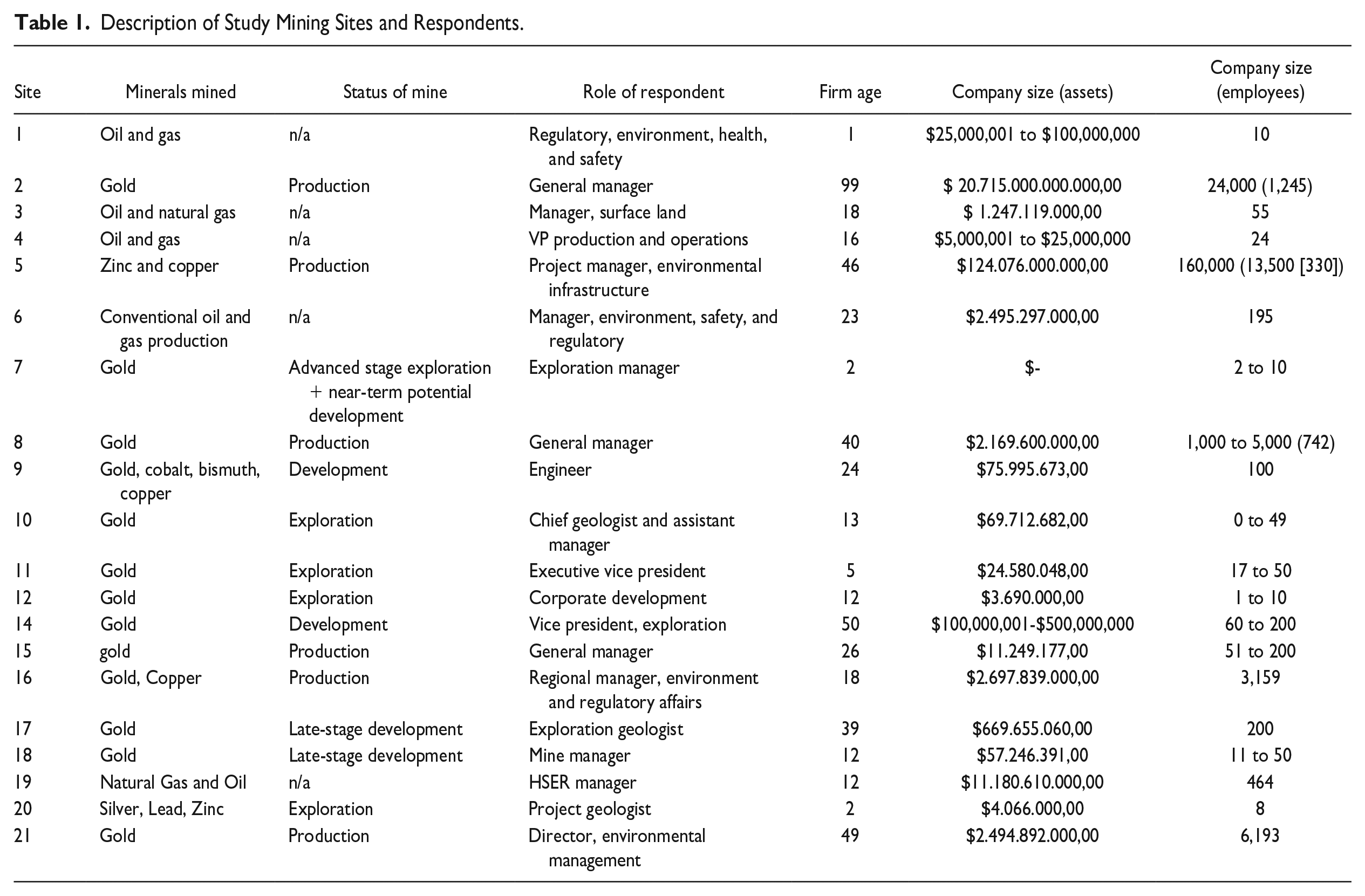
We collected data for our analysis from multiple sources. Our primary data source was a survey that we administered (see Appendix). The survey was administered to site-level decision-makers at the in-person Prospectors & Developers Association of Canada conference in March 2020, over a period of 2 days. This conference brings together over 1,000 exhibitors from the mineral exploration industry which thus offered an ideal event from which to recruit respondents. Two of the authors attended this conference and approached mining exhibits to identify appropriate respondents. Through conversation, the authors were able to identify respondents from operating mining sites or advanced-stage exploration sites in Canada possessing sufficient site-level understanding. Respondents took approximately 15 min to complete the survey on paper. These surveys were collected and digitized. Administering surveys in person provided a high degree of confidence that the respondent and site were appropriate for the study. Table 1 describes the 20 mining sites in our study. The survey was supplemented with visits to the mining firm’s website and expert analysis of the geographical region in which the mining site sits.
Description of Study Mining Sites and Respondents.
Measures
Disaster Preparedness
Drawing on prior research (Oetzel & Oh, 2021), we generated survey questions to measure disaster preparedness. We measured disaster preparation via two items—established a disaster management program (Appendix: 12c) and conducted at least one training event regarding natural disaster preparedness in the last year (Appendix: 12g). We used these two items because planning for disasters through both programs and training events are critical for protecting physical property, maintaining business operations, adapting to new threats, and ensuring the safety of employees (Castillo, 2005; Josephson et al., 2017; Xiao & Peacock, 2014).
The four dimensions of psychological distance are captured in this study via conditions that deal with perception: belief in anthropogenic climate change, perception of regional increase in wildfires, controllability of wildfires, and experience with wildfires. We describe these below.
Belief in Anthropogenic Climate Change
We derived our survey question for this condition (Appendix: 14b) using a study by Wang et al. (2019). We focused on the statements related to whether the respondents believed that climate change was caused by human activity. This belief runs contrary to much of the narrative espoused historically by the extractive resource sector. Due to this, many decision-makers in this industry may feel socially distant from climate issues and thus climate-mediated natural hazards. We argue that belief in anthropogenic climate change reduces the uncertainty with which the respondent views the prevalence of climate-mediated natural hazards. Such a belief decreases psychological distance and increases the likelihood to prepare (Hoffmann et al., 2009; Wang et al., 2019).
Perception of Regional Increase in Wildfires
This condition assesses a respondent’s understanding of their geographic exposure to wildfires. We used the item there is increasing prevalence of forest fires in the area surrounding our mining operation (Appendix: 14k). Respondents who rate this condition highly express a lower psychological distance to wildfire hazards. Regional increases in wildfire capture all four dimensions of psychological distance. This perception relates to each of temporal, social, and geographic closeness as the individual believes their physical location to be experiencing elevated wildfire hazard at that moment in time, impacting similar businesses and people. The perception of increasing wildfires denotes a decreased uncertainty among the decision-makers as to their occurrence.
Controllability of Wildfires
This condition refers to whether the decision-maker feels a sense of hopelessness or (over)confidence regarding the controllability of wildfires. A respondent’s perception of the controllability of wildfires influences their propensity to prepare for disasters (Gasbarro & Pinkse, 2016; Linnenluecke & Griffiths, 2010, 2012). We used there is little that can be done about large wildfires disrupting mining operations (Appendix: 9a) to operationalize controllability. Controllability is influenced by the individuals’ certainty regarding wildfires in their region.
Disaster Experience With Wildfires
In the survey, we used one question with four different items (Appendix: 11d, 11e, 11f, and 11g), derived from Oetzel and Oh (2021), to understand the extent of the firm’s experience with disasters including the impacts of facilities, operation stoppage, supply chain disruption, and shipment disruption. Respondents who experienced significant direct impacts on their facilities likely feel less uncertain regarding the potential for natural hazards. They also likely have a decreased psychological distance due to the occurrence of relatively recent and proximate natural hazards.
Company Size
Corporate contexts within the firm also affect disaster preparation (Han & Nigg, 2011). Company size, for example, is a key factor (Josephson et al., 2017). Firms with more employees have a greater ability to prepare for disasters and have been shown to do so (Quarantelli et al., 1979). Similarly, companies with more financial resources can more readily adopt adaptation and mitigation strategies (Josephson et al., 2017). Other corporate contexts that influence disaster preparation strategies include the industry sector, property ownership, firm age, location patterns, and sector differences (Han & Nigg, 2011; Josephson et al., 2017). To assess company size, we gathered the number of employees and total assets from company reports.
Wildfire Exposure
Wildfire hazard is commonly understood as the product of fire probability and fire intensity, while exposed assets are any resources that have human or ecological value (Johnston et al., 2020; Thompson et al., 2011); in the context of this study, these assets might be processing and storage facilities, pipelines, roads, power lines, and worker camps (Khakzad, 2018; Khakzad et al., 2018). Spatial congruence between fire hazard and assets determines exposure. We created an atlas covering all 20 study sites with burn probability, fire intensity, fuel type and cover, and geographic and statistical information related to historical fire perimeters and area burned (see Figure 1 for an example). Burn probability and fire intensity data were obtained using the Burn-P3 stochastic wildfire simulation model (Parisien et al., 2019); fuel data were extracted from the Fire Behavior Prediction System whose fuel categories are based on a classification of Canadian forest cover at a 250 m spatial resolution (Beaudoin et al., 2014; Forestry Canada Fire Danger Group, 1992). Historical fire data were extracted from the National Large Fire Database 1 ; historical fire activity being a valuable indicator of local fire-proneness (McWethy et al., 2019). The atlas was created using QGIS 3.16.4-Hannover (QGIS, 2020). Experts were then asked whether, considering their expertise and the data in the atlas, they would assess the site as being at risk to wildfire within a 50-km radius of the main extraction site.
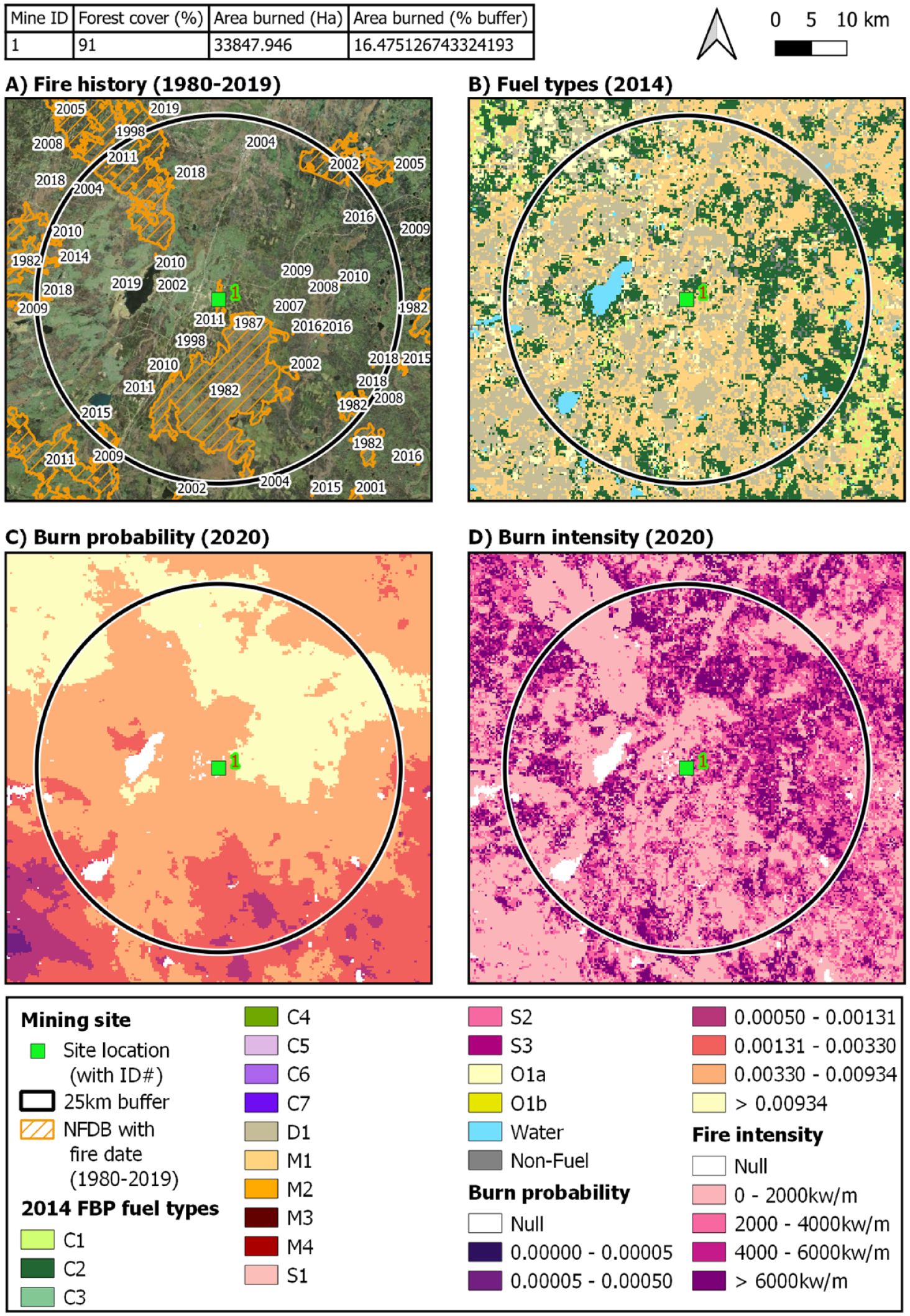
Wildfire Atlas of Mining Sites (Example ID 1)
In summary, we have adopted measures or conditions that tap into the different dimensions of psychological distance. Dimensions of psychological distance are often interconnected meaning that conditions often reflect factors from multiple dimensions of psychological distance. Temporal distance is captured by the condition of regional increase in wildfire. Social and geographic distance is reflected in the conditions of regional increase in wildfires as well as past experience with wildfires. Finally, uncertainty is captured by the conditions related to belief in anthropogenic climate change, regional increase in wildfires, experience with wildfires, and controllability of wildfires.
Qualitative Comparative Analysis
We employed a QCA methodology to study how different combinations of conditions generate multiple pathways toward our dependent variable of interest, disaster preparedness. Whereas regression techniques disaggregate cases into distinct independent variables and assess how these variables compete to create an outcome (Fiss, 2007; Ganter & Hecker, 2014), a configurational approach maintains that causation cannot be so readily disaggregated. QCA as a method is uniquely capable of addressing how complex and nonlinear relationships between measures lead to an outcome of interest (Delmas & Pekovic, 2018; Ragin, 2006; Short et al., 2008). Outcomes are often the result of multiple causes that may work in concert or disagreement with one another (Delmas & Pekovic, 2018; Greckhamer et al., 2008). QCA is a case-based, set-theoretic methodology that uses Boolean algebraic logic rather than regression algorithms (Fiss, 2011; Greckhamer et al., 2013). QCA is favored over multiple linear regression analysis when the goal is to understand how measures combine, instead of compete, toward an outcome (Delmas & Pekovic, 2018; Fiss, 2011).
The foundation of the QCA methodology is identifying when a case, in our study a mining site, are members of the set of mining sites meeting a particular condition. For example, in our analysis, we assess whether mining sites are members of a set of mining sites that are large or have wildfire exposure. For each condition, the analytical approach is to assess whether it is necessary and/or sufficient for the outcome of interest, that membership in these “explanatory” conditions is present. A condition is necessary if it is required for a particular outcome condition, such that the outcome is never present without the necessary condition (Schneider & Wagemann, 2009). A condition is referred to as sufficient when the outcome is present whenever that condition or conditions are present. Both necessary and sufficient conditional statements produce complex causal statements that test and identify combinations of conditions that result in outcomes of interest. Importantly, solutions that are sufficient for successful disaster preparedness are not always necessary which gives way to complex causal pathways.
Crisp-Set QCA
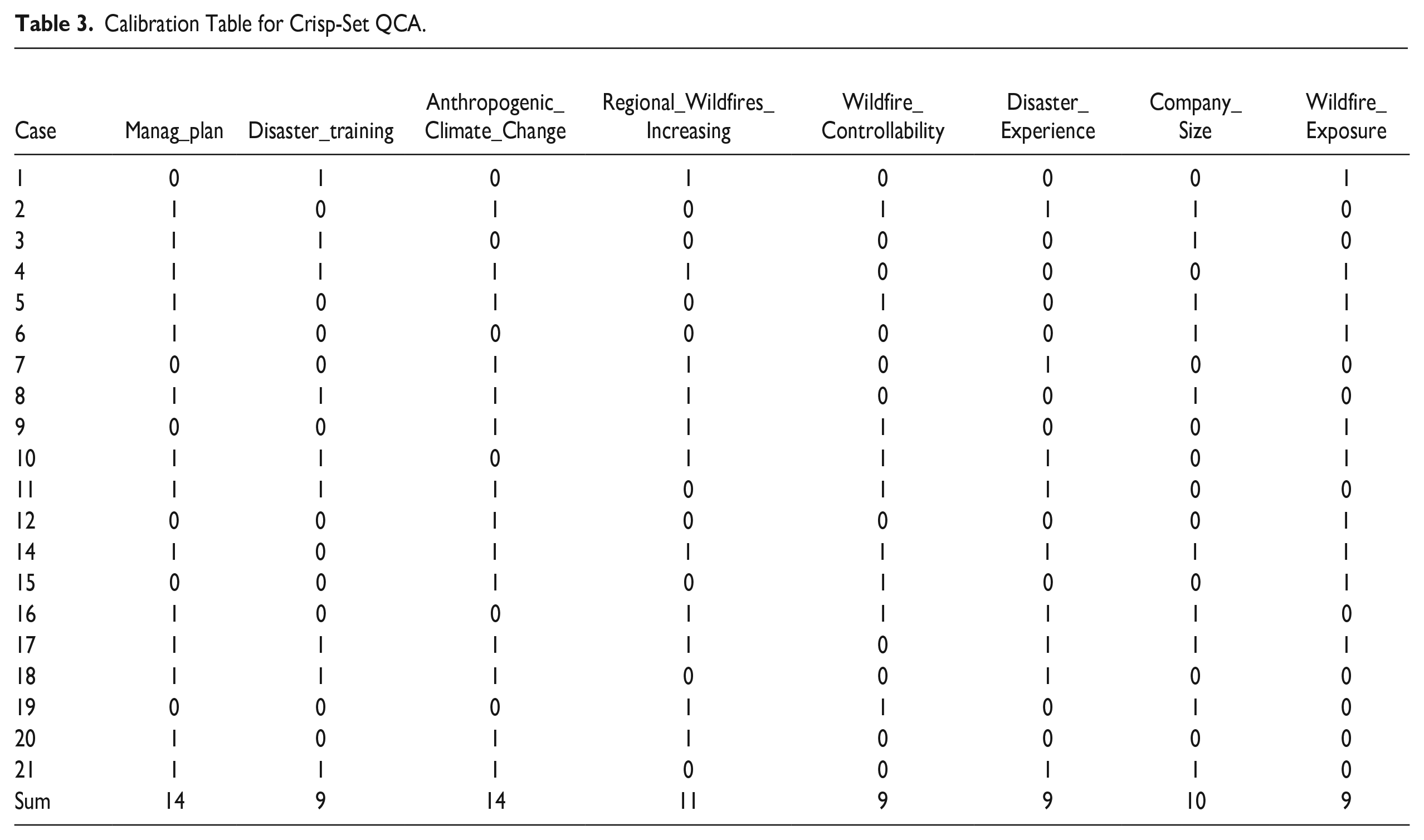
Case membership scores are assigned to sets that describe conditions. We employed a crisp-set QCA (csQCA) strategy to evaluate set memberships in a dichotomous or “crisp” way, assigning cases as “fully in” (membership score of 1) or “fully out” (membership score of 0) of the sets (Greckhamer et al., 2013). We chose not to employ fuzzy-set QCA, another analytical approach, because our conditions of interest do not have easily defined underlying gradients (Greckhamer et al., 2013). Set membership was assigned or calibrated for each condition within each case (Fiss, 2011). Table 2 presents the crisp-set membership calibration for all the conditions. Table 3 shows the final calibration of conditions. It is worth noting that the survey data was initially populated according to the 7-point Likert-type scale as we initially designed our survey for linear regression. As a stronger test, we classified neutral cases as fully out.
Crisp-Set Membership Calibration.
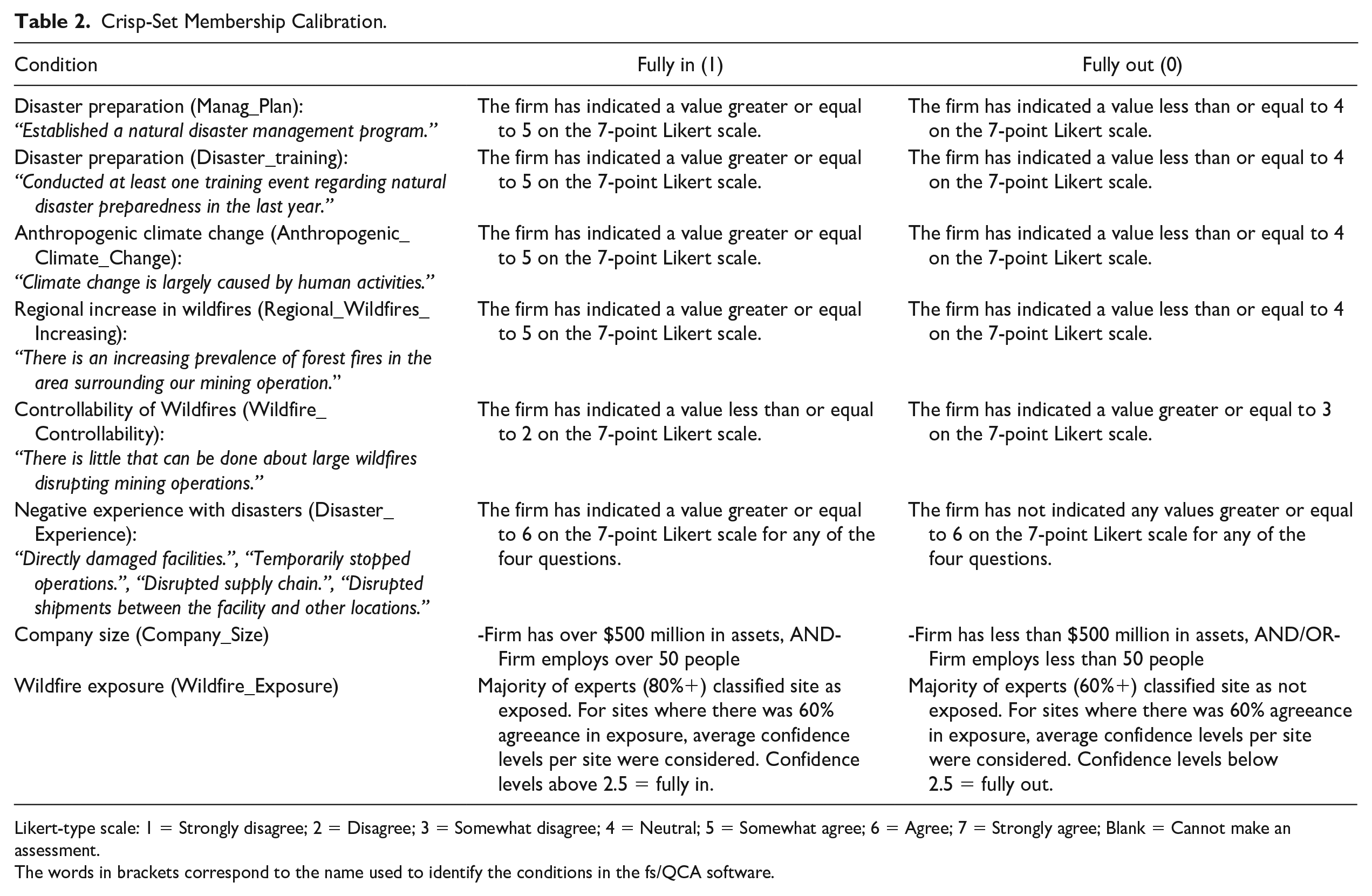
Likert-type scale: 1 = Strongly disagree; 2 = Disagree; 3 = Somewhat disagree; 4 = Neutral; 5 = Somewhat agree; 6 = Agree; 7 = Strongly agree; Blank = Cannot make an assessment.
The words in brackets correspond to the name used to identify the conditions in the fs/QCA software.
Calibration Table for Crisp-Set QCA.
Calibrating Wildfire Exposure
Given the diversity of Canadian fire regimes and landscapes, and thus of at-risk situations, devising a single quantitative exposure analysis method did not seem appropriate. Thus, we relied on expert elicitation to classify the exposure of extraction sites, either as exposed (1) or non-exposed (0); experts were wildfire research scientists from the Canadian Forest Service. Experts were shown surveys containing atlases covering all 20 sites (Figure 1) and were asked whether, considering their expertise and the data in the atlas, they would assess the site as being at risk to wildfire. For 13 of the 20 sites, the majority (80%) of experts agreed on exposure levels.
Analytical Approach and Truth Tables
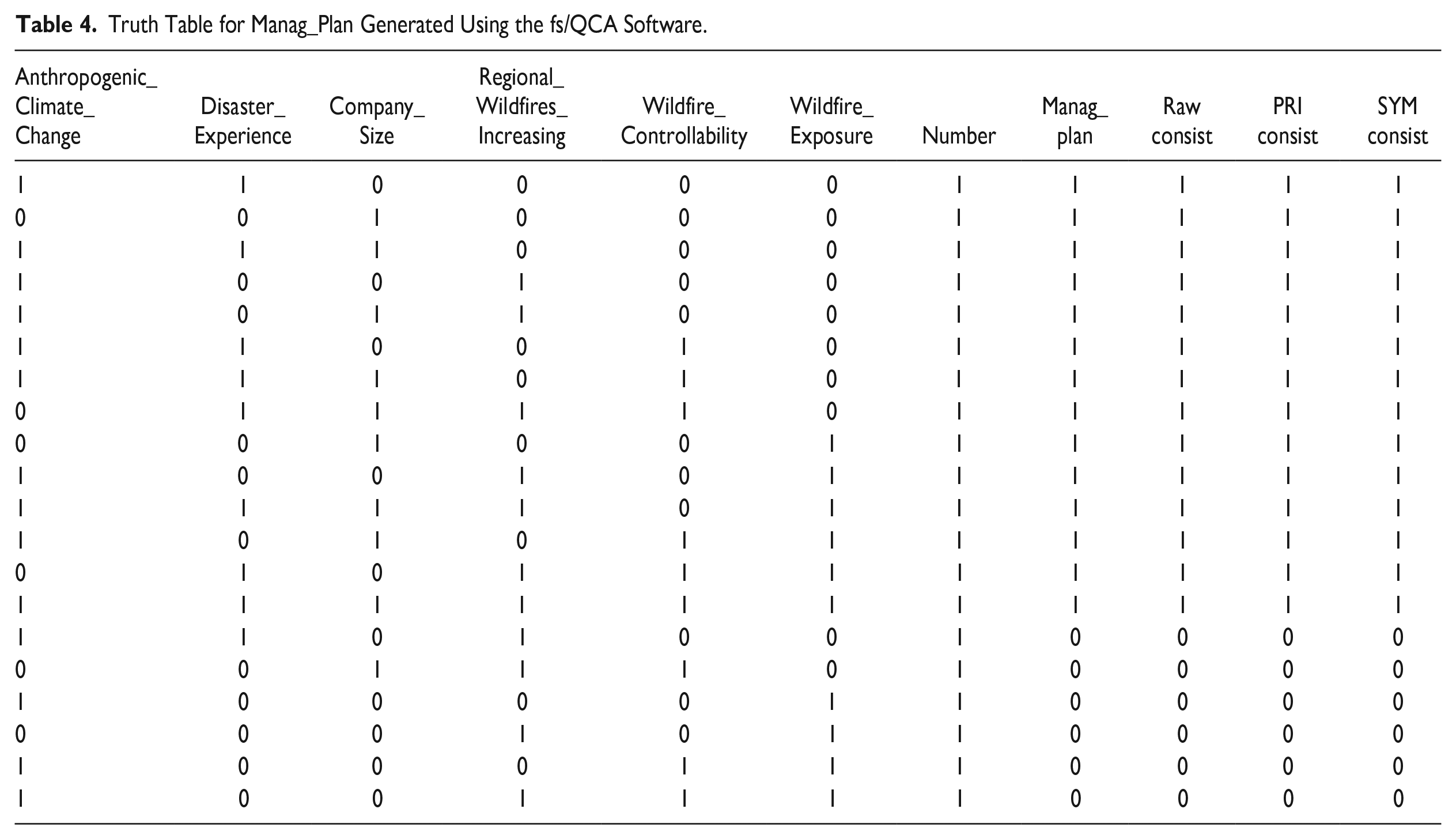
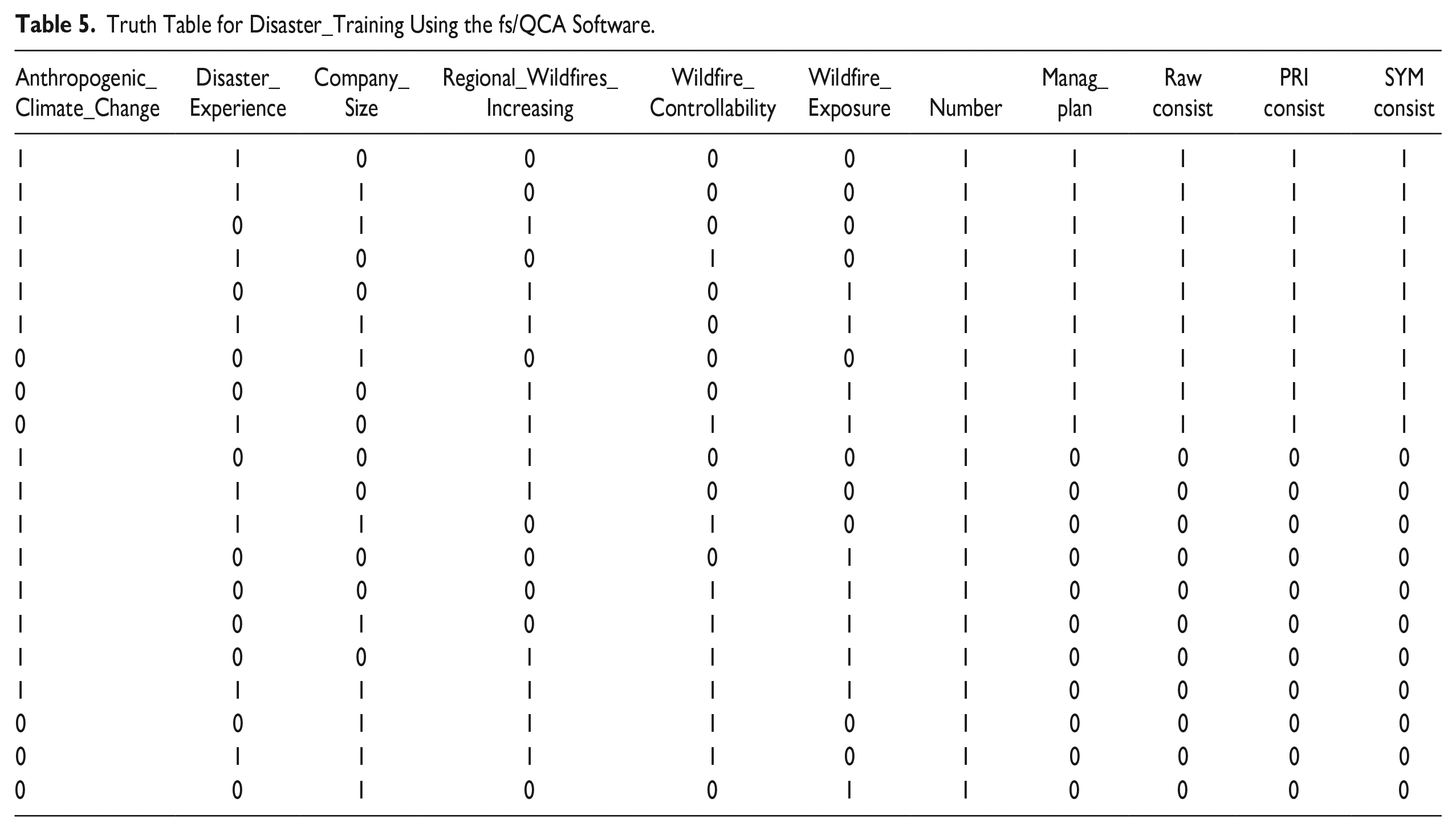
Following the calibration of our outcome and explanatory conditions, we constructed two truth tables consisting of all 64 (26) possible configurations of our six explanatory conditions (Tables 4 and 5). Consistency demonstrates how well a perfect subset relation is approximated (Greckhamer et al., 2013). We adopted a high threshold consistency of 0.8. The objective of csQCA is to obtain a consistency of 1.00; however, consistencies that are close to this value are acceptable and to be expected with small-N studies (Ragin, 2006). By applying this 0.8 consistency threshold, we reduced the number of possible configurations to 20 unique configurations for both outcomes. This was reduced further to seven and six abstract configurations for the management plan and disaster training outcomes, respectively, using the Quine-McCluskey algorithm found in the fs/QCA software package (Fiss, 2011).
Truth Table for Manag_Plan Generated Using the fs/QCA Software.
Truth Table for Disaster_Training Using the fs/QCA Software.
Sufficiency Analysis
Using the fs/QCA software, we show how configurations of differing set membership across multiple conditions were associated with disaster preparation in the form of disaster management programs and disaster preparedness training (Fiss, 2011). Boolean algorithms employed by the fs/QCA tool simplified the truth tables by connecting case memberships in a configuration of conditions to membership in the outcomes of interest (Fiss, 2011). As a result, a Boolean statement is generated, which details all configurations that are sufficient but not necessary for the outcome to occur. This enables us to define multiple, equifinal configurations of conditions that are related to disaster preparation (Fiss, 2011).
Results
Our data show that three-quarters (14 of the 20 firms) prepared disaster management plans however less than half (9 out of 20) engaged in disaster training. Table 3 describes the firms’ set membership in each condition assessed in our study. Of the firms that engaged in both management plans and disaster training, six had a site manager who believed in anthropogenic climate change, five perceived a regional increase in wildfires, five were negatively impacted by past hazards, two perceived wildfires were controllable, four were large companies, and three were exposed to wildfires as assessed by experts. The average firm in our study was 25 years old and 90% fully owned their operations; an equal number operated under domestic ownership (Table 1).
Sufficient Configurations for Disaster Preparation
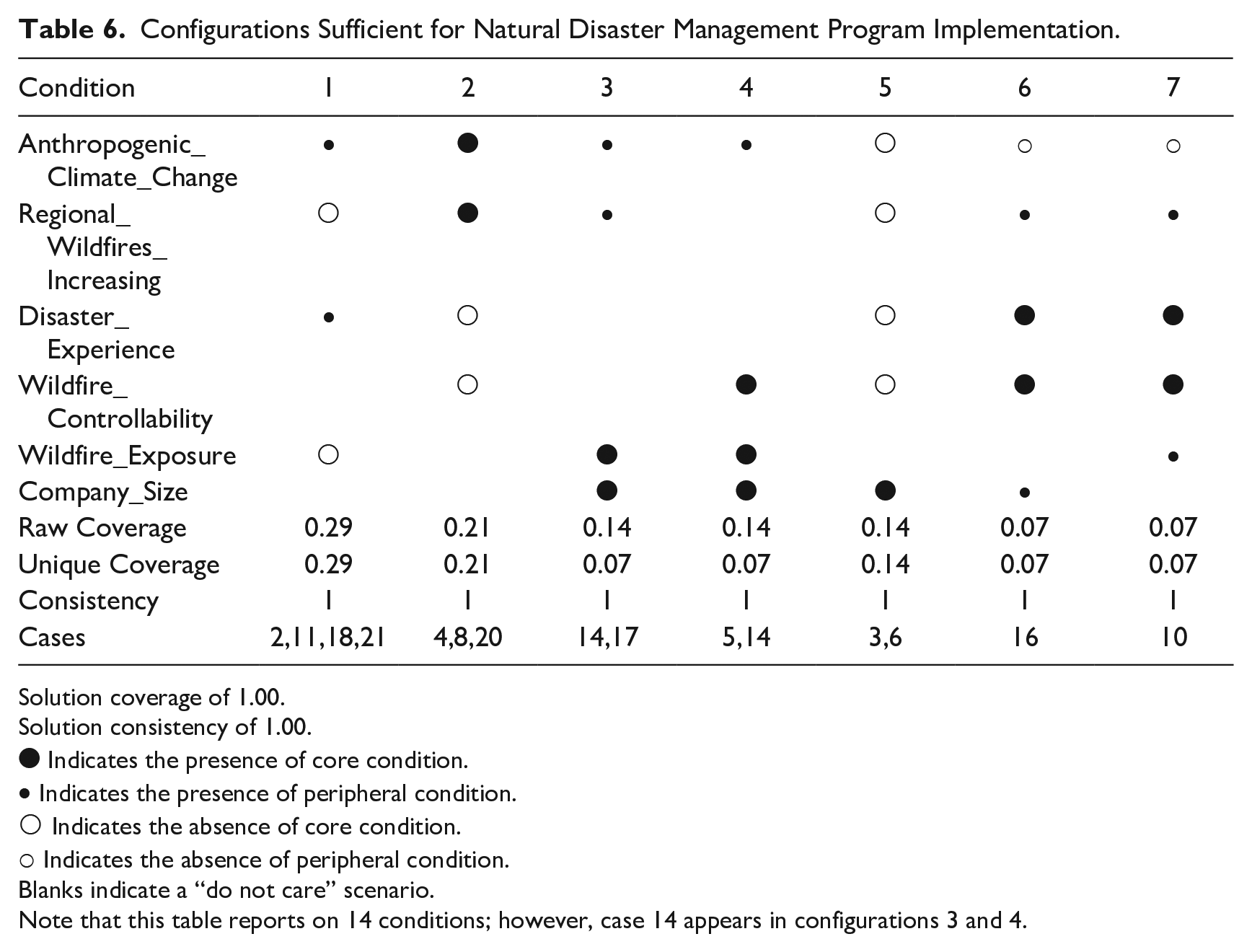
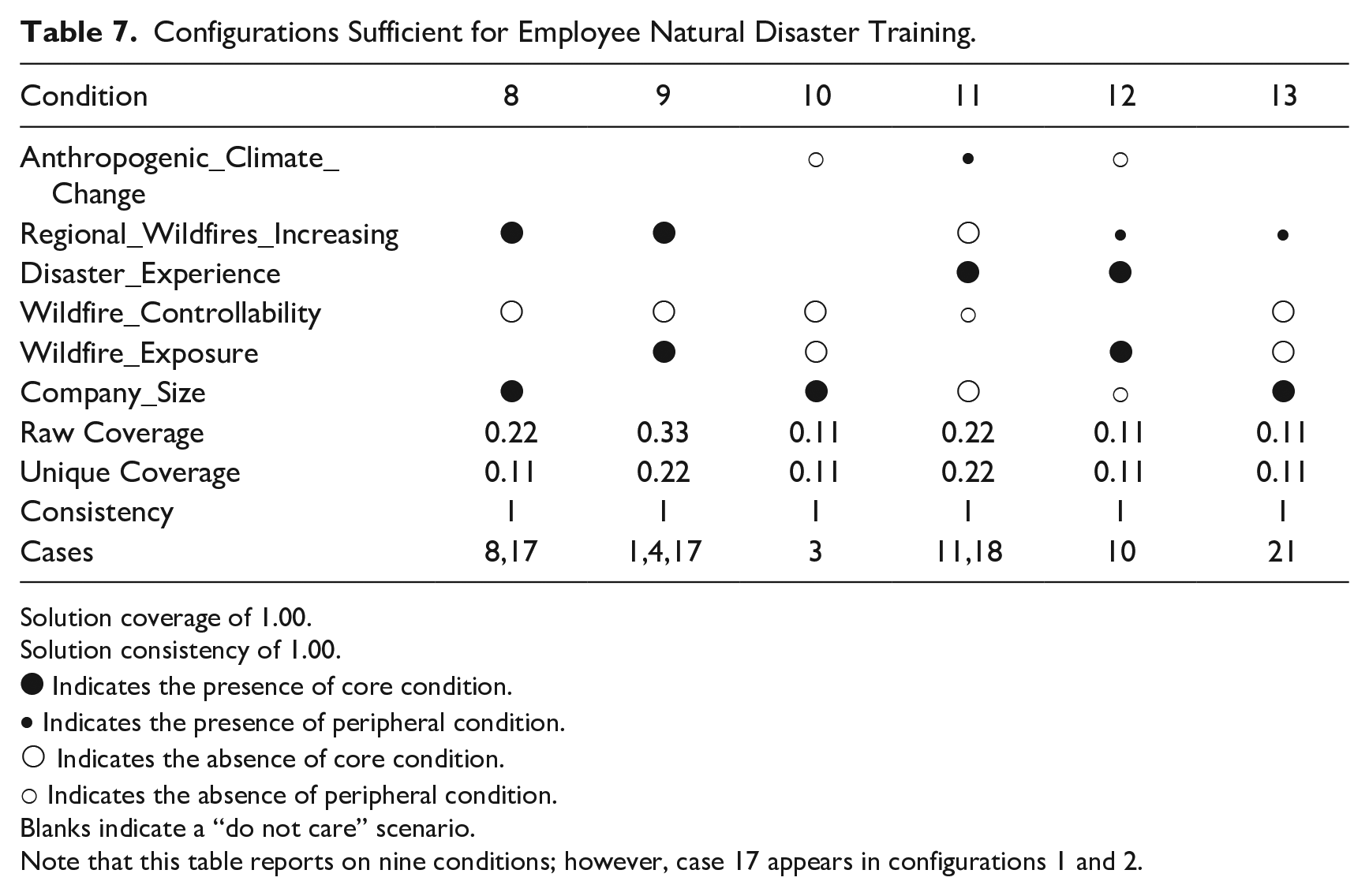
Each column in Tables 6 and 7 represents a distinct configuration; a combination of conditions associated with possessing a disaster management plan or disaster training, respectively. Following the QCA convention, the presence of a condition is denoted by a black solid dot (•), while the absence of a condition is denoted by a hollow circle (○). Blank cells indicate the condition may be present or absent—a “do not care” statement.
Configurations Sufficient for Natural Disaster Management Program Implementation.
Solution coverage of 1.00.
Solution consistency of 1.00.
Indicates the presence of core condition.
Indicates the presence of peripheral condition.
Indicates the absence of core condition.
Indicates the absence of peripheral condition.
Blanks indicate a “do not care” scenario.
Note that this table reports on 14 conditions; however, case 14 appears in configurations 3 and 4.
Configurations Sufficient for Employee Natural Disaster Training.
Solution coverage of 1.00.
Solution consistency of 1.00.
Indicates the presence of core condition.
Indicates the presence of peripheral condition.
Indicates the absence of core condition.
Indicates the absence of peripheral condition.
Blanks indicate a “do not care” scenario.
Note that this table reports on nine conditions; however, case 17 appears in configurations 1 and 2.
Core conditions are highlighted using larger solid dots or hollow circles and peripheral conditions are denoted by smaller dots and circles. Core and peripheral conditions are identified using counterfactual analysis. This is a valuable analysis because, as is common in this analysis, our data did not cover all possible configurations of conditions in a truth table. Configurations without empirical evidence are referred to as remainders and represent the “limited diversity” in our data. Counterfactual analysis addresses this limited diversity by creating two solutions. The first solution, referred to as the parsimonious solution, simplifies the solution by making generous assumptions about remainders to remove unnecessary conditions and arrive at the most simplified solution possible (Misangyi & Acharya, 2014). The intermediate solution employs researcher assumptions about whether, based on prior theory, a particular condition is expected to be associated with the outcome condition of interest (Fiss, 2011). For our analysis, we assumed that the presence of negative disaster experience, the perception that disasters are increasing regionally, and company size were each associated with increased disaster preparation. Core conditions are those present in both parsimonious and intermediate solutions, while peripherals are only present in the intermediate solution, meaning these conditions can only be excluded once the theoretical assumptions about remainders are relaxed (Fiss, 2011; see Ragin, 2000 for detailed reviews). Core conditions offer a stronger causal relationship to outcome conditions than that of peripheral conditions because they align with known relationships from past research that are specified in the intermediate solution.
Coverage and consistency scores are presented for the overall solution (bottom of the table) and each configuration (each column) within the analysis. Coverage measures how well the solution as a whole and each configuration individually describes the cases of disaster preparedness in our sample (Fiss, 2011). Consistency scores explain the extent to which the solution and configurations achieve higher instances of disaster preparation. The coverage and consistency scores for both the individual configurations and the overall solutions for both desired outcomes are above the acceptable threshold of 0.80 (Fiss, 2011). The disaster management program outcome has seven configurations associated with adoption and the disaster preparedness training outcome has six.
Groups of Configurations
When interpreting the results, we sought to understand how configurations of conditions (columns) grouped together resulted in decisions to adopt disaster management programs and/or training. The configurations in our solutions were cohered into five groups as indicated in Tables 6 and 7 and described below.
The first group we labeled Disaster Survivors (DS). The three configurations (1, 11, and 12) in this group were anchored on possessing previous experience with wildfire disasters. The configurations differed, however, in terms of whether regional wildfires were increasing in their area and whether experts assessed their mines to be at risk. A second group of configurations, Disaster Believers (DB), were associated with a belief that regional wildfires were increasing. Importantly, these configurations (2, 8, and 9) did not express confidence that the impacts of these wildfires could be controlled suggesting that these firms were highly concerned about the challenging threat of wildfires. For one of these configurations, this also included a belief that climate change was anthropogenic. The third group we labeled Large and Exposed (LE) because these configurations (3 and 4) were characterized by larger firms that were seen by experts as being exposed to wildfire risk. A fourth group, Large and Pessimistic (LP), reflected configurations (5, 10, and 13) which consisted of large firms that argued controlling wildfires was a hopeless pursuit. The final group we labeled Experienced and In Control (EC), to denote how firms in these configurations (6 and 7) had experienced wildfire disasters but had asserted confidence that their impacts could be controlled or mitigated.
Condition Combinations
We also explored how different conditions alone or in combination substituted or complemented each other (rows) across these configurations.
We found that negative experience with wildfire was an important condition that was often associated with adopting natural hazard training and management plans. In the six configurations associated with Disaster Survivors and Experienced and In Control, this experience was present. However, it was not a necessary condition. In the configurations where negative experience was not present, it was most often the case that the manager perceived natural hazards as increasing in prevalence such as the case with Disaster Believers (four configurations). At times, this was coupled with a belief in anthropogenic climate change.
Interestingly, while the presence of control seemed important when implementing disaster management programs such as for configurations in the Experienced and In Control group (Configurations 4, 6, and 7—Table 6), the absence of control (Configurations 1–3 and 6—Table 7) was associated with adopting disaster training. In configurations 8 and 9, the lack of control was coupled with a sense that wildfire hazards were increasing in the region, whereas, in 13, the lack of control was coupled with experience with past hazards. Putting these two insights together highlights that addressing hazards can be a frustrating experience for managers of mining firms with a lack of control coupled with impending and increasing risks or risk perception.
When examining the configurations, we found that company size was often positively associated with the adoption of disaster management programs and training. This was the case in configurations 3, 4, 5, and 6 in Table 6 associated with disaster management plans and in configurations 8, 10, and 13 in Table 7 associated with disaster training.
We note poor alignment between managerial perceptions of exposure to wildfire and expert assessment of the same exposure. We note that almost half of respondents (9 of 20 in Table 4) disagreed with expert assessments of wildfire hazard either by expressing that it was there when experts disagreed or by underreporting it when it was indeed high. Perhaps more concerning still, of the six organizations without a disaster management plan, four were assessed by experts as being highly exposed to wildfire.
We note some configurations appeared common or similar across both outcome conditions. Configurations 1 and 11 are associated with firms that have experience with disasters but without concern that these disasters would increase. This lack of concern is corroborated in these configurations by the absence of expert assessments concerned about high wildfire exposure levels. Configurations 2 and 8, members of the Disaster Believers group, are firms that believe strongly that they are increasingly exposed to wildfires; a concern that is more abstract in nature as it is not corroborated by expert assessment. Configurations in the Large and Exposed group are larger firms that share an expert-verified risk of wildfire hazard. These firms may also share a concern that climate change is manmade and of concern. These firms are planning for very real wildfire risks. Configurations in the Large and Pessimistic group refer to large and well-resourced firms that, despite a lack of expert-assessed wildfire exposure, are engaging in disaster preparedness due to their large size and the capacity to engage in these activities.
Theory Development and Discussion
We studied how conditions related to prior wildfire experience and the perceptions that managers have regarding wildfire occurrence, climate change, and controllability influence disaster preparedness. Our results, while consistent with previous research on risk perception, offer new insights regarding the determinants of DRR in the extraction industry. We answer past calls for more work on the role of decision-makers in disaster preparation (Arnell, 2010; Borlu & Glenna, 2021; Gasbarro & Pinkse, 2016; Linnenluecke et al., 2013), by building configural explanations of causality that can provide more nuance to our understanding.
Wildfire Exposure
Our study is unique in that our assessment of managerial perceptions regarding wildfire exposure was corroborated—or not—by several wildfire risk experts. We found that managerial perceptions and expert assessments agreed only approximately half of the time. These perception errors were symmetric. Managers perceived exposure that experts assessed as not present while at other times perceived no exposure when experts argued for its presence. This is a critically important finding because prior research data have been largely constrained to data-capturing managerial perceptions, whereas, in this study, we also consider expert analysis. Studies considering exposure to wildfires might consider specifying if their assessment is based on perceptions from lay people or on potentially more objective risk analysis techniques utilizing experts.
In our approach, wildfire hazard exposure assessment involved evaluating a set of variables including historical wildfire activity, the presence and type of vegetal fuels, the probability of a location experiencing a fire on a yearly basis, and the expected median fireline intensity. The complexity induced by this number of factors can make exposure levels hard to quantitively evaluate without advanced data processing techniques calibrated to various wildfire environments. We thus argue that the recourse to an expert elicitation method, despite existing limitations and the unavoidable effects of an expert’s own perception error (Morgan, 2014), offers a straightforward means to reduce reliance on lay perceptions of wildfire risk. We suggest that studies focusing on the determinants of DRR action in various environmental settings consider non-expert and expert assessment in parallel.
By measuring not just perception of exposure but also connecting respondents’ survey responses with spatial and biophysical data that detailed actual wildfire exposure measures, we create an opportunity to assess and explore the gap between expert and layman risk assessment. This finding emphasizes the important role that psychological distance and perception can play on how decision-makers assign their limited attentional capacities in adaptation efforts (Millett & Simon, 1947; Ocasio, 1997, 2011). Our methods reflect the reality that managers must convert complex wildfire hazard data and take discrete actions. Decision-makers assess a range of data and make a dichotomous decision on whether to act. We take our finding that experts disagreed with managers regarding the presence of wildfire hazards as support for the importance of perception and psychological distance in disaster preparation decisions (Brügger & Pidgeon, 2018).
Wildfire Perception
Prior research has found that direct negative experience with natural hazards increases attention and action (Oetzel & Oh, 2018, 2021) and is often required to sufficiently elevate concern regarding the impacts of climate change (Lujala et al., 2015). Our findings reinforce this as evidenced by the Disaster Survivors and Experienced and In Control configurations of firms. However, our research also finds that other elements of perception including belief in anthropogenic climate change and a perception that wildfires are increasing were commonly present or even substituted for direct negative experience with a disaster as was the case for firms in the Disaster Believers group of configurations. This finding is similar to that of Oetzel and Oh (2021) that found organizational experience alone is often not enough incentive to prepare. They found that experience encourages managers to learn from others, which then initiates preparation.
In our analysis, four conditions affected decision-makers’ perceptions of their exposure to wildfire. These explanatory conditions included whether the respondent held a belief in anthropogenic climate change, had perceptions of regional increase in wildfires, controllability of wildfires (discussed in the following subsection), and experience with wildfires. We found that in most cases wildfire exposure was salient to the decision-maker. However, two of three other conditions needed to be present before decision-makers acted on signals regarding past wildfire hazards and prepared for disasters.
We draw on the concept of psychological distance to explain this finding. First, prior experience with disasters reflects decreasing geographic, temporal, and social distance (Spence et al., 2012). Experiencing a disaster makes potential risks real. Decision-makers understand that wildfire risks are physically close and can happen at any time. The risks can no longer be discounted as being associated with different types of organizations or people. Second, the belief that climate change is anthropogenic reduces the perception of uncertainty as decision-makers can better explain the possibility of more frequent and intense wildfires. That climate change is anthropogenic provides a plausible causal mechanism for the prevalence of wildfire that could increase the propensity for action. Third, increasing regional wildfire occurrences reflect a decreasing geographical distance between the organization and the negative impact of wildfire. As wildfire hazards increasingly occur close to the decision-maker, they are both physically and psychologically closer to the risks. When managers feel sufficiently psychologically close to these events, they are more likely to focus time and effort on disaster preparation efforts.
Our research addresses prior calls to focus on the important role of climate change perception (Borlu & Glenna, 2021), but it also suggests that more work on wildfire prevention and communication from the authorities could be done. Wildfires may indeed be seen as too rare and too stochastic for companies to prepare proactively beyond what might be imposed by federal or provincial regulation (McKnight & Linnenluecke, 2019), yet current and future fire-proneness of Canadian forests indicates that reactive-only response to disaster might be a risky strategy.
Controllability
We found interesting the role played by the perception of control as it pertains to wildfires. For some firms, the combination of control and a prior negative disaster experience appeared to be associated with adopting disaster management programming. This suggests some firms might have been empowered by a combination of urgent experience and a comfort that, through action, the negative impacts of wildfires could be controlled. However, more prevalent appeared to be an association between a lack of perceived control and the adoption of disaster management training. In no disaster training, configuration was controllability a required condition. We infer that for many firms, engaging in disaster training played a critical role in compensating for this lack of control. This finding contrasts with prior research that has found that a sense of controllability led to a feeling of confidence and capacity to adapt (Baltatescu, 2014; Liberman & Trope, 2008). Our findings better support the contrary perspective that firms engage in disaster preparation as a means of compensating for a lack of control (Gasbarro & Pinkse, 2016; Linnenluecke & Griffiths, 2010, 2012). This may be particularly relevant for managers of firms in the extractive industry as their mining sites are fixed in place for decades and cannot be readily moved to a less hazard-exposed location. This necessary long-term connection with the mining site may help managers at these firms to feel psychologically “closer” to the wildfire risk due to more certainty that wildfire will, at some point, impact these sites over the life of a mine.
Company Size
Company size is often positively associated with adopting disaster management programs and training such as those firms in the Large and Exposed and Large and Pessimistic group of configurations. This finding likely speaks to how larger companies have greater resources to invest in such preparation activities, which corroborates past research findings (Josephson et al., 2017; Quarantelli et al., 1979).
Limitations and Future Research
This research has limitations that should be considered. One key limitation is the absence of smoke variables within our exposure assessment. Incorporating smoke in our expert assessment is challenging. Smoke emissions are heavily dependent on local weather conditions during fires in surrounding areas, and smoke modeling remains notoriously complex (Sokolik et al., 2019). Moreover, despite smoke being an important element of wildfire exposure, and assuredly a safety concern to companies’ personnel and operations (Canadian Association of Petroleum Producers, 2015); existing data on evacuation show that more than 80% of evacuations that have happened in Canada were triggered by a direct threat from fire, not because of smoke. Regardless, incorporating smoke may prove a productive addition to a fulsome understanding of wildfire exposure. A second limitation of our study is the relatively small number of companies (20) under study. This study also focuses on a Canadian context which removes international regulatory concerns, further limiting the generalizability of the study. A third limitation is incorporating legal obligations regarding wildfire risk reduction and preparedness. It is possible that differences in provincial and territorial regulations explain some of our findings. However, to the best of our knowledge, no specific regulation or mandate exists at the federal level, besides general obligations to intervene during an emergency. Several provinces have regulations pertaining to wildfire and industrial activities that vary in content and scope by province but usually involve creating, submitting, and maintaining a wildfire prevention and an emergency plan and the recommended application of FireSmart principles. The level of details of these plans, their level of implementation and their actuality, are unknown (private information) and likely vary by site and industry. Fourth, as companies develop mines from exploration and discovery through development and production, the number of employees tends to grow. Care should be taken in evaluating the impact of company size on disaster preparation as this condition might be conflated with the stage in a mine’s life cycle.
Our findings suggest that future research building configurational theory would help to better understand disaster preparedness. Research should continue to explore how measures of exposure as assessed by hazard experts configure with other conditions found to influence disaster preparation. Our exposure variable measures only one hazard, wildfire, and trends call for multi-hazard assessments (McKnight & Linnenluecke, 2019). Adding additional hazards such as flooding and extreme heat, for example, would be a productive next step. This will better capture exposure and its alignment with individuals’ perceptions of their exposure and vulnerability.
Managerial Implications
Our focus on the natural resources extraction industry is important and timely as this sector will continue to face the effects of climate change (Gauthier et al., 2015; IPCC, 2022; Kato et al., 2020). For managers, understanding whether, when, and how to invest in disaster preparation activities is critically important. Prior research has identified gaps in managerial knowledge regarding climate change. Managers without this knowledge appear to struggle to connect climate change to concrete impacts on their business (Weinhofer & Busch, 2013). Pinkse and Gasbarro (2019) found that firms are aware of informational resources that would help them to understand climate change (e.g., IPCC) but may not connect these resources to their mining context and daily practice. Our study reaffirms this gap and the need to help managers more clearly understand the implications of climate change on their businesses; furthermore, it underlines the paucity of research focusing on wildfire DRR in industries that many consider critical to Canada’s economy. We find that many firms that were taking DRR actions were not those at most risk, and conversely, many firms that were exposed to wildfires did not have a disaster plan in place.
Assessing wildfire risk is a challenging and uncertain undertaking, and the specifics of wildfire risk reduction and preparedness resulting from such assessment will depend on the characteristics of the mining site. Managers may consider finding sources of verification and validation to “correct” difficulties in properly attending to the true risk of disaster for a particular site such as engaging a panel of wildfire experts to flesh out a more fulsome risk profile for their mining sites. Of course, many larger firms are more likely to engage in disaster preparation simply because they have the resources to do so, leveraging resources across multiple mine sites (Han & Nigg, 2011; Josephson et al., 2017; Quarantelli et al., 1979). Findings from this research may help managers improve their knowledge, preparedness, and even feeling of empowerment to affect disaster preparedness.
Footnotes
Appendix
Declaration of Conflicting Interests
The author(s) declared no potential conflicts of interest with respect to the research, authorship, and/or publication of this article.
Funding
The author(s) disclosed receipt of the following financial support for the research, authorship, and/or publication of this article: The authors would like to acknowledge financial support from Canada’s Boreal Wildland-Society-Water Nexus: Water futures risk assessment.
