




Abstract
Knowledge, skills, and attitudes to manage sustainable development have become significant components of different career paths. Previous research has explored which competencies are needed for future change agents in the field of sustainable development. Sustainable entrepreneurship can be seen as a promising work context in which these competencies are truly at the forefront and enacted. Several researchers have compiled frameworks of key competencies. However, their work is exploratory in nature and a more in-depth analysis of these frameworks is called for. In this study, an existing competence framework for sustainable entrepreneurship was tested in terms of construct validity, among 402 would-be entrepreneurs. The results suggest the inclusion of six competencies, which constitute a competence framework with a good model fit. Furthermore, a new combination of two existing competencies is proposed. This study has important implications for the debate on which competencies for sustainable entrepreneurship are essential on theoretical and empirical grounds.
Keywords
Introduction
The concept of sustainable development has gained global importance over the past 10 years (Schaltegger & Wagner, 2011). In response to this worldwide focus on sustainability, higher education institutions have engaged in incorporating and institutionalizing sustainability into their curricula, research, and operations in order to educate future sustainability professionals as change agents for sustainable development (Rieckmann, 2012; Wals & Jickling, 2002). These change agents develop sustainability as a factor of success in their working environment, integrate sustainability criteria into business processes, and transfer the vision of sustainable development to society (Hesselbarth & Schaltegger, 2014).
In this line of thought, education for sustainable development (ESD) aims at enabling people to “not only acquire and generate knowledge, but also to reflect on further effects and the complexity of behavior and decisions in a future-oriented and global perspective of responsibility” (Rieckmann, 2012, p. 128). It is likely that these skills, attitudes, and knowledge stem from individual competencies for sustainable development. In general, competencies are described as enabling successful task performance and problem solving with respect to real-world problems, challenges, and/or opportunities (Barth, Godemann, Rieckman, & Stoltenberg, 2007; Dale & Newman, 2005) on an individual level and consist of knowledge elements, skills, and attitudes (Mulder, 2014; Wesselink, De Jong, & Biemans, 2010). Over the past few years, individual competencies for sustainable development have received much attention in the education for sustainability literature. Significant progress has been made in conceptualizing key competencies for sustainable development (Barth et al., 2007; de Haan, 2006; Rieckmann, 2012; Wiek, Withycombe, & Redman, 2011). Competencies such as foresighted or anticipatory thinking, systems thinking, interdisciplinary work, and participation are considered as key competencies that warrant (additional) attention in higher education.
Critical questions can be raised regarding the conceptual nature of these studies as they lead to rather abstract academic descriptions of competencies (Delamare Le Deist & Winterton, 2005). Furthermore, competence descriptions from the education for sustainability literature are usually decontextualized because competence lists are meant to be study program overarching, crossing various educational contexts and curricula. The reality, however, is that sustainability challenges and tasks often become meaningful in one’s specific work environment. Therefore, the work context is also an important factor to take into account in the field of sustainable development.
As a reaction to these critical remarks, several scholars have identified and studied competencies for sustainable development that are enacted in a specific work context (Hesselbarth & Schaltegger, 2014; Lans, Blok & Wesselink, 2014; Osagie, Wesselink, Blok, Lans, & Mulder, 2016; Wesselink, Blok, van Leur, Lans, & Dentoni, 2015). In today’s society different types of work contexts for change agents in the field of sustainable development can be distinguished. For instance, corporate social responsibility (CSR) managers, sustainable intrapreneurs, sustainable development champions, and sustainable entrepreneurs all play a key role in bringing about change to companies and society as a whole. Competencies identified in relation to specific change agent’s context are usually combinations of the key competencies for sustainable development mentioned above and key competencies identified in management and entrepreneurship literature (Hesselbarth & Schaltegger, 2014).
Nevertheless, the number of competence studies from a business perspective is much more limited, compared to competence studies from the educational context. To the best of our knowledge, only Hesselbarth and Schaltegger (2014), Osagie et al. (2016), Wesselink et al. (2015), and Lans et al. (2014) have made an effort in “translating” more generic lists of competencies for sustainable development into specific working contexts of change agents for sustainability. The former three focus more on the role of competencies in the work context of CSR managers and the latter focuses on would-be sustainable entrepreneurs.
Similar to the study of Lans et al. (2014), the current study focuses on the work context of sustainable entrepreneurs. Nevertheless, studies in this field are still explorative in nature and offer little information about the various combinations of interrelated competencies for sustainable entrepreneurship that (start-up) businesses are in need of in order to address sustainability challenges. Furthermore, it is not clear how competencies relate to other predictors of entrepreneurial behavior that have been previously found in the literature such as gender, entrepreneurial self-efficacy, or entrepreneurial intentions. In addition, to establish a valid competence framework, the competencies should be tested against these other established measures. The contribution of this study consists of (1) validating and expanding existing key competence frameworks for sustainable development in the specific context of sustainable entrepreneurship, (2) examining the interrelatedness between key competencies for sustainable entrepreneurship, and (3) examining the relation between key competencies for sustainable entrepreneurship and particular antecedents of entrepreneurial behavior. The following research questions are addressed:
To answer these research questions, we conducted an explorative empirical study among would-be entrepreneurs (N = 438) at a higher education institute in the Netherlands. Would-be entrepreneurs are individuals who have the intention to become sustainable entrepreneurs (i.e., Baron & Ensley, 2006; Dimov, 2007). The role of higher education is widely recognized as important as the intention to become a (sustainable) entrepreneur usually develops when these future change agents are still in school. Furthermore, the foundation of competencies is usually laid in an educational context as well. Both considerations make would-be entrepreneurs an interesting group to analyze. The study by Lans et al. (2014) is the only study we know of focusing on competencies for sustainable entrepreneurs and results in a competence framework consisting of seven underlying key competencies. Moreover, as their framework is comprehensive and comparable to other studies—which use comparable competencies in other work contexts—this framework was chosen to analyze in more detail.
The remainder of this article is structured as follows: In the next section, the concept of individual competence is explained. Furthermore, literature in the field of competencies for sustainable entrepreneurship is reviewed. Then we describe the methods that are used in this study. Then the main results are discussed, followed by the final section in which the results are discussed in light of the literature and conclusions are drawn.
Theoretical Framework
Individual Competence: Setting the Stage
In general, competencies can be defined as enabling successful task performance and problem solving with respect to real-world problems, challenges, and opportunities on an individual level (Barth et al., 2007; Dale & Newman, 2005). Competence consists of knowledge, skills, and attitudes, which enable this successful task performance (Mulder, 2014; Wesselink et al., 2010). Three dominant approaches to the concept of competence can be distinguished (Delamare Le Deist & Winterton, 2005; Sandberg, 2000).
In the behavioral-functionalistic or work-oriented approach, individual competencies are derived from detailed job descriptions that are central for accomplishing specific work tasks and then translating those activities into personal attributes (Sandberg, 2000). One basic criticism of the behavioral-functionalistic approach is that a list of work activities does not sufficiently capture the underlying knowledge, skills, and attitudes required to accomplish those activities efficiently (Eraut, 1994).
As a reaction to these critiques, the generic or worker-oriented approach to the concept of competence emerged (Eraut, 1994; Sandberg, 2000). The generic approach views competence as a set of attributes possessed by workers, typically represented as knowledge, skills, attitudes, and personal traits required for effective work performance. According to this approach, competency is defined in terms of “underlying characteristics of people” that are “causally related to effective or superior performance in a job” are applicable “across situations” and “endure for a reasonably long period of time” (Boyatzis, 2008). Researchers in this approach focus on observing successful and effective job performers to determine how these individuals differ from less successful performers. However, the profiles resulting from this approach are often too general, thereby losing the context-specificity of the competencies and are therefore difficult to use in professional practice (Eraut, 1994; Osagie et al., 2016).
Recent studies on the concept of individual competence include the context-dependent nature of professional practice and thus provide a more comprehensive conceptualization (Delamare Le Deist & Winterton, 2005; Wesselink et al. 2010). This comprehensive approach to competence, or multimethod-oriented approach (Sandberg, 2000), can be viewed as the integration of the functionalistic and generic approach. Following the comprehensive approach, competence in this research is defined as a person’s integrated performance-oriented ability to reach specific achievements. “Integrated” refers to a cohesive and complex set of knowledge, skills, attitudes, and their embeddedness within the context in which successful performance has to take place (Mulder, 2014).
Competencies for Change Agents in Specific Work Contexts
According to Svanström, Lozano-García, and Rowe (2008) a successful change agent for sustainability must have knowledge of environmental-, of economic-, and of social issues related to sustainability (i.e., knowledge element of competence). Furthermore, the change agent must have a value system to support their actions (i.e., attitude element of competence). In addition, the change agent must have the ability to perform sustainability tasks (i.e., skills element of competence).
Considerable, though mostly conceptual, efforts in translating these abilities for change agents into competencies have been made over the past decade (de Haan, 2006; Rieckmann, 2012; Svanström et al., 2008; Wiek et al., 2011). Derived from research on competencies for sustainable development in higher education, various scholars have identified competencies for sustainable development in a work/business context (see Table 1). Most of these studies applied the comprehensive or multimethod-oriented approach to competence in applying these competencies in the business context. For example, the work of Hesselbarth and Schaltegger (2014) focusses on contextualizing competencies for sustainable development in a work context. Based on experiences of MBA alumni, they propose five key competencies for change agents for sustainability. Osagie et al. (2016) combined results from a systematic literature review with results from 28 interviews with CSR managers to compile a set of eight CSR-related competencies. In the field of CSR, Wesselink et al. (2015) performed an empirical study to analyze individual competencies for managers engaged in corporate sustainable management practices and identified five competencies that highly correspond with core tasks performed by CSR managers. Finally, Lans et al. (2014) identified a framework of seven competencies for sustainable entrepreneurship based on focus groups with teachers involved in entrepreneurship education and by performing an exploratory factor analysis on the survey in which the seven competencies were queried. Table 1 provides an overview of the different competencies mentioned in the four different studies.
Overview of Competencies for Sustainable Development Contextualized in the Work-Context, Identified by Key Researchers.
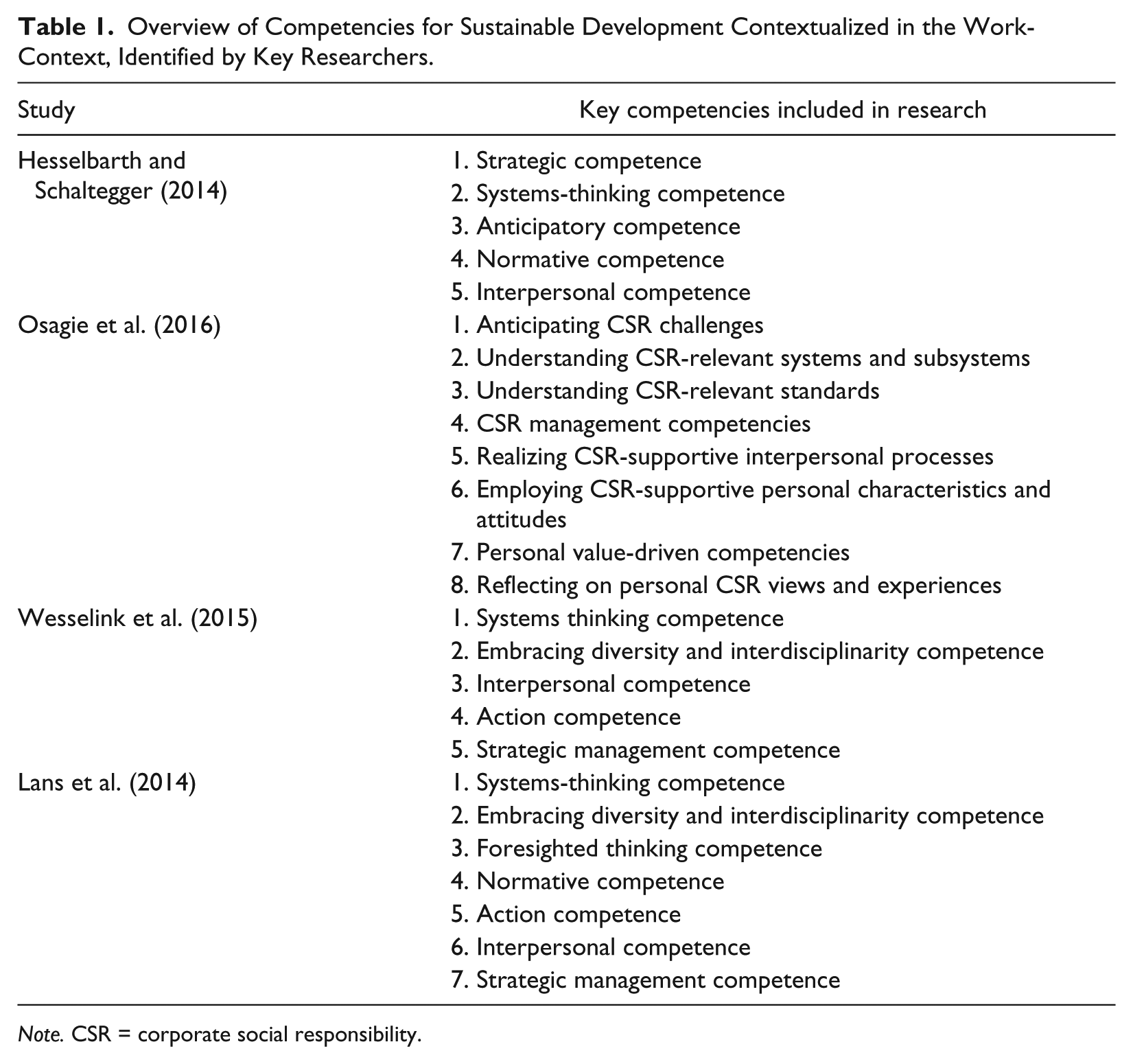
Note. CSR = corporate social responsibility.
Despite the use of some of the same initial competencies, the inclusion of key competencies differs among the different studies. Three competencies are included in all four studies, namely, strategic (management) competence, systems thinking competence, and interpersonal competence. Where Hesselbarth and Schaltegger (2014), Lans et al. (2014), and Osagie et al. (2016) underpin the importance of normative competence, the empirical study performed by Wesselink et al. (2015) did not point in this direction. They argue that this could be a result of either normative competence already being internalized in the behavior of CSR managers, or the structural lack of normative behavior in this specific work/business context (Wesselink et al., 2015). Another competency that has been subject to debate is anticipatory/foresighted thinking competence (both words are used for more or less the same construct). Rieckmann (2012) identifies this as one of the most important competencies, and it is also empirically found in the work of Hesselbarth and Schaltegger (2014), Osagie et al. (2016), and Lans et al. (2014). However, Wesselink et al. (2015) did not include this competency as a key competency. The reason for not including this competency seems to be directly related to the specific CSR context in which they have researched the enactment of the competencies (Wesselink et al., 2015). They argue that in the more mature phases of the CSR implementation process, foresighted thinking is less important than in the starting phases. Their sample consisted of companies in the more mature phases, which could explain the absence of foresighted thinking competence. Also, embracing diversity and interdisciplinarity competence is not supported by all four researchers. Lans et al. (2014) and Wesselink et al. (2015) acknowledge the importance of this competence but it is not included in the studies by Hesselbarth and Schaltegger (2014) and Osagie et al. (2016). The fourth and last competence up for debate is action competence. In the literature this competence is widely considered as one of the most important competencies for sustainable development (Blok, Gremmen, & Wesselink, 2015; de Haan, 2006; Ellis & Weekes, 2008), but in practice this does not always show. Even though Lans et al. (2014) tend to keep action competence included, the results of their exploratory analysis show significant overlap with strategic management competence. Also, Hesselbarth and Schaltegger (2014) and Osagie et al. (2016) encounter difficulties with the concept of action competence. The latter encourage a more practical interpretation of the concept and see it merely as “actively engaging oneself in the process of CSR implementation” (Osagie et al., 2016, p. 17). This calls for a more in depth and empirical analysis of the competencies at stake when dealing with sustainability challenges.
Sustainable Entrepreneurs as Change Agents
An example of a promising work context in which competencies for sustainable development are truly at the forefront, enacted (and also contested), is the field of sustainable entrepreneurship. The emerging stream of academic literature on sustainable entrepreneurship adds a new dimension to the promise of entrepreneurship being an attractive way of generating competitive advantage and resulting in economic gain. Entrepreneurship for sustainable development is supposed to result in more than economic success. Sustainable entrepreneurs try to manage the “triple bottom line” (Patzelt & Shepherd, 2011); in other words, they balance economic health, social equity, and environmental resilience through their entrepreneurial behavior. Sustainable entrepreneurship is not only associated with the promise of more traditional concepts of entrepreneurship but also has additional potential both for society and the environment.
The term sustainable entrepreneurship can be seen as an overarching concept looking at the contribution of entrepreneurs to social, environmental, and economic aspects (Schaltegger & Wagner, 2011). Sustainable entrepreneurs initiate those activities and processes that lead to identifying, evaluating, and exploiting business opportunities to contribute to sustainability and profitability (Patzelt & Shepherd, 2011; Schaltegger & Wagner, 2011). In this respect, sustainable entrepreneurship is seen as a way of generating competitive advantage by recognizing new business opportunities resulting in new products, new methods of production, new markets or new ways of organizing business processes more sustainably (Patzelt & Shepherd, 2011). Thus, the recognition of opportunities can be seen as an important element of (sustainable) entrepreneurship (Gaglio & Katz, 2001; Shane & Venkataraman, 2000). Therefore, sustainability is not only something to act on, comply with, or engage in, but a major source for change and opportunities (Dean & McMullen, 2007).
According to Hesselbarth and Schaltegger (2014), sustainable entrepreneurs act as change agents as they develop sustainability as a factor of success in their working environment, integrate sustainability criteria into business processes, and transfer the vision of sustainable development to society. Nevertheless, becoming a successful sustainable entrepreneur does not happen overnight. The Global Entrepreneurship Monitor defines four entrepreneurial stages: (1) potential entrepreneurs who intend to start a business in the future; (2) nascent entrepreneurs who are involved in setting up a business; (3) new entrepreneurs who have just started a business; and (4) established entrepreneurs who own and manage an established business (Kelley, Bosma, & Amorós, 2011). The role of higher education in this process is widely recognized as education can play a significant role in stimulating and fostering Phases 1 and 2. These individuals who have the intention to become a sustainable entrepreneur are labelled as would-be (sustainable) entrepreneurs (i.e., Baron & Ensley, 2006; Dimov, 2007). Furthermore, competence development usually is strongest in a context in which learning is central, which also emphasizes the role of higher education. In this research, we focus on these would-be sustainable entrepreneurs as they have an important role as future change agents and are in the stage of developing competencies and an entrepreneurial intention.
To bridge the gap between conceptual and empirical research on competencies for sustainable entrepreneurship, Lans et al. (2014) developed a competence framework. This framework is, to the best of our knowledge, the only framework that specifically addresses competencies for sustainable entrepreneurship. The competence framework consists of key competencies from entrepreneurship literature and key competencies from ESD literature, which makes it a unique and innovative overview. The competence framework as proposed by Lans et al. (2014) includes 7 key competencies that are described as follows:
Systems thinking competence: The ability to identify and analyze all relevant (sub)systems across different domains (people, planet, profit) and disciplines, including their boundaries (Wiek et al., 2011).
Embracing diversity and interdisciplinary competence: The ability to structure relationships, spot issues, and recognize the legitimacy of other viewpoints in business decision-making processes; be it about environmental, social, and/or economic issues (de Haan, 2006; Ellis & Weekes, 2008).
Foresighted thinking competence: The ability to collectively analyze, evaluate, and craft “pictures” of the future in which the impact of local and/or short-term decisions on environmental, social, and economic issues is viewed on a global/cosmopolitan scale and in the long term (Wiek et al., 2011).
Normative competence: The ability to map, apply, and reconcile sustainability values, principles, and targets with internal and external stakeholders, without embracing any given norm but based on the good character of the one who is involved in sustainability issues (Blok et al., 2015; Wiek et al., 2011).
Action competence: The ability to actively involve oneself in responsible actions for the improvement of the sustainability of social–ecological systems (de Haan, 2006; Mogensen & Schnack, 2010; Schnack, 1996).
Interpersonal competence: The ability to motivate, enable, and facilitate collaborative and participatory sustainability activities and research (Schlange, 2009; Wiek et al., 2011).
Strategic management competence: The ability to collectively design projects, implement interventions, transitions, and strategies for sustainable development practices (de Haan, 2006; Wiek et al., 2011).
To sum up, several frameworks of competencies for sustainable development exist. A few of these frameworks have been tested and operationalized in a work context. Nevertheless, the descriptions of these frameworks are still too general, and empirical work in this field is often exploratory. Therefore, this study attempts to assess the validity one of those competence frameworks by using confirmatory factor analysis.
Method
A cross-sectional study design was used to evaluate perceived levels of sustainable entrepreneurial competence and levels of entrepreneurial self-efficacy, intention, and general background questions by would-be entrepreneurs.
Setting and Sample
The data for the analysis of the competence framework of sustainable entrepreneurship were gathered at a university of applied sciences in the Netherlands (which can be compared internationally with Technical/vocational and Further Education institutions). This higher education institute is labelled as having a “green” curriculum. All students participating in this research were enrolled in entrepreneurship courses for the duration of 6 months and show the intention to become an entrepreneur (N = 438). The questionnaire was spread among the participants as an integrated part of their 6-month entrepreneurship program. The questionnaires were filled in during class after the students received a short introduction to the research and its intended learning outcomes for the respondents. The participants were asked to create a unique code to ensure the anonymity of the results.
Constructs and Measures
The competence framework developed by Lans et al. (2014) and its accompanying questionnaire was used. They improved the initial framework by organizing focus group discussions with educators in the field before testing the framework among students. As a next step, items for all key competencies were developed. This led to a set of 42 items. Initial face-validity of these items was ensured through discussing all the items with three senior researchers and two master students involved and making changes in the phrasing when necessary. In the next step the items were pretested on understandability and interpretation during a pilot study with students. The data from a sample of 210 students were used to analyze scale development by means of reliability tests (Cronbach’s alphas were all above the threshold of .7). Scale reduction and validation tests were constructed by means of an explorative factor analysis (EFA). The EFA led to the proposition of the final 7-factor competence framework for sustainable entrepreneurship. These considerations make the competency framework for sustainable entrepreneurship developed by Lans et al. (2014) most appropriate to use in this particular study.
The questions used to analyze the integrated competence framework for sustainable entrepreneurship can be labelled as a competence self-report. To measure their competencies, respondents were asked to rate themselves according to their opinion about their performance at that moment for an item, by rating the item on a scale of 1 to 10 (1 = low and 10 = high). Critique on using self-reports or self-assessments as a measurement tool is common and widely used to underevaluate this type of research (Braun, Woodley, Richardson, & Leidner, 2012). Nevertheless, research shows that certain conditions make it possible to measure different kinds of competencies by using self-reports (Braun et al., 2012). To do this, the self-report should first include multiple indicators per competency to address a competency’s full complexity; second, context should be given for the competencies and instruments; and third, the indicators should describe concrete behavior (Braun et al., 2012). The seven competencies for sustainable entrepreneurship and their underlying items (27 in total) fulfil the three requirements mentioned above. The complete questionnaire can be can be acquired by sending a request to the corresponding author.
In order to further validate the competence framework for sustainable entrepreneurship, constructs from the field of entrepreneurship were used to analyze the relationship between the competencies for sustainable entrepreneurship and these commonly used antecedents of entrepreneurial behavior in general. These antecedents are described as entrepreneurial self-efficacy, entrepreneurial intentions, gender, work experience, and entrepreneurial parents. These constructs are not integrated in the competence framework as such, but could be strongly correlated to one or more competencies and therefore endanger the validity of the framework.
First, entrepreneurial self-efficacy (ESE) can be described as an antecedent of entrepreneurial behavior in general. Self-efficacy concerns an individual’s belief in his or her own ability to perform well (Bandura, 1982). More specifically, ESE concerns an individual’s belief in his or her own entrepreneurial competence to explore and exploit new business opportunities. Meta-analyses show that ESE is one of the strongest individual level predictors for entrepreneurial success (Rauch & Frese, 2007). ESE is measured through a six-item measurement scale, based on the validated scale developed by Liñán and Chen (2009).
Second, entrepreneurial intentions are taken into account as an important predictor of entrepreneurial behavior. Entrepreneurship is viewed as a process that occurs over time. In this sense, entrepreneurial intentions would be the first step in the evolving process of new venture creation. The intention to start a business is considered a necessary precursor to performing entrepreneurial behaviors. In addition, intention in general is considered to be the single best predictor of behavior (Ajzen, 2001). Entrepreneurial intention was measured on a 5-point Likert-type scale, with five underlying items.
Third, an important characteristic of entrepreneurial behavior is gender. Even though it is still heavily under discussion in the literature, some researchers argue that women are discriminated against men in various stages of the new venture creation process and face more barriers compared to men: Women tend to have less educational, entrepreneurial, and work experience, which suggests women having lower human capital (Thébaud, 2010). However, evidence has also been found that females have more social capital in the business setting compared to males, as women base their beliefs, rules, and behaviors on mutual trust that is supposed to increase information exchanging (Farr-Wharton & Brunetto, 2009).
Fourth, work experience is also an important factor to take into account. According to Gibb (2002), entrepreneurs of small companies learn from peers, learn by doing, learn from feedback, learn by copying, learn by experiment, learn by problem solving, and learn from mistakes. Having experience positively influences the success of the next entrepreneurial endeavor.
Finally, another individual factor that could explain differences in entrepreneurial behavior is the family background of an individual. The family (business) environment has been associated with the tendency to start a new venture. Evidence has been found that individuals raised in an entrepreneurial family are more likely to be involved in entrepreneurial activities themselves (White, Thornhill, & Hampson, 2007).
Data Analysis
Excluded Cases
The initial data set consisted of 438 responses (N = 438). Based on a missing value analysis, 36 cases were excluded from the data analysis. Cases with more than 10% missing values were excluded; other missing values were replaced with the mean of the other variables. Replacing missing values with the expectation maximization technique is a common procedure to deal with random missing values. Little’s missing completely at random test showed that the missing values appear randomly and that there a no systematic missing values in the database (χ2 = 570.365, df = 619, p = .919). This allows for imputation techniques for the cases which have 10% or less missing values. In total 402 cases were used for the confirmatory factor analysis (CFA; n = 402).
Confirmatory Factor Analysis
To answer Research Question 1, the construct validity of the 27-item competence framework for sustainable entrepreneurship was tested through CFA. CFA is a well-established method for model testing and scale development (Noar, 2003). We tested the seven-factor model and compared it to two competing models, namely, with a one-factor model and with a six-factor model. The latter six-factor model corresponds with the results from the exploratory study by Lans et al. (2014) and is hypothesized to outperform the seven-factor and one-factor models. The data were analyzed by using IBM SPSS AMOS 23 in which CFA can be performed. We used the maximum likelihood robust extraction method as the estimator. This is recommended for nonnormal distributed data. The following indices were used to assess model fit: normed chi-square (χ2/df), root mean square error of approximation, comparative fit index, Tucker–Lewis index, and the goodness of fit index. To test Research Question 2, correlation coefficients between the constructs were calculated by using IBM SPSS Statistics 23.
Results
Results are presented in the following order: descriptive analysis, discriminant and construct validity, and finally, criterion validity.
Descriptive Analysis
In total, 402 cases were included in the analysis. The male–female division within the data set is 47.5% and 52.5%, respectively. Most respondents are, at the moment of participation, enrolled in their second year of education at the participating higher education institute (88.3%). Only a few respondents mention they already own their own company (6.7%) versus the majority (93.7%) who mention they do not have their own company. Nevertheless, 66.6% of the respondents show that they have the intention to become an entrepreneur within the next 5 years (based on a score of 3 or higher, measured on a 5-point Likert-type scale). Regarding having prior working experience, 16.9% of the respondents mention they do not have any prior working experience; the rest have either prior experience as an employee (70.9%), as an owner of a company (4.5%), or both (4.7%). Furthermore, 43.3% indicate having entrepreneurial parents, compared to 54.0% who indicate not having entrepreneurial parents.
Assessment of the Measurement Model
The first step in confirmatory factor analysis is to test the goodness-of-fit indices, the reliability and the validity of the preferred measurement model. Based on theoretical grounds, three measurement models were tested to compare which model fitted the data best. Table 2 suggests that, based on the model fit indices, the six-factor model best fits the data and is therefore chosen to continue the analysis with. This is also in line with the findings from the explorative analysis as performed by Lans et al. (2014).
Model Fit Indices of the Measurement Models.
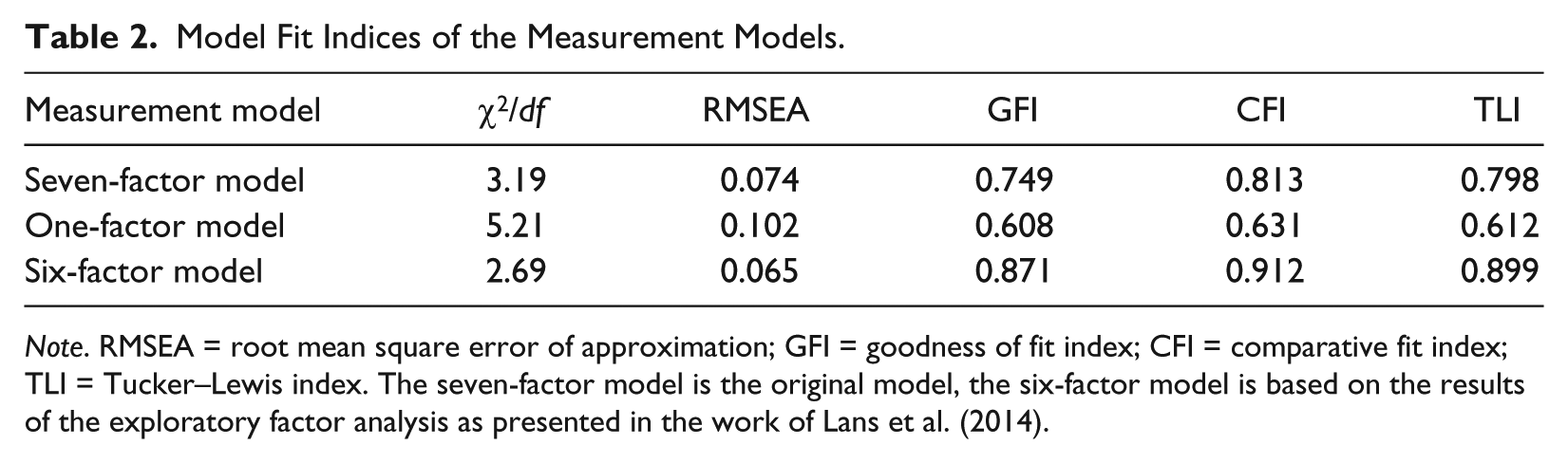
Note. RMSEA = root mean square error of approximation; GFI = goodness of fit index; CFI = comparative fit index; TLI = Tucker–Lewis index. The seven-factor model is the original model, the six-factor model is based on the results of the exploratory factor analysis as presented in the work of Lans et al. (2014).
The preferred measurement model includes 27 items describing six latent constructs: strategic management and action competence (Sm_AC), diversity competence (DC), systems thinking competence (StC), normative competence (NC), foresighted thinking competence (FC), and interpersonal competence (IC). Based on the modification indices, item Normative_c was moved from the latent construct FC to the latent construct NC (which it also initially belonged to), which lowered the chi-square to improve the model. After optimizing the model, the goodness of fit indicators suggest a reasonably good fit of the proposed six-factor model.
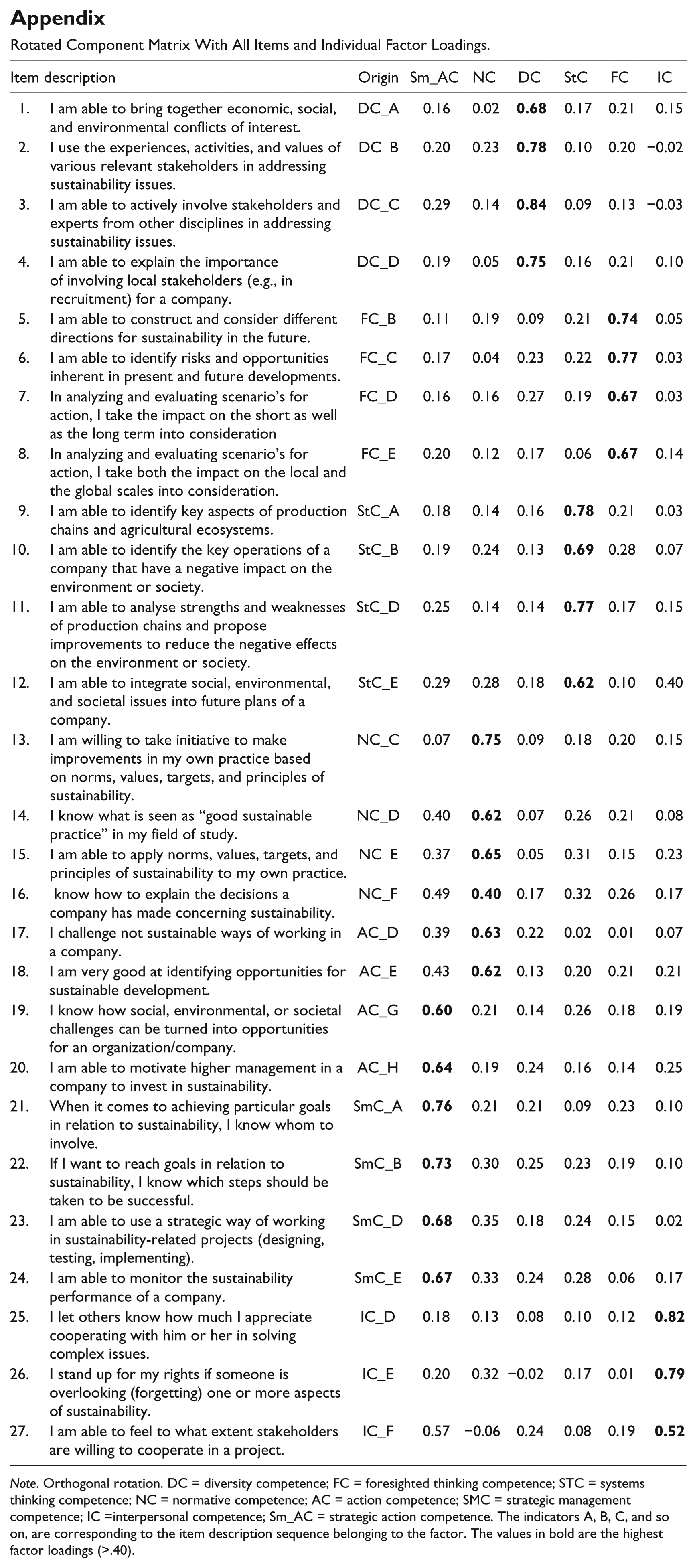
The convergent and discriminant validities of the constructs can be assessed by referring to the measurement model. According to Fornell and Larcker (1981), convergent and discriminant validity are evaluated based on three criteria (1) factor loadings, (2) the scale composite or construct reliability, and (3) the average variance extracted (AVE). The findings showed that all loadings are more than 0.5 (a table with individual factor loadings is added to the appendix). Moreover, all constructs had a construct reliability value, ranging from 0.68 to 0.89, close to or higher than the recommended level of 0.70. With respect to the AVE estimate, the results revealed that the AVE estimate for all constructs is above or close to the recommended threshold of 0.50 (Table 3), except for IC, which is lower with 0.42.
Reliability and Convergent Validity of the Measures.
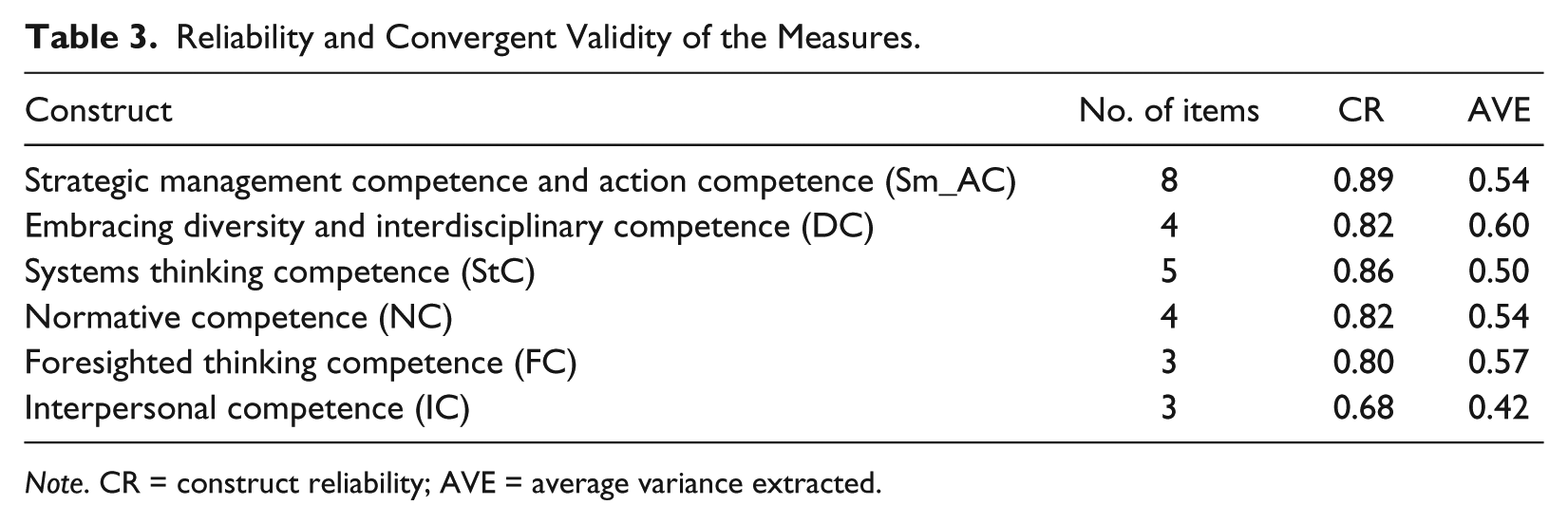
Note. CR = construct reliability; AVE = average variance extracted.
Discriminant validity establishes whether any latent construct (i.e., competence) is different from any other latent construct in the model and was assessed by comparing the interitem correlations between the latent constructs. All latent constructs are assumed to correlate to a certain extent with each other and the maximum threshold of 0.85 is not exceeded. The Fornell–Larcker criterion for discriminant validity assesses whether the square root of AVE is greater than the correlation coefficient of the focal construct with any of the other constructs in the model. Table 4 shows that this is the case. Therefore, the constructs are distinct from each other and their discriminant validity is established. However, the factor IC is only just meeting the criteria, which could lead to problems for the discriminant validity of this particular factor.
Discriminant Validity and Means and Correlations Between Competencies and Important Entrepreneurial Antecedents (N = 403).
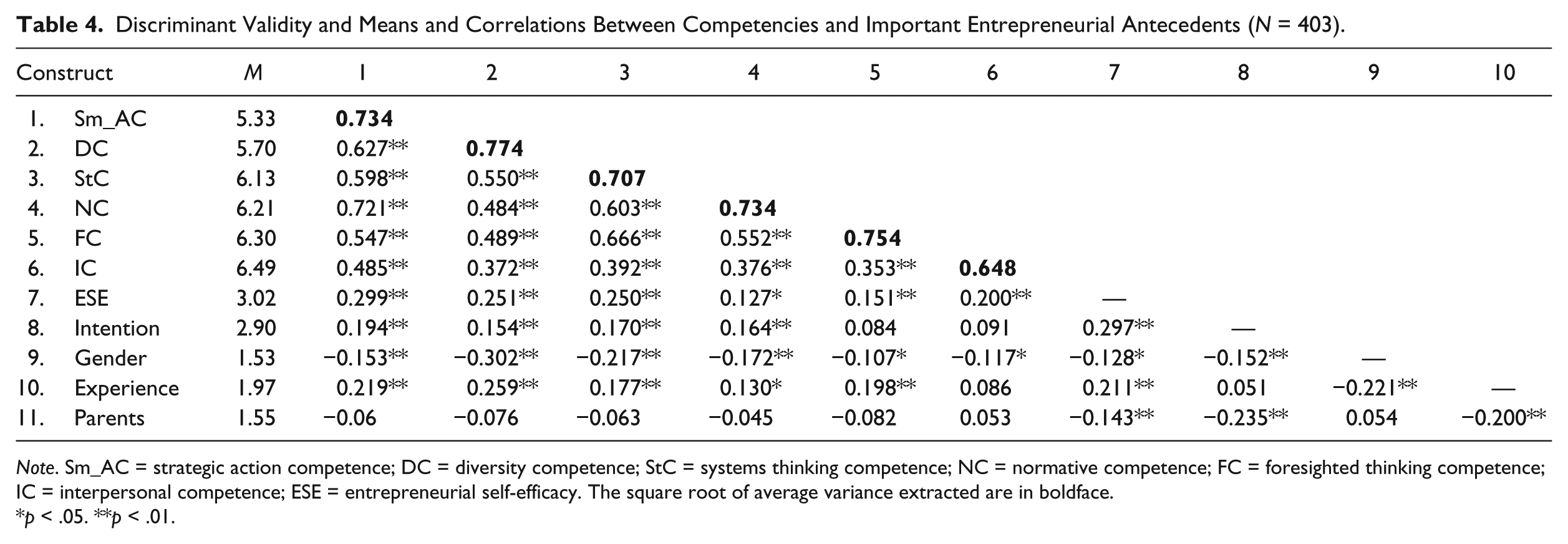
Note. Sm_AC = strategic action competence; DC = diversity competence; StC = systems thinking competence; NC = normative competence; FC = foresighted thinking competence; IC = interpersonal competence; ESE = entrepreneurial self-efficacy. The square root of average variance extracted are in boldface.
p < .05. **p < .01.
Criterion Validity–Related Variables
There is a positive relationship between the six competencies: They all correlate to a medium extent with each other (Table 4). The competencies that correlate the lowest are IC and FC (r = .353, p < .01). The highest correlation exists between the combined competence of strategic management and action and NC (r = .721, p < .01). ESE is positively correlated with all of the six competencies, of which five are at p < .01 significance level and one is at p < .05 significance level. Also, the correlation between ESE and intention is significant and relatively high. When looking at the correlations between the intention to become an entrepreneur and the competencies it becomes clear that only FC and IC do not show significant results. Furthermore, the results suggest that women score themselves significantly lower on all competencies compared to men. Males score themselves a bit higher on DC and systems thinking, and those who already have some work experience as an employee tend to score themselves slightly higher on DC, on the combined Sm_AC and on ESE as well. Students with parents who own a company only scored higher on ESE and have significantly more work experience.
Discussion and Conclusion
The six-factor model structure identified in the EFA (Lans et al., 2014) was confirmed in the CFA with adequate model fit in a new sample of would-be entrepreneurs, thus providing additional evidence for the construct validity of the integrated competence framework for sustainable entrepreneurship. With this, Research Question 1 “What is the empirical strength of the existing key competence frameworks for sustainable entrepreneurship?” is answered; the six competencies can be seen as supporting future change agents in their sustainable entrepreneurial endeavors.
When comparing these results with the work of other key authors in the field, this study underlines the empirical validity of four competencies that are recognized by all key researchers, namely, StC, FC (or anticipatory competence), NC, and IC (de Haan, 2006; Hesselbarth & Schaltegger, 2014; Lans et al., 2014; Osagie et al., 2016; Rieckmann, 2012; Wesselink et al., 2015; Wiek et al., 2011). However, when zooming in on IC and applying a stricter threshold for discriminant validity, it does not seem to have sufficient discriminant validity in our sample. Even though, based on theory, IC is assumed to be discriminant from the other competencies, these results point in the direction that this is not completely the case. The EFA has led to a scale reduction from six items to three and one can wonder whether these three items that belong to the factor IC are defining enough to be discriminant from the others. Another explanation for the weak discriminant validity of this factor could be that IC is the only competence that is the least specific for sustainable entrepreneurship and operates on a more general level. Furthermore, the correlation structures between the six competencies reveal possible clusters among the competencies. First, the merge of strategic management competence and action competence is discussed. This is followed by an analysis of the underlying relations between the competencies and explore whether a distinction based on the clusters can be made.
To start, as Lans et al. (2014) state in their conclusion,
From a practical point of view this [e.g., the merge of both competencies] makes sense since both competencies represent the actual pursuit of a sustainability opportunity and the turning of it into a concrete project; both require active involvement of the individual. (p. 45)
Nevertheless, Lans et al. (2014) were, based on their exploratory research, reluctant to merge these two competencies into one. As our six-factor measurement model also shows a better model fit when both competencies are taken together, we propose to combine both competencies and in the future refer to them as one. This synthesis of one Sm_AC can further strengthen the debate on the importance of action competence and the additional role of strategic management.
Action competence has received increased attention in the domain of higher ESD (Blok et al., 2015; Ellis & Weekes, 2008; Jensen & Schnack, 2006; Mogensen & Schnack, 2010). Action competence has been defined as the ability to actively involve oneself in responsible actions to improve the sustainability of social–ecological systems in general and products, processes and procedures in particular (de Haan, 2006). Jensen and Schnack (2006) distinguish four components of action competence: knowledge and insight concerns knowledge about the problem of sustainable development and the ability to think critically about its possible solutions; commitment relates to the motivation and drive to engage oneself in the solution of sustainability problems; visions concerns the ability to conceptualize the future state of the world; and action experiences stresses the importance of actual involvement in concrete sustainable actions.
Nevertheless, the initial operationalization of action competence in this study focusses primarily on the motivational aspects and ability to recognize opportunities, but does not address the knowledge and more strategic aspects of action competence as described by Jensen and Schnack (2006). However, within the initial strategic management competence the actual involvement in sustainable actions and critical thinking are at the forefront, which are also important elements of action competence. In addition, when comparing the field of sustainable entrepreneurship to the general field of sustainable development, strategic thinking and planning and actively involving oneself in sustainable action might be even more prominent and more interwoven as entrepreneurship unmistakably is associated with turning ideas into actions. Therefore, the entrepreneurial context could be one of the reasons for the strong relation between strategic management and action competence. Whether this also holds for the field of sustainable development in general can be disputed. At least we can argue that when dealing with action competence in a work context such as sustainable entrepreneurship, strategic management should be incorporated in the operationalization of action competence and should be referred to as strategic action competence (Sm_AC).
Second, as all competencies correlate to a medium extent with each other in general and each competence seems to correlate high with at least one of the other competencies, it is likely that these high correlating competencies share some kind of overlapping orientation. Analyzing these clusters of competencies and linking them to a general orientation of the competencies, could help in further analyzing and understanding the underlying relations between the competencies. Based on the (inter-) correlations between the competencies, as well as the content of these competencies and their underlying items, a subdivision between the competencies can be made.
Distinctions based on the orientation of competencies have been made by other researchers as well (e.g., Hesselbarth & Schaltegger, 2014; Wals, 2015). Hesselbarth and Schaltegger (2014) make a general distinction based on methodological competencies, social competencies, and personal competencies. Wals (2015) refers to four dimensions of sustainability competence, namely, a conceptual and systemic knowledge dimension, a critical thinking dimension, a change and innovation dimension, and an ethical dimension. These four dimensions are taken into account in analyzing the relations between the competencies. Looking at the correlations between the competencies and taking into account the content of the competencies as well, it becomes clear that foresighted thinking and StC seem to cluster together. These two competencies both deal with learning to know how to deal with sustainability, which could be referred to as the conceptual and systemic knowledge dimension. Also strategic action and NC correlate high with each other and could be clustered in an ethical dimension, as both competencies are value oriented, normative, and deal with learning to be, learning to care. Another dimension could be constituted by clustering DC and Sm_AC; both competencies deal with learning to critique. From the four dimensions by Wals (2015), this is best explained by the critical thinking dimension. Where the previous three dimensions are also empirically sound, the last cluster of competencies, consisting of IC and DC, is only based on overlapping content based on the interpretation of the items belonging to the competencies. These two competencies share a mutual goal of learning to make change happen, which could be explained by the change and innovation dimension. It appears that the four dimensions of sustainability competence could be applied to the six competencies for sustainable entrepreneurship. In other words, these four, more general, dimensions support sustainable entrepreneurs as change agents for sustainable development.
In addition, to answer Research Question 2 and further validate the framework, the relation between the competencies and general antecedents of entrepreneurial behavior (ESE, gender, experience, and entrepreneurial parents) was analyzed. Overall, the antecedents did not correlate too high or low with the competencies for sustainable entrepreneurship. However, there were some differences between the different antecedents and their relation to the competencies. In-line with the expectations, ESE correlates positively with all competencies (Delamare Le Deist & Winterton, 2005). Future research should focus on the relation between ESE and the competencies for sustainable entrepreneurship as ESE could be an important influence on these competencies and could define the boundaries of the sustainable entrepreneurial spectrum. Also, the relation between the competencies and ESE with entrepreneurial outputs is an interesting field of future research as they can be seen as possible predictors of entrepreneurial success (Rauch & Frese, 2007).
As intention is perceived as one of the most influential antecedent of entrepreneurial behavior, one would expect that intention would have a significant correlation with all competencies. Nevertheless, it does not significantly correlate with FC and IC. It could be that these two competencies show less overlap with entrepreneurial characteristics and therefore do not relate with entrepreneurial intention. The relation between entrepreneurial intentions, competencies for sustainable entrepreneurship, and entrepreneurial behavior could be an interesting topic for future research.
Furthermore, gender is a broadly discussed concept in entrepreneurship literature; the results in this study are more in line with literature that states that women have lower human capital and therefore perceive themselves as less competent when it comes to entrepreneurial behavior (Thébaud, 2010). Female respondents score themselves significantly lower than male respondents on all competencies and also on ESE. Even on the competencies that are more related with social capital, such as IC and NC, females score themselves lower than their male counterparts. This is somewhat unexpected, as literature states that women generally score higher on these type of constructs (Farr-Wharton & Brunetto, 2009). Whether these results also hold for actual sustainable entrepreneurial behavior is beyond the scope of this research, as we focused on self-perceived scores on the competence framework.
Next, having prior experience seems to have a positive influence on the scores on the competencies, this is also in-line with the expectations and therefore can positively influence the level of sustainable entrepreneurial competence of would-be entrepreneurs. Having entrepreneurial parents is positively associated with involvement in entrepreneurial activities (Lans, Blok, & Gulikers, 2015; White et al., 2007), but in this sample the relation between the competencies and having entrepreneurial parents is not significant. Only with ESE and experience there is a positive relation with having entrepreneurial parents. Establishing relations between general entrepreneurial antecedents like gender, experience, and entrepreneurial parents, and the six competencies for sustainable entrepreneurship remains difficult. This could be due to the fact that in this research the role of the sustainability part of sustainable entrepreneurship is emphasized and the antecedents more with the entrepreneurship part. Nevertheless, the relation with ESE and the competencies for sustainable entrepreneurship could be further analyzed to better grasp the influence of ESE on these competencies.
Although the results of the study are promising, the data on the sustainable entrepreneurship framework were only collected among would-be entrepreneurs, that is, students with the intention to become a (sustainable) entrepreneur and at only one higher education institute. Whether nascent or established sustainable entrepreneurs also recognize themselves in these competencies was beyond the scope of this research. Future research could focus on nascent or established sustainable entrepreneurs and test the framework in this context to examine whether the framework for sustainable entrepreneurship could also be supporting for these entrepreneurs. This would also create the possibility of exploring the boundaries of sustainable entrepreneurship (e.g., NC and ESE/action competence) more carefully and to address the predictive validity of the model. Although our model does seem to be robust enough to pass basic criteria for convergent and discriminant validity, the threshold values also suggest that these result have to be interpreted with care.
Another methodological limitation is related to the use of the Fornell–Larcker criterion for assessing the discriminant validity. The downsides of the measure are the overestimation of the indicator loadings and the indicator variance being included in the composite score (Henseler, Ringle, & Sarstedt, 2014). Nevertheless, the Fornell–Larcker criterion and assessing the cross loadings are still the most dominant approaches for analyzing discriminant validity (Henseler et al., 2014). Furthermore, in this study, antecedents of entrepreneurial behavior, such as ESE, were only measured by contextualizing them in an entrepreneurial context, not in a sustainable entrepreneurial context. Related to this, future research should focus on also including outcome variables. Combining the six-factor competence framework with more tangible performance indicators, for instance, related to the moral decision-making process or entrepreneurial outcomes (i.e., success, opportunity recognition), could lead to useful information about how these competencies are used in practice and what are more or less important competencies in different phases of the entrepreneurial process.
The results of this study are not only relevant and important for practitioners in the field of higher education but also for start-up companies or entrepreneurs that are involved in tackling the sustainability challenges that we currently face. In a world in which global climate disruption, ever-increasing population and massive extinctions of biodiversity are recognized and acknowledged, there is a need for individuals who are able to deal with these challenges. Competencies can be viewed as a catalyst for creating a more critical, innovative, and reflexive culture that frequently questions its own routines, assumptions, and guiding principles. Knowing which kind of competencies enable future change agents to deal with these complex problems helps higher education institutes to adjust and reframe their education program accordingly.
To conclude, the results of the CFA confirm the convergent, discriminant, and construct validity of the six-factor competence framework for sustainable entrepreneurs. These competencies, which can be described by four dimensions, support future change agents in their sustainable entrepreneurial endeavors. Furthermore, action competence was redefined by including elements of strategic management and was renamed as strategic action competence. Altogether, at this point, the six-factor competence framework provides researchers as well as teachers and practitioners with stepping stones for further enhancing sustainable entrepreneurship.
Footnotes
Appendix
Rotated Component Matrix With All Items and Individual Factor Loadings.
| Item description | Origin | Sm_AC | NC | DC | StC | FC | IC |
|---|---|---|---|---|---|---|---|
| 1. I am able to bring together economic, social, and environmental conflicts of interest. | DC_A | 0.16 | 0.02 |
|
0.17 | 0.21 | 0.15 |
| 2. I use the experiences, activities, and values of various relevant stakeholders in addressing sustainability issues. | DC_B | 0.20 | 0.23 |
|
0.10 | 0.20 | −0.02 |
| 3. I am able to actively involve stakeholders and experts from other disciplines in addressing sustainability issues. | DC_C | 0.29 | 0.14 |
|
0.09 | 0.13 | −0.03 |
| 4. I am able to explain the importance of involving local stakeholders (e.g., in recruitment) for a company. | DC_D | 0.19 | 0.05 |
|
0.16 | 0.21 | 0.10 |
| 5. I am able to construct and consider different directions for sustainability in the future. | FC_B | 0.11 | 0.19 | 0.09 | 0.21 |
|
0.05 |
| 6. I am able to identify risks and opportunities inherent in present and future developments. | FC_C | 0.17 | 0.04 | 0.23 | 0.22 |
|
0.03 |
| 7. In analyzing and evaluating scenario’s for action, I take the impact on the short as well as the long term into consideration | FC_D | 0.16 | 0.16 | 0.27 | 0.19 |
|
0.03 |
| 8. In analyzing and evaluating scenario’s for action, I take both the impact on the local and the global scales into consideration. | FC_E | 0.20 | 0.12 | 0.17 | 0.06 |
|
0.14 |
| 9. I am able to identify key aspects of production chains and agricultural ecosystems. | StC_A | 0.18 | 0.14 | 0.16 |
|
0.21 | 0.03 |
| 10. I am able to identify the key operations of a company that have a negative impact on the environment or society. | StC_B | 0.19 | 0.24 | 0.13 |
|
0.28 | 0.07 |
| 11. I am able to analyse strengths and weaknesses of production chains and propose improvements to reduce the negative effects on the environment or society. | StC_D | 0.25 | 0.14 | 0.14 |
|
0.17 | 0.15 |
| 12. I am able to integrate social, environmental, and societal issues into future plans of a company. | StC_E | 0.29 | 0.28 | 0.18 |
|
0.10 | 0.40 |
| 13. I am willing to take initiative to make improvements in my own practice based on norms, values, targets, and principles of sustainability. | NC_C | 0.07 |
|
0.09 | 0.18 | 0.20 | 0.15 |
| 14. I know what is seen as “good sustainable practice” in my field of study. | NC_D | 0.40 |
|
0.07 | 0.26 | 0.21 | 0.08 |
| 15. I am able to apply norms, values, targets, and principles of sustainability to my own practice. | NC_E | 0.37 |
|
0.05 | 0.31 | 0.15 | 0.23 |
| 16. know how to explain the decisions a company has made concerning sustainability. | NC_F | 0.49 |
|
0.17 | 0.32 | 0.26 | 0.17 |
| 17. I challenge not sustainable ways of working in a company. | AC_D | 0.39 |
|
0.22 | 0.02 | 0.01 | 0.07 |
| 18. I am very good at identifying opportunities for sustainable development. | AC_E | 0.43 |
|
0.13 | 0.20 | 0.21 | 0.21 |
| 19. I know how social, environmental, or societal challenges can be turned into opportunities for an organization/company. | AC_G |
|
0.21 | 0.14 | 0.26 | 0.18 | 0.19 |
| 20. I am able to motivate higher management in a company to invest in sustainability. | AC_H |
|
0.19 | 0.24 | 0.16 | 0.14 | 0.25 |
| 21. When it comes to achieving particular goals in relation to sustainability, I know whom to involve. | SmC_A |
|
0.21 | 0.21 | 0.09 | 0.23 | 0.10 |
| 22. If I want to reach goals in relation to sustainability, I know which steps should be taken to be successful. | SmC_B |
|
0.30 | 0.25 | 0.23 | 0.19 | 0.10 |
| 23. I am able to use a strategic way of working in sustainability-related projects (designing, testing, implementing). | SmC_D |
|
0.35 | 0.18 | 0.24 | 0.15 | 0.02 |
| 24. I am able to monitor the sustainability performance of a company. | SmC_E |
|
0.33 | 0.24 | 0.28 | 0.06 | 0.17 |
| 25. I let others know how much I appreciate cooperating with him or her in solving complex issues. | IC_D | 0.18 | 0.13 | 0.08 | 0.10 | 0.12 |
|
| 26. I stand up for my rights if someone is overlooking (forgetting) one or more aspects of sustainability. | IC_E | 0.20 | 0.32 | −0.02 | 0.17 | 0.01 |
|
| 27. I am able to feel to what extent stakeholders are willing to cooperate in a project. | IC_F | 0.57 | −0.06 | 0.24 | 0.08 | 0.19 |
|
Note. Orthogonal rotation. DC = diversity competence; FC = foresighted thinking competence; STC = systems thinking competence; NC = normative competence; AC = action competence; SMC = strategic management competence; IC =interpersonal competence; Sm_AC = strategic action competence. The indicators A, B, C, and so on, are corresponding to the item description sequence belonging to the factor. The values in bold are the highest factor loadings (>.40).
Declaration of Conflicting Interests
The author(s) declared no potential conflicts of interest with respect to the research, authorship, and/or publication of this article.
Funding
The author(s) received no financial support for the research, authorship, and/or publication of this article.
Author Biographies
 for more information about his current research.