




Abstract
Collaboration across hospital-primary-community healthcare continuum is crucial to ensuring secure medication management at home, particularly among elderly persons. The study aim was to describe older adult’s experiences of medication assessment using Safe Medication Assessment (SMA) in connection to home visits. A study was conducted, with data from 44 participants analyzed through qualitative content analysis (semi-structured interviews) at baseline, 1-month, and 3-month follow-ups based on SMA’s 20 items. The results include 1 theme “Personcentredness due to medication management,” and 2 categories, “Systematic approach towards safe medication at home” and “Taking control over prescribed drugs.” SMA ensures a systematic work approach during home visits conducted by mobile team units, working in partnership with all involved parties (elderly, care providers, relatives) improving safe medication management at home.
Keywords
Background
A university hospital in Western part of Sweden started in year 2016 a mobile team included a registered nurse, and physician performed home visits, to connect specialist hospital care to primary and community care toward continuity and healthcare at home. The aim was to improve health and well-being, especially among older adults, toward patient safety without use of hospital care. By increased collaboration among care providers, the issue was to create continuing caring and treatment activities such as drugs and rehabilitation at home.
People in Sweden living longer, 84 years for women and 81 years for men, that places demand on healthcare with increases need for elderly care. Swedish healthcare are decentralized and tax-funded with responsibility to regional councils regulated by Health and Medical Service Act 1 providing health and medical care for the entire population. Sweden have 3 levels of care, specialized healthcare (hospital) offer advanced treatments and interventions, one example is Sahlgrenska University Hospital, in Western part of Sweden, have approximately 25 special healthcare areas, and offer education and research in collaboration with University of Gothenburg. 2 Next level, basic healthcare generally referred as primary care and includes medical practitioners, specialist nurses, physiotherapists, and occupational therapists offering general care and treatment of conditions and illnesses. 3 Moreover, elderly care is governed by Social Service Act supporting independent lives in private homes as long as possible to cope with demands of everyday life around the clock. 4 Mobile teams is another option offering healthcare to persons at home to avoid hospital care. In Sweden mobile teams is a complement normally connected to emergency or geriatric clinics, in collaboration without organizations boundaries grounded in person’s needs and situation. 5
Medication compliance, a term that refers to degree/extent of conformity to recommendations of treatment due to timing, dosage, and frequency, that is, how patient’s acts in accordance with prescription. Medication persistence refers to continuing treatment due to prescription, that is, duration of time of therapy. Adoption of a consistent definitions for compliance and persistence, is useful to express and explain patients’ drug dosing, especially when different care providers is involved. 6 Moreover, Safe Medication Assessment (SMA), is a systematic protocol for assessment, activities, and communication, toward safety medication at home. 7 Research 8 in primary healthcare showed that SMA was simple, relevant, complete, and understandable tool following up older adults drug treatment. However, medication assessment need to be grounded in persons need, for example some want detail information about their medications, but another already know regarding earlier experiences or do not need to know everything. 9 Therefore, conducting home visits performing medication assessment is crucial when prescriptions is changed, especially due to change of drug name, to avoid unsafe medication management such as double dose, unclear medications (newly prescribed, expired) could be messed up in different places at home, etc. 10 Therefore, medication assessment at home asking patient to show their medications together with a list of prescribed medication support safe medication management. 9 In addition, transfer of information among involved actors (patients, staff) reduce misunderstandings, however medication report do not increase correct medication management 10 and why follow-up (home visits, telephone) at home is recommended to reduce acute medication problems.11,12
Globally, polypharmacy (>5 medications), especially among older adults, is a problem among those living in private home.13,14 Unsafe medication is often connected to limited knowledge of prescribed medications, poor information transfer, and/or trust regarding correct prescribed treatment. Around 20% of person’s over age of 80 followed prescription completely, however 40% had poor compliance with at least 1 of 7 prescribed medications, often asthma medication. 9 Therefore, it is important to ensure updated, and easy understandable medication list with clear prescriptions of each medication prescription in connection to all visits to healthcare to ensure safe medication management. 15 Geriatricians, is stressed to be good at continuity according to medication, including different option using a common approach to manage lack of time as well as limited routines and methods regarding medication management. 16 Moreover, lack of channels to transfer information cause communication problems among care providers. 17 One reason could be today’s short treatment regarding discharges with poor continuity and cooperation among care providers, which negatively influence safe medication management, for example lack of information transfer influence patient’s uncertainty regarding medication management. 16 Research show difficulties in information transfer regarding prompt discharges among older adults with limited cognition, which cause uncertainty regarding medication at home. What was easy to manage in hospital or health center looks different in private home environment; patient believes to manage their medications, but it turns out not to be the case. 18 Advantage of home visits is that patient’s calmly can demonstrate how they proceed their routines and what kind of system they for store and manage drugs. Thereafter health professionals could support how medication management can be simplified due to individual specific situation at home.15,19 Research 18 showed that 93%, who manage their medications by themselves, were positive to receive support regarding medication management. Another study 11 point out that two home visits from a pharmacist improved health, as well as reduced medication profit by increased knowledge and understanding of individuals medications. In addition, lack of compliance occurred due to interaction among prescribed medications, why side effects occurred without difference regarding economical perspectives or housing situation among consumers.13,20 To our knowledge, there are limited knowledge regarding use of systematic approach such as SMA toward safeguarding medication management for older adults at home. Therefore, the aim of the study was to describe older adult’s experiences of medication assessment using Safe Medication Assessment (SMA) in connection to home visits.
Methods
Settings
The university hospital in Western part of Sweden have approximately 17,000 employees who are divided into 120 departments located at four different hospitals. The hospital where the study was conducted includes emergency department, intensive care unit (ICU), operating theatre, wards as well as different care units for day care. Patients suffering from ill-health and depended on the health situation, different pathways were used such as wards and/or transfer to other care providers as primary- or community care. The mobile care units connected to the hospital conduct, among other things, drug utilization reviews for older adults who had been in contact with the hospital as former inpatients or day care visits.2,5
Design
A study using qualitative content analysis 21 was used to analyze data collected by semi-structural interviewed (baseline, 1 month, 3 month) guided by SMA-protocol7,8 20 items.
One registered nurse at one mobile care units in Western part of Sweden collected data used SMA-protocol for drug reviews among older adults (+65 years) living in their private homes. Four out of 20 items focus prescription, routes of administration, potency, dosage, and if assisting in dispensing medications was used. Rest 16 items cover medication safety as report/showing prescribed medications, clarify of medication, and cognitive ability/memory problems.
Data Collection
A strategic sample was used, a visiting registered nurse from a mobile team unit conducting drugs reviews (semi-structured interviews) with older adults described their experience of medication management in line with SMA.7,8 The inclusion criteria for participation were former patients (hospital stay, day care) over age 65 years with ability to understand and speak Swedish who lived in private home who got home visit from mobile care team connected to one university hospital in Western part of Sweden. Exclusion criteria was adult younger than 65 years, and persons who lived in nursing home. First 18 persons who were asked to participate in the study (February-April 2023) were included (10 = former inpatients, 5 = who used emergency department, 2 = who used day care unit, 1 = who used ambulance transport). During first home visit (baseline), participants received oral and written information regarding aim, method, and forthcoming results as well as inquiry regarding confidentiality and voluntary participation by the visiting nurse (baseline).22,23 Before follow-up visits (1, 3 months), same nurse called (1-3 days before planned follow-up) participants to ensure that they still would like to participate. Written informed consent was collected before all data collections in line with Declaration of Helsinki 23 safeguarding voluntarily participation without harm. Five out of 18 (baseline) dropped out during follow-ups (1 + 3 month), therefore data collection resulted in 44 interviews (18 + 13 + 13) collected and conducted in Swedish in February to August 2023. The interviewer (CS) asked participants to show his/her specific medications and describe them according to name, dose, number of drugs, treatment, ordination, methods to remember medications, and if support by relative/health professional. Based on participants answers, related questions were asked regarding medication management, including nurse assessment of participants cognitive impairment, swallowing difficulties, and/or language difficulties. All 44 interviews (18 + 13 + 13) were performed individually and recorded (20-40 minutes) by the same interviewer (CS), thereafter were data transcribed verbatim, and assigned with a number due to confidentiality during data analysis. Participants (n = 18/13) ages was between 65 and 101 (mean = 82/84 year) with variation of number of drugs (3-12, mean = 8 drugs).
Data Analysis
Qualitative content analysis24,25 was used to develop trustworthy, credibility, dependability, and transferability. The qualitative data were collected through semi-structural interviews conducted by visiting nurse (CS) asking participants to describe their medication management based on SMA-items. The interviewer (nurse) and a senior researcher performed data analysis, without personal relationship to participants (preunderstanding due to trustworthiness), using qualitative content analysis,24,25 first individually and then together until agreement was found. Interviews (narratives) were analyzed by following steps: (1) The written words were read and re-read to obtain an understanding of and familiarity with the text regarding SMA as describe by participants; (2) Meaning units (words, sentences or paragraphs) corresponding to content areas (older adults experiences of medication management) as; (a) limited understanding of prescribed medications and (b) limited shared decision-making regarding prescribed medication; (3) Each meaning unit was condensed into a description of risk-/protective factors regarding medication management at home; and (4) content identified and clustered; Nursing intervention toward safe medication management followed by two subcategories, and illustrated with quotes without identifications.
Ethical Considerations
Ethical approval for the study were obtained from managers of included department. Swedish regulations1,22 do not mandate ethical approval when health professionals conducting quality improvement with no harm due to safety medication management. However, respect for individual participants was a main concern throughout the study in accordance with Declaration of Helsinki. 23 All participants who attendant to medication assessment during home visit were informed about the aim of the study and that their participation was voluntary (baseline, follow-up 1 and 3 months), thereafter written informed consent was collected. 23 To ensure confidentiality, respect for participants’ integrity and autonomy avoiding harm are shown as following; no names are used in quotes, and results are presented at group level through categories.
Results
The results includes 1 theme “Personcentredness due to medication management,” and two categories, “Systematic approach towards safe medication at home” and “Taking control over prescribed drugs” (Figure 1).
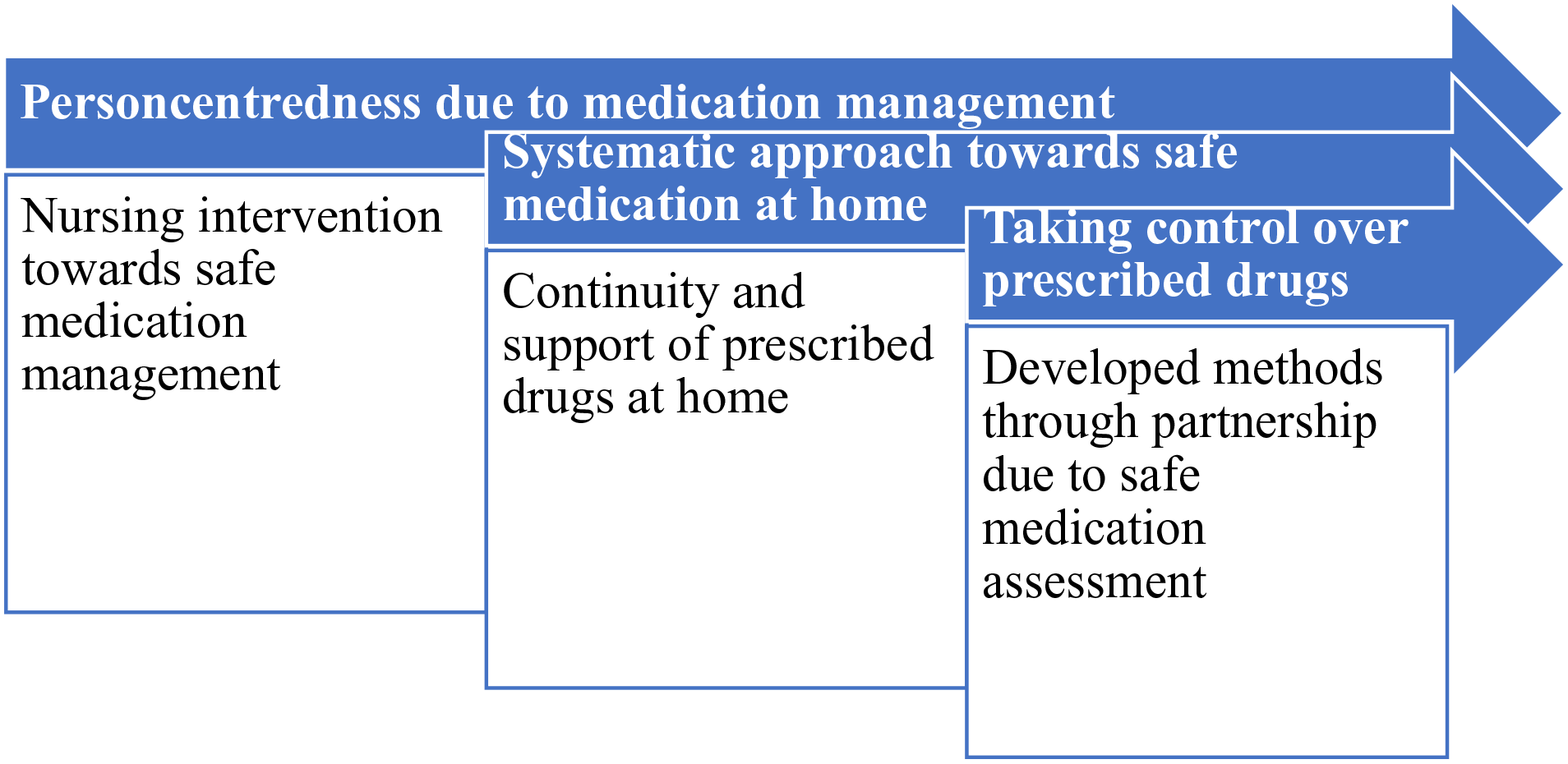
Presentation of the results.
Personcenteredness Due to Medication Management
The theme, personcenteredness due to medication management, is grounded due to nursing intervention toward safe medication management in partnership with all involved in private home.
Systematic approach toward safe medication at home
The category “Systematic approach towards safe medication at home” includes content as continuity and support of prescribed drugs at home. Home visits conducted by a nurse was stressed as facilitator that safeguard participants use of prescribed medications grounded in increased information and education regarding treatment of ill-health as well as coordination and arranging new visit to prescribers/physicians in charge of participants treatment. Participants highlight the significant of continuity knowing who (care providers) engages in the care chain. Moreover, they also point out that visits from the same staff members (nurse) affect their security being home despite of illness, struggle with re-named drug, prescribed unknown medication, limited information transfer, and collaboration among care providers. Moreover, understanding of prescribed medications varied from time to time due to health status and unfamiliar drugs, especially in beginning of a new treatment or illness, why they stress need for support at home to safeguard medication management. An 80-year-old man expresses difficulties as: I do not feel comfortable with all those strange names that different drugs use.
Moreover, participants highlight limited information transfer of prescribed medication, especially though knowledge and background regarding ill-health varies during treatment, for example when they need acute healthcare as well as are chronical ill with serious need for medication due to day-to day living activities at home. Unknowing what and why medication is used is frustrating and feeling of unsecure appears, therefore participants search for information inside or outside the hospital. An 87-year-old man says: I do not know why I take it, I just read the packaging.
Another task, stressed by the participants, is when treatment is changed and re-changed which cause difficulties, one 83-year-old lady explain her changed cortisone dose like this: . . .it has been a bit up and down after I took the high dose. Now taking 7.5 mg, but it did not work so they increased it to 10 mg again. . .
Additional things regarding limited information transfer, highlighted by the participants, is complicated medication management such as administrations more than 3 times per day and more than 12 doses, or cyclical treatments, and why support is stressed to avoid misunderstandings. In addition, misunderstanding could also be grounded in memory problems, with negative influences on medication management and health. A 70-year-old woman says: . . .sometimes I forget, then I take the weekly tablet on another day
Therefore, nursing inventions such as support to decrease difficulties with medication management at home are stressed to increase their possibilities of problem-solving feel secured at home. Participants describe that home visits are one way to decrease uncertainty being home with different kind of drug prescribed. However, they highlight improved collaboration and support by health professionals as well as relatives to safeguarding medication management at home. A man in his 80s says that support by more than one staff member offer broader perspectives.
Taking control over prescribed drugs
The category “Taking control over prescribed drugs” includes following content; side effects, developed methods, and partnership. By using mobile team units performing home visit after hospital stay, nurse’s and physicians could continue treatment started at hospital conducting personcenteredness to evaluate specific needs of each person due to ill-health. A person-centered ethical approach, grounded in interactions among involved actors, were described by participants, a useful part in deciding and planning medication management by providing room for influence in their own treatment due to effects of different drugs. Participants experience limited amount of side effects, however those who suffer from side effects elaborate with their prescribed dose developing individual strategies for health and well-being despite treatment with drugs.
Participants daily routines were depended on their health status of the day, describing healthy days as well as days with limited health status which negatively affect their medication management, for example delayed or forgotten intact of some drug. Other findings showed that agreement before admission (hospital) could be changed though it is hard to plan for recovery after admission, needs and wishes could change. One example was that participant’s daughter support were not needed though he recovered faster than planned and therefore manage his medications by himself. Participants points out that this kind of flexibility were managed during home visits, visiting nurse helped with contacts to make sure that non-needed visits/support was canceled, participants were in charge taking control over their medication management.
Moreover, participants develop own methods to remember their medications by using different skills, to be in control of prescribed drugs. A 101-year-old woman, completely blind, tells us that her daughter comes three times a week to distribute her doses, then she manages her daily medication by herself.
I can feel the tablets with my fingers, there is one round and one oblong.
Another example of taking control of prescribed drugs is stressed by a 93-year-old man who describe his methods as: . . .dose in doses every Monday and then I follow that list.
In addition, participants stress that they experienced side-effects as nausea, diarrhoea, dizziness, and dry mouth. Therefore, they conduct different procedures to take control over these side effects, a 70-year-old woman thought that her easily bleeding appeared from a specific prescribed medication (Eliquis) why she had changed her dose as well as sensor in her blood sugar meter to be sure that everything was ok: I only take it once a day because it is too much, though I get skin bleeding.
Same participants also chose to remove her newly inserted antihypertensive drug because she felt dizzy and was staggering: I do not want to use so much blood pressure medication.
Another participant, who had been introduced to Repaglinide, argued that his diarrhoea was a side effect after reading the leaflet of his new medication. To be able to control his medication, he stopped his medication, to feel healthy again without support from his prescriber. Moreover, an 83-year-old woman reported that she did not want to take one of her prescribed medications (Oxycontin) when she was treated in a hospital ward because she felt unhealthy using that specific drug. This were express as: I have not denied treatment, but I do not feel good taking that specific drug.
In time for discharge, she asked her physician to prescribe painkiller related pain getting out of bed. According to participants earlier refused medication during hospital treatment, the prescribed did not prescribe any pain killer to her. The participant argued that her earlier lack of compliance (hospital) negatively influenced her health. Lack of partnership regarding earlier suggested and prescribed medication, negatively influenced wellbeing due to denied drugs, painkiller. Participant’s stress that lack of control of medication delayed rehabilitation due to pain when physical activities were performed.
Discussion
The aim, to describe older adult’s experiences of the medication assessment using Safe Medication Assessment (SMA), could be viewed as achieved. In the light of registered nurse’s high workload,26-27 they need to prioritize issues or task due to high quality of care, such as secured medication management, and at the same time facilitate healthy working environment. 28 By focusing on risk factors as polypharmacy, different prescribers, complexity of medication management, deliberately of doses than prescribed and side effects, registered nurses could safeguard medication management without increasing nurse’s workload. By medication assessment using SMA, risk factors could be visual, especially among older adults with reduced cognitive ability/memory problems in combination with prompt discharges from hospitals stay. Medication management is running different in hospital environment compared to private home. 18 Therefore, continuing treatment within the care chain is significant to secured medication management after discharge from hospital. For example, duration of time of therapy could be tricky to manage, why available tools as container or dose dispenser are crucial to support secured medication management. To prepare for security, information transfer is essential among involved care providers (hospital, primary care, home healthcare). Nursing intervention grounded in SMA offer a systematic and structural approach due to medication assessment including explain drug dosing, especially when different care providers is involved in the care chain.6,8 In addition, nursing intervention is stressed to ensure safeness of medication management in private homes due to polypharmacy (>5 medications) among older adults with fragility.13,14 By supporting updated, clear and understandable person-centered information 10 grounded in older adults resources and wishes could decrease uncertainty regarding prescriptions toward to health and well-being.9,15,14 Mobile team 5 working toward person-centered approach29,30,31 focusing teamwork and continuity, could be a bridge for safe medication management when different stakeholder/care providers are involved.16,17 Research 18 showed that 93% of former patients could manage medications by themselves, however support is stressed, and SMA is one tool to facilitate routines and methods for safe medication management.8,9 Moreover, home visits is one possibility to increase knowledge and understanding of medication management aiming to decrease need of medications as well as manage interaction among medications that cause side effects regardless of economical perspectives or housing situation.11,13,20,32
Another point of view is use of drugs others than prescribed, and why nursing intervention as education, re-book appointment to prescriber to decrease side effects. Advantage of home visits by a nurse encourage routines and system for medication management, using concrete and simple approach how drugs can be used grounded in partnership and teamwork with person involved (patient, relatives, staff). Nurses’ health education in partnership10,29,33 grounded in information transfer regarding medication management in calm, familiar, and well-known home environment, to reduce risk of misunderstandings.34,15,19 Research 35 show lack of nursing intervention regarding medication-related information, therefore support by health professionals due to medication self-management is highlighted using mobile team for home visits conducting medication assessment via SMA. Systematic management in a person-centered solution is stressed, especially when drugs are prescribed in relation to new or changed treatment, as well as non-easy opening packaging of specific drugs that hinder treatment, and then health and well-being. 36 Older adults with polypharmacy had positive beliefs about medication after hospital discharge 37 and why it is significant to support this feeling at home 5 to hinder re-admission to hospital due to incorrect medication management.
Systematic home visits using SMA could visualize other risk factor’s such as limited language skills, especially from a migration aspect, as well as alcohol consumptions. By using mobile team’s professional skills together with a person-centered approach,10,29,32 older adults needs and wishes could be integrated, formulated tasks and goals (short, long) could secure medication management. SMA-protocol ensure systematic and structural work approach among different staff, a guaranty that same questions/areas are discussed during home visits regardless of who (staff members) carries out home visits and review of medication management.7,8 Mobile care unit could be described as a future care provider regarding decrease of number of hospital bed, instead increase of home healthcare due to individual needs10,29 in their home environment, an extended arm of hospital care creating continuity without organizational boundaries.5,32 SMA is highlighted to ensure safe medication management,7,8 a systematic structural work approach, a common tool used by different care providers in collaboration with whom it concern and his/her medication at home. Quality of life are grounded in relationship asking person’s about how they manage their medication using shared decision making in partnership29,33 incorporated into nursing interventions with all involved.37 -39
Limitations
There are limitations with current study. The sample in this study is limited (n = 18 + 13 + 13) and dependent to its context (settings), one mobile care units connected to one university hospital in Western part of Sweden. However, trustworthy could be described as achieved due to that same participants (13) participate were included in all three data collections (baseline, follow-up 1 and 2), in addition the same structured approach (SMA) is used collected by the same interviewer (nurse, mobile team) with knowledge and experiences of medication assessment. Moreover, participant describe his/her experiences of medication management in a trustful environment (private home, continuity) to a nurse they had meet before. Furthermore, data analysis was performed by the interviewer (nurse) and a senior researcher without personal relationship to participants (preunderstanding due to trustworthiness). Data analysis was conducted first individually by the authors and then together until agreement was found. According to use of well-known scientific methodology (qualitative content analysis)24,25 as well as quotes are used to exemplify the results, current study could be viewed as valid with reliability, credibility, and dependability. However, transferability needs to be developed due to limited participants within one setting, why future studies are needed to confirm the results. Summary, current study are grounded in ethical consideration following Declaration of Helsinki 23 such as voluntarily participation and confidentiality were assured (results are presented in groups without personal identification) to safeguard that participant did not get harmed.1,22
Conclusions
Using a person-centered approach, older adults needs and wishes could be integrated through structured narratives using SMA in partnership with all involved (person, staff, relatives), that is, foundation for continuity addressing older adults concerns to enhance safe medication management at home. Mobile care team could be viewed as a future care provider to facilitate continuity toward high quality of care, using SMA to ensure systematic work approach to safeguard medication management regardless of visiting health professional.
Footnotes
Acknowledgements
The authors would like to acknowledge patients that shared their experience with us as well as the Sahlgrenska University Hospital, Department of Geriatrics, Mölndal, Sweden, and University of Gothenburg Centre for Person-Centred Care (GPCC), and Sahlgrenska Academy, University of Gothenburg, Gothenburg, Sweden.
Declaration of Conflicting Interests
The author(s) declared no potential conflicts of interest with respect to the research, authorship, and/or publication of this article.
Funding
The author(s) received no financial support for the research, authorship, and/or publication of this article.
