




Abstract
Home care for the elderly constitutes a large and growing part of the social welfare system. Though, home care work is associated with a number of work environment-related challenges, including an increased risk for injuries, musculoskeletal disorders, high levels of sick leave and staff turnover, as well as stress and high workload, research is sparse. The present study explores local initiatives to improve the work environment initiated by the home care organizations themselves, and asks whether or not these initiatives affected gender equality. A qualitative web survey was sent to Swedish home care organizations, with open questions about change initiatives intended to have a positive effect on the work environment. There is an impressive amount of local work environment-related change initiatives going on. 80 categories of change initiatives were identified in answers from 178 units. However, these change initiatives were seldom evaluated or made accessible to stakeholders outside the organization. Main themes were concerned with work organization, digitalization, and planning, which largely follows trends in society (ie, digitalization, teamwork), rather than the actual needs identified by research (eg, musculoskeletal disorders). Despite apparent gender-related challenges, little of the work was associated with gender equality. The results indicates that there is a huge learning potential as the identified initiatives can serve as inspiration for others. However, to fully take advantage of these type of initiatives, more systematic evaluations are required.
Introduction
The need for home care is estimated to increase in many countries as more people are reaching older ages and experience age-related physical and/or cognitive decline that challenges their ability to function without assistance.1,2 As a consequence, the number of people providing home care services, also needs to increase in order to meet the demands of the growing population.3,4 For example, Sweden will need to increase the workforce in eldercare by 170 000 by 2035. 3 In the U.S., the need of home health aides is estimated to grow by 36% between 2018 and 2028. 4 Given this need to expand the workforce in a relatively short time, it is problematic that home care work is associated with an increased risk for injuries, musculoskeletal disorders, high levels of sick leave and staff turnover, as well as perceived stress and high workload.5-14 In addition, the research suggests that many work environment problems are related to the low status of the home care sector, which, in turn, can be linked to issues of class, gender and ethnicity.15,16 Care work is mainly carried out by women and is often considered to be low skilled.17-19 The lack of value attributed to home care work can thus be understood in relation to an overall inequality regime in society. 20 Irrespective of country, work in the home care sector is dominated by women and entails working alone and having low wages.3,8,21
For the healthcare system as a whole, this development is challenging. In order to be able to expand the work force to meet the demands, working in home care must become more attractive and an improved work environment can be one way to achieve this. However, much of the existing change initiatives related research focuses on efficiency and/or quality improvement.22,23 Few scientific studies have addressed questions on work environment-related change initiatives in home care practice. 24 Given that the home care sector is heavily dominated by women, and that “. . . inequality between women and men is also partly created in organizational processes. . .” 25 (p. 140) it is also of interest to explore how gender aspects are accounted for in efforts to improve the work environment in home care.
In Sweden, home care services are governed by the state via rules and regulations, whereas the municipalities are responsible for providing the service to the citizens. It is common to distinguish between basic home care and home care nursing. While the latter refers to medical care provided by registered nurses, the former includes home help services and basic care needs such as personal hygiene, provided by home health aides and assistant nurses. 26 Basic home care is delivered by both public and private home care organizations. However, it is the municipality that provides the funding for basic home care to its citizens. The number of home care units in each municipality vary depending on the municipality’s size and population. It is this basic home care, and change initiated within the local home care organizations, that are the focus in this study.
In order to provide home care organizations with tools useful to meet the massive challenges they are facing related to recruitment and the work environment, it is necessary to study the occurrence and content of different initiatives to improve the work environment in home care. The aim of the present study is to explore the occurrence and content of local change initiatives that have had the explicit purpose to improve the work environment. A secondary aim is to explore whether these change initiatives are perceived to have had any noticeable effects on gender equality issues at the home care units in question.
Method
Study Design
The present qualitative web survey entailed open-ended questions to be answered by managers at the unit or division level in Swedish home care. 27 A qualitative survey design was chosen as it provides means to reach out broadly while it still allows for an explorative approach to data analysis. Before the survey was sent out, its design was discussed with a reference group consisting of labor market stakeholders representing both home care workers and employers. The title of the survey showed that the focus was on changes that had led to an improvement of the work environment.
The survey consisted of 8 questions. Six questions requested information about the respondents’ position within the organization, the organizational unit, the municipality, and contact information. Of the remaining 2 questions, 1 mapped change initiatives and the other asked how the initiatives had potentially affected gender equality. The question on change initiatives asked respondents to describe up to 3 such initiatives. The question read:
Have you [the organization] made any changes that affect the home care personnel’s work or work environment positively in the last three years?
The respondents were asked to provide a free-text answer to this question guided by a set of sub-questions to assist them in providing a relevant answer. The 6 sub-questions were:
(a) What did you do and why? (b) How many home care employees were affected? (c) What were the results? (d) Were you satisfied with the results? (e) In what way were members of the home care personnel involved in the design of the change? (f) Is there any evaluation available that we can read? If yes, how can we get hold of it?
The gender equality question aimed to expand the response to the previous question by asking whether the change had affected gender equality and if so, in what way. The question read:
Has this change work affected gender equality [Swedish: jämställdhet] in the organization? In what way?
As the questions in the survey were only concerned with matters on the organizational level, and not with matters that could be linked back to specific individuals in the responding organizations, nor with any sensitive personal data, ethical review was not necessary according to Swedish legislation. 28
Data Collection
The survey was sent via e-mail to the registrars in all 290 municipalities in Sweden responsible for both public and private home care organizations. The e-mail included explicit instructions that it was to be forwarded to all home care managers in the municipality. Reminders were sent on 2 occasions. Responses were collected between September 1st and October 2nd, 2017.
Analysis
The free text answers from the 2 questions on change and gender were analyzed separately. Given the exploratory aim of the present study, the data were analyzed with qualitative content analysis in the conventional sense. 29 This means that the coding categories emerged from the data during the analysis rather than from a predefined coding scheme. Using QSR International’s NVivo 12© software, a stepwise data analysis strategy was applied. In the first step, the data were analyzed by the first author who identified change initiatives, coded them into initial coding categories and organized them into overarching themes. In the second step, the last author reviewed the initial coding, including the overarching themes and, if necessary, suggested changes. In the third step, the first and last authors conferred on identified disagreements in the coding until an agreement could be reached, and conducted the necessary adjustments to finalize the coding. Since the coding is concerned with the manifest content of the survey, statements that were vague, or needed extensive interpretation to make sense, were not included.
Findings
A total of 178 home care units spread over 124 of the 290 municipalities in Sweden responded to the survey. First and second line managers provided the responses. The responses varied considerably in level of detail, quality and length, which affected the qualitative analysis. Three main findings may be highlighted:
(1) Many diverse change initiatives are taking place. It is thus obvious that the organizations themselves see a variety of tasks and circumstances with a potential for improvements that they also take the initiative to try to improve.
(2) Few of the identified change initiatives had been evaluated. It is therefore not possible to verify that the staff at the home care units experienced that the changes reported by the first and second line managers actually did improve the work environment.
(3) Few of the initiatives had an explicit gender perspective. Furthermore, the concept of gender equality was interpreted differently by different respondents.
The content of the 10 overarching themes are reported below, followed by the results regarding how the respondents considered the impact on gender equality.
Change Initiatives to Improve the Work Environment
A total of 80 coding categories emerged from the data, with each coding category consisting of similar change initiatives mentioned in the survey. These coding categories were organized into 10 overarching themes describing the focus of the change initiatives (see Table 1).
Overarching Themes, the Number of Coding Categories Included in each Theme, and the Total Number of Change Initiatives in Each Theme. Note that Each Coding Category can Contain Several Change Initiatives.
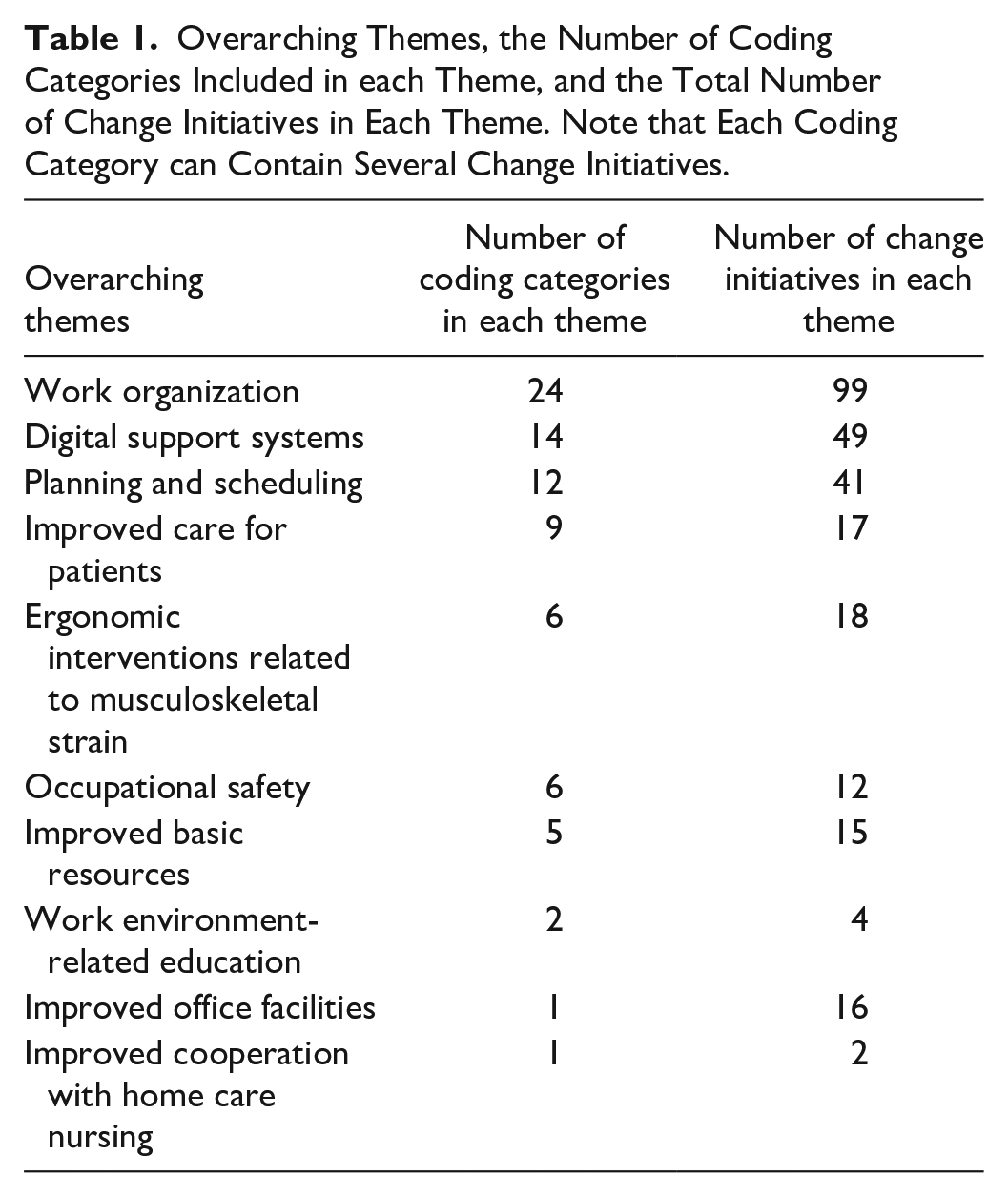
Each of the 10 overarching themes are delineated in more detail in the following sections.
Work organization
This broad theme is concerned with changes related to the organization of work. Examples of coding categories are increased staffing, participation in leadership, improved access to management, participation in organizational development, the right to full-time employment. The largest coding category by far was organization in smaller teams or increased teamwork.
Regarding organization in smaller teams, one respondent described the change like this:
Smaller teams to increase continuity for the clients, along with greater participation among co-workers.
The same respondent described the results of the change as:
. . . more satisfied co-workers and better continuity for the clients.
Another respondent expressed the change to smaller teams like this:
We divided a large home care group into two smaller ones because we discovered that the staff had less control in the large group and that it had a negative impact on the continuity for the customers when all home care staff members were in one large group.
And the results of the change as:
The staff is under less stress and we have one of our county’s best levels of customer continuity, which has resulted in an increased sense of security among our customers.
Improved access to management implies that the number of managers has increased or that managers in some other way have become easier to approach for the home care aides.
Digital support systems
This theme is concerned with digital systems and tools at work. Most of the coding categories included were concerned with the introduction of new tools, such as digital key systems, mobile documentation, digital signing and the introduction of smart phones. This is how one respondent reasoned about the introduction of digital key systems and digital signing:
We introduced a digital key system in all care recipients’ homes so we didn’t have to handle the individual’s keys and to save time for the personnel. In addition, it speeded up getting help out to individuals because the staff member who is closet when for example a security alarm goes off can be in place [in the person’s home] faster. About 70 staff members are affected by this change when you include the licensed personnel. The result was very good, saving an enormous amount of time. At the same time, cellphone registration of the work that is carried out was introduced, this also saved time because the staff didn’t have to search the individual’s home for the “box” that was previously used.
The largest coding category in the theme was the introduction of digital planning systems. This is how one respondents described their change initiative concerning this:
We introduced a newer and better planning system [software name]. In our old system you had to enter the clients yourself – the new system communicates with our organization’s journal system.
Planning and scheduling
This theme is concerned with scheduling work in different ways. The theme’s coding categories include, among others: participation in planning, scheduled breaks, the assignment of a dedicated planner and decreased number of weekend shifts or evening shifts.
Regarding participation in planning—the dominating coding category—one respondent expressed it like this:
The staff was given greater responsibility together with the clients. The personnel were able to write their daily work schedules themselves.
Regarding the assignment of a dedicated planner, one respondent motived the change like this:
We made sure that all groups have a planner who plans the day’s routes via the organization’s planning system [software name]. It was a work environment measure that the staff had wanted for a long time. They had expressed this at our staff meeting days. The result is that the planner then has knowledge of the clients. The routes get better. The staff can talk to the planner and quickly rectify deviations when the planner has such good knowledge of the clients.
As can be noted in the 2 responses cited above, in some of the organizations, the responsibility for scheduling was decentralized to the personnel while in some cases, it seems as if the responsibility was centralized to 1 person. However, as can be seen in the last quote, the dedicated planner can also be an integrated part of the home care group with good knowledge of the clients.
Improved care for patients
This theme contains initiatives reported by the respondents but that are primarily concerned with improved care for the patient. However, some of these initiatives could also have an effect on the personnel’s work environment, such as patient home-taking teams (ie, a team that takes care of the patient when they are discharged from the hospital in order to evaluate if and to what extent home care is needed), and increased continuity in personnel.
Ergonomic interventions related to musculoskeletal strain
This theme is concerned with initiatives to reduce musculoskeletal strain, for example, the introduction of electric bicycles, behavioral change initiatives in the form of physical training, new lift equipment and the education and assignment of transfer and positioning instructors. The introduction of electric bicycles was the most common type of improvement initiative in this overarching theme.
Occupational safety
This theme is concerned with safety in the workplace, mainly with reduced risk exposure. Coding categories include occupational risk assessment in the patients’ home, studded tires on bicycles, efforts to reduce exposure to smoking and assault alarms.
Improved basic resources
This theme involves changes related to basic work resources other than the actual office facilities. Examples of the coding categories are: working clothes, more or new cars and new furniture.
Regarding the cars, 1 respondent stated:
We have purchased more home care cars. This has meant that you don’t need to use your own car for work. Very positive for our co-workers.
Work environment-related education
This theme is concerned with educational initiatives in relation to the work environment. It is a small theme containing 2 small coding categories, the first one being about basic work environment-related education and the second one about mental illness in relation to work and life in general.
Improved office facilities
This theme is concerned with the office facilities used by the home care personnel. The theme only consists of 1 coding category, but it in turn comprised 16 responses.
One of the respondents expressed the result of a change of office facilities like this:
[We] have moved to new premises, larger spaces. We are about 38 people and that makes up two home care groups. We are happy with the results.
Improved cooperation with home care nursing
This small theme is concerned with cooperation with home care nursing. In Sweden, home care nursing encompasses mainly registered nurses, employed by the municipality, that provide medical care in the patients’ homes. It is often the case that patients with basic home care also are enrolled in home care nursing. For this reason, it is important that the organization that provides home care and its personnel have good cooperation with the home care nursing staff. In many cases, home care personnel work on delegation from home care nurses.
The Impact of Change Initiatives on Gender Equality
The second main content question of the survey concerned whether the above-mentioned changes had any effects on gender equality. The analysis indicated that many of the respondents did not think that their change initiatives had any effects on gender equality. Among those that responded that it had an effect, it became clear that the Swedish term for gender equality [Swedish: jämställdhet] in itself meant different things to the respondents, and in some cases, it was interpreted in a more general way than equality between genders, possibly confused with the Swedish term for equality [Swedish: jämlikhet].
One way to interpret it was as equality between the members of the work group. For example, 1 respondent expressed it like this:
Yes, the work is more equally distributed among co-workers in the various units.
In this quote, it becomes apparent that the respondent related the concept to fairness in the work group. Other respondents emphasized not only fairness, but also fairness between groups and genders at the workplace.
Yes, in the first round of changes we tried to come up with a fair schedule with the same number of evenings and shared rounds regardless of gender, age or ethnicity.
In some of the responses, it was framed as participation, that is, that the home care personnel had more influence in their workplace in some manner.
Yes I agree the power lies more with the co-workers, although it hasn’t been heard. In any case, we steer things more together.
There were also respondents who reflected on how their change initiatives had made the work environment more equal compared to workplaces that were mainly male dominated, and thus applied an interpretation that was closer to the intended meaning of gender equality.
Yes, in part. In the past, the municipal technical services department had better work clothes for its staff, which was made up of more men, and in caregiving there are more women.
Discussion
In the present study, a qualitative survey was used to explore and map the occurrence and content of local initiatives that explicitly aimed to improve the work environment in the home care sector. The survey also explored whether these change initiatives were perceived to have had any noticeable effects on gender equality at the home care units in question. The first and second line managers from the 178 home care units who responded to the survey showed considerable variation in their answers regarding level of detail, quality and length. However, the sheer amount of reported change initiatives indicates a willingness to address work environment-related issues in home care. Yet, the fact that very few of the reported change initiatives had been evaluated constitutes an obstacle for dissemination of experiences both within and outside the home care unit in question. These units’ willingness to engage in improvements suggests that there is a potential for learning, should the home care organizations put more effort into systematically evaluating their initiatives.
The largest theme, work organization, is dominated by the coding category: organization in smaller teams or increased teamwork. This indicates a trend in Swedish home care, to embrace teamwork to a higher degree, and to emphasize the benefits associated with it. This trend appears to be in line with how health care in general has developed over the last decades, with more focus on, and effort put into, the implementation of teamwork. There is a large body of research on teamwork in health care.30-34 However, most of it is concerned with specialized and different interprofessional settings (eg, intensive care units, operating rooms), rather than with home care.35,36 By contrast, many of the change initiatives regarding smaller teams reported in the survey, were only concerned with the assistant nurses and home care health aides, 2 personnel categories that in the context of Swedish home care do the same type of work to a large degree. Thus, the motive behind those reorganizations into smaller teams was not to improve interprofessional work, but rather to ensure the clients a better continuity of care and to give the personnel a better overview and more control in relation to their work situation. Smaller units or teams can have the effect that the personnel are more in control but also have a more explicit social context that can provide social support and facilitate trust building at work. 33 Both increased control and support from co-workers are associated with a less stressful work environment.37-40
The theme digital support systems reflects the digitalization of society at large and of health care in particular.41-43 Two coding categories dominated the theme: introduction of digital planning systems and digital key systems. Both categories can be associated with an improved work environment since digital planning systems, if applied correctly, can make work easier, and digital key systems can free home care personnel from carrying around large bunches of keys to their patients’ homes. However, there are also risks. Digital planning systems in combination with a digital schedule on a mobile device, run the risk of decreasing employees’ control over their work because it can then be monitored and rescheduled by the management without the employees’ input. Another consequence of some digital key solutions used in home care is that the personnel’s entering and exiting patients’ homes is automatically logged. These digital logs make it easier for management to monitor the amount of time the personnel use for movement between patients’ homes. Hence, these types of services can be used to improve the work environment, but also to monitor the personnel in ways that actually impair their work environment. 44 There are also indications that increased surveillance of workers with the help of digital systems may decrease organizational commitment. 45 As already stated, digitalization not only concerns home care, but is rather a trend that permeates society. This implies that home care organizations are in the midst of a large societal transition that they cannot entirely control. In part, this is reflected by the uncritical, or even haphazard, implementation of technology without sufficient reflection on whether it leads to any improvements.46,47
The planning and scheduling theme was dominated by the coding category participation in planning. Participation in planning is partly related to the previously discussed digital support systems theme, as the organizations introduced digital planning systems, and at the same time, gave the personnel more influence over their schedules. In this sense, participation in planning represents the positive upside of digital support systems: that they can be used to increase the employees’ sense of control over their work situation if it gives them influence over the scheduling. 37 When looking at organizational change in general, participation is also an important trait as it ensures “a fit between the employees and their environment” 48 (p. 1045).
The results indicate that the home care organizations put much emphasis on work organization, digital support systems and planning and scheduling in relation to the work environment. However, in the research literature, it becomes apparent that issues related to the physical work environment and musculoskeletal strain are common.5,7,12,13 Thus, it is surprising that the home care organizations did not report more initiatives for the ergonomic interventions related to musculoskeletal strain theme.
It is well established that home care as a highly gender segregated occupation, but as most respondents did not perceive that their change initiatives had any effect on gender equality, and since the term had such a wide variety of interpretations, it can be concluded that this is not a central driver for change.
The main limitation of the study is that the open questions in the survey resulted in answers that varied considerably in quality. This made the data material challenging to handle and resulted in some coding categories being more vague than desired. This approach was necessary, though, because the aim was to explore rather than to describe change initiatives intended to improve the work environment in home care. Another aspect of the study that could be perceived as a limitation is that it opened up for interpretation regarding what gender equality actually meant. However, this is also a strength as it sheds light on how the responding organizations understand gender equality. Not only does it reveal that the Swedish term for gender equality (jämställdhet) can be confused with the term for equality (jämlikhet), which indicates that this needs to be made more explicit when formulating survey questions. Moreover, it shows that there are ambiguities of what gender equality means in women dominated organizations, an issue that calls for further research.
This aim of this study is concerned with possibilities to learn from what worked for others, thus, it was purposefully focused on positive changes. It could, of course, be interesting to catch those initiatives that failed as well. However, for several reasons, we believe this would have been difficult to achieve with a survey; firstly, people are in general keener on reporting positive events than negative, which most probably would have introduced a bias in the reporting, and secondly, for ethical reasons we deliberately choose to probe only for positive information about the organizations.
Conclusion
The results demonstrate that many diverse local initiatives are initiated and carried out with the intention to improve the work environment in the Swedish home care sector. However, these change initiatives are seldom evaluated or made accessible to stakeholders outside the organization. The type and direction of these initiatives spread over a wide spectrum, from changes that are work organization related, to digitalization, to changes related to the office facilities. In a sense, the content of the initiatives mirror societal trends, rather than the actual needs identified by existing research. Thus, researchers and managers both have a responsibility to ensure that enough effort is put into change initiatives that also take needs identified by existing research, such as musculoskeletal strain, into consideration.
Although home care is a highly gender-segregated sector, few of the reported change initiatives were perceived as having any noticeable effects on gender equality. To address these issues, it is important to increase the knowledge about gender equality, especially on the local level.
Since the home care sector struggles with a high job turnover, and the amount of care being delivered in patients’ homes is estimated to increase in the future, it is important to seize all opportunities to promote a good working environment in the home care sector. The present results indicates that the learning potential is considerable across the sector. And, while the here identified local change initiatives can serve as inspiration for others, it is also important that future initiatives are systematically evaluated and broadly communicated within the home care sector.
Footnotes
Declaration of Conflicting Interests
The author(s) declared no potential conflicts of interest with respect to the research, authorship, and/or publication of this article.
Funding
The author(s) disclosed receipt of the following financial support for the research, authorship, and/or publication of this article: The work was funded by FORTE – the Swedish Research Council for Health, Working Life and Welfare (grant number 2016-07151).
