




Abstract
Little is known about the significance of gardening services for frail elderly people. This study explored the value of a gardening service for frail older people and people with a disability living in the community. Using qualitative and quantitative data collected from pre-gardening (n = 38) and post-gardening service delivery interviews (n = 35) and the Housing Enabler, the value of a gardening service was examined. Findings suggest that the service had a positive impact on the independence and emotional well-being of frail aged people and younger people with a functional disability, with little impact on physical health. Results indicate that gardening services should be fundamental to planning for these populations to remain or return to living in the community.
Introduction
Elder-friendly communities, “where older adults are actively involved, valued, and supported with infrastructure and services that effectively accommodate their needs,” 1 have been actively embraced for the past decade.2,3 This movement addresses characteristics that enable older people and people with disabilities to age in place, such as safe neighborhoods, door-to-door transport, home delivered meals, and access to an outdoor maintenance service. 1
Although there is considerable research and literature that demonstrates how a supportive home environment is key to successful aging, the significance of gardening services for the independence, and emotional and physical well-being of frail older people and younger people with a disability is less well documented and understood. Aging at home is preferred by most people to residential age care,4-8 however, as people age, they experience changes in their economic, physical, and social independence that become barriers to managing their own gardens and homes. Many people need assistance to maintain their independence, health, and well-being to enable them to maximize self-fulfillment and preferred lifestyle in familiar surroundings, traditionally the family home.
Many people live in hazardous environments, which have been a contributory factor in falls. 6 In 2009-2010, approximately 33% of all hospitalized fall-related injury cases involving older Australians aged 65 years and older occurred in and around the home. They were due to slipping, tripping, and stumbling, resulting in substantial hospital costs. 9 Apart from the cost of acute hospital care and treatment of fall injuries, there are also personal costs relating to the loss of independence, quality of life, and for some, a complete lifestyle change. Therefore, attention to fall prevention within the garden and surrounds for older people is essential.
For some households, a garden is a place where family members share domestic routines and work on projects together. It is also a place for family leisure and a space for entertaining where fond memories are created. Gardens can also facilitate social interactions as neighbors and passers-by comment on the garden display and designs. 10 “Gardening talk” can create links between family members and also with neighbors across the garden fence.10,11 Gardening helps with forging and supporting social relationships both with family and the wider neighborhood.11,12 A garden is a place of identity and an important source of self-expression, personal value, and pride.10,11 For older people, the garden is a place where they can grow old gracefully and it is a place that invokes fond memories of the past. 10 Gardens can also be a powerful symbol of memories and loss, a “living” reminder of a person’s deceased partner. 13 For older people with poor health and mobility problems, the ability to view the outside world and remain part of it is important as it brings positive well-being. 14
When the garden becomes messy, a “lost space,” and an eyesore as older people cannot manage it anymore due to frailty and disability, the unmanageable garden becomes a burden, a source of worry, and symbolizes a loss of control over their bodies and lives. 12 They may experience negative psychological effects that include feeling depressed, powerless, and frustrated as they have to engage others to carry out tasks they once did with ease. According to Bhatti, 10 inability to garden, or the loss of the garden, can induce a sense of bereavement leading to low morale.
Gardens can be sources of escapism, ownership, identity, and attachment, places to relieve stress and to connect with nature, family and friends. In addition, gardens provide opportunities for caring and represent ways of showing affinity with the environment.15,16 This article explores these themes by focusing on the concerns of older people and younger people with disabilities and assesses the impact changes to the outdoor home environment have on their health, well-being, and independence after receiving an affordable and accessible gardening service.
Method
This study used a mixed methods design. Qualitative and quantitative data were collected twice; once before the first gardening service and then 4 months later when participants had received at least two gardening services.
This project was approved by the Curtin University Human Research Ethics Committee and written consent was provided by each participant.
The gardening service was provided by a not-for-profit organization based in Perth, Western Australia, that regularly supports approximately 2,000 gardening clients across the metropolitan area. The service provides gardening every 8 or 12 weeks with a subsidized fee (Aus$22) which could be waived for those not able to afford the service. Each one-hour gardening visit includes two coordinators and two or more volunteers. The service’s focus is on safety and well-being and includes clearance of pathways, pruning overhanging branches, mowing lawns, and whipper snipping. Clients are encouraged to carry out gardening tasks suitable for their abilities such as watering, light pruning and sweeping patios. All green waste is removed.
Participants
Participants were clients of Home and Community Care (HACC), an Australian government service designed to provide support to build and maintain a person’s independence in the community. To be eligible for HACC, a person must live in the community and have an ongoing functional disability that affects activities of daily living. 17 Participants were receiving either a Commonwealth-funded Disability Support Pension (financial support for people with a physical, intellectual, or psychiatric condition that stops them from working or people who are permanently blind) or Aged Pension (income support and access to a range of concessions for eligible older Australians). Participants in the study were classified by HACC as unable to look after their gardens and were using the gardening service for the first time. The gardening service has a database of clients with routinely collected information. De-identified client details from July 1, 2012, to June 30, 2013 (n = 2,402) were analyzed to ascertain their demographics so the study sample, purposively sampled, would be similar in proportion to the gardening service population (Table 1).
Demographic Background of Gardening Database and Study Participants (Pre-Gardening and Post-Gardening Service).
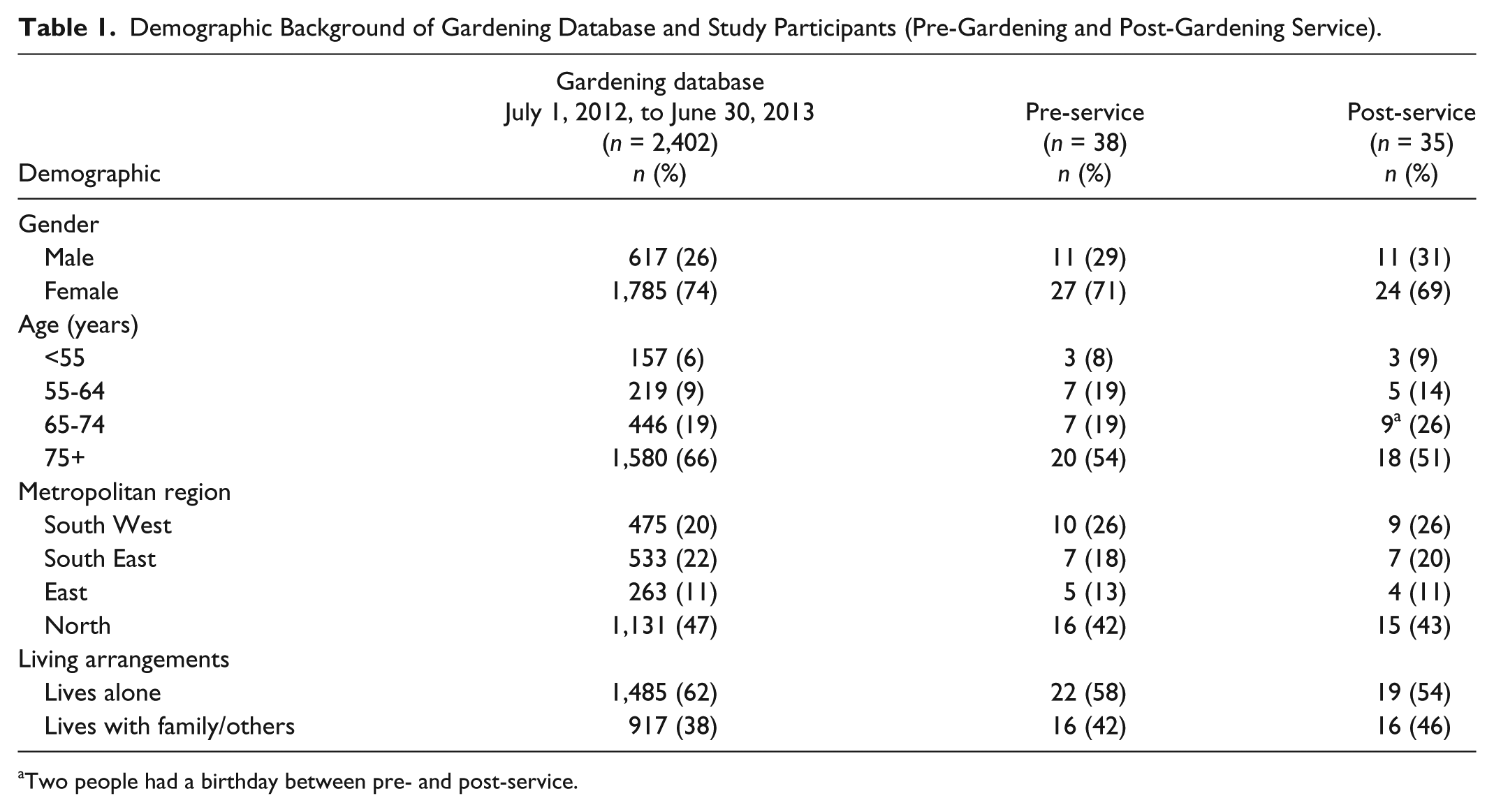
Two people had a birthday between pre- and post-service.
Data Collection
Data collection occurred at two points in time: before participants received any gardening service from the service provider (pre-service data collection) and 4 months after, once they had received two or more gardening services (post-service data collection). All data were collected at the participants’ homes. The pre- and post-service data collection consisted of a semi-structured interview, Housing Enabler functional limitations and Home Safety checklist, and basic demographic data collection. Photos of the garden were taken. Data collection was piloted initially on five people. No changes were made following the pilots.
Measurement Instruments
The semi-structured interview at the pre-service visit asked participants what the garden meant to them, concerns about their gardens, current gardening practices, expectations from the service, the social impact of the current state of the garden, any injuries in the garden, and motivation for using the service. The post-service interview centered on the safety, health, well-being, social impacts of the changed garden, current garden practices, participants’ feelings and use of the garden, injuries, and the benefits/difficulties, or not, of the gardening service.
The Housing Enabler 18 is in two sections. The first section consists of 14 items that measure the participants’ mobility, dependence on mobility aids, and functional limitations that impede their independence. It is a valid and reliable instrument. 18 The second section of the Housing Enabler consists of a Home Safety checklist. It is a general environmental assessment used to assess accessibility, safety, and other problems in the exterior and interior of the home (e.g., “yard uncared for/garden overgrown”). This checklist was completed by the researcher.
Data Analysis
The semi-structured interviews were taped and de-identified. Audiotapes of the interviews were transcribed. The NVivo 10 software was used to manage the qualitative data for thematic analysis of the transcripts. A combination of approaches was used to analyze the data. A priori ideas and themes, based on the literature and participant questions, were identified to determine the meaning of the garden for the participants and how they responded to the changed environment following use of the garden service. Other ideas/themes emerged from the transcripts. The quantitative data were entered and analyzed using SPSS Version 20. 19 Simple descriptive analyses were used to summarize demographic data, the Housing Enabler measures and the Home Safety checklist.
Findings
A total of 38 new gardening clients participated in the pre-service data collection and 35 participated in the post-service data collection. Their demographic characteristics were similar to the existing gardening service clients in the gardening database of the service provider (Table 1).
The Housing Enabler indicated that 85% of the participants had reduced spinal and/or lower extremity function, 72% had limitations of stamina, 58% had poor balance, and 26% used walking aids at pre-service interviews. Following receipt of the gardening service, the functional limitations of the clients were similar to the pre-service interviews. Major functional limitations were reduced spine and/or lower extremity function (91%), limitations of stamina (83%), and poor balance (54%). One fifth (20%) of the participants relied on walking aids.
Safety and Independence
Participants were generally ailing frail elderly people with conditions such as arthritis, cancer, diabetes, depression, and cardiovascular and neurological disorders. Safety became paramount as their conditions worsened. All needed assistance with their gardens. Injury, surgery, and treatment that restricted their gardening activity were reasons for opting to use the gardening service.
The Housing Enabler Home Safety checklist indicated that common problems in and around the gardens included obstructed or broken paths (34%) and paving (47%) that hindered accessibility making it unsafe for participants to move around their garden. Other tripping hazards included garden hoses on paths, pop-up sprinklers, and unsafe steps and stairs (32%). Some clients’ homes had 10 or more steps from the house to the garden with no rails. Maintaining a safe physical environment, particularly managing the hazardous overgrown plants, was an issue reported by most participants. A few had fall experiences because of the overgrown weeds and uneven steps and paving. Many could not access their letterbox and did not have a clear view from the front door to the road. Most said they had to rely on others for gardening assistance, especially family members, because of their own health problems, deterioration in their partners’ health, loss of a partner, or loss of assistance from organizations such as churches. Participants did not want to become a burden to family members and wished to have control of their own garden.
Four months after commencement of the gardening service, the Home Safety checklist indicated that only three of the participants had an uncared for yard or overgrown garden. Only one participant had unsafe access to the letterbox and all had a clear view from their home to the road. Participants reported that the gardening service increased their independence and ability to remain in their own home. They were able to get around more easily in their tidy gardens that helped prevent falls and injuries. With trees, branches, overgrown grass, and bushes being cut and trimmed, most participants reported having a safer and more secure home environment:
If I go out and the lawns are not very straight and I slip I could break a leg easy and that’s what makes me wary about doing gardening. I couldn’t go through that again, a broken ankle.
Some participants reported that since the commencement of the gardening service they were gardening more as they could move safely around their garden, not overwhelmed with the amount of work that needed to be done, and felt more inclined to be in the garden. A small number of participants reported that they felt more safe and comfortable with the gardening team from a reliable and reputable service provider as compared with unfamiliar private gardening contractors who were often perceived as unreliable and did not do as they were asked.
Satisfaction and Well-Being
Although longing for a safe and neat garden, participants were worried about the costly fees from private gardening contractors. They were greatly relieved that the subsidized service was affordable and that they did not have to rely on family members or engage costly private gardening contractors for the upkeep of their garden. Participants in rented homes were particularly relieved with the service as a tidy garden meant that they did not have to worry about losing their tenancy.
The gardening service changed behaviors in relation to the participants’ involvement in their own garden. A number of the participants reported that they were more motivated to do gardening after their garden had been neatened and looked much nicer than before. The garden was where some participants with limited mobility connected with the outside world. It was a place where they sat and relaxed, took refuge, and enjoyed the beauty of nature:
I love birds and when my garden’s healthy I love watching the birds come by.
Participants stated that they were happier, relieved, more comfortable, less anxious, less embarrassed, and did not have to worry about their garden being untidy, uncared for and out of control when using the gardening service. They believed their garden would continue to improve with the ongoing service. Some were “thrilled” that they could be in their gardens and that the service brought life and beauty back to their garden for them to enjoy and connect with nature and to release stress:
It’s just relaxing and it’s lovely to sit out here and look at it. You feel better, definitely feel an improvement in your general well-being I think. It’s nice and peaceful.
Acknowledgment and compliments from neighbors about the nicely maintained garden increased self-esteem, pride and dignity of some participants:
It’s important because it’s a reflection on the individual themselves and I had a comment from my neighbour the other day, she was walking past and she said it’s good to see your lawn looking green.
The garden was also a place that reflected memories and loss. One participant expressed that it was important for him to keep a nice garden in memory of his wife. He was happy that he had managed to do that with the gardening service:
Basically everybody likes a nice clean back yard and tidy because of what it used to be when my wife was alive and what it is now. It’s very important that we get back to something that she would appreciate.
Maintaining Social Relationships
At the pre-interview, some participants were distressed with the condition of their garden and were embarrassed to invite friends to their home. They wanted to improve its appearance to provide a place for entertaining and socializing with family and friends, a place for their pets, and a safe place for their grandchildren:
I’ve always had a good garden all my life and now that I’m not that capable it’s a bit depressing and it’s important . . . it sort of adds to the integrity and dignity of me living here to some extent.
After receipt of the gardening service, it was clear from the participants’ reports that the garden was important in forging close-knit family and social relationships through shared activities:
Yes I do sit out there and eat and the grandchildren play out there because they love coming here, it’s special. I feel a lot happier with it and now, if someone comes over, we can go and sit outside because it looks quite tidy, whereas before it was a mess.
The majority of the participants were happier after receiving the garden service because they wanted to live in their own home with their friends close by. Having a well-maintained garden provided them with opportunities for shared conversations with passers-by and neighbors due to a clear view of the road and neighboring properties.
Some participants felt a social responsibility to the community in which they live to maintain their garden well, and in that way feel part of the community and not disappoint their neighbors:
It’s very important for the whole aspect of living. It’s part of the community, it’s me being part of sort of life in a way. What it means to me is it’s like keeping the floor and kitchen tops clean, it’s the same sort of thing.
Discussion
For the past decade, elder-friendly/age-friendly communities have encouraged aging in place so as to meet the needs and aspirations of older people. 20 Older people generally want to stay in their own home, in familiar surroundings, for as long as possible. 14 Older people identify strongly with their neighborhoods, relying on neighbors for much of their social and other support. 20 In our study, as with other studies,21,22 we found that due to a range of functional and mobility limitations, participants either could not independently look after, or required ongoing assistance, with their gardens. Significant improvements were noted after receiving the gardening service; the service restored the garden to a safer environment, was affordable, and allowed participants to remain more independent in their own home.
The adoption of age-friendly communities, aimed at increasing the quality of life for residents and encompassing aging in place, is gaining momentum.1,23 This movement has implications for public policies and funding. The gardening service offers one example of this movement. Our evaluation demonstrated that the delivery of a preventive service benefitted the quality of life of the recipients and supported their continued independent living. Investment in a subsidized gardening service has the potential to reduce costs associated with falls and injuries, and identified barriers and enablers in the garden, encouraged the upkeep of current skills of the participants, and assisted with safe gardening. The service removed some reliance on gardening support from family and neighbors. The viability of the gardening service was enhanced by the use of volunteers in the service, two to three volunteers for every paid supervisor.
The concerns raised by the participants reflect how they valued their garden as a conduit for healthy social relationships, escapism, connectedness to nature, and community responsibility.15,16 The experiences of participants in this study demonstrated that the gardening service positively affected their emotional well-being. As with other studies, a well-kept garden allowed the participants to connect with nature and provided them with a place where they could retreat, relax and indulge themselves. 11 The well-maintained garden also promoted dignity and self-esteem for the participants as they commented that the garden was a reflection and expression of themselves. Gardens are indeed connected with the home owners’ identities, reflecting their culture, gender, and social class.16,24 The gardening service also assisted participants to fulfill their sense of duty to the community, showing their responsibility to their neighborhood, and an affinity with caring for the environment. The well-kept garden was a connection to the broader environment that helped to bring the world to them 13 through interactions with family, friends, and neighbors. Affordable and accessible gardening services are not simple additions to the more prominent and well-known health and community services provided to older people, but key resources that deserve greater attention and financial support.
Conclusions
The internationally identified importance of gardens for the health and well-being of people was reflected in this study. Gardens matter greatly to many older and frail people living in the community and it appears from our research that they assist with continuing independence and well-being. Before receipt of the gardening service, participants struggled with the disorder of their gardens, taking a toll on emotional well-being and safety. Our findings indicate a reduction in the worry associated with being unable to maintain a garden, reduced risk of potential falls, and benefits from accessing an affordable and acceptable gardening service. The study participants indicated that they were better able to stay in their own home, which is the overwhelming preference among older people as they age. It is important that some form of subsidized gardening service is available for frail and elderly people living in the community.
Footnotes
Acknowledgements
The authors are grateful to the study participants.
Declaration of Conflicting Interests
The author(s) declared no potential conflicts of interest with respect to the research, authorship, and/or publication of this article.
Funding
The author(s) disclosed receipt of the following financial support for the research, authorship, and/or publication of this article: This work was funded by the Home and Community Care Program (WA) through Volunteer Task Force.