




Abstract
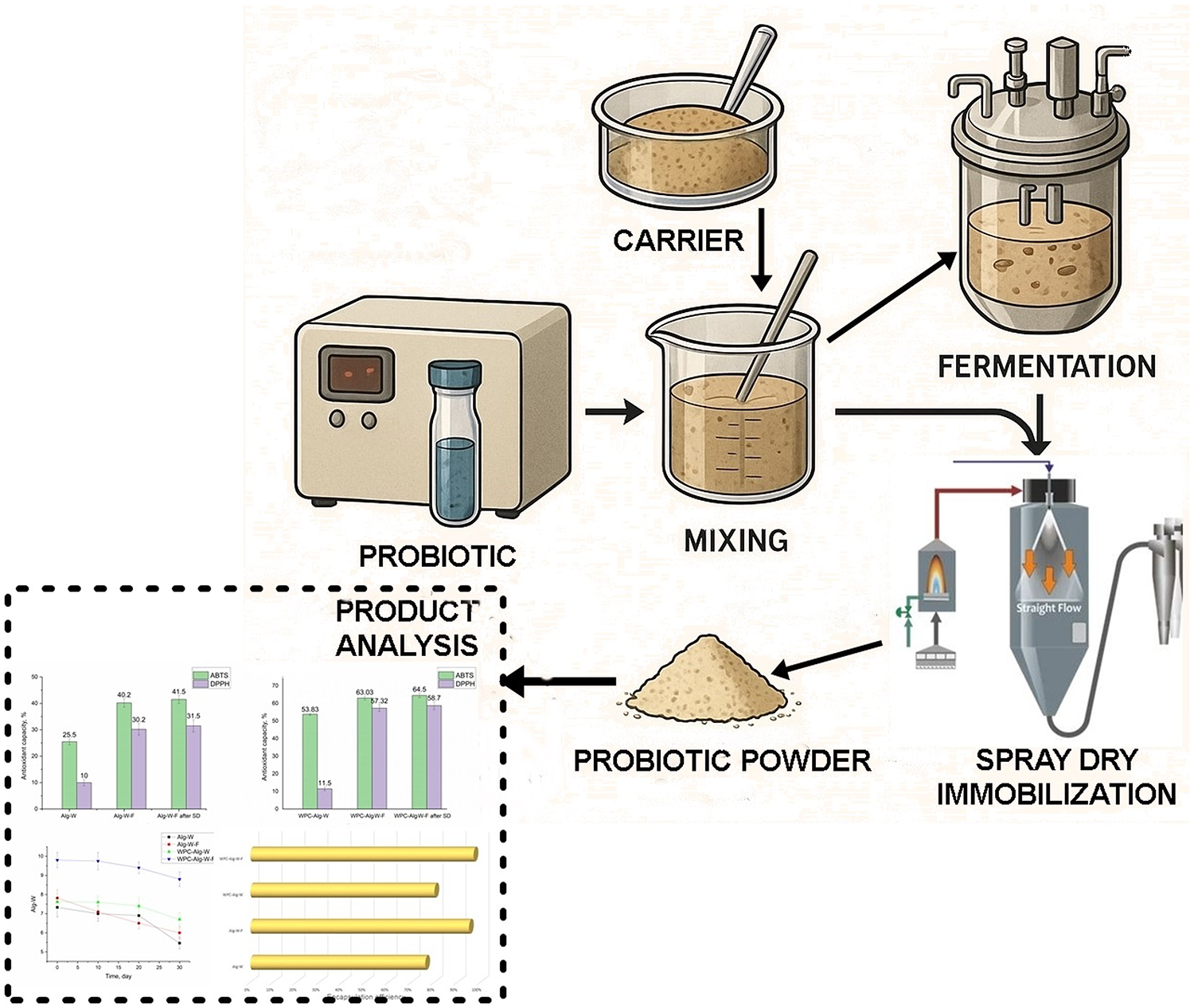
Probiotic encapsulation represents a key strategy for maintaining their viability. Among the various techniques, spray-drying has shown significant potential in the food industry. While alginate has traditionally been used as a carrier, the incorporation of dairy byproducts offers advantages as enhanced encapsulation efficiency, added functionality, and improved sustainability through the valorization of industrial waste. This study examines the impact of carrier composition and fermentation on the viability of probiotics, the antioxidant capacity, and the encapsulation efficiency achieved through spray-drying. Different carrier compositions containing whey, alginate, and whey protein concentrate (WPC) were inoculated with probiotics, subjected to fermentation and spray-drying, and subsequently evaluated for the properties of the probiotic powders. The addition of WPC to the alginate matrix increases probiotic viability and encapsulation efficiency by 5% and antioxidant capacity from 25% to 53%. Fermentation of carriers with probiotics before encapsulation increases probiotic viability (for about 1 log), antioxidant capacity (for more than 20%), and efficiency of the spray-dry encapsulation (for about 20%). The fermented sample with WPC showed a significantly higher number of viable cells after encapsulation and 30 days of storage. Fermentation did not significantly impact product yield which is about 70%, moisture content, or solubility (85%), while the addition of WPC increase moisture content from 3.7% to 4.7%. Additionally, the spray-drying process does not negatively affect the antioxidant capacity of samples. Therefore, the highest antioxidant capacity is shown in a fermented sample with WPC (64.5%). Using adequate carrier and fermentation as pretreatment before spray-dry encapsulation, the viability of probiotics during encapsulation increased from 78 to more than 95%. These findings demonstrate that dairy byproducts, in combination with alginate and fermentation, using spray-drying as the encapsulation technology, provide effective protection for probiotics and represent a promising encapsulation approach.
Get full access to this article
View all access options for this article.