




Abstract
The objective of this study was to compare physicochemical traits and sensory profile of meat from rabbits of both sexes belonging to two genotypes, local population and new line (ITELV 2006) which exhibited better characteristics due to its genetic potential. A total of 60 rabbits at 90 days of age were used in the experiment. At slaughter, meat physicochemical and sensory characteristics were measured on Longissimus lumborum muscle. Differences related to genotype were found in most of the physicochemical characteristics studied like Cooking Losses (P < 0.001), Percentage of Released Water (P < 0.001), Myofibril Fragmentation Index (P < 0.001) and a* value (P < 0.001). However, in some of the traits, the differences were related to interaction of sex and genotype (S*G) as in the case of Cooking Losses (P < 0.001) and b* value (P < 0.01). Regarding SDS-PAGE analysis results, the comparison between two breeds has not shown any particular distinction in the myofibrillar and sarcoplasmic protein profiles in relation to the number and the intensity of bands. No significant differences in the sensory characteristics of the meat were noted (P > 0.05). Interestingly, no relevant differences were found between meat from male and female rabbits in all the variables studied (P > 0.05). It was concluded that meat quality was mainly affected by genotype. Thus, the new line exhibited good physicochemical characteristics compared to the local one. This study is the first to analyse and compare the physicochemical and sensory properties of Algerian rabbit meat.
INTRODUCTION
In the Mediterranean basin, rabbit-based food dishes have been a regular part of the diet since the earliest civilisations. Rabbits are easy to raise and environmentally friendly on farms and in backyards (Siddiqui et al., 2023). In Algeria, meat production is mainly based on cattle and sheep farming. These production systems are still unable to meet the protein needs of people to keep this country dependent on the world market (CNIS, 2017). In fact, there is a pressing need for increased animal production to meet the ever-growing demand for animal proteins (Lounaouci-Ouyed et al., 2008; Zerrouki et al., 2004). Rabbit meat consumption is still low and its consumption continues to be negligible. This meat is consumed especially in rural regions by farmers and their families. The consumption is mainly increased during the month of Ramadhan and the winter season or is linked to special events. Additionally, rabbit marketing is still modest, not organised or structured (Sanah et al., 2020, 2022). An estimated production of 8474 t of rabbit meat that is, 1% of the global world production (861 739 t) was registered in Algeria, in 2021 (FAO, 2021). In order to diversify Algeria's animal protein supplies and fulfil the food needs of the population, the livestock sector has initiated several livestock development programmes including rabbit meat production and breeding (Mouhous et al., 2021). Relatedly, meat production efficiency can be enhanced by crossbreeding to acquire the advantage of diversity between rabbit breeds and lines, through complementarity and heterotic effects and to generate new breeds or lines (Balaguer, 2014). In this regard, and in order to provide Algerian farmers with more productive animals and improve the genetic stock for rabbit meat production, a new strain (called ITELV2006) has been created since 2003 with females from the local population adapted to produce all year round in the local conditions, and males from a French INRA strain, heavier and more productive (Bolet et al., 2012).
Indeed, since its diffusion in 2012, this new strain has been the subject of numerous studies, which were first based on describing its reproduction, growth characteristics (Aroun et al., 2021; Belabbas et al., 2019; Sid et al., 2018; Thiziri et al., 2021). The obtained results seem very promising and confirmed the potential use of this line to develop a more efficient rabbit production in Algeria.
Currently, Algerian rabbit meat production is based mainly on the local populations and the new strain which requires, in addition to the morphological and zootechnical characterisation, a good knowledge of organoleptic and sensory meat qualities. To the best of our knowledge, in Algeria, studies about rabbit meat quality characteristics are scarcely reported or non-existent. The researchers pay less attention to the meat quality aspect. This aspect seems very important and deserves an in depth study. It is also interesting to investigate whether the genetic improvement could affect or not the quality characteristics of meat from our local population. In view of the above, the aim of this study was to examine and compare both meat physicochemical traits and sensory attributes of male and female from two Algerian rabbit breeds: the local Algerian population and the new line.
MATERIAL AND METHODS
Animals rearing and slaughter
The experimental protocol was designed according to guidelines on ethical standards of Official Journal of the Democratic and People’s Republic of Algeria relating to veterinary medicine activities and the protection of animal health (N° JORA: 004 du 27-01-1988) and was approved by the ethical committee of University of Mentouri Constantine 1. Algeria. The research was carried out at Biotechnology and Food Quality Laboratory (INATAA, University of Frères Mentouri Constantine 1, Algeria). A total of 60 rabbits, from 2 different genotypes, (30 rabbits per group, 1:1 male: female ratio) were used in this study. Rabbits from local Algerian breed and new line were raised in experimental rabbit station of the technical institute of breeding (ITELV), located in Hamma Bouziane, Constantine, Algeria. Animals were housed in flat deck cages (n = 3 per cage; 50 × 60 × 53 cm). The cage was equipped with a nipple drinker and a feeder for manual distribution of the feed and were fed ad libitum with a commercial pellet diet containing (curde proteins 15%, curde fat 2.5%, crude Ash 10%, crude cellulose 12%; calcium; phosphorus, vitamins (A, E, D3); salt (NaCl), (Telmcen, Algeria). The animals were submitted to a constant photoperiod of 16L: 8D light cycle during the whole experiment period, and were slaughtered by cutting the carotid artery and jugular veins at an average bodyweight of 2078 ± 5 g, and age of 90 day, without prior fasting. The rabbitry was close to the laboratory, so stress due to transport was minimal. Skinned and eviscerated carcases were stored at 4°C. Chilled carcases were divided into three parts according to Rabbit Science Association's (WRSA) recommendations (Blasco and Ouhayoun, 1996). The Longissimus lumborum muscle (LL) located between the first and seventh lumbar vertebrae was removed from both sides of refrigerated carcasses (after 24 hours at 4°C), each sample was divided into two parts: one for physicochemical analyses and the other for sensory assessment. All samples were carefully trimmed of all external fat and connective tissues. The samples were vacuum-packed and stored at −20°C during 10 days, until they were used for further laboratory analysis. The mean of three replicates was used for all of the variables’ analysis.
Meat quality variables
pH
The pH in triplicate was measured 24-hour postmortem in the LL muscle after homogenisation of 1 g of raw muscle for 30 s in 10 ml of sodium iodoacetate (5 mM) and potassium chloride (150 mM) according to McGeehin et al. (2001) using a previously calibrated pH metre (PHS-3CW microprocessor pH/mV metre, BANTE instrument) equipped with a glass combination electrode.
Water holding capacity
Water holding capacity (WHC) of LL muscle was measured according to the Grau and Hamm (1953), also called ‘Filter Paper Press Method,’ with slight modifications of the areas determined. WHC expressed as the ratio of the muscle area to the total area after compression of 300 ± 5 mg of meat for 5 minutes by a 2.25 kg weight (Pla and Apolinar, 2000). Circles of meat (M) and released juice (T) were then carefully drafted on clear plastic for a permanent record and the damp paper-filter was rapidly weighed after accurately removing the compressed meat. The areas were measured using the open source Image J 1.48 software. The areas drawn in clear plastic were scanned and quantified using freehand selection option (Hafid et al., 2016). The percentage of the released water (PRW) was calculated as the ratio of the percentage of weight of released water (damp paper-dry paper) to intact meat ×100.
Cooking losses
Meat cooking losses, CL (%) were determined, as described in Pascual and Pla (2007), 10 g of meat was weighed (P1) and frozen at −20°C. When required, LL muscle samples were continuously boiling water bath. After cooling for 10 minutes by immersion in water, samples were removed from the bags, dried on the surface with a paper towel and weighed (P2). CL (%) were calculated as (P1−P2) × 100/P1.
Determination of myofibril fragmentation index
The myofibril fragmentation index (MFI) was determined according to the turbidity method of Culler et al. (1978) as modified by Li et al. (2012). Protein concentration of the suspension of myofibrils was determined by the colorimetric method of Bradford (1976). Aliquots of myofibril suspensions were diluted in the buffer to a final protein concentration of 0.5 ± 0.05 mg/ml. The Absorbance was immediately measured at 540 nm with a spectrophotometer (Jenway 7305).The mean of the triplicate absorbance readings was multiplied by 200 to obtain the MFI for each sample (Hopkins et al., 2000).
Myoglobin concentration
Pigments in rabbit meat samples were extracted based on the principles of the Faustman and Phillips (2001).The absorbance of the filtrate was measured by a spectrophotometer (Jenway 7305) at a wavelength of 525 nm, using an extinction coefficient of 7.6 mM−1 cm−1 as follows:
[Myoglobin] (mg/g) = [A/(7.6 mM–1 cm–1 × 1 cm)] × [17000/1000] × 10 (Canto et al., 2015).
Colour analysis
The colour of the rabbit meat was determined according to the method of He et al. (2020) using the Grab colour-extracting application (version 3.6.1, 2017, Loomatix Ltd, Munchen, Germany). To ensure that the colour capture was not affected by ambient light, a closed polystyrene box (39 × 17 × 28 cm) was used, and integrated with a 1.2 W 5 V white LED to obtain an evenly scattered light on top of the sample. The CIE-L*a*b* colour space mode was chosen. This is a mathematical colour model based on the sensitivity of the human visual spectrum (Chen and Ren, 2014), where the L* value designates lightness, while a* and b* are colour coordinates ( + a* = redness, −a* = green, + b* = yellow, −b* = blue). Colour measurements were taken at five different locations on the same LL muscle. The values of colour saturation (chroma; C*), and colour hue (hue; H*) were calculated using the following formula (Cielab, 1976): H* = tan−1(b*/a*), C* = (a*2 + b*2)0.5.
Polyacrylamide gel electrophoresis
Myofibrillar and sarcoplasmic proteins were extracted according to the procedure described by Joo et al. (1999). A sample of 0.5 g of fresh meat of LL muscle was added to 10 ml of extraction buffer, containing (75 mM KCl, 10 mM KH2PO4, 2 ml MgCl2, 2 mM EGTA, 1 mM NaN3, pH 7.0). The solutions of extracted proteins (sarcoplasmic and myofibrillar) were stored in eppendorf tubes at −20°C.The protein concentration of both sarcoplasmic and myofibrillar protein extracts was determined by the Bradford method (1976) using bovine serum albumin as the standard. After denaturation, the extracts of the sarcoplasmic and myofibrillar proteins were analysed using one dimensional SDS-PAGE electrophoresis on 3.75% stacking and 12% resolving gels according to Laemmli (1970). For staining, the gel was placed in a Coomassie Brilliant Blue R-250 staining solution for at least 20 minutes with agitation. Finally, the gel is destained by successive washes and agitation in a destaining solution, until the protein bands are clearly visible. A mixture of proteins with a known molecular weight ranging from 10 to 250 kDa (#161-0305) obtained from Bio-Rad Laboratories, Hercules, CA, was used. The molecular weight of the protein bands was calculated using the Un-Scan-It Gel 6.1 analysis programme (Silk Scientific, Orem, UT) (Boudechicha et al., 2016).
Sensory analysis
For the purpose of evaluating sensory quality attributes, an experienced 10-members’ (5 women and 5 men) panel in rabbit meat was appointed. The panel consists of teachers and postgraduate students belonging to ‘Frères Mentouri Constantine 1 University’. The selected panel is already trained in sensory analysis and therefore considered qualified for this type of analysis. In addition, familiarisation and training sessions for judges were undertaken as recommended in International Organisation for Standardisation (1996) and as described by the American Meat Science Association (1995) in order to help the panel to evaluate meat products, increase their sensory knowledge and giving purely qualitative judgements without considering their preferences.
The meat samples were stored at −20 °C during 10 days before undergoing sensory analysis. The samples of LL muscle were thawed at 4 °C for 24 hours before sensory assessment.
To prepare the samples for sensory evaluation, the LL muscle was cut into 10 pieces of equal size (approximately 5 g) according to the taste panel number and placed in labelled and sealed cooking bags. The bags were then immersed in a water bath, and the meat was boiled without salt or spices.
According to Honikel’s (1998) method, the samples were cooked at a constant temperature of 80 °C for approximately 1 hour to reach a core temperature of 75 °C and served hot immediately to the judges in white plates. In each session, the panelist evaluated 2 samples in randomised order, on average; each sample was evaluated by the 10 panelists. A cup containing water (90%) and apple juice (10%) was given to the panel at the beginning of the session and in between samples in order to cleanse the palate between tastes (Hutchison et al., 2012). A list of 11 selected parameters was used (Rabbit flavour intensity, grass odour intensity, rabbit odour intensity, juiciness, tenderness, cohesion, chewiness, fibrousness, flouriness, residual, and the overall appreciation) (Table 1). Each attribute was rated on a 0 (absence of perception) to 10 (very intense perception) using a 10 cm unstructured continuous line, as recommended by the UNE-EN-ISO 4121:2006 standard (AENOR, 2006). Samples were tasted by the trained panel in a normalised tasting room, under white artificial light, according to ISO 8589:1988. A paired preference test was performed to determine whether there is a statistically significant preference between two samples of meat of two breeds and both sexes. The 10 panelists were asked to choose which sample was more preferred according to their sensory properties. Since a forced choice procedure was adopted, a sample must be chosen even if the selection by the assessor was done randomly.
Effect of genotype (G) and sex (S) on physicochemical variables and sensory attributes of Longissimus lumborum muscle of rabbit meat measured at 24-hour post-mortem.
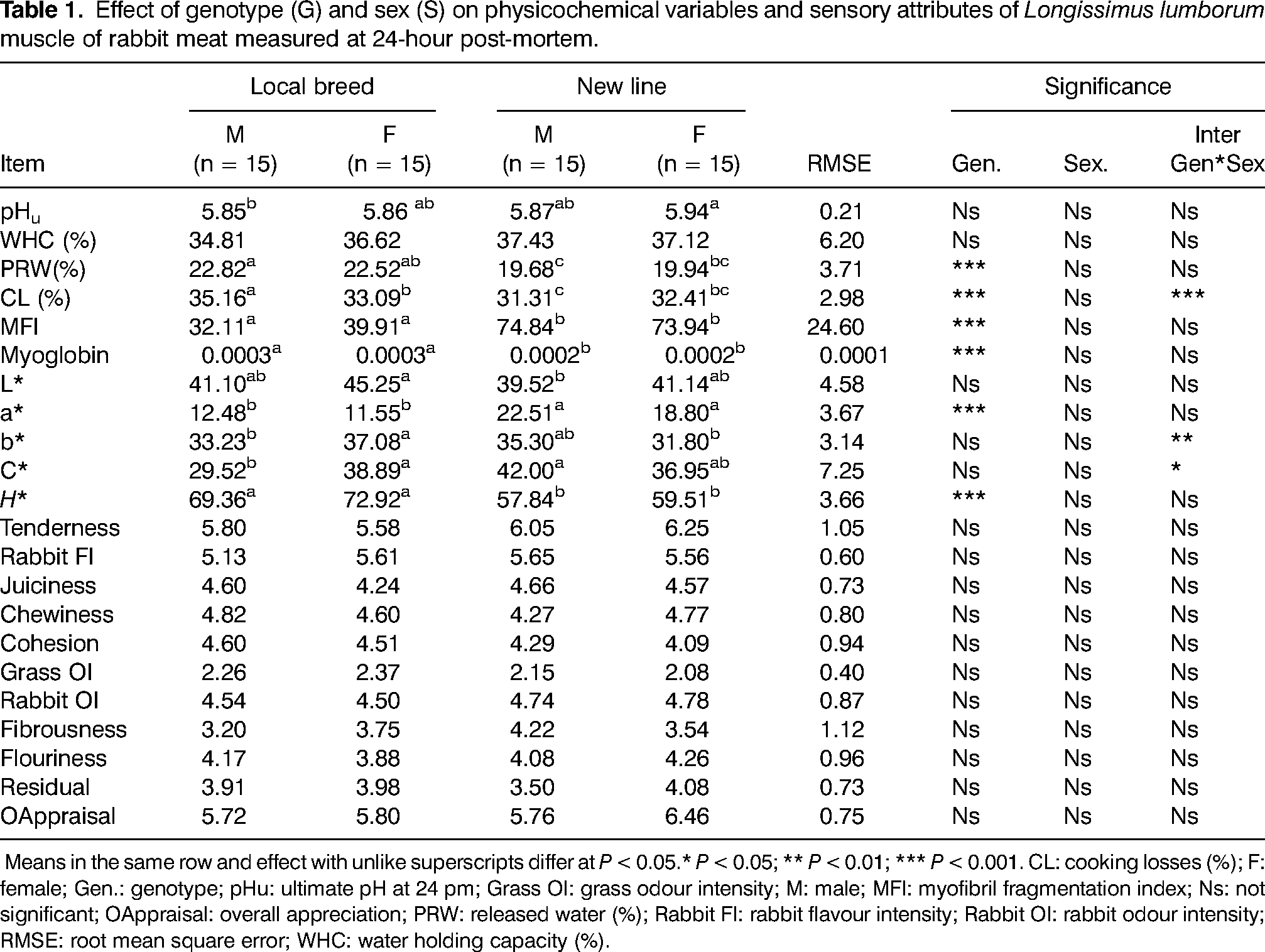
Means in the same row and effect with unlike superscripts differ at P < 0.05.* P < 0.05; ** P < 0.01; *** P < 0.001. CL: cooking losses (%); F: female; Gen.: genotype; pHu: ultimate pH at 24 pm; Grass OI: grass odour intensity; M: male; MFI: myofibril fragmentation index; Ns: not significant; OAppraisal: overall appreciation; PRW: released water (%); Rabbit FI: rabbit flavour intensity; Rabbit OI: rabbit odour intensity; RMSE: root mean square error; WHC: water holding capacity (%).
Statistical analysis
Depending on the target, different statistical methods were used. The results are given in the form of means and root mean square error (RMSE). First, the data was analysed by least square means procedure of the General Linear Model (GLM), following a fixed effect model that included genotype, sex and their interaction. Residuals were assumed to be independently normally distributed. The model was:
RESULTS AND DISCUSSION
The effect of genotype and sex on physicochemical variables and sensory attributes of rabbit meat is reported in Table 1.
pHu
Our results have shown that the ultimate pH (pHu) was ranged from 5.8 to 5.9. In line with the present study, Kozioł et al. (2015) also suggested that this pH might indicate that rabbit meat has an inferior shelf life compared to the meat of other animal species. Generally, the pHu is affected by various factors, including pre- and post-slaughter conditions, type of muscle, individual animal characteristics and level of stress. Genotype, sex and their interaction effect have no significant differences on pHu (P > 0.05, Table 1), but intragroup comparison revealed that there is a difference in pHu between the two groups of both sexes. Higher pHu values of rabbit meat originating from new breed and female animals, respectively, compared to local breed and male animals were observed. Our findings are in agreement with the results obtained by Gasperlin et al. (2006) in their study. They found that pHu values were significantly different for genotype and sex. In the same regard, a recent paper written by Daszkiewicz and Gugołek (2020) have shown that the type of breed and muscle affects pHu; while sex had no effect on those variables. Another recent research done by Sampels and Skoglund (2021) have found that at 24 hours post-mortem, pHu was significantly lower in male compared to female rabbits. In contrast, no significant differences between male and female rabbits were observed in other studies (Dalle Zotte et al., 2016; Lazzaroni et al., 2009; Pla, 2008).
Water holding capacity
Water holding capacity (WHC) is an essential measurement to estimate and assess juiciness; consequently, it determines the appearance and palatability of the final product (Huff-Lonergan and Lonergan, 2005). No differences in WHC were found in both groups and sexes. However, when considering the percentage of the released water, a significant difference was found due to genotype (P < 0.001). There was a tendency for the local breed to have higher PRW than the new line (Table 1). In disagreement with the present findings, Daszkiewicz and Gugołek (2020) have found that WHC differed amongst breed, but not due to sex. A similar situation has been observed by Pla et al. (1998) and Pla (2008) in their researches on rabbit meat. In the same context, the results received by Pascual and Pla (2007) on rabbit meat and Smili et al. (2022) on Sahraoui dromedaries of WHC were lower compared to those of the present study.
Cooking losses’ percentage
Referring to the effect of the rabbit breeds on the CL (%), it was found that genotype groups and their interactions with genre have relevant differences (P < 0.001); whereas, no effect of sex was observed on CL (%). The local breed was the highest in CL (%) compared to the new breed. In disagreement with the results of this research, several studies did not find a significant effect of genotype on CL (%) (Dalle Zotte et al., 2015; Metzger et al., 2009; Safaa et al., 2023). While, Sampels and Skoglund (2021), in their research, recorded a significant effect of genotype on LC (%). Compared to the results of this study, lower values of CL (%) of rabbit meat were observed by several studies (Alagón et al., 2015; Nakyinsige et al., 2014; Paci et al., 2013; Sampels and Skoglund, 2021; Radwan et al., 2023); whereas, Dalle Zotte et al. (2015) obtained similar values. Considerably higher values of CL (%) were noted by many authors (Pascual and Pla, 2007; Xiccato et al., 2013; Zeferino et al., 2013), which may be due to the use of different breeds of rabbits and other measuring instruments and methods.
Myoglobin content and colour parameters
Colour, one of the most important characteristics of the technological and culinary quality of meat, is influenced by such factors as animal breed, sex, age, type of muscle, system of feeding, pre-slaughter handling and slaughtering, but mostly depends on the amount of myoglobin present in the muscle tissue (Maj et al., 2012). LL muscle meat of the local breed exhibited a higher level of myoglobin (0.0003 mg/g) for both sexes compared to the new line (0.0002 mg/g). Rabbit genetic group in the present study affected myoglobin concentration (P < 0.001). However, neither the gender nor the S*G interaction produced significant differences in the level of myoglobin of the meat (Table 1). In the same context, the values of L* measured in this experiment were lower than the results of several studies (Kozioł et al., 2015; Maj et al., 2012; Sampels and Skoglund, 2021; Zepeda-Bastida et al., 2019).Whereas, a* and b* values were higher than those obtained by many authors (Daszkiewicz and Gugołek, 2020; Metzger et al., 2009; Pla, 2008; Wang et al., 2016). Similarly, C * and H* parameters were also higher than those recorded by (de Oliveira Paula et al., 2020; Kadim et al., 2008; Pla, 2008; Rotolo et al., 2013). The difference in the results was probably due to the methods or the procedures of measuring colour parameters used for the first time in this study. Consequently, the results obtained in this study cannot be compared with other findings using different methodological approaches. Additionally, the meat colour parameters, measured on the surface of LL muscle 24 hours after slaughter, were not affected by the sex. By contrast, the type of breed and S*G interaction had effect on some colour parameters (Table 1), which indicates that the LL muscle of males and females were similar in colour. Our results agree with those of Maj et al. (2012), who found that genotype affected the rabbit meat colour parameters of the Longissimus dorsi muscle 24 hours after slaughter; suggesting that crossbreeding may be used in practice as a means for changing meat colour. Whereas, in their study, sex did not influence the colour parameters of the muscle at this time point. In a similar vein, Dalle Zotte and Ouhayoun (1998), in their previous paper, found that the L*, a* and b* colour was significantly influenced by genotype. In contrast, Dalle Zotte et al. (2015), in their research, did not show clear connection between rabbit meat colour and genotype. Also, in disagreement with our results, Lazzaroni et al. (2009), in their study, recorded that the muscle colour parameters showed significant differences due to gender in Longissimus lumborum and Biceps femoris rabbit muscles.
Myofibril fragmentation index
Meat tenderness is also related to structural and biochemical properties of skeletal muscle fibres, especially those of myofibrils and intermediate filaments (Veiseth et al., 2001). MFI is the most important index with which to measure the improvement of meat tenderness and proteolysis (Smili et al., 2022). The turbidity method is the most commonly used method to obtain MFI (Nakyinsige et al., 2014). In our experiment, meat samples from the local breed exhibited significantly lower MFI (32.11 for male vs 39.91 for female) than those from the new line (74.84 for male vs 73.94 for female). Genotype showed a significant effect (P < 0.001) on the MFI values; whereas, G*S interaction have no effect on this variable (P > 0.05). Determining the extent of fragmentation of myofibrils when subjected to homogenisation is an indication of the degradation of muscle myofibrillar proteins under post-mortem conditions and the MFI is a useful indicator of the extent of proteolysis reflecting the degradation of key structural proteins, particularly the rupture of the I-band and breakage of inter-myofibril linkages (Taylor et al., 1995). Thus, the weakening of the myofibrillar structure, with the consequent transversal fragmentation of sarcomeres, is a major structural change in myofibrils occurring during meat ageing (Prates et al., 2002). It was demonstrated that the MFI increased with post-mortem storage in many animal species, and it is well related to the meat tenderness profile (Dosler et al., 2007; Nakyinsige et al., 2014; Prates et al., 2001; Smili et al., 2022; Veiseth et al., 2001). Thus, the new strain meat seems to be more tender compared to the local breed meat. MFI values for rabbit LL muscle acquired in this study are somewhat lower compared to those of Nakyinsige et al. (2014) for L. lumborum of rabbit meat as well as those of Smili et al. (2022) for sahraoui dromedary obtained using the same methodological procedures at the same post-mortem time, but our results are higher compared to those of Dosler et al. (2007) applied on the L. dorsi muscle pork at 24 h post-mortem using methods described by Olson and Stomer (1976) and by Hopkins et al. (2000). These differences in the MFI values are probably due to the use of different extraction procedures, the ageing conditions, animal species, muscle types and states of the sample (fresh or frozen and thawed), etc.
SDS-PAGE electrophoresis
Muscle proteolysis by endogenous proteases systems (cathepsins, calpains, caspases, etc.) is the most important phenomenon occurring during meat ageing (Sentandreu et al., 2002). Major changes in muscle protein architecture are associated to the conversion of muscles into meat (Lonergan et al., 2010); such changes are primarily noticeable at the expression levels of the major myofibrillar proteins like myosin, actin, titin, nebulin, troponin-T, desmin and filamin (Paredi et al., 2012). Myofibrillar proteins, accounting for 55–65% of the total muscle protein, are also responsible for meat quality attributes because of their ability to provide textural and functional properties (Chen et al., 2018; Joo et al., 1999). Many factors concur to affect the post-mortem biochemistry of meat, most of them related to animal husbandry and the production system (Bonneau and Lebret, 2010): genotype/breed, sex, age, castration, nutritional status, nutritional management and weight at slaughter (Paredi et al., 2012). Electrophoresis was performed in order to characterise myofibrillar and sarcoplasmic proteins of LL muscle in rabbit meat during the first 24 hours post-mortem of ageing. Comparisons were made between two studied breeds in order to have an overall appreciation of the proteolytic degradation changes of the muscle that occur as part of cellular death and meat ageing process, resulting in the production of protein fragments. The SDS-PAGE results of the myofibrillar and sarcoplasmic protein profiles are depicted on Figure 1. The electrophoretic analysis showed that the myofibrillar protein fraction (Figure 1, left) contained various proteins with major molecular weights (MW) ranging from 17 to 106 kDa. The MW of 16 fragments of low and high MW (17, 18, 22, 24, 27, 30, 38, 43, 50, 51, 56, 67, 76, 86, 98 and 106 kDa, from bottom to top) have been calculated in the myofibrillar profile. The Commassie-stained polyacrylamide gel showed a similarity of the bands’ electrophoretic profile in both rabbit breeds regardless of their sex group. However, the difference was in the intensity of some bands. This means that the profile shows that some bands are more intense compared to others (24, 27, 30, 38, 51 and 86 kDa). Therefore, the concentrations of those bands in the muscles of the two studied breeds are important. Sarcoplasmic proteins, which represent 30–35% of the total muscle protein, are not directly involved in meat tenderness because sarcoplasmic proteins have non-structural functions consisting primarily of enzymes involved in cellular metabolism, which are represented mainly by glycolitic enzymes and myoglobin, yet studies on pigs have indicated that denaturation of sarcoplasmic proteins has an impact on meat quality parameters such as colour and water retention capacity (Joo et al., 1999; Marino et al., 2014).
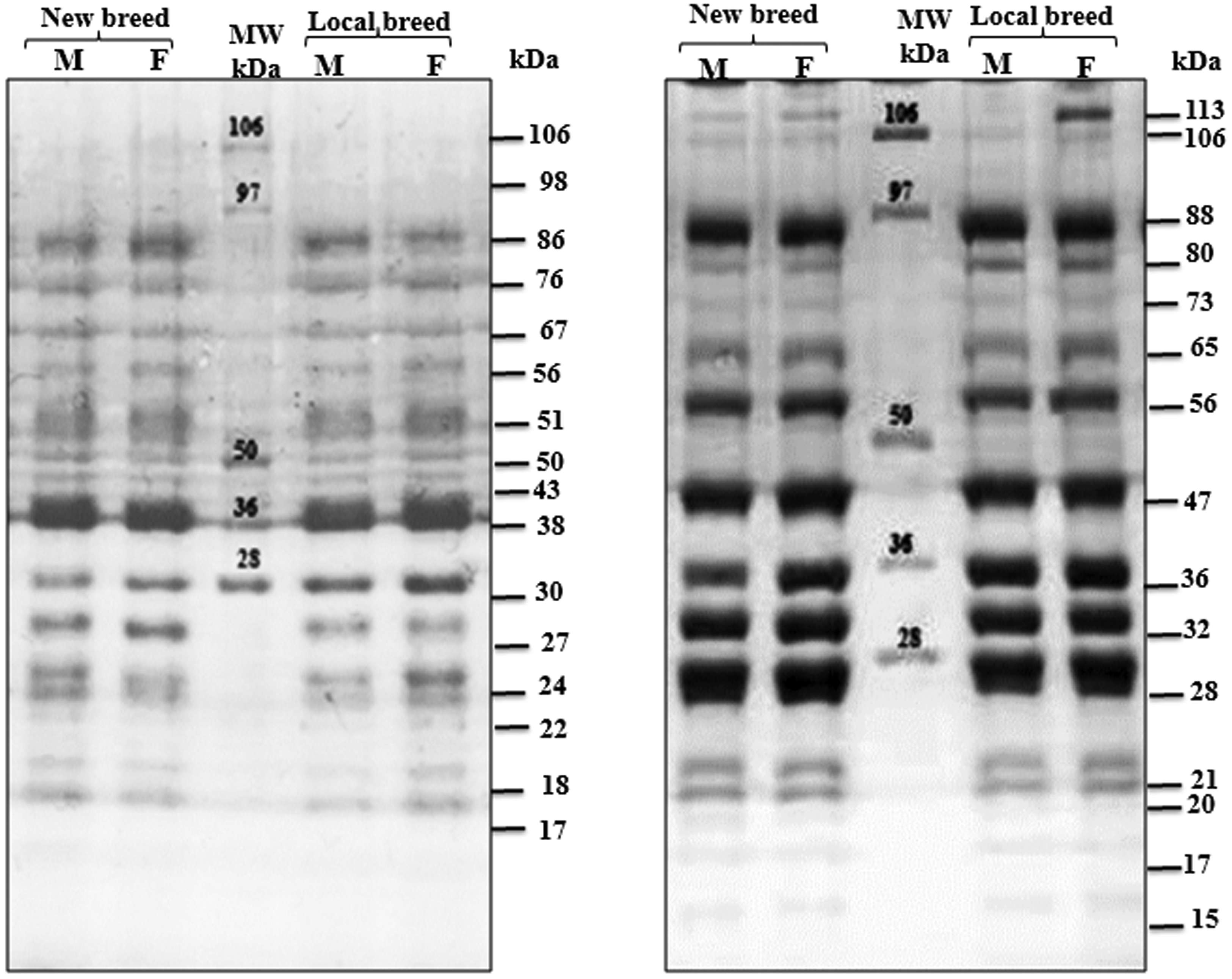
SDS-PAGE profiles of myofibrillar and sarcoplasmic proteins extracted from Longissimus lumborum of rabbit meat at 24 h postmortem. Left: Myofibrillar proteins. Right: Sarcoplasmic proteins. M: male; F: female.
According to the electrophoretic profile of the sarcoplasmic fraction, several bands were observed in protein extracts (Figure 1, right). Stained bands 24 h after slaughter had molecular weights of 15, 17, 20, 21, 28, 32, 36, 47, 56, 65, 73, 80, 88, 106 and 113 KDa. In both groups of rabbits, it was noticed that few bands corresponded to MW of 28, 32, 36, 47, 56 and 88 kDa which were bulky and characterised by a great intensity compared to the other bands; this is due to their high concentration in muscle. The comparison between the local and the new line has not shown any particular distinctions in the sarcoplasmic protein profiles of LL muscle in terms of number and intensity of bands. On the other hand, the intensity of sarcoplasmic bands was higher in comparison with myofibrillar pattern, which may suggest an increased rate of glycolysis properly due to several glycolytic enzymes increase in intensity early after animal slaughter (Marino et al., 2014).
Sensory analysis
In rabbit, sensory properties are amongst the main criteria influencing the consumer's choice (Dalle Zotte, 2002), especially regarding tenderness and flavour. These traits can be genetically determined by major genes or by sets of genes to moderate effects. If this is to be the case, sensory quality might be modified by selection or crossing. Even if sensory qualities are determined by a large number of genes with small effects, some breeds can have the favourable alleles in higher proportions than other breeds (Ariño et al., 2007). A quantitative descriptive analysis by a panel of trained assessors is a good way to objectively describe and compare the sensory properties of food products (Lawless and Heymann, 2010). Table 1 and Figure 2 show the average for the scoring of each trait of the sensory analysis. Among eleven sensory attributes of rabbit meat, the panelists scored highly tenderness, overall appreciation, rabbit flavour intensity and rabbit odour intensity. Whereas, the two genotypes were given lower scores for grass OI, fibrousness and residual. Similar findings were produced by Moumen and Melizi (2016), in their paper, on local Algerian rabbit reared in the Aures region (north-eastern part of Algeria), where sensory analysis revealed that meat was very tender, juicy and has a characteristic flavour. In this context, Dalle Zotte (2002) stated that rabbit meat is considered by the traditional consumer to have positive sensory properties: it is tender, lean and delicately flavoured.
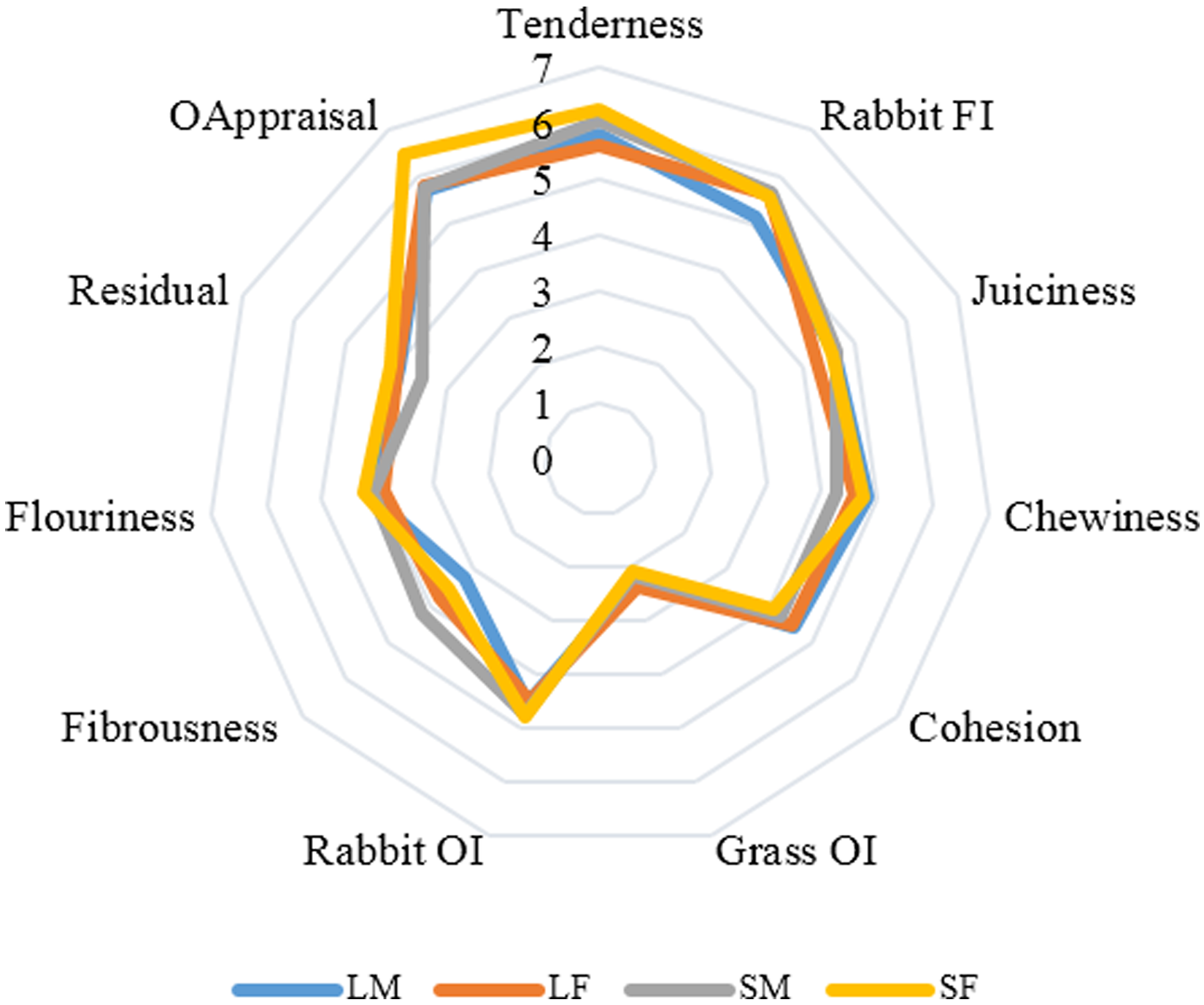
Sensory quality traits of LL muscle meat rabbit of local and new breed. Rabbit FI: rabbit flavor intensity; Grass OI: grass odour intensity; rabbit OI: rabbit odour intensity; OAppraisal: overall appreciation; LM: local male; LF: local female; SM: strain male; SF: strain female.
Martínez-Álvaro and Hernández (2018), in their study on LD muscle of rabbit meat using unstructured continuous line, have found similar scores to our results for some attributes such as: rabbit odour (4.53), rabbit flavour (4.15), juiciness (3.60) and fibrousness (4.50). Genotype and sex and their interaction have no effect on the sensory characteristics of rabbit meat (P > 0.05; Table 1). Our results agree with the study of Gasperlin et al. (2006), who have found that genotype has no effect on the main characteristic of rabbit meat, such as smell, colour, tenderness, juiciness and mouth feel. Similarly, Carrilho et al. (2009), in their research, found that sex has no effect on the sensory characteristics of rabbit meat. In disagreement with our results, Ariño et al. (2007) in their paper, found that line origin has an influence on some sensory traits determining rabbit meat tenderness. Whereas, line effect was not found for other sensory characteristics, or the effect found was very small. Cross tabulations using chi-square are presented in Table 2. Results of a paired preference test showed no statistically significant differences between meat samples from two breeds and sexes. This means that the two samples were essentially identical in terms of preference. This result confirms the previous findings obtained concerning the sensory traits scores attributed by the panelists. It is noteworthy that meat preference is not an intrinsic attribute of the product, but rather a subjective measure relating to the respondents’ affective or hedonic responses (ASTME2263, 2012).
Cross tabulations of paired preference test results according to breed type and sex.
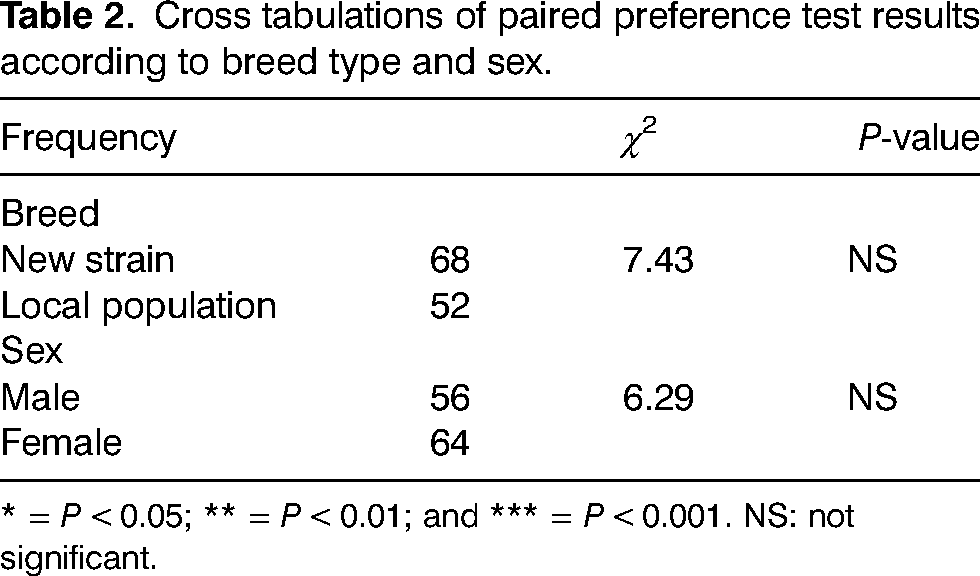
* = P < 0.05; ** = P < 0.01; and *** = P < 0.001. NS: not significant.
Correlations and PCA
Correlation coefficients between sensory properties and physicochemical traits of rabbit LL muscle are shown in Table 3. These measurements produced higher positive and negative correlation coefficients. The pHu of meat has a considerable influence on many other meat quality attributes, for example; pHu was positively correlated with FMI, tenderness, OAppraisal, rabbit OI, H* and negatively with PRW, grass OI, myoglobin, L*, b* and cohesion (r = −0.97; P < 0.05). Strzyzewski et al. (2008) reported that the concentration of hydrogen ions in muscles is also associated with meat colour, similarly, Kozioł et al. (2015) in their research found that pH value of meat 24 hours after slaughter is negatively correlated with the colour parameters L*, b* and C*. Our results are similar to those reported by Sampels and Skoglund (2021) where the ultimate pH was negatively correlated to b* values. The same results were previously observed on broiler breasts (Fletcher et al., 2000). It clearly shows that PRW % parameter has many high correlations with meat quality traits such us : MFI (r = −0.99; P < 0.05), myoglobin (r = 0.99; P < 0.05), rabbit OI (r = −0.96; P < 0.05), and a* and H* (r = −0.96; P < 0.05). Our results are also confirmed high correlation between PRW % and juiciness, grass OI and tenderness. It also appears that there was a very high positive correlation between tenderness and rabbit OI (r = 0.96; P < 0.05), juiciness, flouriness, OAppraisal a* and H*.Whereas, a high negative correlation was found with grass OI (r = −0.99; P < 0.05), cohesion, L* and b*.
Pearson's correlation coefficients between traits of the sensory analysis and physicochemical characteristics of rabbit meat from local and new breed.
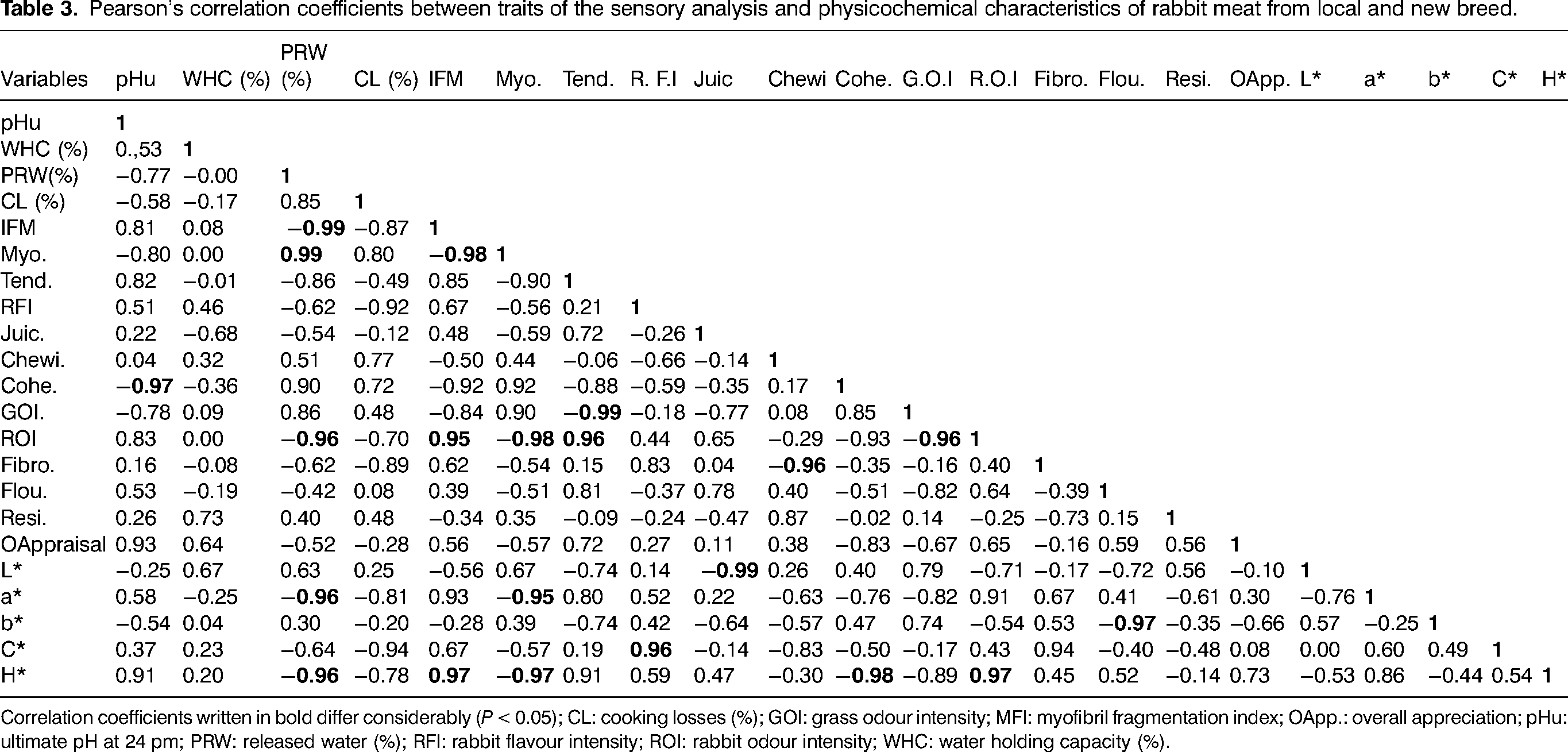
Correlation coefficients written in bold differ considerably (P < 0.05); CL: cooking losses (%); GOI: grass odour intensity; MFI: myofibril fragmentation index; OApp.: overall appreciation; pHu: ultimate pH at 24 pm; PRW: released water (%); RFI: rabbit flavour intensity; ROI: rabbit odour intensity; WHC: water holding capacity (%).
A better picture of the relationships between sensory quality and physicochemical characteristics is shown in the results of the principal component analysis. Figure 3(a) shows the projection of the variables on the plane defined by the two principal components, which explained an 82% of the total variability. The first principal component (horizontal axis) accounted for 56% of the total variance. This axis was explained by PRW (%), myoglobin, cohesion and grass OI on the positive parts which were positively correlated amongst themselves, but negatively correlated with the variables located on the left side of the figure such us: IFM, rabbit OI, tenderness, a*, H* and pHu. While, the second PC (vertical axis) explained a 25% of variability and mainly characterised by b*, C*, fibrousness and rabbit FI on the positive side. Whereas, on the opposite side we found other traits like: flouriness, CL(%), chewiness and residual. The variables near each other are generally correlated positively and those far from the origin show to be predominant in defining the principal component. It seems that physicochemical characteristics of rabbit meat contributed mostly in defining the first PC that is, they explained a large part of the observed variation, while the sensory properties described typically the second factor. PCA allows an instant visual identification of the variables that are correlated with each other, and with their direction. By plotting the parameters scores for PC1 and PC2, it can be seen how the variables are placed in the multivariate space. Two distinctive groups according to genetic type and sex are presented in the bi-plot (Figure 3(b)). The first two axes were able to discriminate between the local and the new breed groups and between males and females for the selected variables. The rabbits of the local breed are grouped on the right side and the new line rabbits are on the left side. According to the Figure 3(b) and (c) we find that male and female animals of the local breed are located near the first PC and contributed mainly in its definition rather than the new strain group. By observing the right region of the graph reported in (Figure 3(b)), two groups (local male and female breeds) can be differentiated. All the meat samples from those groups have high PRW, myoglobin, cohesion, CL(%), chewiness and grass OI, but the new strain group (male and female) appeared to have high values of IFM, rabbit OI, tenderness, a*, H* and pHu. The results from this statistical approach reinforce the differences previously described between the two groups studied, where using different breeds (crossbreeding) and sex of animals produces meat with different quality parameters.
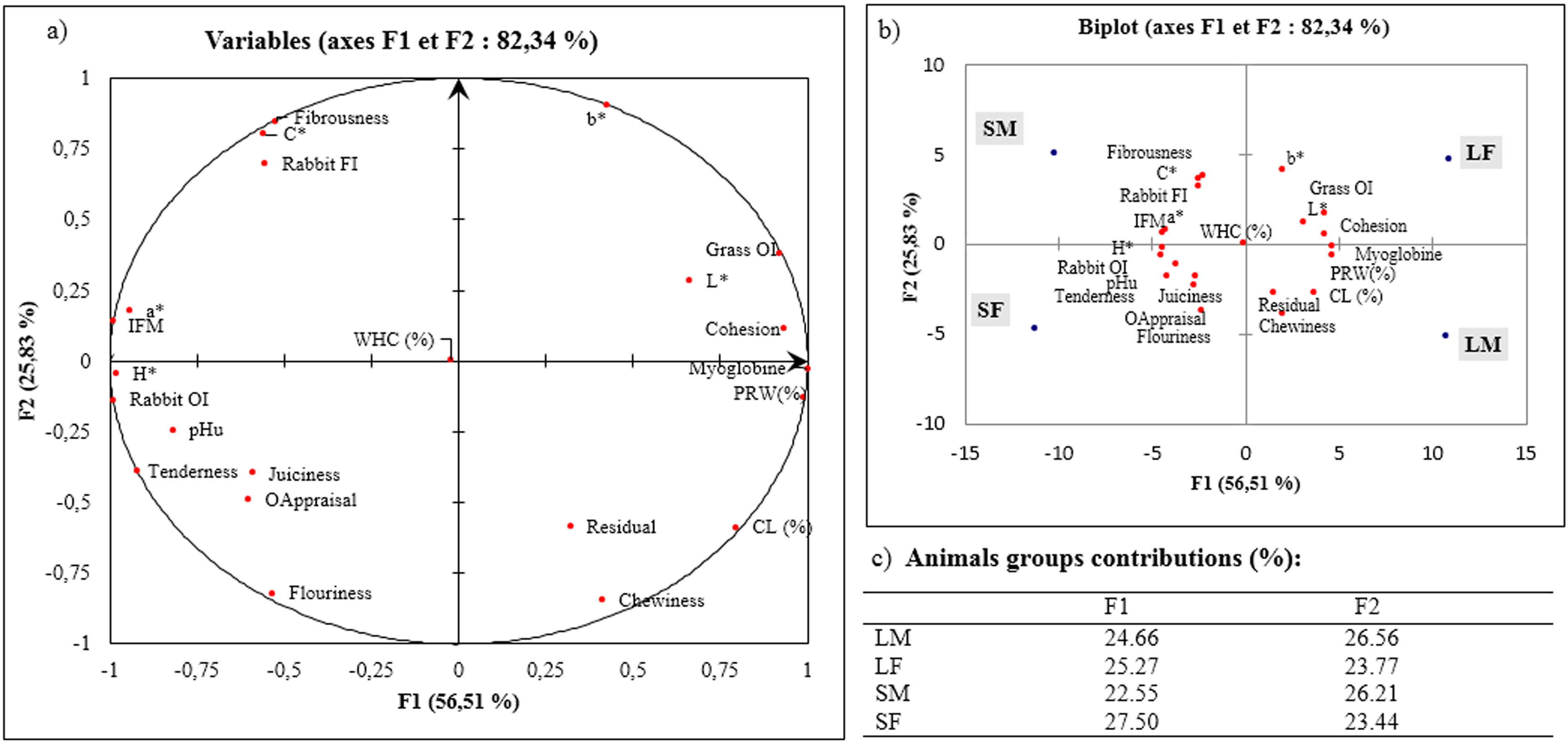
Principal component (PC) analysis of rabbit meat traits quality. a) Projection of the studied variables in the two first components. b) Bi-plot of the animal groups observations on the two first principal components. c) Animals groups contributions (%). pHu: ultimate pH at 24 p.m; WHC: water holding capacity (%); PRW: percentage of the released water (%); CL: cooking losses (%); MFI: myofibril fragmentation index: Rabbit FI: rabbit flavour intensity; Grass OI: grass odour intensity; Rabbit OI: rabbit odour intensity; OAppraisal: overall appreciation; SM: Strain male; SF: Strain female; LM: local male; LF: local female.
CONCLUSION
This study found considerable differences in the physicochemical properties of the LL muscle traits among two rabbit breeds. The results indicate that the meat of the new breed was tenderer and had less cooking losses and less percentage of released water values compared to the local one. Additionally, a high significant difference was found in the myoglobin concentration and the values of some colour parameters between the two groups studied. However, no relevant differences in meat from male compared to female rabbits were found in the aggregate number of the analysed meat quality variables. Sex might be regarded as a minor factor which affected rabbit meat traits. The meat of the new breed appears to have similar sensory properties to those of the local breed commonly consumed by Algerian people. However, results of the present experiment provide further information about meat physicochemical characteristics quality of the new line (ITELV 2006) and confirmed a possible positive effect of the crossbreeding on meat qualities. The results obtained here, could positively influence the acceptability of synthetic rabbit meat by the Algerian consumers.
Footnotes
DECLARATION OF CONFLICTING INTERESTS
The authors declared no potential conflicts of interest with respect to the research, authorship, and/or publication of this article.
FUNDING
The authors disclosed receipt of the following financial support for the research, authorship, and/or publication of this article: This work was supported by the Algerian Ministère de l'Enseignement Supérieur et de la Recherche Scientifique.
