




Abstract
Consumers are worried about potential contaminants, especially during any pandemic event, and are demanding more biodegradable food packaging with little to no chemical preservatives. This study aims to prepare carrageenan film containing essential oil with antibacterial properties. Oregano essential oil is successfully added into the carrageenan-based film using the Pickering emulsion method with cationic nanocellulose as stabilizer. The positive charge of nanocellulose enhances the stability of emulsion through strong electrostatic interaction with the Oregano Oil. FTIR spectra and SEM micrographs show the Oregano Pickering emulsion (OrePE) well dispersed in the polymer matrix and good compatibility with carrageenan film. The mechanical and thermal properties of carrageenan film were only slightly affected by the addition of OrePE. The tensile strength of films significantly decreased, whereas the elongation break increased following the addition of OrePE. Moreover, the addition of OrePE to the carageen film provides inhibitory effects on gram-positive (S. aureus) and gram negative (E. coli) bacteria. This innovative incorporation of essential oil into biopolymer films by Pickering emulsion technology may have implications for extending the shelf life of food products which is indicates that the material has the potential to be used in active packaging.
INTRODUCTION
A packaging system was used to either close or coat foods to help most food products reach the consumer. Simply, the quality and safety of food for consumers are maintained by packaging, enabling foods to travel safely for long distances and still be wholesome at the time of consumption (Marsh and Bugusu, 2007; Pavli et al., 2018). This is making food packaging an essential stage in the food chain, and it drives the packaging industries to pay more attention to the development of packaging technology.
Today, heightened environmental consciousness and concerns regarding food safety and the environmental impact of non-degradable plastic packaging waste make packaging technology about food protection and must balance with other problems, including the raw material resource (Marsh and Bugusu, 2007; Roy and Rhim, 2021). One innovative packaging technology, biopolymer-based active packaging, is a sustainable and environmentally friendly technique to extend the shelf life of food without sacrificing food safety and quality (Roy and Rhim, 2021). Functional packaging materials based on biopolymers have emerged due to impressive characteristics, such as abundant availability, renewability, biodegradability, biocompatibility, and the potential for developing novel functional composite materials (Saedi et al., 2020).
Natural material such as chitosan, starch, pectin, and cellulose are being used to manufacture packaging materials in the present active packaging development trend (Wu et al., 2021). As one of such biopolymers, carrageenan has been widely used to prepare functional packaging films due to its excellent film-forming property with high mechanical strength (Saedi et al., 2020). Carrageenan is a group of sulfated polysaccharides made up of a repeating disaccharide unit of sulfated galactose and anhydrous-galactose connected via α-1,3 and β-1,4 glycosidic linkages. Carrageenan is an anionic polysaccharide isolated from cell walls of red seaweed (Rhodophyta) (Brychcy et al., 2015; Farhan and Hani, 2017; Saedi et al., 2020; Tye et al., 2018; Wang et al., 2012; Webber et al., 2012). Carrageenan is characterised depending on the number and position of sulfate groups. Carrageenan is categorised as Kappa (κ), Iota (ι) and Lambda (λ) based on its sulfate substitution pattern and 3,6-anhydro galactose content. The structure of kappa carrageenan contains 25–30% sulfate ester group and 28–35%3,6-anhydrogalactose, whereas the structure of Iota carrageenan contains 28–38% and 25–30%, respectively. There is no 3,6-anhydrogalactose in the Lambda structure, although it does include 32–39 percent sulfate ester. The different structure of carrageenan affects the gel-forming properties (Saedi et al., 2020; Webber et al., 2012; Zarina and Ahmad, 2015).
Previously, food packaging provided a traditional technology that only served one purpose: to protect items from external damaging forces; however, modern packaging technology has evolved into multi-functional protection. The modernisation of a packaging system with advanced technology such as smart packaging, active packaging, and intuitive food freshness is being developed and applied (Wu et al., 2021). A type of packaging in which the food product, the packaging material, and the environment interact is known as active packaging. When food is stored in this active packaging type, the shelf life will increase due to the chemical, physical and biological activities that aggressively alter its state without compromising food quality. Several beneficial functions and properties could find out in active packaging, such as moisture content controller, oxygen scavenger (Gaikwad et al., 2018), control ethylene and carbon dioxide diffusion, and inhibition microorganism or antibacterial agents (Rai et al., 2019). Currently, because of the deterioration of foods and foodborne diseases caused by the growth and reproduction of microorganisms, the most active packaging used is antibacterial packaging (Pavli et al., 2018; Wu et al., 2021).
Currently, the demand for bioactive agents is experiencing attachment due to increasing attention to the safety issues of active chemical ingredients that are widely used in active packaging. To this end, essential oils from plants are generally regarded as GRAS food additive and have significant antibacterial qualities, making them acceptable for use in active packaging (Simona et al., 2021). Using essential oils in active packaging applications is a cost-saving alternative and can reduce food safety risks (Wu et al., 2021).
Recent studies have demonstrated combining biodegradable materials with essential oil to prepare active packaging films. However, the direct application of EOs into biopolymer-based packaging materials faces various challenges such as insolubility and loss of activity because of rapid volatilization of its components which can decrease their effectiveness (Dávila-Rodríguez et al., 2020; Hashemi Gahruie et al., 2017). Thus, surfactants usually combine biodegradable material with essential oil (Dávila-Rodríguez et al., 2020). However, the addition of surfactant made the packaging films prepared in this way is not true green active packaging material. Pickering emulsion (PE) method is considered a fascinating approach that can be used to solve this problem (Dávila-Rodríguez et al., 2020). Pickering emulsion is solid particles instead of surfactants stabilized emulsion system. The emulsion droplets aggregation is effectively prevented by irreversible adsorbing the solid particles on the oil-water interface of the emulsion. This endows PE with better physical stability (Saffarionpour, 2020; Sanchez-Salvador et al., 2019). At present, chitosan, pectin, and nanocellulose have been used as solid particles to stabilize PE for any application (Dávila-Rodríguez et al., 2020; Feng et al., 2022; Roy and Rhim, 2021).
Nanocellulose has amphiphilic surface properties derived from the cellulose chain's hydrophobic face and hydrophilic edges. It makes the particle stabiliser intact in both stages for the PE system's duration, thus making these solid particles able to stabilise the oil/water interface efficiently (Amanda et al., 2021; Fujisawa et al., 2017; Roy and Rhim, 2021). In PE, the excellent mechanical properties of nanocellulose such as high modulus, strength and low coefficient of thermal expansion play an important role in structurally stabilising the interfaces. Moreover, the emulsions’ stability is affected by surface modification of nano cellulose due to the ability to tailor wettability at the oil/water interfaces (Capron et al., 2017; Saffarionpour, 2020).
This study used cationic nanocellulose as pickering agent in Oregano essential oil. Cationic nanocellulose is quaternary ammonium compounds that is frequently utilized for its antibacterial capabilities, low toxicity, low cost, and friendliness with the environment. Cationic nanocellulose exhibited good interactions with negatively charged material (Chaker and Boufi, 2015; Ghasemlou et al., 2021), such as essential oil. The strong interaction between cationic nanofibrils and anionic essential oil may also enhance the stability of the emulsion. Furthermore, there are limited reports on manufacturing functional nanocomposite films containing Oregano essential oil using cationic nanocellulose as a Pickering agent. Although numerous studies on the fabrication of composite films employing oregano oil-based PE and various biopolymers have been published (Gaikwad et al., 2018; Zarina and Ahmad, 2015)], to the best of our knowledge, no work on the use of cationic nanocellulose as a pickering agent. Therefore, the objective of this work was to investigate the effect of cationic nanocellulose on the Oregano oil Pickering emulsion and applied the emulsion to carrageenan films and then investigate the physical and functional properties such as structural, mechanical, thermal, and antibacterial properties of the carrageenan-based film with the addition the Pickering emulsion of Oregano essential oil.
MATERIALS AND METHODS
Materials
Food grade Kappa-carrageenan were procured from INDOgum (Indonesia). Cationic Cellulose nanofiber was obtained from Oil Pal Empty Fruit Bunch (OPEFB) cellulose was reacted with GTMAC following a procedure adapted from literature (Mautner et al., 2017) with modification (Surface charge Zeta potential was +35 mV). Oregano essential oil was acquired from a commercial product with a purity of 99% (Young living). Glycerol was obtained from Sigma Aldrich (Singapore).
Preparation of pickering emulsion
Oregano oil-based Pickering emulsion (OrePE) was prepared using cationic cellulose nanofibrils (C-CNF). 1 wt% C-CNF aqueous solution was prepared by stirring for 2 h, 10% v/v Oregano oil was mixed with the C-CNF aqueous solution at 7000 rpm for 5 min by ultra turax (IKA T25, Staufen, Germany).
Emulsion characterization
Zeta potential
The particles’ surface charge and stability in aqueous suspension were determined using zeta potential, and Horiba SZ-100 confirmed the particle size distribution.
Optical micrograph
Microscopic characterization of pickering emulsion viewed using an optical microscope Keyence VHX600 fit digital camera. The size distributions of oil droplets were determined from optical micrograph picture using ImageJ and origin software.
Preparation of film
The carageen integrated PE film was prepared using a solution casting method. For this, 2 gr of carrageenan was added to aqua dest containing 30 wt% glycerol (based on polymer) as a plasticiser. The mixture was cooled at 50°C, a various amount of CCNF-OrePE (1,3 and 5% v/v) were added to the solution and agitated for 1 h at 50°C. The antibacterial activity of OrePE had investigated before we choose the concentration of OrePE that added to the film. The film-forming solution was cast onto a flat Teflon and dried for 48 h at 40 ± 2°C The dry film was scraped off a glass plate and conditioned for at least 72 h at 25 °C and 50% relative humidity. The produced films were Carrageenan (Car), Car/CCNF-OrePE1, Car/CCNF-OrePE3, Car/CCNF-OrePE5.
Film characterisation
FTIR spectroscopy
FTIR spectra of the film samples were recorded using an FTIR spectrometer (Perkin Elmer Spectrum Two) in attenuated total reflection (ATR) mode with the wavenumber ranging from 4000 to 5000 cm−1 at 16 scan rates with the resolution of 4 cm−1.
Morphology
The film's microstructure was observed using FESEM (FE-SEM Thermo Scientific Quattro S) at an accelerating voltage of 1 kV.
Mechanical properties
The film sample was cut into rectangular strips (2.5 × 10 cm) using a high precision double-blade cutter and measured the film thickness using a Digital Caliper Mitutoyo-500 with an accuracy of 1 µm. The mechanical properties of the film, such as tensile strength (TS), elongation at break (EB), and elastic modulus (EM), were tested using a Shimadzu AGS-X series 5 kN Universal Testing Machine (UTM) according to the standard technique of ASTM D 882–88.
Thermal stability
The thermal stability was evaluated using a thermogravimetric analyser (Perkin Elmer 4000). For this, ∼10 mg of film sample was taken in a standard aluminium pan and scanned at a heating rate of 10 °C/min in a temperature range of 25–750 °C under a nitrogen flow of 20 cm3/min. The phase transition was measured by differential scanning calorimetry (DSC) Perkin Elmer 4000 with Pyris-1 analyser, at a temperature of 25–350 °C and constant heating rate of 10 °C/min.
Moisture content, swelling ration and water solubility
The films’ MC content was checked by determining the weight change of the film after drying at 105 °C using Moisture Analyser Shimadzu Type MOC63U. The percentage of MC content of the films was calculated in triplicate. A swelling ratio is determined using equation (1). A pre-weighed film sample was placed in a beaker containing 20 mL DI water, removed from the water after one hour, blotted to remove surface water, and weighed. The SR of each film was calculated three times.

The pre-dried film sample was placed in a beaker containing 30 mL DI water, which was covered and left at room temperature for 24 h with gentle agitation. The film specimen was then removed and dried for 24 h at 105°C in a hot air oven before being weighed. The following equation (2) was used to compute the WS of the film sample.

Antibacterial activity
Antibacterial activity of biodegradable film against S.aureus and E.coli was determined using the disc diffusion method similar to the method reported by Rosalina et al. (2018) with modification. First, inoculate the bacterial cultures into Nutrient Broth (NB) media to prepare the bacterial suspension, then incubating them for 18–24 h at 37 °C. Second, the bacterial suspension was streaked on the surface of the Nutrient Agar (NA) media on a petri dish. After that, the biofilm, control positive and control negative, were placed on the NA media, then incubated for 24 h at 37 °C. Control positive is ciprofloxacin 50%, while control negative is sterile distilled water. Third, the inhibition zone was determined by calculating the clear zone diameter.
Statistical analysis
Individually made films in triplicate used as replicated experimental units for measuring film qualities. Using the SPSS 16.0 version statistical analysis computer program for Windows (SPSS Inc., USA), a one-way analysis of variance (ANOVA) was done, and the significance of each mean property value was determined (p < 0.05) with Duncan's multiple range test.
RESULT AND DISCUSSION
Pickering emulsion properties of cationic-CNF/OrePE
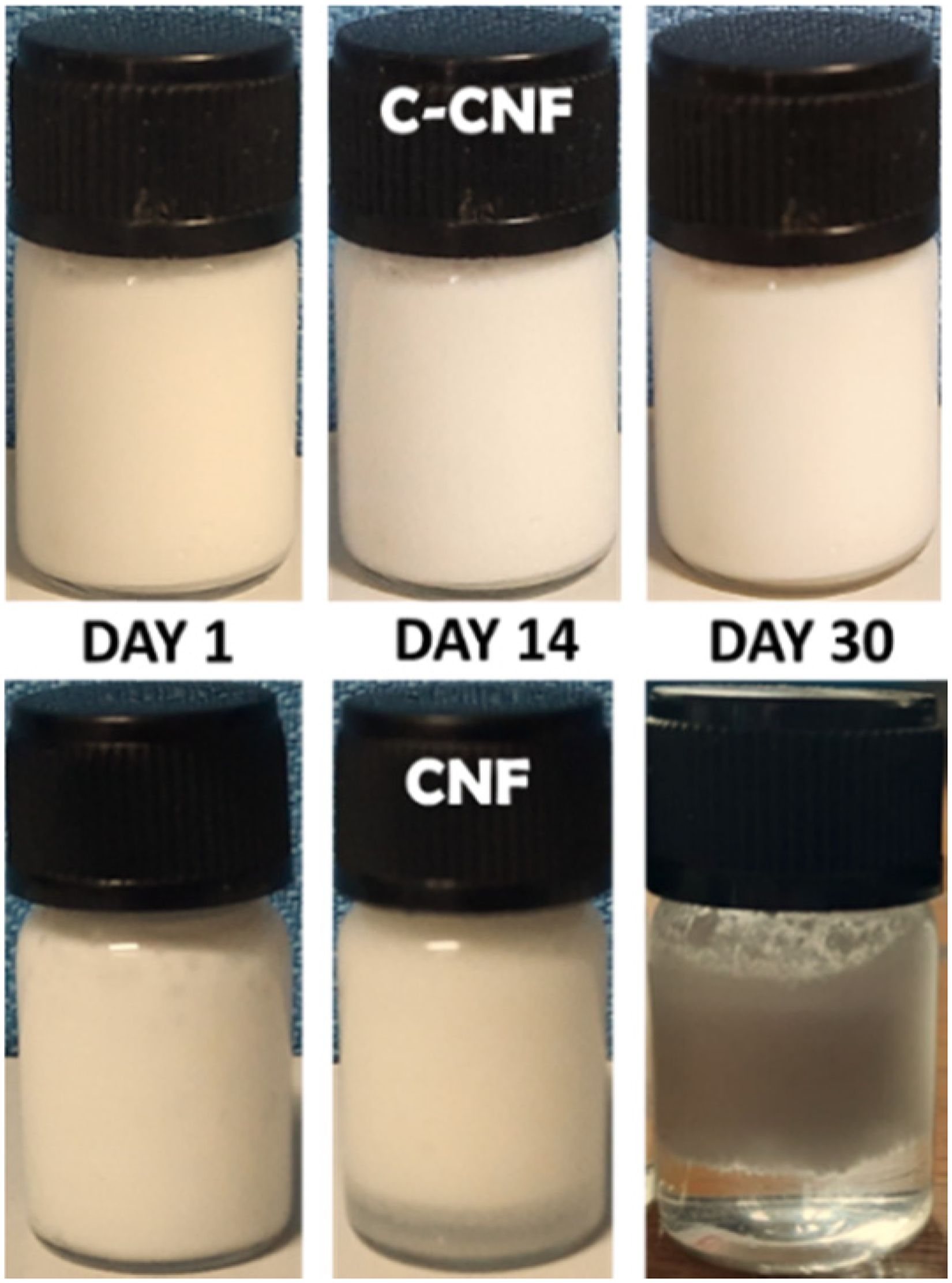
It is known that many parameters, such as oil/water ratio, particle concentration, pH, surface activity, and ionic strength, affect the stability of the PE (Zoppe et al., 2012). At oil-water interfaces, ionic strength plays a significant role in regulating electrostatic interactions between nearby nanoparticles (Destribats et al., 2014). This research uses cationic cellulose nanofibrils which have different charges with Oregano oil. The intermolecular force between the positive charge of cationic nanocellulose and oregano oil make the emulsification process faster and the emulsion more stable. To clarify the influence of charges, we prepared two types of oregano oil pickering emulsion, using CNF pristine and Cationic CNF and then stored them for 30 days. The difference in emulsion stability is shown in Figure 1.
The difference of OrePE stability with two different charges of nanocellulose.
Figure 1 shows the stability of the emulsion, which is stored for 30 days. The CCNF/OrePE formed a very stable emulsion with no serum layer in 30 days stored. On the other hand, the OrePE stabilized by CNF displayed a separating serum layer in 14 days stored and more separated in 30 days stored. This result provides that the nanoparticle charge affected the PE stability.
Particle Size Analysis and zeta potential were used to identify the Pickering emulsion's size and stability. The Zeta potential of the aqueous phase greatly influences the stability, aggregation, flow, and sedimentation of the Pickering emulsion (Zhou et al., 2018). Figure 2 presented the emulsion of oregano oil (10% v/v) with and without addition CCNF. The light-yellow colour produced of Pickering emulsion Oregano oil stabilized by Cationic nanocellulose fiber (OrePE) indicated that the oregano oil was loaded.
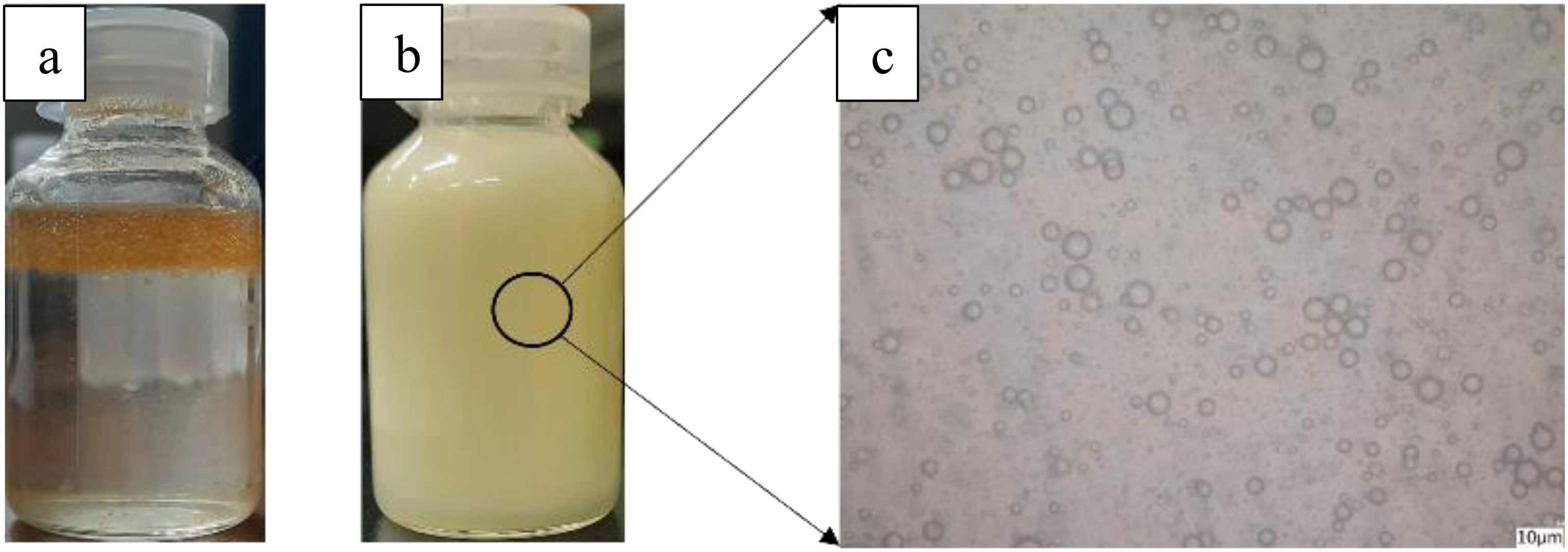
(a) The emulsion without CCNF, (b) Emulsion with CCNF (c) Optical micrograph of CCNF/OrePE emulsion.
The hydrodynamic size of the OrePE was 67.41 ± 2.24 µm, and it is in good agreement with the range of droplet size of emulsion, which findings by 3D Digital Microscope; 70 ± 1.57 µm, the range droplet size of emulsion were calculated using ImageJ. The result shows the emulsion type is a microemulsion, which is different from the result reported by Liu et al. (2019). The emulsion type of oregano oil PE stabilized by Soy soluble polysaccharide complexes was in nanoscale with an average particle size of 162.1 nm (Liu et al., 2019). The size of the droplets formed, and the oil/water ratio determines the stability of the emulsion droplets to coalescence. At the same concentration of nanoparticles, nanoparticles may not be sufficiently capable of covering an increased interfacial area at higher oil concentrations. Thus, the interracial area decreased, and the smaller drops fused quickly together later. Thus a high oil/water ratio results in a larger droplet than a lower oil/water ratio (Aveyard et al., 2003; Hu et al., 2016; Leal-Calderon et al., 2007; Trajkoska-bojadziska et al., 2021)
The surface zeta potential of OrePE was +66.8 ± 0.5 mV in day 1, and +65.13 ± 0.5 mV, +60.03 ± 0.4 mV in day 14 and 30 respectively. The positive charge was originally from the cationic cellulose nanofibril that was used. When the absolute value of the emulsion system's zeta potential is ±30 mV or more, an emulsion system is known to maintain sufficient stability. Physically, the stability of the emulsion can be seen in Figure 1, which is no different in 30 days stored and this result is supported by the zeta potential value which does not change significantly during 30 days of storage.
Properties of carrageenan/Ns-OrePE films
Apparent and morphological properties
The apparent color of carrageenan film is shown in Figure 3(a). The carrageenan film is transparent and colorless, and the OrePE integrated film has a pale yellow color due to the oregano essential oil. The color change of the film with increasing OrePE concentration was also measured using a color reader Konica Minolta CR-10, and the results showed that ΔE for OrePE film samples was 0.75, 2.4, and 9 for Car/CCNForePE1, Car/CCNForePE3, Car/CCNForePE5 respectively, this indicates an increase in concentration. The added OrePE makes the film color darker (brown yellow).
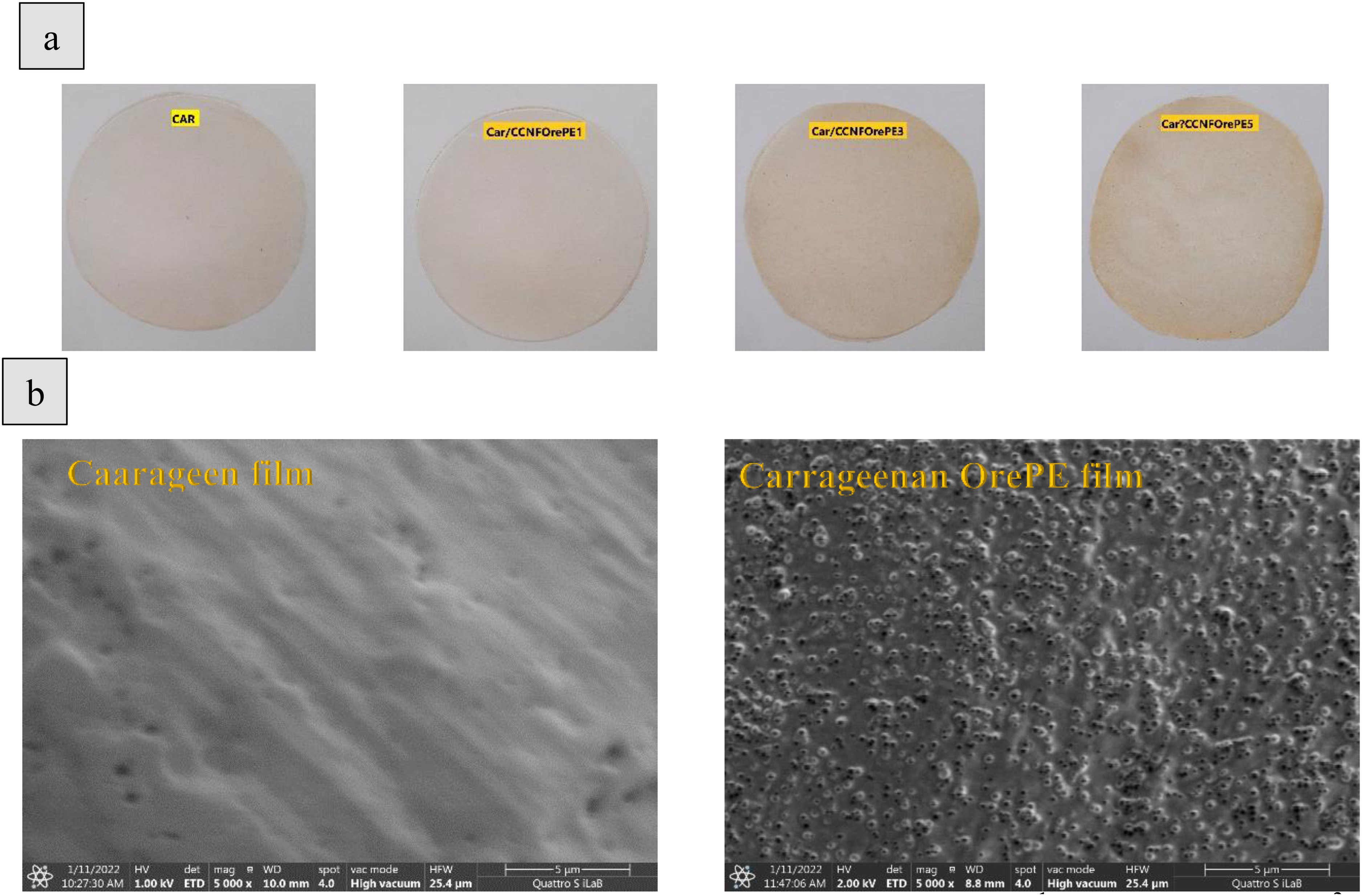
(a) Digital images of the films (Car, Car/CCNFOrePE1, Car/CCNFOrePE3, Car/CCNFOrePE5 (b) FESEM surface image of carrageenan and carrageenan added OrePE films.
Figure 3(b) showed FESEM microscopic images of film carrageenan without and with essential oil. The carrageenan film shows smooth homogenous surfaces indicating an effective plasticisation of the carrageenan by glycerol. The film carrageenan with OrePE revealed an excellent distribution of Pickering emulsions droplets embedded within the film matrix. The positive charge of OrePE contributed to the good compatibility of OrePE with the Carrageenan matrix. Carrageenan molecules carry negative charges due to comprising negatively charged SO42− suspended groups; this enables them to combine good with positively charged. Moreover, the OrePE droplets spread evenly over the carrageenan matrix without forming aggregations. The SEM image showed the film carrageenan with 5% wt of OrePE, confirming the presence of microemulsion droplets in the carrageenan-based film. Most importantly, even at 5% wt, the dispersion of the microemulsion showed good compatibility between the polymer matrix and the emulsion.
FTIR spectroscopy
In this study, FTIR research using the attenuated total reflectance (ATR) technique revealed the chemical structure of the generated carrageenan films in greater detail. Figure 4 illustrates the FTIR spectra of all of the films. The major structural component's presence is reflected in the observed spectra. The spectrum of the control sample (Car) shows a spectrum of the principles film-forming carrageenan and plasticizer (glycerol). The broad absorption band centered at 3300–3400 cm−1 is attributed to the stretching vibration of O-H bonds found throughout the film component.
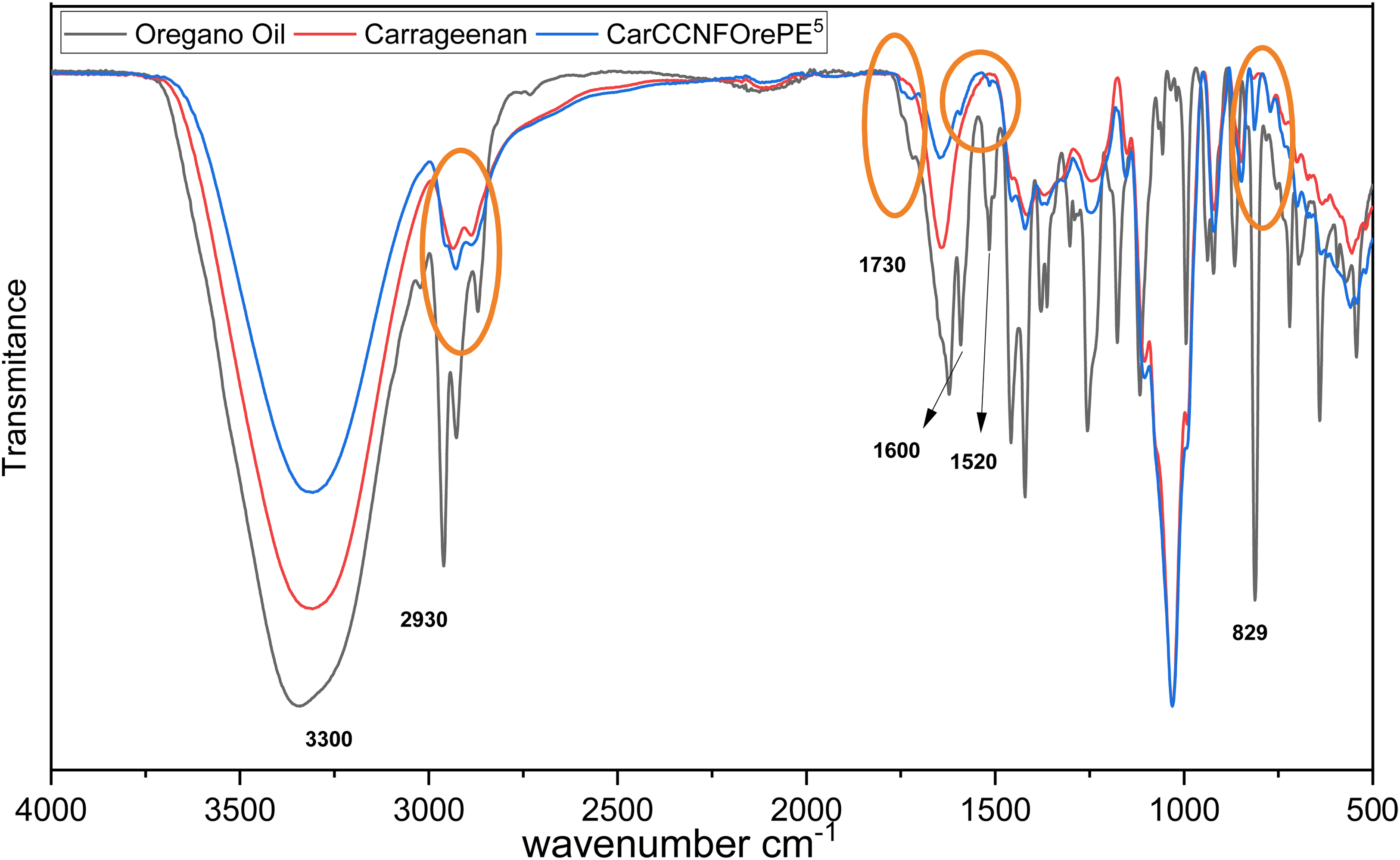
FTIR Spectra of the OrePE added carrageenan-based films.
First asymmetric and symmetric stretching vibrations of C-H bonds in carrageenan methylene groups are located at 2930 and 2870 cm−1, respectively. Second, the characteristic vibration pattern of oxygen-containing groups in carrageenan can be found in the region from 900 to 1100 cm−1, named at 910 cm−1, C-O stretching in 3,3 anhydro-d-galactose, 1035 cm−1 and 1063 cm−1 C-O and C-OH modes and glycosidic linkage and 1249 cm−1 COC symmetries stretching. Lastly, the sharp peak in a specific fingerprint pattern at 730–700 cm−1 is manifested as the skeleton bending of pyranose. Unlike the well-distinguished spectral featured of carrageenan characteristic C-C and C-O, vibration bands of glycerol commonly occurring in her range 850–1100 cm−1 are not easily identified in the spectra as the carrageenan signal overlaps them even at its lower content in the film (Simona et al., 2021).
Oregano essential oil consists of the main components are carvacrol, beta-fenchyl alcohol, thymol and gamma-terpinene. The main functional groups are O–H, C = O and C = C, and Csp2-H and Csp3-H. The O-H stretch shows at around 3500–3300 cm−1 in the IR spectra of phenols group. Furthermore, the IR spectra will show the bands typical for aromatic chemicals in the 1500–1600 cm−1 range and Carbonyl group in 1730 cm−1.
The peak of the C = O band was shown in 1730 cm−1 in OrePE integrated Carrageenan, demonstrating the successful incorporation of oregano within the film. Furthermore, the presence of the peaks between 1520 and 1600 which are the peaks of aromatic and C = C bonds verifies the presence of integrated OrePE in the carrageenan film (Altaf et al., 2021). In addition, The physical interactions (van der Wall interactions and H-bonds) between the biopolymer and the active ingredients in the microemulsion) resulted in the different intensity of peak (Agarwal et al., 2020; Roy and Rhim, 2021)
Physical properties (moisture content, swelling ratio and water solubility)
Table 1 shows the moisture content (MC), swelling ratio (SR), and water solubility (WS) of the films. The addition of OrePE significantly (p < 0.05) reduced the MC of the carrageenan film. The reduced absorption of water molecules due to the intermolecular interaction between the polymer and the hydrophobic microemulsion led to a significant decrease in the MC of the film. Adding a PE of sunflower seed oil stabilized with cellulose nanofibers to konjac glucomannan-based films resulted in a similar reduction in MC (Liu et al., 2020) and gelatin/agar-based functional film integrated with PE of clove essential oil stabilized with nanocellulose (Roy and Rhim, 2021).
Moisture content (MC), water solubility (WS), swelling ratio (SR).

Different letters in the same column indicate a statistically significant difference (p < 0.05).
In addition to MC, the solubility of the films in water (WS) is also essential for food packaging systems. WS is an essential index of hydrophilicity properties for films packaging. Many food products contain high moisture content, so the packaging system with low water solubility is more desirable in such instances. The WS of the neat Carrageenan film was 50.76%, indicating that the film is highly water-soluble, mainly due to carrageenan's high hydrophilicity. The concentration and the index of hydrophobicity and hydrophilicity of the raw materials affect the solubility of the film's material. In our case, the solubility of the films decreased in line with the concentration of OrePE. The solubility of the films was reduced in line with the increase of the OrePE in films which was most likely due to the hydrophobicity of the microemulsion and the film containing a higher concentration of OrePE have lower water solubility. The water solubility trend demonstrated by OrePE films complied with earlier studies (Liu et al., 2020; Roy and Rhim, 2021; Zhou et al., 2021).
The Swelling ratio (SR) of the neat carrageenan film was 267.30%, indicating that the film had moderate water-holding power. The addition of OrePE reduced the SR of the composite film compared to the neat carrageenan film, probably due to the increased intermolecular interactions and hydrophobicity by OrePE.
Mechanical properties
Mechanical properties are used to determine the structural integrity of films. Table 2 shows the mechanical properties of the carrageenan-based film. The addition of the OrePE improved the film thickness in proportion to the content of OrePE, mainly due to the increased solid content by the nanocellulose fiber in the OrePE. Previously, it was reported that adding PE stabilized with nanocellulose fibers increased the thickness of the konjac glucomannan film (Liu et al., 2020) and the gelatin/agar film (Roy and Rhim, 2021).
Mechanical properties of carrageenan film integrated OrePE.

Different letters in the same column indicate a statistically significant difference (p < 0.05).
Carrageenan film displayed the highest tensile strength (TS) value and elongation at break (EB) values among all the samples, 2.47 MPa and 47.24%, respectively. For a film with OrePE, there were significant changes (p > 0.05) in TS values. The tensile strength results show that the addition of OrePE reduces the TS value. The results were consistent with previous studies reporting that due to the phase separation effect rooting from the difficulty for lipophilic species to form the cohesive matrix, the TS values decreased because of the presence of oil droplets (Liu et al., 2019). These can be attributed to replacing stronger polymer chain-to-chain interactions with weaker polymer emulsion droplet interactions, weakening the continuous film matrix and reducing the film's TS (Zhou et al., 2021). This may be attributed to the effect of plasticization (Sun et al., 2020). Several works have reported the plasticizing effect on the film, such as xyloglucan-based-emulsion films (Rodrigues et al., 2018) and gelatin–palm oil emulsion film.
Similar to the TS values of films, the stiffness (EM) of the carrageenan film was also decreased along with addition of OrePE, although there was no significant difference with the increase in the concentration of added OrePE. On the other hand, the flexibility (EB) of the film increased linearly with increasing OrePE concentration. It increased EB associated with the wrapping of oil by nanoparticles (Pickering agent), causing the interruption of polymer chain aggregation in the biopolymeric matrix, which facilitates the polymer chain sliding during stretching.
In general, although the addition of OrePE does not significantly increase the mechanical properties of carrageenan films, the inclusion of OrePE also does not negatively affect the mechanical properties of carrageenan films. Furthermore, the mechanical properties of carrageenan/OrePE exhibit a similar trend to prior findings of the addition of a Pickering emulsion incorporated with cinnamon essential oil to sodium starch octenyl succinate-based film (Sun et al., 2020) or Zataria multiflora essential oil nanoemulsion incorporated in seed gum-based edible film (Hashemi Gahruie et al., 2017). However, slightly different results also have been reported by Souza et al. (2021) who developed thermoplastic starch-based films enhanced with nanocellulose-stabilized Pickering emulsions containing other essential oils (Souza et al., 2021). They discovered that adding PE of Cinnamomum Camphora essential oil boosted the film's strength whereas adding Pickering emulsion of Cardamom essential oil diminished it. Also, when a low content (2%) of Pickering emulsion of cinnamon essential oil was applied to the film, the TS increased, but when a high content (5%) was added, the TS reduced. This suggests that numerous aspects such as the type, compatibility, and concentration of essential oils and polymer matrix can affect the mechanical properties of films with the addition of a PE.
Thermal stability
The TGA thermograms of the carrageenan base film are presented in Figure 5(a). All the carrageenan-based films exhibited a multistage of thermal decomposition. The initial weight change was observed at 60–120 °C due to the evaporation of physisorbed moisture (Ni et al., 2018; Salama and Abdel Aziz, 2020; Van Hai et al., 2020). The second weight loss occurred at 130–270°C with a maximum decomposition at around 240°C, due to the thermal degradation of plasticiser (glycerol) and while the final step degradation occurred at 270–400 °C with a maximum degradation around 310°C due to the degradation of carrageenan (Rane et al., 2014; Saedi et al., 2020).
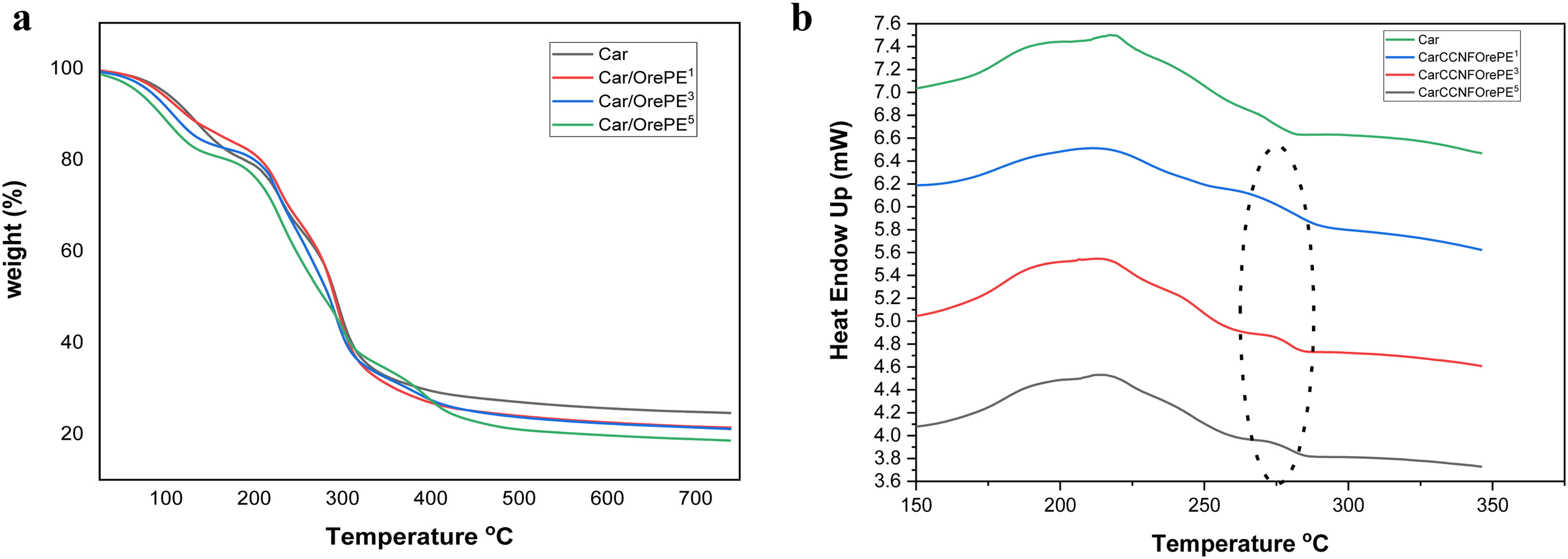
(a) TGA (b) DSC thermograms of the OrePE added carrageenan-based films.
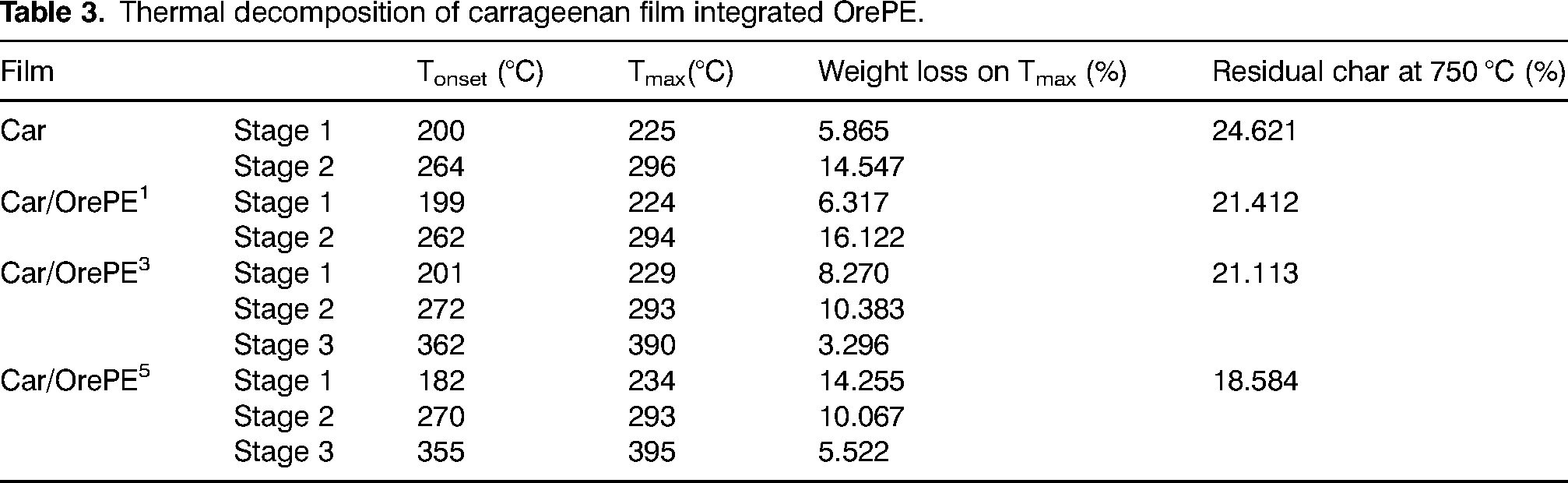
Table 3 summaries the details of the TGA results. The Tonset and Tmax temperatures for the thermal decomposition were similar for all films. At 750 °C, the residual char content of the film was ∼24–18%, and it slightly decreased when the concentration of OrePE was increased, most likely due to components consisting of Oregano oil. From all of the samples, Carrageenan film shows higher final char residue than other samples with the addition of OrePE. It might be due to the non-flammable minerals and impurities present in the biopolymers (Sedayu et al., 2020).TGA test results showed that the addition of OrePE did not significantly affect the thermal stability of the carrageenan-based films.
Thermal decomposition of carrageenan film integrated OrePE.
DSC experiments were performed to investigate the physical state of the OrePE interaction with polymer. Thermograms of Carrageenan film and integrated OrePE film are presented in Figure 5(b). The obtained DSC results show a broad endothermal peak characteristic for all film sample in the temperature range between 150–300 °C which correspond to the complete thermal degradation of the film. The onset temperature (To), melting temperatures (Tm) and enthalpy (ΔH), already summarized in Table 4.
Thermodynamic parameters of film.
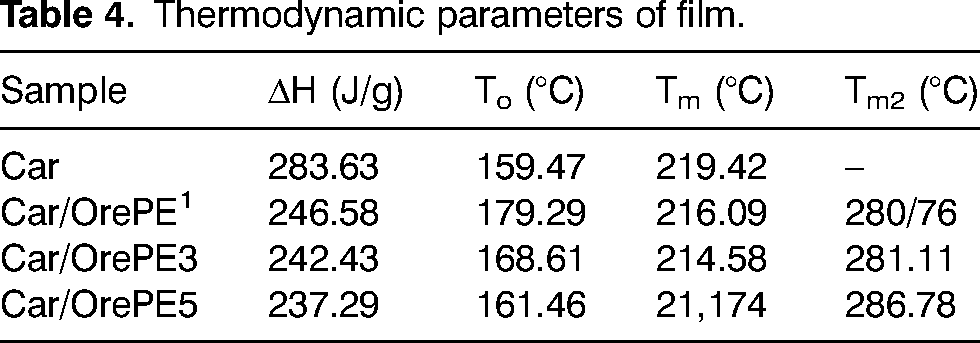
Differences in the enthalpy (ΔH), onset temperature (To) and temperature maximum (Tm) of thermal transition are noticeable considering different levels of OrePE addition. There is a common trend in ΔH, To and Tm decrease, considering the addition of OrePE, which means that films with OrePE have reduced overall thermal stability compared to the control. In addition, the obtained data indicate that the treatments containing OrePE had values of second Tm in high temperature which did not show in the control film. The presence of intermolecular interactions in OrePE with polymer matrix, including as hydrogen bonds, ionic contacts, and hydrophobic interactions, contributes to the second Tm at high temperature and affects the thermal stability of the film.
Antibacterial properties
The antimicrobial activity of films against two selected bacteria, E. coli (Gram-negative) and S. aureus (Gram-positive), was tested. In this study, the disc diffusion method was used to investigate the antimicrobial efficacy of films against foodborne pathogens. This method was chosen because it can simulate packaged foods and be used as a measurable technique (Bahrami et al., 2019).
The result is shown in Figure 6 and Table 5. A significant inhibitory activity against the bacteria, as mentioned above, was exhibited by active film loaded with OrePE. The results showed that the concentration of OrePE loaded in Carrageenan film affect the inhibition effect of E. Coli growth. The most optimal concentration in inhibiting E. Coli growth was the sample at the highest OrePE concentration. Generally, the film had more significant inhibitory effects on gram-positive bacteria (S. aureus), however there is no optimal concentration of OrePE in film carrageenan toward S. aureus, as shown in Table 5, the average inhibitory zone did not differ significantly. To give effective antibacterial activity, physical connections between bacterial cells and the film matrix are required. Carvacrol and thymol, which are monoterpenes with a single phenolic ring generated by the bonding of two isoprene molecules with three functional group substituents, were shown to be the key active constituents in Oregano Essential oil that operated against bacteria in previous studies and oregano essential oil has antimicrobial capabilities due to its chemical nature (Pontes-Quero et al., 2021).
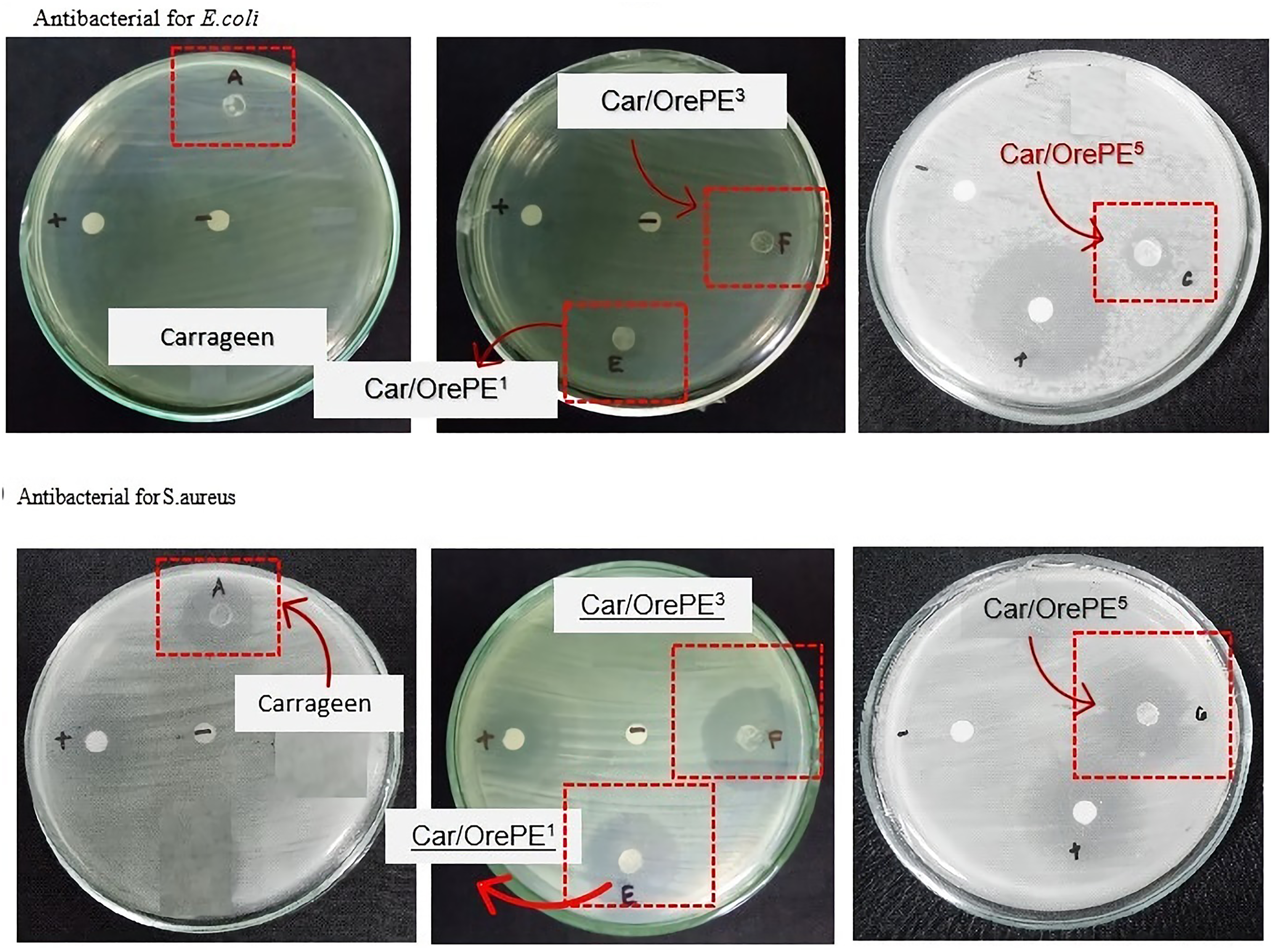
Inhibition zones obtained by carrageenan and Car/OrePE against E.Coli and S.Aureus.
Inhibition zone of carrageenan-based films.
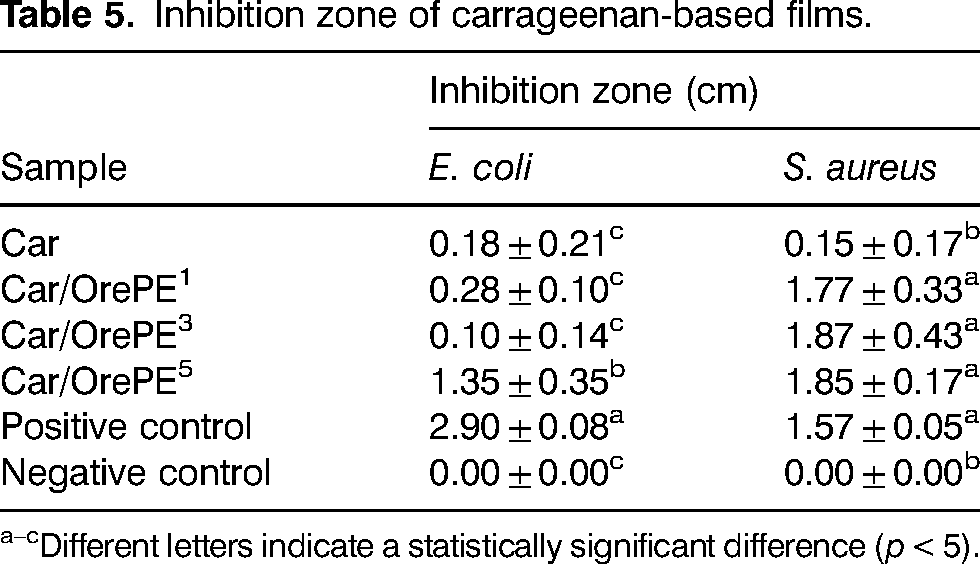
Different letters indicate a statistically significant difference (p < 5).
CONCLUSION
In this study, Oregano essential oil was successfully added into the carrageenan-based film using the Pickering emulsion method with cationic nanocellulose as Pickering agent. The OrePE showed good compatibility with carrageenan film, which was confirmed by FTIR Spectra. SEM micrographs showed the OrePE was well-distributed and well-maintained emulsion droplets in the film matrix. The mechanical and thermal properties of carrageenan film were only slightly affected by the addition of OrePE. Moreover, the addition of OrePE to the carageen film provides antibacterial properties in the film. These results can play a role in developing a new generation of active packaging materials.
Footnotes
Declaration of conflicting interests
The author(s) declared no potential conflicts of interest with respect to the research, authorship, and/or publication of this article.
Funding
The author(s) received no financial support for the research, authorship, and/or publication of this article.
