



Abstract
Aluminum foam is a critical component of state-of-the-art micrometeoroid and orbital debris shielding. However, its randomly oriented constituent ligaments create significant variability in properties at different length scales. Previous efforts have thoroughly characterized the statistical implications of micro- to macro-scale-length transitions on the homogenized elastic behavior of damage-free, pre–micrometeroid and orbital debris (MMOD) strike structures. In this work, the properties of the residual material post MMOD impact are assessed by introducing cylindrical cavities representing the damage track. It was observed that configuring the cavity parallel to the through-the-thickness direction transformed a nominally isotropic foam into an anisotropic (transverse isotropic) material, weaker in-plane than through-the-thickness. Furthermore, by calculating similarity indices of computed probability distribution functions, we observe that in a substantial fraction of cases local variability arising from the ligamented structure itself is large enough that the elastic moduli of structures with and without cavities are statistically indistinguishable. These findings are evidence that we are able to draw statistics-based conclusions regarding the effect of MMOD impact-inspired defects on the mechanical properties of aluminum foam structures.
Keywords
1. Introduction
Micrometeroid and orbital debris (MMOD) poses a significant danger to both robotic and crewed spacecraft operating beyond Earth’s atmosphere and necessitate carefully designed shielding materials [1–6]. The impact of even a sub-millimeter projectile traveling at hypervelocity can cause devastating damage [1]. A number of studies have focused on simulating the strike event through both experimental and computational approaches [7–10]. The natural continuation of this work is an evaluation of the mechanical behavior of the resulting damaged materials, incorporating the configuration of the damage track as a change to the material structure. This is critical for assessing the potential response not only to future MMOD strikes but also to any mechanical stress the shielding will experience for the duration of its lifetime.
Open cell metallic foam sandwich panel structures have proven effective at mitigating MMOD impact damage [3–5]. The foam core layer is composed of open, node-ligament networks of randomly oriented polycrystalline metallic ligaments. Ligament lengths and pore sizes vary over some distribution characteristic of the specific material, but typically have lengths on the order of microns. Impacting particles penetrate the outer sacrificial facesheet of the sandwich structure and suffer repeated impacts with ligaments in the foam—deflecting, fragmenting, and vaporizing in the process. Any residual impactor fragments arriving at the rear facesheet have sufficiently reduced kinetic energy that they can be stopped without danger of perforation.
Predicting the properties of such a material in conditions involving hypervelocity impacts is difficult on two primary fronts. First, while metallic foams enable the “multiple-impact” energy absorption mechanism, the stochastic ligamented structure results in non-singular materials properties at smaller length scales. Since the component ligaments have nominally random orientations, the metallic foams behave inhomogeneously at millimeter and centimeter length scales, exhibiting homogeneous materials properties only at large length scales. This local or mesoscale inhomogeneity leads to materials properties that present as distributions rather than singular values at length scales relevant for MMOD damage. Second, spacecraft designers must consider the properties of previously damaged shielding components and/or the effects of repeated strikes. In this context, knowledge of the properties of pristine material is not sufficient for accurate prediction of material’s behavior over long-duration missions. Models for the overall behavior of shielding materials must account for the effects of previous damage, represented here as cylindrical cavities similar to what is observed experimentally (e.g., Figure 1).
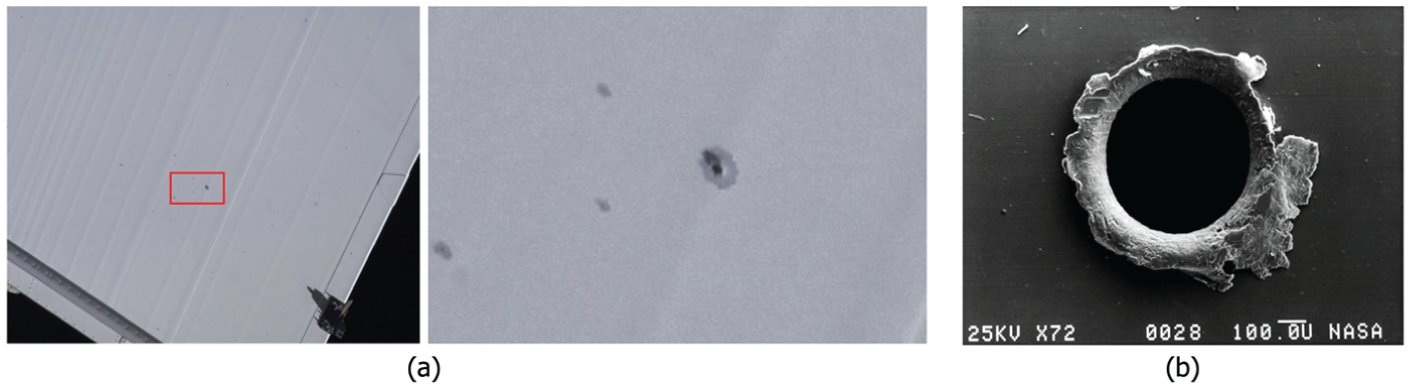
Previous related results [11] described the variation in mechanical properties exhibited by pristine foam materials over a range of length scales—from the feature-scale, where individual structural features like ligaments, pores, and nodes dictate properties, to the mesoscale, where ensembles of features dictate mechanical behavior. This previous work also indicated that macroscale behavior, where mechanical properties are single valued, no longer exhibiting variation due to the underlying stochastic structure, arises only for volumes orders of magnitude larger than the typical diameters of MMOD damage tracks. Here, we extend previous work on damage-free foam structures by computing the effects of cylindrical cavities representing MMOD damage tracks on mechanical properties. Using the Kentucky Random Structures Toolkit (KRaSTk) [12, 13] we quantify the reduction in mechanical stiffness due to prior damage and assess the variation in damage effects as both the relative size of the damage path and the relative orientation of the damage path vary. We find that the presence of a cylindrical damage tracks alters otherwise isotropic metallic foams, yielding regions with transverse isotropic behavior, and that the effects of damage tracks cannot simply be represented as changes in foam reduced densities. Overall, we find that the effects of MMOD damage can be larger than the intrinsic variability in foam properties due to their stochastic structure, demonstrating that presence of damage in foam-based shielding cannot be ignored in modeling system-level p roperties and performance.
2. Methods
2.1. RVE generation
KRaSTk was used to procedurally generate large numbers of stochastic model representative volume elements (mRVEs) based on a geometric seed description characterizing the structure of a material. Individual mRVEs are volumes that stochastically sample arrangements of structural features possible based on the seed geometry. Sets of mRVEs constructed with common parameters (e.g., sizes or lengths of characteristic features) can then be used to quantitatively predict properties of real materials whose structure is described by the seed geometry. Previous investigation [11] has shown that a node-ligament geometry accurately represents the mechanical behavior of Duocel, a commercially available Al foam utilized in MMOD shielding.
For this study, mRVEs were produced with a node-ligament seed geometry. Input parameters for mRVE generation with this seed geometry include the range of ligament diameters, the volume density of nodes at which ligaments meet (functionally equivalent to an average, or characteristic, ligament length, ℓ), and the ligament coordination number at each node (
To accurately model distributions of properties on the mesoscale, sets of mRVEs must contain enough individual mRVEs to meaningfully sample the full range of possible microstructural configurations. Based on previous convergence testing of the node-ligament seed geometry [12], sets of 60 mRVEs were used here to determine distributions of properties for given input structural parameters. To probe the effects of MMOD damage tracks on distributions of mesoscale properties, three sets of undamaged mRVEs were first constructed expressing three different target reduced densities1. Three initial sets of mRVEs were generated with “low”, “medium”, and “high” reduced densities of approximately
At each target reduced density, three additional sets of “damaged” mRVEs were generated by adding cylindrical cavities with
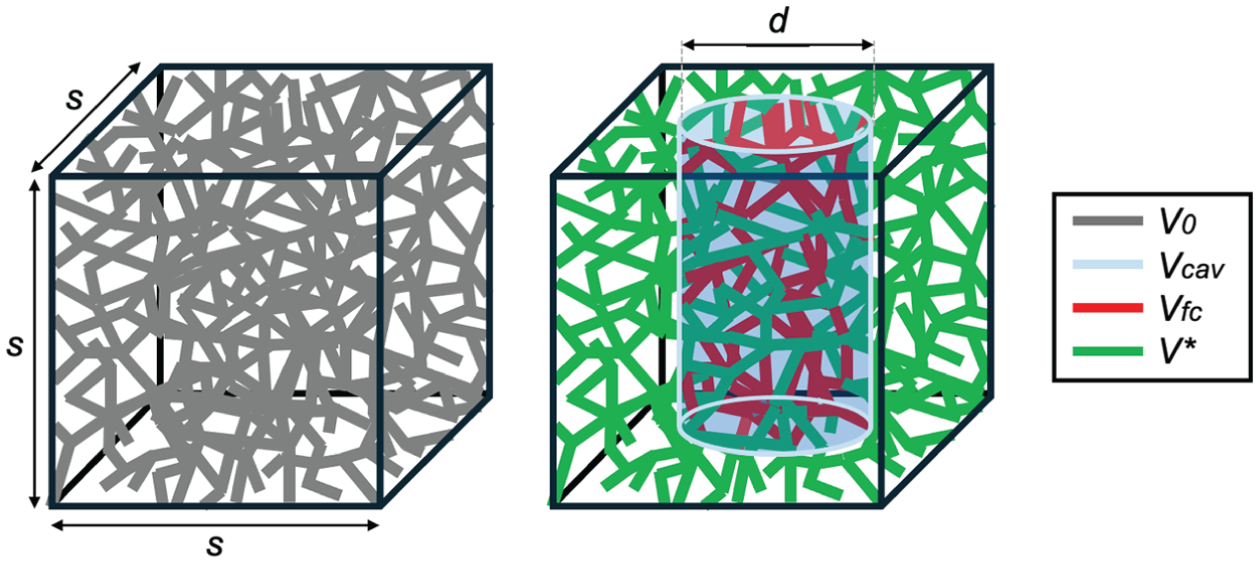
A representation of the variables referenced in this study. The quantity
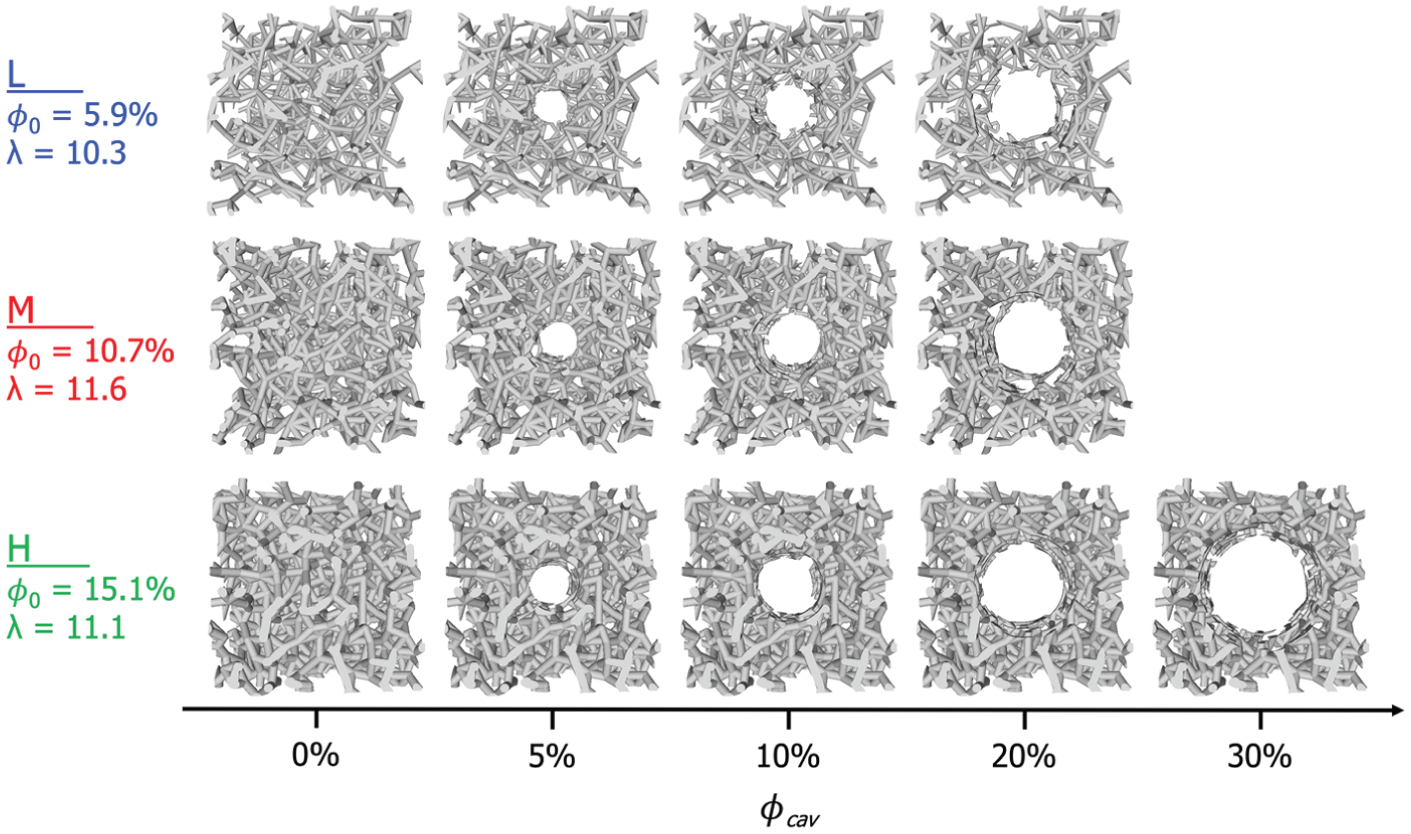
A map of each of the 12 structure sets utilized in this study. It is important to note that the structure shown for each set of conditions is a single example; in reality, each set contains 60 mRVEs.
2.2. Computing mRVE Properties via FEM
The orthorhombic stiffness tensor for each mRVE was computed using an FEM-based approach, extending a previously developed method [12]. To extract the full stiffness tensor, total elastic energies were computed for each mRVE in nine independent strain states established using combinations of displacement and frictionless support boundary conditions. The nine strain states included the three independent uniaxial compressions (

allowing direct calculation of
Finite element calculations were conducted using the
2.3. Determining materials properties from mRVE properties
As stated above, each of the 12 sets of mRVEs contains unique 60 mRVEs (
The standard deviation (
While individual distributions describe the properties of individual sets of mRVEs, comparing multiple distributions allows for an examination of the relative effects of the cavities and structural stochasticity. Here, we assess the similarity of pairs of distributions by quantifying the degree to which they overlap. The overlap coefficient, a similarity measure that determines the overlap between two finite sets

Because the total area of each distribution (i.e. the probability distribution function) generated by KRaSTk is always equal to 1, Eq. 2 can be rewritten in terms of distribution area A:

Therefore, the ratio of overlap to total unique area beneath the two distributions, here referred to as the similarity index (η), is:

3. Results and discussion
3.1. Deviation from elastic isotropy
Figure 4 (and Appendix 4) summarizes both expected bulk stiffnesses and distributions of local stiffnesses computed for each set of undamaged and damaged foam mRVEs. Expected bulk values of stiffness for each mRVE set are indicated with points, and the standard variabilities in stiffness are shown as whiskers. Blue, green, and red colors indicate results for low-, medium-, and high-volume fraction mRVEs respectively, while thick whiskers and darker points are for mechanical responses in “in-plane” directions and lighter whiskers and points for the “through-the-thickness” (TTT) direction. In Figure 4, the five panels show results for (from top to bottom)
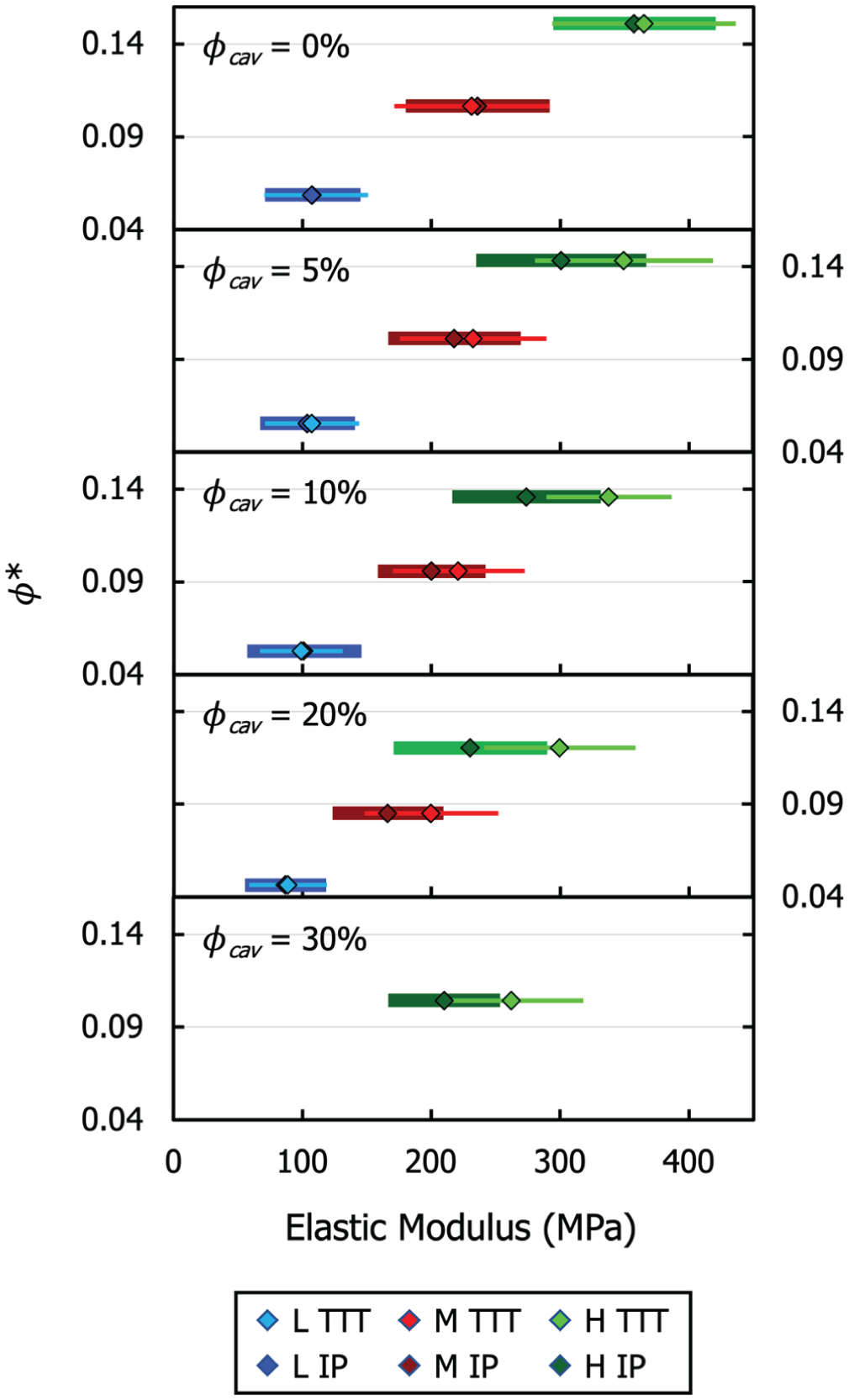
The expected bulk stiffnesses (represented as points) and the standard deviations (represented as whiskers) for both the TTT and IP directions for each mRVE set.
With respect to defect free,
In contrast to damage-free sets, medium and high reduced density sets damaged exhibit disparities in stiffness for both the TTT and IP directions. In these foams the mechanical response in the IP direction (orthogonal to the damage track) is more strongly affected (specifically, stiffnesses are more greatly reduced) by damage than in the TTT direction (along the damage track). However, the ranges of expected local stiffnesses (as characterized by the standard variability) in the TTT and IP directions in damaged structure sets overlap significantly. This implies that at individual points along the damage track, local structural variability will result in (local) regions where loading in the IP and TTT directions still yields similar responses (or even responses where the IP stiffness is greater than the TTT stiffness). In a similar vein, damaged structure sets of different reduced densities no longer exhibit fully distinct stiffness ranges–they overlap significantly. That is, in contrast to damage-free foams, individual measurements of the stiffness of damaged foams are not sufficient to distinguish between foams of different densities—or, equivalently, the effect of MMOD damage on mechanical properties can be larger than the effect of changes in overall foam reduced density, depending on local structural configuration details. As
Low reduced density sets appear to behave differently, remaining isotropic and exhibiting minor overall effects due to the cylindrical damage tracks. This may be because the already relatively open ligament networks in low reduced density foams are comparatively less impacted by the presence of a damage track. Some evidence supporting this hypothesis can be gleaned from considering the change in overall reduced density due to the removal of material within the cavity. Where the addition of
Figure 5 replots data to better highlight how damage tracks can have as large an impact on expected bulk (and local) mechanical properties as otherwise significant changes in reduced density. The H-30 set has a
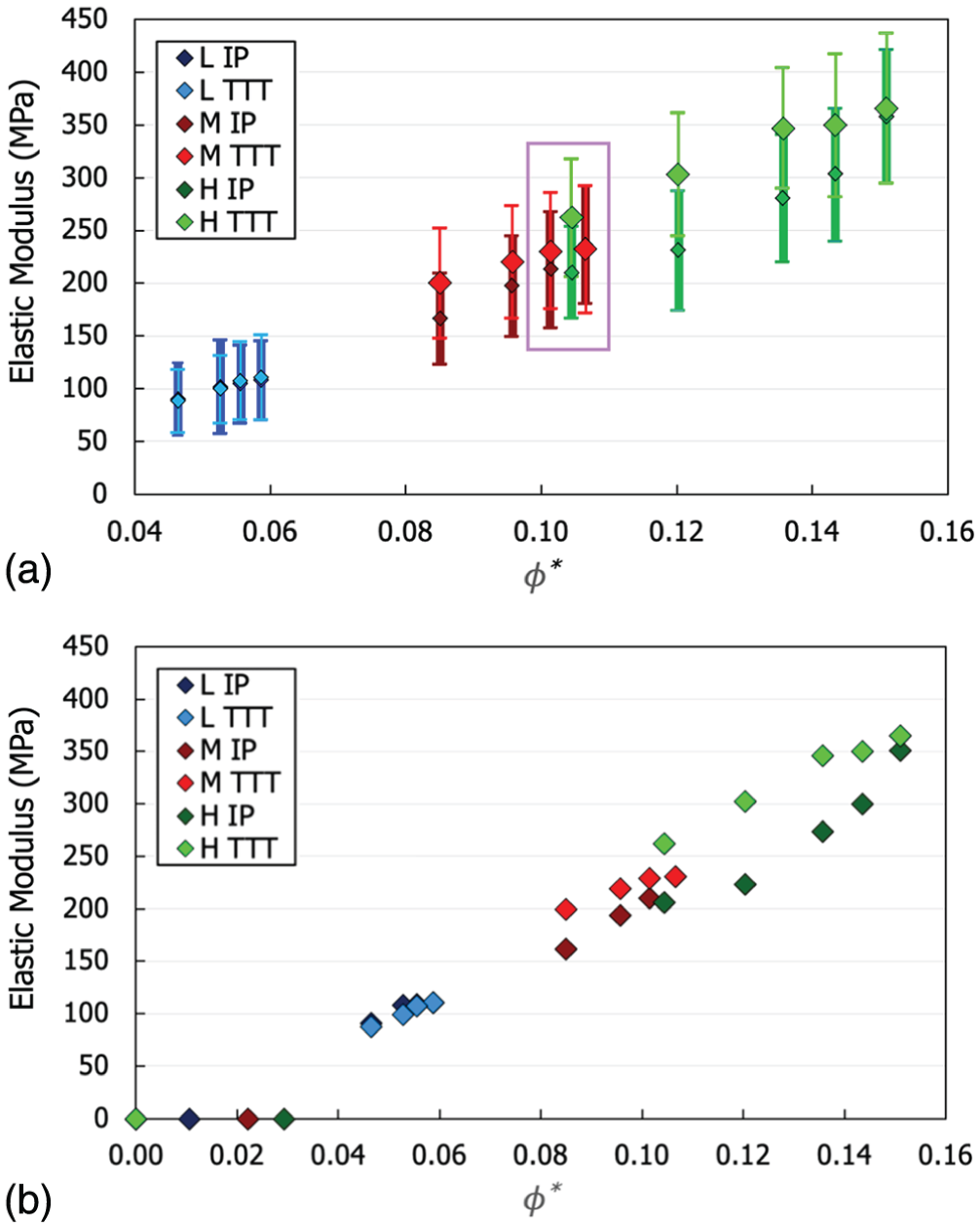
Elastic modulus distributions, in both IP and TTT orientations, for all mRVE sets. In (a), the elastic modulus values are plotted as points and whiskers. In (b), only the expectation values are included.
These results also suggest more fundamental differences in underlying effects of MMOD damage on IP versus TTT mechanical responses. This is highlighted in Figure 5(b), which plots only the expectation values of stiffness. As the diameter of the damage track increases, stiffness in the TTT direction falls in proportion to the fraction of the mRVE cross-sectional area occupied by the damage track. In contrast, in the IP direction, increasingly large diameter damage tracks lead to a more rapid decrease in stiffness than in the TTT direction. In the IP direction, we observe that E reaches 0 while
3.2. Implications for statistically significant effects of damage
Additional implications arise by considering the overlap of distributions for damaged and undamaged sets of structures. These overlaps essentially measure the probability that the effects of any particular damage track in any particular local volume are so limited that they cannot be distinguished from the background, intrinsic variations in local foam properties. Figure 6 presents the
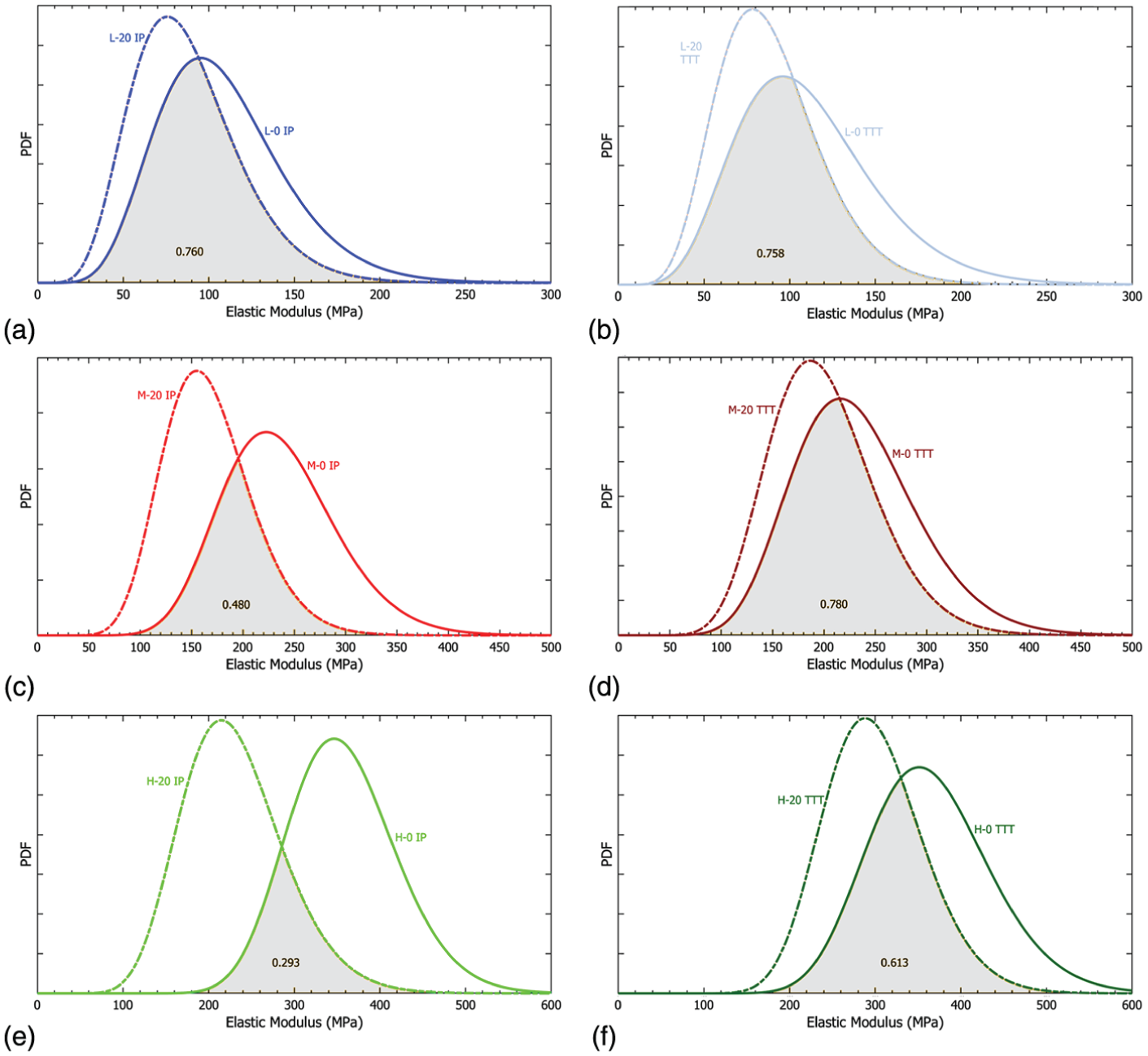
Plots showing the overlap in distributions of
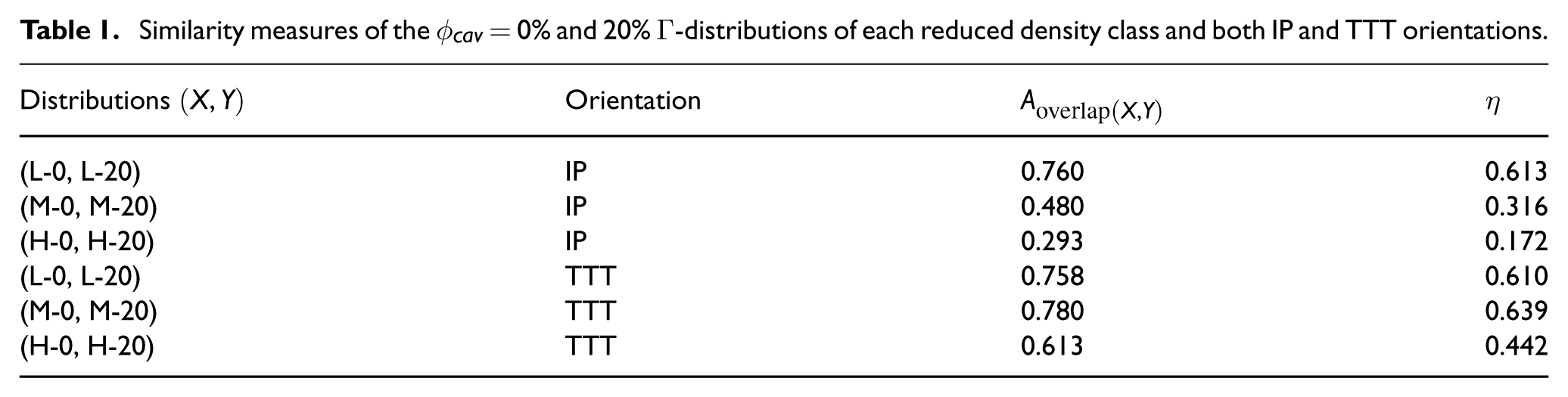
Similarity measures of the
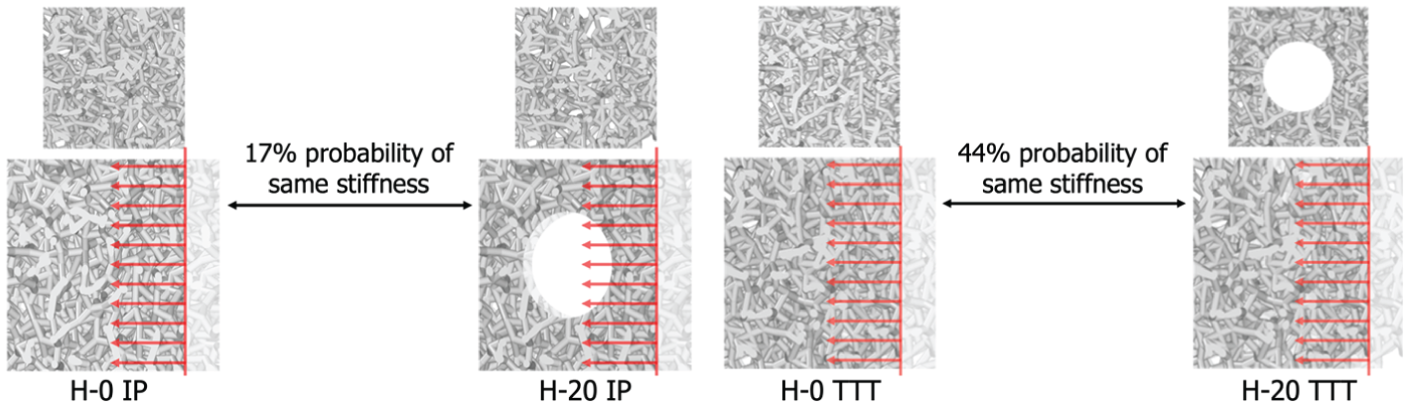
A representation of the physical implications of the overlapping Γ-distributions in Figure 6(e) and (f).
The computed distributions of expected stiffness values for both damaged and undamaged structure sets suggest that the present stochastic approach to predicting properties of complex materials and the effects of defects may have impactful applications in the context of uncertainty quantification. Comparing distributions predicts both the magnitude and frequency of changes in mechanical properties due to significant structural changes (here, the addition of a cylindrical void mimicking an MMOD impact damage track). Of particular interest is the ability to distinguish between background variations in local materials properties–present in as-fabricated samples of all stochastic materials–and “above the noise” effects of damage events.
4. Summary and outlook
We have analyzed the effect of cylindrical cavities on statistically significant sets of mRVEs built to represent Duocel foam, a commonly employed component of MMOD shielding, using techniques that are easily transferable to other complex or randomly structured materials. Cylindrical cavity defects were selected to mimic the structure of MMOD damage tracks and were varied to quantify the effects of relative volume and load orientation. Utilizing FEM, elastic modulus values in both the IP and TTT orientations were computed for all mRVEs representing both damaged and undamaged structures. While it was shown that in all cases increasing the relative size of the cavity defect decreases the stiffness of the structure, this effect is not necessarily proportional to the relative volume of the removed material and is not symmetric with respect to the orientation of the loading relative to the damage track. Critically, larger reductions in stiffness are seen for IP loading (that is, perpendicular to the damage track). This implies that system- or component-level models intended to account for potential MMOD damage must account for not only changes in stiffness in damaged materials but also increases in structural anisotropy in damaged regions. More fundamentally, the trends for reductions of stiffness in both IP and TTT loading conditions suggest that damage to the ensemble of load-bearing paths present in a material influence the magnitude of changes in stiffness. For the relative sizes of damage tracks considered here, the computed changes in mechanical stiffness due to damage track formation were frequently similar to the magnitude of intrinsic local variations in stiffness arising purely from the stochastic nature of the material structure itself. Despite this, the results provide strong evidence that there is always a meaningful probability that a particular damage track will alter mechanical properties well beyond expected intrinsic variations. Overall, the present findings suggest that the approach applied here could be used to quantify uncertainty in system or component performance, particularly for cases where defects or accumulations of defects are possible. The approach utilized here can and should also be extended to address thermal properties alongside mechanical properties, and can be applied to any materials system well described by identifiable sets of geometric structural primitives (including both porous and, e.g. polycrystalline, fully dense solids).
Footnotes
Appendix 1
The structural parameters utilized to generate the mRVEs of each set are provided in Table 2.
Appendix 2
Appendix 3
Appendix 4
Appendix 5
Acknowledgements
We thank the University of Kentucky Center for Computational Sciences and Information Technology Services Research Computing for their support and use of the Lipscomb Compute Cluster and associated research computing resources.

Funding
The authors disclosed receipt of the following financial support for the research, authorship, and/or publication of this article: The research presented here was supported by M.N.S.’s NASA Space Technology Graduate Research Fellowship.
Declaration of conflicting interests
The authors declared no potential conflicts of interest with respect to the research, authorship, and/or publication of this article.