




Abstract
Large deflections of an elastic beam are considered within Euler–Bernoulli hypotheses. The Gao beam model couples nonlinear constitutive equations for longitudinal and vertical displacements. The setting is motivated to describe non-penetration between surfaces of an inclined crack in the thick beam. The governing relations are established for the cracked beam, which are based on constrained minimization of a non-convex function of the strain energy. The variational solution is proved, optimality conditions are obtained in the form of variational inequality, and the complete system of nonlinear boundary conditions fulfilled at the crack is derived.
1. Introduction
In this contribution, we formulate a coupled model which describes large vertical displacement (deflection) together with horizontal (longitudinal) displacement in a thick elastic beam based on the Euler–Bernoulli distribution. The nonlinear constitutive relations keep the second-order asymptotic terms and are stated in plane stress conditions according to Gao [1]. The basic theory of nonlinear beams, plates, and shells can be found in the monographs by Ciarlet and Rabier [2], Timoshenko [3] and von Kármán [4], and suitable variational and dual principles by Gao [5], Khludnev and Kovtunenko [6], and Khludnev and Sokolowski [7]. For analysis of the respective obstacle problems, we refer to Ciarlet et al. [8], Ciarlet and Piersanti [9], to Lagnese and Leugering [10] and Perla Menzala and Zuazua [11] for parameter sensitivity in beam dynamics. One of the principal difficulties of the nonlinear theory concerns so-called buckling deformation which leads to non-convex energy functions and, as the consequence, to non-uniqueness of solutions, see Russell and White [12]. For semi-coerciveness issues, we cite Goeleven and Gwinner [13].
Gao’s model of nonlinear elastic beams is typically formulated as a fourth order semi-linear equation written with respect to vertical deflections referred to the mid-line of the beam. Existence of unique variational solution was provided within minimization of the strain energy under convexity assumption, this prohibiting buckling, in Machalová and Netuka [14]. For modeling with dynamic equations of motion we refer the reader to Andrews et al. [15], for a singular equation under moving point-wise load to Atlasiuk et al. [16] and Bauer et al. [17], for inverse parameter identification problem to Radová et al. [18], and for numerical solution to Borsos and Karátson [19]. An extended Gao’s model coupling nonlinear constitutive equations for large deformation within Timoshenko hypotheses was presented in Dyniewicz et al. [20]. Simulations of a contact problem for a nonlinear dynamic beam with a crack were described in Kuttler et al. [21].
In our modeling, we are motivated by non-penetration conditions between opposite surfaces of an inclined crack (the cross cut) in the thick beam. For this task, we utilize both horizontal and vertical displacements along the beam thickness. The variational theory of elastic and inelastic bodies with non-penetrating cracks is well established, see Bach et al. [22], Hintermüller et al. [23], Itou et al. [24], and Khludnev et al. [25], numerical simulation in Kovtunenko [26], and a review on edge crack problems in Singh [27]. Inequality constraints subjected to non-penetration across inclined cracks were first introduced in Kovtunenko et al. [28] and developed further in works by Lazarev and Popova [29] and Rudoy and Lazarev [30]. Variational inequalities describing non-penetrating cracks were treated in Kovtunenko and Lazarev [31] for the Timoshenko plate contacting at the boundary with an inclined obstacle. We cite relevant obstacle problems over non-convex feasible sets in Lazarev and Kovtunenko [32, 33]. See generalization of inequality constraints to global injectivity conditions for rigid inclusions and cracks in Furtsev et al. [34].
Within the energy minimization approach, we consider the strain energy function for the Gao beam subject to non-penetration inequality imposed on an inclined crack. The function is non-quadratic and non-convex allowing buckling. We provide a variational solution to the problem, which may be non-unique, by the direct method in the calculus of variations owing to coercivity and weak lower semi-continuity properties of the energy function. Due to the lack of convexity of the strain energy, the necessary optimality condition is derived in the form of a variational inequality over convex closed set of feasible displacements. A complete system of nonlinear relations which consist of equilibrium equations and boundary conditions fulfilled at the crack is proved rigorously.
2. Modeling of nonlinear beam
Let an elastic beam of the length

where

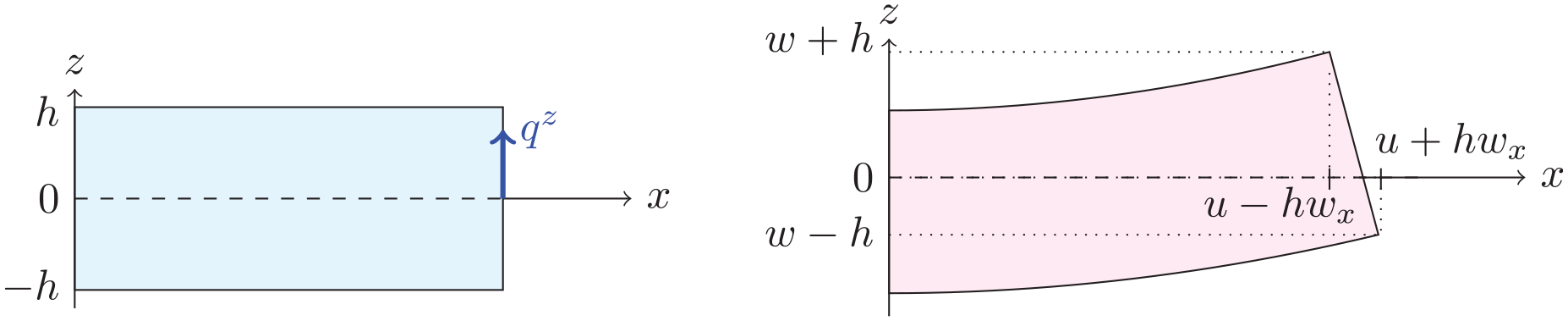
Undeformed (left), and deformed (right) element of thick beam at reference point x.
Here,

For Poisson’s ratio

Integrating over the beam thickness with the use of identity

and the bending moment:

We introduce the beam energy

Varying equation (7) with test functions

integrating by parts when

Let us introduce constant p to reduce equation (9) to the coupled Gao equations:

Note that omitting here the nonlinear term
3. Modeling of inclined non-penetrating crack
Let an interior point

drawn in Figure 2 (left). After deformation illustrated in Figure 2 (right), according to hypotheses (1) the left crack face

respectively, the right crack face

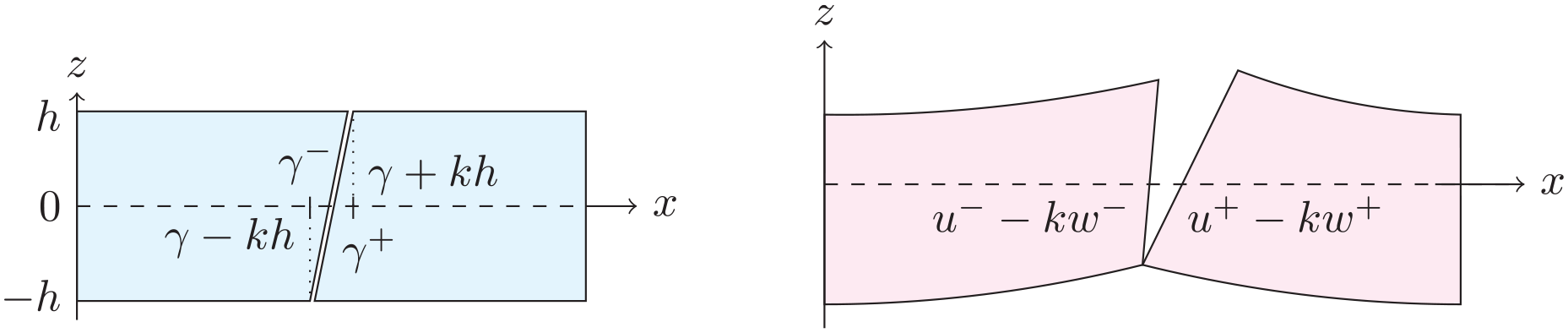
Undeformed (left), and deformed (right) element of beam with inclined crack at
Non-penetration between the crack faces requires the non-negative jump:

Owing to the linearity in z, this inequality holds for

Note that the particular case of
4. Variational problem
Let us denote the Sobolev spaces

which is a convex closed cone. For given

It is well-defined due to the continuous embedding estimates for

Also, the Poincaré inequality holds for

Based on equations (13) and (14), below we establish useful properties of the beam energy functional.


and using Young’s inequality with weight

which yields the lower bound:

Choosing here
Here, it is worth noting that the first, nonlinear term in the energy functional is non-convex allowing buckling deformation, see Machalová and Netuka [14].


The Sobolev compact embedding provides that

Let us express the first, nonlinear term in

With the use of equation (17) we infer that

Then equations (17)–(19) guarantee the weak lower semi-continuity property (16). □
Consider the minimization problem: find

As a consequence of the direct method in the calculus of variations, from Lemma 1 and Lemma 2, we conclude straightforwardly with the existence theorem.
Because of buckling deformation, the solution to equation (20) may be non-unique.
5. Optimality conditions
Based on the variation (8) of the strain energy and equilibrium equations (9), using notation (5) for the integrated stress and equation (6) for the bending moment, we deduce Green’s formula in the cracked domain accounting for the jump across γ, see Khludnev and Kovtunenko [6]:

where

If the solution is smooth such that

and boundary conditions at the crack γ :




For the smooth solution

Testing this inequality by continuous functions

We look for the representation of

Under the solvability condition (26), unknown a and b can be resolved from equations (28) and (29) as follows:

Then inequalities (11) and (28) necessitates
The argument in the proof of Theorem 2 can be converted to derive the variational inequality (22) from the boundary value problem (23)–(27). The problem is supported by the boundary conditions at
Footnotes
Acknowledgements
The results were obtained with the support of the Ministry of Science and Higher Education of the Russian Federation, supplementary agreement (No. 075-02-2025-1792, 11 March 2025).
Authors’ note
This contribution is a part of Special Issue in honor of Professor Philippe G. Ciarlet.
Funding
V.A.K. acknowledges the financial support by the University of Graz.
