We recall in this note that the induced tangent stiffness tensor appearing in a hypoelastic formulation based on the Zaremba–Jaumann corotational derivative and the rate constitutive equation for the Kirchhoff stress tensor τ is minor and major symmetric if the Kirchhoff stress τ is derived from an elastic potential . This result is vaguely known in the literature. Here, we expose two different notational approaches which highlight the full symmetry of the tangent stiffness tensor . The first approach is based on the direct use of the definition of each symmetry (minor and major), i.e., via contractions of the tensor with the deformation rate tensor D. The second approach aims at finding an absolute expression of the tensor , by means of special tensor products and their symmetrisations. In some past works, the major symmetry of has been missed because not all necessary symmetrisations were applied. The analogous tangent stiffness tensor , relating the Cauchy stress tensor σ to the Zaremba–Jaumann corotational derivative is also obtained, with both methods used for . The approach is exemplified for the isotropic Hencky energy. Corresponding stability checks of software packages are shortly discussed.
1.1. Recap on rate-formulations for nonlinear elasticity
Nonlinear elasticity is today an integral part of continuum mechanical modelling. The basic framework is definitely established [1–9]. Here, we are interested in a question occurring when implementing a finite element model (FEM)-code for nonlinear elasticity.
While the overwhelming current trend is to use a totally Lagrangean approach, providing the direct discretization of the equilibrium equation
on the reference configuration where is the deformation, is the deformation gradient (the Fréchet-derivative of φ) and is the (non-symmetric) first Piola–Kirchhoff stress, many established software packages like Abaqus™, Ansys™1, LS-DYNA, and so on discretise a rate-type formulation on the current configuration , and the constitutive law is accordingly an expression relating increments of spatial stress to increments of spatial strain. For example, Abaqus™ in its UMAT subroutine requires the rate-formulation for the Kirchhoff stress τ expressed with the Zaremba–Jaumann rate.
Here, it has to be remarked that any hyper- or Cauchy-elastic law on the reference configuration can be equivalently expressed in a rate-type or hypoelastic format. More precisely, a hypo-elastic material, in the sense of Truesdell [10] and Noll [11], obeys a constitutive law of the form
where
is an appropriate objective rate of the Cauchy stress tensor σ,
is a constitutive fourth-order tangent stiffness tensor,
= is a constitutive fourth-order tangent compliance tensor and
D = sym Dξv = sym L is the Eulerian strain rate tensor, measuring the spatial rate of deformation or “stretching”, where v describes the spatial velocity at a point ξ in the current configuration, and is the velocity gradient.
Hence, the elastic stretching D depends only on the current stress level σ and the rate of stress as seen by the objective derivative.
As for time derivatives of the Cauchy stress tensor σ, there are many different possible choices (see, e.g., also the related works by Xiao et al. [12, 13], Bonet and Wood [14], Aubram [15], Bellini and Federico [16], Palizi et al. [17], Fiala [18, 19]), Govindjee [20], Korobeynikov [21, 22], Pinsky et al. [23], and the book by Ogden [6]).
This framework admits usually two basic choices. We can express the rate-form constitutive law in terms of the Cauchy stress σ, or alternatively in terms of the Kirchhoff stress (the weighted Cauchy stress)
On the contrary, we are free to choose the objective derivatives [24–26]. Provided the induced tangent stiffness tensor in equation (2) is adjusted properly, all formulations are fully equivalent. Here, we consider primarily the combination of the Kirchhoff-stress τ with the corotational Zaremba–Jaumann rate [24, 27, 28], using the vorticity tensor (or spin tensor) ,
Neff et al. [26] have shown how to obtain the corresponding induced stiffness tensor if is given as an isotropic Cauchy elastic law. Indeed, for , it holds
together with
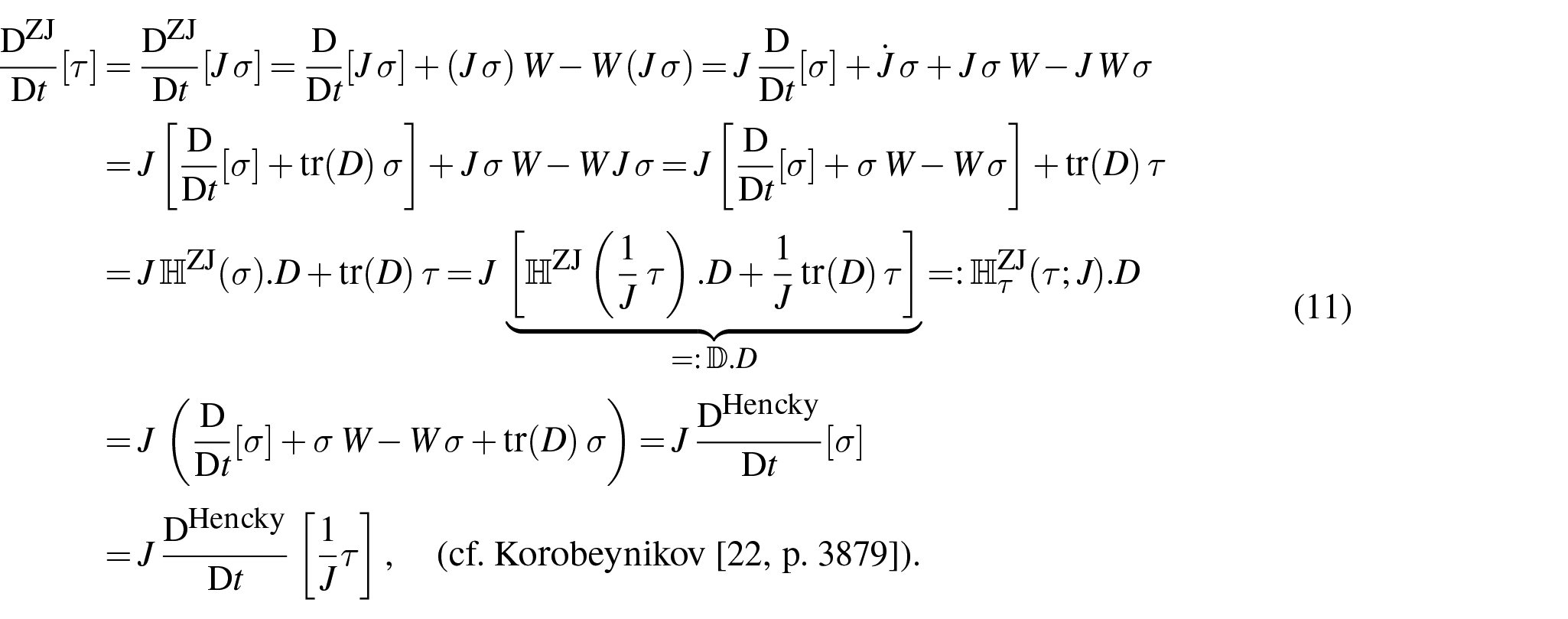
The constitutive law (6) can be converted into a rate-formulation for the Kirchhoff stress τ:
This will be recalled in the next section 1.2. It is then an observation, which while the fourth-order tensor is in general not major-symmetric (but always minor symmetric), the corresponding induced stiffness tensor for the Kirchhoff stress will be major-symmetric provided derives from hyperelasticity.
This will be shown by two different and complementing approaches, and this constitutes the major result of this contribution. Demonstrating all symmetries of the stiffness tensor is important for two reasons. First, from the epistemological point of view, if a symmetry exists, it must be studied and accounted for. Second, from the computational point of view, a fourth-order tensor with major and both minor symmetries has 21 independent components, as opposed to the 36 of a fourth-order tensor with only the minor symmetries, and this reduces the memory allocation, which can be advantageous in large FEMs.
In addition, we will give an explicit example for the calculation of and for the Hencky energy in section 2. Finally, we shortly discuss a customary stability check of Abaqus™ and Ansys™ in relation to the Hencky model.
1.2. Converting the hypoelastic formulation with Zaremba–Jaumann rate and Cauchy stress σ into an equivalent hypoelastic formulation for the Kirchhoff stress τ
Assume we know how to express the rate-formulation for the Cauchy stress σ and the Zaremba–Jaumann rate, i.e., we have
and we know the fourth-order tensor . Then it is easy to obtain the rate-formulation for the Kirchhoff stress τ, as is shown next.
It is engineering folklore that is a symmetric matrix viewed as a (self-adjoint) mapping from , i.e., it has major symmetry if τ derives from an elastic potential (see e.g., Ji et al. [29] [equation (33)], Brannon [30]). In this respect, we formulate
Lemma 1.1 (Major symmetry for in the hyperelastic case). For hyperelasticity, the induced Kirchhoff tangent stiffness tensor is major symmetric and .
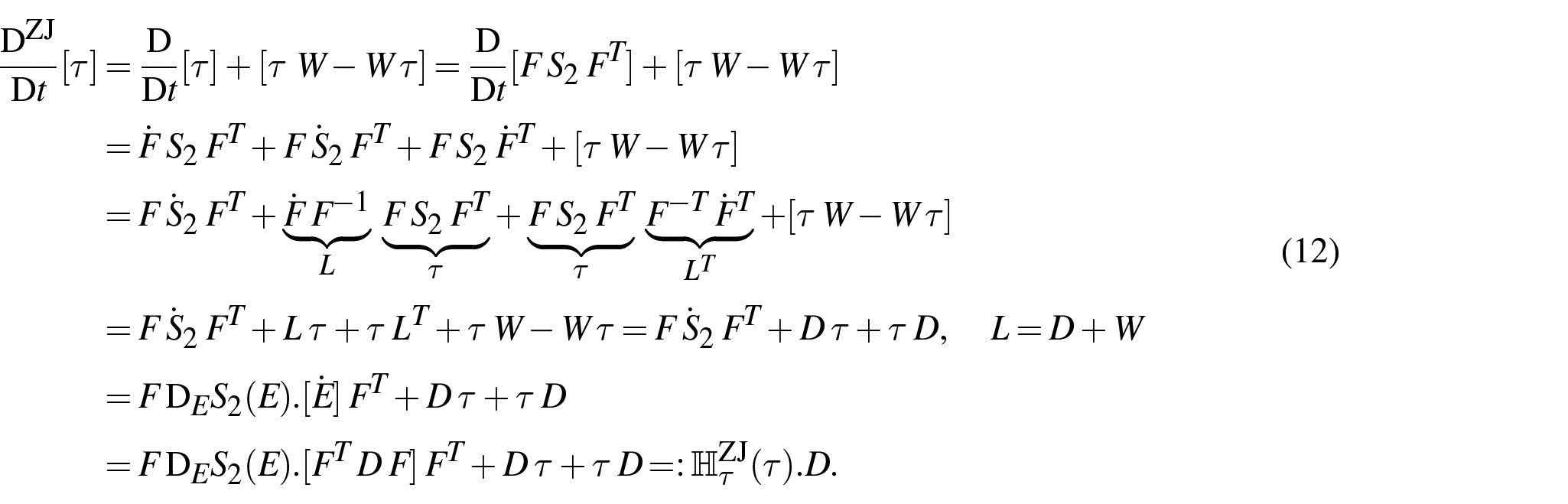
Proof. Starting with the Zaremba–Jaumann derivative of the Kirchhoff stress τ we obtain
In the second-last equation of (12) we used that by writing with , we obtain , where
Since major symmetry of amounts to and the mapping is already major symmetric, since with
It therefore remains to prove that the mapping is major symmetric, too. By assumption, the formulation is hyperelastic, which means that
where W is the elastic energy. Thus it follows that is itself self-adjoint, i.e., , meaning that
Therefore, we obtain for the mapping
which is the required major symmetry. □
Remark 1.2. Minor symmetry of is clear from equation (12) since . Moreover, minor and major symmetry of are independent of assuming isotropy.
Looking at equation , it is clear that major symmetry of does not imply that is major symmetric, apart from the incompressible case in which .
We observe that in the incompressible case, we have and and therefore
so that the latter rate formulation for τ coincides with the Cauchy stress rate-formulation, as it should be for the incompressible case in which .
There is also a more direct way to obtain the rate-formulation in terms of the Zaremba–Jaumann rate and the Kirchhoff stress τ in the case of isotropy. Indeed, for isotropy, the Kirchhoff stress satisfies
According to the Abaqus™ user manual, for three-dimensional (3D) continuum elements Abaqus™ uses the elasticity tensor associated with the Zaremba–Jaumann rate for the Kirchhoff stress τ, i.e., the positive definiteness of (i.e. ) is checked for material stability.
1.3. Alternative approach and absolute expression of
An absolute expression of the Zaremba–Jaumann elasticity tensor , i.e., an expression not involving the double contraction with the deformation rate D, can be obtained using the special tensor products and and, specifically, their symmetrisation , as defined in the work by Curnier et al. [31]. We shall define these tensors for the case of Cartesian coordinates, but general covariant expressions can be found in studies by Bellini and Federico [16], Federico and Grillo [32] and Federico [33]. As in the remainder of this work, means that the fourth-order tensor acts as a linear map on the second-order tensor Z. The transpose of the fourth-order tensor is defined as the tensor such that, for every second-order tensors Y and Z,
In the literature on the special tensor products and [16, 17, 31–35], the action of on Z is usually denoted with the double contraction symbol, i.e., the colon “:”, as . In the same literature, the colon “:” is also used for the double contraction of two second-order tensors, , which here is denoted by the scalar product .
1.3.1. Standard and special tensor products
The standard tensor product ⊗ maps two second-order tensors P and Q into the fourth-order tensor , defined by
for every second-order tensor Z. Therefore, the component expression of is the familiar
It is easy to verify, in components or with the definition (22) of tensor product and the definition (21) of transpose of a fourth-order tensor, that
which, for the arbitrariness of Y and Z, implies equation (24).
The special tensor product (denoted ⊠ by some authors, e.g., Korobeynikov [21, 22], Del Piero [36], Lucchesi [37], and Jog [38]) maps two second-order tensors P and Q into the fourth-order tensor defined by
for every second-order tensor Z. The component expression of is thus
For the case of the special tensor product , the transpose is
which can be verified in components or by the definition (26) of and the general definition (21) of transpose of a fourth-order tensor.
The special tensor product maps two second-order tensors P and Q into the fourth-order tensor defined by
for every second-order tensor Z. The component expression of is thus
For the case of the special tensor product , the transpose is
which, again, can be verified in components or by the definition (29) of and the general definition (21).
1.3.2. Symmetrisation of the special tensor products
In general, the special tensor products and possess neither the major symmetry nor the minor symmetries. However, symmetrisations exist that turn out to be very useful.
The tensor product (denoted ⊙ by some authors, e.g., Holzapfel [39]) is defined by
The transpose of the fourth-order is not obtainable via . Indeed, using equations (28) and (31), we have
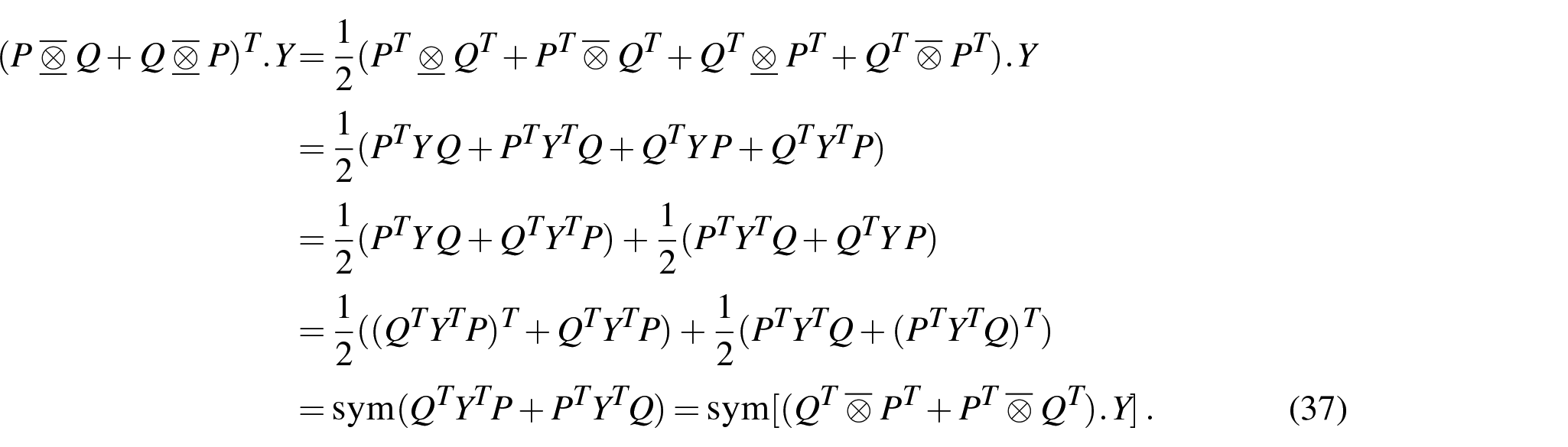
The tensor possesses the left minor symmetry [16], i.e., the minor symmetry on the first pair of indices. This can be verified easily in components, or by studying the action of on an arbitrary second-order tensor Z:
In contrast, does not possess the right minor symmetry and, again, this can be verified in components, or by studying the action of its transpose on an arbitrary second-order tensor Y:
The further symmetrisation
possesses both minor symmetries. Indeed, the left minor symmetry follows from the fact that each of and possesses the minor symmetry, by virtue of equation (34), and the right minor symmetry can be verified easily in components or, as above, by studying the action of the transpose , which is easily obtainable from equation (33), on an arbitrary second-order tensor Y:
Finally, if both P and Q are symmetric, then also possesses the major symmetry, i.e., for every second-order tensors Y and Z,
As usual, this can be verified in components, or by working out the (double) contractions.
1.3.3. Lie derivative of the Kirchhoff stress and spatial elasticity tensor
The Lie derivative of the Kirchhoff stress τ is related directly to the material elasticity tensor
as already seen in equation (12). Indeed, the material elasticity tensor (39) features in the rate expression of the second Piola–Kirchhoff stress,
and, since the second Piola–Kirchhoff stress is the pull-back of the Kirchhoff stress τ, i.e.,
the push-forward of the time derivative (40) of is, by definition, the Lie derivative of the Kirchhoff stress τ, as per equation (100). Therefore,
We aim at expressing the Lie derivative (42) as a function of the spatial elasticity tensor,
which is the full backward Piola transform of the material elasticity tensor , and relates the Truesdell rate (cf. Appendix 1) of the Cauchy stress σ to the deformation rate D [8, 14, 32, 33]. Note how the use of the special tensor product allows to write the backward Piola transformation equation (43) in component-free formalism, via the tensor and its transpose [33, 40]. The inverse relation of equation (43) is
It is easy to show (for instance, in components), that substitution of equation (44) into equation (42) yields
where we exploited the fact that the rate of deformation D is the push-forward of the time derivative E:
1.3.4. Zaremba–Jaumann rate of the Kirchhoff stress and its conjugated elasticity tensor
Here, we use the Cartesian expressions of some results from Appendix 1, which were obtained in covariant formalism. Substitution of the expression (45) of the Lie derivative of τ into the Zaremba–Jaumann rate (118) of τ yields
In order to find an absolute expression of the elasticity tensor relating the Zaremba–Jaumann rate of τ to the deformation rate D, we need to express the term as a fourth-order tensor double-contracted with D. We note that, by definition of identity tensor (which, in this case, means the spatial identity tensor and, rigorously speaking, would be the inverse metric tensor , which has contravariant components , similarly to the Kirchhoff stress τ, which has contravariant components ), we have the identity
By virtue of the symmetry all the tensors involved, i.e., , , , this can be written
which compared with equation (12), finally gives the sought absolute expression of , as
or, in components:
The elasticity tensor defined in equation (52) possesses the major symmetry and both minor symmetries, which follow from those of and (the major symmetry of descends from the symmetry of τ and ).
The spatial elasticity tensor inherits the major symmetry and both minor symmetries from the material elasticity tensor , which, in turn, enjoys the major symmetry because of the smoothness of the elastic potential (Schwarz’ theorem on the symmetry of the second partial derivatives), and both minor symmetries because of the symmetry of the Green-Lagrange strain E. The symmetrised special tensor product possesses both minor symmetries, as shown in equations (34) and (37), and, by virtue of the symmetry of τ and 1, it also possesses the major symmetry, as shown in equation (38). In a past work Palizi et al. [17], the major symmetry was missed because, in place of the symmetrised contribution , the contribution was used. This was the result of not accounting explicitly for the symmetry of τ and 1.
We remark that the component expression (53) is particularly convenient for the numerical implementation of , regardless of the specific software package at hand. As mentioned in Section 1.2, the programming of Abaqus™ UMAT user-defined material subroutines requires the elasticity tensor
Last, we note again that, in covariant formalism, the identity 1 must be replaced by the inverse metric tensor .
1.3.5. Truesdell rate of the Cauchy stress and spatial elasticity tensor
Similarly to the case of the Lie derivative of the Kirchhoff stress τ, the Truesdell rate of the Cauchy stress is related directly to the material elasticity tensor of equation (39). Indeed, the second Piola–Kirchhoff stress is the backward Piola transform of the Cauchy stress σ, i.e.,
and the forward Piola transform of the time derivative (40) of is, by definition, the Truesdell rate of the Cauchy stress σ, as per equation (116). Therefore,
With the same procedure seen above for the Lie derivative of the Kirchhoff stress τ, we can show that the Truesdell rate equation (56) of the Cauchy stress σ is related to the spatial elasticity tensor of equation (43) via
1.3.6. Zaremba–Jaumann rate of the Cauchy stress and its conjugated elasticity tensor
We refer again to Appendix 1. Substitution of the expression (57) of the Truesdell rate of σ into the Zaremba–Jaumann rate equation (119) of σ yields
The term is obtained by simply dividing equation (50) by J, as
and the term is obtained via the definitions of the trace and (standard) tensor product, as
which, compared with equations (5) and (65) yields the absolute expression of as
or, in components,
All considerations made for hold for , except for the fact that does not posses major symmetry, due to the presence of the term which can only be major symmetric when the Cauchy stress σ is hydrostatic: not a very interesting scenario, and certainly not a general scenario. Finally, we note again that, in covariant formalism, the identity 1 must be replaced by the inverse metric tensor .
As for the relevance of the representation equation (63), we observe that indeed, in the works by by Li and Wang [41, equation (6)], by Wang et al. [42, equation (2.22)], and by Morris and Krenn [43, equation (22)], the following (largely ad hoc) constitutive stiffness tensor is analysed for stability of the elastic law,
where is interpreted by us as the spatial elasticity tensor occurring in equation (57) ([42, equation (2.22)]) and the authors define [material] instability to be present at . Taking into account equation (63), it occurs therefore that the above coincides with the induced tangent stiffness matrix appearing in the rate-formulation for the Cauchy stress σ and the Zaremba–Jaumann rate [26]
The condition is, in fact, equivalent to checking (cf. Neff et al. [26]) the local invertibility of , i.e.
In the paper [42], the authors check, in this interpretation,
being aware that is, in general, not major symmetric and we note that [25, 44, 45]
2. The induced tangent stiffness tensor for the Hencky energy
2.1. The compressible Hencky energy
Let us now present as an example of the foregoing development the Hencky model. The Hencky energy (see Neff et al. [47–49] and Xiao et al. [12, 13, 50, 51] for related literature) reads
The corresponding Kirchhoff stress τ can be calculated using the Richter representation [52–59]
For , Hill’s inequality is satisfied (cf. Hill [60–62] and Sidoroff [63])
and we even have
since
and is convex in .
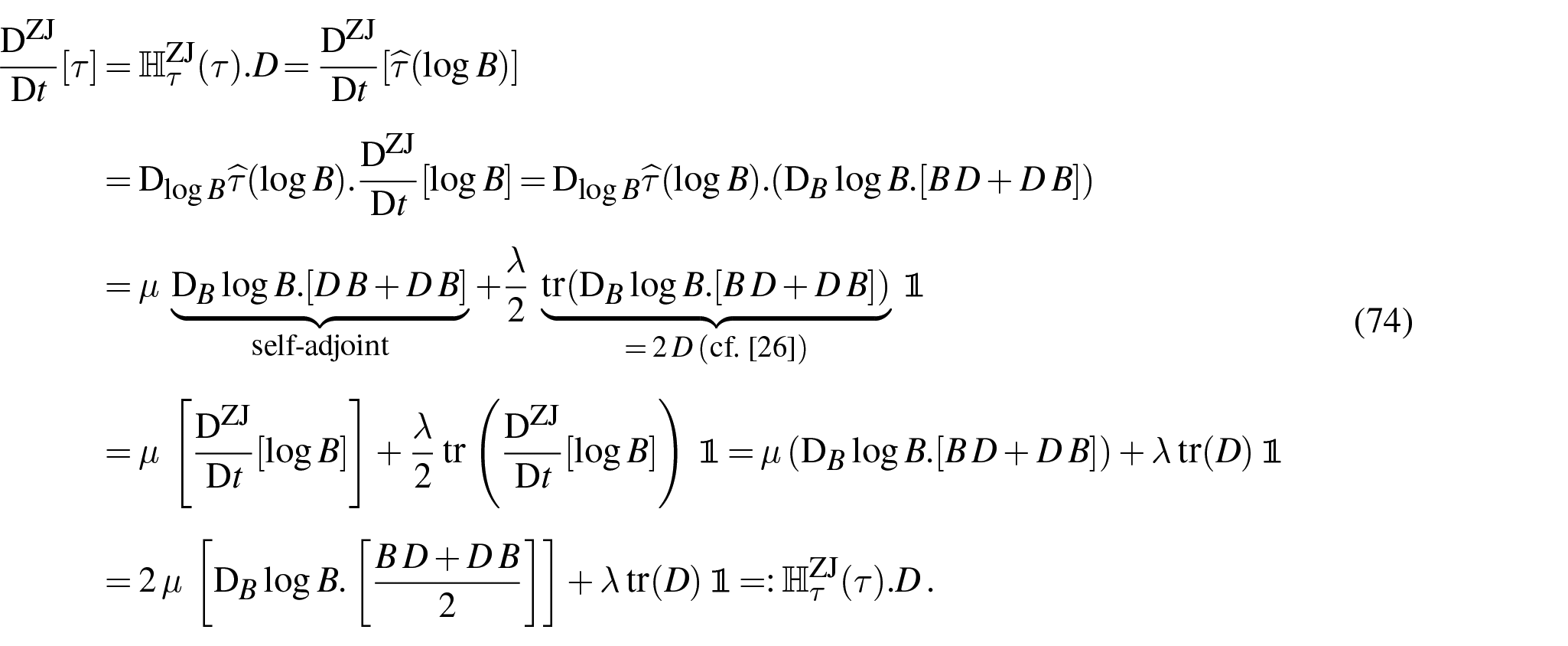
We wish to directly determine the rate-formulation for the Kirchhoff stress τ with the Zaremba–Jaumann rate. From d’Agostino et al. [44] and Neff et al. [24, 26], we have
It is easy to see directly that is self-adjoint since the first part in equation is, and is obviously minor symmetric. Moreover, is positive-definite for since (cf. Neff et al. [26], Appendix 1)
Looking back at equation (20), we see that the tangent stiffness tensor of the Abaqus™ input format given by
is major symmetric and throughout positive definite, such that the Abaqus™ and Ansys™“stability check” is satisfied globally while the Hencky elasticity model shows unphysical response (e.g. for purely volumetric response). Thus, the Abaqus™ and Ansys™“stability check” must be used with great care when applied to the compressible case. It does neither imply that the elasticity model is physically sound nor that the FEM-calculations are stable and yielding a mesh-independent result.
2.2. The incompressible Hencky energy
In the incompressible case, , and we observe that due to
we have the “linear incompressibility contraint” in the logarithmic strain .
The energy now reads
Repeating the calculations for the compressible case, we obtain
The author(s) disclosed receipt of the following financial support for the research, authorship, and/or publication of this article: This research was supported in part by the Natural Sciences and Engineering Research Council of Canada, through the NSERC Discovery Programme, grant no. RGPIN-2024-04247 [S. Federico].
XiaoHBruhnsOTMeyersA.Objective corotational rates and unified work-conjugacy relation between Eulerian and Lagrangean strain and stress measures. Arch Mech1998; 50: 1015–1045.
14.
BonetJWoodRD.Nonlinear continuum mechanics for finite element analysis. 2nd ed.Cambridge: Cambridge University Press, 2008.
15.
AubramD.Notes on rate equations in nonlinear continuum mechanics. arXiv:1709.10048, 2017.
16.
BelliniCFedericoS.Green-Naghdi rate of the Kirchhoff stress and deformation rate: the elasticity tensor. Z Angew Math Phys2015; 66(3): 1143–1163.
17.
PaliziMFedericoSAdeebS.Consistent numerical implementation of hypoelastic constitutive models. Z Angew Math Phys2020; 71: 1–23.
18.
FialaZ.Is the logarithmic time derivative simply the Zaremba-Jaumann derivative?Eng Mech Natl Conf Int Particip2009; 211: 227–240.
19.
FialaZ.Objective time derivatives revised. Z Angew Math Phys2020; 71(1): 4.
20.
GovindjeeS.Accuracy and stability for integration of Jaumann stress rate equations in spinning bodies. Eng Comput1997; 14(1): 14–30.
21.
KorobeynikovSN.Basis-free expressions for families of objective strain tensors, their rates, and conjugate stress tensors. Acta Mech2018; 229: 1061–1098.
22.
KorobeynikovSN.Families of Hooke-like isotropic hyperelastic material models and their rate formulations. Arch Appl Mech2023; 93: 3863–3893.
23.
PinskyPMOrtizMPisterKS.Numerical integration of rate constitutive equations in finite deformation analysis. Comput Methods Appl Mech Eng1983; 40(2): 137–158.
24.
NeffPHolthausenSKorobeynikovSN, et al. A natural requirement for objective corotational rates - on structure preserving corotational rates. arXiv:2409.19707v1, 2024.
25.
LeblondJB.A constitutive inequality for hyperelastic materials in finite strain. Eur J Mech A/Solids1992; 11(4): 447–466.
26.
NeffPHolthausenSd’AgostinoMV, et al. Hypo-elasticity, Cauchy-elasticity, corotational stability and monotonicity in the logarithmic strain. arXiv:2409.20051v1, to appear in the Journal of the Mechanics and Physics of Solids, 2024.
27.
ZarembaS.Sur une forme perfectionnée de la théorie de la relaxation. Bull Int Acad Sci Cracovie1903; 3: 534–614.
28.
JaumannG.Geschlossenes system physikalischer und chemischer differential-gesetze. Sitzungsber Akad der Wiss Wien IIa1911; 120: 385–530.
29.
JiWWaasAMBazantZP.On the importance of work-conjugacy and objective stress rates in finite deformation incremental finite element analysis. J Appl Mech2013; 80(4): 041024.
30.
BrannonRM.Caveats concerning conjugate stress and strain measures for frame indifferent anisotropic elasticity. Acta Mech1998; 129: 107–116.
31.
CurnierAHeQCZyssetP.Conewise linear elastic materials. J Elast1995; 37: 1–38.
32.
FedericoSGrilloA.Elasticity and permeability of porous fibre-reinforced materials under large deformations. Mech Mater2012; 44: 58–71.
33.
FedericoS.Covariant formulation of the tensor algebra of non-linear elasticity. Int J Non Linear Mech2012; 47: 273–284.
34.
GasserTCOgdenRWHolzapfelGA.Hyperelastic modelling of arterial layers with distributed collagen fibre orientations. J R Soc Interface2006; 3: 15–35.
35.
GrilloACarfagnaMFedericoS.An Allen-Cahn approach to the remodelling of fibre-reinforced anisotropic materials. J Eng Math2018; 109: 139–172.
36.
Del PieroG. Some properties of the set of fourth-order tensors, with application to elasticity. J Elast1979; 9: 245–261.
37.
LucchesiMOwenDRPodio-GuidugliP.Materials with elastic range: a theory with a view toward applications. Part III: approximate constitutive relations. Arch Ration Mech Anal1992; 117: 53–96.
38.
JogCS.A concise proof of the representation theorem for fourth-order isotropic tensors. J Elast2006; 85: 119–124.
39.
HolzapfelGA.Nonlinear solid mechanics. A continuum approach for engineering. Chichester: John Wiley & Sons, 2000.
LiWXWangTC.Ab initio investigation of the elasticity and stability of aluminium. J Phys Condens Matter1998; 10(43): 9889–9904.
42.
WangJHLiJYipS, et al. Mechanical instabilities of homogeneous crystals. Phys Rev B1995; 52(17): 12627–12635.
43.
MorrisJWKrennCR.The internal stability of an elastic solid. Philos Mag A2000; 80(12): 2827–2840.
44.
d’AgostinoMVHolthausenSBernardiniD, et al. A constitutive condition for idealized isotropic Cauchy elasticity involving the logarithmic strain. arXiv:2409.01811v1, 2024.
45.
NeffPHusemannNJTchakoutioASN, et al. The corotational stability postulate: positive incremental Cauchy stress moduli for diagonal, homogeneous deformations in isotropic nonlinear elasticity. arXiv:2411.12552, 2024.
46.
BendixsonI.Sur les racines d’une équation fondamentale. Acta Math1902; 25: 359–365.
47.
NeffPEidelBMartinRJ.Geometry of logarithmic strain measures in solid mechanics. Arch Ration Mech Anal2016; 222: 507–572.
48.
NeffPGhibaIDLankeitJ.The exponentiated Hencky-logarithmic strain energy. Part I: constitutive issues and rank–one convexity. J Elast2015; 121: 143–234.
49.
NeffPGhibaIDLankeitJ, et al. The exponentiated Hencky-logarithmic strain energy. Part II: coercivity, planar polyconvexity and existence of minimizers. Z Angew Math Phys2015; 66: 1671–1693.
50.
XiaoHBruhnsOTMeyersA.Hypo-elasticity model based upon the logarithmic stress rate. J Elast1997; 47: 51–68.
51.
XiaoHBruhnsOTMeyersA.Strain rates and material spins. J Elast1998; 52: 1–41.
52.
GrabanKSchweickertEMartinRJ, et al. A commented translation of Hans Richter’s early work ‘The isotropic law of elasticity’. Math Mech Solids2019; 24(8): 2649–2660.
53.
RichterH.Das isotrope Elastizitätsgesetz. Z Angew Math Phys1948; 28(7–8): 205–209.
54.
RichterH.Verzerrungstensor, Verzerrungsdeviator und Spannungstensor bei endlichen Formänderungen. Z Angew Math Phys1949; 29(3): 65–75.
55.
RichterH.Zum Logarithmus einer Matrix. Arch Math (Basel)1950; 2: 360–363.
56.
RichterH.Zur Elastizitätstheorie endlicher Verformungen. Math Nachr1952; 8: 65–73.
57.
MoreauJJ.Lois d’élasticité en grande déformation, séminaire d’analyse convexe. Montpellier: Université de Montpellier II, 1979.
58.
ValléeC.Lois de comportement élastique isotropes en grandes déformations. Int J Eng Sci1978; 16(7): 451–457.
59.
ValléeCFortunéDLerintiuC.On the dual variable of the Cauchy stress tensor in isotropic finite hyperelasticity. C R Mec2008; 336(11): 851–855.
60.
HillR.On constitutive inequalities for simple materials - I. J Mech Phys Solids1968; 16(4): 229–242.
61.
HillR.On constitutive inequalities for simple materials - II. J Mech Phys Solids1968; 16(5): 315–322.
62.
HillR.Constitutive inequalities for isotropic elastic solids under finite strain. Proc R Soc Lond Ser A Math Phys Sci1970; 314(1519): 457–472.
63.
SidoroffR.Sur les restrictions à imposer à l’énergie de déformation d’un matériau hyperélastique. C R Acad Sci1974; 279: 379–382.
NeffPLankeitJMadeoA.On Grioli’s minimum property and its relation to Cauchy’s polar decomposition. Int J Eng Sci2014; 80: 209–217.
69.
LankeitJNeffPNakatsukasaY.The minimization of matrix logarithms: on a fundamental property of the unitary polar factor. Linear Algebra Appl2014; 449(0): 28–42.
70.
NeffPNakatsukasaYFischleA.A logarithmic minimization property of the unitary polar factor in the spectral norm and the Frobenius matrix norm. SIAM J Matrix Anal Appl2014; 35: 1132–1154.
71.
CotterBARivlinRS.Tensors associated with time-dependent stress. Q Appl Math1955; 13: 1036–1041.
72.
OldroydJG.On the formulation of rheological equation of state. Proc R Soc Lond Ser A Math Phys Sci1950; 200: 523–541.
73.
BiezenoCBHenckyH.On the general theory of elastic stability. K Akad Wet1928; 31: 569–592.
74.
KolevBDesmoratR.Objective rates as covariant derivatives on the manifold of Riemannian metrics. Arch Ration Mech Anal2024; 248(4): 66.
75.
JaumannG.Die Grundlagen der Bewegungslehre von einem modernen Standpunkte aus dargestellt. Leipzig: Johann Ambrosius Barth, 1905.
76.
GreenAEMcInnisBC.Generalized hypo-elasticity. Proc R Soc Edinb Sec A Math Phys Sci1967; 67(3): 220–230.
77.
GreenAENaghdiPM.A general theory of an elastic-plastic continuum. Arch Ration Mech Anal1965; 18(4): 251–281.
78.
NaghdiPMWainwrightWL.On the time derivative of tensors in mechanics of continua. Q Appl Math1961; 19(2): 95–109.
79.
HughesTJRMarsdenJE.Some applications of geometry in continuum mechanics. Rep Math Phys1977; 12: 35–44.
80.
FedericoS.The Truesdell rate in continuum mechanics. Z Angew Math Phys2022; 73: 109.