We study the steady-state response of a three-phase composite composed of an internal hypotrochoidal compressible liquid inclusion, an intermediate isotropic elastic coating and an outer isotropic elastic matrix with simultaneous interface slip and diffusion occurring on the solid–solid interface when the matrix is subjected to a uniform hydrostatic stress field. We design a neutral coated hypotrochoidal liquid inclusion that does not disturb the prescribed uniform hydrostatic stress field in the surrounding matrix. The neutrality is achieved when the plane-strain bulk modulus or the compressibility of the elastic matrix is determined by solving a system of simultaneous linear algebraic equations for given geometric and material parameters of the coated liquid inclusion.
A neutral elastic inclusion when inserted into a uniformly stressed elastic matrix does not disturb the elastic field outside the inclusion. The design of neutral elastic inclusions can be dated back to Mansfield [1] who achieved the neutrality of certain reinforced holes. Since then, the idea of neutrality has been pursued by many researchers with corresponding investigations reported extensively in the literature. The neutrality of an elastic inclusion can be achieved through a soft or stiff imperfect interface with vanishing thickness [2,3] or through an elastic coating of finite thickness [4–7]. On the other hand, liquid inclusions trapped in solids such as crystals, rocks, biological tissues, hydrogels, and elastomers are a common phenomenon in nature. Although micromechanics analysis of liquid inclusions embedded in an elastic matrix has become a focused research topic in the past decade [8–22], the problem of neutral liquid inclusions has not been thoroughly investigated. It is then natural to ask whether a liquid inclusion covered by an elastic coating can be made neutral to a prescribed uniform stress field applied in the elastic matrix. It is well known that stress relaxation can be accomplished by viscous-type interface slip and long-range interface diffusion [23–35]. After complete stress relaxation by interface slip and diffusion, both the tangential traction and gradient in normal traction vanish at the interface. It is of interest to ask whether this property of interface slip and diffusion can be applied in the design of neutral coated non-circular liquid inclusions.
In this paper, we study the steady-state response of a two-dimensional hypotrochoidal compressible liquid inclusion covered by an isotropic elastic coating, which is bonded to a hydrostatically stressed isotropic elastic matrix through an interface admitting simultaneous interface slip and diffusion. At steady state after complete relaxation by interface slip and diffusion, uniform normal tractions are applied on both the liquid–solid interface and the solid–solid interface. The steady-state elastic field in the coating and the internal uniform hydrostatic stress field within the liquid inclusion are obtained by solving a coupled set of linear algebraic equations for given geometric and material parameters of the coated inclusion and we find that they are in fact irrelevant to the neutrality of the coated liquid inclusion. We further design a neutral coated hypotrochoidal liquid inclusion that does not disturb the uniform hydrostatic stress field in the matrix. The neutrality of the coated liquid inclusion is achieved once the plane-strain bulk modulus or the compressibility of the matrix is properly chosen. Detailed numerical results of the internal uniform hydrostatic stress field within the liquid inclusion, the hoop stresses along the liquid–solid and solid–solid interfaces on the coating side and the compressibility of the matrix are presented to demonstrate the analytical solution. The practical significance of the present solution lies in the fact that a uniform hydrostatic stress distribution in the matrix eliminates any possible stress peaks and stress concentrations in the matrix. We mention here that it is impossible to achieve the neutrality of the hypotrochoidal liquid inclusion when the solid–solid interface is perfect and when the plane-strain bulk moduli of the liquid inclusion and the coating are unequal. For this reason, it is important to study the interface slip and diffusion although this makes the analysis more laborious.
2. Muskhelishvili’s complex variable formulation
We first establish a fixed rectangular coordinate system . For the plane strain deformation of an isotropic elastic material, the three in-plane stresses , two in-plane displacements , and two stress functions can be expressed in terms of two analytic functions and of the single complex variable as [36]
and
where , μ and are the shear modulus and Poisson’s ratio, respectively. In addition, the three in-plane stress components are related to the two stress functions through [37]
3. A neutral coated hypotrochoidal liquid inclusion
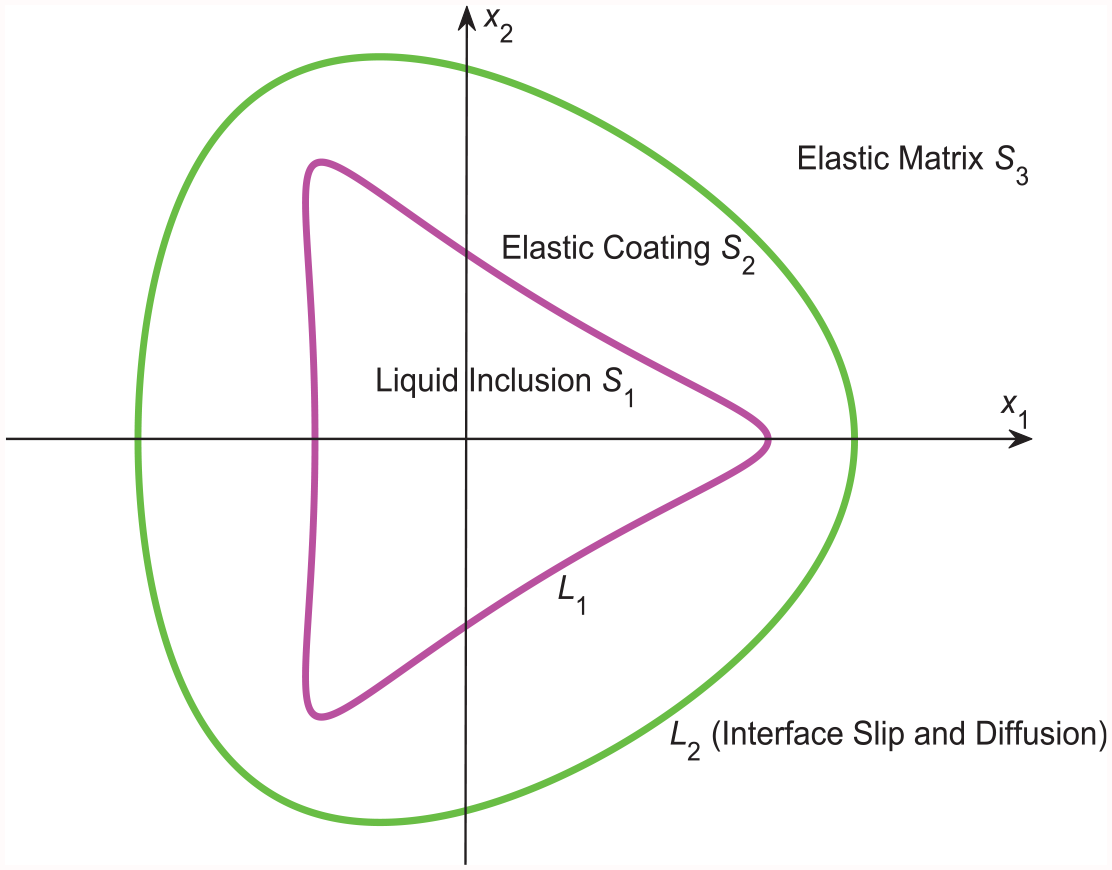
As shown in Figure 1, we consider a hypotrochoidal compressible liquid inclusion covered by an isotropic elastic coating which is surrounded by a finite or infinite isotropic elastic matrix subjected to a prescribed uniform hydrostatic stress field. Let , and denote the internal liquid inclusion, the intermediate elastic coating, and the outer elastic matrix, respectively. The liquid inclusion is perfectly bonded to the elastic coating through the liquid–solid interface , while viscous-type interface slip and interface diffusion occur concurrently on the solid–solid interface . We study the steady-state response of the three-phase composite after complete relaxation by interface slip and diffusion on . In what follows, subscripts 1, 2, and 3 are used to identify the respective quantities in , and .
A hypotrochoidal compressible liquid inclusion covered by an isotropic elastic coating which is surrounded by an isotropic elastic matrix under a prescribed uniform hydrostatic stress field.
We first introduce the following conformal mapping function for the coating:
where N is an integer greater than 1.
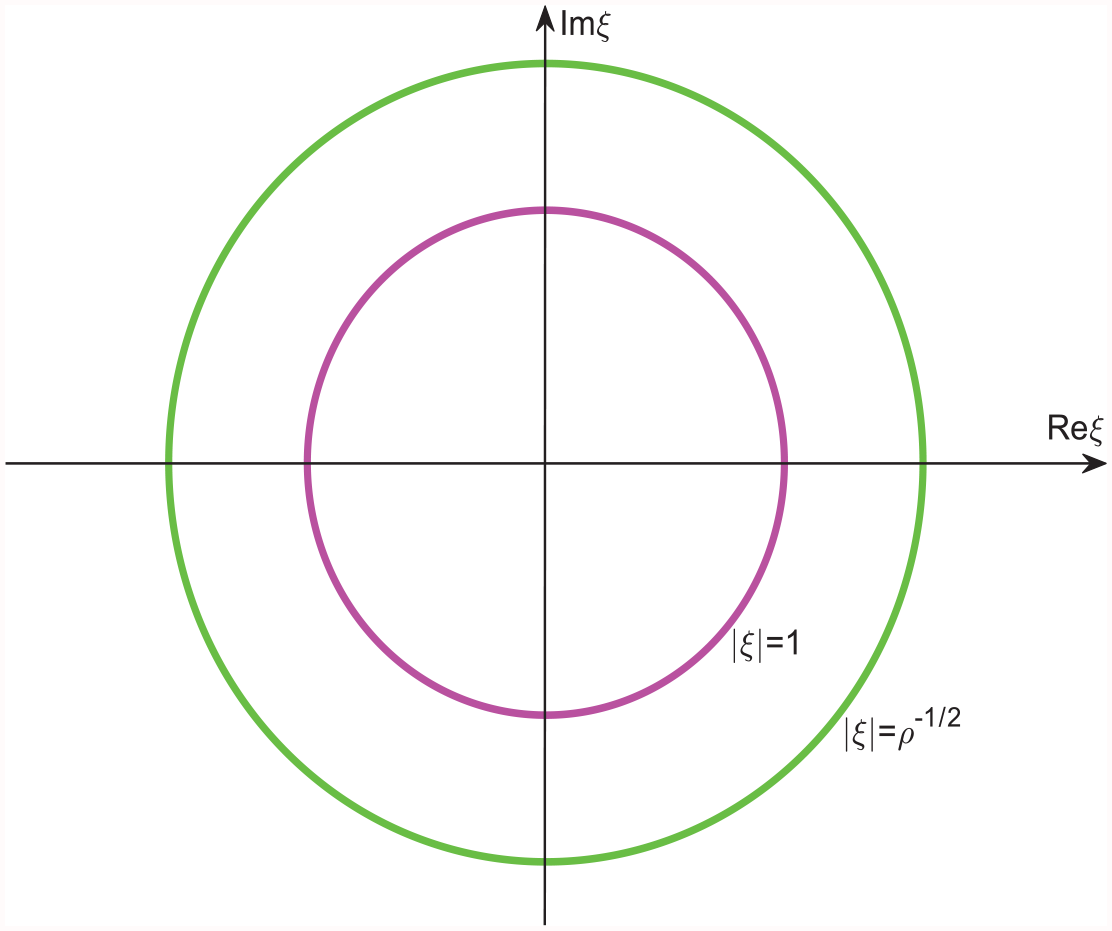
As shown in Figure 2, using the mapping function in equation (4), the coating is mapped onto the annulus with , the liquid–solid interface is mapped onto the inner unit circle and the solid–solid interface is mapped onto the outer concentric circle . It will be seen in the ensuing analysis that the parameter ρ representing the relative thickness of the coating is related to the volume fraction occupied by the liquid hypotrochoidal inclusion in the coated liquid inclusion in a nonlinear manner (see section 4).
The image ξ-plane.
The two stress functions within the liquid inclusion and the elastic matrix take the following forms
where p is the unknown uniform hydrostatic tension within the liquid inclusion (to be determined) and q is the prescribed hydrostatic tension in the undisturbed elastic matrix after complete relaxation by interface slip and diffusion on .
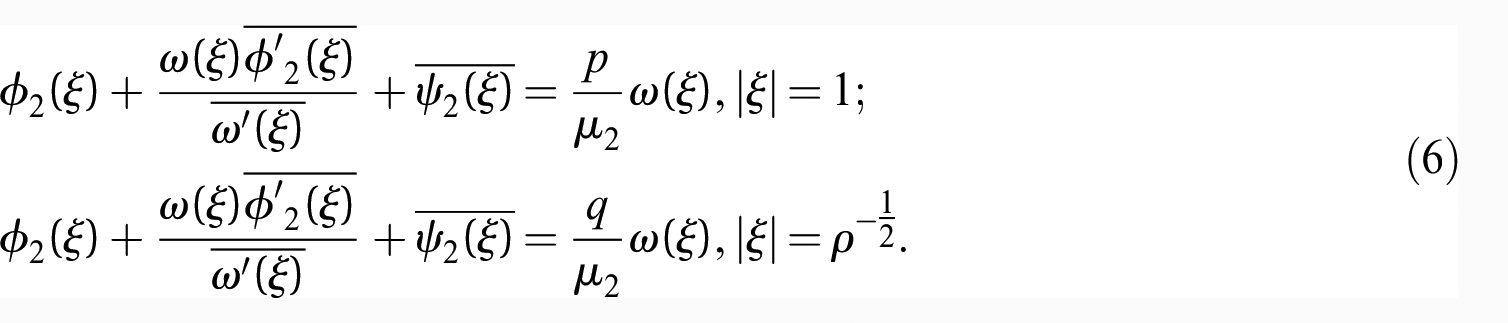
The continuity conditions of tractions across the liquid–solid interface and the solid–solid interface can then be expressed in terms of and as
Considering equation (6), we introduce the following analytic continuation
where the superscripts “+” and “−” indicate the values when approaching the two circles and from inside and outside, respectively.
Equation (8) implies that is continuous across and , and is then analytic in the annulus . Consequently, for can be expanded into a Laurent series as follows
where and are unknown real constants to be determined.
Using the analytic continuation of in equation (7) to satisfy the uniqueness of , we arrive at the following relationship:
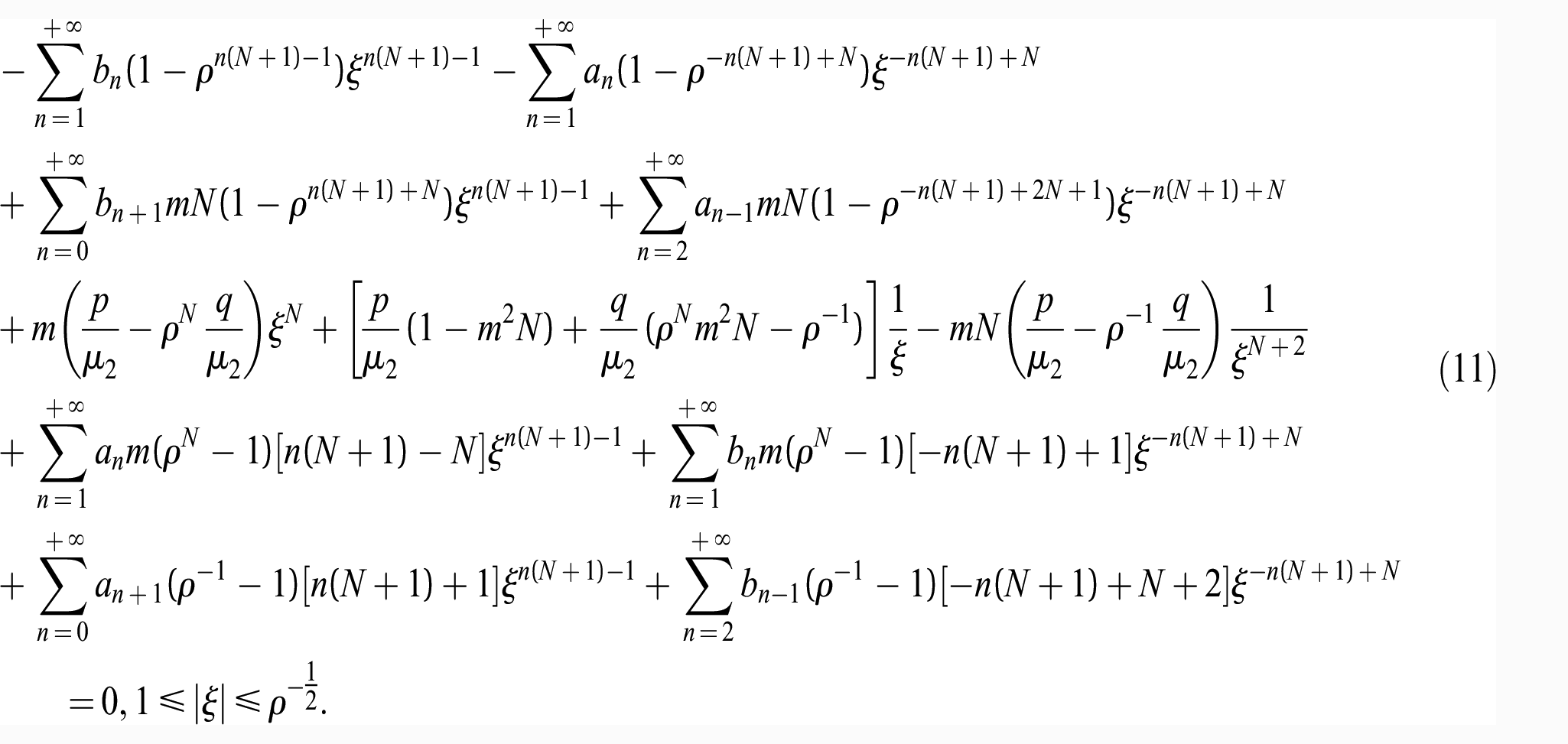
By equating coefficients of like powers of ξ in equation (11), we obtain
The change in area of the hypotrochoidal compressible liquid inclusion due to internal uniform hydrostatic stresses is given by
where is the initial area of the hypotrochoidal liquid inclusion and is its plane-strain bulk modulus. The liquid inclusion becomes incompressible when and infinitely compressible when .
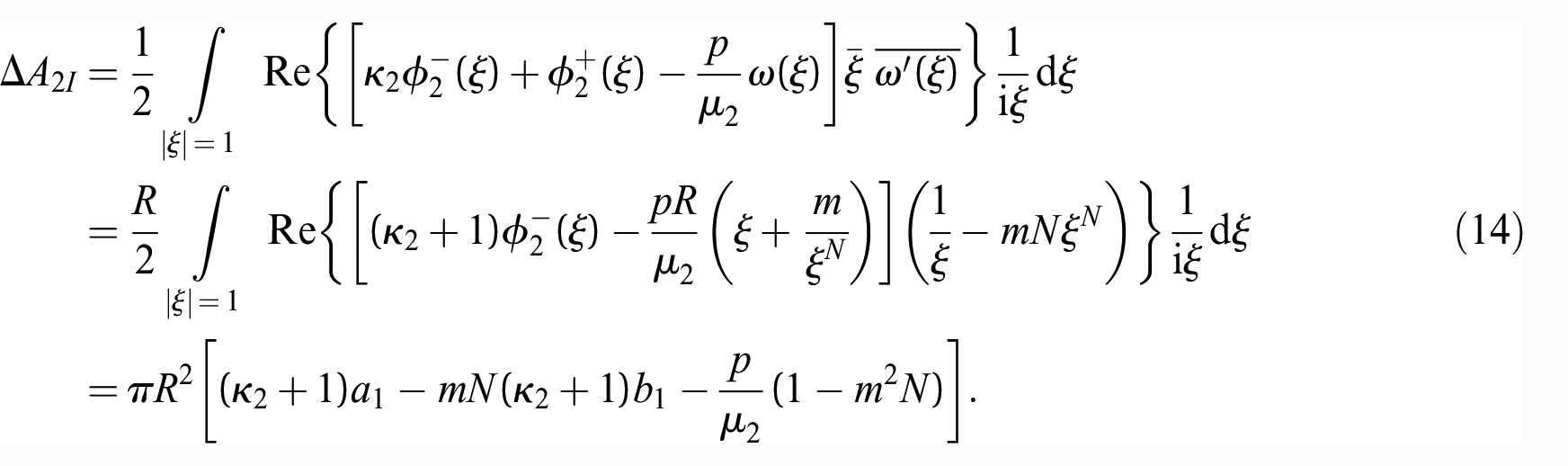
The change in area of the liquid-solid interface on the coating side can be determined by adapting the formula given by Wu et al. [10] as follows:
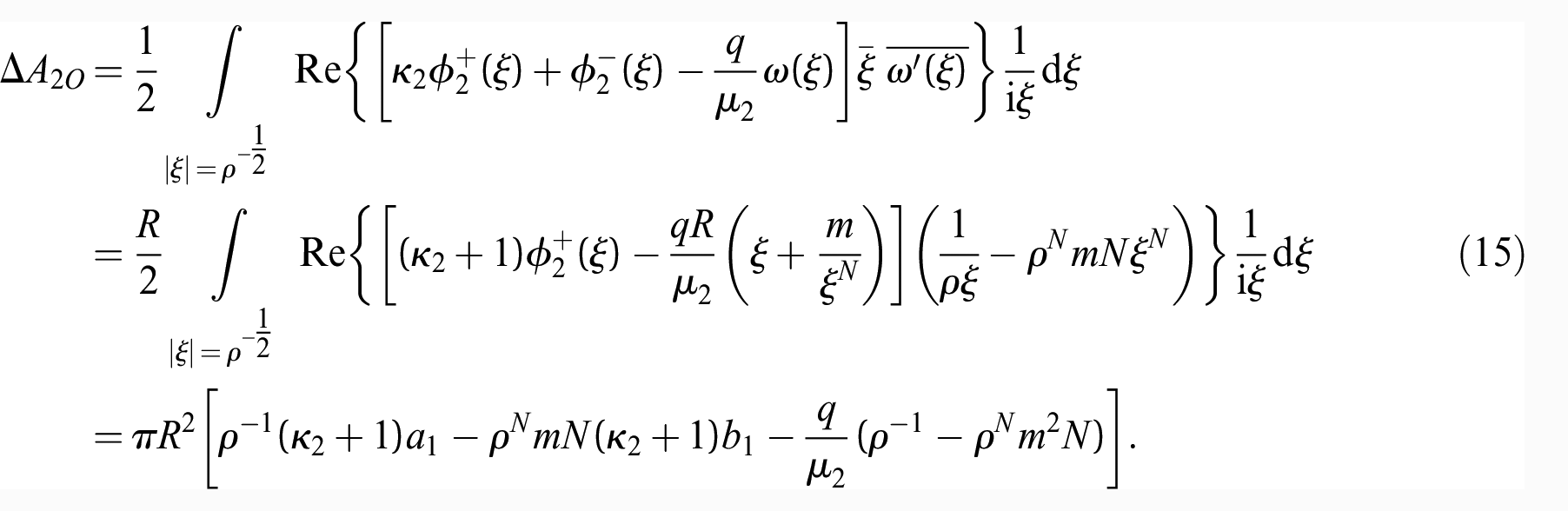
In a similar manner, the change in area of the solid–solid interface on the coating side can be determined as follows:
The change in area of the solid–solid interface on the matrix side can be determined quite simply as
where is the plane-strain bulk modulus of the elastic matrix and is the initial area enclosed by .
In order to ensure the continuity of displacements across the perfect liquid–solid interface , it is necessary that [22]
Similar to the argument by Srolovitz et al. [25] based on Eshelby’s method [38], it is also necessary that
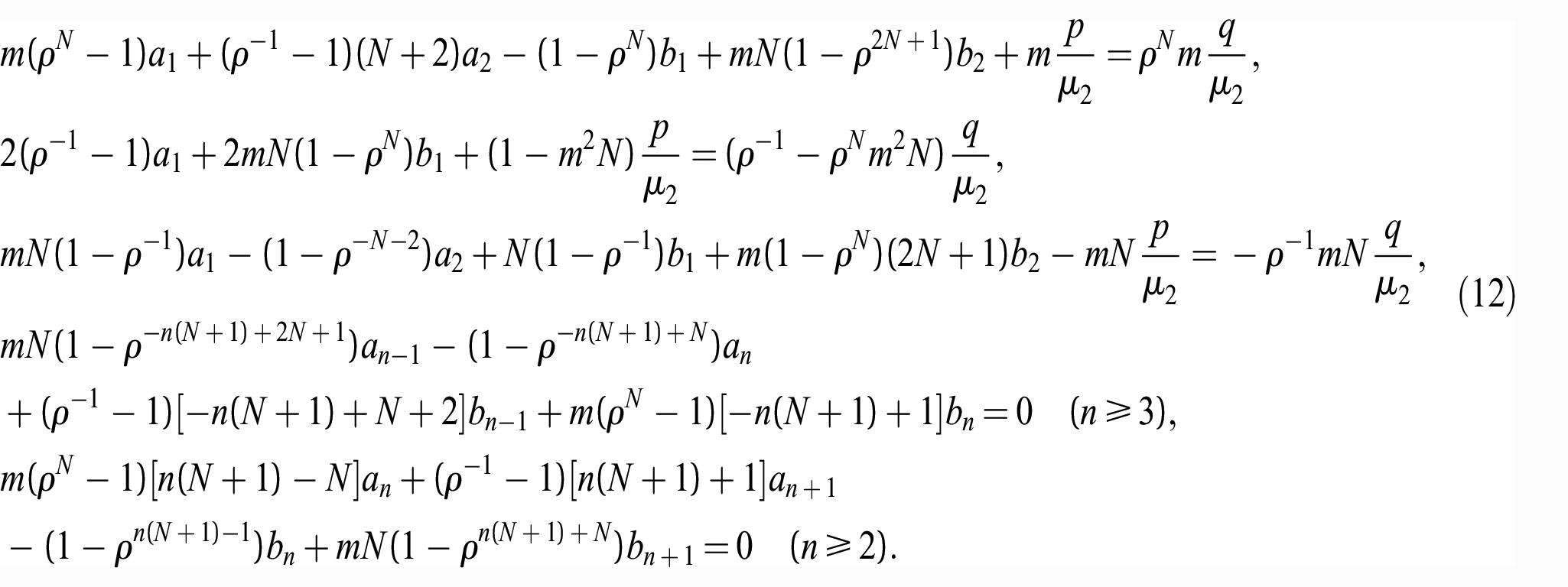
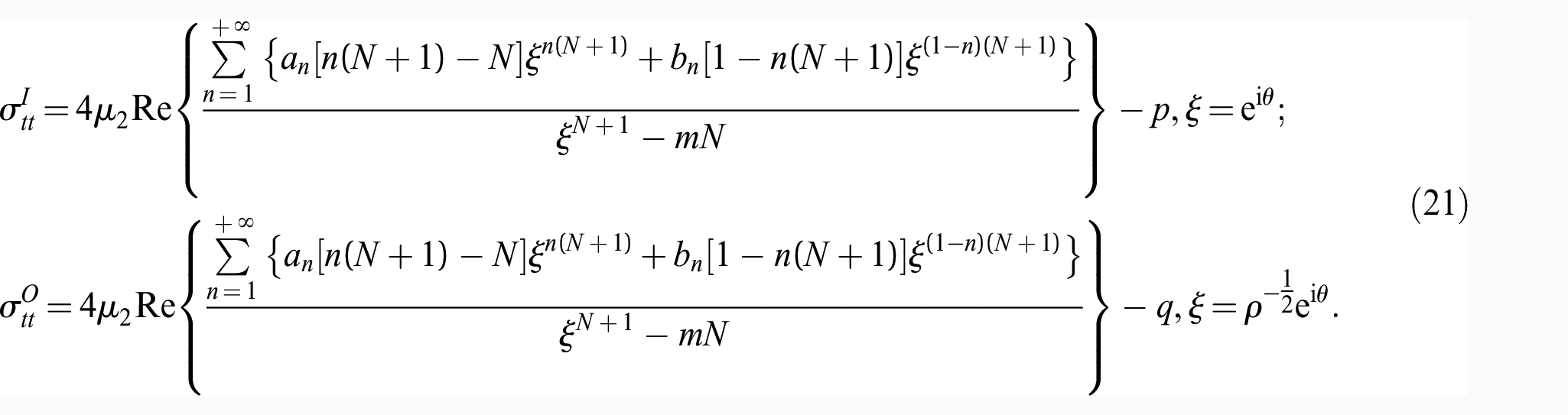
We have now arrived at an infinite number of linear algebraic equations in equations (12) and (19) for the infinite number of unknowns and . By truncating at the value in equations (12)4 and (12)5, we arrive at linear algebraic equations for the unknowns and . Thus, all of the unknowns can be uniquely determined by solving the coupled linear algebraic equations for given geometric and material parameters: , and . Consequently, the steady-state elastic field in the coating and the internal uniform hydrostatic stress field within the liquid inclusion are determined and they are in fact irrelevant to the neutrality of the coated liquid inclusion. For example, the hoop stress along the liquid–solid interface on the coating side and the hoop stress along the solid–solid interface on the coating side are given by the following:
where is the plane-strain bulk modulus of the elastic coating. The plane-strain bulk modulus or the compressibility of the elastic matrix can be uniquely determined from equation (22). Once or is determined according to equation (22), the introduction of the coated hypotrochoidal liquid inclusion does not disturb the prescribed uniform hydrostatic stress field in the elastic matrix after complete relaxation by interface slip and diffusion on . Thus, the coated hypotrochoidal liquid inclusion becomes neutral to a prescribed uniform hydrostatic stress field in the matrix.
4. Numerical results
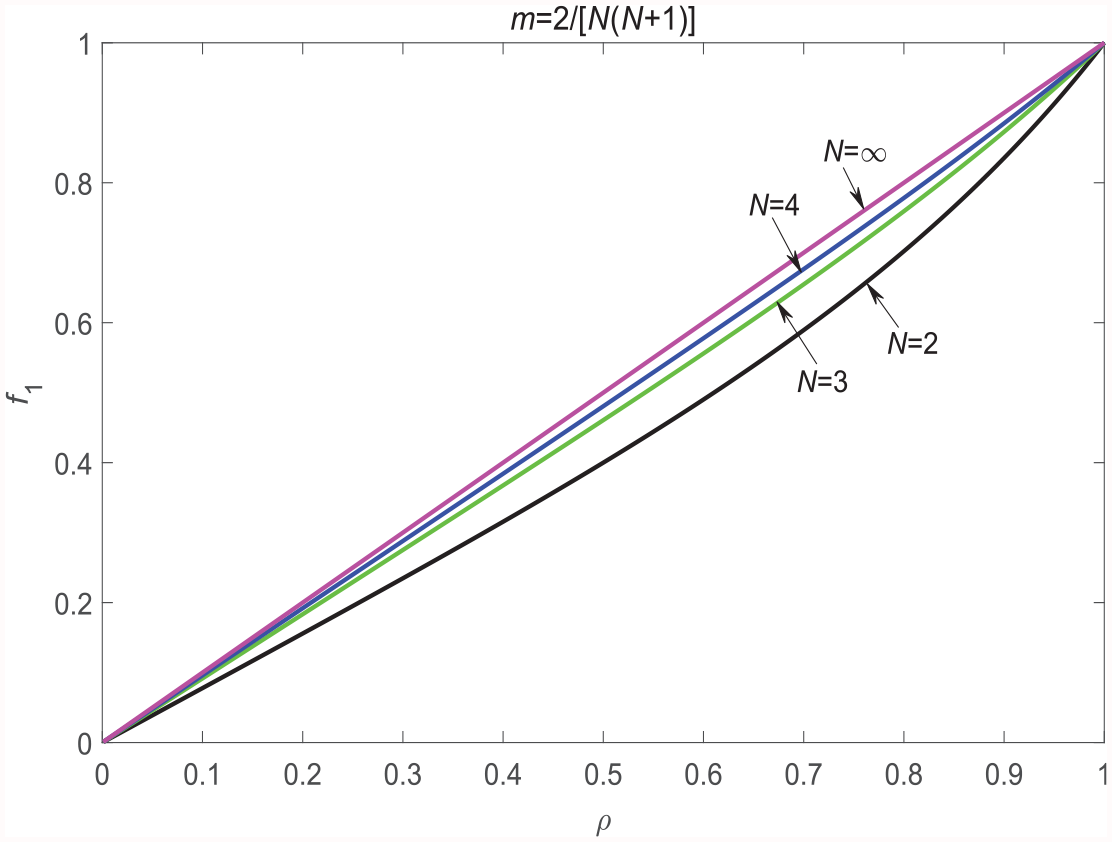
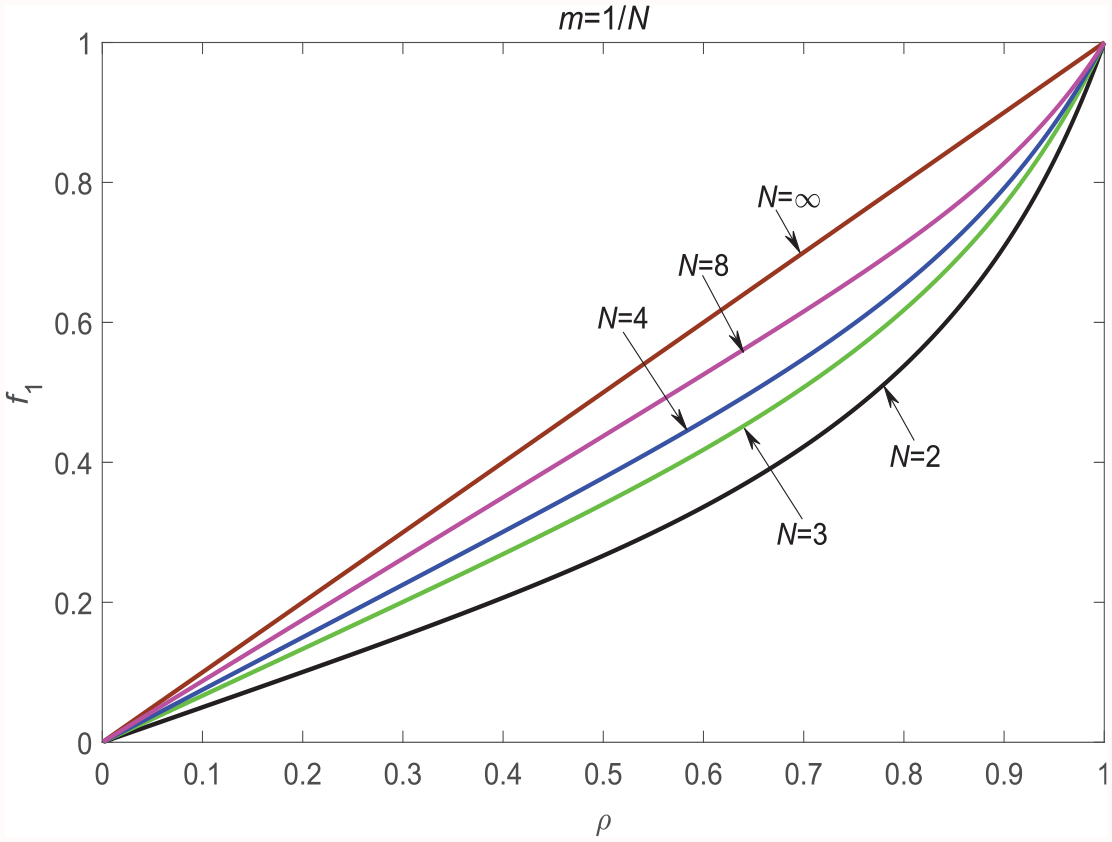
The volume fraction occupied by the liquid inclusion in the coated liquid inclusion is determined as
which is illustrated in Figures 3 and 4. It is seen from equation (23) and Figures 3 and 4 that (1) for a finite value of N and ; (2) as for a coated circular liquid inclusion; (3) is an increasing function of ρ: when and when ; (4) in general, is related to ρ in a nonlinear manner.
Variations of as a function of ρ for different values of N with for having rounded corners.
Variations of as a function of ρ for different values of N with for having cusps.
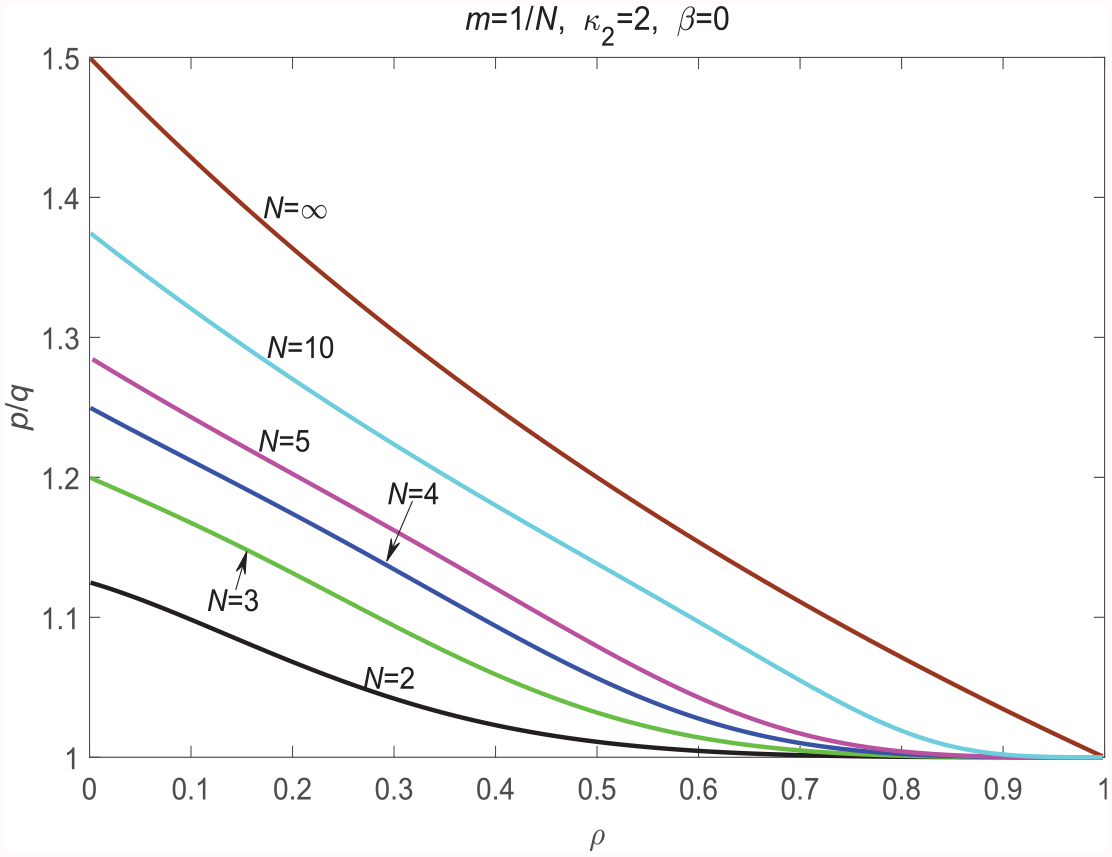
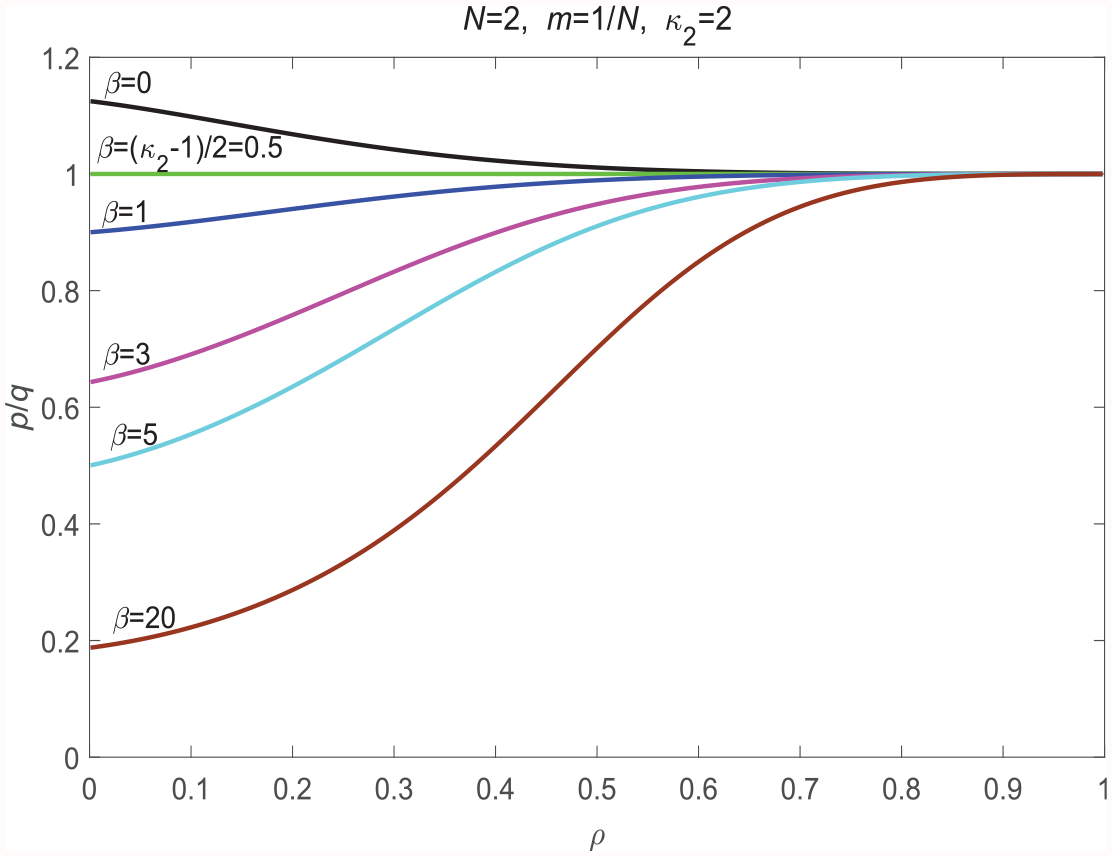
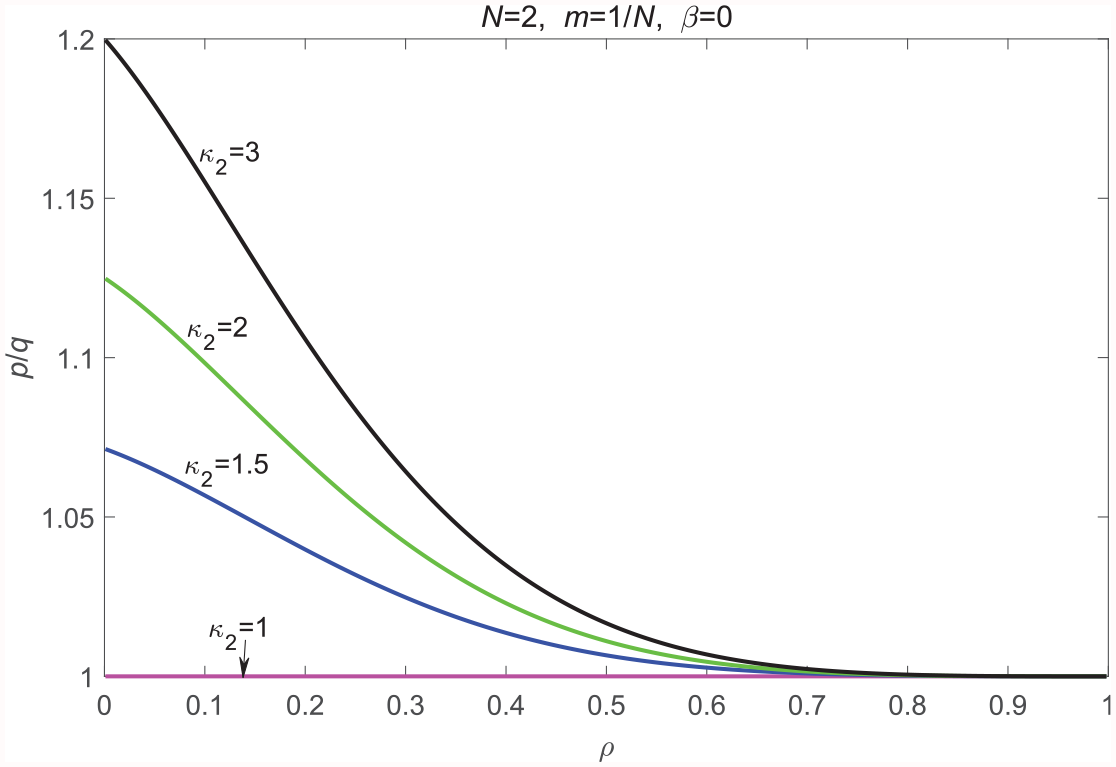
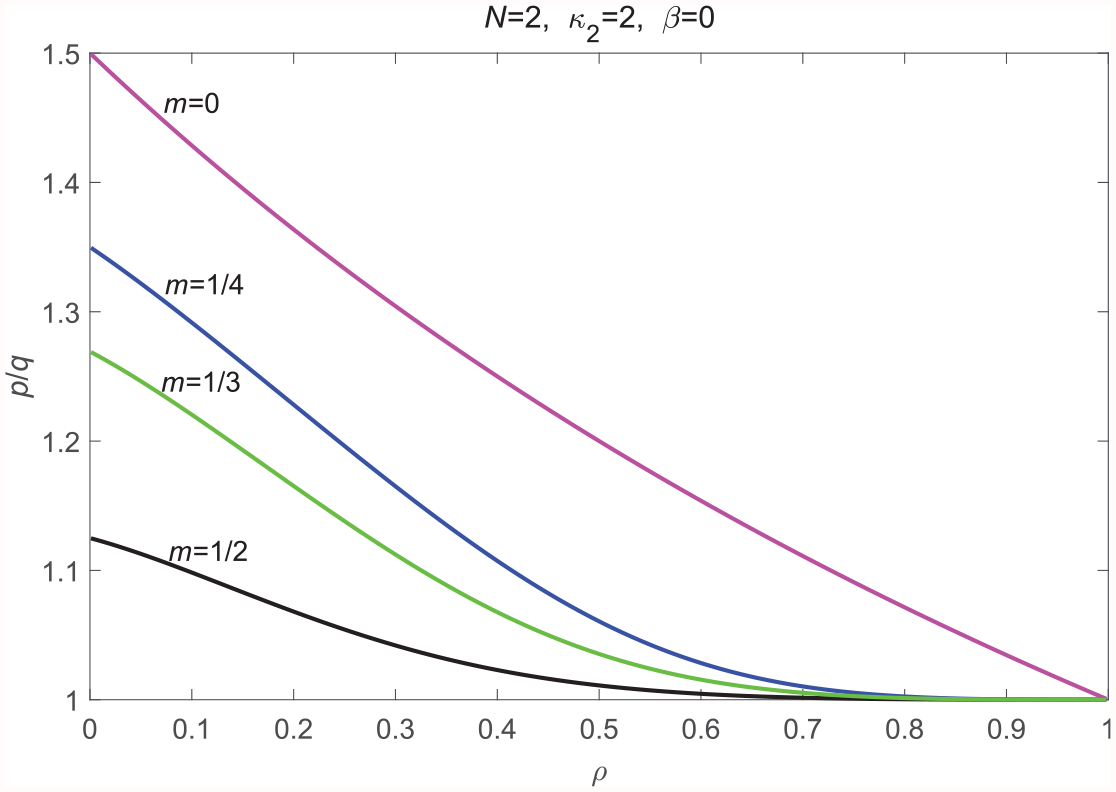
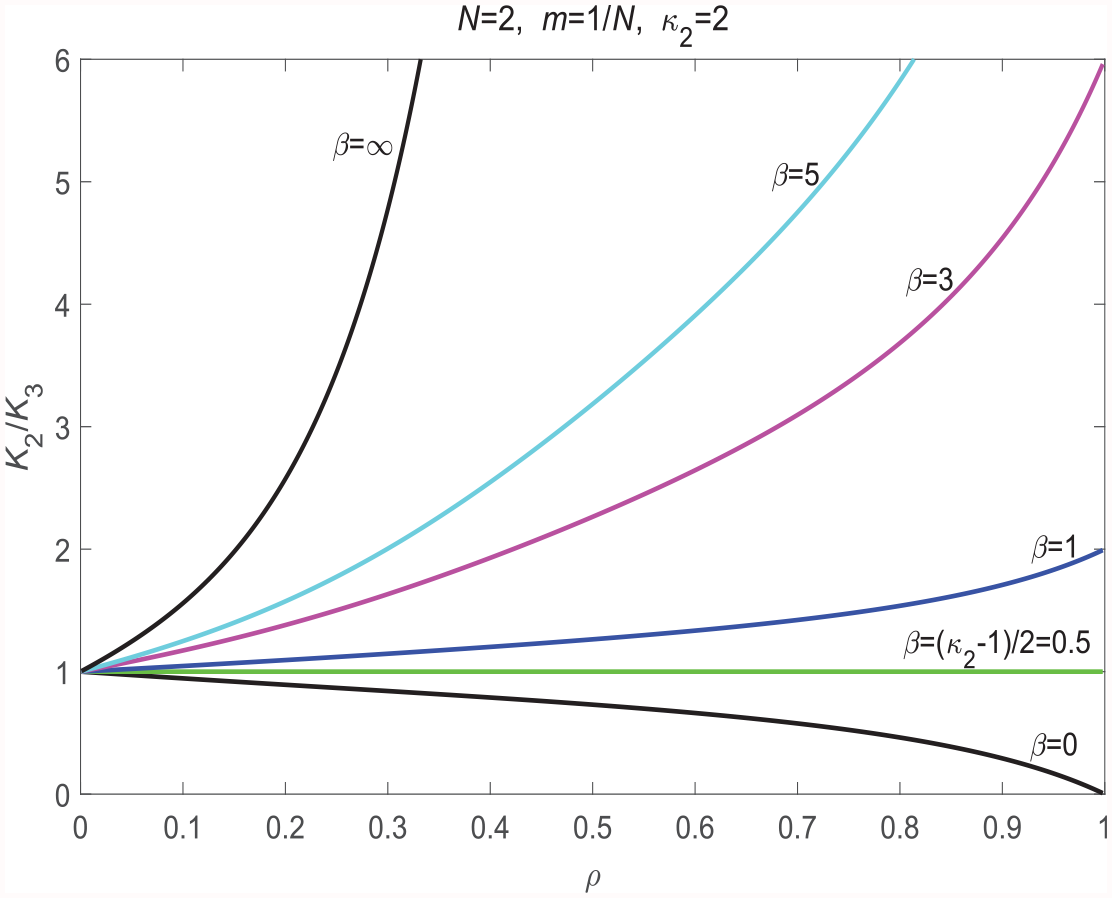
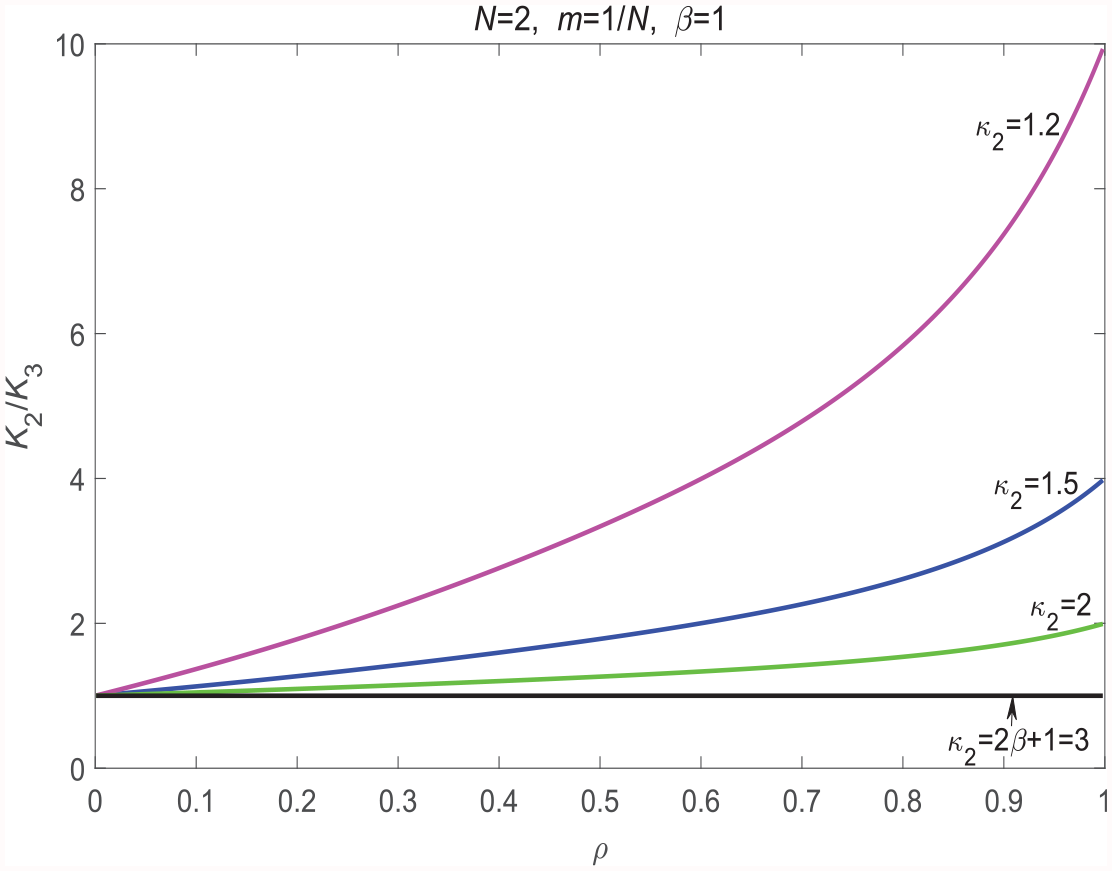
We illustrate in Figures 5–8 the ratio as a function of ρ for different values of . It is seen from Figures 5–8 that (1) is a decreasing function of ρ when , is an increasing function of ρ when , when (i.e. the plane-strain bulk modulus of the liquid inclusion is equal to that of the elastic coating); (2) when for an infinitely thick coating, the ratio approaches the following result for a hypotrochoidal compressible liquid inclusion embedded in an infinite isotropic elastic matrix subjected to uniform remote hydrostatic stresses [22]
Variations of as a function of ρ for different values of N with .
Variations of as a function of ρ for different values of β with .
Variations of as a function of ρ for different values of with .
Variations of as a function of ρ for different values of m with .
(3) when for a vanishingly thin elastic coating; (4) when , the ratio increases as m decreases (i.e. the inclusion becomes more rounded); (5) when , the ratio decreases as m decreases; (iv) p and q always have the same sign, i.e, . Here, is the Skempton’s [39] induced pore-pressure coefficient B for a finite domain. The compressibility [40,41], the fractional decrease in the area of a traction-free hypotrochoidal hole due to a hydrostatic pressure of unit magnitude applied on , can be determined from the acquired ratio and the formula for the determination of the pore-pressure coefficient B in Zimmermann [42] as follows
which is illustrated in Figures 9 and 10. The calculated in Figures 9 and 10 is found independent of both and β, a result in agreement with the conclusion by Ekneligoda and Zimmerman [41]. It is seen from Figures 9 and 10 that (1) with equality attained when or ; (2) is a decreasing function of ρ and an increasing function of N; (3) as for an infinitely thick coating
which recovers the result by Zimmerman [43], Jasiuk et al. [44], Kachanov et al. [45], and Ekneligoda and Zimmerman [41]; (4) the compressibility becomes infinite as . It seems that the compressibility of a pore in a finite domain has not been studied in detail.
Variations of as a function of ρ for different values of N with .
Variations of as a function of ρ for different values of N with .
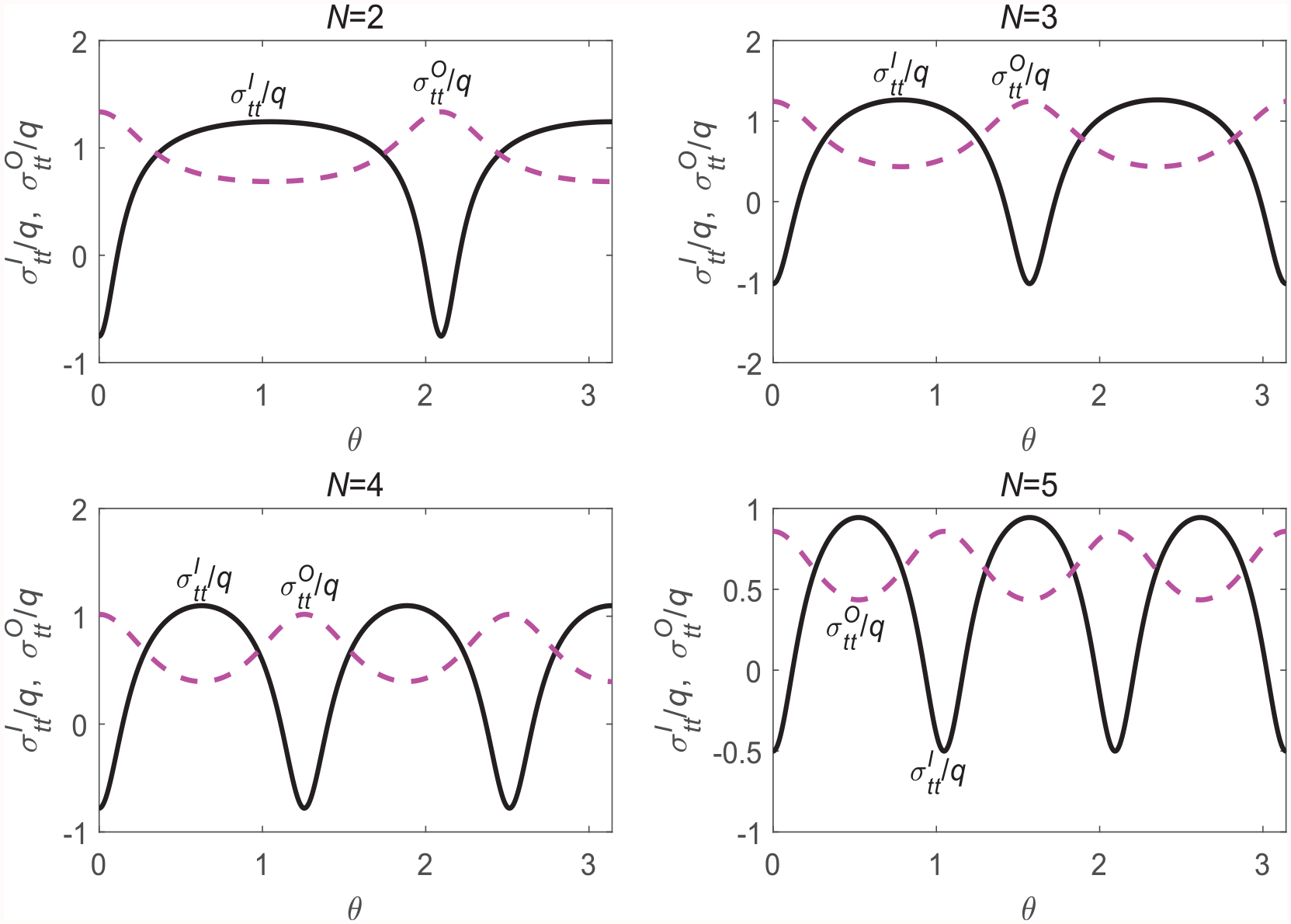
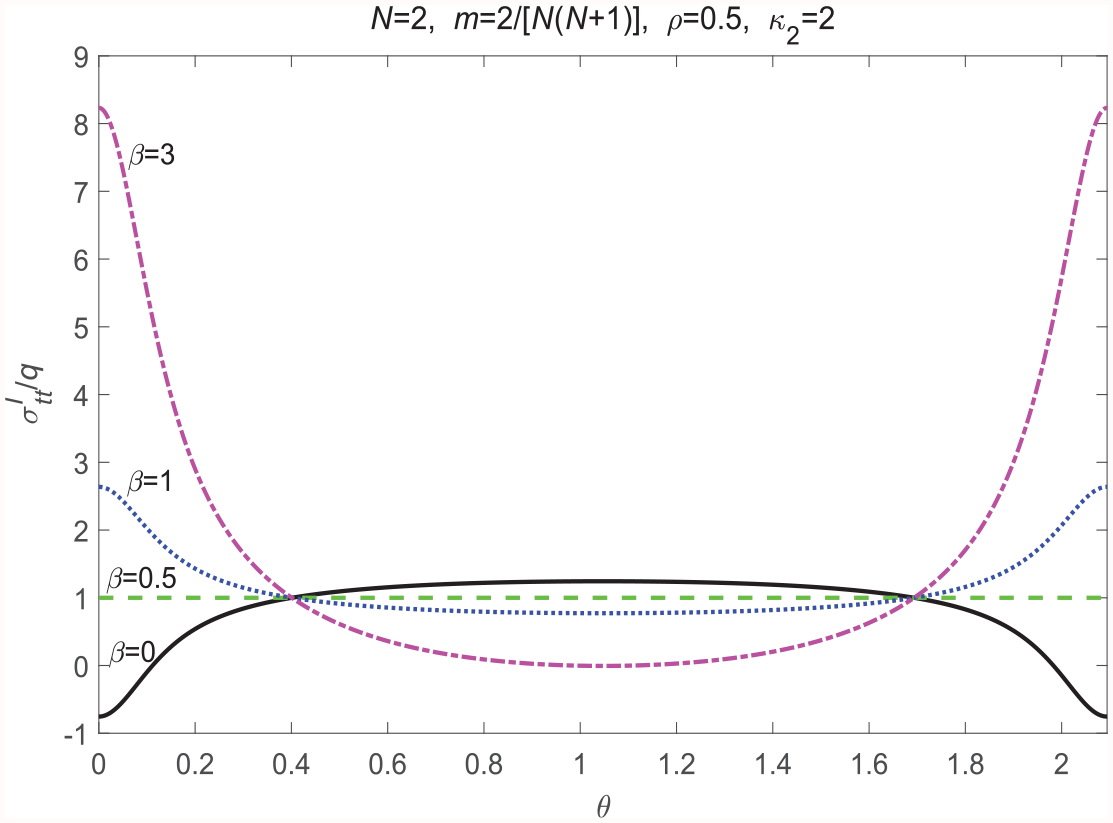
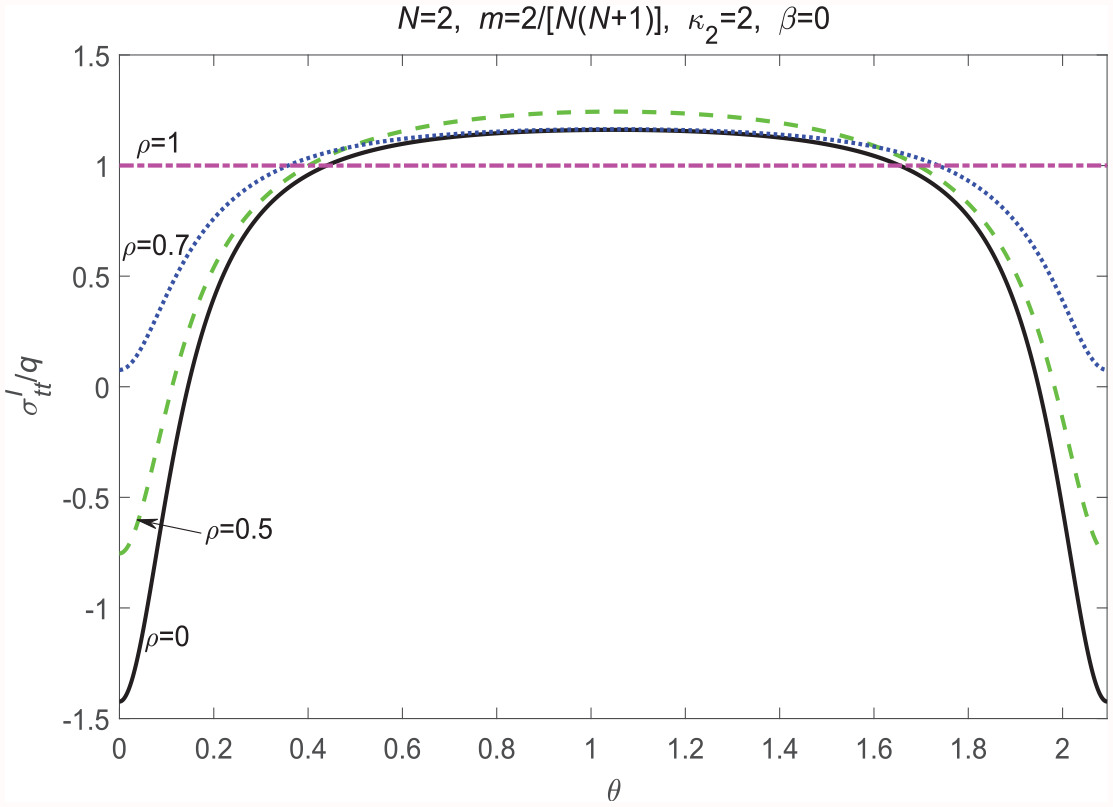
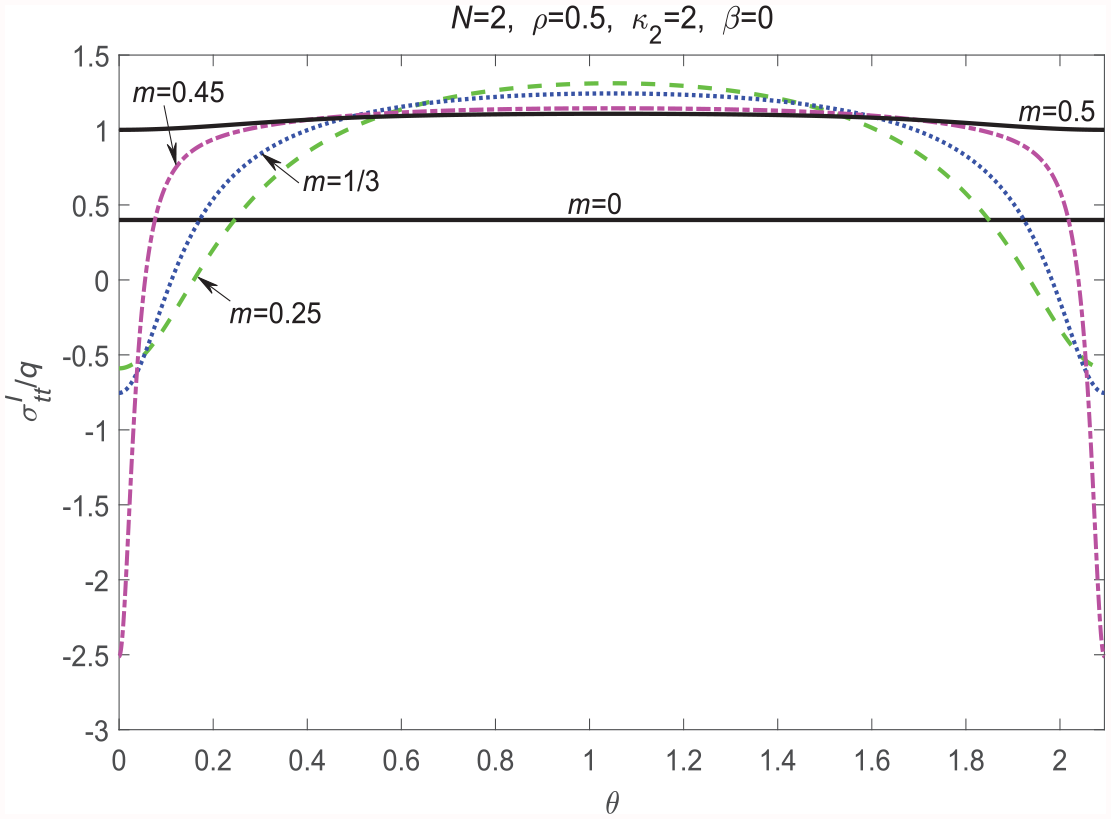
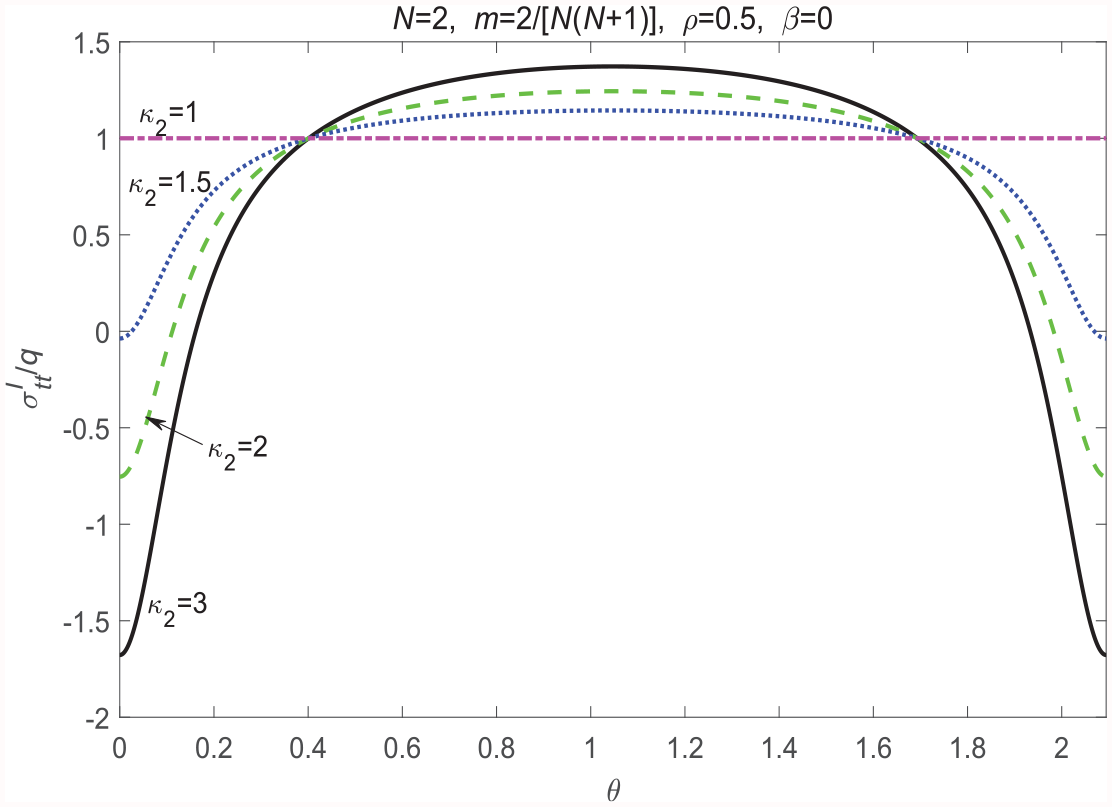
We illustrate in Figures 11–15 the distributions of and along and for different values of , and . It is seen from Figures 11–15 that (1) the variation of along ranging from negative to positive is more apparent than that of along with its sign remaining unchanged (see Figure 11); (2) the parameters and m exert a significant effect on ; (3) is constant along when or or ; (4) remains finitely valued along when after excluding the isolated points at the cusps (see Figure 14); (5) is reliant on Poisson’s ratio of the matrix for a finitely valued β (see Figure 15) and is independent of Poisson’s ratio of the matrix for an infinitely compressible liquid inclusion with .
Distributions of the hoop stresses and along and on the coating side for different values of N with .
Distribution of the hoop stress along on the coating side for different values of β with .
Distribution of the hoop stress along on the coating side for different values of ρ with .
Distribution of the hoop stress along on the coating side for different values of m with .
Distribution of the hoop stress along on the coating side for different values of with .
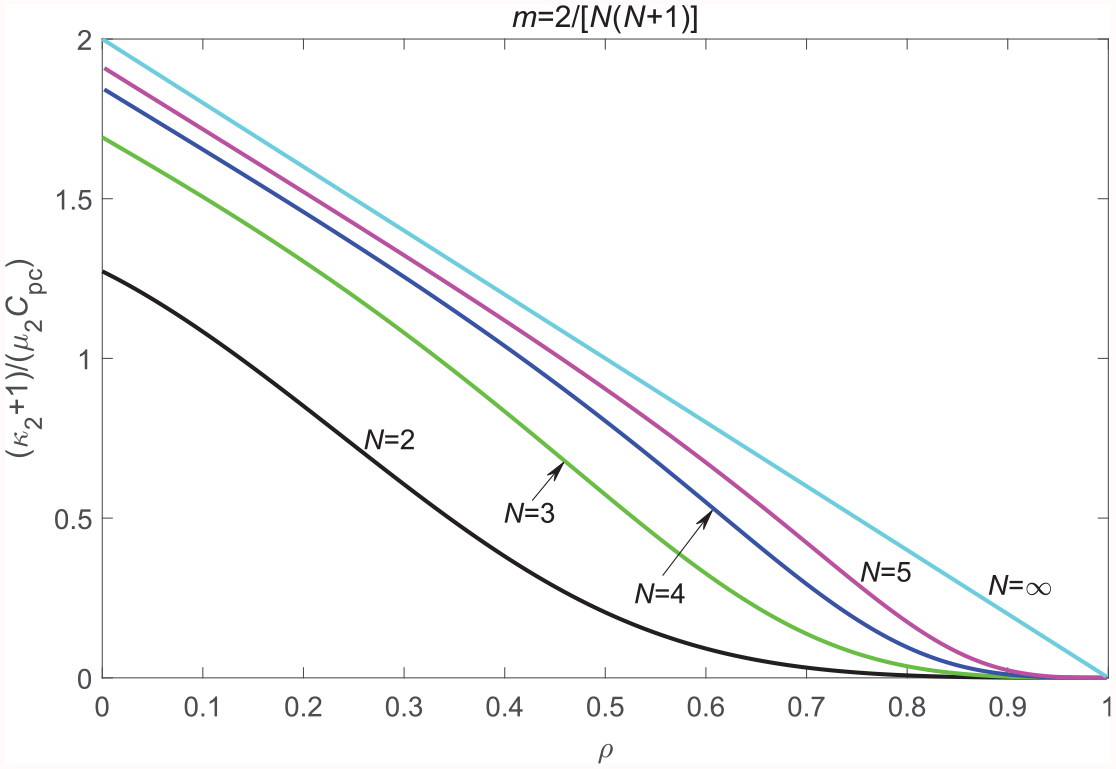
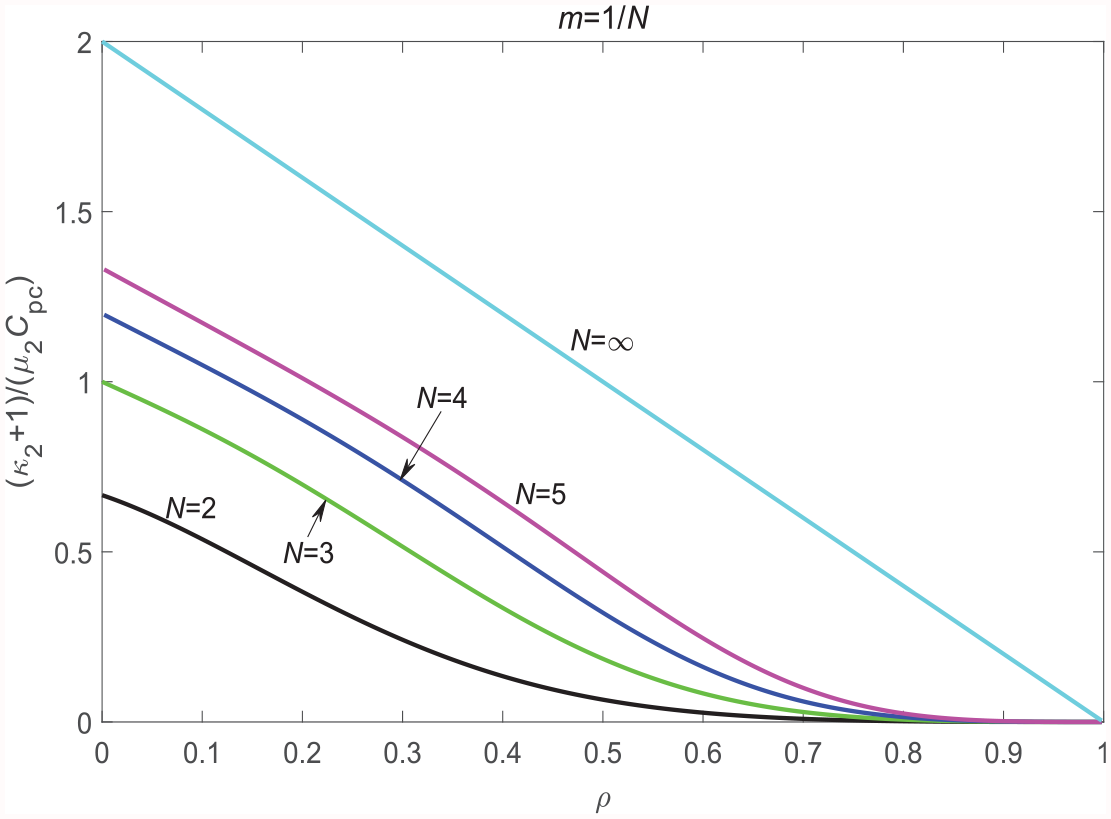
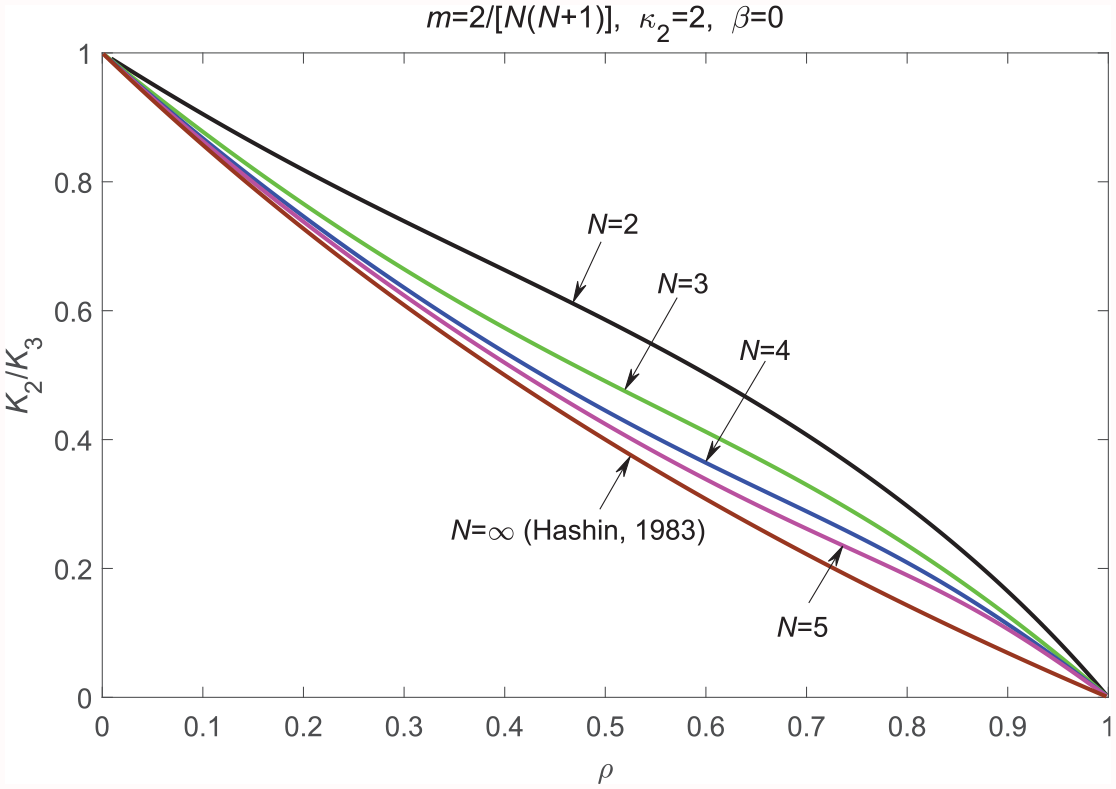
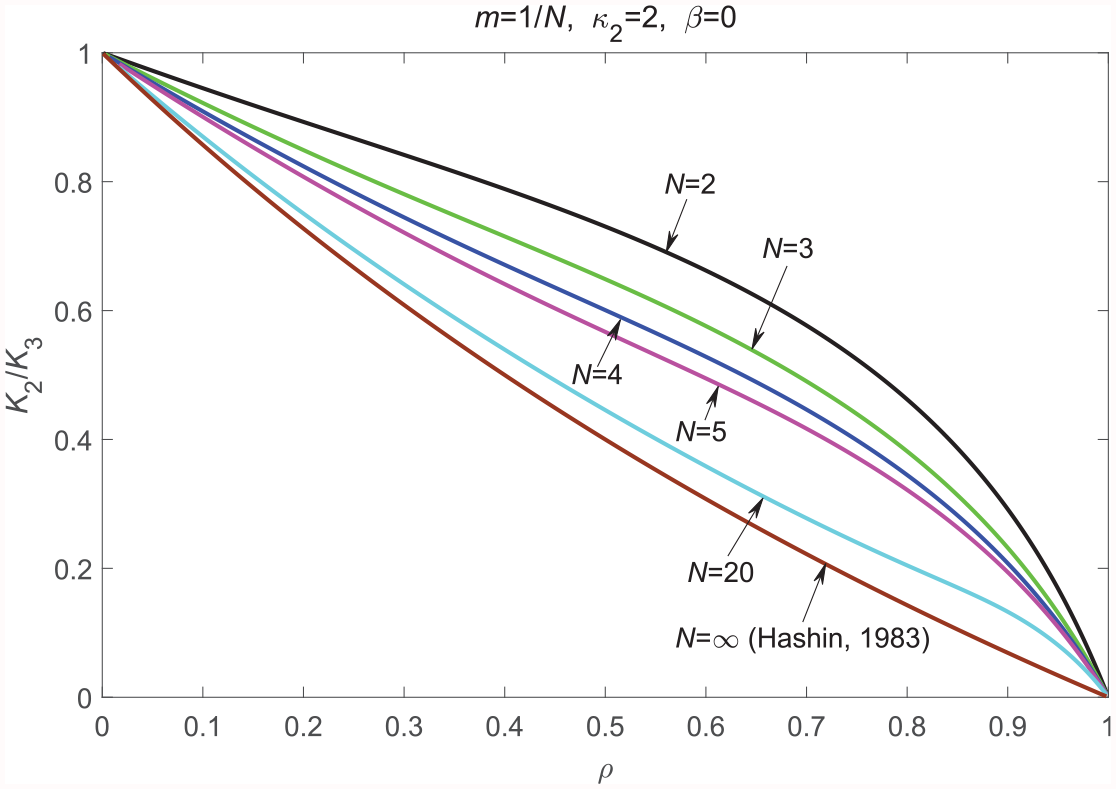
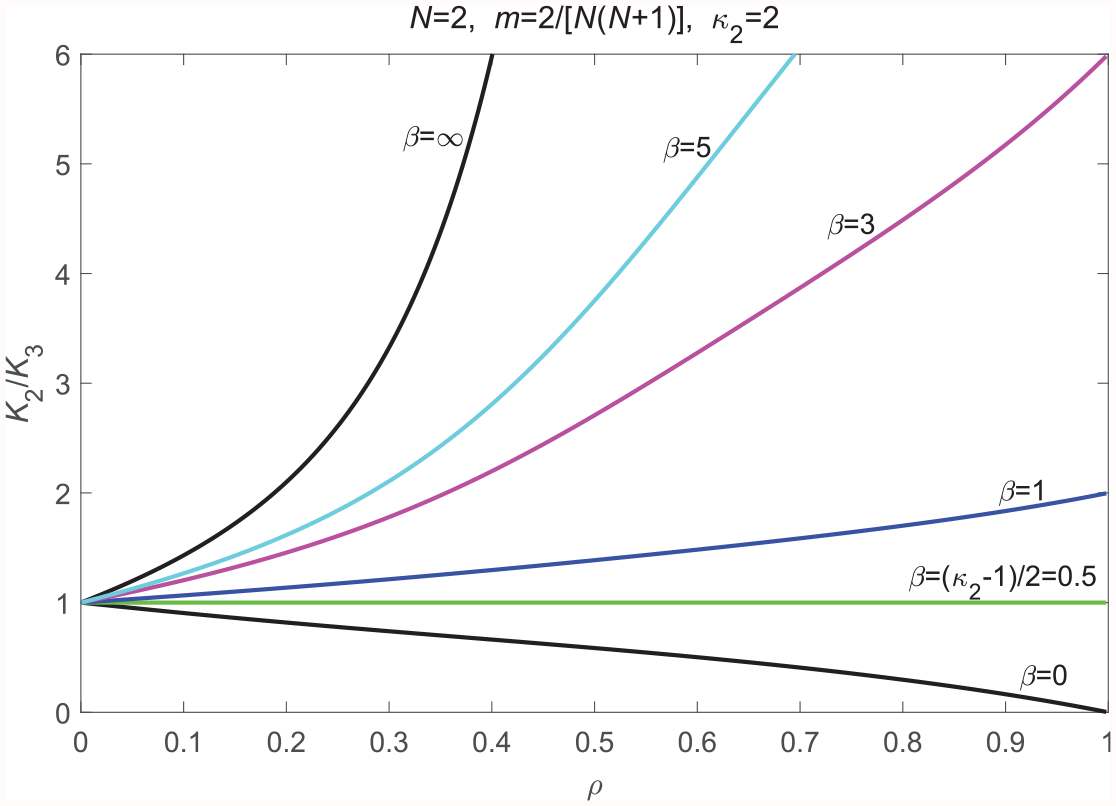
We illustrate in Figures 16–20 variations of the determined as a function of ρ for different values of . It is seen from Figures 16–20 that (1) is a decreasing function of ρ when , is an increasing function of ρ when , when ; (2) as ,
which is the classical result of the composite cylinder assemblage (CCA) model [5,46]; (3) when for an infinitely thick coating; (4) when for a vanishingly thin coating.
Variations of as a function of ρ for different values of N with .
Variations of as a function of ρ for different values of N with .
Variations of as a function of ρ for different values of β with .
Variations of as a function of ρ for different values of β with .
Variations of as a function of ρ for different values of with .
The results in Figures 16–20 clearly demonstrate the realization of a coated hypotrochoidal compressible liquid inclusion neutral to a prescribed uniform hydrostatic stress field in the elastic matrix after complete stress relaxation by interface slip and diffusion on .
5. Conclusion
We solve the steady-state and plane strain problem of a hypotrochoidal compressible liquid inclusion covered by an isotropic elastic coating which is bonded to a hydrostatically stressed isotropic elastic matrix through an interface admitting interface slip and diffusion. The steady-state elastic field in the coating and the internal uniform hydrostatic stress field within the liquid inclusion are obtained by solving a coupled set of linear algebraic equations in equations (12) and (19) for given geometric and material parameters: , and . At steady state after complete relaxation by interface slip and diffusion on , the insertion of the coated hypotrochoidal liquid inclusion does not disturb the prescribed uniform hydrostatic stress field in the matrix when the plane-strain bulk modulus of the elastic matrix is chosen according to equation (22). Detailed numerical results of the ratio , the hoop stresses and on the two interfaces and the determined plane-strain bulk modulus of the elastic matrix are presented to demonstrate the obtained analytical solution. If the solid–solid interface is assumed to be perfect, we cannot achieve the neutrality of a coated hypotrochoidal liquid inclusion with and in view of the fact that in this case both normal and tangential tractions are applied on and furthermore these traction components are non-uniformly distributed along . In this paper, the displacements are continuous across in the average sense that , where is the normal displacement and is the tangential displacement on the interface . One can further achieve neutrality of a multicoated hypotrochoidal compressible liquid inclusion embedded in a hydrostatically stressed elastic matrix with simultaneous interface slip and diffusion occurring on all the existing solid–solid interfaces. Another extension of the present result is the neutrality of a coated compressible liquid inclusion of arbitrary shape in a hydrostatically stressed elastic matrix with interface slip and diffusion occurring on the solid–solid interface. It is also feasible to discuss the neutrality of a coated non-spherical liquid inclusion with interface slip and diffusion occurring on the solid–solid interface when the matrix is subjected to a hydrostatic pressure field, although there exist some technical difficulties in solving the three-dimensional elasticity problem (especially the elastic field in the coating).
Footnotes
Declaration of conflicting interests
The author(s) declared no potential conflicts of interest with respect to the research, authorship, and/or publication of this article.
Funding
The author(s) disclosed receipt of the following financial support for the research, authorship, and/or publication of this article: This work is supported by a Discovery Grant from the Natural Sciences and Engineering Research Council of Canada (Grant No: RGPIN-2023-03227 Schiavo).
ORCID iD
Peter Schiavone
References
1.
MansfieldEH.Neutral holes in plane sheet-reinforced holes which are elastically equivalent to the uncut sheet. Q J Mech Appl Math1953; 6: 370–378.
2.
RuCQ.Interface design of neutral elastic inclusions. Int J Solids Struct1998; 35: 559–572.
3.
WangXSchiavoneP.Size-dependent effective shear modulus in a three-phase sphere model incorporating Steigmann-Ogden surface elasticity. Euro J Mech A/solids2023; 100: 104965.
MiltonGWSerkovSK.Neutral coated inclusions in conductivity and anti-plane elasticity. Proc R Soc London A2001; 457: 1973–1997.
7.
WangXSchiavoneP.Neutrality of a four-phase spherical inhomogeneity under an arbitrary uniform remote load. Acta Mech2023; 234: 2809–2818.
8.
StyleRWWettlauferJSDufresneER.Surface tension and the mechanics of liquid inclusions in compliant solids. Soft Matter2015; 11(4): 672–679.
9.
StyleRWBoltyanskiyRAllenB, et al. Stiffening solids with liquid inclusions. Nat Phys2015; 11(1): 82–87.
10.
WuJRuCQZhangL.An elliptical liquid inclusion in an infinite elastic plane. Proc Royal Soc A2018; 474(2215): 20170813.
11.
ChenXLiMXYangM, et al. The elastic fields of a compressible liquid inclusion. Extreme Mech Lett2018; 22: 122–130.
12.
KrichenSLiuLPSharmaP.Liquid inclusions in soft materials: capillary effect, mechanical stiffening and enhanced electromechanical response. J Mech Phys Solids2019; 127: 332–357.
13.
DaiMHuaJSchiavoneP.Compressible liquid/gas inclusion with high initial pressure in plane deformation: modified boundary conditions and related analytical solutions. Euro J Mech A-solids2020; 82: 104000.
14.
DaiMHuangCSchiavoneP.Modified closed-form solutions for three-dimensional elastic deformations of a composite structure containing macro-scale spherical gas/liquid inclusions. Appl Math Modelling2021; 97: 57–68.
15.
TiFChenXLiMX, et al. Cylindrical compressible liquid inclusion with surface effects. J Mech Phys Solids2022; 161: 104–813.
16.
GhoshKLopez-PamiesO.Elastomers filled with liquid inclusions: theory, numerical implementation, and some basic results. J Mech Phys Solids2022; 166: 104–930.
17.
GhoshKLefevreVLopez-PamiesO.The effective shear modulus of a random isotropic suspension of monodisperse liquid n-spheres: from the dilute limit to the percolation threshold. Soft Matter2023; 19: 208–224.
18.
GhoshKLefevreVLopez-PamiesO.Homogenization of elastomers filled with liquid inclusions: the small-deformation limit. J Elasticity2023; 154: 235–253.
19.
WangXSchiavoneP.Interaction between an edge dislocation and a circular incompressible liquid inclusion. Math Mech Solids2024; 29(3): 531–538.
20.
WangXSchiavoneP.A partially debonded circular elastic inhomogeneity with an incompressible liquid inclusion occupying the debonded section. Acta Mech2024; 235: 897–906.
21.
WangXSchiavoneP.An edge dislocation interacting with an elliptical incompressible liquid inclusion. J Mech Mater Struct2024; 19(1): 131–140.
22.
WangXSchiavoneP.A liquid inclusion having an n-fold axis of symmetry in an infinite isotropic elastic matrix. Continuum Mech Thermodynam2024; 36: 229–239.
23.
KoellerRCRajR.Diffusional relaxation on stress concentration at second-phase particles. Acta Metall1978; 26: 1551–1558.
24.
MoriTOkabeMMuraT.Diffusional relaxation around a second phase particle. Acta Metall1980; 28(3): 319–325.
OnakaSKatoM.Relaxed stresses and relaxation kinetics caused by diffusion around a second-phase particle. Mater Sci Eng A1991; 146(1-2): 217–232.
27.
SofronisPMcMeekingRM.The effect of interface diffusion and slip on the creep resistance of particulate composite materials. Mech Mater1994; 18: 55–68.
28.
KimKTMcMeekingRM.Power law creep with interface slip and diffusion in a composite material. Mech Mater1995; 20: 153–164.
29.
OnakaSHuangJHWakashimaK, et al. Kinetics of stress relaxation caused by the combination of interfacial sliding and diffusion: two-dimensional analysis. Acta Mater1998; 46: 3821–3828.
30.
OnakaSHuangJHWakashimaK, et al. Stress relaxation caused by the combination of interfacial sliding and diffusion around spherical inclusions. Mech Mater1999; 31: 717–727.
31.
HeLH.Transient stress relaxation around spherical inclusions by interfacial diffusion and sliding. Acta Mech2001; 149(1-4): 115133.
32.
HeLHHuXF.Transient stress relaxation around a spherical inclusion: the role of the combination of interfacial diffusion and sliding. Mater Chem Phys2002; 77: 147–152.
33.
WeiYJBowerAFGaoHJ.Recoverable creep deformation and transient local stress concentration due to heteregeneous grain-boundary diffusion and sliding in polycrystalline solids. J Mech Phys Solids2008; 56: 1460–1483.
34.
WangXPanE.A circular inhomogeneity with interface slip and diffusion under in-plane deformation. Int J Eng Sci2010; 48: 1733–1748.
35.
WangXWangCYSchiavoneP.In-plane deformations of a nano-sized circular inhomogeneity with interface slip and diffusion. Int J Eng Sci2016; 108: 915.
36.
MuskhelishviliNI.Some basic problems of the mathematical theory of elasticity. Groningen: P. Noordhoff Ltd., 1953.
37.
TingTCT.Anisotropic elasticity: theory and applications. New York: Oxford University Press, 1996.
38.
EshelbyJD.The determination of the elastic field of an ellipsoidal inclusion and related problems. Proc Roy Soc London A1957; 241: 376–396.
39.
SkemptonAW. The pore-pressure coefficients A and B. Geotechnique1954; 4: 143–147.
40.
ZimmermanRW.Compressibility of sandstones. Amsterdam: Elsevier, 1991.
41.
EkneligodaTCZimmermanRW.Compressibility of two-dimensional pores having n-fold axes of symmetry. Proc R Soc Lond A2006; 462: 1933–1947.
42.
ZimmermanRW.Coupling in poroelasticity and thermoelasticity. Int J Rock Mech Min Sci2000; 37: 79–87.
43.
ZimmermanRW.Compressibility of two-dimensional cavities of various shapes. ASME J Appl Mech1986; 53: 500–504.
44.
JasiukIChenJThorpeMF.Elastic moduli of two dimensional materials with polygonal and elliptical holes. Appl Mech Rev1994; 47(Suppl. 1): 18–21.
45.
KachanovMTsukrovIShafiroB.Effective moduli of solids with cavities of various shapes. Appl Mech Rev1994; 47(Suppl. 1): 152–174.