




Abstract
We study the plane strain problem of a symmetric compressible liquid lip inclusion with two cusps in an infinite isotropic elastic matrix subjected to uniform remote in-plane normal stresses. The pair of analytic functions characterizing the elastic field in the matrix is derived in closed form. Explicit, elementary, and concise expressions in terms of the two Skempton’s induced pore-pressure coefficients are obtained for the internal uniform hydrostatic tension within the liquid inclusion and the mode I stress intensity factor at the cusp tip. When the two remote normal stresses satisfy a single condition, the external loading will not induce any singular stress field at the cusp tips.
Keywords
1. Introduction
Liquid inclusions trapped in solids such as crystals, rocks, biological tissues, hydrogels, and elastomers are ubiquitous in nature. Micromechanics analysis of a composite consisting of a solid matrix and liquid inclusions has become a focused research topic in the past decade [1–15]. In the majority of previous studies on this topic, only regular and smooth shapes of liquid inclusions such as three-dimensional ellipsoidal and two-dimensional elliptical have been investigated. However, the shapes of liquid inclusions in solids are in many cases more irregular. In some situations, the boundary of a liquid inclusion may also possess cusps and sharp corners which are known to be sources of stress singularity and high-stress gradients. It is therefore of great interest to investigate how irregular and cusped shapes of liquid inclusions affect the microscopic and macroscopic mechanical responses of a solid matrix filled with liquid inclusions. This research endeavors to examine this challenging problem.
In this paper, we study the plane strain problem associated with a symmetric compressible liquid lip inclusion with two cusps perfectly bonded to an infinite isotropic elastic matrix subjected to uniform remote in-plane normal stresses. A closed-form exact solution to the problem is derived by means of the techniques of conformal mapping [16,17] and analytic continuation [18] and the application of the residue theorem, which encounters some difficulty due to the appearance of two first-order poles (not located at the origin) in the mapping function. Explicit and elementary expressions for the internal uniform hydrostatic tension within the symmetric liquid lip inclusion and the mode I stress intensity factor at the cusp tip are obtained in terms of the two Skempton’s induced pore-pressure coefficients A and B [19] and are graphically illustrated. Due to the introduction of the two Skempton’s pore-pressure coefficients, the expressions for the internal uniform hydrostatic tension within the liquid inclusion and the stress intensity factor at the cusp tip are particularly concise. When the two remote normal stresses satisfy a single condition, the stress intensity factor at the cusp tip becomes zero and this particular external loading will not induce any singular stress field at the two cusp tips. For an incompressible liquid inclusion, the two remote normal stresses can have identical as well as opposite signs in order to remove the stress singularity. However, for an infinitely compressible liquid inclusion or a traction-free cusped cavity, the two remote normal stresses must have the same sign in order to remove the stress singularity. As a consequence of this research, the compressibility of a symmetric lip crack is explicitly determined from the acquired Skempton’s pore-pressure coefficient B and the formula for its determination in the work by Zimmerman [20].
2. Muskhelishvili’s complex variable formulation
We first establish a Cartesian coordinate system

and

where

3. A symmetric compressible liquid lip inclusion
As shown in Figure 1, we consider a symmetric compressible liquid lip inclusion with two cusps embedded in an infinite isotropic elastic matrix subjected to uniform remote in-plane stresses
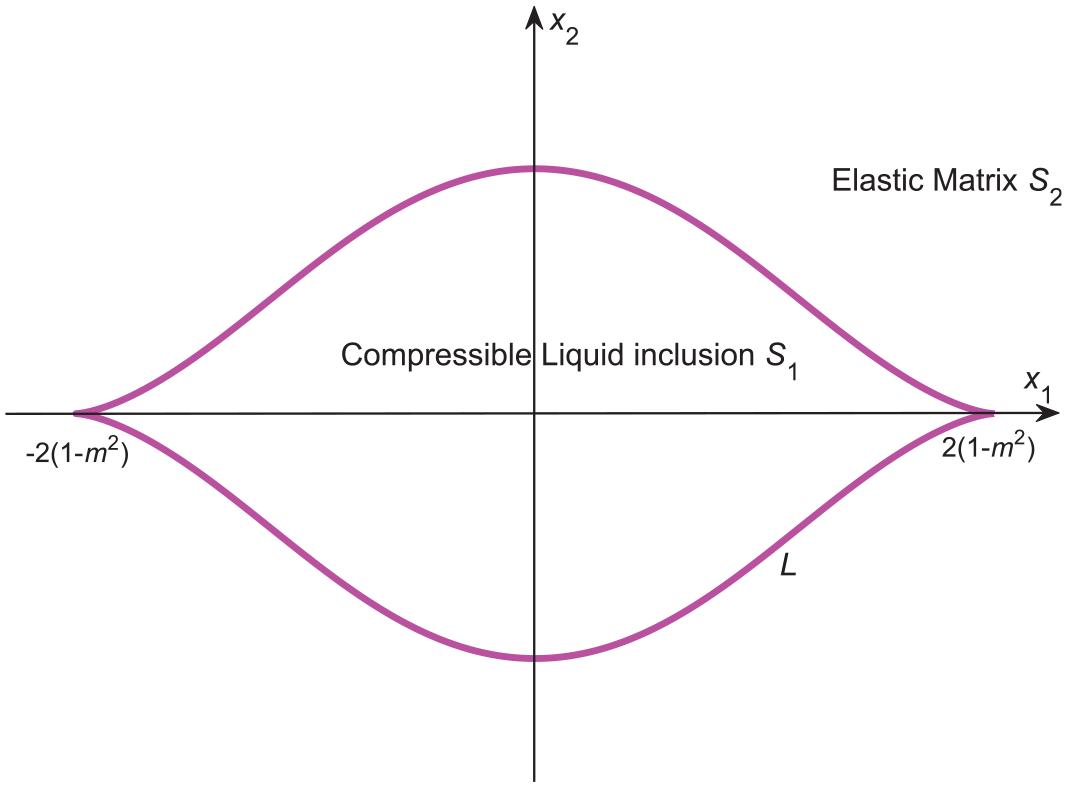
A symmetric compressible liquid lip inclusion embedded in an infinite isotropic elastic matrix subjected to uniform remote in-plane stresses.
We first introduce the following conformal mapping function for the matrix [16,17]:

Using the mapping function in equation (4), the region occupied by the matrix is mapped onto

By substituting the specific mapping function in equation (4) into equation (5) and applying the residue theorem, we finally arrive at

which is illustrated in Figure 2 as a function of m. It is seen from Figure 2 that
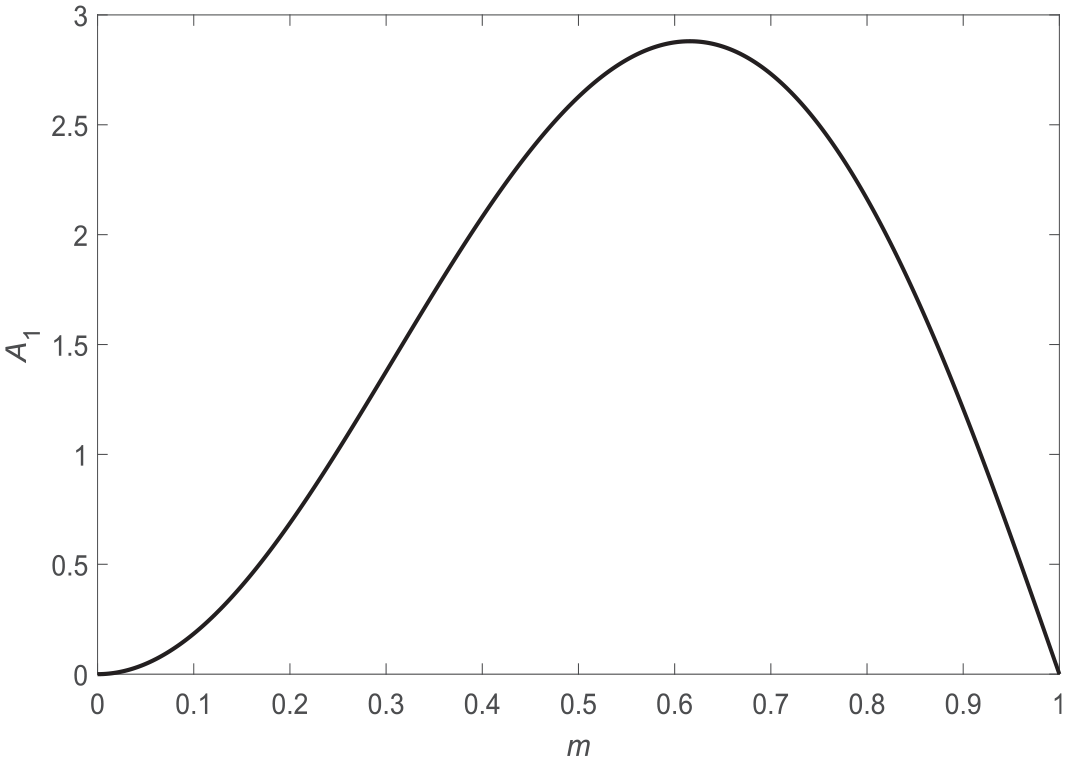
The initial area
In order to ensure a uniform hydrostatic stress field within the liquid inclusion, the two stress functions within the inclusion should take the following particular form

where
Thus, the continuity of tractions across the perfect liquid–solid interface L can be expressed in terms of

By considering the fact that the uniform remote shear stress

In view of equations (9), equation (8) can be written more concisely as

where the superscripts “+” and “−” indicate the values when approaching the unit circle from inside and outside, respectively. Equation (10) can be equivalently written as
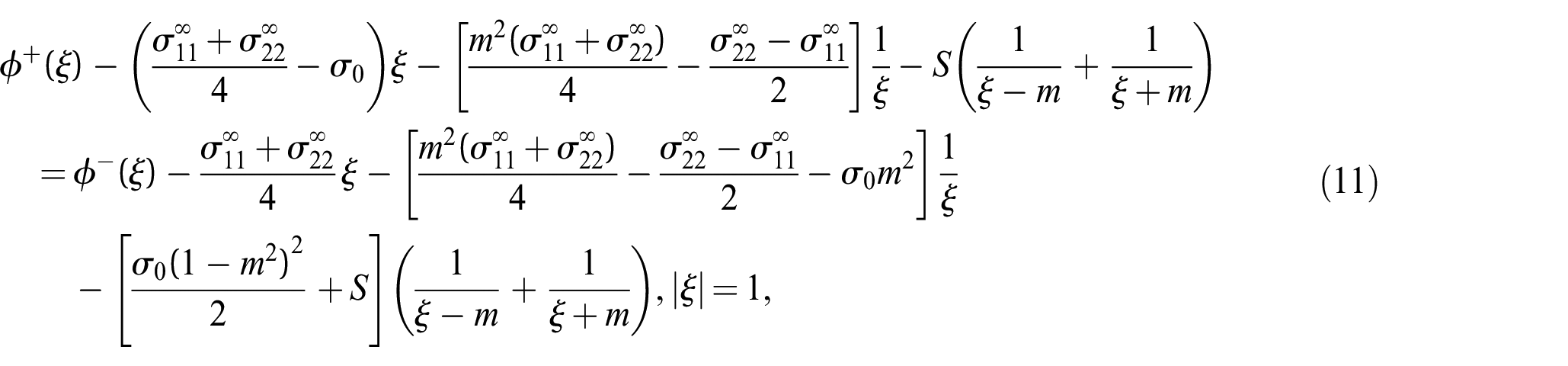
where the real constant S is related to

The left-hand side of equation (11) is analytic and single valued everywhere within the unit circle, and the right-hand side of equation (11) is analytic and single valued everywhere outside the unit circle including the point at infinity. Using Liouville’s theorem, we arrive at
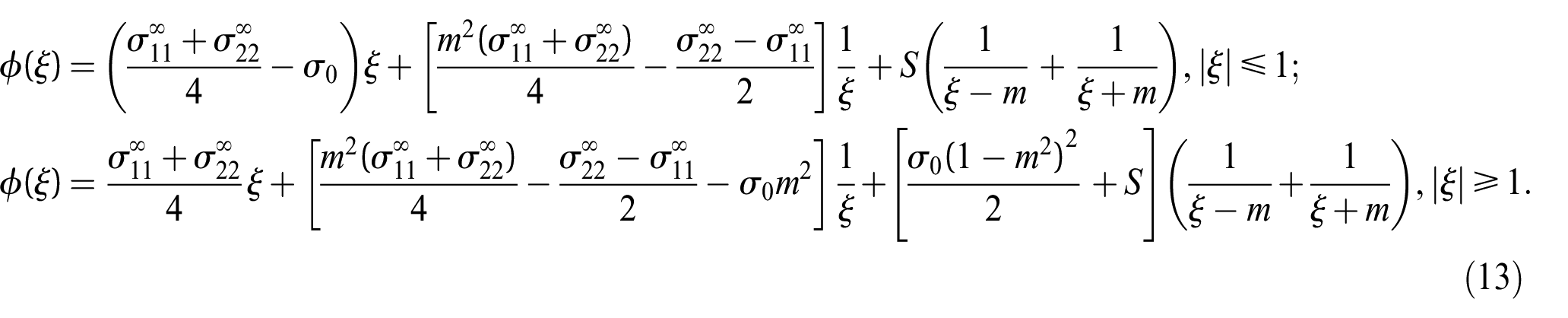
Substitution of equation (13)2 into equation (12) leads to the following expression for the real constant S in terms of

At this stage, the single unknown

where the integral is in the counter-clockwise direction.
By substituting equation (13) into equation (15) and applying the residue theorem, we finally arrive at

On the other hand, the change in area

where K is the plane-strain bulk modulus of the liquid inclusion. The liquid inclusion is incompressible when
In order to ensure the continuity of displacements across the perfect liquid–solid interface L, it is necessary that

Substituting equation (16) and (17) into equation (18), the internal uniform hydrostatic tension within the liquid inclusion can be uniquely determined as

where A and B are the two Skempton’s induced pore-pressure coefficients [19] given explicitly by
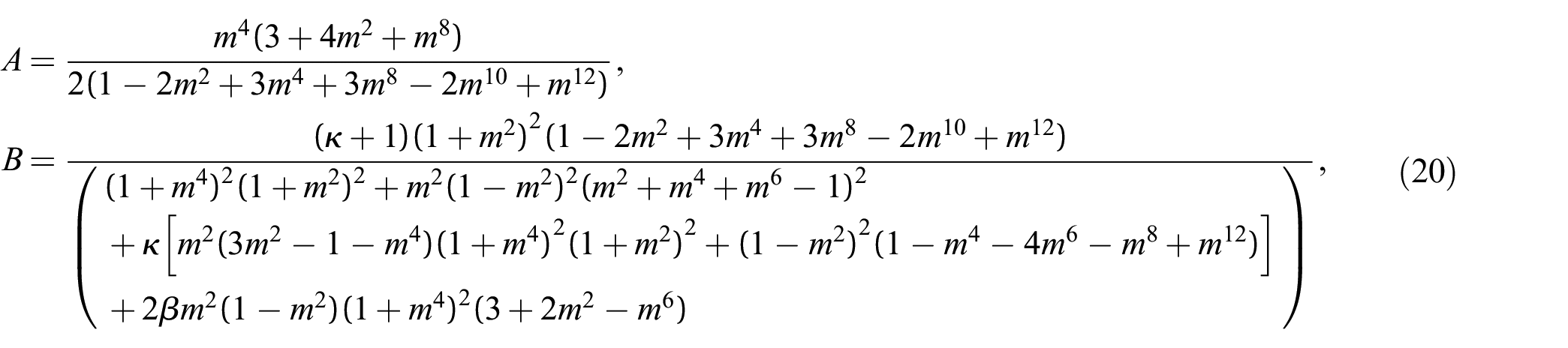
where

It is seen from equation (20) that (1) the pore-pressure coefficient A is independent of all the material constants of both the liquid inclusion and the elastic matrix, and depends only on the geometric parameter m; (2) the pore-pressure coefficient B is dependent on the three material and geometric parameters
When
We illustrate in Figure 3 the variation of the coefficient A as a function of m. It is seen from Figure 3 that
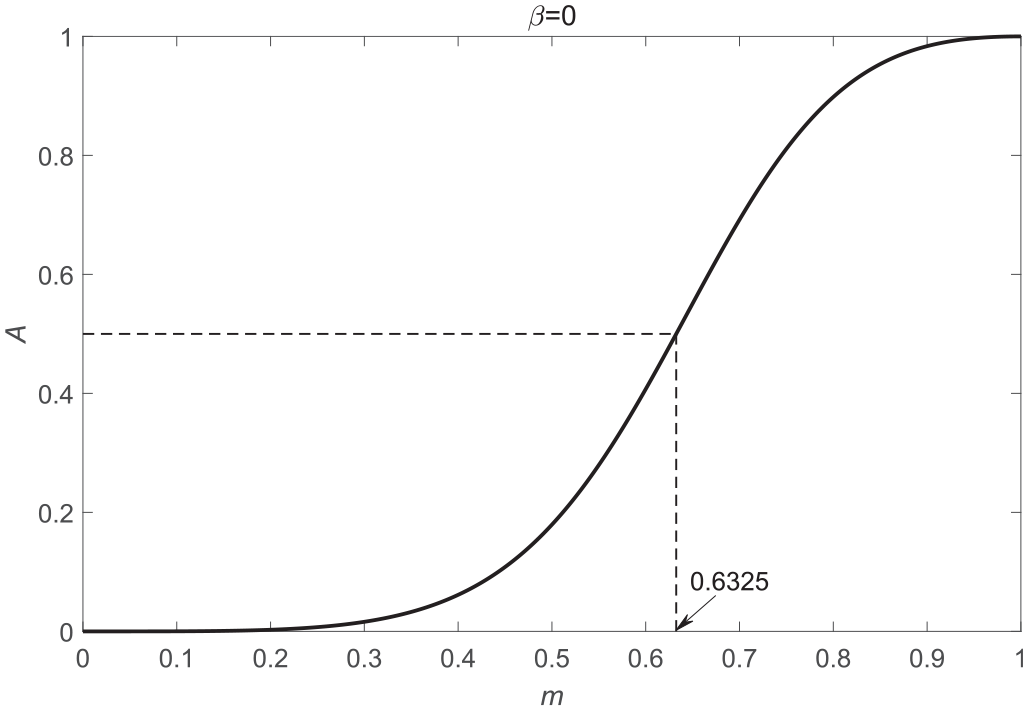
Variation of the pore-pressure coefficient A as a function of m.
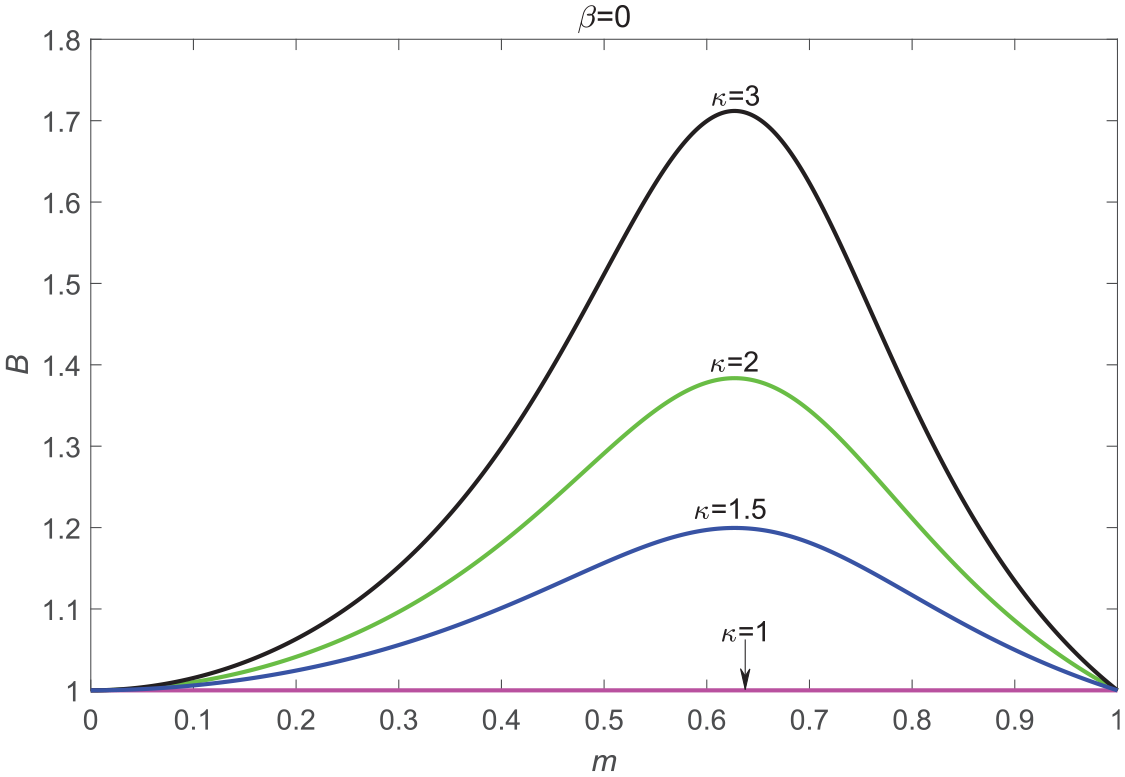
Variations of the pore-pressure coefficient B as a function of m and κ with
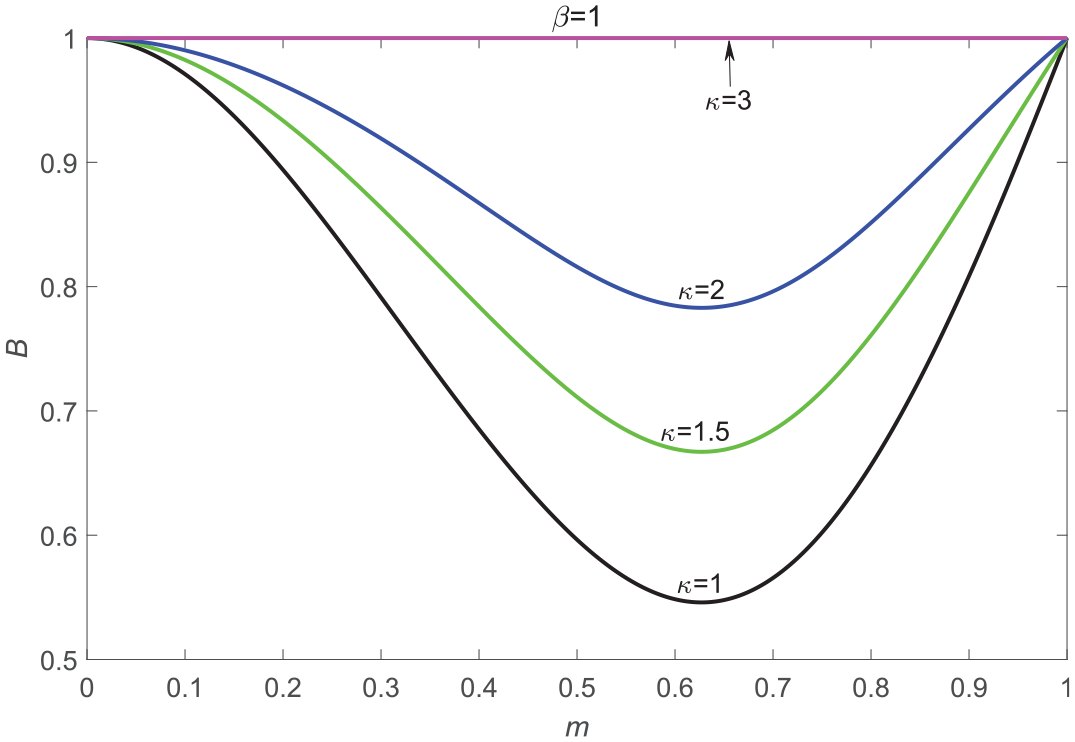
Variations of the pore-pressure coefficient B as a function of m and κ with
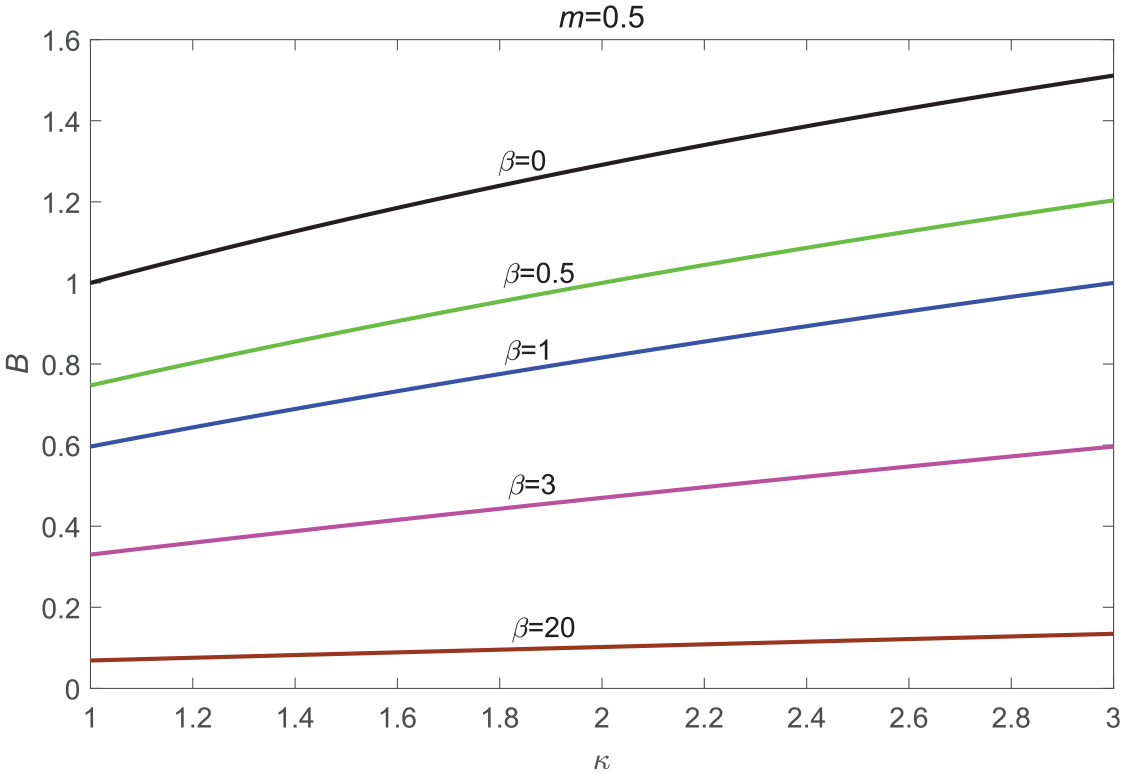
Variations of the pore-pressure coefficient B as a function of κ and β with
The mode I stress intensity factor at the right cusp tip
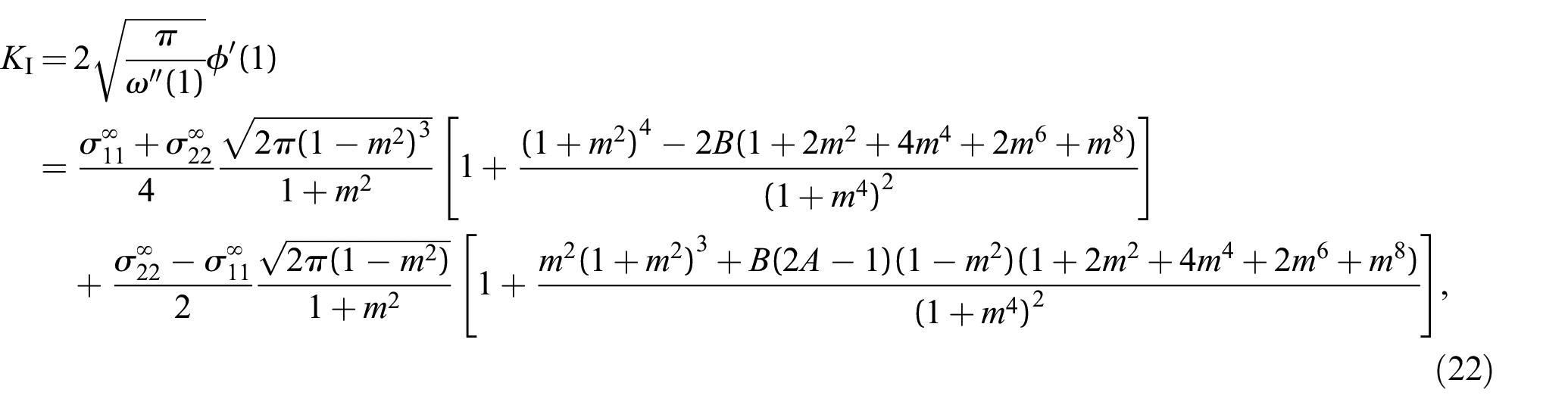
which is illustrated in Figures 7–12. It is seen from Figures 7–12 that (1) under a hydrostatic far-field load,
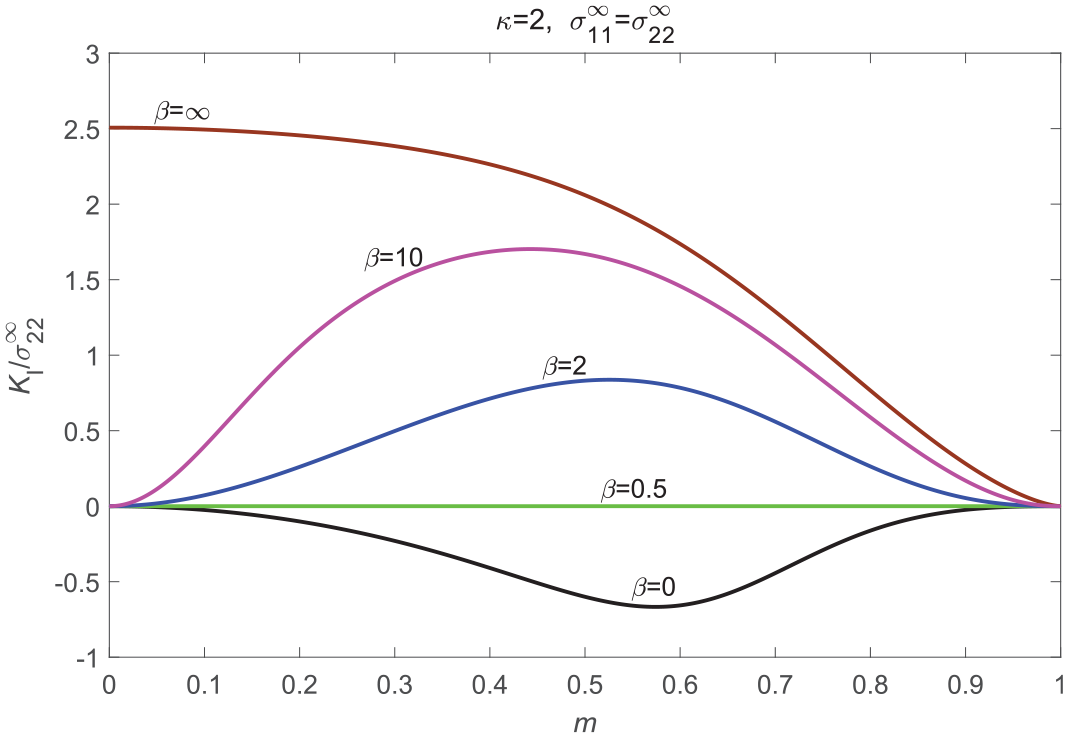
Variations of
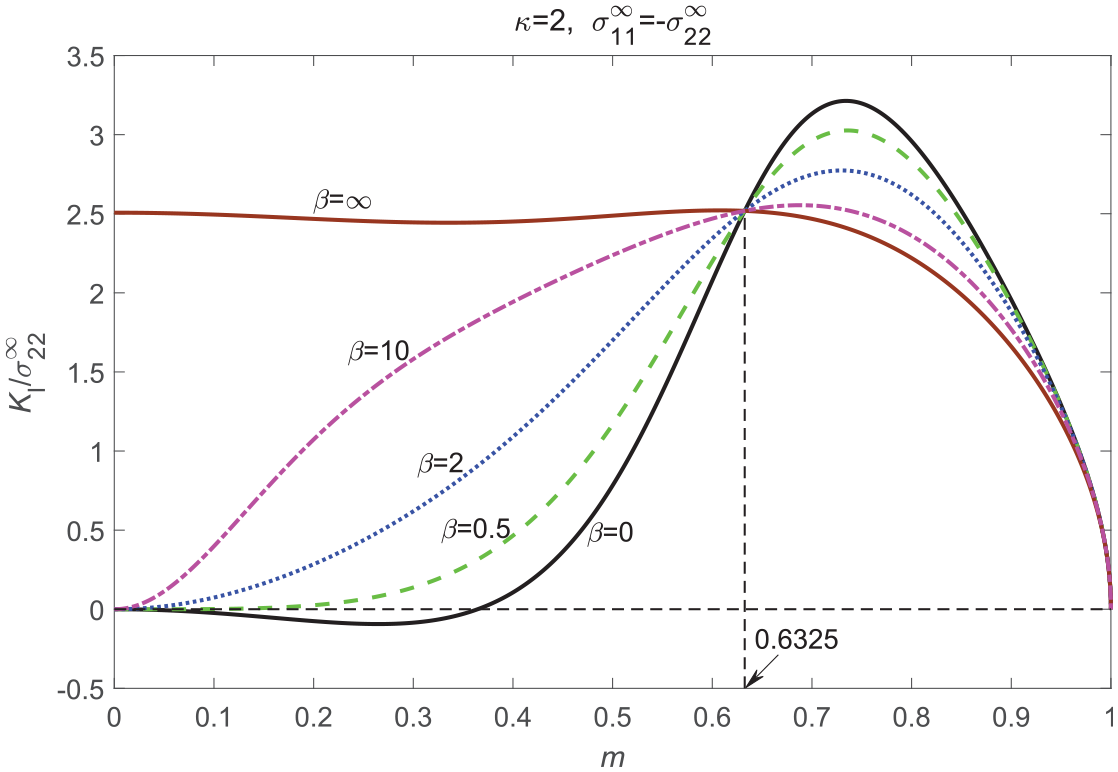
Variations of
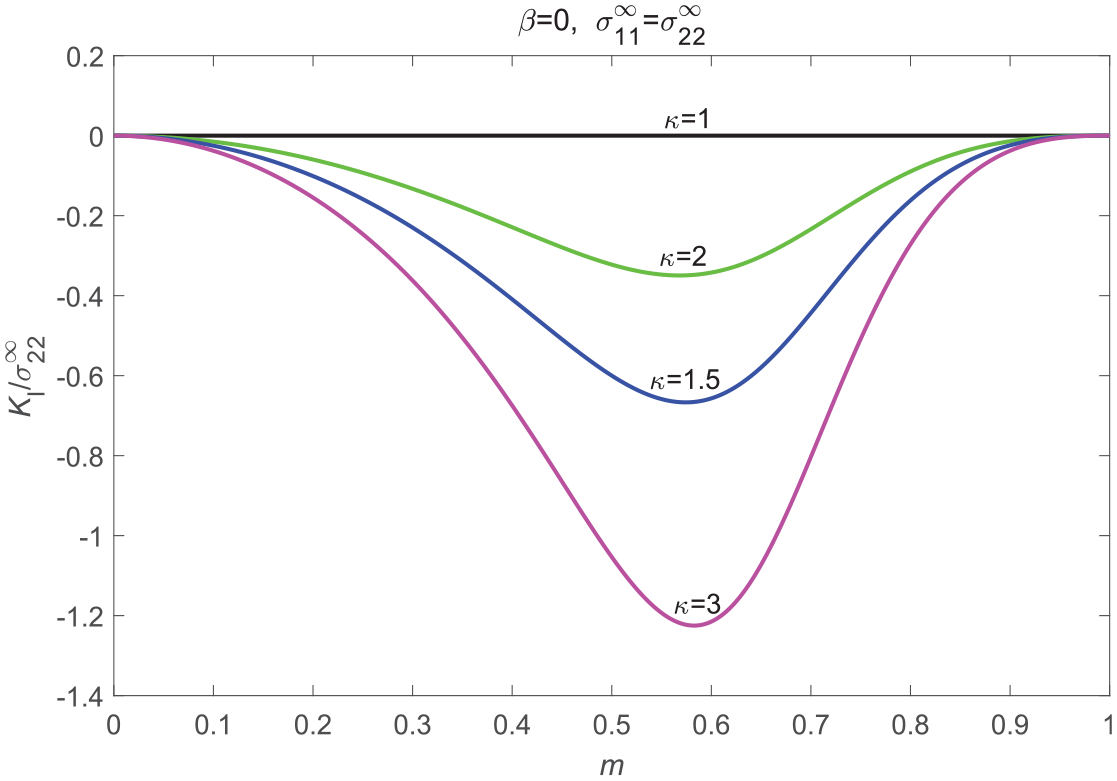
Variations of
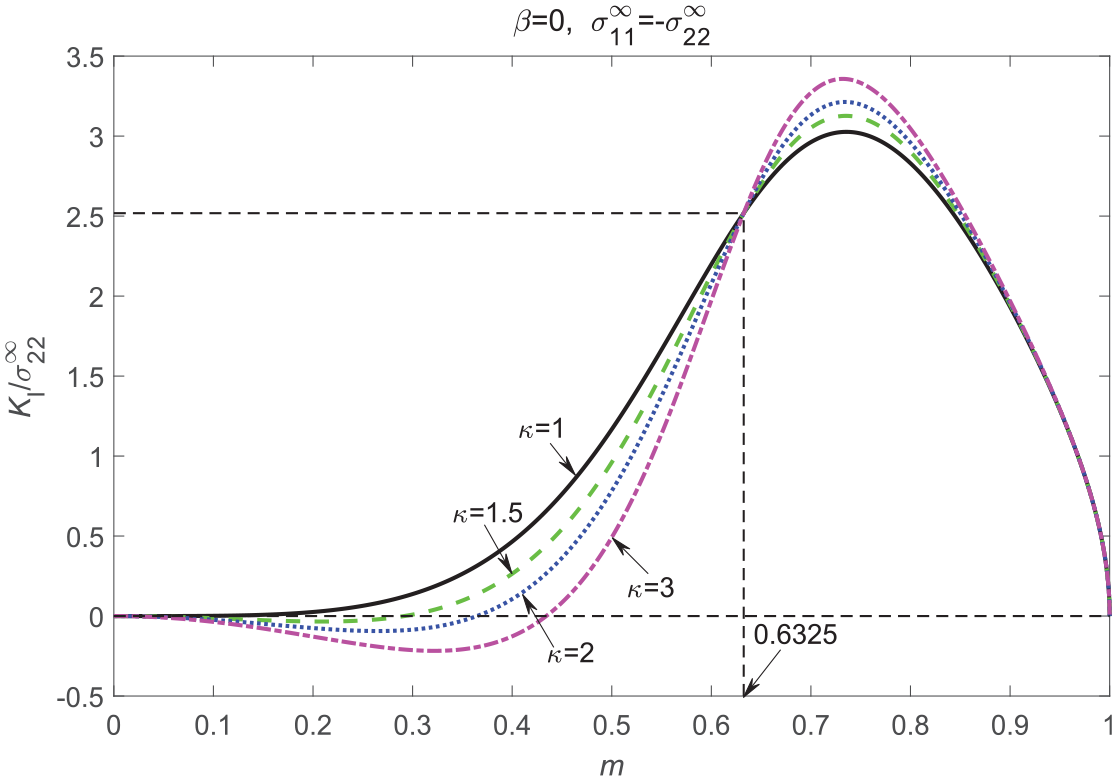
Variations of
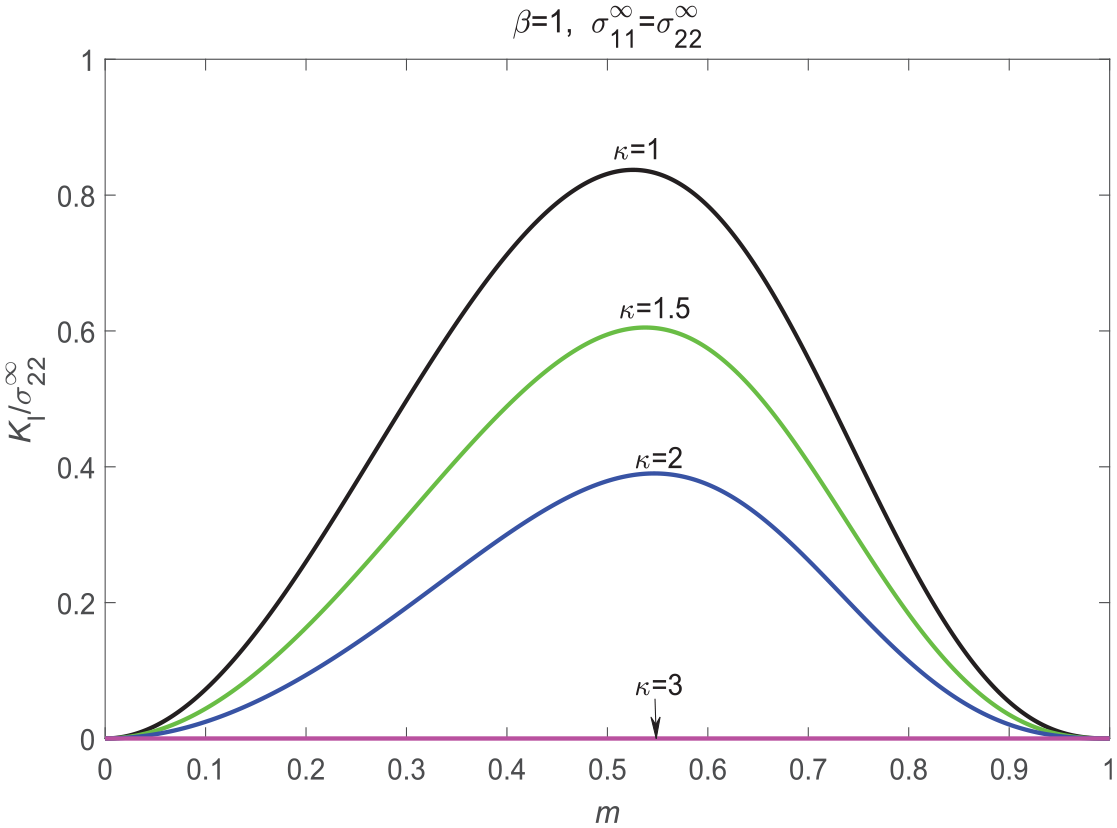
Variations of
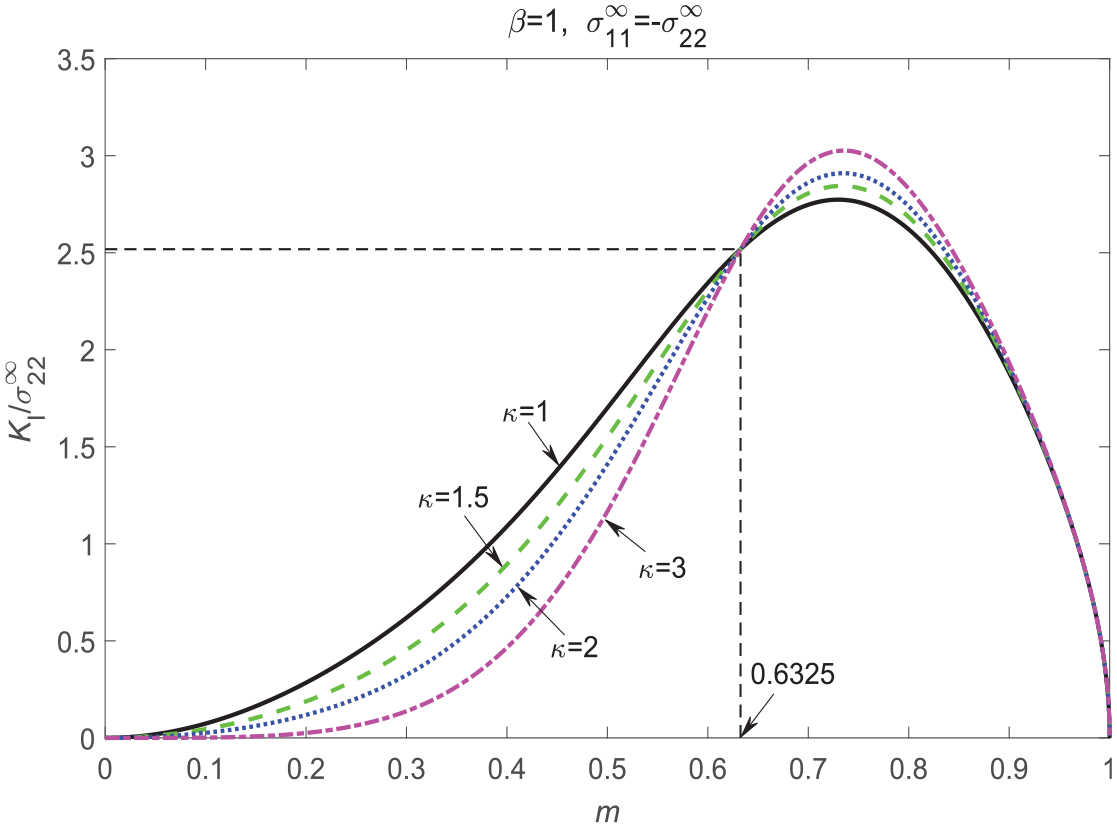
Variations of
It is derived from the stress intensity factor in equation (22) that the remote loading will not induce any singular stress field at the cusp tips when the following condition is met:

which is illustrated in Figure 13. It is seen from Figure 13 that (1) the ratio
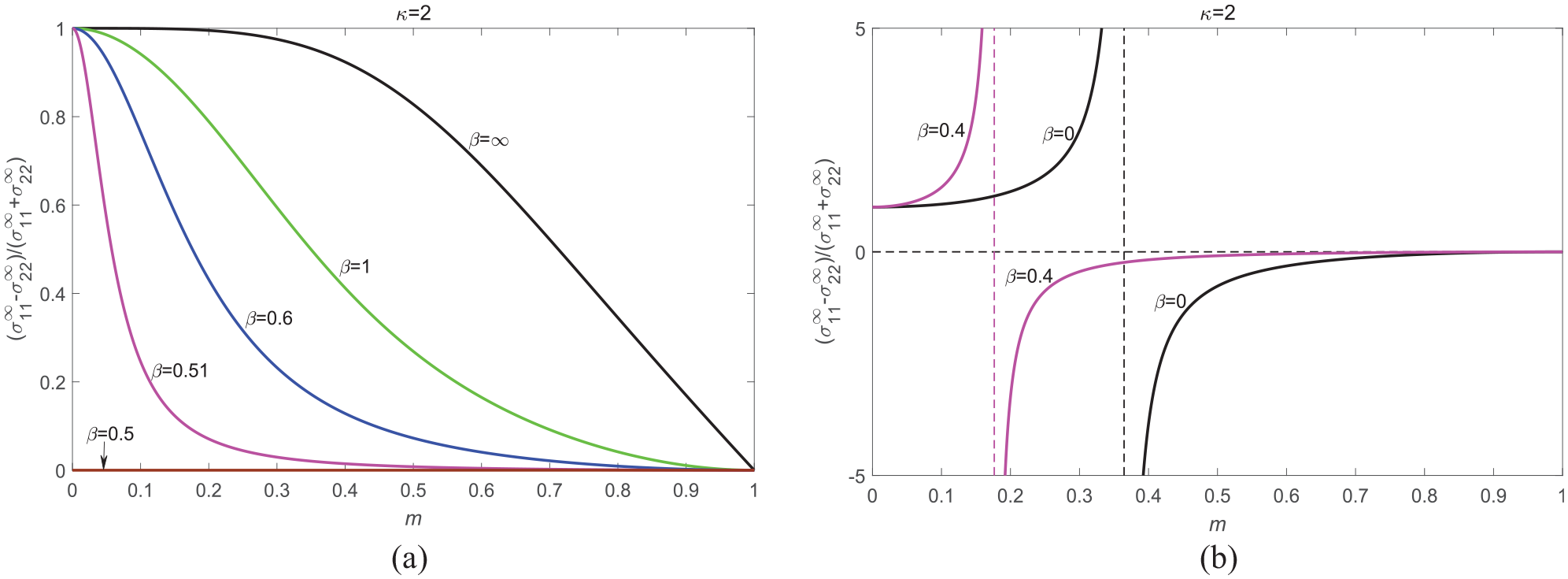
The ratio
As a consequence, the parameter

which is illustrated in Figure 14. It is seen from Figure 14 that
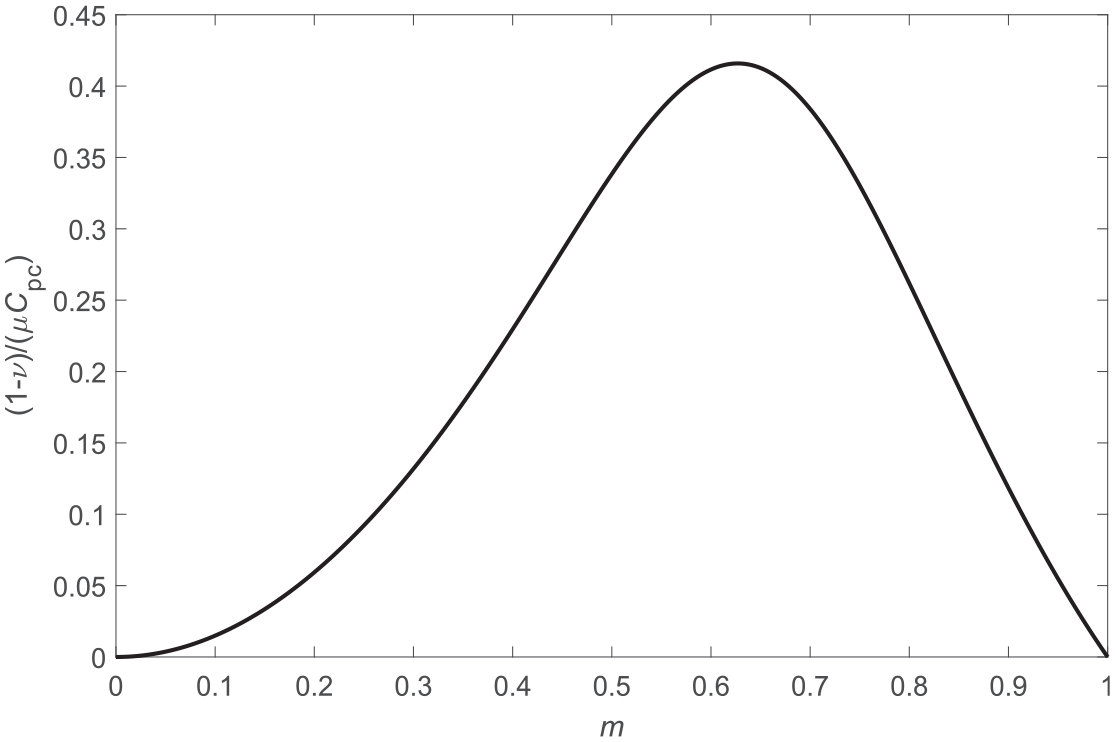
The inverse of the compressibility
4. Conclusion
A rigorous analysis is performed to investigate the plane strain problem of a symmetric compressible liquid lip inclusion embedded in an infinite isotropic elastic matrix subjected to uniform remote in-plane normal stresses. The analytic function
Footnotes
Declaration of conflicting interests
The author(s) declared no potential conflicts of interest with respect to the research, authorship, and/or publication of this article.
Funding
The author(s) disclosed receipt of the following financial support for the research, authorship, and/or publication of this article: This work is supported by a Discovery Grant from the Natural Sciences and Engineering Research Council of Canada (grant no. RGPIN-2023-03227 Schiavo).
