




Abstract
An equibiaxially stretched thin neo-Hookean circular membrane with a hole at its center under plane-stress condition is analyzed within the framework of finite deformation elasticity. Initially, we introduce a novel form for the differential governing equation to the problem. This enables the introduction of a closed-form solution in the limit of infinite stretch. Comparison of this solution to corresponding finite element simulations reveals a neat agreement for stretch ratios larger than 2.5. In the practically important case of a small hole, at the circumference of the hole, the stress concentration factor is 4 and the tangential stretch ratio is twice the applied far-field stretch ratio. These values are double the corresponding ratios in the well-known limit of infinitesimal deformation.
1. Introduction
The problem of an equibiaxially stretched membrane with a hole at its center under a plane-stress condition is frequently encountered. The well-known axisymmetric solution in the limit of infinitesimal deformations [1] is crucial for analyzing failures due to stress concentration around the hole. Moreover, the asymptotic solution in the limit of a small hole is frequently used for estimating the stress in many other problems containing small holes. However, the known solution for infinitesimal deformations is not applicable for materials such as elastomers and tissues that undergo finite deformations. For these stretchable materials, this problem needs to be analyzed within the framework of finite deformation elasticity [2].
Previous analyses [3–5] dealt with a general Mooney–Rivlin material [6, 7], with the neo-Hookean material as a special case, and a wide range of boundary conditions. Exact analytical results were obtained only in the limit of infinitesimal deformations. Approximated expressions based on expansion series about these exact solutions were proposed and compared with corresponding numerical results for a narrow range of ratios between the hole and the membrane radii. Yang [4] and Wong and Shield [5] further pointed out how their approximations break down in the case of traction-free boundary conditions at the hole. Haughton [8] solved a similar plane-stress problem for the Varga [9] material, revealing that for this material the membrane thickness remains uniform. Various numerical analyses of similar problems and the related cavitation problems were conducted for different hyperelastic materials [10–13].More recently, Geng et al. [14] obtained asymptotic approximations for a few hyperelastic membranes with a small hole near the cavitation critical stretch ratio.
Herein, we tackle the plane-stress problem of an equibiaxially stretched incompressible neo-Hookean circular membrane with a traction-free hole of an arbitrary size at its center. Initially, we introduce a new non-dimensional, non-linear second-order ordinary differential equation governing the boundary value problem. This further leads to a closed-form solution in the limit of infinite stretching of the membrane. This solution is then compared to the corresponding finite element (FE) simulation of the problem, demonstrating that the closed-form solution provides an excellent approximation for stretch ratios larger than 2.5.
2. Background
The deformation of a three-dimensional body from a reference (undeformed) configuration to a current (deformed) configuration can be described by a bijection mapping of each material point at a reference position

where
If no body forces are at play, the equilibrium equation for linear momentum is

where

where

The constitutive behavior of hyperelastic materials can be expressed in terms of a Strain Energy Density Function (SEDF)

A simple constitutive relation that describes the behavior of many highly deformable materials in the small to intermediate deformation range is the incompressible neo-Hookean material, for which

where the incompressibility constraint is

where
3. The boundary value problem
Consider a thin circular incompressible neo-Hookean membrane with a hole at its center (see Figure 1(a)). In its referential state, the outer radius of the membrane is
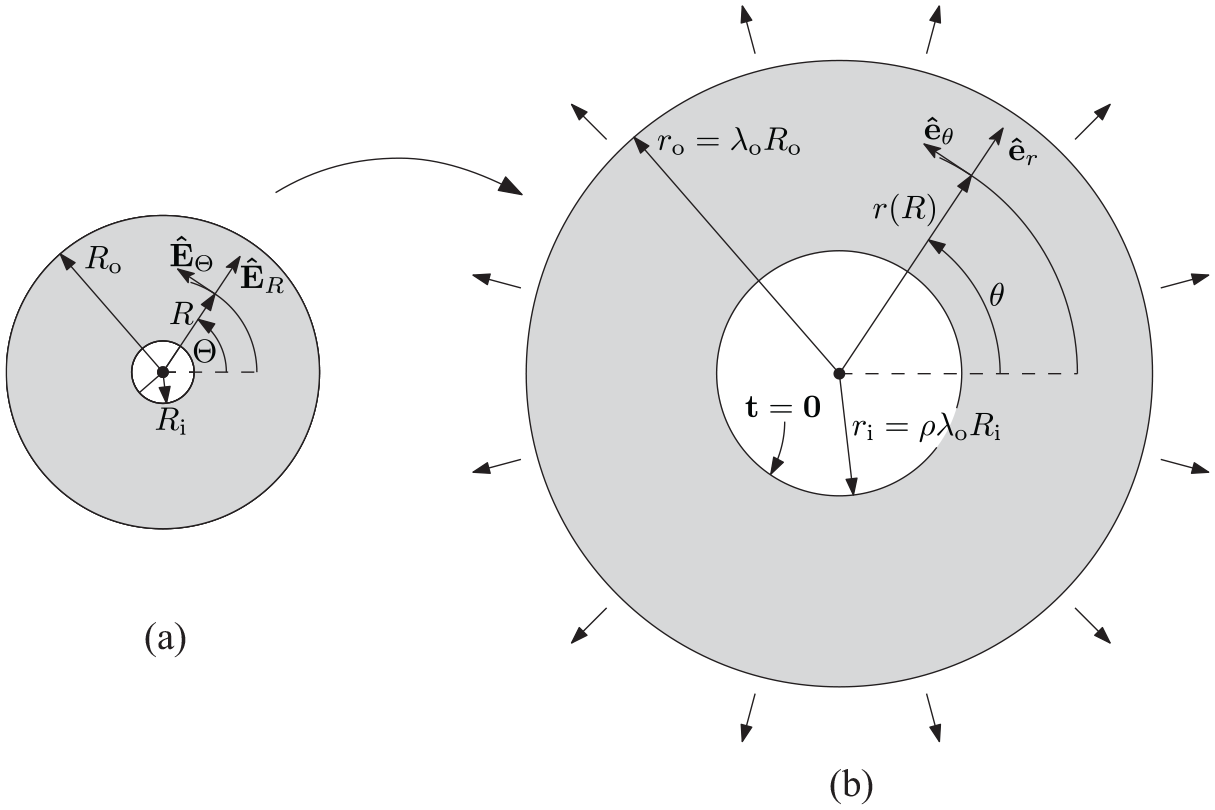
An equibiaxially stretched punctured membrane in the (a) reference configuration and (b) deformed configuration.
We examine this problem in polar coordinates

where
For future reference, we define the nominal problem of a circular membrane (without any holes) subjected to an equibiaxial stretch. For this problem, there is a trivial solution,

where we adopt the
Returning to the BVP at hand, the boundary conditions at the outer and inner radii are

Since the lateral boundaries of the membrane are stress-free, on account of the small thickness of the membrane, we assume the plane-stress condition

within the membrane.
The deformation gradient of the assumed mapping is

We denote the radial, hoop, and axial stretches

respectively, where we use the comma convention for the partial derivative. Thanks to the negligible thickness of the membrane, we set
Incompressibility yields that

Next, the constitutive relations (7) lead to


Plane-stress (11) implies


and

Substituting the resulting expression for

leads to the non-linear differential equation

The associated boundary conditions (10) are

where the conditions on
For later reference, we note that the boundary condition at the hole, together with the incompressibility constraint and the plane-stress condition, define the deformation gradient at the boundary of the hole up to a single degree of freedom

This deformation gradient is identical to one of an incompressible strip under uniaxial tension.
4. The limit of infinite stretch
To solve the problem in the limit of infinite stretch, we represent the BVP in terms of the normalized dimensionless variables

For conciseness, we also define the hole expansion ratio

In terms of

The corresponding boundary conditions at the outer boundary and at the hole are

respectively.
To solve the problem in the limit of infinite stretch, we let

where the superscript
The solution of equation (28) is

This solution indeed satisfies the assumption we made above and is therefore the solution to the problem in the infinite stretch limit.
We further note that if we want to expand this solution for finite values of

The reasoning behind this choice for the expansion parameter is attributed to the deformation gradient at the boundary of the hole (23). Since the lowest non-vanishing term in this expansion corresponds to
Returning to the physical variables, the solution for

The hole expansion ratio in this limit is

and from equation (18) we have that the hoop stress is

5. Application
We begin this section with the important case of an infinitesimally small hole. Equation (32) shows that in the limit of infinite stretch, the hole expansion ratio of an infinitesimally small hole is
For a finite ratio between the radii,
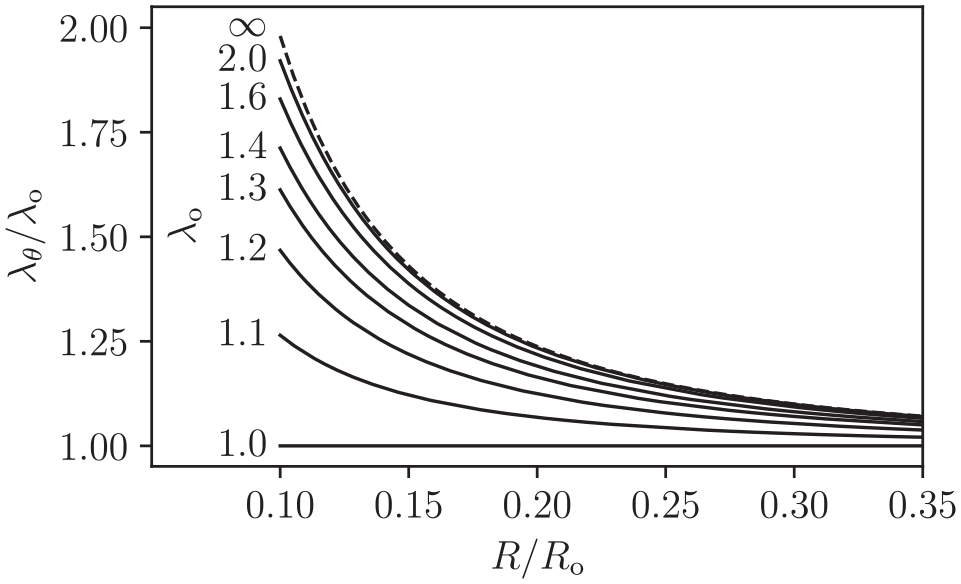
The tangential stretch ratio normalized by
A contour plot of the hoop stress resulting from an FE simulation is shown in Figure 3. Note that the stress reduces to the nominal stress at a rate similar to expression (33).
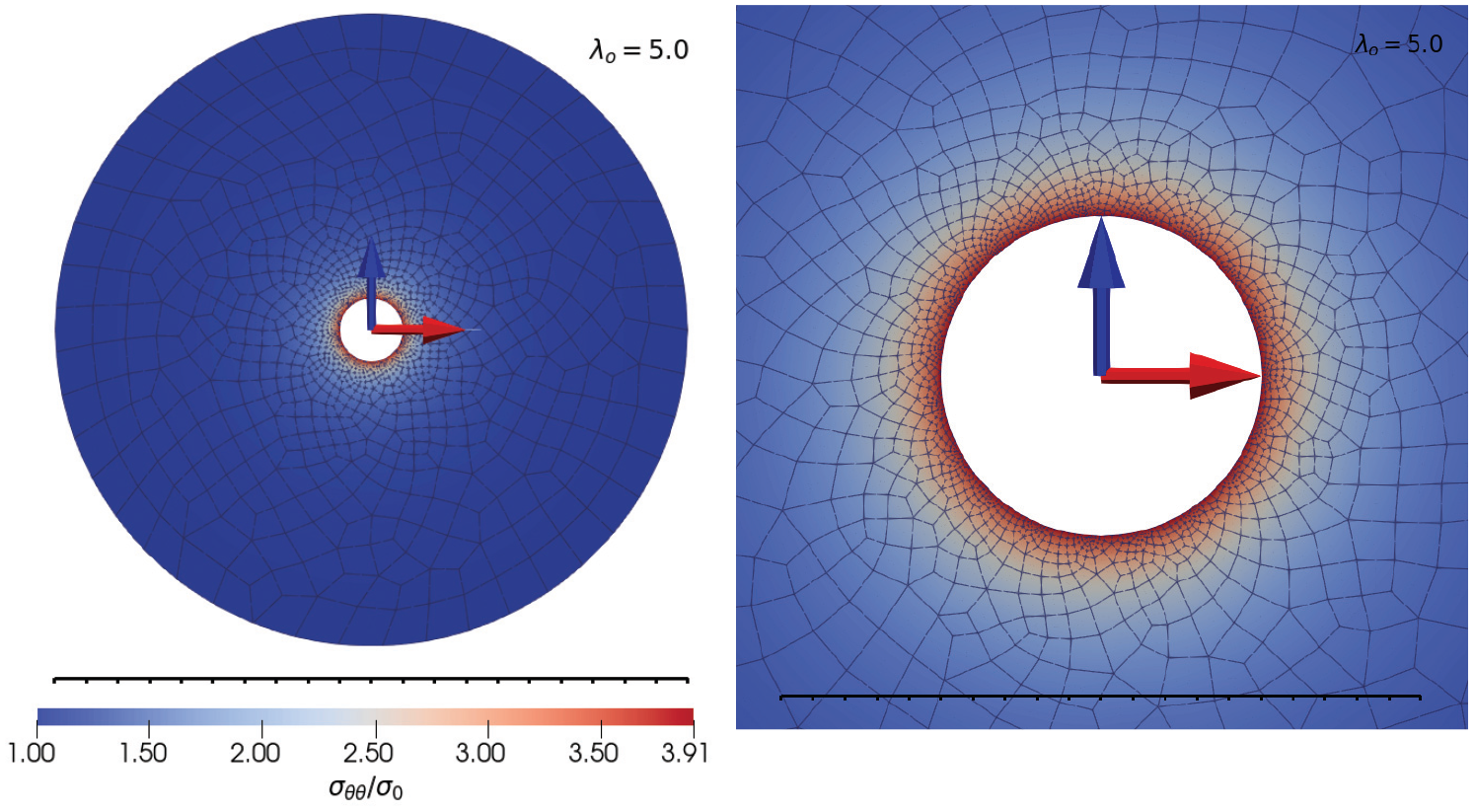
The hoop stress determined by a finite element simulation of a membrane with
The stress concentration factor in the infinite stretch limit is

In particular, for an infinitesimally small hole, the stress concentration factor is 4. This is twice the well-known factor in the infinitesimal deformation limit [1].
Figure 4 compares the infinite stretch solution to FE simulations for the hole expansion ratios (Figure 4(a)) and the stress concentration factor (Figure 4(b)) as functions of the stretch ratio
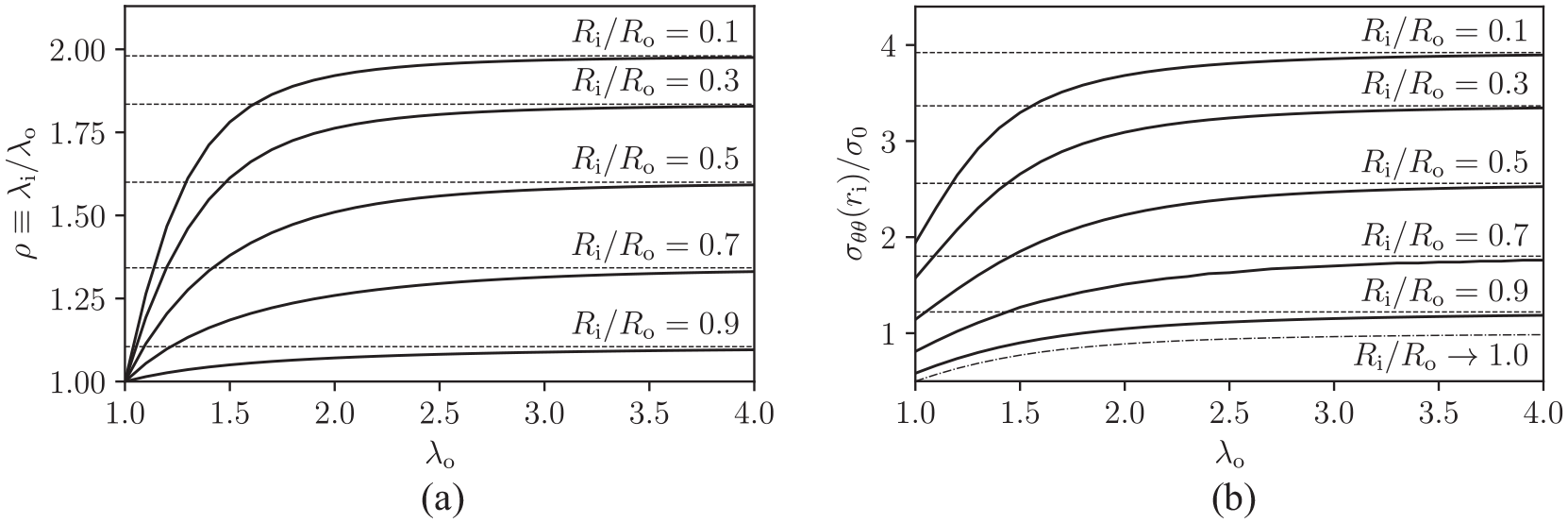
(a) The hole expansion ratio
6. Conclusion
We analyze, within the framework of finite deformation, equibiaxial extension of a thin neo-Hookean circular membrane with a hole at its center under plane-stress condition. First, examining the problem in polar coordinates, we derived the non-linear radial equilibrium equation with the associated non-linear boundary conditions. Next, with an appropriate change of variables, we introduced a new representation for the governing problem. This new form lends itself to an exact closed-form solution in the limit of infinite stretch.
Comparison of this solution with corresponding finite element simulations revealed fine agreement for applied equibiaxial stretch ratios larger than 2.5 for any hole size. In the limit of an extremely large hole, we show that the deformation of the membrane approaches that of an uniaxially stretched thin strip. Finally, we reveal that at the limit of infinite stretch, at the circumference of an infinitesimal hole, the stress concentration factor is 4 and the tangential stretch ratio is twice the applied far-field stretch ratio. These values are double the corresponding stress concentration factor and hole expansion ratio in the limit of infinitesimal deformation.
