



Abstract
We consider a horizontal elliptical tunnel buried in a medium under gravity and lateral pressure (perpendicular to the generatrix of the tunnel). The stress field in the medium is generally treated as the superposition of an initial stress field induced by the gravitational body force and lateral pressure before tunnel excavation and the perturbation stress field after the introduction of the tunnel. Closed-form solutions for the perturbation stress field are available if the interaction between the tunnel and the surface of the medium is neglected. The initial stress field is usually assumed to be constant in deriving closed-form solutions for the perturbation stress field since it is often believed that the interaction between the tunnel and the surface of the medium is negligible only for a deep-buried tunnel. However, it is indicated from the literature that the interaction between the tunnel and the surface of the medium is insignificant in determining the stress distribution around the tunnel as long as the distance between them exceeds the diameter of the tunnel’s cross section. Consequently, we are motivated to derive in this paper a refined closed-form solution for the perturbation stress field by admitting a realistic initial stress field that varies linearly in the depth direction. The refined solution may lead to more accurate results in predicting the gravity-triggered stress concentration around a moderate-depth tunnel. The refined solution is compared with the classical solution (obtained by using a constant initial stress field) in calculating the hoop stress around the tunnel via several numerical examples.
1. Introduction
The complex variable formalism of elasticity [1,2] is very powerful in dealing with two-dimensional problems of linearly elastic bodies. When combined with conformal mapping techniques [1–3], it is extremely advantageous in solving various boundary value problems of two-dimensional deformations of geometry-complex elastic bodies. For example, one may easily recover the classical Kirsch’s solution [4] for the stress concentration around a circular hole with traction-free boundary in an elastic plane under uniform remote in-plane tension. For the case of an elliptical hole with either traction-free or uniformly pressed boundary in an elastic plane subjected to arbitrary uniform in-plane loadings remotely, the complex variable formalism is probably the only methodology that could be used to yield the explicit closed-form solution for the full stress field [1–3]. Even for the cases of an elastic plane containing holes of general shapes whose boundary undergoes intricate strain gradient-dependent and/or curvature-dependent tractions (e.g., arising from the presence of significant surface energies at small length scales), the complex variable formalism may probably be the only feasible methodology that is available to derive the analytic or at least semi-analytic solutions for the elastic field [5–9].
In addition to the analysis of the mechanical behavior of porous media in materials science and engineering, the analytic study in the geomechanics and underground engineering usually resorts to the complex variable formalism whenever the specific problem can be transformed essentially into a two-dimensional deformation problem. For example, several researchers have used the complex variable formalism in predicting the stress perturbation induced by tunnel excavation. For example, based on the complex variable formalism of isotropic plane elasticity, Lu et al. [10] presented an analytic solution of determining the gravity and lateral stress-caused stress field in the medium surrounding a circular shallow-buried tunnel by using a fractional linear mapping function, while Wang et al. [11] developed an iterative procedure to calculate the ground surface loading-induced stress concentration around a horizontal shallow-buried tunnel of arbitrary cross section. In the study of shallow-buried tunnels, it is usually necessary to model the medium enclosing the tunnel as an elastic half-plane rather than an elastic completely infinite plane since the presence of the ground surface may influence the stress distribution around the tunnel significantly. In particular, because of the mathematical complexity involved in half-plane problems, explicit analytic results of shallow-buried tunnels have been quite limited (most likely, only for some cases of circular tunnels explicit closed-form solutions are available [12]). For the cases of deep-buried tunnels whose depth is much larger than their cross-section size, however, the interaction between the ground surface and the tunnel’s boundary is negligible so that much more explicit solutions have been found by using the approximate model of an elastic completely infinite plane with a single hole [13–15]. In fact, as demonstrated in Dai et al. [16,17], the interaction between the ground surface and the boundary of the tunnel could be neglected without inducing large errors in calculating the stress concentration around the tunnel when the distance between them exceeds the diameter of the cross section of the tunnel (not necessarily much larger than the size of the cross section). Consequently, the above-mentioned completely infinite plane model is generally applicable to approximate evaluation of the stress field around tunnels as long as they are not very shallow. Nevertheless, most analytic solutions (including those in Exadaktylosa and Stavropoulou [13], Wang and Li [14], and Lu et al. [15]) originally derived for deep-buried tunnels probably need to be modified when used for the gravity-related stress analysis of a tunnel with moderate depth (e.g., few times the diameter of its cross section), because the initial stress field in the surrounding medium before tunnel excavation was simply taken as a constant in the process of deriving these analytic solutions. In fact, such an assumption of constant initial stress field is reasonable for a deep-buried tunnel, although for a moderate-depth tunnel it may deviate from the realistic situation since the gravity-related initial stress field in the surrounding medium has a large gradient in the depth direction. In this paper, we address this deficiency and present a refined solution for the gravity-related stress field around an elliptical tunnel whose depth allows for the use of the completely infinite plane model.
We arrange the paper as follows. In section 2, we introduce the plane deformation problem of an elliptical underground tunnel surrounded by an elastic medium under gravity and lateral pressure, and formulate it into the boundary value problem of an elliptical hole embedded in an elastic infinite plane employing the complex variable formalism. In section 3, we obtain modified closed-form solution for the full stress field in the elastic plane via the use of Cauchy integral techniques. In section 4, numerical examples are presented to compare the modified solution and the classical solution in the stress concentration around the hole. The main points of the paper are finally highlighted in section 5.
2. Formulation of the problem
We consider an elliptical cylindrical tunnel buried in an elastic half-space. The depth of the tunnel is assumed to be larger than the diameter of its cross section, while the surface of the half-space and the generatrix of the tunnel are assumed to be horizontal. The half-space undergoes gravity in the vertical direction and a lateral depth-dependent pressure in the horizontal direction, while the boundary of the tunnel is free of traction. Consequently, the stress field in the half-space could be determined by solving the plane-deformation problem of an elliptical hole located in an elastic half-plane subjected to a gravitational body force in the vertical direction and specific far-field lateral loadings in the horizontal direction. We refer to a rectangular x-y coordinate system and diagram the latter problem in Figure 1. As introduced in Figure 1, L denotes the boundary of the elliptical hole, while
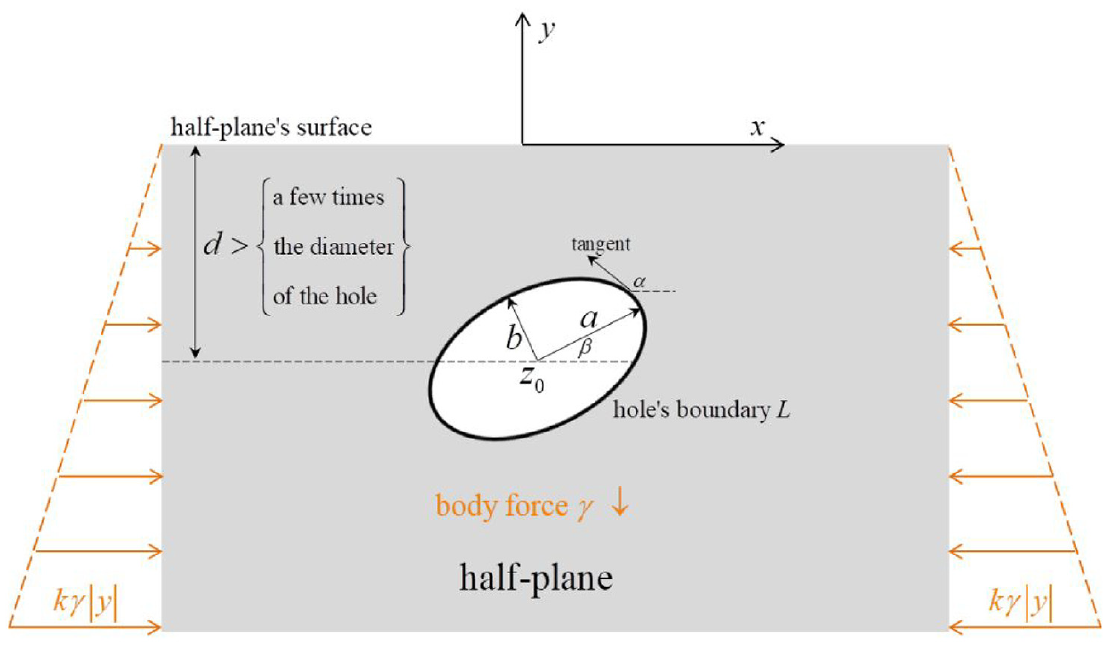
An elliptical hole embedded in an elastic half-plane under gravity and lateral pressure.
The total stress field (

where (

From a mathematical point of view, the interaction between the elliptical hole and the surface of the half-plane could be neglected only if the depth of the hole is extremely larger than the diameter of the hole. From a practical point of view, however, the interaction between them is negligible (only leading to slight errors in evaluating the stress concentration around the hole) when the distance between the boundary of the hole and the surface of the half-plane reaches or exceeds the diameter of the hole [16,17]. Consequently, for the current case in which the depth of the elliptical hole reaches at least its diameter, the perturbation stress field (

where
The perturbation stress components (

where

where ds is arc length of an infinitesimal element (counterclockwise directed) of L.
We shall solve the boundary value problem (5) with equation (3) to derive the explicit solutions for
3. Explicit solution
We first examine the indefinite integral on the right side of equation (5). Using equations (2) and (3) while noting

we represent it as

Here, equation (7) indicates that the resultant traction imposed on the boundary L is not self-equilibrated and its magnitude turns out to be

where S is the area enclosed by L. We introduce a conformal mapping

with

where “Im” denotes the imaginary part of a complex quantity. The definition of the parameters introduced from equation (10) are shown in Figure 1:

while the complex coordinate t = x + iy of a certain point on L is expressed in terms of the mapping as

Using equations (12) and (11), one may simplify equation (7) into

where C is an arbitrary constant of integration and

We continue to focus on the unknown functions

where

with

where


In addition, we readily see that each of
Substituting equations (13), (18), and (12) into the boundary condition (5), we arrive at (through a short simplification)

Applying the operator

whose derivative is

The conjugate of equation (20) is

Similarly, applying the above-mentioned operator to both sides of equation (23) results in

where

We have determined explicitly all the analytic functions related to the perturbation stress field. The total stress field may be obtained by adding the perturbation stress field and the initial stress field. The components of the total stress field around the elliptical hole are organized into

where

If the elliptical hole is deeply buried (i.e. d is significantly larger than a and b), equation (27) is reduced to

which agrees with the classical solution given by Muskhelishvili [1] (see also Exadaktylosa and Stavropoulou [13]).
4. Numerical examples
In this section, we present some comparisons between the current refined solution and the classical solution in calculating the total hoop stress around the elliptical hole with a certain depth at which the interaction between the hole and the surface of the half-plane could be neglected. In fact, as shown in Dai et al. [16,17], the interaction between the hole and the surface of the half-plane is negligible as long as the distance between the boundary of the hole and the surface of the half-plane exceeds the diameter of the hole. Here, since the initial stress field (before excavation of the hole) used in the derivation of the classical solution is treated as a constant, the use of the classical solution may probably lead to large errors in predicting the total stress field around the hole with its depth being only few times the size of the hole.
Figures 2 and 3 present the normalized hoop stress around a circular hole and an elliptical hole with a moderate depth (about the diameter of the hole), respectively, for plane strain deformation. We see from these figures that the refined and classical solutions differ more from each other in determining the stress distribution around the hole when lateral pressure exists. It is particularly shown that the points at which maximum compression stress concentration occurs are not exactly the horizontal endpoints of the hole (corresponding to
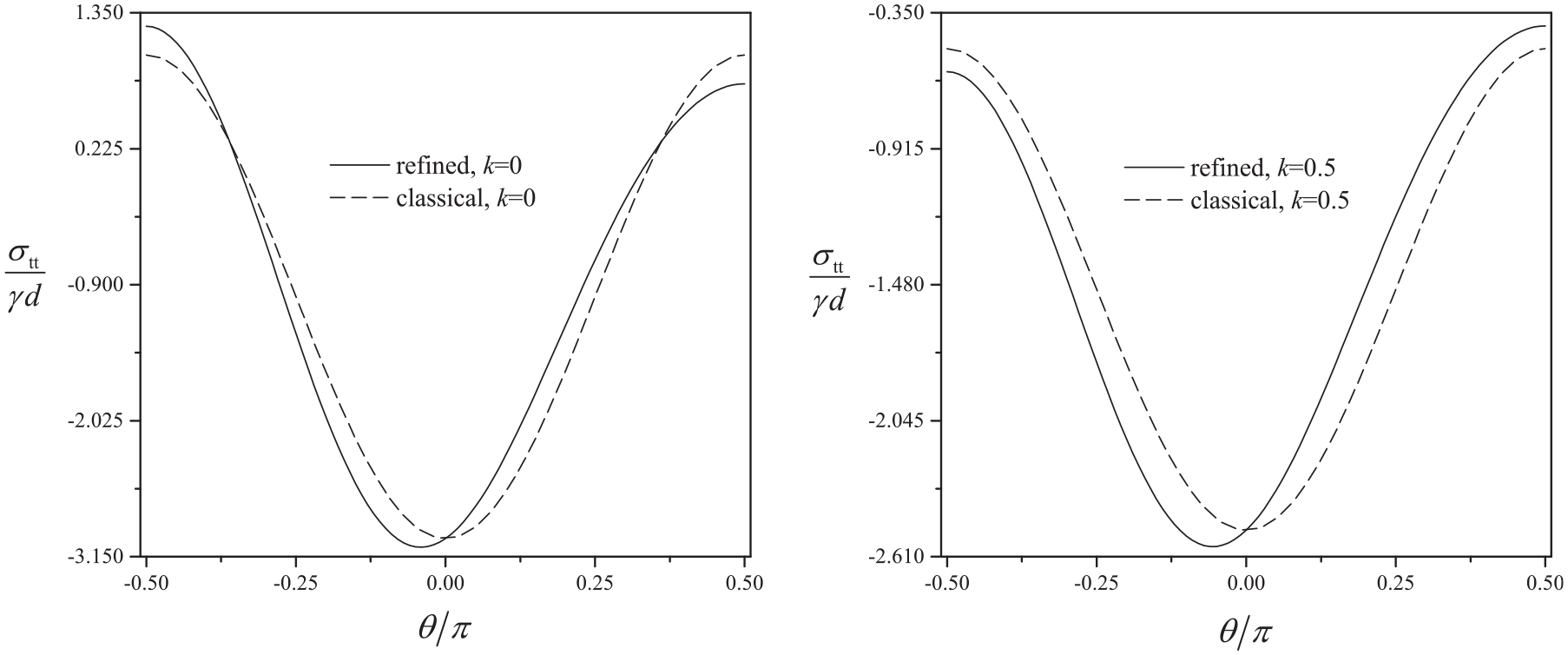
Gravity and lateral pressure-induced hoop stress concentration around a circular hole in an elastic plane under plane strain deformation (d/a = d/b = 3,
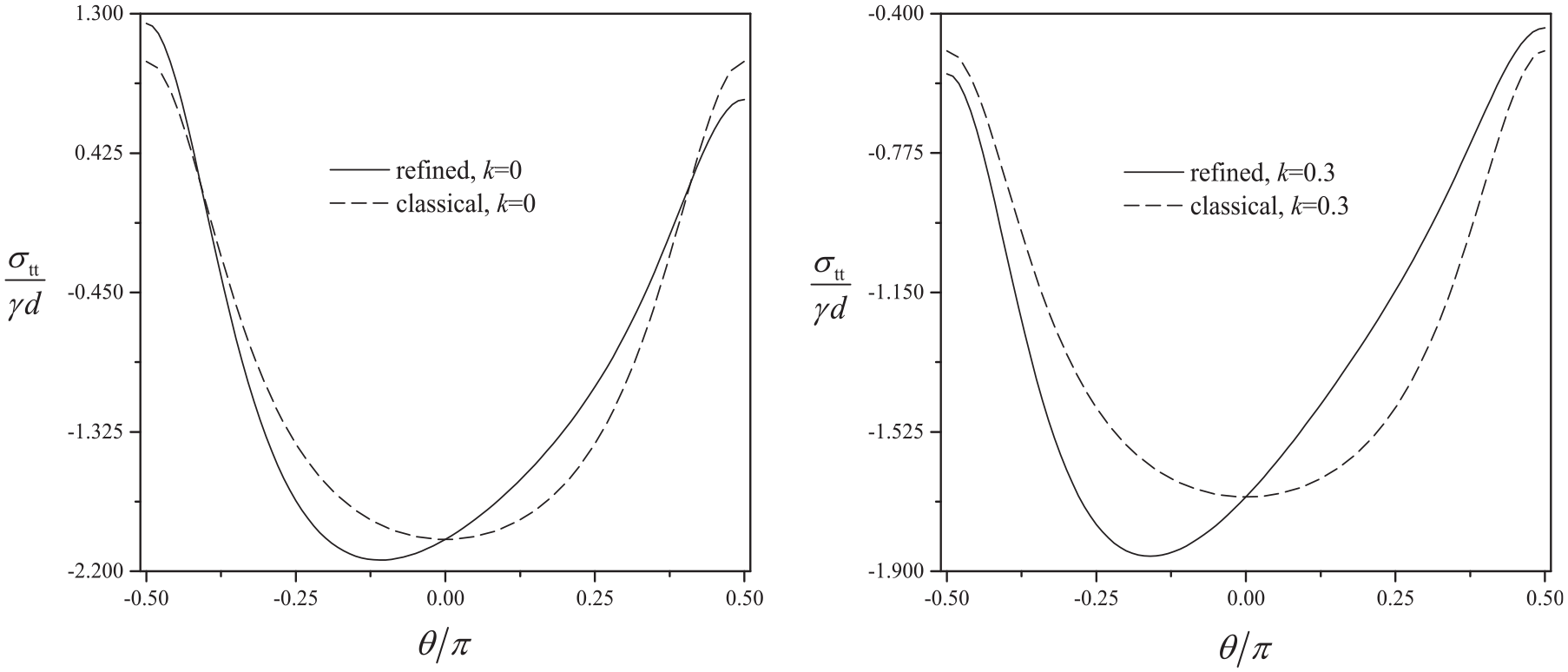
Gravity and lateral pressure-induced hoop stress concentration around an elliptical hole in an elastic plane under plane strain deformation (d/a = 6, d/b = 3,
5. Conclusion
We study the problem of an elliptical tunnel buried horizontally within an elastic half-space under gravitational body force and lateral compressive stress perpendicular to the generatrix of the tunnel. The tunnel is assumed to be not very shallow ensuring that the interaction between the tunnel and the surface of the half-space may be neglected in determining the stress field near the tunnel. This problem is then transformed into that of an elliptical hole located in an elastic infinite plane under plane deformation. The total stress field in the elastic plane is divided into two parts, the initial stress field induced by the gravitational body force and lateral compressive stress in a complete plane (without any hole) and the perturbation stress field caused by introducing the elliptical hole (here, the determination of the perturbation stress field is closely related to the specific initial stress field). The perturbation stress field in the region outside the elliptical hole is determined explicitly in closed form when the initial stress field is taken as a linear function with respect to the depth-coordinate (which is in contrast to the constant initial stress field used in the previous study of deep-buried holes), and a refined formula is then obtained for the total hoop stress around the hole. Numerical examples are given to illustrate the difference between the refined formula and the classical formula (resulting from the use of a constant initial stress field) in calculating the hoop stress around the hole with a moderate depth. We show that the hoop stress distribution predicted by the refined formula becomes more inconsistent with that predicted by the classical formula as the lateral compressive stress increases. More importantly, the points at which maximum compression stress concentration appears would move downward (in the depth direction) on the hole’s boundary when the refined formula is used instead of the classical one.
Footnotes
Funding
The author(s) disclosed receipt of the following financial support for the research, authorship, and/or publication of this article: We acknowledge the National Natural Science Foundation of China (Nos 11902147 and 11802040), the Natural Science Foundation of Jiangsu Province (No. BK20190393), and the Research Fund of State Key Laboratory of Mechanics and Control of Mechanical Structures (Nanjing University of Aeronautics and Astronautics) (Grant No. MCMS-I-0222Y01).
