




Abstract
Beyond the defective structures (or inhomogeneities) occurring in bodies made of a single constituent, composite materials may exhibit a different kind of defectivity arising from the fact that, even if each constituent is defect-free, the incompatibility between them is a detectable entity. After defining a rigorous tensorial measure of the density of these defects, a law for its material evolution is proposed whose driving force is the presence of the defectivity itself. The model is illustrated with numerical solutions of properly formulated initial boundary value problems of systems of partial differential equations.
1. Introduction
Continuously defective material structures have been the subject of modeling and investigation from various theoretical and applied viewpoints for at least the last seven decades. When trying to summarize the commonalities and, at the same time, the differences between the many avenues of approach to this subdiscipline of the mechanics of continuous media, one may wish to identify the answers given by each of them to the following three questions: (1) How are defects defined? (2) What mathematical tools are used to represent them? (3) What are the mechanisms, if any, behind their evolution in time?
The notion of an isolated dislocation in an elastic body can be traced back to the works of Weingarten [1] and, more particularly, of Volterra [2], 1 which contains a now famous figure showing six hollow cylinders, each with a cut through the wall along a generator, and a relative displacement of the lips of the cut in three different directions and, similarly, a relative rotation around three different axes. After imagining that the distorted open cylinder has been glued back together, Volterra calculates the distribution of stresses according to the infinitesimal theory of elasticity. The Volterra kinematic paradigm does not invoke any atomic substrate nor does it in principle rely on any particular constitutive model.
It is noteworthy that, to the best of our knowledge, no rigorous attempt has been made to emulate the Volterra paradigm in a continuous limit of a sequence of infinitesimal cut-and-glue operations until very recently [3]. Instead, the earliest successful attempts at a consistent definition of continuous distributions of defects in solid bodies rely on a putative passage to the limit of a distribution of isolated defect lines in a crystal lattice. In this context, Burgers [4] identified various types of isolated dislocations by means of what he regarded as a discontinuity of a displacement component. This quantity is now known as Burgers’ vector, which is a measure of the lack of closure of an atomic circuit enclosing a line of defects, as explained more clearly by Frank [5]. The culmination of the various attempts at generalizing this concept to the case of a continuous distribution of dislocations is perhaps best represented by an article of Bilby et al. [6] in which the crystallographic basis is represented by a (generally anholonomic) frame field, and where the lack of closure just mentioned is identified with the Lie brackets between pairs of base vectors. In other words, the Burgers’ vector transmogrifies into the torsion tensor of the distant parallelism represented by the frame field.
In contradistinction with the preceding structural viewpoint, there is yet a third approach to the definition and representation of continuous distributions of defects. Anticipated in part by the works of Kondo [7], this third avenue may be designated as a constitutive approach. It was most forcefully advocated by Noll [8] on the basis of the epistemological principle that a continuum theory should be self-sufficient, not necessarily relying on a more fundamental level of discourse. From this viewpoint, it should be clear that all the information available at the macroscopic level should have already been encapsulated in the constitutive equations of the material at hand. A remarkable and rather unexpected result of this recalcitrant philosophical position is that, at least for materials with a discrete symmetry group, the results are identical with those of the structural approach. In particular, the torsion tensor of a constitutively induced connection emerges quite naturally as the appropriate measure of defectivity of the material.
In the constitutive approach, the concept of material uniformity plays a pivotal role. Considering, for example, a body made entirely of elastic points, two material points are said to be materially isomorphic if a linear transformation of an infinitesimal neighborhood of the first point renders its material response identical to that of the second point. Clearly, material isomorphism is an equivalence relation. A body is said to be materially uniform if all its points are mutually materially isomorphic. But is the body homogeneous? Not necessarily, since it may not be possible to deform it into a configuration such that the material isomorphisms are just Euclidean translations. The criterion for this to be possible (at least in a neighborhood of each point) is shown to depend on the (common modulo conjugation) material symmetry group of the material points. For the case of a discrete symmetry group, this criterion amounts to the vanishing of the torsion of a unique connection arising from the material isomorphisms. We remark that when adhering to the structural approach, material uniformity is implicitly assumed, since the crystal lattice does not make any constitutive distinction beyond its being represented by a local crystal basis. Material homogeneity, however, is still represented by the integrability of the lattice. In other words, the body is homogeneous (or defect-free) if the lattice can be straightened into an orthonormal Euclidean frame by means of what in the structural approach is designated as an “elastic” deformation.
In the present work, we consider a new and different type of material defects, namely, those that arise by virtue of the combination of two (or possibly more) constituents into a composite, while each constituent retains its recognizable individuality. As suggested in Epstein [9, 10], even when the two constituents are individually homogeneous, the resulting composite is not generally uniform, let alone homogeneous. The lack of uniformity may be considered as a material defect that can act as a driving force for the time-evolution of the defective structure. Applications relevant to additive manufacturing and to biological tissues are expected.
Section 2 is a rather self-contained review of the main ideas pertaining to the representation of a possibly dislocated continuous crystalline solid by means of a frame field over a body manifold. Section 3 extends and generalizes these ideas to binary composites and introduces a tensorial measure of composite defectivity. In section 4, the general principles underlying laws of material evolution are laid down and applied to the problem of self-driven evolution of a defective binary composite. Finally, section 5 illustrates the results of the theory as applied to several numerical examples.
2. Brief review of material homogeneity
Leaving aside the constitutive approach (which is more general than its structural counterpart inasmuch as it can deal with continuous symmetry groups), we will identify a crystalline solid constituent with a frame field attached to a fixed reference configuration
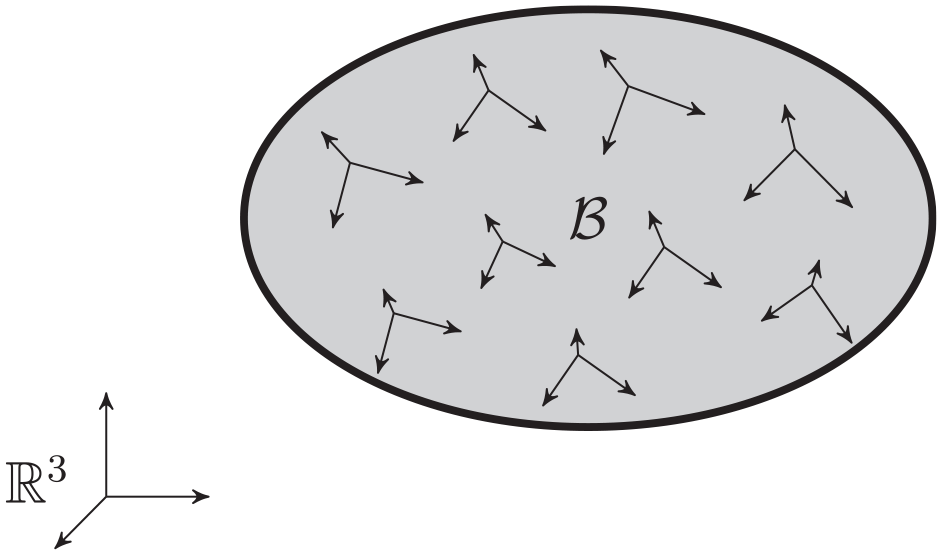
A material frame field on
A frame field induces a distant parallelism in

where the summation convention for diagonally repeated indices is enforced, and where the notation
Since everything has been assumed to be differentiable, we look for a differential condition that expresses the constancy or lack thereof of a vector field. Clearly, using commas to indicate partial derivatives with respect to the coordinates

or, equivalently, as:

In this equation,

We note that neither
We have shown that if a vector field is materially parallel, then its covariant derivative with respect to the material parallelism vanishes. Vice versa, if the covariant derivative of a vector field

whence we conclude that
The torsion of a distant parallelism is defined as the skew-symmetric third-order tensor

Even though the connection symbols themselves are not components of a tensor, the skew-symmetric combinations (6) are. An important property of the torsion tensor is contained in the following lemma.
From the point of view of the theory of dislocations, this lemma implies that the torsion tensor vanishes identically if, and only if, the material is homogeneous (defect-free). Indeed, the existence of a coordinate system whose natural base vectors coincide with the material frame implies that, by a mere change of reference configuration, the curvilinear coordinates can be transformed locally into Cartesian coordinates, thus recovering a perfect crystal lattice.
3. A binary composite
Suppose that the reference configuration
If by chance or by design the two material frames coincide at each point of

where

Clearly, if the components
From the above considerations, we may unequivocally state that a binary composite is uniform if, and only if, the difference:

vanishes identically on
It is important to point out that, even if the composite turns out to be uniform, it does not necessarily follow that it is homogeneous. For that to be the case, we would need to require the vanishing of the torsion of the common material parallelism. This observation gives rise to the following characterization. The defectivity of a binary composite is to be judged in two stages, the first of which pertains to the determination of whether or not the composite is uniform. Only if the answer to this first question is in the affirmative, can we proceed to the second stage and assess its homogeneity. It is in this sense that we have stated in section 1 that we are considering a new and different kind of material defect of a composite, namely, its possible lack of uniformity. Moreover, we have obtained a precise quantitative measure of this kind of defectivity.
4. Material evolution
4.1. General considerations
Once present or installed in a material body, continuous distributions of defects tend to evolve in time. The physical driving forces behind this evolution can be of many different origins, such as the mere passage of time (aging), increase of mass (growth) due to biological reactions or other factors, adaptation to external mechanical agents (remodeling, such as it occurs in orthodontics), morphogenesis (creation of new patterns via reaction–diffusion phenomena), the natural tendency of some defects to dissipate or pile up (self-driven evolution), and so on. Material responses such as plasticity and viscoelasticity can also be viewed under this light, and the history of the theory of dislocations is intimately connected with the largely successful attempts to explain crystal plasticity in terms of dislocation slip. 2
What all these phenomena have in common is that they affect the body itself in any fixed reference configuration. In other words, it is not the kinematics of the deformation that, naturally, evolves in time under the action of external agents, but rather the material properties themselves are affected by processes of material evolution. These two different entities, the one spatial and the other material, are not necessarily unrelated. Indeed, as demonstrated by the theory of metal plasticity, the material changes (expressed, say, in terms of permanent plastic strains) can be triggered by external stresses and strains. Prominent among the formulations based upon this interaction is the concept of Eshelby stress, proposed by Eshelby [11], who was also an important contributor to the theory of continuous distributions of dislocations. Regardless of the driving forces behind material evolution, however, it is possible to formulate a few general principles by which the governing laws must abide, as discussed in greater detail in Epstein and Elżanowski [12].
In this paper, we intend to consider exclusively the self-driven evolution of material defects in binary composites. The concept of self-driven evolution of defects in general was introduced in Epstein and Elżanowski [13] in the context of dislocations. Within the framework of composites, however, we want to investigate the evolution of the material parallelisms defined by the frames

and

where dots are used to indicate time derivatives.
To simplify somewhat the formulation, we will henceforth assume that the second frame field,

where the matrix
Applying the preceding reasoning to the generic evolution law (10), one concludes that it reduces to the form:

where

and

4.2. A concrete example
To obtain a concrete example that can give rise to numerical computations, we will assume that

where

where


where
5. Numerical illustrations
The model is tested in a two-dimensional context (which results in a system of coupled quasi-linear partial differential equations (PDEs)) under rather extreme conditions. As an initial state, a vortex-like pattern for the evolving constituent is adopted in terms of a non-holonomic orthonormal frame whose rotation from the global

The domain is the square
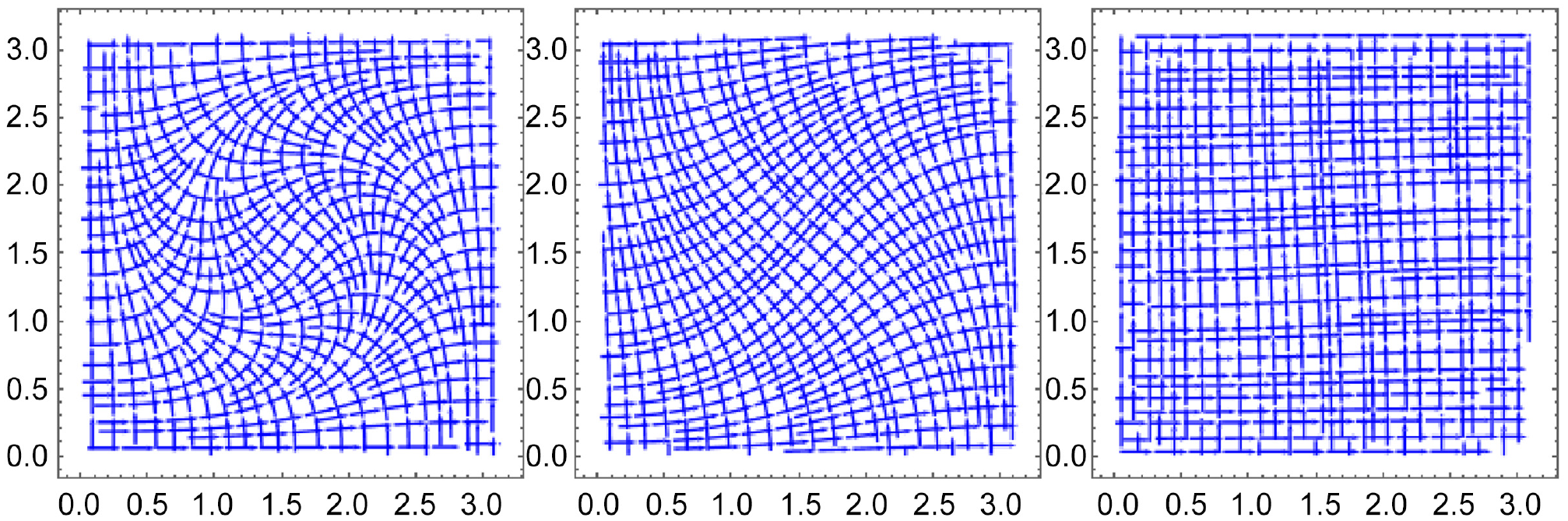
Evolving frame at times
In a second example, the initial conditions are modified so that, at the boundary, the prescribed frames are not aligned in a parallel fashion along the boundary. The initial conditions used are a modification of equation (20) into the form:

In this case, as shown in Figure 3, the system evolves to the best possible approximation of a Cartesian frame, taking into consideration the constraints imposed at the boundary, just as a soap bubble on a non-planar frame would try to become as flat as possible.
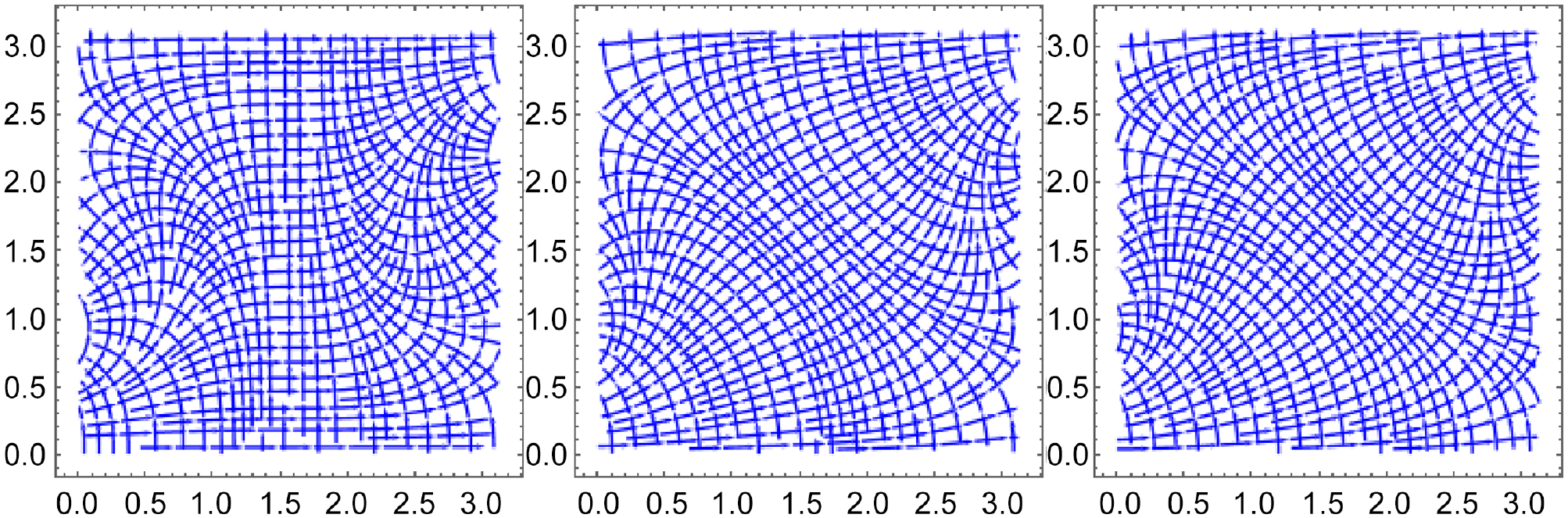
Evolving frame at times
In the previous examples, the Dirichlet boundary conditions, imposing as they do a fixed value of the frame field at the boundary of the domain of interest, may prevent (as in Figure 3) the attainment of uniformity even when the system is attempting to remove all the defects. It makes sense, therefore, to consider the case of Neumann boundary conditions, whereby this impediment is absent as only the derivative normal to the boundary is specified. Figure 4 shows the counterpart of Figure 2 when vanishing Neumann boundary conditions are enforced. The inconsistency between boundary and initial conditions, duly noted by the Mathematica software, is promptly removed as behooves a dissipative phenomenon. We remark that the final steady states attained for the frames are different.
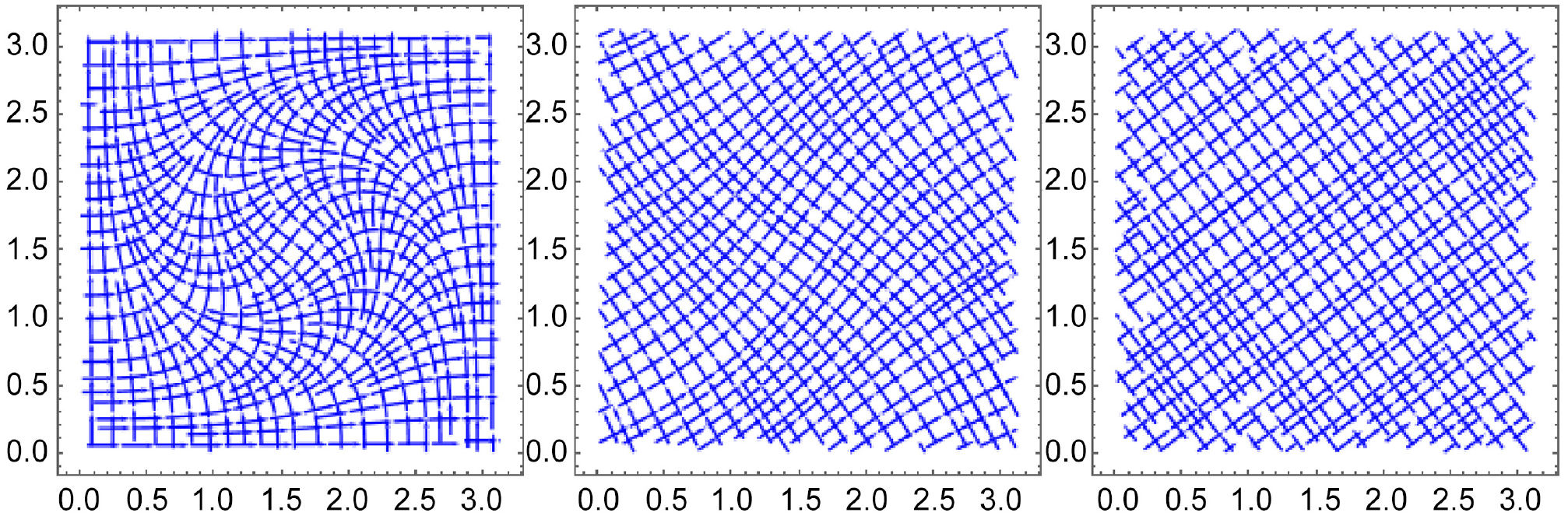
Evolving frame with initial conditions (20) and with zero Neumann boundary conditions.
Finally, let us consider the initial conditions of equation (21) combined with vanishing Neumann boundary conditions. The results are shown in Figure 5, where we can see that the evolution leads to a homogeneous configuration, in contradistinction with the situation illustrated in Figure 3, in which the Dirichlet conditions impeded the attainment of such a state.
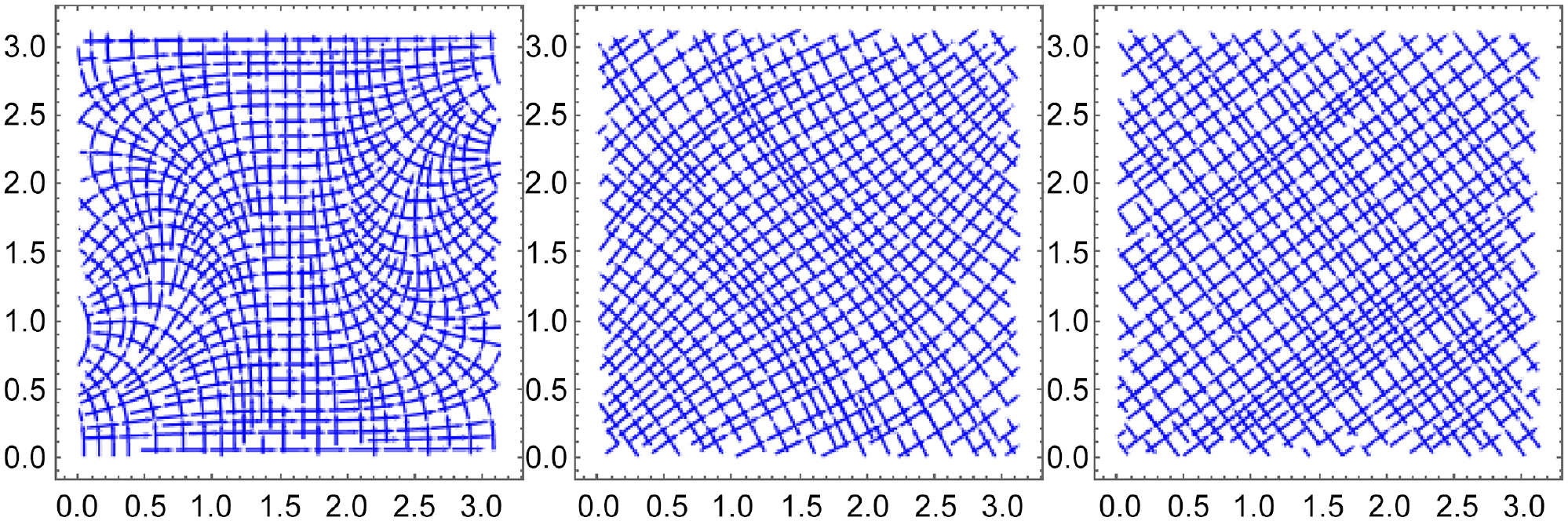
Evolving frame with initial conditions (21) and with zero Neumann boundary conditions.
6. Summary and conclusions
After defining a type of defectivity peculiar to composites, and having suggested a rigorous tensorial measure
It is fair to say that this is not a conclusive study, but it is hoped that its application to the context of defects induced by additive manufacturing or, more appropriately, by processes in biological tissues will provide the elements needed to refine the constitutive evolutive elements of the proposed model.
