




Abstract
We use complex variable techniques to study the decoupled two-dimensional steady-state heat conduction and thermoelastic problems associated with an elliptical elastic inhomogeneity perfectly bonded to an infinite matrix subjected to a nonuniform heat flux at infinity. Specifically, the nonuniform remote heat flux takes the form of a linear distribution. It is found that the internal temperature and thermal stresses inside the elliptical inhomogeneity are quadratic functions of the two in-plane coordinates. Explicit closed-form expressions of the analytic functions characterizing the temperature and thermoelastic field in the matrix are derived.
1. Introduction
The analysis of an elliptical elastic inhomogeneity under a heat flux at infinity has been carried out by a few authors [1−5]. In previous discussions, the heat flux at infinity is assumed to be uniform. A uniform heat flux at infinity will induce a linear stress distribution inside the elliptical inhomogeneity. Although the effects of a nonuniform mechanical loading have been thoroughly investigated [6−12], the influence of a nonuniform heat flux on the induced thermoelastic field in a composite has seldom been examined. As in the case of mechanical loading, highly variable thermal loadings can also develop in composites.
In this paper, we study the decoupled two-dimensional steady-state heat conduction and thermoelastic problems associated with an elliptical elastic inhomogeneity embedded in an infinite matrix under a nonuniform heat flux at infinity. The nonuniform remote heat flux has a linear distribution. By means of Muskhelishvili’s complex variable formulation [13,14], closed-form analytic solutions for both heat conduction and thermoelasticity are derived. It is found that the internal temperature and thermal stresses inside the elliptical inhomogeneity are quadratic functions of the two in-plane coordinates. With the aid of analytic continuation, explicit expressions of the analytic functions characterizing the temperature and thermoelastic field in the matrix are derived.
2. Complex variable formulations
A Cartesian coordinate system


where m is the heat conductivity, µ is the shear modulus;
In addition, the stresses are related to the stress functions through [15]

3. Analysis
As shown in Figure 1, we consider a two-phase composite composed of an internal elliptical inhomogeneity surrounded by an infinite elastic matrix. Let
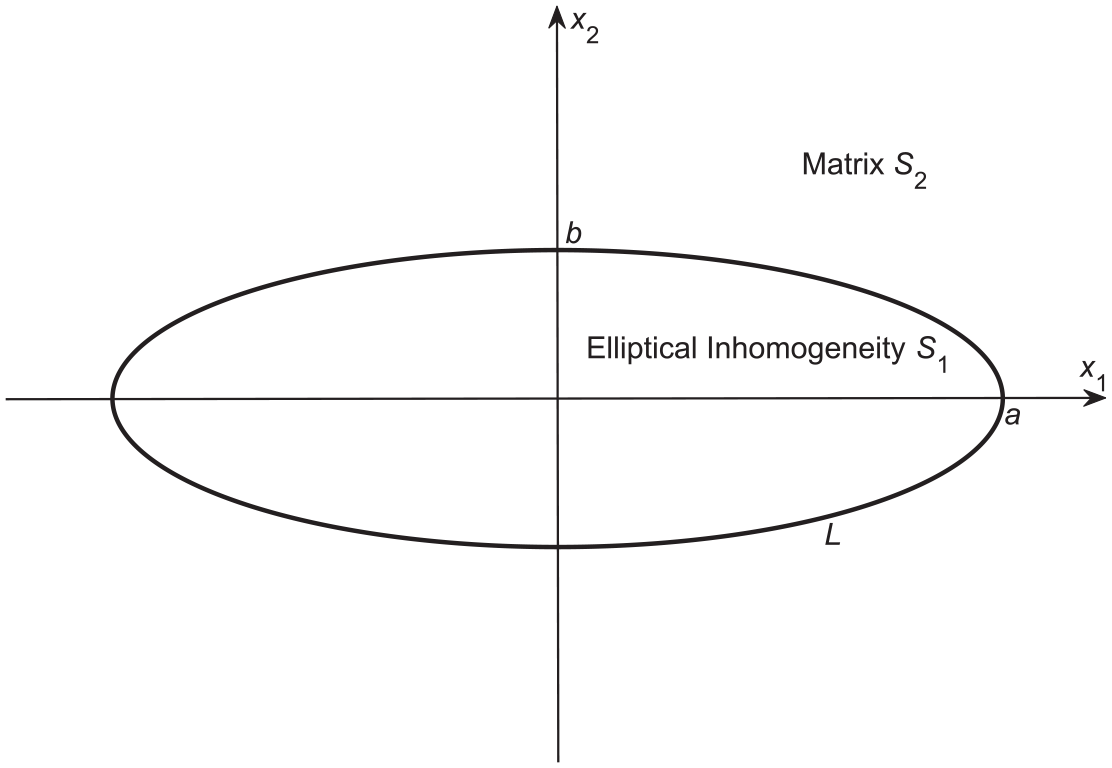
An elliptical inhomogeneity under a nonuniform heat flux at infinity.
First, we introduce the following conformal mapping function:

where

Using the mapping function in equation (4), the domain occupied by the matrix is mapped onto
The corresponding boundary value problems for decoupled heat conduction and thermoelasticity take the following form in the physical z-plane:


and


where Q is a given complex constant, and the two ratios Λ and Γ are defined by

Equation (6a) describes the continuity of temperature and normal heat flux across the perfect elliptical interface L, equation (6b) gives the remote asymptotic behavior of

Equation (7a) describes the continuity of tractions and displacements across the perfect elliptical interface L, and equation (7b) is the stress-free condition at infinity.
Using the mapping function in equation (4), the boundary value problems for heat conduction and thermoelasticity take the following form in the image ξ-plane:


and
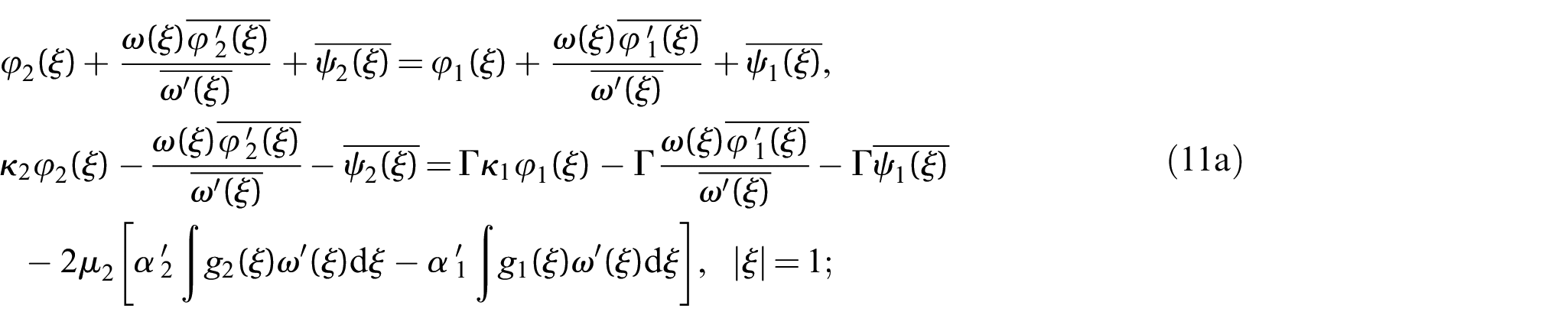

where
The analytic function

where C and D are two complex constants to be determined.
By enforcing the continuity conditions in equation (10a) with the use of equation (12) and with the aid of analytic continuation, we arrive at

Using equation (13) to satisfy the remote asymptotic condition in equation (10b), the following set of linear algebraic equations can be obtained:

Consequently, the two complex constants C and D can be uniquely determined from equation (14) as follows:

Thus, the assumption of the form of solution for heat conduction inside the elliptical inhomogeneity in equation (12) is indeed valid. Furthermore, the temperature is distributed inside the elliptical inhomogeneity as follows:

It is seen from the above expression that the temperature inside the elliptical inhomogeneity is a quadratic function of the two in-plane coordinates
In addition, by using equations (12) and (13), the term

where the four complex constants
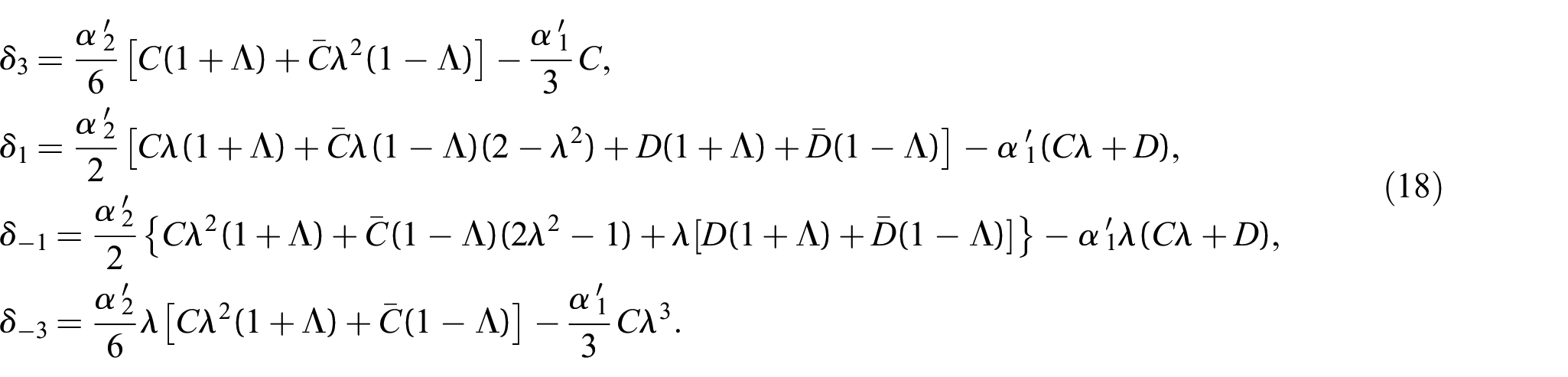
The pair of analytic functions

where
By enforcing the continuity conditions in equation (11a) with the use of equations (17) and (19) and with aid of analytic continuation, we arrive at
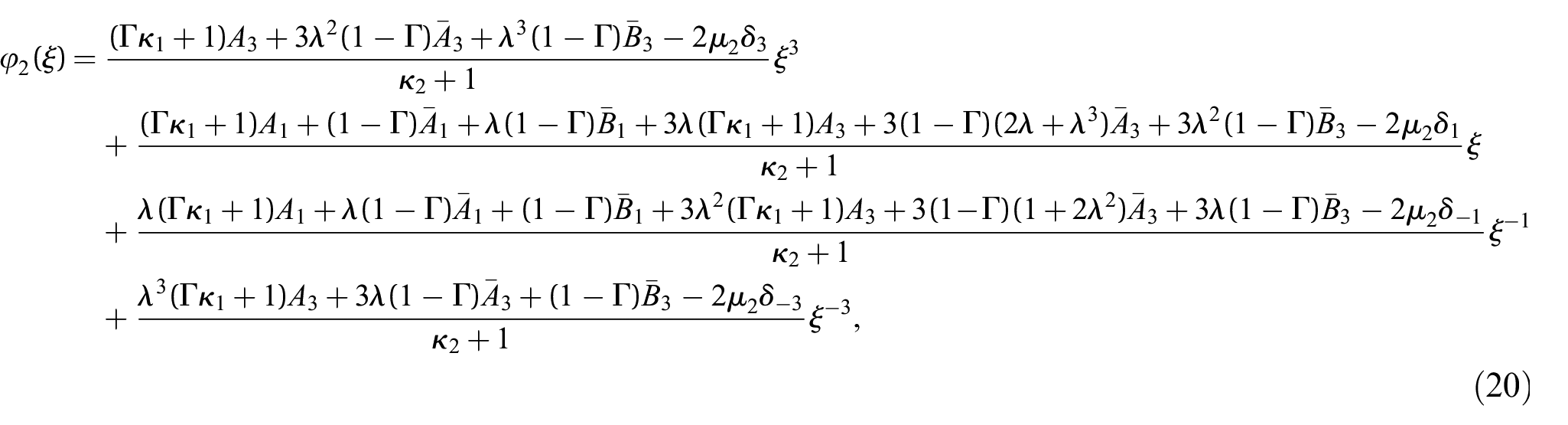
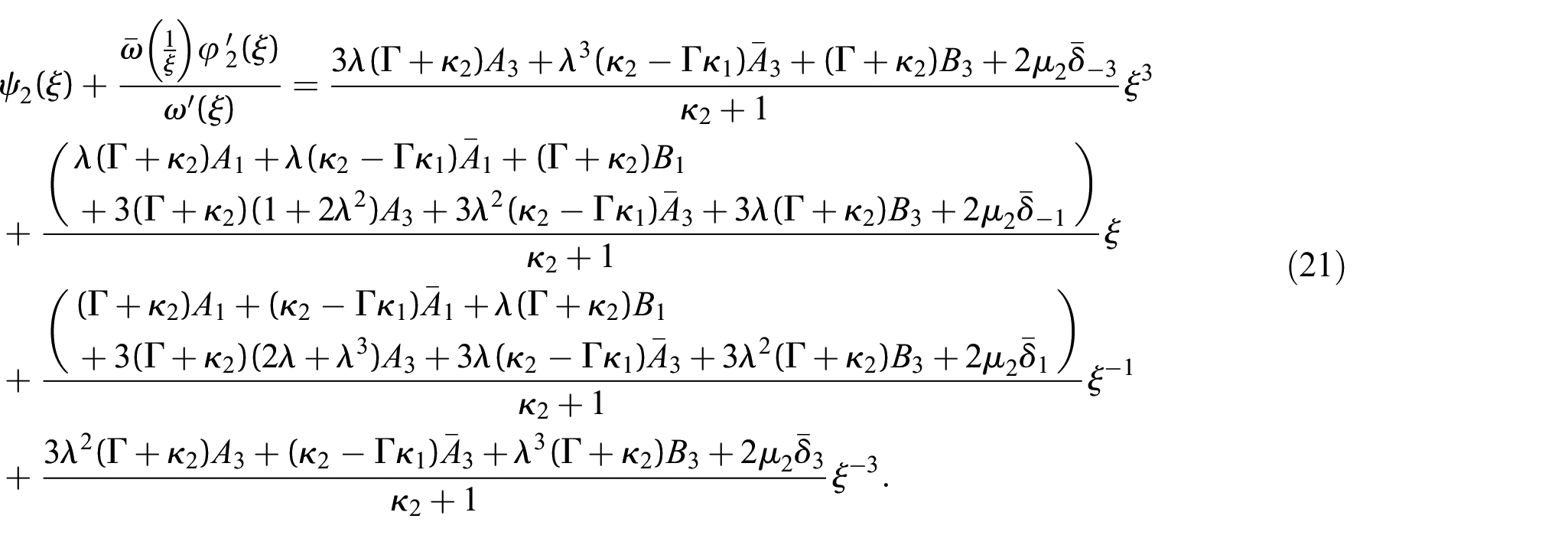
Using equations (20) and (21) to satisfy the remote asymptotic conditions in equation (11b), we obtain the following set of linear algebraic equations
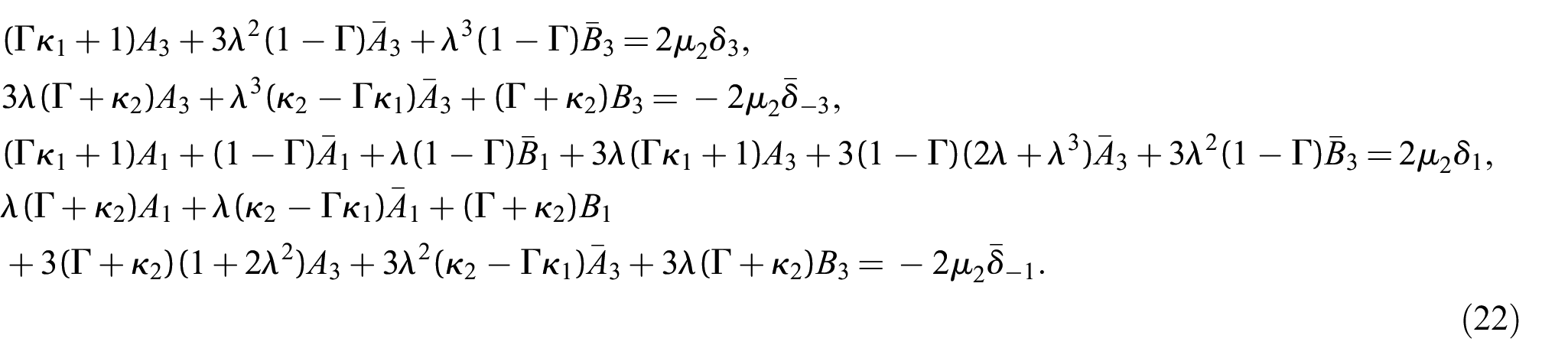
The four complex constants
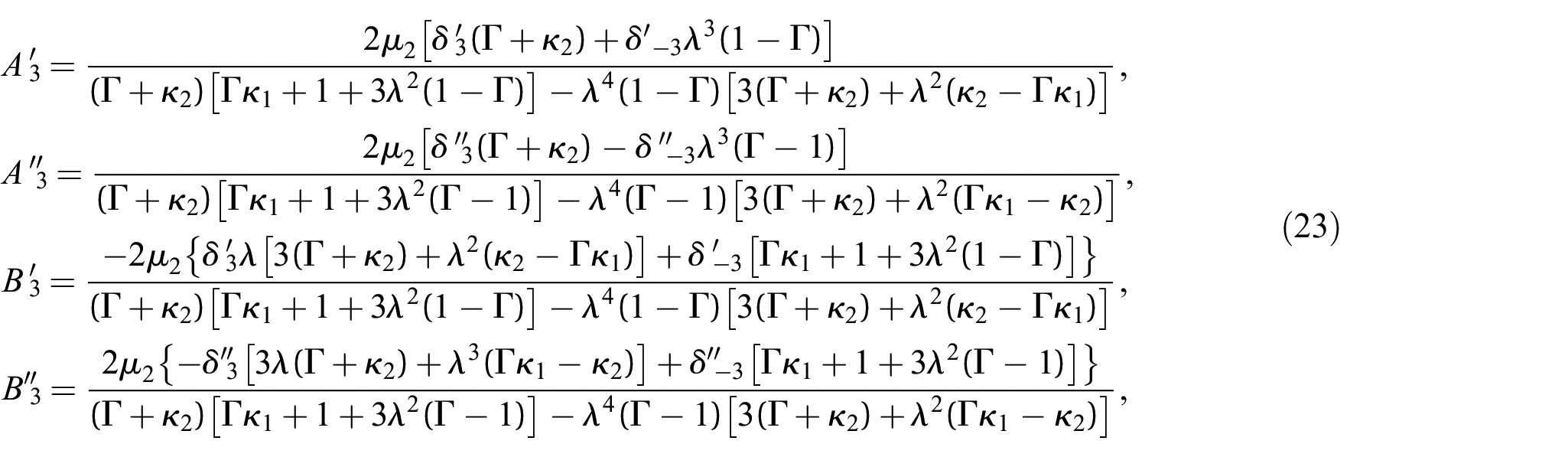
and
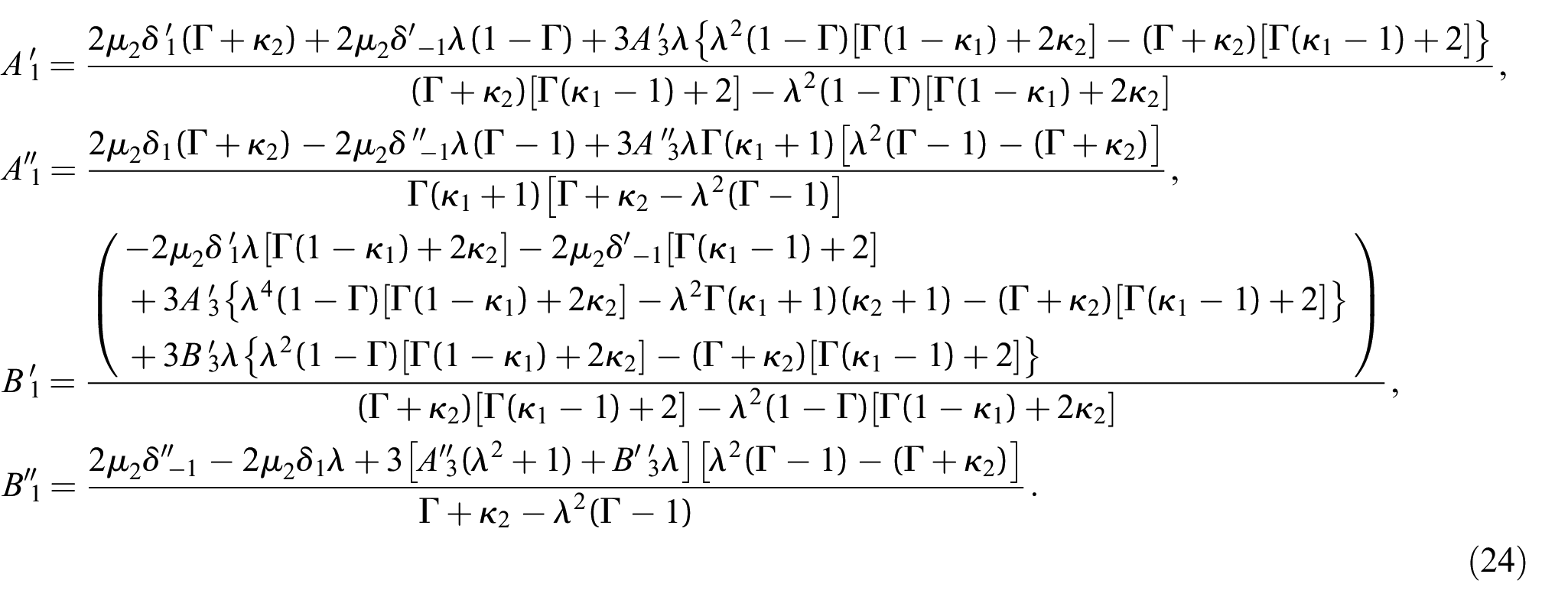
Consequently, the assumption of the form of solution for thermoelasticity inside the elliptical inhomogeneity in equation (18) is indeed valid. In addition, the thermal stresses are nonuniformly distributed inside the elliptical inhomogeneity as follows:

It is seen from the above expression that the internal thermal stresses inside the elliptical inhomogeneity are quadratic functions of the two in-plane coordinates
Now that the remote asymptotic behaviors of
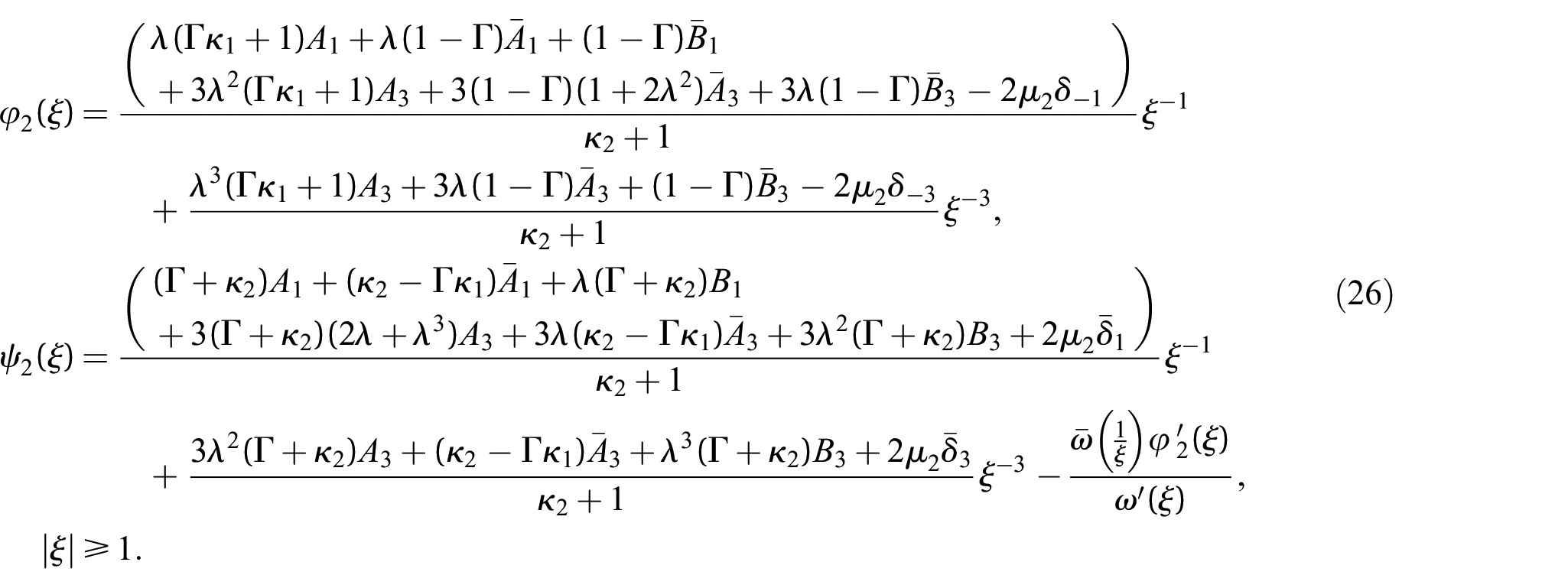
The induced thermal stresses in the matrix can be obtained by substituting equation (26) into equation (2).
4. Conclusion
We have solved the two-dimensional heat conduction and thermoelastic problems associated with an elliptical elastic inhomogeneity embedded in an infinite matrix subjected to nonuniform remote heat flux represented by a linear heat flux distribution. The temperature and the induced thermal stresses within the elliptical inhomogeneity given by equations (16) and (25) are quadratic functions of the two in-plane coordinates
Footnotes
Funding
The author(s) disclosed receipt of the following financial support for the research, authorship, and/or publication of this article: This work was supported by a Discovery Grant from the Natural Sciences and Engineering Research Council of Canada (Grant No: RGPIN – 2017 - 03716115112).
