We study the anti-plane strain problem associated with a p-Laplacian nonlinear elastic elliptical inhomogeneity embedded in an infinite linear elastic matrix subjected to uniform remote anti-plane stresses. A full-field exact solution is derived using complex variable techniques. It is proved that the stress field inside the elliptical inhomogeneity is nevertheless uniform. The uniformity of stresses is also observed inside a p-Laplacian nonlinear elastic parabolic inhomogeneity.
The uniformity of stresses inside an elastic inhomogeneity under a uniform loading at infinity has been discussed by many investigators [1–8]. The majority of these studies are confined within the framework of linear isotropic or anisotropic elasticity. Ru et al. [7] considered an elastic inhomogeneity in a particular class of harmonic materials and showed that if the Piola stress within the inhomogeneity is uniform, the inhomogeneity is necessarily an ellipse except for a special case of uniform remote loading.
In this paper, using complex variable techniques, we show that even when the elliptical inhomogeneity is composed of a p-Laplacian nonlinear elastic material [9,10], the stress field inside the inhomogeneity is still uniform when the linear elastic matrix is subjected to uniform remote anti-plane stresses. In addition, we obtain a full-field solution for an elliptical inhomogeneity with internal uniform stresses. More specifically, the uniform stress field inside the nonlinear elastic elliptical inhomogeneity and the non-uniform stress field in the linear elastic matrix are presented explicitly. It is proved that the state of stress inside a nonlinear elastic inhomogeneity is uniform if and only if the closed curvilinear contour enclosing the inhomogeneity is an ellipse. We also prove that the stresses inside a p-Laplacian nonlinear elastic parabolic inhomogeneity are uniform when the linear elastic matrix is subjected to uniform remote anti-plane stresses. The uniform stress field inside the nonlinear elastic parabolic inhomogeneity and the non-uniform stress field in the linear elastic matrix are presented explicitly.
2. A nonlinear elastic elliptical inhomogeneity with an internal uniform stress field
We begin by considering a fibrous composite in which a nonlinear elastic elliptical inhomogeneity with is perfectly bonded to an infinite linear elastic matrix under uniform remote anti-plane stresses and . The linear elastic material occupying the matrix has a shear modulus , while the nonlinear elastic material occupying the inhomogeneity is characterized by its nonlinear shear modulus with and w the out-of-plane displacement. In what follows, subscripts 1 and 2 are used to identify the respective quantities in and . The stress–strain law for the nonlinear elastic material in the inhomogeneity is
where and are the two anti-plane shear stresses. The nonlinear constitutive relation in equation (1) has been adopted by several authors [9–17]. Considering the equilibrium equation , the out-of-plane displacement w in the inhomogeneity will satisfy a p-Laplacian equation: [9,10].
Under anti-plane shear deformation of the linear isotropic elastic material in the matrix, the two shear stress components, the out-of-plane displacement and the stress function can be expressed in terms of a single analytic function of the complex variable as [4]
and the two stress components can be expressed in terms of the stress function as follows [4]:
We now introduce the following conformal mapping function for the matrix:
where
Using the mapping function in equation (4), the region occupied by the matrix is mapped onto , and the elliptical interface is mapped onto the unit circle in the ξ-plane. In order to ensure that the anti-plane stress field inside the elliptical inhomogeneity is uniform, the anti-plane displacement within the nonlinear elliptical inhomogeneity should take the following form
where k is a complex constant to be determined. As a result, the uniform anti-plane stress field inside the elliptical inhomogeneity is given as follows:
The boundary value problem can now be expressed in terms of the analytic function in the ξ-plane as follows:
Equation (8) describes the continuity of traction and displacement across the perfect elliptical interface between the inhomogeneity and the matrix, while equation (9) gives the remote asymptotic behavior of due to the uniform anti-plane stresses at infinity. The analytic function can be readily derived from equation (8) as follows:
where and are, respectively, the real and imaginary parts of k.
It is further derived from equation (13) that should satisfy the following nonlinear equation:
or equivalently
When , there exists at least a suitable solution of to equation (14) in view of the fact that
When for a linear elastic material, it follows from equation (13) that can be given exactly by
which is proportional to .
Similarly, when , there exists at least a suitable solution of to equation (15) in view of the fact that
Consequently, at least a suitable solution of to equation (14) or (15) exists for . Our extensive calculations reveal that there exists only a single solution of for prescribed values of the parameters , and in view of the fact that or is always an increasing function of . It follows from equation (7) that
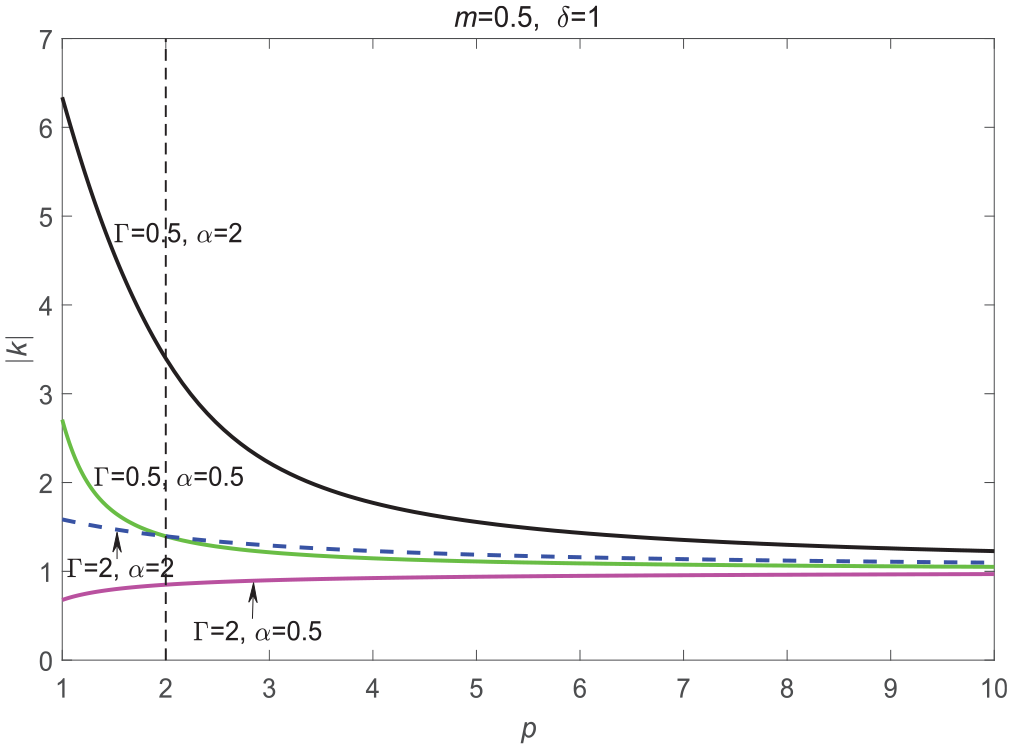
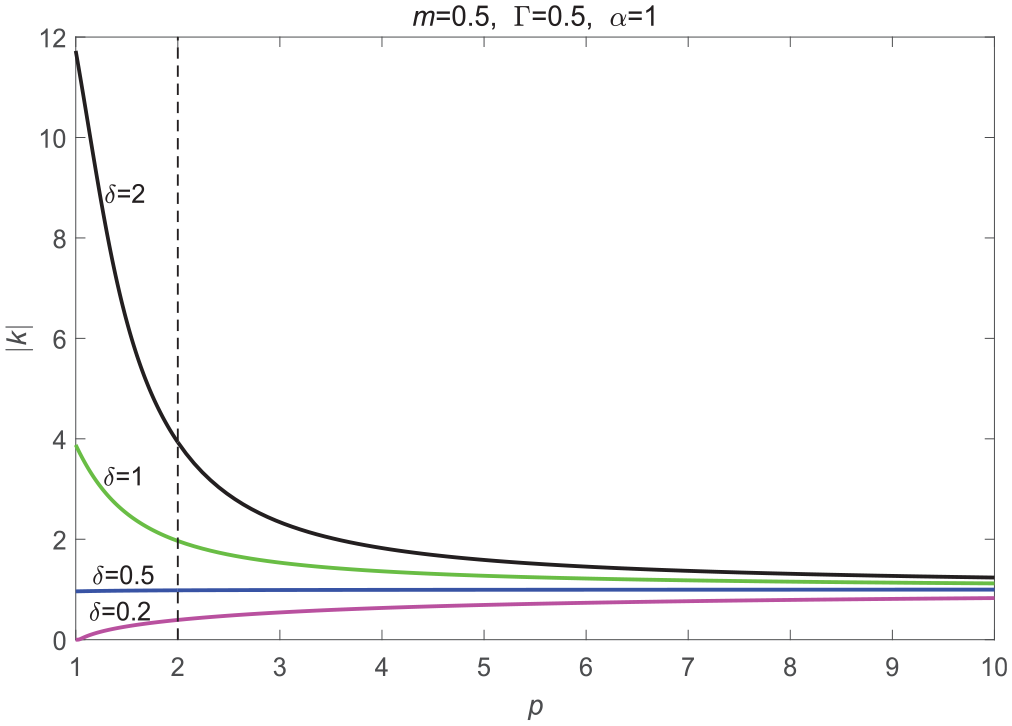
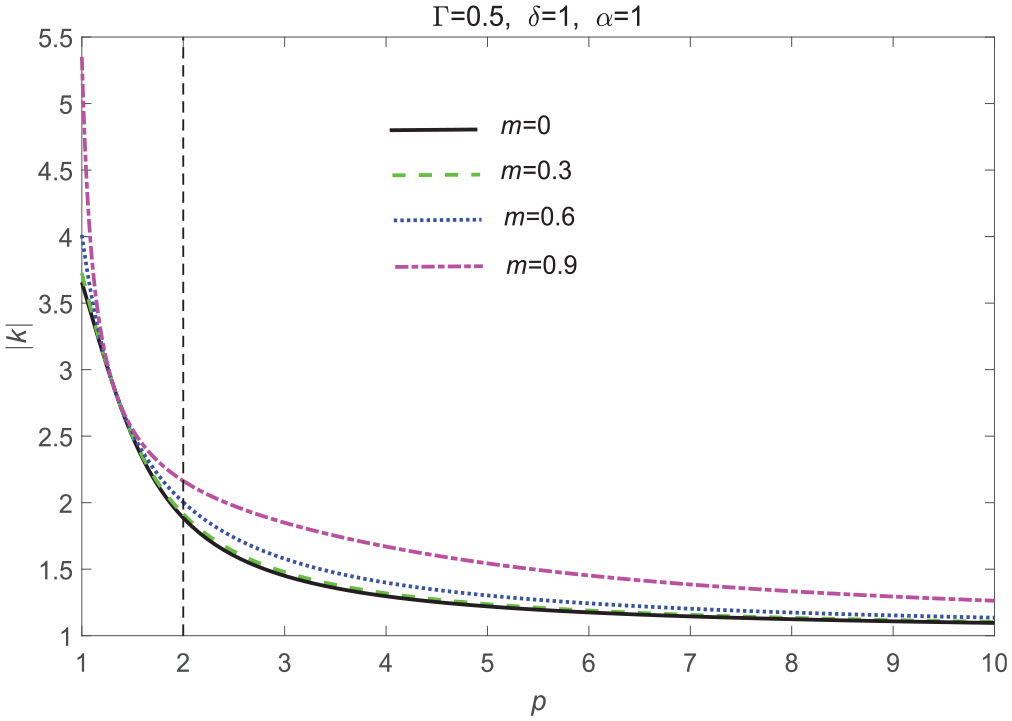
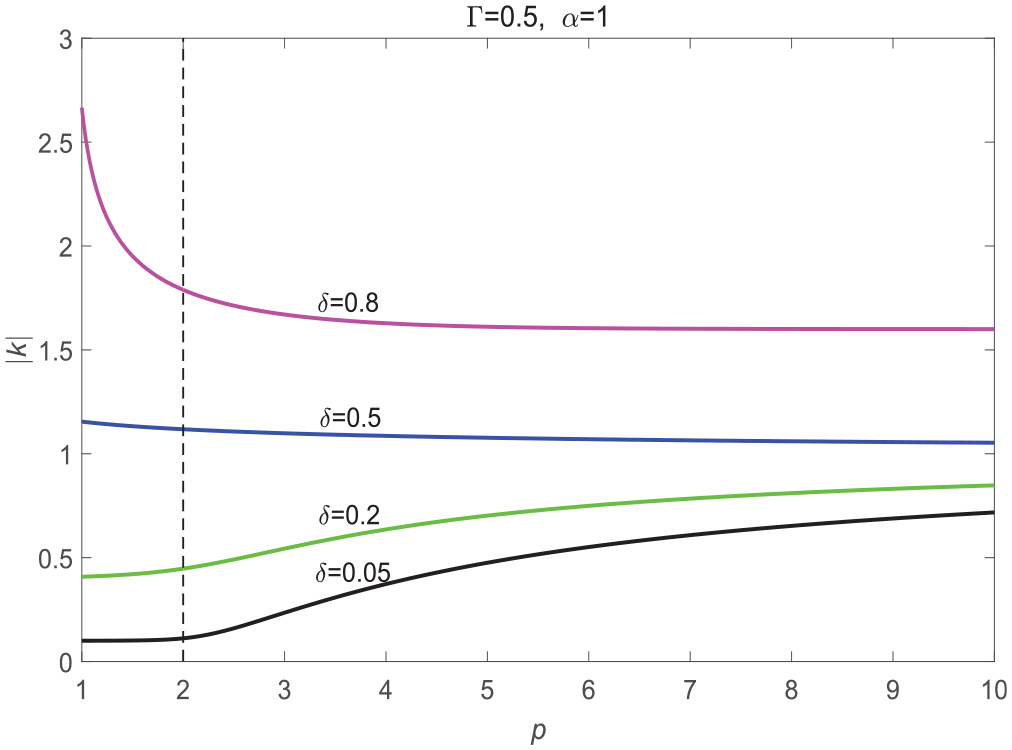
which gives a relation between the constant effective stress within the inhomogeneity and . Once has been determined by solving equation (14) or (15), and can be uniquely determined using equation (13). We illustrate in Figures 1–3 the variations of as a function of and . It is seen from the three figures that can be considerably large when . From Figure 2, it can be seen quite clearly that is no longer proportional to when for a nonlinear elastic material. From Figure 3, we see that is almost unaffected by the specific value of m when .
Variations of determined from equation (14) or (15) as a function of p for different values of Γ and α with .
Variations of determined from equation (14) or (15) as a function of p for different values of δ with .
Variations of determined from equation (14) or (15) as a function of p for different values of m with .
From the above analysis, it is rather clear that the assumption of a uniform stress field inside the elliptical inhomogeneity is indeed valid. In addition, the non-uniform stress field in the matrix is given as follows:
Similar to the argument by Sendeckyj [3] and Ru and Schiavone [5], the ellipse is the only shape of inhomogeneity with a closed curvilinear contour for which uniform anti-plane stresses at infinity will induce a uniform stress field within the inhomogeneity.
3. A nonlinear elastic parabolic inhomogeneity with an internal uniform stress field
Next, we consider a p-Laplacian nonlinear elastic inhomogeneity with bonded to an infinite linear elastic matrix through a perfect parabolic interface . The matrix is subjected to uniform remote anti-plane stresses and . The out-of-plane displacement and uniform anti-plane stresses within the parabolic inhomogeneity continue to take the forms in equations (6) and (7). The boundary value problem can be expressed in terms of in the physical z-plane as follows:
Using the following identity established along the parabolic interface [8]
the analytic function can be readily derived from equation (21) as follows:
It is further derived from equation (26) that should satisfy the following nonlinear equation:
or equivalently
When , there exists at least a suitable solution of to equation (27) in view of the fact that
When for a linearly elastic material, it follows from equation (26) that can be exactly given by
which is proportional to .
When , there exists at least a suitable solution of to equation (28) in view of the fact that
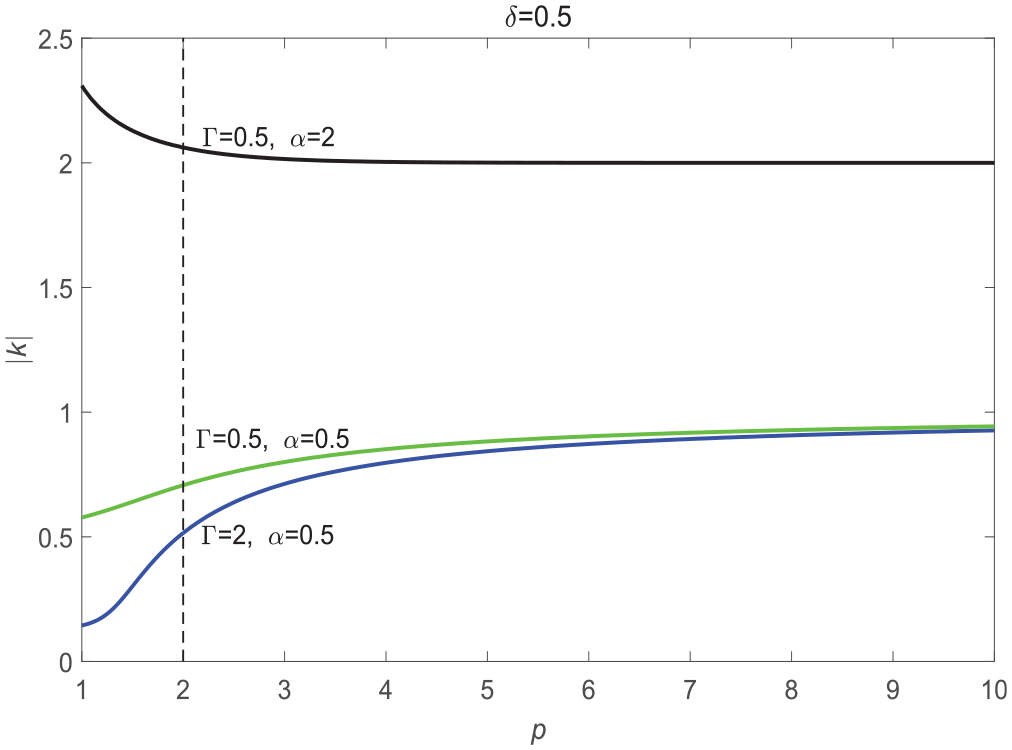
Consequently, at least a suitable solution of to equation (27) or (28) exists for . Our extensive calculations reveal that there exists only a single solution of for prescribed values of the parameters , and . Once has been determined by solving equation (27) or (28), and can be uniquely determined using equation (26). We illustrate in Figures 4 and 5 the variations of as a function of , and . It is clear from Figure 5 that is no longer proportional to when for a nonlinear elastic material. It is seen from the analysis carried out in this section that the assumption of a uniform stress field inside the parabolic inhomogeneity is indeed valid. Furthermore, the stresses are non-uniformly distributed in the linearly elastic matrix as follows:
Variations of determined from equation (27) or (28) as a function of p for different values of Γ and α with .
Variations of determined from equation (27) or (28) as a function of p for different values of δ with .
4. Conclusion
We have proved the uniformity of stresses inside a p-Laplacian nonlinear elastic elliptical inhomogeneity when the linear elastic matrix is subjected to uniform anti-plane stresses at infinity. The internal uniform stress field is given by equation (7) with numerically determined by solving the nonlinear equation in equation (14) or (15) and then with the real and imaginary parts and obtained from equation (13). The exterior non-uniform stress field in the linear elastic matrix is given explicitly by equation (20). We have also proved the uniformity of stresses inside a p-Laplacian nonlinear elastic parabolic inhomogeneity. The internal uniform stress field is again given by equation (7) with numerically determined by solving the nonlinear equation (27) or (28) and then with the real and imaginary parts and obtained from equation (26). The exterior non-uniform stress field in the linear elastic matrix is given explicitly by equation (32).
Footnotes
Declaration of conflicting interests
The author(s) declared no potential conflicts of interest with respect to the research, authorship, and/or publication of this article.
Funding
The author(s) disclosed receipt of the following financial support for the research, authorship, and/or publication of this article: This work is supported by a Discovery Grant from the Natural Sciences and Engineering Research Council of Canada (grant no. RGPIN-2023-03227 Schiavo).
ORCID iD
Peter Schiavone
References
1.
HardimanNJ. Elliptic elastic inclusion in an infinite elastic plate. Q J Mech Appl Math1954; 7: 226–230.
2.
EshelbyJD. The determination of the elastic field of an ellipsoidal inclusion and related problems. Proc Roy Soc London A1957; 241: 376–396.
3.
SendeckyjGP. Elastic inclusion problem in plane elastostatics. Int J Solids Struct1970; 6: 1535–1543.
4.
TingTCT. Anisotropic elasticity: theory and applications. New York: Oxford University Press, 1996.
5.
RuCQSchiavoneP. On the elliptical inclusion in anti-plane shear. Math Mech Solids1996; 1: 327–333.
6.
ChengZQReddyJN. Laminated anisotropic thin plate with an elliptic inhomogeneity. Mech Mater2004; 36: 647–657.
7.
RuCQSchiavonePSudakLJ, et al. Uniformity of stresses inside an elliptic inclusion in finite plane elastostatics. Int J Non-Linear Mech2005; 40: 281–287.
8.
WangXSchiavoneP. Uniformity of stresses inside a parabolic inhomogeneity. Z Ang Math Phys2020; 71(2): 48.
9.
JiménezSVernescuBSanguinetW. Nonlinear neutral inclusions: assemblages of spheres. Int J Solids Struct2013; 50: 2231–2238.
10.
BolanosSJVernescuB. Nonlinear neutral inclusions: assemblages of coated ellipsoids. Royal Society Open Science2015; 2: 140394.
11.
AtkinsonCChampionCR. Some boundary-value problems for the equation . Q J Mech Appl Math1984; 37(3): 401–419.
12.
SuquetP. Overall potentials and extremal surfaces of power law or ideally plastic composites. J Mech Phys Solids1993; 41(6): 981–1002.
13.
TalbotDRSWillisJR. Upper and lower bounds for the overall properties of a nonlinear elastic composite dielectric. I. Random microgeometry. Proc R Soc London A1994; 447: 365–384.
14.
TalbotDRSWillisJR. Upper, lower, bounds, for, the, overall, properties, of, a, nonlinear, elastic, composite, dielectric. II. Periodic microgeometry. Proc R Soc London A1994; 447: 385–396.
PonteCastañedaPWillisJR. Variational second-order estimates for nonlinear composites. R Soc Lond Proc Ser A Math Phys Eng Sci1999; 455: 1799–1811.
17.
IdiartM. The macroscopic behavior of power-law and ideally plastic materials with elliptical distribution of porosity. Mech Res Commun2008; 35: 583–588.