



Abstract
A new approach to defining the effective fracture toughness for heterogeneous materials is proposed. This temporal averaging approach is process dependent, incorporating the crack velocity and material toughness. The effectiveness of the new technique is investigated in the context of hydraulic fracture through heterogeneous rock with a periodic material toughness. The plane strain model is considered without fluid leak-off, to more easily investigate different regimes (toughness/viscosity). Numerical simulations are used to examine the effectiveness of the new homogenisation strategy, with comparison against the recently proposed maximum toughness strategy. Simulations are conducted using an extremely effective (in house-built) time–space adaptive solver. The regimes in which each strategy is effective are determined.
Keywords
1. Introduction
Most materials, whether natural or man-made, are heterogeneous on the micro level (and many on the macro level). When creating mathematical or numerical models of complex processes however, incorporating this behaviour explicitly is often not possible, or is extremely costly. Instead, it is typically beneficial to implement some “averaging” concept, whereby the heterogeneous material is replaced in the model with an equivalent homogeneous one which preserves the properties considered most important for the analysis. This broad branch of mathematical and material sciences, comprising a wide array of homogenisation techniques and strategies (see e.g. textbooks and references therein [1–6]), has developed for over a century. Starting with Maxwell [7], it now offers homogenised equivalents for elastic, thermal–electro–magnetic and other physical fields, having even established clear linkages between them (cross-property connections) depending on the type of heterogeneity (see Kachanov and Sevostianov [1]). Moreover, various types of heterogeneity (periodic, quasi-periodic, random, etc.) have their own array of analyses and methods, relating to the nonlocal nature of the material characteristics.
Unfortunately, the approach to successful homogenisation becomes far more complicated when dealing with local material properties. One of the most crucial examples of this is the toughness, which defines the resistance of the material to fracture propagation. It has long been known that a general homogenisation theory for the toughness was not possible, with Kachanov (and Sevostianov) [1,8] providing several illuminating examples to explain this unfortunate fact, while further overviews can be found in the theses [9,10], as well as the conclusion of Hossain et al. [11]. While we cannot provide a full summary here, a few relevant aspects will be discussed below.
First, for problems of fracture, the heterogeneity of the elastic constants (Young’s modulus and Poisson’s ratio) can significantly effect the crack behaviour in ways that the homogenisation needs to account for. Hossain et al. [11] demonstrated that even if the material toughness is constant, elastic heterogeneity can result in a toughening mechanism even if the crack path remains unchanged, while an asymmetric elastic distribution (in the direction of propagation) leads to a corresponding asymmetric effective toughness.
Heterogeneity of the Young’s modulus or material toughness may also cause the fracture to redirect to the more malleable material, resulting in a tortuous path and thus increasing the effective toughness. For example, the changing crack paths around material inclusions greatly complicates the prediction of the (effective) material toughness of designer materials (refer e.g. previous studies [12–14]). For the case of hydraulic fracture (HF), it was demonstrated [15] that on the pore-scale for granular materials, while the crack follows the least tortuous path over long time periods, this may not be true over short time. Instead, the crack may branch, with some paths closing at a later time as the least tortuous path becomes the primary path. In addition, the weakening/damaging of material by the propagating crack(s) may also influence which path is least tortuous. The solid–fluid coupling inherent to HF complicates this further, as the nature of the path may effect the distribution of particles within the fluid (proppant) [16], altering the fluid properties and thus the resulting fracture development [15]. The increased path length may effect the leak-off of fluid to the surrounding domain, or the transfer of heat to the fluid in geothermal applications [17]. The heterogeneity can also simply redirect the crack to a new primary direction of propagation [18], affect the fracture profile [19], alter the crack initiation and propagation conditions [20,21], impact the fracture breakdown pressure [22], alter the rock mass stability [23], and influence the formation/extent of complex fracture networks [24].
The dynamic nature of fracture must also be considered. For instance, the potential rate-dependence of the energy-release rate may need to be accounted for previous studies [25,26]. In particular, the relation may vary between different regimes of crack propagation (e.g. the subcritical and critical regimes in rock, see e.g., Ponson’s study [27]). For heterogeneous materials, this is complicated by crack re-nucleation, or the stopping and restarting of the crack as it encounters an area of higher toughness (refer Section 2.4.1). This is of fundamental importance in HF applications, where predicting fracture arrest is one of the key aims of applied models but is complicated further by the already piece-wise nature of the fracture growth [28–30]. Predicting this phenomena requires a linking of the toughness and fracture criterion, necessitating an understanding of the energy driving the crack. As such, an effective toughness homogenisation strategy requires some knowledge of the process governing the fracture evolution to be incorporated.
In spite of these difficulties, among others, a number of different approaches to homogenising the fracture toughness have been developed, only a few of which can be mentioned here. Most generalised approaches are based on the Griffith relation and operate by estimating the fracture energy, for example [11,12,25,31,32]. More specialised approaches have been developed for specific applications, including the prediction of the material toughness of metamaterials with inclusions [13,33], materials containing fibres [34], or those with anisotropic crack resistance [35]. Some authors have even suggested replacing the concept of material toughness with a more specialised energy-based analysis [36]. In simple cases, it may also be possible to approximate the effective toughness using the maximum material toughness found in the body, 1 with this approach recently being investigated for the case of HF by Dontsov and Suarez-Rivera [37].
While these methods have demonstrated appreciable successes in defining the effective toughness for heterogeneous materials, they are not applicable in all cases. Most notably, the majority of these approaches make assumptions, either explicitly or implicitly, about the nature of the crack tip velocity. This may either take the form of presuming crack propagation remains within a certain regime (typically close to the wave-speed of the medium), or that the velocity is in some way smooth, such that the tip can be examined using a roaming boundary condition
The case of HF, where the crack propagation in a solid body is driven by the action of a fluid, is one such area. In this instance, there is both a pressing practical need for effective homogenisation strategies, while the applications also allow for potential experimental verification. Of particular importance is its application within the energy sector, including the extraction of hydrocarbons from unconventional reservoirs, carbon sequestration, geothermal energy, and among others. With these processes taking place deep underground, the depositional history and subsequent deformation means that the rock strata in which HF is employed are typically characterised by highly complex structures. It has long been understood that heterogeneity is a key component for understanding the influence of rock mechanical behaviour on HF outcomes (see e.g. previous studies [38,39]). Attempts have been made to incorporate this directly, utilising core samples taken along the expected fracture path, from which details of the fracture toughness can be obtained (typically determined by experiment, following e.g. the standard ASTM E1820/E399 [40]). Gaillot [41] and Richards et al. [42] examined the significance of local, discrete features in determining macro-scale geological and fracture characteristics. They utilised an finite-element method (FEM)-based approach (see e.g. Profit et al.’s study [43] and literature) to model fracture development for domain geometries obtained using the standard vertical resolution (
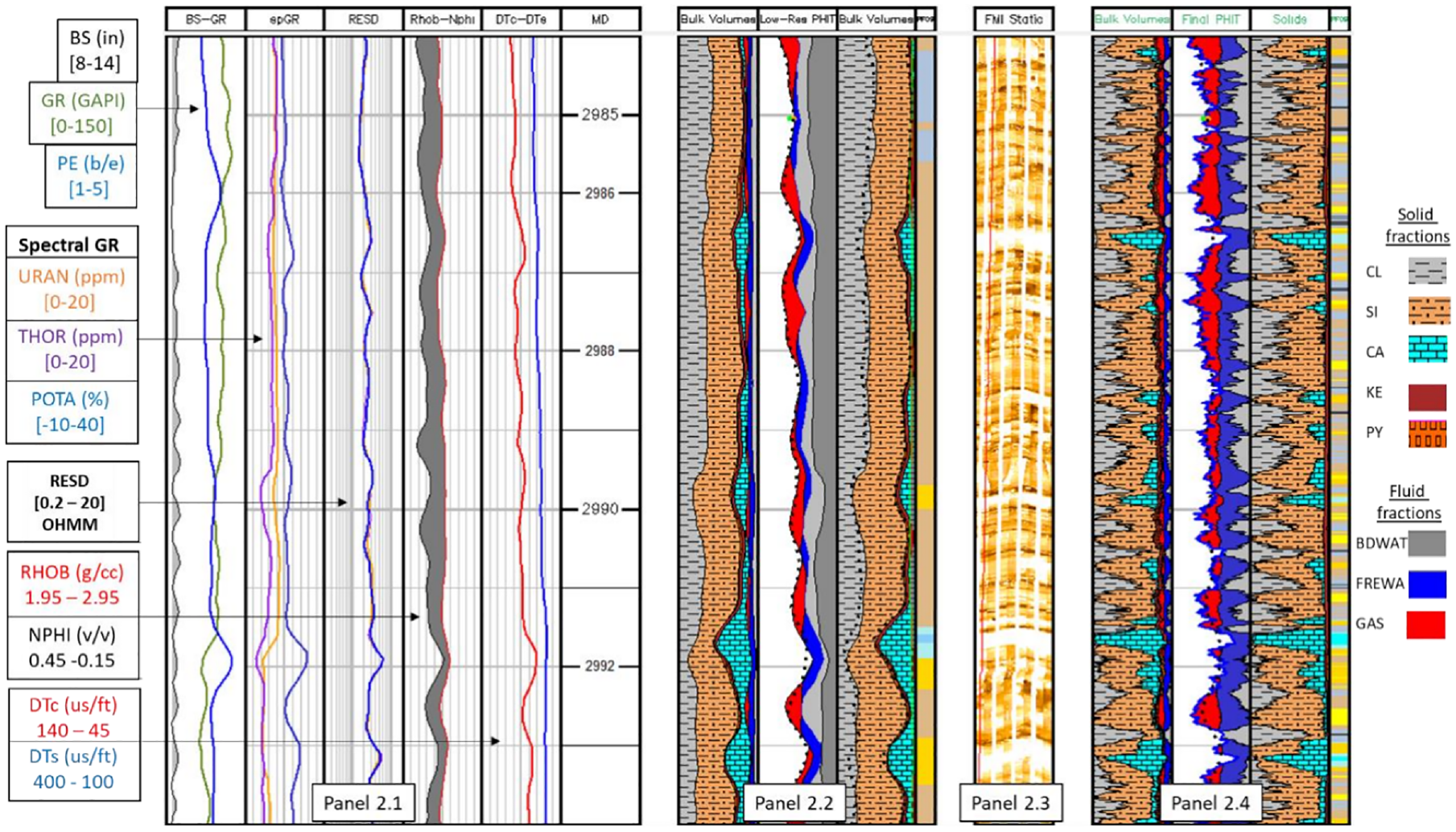
Different levels of resolution (from Galliot, 2020): Input logs (Panel p2.1), standard log vertical resolution petrophysical outputs, (p2.2), resistivity borehole image (p2.3), and high-resolution outputs (p2.4).
In this paper, we propose a new, process-dependent approach to homogenising the fracture toughness, based on the concept of temporal averaging. We investigate its effectiveness in the context of HF, which involves fluid-driven cracks propagating through a solid medium and is of keen interest due to its broad applicability in both industrial and natural contexts. We will also restrict the analysis to a domain with periodic toughness for simplicity. We will focus in this work on the plane-strain model, for a number of reasons. First, it presents a case where the fracture propagation is (relatively) well-behaved, in that it varies significantly on the local level but is never comparable to the wave-speed of the medium, while still potentially featuring crack re-nucleation (see Figure 5(c) and (d)). The inherently nonlinear nature of the relations governing the process allow the process-dependence to be investigated. In the context of HF, approaches to homogenising the other material parameters, such as the Young’s modulus, are already well known, while developing effective homogenisation procedures for the plane strain formulation is an essential first step to incorporating the issues related to elastic heterogeneity mentioned above. Working with the plane strain formulation, with only heterogeneity of the material toughness, therefore greatly simplifies the analysis. It allows this work to concentrate solely on the effect of varying toughness on the homogenisation strategy, without needing to consider issues such as crack redirection, domain geometry, inclusions, and others mentioned previously.
The paper is structured as follows. In Section 2, we first introduce the mathematical formulation of analysed problem and then provide short description of our motivations to undertake the work. Section 3 describes our proposal for improved homogenization technique including its formulation, efficiency, and consistency. The final conclusions are presented in Section 4.
2. Motivations and problem formulation
2.1. The KGD model with inhomogeneous toughness
We consider an HF approximated using the KGD (plane strain) formulation first developed by Kristianovich, Geertsma, and de Klerk [44], modified to account for the inhomogeneity of the material toughness. The crack is of fixed height
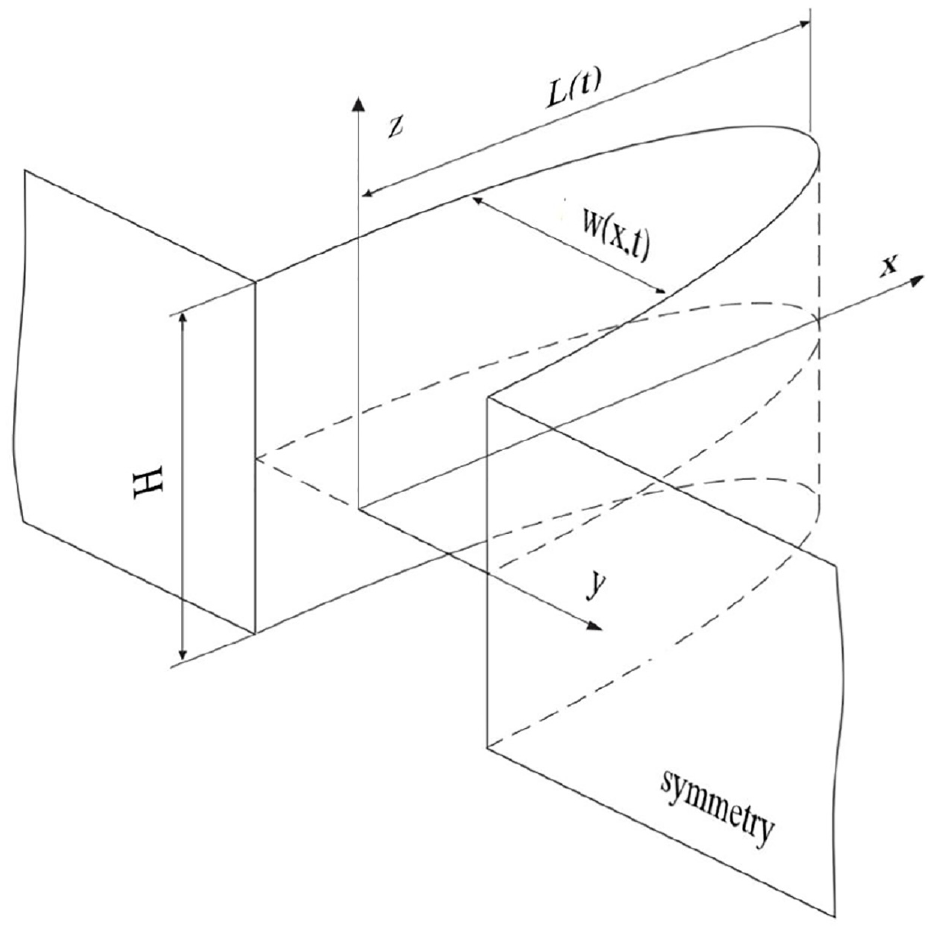
The KGD fracture geometry.
The governing equations for this system follow mostly the standard form (refer e.g. study by Wrobel and Mishuris [45]), with some modification to account for the variation in the material toughness
The continuity equation, which follows from the conservation of mass (assuming no fluid leak-off), is given by:

while the global fluid balance equation takes the following form:

The fluid flow inside the fracture is described by Pouseuille equation (laminar flow), which for a Newtonian fluid takes the following form:

where

While the right-hand side of this equation also degenerates, in the case without fluid lag, the fluid front and fracture tip coincide, yielding the speed equation:

allowing the value of
Considering the crack evolution within the framework of linear elastic fracture mechanics, the fracture extension is determined using the standard Irwin criterion:

where

Note that the material toughness
One crucial difference between the standard KGD formulation and that utilised in this work is the elasticity equation, relating the fracture width

where

Here, the only modification to the elasticity equation from the standard form is to account for
2.2. Computational algorithm
The results provided in this paper are produced using a previously developed code, based on the “universal algorithm” approach to the KGD model outlined by Wrobel and Mishuris [45]. This includes utilising the fluid velocity and associated Stefan-type condition (4) and (5), alongside employing the asymptotics at all stages of the algorithm, to properly treat the singular points of the domain and trace the fracture front. The inverse elasticity operator (8) (the BEM formulation) is utilised to relate the solid and fluid phases in the form of a compact operator acting on the pressure gradient, while also allowing direct implementation of the variable toughness. The algorithm is adaptive in both the spatial and temporal dimensions, allowing for a high level of solution accuracy over the whole domain. The specifics of the algorithm are outlined in detail by Da Fies [47].
Throughout this paper, all parameters except for the toughness are taken as constant values for simplicity (see footnote 2). Thus, Poisson’s ratio and Young’s modulus are the same in all rock layers and, within the fracture, the fluid is attributed to a constant effective viscosity
Problem parameters used in simulations, with

Note that the pumping rate
Example solutions for the aperture and fluid pressure are provided in Figure 3 for the case of a fracture propagating through distinct layers of rock with periodically distributed toughness distribution (defined such that
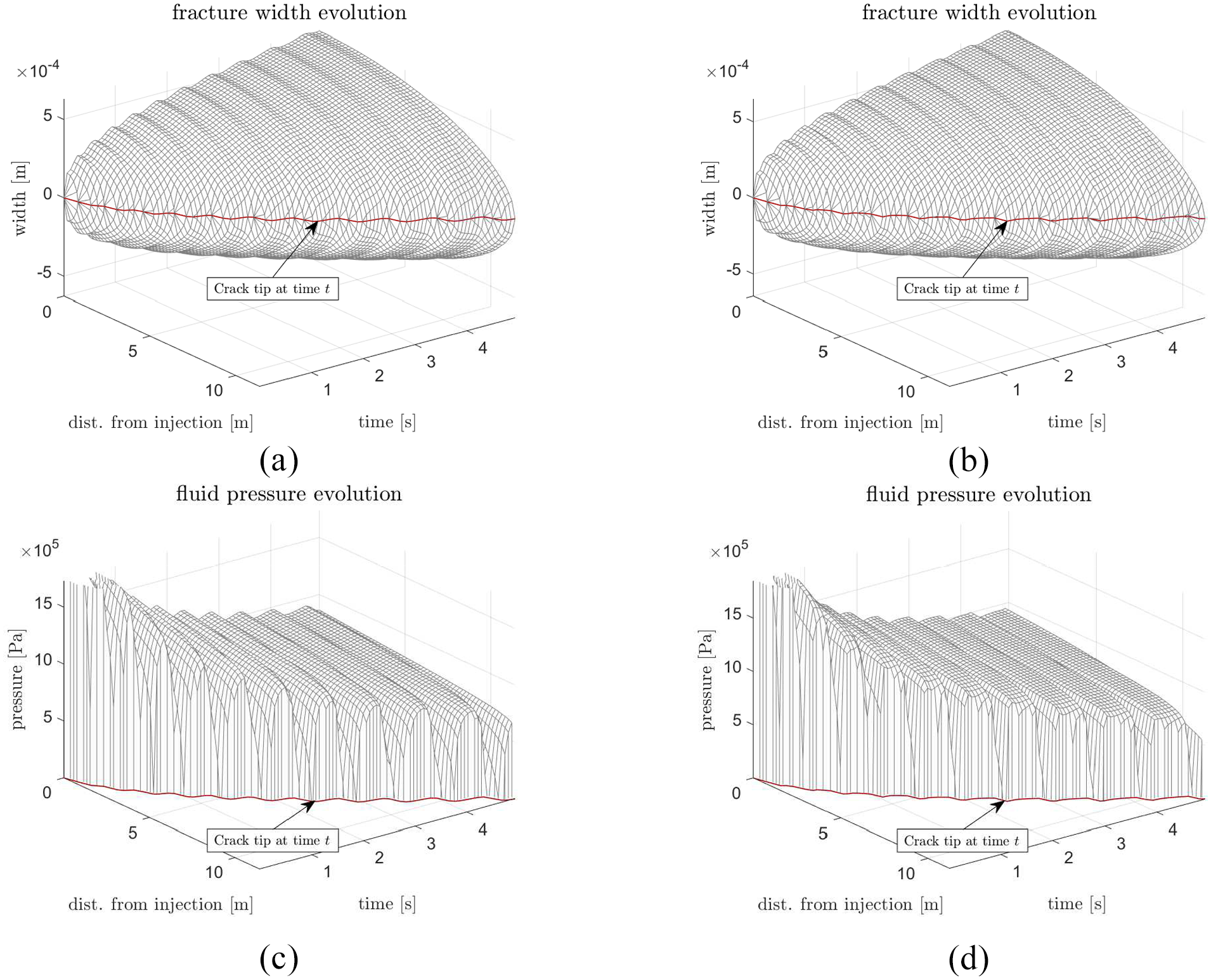
The (a), (b) aperture
2.3. Form of the material toughness
For simplicity, we consider a rock structure with a toughness distribution that is periodic in space. The period is taken as

Two separate distributions are considered, both of which are considered symmetrical about the injection point, allowing only the region
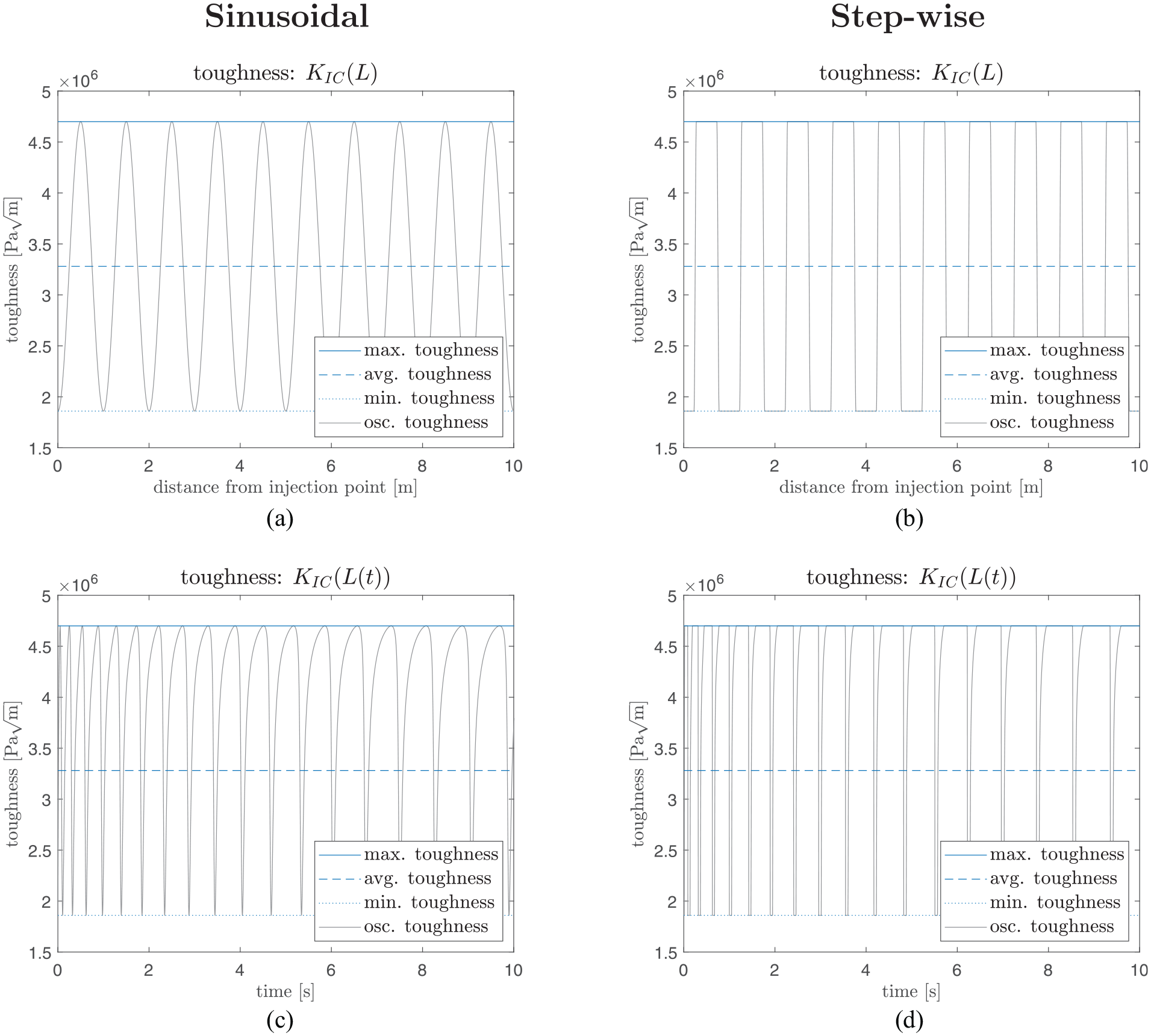
The toughness distribution (a), (b) over the spatial length
We can consider the average of the toughness

An alternative measure which places a greater focus on the local behaviour of the toughness is the roaming average, defined over some length

Note that this function

2.4. Motivation
To consider the handling of the the fracture toughness heterogeneity, the difficulties associated with this and the rational behind proposed techniques, we must begin by examining the effect that a variable toughness distribution has upon the fracture behaviour. As the effect will be regime dependent, we start by introducing an approach to approximately determine which regime a fracture will experience when propagating through each rock layer. Then, we can conduct an examination of existing strategies and their relative effectiveness in differing propagation regimes.
2.4.1. Parameterising the fracture regime
We can consider the fluid volume stored in the fracture:

Noting the form of the elasticity equation given in equation (8), where the term

with

As a result, we can define the ratio between these two:

which will clearly provide an approximation of the extent to which the fracture evolution is governed by viscosity-dominated or toughness-dominated effects, providing a basic measure for the regime a particular fracture is in at a certain moment. This can be demonstrated by considering the self-similar solution, where the material is homogeneous and pumping is constant in time. It is easy to see that in this case


Consequently, the general form of the self-similar solution may be considered as only depending on
Values of the material toughness

Recall that in the case with oscillating toughness
It should be noted that, while one might expect that the value of
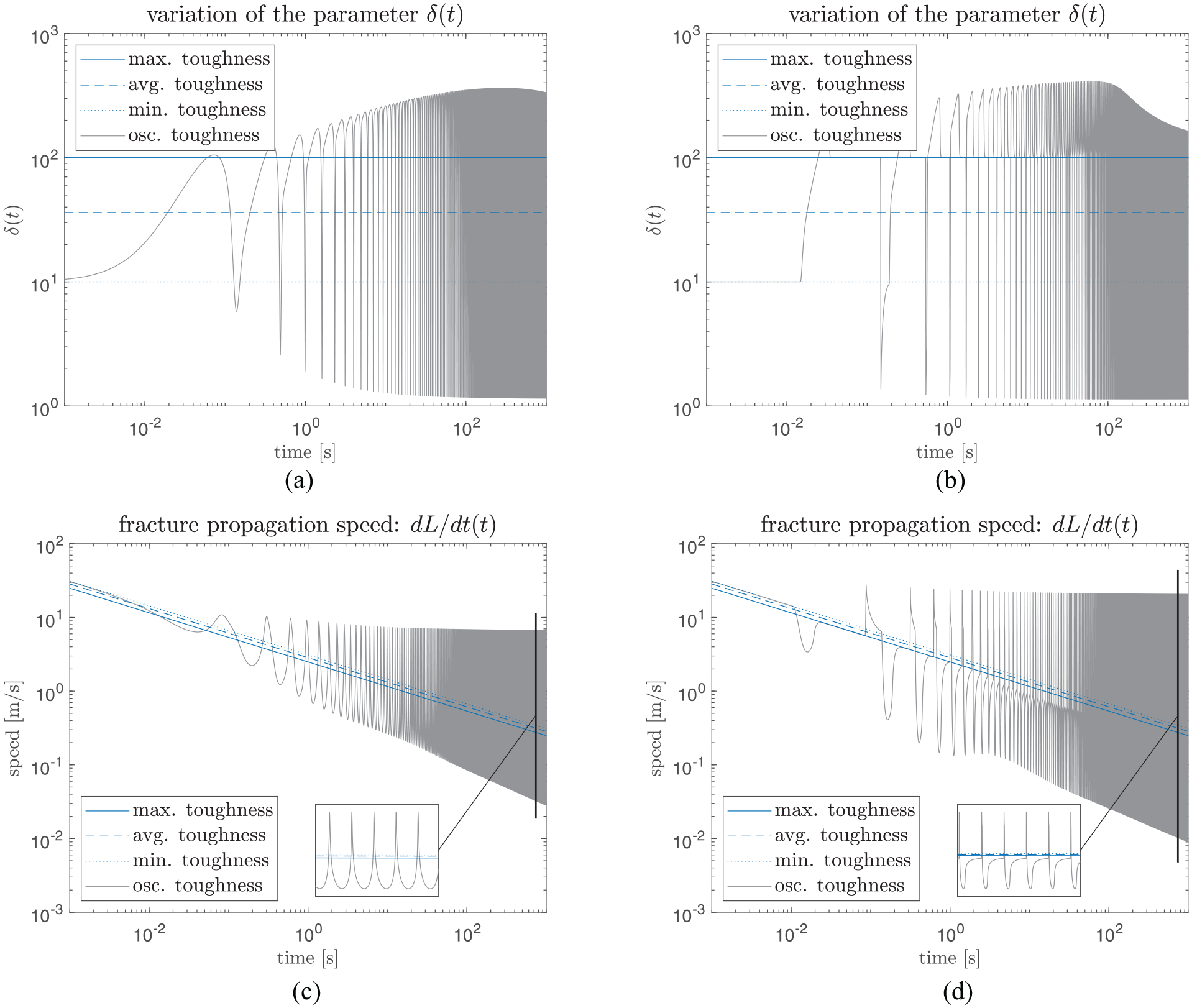
For the oscillatory toughness such that
The physical explanation follows from considering the perspective of the crack tip, as partially indicated by the propagation velocity in Figure 5(c) and (d). Consider the case of a fracture travelling between two distinct materials of differing toughness. If the fracture is travelling from the material with higher toughness to that with lower toughness, then when the crack tip arrives at the boundary the fracture is overpressurised for extending the crack in the new material. As such, the fracture moves rapidly, with the process governed almost solely by the fluid behaviour not the toughness, to an even greater extent than in a homogeneous material. Conversely, a fracture moving from a low toughness layer to one with high toughness will encounter a material for which the fluid pressure is far lower than that required to fracture the rock. Thus, the fracture growth slows significantly, with the toughness playing an exaggerated role in the crack evolution. 4 Note that this also holds true even when the material toughness changes continuously, as in the case of a sinusoidal distribution provided in Figure 5(a).
This is indicative of the problem with handling the toughness, which does not hold for other material constants. Having multiple layers of differing toughness alters the physical process. As such, an effective strategy must account for this change.
2.4.2. Strategies for handling the material toughness
It is well known that classical averaging of the toughness does not provide a satisfactory prediction for the crack length or other process parameters. It has previously been suggested that, away from domain boundaries, the toughness could be approximated using the maximum toughness after some period of time (see e.g. discussion of the energy-release rate by Hossain et al. [11]). This “maximum toughness strategy” was later proposed to be effective for the case for HF by Dontsov and Suarez-Rivera [37]. The investigation provided there, as well as by Da Fies et al. [38], confirmed that taking the classical averaging of the toughness does not provide a satisfactory prediction for the crack length and other process parameters, with the maximum toughness providing a significantly better approximation. This is further demonstrated in Figures 6–9, where results for the fracture length
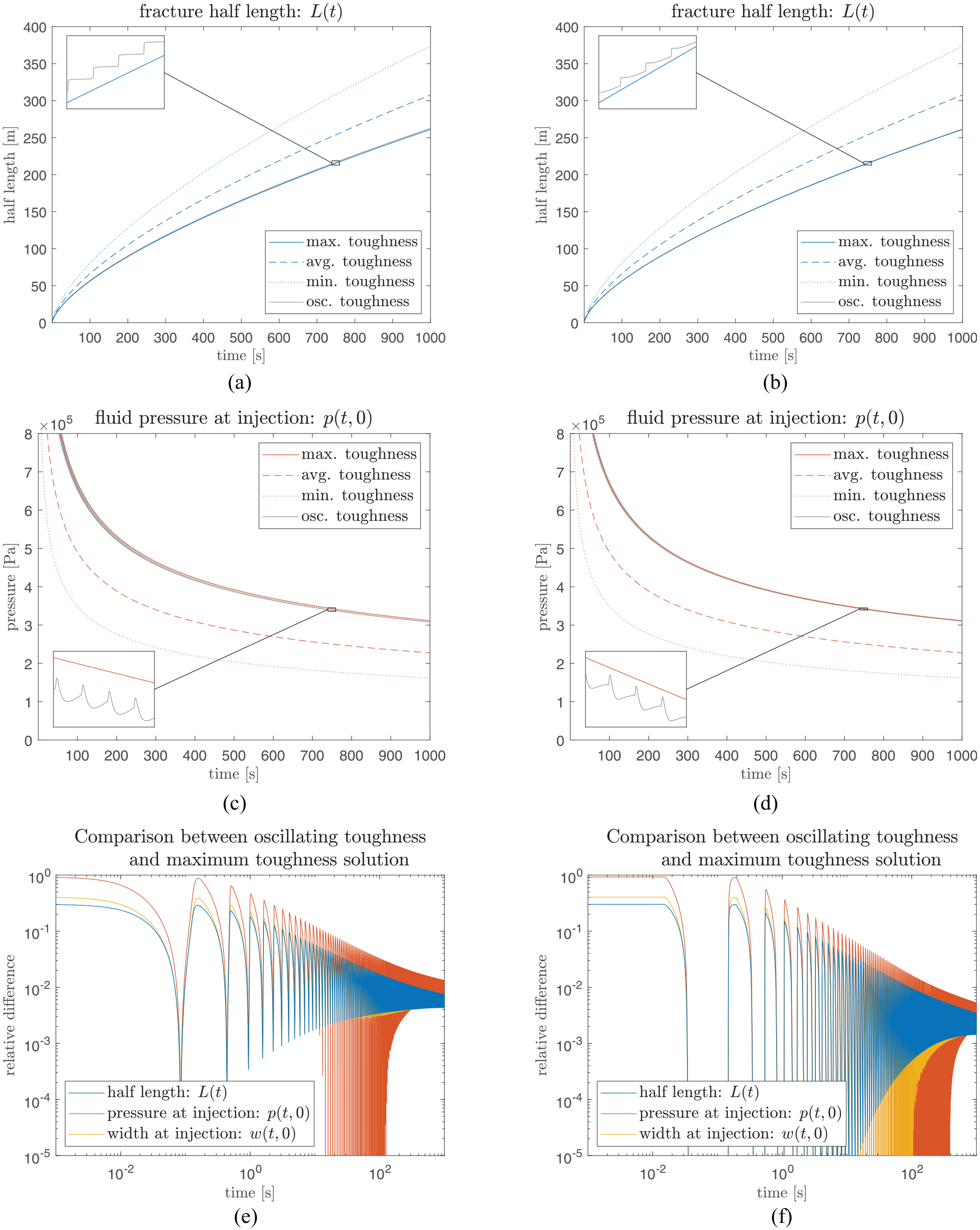
Various process parameters for the case of oscillating toughness when
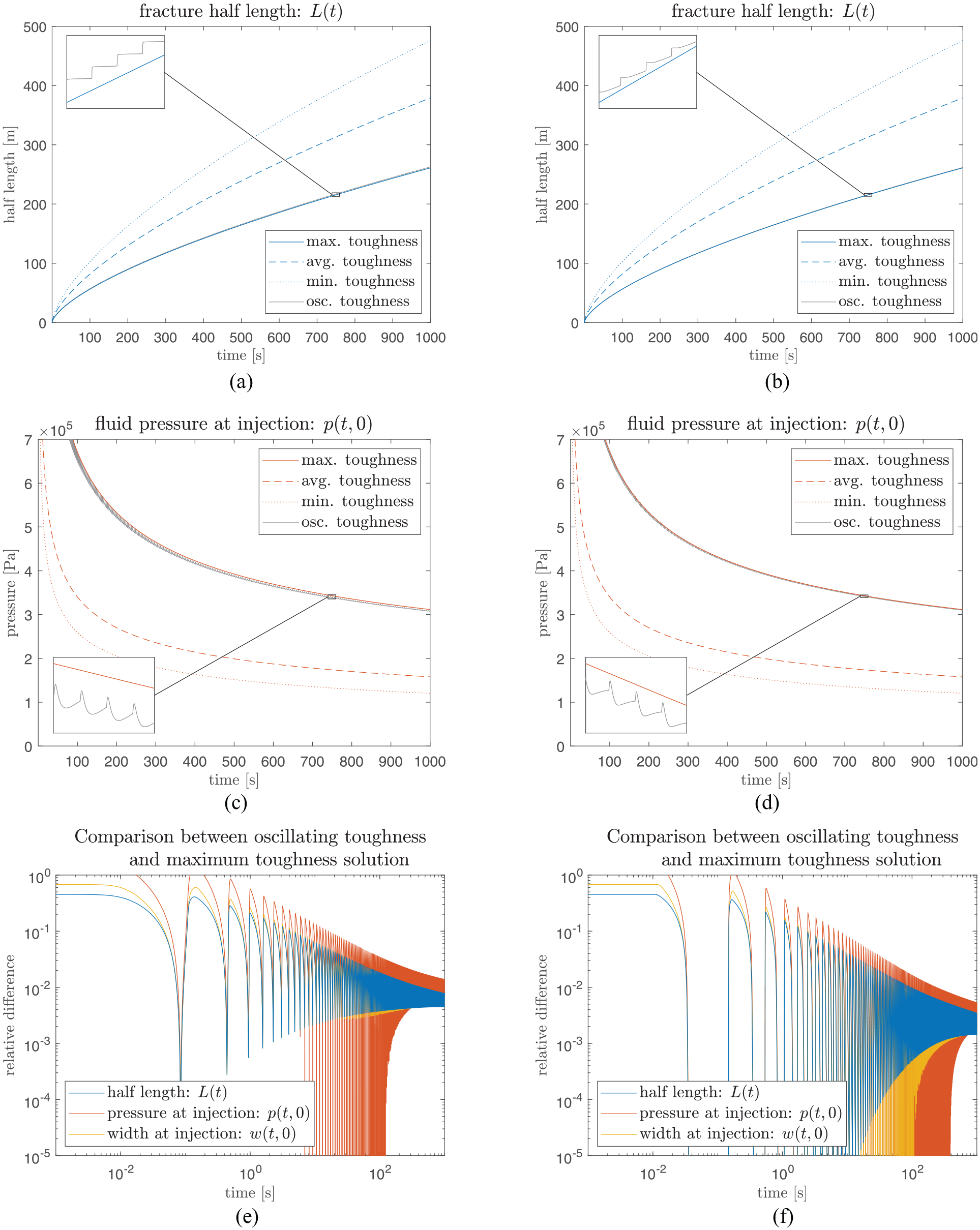
Various process parameters for the case of oscillating toughness when
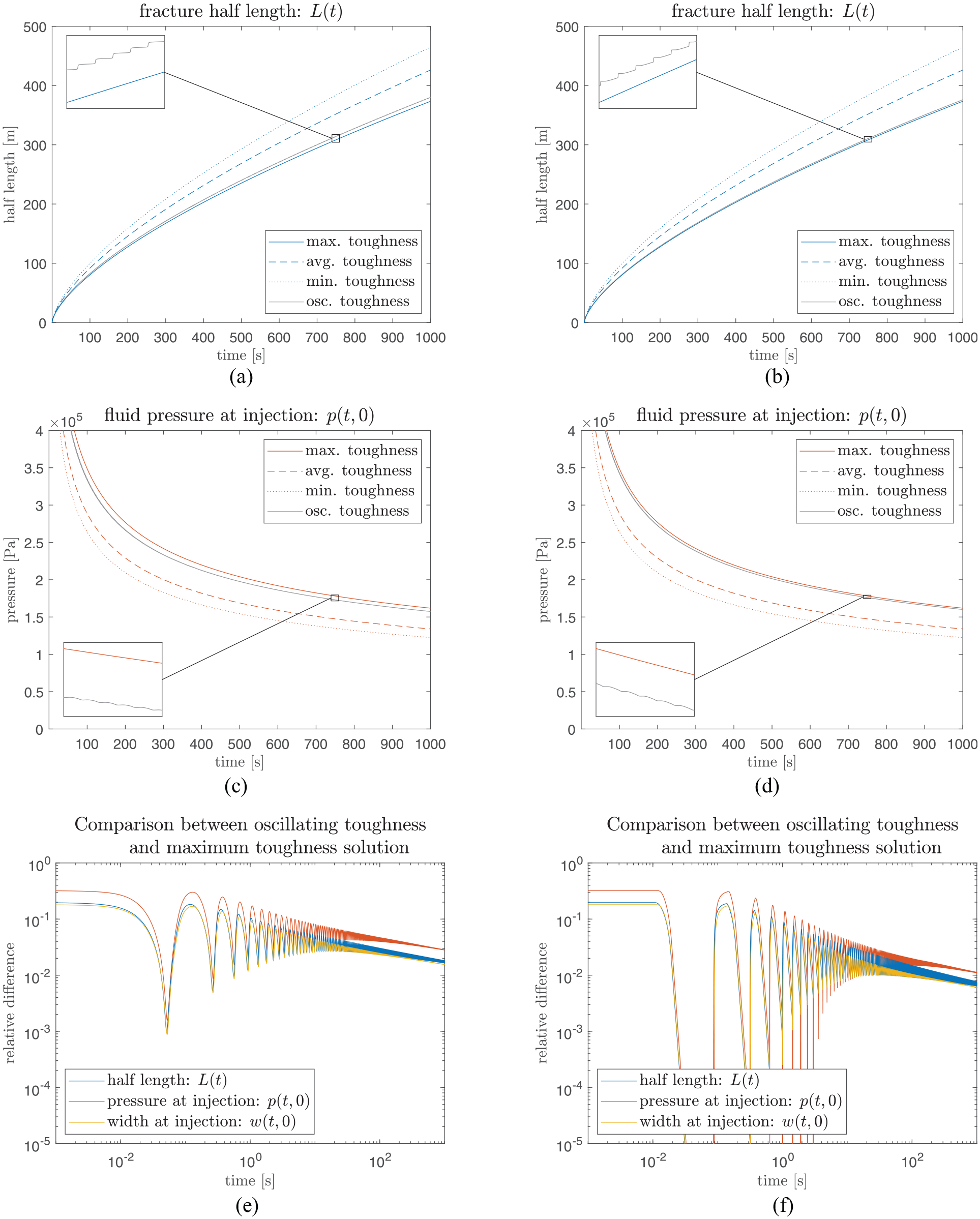
Various process parameters for the case of oscillating toughness when
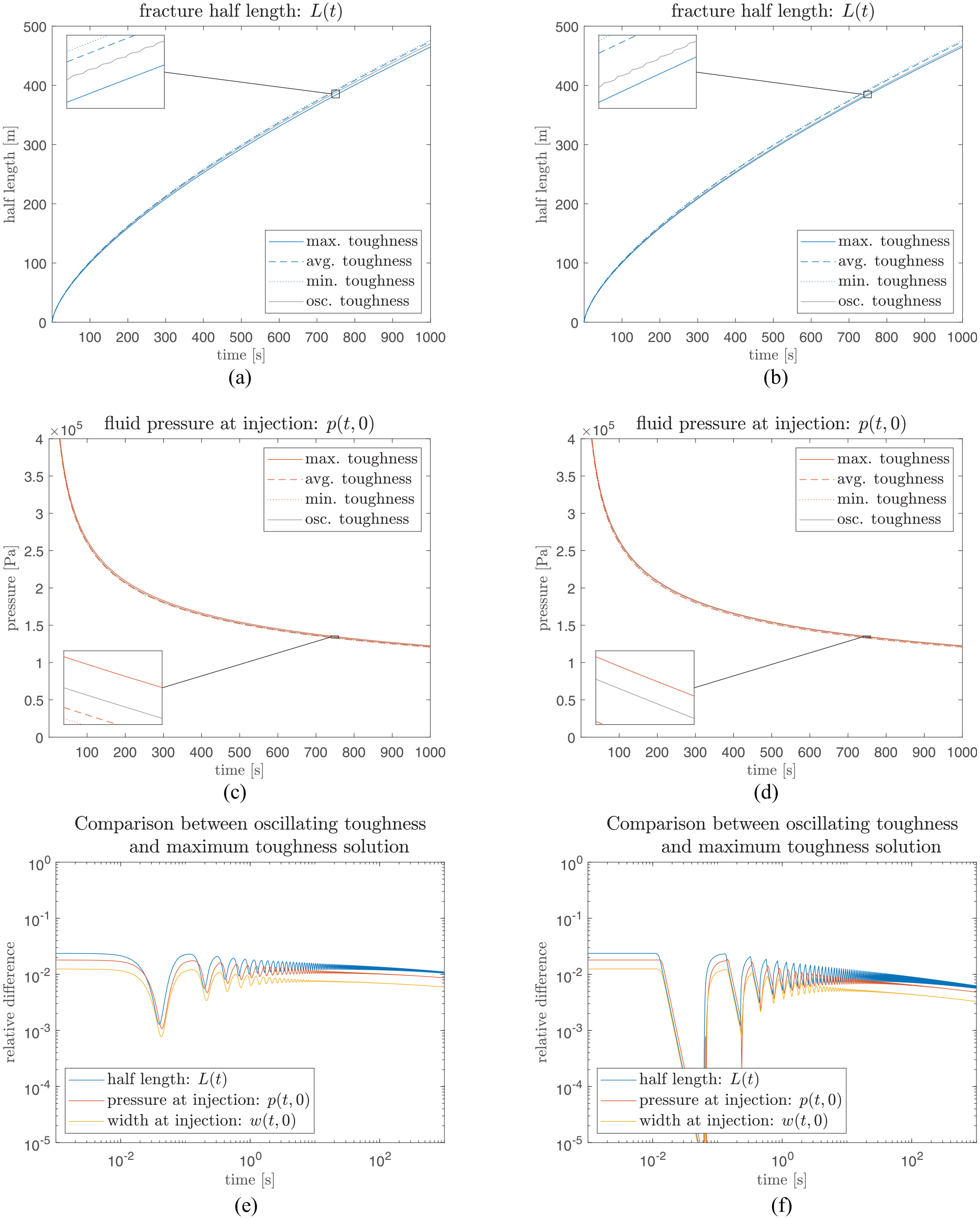
Various process parameters for the case of oscillating toughness when
As can be seen in Figure 6, where both the maximum and minimum values of
This trend of the maximum toughness approximation being significantly less effective over short time periods reduces as the maximum toughness decreases. As can be seen in Figure 8 (where
Finally, in Figure 9 we consider a fracture passing through rock layers in the transient and viscosity-dominated regimes (with
Combining these results, we draw the following preliminary conclusions:
If the maximum toughness is low (viscosity-dominated regime), then approximating using the maximum toughness (as well as the average one) is always effective.
If considering a material with high toughness over long time-periods (or a large fracture length), then the maximum toughness can be consider as an effective homogenisation technique, with the error of order 1%.
When considering short fractures, or the initial stages of fracture, then using the maximum toughness strategy may lead to a large error.
Note that the distances over which this final statement is valid depends on all of the process parameters (not only the toughness distribution and period length), because it is related to the propagation regime corresponding to the maximum possible toughness. However, point 3 is particularly important when considering cases such as mini-frac testing, as it implies that the maximum toughness strategy would not provide an accurate approximation. This raises the question, is there a better approach for short fractures?
3. Improved strategies for short and intermediate fractures
3.1. A temporal toughness averaging approach
Towards developing an improved technique for handling the fracture toughness, let us consider the case in which parameters are averaged over time rather than space. As such, we can consider two measures (equivalent to (9)–(10), except averaged over time):

and

It is clear from looking at the toughness distribution over time, see Figure 4(c) and (d), that this will give a different approximation than the spatial average, while tending to a larger value of the average toughness over time (although not necessarily
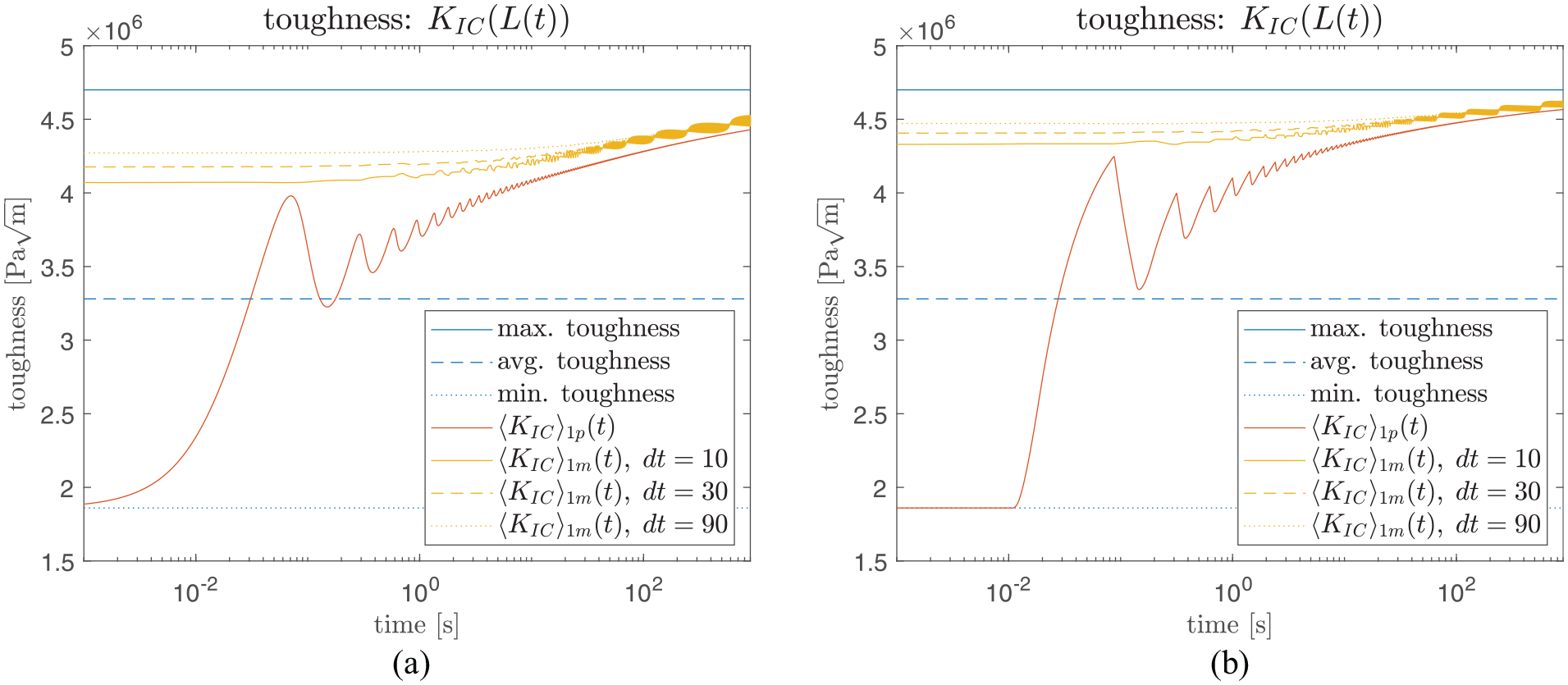
Temporal averaging of the toughness utilising definitions (15) and (16) for various integration ranges
A drawback of the definition of
On the contary, we can transform these into expressions in terms of the spatial coordinate, by defining inverses in the form:

While the definition of

and

Here the time interval
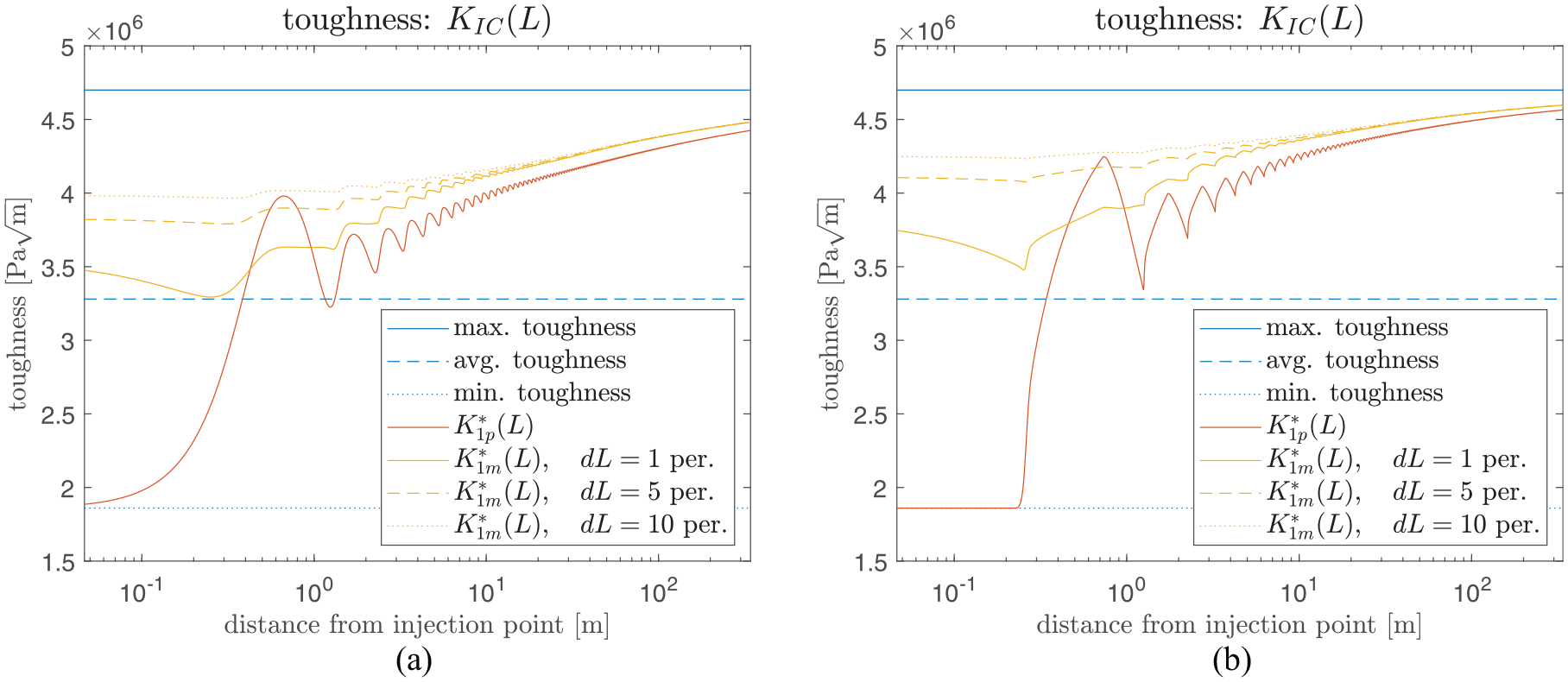
Temporal averaging of the toughness using the spatial definitions
In the remainder of the paper, we will take the value of
In Figure 12, values of
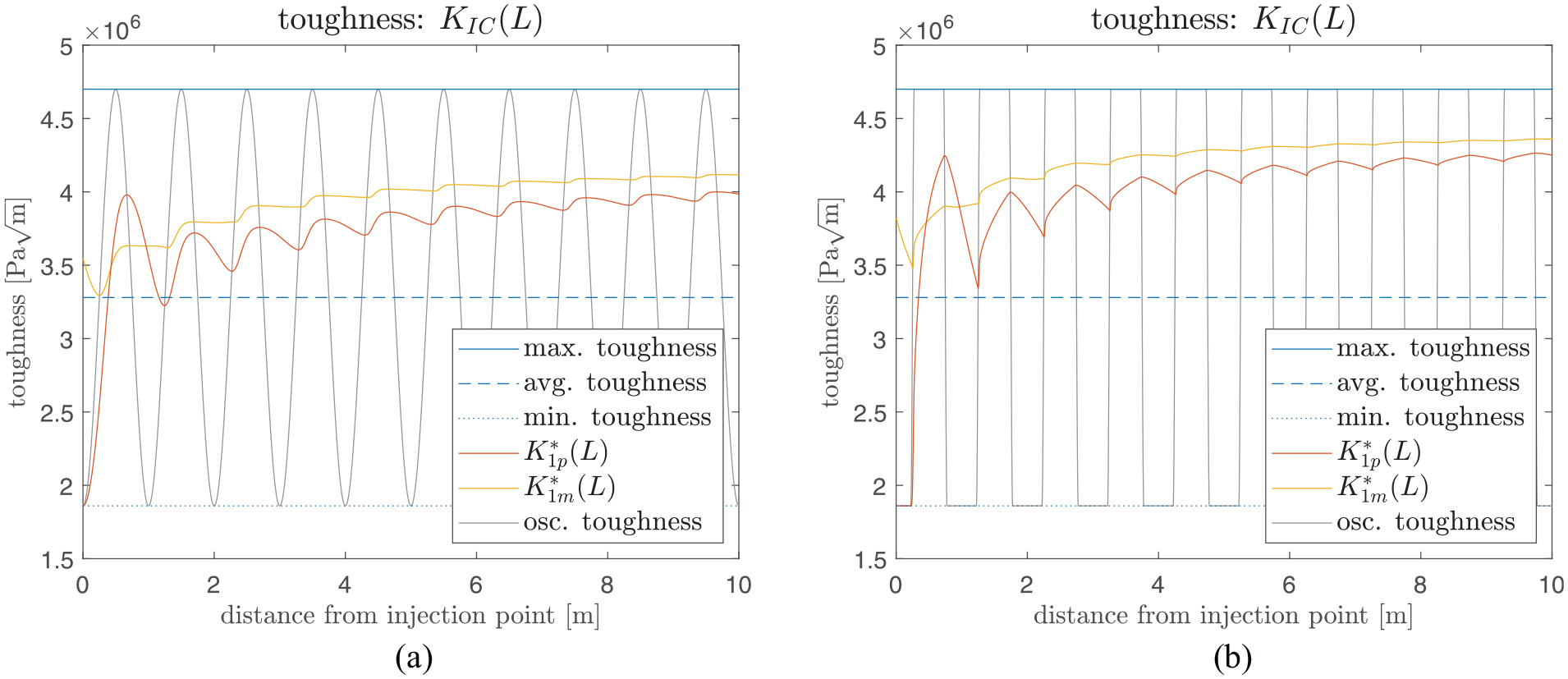
Temporal averaging of the toughness using the spatial definitions (18) and (19) for
Finally, noting the crucial role of the fracture velocity on both the process and the influence of the toughness inhomogeneity (see Figure 5(c) and (d), Section 2.4.1), we can also modify the expressions (18) and (19) to be in the equivalent form:

and

where
3.2. Effectiveness of the temporal averaging approach
An immediate question arises concerning these new measures. First, do they provide a more effective approximation of the material toughness for short fractures than the maximum toughness? If so, then is one of these measures (20) and (21) more effective than the other?
To investigate this for fractures with a high toughness, the case with
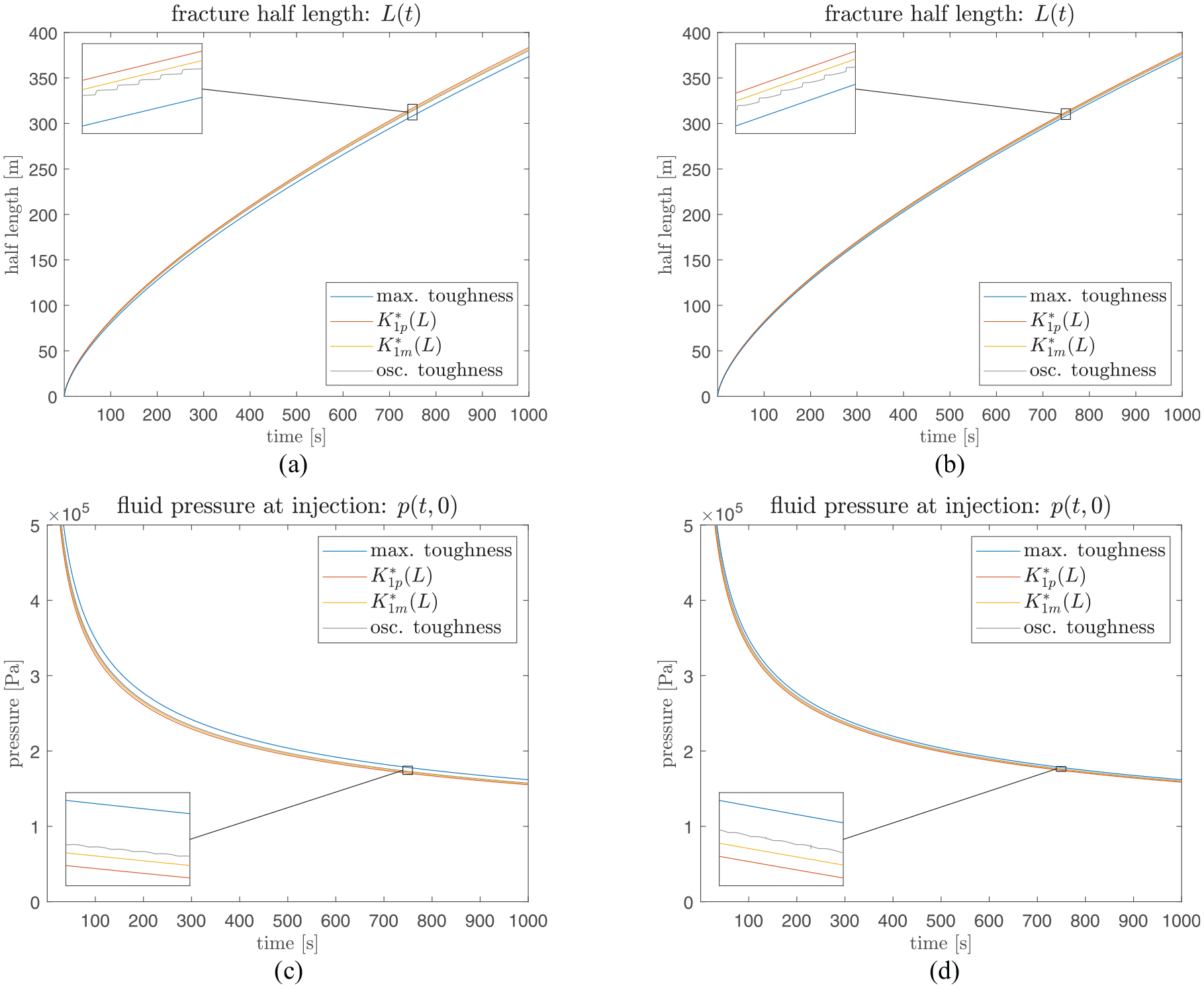
The (a), (b) fracture half-length
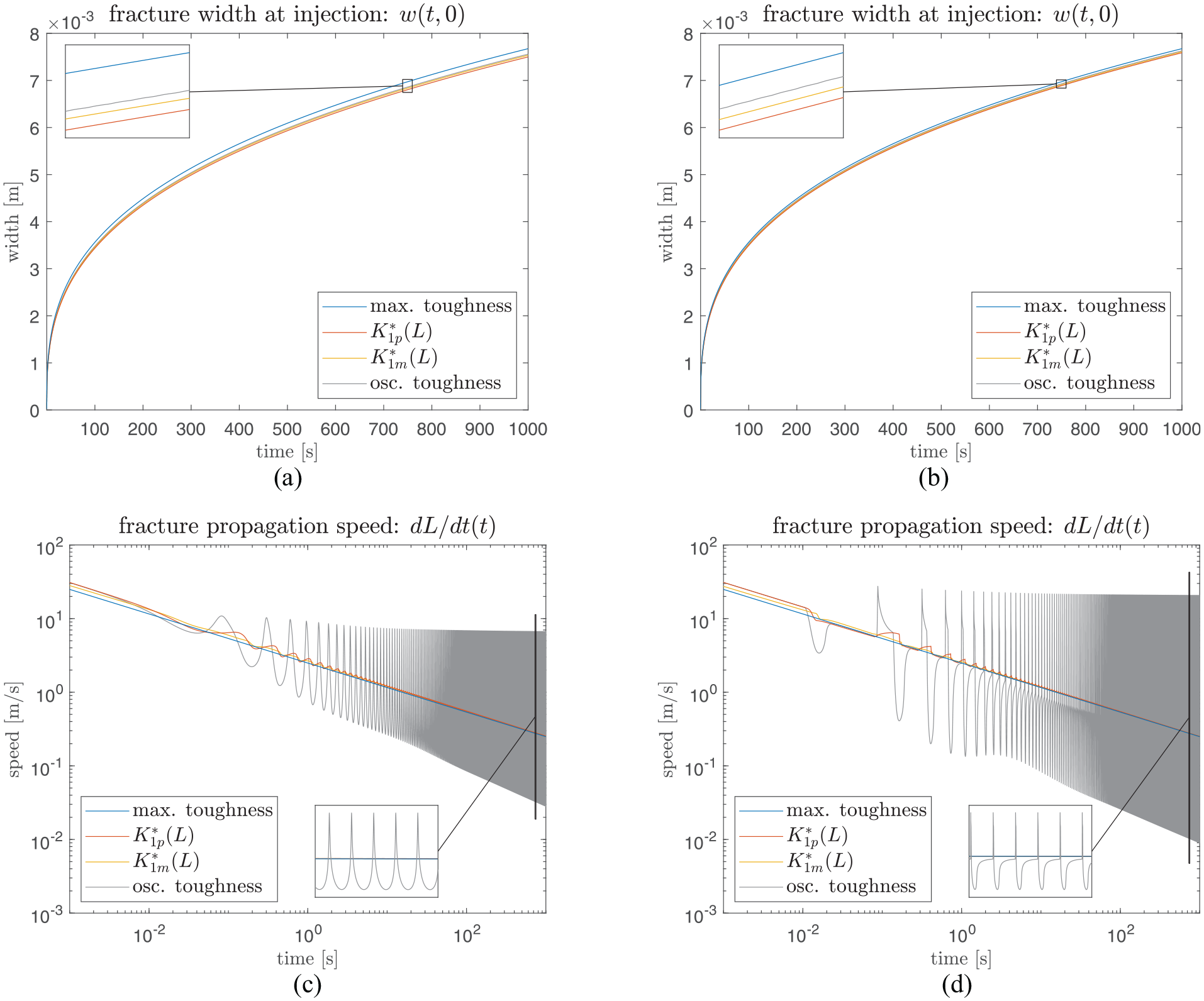
The (a), (b) aperture at the point of injection
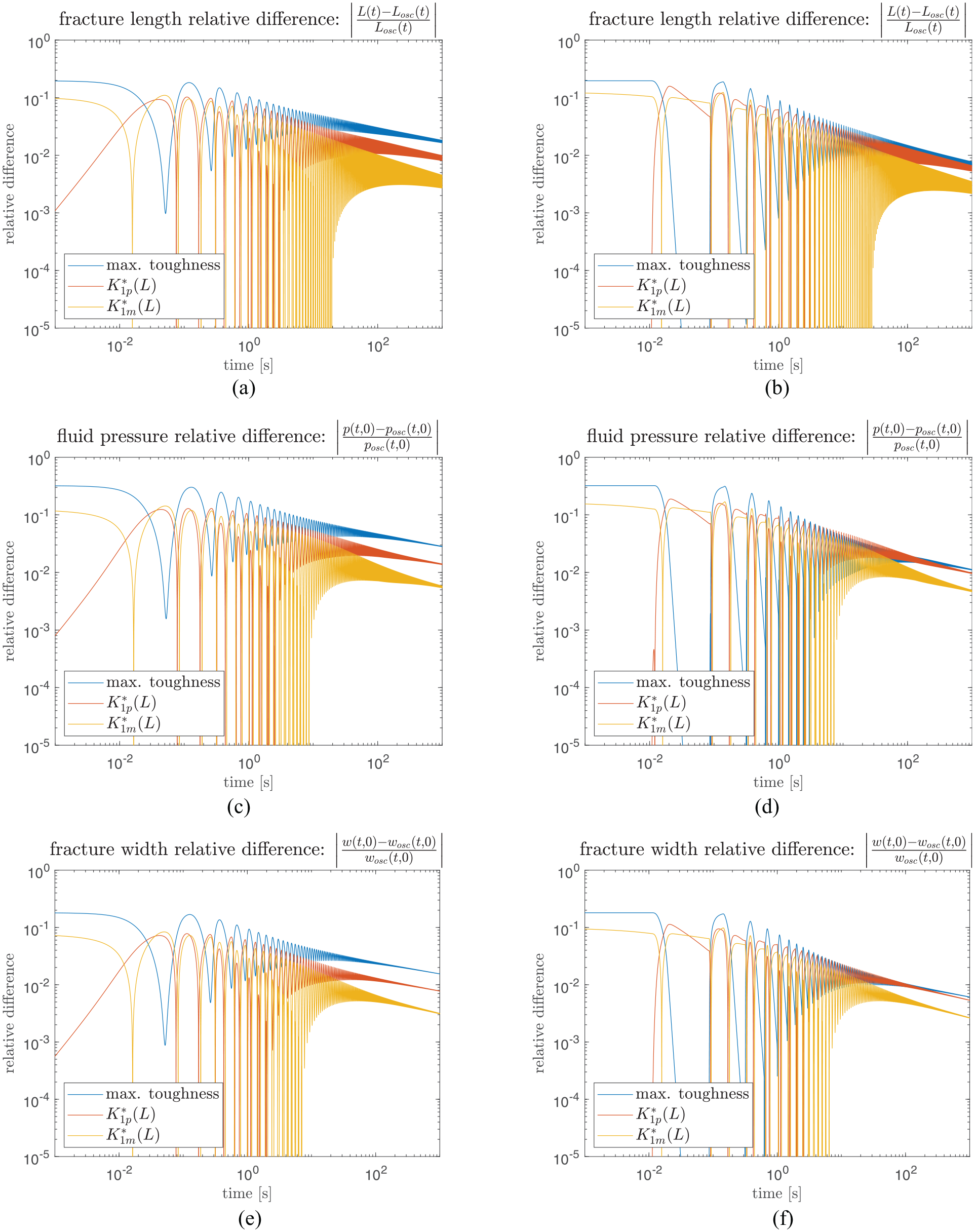
Relative difference between the (a), (b) fracture half-length
As for the comparative effectiveness of
Finally, as is the case for most averaging procedures, the proposed approach does not preserve local peculiarities of the process. For example, the real crack speeds and those produced with use of the averaged toughness,
However, comparing the relative errors of the different strategies, presented in Figure 15, we confirm that the proposed averaging does improve the results of simulations for short and moderate crack lengths in comparison with the
3.3. A temporal energy averaging approach
In the previous section, we have analysed the toughness averaging approach based on the fact that, in the case with constant elastic parameters, even between layers with differing toughness, the Irwin and Griffith criteria locally coincide (
In order to construct an averaging-based approach that is effective for inhomogeneous elastic parameters alongside the toughness, we modify the formulation to be based on the fracture energy. To achieve this, we start by introducing:

It is straightforward to verify that measures in the pair

Thus, instead of the weighted

and

where
Due to the strong similarities between these measures and the toughness averaging
Comparing the different measures in Figure 16, we can observe that the predictions given in simulations by the new averages
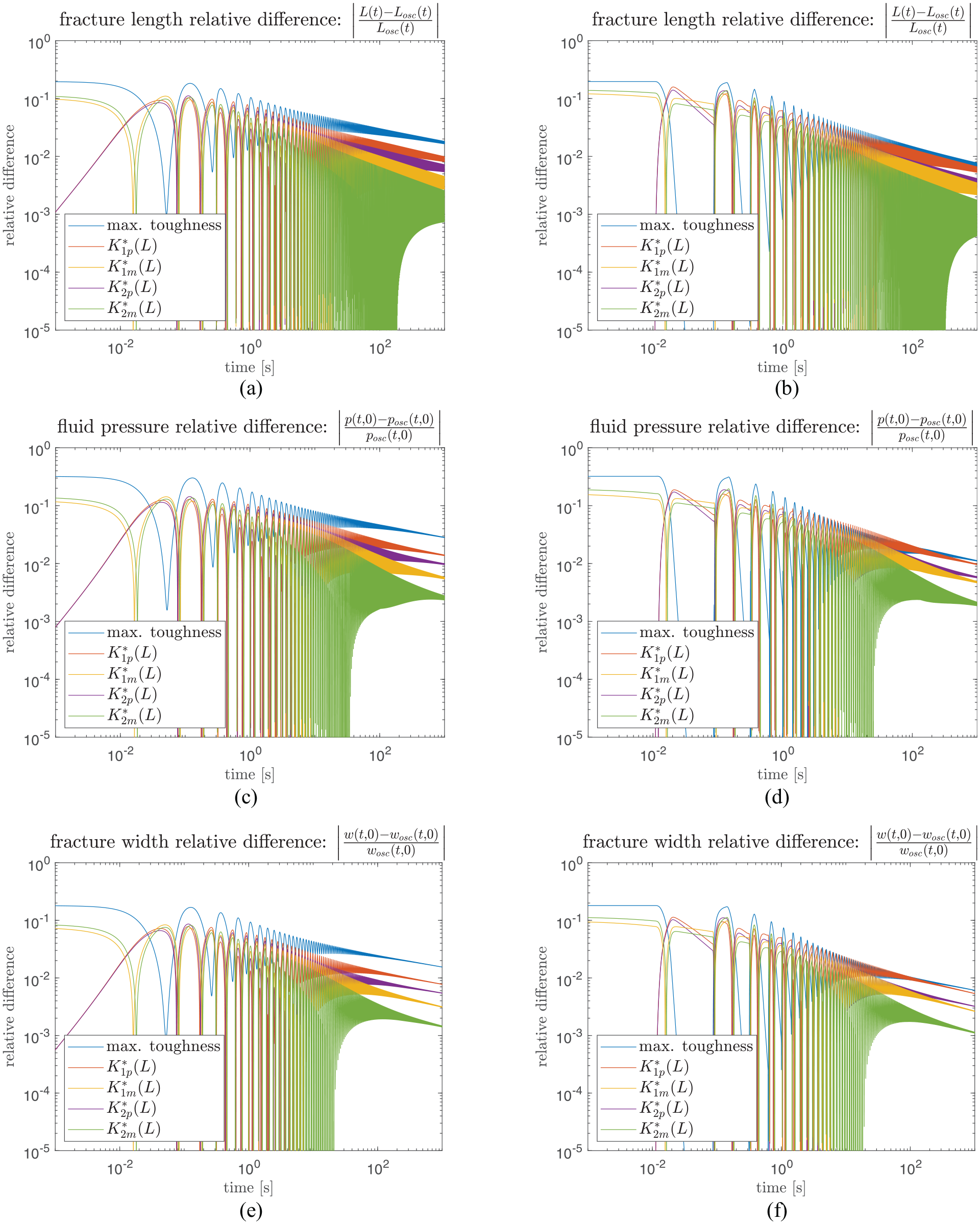
Relative difference between the (a), (b) fracture half-length
With the effectiveness of the temporal averaging–based approach established, a comparison of the measures was undertaken for all range of the regimes under investigation in this paper. The final results in comprehensive form are presented in Figure 17, for different combinations of the process parameters
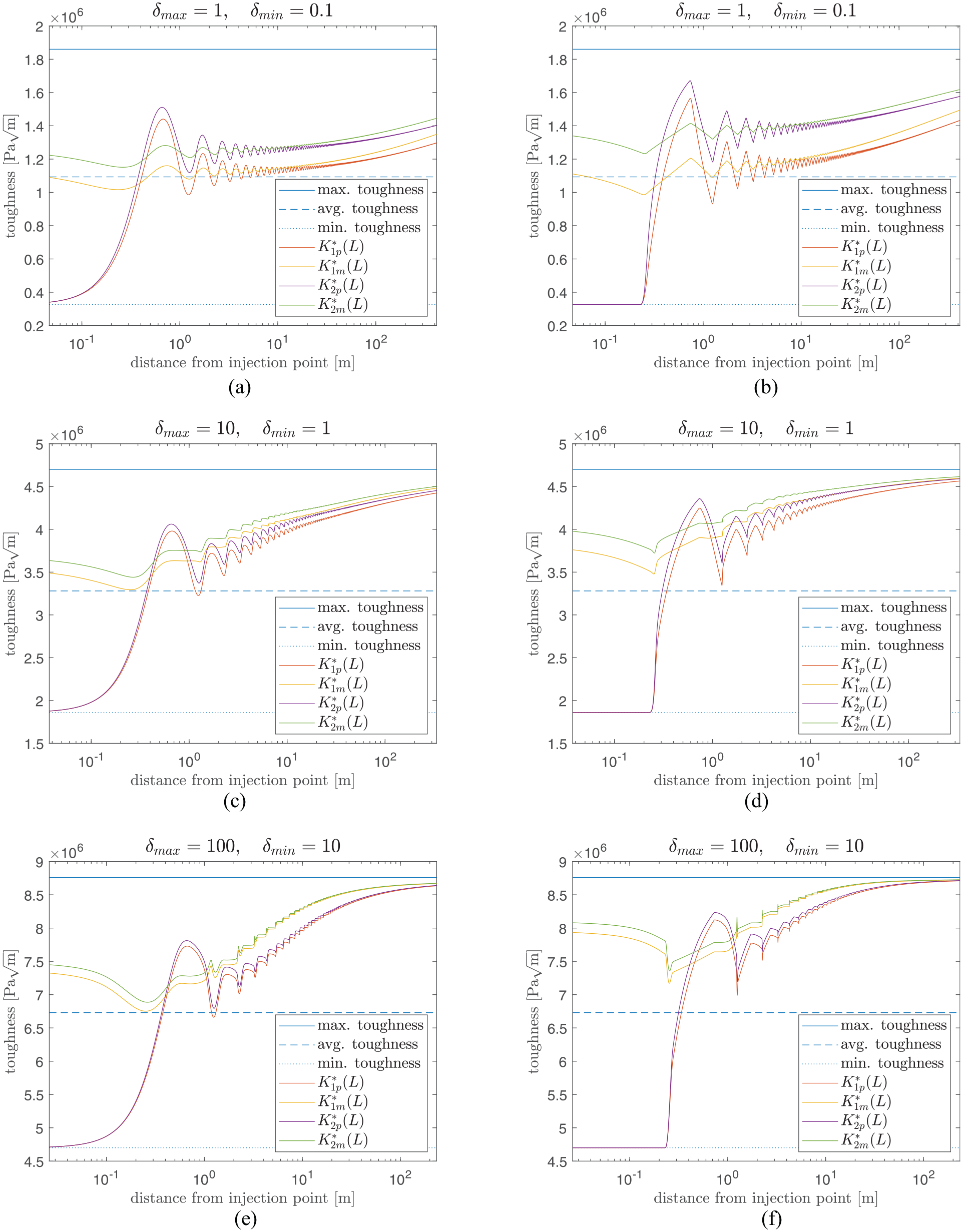
Various averaging strategies for oscillating toughness for different combinations of the pairs
3.4. Consistency of the various averaging techniques
3.4.1. Behaviour under repeated averaging
The temporal averaging approach has been shown above to produce an effective approximation of the key process parameters for the cases under consideration. In order to provide further justification for the approach and provide a comparison between the different averaging techniques proposed in this paper, let us here perform a brief examination of the consistency.
Some initial observations regarding the consistency of the proposed measures are easy to verify. For example, in the case with of a homogeneous material with constant toughness
Towards a more thorough investigation, we pose the following question: if the approach has been applied twice, does it produce a comparable outcome? 7 In other words, we proceed as indicated in the following scheme:


and try to estimate the outcome of the process. The results of applying the averaging twice are provided in Figure 18, while the ratio between the single/double averaging are given in Figure 19. Here, we take the notation:
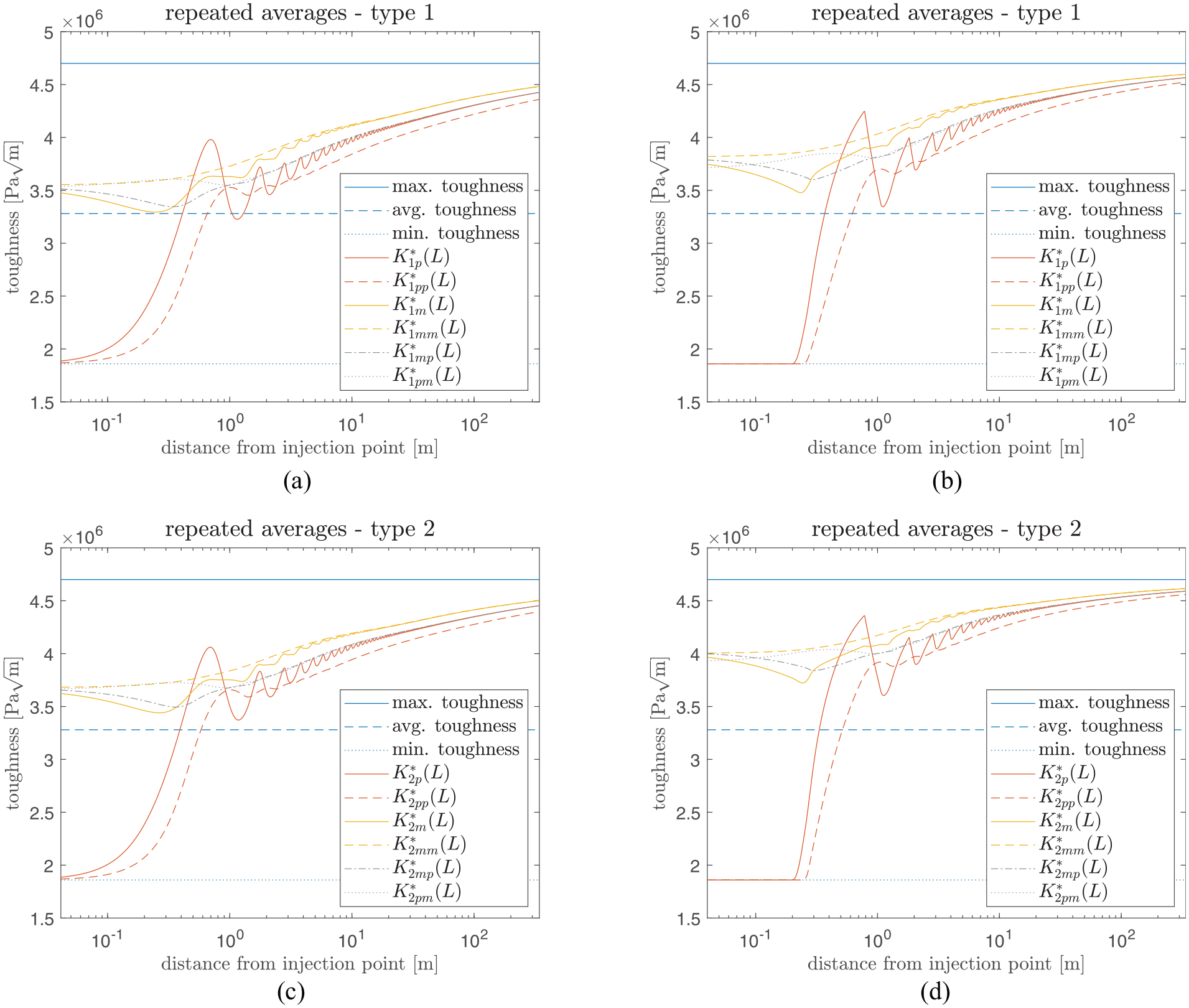
Repeated averaging of (a), (b)
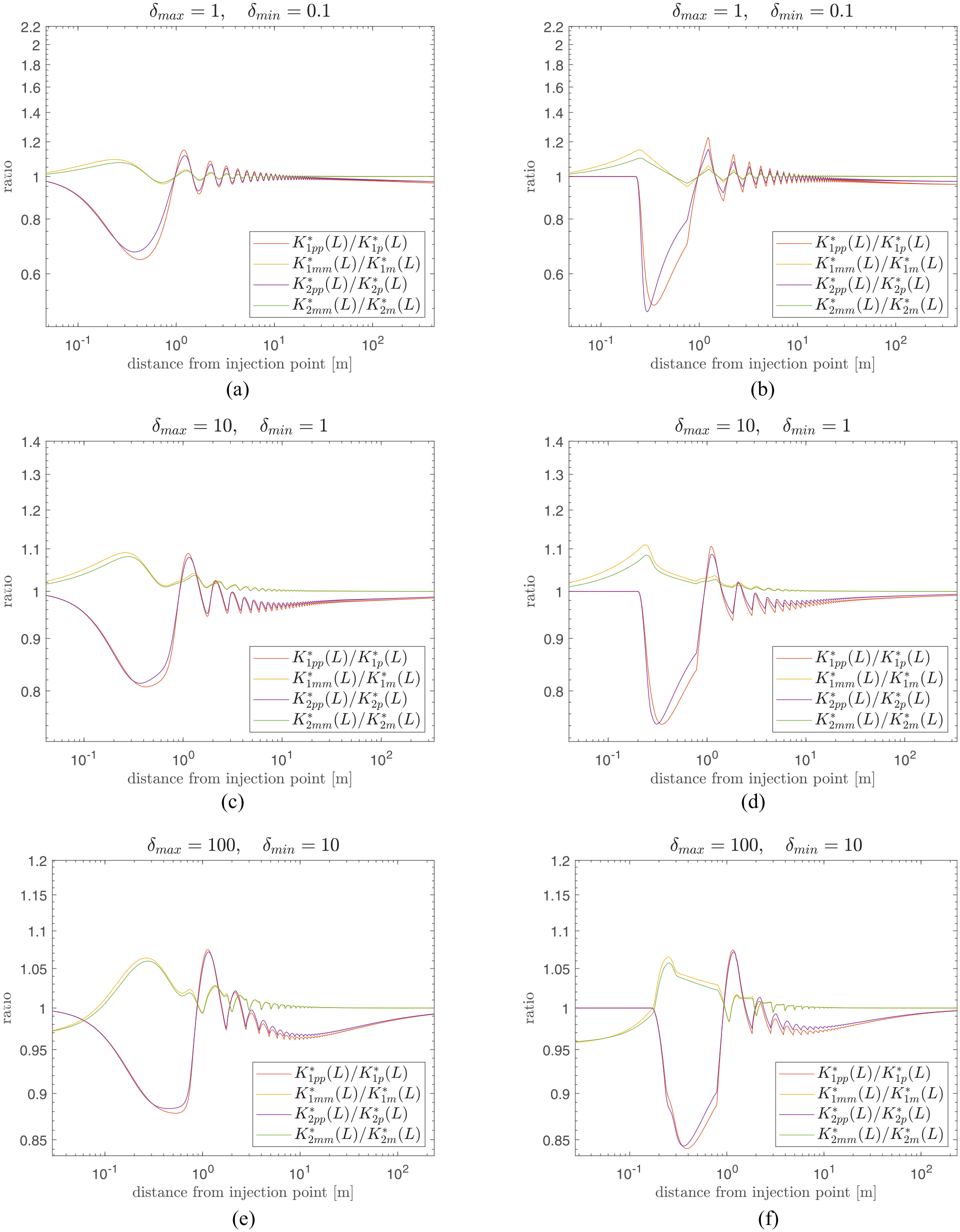
Ratios of the repeated averaging of
It is clear from Figure 18 that the averaging procedures based on the moving frame approach (
For the sake of curiosity, we also test the mixed iterations (
Overall behaviour of the measures, combined with the lower error of approximation obtained using
3.4.2. Changing the order of the layers
As a final consistency check, we change the order of the layers in the periodic toughness distribution. Namely, so far we have had the crack starting from the interior of the weakest layer, while in this subsection, we consider the case when the injection point is situated inside the tougher layer. 8 Throughout this analysis, the periodic nature and distribution of the toughness remains the same as considered previously (as outlined in Section 2.3).
In Figure 20, the relative difference between the oscillating toughness solution and that obtained when homogenising using the four measures are given for three key process parameters: the fracture length, crack opening and pressure at the injection point. It is evident that the relative differences in these figures are practically identical to those presented previously in Figures 15 and 16 (for the fracture starting in the weaker layer).
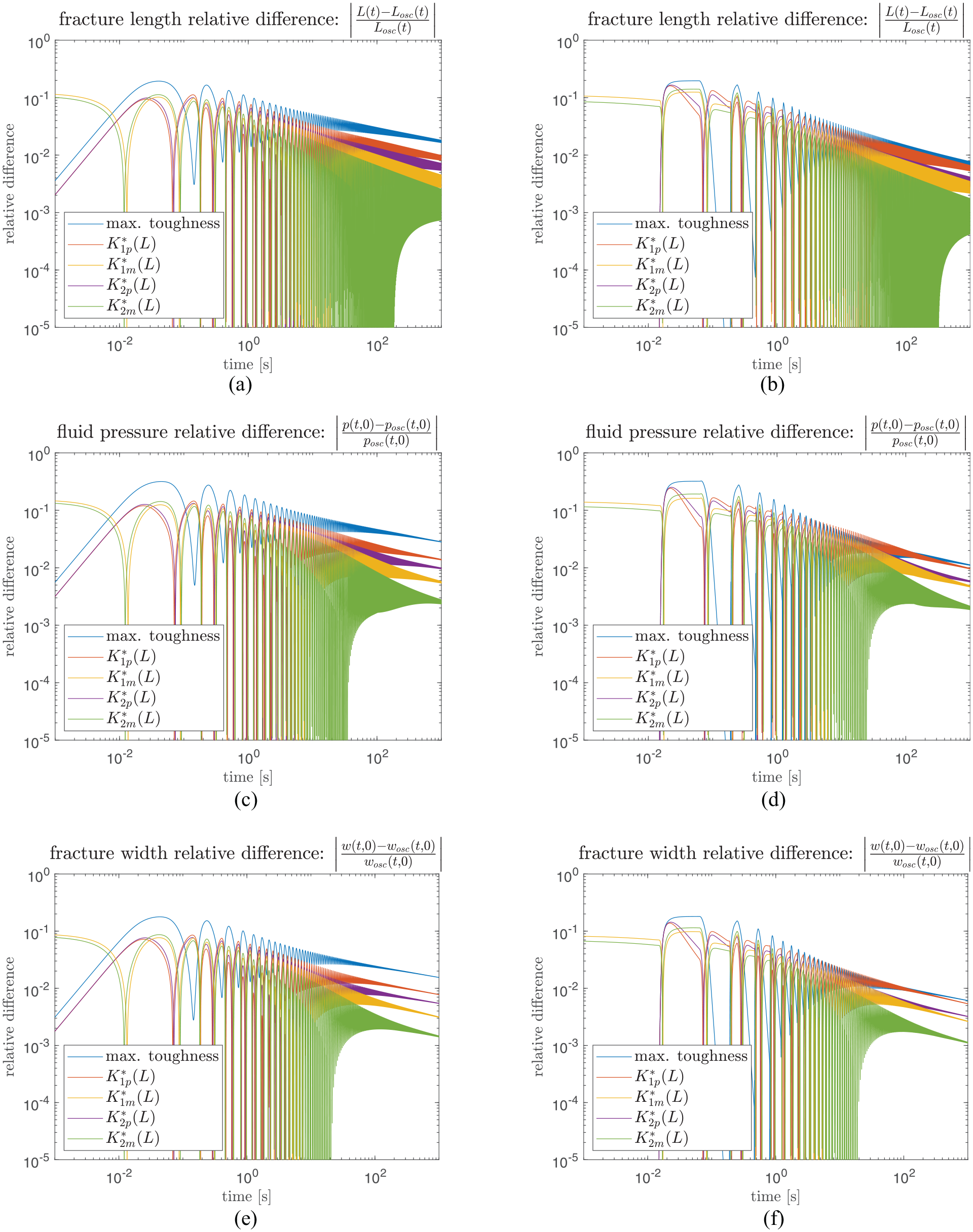
The case when crack initiation is in the middle of the tougher layer. Relative difference between the (a), (b) fracture half-length
Meanwhile, in Figure 21, we provide the values for all of the proposed measures for different combinations of the process parameters
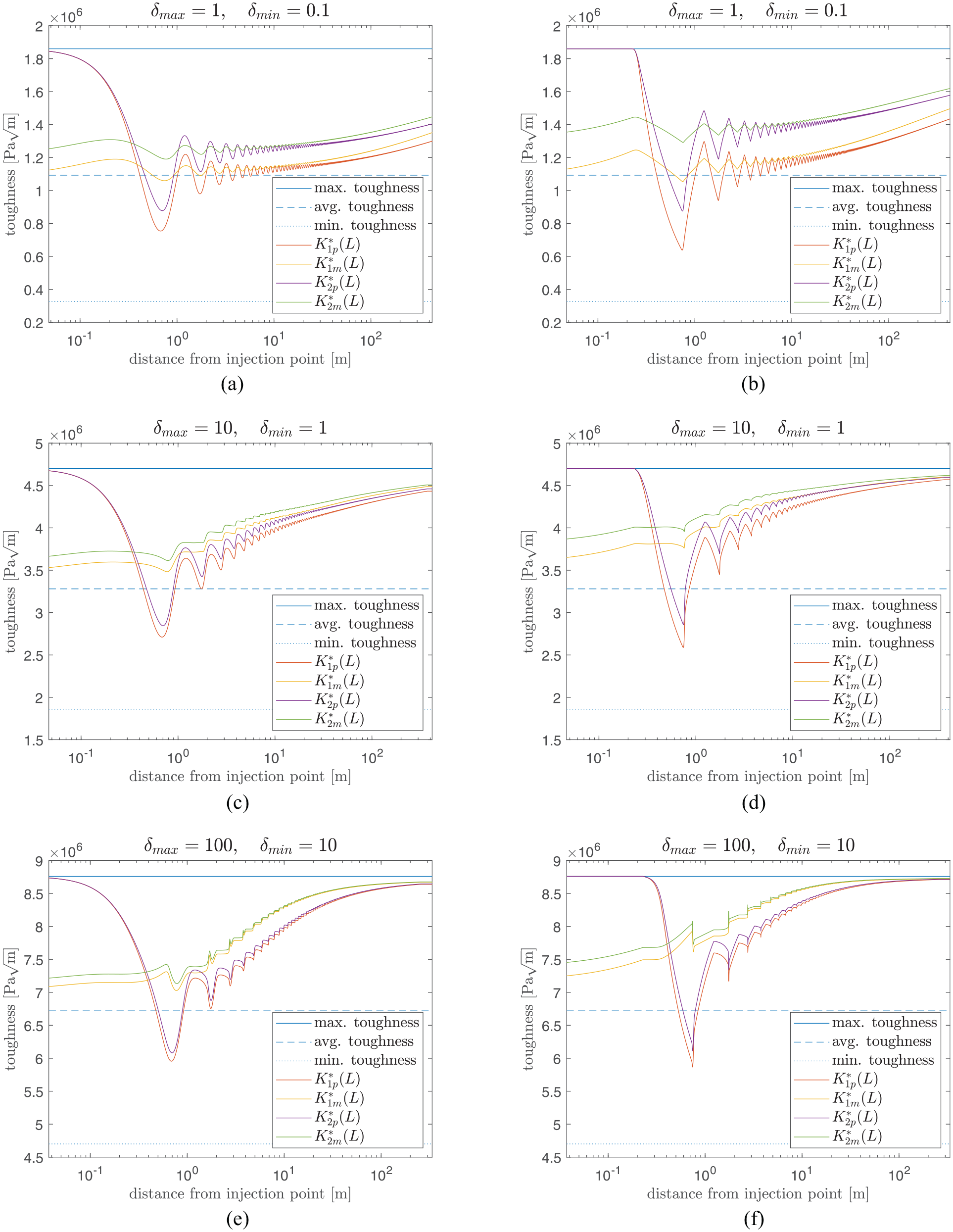
The case when crack initiation is in the middle of the tougher layer. Various averaging strategies for oscillating toughness for different combinations of the pairs
To highlight this more clearly, in Figure 22, we show the ratio between the averages obtained by each of the measures in each of the two cases, when it is initiated within the high toughness layer and when it starts within a weakened layer. It is clear that within the first period, the results of the two are different, particularly for the progressive measures. This primarily concerns the location and nature of the peaks for each line, which correspond to the differing interfaces (high gradients) between the various rock layers. However, this difference gradually decreases in all cases, until becoming almost unrecognisable after a distance of roughly
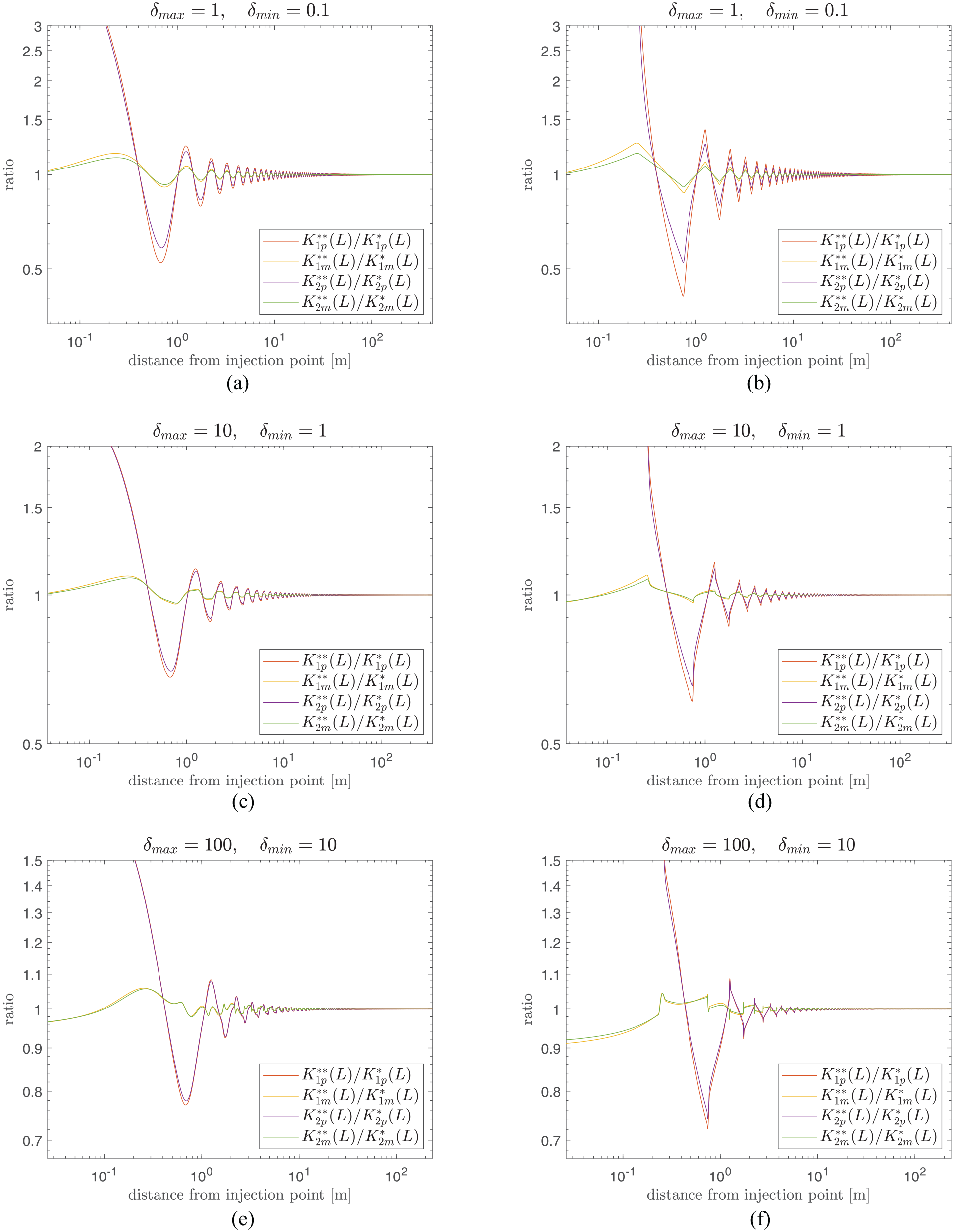
Ratio between the respective averages for the crack initiated in the middle of the tougher layer,
While this helps to demonstrate the consistency of the approach it also demonstrates that, in the case where an almost exact solution is needed from the very start of computations, then the precise layering of the rock stata will need to be incorporated into the initial computations and the averaging-based homogenisation only incorporated during a later point in computations. Here, the results from Figure 22 give a good indication of the length-scale over which this effect would need to be accounted for.
Combining these observations with the results of the previous subsection, it is clear from the consistency analysis that the roaming averages (21), (25) provide a more representative approach, with them both reproducing themselves under repeated averaging and showing less dependency on the ordering of the rock layers. In addition, the energy-based average
4. Discussions and conclusion
A few strategies for handling the toughness heterogeneity of rock in HF based on temporal averaging have been considered. Four measures were introduced in equations (20)–(21) and (24)–(25), with the different forms being based on the toughness or fracture energy, and for the global and roaming averages. These measures were formulated to directly incorporate aspects of the process behaviour, or more specifically, the instantaneous crack speed. All those measures coincide for a constant toughness, while the fracture energy-based approaches have the advantage of being able to incorporate heterogeneous elastic constants.
An in-house-developed time–space adaptive solver allowed us to produce extremely accurate computations with a guaranteed tolerance. These four measures were compared with the maximum toughness strategy [37] in a variety of different fracture regimes for an impermeable rock with periodic toughness.
It was demonstrated that the roaming measure
For long fractures, or those where both rock layers permit the crack to remain in the viscosity-dominated regime, the maximum toughness strategy is highly effective, with a typical error of the order of a few percent at the end of the process.
For short and moderate fractures, or during the initial stages of propagation, the maximum toughness strategy is rather inaccurate. The level of error is process dependent, alongside depending on the maximum toughness of the rock, however may be of the order 20% or above (as observed even after
All of the averaging-based approaches proposed in this paper consistently produced more accurate approximations than the maximum toughness strategy (see Section 3.2). The highest gain is seen for short to moderate length fractures, where the maximum toughness strategy is at it is least effective. Results obtained by the authors so far indicate that, after five toughness periods, the averaging-based homogenisation achieves an up to 50% reduction in the relative error of the key process parameters (fracture length, width, and inlet pressure) compared to the maximum toughness strategy for short, high-toughness fractures (
The maximum toughness strategy and temporal averaging approach were found to produce opposite bounds for the three key process parameters
Since
Consistency analysis performed on the measures demonstrated that the moving averages
When implementing these averaging procedures into commercial solvers, the roaming averages
All of the results demonstrate that an averaging-based approach (using any of the outlined measures) has great potential to form part of an effective homogenisation procedure constructed around mimicking the real instantaneous (local) crack speed.
In light of the above, we can conclude that an averaging-based approach can be successfully used to approximate the material toughness in the HF process. The new averaging-based homogenisation achieves the aim of this work, significantly reducing the error for crucial process parameters when working with short and moderate cracks and even improves upon existing prediction strategies for long fracture lengths. The crucial change is that the averaging must be specifically weighted in order to incorporate the influence of both the rock heterogeneity and the process peculiarities. While the focus in this case was on the HF process, this approach to homogenising utilising averaging could potentially be employed in other areas of application.
There does, however, remain one crucial obstacle to successful application of this technique, namely that the measures require prior knowledge of the (unknown) instantaneous fracture velocity. This can, in principle, be approximated sufficiently accurate utilising known properties of the process behaviour, which will be the subject to a future paper by the authors. Implementation of this averaging-based homogenisation strategy on a wider scale also necessitates investigating the effect of other heterogeneous effects. This includes many of the measures outlined in the introduction, including crack redirection, either to a tortuous path or permanent deflection, or other effects of the elastic heterogeneity like stress shielding or other hardening effects, among others. While the direct homogenisation of elastic heterogeneity can already be incorporated for the temporal energy averaging approach, the ability to incorporate these wider effects needs to be demonstrated.
For a wider averaging-based homogenisation procedure to be effective in HF, there also needs to be further investigation into the effect of other process inhomogeneities on the proposed measures. In addition, there has recently been a greatly increased interest in the driving of HF processes utilising “pulse loading” techniques, with the aim of introducing a greater damaged area than via traditional static loading (a good overview of the topic can be found in the introduction of Xi et al. [52]). Another area where non-uniform crack propagation has been observed is HF in poro-elastic media with saturation [28,29].
Note that in this paper, we have discussed only a few “balanced” toughness periodic distributions, where the toughness heterogeneity is normal to the direction of fracture propagation. As was made clear by the preliminary research [38], the nature of this distribution will play an important role and will manifest itself during the averaging. The extent to which the approach will be effective when considering differing orientations of the toughness inhomogeneity, such as the case when rock layers are instead aligned at some angle to the direction of fracture propagation needs to be demonstrated. Another question that is now under analysis is the case of random toughness distribution, where the notion of the maximal toughness is not well defined at all and which has been shown to significantly effect the resulting fracture process and geometry [53].
Finally, fracture propagation, in the context of the observed step-wise nature of the crack advancement (see e.g. refer previous studies [28,29,54]), is crucial for understanding the nature of this important technological and natural process (material destruction). Various scenarios are possible here, not only a monotonic (but non-uniform in time) crack propagation but also branching, clustering, and forerunning like behaviours have been already observed and analysed [54–59]. While having their own peculiarities, their impact on the effectiveness of any averaging approach (if feasible) needs to be considered.
Footnotes
Acknowledgements
G.M. is thankful to the Royal Society for the Wolfson Research Merit Award, while M.D. acknowledges the Royal Academy of Engineering for the Industrial Fellowship. The authors are very grateful to the (anonymous) reviewers for their helpful comments.
Funding
The author(s) disclosed receipt of the following financial support for the research, authorship, and/or publication of this article: The authors have been funded by Welsh Government via Sêr Cymru Future Generations Industrial Fellowship grant AU224 and the European Union’s Horizon 2020 research and innovation programme under the Marie Sklodowska-Curie grant agreement EffectFact No. 101008140.
1.
2.
Since we consider in this paper the case when all elastic properties remain constant, condition (6) is equivalent to the energy condition  ].
].
3.
Note that here, ).
4.
This physical explanation for the behaviour when transitioning between rock layers of differing toughness has previously been noted by others (see presentation Benedetti & Lecampion at the ECCM-ECFD 2018 conference).
5.
Note however, that if the difference between
6.
The main goal of developing this averaging procedure is to implement it into commercial solvers that, for evident reasons, cannot deliver computations with a highly detailed toughness distribution. Here however, apart from the size of the RVE there is a minimal size of the finite element,
7.
Note that when using homogeneous techniques, in most cases the homoginised material will “reproduce itself” after repeated averaging.
8.
In practice, this is equivalent to a translation of the toughness distribution by