




Abstract
We investigate the buckling and post-buckling properties of a hyperelastic half-space coated by two hyperelastic layers when the composite structure is subjected to a uniaxial compression. In the case of a half-space coated with a single layer, it is known that when the shear modulus
Keywords
1. Introduction
Buckling of a coated elastic half-space induced by uniaxial compression is a topic that has been much studied in recent decades. Motivated mostly by the desire to suppress buckling as a precursor to structural failure, early studies under the framework of nonlinear elasticity include the linear analyses by Dorris and Nemat-Nasser [1], Shield et al. [2], Ogden and Sotiropoulos [3], Bigoni et al. [4], Steigmann and Ogden [5] and the nonlinear post-buckling analysis by Cai and Fu [6]. The subsequent experimental work by Bowden et al. [7,8] on pattern formation at the micrometre and sub-micrometre scales opened the possibility to use such pattern formation to achieve a variety of useful purposes. Known applications now range from cell patterning [9], optical gratings [10–12], creation of surfaces with desired wetting and adhesion [13, 14] and buckling-based metrology [15]. Pattern formation is also known to play an important role in many biological processes where the main driving mechanism is growth [16]. Motivated by these newly found applications, further linear and nonlinear analyses have been conducted by Cai and Fu [17, 18], Steigmann and Ogden [19], Sun et al. [20], Hutchinson [21], Ciarletta [22], Fu and Ciarletta [23], Ciarletta and Fu [24], Zhang [25], Holland et al. [26], Alawiye et al. [27, 28] and Rambausek and Danas [29]. There also exists a large body of literature that employs approximate plate theories and simplified interfacial conditions in order to provide qualitative understanding of the phenomena observed; see, e.g., Chen and Hutchinson [30], Huang et al. [31], Audoly and Boudaoud [32] and Song et al. [33]. We refer to the reviews by Genzer and Groenewold [34], Yang et al. [35], Li et al. [36] and Dimmock [37] for a comprehensive review of the relevant literature.
A major result arising from a weakly nonlinear analysis [6, 21, 28] is that there exists a critical stiffness ratio that marks the transition from sub-critical bifurcation to super-critical bifurcation. It can then be expected, and indeed confirmed by many recent numerical and experimental studies, that in the sub-critical regime localization is the norm [38] whereas in the super-critical regime stable periodic patterns and further secondary bifurcations are the norm [18, 39–47].
In this article, we extend the analysis of Cai and Fu [6] and consider the effects of adding an extra layer to the film–substrate bilayer structure. The structure of a substrate coated by two layers has been recognized to offer enhanced capabilities in buckling-based metrology [48–50], stretchable electronics [51] and surface pattern switching [49, 52]. Multi-layering is of course the norm in biological systems (e.g. the human skin), whereas in other situations adding extra layers arises out of necessity. For instance, in cell patterning, there may exist the conflicting demands that, on the one hand, well-ordered wrinkling patterns are desired and, on the other hand, the top film is required to be sufficiently soft to dictate a certain cell behaviour [37].
For the structure under consideration, there exist two modulus ratios, namely
The rest of this paper is divided into five sections as follows. After formulating the buckling problem in the next section, we present in Section 3 the necessary linear analysis that produces the bifurcation condition. The bifurcation condition exhibits two interesting features. First, even if both layers are softer than the half-space, the stretch can still exhibit a maximum at a finite wavenumber. Second, there is a range of thickness ratios for which multiple stretch maxima exist and mode switching becomes possible as a material parameter is varied. This is in contrast with the situation of a single layer where a stretch maximum is only possible when the layer is stiffer than the half-space and no mode switching is possible. In Section 4 we conduct a weakly nonlinear analysis in order to determine the nature of buckling, namely whether it is super-critical or sub-critical. A richer variety of behaviour than what is possible for a single layer is uncovered. The paper is concluded in Section 5 with a summary, and a discussion of limitations of the current study, and possible future work.
2. Governing equations
We first formulate the governing equations for a general homogeneous elastic body B composed of a non-heat-conducting incompressible elastic material. Three configurations of B are involved in our analysis: the initial unstressed configuration

where
The deformation gradients arising from the deformations

It then follows that

where here and henceforth a comma signifies differentiation with respect to the indicated coordinate, with ‘
In the absence of body forces, the equations of equilibrium and the incompressibility constraint are given by

where

with W denoting the strain-energy function (per unit volume in the reference configuration) and p a Lagrange multiplier enforcing the incompressibility constraint. We denote by
We define the incremental stress tensor

where

and has a Taylor expansion given by

where

On substituting (8) into (7) and simplifying with the use of the identity

These incremental equilibrium equations are supplemented by the incompressibility condition in the form

We now specialize the above equations to the structure of an incompressible elastic half-space coated by two incompressible elastic layers. Each component (layer or half-space) in this structure is a homogeneous elastic body to which the above equations apply. We choose our common coordinate system such that the half-space, the first layer and second layer are defined by
To simplify analysis, we assume that the bonded structure is in a state of plane strain so that
Our problem is then to solve (11) and (10) in



where the notation
Our numerical calculations will be carried out for the case when the layers and half-space are all composed of either neo-Hookean or Gent materials, and the prestress in

respectively, where
3. Linear theory
In preparation for the later nonlinear analysis, we first consider the linearized version of the problem specified by (10), (11) and (12) – (14). The linearized governing equations are

and the auxiliary conditions are



where the linearized traction

Equation (16)1 implies the existence of a ‘stream’ function

Substituting (20) into (16)2 and eliminating

where

We look for a periodic wrinkling solution in the form

where k is the wave number. On inserting (23) into (21) and solving the resulting fourth-order ordinary differential equation for H, we obtain

where

that have positive real parts (so that
On substituting the above solutions into the auxiliary conditions (17) – (19), we obtain a matrix equation of the form

which is the bifurcation condition relating the pre-stretch
For each choice of h,

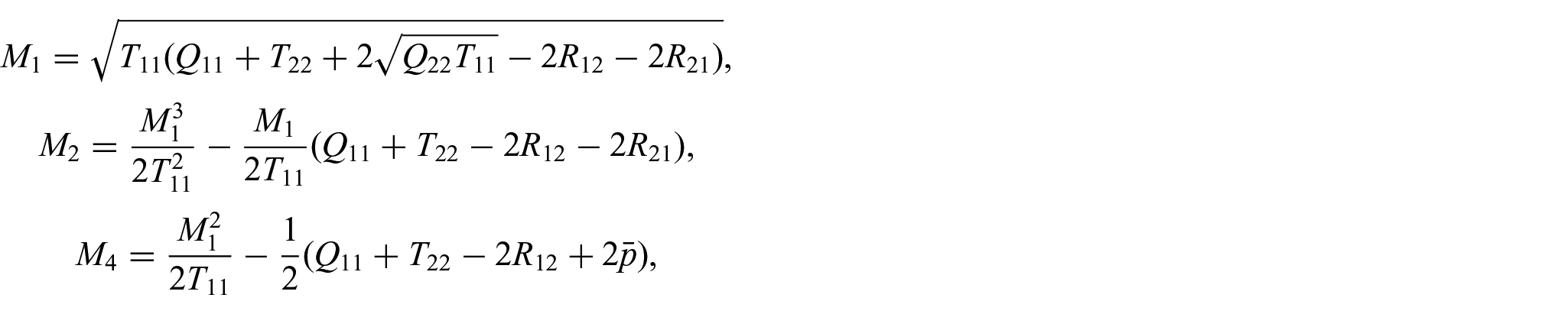
with
and

The bifurcation condition for a single half-space may be written as

see also [56]. It is known that a necessary condition for
The bifurcation condition discussed above is next used to generate plots in the
In Figures 1(a), 2(a) and 3(a), we have shown the domain in the
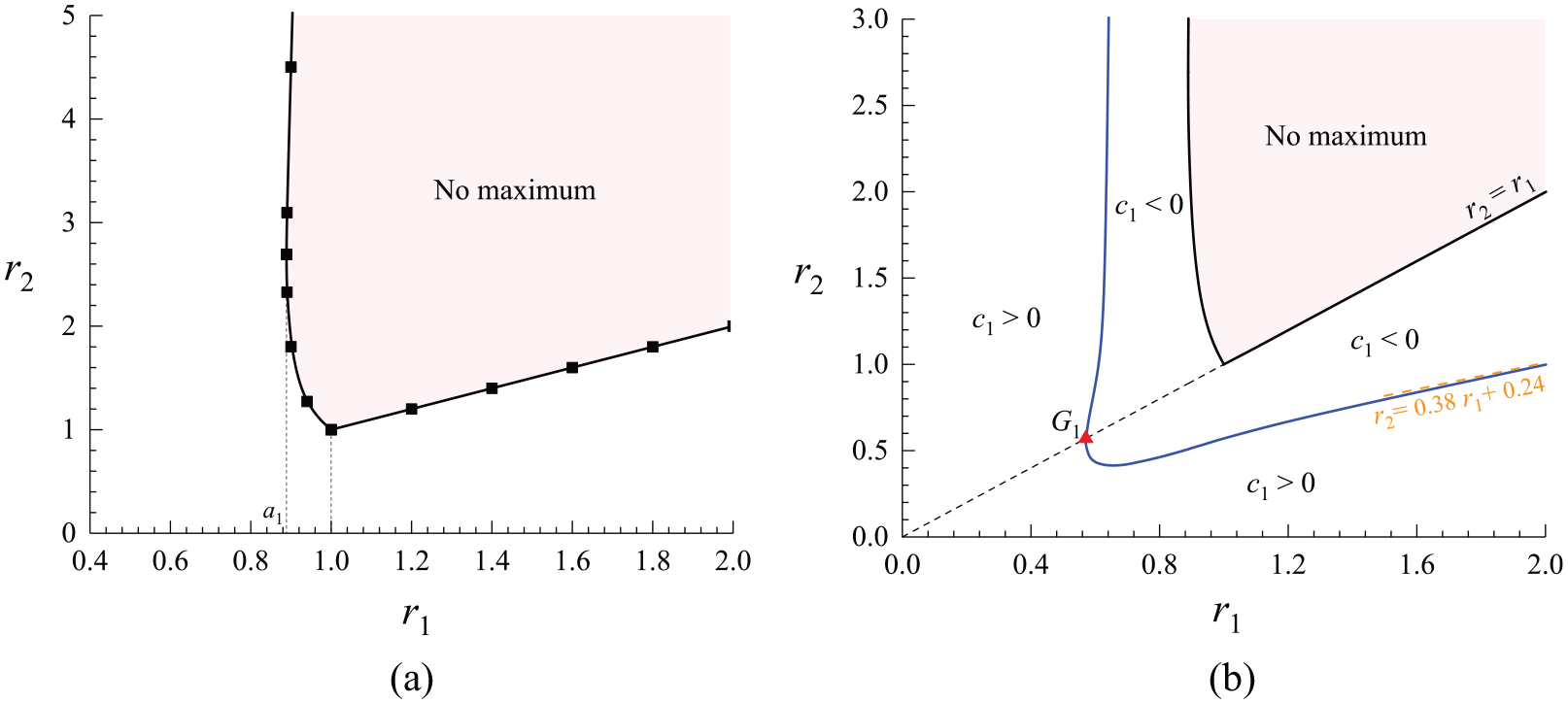
Linear and nonlinear bifurcation behaviour for
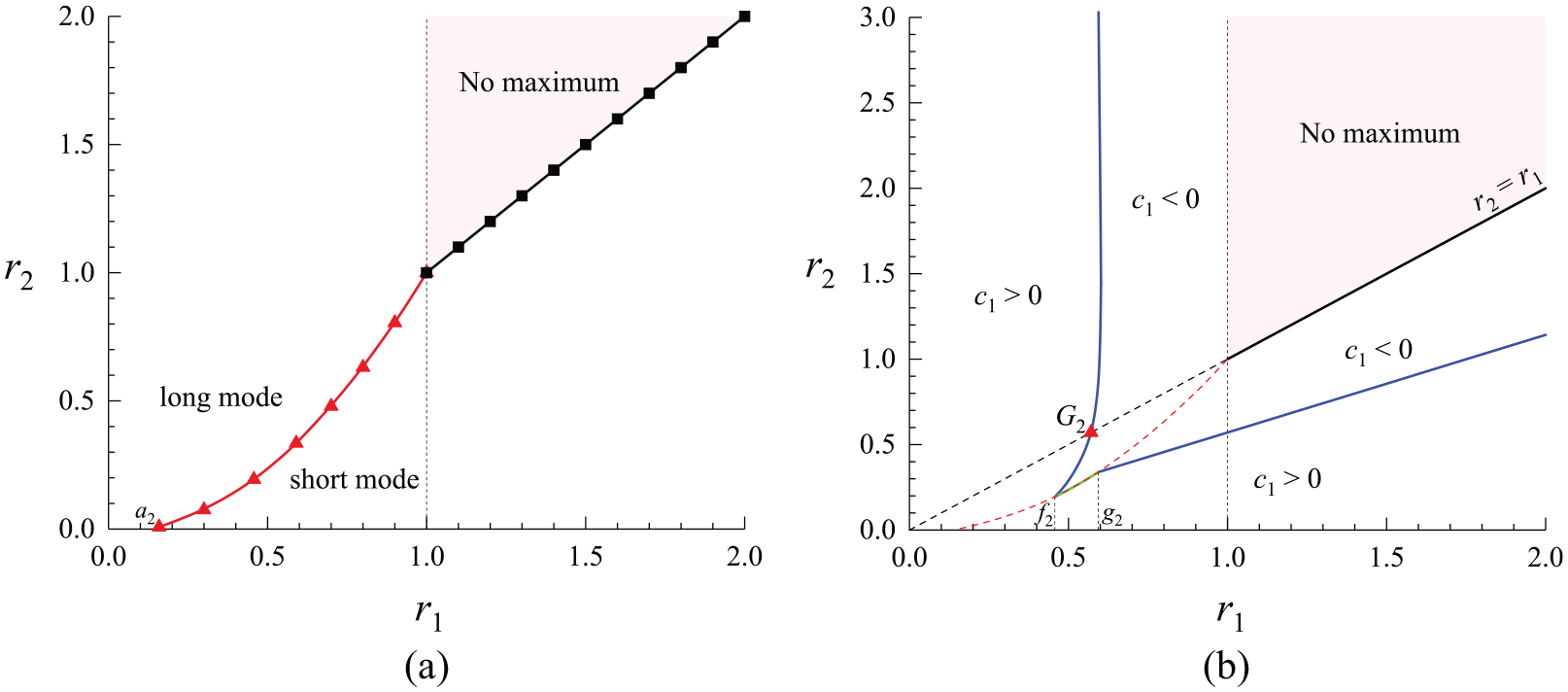
Results for
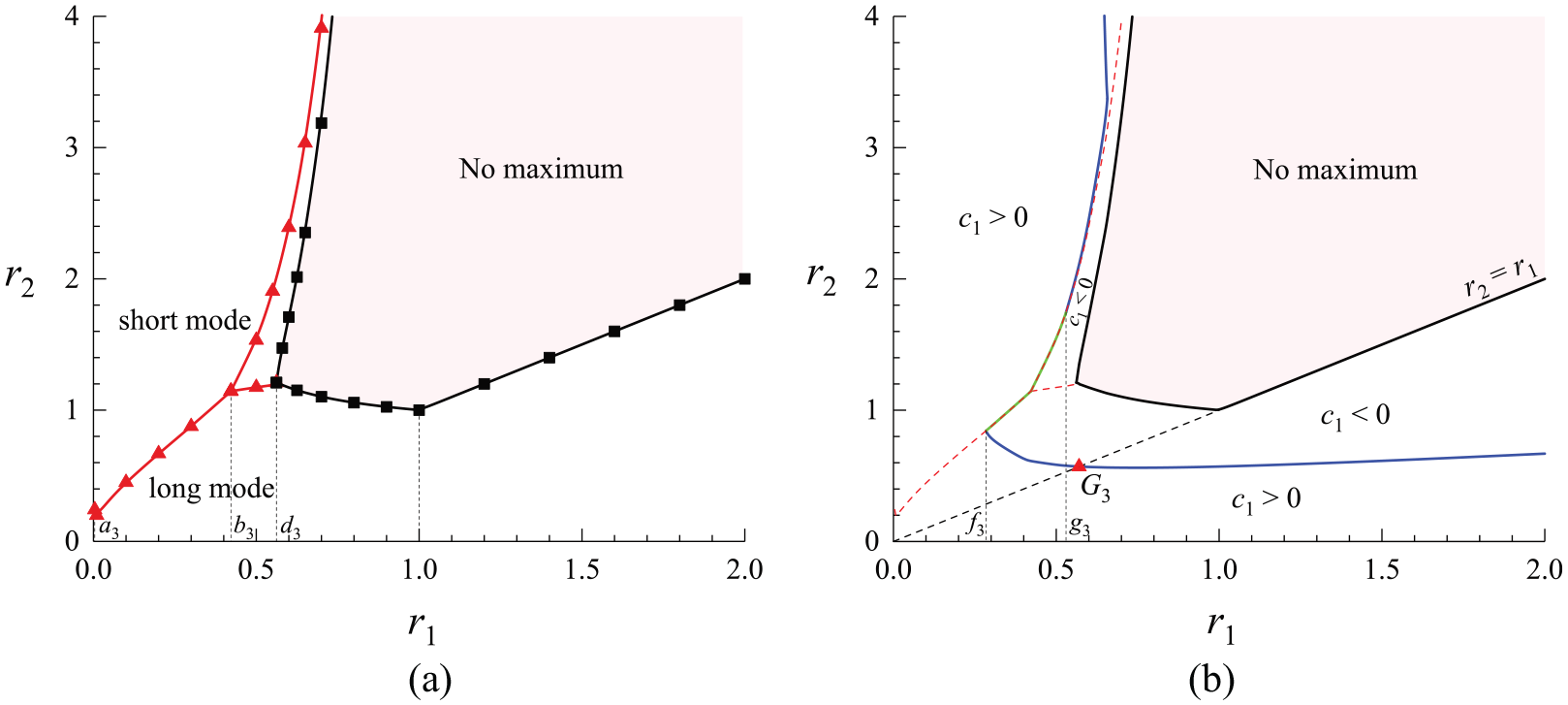
Results for
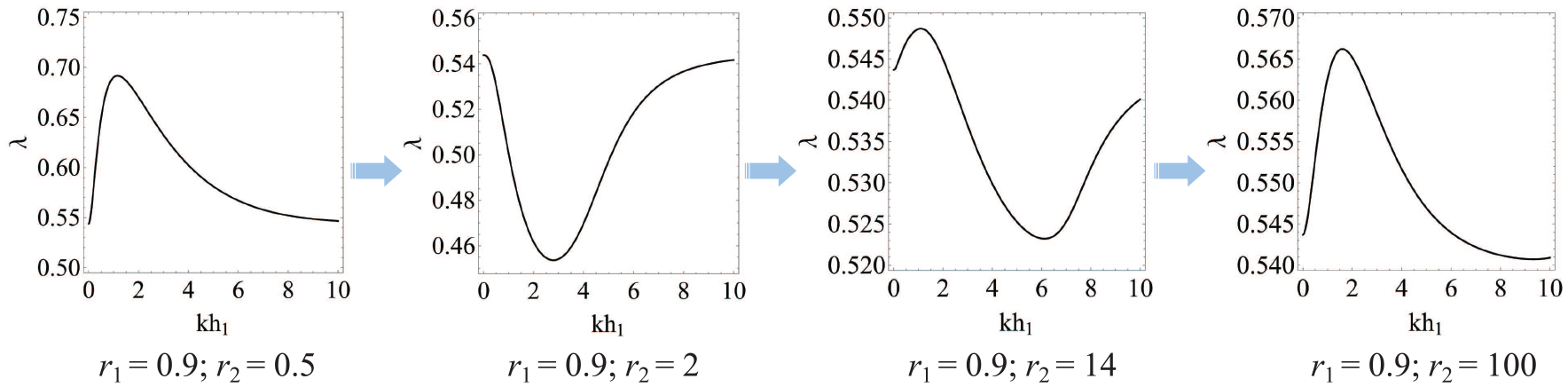
Evolution of the bifurcation curve when
As h is varied around 1, it is found that multiple stretch maxima may occur when
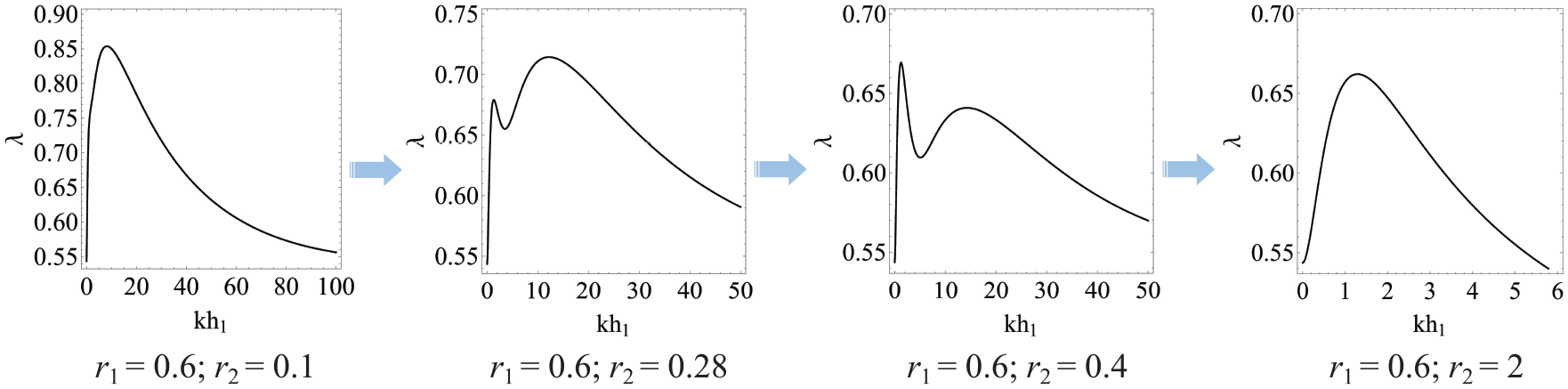
Evolution of the bifurcation curve when
When h is sufficiently larger than 1 (the lower layer becoming thinner than the top layer), we observe the novel phenomenon that mode switching may take place more than once when
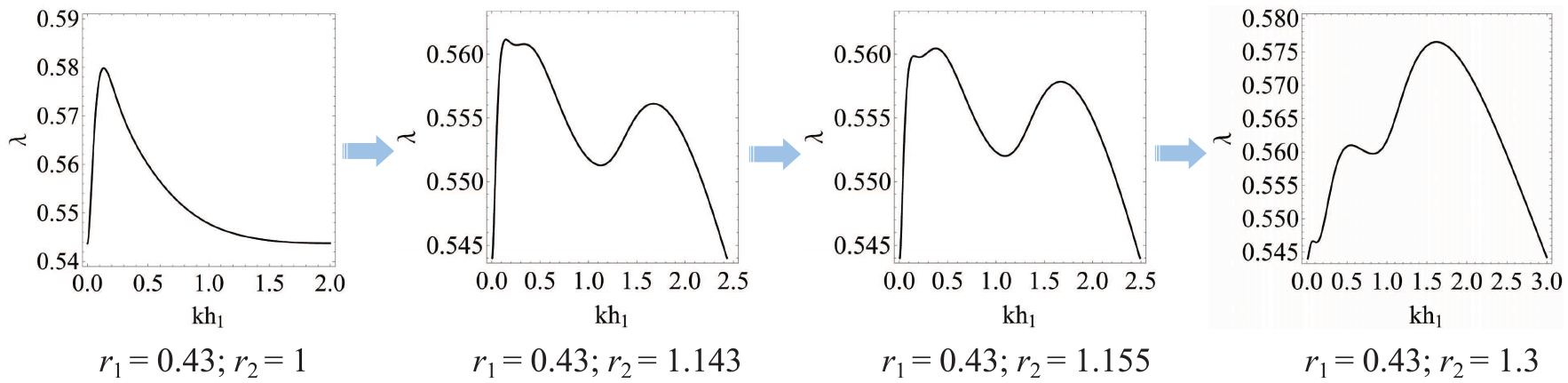
Evolution of the bifurcation curve when
It is clear from the above representative results that the addition of a second layer may provide more flexibility in generating stable periodic patterns. Of course, the existence of a stretch maximum is only one of the necessary conditions for the existence of stable periodic patterns. Another necessary condition is that the associated bifurcations need to be super-critical. This will be discussed in the next section by referring to Figures 1(b), 2(b) and 3(b).
4. Post-buckling analysis
In this section, we shall first derive the amplitude equation for a single near-critical mode for general prestress and general material models. We then present numerical results for uniaxial compression and for neo-Hookean or Gent materials.
4.1. General prestress and material models
For general prestress, we assume that the finitely stressed state

where
We look for a solution of the form


where the first terms represent the uniform perturbation from

and

In the last two expressions, c.c. denotes the complex conjugate of the preceding term, A is the unknown amplitude that is to be determined and
As the above leading-order solution is simply the linearized solution with the undetermined amplitude chosen to be A, when we substitute (30) – (31) into the nonlinear governing equations and auxiliary conditions, we find that the system of equations obtained by equating the coefficients of


and the corresponding auxiliary conditions



where

In writing down the last expression, we have made use of the result
The second-order problem specified by (34) – (39) can be solved once the form of prestress and the elastic moduli are given. In the next section we explain how this problem can be solved and present explicit results for the special case of uniaxial compression and neo-Hookean materials. However, our following derivation of the amplitude equation does not depend on the explicit solution of this problem.
To derive the amplitude equation which must be satisfied by A, we follow [59] and [61] and make use of the virtual work principle

where

The identity (40) can be proved by integration by part followed by an application of the divergence theorem [6]. The expansions (30) – (31) can now be substituted into (8) and the resulting expression into (40). On equating the coefficients of

where


In writing down (44) we have made use of the identities that

which can be verified by expanding the summations and then making use of the properties
Only the first term in the integrand of (42) now contains the unknown third-order solution

where

In obtaining (45), we have also made use of the result
To facilitate the remaining presentation, we write



where the bars on A and
On substituting (46) – (48) into (45) and evaluating the integral with respect to

where the linear and nonlinear coefficients


In the above expression for

The amplitude equation (49) admits the non-trivial post-buckling solution

It can be shown [6] that
On comparing the above expressions for

We have verified numerically that when this term is added in the evaluation of the virtual work principle in [6], the approach used by Cai and Fu [6] gives the same result for
4.2. Uniaxial compression and neo-Hookean materials
In this subsection, we calculate the coefficients in the amplitude equation (49) for the special case when the layers and half-space are made of different neo-Hookean materials and the prestress takes the form of a uniaxial compression. We shall present numerical results for the three cases considered in Figures 1(a), 2(a) and 3(a).
We assume that the maximum
With the aid of (32) – (33) and (46)1, we obtain

and

The governing equations (34) and (35) for the second-order solution reduce to

where

Owing to quadratic interaction, the right-hand side of (56)1 is a linear combination of


and



It was shown in [6] that (62) has a particular integral given by

Thus, the general solution to (62) is given by

where
With the aid of (58) – (59), we may calculate

The expressions for
We now investigate the dependence of
Figure 1(b) shows the sign of
Figure 2(b) displays the corresponding results when
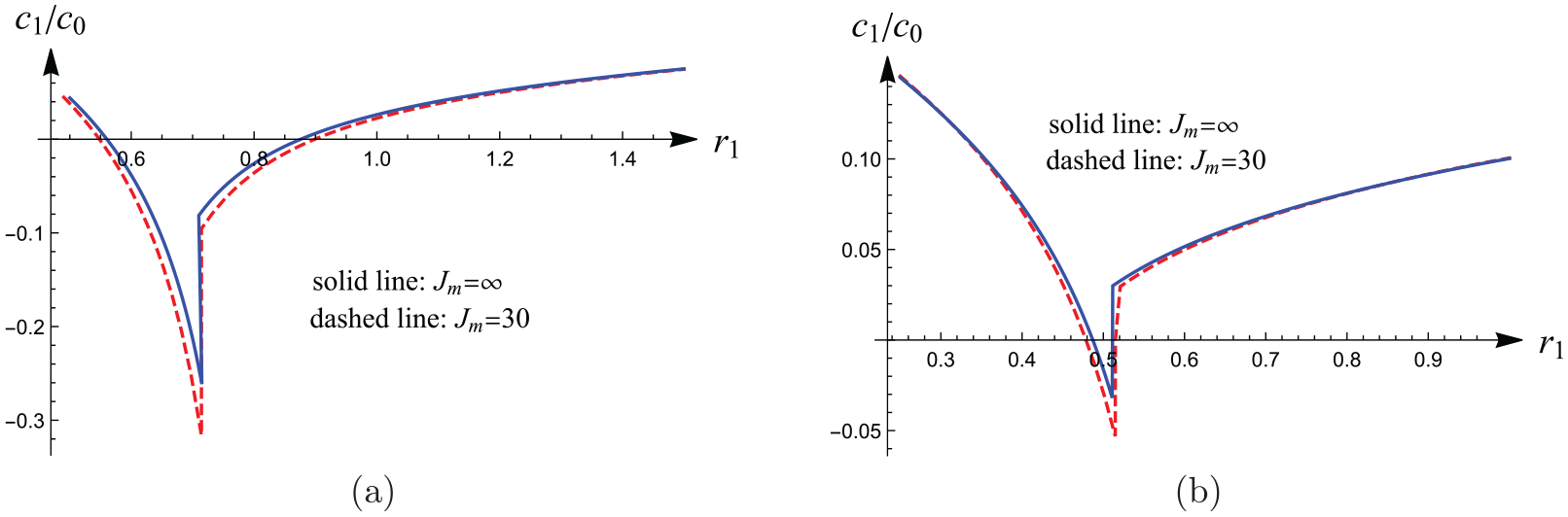
Comparison of the dependence of
Finally, in Figure 3(b) we display the results for
4.3. Uniaxial compression and general material model
When more general strain energy functions are used, solution of the second order problem follows the same procedure as in the previous section. The only major difference is that a particular integral as simple as (63) does not seem to be possible. Instead the required particular integral in (64) can be found using the method of variation of parameters [42]. If the equation for

where a and s are known constants, then the particular integral is given by

with the understanding that the arbitrary constants in the indefinite integrals are all set to zero (this is necessary in order to satisfy the decay condition as
We have written a separate Mathematica code based on the above formula to compute
5. Conclusion
In this paper, we have investigated the linear and nonlinear buckling properties of a hyperelastic half-space coated with two layers. At macro-scales, buckling usually undermines a structure’s integrity and should be avoided. When a structure is sensitive to imperfections, any imperfection, material or geometrical, will significantly reduce the critical load at which bifurcation takes place. Thus, from a practical point of view, it is important to find the parameter regime in which the structure is imperfection sensitive. At micrometre and sub-micrometre scales, robust wrinkling patterns can be harnessed to serve useful purposes. As only super-critical bifurcations may be observable/realizable in practice, results from our weakly nonlinear analysis provide a road map on how to choose a variety of combinations of material parameters to achieve robust wrinkling patterns.
Our analysis is conducted with the aid of the exact theory of nonlinear elasticity and for general strain energy functions. A Mathematica code is written for computing the coefficient
When the neo-Hookean model is used, three sets of representative results are presented corresponding to
We remark that although we have presented some representative behaviours, our numerical calculations are by no means intended to be exhaustive. For instance, we cannot conclude whether three or more stretch maxima can occur or not for other parameter combinations. Neither have we considered the effects of allowing a pre-stretch in the substrate [21]. The main aim of this paper has been to demonstrate that the sign of
