



Abstract
The traconia fish fish poisons people it comes into contact with using the spiny structure on its back. In this case, we report the exposure of a 62-year-old housewife to a dead traconia fish while cleaning the fish. The patient came to the emergency room with unbearable pain and burning sensation in his hand. He was not relieved by the analgesia given after the examination in the emergency room and the hot water immersion methods applied. Local anesthesia-analgesia was provided by the orthopedist using the regional block technique. It should not be forgotten that such rare cases may occur in places that are not connected to the sea and/or even when the fish is dead.
Introduction
Trachinus draco (trachonia) fish (the greater weever fish), which also has names such as big wolf and sea viper, is a poisonous fish species. It secretes poison upon contact with the poisonous spiny structures on the dorsal fin, which are located on both sides of its head. After this poisoning, pain, headache, nausea, dizziness, and/or tissue necrosis may develop in the affected body area. 1 These fish are mostly found hidden under the sand at the seaside or in shallow waters. 2 Traconia fish fish sting cases are more frequently seen on the Mediterranean and European coasts and in the summer months. 3 The main symptoms seen in patients are severe pain, swelling, and limited movement in the exposed area. The first treatment for patients is hot water immersion (HWI). It is necessary to apply hot water at 42–45 °C to the affected extremity for a period of approximately 30–90 min without causing a thermal burn or until the pain subsides. 4 During the continuation of the treatment, patients will experience severe pain, in which case analgesics and even regional anesthesia may be required.
Our case, on the other hand, took place at the patient’s home, in a city that is not connected to the sea. In addition, our patient's history of poisoning occurred by touching the spiny part of a dead traconia fish fish. Our study can be considered as a unique traconia case in the literature review.
Case Report
Our case involves a 62-year-old female patient who is a housewife. While she was cleaning anchovies she bought from the fishmonger, she noticed that a painful needle-shaped object was stuck in the second finger of her left hand. She recognized that the object that sank into her hand was another small-sized dead fish with its lower jaw pointing upwards—a different appearance from other fish (Figure 1). When she came to the emergency room, she had an unbearable pain covering her entire hand, along with swelling and mild erythema on her finger (Figure 2). The patient’s vital parameters, which were measured in the triage department of our hospital's emergency department, were as follows: blood pressure was 125/70 mm Hg, pulse was 86 beats/min, O2 saturation was 97%, respiratory rate was 18 breaths/min, and temperature was 36.6 °C. The patient had taken a picture of this fish that stung her hand and showed it to the emergency doctors; it turned out that it was a traconia fish fish—a poisonous fish species. During the physical examination, there was no foreign object in the area where the fish's spine had penetrated; sensory and motor examinations were normal. No pathological values were detected in the blood tests (hemogram, coagulation, and biochemistry) performed on the patient. There was no abnormal image on the plain radiograph.
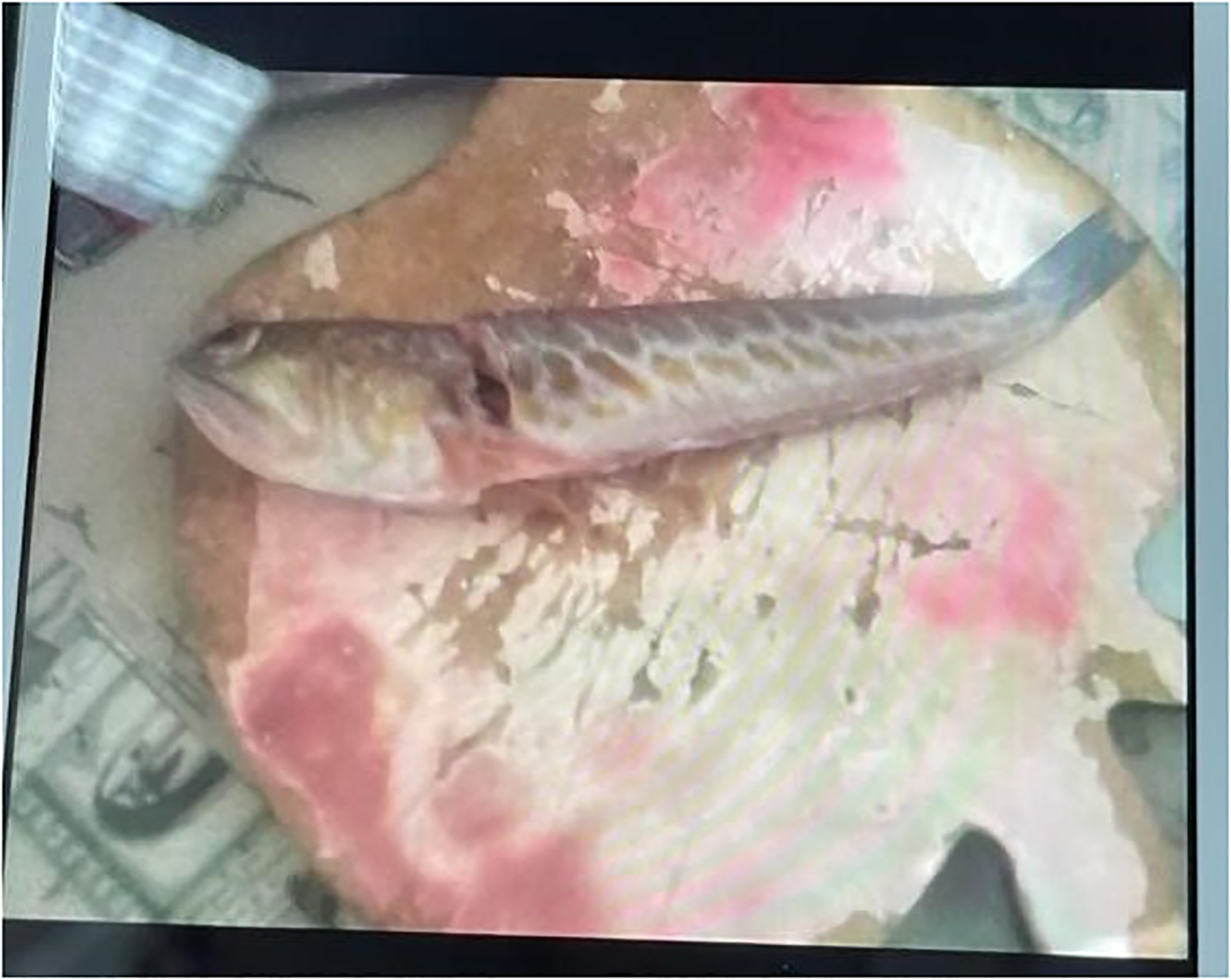
Mobile phone image of the traconia fish fish taken by the patient.
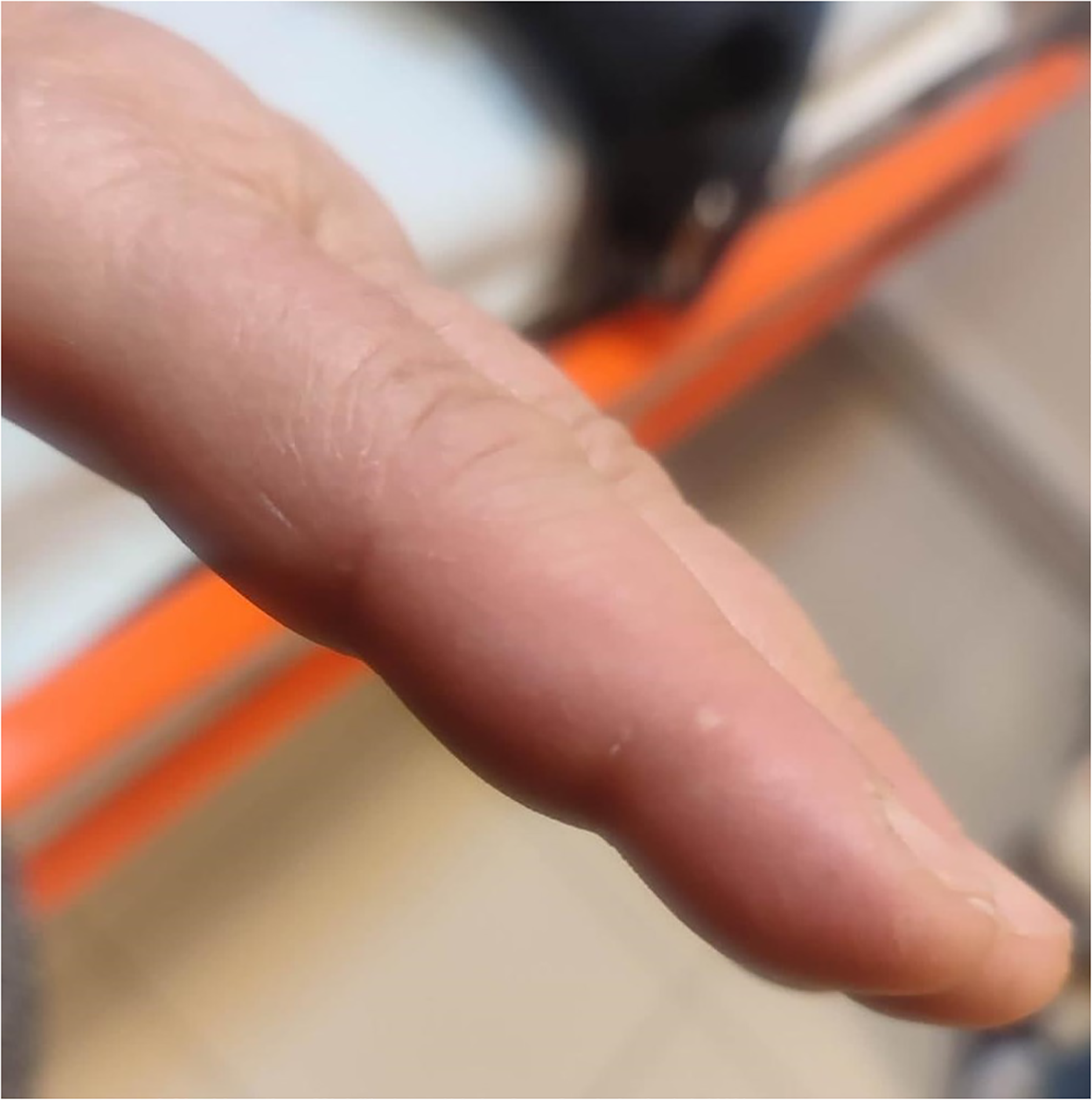
Redness on the lateral side of the second finger of the left hand.
The patient's hand was immersed in 45 °C hot water and kept as long as she would allow. Prophylactic tetanus vaccination, antihistamine, cortisone, and painkillers were given intravenously in serum. If she had an open wound, prophylactic antibiotics could also be given; however, since there were no findings suggestive of infection in the patient's clinical and laboratory results, prophylactic antibiotic treatment was not required. Due to continuing severe pain, consultation was requested from the orthopedic clinic. When the pain did not subside, regional block therapy was applied to the affected finger with 5 cc of 2% prilocaine solution (Priloc® -VEM-Turkey) as an anesthetic for analgesia. Doctors followed up for 1 day in the orthopedics and traumatology service for compartment syndrome and soft tissue infection. Our patient, whose circulatory and neurological examinations were normal during follow-up and whose complaints resolved, was discharged with an analgesic anti-inflammatory prescription. On the third day, the patient was called for control. No pathology was detected in the control examination and laboratory tests.
To publish this case, the images in Figure 1 and Figure 2 were used with permission from the patient.
Discussion
Animal bites or stings, which have increased with climate change, have become an important public health problem worldwide. 5 traconia fish fish (weever fish) is known as one of the animals famous for its poison. They live on sandy/gravelly bottoms of the sea, generally at depths ranging from shallow water to 150 meters. The spines protruding from its dorsal fin contain a poison consisting of a heat-sensitive protein called ichthyoacanthotoxin. The most detected toxin is dracotoxin, which causes destruction and necrosis of erythrocytes. Dracotoxin poison contains heat-denatured proteins and mucopolysaccharides such as 5-hydroxytryptamine, which causes pain, histamine (resulting in redness and itching), epinephrine, norepinephrine, and serotonin, which causes cardiovascular effects. 6
The local effects, such as pain, burning, and redness, that occur in patients are due to the dracotoxin in the venom, which depolarizes the membrane and has hemolytic properties. The pain it creates is instantaneous, long-lasting, and quite severe. Systemic symptoms such as fever, chills, vomiting, syncope, delirium, bradycardia, and hypotension may also be observed in patients. 7 Unlike cases in the literature, local symptoms such as pain and burning were observed in the area where the poison penetrated but no systemic findings were observed. We guess that this is because the fish was dead, and therefore, the chemical structure of the poison had changed and/or its effect had decreased. We think that because the fish was not alive, the amount of poison secreted may have been reduced. On the other hand, it is stated in the literature that the secretion occurs outside the control of the fish since there is no muscle structure in the spiny region. 8 All previous cases had a sea connection. A diver off the coast of Malta was stung by this species of fish on the third finger of his right hand. Although the patient was treated with warm water and topical lidocaine, swelling and hemorrhagic areas developed in the entire finger. 9
In addition to acute symptoms of poisoning, some late symptoms have also been observed in other studies. In one study, excess skin tissue was removed with liposuction as a treatment option for the late finding of edematous excess tissue. 10 In some cases, finger amputation and Raynaud's phenomenon have been observed, as well as lymphangitis and lymphadenopathies. 1 However, no case of anaphylaxis due to the sting of this fish has been reported so far. One of the first steps in the treatment is to clean the affected area and remove thorn residues. 11 Afterward, it is also important to immerse the affected limb in hot water as a first aid option. 12 The first record of this practice dates back to 1758. The standard practice recommended today is to immerse the affected part in hot water at a temperature as high as the patient can tolerate for approximately 30–90 min. The purpose here is to make the protein structure in the dracotoxin poison inactive by being denatured by heat. We kept the patient's hand in hot water for about 45 min. Toward the end, she said he couldn’t stand it so we took her hand out of the water. On the other hand, in some studies, we have seen that there are different treatment applications for other poisonous marine creatures. In jellyfish stings, Loten et al tried ice application against HWI to relieve pain and found that HWI application was more effective. 13 Although bacterial infection at the sting site is rare, antibiotics may be given to prevent possible regional inflammation. 14 When the clinical picture is delayed and hot water immersion does not help, paracetamol, NSAIDs, steroids, and antihistamines can also be given. 11 While antihistamines are preferred to relieve local inflammatory reactions, in the presence of an allergic reaction due to poisoning, steroids are used. 15 Apart from all these medical treatments, various exercises may be required to prevent contraction and flexion limitation in limbs such as hands and feet.
Conclusions
Our case is unique in the literature both in terms of the death of this fish and its clinical history. It is possible to encounter such cases even in places not close to the sea. As a result, all poisonous sea creatures need to be known. In cases of poisonous animal sting/bite, the correct and careful approach of clinicians to patients will prevent possible complications.
Footnotes
Author Contribution(s)
Declaration of Conflicting Interests
The authors declared no potential conflicts of interest with respect to the research, authorship, and/or publication of this article.
Funding
The authors received no financial support for the research, authorship, and/or publication of this article.
