



Abstract
Research has highlighted the need for training lifeguards in psychosocial skills. Therefore, this study aims to analyze the effectiveness of a short 10-h training program encompassing dimensions associated with emotional management, focus of attention, interpersonal relationships, and lifeguard behavior, and its effects on their psychosocial skills. A total of 64 lifeguards with experience ranging from 1 to 25 years (M = 5.93, SD = 6.07), randomly divided into experimental and control groups, participated in this study. The d2 Test of Attention, the Social Intelligence Test of O'Sullivan and Guilford, and the MSCEIT Emotional Intelligence Test were used to assess psychosocial skills. A multivariate analysis of variance for repeated measures (2 × 3 (Group × Time) MANOVA) was performed to analyze the effects of the training program on psychosocial skills. The results revealed that the experimental group showed statistically significant improvements in focus of attention and emotional intelligence compared to the control group. However, it is worth noting that no statistically significant group interactions were observed for measures of social intelligence. Taken together, these results seem to highlight the importance of including psychosocial content in the general training of lifeguards.
Introduction
Drowning is the third leading cause of unintentional fatalities worldwide, and the preventive actions of lifeguards have demonstrated the ability to reduce incidences of drowning.1,2 Although the capabilities associated with water rescue are extremely important for lifeguards, it is known that 99.8% of their work is carried out in preventive actions to avoid potentially dangerous situations for others and themselves. 3
In a study with expert lifeguards, Santiago et al identified different characteristics that prove to be fundamental for professional lifeguards, such as preventive character (eg, attention, surveillance, and emotional regulation) and interpersonal relationship skills (eg, communication, politeness, positive attitude, and assertiveness). 4 The construct of attention represents cognitive states in which the subject focuses on a certain aspect, information, or event. This seems to be essential for lifeguards since drowning can occur in brief moments, and the prevention of potentially dangerous situations is fundamental to and part of the duties of this professional.5,6
Another construct that seems to be associated with lifeguard competence is the ability to influence one's own or others’ emotions. Expert lifeguards understand the importance of recognizing and regulating emotions during their preventive actions. 7 Knowing how to interpret emotions may allow lifeguards to adapt their communication and interact more assertively with bathers. 8 Emotional regulation develops over time and takes into account social, cognitive, biological, and personality traits. 9
The lifeguard's capacity to form interpersonal relationships is recognized as fundamental. 10 Specifically, the lifeguard's nonverbal communication is driven by emotions, as shown through facial expressions, body posture, gestures, body movement, eye contact, and personal space management, among others.11–14 On the other hand, verbal communication provokes specific emotions and distinct responses in human beings. 14 Factors such as tone of voice and appropriate vocabulary for the circumstances must be mastered by lifeguards to ensure that interaction with bathers is guided by correct and adapted speech. Communication skills also represent fundamental tools to regulate behavior and disciplinary problems. 15
Due to the lack of specific training in psychological and behavioral components, lifeguards have reported difficulties in performing preventive actions and establishing positive relationships with bathers. 16 In particular, lifeguards reveal that communication with people who violate safety regulations is difficult. Additionally, lifeguards exhibit vulnerabilities in maintaining concentration due to the routine of their surveillance activity. Consequently, lifeguards experience situations of fatigue and tiredness that hinder their performance in their preventive functions. 17 Previous studies have reported the effectiveness of training programs on the development of emotional intelligence, social intelligence skills, and the focus of attention.18–22 Social intelligence entails the skill to interpret nonverbal and behavioral cues, showcasing proficiency in engaging and facilitating interpersonal relationships with others. 4
The effectiveness of this type of skills training program has not previously been studied in lifeguards. The basic lifeguard course usually consists of about 150 h of training. In this regard, assessing the effectiveness of a short training program (10 h) that could be included in the course content may be key to improving the lifeguards’ working skills, namely emotional intelligence, social intelligence skills, and the focus of attention. These topics require some specificity in the teaching content for lifeguards. More specifically, the knowledge of the framework of the reality experienced by the lifeguard allows a better assimilation of the contents. Similarly, the interpretation of nonverbal language may be a decisive factor in avoiding confrontations and allowing a greater respect for safety rules.
Considering the lifeguard profession, the need to keep attentive behavior is mandatory for successful action.23,24 In addition, lifeguards have to deal with people on a regular basis when both social and emotional intelligence may be determinant.25,26 Thus, understanding how these constructs can be impacted with a training program may be fundamental to enhancing lifeguards’ performance and working safety.
In this sense, a randomized study was developed to test the effectiveness of a skills training program aimed at improving the focus of attention, social intelligence, and emotional regulation of lifeguards.
Methods
Participants
Sixty-four professional lifeguards participated in this study (44 men and 20 women). After randomizing the participants, the control group was composed of 23 men and 9 women, while the experimental group was composed of 21 men and 11 women. All participants had completed at least 1 bathing season, corresponding to a minimum of 50 working days at the time of the study. Participants were between 19 and 50 y old (M = 26.84, SD = 7.63). The years of working experience varied between 1 and 25, with an average experience of 5 y (M = 5.93, SD = 6.07). Fifty-three percent of the participants had an academic degree equal to or higher than a bachelor’s degree (42% with a bachelor's degree, 9% with a master's degree, and 2% with a PhD degree). Forty-seven percent had an academic degree corresponding to complete high school education. All participants were lifeguards recognized by the Portuguese Instituto de Socorros a Náufragos (Maritime National Authority). In geographical terms, 36 participants were from the North (53%), 16 participants from central Portugal (25%), 9 participants from the South (14%), and 3 participants from Madeira (5%).
Study Design
The sixty-four participants were randomly divided into an experimental group and a control group. Initially, both groups performed the psychosocial skills assessment by responding to psychometric instruments (M1). Subsequently, only the experimental group participated in the 10-h program promoting psychosocial skills (ie, focus of attention, social intelligence, and emotional intelligence). The training sessions were developed online through Microsoft Teams (Microsoft Corp, Redmond, WA). At the end of this training, both groups were submitted for reevaluation (M2). After 3 months, a follow-up session was held for reevaluation (M3). After M3, the control group had the opportunity to attend the training program (Figure 1).
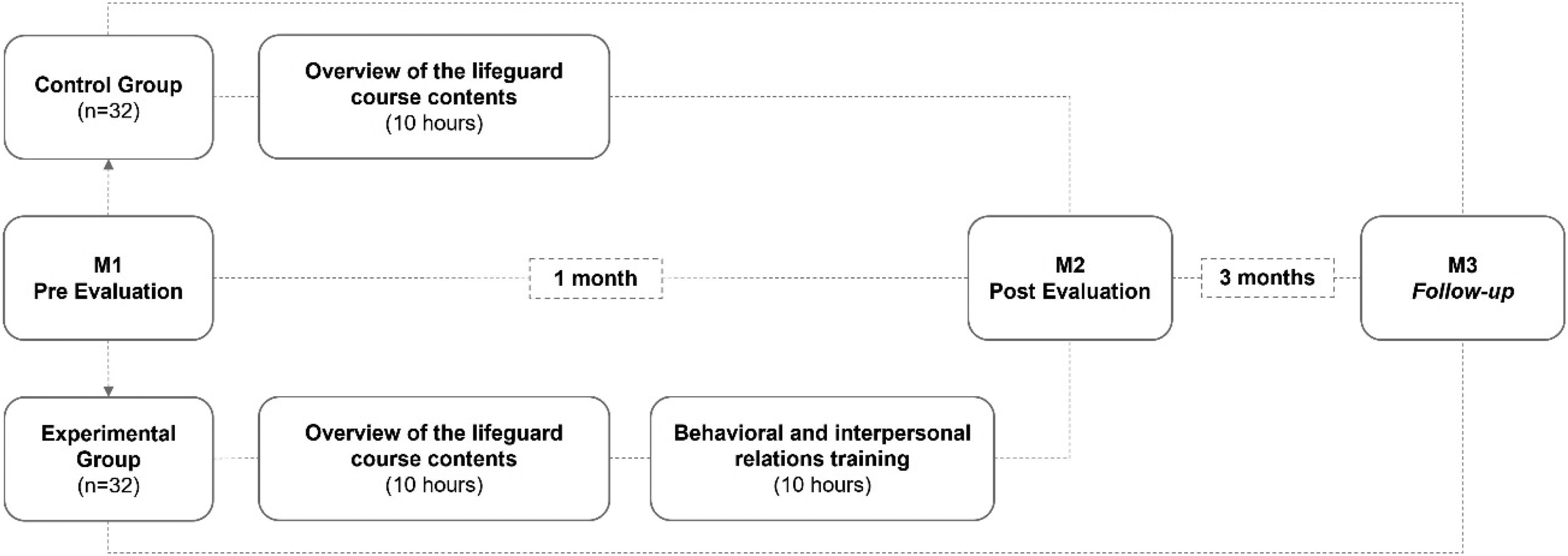
Diagram of the study.
Training Program
The participants completed a free and informed consent about the characteristics of the study and its purposes. All procedures were approved by the Scientific Committee of the Research Centre of the Polytechnic Institute of Maia (REF.004/05/18) and followed the guidelines of the Helsinki Declaration.
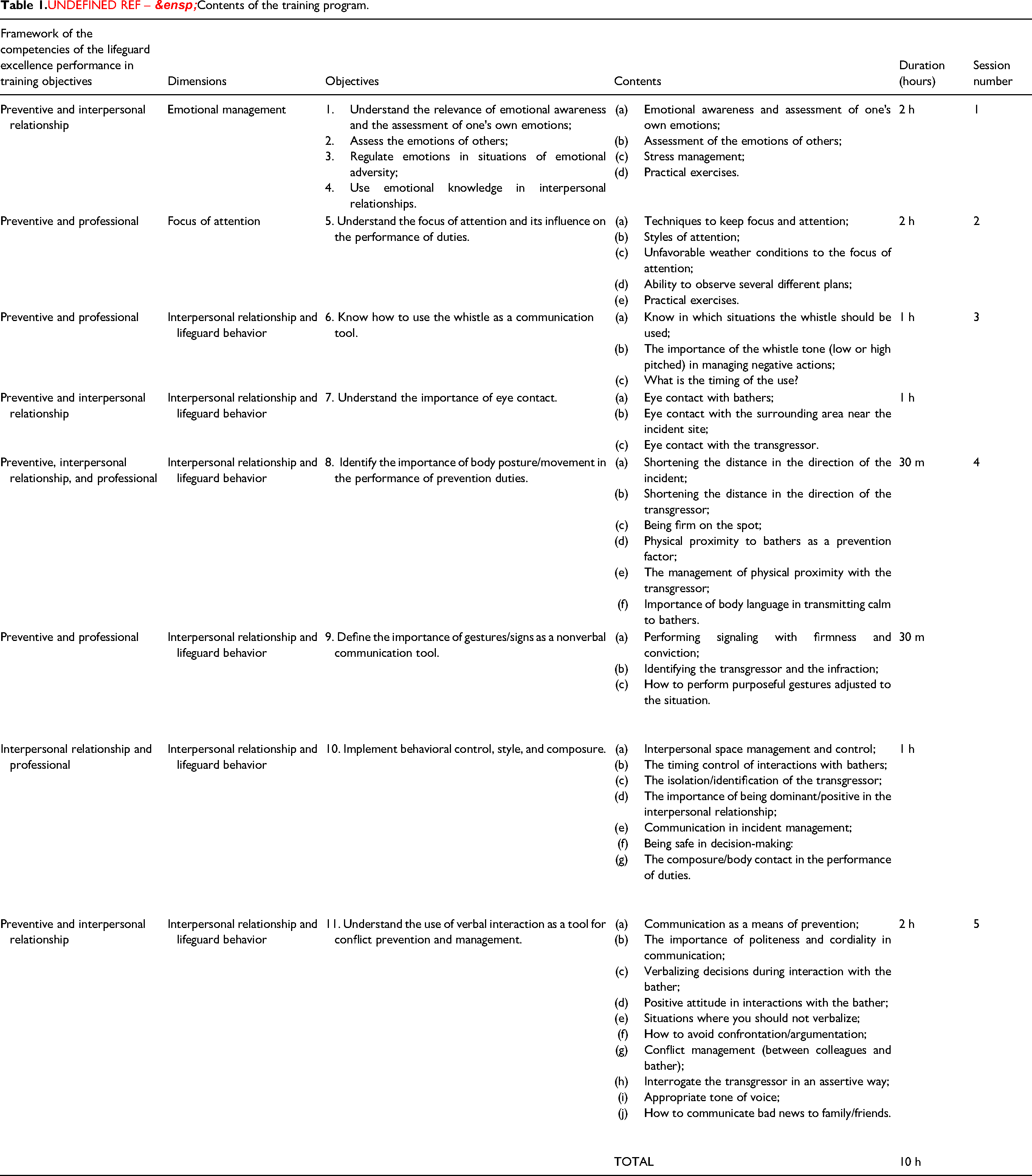
Based on the framework of the competencies of the lifeguard excellence performance, training contents were addressed within the dimensions of emotional management, the focus of attention, interpersonal relationships, and lifeguard behavior during 1 week totaling 10 h of training, as described in Table 1. 4
Contents of the training program.
Competencies Assessment Tools
In the initial and final assessment process, the d2 Test of Attention of Brickenkamp, the Social Intelligence Test of O'Sullivan and Guilford, and the MSCEIT Emotional Intelligence Test of Mayer-Salovery-Caruso were used.27–29 All tests were previously validated for this study.30–32
Attention
The d2 assessment test was used, which assesses attention span and is a time-limited test to measure continuous attention, selective attention, and mental concentration. It was applied individually for a duration of 4 min and 40 s. 27 The test includes 14 lines with 47 stimuli (letters “d” or “p” with dashes). The task consisted of going through each line and marking each letter “d” with two dashes. The scores resulting from the d2 test are derived from the ratio between correct and incorrect answers.
Social intelligence
This competency was assessed using the Social Intelligence Test of O'Sullivan and Guilford. 28 Social intelligence is the ability to decode nonverbal and behavioral messages and is characterized by the ability to interact and mediate relationships with others. 33 The Social Intelligence Test consisted of observing 3 images on the left-hand side and then observing 4 images on the right side and selecting the number of images that were most related to the images on the left.
Emotional intelligence
Emotional intelligence was assessed regarding competency of the Mayer-Salovery-Caruso MSCEIT. 29 This competency correlates with skills and abilities that enable awareness of one's own and others’ emotional states. The ability to regulate or use emotions positively affects performance.34,35 In the MSCEIT Test, we assessed the ability to interpret emotions and to use emotions to improve thinking. The ability to identify, understand, and regulate emotions was assessed to measure the best way to regulate one's own emotions and those of others. This task measures the participant's ability to incorporate emotions into decision-making processes involving other people. Participants were also asked to assess the effectiveness of different actions in different social contexts. 29
Statistical Analysis
Data were statistically analyzed in SPSS (Statistical Package for Social Sciences) version 27.0. Descriptive statistics means (M) and standard deviations (SD) were calculated for each of the constructs. The reliability of the measures was analyzed through Cronbach's alpha internal consistency index. A preliminary analysis of the data was carried out by performing the student’s t-test for independent samples and comparing the experimental group with the control group to check if the two groups were homogeneous. Then, considering the recommendation of Arnau and Bono, we used the multivariate analysis of variance of repeated measures (RM) (2 × 3 (Group × Time) MANOVA) to analyze the effects of the training program. 36 Wilks’ lambda was used to assess all multivariate effects, with a significance level set at 0.05. Effect sizes for F-statistics were analyzed according to Tabachnick et al, in which η2 = .01 corresponds to a small effect, η2 = .09 corresponds to a medium effect, and η2 = .25 represents a large effect. 37
Results
To assess the differences in the constructs under study between the groups in the pre-intervention phase (baseline), a t-test for independent samples was performed. No significant differences were found at baseline for selective attention (t (62) = 1.261, P = .189), emotional intelligence (t (62) = 1.870, P = .066), and social intelligence (t (62) = 1.044, P = .301).
To assess the effects of the intervention on psychosocial skills, a repeated measures MANOVA was performed, in which selective attention, emotional intelligence, and social intelligence were included as independent variables, and time (ie, pre- and post-intervention) and group (ie, experimental, control) as dependent variables. The results showed a statistically significant overall effect of the variable time * group (Wilks λ = 0.126, F(18,220) = 19.16, P < .001, η2 = .69).
Then, comparisons between the control group and the experimental group in the time * group interaction were analyzed with the other dependent variables: selective attention, emotional intelligence, and social intelligence. Specifically, participants in the training program showed significant improvement in selective attention (F(1.56) = 21.28, P < .001, η2 = 0.26) and emotional intelligence (F(1.56) = 18.67, P < .001, η2 = 0.27) compared to the lifeguards who did not participate in the training program. There were no significant differences between groups regarding social intelligence competencies (F(1.56) = 1.02, P = .122, η2 = .03). The means, standard deviations, and MANOVA results of the pre and post-test for the experimental and control groups are described in Table 2.
Means (M), standard deviations (SD), and MANOVA results for the pre-posttest comparisons.
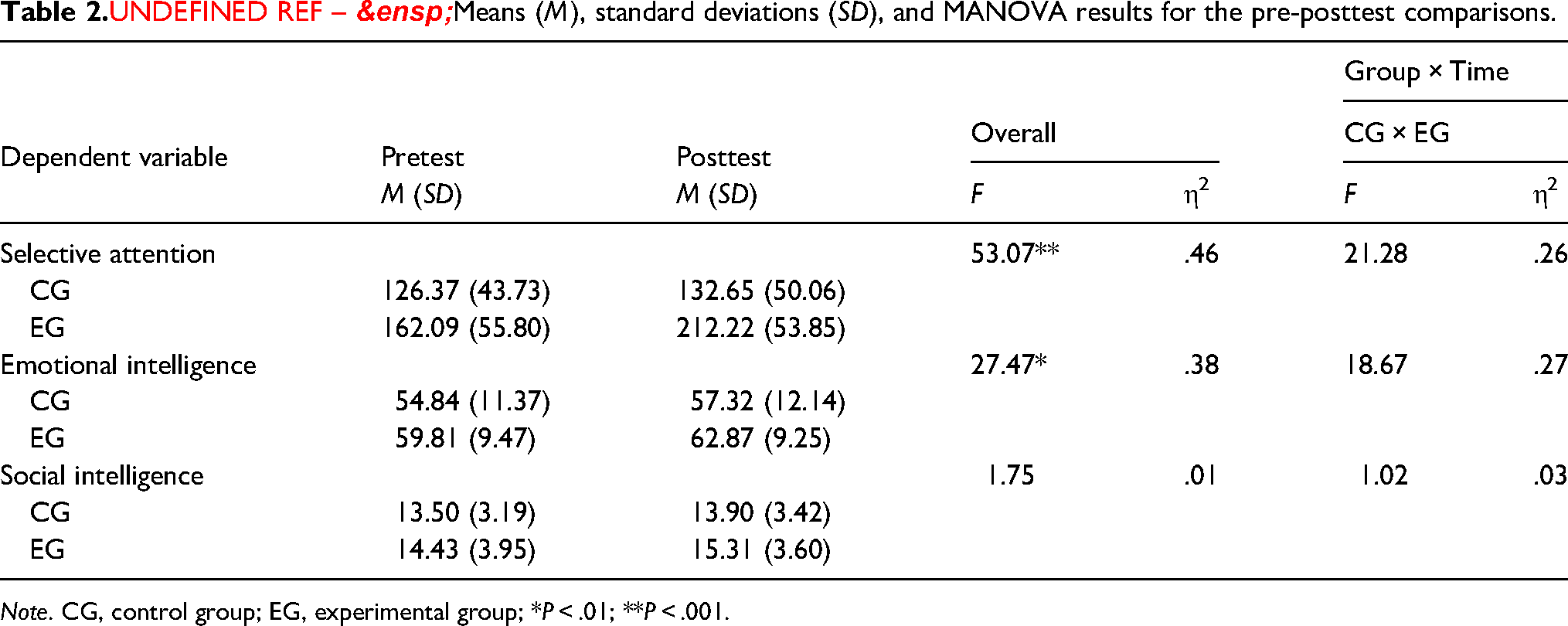
Note. CG, control group; EG, experimental group; *P < .01; **P < .001.
To examine the stability of the intervention effects after 3 months from the end of the program, a repeated measures MANOVA was again performed, including selective attention, emotional intelligence, and social intelligence as independent variables, and time (post-intervention, follow-up) and group (experimental, control) as dependent variables. Results revealed a statistically significant overall effect of the variable time * group (Wilks λ = 0.433, F(10,896) = 4.03, P < .001, η2 = .51). Participants in the training program revealed a significant improvement in emotional intelligence (F(1.61) = 6.33, P = .012, η2 = 0.18) compared to the lifeguards who did not participate in the training program. Results revealed no significant differences between groups for selective attention (F(1.61) = 1.06, P = .189, η2 = 0.02) and for social intelligence (F(1.61) = 1.29, P = .118, η2 = 0.03). Additionally, mean scores for selective attention, emotional intelligence, and social intelligence were compared between post-intervention and 3-month follow-up in each group, showing no statistically significant differences in the constructs under analysis over time (Wilks λ = 0.736, F(10,896) = 0.912, P = .622, η2 = .21). This result seems to indicate that the effects of the intervention are stable after 3 months. Figure 2 presents the results of repeated measures MANOVA for the pre and post-test and for the 3-month follow-up.
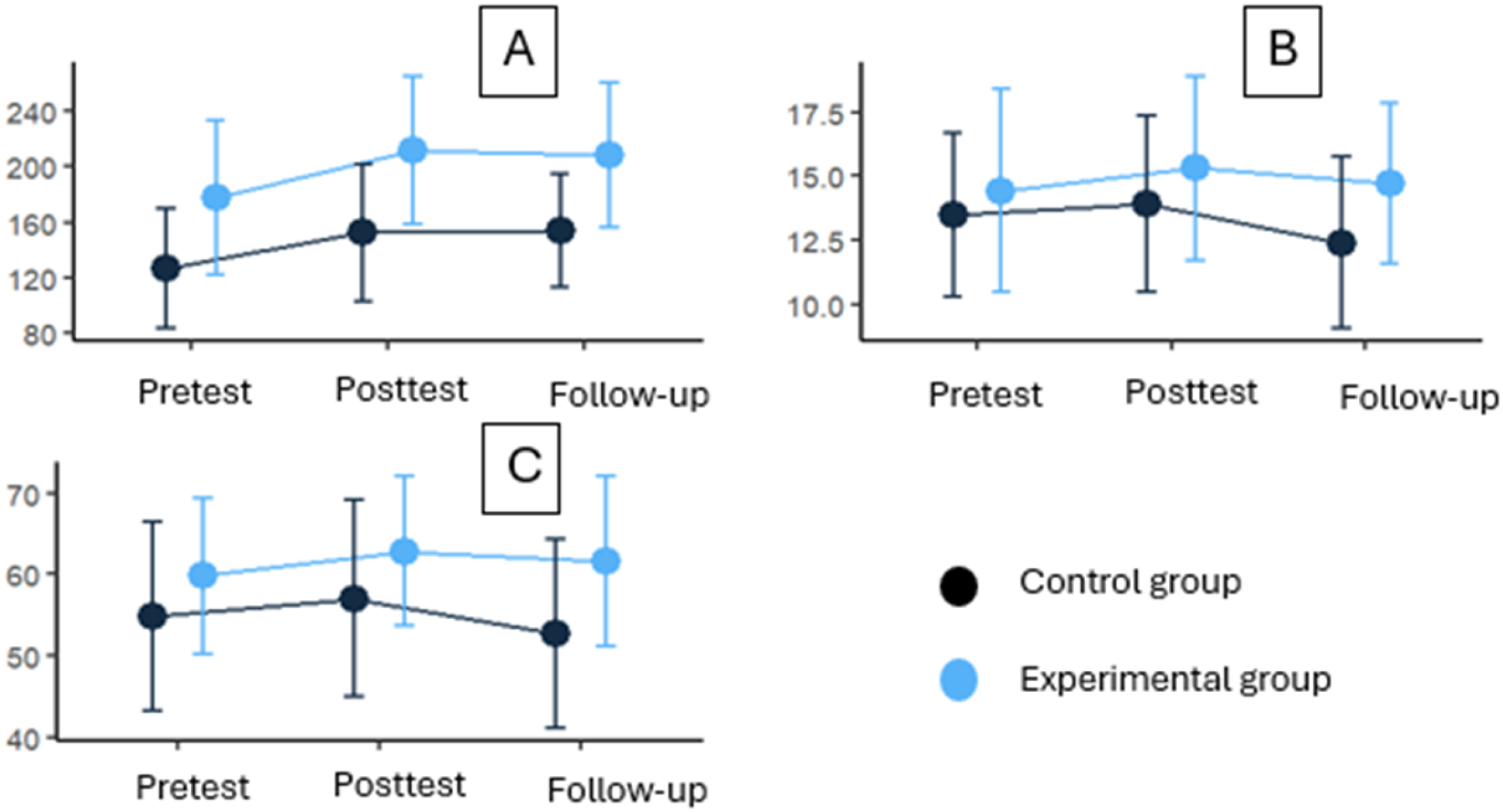
Pre-post and 3 months follow-up comparisons between the control and experimental group for the constructs under study. Values are mean ± standard deviation. A, Selective attention; B, social intelligence; C, emotional intelligence.
Discussion
The contents of the lifeguard course seem to inadequately cover training in the psychosocial component. International references are now adopting psychological and social dimensions in lifeguard training courses, exemplified by organizations such as Royal Life Saving Australia. 38 These components seem to be fundamental in the lifeguards’ actions because 99.8% of their work focuses on preventative actions. 3 Thus, this pilot study was designed to test and analyze the influence of a psychosocial training program on the psychosocial skills of professional lifeguards. To the best of our knowledge, this is the first study seeking to enhance psychosocial skills in lifeguards.
A statistically significant overall effect between time and groups was verified, which may indicate the effectiveness of the training program. Specifically, in the construct under analysis, participants in the training program showed a statistically significant increase in the constructs of selective attention and emotional intelligence but not in the construct of social intelligence. The importance of selective attention and emotional intelligence in lifeguards seems to be related to the ability to maintain the focus of attention, which may allow the prevention and detection of accidents more quickly, and to emotional intelligence in enhancing the ability to manage and control actions in stressful situations.39,40
The present study revealed nonsignificant effects regarding social intelligence. However, future studies must reinforce the analysis of social intelligence since it may enable lifeguards to interpret the bathers’ body language and act accordingly in this assessment. 41 The results obtained for this construct analysis may be justified by the sociocultural and demographic diversity. Psychometric studies demonstrate the crucial role of multiculturalism in enhancing individuals’ behavior identification performance. 42 Furthermore, the demographic variable may influence perceptions, motivations, and information processing in the interpretation of human behavior. 43
After 3 months, the participants underwent a follow-up assessment in which the stability of the effects of the training program was verified. Specifically, the groups showed statistically significant differences for emotional intelligence, but no differences were found for selective attention and social intelligence. A possible justification for this absence of differences in selective attention may be associated with the need for regular training to develop focused attention. 23 In particular, it may be important to understand the stability of the effects of continuous training on attention, similar to those used with emergency medical professionals. 22
Additionally, means were compared between M2 and M3 in each group. The results showed no statistically significant differences in the constructs under analysis over time, which seems to indicate a stabilization of skills. These results show that this training program for lifeguards may have positive medium-term effects, mainly on emotional intelligence skills. Considering that lifeguards constantly interact with bathers, this training program may be beneficial to improve prevention and interpersonal relationship skills. 19 Furthermore, it is hypothesized that a possible burnout at the end of the season may explain the worsened results at the 3-month follow-up of the control group. In contrast, the participants in the training program were able to maintain their psychosocial capacities, highlighting the usefulness of the training program.
Limitations and Future Research
Despite the overall positive effects of the training program, the results of the present study should be considered with caution due to inherent limitations. Firstly, the short time gap of 1 month between pre- and post-assessments (M1 to M2) may influence the recall aspect of the tests. 44 Additionally, we consider that this training program could be replicated with an intervention period of longer duration that would allow a deeper and more consistent testing of the effectiveness of this program. 44 In addition, a 6-month follow-up period may be relevant to verify the stability of skills in the long term. Secondly, the current lifeguards’ training in these areas is still limited, so other psychosocial factors could be considered, such as assertiveness, safety, and friendliness. 4 Moreover, there is research suggesting that women have higher emotional intelligence than men.45–47 In this sense, not considering participants’ gender may contribute to heterogeneous results. Finally, the tests carried out may not be able to give an accurate indication of the psychosocial readiness of the participants, especially if they are under significant stress from their role in the aquatic environment.
In summary, this pilot study guides several research possibilities in this area. The professional lifeguards in the experimental group benefited from the psychosocial skills training program, namely, in the short-term selective attention competency and in the short- and medium-term emotional intelligence competency. These competencies may be relevant for saving human lives, promoting a better capacity for preventive action, and psychologically preparing lifeguards.
Footnotes
Author Contribution(s)
Declaration of Conflicting Interests
The authors declared no potential conflicts of interest with respect to the research, authorship, and/or publication of this article.
Ethics Approval
This study was approved by the Institutional Review Board of the Polytechnic Institute of Maia (REF.004/05/18).
Funding
The authors received no financial support for the research, authorship, and/or publication of this article.