




Abstract
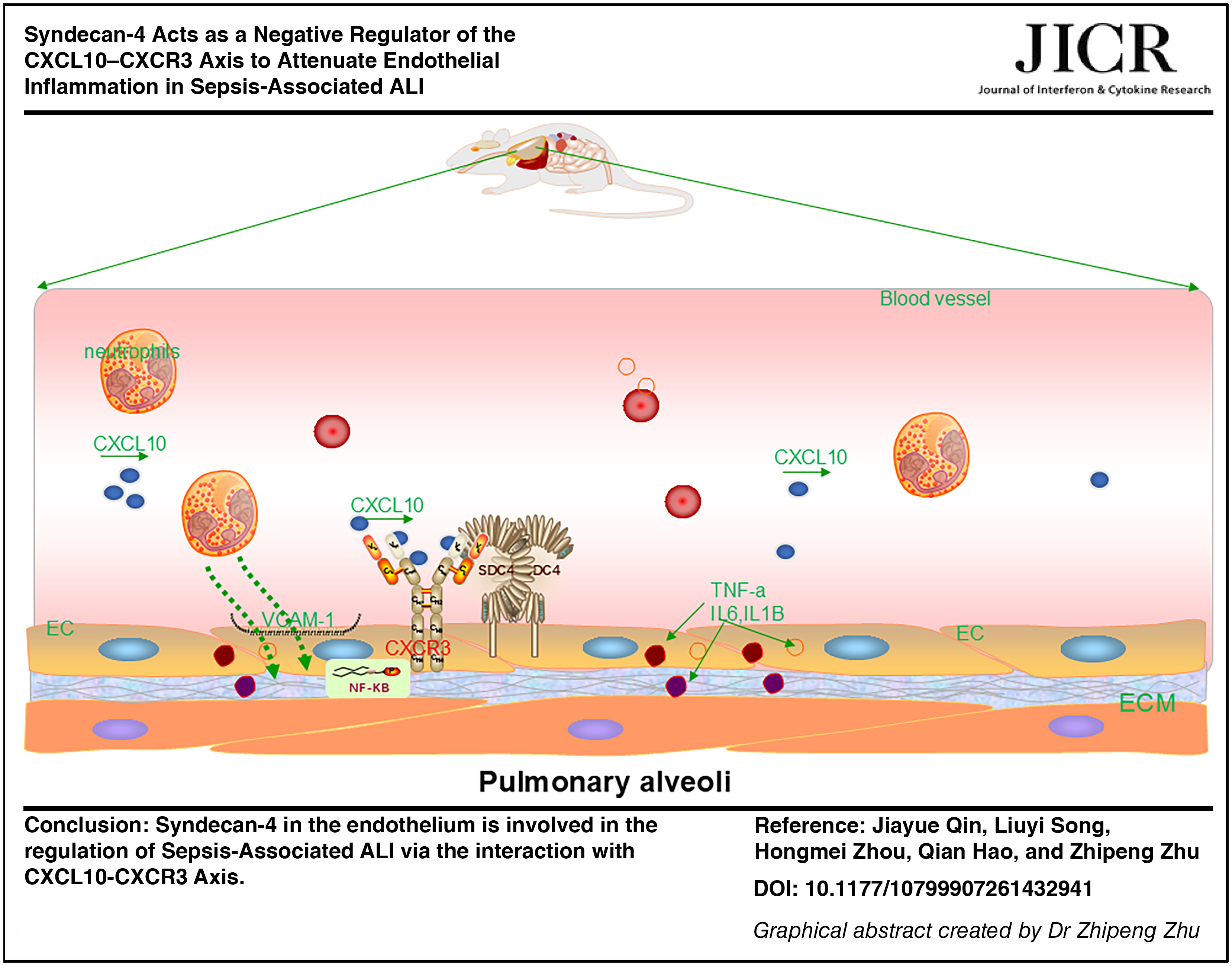
Endothelial cell injury and dysfunction are among the main causes of sepsis-associated acute lung injury (ALI); however, the underlying mechanism through which endothelial activation coordinates the adhesion and migration of immune cells remains elusive. Bioinformatics analysis revealed that the hub gene (C-X-C motif chemokine ligand 10 [CXCL10]) was predicted to be involved in both endothelial activation and syndecan 4 (SDC4) binding capacity. In both the LPS- and tumor necrosis factor-alpha -induced sepsis models, the expression level and biological function of the hub gene were confirmed by means of quantitative PCR and immunofluorescence staining. With the knockdown of SDC4 and the HS mutation technique, loss-of-function experiments and downstream pathway experiments following modulation of the hub gene’s expression were conducted to elucidate the underlying molecular mechanism. Through the overlap of GSE5883 and the glycosaminoglycan-binding DB, seven genes were discovered to be involved in the biological processes of SDC binding and cytokine–cytokine receptor interactions, including those involving CXCL10. Compared with that in the normal state, the expression of CXCL10 in the ALI state markedly increased during the acute phase of inflammation, and the SDC4 mRNA level greatly increased. Mechanistically, CXCL10 induces a proinflammatory response with the help of SDC4 as a coreceptor, leading to CXCR3/NF-κB pathway activation and VCAM1 overexpression. This proinflammatory phenotype was further enhanced by knockdown of SDC4. By mutating the heparan sulfate (HS) chain of SDC4, the severity of inflammation was exacerbated, and the recruitment of immune cells was also enhanced. In summary, endothelial-derived SDC4 acts as a negative mediator to ameliorate ALI through modulation of the CXCR3 pathway with the help of HS chains.
Get full access to this article
View all access options for this article.
References
Supplementary Material
Please find the following supplemental material available below.
For Open Access articles published under a Creative Commons License, all supplemental material carries the same license as the article it is associated with.
For non-Open Access articles published, all supplemental material carries a non-exclusive license, and permission requests for re-use of supplemental material or any part of supplemental material shall be sent directly to the copyright owner as specified in the copyright notice associated with the article.
