




Abstract
The non-consensual sharing of private sexual images (so-called ‘revenge pornography’) has become an increasingly prominent topic in social and legislative discussions about sexual crime but has received relatively little attention within psychological research. Here, we leveraged existing theorizing in the area of sexual offending proclivity to systematically develop and validate a measure of beliefs about this type of offending. There is currently a lack of validated assessment tools in this area, and these are important to better understand the role of offense-supportive cognition in predicting both proclivity of these offenses and judgements of both victims and perpetrators. Using an international community sample (N = 511) we found our ‘Beliefs about Revenge Pornography Questionnaire (BRPQ)’ to be comprised of four underpinning domains: ‘Victims as Promiscuous’, ‘Victim Harm’, ‘Avoiding Vulnerable Behaviors’ and ‘Offense Minimization’. Concurrent validity is demonstrated through relationships with trait empathy, belief in a just world, dark personality traits and rape myth acceptance. Randomly dividing the sample, we also show that the BRPQ was associated with both proclivity (n = 227) and social judgements of this type of offending (n = 232). Implications and future directions are discussed. An open-access preprint is available at https://psyarxiv.com/6qr7t/.
Keywords
The high profile leaking of private sexual images of celebrities such as Jennifer Lawrence, Kim Kardashian and Kate Upton has helped to not only catapult the term ‘revenge pornography’ into the public’s consciousness, but has also captured the attention of legislative bodies, politicians, legal scholars and social scientists (e.g. Fido & Harper, 2020; Hall & Hearn, 2017; Henry & Powell, 2016; McGlynn et al., 2017). Now identified as a criminal offense in several countries and local jurisdictions (for review of global legislative developments, see Fido & Harper, 2020), ‘revenge pornography’ is defined as the non-consensual distribution of explicit, private sexual images or videos of another individual, which typically are shared with the intention to cause shame, humiliation, embarrassment, or distress to that person (Citron & Franks, 2014; Patella-Rey, 2018), or for the perpetrator to gain popularity (e.g. bragging about sexual conquests; Ringrose et al., 2013). There is a growing body of research emerging that focuses on social judgements of ‘revenge pornography’ (see e.g. Bothamley & Tully, 2018; Fido et al., 2021; Pina et al., 2017), but little is known about what people think about his type of behavior, nor what can predict such beliefs. Therefore, a gap exists for a standardized test that accurately measures these beliefs so that our knowledge in this area can be better measured and therefore understood. It is this gap that we seek to fill with this paper.
There is currently a lack of clarity over how to best conceptualize so-called ‘revenge pornography’. At the social level, one approach (likely related to the popularity of this colloquial label) asserts that this behavior is exclusively committed by ex-lovers following the breakdown of a relationship. Although a notably common motivation (Burris, 2014; Walker & Sleath, 2017), the term ‘revenge’ depicts a narrow, incomplete view of this type of behavior. This narrow view ignores the possibility of other motivations, such as blackmail, coercion, entertainment, financial gain, notoriety, or sexual gratification (Franks, 2015; Harper, et al., 2021; Henry & Powell, 2016). It can therefore be argued that the terminology itself further adds to the misunderstanding of the act being facilitated purely for the purposes of revenge. The term pornography is also inaccurate as it suggests that the distribution of content is consensual, and thus fails to capture the breaches of trust and privacy that the behavior embodies, alongside the severity of the harm caused to the victim (Henry & Powell, 2015). Accordingly, it could be argued that terminologies such as revenge and pornography may contribute to public misconceptions about the offense and further stigmatization of the victim. However, we do adopt this label in our scale for several reasons. For example, a lot of work has been conducted already using this label that examine public judgements of this behavior (e.g. Bothamley & Tully, 2018; Fido & Harper, 2020; Hall & Hearn, 2017; Walker & Sleath, 2017), and we believe that it is important to use language that most people will recognize, particularly when surveying public attitudes (as is our aim here) 1 .
There is a paucity of available data on social attitudes about the non-consensual sharing of private sexual materials. However, recent US-based research provides evidence for a high level of support for the criminalization of ‘revenge pornography’ (Lageson et al., 2018). This was particularly the case among women in this sample, but support for criminalization was reduced in cases whereby the victim had self-produced and initially distributed such material themselves. This might indicate a degree of ‘just world’ thinking (Lerner, 1980), where individuals make assumptions that the world is fair, and people get what they deserve (Strömwall et al., 2013).
Alternatively, those with a higher degree of trait-level empathy might be better able to sympathize with victims of the non-consensual sharing of private sexual images, regardless of their history of sexting, and recognize the normative (or, at times, coercive) nature of this emergent socio-sexual behavior. Empathy is considered a multifaceted construct that helps people to act in altruistic ways and acquire social and moral norms (Decety & Cowell, 2014; Zaki, 2018). Where an individual is unable or unwilling to act empathically, antisocial or criminal behavior including sexual violence may occur (Ward & Durrant, 2013). In the only existing work to examine the effects of empathy on judgements of the non-consensual sharing of private sexual images, Fido et al. (2021) reported weak relationships (r < .20) between empathy and leniency judgements about a hypothetical case, potentially suggesting an attenuating effect of empathy over the direct effects of other factors, rather than empathy having a direct effect on judgements in its own right. They cited so-called ‘dark’ personality traits (Jonason & Tost, 2010) such as sadism, narcissism, Machiavellianism and psychopathy as potential drivers of negative social attitudes (and proclivities for) engaging in the non-consensual sharing of private sexual materials (for evidence of sadism impacting criminal activity, including ‘revenge pornography’ offending, see Buckels, et al., 2013; Buckells et al., 2014; Fido et al., 2021; Russell & King, 2016). As such, it is important to control for these kinds of personality characteristics when examining social attitudes about this emergent form of sexual offending. However, of perhaps more direct importance is understanding specific belief structures that may be supportive of such acts.
Why do we Need a Measure of Beliefs?
There is a vast amount of work within the sexual offending literature that examines the role of offense-supportive cognition in predicting a proclivity towards sexual aggression (e.g. Bohner et al., 2005; Bumby, 1996; Hermann et al., 2012; Polaschek & Gannon, 2004; Polaschek & Ward, 2002; Ward, 2000) and judgements of sexual aggression (e.g. Harper, et al., 2020; Süssenbach et al., 2012). At a societal level, we refer to widespread offense-supportive beliefs as rape myths. These are defined as a complex set of prejudicial, stereotyped and false beliefs about rape victims, rape perpetrators and the crime of rape (Burt, 1980). Although some aspects of this definition have been queried (see Reece, 2013), such beliefs may commonly serve to place blame on the victim, absolve or excuse the perpetrator of sexual violence, and minimize or justify the crime of rape (Bumby, 1996; Burt, 1980; Harper, et al., 2020; Hermann et al., 2012). Common examples of rape myths include that victims ‘ask for it’ by wearing sexually provocative clothing, that men commonly do not mean to commit sexual offenses (but rather their sexual arousal gets the better of them), that some women report sexual offenses that did not really happen, and that women can manipulate men into behaving in sexually inappropriate ways (McMahon & Farmer, 2011; Polaschek & Gannon, 2004; Polaschek & Ward, 2002).
The endorsement of such beliefs has profound effects on judgements of sexual aggression, with subsequent effects of victims blaming themselves for their experiences, decreased willingness to seek support after victimization, and low conviction rates (Hildebrand & Najdowski, 2015; Watts et al., 2017). Although rape myths and beliefs about sexual assault are widely studied (see Helmus et al., 2013), there has been virtually no examination of such cognitive processes related to the non-consensual sharing of private sexual images, that uses a systematically developed and validated scale that measure beliefs about this behavior. In one related study, Branch et al. (2017) found that participants believed that those who sext would be more likely to ‘hook up’, indicating the presence of subtle rape myths linking normative sexual behavior in the modern era with sexual promiscuity. This may support the research of Hatcher (2016), wherein rape myth acceptance predicted victim blaming. It may be that in the case of a sexual assault, a woman is seen as ‘asking for it’ because of her perceived sexual promiscuity or dress (Edwards et al., 2011), with this same judgement being made in cases when a victim has previously distributed self-produced sexually suggestive materials.
We should highlight why we seek to study beliefs about the non-consensual sharing of private sexual materials, rather than myths. Although it is accurate to state that no victim is responsible for their experiences, it is equally true to suggest that the self-production and consensual dissemination of private sexual materials does place somebody at a greater level of vulnerability to become a victim of such materials becoming more widely available. This is highlighted in psychoeducational programs designed to reduce risk of victimization, wherein education providers speak about the inherent dangers of making such material privately available, and thus losing control over its dissemination (Döring et al., 2014). We also know that around 80% of victims self-produce the sexual content that is ultimately shared (Citron & Franks, 2014), and it may be that this self-production leads to victim blaming at a social level (Campbell & Raja, 2005).
We know that victim blaming is high for sexual crimes, and labelling theory exerts how individuals are impacted by how society views them (Becker, 2018). Victims of the non-consensual sharing of private sexual materials often suffer high levels of embarrassment, guilt, self-blame and shame (Bates, 2017), some which may be a result of the blame imposed upon them by society, in that they internalise these societal views. Victims are also at risk of harm for continuous and prolonged periods of time (Bates, 2017), as social media platforms and photo sharing sites allow for their photos/content to continue to exist or easily re-emerge at any time, to potentially millions of people (Citron & Franks, 2014). They also exhibit greater levels of anxiety, depression, low self-esteem, maladaptive coping mechanisms and suicidal ideation at similar rates to victims of rape and sexual abuse (Bates, 2017). Therefore, it is crucial to understand public beliefs about the non-consensual sharing of private sexual materials so that we can better understand both judgements about the crime itself, the perpetrator, and the victim, including blame, and to also understand proclivities to engage in this form of sexually harmful behavior.
There are currently no systematically developed or validated measures of beliefs about the non-consensual sharing of private sexual materials as a specific behavioral pattern. Such beliefs have been measured in relative ad-hoc ways thus far. For example, Bothamley and Tully (2018) used eight self-written items to measure perceptions of victim blame and the psychological harms associated with victimization. This scale was subsequently used in Fido et al. (2021) as a single-factor measure of ‘offense leniency’. Zvi and Bitton (2020) used a similar approach, instead using a smaller number of face-valid items tapping into victim blame. Alternatively, other studies have simply adapted belief scales from the broader rape myth and cognitive distortion literature (e.g. Starr & Lavis, 2018). In the only specific measure of beliefs about the non-consensual sharing of private sexual materials, Powell et al. (2019) used existing rape myth scales to develop their ‘Sexual Image-Based Abuse Myth Acceptance Scale’. Although this measure was a positive step forward for the field, the paper reported minimal psychometric data, information about item construction and scale validation. As such, we believe that there is still room within the literature for a new, systematically developed and validated, measure of beliefs about the non-consensual sharing of private sexual materials.
Aims and Structure of this Paper
To date, little research has been conducted to understand not only what beliefs are associated with the non-consensual sharing of private sexual images, but also how these beliefs might be predicted. In addition, once these beliefs are established, it is important to understand how they might predict both a proclivity to offend in this way and social judgements of such criminal cases.
We conducted four complimentary studies. Study 1 documents the systematic development and validation of a scale designed to measure beliefs about the non-consensual sharing of private sexual images as a form of image-based sexual abuse. We used a large sample to examine the factor structure of our draft ‘Beliefs about Revenge Pornography Questionnaire’ (BRPQ). In Study 2, the demographic variables and measures of constructs theoretically associated with beliefs about the non-consensual sharing of private sexual images (e.g. rape myth acceptance, empathy, belief in a just world, sadism and dark triad personality traits) were used to predict BRPQ factor scores to examine the construct validity of the scale. In Study 3, the sample was randomly allocated to different vignettes that explored the self-reported proclivities to engage in the non-consensual sharing of private sexual images. In Study 4, judgements of revenge pornography scenarios were then explored, controlling for pre-existing beliefs about the non-consensual sharing of private sexual images, measured using the BRPQ.
Methods
Participants and Recruitment
We used an online cross-sectional survey design to run this project. In total, 683 people started the survey, with all participants who completed the draft BRPQ being retained. This left a final sample of 511 participants (56% female; Mage = 30.05years, SD = 10.69). All participants were recruited online, using institutional research participation schemes and posts on social media websites. We posted study advertisements on personal and community Facebook pages, Twitter (with tags #revengeporn, #revengepornography and #imagebasedsexualabuse) and selected forums on Reddit.com (r/SampleSize, r/love, r/relationships, r/porn and r/dating). This approach to data collection allowed us to gain a more representative general community sample than merely relying on student participation schemes or populations who sign up to survey participation platforms, such as Amazon’s MTurk, or Prolific. The inclusion criteria were an age over 18years, and fluency in English. Most participants were from the UK (47%), US (26%), Canada (7%), or Australia (4%). From the outset, we set no sample size targets due to a lack of funded support for the project but sought to maximize the number of participants with the resources available to us.
Procedure and Materials
The data reported in this paper stem from a sample of community members (see above) who all participated in a single online survey. Within this survey, everybody completed the first draft of the BRPQ (Study 1), and subsequently completed a series of other measures to validate the questionnaire (Study 2). Following this, participants were randomly assigned to one of two subsequent study branches, wherein they completed either a measure of ‘revenge pornography’ proclivity (Study 3), or a task asking them to judge hypothetical cases involving the non-consensual sharing of private sexual images (Study 4). As such, Studies 3 and 4 represent independent samples. We did not use any specific attention or additional validity checks within our survey. This procedure was approved by the Nottingham Trent University School of Social Sciences Research Ethics Committee.
Demographics
Participants were asked to report their age (in years), sex (male/female/other), political ideology (scored using a single-item 1-5 scale, where higher scores indicated higher levels of conservatism) and nationality. In all analyses, we removed those who declared their sex as ‘other’ (n = 8), and coded this variable as 0 = female, 1 = male.
Beliefs about Revenge Pornography Questionnaire (BRPQ)
Originally, 91 items comprised the draft BRPQ. These items were produced in a manner such that they related to a range of themes evident within the literature related to the non-consensual sharing of private sexual images, as well as related concepts in the areas of rape myths, implicit theories of sexual offending and rape culture. We used several existing measures for inspiration when writing the initial items of the BRPQ, including Burt’s (1980) rape myth measure, and the Illinois Rape Myth Acceptance Scale (IRMA; Payne et al., 1999). In addition, we reviewed popular, legal and academic discourses about the non-consensual sharing of private sexual images to add themes that were not represented in traditional sexual offending literatures. Participants responded using a six-point Likert scale anchored from ‘strongly disagree’ to ‘strongly agree’.
Toronto Empathy Questionnaire (Spreng et al., 2009).
The Toronto Empathy Questionnaire is a 16-item scale developed by Spreng et al. (2009), who combined a multitude of empathy questionnaires to gain an all-encompassing measure. It conceptualizes empathy as a primarily emotional process, with each item measuring a single factor of empathic concern. Items include ‘it upsets me to see someone being treated disrespectfully’, with response options scores from ‘1 – Never’ to ‘5 – Always’. Responses were averaged, with higher scores indicate greater levels of empathy.
Belief in a Just World Scale (Lipkusa et al., 1996)
The Belief in a Just World Scale (Lipkusa et al., 1996) is a measure designed to assess the extent to which its respondents believe other people get what they deserve and deserve what they get (Lippman & Campbell et al., 2014). Items include ‘I feel that people get what they deserve’ and are rated using a six-point scale anchored from ‘strongly disagree’ to ‘strongly agree’. Responses were averaged, with higher scores indicating a greater just world belief.
Short Dark Triad (SD3; Jones & Paulhus, 2014)
The Short Dark Triad Scale (SD3; Jones & Paulhus, 2014) consists of three separate nine-item subscales that measure trait scores of Machiavellianism (e.g. ‘Most people can be manipulated’), narcissism (e.g. ‘People see me as a natural leader’) and psychopathy (e.g. ‘Payback needs to be quick and nasty’). All items are responded to using a five-point scale, anchored from ‘strongly disagree’ to ‘strongly agree’, before being averaged for each dark triad domain. Higher scores represent a greater presence of each trait.
The Assessment of Sadistic Personality (ASP; Plouffe et al., 2019)
The Assessment of Sadistic Personality (ASP; Plouffe et al., 2019) is comprised of nine items designed to be used alongside SD3 to measure sadism, which allows for the measurement of each trait within the Dark Tetrad model of personality. Items such as ‘I would hurt somebody if it meant that I would be in control’) are rated using a five-point scale anchored from ‘strongly disagree’ to ‘strongly agree’. Following relevant reverse coding, an average score across all items was calculated, with higher scores indicating greater levels of sadism.
Illinois Rape Myth Acceptance Scale (McMahon & Farmer, 2011)
The updated Illinois Rape Myth Acceptance scale (IRMA; McMahon & Farmer, 2011) is a 22-item measure of adherence to myths about rape victims, rape perpetrators and the crime of rape (e.g. ‘When guys rape, it is usually because of their strong desire for sex’). The scale has a general rape myth construct and seven subscales. In this study, we used the IRMA to obtain an index of participants’ general adherence to rape myths. Each item was rated using a five-point scale anchored from ‘strongly disagree’ to ‘strongly agree’, before an average score across all items was calculated. Higher scores indicated more rape myth acceptance.
‘Revenge Pornography’ Proclivity Scale (Study 3 only)
The measure of ‘revenge pornography’ proclivity produced by Watson and Bartels (2017) was used to present a selection of short scenarios describing the non-consensual sharing of private sexual images. These cases were driven by one of five different motivations (relationship breakdown, infidelity, bragging, sabotage, or amusement) and were each approximately 150 words in length. To avoid participant fatigue, each respondent received five of the ten possible scenarios in a randomized order, ensuring that each motivation was presented once. We coupled each scenario with a brief proclivity measure used in Pina et al. (2017). This ten-item measure asked about participants’ direct proclivity to engage in the non-consensual sharing of private sexual images (‘In this situation, how likely is it that you would do the same?’), anticipated enjoyment (e.g. ‘How much excitement would this situation bring you?’; five items) and social approval (e.g. ‘In this situation, would you feel any regret over sharing the images?’; four items). Although Pina et al. (2017) used a five-point scale, we asked our participants to use a six-point scale (anchored from ‘not at all’ to ‘very much’) to avoid the use of a neutral scale midpoint.
‘Revenge Pornography’ Judgements Scale (Study 4 only)
To test social judgements of the non-consensual sharing of private sexual images, we adapted three scenarios from Scott and Gavin (2018). These scenarios depicted cases of the non-consensual sharing of private sexual images committed against a female victim who previously posted images of herself online in either sexually provocative or conservative poses. The third scenario omitted information about previous posting behavior. Following each scenario, participants used a six-point scale anchored from ‘strongly disagree’ to ‘strongly agree’ to provide ratings of victim blame (e.g. ‘How likely do you think it is that [victim’s name] could have avoided the incident?’; four items), perceived criminality of the behavior (e.g. ‘Do you think police intervention is necessary for the resolution of this situation?’; three items) and victim harm (e.g. ‘To what extent do you think the situation will have affected [victim’s name]’s trust of others?’; five items). Scores across items on each domain were averaged, with higher scores indicating increased levels of victim blame, perceived criminality and victim harm judgements.
Study 1 – BRPQ Scale Development
Responses to the draft BRPQ were entered into an exploratory factor analysis (EFA) using the psych package embedded into the jamovi statistics program (Revelle, 2019). An oblique rotation (direct oblimin) was used to allow factors to correlate with one another, with factors extracted using the maximum likelihood method and via a parallel analysis. This analysis runs 20 replications of an EFA to establish statistically meaningful factor eigenvalues. These are then compared to the observed eigenvalues within the current dataset to determine the number of factors to extract. The Kaiser-Meyer-Olkin (KMO) measure of sampling adequacy was .94, suggesting that our data were suitable for studying in this manner. In addition, Bartlett’s test for sphericity was significant, χ2(4095) = 23460, p < .001, meaning that our scale items correlated with each other in a manner that makes them suitable for factor analysis. We retained items in factors where their loadings were >.40 (Field, 2005). Cases with missing data were deleted listwise.
Significant Item loadings for the First Draft of the BRPQ.
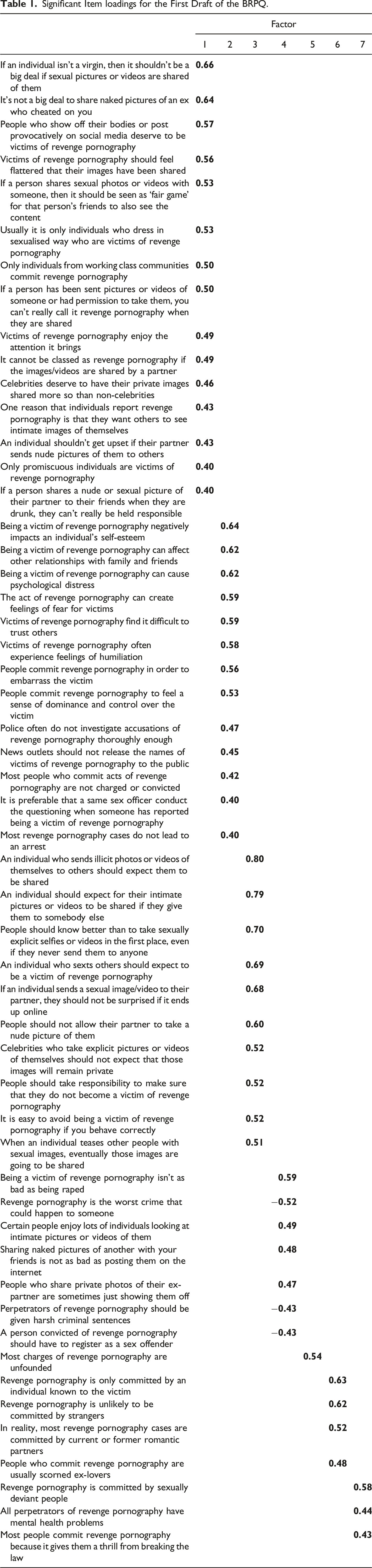
In examining Table 1, we chose to retain components where psychometric properties could be said to be strong. This meant that either there were at least five items within a component (Osborne & Costello, 2009), or where there were fewer than five items, these held together in a conceptually meaningful way (Worthington & Whittaker, 2006). Four of the seven factors met these criteria. In each case, final factor scores on the BRPQ were computed as mean values across all items of each respective factor (possible range = 1–6; higher scores indicate greater endorsement of the respective factor).
Factor 1 was labelled ‘Victims as Promiscuous’ (15 items) and taps into themes related to the characteristics of victims’ sexuality that may make them more vulnerable to the non-consensual sharing of private sexual images. This factor had excellent internal consistency (α = .94; ω = .94). Factor 2 was labelled ‘Victim Harm’ (13 items) and represents a cluster of items that link to the deleterious effects of being a victim of this type of offending, and the need for victims to be protected. This factor demonstrated very good internal consistency (α = .87; ω = .89). Factor 3 was labelled ‘Avoiding Vulnerable Behavior’ (10 items) and relates to the strategies that people might employ to avoid becoming a victim of revenge pornography. This factor was found to have excellent levels of internal consistency (α = .90; ω = .90). Factor 4 was labelled ‘Offense Minimization’ (7 items) and reflects the downplaying of the effects of ‘revenge pornography’ and its criminality. This factor possessed acceptable levels of internal consistency (α = .74; ω = .74).
In line with Schrieber’s (2021) guidance, we re-ran the EFA using only the included items to ensure consistency within the model, and found that all items loaded onto the expected factor (for transparency, this re-analysis is presented in the datafile at https://osf.io/3t6rh/.
Study 2 – Predictors of BRPQ Scores
After identifying the factor structure of the BRPQ in Study 1, we went on to predict scores on each of these components using constructs that were theoretically associated with associated outcomes (e.g. rape myth acceptance and judgements of the non-consensual sharing of private sexual images offending). Specifically, we used demographic predictors (e.g. sex, age, political orientation) alongside psychometric measures of empathy, belief in a just world, sadism, dark triad personality traits and rape myth acceptance.
Sample Information
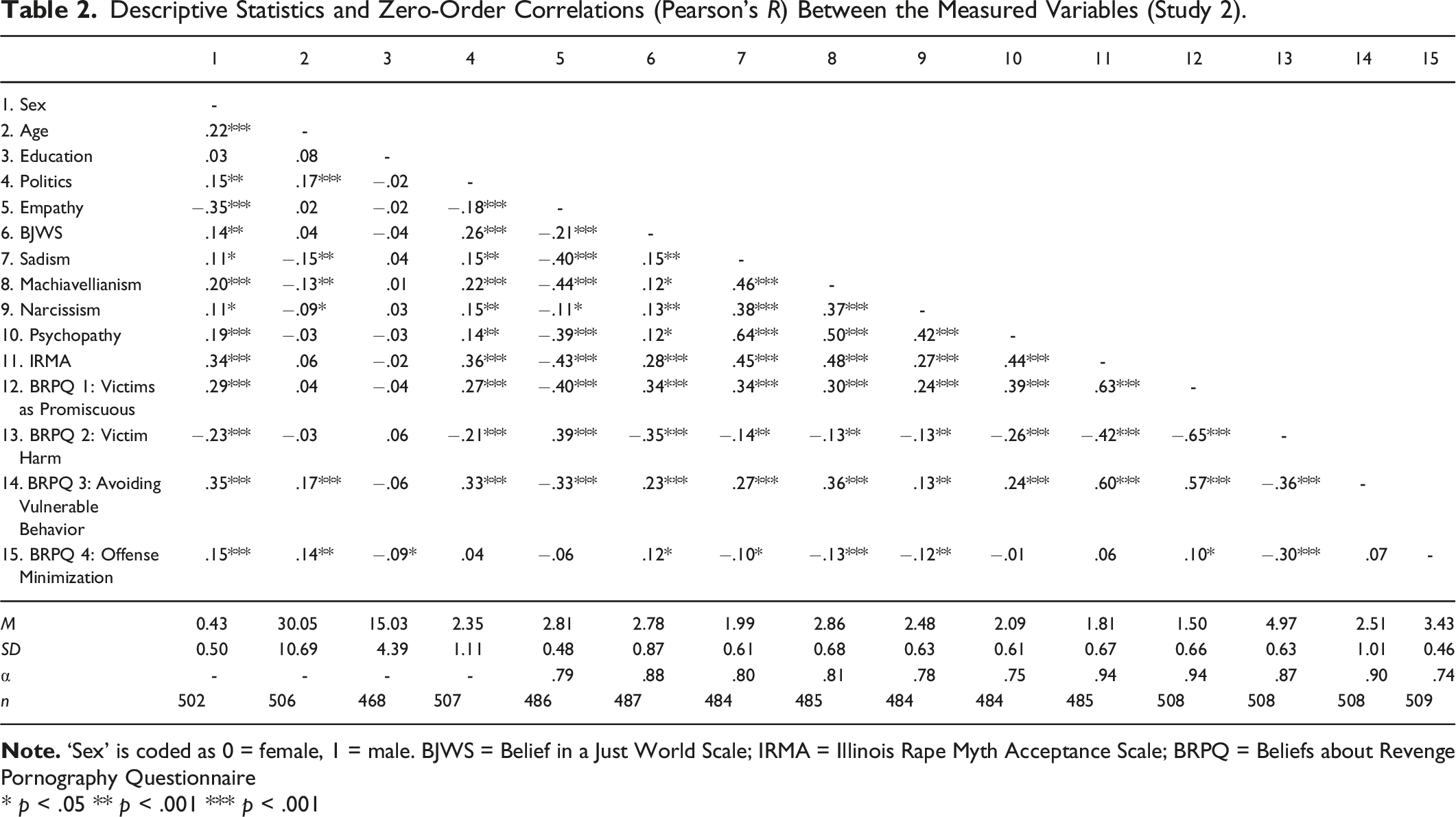
Descriptive Statistics and Zero-Order Correlations (Pearson’s R) Between the Measured Variables (Study 2).
* p < .05 ** p < .001 *** p < .001
Results and Discussion
Consistent with expectations, viewing victims of the non-consensual sharing of private sexual images as promiscuous and seeing victimization as avoidable were negatively correlated with empathy, but positively with constructs such as political conservatism, belief in a just world, dark triad and sadistic personality traits and rape myth acceptance. In most of these cases, the magnitude of the relationships between the variables corresponded to a medium effect size. These correlations were inverted when examining participant perceptions about the harm experienced by victims. In relation to the endorsement of minimizing beliefs, we observed relatively weak associations (rs < .15) with our observed psychological trait variables. Although the coefficients for belief in a just world (positive association) and sadism, Machiavellianism, and narcissism (all negative associations) were statistically significant, the magnitude of these relationships casts doubt over their practical meaning.
Seeing victims as being promiscuous was positively correlated with viewing victimization as avoidable, but negatively correlated with perceptions of victim harm. Similarly, endorsing the view that people can avoid becoming victims of the non-consensual sharing of private sexual images was associated with lower attributions of victim harm. Attributions of higher levels of victim harm were associated with less offense minimization.
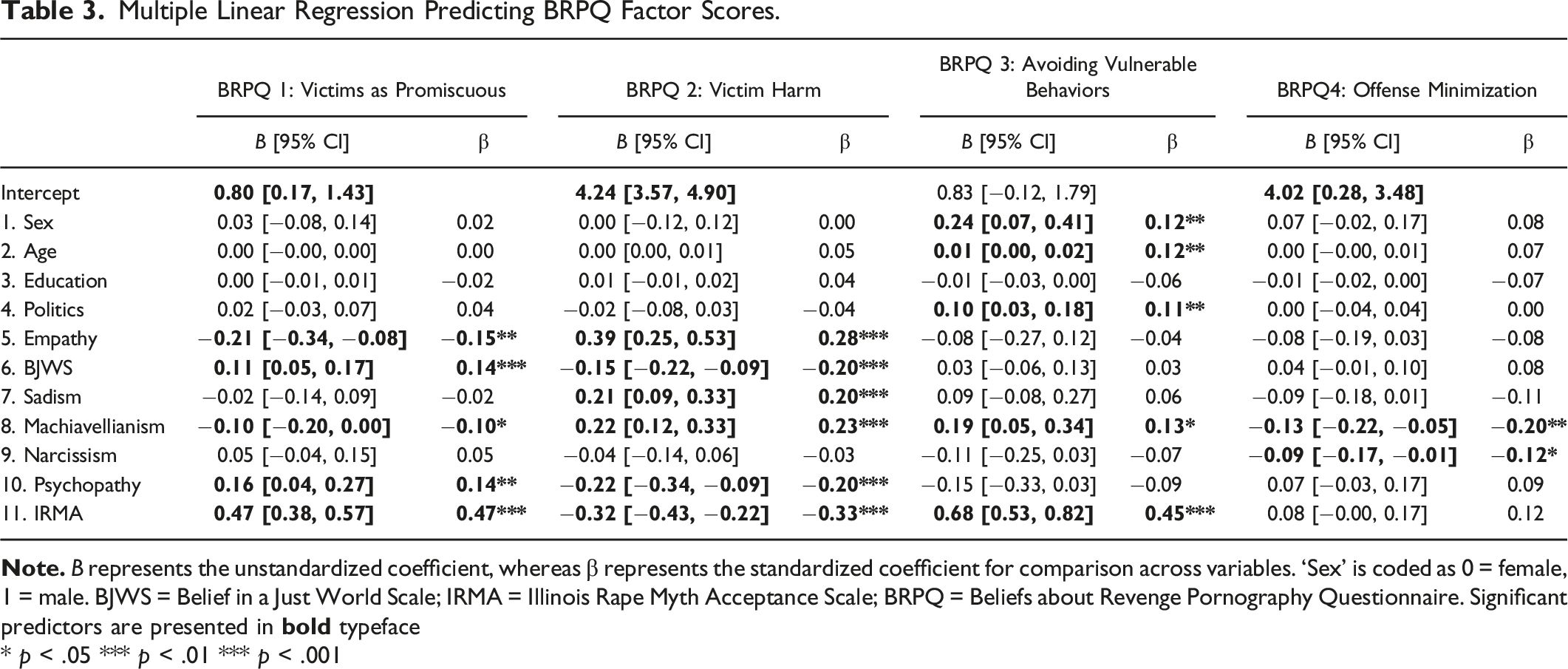
Multiple Linear Regression Predicting BRPQ Factor Scores.
* p < .05 *** p < .01 *** p < .001
In relation to viewing victims as promiscuous, lower levels of empathy (β = −.15, p = .001), higher levels of belief in a just world (β = .14, p < .001), lower levels of Machiavellianism (β = −.10, p = .040) and higher levels of both psychopathy (β = .14, p = .0009) and rape myth acceptance (β = .47, p < .001) predicted this view. These associations are consistent with what we might expect in relation to this outcome. For example, if somebody has the belief that the world is a fair place then they may assume that victimization is deserved in some way, with perceptions of promiscuity being a potential driver of this (see also Dustagheer, 2018). Specially, it may be the case among those high in psychopathy (via the mechanism of aggressive narcissism) and rape myth acceptance (whereby victims of sexual violence as seen as playing a role in their own victimization through the wearing of provocative clothing or the outward appearance of sexual availability; Burt, 1980; McMahon & Farmer, 2011; Payne et al., 1999), consistent with the broader rape myth literature. Those low in empathy may fail to have the ability to identify with those who become victims of the non-consensual sharing of private sexual images, and assume image-taking behavior leaves the victim vulnerable (and thus somewhat culpable) to having such images shared. This is particularly the case among those who score low on cognitive indices of empathy. The negative association of Machiavellianism with victim blaming is contrary to what may be expected from a theoretical perspective. The items are framed as general views about people’s vulnerability to manipulation (rather than their propensity to engage in manipulation themselves). For example, agreeing with the item ‘Most people can be manipulated’ (an SD3 item for Machiavellianism) is a general perception, while ‘I manipulate many people’ (the behavioral manifestation of Machiavellianism) is congruent with the classic conceptualization of this trait. As such, acknowledging vulnerabilities of some people to being manipulated is congruent with lower victim blame scores, as such a vulnerability would lead to lower levels of victim culpability.
When predicting the attributions of victim harm, several factors emerged as being associated with this outcome. Higher levels of empathy (β = .28, p < .001), sadism (β =.20, p = .001) and Machiavellianism (β = .23, p < .001) all predicted greater endorsement of these arguments. This could be related to empathy having a link to the care for the victims of such offenses (and thus a recognition of the potential effects of victimization; Bates, 2017), as well as sadistic and Machiavellian impulses being recognized as leading to increased amounts of harm (Paulhus & Williams, 2002). In contrast, lower levels of belief in a just world (β = −.20, p < .001), psychopathy (β = −.20, p < .001) and rape myth acceptance (β = −.33, p < .001) predicted a greater level of perceived victim harm. These data are suggestive of those who do not believe that the world is a fair place endorsing the view that victimization is a manifestation of societal or interpersonal injustice (this inference would also explain the association between rape myth acceptance and victim harm perceptions, with a third variable – victim blame – potentially acting as the bridge between these constructs). Those who score lower on indices of psychopathy may be more able to take the emotional perspective of victims, and to be able to empathize with the deleterious effects of victimization.
Only two psychological factors predicted seeing victimization as avoidable. These were Machiavellianism (β = .13, p = .009) and rape myth acceptance (β = .45, p < .001), where those scoring higher on the acceptance of rape myths being less likely to label the non-consensual sharing of private sexual images a sexual offense. It is particularly interesting that rape myth acceptance was associated with a greater propensity to believe that becoming a victim of the non-consensual sharing of private sexual images is avoidable. This may be suggestive of the idea that ‘rape’ myth acceptance is not limited to a particular offense context. That is, the effects of these beliefs translate into judgements of several types of sexual offenses, rather than just to those judgements related to rape. This is perhaps unsurprising, and reflective of a broader pattern of misunderstanding and victim blaming in large portions of the general population. In addition, several demographic constructs predicted seeing victimization as avoidable, including sex (higher scores among men; β = .12, p = .006), age (higher scores as age increases; β = .12, p = .004) and politics (higher scores among ideological conservatives; β = .11, p = .007). The finding in relation to respondent sex may be reflective of the typical demographics of victims of the non-consensual sharing of private sexual images. Given that victims are typically female (McGlynn et al., 2017), these participants may feel a greater affinity to those who have been victimized in this way, and more acutely acknowledge the uncontrollability of maintaining control over the distribution of sexualized content. Older age predicted avoidability judgements may relate to a lack of understanding about the nature of content dissemination, with this typically taking place via digital platforms and social media applications (Hall & Hearn, 2017), while ideological conservatives place moral importance on individual responsibility than do ideological liberals (Niemi & Young, 2016).
Study 3 – Predicting ‘Revenge Pornography’ Proclivities
Sample Information
A total of 233 participants were assigned to this branch of the survey. However, one participant was removed as their stated age was below 18years (despite us asking participants to confirm this minimum age at sign-up), and five participants had missing data on all proclivity questions. This left a final sample of 227 participants for analysis (56% female; Mage = 29.92years, SD = 10.27).
Results and Discussion
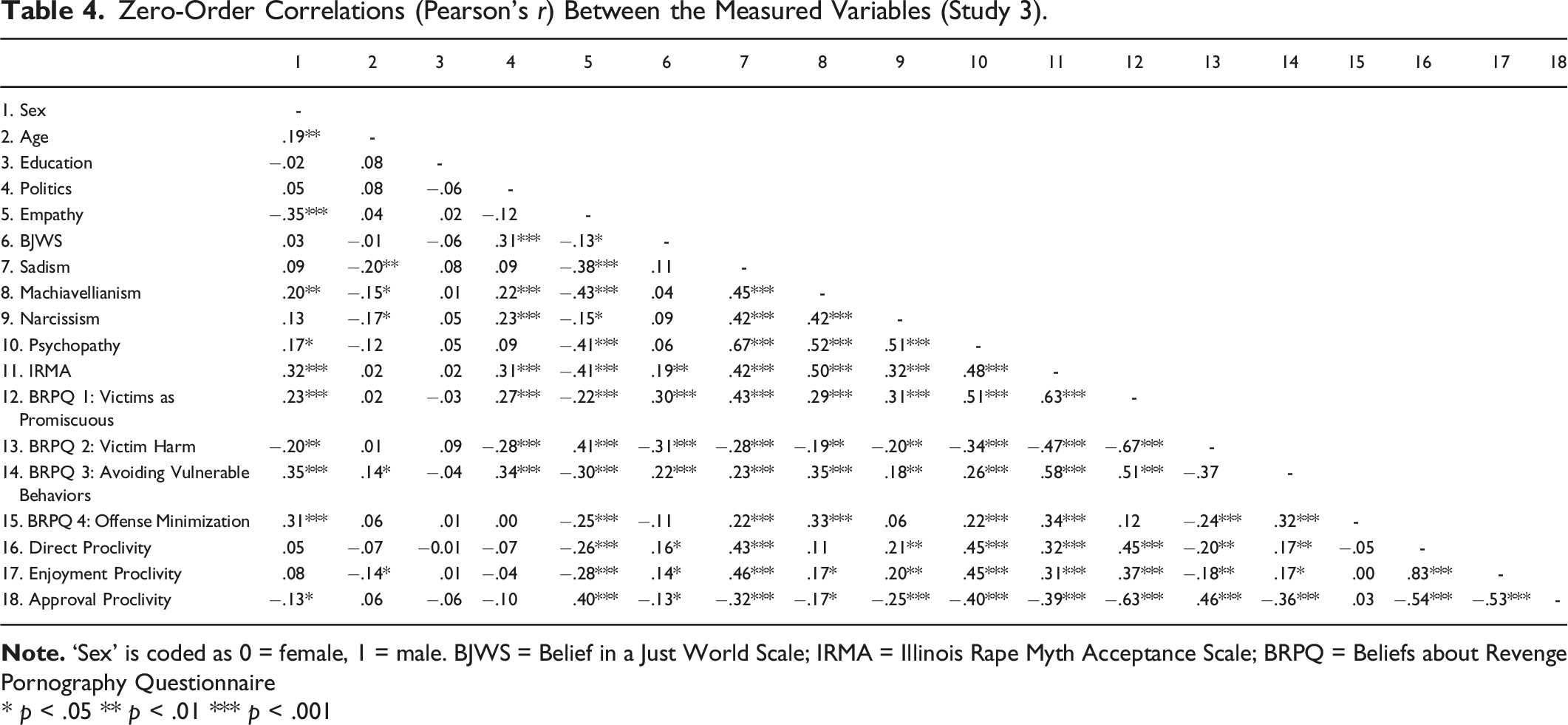
Zero-Order Correlations (Pearson’s r) Between the Measured Variables (Study 3).
* p < .05 ** p < .01 *** p < .001
The approval facet of the proclivity measure was reverse-framed, meaning that higher scores reflected perceptions of societal disapproval of the non-consensual sharing of private sexual images. Conversely to that of direct proclivity, such disapproval was positively associated with higher levels of empathy, and lower levels of belief in a just world, dark tetrad personality traits and rape myth acceptance. Further, anticipated disapproval of was negatively associated with seeing victims as promiscuous and victimization as avoidable, but positively correlation with perceptions of victim harm. In combination, these relationships provide preliminary evidence of the concurrent validity of the BRPQ.
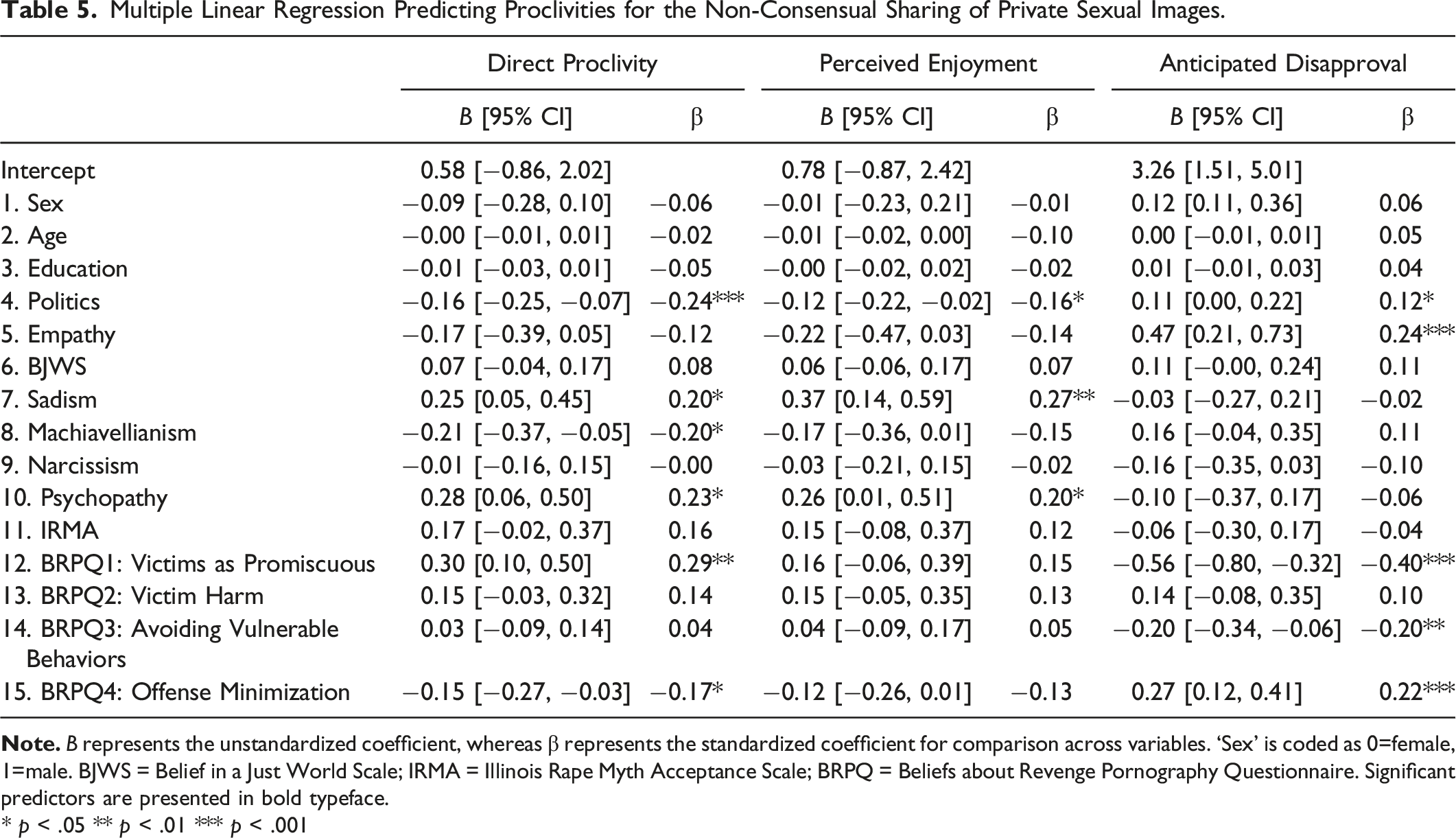
Multiple Linear Regression Predicting Proclivities for the Non-Consensual Sharing of Private Sexual Images.
* p < .05 ** p < .01 *** p < .001
In predicting a direct proclivity for the non-consensual sharing of private sexual images, we found that having a more liberal (or left-wing) political orientation (β = −.24, p < .001), lower levels of Machiavellianism (β = −.20, p = .011) and higher levels of both sadism (β = .20, p = .016) and psychopathy (β = .23, p = .014) were all significantly associated with this outcome. Although we have explored the likely relationship between dark tetrad traits and proclivity within this section above, the association between liberal political orientations and direct proclivity was surprising. Previously, ideological conservatives, relative to liberals, have been found to place a greater moral importance on individual responsibility (Niemi & Young, 2016), and so in this research, we would have expected those of right-wing orientation to report higher proclivity ratings. Examining the BRPQ specifically, seeing ‘Victims as Promiscuous’ significantly predicted a greater self-reported proclivities for engaging in the non-consensual sharing of private sexual images (β = .29, p = .004), while higher scores on the ‘Offense Minimization’ factor, perhaps paradoxically, yet to a weaker degree predicted lower proclivity outcomes (β = −.17, p = .013). Scores on neither ‘Victim Harm’ nor ‘Avoiding Vulnerable Behaviors’ were significantly associated with a direct self-reported proclivity for this type of behavior. Taken together, this data suggests that facets of the BRPQ differentially predict proclivity ratings, however there is needed scope to better understand the ‘Offense Minimization’ to proclivity association, which may be underpinning by an unknown mediator.
Anticipated enjoyment of engaging in the non-consensual sharing of private sexual images was predicted by participants having a more liberal (or left-wing) political orientation (β = −.16, p = .025), and higher levels of both sadism (β = .27, p = .002) and psychopathy (β = .20, p = .044). None of the BRPQ factors were significant predictors of this outcome. Again, the observed relationship between holding a liberal political orientation and support for (i.e. enjoyment of) the non-consensual sharing of private sexual images deserves future qualitative attention.
Disapproval of the non-consensual sharing of private sexual images was predicted by political conservatism (β = .12, p = .048) and higher levels of empathy (β = .24, p < .001). In relation to the BRPQ factors, higher anticipated disapproval was predicted by lower scores on both the ‘Victims as Promiscuous’ factor (β = −.40, p < .001) and the ‘Avoiding Vulnerable Behaviors’ factor (β = −.20, p = .005). Perhaps paradoxically, the more that participants appeared to minimize this behavior as a serious crime, the more they anticipated disapproval of their own hypothetical offending (β = .22, p < .001). However, this result might be rooted in offense-supportive cognition and an awareness of negative public attitudes about sexual crime (for a review, see Harper et al., 2017). That is, although one might not believe that their actions are serious, they would still expect a disapproving response from others.
Study 4 – Predicting Judgements of ‘Revenge Pornography’
Sample Information
A total of 236 participants were assigned to this branch of the survey. However, one participant was removed for declaring an age of lower than 18years, and three participants were removed from the dataset as they had incomplete data on the response variables. This left a final sample of 232 participants for analysis (55% female; Mage = 30.64 years, SD = 11.17). The sample was evenly split between vignettes: sexually provocative posting (n = 78), conservative posting (n = 78) and control (no posting content information (n = 76).
Results and Discussion
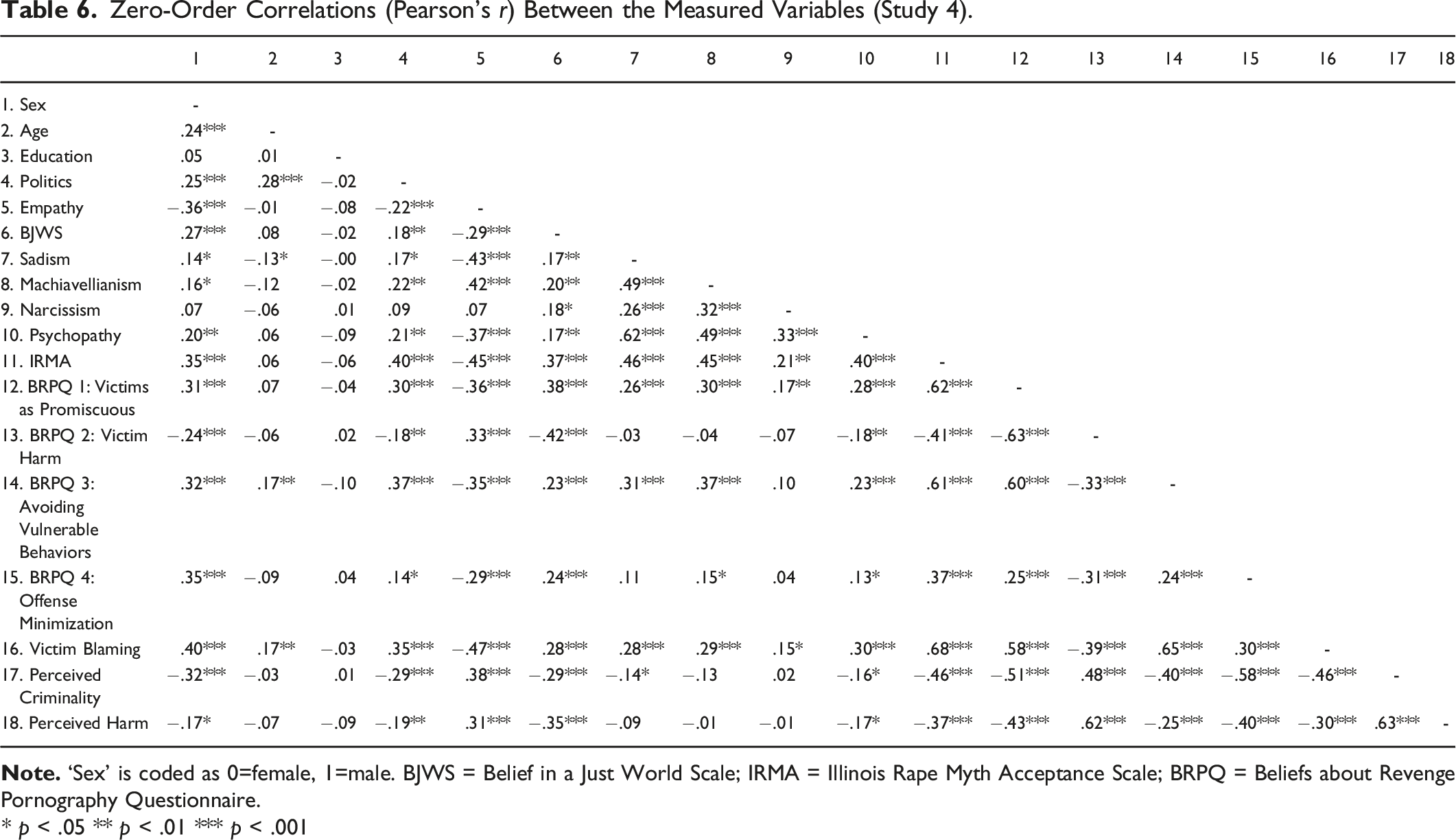
Zero-Order Correlations (Pearson’s r) Between the Measured Variables (Study 4).
* p < .05 ** p < .01 *** p < .001
Increased perceptions of the criminal nature of non-consensually sharing private sexual images were associated with female sex and left-leaning politics. Those scoring higher on empathy, but lower on belief in a just world, psychopathy and rape myth acceptance also viewed the non-consensual sharing of private sexual images as needing police intervention. On the BRPQ, increased criminality perceptions were associated with lower scores on the ‘Victims as Promiscuous’, ‘Avoiding Vulnerable Behavior’ and ‘Offense Minimization’ factors, and higher score on the ‘Victim Blame’ factor.
Greater anticipated victim harm was associated with female sex and left-leaning politics. Psychologically, these judgements were correlated with higher scores for empathy, but lower scores for belief in a just world, psychopathy and rape myth acceptance. Victim harm scores (measured in response to each vignette) were associated with lower scores on the ‘Victims as Promiscuous’, ‘Avoiding Vulnerable Behavior’ and ‘Offense Minimization’ factors, and higher score on the ‘Victim Blame’ factor. These data again provide preliminary support for the concurrent validity of the BRPQ.
Each of the outcomes were significantly correlated to each other. Victim blaming was associated with less perceived criminality and reduced anticipations of victim harm. In contrast, perceptions of criminality and victim harm were positively correlated.
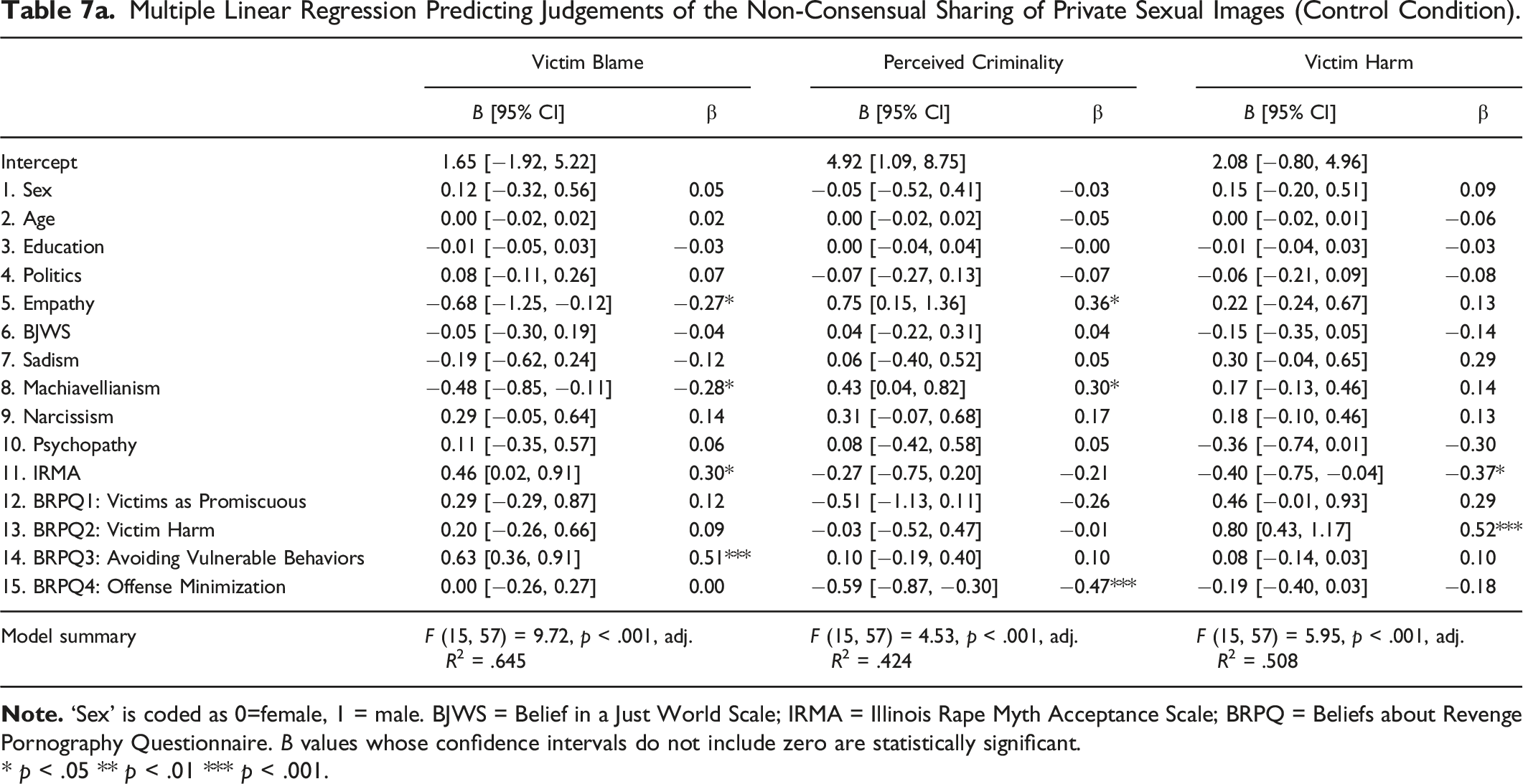
Multiple Linear Regression Predicting Judgements of the Non-Consensual Sharing of Private Sexual Images (Control Condition).
* p < .05 ** p < .01 *** p < .001.
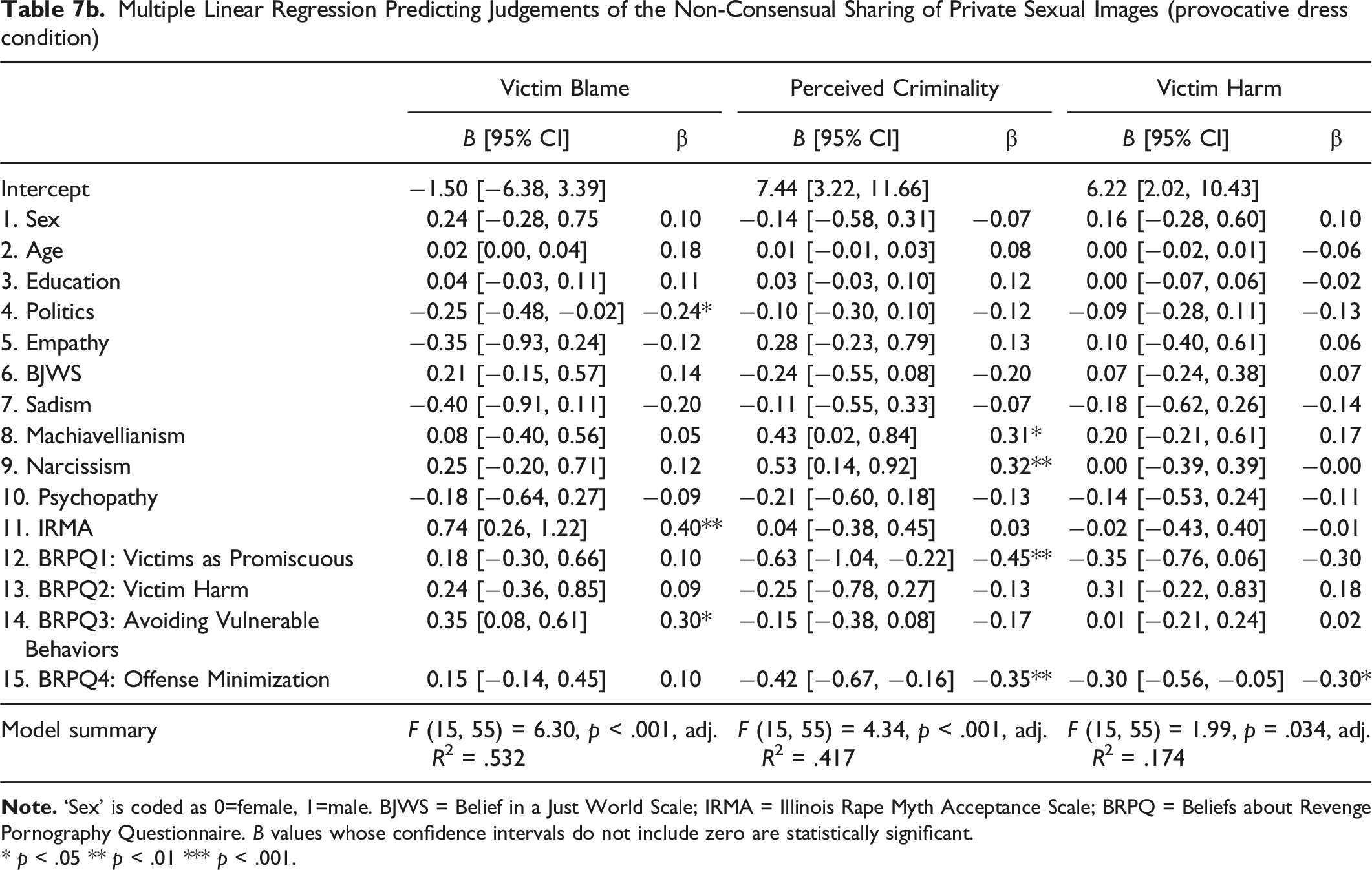
Multiple Linear Regression Predicting Judgements of the Non-Consensual Sharing of Private Sexual Images (provocative dress condition)
* p < .05 ** p < .01 *** p < .001.
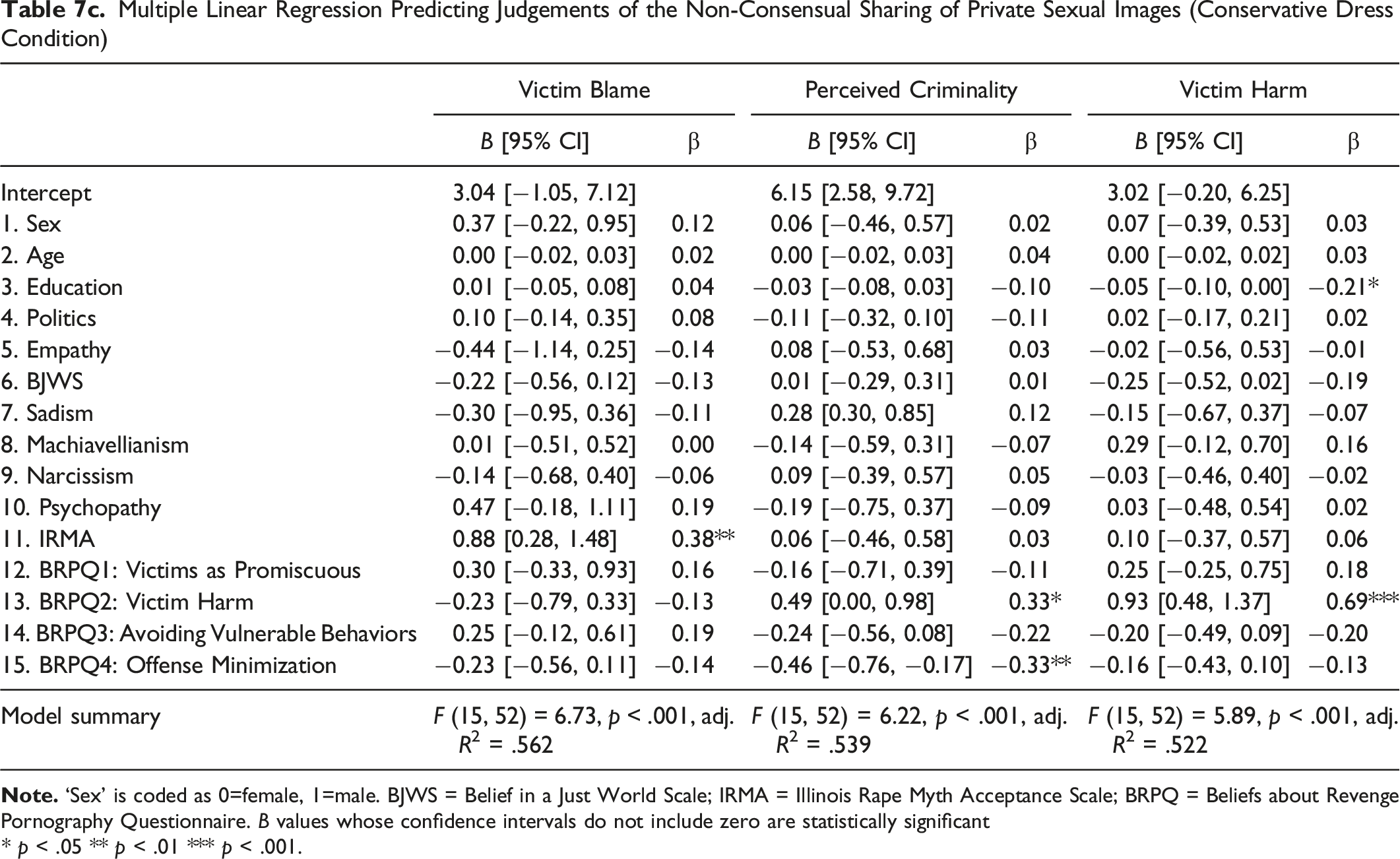
Multiple Linear Regression Predicting Judgements of the Non-Consensual Sharing of Private Sexual Images (Conservative Dress Condition)
* p < .05 ** p < .01 *** p < .001.
In the control condition (with no previous social media posting context), victim blaming was predicted by lower levels of empathy and Machiavellianism, but higher scores on the ‘Avoiding Vulnerable Behaviors’ BRPQ factor. This suggests that an impulse to place culpability on victims is linked to victim blaming even in the absence of any contextual cues to self-increased vulnerability to victimization. Higher scores for both empathy and Machiavellianism predicted increases in perceived criminality of the offense, suggesting that a vulnerability to manipulation and an identification with victims on an emotional level is associated with a greater willingness to support criminal sanctions for the non-consensual sharing of private sexual images. In contrast, higher scores on the ‘Offense Minimization’ factor of the BRPQ were associated with a lower perception of criminality. This is unsurprising, as minimizing the effects of the non-consensual sharing of private sexual images should logically lead to reduced support for criminal sanctions. However, this unsurprising result does offer support for the validity of the BRPQ in predicting meaningful outcomes. These perceptions did not translate to judgements of victim harm. Instead, lower rape myth acceptance and higher scores on the BRPQ’s ‘Victim Harm’ factor predicted greater perceptions of vignette-specific victim harm. This indicates a potentially malicious view that harm is lower when victims ‘deserve’ what happens to them (indicative of higher rape myth acceptance). In addition, the expected predictive effect of the ‘Victim Harm’ factor in this case provides additional evidence of the BRPQ’s validity.
When the victim had previously posted sexually provocative images online, participants with a more left-leaning political ideology, and those with higher levels of rape myth acceptance, attributed higher levels of blame to the victim. This is perhaps surprising from an ideological standpoint, whereby ideological conservatives might be expected to demonstrate sex-negative responses and place higher levels of blame on victims for posting sexually provocative content online. However, left-leaning individuals might demonstrate more punitive views towards such women for yielding to societal expectations about women, wherein it is seen that women are required to use sex to advance their social status. On the BRPQ, higher scores on the ‘Offense Minimization’ factor were again predictive of lower perceived criminality, supporting our view that this is an accurate measure of the minimization of the seriousness of this type of behavior. In addition, seeing ‘Victims as Promiscuous’ led to lower criminality judgements in this case, suggesting that the BRPQ can contribute to divergent judgements resulting from specific case details in the direction that would be expected. Lower levels of perceived victim harm were only predicted by the BRPQ’s ‘Offense Minimization’ factor when the victim had posted sexually provocative images online. This is perhaps indicative of an association between the level of harm caused by an offense and the extent to which it is seen as being deserving of criminal sanctions.
When the victim had a history of sexually conservative social media posting, rape myth acceptance was significantly and positively predictive of victim blame attributions, and negatively associated with anticipated victim harm. It is perhaps unsurprising that none of the BRPQ factors were significantly associated with victim blaming in this condition, as the vignette contained no cues related to promiscuity or self-directed vulnerable behaviors on the part of the victim. However, lower scores on the BRPQ factor of ‘Offense Minimization’, and higher scores for ‘Victim Harm’, were predictive of higher criminality judgements. These results combine to again suggest an interplay between judgements of the behavior and its effects in perceptions about whether criminal justice involvement is required in cases of the non-consensual sharing of private sexual images. Lower levels of education and higher scores on the BRPQ factor of ‘Victim Harm’ significantly predicted greater levels of anticipated victim harm for this specific case.
Taken in totality, these data offer good evidence of the BRPQ’s validity as a measure that can predict meaningful outcomes, at least in the research context in relation to hypothetical case scenarios. Consistently, scores on the ‘Offense Minimization’ factor predicted criminality judgements, while ‘Victim Harm’ (as a global BRPQ factor) predicted scenario-specific anticipations of victim harm. The only exception to this was in relation to the victim with a provocative posting history, whereby perceptions of the victim’s potential promiscuity and vulnerable behaviors appears to have reduced perceptions of the harm caused by the offense.
General Discussion
In this paper, we set out with the aim to systematically develop and validate a measure of beliefs about the non-consensual sharing of private sexual images. Our motivation in doing so was rooted in the existing literature either using brief (and ad-hoc) measures of judgements about this emergent form of sexual offending (Bothamley & Tully, 2018; Fido et al., 2021) or not using transparent and systematic measures of scale development (Powell et al., 2019). Given the importance of offense-supportive cognition in contributing to both a proclivity towards and judgements of sexual offending (Bohner et al., 2005; Harper, et al., 2020; Hermann et al., 2012) the project reported here offers a domain-specific measure of empirically supported clusters of beliefs.
The belief clusters of ‘Victims as Promiscuous’, ‘Victim Harm’, ‘Avoiding Vulnerable Behaviors’ and ‘Offense Minimization’ correspond to distinct domains of beliefs, which appear to have important links to both a proclivity towards engaging in the non-consensual sharing of private sexual images. Importantly, they correspond to different aspects of views about this type of behavior, including its victims and their perceived culpability in their experiences (‘Victims as Promiscuous’ and ‘Avoiding Vulnerable Behaviors’), the impact of perpetration (‘Victim Harm’) and its legal status (‘Offense Minimization’). It is here where we make a distinction between the BRPQ and related measures of cognitive distortions and rape myths within the broader literature. Our measure is not a measure of ‘myths’ or distortions, but rather beliefs that may be best subsumed under the broader heading of offense-supportive cognition.
The systematic validation of the BRPQ identified several predictors of each cluster of beliefs, as well as establishing the measure’s concurrent validity itself. Endorsing rape myths was a substantial predictor of viewing victims as being responsible for their experiences; correlating highly with beliefs that framed victims as being promiscuous and engaging with behaviors that would leave them vulnerable. This belief was also predicted by lower levels of empathy and Machiavellianism (suggestive of the view that victims are not ‘tricked’ into victimization, but instead play an active role), and higher levels of psychopathy and belief in a just world. Attenuated beliefs about the harm felt and experienced by victims of the non-consensual sharing of private sexual images were predicted by lower levels of empathy and higher levels of psychopathy and beliefs in a just world, data which is expected given the well-documented inverse association between the traits, and the role of empathy in recognizing and understanding the role of behavior on others (Bates, 2017). This data maps well onto our understanding of how deviant traits, such as psychopathy, contribute to perceptions of victims of image-based sexual offenses and our empathic responses to them (Fido et al., 2021). Of interest, similar patterns of responses were not observed when predicting responders’ beliefs that minimized the degree of the offense. Here, our data suggest that only Machiavellianism and rape myth acceptance were significant predictors of offense minimization, and so less likely to label the non-consensual sharing of private sexual images as a sexual offense, potentially suggesting that rape myth acceptance translates into broader judgements of sexual offenses, and is not restricted to rape, specifically.
Collectively, these findings are consistent with literature that finds judgements of sexual violence – in a general sense – are associated with beliefs about the fairness of the world, ‘dark’ personality traits and stereotypical beliefs about sexual violence. The data are therefore supportive of the view that the non-consensual sharing of private sexual images, as a form of image-based sexual abuse, should be classified as a sexual offense from a legislative perspective (Fido & Harper, 2020; McGlynn et al., 2017). Importantly, however, they also suggest that views about this form of behavior may be less dimensional than they are in relation to other forms of sexual violence and be centred more directly around views about victim culpability and offense motivations.
Importantly, the BRPQ does seem to possess good concurrent validity. Indeed, across all clusters of ‘Victims as Promiscuous’, ‘Victim Harm’, ‘Avoiding Vulnerable Behaviors’ and ‘Offense Minimization’, there were moderate to strong correlations with self-reported proclivity, anticipated enjoyment and greater levels of approval of this kind of offending. In addition, seeing the victims as being responsible for their experiences (e.g. ‘Avoiding Vulnerable Behaviors’) was associated with greater levels of victim blame (irrespective of their previous online posting activity), with those seeing the non-consensual sharing of private sexual images as not being a sexual offense (i.e. ‘Offense Minimization’) predicting lower perceptions of criminality. This is consistent with broader work in the area of sexual offending, where victim blaming and other offense-supportive cognitions are associated with a host of undesirable outcomes, including increased rates of sexual aggression proclivity and more lenient judgements of offense case studies (Bohner et al., 2005; Harper, et al., 2020). As such, the argument that the non-consensual sharing of private sexual images operates as a sexual offense from both a legislative and psychological perspective is supported here (Fido & Harper, 2020; McGlynn et al., 2017).
The existing literature within the area of image-based sexual abuse is rooted in sociological conceptualizations of this behavior and explains it as a gendered type of sexual offending with desires for power, control and dominance as its core motivations (e.g. McGlynn, 2018; McGlynn et al., 2017). However, data reported here, specifically that around proclivity to engage in the non-consensual sharing of private sexual images, suggest a potential disconnect between elite (sociological) views and the opinions and beliefs held and expressed by the lay public. Arguably this lay conceptualization is more representative of social thinking about the non-consensual sharing of private sexual images and has clear links to jury decision-making and offense motivations. That is, although the academic zeitgeist is to view the non-consensual sharing of private sexual images (among a constellation of image-based sexual abuse offenses; Harper, et al., 2021) through the sociological lens, if the public do not endorse this view (favouring, for example, explanations that focus on sexual arousal) then cases that do not possess these sex-related features may be viewed less harshly. This becomes even more important when considering that the legislative discussions around image-based sexual abuse lay on the foundations of academic discourse, and thus may omit important details needed to ensure convictions – and therefore justice – after victimization.
Limitations and Future use of the BRPQ
Like any empirical study, our project here does have some limitations. The initial draft of the BRPQ was based on parallel items that were constructed using existing rape myth questionnaires and measures of other sexual offense-supportive cognitions. Although we did not pre-test these items using an expert panel, we make the full draft available via the OSF (https://osf.io/3t6rh/). We invite other research teams to examine this draft list of candidate items and seek to confirm our factor structure in independent samples, and in other legislative contexts.
We believe that the BRPQ has the potential to inform our understanding of the psychological responses of lay members of the public to the non-consensual sharing of private sexual images, and perhaps to other forms of image-based sexual abuse. It may be that similar themes are related to views about behaviors such as upskirting, cyber-flashing and deepfake pornography production – all of which have been identified as forming the constellation of image-based sexual abuse (Fido & Harper, 2020). Parallel versions of the BRPQ may be developed to test these ideas in relation to the full range of image-based sexual abuse offenses. It may also be said that we studied only a select number of correlates of the BRPQ. Although these were constructs known to be associated with judgements of ‘revenge pornography’ (Dustagheer, 2018; Fido et al., 2021), we did not examine the relationships between the BRPQ and constructs such as ambivalent sexism, masculinity, or attitudes related to the sexual double standard. These may all be related in meaningful ways to proclivities towards and judgements of the non-consensual sharing of private sexual images as they relate to gendered interactions and relationships. Further validation is necessary to identify the unique contributions of the BRPQ’s belief domains after controlling for these other notable covariates. Additional validation studies might also embed attention checks (e.g. mandated responses to non-scored questions) and validity checks (e.g. asking raters to place each BRPQ item into one of the four factor headings). Such checks were not used in the current study.
Conclusions
Despite knowing that offense-supportive cognitions are important predictors of sexual offending proclivity and judgements of sexual aggression, no authors had previously developed a measure of such beliefs in relation to the non-consensual sharing of private sexual images. Our new BRPQ fills this gap in the literature, reporting beliefs that take a tripartite structure and cover domains related to victim culpability, offense motivations and the legal status of the non-consensual sharing of private sexual images as an offending behavior. The development of such a measure opens up many possibilities for specifically examining this type of offending behavior as a specific sexual crime. We believe that it is likely that – as in the case of sexual violence in a general sense – attitudes that blame victims and endorse stereotypical beliefs act as barriers to effective legislative action. It is only by systematically exploring the structure of these beliefs in the manner that we have done here, by understanding their correlates and effects, and by seeking to address antisocial beliefs through education, that we can begin to turn the tide on the non-consensual sharing of private sexual images as a growing social problem.
Footnotes
Declaration of Conflicting Interests
The author(s) declared no potential conflicts of interest with respect to the research, authorship, and/or publication of this article.
Funding
The author(s) received no financial support for the research, authorship, and/or publication of this article.
Author Note
We take responsibility for the integrity of the data, the accuracy of the data analyses and have made every effort to avoid inflating statistically significant results. Further, we report how we determined our sample size, all data exclusions (if any), all manipulations, and all measures in the study. We have no financial interests, funding information, or other conflicts to disclose related to conducting of this research.
Correction (December 2022):
Article updated to correct typographic errors in terms of item numbers in the two sentences when describing the number of items in Factors 1 and 2.
