



Abstract
This article sheds a new light on the impact of image-based sexual abuse (IBSA) on women. Drawing on findings from 17 in-depth interviews, it details the emotional, physical and social impact of this online victimisation, and how the impact of IBSA manifests in women’s everyday lives. By also using these findings as a basis to examine online victimisation more broadly, this article brings to the fore broader considerations of how technology is facilitating a mutation in forms of sexual violence causing victims to encounter impacts which are specific to, or amplified by, technology. Therefore, it calls for greater attention to be paid to the impacts of IBSA and more research into how the relationships between the online and offline worlds require us to change our understanding of victimisation in an ever-increasing digital society.
Introduction
Advancements in technology have resulted in many positive changes, including the ease of networking, increased success of campaigns, and access to almost any kind of information (Yar, 2012). At the same time, the interconnectivity of technological platforms has been amplifying the likelihood of many forms of victimisation, with social media playing a facilitating role (End Violence Against Women Coalition, 2013; Franks, 2011; Yar, 2012). This is particularly the case for violence against women, with research finding increasing levels of misogyny online, evidenced by the increasing use of misogynistic material on social media platforms (Bartlett et al., 2014; Jane, 2017). This has become so widespread that we are now seeing a normalisation of online abuse, with threats of rape and violence against women becoming more common (Jane, 2017). Whilst there has been increasing recognition of how technology is changing the nature of, and potentials for, crime (Yar, 2012) our understanding of how online sexual victimisation impacts upon women’s everyday lives remains somewhat limited.
This article details the findings of research which explored the impact of image-based sexual abuse (IBSA) on women’s lives. The term IBSA refers to a wide range of abusive practices surrounding the non-consensual taking, making and sharing of (usually sexual) images (see Law Commission, 2021; McGlynn et al., 2017). However, it is important to note that this research focused upon cases involving women subjected to the non-consensual sharing, or threat to share, images, colloquially known as ‘revenge pornography’. Nonetheless, many other forms of IBSA were evident and interlinked in these cases. The findings presented provide vital and much-needed knowledge in understanding the impact of online sexual violence and useful narratives through which to explore how technology is changing the landscape of sexual violence and victimisation. Moreover, they reject assumptions that sexual violence is less significant when perpetrated in an online context and highlight the need to recognise the magnitude of consequences for victims, including giving greater consideration to how the online environment produces specific forms of trauma. This article begins with a discussion on how technology has facilitated abuse against women, particularly IBSA, and current knowledge on the impact of IBSA victimisation. After a summary of the methods undertaken during the research, it then outlines the research findings from 17 in-depth interviews with victims of IBSA. Finally, it calls for greater attention to be paid to the impacts of IBSA and more research into how the relationships between the online and offline world require us to change our understanding of victimisation. In doing so, the article responds to, and reiterates, Powell et al.’s (2018) call for a ‘digital criminology’.
The new era: Technology’s contribution in facilitating violence
Online abuse against women occurs in a multitude of ways, including direct threats of sexual violence and rape, IBSA, harassment, and stalking (Jane, 2017; Marganski, 2018). There is also a wide range of platforms used to facilitate these behaviours, including email, public message boards, social media (including pages dedicated to abusing women), blogs, dating apps and gaming sites (Jane, 2017). This treatment of women online is not new, but an alternative manifestation of violence against women which is underpinned by the same misogynistic and patriarchal discourses as offline abuse (Bartlett et al., 2014; End Violence Against Women Coalition, 2013; Franks, 2011). Cyberspace, therefore, is often considered to be a facilitator of online abuse because it increases the ease with which abuse can be perpetrated by making it easy for abusers to communicate with, and harm, victims without the need for physical proximity (Powell et al., 2018). It is not surprising then to find that just as women represent the overwhelming majority of victims of domestic abuse and forms of sexual violence offline (Office for National Statistics, 2018), they also form the majority of those who are sexually victimised online (Davidson et al., 2019).
IBSA is a prime example of sexual violence which has mutated and grown as technological advancements have continued to be exploited to cause harm. For example, Dworkin and MacKinnon (1988: 43) acknowledged the use of IBSA in their exploration of pornography. They argued that ‘[y]oung women are tricked or pressured into posing for boyfriends and told that the pictures are just “for us” only to find themselves in this month’s Hustler’ and how ‘[m]any women are photographed by lovers and find the photographs published as pornography in revenge or retaliation’ (Dworkin and MacKinnon, 1988: 70). Whilst Dworkin and MacKinnon did not examine IBSA in isolation, non-consensual image sharing was already being recognised as a form of abuse. With the World Wide Web yet to fully emerge, they pointed to the use of IBSA in physical form, thus recognising a harmful behaviour which was to become significantly intensified by technology.
Potentially one of the first major sexist incidents online, the creation of ‘Babes on the Web’ in 1995 brought about the realisation that the internet would not be a sexism-free space. Created by Robert Toups, the site displayed the names and photographs of women who were to be subjected to attractiveness ratings (Kibby, 1997). Whilst at this time what we now know to be IBSA did not exist in the online world, the creation of this site demonstrates that the sharing of women’s images for the purposes of judgement had already started to permeate the online world. It was the much later creation of IsAnyoneUp.com, created by Hunter Moore in 2010, which encouraged users to publish nude or sexualised images of their ex-partners without their consent, that pushed IBSA to the forefront of academia, police inquiries and the media (Lee, 2012).
Today, this kind of image sharing has become evident across several different media platforms, with Short et al.’s (2017) survey finding that that the publishing of these images was most common on social media platforms (37%), followed by mobile phones (27%) and websites such as YouTube (25%). Technology also plays a key role in how images are obtained by abusers; whilst the most common form of image obtainment is sharing between partners, other obtainment methods including hacking, downloading images and sharing across different websites (Franklin, 2014; Stroud, 2014), and photoshopping (otherwise known as ‘deepfake’ images or ‘fake porn’) are common (McGlynn et al., 2019). However, it is not just the sharing of images which presents fundamental concerns for victims, but their public identification. When images are distributed, victims often become facially recognisable amongst known associates and it is common for personal identifying information, including names (first and/or second), links to social media profiles, telephone numbers and locations (city and/or address), to be disclosed (Citron and Franks, 2014; Franklin, 2014; Franks, 2011; Laird, 2013; Lee, 2012; Stroud, 2014). Cyber Civil Rights (2014) concluded that 59% of victims had their full names disclosed, 40% had their social network profiles identified, and 20% had their phone numbers released. In some cases, images are also sent, or pointed out, to employers, co-workers, families and friends (Citron and Franks, 2014; Laird, 2013). This public identification combined with the connective opportunities provided by technology is inevitably increasing victims’ chances of further abuse, with Cyber Civil Rights (2014) finding that 49% of victims had been stalked and harassed online by those who had come across the material.
Essentially, the ability to share these images and personal information online amplifies the consequences for victims because of the increased audience and connectivity compared to offline sharing of these images, as identified by Dworkin and MacKinnon (1988). In relation to the online abuse of women more generally, Jane (2017: 61) highlights the potential for amplified or intensified harm because of the ‘sheer relentlessness’ of online abuse, with technology making repeat perpetration ever more achievable. With IBSA more specifically, it is argued that the impact of victimisation may become amplified due to the permanence of online material. Whilst something said in public can potentially be forgotten, the sharing of material on the internet remains a permanent feature (Chief Constable of Essex Police, cited in UK Parliament, 2014). Even if images are removed from one website, the ease of downloading or saving images renders removal irrelevant to those who already possess them (Franklin, 2014). Once possessed, material can be re-uploaded at any time, and as many times as the person chooses; it is impossible to guarantee complete removal (Bartow, 2012).
Whilst there has been a steadily increasing amount of literature detailing the nature of IBSA, recognition of the impact of this type of victimisation is much more limited. Thus far, research has identified a range of emotional, physical and financial consequences for victims including suicide, shame, humiliation, reputational damage, occupational issues, forced changes or loss in occupation, fear, anxiety, restriction in the use of space, and an increased vulnerability to further harassment and/or abuse (Citron and Franks, 2014; Cyber Civil Rights, 2014; End Violence Against Women Coalition, 2013; Franks, 2014; Henry and Powell, 2016; Short et al., 2017; Stroud, 2014). There has also been a limited amount of qualitative work which provides in-depth examination of these consequences. For example, Bates’ (2017) interviews with 18 survivors detail the mental health impacts on victims, and McGlynn et al.’s (2020) interviews with 75 victim-survivors examine the lived, and intersecting, consequences for victims including social rupture, continuing and constant harms, isolation, and constrained liberty. McGlynn et al. (2019) also pay particular attention to the levels of isolation felt by victims, and the potential permanence of images being shared online leaving victims in constant fear. However, with the exception of McGlynn et al.’s (2019; 2020) studies, research that examines the experiences of victimisation is primarily based on research originating from the US and Australia, leaving knowledge of UK victims’ experiences limited in comparison. The research presented in this article not only provides continued in-depth examination of the everyday experiences of UK victims, but also highlights how technology has facilitated a mutation in forms of sexual violence, causing victims to encounter impacts which are specific to, or amplified by, technology-facilitated victimisation.
Methods
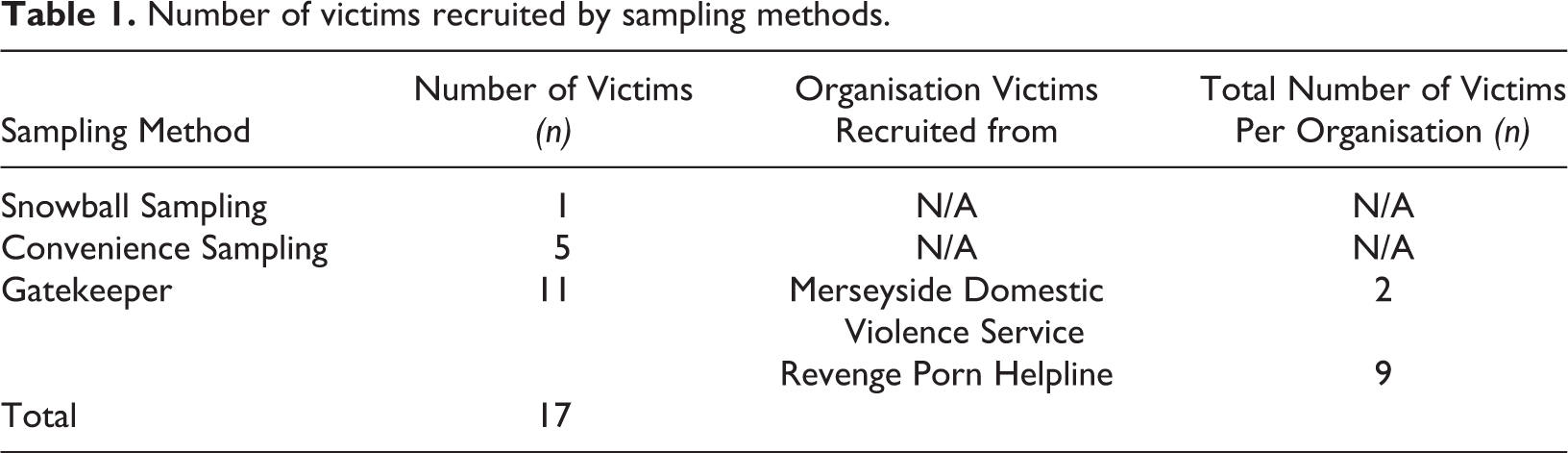
The research aimed to examine the impact of IBSA on women. To uncover the detailed everyday narrative of victims’ 1 lives post-victimisation, the research drew upon Mawby and Walklate’s (1994) critical victimology, seeking to explore how victimisation has changed women’s everyday lives. This allowed for an analysis which moved beyond identification towards an understanding of how women’s behaviour not only changes after victimisation but becomes ingrained in their everyday practices, often to the extent where women struggle to identify some behavioural changes as a direct impact of victimisation. In order to do this, in-depth, semi-structured interviews were undertaken with 17 women victims of IBSA between August 2015 and February 2017. Interviews explored the emotional, physical and social impact of IBSA on their lives, and the use of coping mechanisms and life changes employed as a result of victimisation. Given the sexual and public nature of this type of victimisation, recruitment of victims was particularly difficult, with many women refusing the invitation to partake and withdrawing during the data collection process. These women were, without doubt, a hard-to-reach group (Benoit et al., 2005) and the difficulty in recruitment is likely to be one of the reasons in-depth knowledge on victims’ experiences is limited. As a consequence of recruitment difficulties, participants had to be recruited through a number of avenues; the majority of victims were recruited through gatekeepers, with the remainder being recruited through snowball and convenience sampling. Table 1 demonstrates the number of victims recruited per sampling method.
Number of victims recruited by sampling methods.
Demographically, this sample included victims within the age range of 19–46 years and included the following ethnicities: white (n = 11), black (n = 1), mixed ethnicity (n = 2), south Asian (n = 3). There was also a diverse range of occupations amongst the women interviewed, including teachers, customer service staff, accountants, digital marketing staff, students, and unemployed participants. Each case involved sharing (n = 15) or threat to share (n = 2) images. The 15 women who had images distributed had multiple images published and, in some cases, both still images and videos were shared. The lowest number of images shared (of the same woman) was one and the highest number of images shared was 50. In all of the cases except one (a Muslim woman without her hijab) the images were sexually explicit; this included images of full nudity, partial nudity, women performing sexual acts, and/or images of women in their underwear. One of these cases also included non-nude images which had been photoshopped to appear sexual in nature. The women had a range of relationships with their perpetrators, including long-term relationships (n = 10), casual relationships (n = 3), work relationships (n = 2) and friendships (n = 2).
All of the interviews were digitally recorded for ease of transcription and to increase the accuracy of recorded data (compared to manual note taking) (Gray, 2018). Six of the interviews with victims took place face-to-face and nine were conducted via telephone due to time constraints, with the same questions that were used in the face-to-face interviews. Interview transcripts were then downloaded into NVivo and coded inductively and thematically. The following section details the findings of the research interviews with victims.
Sending sexy pictures: The blurring of consensual boundaries
Interviews clearly demonstrated that technology plays a key role in the entire victimisation process, with victimisation often beginning with the use of modern technology to obtain images through both consensual and non-consensual means. Within the interview sample, the four most common methods of obtaining images were hacking, consensual sharing, coercion, and hidden cameras. Two of the 17 victims had their images obtained by the perpetrator non-consensually through hacking. I was with [my ex] from like when I was 16 to when I was 18. Erm…we split up and like we ended on good terms…I started seeing my [current partner]…I’d sent pictures to [my current partner] and he’s sent pictures to me and it was just it built a different side to the relationship, it was like fun, and it was something different because I hadn’t done it before. A year after that I had a message on an Instagram account [from my ex] saying ‘I’ve seen these pictures of you, I know you from school and I know you’re not the type of person to do this’ and then sent me like two or three links to different porn sites and then I opened them, and I was there, and I was like, ‘how has that happened!, like I didn’t even think, like, he obviously was in the account in the past but I didn’t think he was still in there but he was getting in through an email address. So, every time I changed my password, he knew about it and then there was a few times when he changed it and it was all like weird things kept happening. (Participant Ten) He went through my phone and sent like a picture with me, just with a bra on and I didn’t notice that he had that picture. (Participant Sixteen) [My partner] put his phone in the room and I knew nothing about that. So that was like full on start to finish sex basically. (Participant Four) At some point I was getting changed [at work] from uni. I was behind the screen…And I turned around at some point and there was a phone…I tried to cover up. Didn’t know how long [my manager had] been there, I had my phone on with my music on so I was just completely unaware, thought everybody was either sat down or outside at this point…as far as I know he’s got pictures and a video of me getting changed, topless. (Participant Thirteen) I was sleeping [having sex] with [my partner] from the back so I’m in the front and he’s at the back, he’s recording from the back. (Participant Seven) Well, I’ve realised it was big lie now but he told me that he had cancer the whole time. I think that was probably partly why I ended up doing [the sexual act over Skype], you know it wasn’t me who, I never offered to do it, it was something that’s being constantly asked of me. (Participant One) It had been over long period of time, something that he wanted to do. And also, I wouldn’t have done that had I not had so much to drink bearing in mind he had only had a couple of bottles of beer. So, you know, he definitely knew what he was doing and if he plied me with enough drink that I would, the hope that I would let him. (Participant Twelve) He was like asking like…well he didn’t even have to…like he did ask a lot of times and was like ‘when are you going to come see me’…asking me to do things that I wasn’t ready to do because I was younger…but at the same time I thought it was normal. So, after a few times of him asking, like I thought ‘oh OK it must be what you do if this boy is so set on, like making me do it’. (Participant Eleven)
Making the private public: Types of image distribution
Once images were obtained, the research findings showed that technology did indeed play a key role in image distribution and that the online environment played a significant facilitating role in increasing the number of people whom these images can be shared with, and as a means of ensuring that victims are clearly personally identifiable. The interviews highlighted five forms of image distribution: direct messaging platforms, for example WhatsApp (including group communication), Facebook Messenger, or email (n = 8); social media (n = 7); pornography websites (n = 6); dating websites (n = 1); and IBSA websites (n = 1). Twelve of the 15 women who had images shared found that their images had been distributed multiple times and/or through the use of multiple dissemination methods. For example, those who had their images uploaded onto pornography websites found that these images existed on multiple pornography websites. Those women who had their images shared via direct messaging found that their images had been sent to multiple people (friends, work colleagues, strangers) and/or that they had also appeared on social media. All of the women interviewed could be identified by their face in all or some of the images. In some cases, there was a conscious effort by the perpetrator to include non-sexual images which were more likely to depict the women’s faces, as a means of identification. Some of the women also had additional personal information posted with the images, including their names (n = 11), friends and/or family tagged or befriended on social media to ensure that those close to the victim would see the image (n = 4), email addresses (n = 2), home addresses (n = 2), telephone numbers (n = 2), links to Facebook profiles (n = 2), and work locations (n = 1). As a result of this type of identification, seven women were contacted by strangers through online communication and one woman had a stranger attend her home. For those who were contacted online, contact ranged from an unusually high volume of Facebook friend requests to direct messages through social media, Skype, phone and/or email. I was really upset about the male requests, yeah. It just added to the kind of invasion and the feeling of being dirty because I thought well, these men just think I’m just, you know…So, these men who are trying to friend request me on Facebook they don’t know me so they must of thought, or I had this in my head, that I was just a piece of meat, she’ll go with anybody, look what’s online. (Participant Twelve) I just started getting loads of WhatsApp messages, like one after the other…within that night I had about three hundred WhatsApp messages from different men. And my phone was constantly. [The messages] was just like ‘oh hi sexy’ and like ‘nice pics’ and things like that. And, some men got sending me like nude pictures of themselves, others were asking to meet up like all of that kind of nature. (Participant Eight)
Image-based sexual abuse and mental health
For 16 of the 17 women, victimisation resulted in at least one mental health issue, which was either self or clinically diagnosed. These included high levels of stress, depression, anxiety, low self-esteem, insecurity, paranoia, obsessive behaviour and suicidal thoughts. The most common impact was depression. At least 15 of the women interviewed had depression as a result of IBSA. This depression often led to further issues for the women, including an inability to carry out simple everyday tasks. So, it made me really depressed and I started neglecting myself a lot. I wouldn’t do my hair, I wouldn’t wear make-up, I would just dress…rough, all the time. And I wasn’t eating properly, and I wasn’t cooking properly. I just couldn’t be bothered you know. So, I’d say it affected me quite a bit. (Participant Seventeen) I’ve actually, I have to go to counselling once a week now, I got quite depressed from it. (Participant Two) Before this happened, I always stuck up for myself. But then that happened and I’m just a completely different person. I’d just didn’t say nothing to anyone and I didn’t know why. Cos I was like, it just completely changed me. Cos I was always quite mouthy and confident and then that happened and I was just like an actual shadow of me old self. (Participant Eleven) I felt destroyed and upset and just, I wasn’t worth anything. (Participant Seven) You know, I’d go to the shop and I’ll have a hoodie on and if anybody looked at me, I’d jump, and I’m thinking, ‘everybody’s looking at me,’ cos you do. Cos I’m thinking, they know it’s me, everybody knows it’s me, everybody’s seen the pictures and even if that’s not the case. (Participant Seventeen) Because I work in retail I don’t like people being close to me, I don’t like people looking at me, sometimes I get paranoid because I feel like someone’s looked at me and thought, ‘I’ve seen her online’. (Participant Ten) I think depending on the situation obviously, but it doesn’t necessarily ever end. You never know if they haven’t been published yet, if they will, or if they’re gonna be republished, or once they’re there you can’t get rid of them. I have questioned whether or not I’ll go through with the teacher training, whether or not this does all come out whether it would even be possible for me to teach. It’s really hard. And also, for my daughter, luckily, she’s young enough at the moment just about still…I’d just, even the thought of it impacting her and people seeing it and saying stuff to her. That’s a massive issue for me. (Participant Six) I just feel like there’s not closure, there hasn’t been any closure to it and I don’t think that there will ever be any closure to it…It’s quite long term. Cos even though the images might be removed, I wouldn’t say I was just totally better or forgot about it. It’s still ongoing, I don’t know who else these images have been sent to, other people could have them, he could do it again. So, it’s a long-term kind of effect for you. (Participant Eight) But that really affected me and I did feel suicidal twice because [the perpetrator] did say [he was] going to embarrass me with the revenge porn account to my manager. And that will be real embarrassing so that’s why I’ve been going through depression at the moment because, you know, I couldn’t do it anymore. I was looking to kill myself. I’m so sorry to say this but I was looking to suicide myself because it was affecting me a lot, I couldn’t go through it. (Participant Seven) Yeah. I think I suffered with like mild depression myself for a number of years but this is you know something that comes and goes but this has definitely, you know, triggered it massively. And, you know, I have been suicidal, it was something that I was contemplating. (Participant Nine)
Women’s physical health and use of space
The impact on the women’s mental health was interrelated with physical impacts. Poor mental health contributed to, or resulted in, poor physical health. This included lack of nutrition, weight loss, lack of general hygiene, lack of sleep and general ill health. [I] hid away, I lost weight. And I literally lost weight. And I’m not the biggest person. I must have gone down to a size 10. Cos I wasn’t eating, I stopped eating. (Participant Seventeen) I think it’s made me physically ill, I’ve just been constantly sick since this all happened. I can’t sleep, I’m not really eating properly, quite a big effect. (Participant Five) I didn’t leave the house, it happened on the Monday, on the Saturday my sister, my niece and friend came to house and told me they were taking me away for the night. Now, it took me two hours and diazepam to get me into the car. Now, once I was away actually it was best thing they could have done because I ate for the first time, I slept better that night and because I was away and no one knew me. And I just, I could breathe again, I felt as if a weight had been lifted from my shoulders and it was lovely for that one night but the next day my panic attacks started, I cried. I didn’t want to go home and I knew I had to walk in the front door to the house, even just driving up to the front door and having to walk through my front door at the house, I mean my friends accompanied me, but I had to do it and once I was in the house that was me, I stopped eating, I stopped sleeping again…I would most days go to the shops after work, I would go and get extra milk, extra bread, you know, just the usual things. I would go to my local shop just about every day and I’ve not been doing that, I’ve not been in my local shop hardly at all. And even the shop where I work, in the town where I work, I would go to the shop maybe every other day. [Now] I need to set a date in place when I’m going to shopping, you know, not an impulse, like oh I need milk, I’ll nip down to the shop. I’ve got to set a date and get someone to come with me to go to the shops. I still don’t want to go shopping on my own. (Participant Twelve) I didn’t go out for a long time, I didn’t speak to anyone, didn’t come to Uni. Erm, I had like three months off of life. I just couldn’t…really go out. It wasn’t until like summer really, the end of summer this year all my friends were on holiday and I was like, ‘no I still like can’t, I can’t go out’. (Participant Four) And for ages I kept thinking I didn’t want to go out anywhere at night by myself, I didn’t want to walk to my car. I’d always have to say [to my staff members], ‘can you walk me to my car, or can you drop me off at my car’…I always change up my route now whenever I go home just cos I heard people can follow you and stuff and they know your route and stuff like that. (Participant Fourteen) They put my place of work on there and I know they know where I work so I don’t know if they’re gonna turn up or whether a random bloke’s gonna turn up. I mean I’m moving jobs in a few weeks. (Participant Five) I avoid everywhere he goes, which is a lot of places where we used to go together, which is like round where I live. And I won’t go because I don’t know how I’d be when I saw him. And to stay away from him is a lot easier than to face that. (Participant Four) So, while I’m driving in the town where he lives to go to work, I’ve actually avoided going through the town, I’ve actually got a different route to work so I don’t go through the town. So, that’s just deliberately going a different route to work. It’s just in case I see someone I know or I see him. (Participant Twelve) Well I’ve had to, you know, remove myself from most of my social media just for the fear of him getting into it and finding out who my friends and family are and sharing this, this video. So, it has had an impact because I’ve had to withdraw myself from all my social media and yeah, I’d say it’s had a big impact. (Participant One) I did abstain from updating my LinkedIn just in case somehow, my ex-boyfriend was able to see where I’m working now, so I’ve just refrained from updating cos I am a little nervous he might try and share anything with my employers. (Participant Nine)
Participant Nine: you know I’ve been, especially in the first few weeks and after I saw profiles posted, I was kind of actively looking on Facebook, you know, with a lot of anxiety every day. I still do it…normally once a day. I feel like it just stresses me out if I try to do it more than that and it’s just a lot of anxiety when I do it, so I kind of avoid it.
Researcher
Participant Nine
Every two minutes I was updating [the webpage]. Because I wanted to know what people, not thought of the pictures, but thought of the situation and like what they were, what I don’t know, what everyone was thinking really. Who’d seen it. (Participant Four) Every day. I’d probably check like two or three times a day. In case anything bad was going on without me knowing I guess. (Participant Ten)
Women’s social wellbeing: The problem of isolation
For some of the women, the changes in their behaviour meant that they ended up socially isolating themselves, resulting in breakdowns of social relationships. When women struggle to leave the house or attend social events, some friendships can quickly dissolve because the victim is at an impasse whilst those around them continue with their lives. I sort of lost touch with a lot of me friends, I became really dependent on [my current partner] because of like, I didn’t want him to like ever leave me on my own again. And I fully lost contact with loads of friends because I was just completely dependent on having this relationship and then I was like putting a strain on it, that he had to be with me all the time. I think that affected his life. At times, we’d like we had split up over things because I’d be so needy cos I didn’t feel comfortable on me own at all…it wasn’t healthy. And then I fell out with loads of me friends, I literally had like two friends and we weren’t even that close. (Participant Eleven) To be honest, felt weak y’know. I liked staying home because my mum supported me and stuff. I’ll literally just read a book and stuff like that on my balcony. Because that’s when I lost friends and when I realised who my friends were. (Participant Seven) I did feel that I couldn’t really share this with a lot of people, I couldn’t really tell people about it. I told some of my close friends and they were aware of what was going on and they were quite supportive but some other people I just didn’t really wanna like share this with them. And like, a few weeks afterwards I just didn’t really feel like mixing with anyone I just became quite isolated in myself because I think it was that combination of stress and worrying. (Participant Eight) [I haven’t told my] family, I wanted to because my family thought so highly of [the perpetrator], they loved him and then when I finished with him they were very accusing and stuff like ‘why would you do that’ and then they really dislike my new partner. Because I feel like they always compare my new partner to him, my old one, because they think that he was so great. And there’s part of me that just wants to say like, ‘you don’t understand like what he’s done to me,’ and like since then how he’s treated me. [I haven’t told them] out of the fear that they’re gonna say, ‘well you finished with him, in a sense you’ve brought it on yourself and he’s gone and shown people since because he’s obviously angry with you.’ So, it does frustrate me that I haven’t told my family but it’s just the embarrassment of knowing that they’ll know that I’ve…you know…the photo of me. (Participant Three) It made me feel violated, it actually made me feel raped almost. (Participant Two) I was looking at articles about this subject online and there was something that was written about, someone saying it was like being raped online, and that statement had really like kept in my head cos…it really is how it feel. (Participant Nine) So, I felt helpless, I felt abused like, that’s not the best word but I felt as if I’d physically been abused even though obviously, I hadn’t been physically abused but it’s just that sick feeling that I had. It was as if somebody had actually punched me in the stomach…it’s just, it’s complete devastation. (Participant Eleven)
The impact on women’s employment and education
The women also explained how the consequences of victimisation were having a direct impact on their employment or education. Those who worked in customer service occupations described difficulties when having to face customers, whilst those in other occupations still found it difficult to concentrate at work. The women who were in education found their grades being negatively impacted by the experience due to lack of concentration and absences. I know it doesn’t matter where you work or what you do but I think having to face the public, I just know from my experience, I found it extremely difficult, I still can’t go to counter and serve someone and I’m four weeks in. (Participant Twelve) So, I mean it was quite a difficult time. I did get pulled up a few times at work that month for like mistakes and sort of doing things wrong. I didn’t want to tell [work] so I had to just make something up. A couple of days I just booked it off as annual leave but then there was another few days, I got my doctor to sign me off with stress but I didn’t specify what the stress was, I didn’t specify details. I don’t think I would have felt comfortable telling my boss that kind of thing. I think for about a month afterwards I was really struggling at work. (Participant Eight) I say my grades slipped but my lecturers don’t. So, the first written work that I came out with was a first and I thought oh great that’s where I’m at and then everything else came out as a 2:1 which everybody’s going, ‘that’s really good, that’s amazing,’ and I sort of like, ‘it’s not a first.’ I feel like that could have been better if there wasn’t everything going on behind the scenes of whatever so. I feel like I have not been able to concentrate. (Participant Thirteen)
The impact of image-based sexual abuse: Women’s everyday experiences
This research found that smart technologies are among the primary facilitators of the growth of IBSA. Interviews revealed that technology is being used as a mechanism to sexually abuse women without physical violence, and without a close proximity between the victim and the perpetrator. In doing so, technology has provided new avenues for abuse through the increased opportunities to cause significant harm to victims. Findings indicate that victims became significantly traumatised by their experiences, so much so that some of the women associated IBSA with rape and sexual assault. Indeed, with the research providing a detailed understanding of the impact of victimisation on women’s lives, it becomes strikingly clear how the impact of IBSA corresponded with the common effects on women who suffer from offline abuse. Mooney’s (2000) survey (n = 1,000) and interviews (n = 15) in London, focusing upon women’s experiences of domestic abuse, identified 20% of victims taking time off work, 46% experiencing depression and loss of self-confidence, and 51% feeling worried, anxious and nervous. Numerous women also experienced nervous breakdowns and suicidal thoughts; some had made suicide attempts (Mooney, 2000). Victims of rape have also been found to suffer from disruption to daily routines and experience emotional reactions such as shock, disbelief, denial, fear, confusion, anxiety, withdrawal, depression, post-traumatic stress disorder, sleep disorder, suicidal thoughts, deterioration of intimate relationships and problems at work (Basile and Black, 2011). Furthermore, it is not just the impact of IBSA that mirrors offline victimisation; Jane (2017) identifies some of the common impacts of online victimisation more broadly, highlighting victims feeling anxiety, sadness, shame, isolation, vulnerability, distress, pain, shock, fear, terror and violation. Some also report mental health problems such as anxiety disorder, depression, panic attacks, agoraphobia and self-harm. With evidence of the overlap in relation to the impact of offline and online sexual violence, the common perception that the impact of online victimisation is less significant or is ‘unreal’ because of it its locale in the cyberspace arena (Franks, 2011) is fundamentally unfounded.
The reality is that the emotional, physical and psychological effects of victimisation result in isolation becoming a key consequence for women and significantly impact women’s lives on a day-to-day basis. Fear of either being recognised by those who have seen the images or crossing paths with their perpetrator meant that women felt they could no longer utilise the same physical space which they had used pre-victimisation. Many women generally struggled to leave their homes, resulting in simple tasks like going to the local shops becoming a terrifying ordeal. This inability to freely use space enhances difficulty in socialising with family and friends outside of the home, increasing the likelihood of friendship breakdowns as a result of social interaction becoming less sustained. Therefore, whilst the mental health issues impact upon women’s behaviour, self-isolation also works to reinforce poor mental health, leaving victims in a ‘cycle of trauma’. Whilst this is not clinically recognised, the research findings clearly indicate that these factors intersect and that this makes it significantly more difficult for victims to maintain normalcy in their lives. Instead, it becomes silencing, as the physical and social restrictions hinder women’s abilities to continue life in the same way as pre-victimisation, making it increasingly difficult to reach out and talk about their experiences.
Alongside these consequences, the findings also bring to light a number of impacts on women which were specifically the result of being victimised in an online context. First, the online environment provides a space in which victims are not only abused but are publicly abused, further exacerbated by the purposeful identification of victims. It is precisely this public arena provided by the online environment which underpins why women suffer from an inability to enter into public spaces in the offline world, as they live in a constant state of paranoia, fear and anxiety of the public linking them to the images. Second, public identification of victims through the sharing of personal information leaves victims increasingly vulnerable to further forms of abuse, which is again made easier to perpetrate by the online environment. The identification of women’s actual identities, their social media and telephone numbers did result in women facing forms of harassment and abuse from strangers, which in the most part was facilitated by the increased ability to locate and access others through the connectivity afforded by cyberspace. This also contributed to changes in women’s routines as they made attempts to navigate this threat within both online and offline spaces.
Third, the permanency offered by online space was a contributing factor to the women’s poor mental health, which stemmed from the constant uncertainly around (further) image publication. Even those women who felt that they had successfully removed their images from online platforms consistently feared images resurfacing in the future, recognising that there was no guarantee of complete image removal and that it was likely that someone personally possessed their images. Although this is not the first time women living with the fear of such uncertainty has been identified as a significant issue (McGlynn et al., 2019), what has not been given significant attention is how this fear is manifesting itself in the constant and almost obsessive searching of images online to check whether images have been removed or uploaded. Whilst this is an attempt by the women to keep control of the situation, searching for these images on a regular basis not only reinforced levels of stress and trauma, but significantly altered the way the women used online space daily.
It is clear from the women’s experiences that victimisation in the online world was not able to be contained within virtual space, highlighting two further considerations. First, for victims of IBSA, the online and offline environments uncontrollably merge, in that victimisation online has significant consequences for victims offline and this means that the two environments are inseparable, increasing the importance of giving due consideration to online victimisation more broadly. Second, the merging of these environments, for victims, sheds light on the power inequality between victims and perpetrators. Suler (2004: 321) discusses the ‘online disinhibition effect’ caused by technology, which results in people behaving in ways they would not ordinarily do offline, as a result of feeling less restrained in the online world. He argues that technology not only provides a physical distance between the victim and the perpetrator but also a symbolic one, in that the use of electronic devices creates a distance by blurring the line between ‘real’ and ‘online’ behaviour (Suler, 2004). If this is the case, and perpetrators are able to create a separation between the offline and online world in which they can alternate and control their interactivity, this means that for perpetrators, the online environment continues to be something that can be separated from ‘real’ life, whilst victims are increasingly unable to draw any form of distinctive line between the two environments. As Yar (2005: 416) argues, ‘cyberspace stands with one foot firmly planted in the “real world”, and as a consequence carries non-virtual spatialities over into its organization’.
The digital society
Gotved (2006) identifies how communication technology has come to impact upon every aspect of western lives to the point at which many now view the spatial differences between the offline and online worlds increasingly insignificant in terms of understanding crime and victimisation. This spatial shrinking was very much felt by the participants in this research as the consequences of cybervictimisation increasingly impinged on their everyday lives. Therefore, whilst it is not new to argue that cyberspace overlaps with the offline world, what does need more consideration is how this spatial overlap is not only unequally distributed amongst victims and perpetrators, but how this is being used by perpetrators as a means to increase the intensity and impact of victimisation. As such, this merging of space is being used to serve and reinforce gender inequality, with women being less able than men to take control or dictate the impact of the online environment on their offline lives. Similarly, it is not new to identify how the anonymity afforded by the online world can offer both protection and danger with an increasing ability to hide identities (Capeller, 2001). For example, anonymity can aid ‘free floating identities’ in which people can navigate the online world using alternative identities which are not bound by the same restrictions as their offline identity, as well as anonymity being used to remain hidden in the event of criminal activity (Aas, 2013). In instances of sexual violence, the anonymity provided by online space is being used to reinforce gendered inequality, with perpetrators having not only power of anonymity but also control over the victims in that their purposeful identification strips the victim of their potential anonymity.
Yar and Steinmetz (2019) identify two general approaches to cybercrime which have been undertaken by academics over the years: those who perceive technological shifts in society as simply providing new tools to commit conventional criminality, and those who view cybercrime as something radically new and different from offline crime. This article sits in neither of these approaches. Instead, it argues that there is a fundamental need to acknowledge the complex interconnections between the two environments, recognising how offline and online victimisation are interconnected. By doing this, we can, first, understand the seriousness of online victimisation to prevent victims’ experiences being perceived as less significant compared to offline victimisation, and realise that online victimisation can be just as damaging or have the same impacts that are seen in the offline world. Second, we can appreciate that online victimisation brings new consequences of victimisation. Only by recognising these two things can we begin to unpick, understand, and therefore appropriately represent and respond to women’s experiences of IBSA and cybervictimisation more broadly. With that said, there is a continuing need to develop what Powell et al. (2018) call a ‘digital criminology’– a criminology that recognises and works to understand our current society as a digital one; a society in which the interrelationship between society and technology requires us to not restrict our understanding of technology as something that can be separated from our everyday lives. The boundaries between the offline and online world are becoming increasingly non-existent and consequently, to understand victimisation in today’s world, it is imperative we pay more attention to this interwoven relationship.
Some of the arguments put forward in Powell et al.’s (2018) concept of the ‘digital society’ are particularly useful here. The ‘digital society’ means recognising that neither entity, neither society nor technology, is dictated by the other. Instead, it is about how technology and society have become one entity to form our now digitalised world. Powell et al. (2018) propose a number of foci through which we can examine digital society, many of which clearly resonate with victims’ experiences of IBSA. Take, for example, their discussion of convergence and omnipresence whereby they identify the continuous contact that allows an increasing ability for people to be in multiple places at once, something which clearly impacted both ability to abuse and accessibility to victims in this research (Powell et al., 2018). They also raise the issue of permanency in digital society; whilst this is discussed in the context of data surveillance and storage as digital footprints (including information, images and opinions an internet user may wish to publicly share online; Powell et al., 2018), the issue of permanency for victims of IBSA was clearly an aspect of our digitalised society that played a significant role in victims’ experiences of victimisation. Finally, they discuss the blurring of public and private space due to the increasing amount of information people choose to share about their personal lives and the ability to re-share information at an increased rate and scale online, as well at the corporatisation of online spaces (Powell et al., 2018). In relation to this final point, the findings suggest the need to broaden this to consider how this private/public blurring is being used as a mechanism to abuse women through the non-consensual sharing of images and personal information as well as the inequality within this context. This research brings to light how the ability to keep private lives private is not something which everyone equally benefits from, with perpetrators revoking victims’ rights to privacy whilst at the same time maintaining their own anonymity and privacy. This inequality not only makes victims increasingly vulnerable to additional harm and further abuse, but also places perpetrators at a clear advantage, making justice ever more difficult to achieve through the criminal justice system.
Conclusion
Through a critical victimological lens, findings were able to uncover the everyday impact of IBSA on women’s lives. The article reveals that as a result of IBSA, women suffer from emotional, mental, physical and social after-effects. These include anxiety, depression, obsessive behaviour, constant fear, paranoia, deteriorating physical health and suicidal thoughts, which ultimately result in significant changes in in the women’s daily use of space, deterioration in the creation and/or maintenance of social relationships and increasing levels of isolation. When considering the multitude and severity of impacts, it is not unexpected that these drastic changes negatively affected the women’s employment and/or education.
These findings not only provide a significant and much-needed insight into victims’ experiences but bring to the fore broader considerations with regards to how technology is facilitating forms of sexual violence and what the use of technology means for victims. Technology was clearly a key factor within this form of victimisation, playing a key role in obtaining images, their distribution, and further forms of sexual abuse as a result of the initial image sharing. These processes represent some of the increasing challenges victims of sexual abuse are faced with. These include the increasing ease with which people can take images without the victim’s knowledge, the ingrained use of technology in society contributing to blurring the consent, the public nature of abuse and identification, the permanence of information in the online world, and unequal opportunities for anonymity and the separation of public and private space. Thus, by using IBSA as a case study through which to examine some of the complexities and specific consequences of online victimisation, this article highlights the need for approaches to research which do not view the online world as a separate entity, but instead consider what the merging of the online and offline world means for the perpetration and impact of sexual violence.
Footnotes
Declaration of Conflicting Interests
The author(s) declared no potential conflicts of interest with respect to the research, authorship, and/or publication of this article.
Funding
The author(s) received no financial support for the research, authorship, and/or publication of this article.