




Abstract
This paper offers a critical discussion of the evolution and impact of an international nursing writing group, developed to support nursing faculty and academics globally. Amid the challenges posed by the COVID-19 pandemic, the writing group adapted and thrived online with a flattened power structure, and shared influence and acknowledgment of mutual capacity and contribution. The writing group attracted participants from various countries, with international members enriching collaboration, and fostering a global network of nursing scholars. By embracing diverse perspectives and promoting nonpatriarchal approaches to scholarly writing, the International Writing Group became a unique and valuable platform for academic growth and cross-cultural exchange in nursing.
Implications for Practice And Research
Introducing a flattened power structure and a nonpatriarchal format in writing groups provides opportunities for greater collaboration, transforming “power over” to “power with” in research and scholarly writing. An international nursing writing group benefits individual growth and development in the pursuit of scholarship and contributes to the global advancement of nursing as a profession. Global writing group collaborations offer opportunities for international mentoring, role modeling, and enhanced productivity through the pooling of strengths and the synthesis of diverse worldviews.
Publishing and disseminating research presents a significant challenge for faculty, particularly when balancing these demands with a full-time teaching load. Novice educators and those transitioning from practitioner roles can benefit from collaborative writing groups in their research journey. Experienced scholars provide support and share their expertise while also learning and gaining invaluable insight from those considered traditionally less experienced. The nursing profession, facing critical shortages, needs strong partnerships and support for nurse educators. Encouragement within academia, both nationally and globally, can help alleviate the hardships and stresses associated with scholarly pursuits. Unique to this International Writing Group (IWG) was the way in which the different experience levels and roles were recognized and used to facilitate individual development related to scholarship, drawing on the contributions only possible through international partnerships.
The main goals of the IWG were to facilitate publications while fostering collegial networks, which would allow participants to support and strengthen each other through mutual feedback and sharing knowledge and ideas. However, additional outcomes and experiential advantages emerged, including the establishment of research collaborations, joint writing projects, and exchange of teaching and clinical practice knowledge. To share these experiences and assess knowledge gains, a subgroup of participants reviewed the process and outcomes of the IWG. This review provided a deeper understanding of the positive impacts of this model and insights into ways to enhance its effectiveness.
Background
The nursing profession remains the largest health-care workforce globally (World Health Organization [WHO], 2020) with an estimated 19.3 million professional nurses worldwide. However, nursing as an established academic discipline faces challenges in ensuring that nurses are acknowledged as autonomous experts and practitioners rather than assistants or adjuncts to physicians (Jackson et al., 2021; Johnson et al., 2020). Despite the potential of nurses to contribute to international health goals, including Sustainable Development Goals (United Nations Department of Economic and Social Affairs, 2024), health equity, and universal access to healthcare, they lack a consistent role in policy development, representation at a political level, and acknowledgment as an expert professional voice (Bolan & Ogbolu, 2020; Rosa et al., 2021). Nurses are ideally positioned to address critical concerns such as aging populations, health-care coordination, patient advocacy, and cost-effective care models (Tsai, 2020). Nurses within academic environments must enhance their field through teaching and engaging in research activities (Alotaibi, 2023).
However, nurses encounter global barriers in publishing their scholarship. These barriers include personal factors, perceptions of the profession, racism, and devaluing of nursing research. Personal factors include nurses in joint academic and clinical roles often having limited experience in scholarly writing; the impact of heavy workloads; and time and resource constraints (Loke et al., 2014; Yao et al., 2022). Barriers reported in the literature included lack of organizational funding and support, lack of recognition for nursing roles in research (Smythe et al., 2022), and poor academic writing skills (Alotaibi, 2023). Kimani (2023) explained racism as a barrier in nursing academic scholarship with non-Western countries underrepresented in the nursing literature, for multifactorial reasons. In Australia, Dwyer et al. (2015) highlighted the importance of reframing barriers to writing improvement, through writing fellowship. Tyndall and Caswell (2016) identified the need to build a writing culture and capacity and to recognize the requirement to publish in disseminating best practice.
Nursing academics in non-English speaking countries who are required to publish in English for career advancement experience additional challenges (Alsabahi, 2022). Research involvement among Japanese university faculty, including nursing, have decreased over the years, with language barriers and lack of guidance cited as major impediments (Japan Academy of Nursing Science, 2013). Lu et al. (2023) identified increasing pressure on Chinese nurses to become proficient in English due to globalization, driven by the demand for publishing in English-language journals. These challenges underscore the importance of building connections, enhancing communication, and forming professional relationships within the international nursing community.
Occupational stress is pervasive among nursing faculty worldwide, leading to shortages of nurses and nursing educators (Boamah et al., 2021). Balancing teaching, research, and clinical responsibilities has been shown to result in a challenging work-life balance for nursing faculty (Moyer, 2022; Myint et al., 2023), with stress levels further exacerbated by promotion-seeking endeavors (Yao et al., 2022).
Against this backdrop, the IWG was established to support nurses in navigating the publishing process. Led by experienced faculty mentors, the group offered support and a welcome distraction from the daily stressors of academic life. The international aspect provided opportunities for linguistic feedback for nonnative English speakers under pressure to publish in English, and the chance to clarify key nursing concepts recognizing cultural differences. As the group developed, the flattened power structure (absence of formal hierarchy or power-based structures) became clear and contributed to the recognition of each participant's capacity to contribute. This cultural context created a sense of community and reciprocal respect, without the need to replicate roles that group members may hold outside of the group. Members benefited from networking opportunities, valuable feedback, and collaboration on international research projects. The group’s focus extended beyond academic publishing to encompass the broader dissemination of nursing knowledge and support for international peers. Additional topics became integral to the group dynamics, as individuals shared interests and concerns. Examples included the relative requirements in different countries and systems for academics to publish and what this meant (in terms of quantity and what constituted “publication”), the role of impact factors in publication, and the implications of artificial intelligence (AI) for both teaching and publishing.
Review Of The Literature
Writing Groups in Academia
In examining the historical timeline of literature about academic writing and scholarly publication, several themes emerged, including productivity, the balance between scholarly writing and teaching, fostering of a writing culture, and accountability (Davis et al., 2012). These themes have developed within the traditional patriarchal culture of academia, with its associated focus on exclusivity, professional identity, and discipline-specific research. In female-dominated professions, the academic discipline is typically ascribed a lower status, suggesting that the associated faculty or department holds a lesser level of academic scholarship (Witz, 1990). This can be seen in areas such as nursing, where the average impact factor for nursing journals is considerably lower than that for medical journals, and the value given to nursing research methodologies (particularly qualitative) is often lesser than that of other approaches. This represents an (un)conscious bias that is evident in the publication, review, citation, and career progression, associated with power inequality (Crawford & Windsor, 2021; Livesay et al., 2022). The differentiation between conscious bias, which is increasingly acknowledged in healthcare, social sciences, and academic fields, still needs to be accompanied by recognition that alongside this sits the often overlooked “unconscious” bias—unconscious to the extent that it is often present even when active steps are being taken to address areas of known bias. Examples of this in nursing academia can be seen in the experiences of nurse practitioner (NP) faculty members, in which the biases around expected academic output in traditional form are often both explicit (in terms of required types and numbers of publications for promotion) but also implicit, are evident in the failure to acknowledge the value of less traditional forms of research outputs, the need to redefine scholarship in practice, and disadvantages linked to NP workload pressures (clinical and academic responsibilities) (Stager et al., 2022).
Potential benefits are highlighted in the literature around faculty writing groups, developed as part of the academic community. Positive aspects valued in these groups have included mentoring, support, collaboration, and the development of community (Ness et al., 2014; Varpio et al., 2010). Many faculty members are new to the teaching role, grappling with the demands of their academic positions and professional development expectations with writing groups offering valuable mentoring during this transitional phase (Varpio et al., 2010). Collaborative writing was often an intended outcome, allowing veteran and novice writers to work together on manuscript development (Ness et al., 2014). Over time, writing groups have aided novice and experienced writers in establishing writing routines, providing and receiving feedback, and honing their writing skills, with the aim of disseminating research findings (Pasternak et al., 2009).
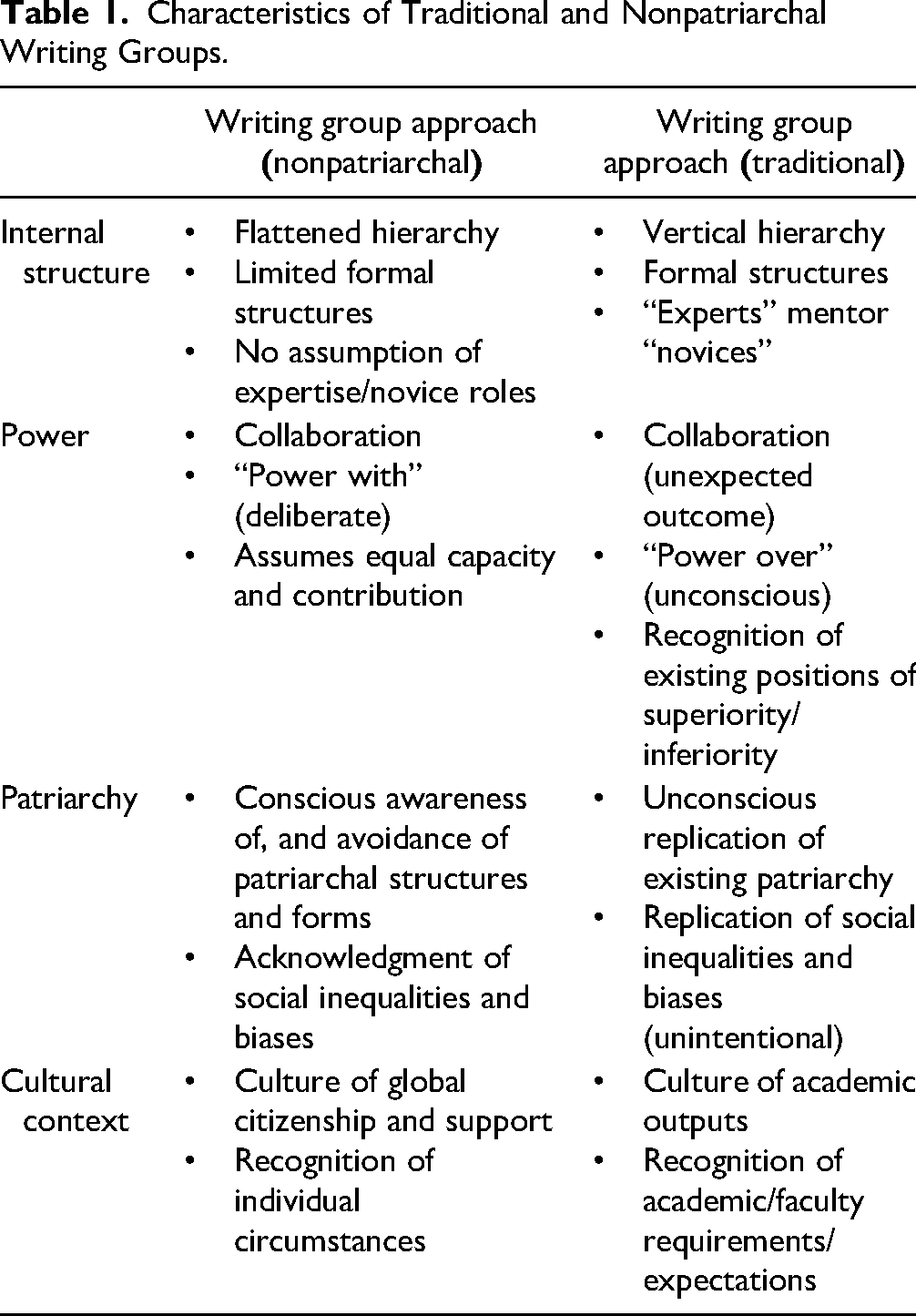
Literature has consistently linked academic writing groups with productivity, the imperative to publish, and the cultivation of a scholarly ethos (Davis et al., 2012; Houfek et al., 2010). The pressure to publish often begins early for academics seeking a permanent position, yet faculty members may lack adequate preparation for this responsibility. The term “productivity” frequently appears in literature, reflecting the push to increase scholarly activities and disseminate research through publications. It also represents the commodification of creativity which is part of the patriarchy of publication. Establishing a culture of scholarship is crucial for faculty transitioning from solely teaching-focused roles to face required outputs in the form of publications (Hampton-Farmer et al., 2013; Houfek et al., 2010). To develop new academics, many faculty writing groups expand their membership to include senior students, typically pre- and postdoctoral scholars, in an apprenticeship style model (Allen, 2019). The differences between a traditional academic writing group and a nonpatriarchal writing group are clarified in Table 1, which identifies the core concepts present in each.
Characteristics of Traditional and Nonpatriarchal Writing Groups.
Emerging Literature Related to Writing Groups
Nursing Academia
The nursing profession is evolving, stressing rapid dissemination of knowledge for optimal patient care and embedding professional values. Nursing research and its effective dissemination is crucial for evidence-based care and enhancing patient outcomes (von Isenburg et al., 2017). The COVID-19 pandemic underscored the essential role of nurses in safe patient care and research (Henshall & Lewin, 2022).
Nursing faculty hold a unique ability to share knowledge and improve patient care through their roles as educators, practitioners, leaders, and scholars (Breitenstein, 2021). Barriers to writing faced by nurses included time constraints, lack of writing skills, limited mentoring and support, difficulty prioritizing writing amidst competing demands, and imposter syndrome (Noone & Young, 2019; von Isenburg et al., 2017). The shortage of nursing faculty has exacerbated these pressures, often resulting in extra teaching responsibilities which can take priority over scholarly pursuits (Breitenstein, 2021).
Writing groups offered valuable support to nursing faculty as well as accountability and increased productivity (Breitenstein, 2021; Henshall & Lewin, 2022; Noone & Young, 2019; von Isenburg et al., 2017). Those involved in writing retreats described encouragement, improved writing skills, dedicated writing time, structured task assignments, and editing assistance (Noone & Young, 2019; von Isenburg et al., 2017). While both face-to-face and online formats were beneficial, members appreciated the flexibility of online groups while acknowledging reduced networking opportunities compared to face-to-face interactions (Henshall & Lewin, 2022).
As nursing faculty have sought to consolidate their position within academia and its associated expectations for publication, the movement to facilitate outputs and address barriers led to recognition of the value of the writing group process (Cygan et al., 2023). Writing groups have been established for both tenured and nontenured track faculty (Dhakal & Tornwall, 2020), faculty members with practice doctorates as well as those with PhDs (e.g., DN, DHSc) and doctoral students within the faculty (Hirschey et al., 2019; Tornwall & McDaniel, 2022; Tyndall et al., 2019) and for nursing teachers/academics/researchers and clinical nursing professionals (Bourgault, 2023; Chargualaf et al., 2024).
International Experiences
The globalization of research has experienced significant growth (Baumann, 2019), paralleled by an increased recognition of global citizenship, defined as “belonging to a broader community and common humanity” (United Nations Educational, Scientific and Cultural Organization [UNESCO], 2015, p. 14) across political, economic, and social spheres, fostering interdependency and interconnectedness (UNESCO, 2015). The United Nations Children's Fund [UNICEF] (2013) highlighted global citizenship as valuing diversity, interconnectedness, and striving to tackle social inequalities. While writing groups are known to benefit faculty and professionals, there is limited literature on international collaboration and writing processes among nurse scholars. Pressures to publish are compounded by various global shifts, including the restructuring of tertiary education, the imperative to provide accessible and equitable education, heightened budgetary and staffing constraints, and the impact of global events such as the COVID-19 pandemic (Fien et al., 2022). Actual and potential global events underscored the necessity for reciprocal exchange of strengths, resources, knowledge, and an appreciation of diverse worldviews (Elliot, 2015). Indeed, Elliot (2015) emphasized collaborative partnerships should not solely benefit “Western” members but should also promote international learning. Global writing group collaborations offer opportunities for international mentoring, role modeling, and enhanced productivity through the pooling of strengths and the synthesis of diverse worldviews.
Evolution Of The International Writing Group
This section outlines the transformation from a faculty writing group to an IWG, summarizing its continued evolution and response to changing member needs, and highlights the impact, challenges, and opportunities of a collaborative, international model. This brief outline, together with the description of the historical basis underpinning its intention (the nonpatriarchal, power sharing, and collaborative model), offers a basis for the subsequent discussion and critical analysis of the applied theory.
Formation of the Writing Group
In 2019, a writing group was formed from a workshop designed to assist new faculty at a teaching university in the United States in disseminating their scholarly work, particularly focusing on family and societal nursing. The primary aim was to help faculty members achieve publication milestones and meet tenure and promotion criteria. This curriculum followed the structured approach outlined in “Writing Your Journal Article in Twelve Weeks” by Belcher (2019), with the on-site group covering one chapter each week. However, with the onset of the COVID-19 pandemic, the writing group transformed into a means for faculty members to maintain connections during remote work and isolation.
Expansion to International Collaboration
In 2022, recognizing the importance of professional connections, the writing group initiated a trial of an IWG by extending invitations to partner universities worldwide, adopting a horizontal democratic model in which each participant and university had an equal voice. While maintaining the original workshop model based on Belcher (2019), the writing group evolved into two distinct entities determined by time zone: the Atlantic group, spanning the United Kingdom, Finland, Denmark, Spain, Austria, Sweden, South Africa, coordinated by one member from the United States, and the Pacific group, encompassing Japan, New Zealand, Australia, and the United States. Both sections continued to use the 12-week format, with online forums meeting weekly for an hour. Some participants remained with the group through subsequent iterations, and new members joined as invitations continued to be extended, often due to recommendations from current participants. Team dynamics altered with membership transitions.
Challenges and Adaptations
Respecting participants’ availability with differing time zones and personal commitments required alterations to the group format. As well as the need to be responsive to different time zones, other challenges became apparent. The commitment of 12 sessions per semester was time-consuming. Identifying the need for a balance between writing knowledge and a supportive community, the group revised the schedule in early 2024, reducing the frequency of sessions to six per semester, with topics determined weekly based on participant input, allowing for exploration of contemporary subjects.
Other adaptations included opening the group to participants from other disciplines, fostering interdisciplinary collaboration and diversified insights. Both novice and expert faculty members found value in these changes. Experts benefited from adopting a “beginner’s mind” and sharing experiences, such as the rejuvenation felt when guiding out-of-town visitors. Novice participants gained encouragement, understanding, and a sense of camaraderie in overcoming fears associated with publishing. Another benefit included understanding the international perspective in research, as the global experience differed by country. The partnerships established by this international group evolved into a rewarding experience for all members as each advanced their own individual scholarship.
Four Years of Growth
Over the past four years, the writing group contributed to increased publications and facilitated the development of meaningful relationships with colleagues worldwide. Exposure to diverse thoughts and collaborative efforts has created a core group of ten participants dedicated to the ongoing success of writing for publication.
The evolution of the scholarly writing group from a local workshop to a global collaborative underscored its resilience and adaptability. This journey reflected a commitment to addressing the changing needs of faculty members (e.g., support for academic promotion, teaching strategies, and questions relating to various stages of writing confidence and competence for different elements, whether articles, grant writing, posters, or other forms) while fostering a supportive community that transcended geographical boundaries.
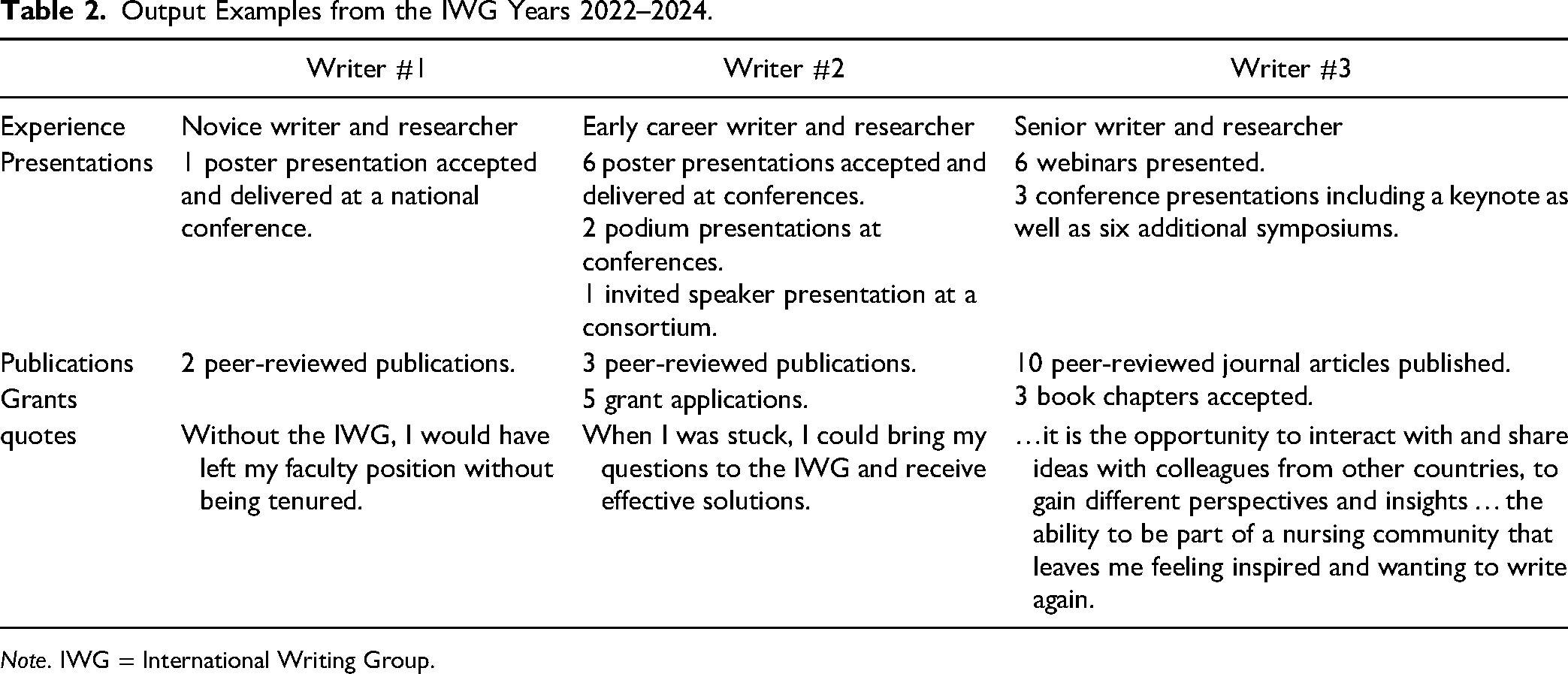
As examples, three members of the Pacific Writing Group increased their writing productivity. Two were new faculty, who received encouragement and coaching through the IWG, beyond what was available at their universities. See Table 2 for examples of the research production from these three members. In addition to these three members, all IWG members continued to gain confidence and skills in working towards publication.
Output Examples from the IWG Years 2022–2024.
Note. IWG = International Writing Group.
As the group continues to evolve and thrive, the shared experiences and diverse insights enriched scholarly pursuits in an ever-evolving academic landscape. The IWG benefited both junior and senior faculty members, in different ways. It addressed the changing needs of faculty members throughout their career trajectories by fostering a supportive collegial environment that built inspiration and insight at various levels of professional development.
Discussion
Theoretical Basis
Historically, the impetus to accumulate nursing knowledge stemmed from recognizing the necessity to distinguish nursing from medicine. Nursing has often been overshadowed by and associated with the medical model, which traditionally leans towards empiricism and reductionism rather than the holistic and humanistic approach of nursing (Sakamoto, 2018). This writing team deliberately avoided the competitive, individualistic model in the research, opting instead for a collaborative and international approach that fosters a new way of engagement. Nursing has traditionally embraced multiple ways of understanding, including empirical, personal, ethical, aesthetic, and now socio-political dimensions (Carper, 1978; Sakamoto, 2018; White, 1995). While evidence-based practice is crucial for providing clinically sound evidence, nursing's unique approach emphasizes holistic, contextualized care. There is evidence to suggest that a continued focus on, and pressure aimed at publishing and academic outputs may result in a narrow focus within nursing. This has been linked to fewer multidisciplinary research collaborations, and where broader opportunities to improve patient outcomes and develop nursing knowledge may be missed (van Dalen & Henkens, 2012).
Positive Impacts on Individual Members
The IWG has positively influenced each member’s productivity, success, and collaboration in scientific writing, regardless of experience level. The group has provided an encouraging platform for nonnative English speakers to join at their own pace and enhance their skills, offering a safe space for practicing writing skills and receiving feedback from native English speakers. All members can initially listen, without pressure to share their writing until they feel comfortable contributing. While international partnerships in writing projects have previously been documented (Marquis et al., 2016, 2017; Scharff et al., 2021), the dynamic of supporting each member in individual projects is not widely reported in the literature.
Mentorship and Collaboration
Regular interaction within an IWG fosters a sense of collegiality that supports mentorship, collaboration, and global citizenship. Rather than solely focusing on the product, membership in a writing group shifts attention to the process (Davis et al., 2012). An IWG allows its members to grow as writers with a deeper understanding of the academic and nursing worlds. Discussions about varying writing and publication expectations for academics globally benefit members, fostering mutual understanding and support for differences and similarities. While publication may be the initial goal for members joining a writing group, the added value of truly knowing and learning from academics worldwide cannot be overstated. Members witness how their academic writing can be influenced by the relationships formed in the IWG, with far-reaching effects on academic scholarship.
Global Citizenship
An international nursing writing group represents a novel concept. Today’s technology enables nurses worldwide to participate in virtual writing groups, facilitating networking and real-time sharing of knowledge and ideas. These groups cultivate cultural awareness, which influences members’ writing and nursing practice. The writing group not only increases publication output but also enhances learning, understanding, and the value of each member in the pursuit of global citizenship. Being in a writing group with other nurses across the globe provides an opportunity to see there are similar queries, research topics, challenges, and barriers for professors and researchers. This realization helps provide the writers with support, motivation, confidence, and empowerment to persevere with scholarly publishing so that the discipline of nursing can continue to grow more scientifically rich and strong.
Global citizenship expands an individual’s identity beyond their origins, encompassing perspectives from worldwide views and shaped by diverse lenses. Through active participation, individuals gain the ability to influence change at regional, national, or international levels. Global citizenship builds bridges and values diversity, fostering respect for equality and working towards human rights for all (Nussbaum, 1997). The writing group allowed all writers to develop self-confidence and courage to share their research for critical review within the group. Embracing this perspective, the IWG unites scholars worldwide to promote academic excellence and collaborate to guide and promote individual and collective success.
Future Directions
The IWG has consistently provided both expected and unexpected benefits for all participants. The group will continue to evolve as it embraces a flexible and responsive format, including frequency of meetings and approach to facilitation. Some veteran participants will continue while others leave and new members join, ensuring a mix of experienced and novice group members, all while maintaining a nonpatriarchal approach (equitable in terms of power) in writing for publication. Continuing to use Belcher’s (2019) model will serve as a foundation for these changes in providing a structure and topics for facilitating discussion. Additional elements can be incorporated into individual sessions, in response to the interests of a particular individual, or more formally developed as part of the content.
IWG members have mentioned the use of AI at several meetings; a more structured engagement with this topic will be included with future IWG sessions, as a conceptual issue but also for practical consideration of how this technology might be used ethically and effectively. Indeed, AI may allow nonnative English speakers to become more proficient in writing scientific articles in English and is a potentially valuable tool for all authors. While AI “should not be used as a replacement for human judgment” (Salvagno et al., 2023, p. 1), it may help “even the playing field” for international authors who have struggled to compose their writing.
Conclusions
The IWG was established to support nurse faculty members in publishing their scholarly work. The demanding workload of academia often makes it challenging for faculty to find the time and resources to publish their work and advance their careers. By fostering a culture of scholarly writing, the group encourages writing accountability and increase productivity, helping nurse faculty to achieve their scholarly goals. Virtual meeting opportunities have allowed the writing group to expand internationally, promoting global networking and collaboration, and empowering nurse faculty in their scholarship growth and development.
The impact of the writing group has been significant. It created a platform for nursing professionals to connect, learn from each other’s diverse perspectives, and collaborate in a nonpatriarchal environment. Nursing faculty members have enhanced their academic skills, engaged in cross-cultural exchange, and contributed to the academic advancement of the nursing field. Joining the writing group not only benefits scholarship growth and development but also contributes to the global advancement of nursing. As nursing continues to grow internationally, these connections will build a more robust nursing community and a stronger voice to shape the future of the profession.
Footnotes
Declaration of Conflicting Interests
The authors declared no potential conflicts of interest with respect to the research, authorship, and/or publication of this article.
Funding
The authors disclosed receipt of the following financial support for the research, authorship, and/or publication of this article: This work was supported by the Taylor Institute, Minnesota State University, Mankato, MN, USA.

Authors’ Biographies