



Abstract
The Promoting Empowered Approaches for Critical/Challenging Encounters (PEACE) program, developed at Duke University School of Nursing, is designed to navigate communication when there has been an exchange between community members, either with actions, words, or behaviors, that does not align with the school's core values. The goal of this program is to provide resources that promote conflict resolution through conversation, as well as managing conflict at the organizational level.
Communication is power. Those who have mastered its effective use can change their own experience of the world and the world's experience of them.
Robbins (1986, p. 25)
Introduction
Creating an inclusive climate within an organization hinges on the responsibility of community members to one another and the agreement to be respectful in communication behaviors. This is even more crucial in the academic setting, where future nurses are being taught how to engage with team members and patients. The behaviors observed in educators are often the behaviors students will embrace and emulate. Therefore, effective communication in the academic setting is part of the educational process that contributes to optimal outcomes for the patients our students will encounter. Engagement in unprofessional communication in the academic setting can affect the ability of students, staff, and faculty to perform their assigned roles effectively. Unprofessional communication in the clinical setting may impact student clinical performance and patient care delivery, and undermine the culture of safety. Strategies that are developed to manage potentially disruptive behaviors that occur in academic or clinical settings are critical not only to preventing the escalation of conflict but to encouraging resolution.
The behaviors observed in educators are often the behaviors students will embrace and emulate.
Background/Problem
Respectful communication behaviors are key in any setting, but are critical in an academic setting, where faculty and staff are role models for undergraduate and graduate nursing students. Within the academic setting, robust, respectful discussions are healthy, and are needed to provide diverse perspectives and to model healthy discourse.
Advocacy is another area in which modeling of respectful communication is important. In the academic setting, faculty are teaching and demonstrating to students how to advocate for their patients. But faculty are also keenly aware that students are observers; when potential issues threaten the safety of the learning and/or work environment, there may not be direct interaction, but respect is shown by how faculty and staff colleagues advocate for one another or for students.
A specific behavior that threatens these interactions is incivility; whether shown verbally or in behaviors, it can undermine communication and teamwork in an organization. Clark (2009) initially defined incivility as “disruptive behaviors that often result in psychological or physiological distress for the people involved (including the intended recipient, bystanders, peers, and the organization) and if left unaddressed, may progress to threatening situations or escalate into hostility and violence” (p. 194).
Clark's definition of incivility has evolved over time, and now cites “a range of lower intensity acts of aggression that if left unaddressed, can escalate into more harmful or threatening situations. These behaviors, especially when patterned over time, can result in psychological or physiological distress” (2022, p. 20). Uncivil behaviors may include what is considered mild (but consistent) rudeness or impoliteness, eye-rolling, demeaning remarks, exclusion, marginalization, and sarcastic remarks (Clark, 2022). These behaviors, if not addressed, may increase in intensity, leading the recipient of this behavior to experience increased stress or even psychological harm. When faculty and staff are exposed to this type of detrimental behavior, it can decrease their productivity and the quality of the work they produce. In this time of remote and hybrid working assignments, communication via email, and people's faces in little boxes in virtual meetings, addressing incivility is challenging. At the same time, isolating oneself has become easier, ultimately eroding a sense of community, teamwork, and morale, and leading to an environment that does not foster inclusivity and/or a sense of belonging.
A NEW WAY TO ADDRESS INCIVILITY IN AN ACADEMIC SETTING
Restorative Justice
Organizational policies that focus on workplace behavior expectations often reflect zero tolerance for uncivil behaviors; therefore, the resulting actions for resolution are mostly punitive or are used to control or manage behavior (Lodi et al., 2021). Restorative justice, in the broadest terms, is an approach that attempts to repair harm by providing an opportunity for those harmed to communicate and address their needs in the aftermath of an encounter (A. Gregory, personal communication, June 6, 2021). Restorative justice is achieved when those who cause harm are provided the opportunity to acknowledge how the harm affects the entire community. This insight is critical not only to resolving a problem, but to repairing relationships to encourage future engagement without fear of conflict.
Duke University School of Nursing (DUSON), while extremely progressive in its strategies to enhance an inclusive climate, is not exempt from workplace harms such as callous or biased remarks, bullying, and other behaviors that do not reflect the school's core values of excellence, integrity, collaboration, respect, innovation, and diversity and inclusion. While many of these interactions tend to fall outside of formal policy violations, the repeated, seemingly benign, or even unintentional situational conflicts can negatively impact an institution's morale, individuals ‘job satisfaction, and organizational productivity.
DUSON has been proactive in addressing workplace harms through a variety of institutional resources and programming. However, in recent years the community appealed for a different approach that encouraged direct communication with individuals demonstrating unprofessional behaviors. With the goal of conflict management in mind, the school's Office of Diversity, Equity, and Inclusion explored several options to enhance effective communication and presented a specific approach to the DUSON community, which comprises faculty, staff, and students at the School of Nursing.
The Cup of Coffee – An Indirect Line of Communication
In the Cup of Coffee program (Dubree et al., 2017), which originated at Vanderbilt University, professional behaviors in the context of a conflict are promoted and fostered through conversations initiated and facilitated by a third individual, one not a party in the conflict. This facilitator is tasked with speaking with the person whose actions or comments do not align with the organization's core values, ostensibly over a cup of coffee, thereby creating an indirect line of communication. While there are third-party strategies that have been successful in other organizations, the DUSON community preferred an approach that did not rely on communication from a third party. Our community favored more direct communication between the individuals involved in a situational conflict, and further recommended that individuals less comfortable with direct communication receive training to prepare and potentially empower them for the challenging conversations that are common in these instances.
Empowerment for Challenging Conversations
The Cup of Coffee program was presented to DUSON's Faculty Governance Association (FGA) and Staff and Workplace Advocacy Council (SaWAC) for feedback. The community embraced the concept of communication around uncivil behaviors in the Cup of Coffee program but desired strategies to encourage direct communication between community members who were engaged in a conflict or had experienced unprofessional behavior. The Office of Diversity, Equity, and Inclusion formed a working group to redesign the Cup of Coffee program to meet the desires of the community members. The working group created the new program's name, Promoting Empowered Approaches for Critical/Challenging Encounters (PEACE), and designed it to engage and support community members by providing resources to facilitate a meaningful resolution when an encounter that is antithetical to DUSON's core values has occurred. The PEACE program provides a supportive infrastructure and resources to assist community members in navigating challenging conversations and interactions through one-on-one communication.
The working group developed the program components, the peer facilitator selection process, and the peer facilitator's role. Peer facilitators would be provided training in:
communication and response skills to appropriately address reports of harm, including harassment, bias, or other work climate concerns;
knowledge and skills to encourage and equip other members of the community to intervene to halt and prevent future conflict or harm by directly addressing the individual causing harm; and,
knowledge of Duke's harassment policy, reporting options, referrals for support, and the most effective ways to respond to reports.
This training in skills and knowledge was designed to create a culture in which harm and conflict are less likely to occur or reoccur. Once the PEACE proposal was fully developed, it was shared again with the FGA and SaWAC for additional feedback. The DUSON community fully supported the PEACE program process design. See Figure 1.
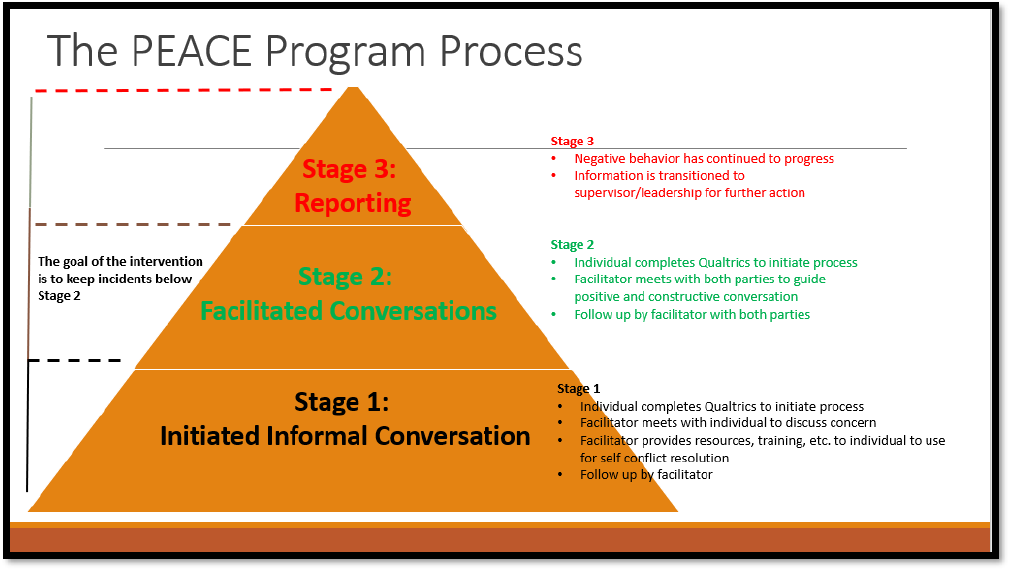
PEACE Program Process
Peace Peer Facilitators
A key component of the PEACE program is the facilitator role; these people are the first point of contact for individuals seeking assistance through the program to resolve a conflict. PEACE Peer Facilitators (PPFs) help community members by providing a safe environment in which to speak about a particular situation, strategies for one-to-one communications, and any additional resources the community member may need. A PPF may also serve as a support person at a meeting between community members interested in resolving a conflict through an open conversation.
Given the sensitivity of such discussions, the situations that may be reported via the PEACE program, and the need to maintain the integrity of the program, all PPFs were expected to have demonstrated qualities of trust and respect, the ability to maintain confidences, and effective listening and communicating. It was equally important to engage DUSON faculty and staff in identifying individuals well suited for the PPF role. To this end, each community member was asked, through an anonymous survey, to nominate three DUSON colleagues (faculty or staff) who have consistently demonstrated the requisite qualities for the PPF role. Of the approximately 90 faculty and 120 staff, 47 submitted nominations of 67 individuals; the 10 individuals who received the most nominations were invited to serve as the program's first PEACE Peer Facilitators.
Peace Peer Facilitator Training
The PPF role is vital to the PEACE program. To ensure the success of the PPFs, and by extension the success of the program, it was important that all PPFs have appropriate training to be effective in the role and in communicating with participants. The training and coaching, provided by Ada Gregory, Associate Director for Duke University Kenan Institute for Ethics, was rooted in restorative justice practices.
Restorative justice provides a means for preventing and addressing harm, conflict or other problematic behaviors or remarks by prioritizing needs of the aggrieved party, by allowing those who caused harm the opportunity to make amends and repair the harm, and by recognizing these harms affect the entire community and therefore require action to ensure similar incidents won't reoccur. Restorative practices prioritize listening, affective statements, and affective questioning to help facilitate accountability and healing. Because this means of conflict resolution is dependent upon building community ties, the training will also expose the cohort to circle process which facilitates stronger relationships and can be applied proactively to lessen the likelihood of conflict and harm. (A. Gregory, personal communication, June 6, 2021)
Ms. Gregory led several interactive sessions with the PPF group. Among the topics covered were introduction to restorative justice philosophy and approach, reporting policy, resources and referrals in DUSON, limits and obligations of the PPF role, communication skills (active listening, common pitfalls, etc.), and response strategies. The sessions also included case studies and role-playing activities. In addition, the training design provided post-training consultation, booster training, and facilitation of quarterly meetings with the PPF cohort to discuss program barriers and facilitators.
In an informal discussion following the training sessions, the PPFs reported an increased level of awareness in applying restorative justice, and increased confidence in their abilities to carry out the responsibilities of the role. It is important to note that while PPFs will perform important work in facilitating conflict resolution, there are some areas that are beyond the scope of their responsibilities. There is a standard process through the university to address harassment, discrimination, and Title IX complaints/concerns related to class (i.e., race, religion, sexual orientation, gender identify/expression, genetic information, national origin, disability, and/or veteran status). It is critical that the PEACE program identifies when a reported concern meets these criteria, and forwards it to the appropriate reporting systems. The PEACE program is not designed to investigate or independently resolve issues which meet the above criteria, but rather to address non-reportable concerns related to communication and/or behaviors. Further, Duke University requires all employees, including DUSON PPFs, who become aware of prohibited conduct to notify the appropriate office.
How Individuals Engage in the PEACE Program
To engage in the PEACE program, a DUSON staff or faculty community member initiates an online request through the Office of Diversity, Equity, and Inclusion website; this request is forwarded only to the Associate Dean for Diversity, Equity, and Inclusion (ADDEI). The purpose of limiting access to online requests is to ensure that the request meets the criteria of the program, minimizes the number of people with access to the request, and protects the community member who sent the request.
The ADDEI assigns a PPF, who then schedules a meeting with the requesting individual, to assist in developing the communication skills needed to navigate and engage in conversations to manage the conflict and/or address challenging encounters. The PPF may be present for the initial meeting between the two community members, not to engage in dialogue but to keep the focus on the behavior or remarks which caused harm, and on the importance of the relationship between the two individuals. Resolution may not occur in the first meeting; additional meetings can be scheduled to keep the conversation moving in a positive direction. After engagement in the PEACE process, the PPF and the community members engaged in the conflict are given the opportunity to measure satisfaction with the resources, trainings, structure, and outcome of the program.
Restorative justice attempts to repair harm by providing an opportunity for those harmed to communicate and address their needs in the aftermath of an encounter.
Implementing the Peace Program
Launching PEACE
The PEACE Program was launched on January 19, 2022, with a Mediasite presentation describing the PEACE program components and process for engaging. While the initial program outcomes are positive, there is not sufficient data yet to determine if the program can be extended to student population. Information about the program is presented at
Sustaining the Program
DUSON's Office of Diversity, Equity, and Inclusion is responsible for facilitating the program's processes, and for the ongoing provision of resources, training, and program evaluation. On an annual or semi-annual basis, depending on the number of participants, an evaluation tool will be distributed to the PEACE program PFFs and community members who engaged in the program, to assess satisfaction with the resources, trainings, structure, and outcomes of the program. In addition, a rapid cycle improvement model will be used to identify, implement, and measure changes that are needed to the program expeditiously. This is critical to ensuring that the process itself is achieving the intended goals and not causing any harm. Currently this program is focused on faculty and staff; however, there are plans to expand after sufficient data on the program outcomes can be evaluated.
Communication within the PEACE process can be misguided if restorative justice practices (prioritizing listening and using affective statements and questioning to help facilitate accountability and healing) are not consistently followed. Continuing engagement with trainer Ada Gregory will be maintained, to provide additional direction and guidance in support of the PPFs ‘knowledge and abilities. The importance of the PEACE process is supporting healthy community relationships so that, over time, we will proactively lessen the likelihood of conflict or harm.
Cite this article: Carter, B. & Arthur, C. (2023). Empowered approaches to critical/challenging encounters: Promoting PEACE in a school of nursing. Creative Nursing 29(1), Article 8.
Footnotes
Brigit Carter, PhD, RN, CCRN, FAAN, (she/her), developed the PEACE program when she served as the Associate Dean for Diversity, Equity and Inclusion at Duke University School of Nursing in Durham, North Carolina, US. She is currently the Chief Diversity, Equity, and Inclusion Officer at the American Association of Colleges of Nursing (AACN). Dr. Carter is an Atlantic Fellow for Health Equity.
Crystal Arthur, BS, (she/her), is the Director of Faculty Affairs at Duke University School of Nursing in Durham, North Carolina, US.