




Abstract
U.S. Supreme Court rulings on reproductive rights and affirmative action inadvertently present the nursing profession with a propitious opportunity to capitalize on the nation's rich mosaic of iceberg demographic identities—inherited and acquired traits that may not be visibly apparent—to address imminent challenges such as worker shortages and other perplexities within the workplace milieu.
Implications for Practice and Research
Understanding and applying the concept of iceberg demographics can help health-care organizations succeed in talent acquisition and retention in a labor market that is both browning and graying. Three such demographics that are particularly relevant in the nursing workforce are people with mixed-race identities, women experiencing menopause, and people with cognitive impairments, particularly young adults with long COVID. By seizing opportunities and leveraging the richness of our nation's diverse identities, the nursing profession can achieve greater reputational equity in the ongoing fierce competition for talent.
Profound transformations in the dimension, composition, and geographic distribution of the U.S. populace (Alexander & Johnson, 2021; Johnson, 2023; Johnson, Bonds, & Parnell, 2021) contribute to the nursing profession's ongoing workforce challenges (Aiken & Cheng, 2008; Kurtzman et al., 2022). Further complicating the scenario, the COVID-19 crisis and climate change-induced adverse weather events (Johnson, Parnell, & Bonds, 2022a, 2022b), coupled with politically polarizing Supreme Court rulings and contentious state-level policies about culturally conflicting issues such as abortion, same-sex marriage, and affirmative action (Johnson & Parnell, 2023; Schlobohm & Johnson, 2023), have ignited a surge in labor activism that manifests in multiple events such as walkouts, strikes, resignations, silent quitting, and resistance against post-COVID-19 return-to-office mandates, not only in the health-care professions but across other domains of the U.S. economy (Gooch, 2023; Grantham-Phillips, 2023).
Amid the circumstances of divided government and political impasse in U.S. politics (Lopez, 2022), public sentiment reflected through opinion polls exposes the burgeoning inclination of Americans toward companies that have purpose and ethics (Crabtree, 2023)—firms endowed with what Johnson and Bonds (2020) have designated “reputational equity.” This shift in preference appears to be a response to the profound anxiety and crises we are currently facing as a nation. Following the terrible murder of George Floyd and partly a reaction to escalating labor unrest, we formulated a comprehensive checklist including policies, strategies, tactics, procedures, and practices that some private sector firms, driven by the objective of establishing and preserving reputational equity, are implementing to recruit and retain talent. The checklist (see Table 1 in Johnson & Bonds, 2020) delineates activities across four pivotal organizational domains: leader behaviors/demonstrated commitment; workplace culture and climate; talent recruitment, development, and retention; and community engagement and support.
Lately, we have extended the application of the reputational equity checklist to the nursing profession, specifically observing that: …to create reputational equity, the nursing leadership must undertake a comprehensive DEIB [Diversity, Equity, Inclusion, & Belonging] audit of the entire nursing profession ecosystem. That is, they must critically review and evaluate policies, procedures, and practices that govern the day-to-day operations of professional schools that train and produce the nursing workforce. The same must be done for the various components of the U.S. healthcare system that rely on the talent the nursing education, training, and certifying systems produce. (Johnson, Alexander, & Bonds, 2021, p. 1)
Nursing Profession Reputational Equity Checklist.
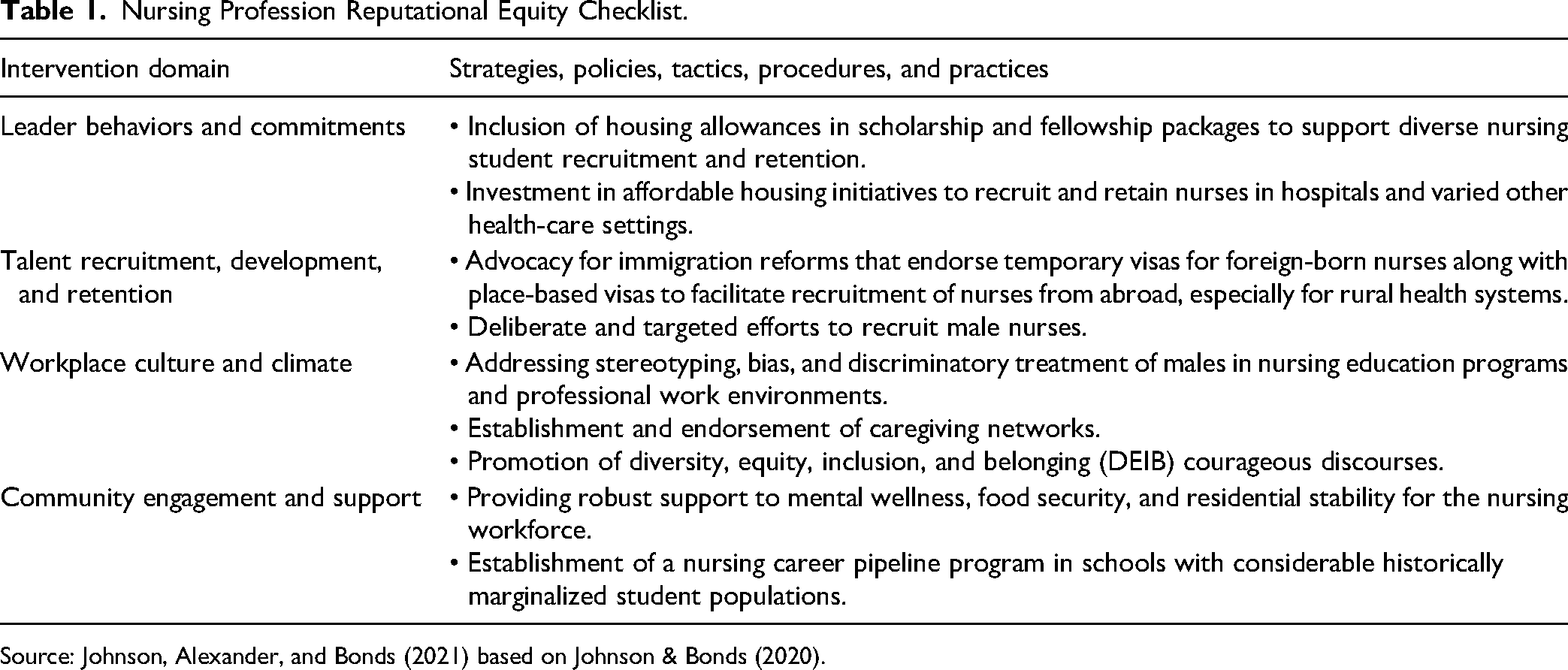
Source: Johnson, Alexander, and Bonds (2021) based on Johnson & Bonds (2020).
Regardless of recent critiques directed at diversity and inclusion initiatives within both public and private sector firms (Butler, 2023; Chronicle Staff, 2023; Grantham-Phillips, 2023; Guynn, 2023; Hsu, 2023; The Conference Board, 2023), we contend that health-care organizations that employ nurses must steadfastly embrace the activities outlined in the checklist “to demonstrate that they are inclusive and equitable places to work with civically engaged leaders that are poised and willing to address society's most pressing ills, including systemic racism” (Johnson & Bonds, 2020, p. 1). Adopting these promising practices will potentially empower the nursing profession, and public and private sector companies that engage nurses, to proactively reengineer their workplace cultures and climates, positioning these entities as preferred employers: organizations where everybody aspires to work (recruitment), and existing employees feel motivated to stay (retention; Argo & Sheikh, 2023; Johnson & Bonds, 2020).
Reimagining Talent Management
To be successful in talent acquisition and retention in a labor market that is both browning (becoming more racially and ethnically diverse) and graying (aging due to extended longevity and declining fertility; Johnson, 2023; Johnson, Bonds, & Parnell, 2021), it is imperative that the nursing industry undergoes a substantial overhaul of Human Resources (HR) policies and practices to instill within the current employee pool a strong sense of inclusion and belonging in the workplace (Argo & Sheikh, 2023). Popularly stated, the nursing profession must strive to create workplaces where employees feel that they have been personally invited to the dance and the disk jockey is playing the music perfectly attuned to their preferences. This metaphor highlights the significance of creating environments that extend beyond mere inclusivity to tailoring the workplace experience to every employee's unique identity and aspirations.
Additionally, the nursing profession must revolutionize its approach to talent recruitment, aligning it with the reengineered employee-centric workplace culture and climate. Drawing insights from the lessons learned from the COVID-19 crisis, this transition requires the nursing profession to identify trusted messengers and develop trusted messages that, through a comprehensive multichannel communication strategy customized to reach the current U.S. workforce constituted by a diverse spectrum of the five generations (Sonnenberg, 2023), convey the virtues of working in a profession characterized by reputational equity, which implies that belonging and well-being are proven core values for both employees and patients (Johnson, Bonds, & Alexander, 2021; Johnson, Bonds, Parnell, & Bright, 2021).
Embracing Iceberg Demographics
Our concept of iceberg demographics derives from scientific discoveries about the physical characteristics of a freshwater iceberg, defined in the New World Encyclopedia (2018) as a “mountain of ice that has broken off from a glacier or ice shelf and is floating in open waters.” While varying in both size and shape, only about 10% of a freshwater iceberg is visible above the water line. The balance (90%) is submerged below the surface (Wadhams, 2023).
Given the Supreme Court's short-sighted decisions on affirmative action and reproductive rights as well as state-level conservative policymaking on a range of culture war issues (e.g., marriage equality and transgender rights; Johnson & Parnell, 2023), we assert that the nursing profession must embrace an analogous iceberg model of demographic diversity (Butts, 2012; Johnson, Bonds, & Alexander, 2021; Think Up Consulting, 2021). In recruiting and retaining talent, nursing HR professionals must look beyond the visible attributes of an individual's demographic identity, such as race, ethnicity, and gender, crafting instead a workforce development strategy that leverages other inherited and acquired traits and experiences in the nation's working-age population. Like a freshwater iceberg, some of these attributes are not readily apparent, but, if comprehended and accommodated effectively, these traits can be value-added in the workplace (Johnson & Parnell, 2023; Sutorius, 2022).
Figure 1 depicts iceberg demographic indicators prevalent in the U.S. working-age population. Given the forecasted continued deceleration in total U.S. total population growth and non-Hispanic white population decline coupled with other disruptive demographic shifts, including premature deaths of despair among prime working-age individuals (Johnson, Bonds, & Parnell, 2021; Case & Deaton, 2020), embracing and accommodating these and other iceberg identities is a strategic imperative for the nursing profession (Alexander & Johnson, 2021).
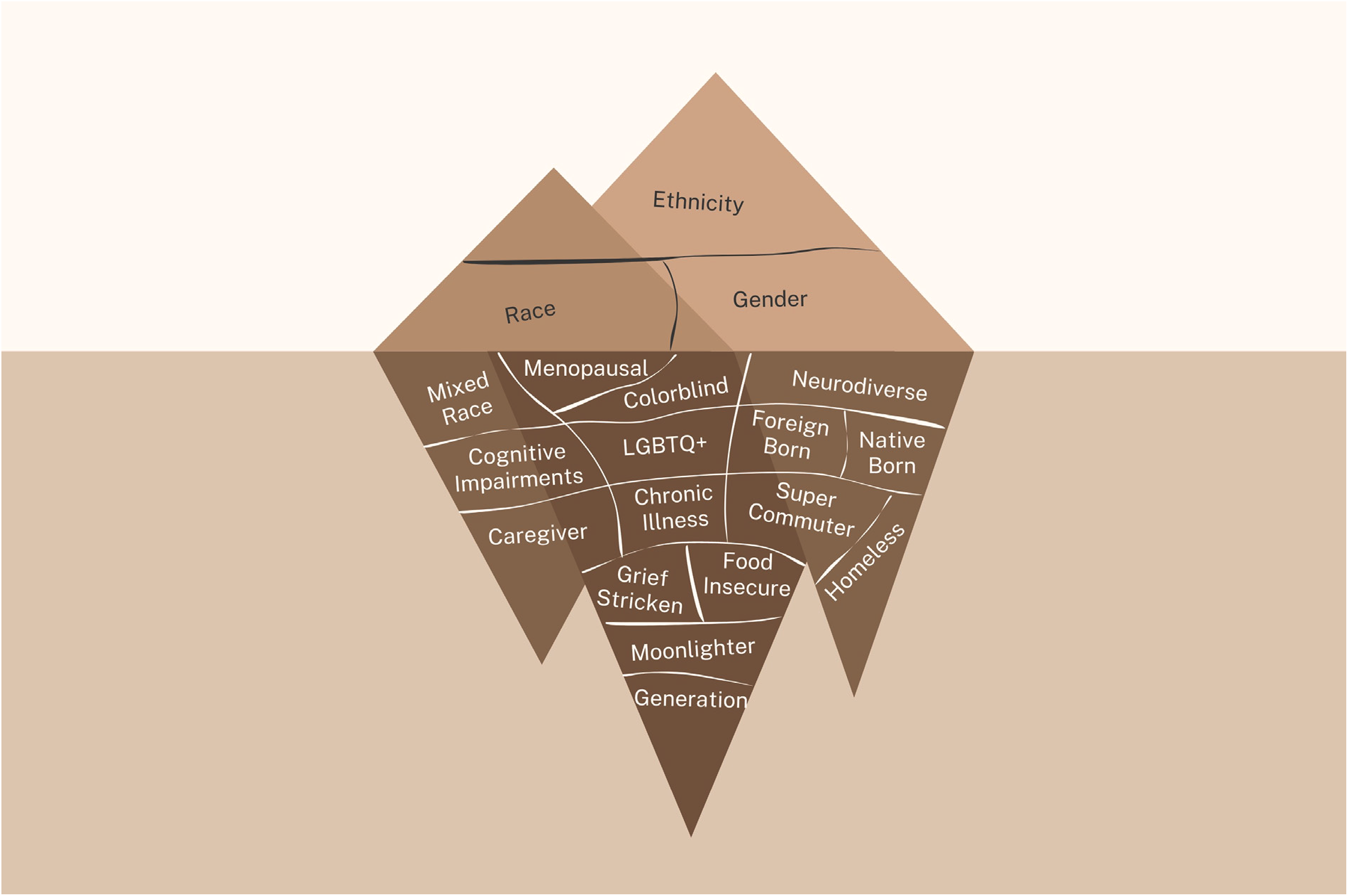
Selected iceberg demographics.
To elucidate the significance of workplace accommodations in attracting and retaining talent, we will briefly delve into three iceberg demographic identities—the mixed-race population, women experiencing menopause, and working-age individuals with cognitive impairments.
Mixed-Race Identities
The mixed-race population in the US stands out as one of the nation's most rapidly expanding demographic groups, growing by 33.8 million (276%) between 2010 and 2020 (Parker et al., 2015; Rico et al., 2023). In contrast, during this period the overall U.S. population grew by 7.4%, an absolute increase of 22.7 million people (Johnson, Bonds, & Parnell, 2021). Notably, during the COVID-19 pandemic, while the total population of the U.S. increased by a modest 1.8 million (0.5%), the nation's mixed-race population grew by 406,548 people (5%; Johnson, Bonds, & Parnell, 2021). Contributing to the ongoing demographic transformation, often referred to as the “browning” of America, mixed-race population growth is driven primarily by immigration of individuals from Asia, Latin America, and the Middle East, coupled with intermarriage between individuals from various countries in these regions and White and Black people, and other native-born people of color descent, already in the US (Parker et al., 2015; Rico et al., 2023).
The complex mixed-race population does not fit the conventional employee categories of race and ethnicity typically employed by HR departments (Rico et al., 2023). Moreover, this demographic pool often receives inadequate attention, with little or no consideration given to the diverse backgrounds, cultural experiences, and other attributes of mixed-race employees that can add value to the evolving world of work. Consequently, it is not uncommon for mixed-race individuals to express a sense of invalidation and not belonging within organizations (von Numers, 2023; Vox First Person, 2021). In light of the fact that the mixed-race population accounted for nearly one-quarter of U.S. net population growth during the pandemic and their share of future growth is poised to be more substantial (Parker et al., 2015), it is vitally important for the nursing profession to proactively develop accommodations to intentionally recruit and retain talent from this iceberg demographic (Mohan, 2020).
Women Experiencing Menopause
Given the considerable challenges faced by men in contemporary American society (including giving up on pursuing a college education; Cerullo, 2022; Cowan, 2018; Kahloon, 2023; Prakash, 2022), women are increasingly occupying pivotal roles in the paid workforce across almost all the domains and industries in the American economy (Almeida & Estep, 2023; Schram & Figueiredo, 2020; U.S. Bureau of Labor Statistics, 2021). This transformation in the American economy compels firms to invest more efforts than ever before to accommodate women, including becoming friendly workplaces for women experiencing menopause (Otterman, 2023).
According to D’Angelo et al. (2023), almost 75% of women experience menopausal symptoms at some stage in their lives, while 25% experience more serious symptoms. Although some women reach menopause before the age of 40, the average reported age of onset of menopause-related health issues, such as brain fog, mood changes, hot flashes, weight gain, insomnia, low energy levels, and low libido, is 51 years (Aldermore Bank, 2022; D’Angelo et al., 2023; Vanderzalm et al., 2023).
Why is attention to menopause an important aspect of talent recruitment and retention? An estimated 60% of women of menopausal age actively participate in the workforce (Almeida & Estep, 2023; Schram & Figueiredo, 2020; U.S. Bureau of Labor Statistics, 2021). However, the majority of them reportedly express reluctance to disclose information about their menopause-related health problems with their manager or supervisor and other work colleagues (D’Angelo et al., 2023; Vanderzalm et al., 2023). Notably, one in every five menopausal women reports contemplating quitting the workforce due to the impact of their symptoms (Castrillon, 2023; D’Angelo et al., 2023). “…[M]enopause isn’t something just women need to know about—men should be aware too so they can support colleagues, friends and family” (Aldermore Bank, 2022). Moving forward, the role of women of all ages in the workforce becomes more vital, particularly in the wake of the declining participation of the male labor force (Prakash, 2022).
Cognitive Impairments
Research findings validate the surge in the employment of U.S. working-age people with disabilities by approximately 1.5 million since the onset of the COVID-19 pandemic in 2020 (Deitz, 2022; Li et al., 2023). This surge is largely attributed to prolonged COVID-19 (also called long COVID), which led to an increase in cognitive impairments, particularly concentrated in adults under the age of 40. “There are more Americans who say they have serious cognitive problems—with remembering, concentrating, or making decisions—than any time in the last 15 years” (Paris, 2023, para. 1). These symptoms, ranging from mild to debilitating, were described by a young software engineer: “I felt like I was permanently hungover, drunk, high and in a brain freeze all at once” (Paris, 2023, para. 10). While brain fog is a frequently reported symptom, some research studies suggest that prolonged COVID may involve neurovascular changes causing brain injury (Deitz, 2022; Paris, 2023).
In construing the labor market implications emerging from the documented increase in disabled workers since the onset of the COVID crisis, a researcher from the Federal Reserve Bank noted, “…[T]hese disabled workers can benefit from workplace accommodations to help them remain productive and stay on the job, particularly as the majority deal with fatigue and brain fog, the hallmarks of long COVID” (Deitz, 2022, para. 8). He emphasizes that flexible scheduling and telework could serve as reasonable accommodations for workers suffering from long COVID.
Resources About Iceberg Identities
In-depth information and rationales for integrating these three iceberg demographic identities, along with others, into the workforce strategy of the nursing profession can be accessed from the links in Table 2.
Sources of Information About Iceberg Demographic Identities.
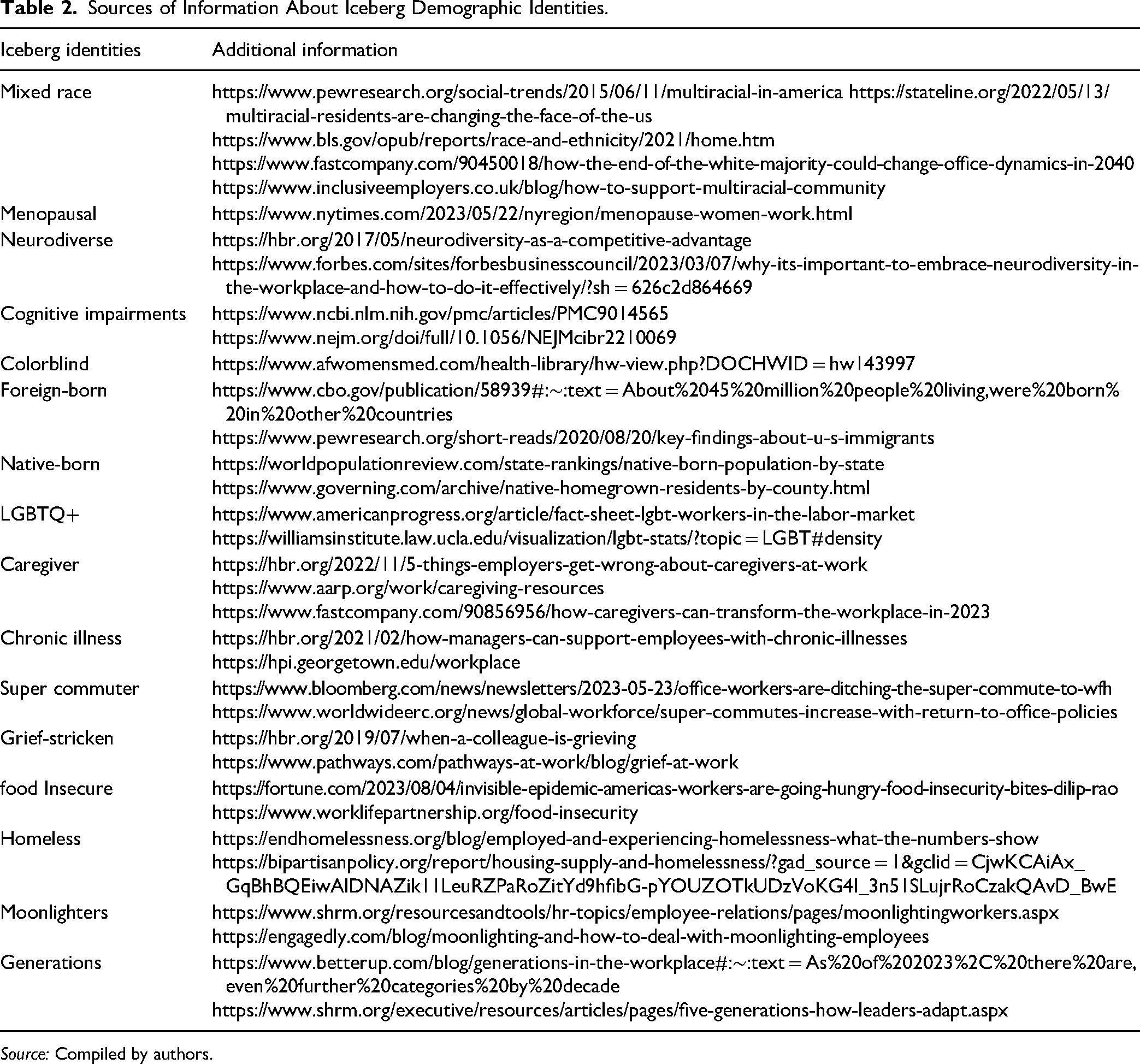
Source: Compiled by authors.
Recommendations
To thrive amid the intensely competitive talent landscape of the current U.S. economy, we recommend a strategic roadmap for health-care organizations that employ nurses that contains a sequential series of actions to be taken:
Conducting pulse surveys to determine the prevalence of iceberg demographic identities, including but not limited to those highlighted here, within the existing workforce. Based on the insights gained from various groups about ways to enhance workplace accommodation and foster a sense of belonging, creating employee resource groups tailored to fit a diverse range of iceberg demographic identities. Enhanced engagement is highly correlated with worker retention and productivity, as well as a firm's profitability. Instituting the required accommodations to enhance worker retention rates and leverage the diverse iceberg demographic employee resource groups as trusted messengers in marketing and advertising that target recruitment of new workers sharing those iceberg identities.
Given current workforce challenges and the tight U.S. labor market, it is strategically important for the nursing profession to act swiftly and purposefully in pursuing these recommendations. Firms in other economic sectors have already embraced the iceberg model of talent recruitment and retention—for example, rebranding themselves as menopausal-friendly workplaces (Otterman, 2023). By seizing the ample opportunities and leveraging the richness of our nation's diverse identities, the nursing profession can achieve greater reputational equity in the ongoing fierce competition for talent. Taking the steps outlined above to reinvent the profession as the employer of choice “where everybody wants to work and nobody wants to leave” (Johnson & Bonds, 2020, p. 4) will serve as a transformative approach.
Footnotes
Declaration of Conflicting Interests
The authors declared no potential conflicts of interest with respect to the research, authorship, and/or publication of this article.
Funding
The authors received no financial support for the research, authorship, and/or publication of this article.
Author Biographies