



Abstract
Compassion and caring are critical foundational concepts for the education of health professions students. Yet many curricula emphasize skill-based learning and test-taking preparation, which often limits the opportunities for students to practice compassionately caring for themselves and others. In 2019, an elective wellness course was introduced into a School of Nursing and Health Professions curriculum to provide students with the knowledge, understanding, and practice of self-compassion and caring as the foundation for holistically caring for others. The goal of the course is to use ethics, values, and ontological competencies of self-compassion and Caritas literacy to awaken students to their being, not just doing, and how it evolves throughout their professional careers. Narrative feedback from students demonstrated a deeper understanding of the necessity for compassion and caring for self to provide compassionate care to others.
In educational curricula for health professions students, there is rarely enough emphasis on self-compassion and self-care as the foundation of caring for others. However, for health professions students to care for the whole person and provide the highest quality of care to others, they must learn the value and practice of caring for themselves holistically, including mind, body, and spirit (Watson, 2018). Therefore, it is of utmost importance for students to understand Caring Science, including the science of self-compassion, that provides a foundation for their practice (Ross et al. 2017; Sitzman, 2022). Students need safe and encouraging spaces where they can practice self-compassion and self-care. More specifically, they need to be guided in forming connections to feelings of safety, meaning, purpose, and a sense of belonging (Ashktorab et al., 2017). These attributes form the foundation of individual healing, health, and wholeness, and create a healing environment.
It is of utmost importance for students to understand the Caring Sciences, including the science of self-compassion, that provide a foundation for their practice.
In a time of high stress, burnout, and turnover, education that integrates self-compassion and Caring Science into curricula serves to prepare, empower, and preserve nurses and other health professionals (Sitzman & Leners, 2006). Unfortunately, burnout impacts health professionals far too often, leading to challenges such as dysfunctional relationships, poor quality care, depression, incivility, medical errors, and poor physical health (Maslach & Leiter, 2017). In Western medicine and health professions education, which tends to focus primarily on sick care rather than wellness, less emphasis has been placed on self-compassion and care for self (Watson, 2008). Thrall et al. (2021) described compassion as a precursor to caring for self and others, related to the ability to embody loving-kindness, which is core to Caring Science.
With the reality of academic programs for health professionals tending to produce sleep-deprived, stressed, anxious, and undernourished individuals, these students need to receive opportunities to engage in affective learning that supports wellness and resilience through compassion, care, connection, safety, and belonging (Martin et al., 2022; Wei et al., 2021). Nursing students have been identified as being at risk for higher levels of stress in nursing school compared to other academic majors, and it is increasingly essential for schools to promote the development of resiliency and well-being (Sitzman, 2017; Martin et al., 2022). Importantly, the new American Association of Colleges of Nursing (AACN) Essentials of Nursing, with its focus on relational coordination, and the American Nurses Association (ANA) Scope and Standards of Practice, 4th Edition, reaffirm that the ‘art and science of nursing ‘also emphasizes caring as a key element in health care (AACN, 2021; ANA, 2021). In addition, Ginwright (2022) introduced the term collective care, a holistic perspective with awareness of how our well-being is interconnected to well-being and concern for others. This manuscript offers a description of a course that incorporates the concepts of Caring Science and self-compassion into a curriculum for health professions students.
Context
Course Overview
An online asynchronous elective wellness course, titled Wellness: Mind, Body, and Spirit, aimed to give undergraduate health professions students knowledge and understanding of self-compassion and Caring Science and to allow them to practice holistically caring for themselves while in relation with others. The goal was to use self-compassion and Caring Science ethics, values, ontology, and literacies to awaken students, transform their being, and engage them in lifelong learning.
Philosophy and Intention
The course intended to ensure that student voices and experiences were the primary focus, and that faculty members modeled authenticity, openness, curiosity, compassion, and care. More than 30 years ago, distinguished professor, author, and social activist bell hooks (1994) argued for more inclusive teaching, which she called an engaged pedagogy. Similarly, in Creating a Caring Science Curriculum, Hills et al. (2021) called for an emancipatory pedagogy in which students transform consciousness through relational inquiry. Both frameworks aim to create brave spaces of possibility, to labor for freedom through the openness of mind and heart. Both frameworks honor and celebrate diversity and engage in whole-person teaching, learning, and knowing. A faculty approach featuring inclusive teaching was applied to this course, which emphasized centering the students ‘voices around their experiences, honoring experiential learning, and involving students in shaping their experiences by providing choices. In addition, faculty utilized self-compassion as a theme threaded throughout the course as key to helping students learn to care for self and others.
Compassion is a precursor to caring for self and others, related to the ability to embody loving-kindness, and core to Caring Science.
Methods
Description of Course and Modules
This course presented a concept of wellness that focused on a healthy balance among mind, body, and spirit. Students were guided through mindful/compassionate practices and various holistic approaches aligned with Watson's Unitary Caring Science (2018). Wellness was explored through reflection and implementation of an individualized practice for compassion and care for self and others. The one-semester course was organized into weekly modules, each including an overview, a presencing exercise, and learning activities. The first half of the course focused on caring for oneself, and the second half on caring for others.
Overview
The course overview provided a warm welcome and a faculty video describing the learning for the week. Students were encouraged to begin each week by listening to the presencing exercise to calm and center themselves prior to engaging in the course modules. The section concluded with a summary of the list of activities for the module.
Presencing.
The weekly presencing exercises guided students in creating space for learning that incorporated their way of doing with their way of being. The exercises varied from week to week; some were led by the instructors and others by Dr. Jean Watson and other renowned healing practitioners. An example of a presencing exercise is a YouTube video of a meditation led by Dr. Jean Watson, available at
Learning Activities.
The final section of each module was the learning activities: weekly readings and assignments. Assignments for the course comprised three short papers, two video reflections recorded by the students, five journal reflections, five small group discussions, and a self-care practice plan/log that students developed at the beginning of the course and used to track their progress over the entire semester. Students had opportunities to shape their experiences by individuating self-care practices, determining the formation of their discussions, and choosing between completing the third paper or participating in an online synchronous Caritas circle at the end of the semester.
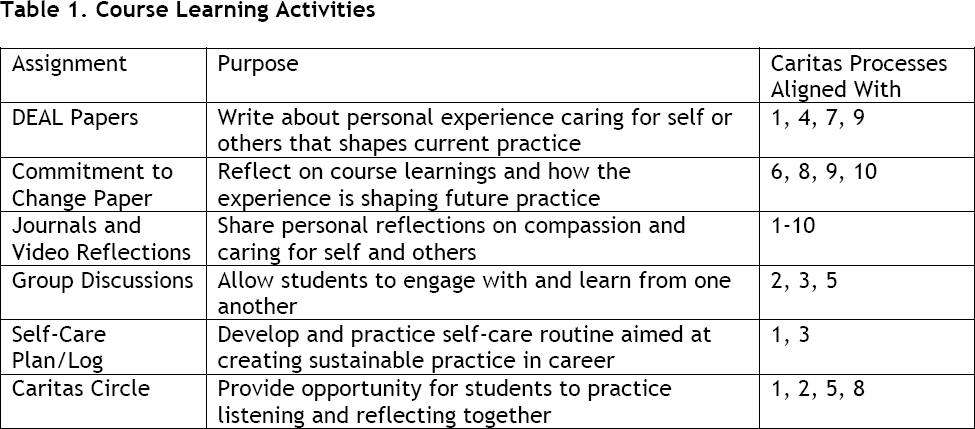
Students learned about self-compassion from the writings and research of Dr. Kristen Neff (2011), at the same time completing exercises of their choice throughout the chapters that became part of their journal reflections. They also read about Unitary Caring Science through the writings of Dr. Jean Watson (2018) and other Caring Science scholars. Finally, they explored and practiced the 10 Caritas Processes, integrating them into their course assignments as described in Table 1 and subsequent paragraphs.
Course Learning Activities
Papers.
The format for the first written paper, a DEAL (describe, examine, and articulate learning) assignment, was adapted from the work of Ash and Clayton (2009). Students wrote about an experience caring for self or others. The assignment ensured that each student started from their unique place, encouraging them to dig deep and write from their heart through a detailed description of the experience. The second paper was a commitment to change, in which students reflected on what they were learning in the course related to compassion and self-care; how the experience was transforming them; how the course and its concepts influenced their professional role; two or three changes they would make to improve their capacity to care for self and others; their level of commitment; and resistance to making the changes. The third and final paper was optional; students could either add an examination and articulation of learning to their initial DEAL paper, formally integrating course readings into their experience, or they could participate in a Caritas circle practicing compassion and care for self and others.
Caritas Circle.
The Caritas circle, emphasizing loving care, provided a synchronous opportunity for students to come together in circle where they committed to sharing from their hearts and supporting each other's journey. One instructor served as the guide and the other as the guardian for the circle, introducing circle agreements to ensure the safety of each participant. The circle began with setting intentions, followed by sharing from the heart, reflecting deeply, and a synthesis of the experience. The circle provided a safe space for students to experience how circles can promote self-care and compassion, mental and emotional healing, and health and well-being, and create a sense of belonging and connection within a community. The circle integrated the traditions of healing circles, as described by Baldwin (1994) and Baldwin and Linnea (2010), and Caritas circles, as explored by Griffin and colleagues (2021).
Self-Care Practice Plan and Log.
Self-care practice was an essential component of this course, often expressed through the vital theme that caring for others requires self-care. At the beginning of the course, students developed a self-care plan, and demonstrated regular self-care practice by completing a log submitted as a final assignment. This assignment aimed for students to develop routine self-care practices while in school, that they can continue once working in the health-care profession. In addition, students discovered the need to be compassionate with themselves when they are unable to achieve their self-care practice goals, and how they might adjust their goals and expectations when the unforeseen occurs.
Journal and Video Reflections.
Reflection was a crucial element of this course that aided students in learning self-care and assisted faculty in understanding how students were meeting the course objectives. Students completed five written journal entries and recorded two videos demonstrating self-reflection; the videos contained responses to the following questions: What do you value most about your life and work? What does wellness mean to you? What do you find the most challenging about self-care? Students answered the same questions for both videos, one completed during week one of the course to provide a baseline understanding, and the other at the end to demonstrate learning.
Group Discussions.
Discussion participation was an asynchronous part of the course that emphasized the importance of students engaging with and learning from each other. Students were guided to substantively and concisely respond to reflection questions, provide new information, describe relevant clinical/client experiences, and share informed opinions about discussion topics. In addition, students were assigned to small groups of three or four to meet virtually periodically throughout the semester to complete some discussion assignments.
Results
By the end of the course, as evidenced by student papers and discussion posts, students articulated learning valuable practices to use in their personal and professional lives, indicative of greater levels of compassion and care for self and others, thus demonstrating the value of Caring Science and the 10 Caritas Processes (Watson, 2018) as a foundation for their professional practice. They also articulated an understanding of alternative practices for health and healing. Students reported various experiences engaging in centering exercises and reflecting through journaling, which they can individually utilize to deepen their ability to be mindful and present in the moment to help themselves and others in their healing processes.
Students who learn self-compassion and the importance of caring for themselves in balance with caring for others will be better positioned to contribute toward healing, health, and wholeness in health-care environments upon graduation.
The success of this course is evident in the consistent expansion of student interest, demonstrating steady growth in numbers of students taking this elective. The course is now offered twice a year and continues to have a waiting list each semester. Students from a variety of academic majors are enrolling in the course, expanding opportunities for interprofessional learning. From qualitative feedback in end-of-course evaluations, students frequently recommend that the course be required.
Here are comments about the course from the assignment narratives of two students from the 4th cohort who completed the course (written permission was obtained to share the verbatim quotes).
I learned it is essential to give care and attention to my overall wellbeing and that others do for themselves as well. Self-compassion and wellness routines reinforce my ability to sustain energy to care for patients, myself, and my family. This course showered us in valuable resources that focus on how to implement the philosophy of compassion and caring to your life and why it is particularly important in the field of nursing. What I have learned in a short amount of time has reshaped my life completely and I feel passionate about sharing these valuable lessons with others so they may experience healthy, lasting changes as well. (Student 1).
Once I started this class and a more active and consistent practice of self-care and compassion, I was able to realize their importance, and began to feel better about myself. Learning how to manage my thoughts and emotions in a healthy way will be extremely beneficial for self-care and prevention of burnout in my future career. As a nurse, I know I will see and deal with a lot of heavy and emotional situations, and I want to be able to process them in a healthy manner. (Student 2).
Discussion
Students who learn self-compassion and the importance of caring for themselves in balance with caring for others while in the formative years of their education will be better positioned to contribute toward healing, health, and wholeness in health-care environments upon graduation. In narrative feedback from course assignments and final evaluations, students self-reported increased awareness of their feelings and greater understanding and empathy for others. Specifically, they report feeling more centered, courageous, and empowered to advocate for self and others. Therefore, the call for academic institutions is to intentionally incorporate wellness and holistic health content as part of the core curriculum for health professions education at all levels.
There is a growing need for health-care professionals to have rejuvenating practices to keep them grounded and resilient.
A key principle of the course is centered around student voices, honoring their experiential knowledge and involving them in determining the shape of their learning. Faculty strategically have students begin the course by writing a DEAL paper that integrates their experience and knowledge as the foundation for learning and moving through the course. Over the past three years, student feedback and experience have been used to refine the course. For example, to emphasize the depth of student work over the quantity, the assignment load has been slightly modified to reduce workload and decrease student stress levels.
One key value of the course is that the faculty give the students permission and guidance to care for themselves, often a concept not learned during school nor carried into the health-care professions. Through self-care and reflective practice throughout the course, students have time to discover what works well for their own care of self. In addition, students learn the importance of pausing throughout the day, making time for centering, and creating their own traditions and rituals for self-care.
Conclusion
With the advancing pace and patient acuity within the health-care system, there is a growing need for health-care professionals to have rejuvenating practices to keep them grounded and resilient. Unfortunately, burnout among health-care professionals threatens to overwhelm the health-care system, causing many to choose to leave their profession altogether. Preserving our health-care workforce needs to be a priority for all health-care educators, with curriculum patterns including self-compassion and self-care content aimed at the well-being of students. Evidence-informed scholarship demonstrated in this area will build the knowledge, understanding and ultimately the wisdom for the necessity of integrating self-compassion and self-care in the curriculum for all health professions students.
Cite this article
Hooper, E. & Horton-Deutsch, S. (2023). Integrating compassion and theoretical premises of caring science into undergraduate health professions education. Creative Nursing 29(1), Article 6.
Footnotes
Erica Hooper, DNP, RN, CNS, CNL, PHN, (she/her) is adjunct faculty at the University of San Francisco in San Francisco, California, USA.
Sara Horton-Deutsch, PhD, RN, FAAN, ANEF, (she/her), is a professor of nursing at the University of San Francisco School of Nursing and Health Professions and Director of the University of San Francisco/Kaiser Permanente Partnership. She is an Associate Faculty for the Watson Caring Science Institute and Co-Director of their Caritas Leadership Program.