



Abstract
How elected officials make policy in an uncertain context is insufficiently understood. To fill that gap, this research examines how much uncertainty impacts climate action in large U.S. cities. We sent a survey to all elected officials in U.S. cities with populations >100,000, querying their level of climate uncertainty and their support for climate policies. To analyze the results, we use a structural equation model with a robust and novel measure of climate uncertainty and then examine the direct and indirect effects of climate uncertainty on a policymakers’ propensity to support climate action. We find that municipal elected officials are generally supportive of climate action, though their support varies substantially based on their partisan affiliations and views about the appropriate role of government. Increased climate uncertainty diminishes support for action. These findings suggest the importance of communicating the robustness and co-benefits of climate policies.
Introduction: Climate Change Uncertainty and Policy Action
Climate policy making at the municipal level requires a balancing act that leverages the powers granted to local governments while acknowledging the vast uncertainties associated with enacting policy and the reality that other levels of government may have a greater influence on climate change. Local governments generally control land use, street space, city parks, and local building codes, and often hold limited taxation powers—though their specific powers vary. To mitigate greenhouse gas emissions, cities can encourage denser land uses, design sustainable transportation systems, set standards for new construction, reduce the carbon footprint of city-controlled assets, and encourage sustainable behavior, among other potential changes (Santamouris and Kolokotsa 2016). Collectively, cities in the United States can lead efforts to reduce climate emissions even as governments at other scales drag their feet (Bulkeley and Castán Broto 2013). Yet local governments cannot arrest ongoing warming alone. From that perspective, urban adaptation measures—such as environmental restoration, floodplain management, and infrastructure designed and maintained to resist natural disasters—are equally critical (Lenzholzer et al. 2020).
Though municipalities possess legal powers that enable them to attempt to mitigate and adapt to climate change within their boundaries, climate change is a global phenomenon whose impacts cannot be completely managed by any single locality (Bulkeley and Kern 2006). Policies determining the scope of impacts will largely be set at the state, national, and international levels. Municipal officials must navigate the existing landscape of climate mitigation policies and adaptation resources available at various levels of government and prepare for climate systems that are neither static nor predictable. Moreover, municipal officials must make climate policy in an uncertain environment because of the nature of the global climate system, the limits of predictive science, and skepticism about the existence of climate change itself. It is thus essential to understand how uncertainty related to climate change's effects and the efficacy of different policies impact policy decisions. Our research seeks to determine whether general climate action uncertainty has a “pernicious” effect on municipal climate action—whether uncertainty diminishes policy maker propensity to act, and thus potentially delays or undermines local efforts to mitigate and adapt to climate change.
Climate change is one salient example of the way uncertainty may affect municipal policy making. City officials encounter numerous arenas in which they lack knowledge that would be helpful in action. The events of the past 15 years—including the financial system collapse, the COVID-19 pandemic, the advent of new transportation technologies, and social uprising—have spotlighted the level of uncertainty for which cities must prepare, not only to prevent devastating outcomes but also to provide new opportunities for their residents. Yet we know little about how uncertainty impacts local decision making. Climate change is universal in its applicability, making it well-suited for a large-scale comparative study. While climate risk exposure is uneven across cities and neighborhoods, this is also true of other relevant uncertainties, such as economic downturns or technological changes. Additionally, awareness of the issue is widespread, allowing us to focus on two core dimensions of uncertainty (1) uncertainty surrounding climate change impacts and (2) uncertainty related to appropriate policies to address it, as opposed to a lack of awareness. We find that, in the context of climate change, uncertainty is a relevant factor that informs how local elected officials make choices.
This study contributes to the climate policy literature in three ways. First, to our knowledge, this is the first comprehensive survey of municipal elected officials asking for their views on climate change. We demonstrate large gaps in perspectives about the necessity of implementing climate policies that are differentiated along partisan lines and, more broadly, views about the role of government. Second, we look to understand how uncertainty impacts the likelihood of policy action. Our results indicate that increased uncertainty diminishes the likelihood that policy makers support climate action.
Literature Review
Making Municipal Climate Policy Under Uncertainty
While guides for city-level climate change mitigation (Santamouris and Kolokotsa 2016) and adaptation provide general direction for cities considering how to respond to climate change (Lenzholzer et al. 2020), uncertainty remains regarding the precise local impacts of many interventions. Indeed, this policy space is challenging because it requires planning for a future outside of what available data can specify (Kandlikar, Risbey, and Dessai 2005). While science can offer valuable insights, projections are inherently imprecise. The science is exemplified by the IPCC report (IPCC Working Group I 2021), which provides multiple scenarios, each with its own error bounds and a note on consistent uncertainty language (Mastrandrea et al. 2010). These uncertainties are exacerbated when forecasters attempt to downscale projections of global climate change to the sub-national or city level (Chu and Schenk 2017; Coonery 2012).
Despite this uncertainty, municipal climate action likely remains an essential element of a broader response. Though individual municipalities can only advance a small part of the necessary global climate action, they can collectively make a substantial impact. Municipalities often have leaders who are motivated independently of higher levels of government and who can test new institutional structures for climate action (Anguelovski and Carmin 2011). They possess tools to act on climate change (Bulkeley and Kern 2006), and networks of cities can multiply their effect (Betsill and Bulkeley 2006).
Municipalities have the power to take climate action through several channels. First, cities can communicate commitments—such as climate action plans—that signal intent to public and private actors (Schulze 2024). Second, land use and development regulations are among the strongest municipal tools. For instance, cities can add resilience and mitigation requirements to building codes (Francart et al. 2019; Sentman, Del Percio, and Koerner 2008). Additionally, municipalities have control over substantial amounts of public space, including roadways. How that space is allocated can directly enhance resilience and encourage more sustainable behavior (e.g., by reducing space for personal automobiles, cities can encourage a mode shift toward less polluting modes of transportation) (Kreijen 2023). Finally, municipalities can make their own facilities less greenhouse gas intensive and more resilient, and they can align their budgets with climate goals (e.g., through procurement requirements) (Gorelick et al. 2020; Vukmirovic, Gavrilovic, and Stojanovic 2019).
Local climate decisions depend on larger economic, social, and institutional contexts. National-level priorities matter, for example (Emelianoff 2014); nonetheless, many cities in the United States are out ahead of the federal government on this matter (Watts 2017). We also acknowledge that municipal human (Bery and Haddad 2023; Krause 2012; Zahran et al. 2008), fiscal (Krause 2011), and other institutional capacity issues (Dierwechter and Wessells 2013) can constrain climate action. However, proactive political leadership (Oulahen et al. 2018; Shi, Chu, and Debats 2015) can support greater climate action. For individual policies, clear co-benefits can drive support, even under fiscal limitations (Sharp, Daley, and Lynch 2011). But, as noted, political leaders encounter immense uncertainty in selecting and advocating for actual policies. Is this uncertainty delaying potential climate action?
Studies on the communication of scientific uncertainty demonstrate that the public often misinterprets the presentation of statistical uncertainty, and those interpretations can be swayed by narratives and framing (Shanahan 2017). Additionally, local elected officials and the public they represent are often ill-informed regarding current best practices in climate adaptation (Lenzholzer et al. 2020). One key problem is that groups and individuals that oppose climate action in the English-speaking world, particularly in the United States, have been given a visible platform (Grundmann and Scott 2014), and fossil fuel companies and allied interests have supported research, communications, and lobbying that spotlight climate doubt, often to a greater degree than outright denial (Oreskes and Conway 2011). When these parties concede the existence of climate change, they often argue that uncertainty should invoke caution lest we hurt the economy with unnecessary regulation (Carvalho 2007).
Media framing and discourse matter as far as they alter the opinions and behavior of their audiences. For instance, framing climate action around “sustainability” may elicit more support than “resilience,” “vulnerability,” or “adaptation” (Meerow and Neuner 2021). Additional context about climate change encourages certainty; controversy discourages certainty (Corbett and Durfee 2004). Less sensationalist, “both sides of the story” reporting increases perceptions of uncertainty (Boykoff and Boykoff 2007; Kohl et al. 2016). Attempts to mitigate these effects through “weight of the evidence” or discrediting language have proven effective in some studies (Clarke et al. 2015; Kohl et al. 2016) but not in others (Kortenkamp and Basten 2015).
Randomized framing experiments indicate that uncertainty can diminish a person's willingness to act. Prospect theory argues that individuals assess how to gamble in response to uncertainty relative to their current position—they are risk averse when seeking improvements to their perceived position, but will take considerable risk to prevent falling below their current position (Kahneman and Tversky 1979). Climate scholars argue that uncertainty combined with a gain framing (meaning, a framing that suggests action will produce individual or societal gains) more effectively promote climate action, since loss frames might cause despair and action paralysis (Lazarus 1999). The fear of potential losses can motivate urgency of action but can also overwhelm one's sense of efficacy (Morton et al. 2011; Nerlich, Koteyko, and Brown 2010). On the other hand, evidence is mixed on this matter. Gustafson and Rice (2019) presented individuals with several articles that differently framed scientific uncertainties to the public. This variation in framing of uncertainty had insignificant effects on respondents’ belief in the scientific claims, assessments of the claimant's credibility, or intentions to act on those claims. But they do find a small negative effect of “consensus uncertainty”—the portrayal of lack of scientific consensus. In fact, reading fully bounded uncertainty estimates may increase trust in science. However, acknowledging unquantifiable uncertainty eliminates these effects (Howe et al. 2019).
From a policy perspective, there are three potential responses to uncertainty. The first is a reversion to a reference narrative (Marris 2003). In such a case, uncertainty should have no effect, and policy makers adopt policies in line with their worldview and constituent preferences. The second possibility is the employment of the precautionary principle (Carvalho 2007). In the context of climate change, the precautionary principle is often deployed to support immediate and drastic climate action. Finally, uncertainty can have a pernicious effect on climate action (Carvalho 2007). Policy makers may repeatedly delay policy action until they are fully confident in its existence, impacts, and policy solutions. Such a case might be justified by reversing the precautionary principle—that climate action should not be pursued until we are sure it will not heedlessly destroy the economy.
An important gap remains in the current literature in understanding how elected officials respond to climate uncertainty. At a base level, elected officials possess the same human tendencies as the rest of us. However, our reactions to uncertainty are deeply context specific, including our personal dispositions and social positions (van der Linden, Leiserowitz, and Maibach 2016). There are several good reasons to believe that policy makers could respond to uncertainty differently from the general population. Most elected officials are higher information actors, with those in larger jurisdictions benefitting from government staff who support their decision needs. This could make officials less susceptible to media narratives, for example, or they might feel pressured by media narratives that they perceive as undermining their political careers. Second, elected officials might be less concerned with scientific uncertainty and more concerned with ambiguous or contradictory positions held by constituents and their fellow elected officials. An otherwise supportive official might oppose policy action if they are unsure where their supporters stand. Third, elected officials are self-selected based on the personality required to run for office and attract votes. Altogether, then, these officials may act differently from the public at large. Our research seeks to fill this gap in the communications and climate action literature by examining specifically how climate uncertainty impacts the decisions of municipal elected officials.
Measuring Uncertainty
Much of the literature on climate communication is based on randomized, limited context, framing experiments with members of the general public. Uncertainty is introduced via the study design—such as by presenting alternative articles—rather than measured in the world (Clarke et al. 2015; Kahneman and Tversky 1979; Kohl et al. 2016; Kortenkamp and Basten 2015). This approach to research design provides a clean, controlled signal but cannot measure uncertainty in non-laboratory settings.
In political science polling, one method of measuring uncertainty is to follow attitudinal questions by asking how certain the respondent is (Alvarez and Franklin 1994). Alternatively, business surveys often request that respondents present a range of expected values. For instance, they may be asked to give lower bound, most likely, and higher bound economic growth estimates (Bachmann et al. 2018). Both approaches are helpful within their context, but neither seeks to develop a measure of general uncertainty.
We take a different approach suited to measuring individual uncertainty regarding climate change policy. We define uncertainty as the perceived gap between the knowledge that we have and the knowledge we would prefer to have in making a decision (Dewey 1929). We take this to refer to the intellectual state of an individual (Marris 2003); this contrasts with the natural randomness of some social and natural processes. The two interact as far as an individual cannot be fully certain about the outcome of an indeterminate process without holding a false belief.
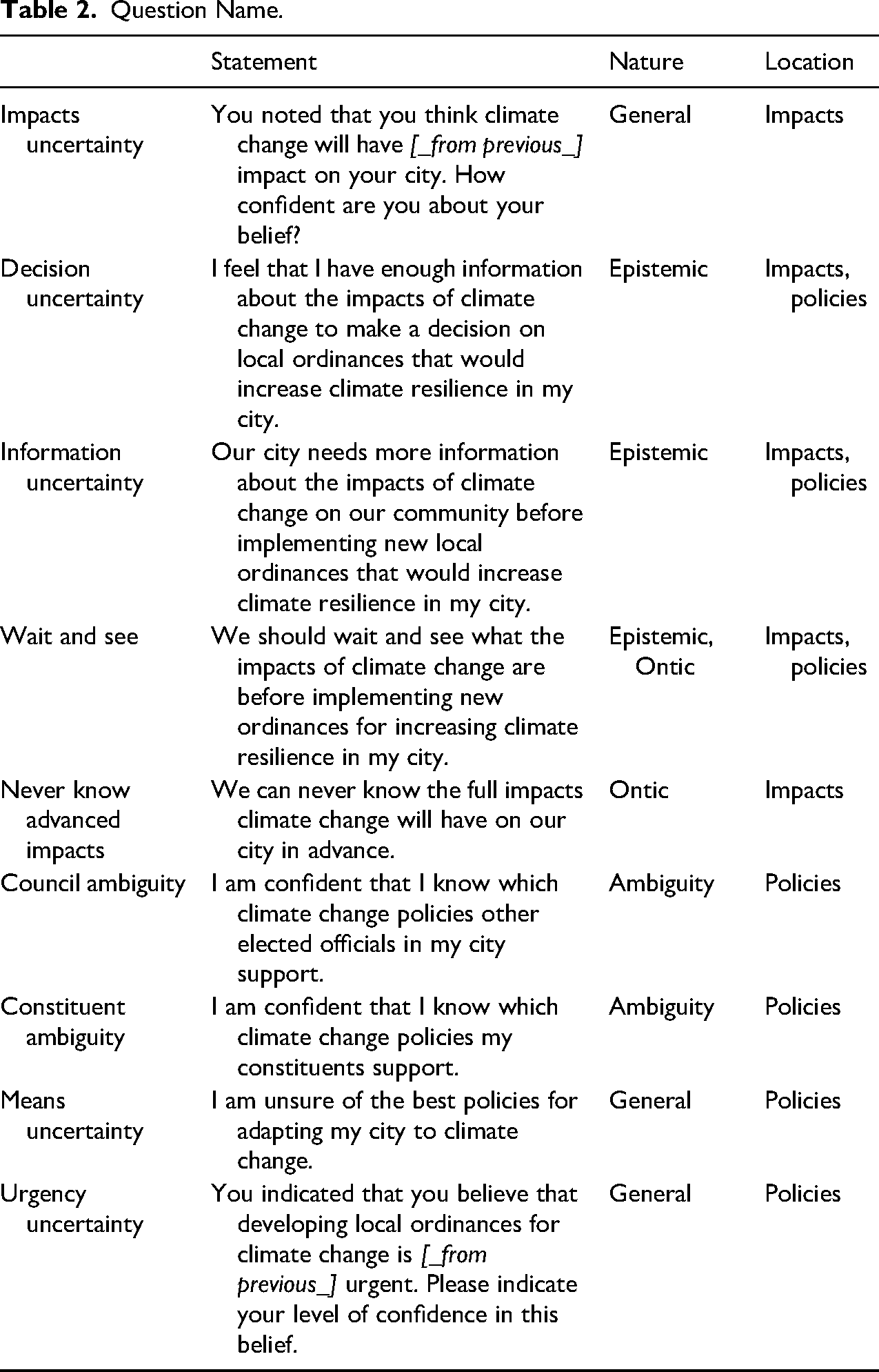
One's sense of uncertainty is multidimensional, and any general measure should attempt to account for as many dimensions as possible. We build on Kwakkel, Walker, and Marchau (2010), who introduced three dimensions of uncertainty: location, level, and nature. The location refers to where uncertainty enters the system we would like to act within. With respect to climate change, we choose to distinguish between (1) uncertainty of climate change impacts and (2) uncertainty of climate policy. The former includes uncertainty regarding climate change's existence and, if existing, the specific impacts it will have on our communities. The latter refers to uncertainty regarding the efficacy or desirability of potential interventions.
The level of uncertainty refers to the scales used to describe the uncertainty. Level 1 (shallow) uncertainties are probabilistic. Level 2 (medium) uncertainties can be ordered in likelihood. Level 3 (deep) uncertainties can have their possibilities enumerated, but relative likelihood cannot be judged. Finally, Level 4 (recognized ignorance) uncertainty acknowledges that surprises happen.
The three natures are epistemic, ontic/variability, and ambiguity. Epistemic uncertainties can be known but are not yet available. Ontic uncertainties are inherently probabilistic or deeply uncertain: relative probabilities cannot be assigned. This is the uncertainty that corresponds to indeterminate features of the natural and social world. Ambiguity refers to differences in ways of knowing and values (Kwakkel, Walker, and Marchau 2010).
Breaking down uncertainty into its constituent elements is central to our measurement of uncertainty. Any robust measure of climate action uncertainty must consider all locations and natures. As a latent variable, uncertainty cannot be measured directly. We thus utilize factor analysis and structural equation modeling, as presented below, to shed light on the unobservable degree of climate uncertainty. Querying the “level” is difficult in a brief survey such as ours because the survey would need to enumerate the potential impacts so that the respondents can explain whether they believe the outcomes can be described statistically, ordinally, or not at all. Nonetheless, a latent measurement can gauge general climate action uncertainty while taking an individual's self-assessed “level” of uncertainty as a given.
Research Questions
This research seeks to measure and assess the impact of “general climate action uncertainty” on municipal climate action. We use the term “general climate action uncertainty” because our latent variable measure of uncertainty is designed to capture the full variety of climate uncertainty that may impact municipal action, rather than testing one location of uncertainty—such as uncertainty of impacts—or one nature—such as epistemic uncertainty. We seek to answer three research questions:
Q1: What is the structure and distribution of “general climate action uncertainty” among municipal elected officials? Q2: How does uncertainty impact the likelihood of municipal elected officials supporting policies for climate change mitigation or adaptation? Q3: How does uncertainty interact with gain or loss framing to impact the likelihood of municipal elected officials to support policies for climate change mitigation or adaptation?
We develop the following hypotheses:
Methods
Survey Methods
We investigate our research questions using a survey-based approach. First, we searched local websites to compile an email list of all elected mayors and local legislators (such as councilors, supervisors, and alderpeople) for all non-county, incorporated municipalities (e.g., cities and towns) of over 100,000 people in the United States, based on 2019 U.S. Census data (there were 307 such municipalities in our database). We transmitted emails to all but eight of the 2,754 elected officials in our population.
We collected data in three stages. First, we contacted 100 random officials in a “pilot” launch on February 4, 2021, and followed up with non-respondents via phone. Next, we contacted the remaining officials in two randomly assigned groups on February 22nd and April 22nd to account for biases produced by any fluctuations related to global events. For each group, we sent three follow-up emails over 2 weeks and randomly called 100 non-respondents. Our response rate was 8.9% across all three data collection stages (245 completed responses). We cannot say for certain whether each elected official responded to the survey for themselves or whether a staffer responded on their behalf. Our outreach email specifically mentioned climate policy. Therefore, suspicions regarding climate change and academic institutions may have generated systematic non-response bias.
We validated our sample by comparing respondents’ race, gender, and party membership against results by Einstein, Ornstein, and Palmer (2019), who sought to establish these characteristics about the demographic and partisan composition of U.S. local elected leaders from publicly available data. 1 We document the p-values of T-tests of means given in Table 1. One area of concern is our undersampling of Black elected officials and oversampling of Hispanic/Latino/Latinx officials. As Einstein, Palmer, and Ornstein used visual identification and name to determine race and ethnicity, they may have classified some individuals as Black who would have chosen “other” or “Hispanic/Latino/Latinx” because of mixed-race heritage. Still, this may not explain the entire discrepancy. This is a significant gap considering the history of underinvestment and dispossession that continues to impact Black communities and the higher vulnerability to climate change impacts in many of these communities. Representatives from these communities, often among the strongest supporters of climate policies, may then possess perspectives that are not well captured in our research. We similarly undersampled male respondents and oversampled Democrats, which may reflect response bias given the study's focus on climate change.
Local Elected Official Characteristics.
As a robustness test, we also validated our respondents by comparing the characteristics of the cities that elected officials represent with the characteristics of all cities with greater than 100,000 people, using 2019 American Community Survey demographic data. In general, the characteristics of respondent's cities are similar to the full population, though several of the variables show statistically significant differences between our sample and the population overall. Even so, the substantive differences are often small, leading us to believe our sample generally presents a picture of conditions nationwide. See Appendix A.2 for details.
Survey Design
The survey consisted of three distinct blocks. The first block collected data on policymakers’ sense of urgency and uncertainty in addressing climate change, plus their estimates of its impacts on their communities. The second block included a randomized framing (with gain, loss, or neutral approaches) and then asked respondents to assess their own likelihood to push for the implementation of different climate-related policies. We randomized the order of the first two blocks of the survey to control for potential ordering effects. The next block requested individuals’ socio-demographic information and political dispositions (some of which we report in Table 1). Finally, we asked respondents if they were made aware of the survey before filling it out to account for any potential exposure bias.
Block 1: Uncertainty
The first block collected respondents’ general perspectives regarding the impacts of climate change on their communities, their feelings of urgency, their level of certainty associated with their answers to the aforementioned questions, and their ‘confidence’ in other climate change-related knowledge.
We collected the uncertainty data in two ways. The first approach was to request respondents’ level of confidence in their prior responses about the impacts of climate change using a three-point Likert scale, from 1 = “not confident” to 3 = “very confident.” The second approach was to ask them directly about their certainty related to specific issues, using a 5-point Likert scale from 1 = “strongly disagree” to 5 = “strongly agree.” This approach included questions related to the sufficiency of information for decision making and their confidence in their knowledge of the perspectives of other elected officials and constituents. Individual questions addressed the three different natures of uncertainty: epistemic, ontic, and epistemic uncertainty. Similarly, questions addressed uncertainty regarding impacts and policies to ensure that we addressed both of the key locations where uncertainty enters the decisions of elected officials (Table 2). We estimated a latent measure of
Question Name.
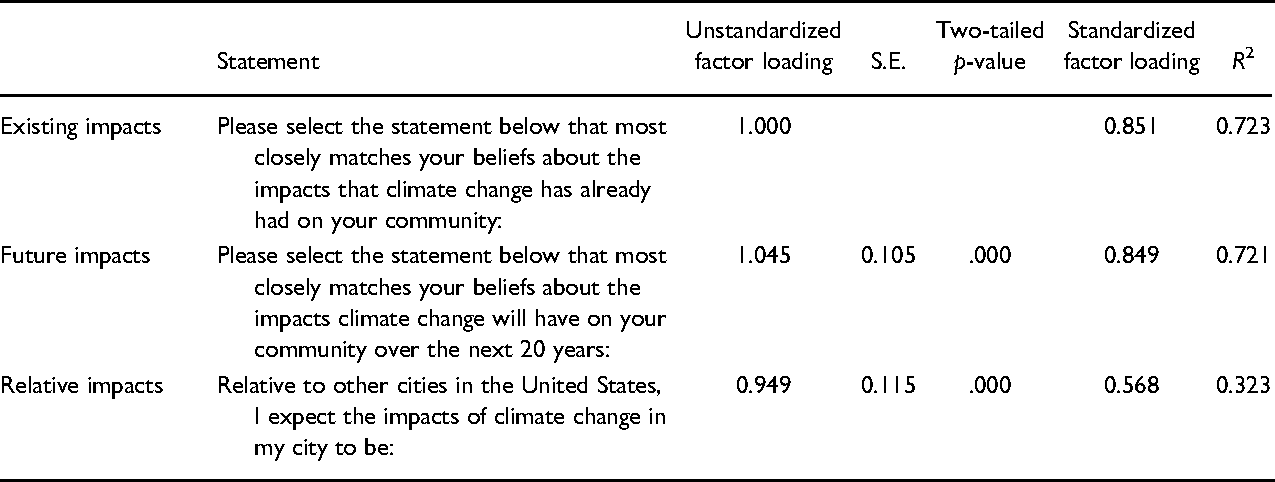
We also asked a series of questions regarding each elected official's perception of current and future impacts. The first question asked the official what impact climate change has already had in their community, from 1 = “no impact” to 4 = “a devastating negative impact.” The second question asked them what impact they expect climate change to have in the future on the same scale. Finally, we asked what they expect the impact to be in their city relative to other cities in the United States, from 1 = “much more mild” to 5 = “much worse.”
Block 2: Framing and Policy Actions
We designed the second block of the survey to determine how a loss or gain framing may influence officials’ propensity for climate action. Though framing was a central part of our research design, we found no effect and thus present these methods and results in Appendix A.3.
We then asked the officials to indicate how likely they would be to support eight different climate mitigation and adaptation policy proposals:
“Fund street trees for all eligible city streets within 10 years” [adaptation 1—street trees] “Require critical systems (like air conditioners) in private development to be above flood levels” [adaptation 2—critical systems] “Charge land owners with impervious surfaces a fee and dedicate funds to environmental restoration” [adaptation 3—impervious fee] “Require climate impact assessment for all government supported infrastructure” [adaptation 4—impact assessment] “Commit to reducing citywide greenhouse gas emissions from private and public sources 90% by 2050” [mitigation 1—ghg goals] “Require all new public facilities to be carbon neutral” [mitigation 2—public facilities] “Reallocate at least 10% of city-owned street space to buses, bicycle, and pedestrian use” [mitigation 3—non-auto space] “Reduce city employee air travel by at least 50% from 2019 levels” [mitigation 4—air travel]
We selected the above specific proposals for which there is a precedent (i.e., they have been implemented or discussed) and also workshopped the survey with experts in the field to ensure that these proposals were ambitious enough to increase the response variance. We also selected policies that municipalities are likely to possess authority over (we provided a disclaimer asking respondents to assume this to be the case). Finally, we selected policies that should be applicable in all cities, which meant excluding some significant policies, such as measures to mitigate coastal flooding. We did not seek to provide a comprehensive list of climate policies since the primary purpose of this survey was not to understand the specific policy predilections of municipal officials. Rather, we presented ambitious policies from across a variety of policy domains (building codes, transportation, public facilities, etc.) to get a general sense of the propensity to enact climate policy.
Modeling Approach
Structural equation modeling (SEM) possesses two key strengths relative to regression methods. First, SEM allows for the estimation of latent variables that cannot be directly observed. In SEM, latent variables are estimated via the correlation structure of responses, which inherently accounts for measurement error in the latent variable construct. Additionally, SEM allows for the estimation of causal pathways, instead of solely estimating a set of relationships between the independent variables and a single dependent variable. This allows the modeler to drop the assumption of independence and additionally provides estimates of both direct and indirect effects.
Latent Variables
We estimate three latent variables to include in our model. The latent variable for
Finally, we estimated a latent variable measurement model for the
The SEM
Our full SEM (Figure 1) provides two pathways for climate uncertainty to influence the intention to pass climate policy. First, uncertainty can directly impact climate policy propensity (
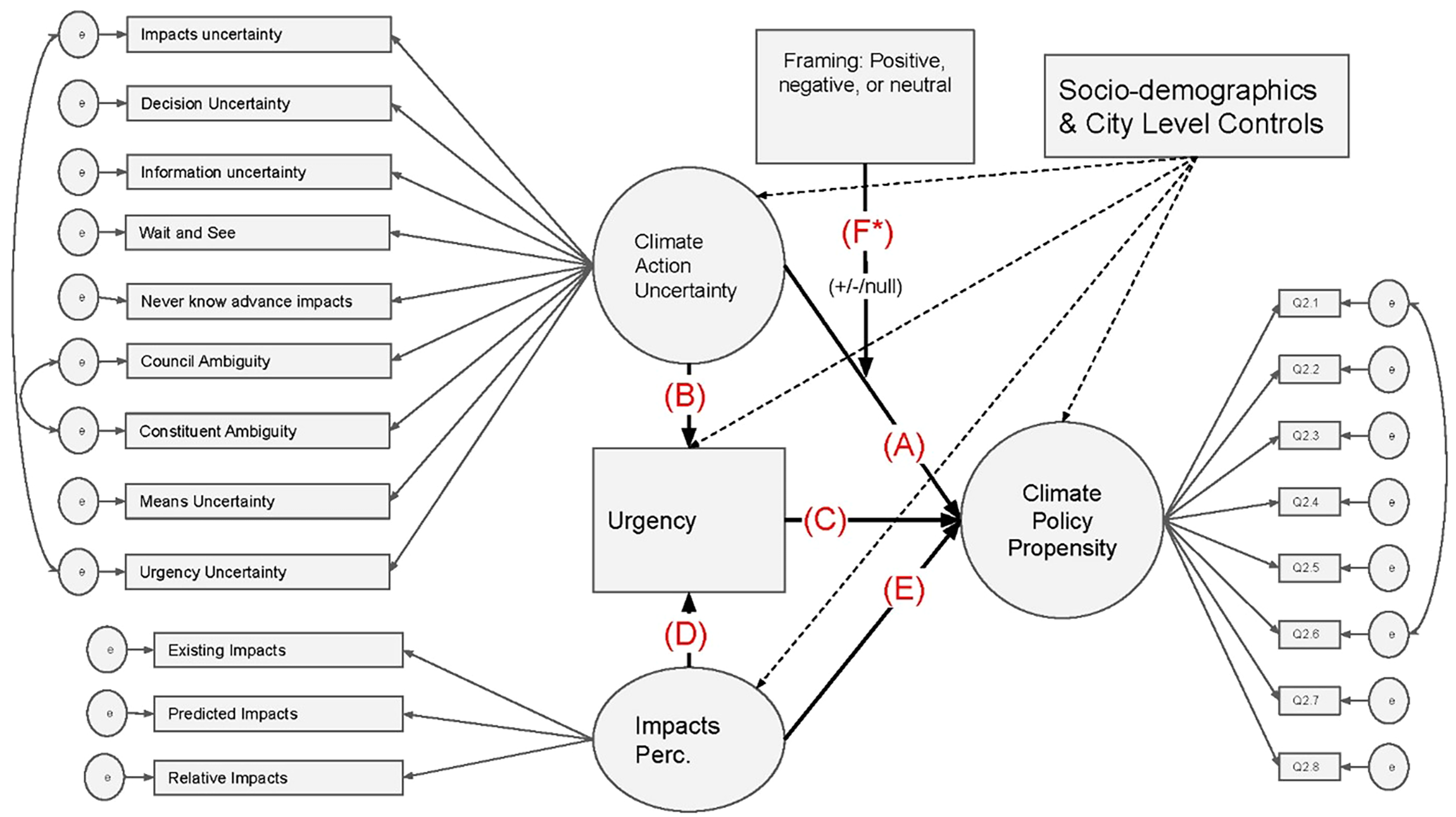
Structural equation model for the effect of climate action uncertainty on climate policy propensity.
In our model, uncertainty (
Finally, we attempted to investigate the influence of the neutral/loss/gain framing via two approaches
Results
Descriptive Results
What Policies Do Municipal Officials Support?
The majority of municipal officials indicated that they were likely or very likely to support almost all the policies we proposed to them (Figure 2). For all but one of the policies, the plurality noted that their city had already passed or that they were very likely to support such a policy. The appetite for climate action—and its co-benefits—is strong.
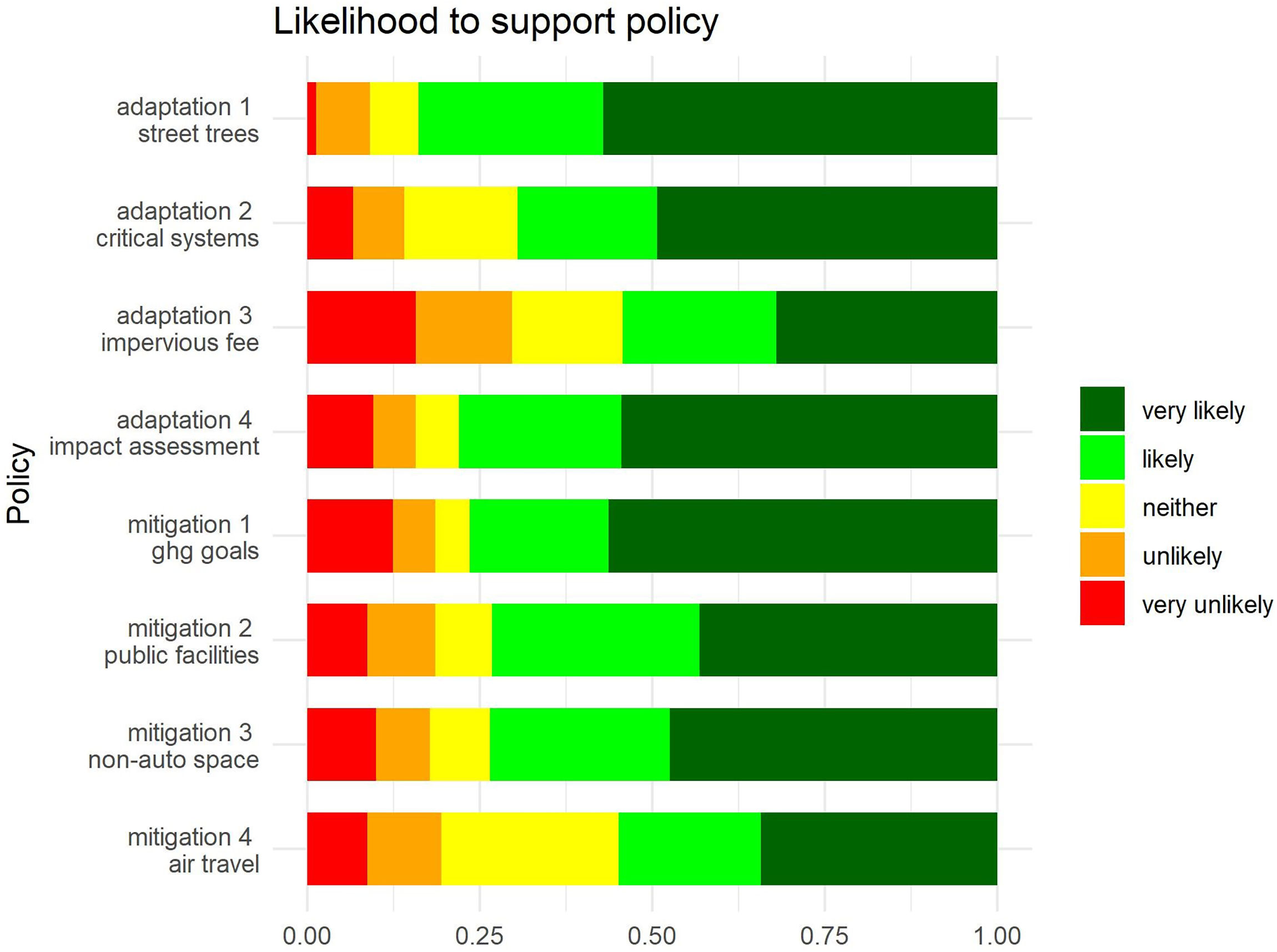
Likelihood to support selected climate policies.
Though our policy list was not exhaustive, some of them represented considerable departures from the status quo in most cities. Among the adaptation policies, officials indicated that they were most likely to support funding street trees and requiring climate impact assessments. The former has many positive impacts beyond climate adaptation, such as reducing the heat island effect and improving mental health. The availability of co-benefits short circuits the longer feedback cycle of climate action (Bain et al. 2016). The least supported policy was charging landowners impervious surface fees. Elected officials might prefer approaches that are less directly costly to the broad middle-class, homeowner community.
Among mitigation policies, committing to ambitious greenhouse gas reduction goals was the most well-supported policy. Like climate impact assessments, this policy might be palatable because it does not allocate limited municipal resources. Elected officials can advertise support for ambitious goals without substantially antagonizing particular interest groups. Interestingly, setting climate goals had relatively strong opposition. As the policy is climate-specific—without intimation of co-benefits—it most clearly polarized respondents into their general position on responding to climate change. A similar polarization is noted in climate impact statements, but this opposition is small enough that it should not be a concern for most large municipalities.
The policy on reducing air travel by 50% from 2019 levels had the lowest level of support, with a sizable portion of respondents indicating that they would be “neither likely nor unlikely” to support such a policy. This may have to do with the uncertainty associated with business travel one year into the COVID-19 pandemic, and that cities typically have little control over air travel policies.
Who Supports Climate Policy?
Before developing our latent variable of propensity to support climate policy, we examine who among our sample supports the policies we presented. Self-identified Republicans and conservative individuals were more reluctant to support any of the policies that we presented, affirming that climate action is a partisan and ideologically differentiated issue (Dunlap and McCright 2008).
Nonetheless, planting street trees and requiring elevated critical systems saw a higher degree of cross-party support. Both policies do not explicitly mention greenhouse gases or climate. Their co-benefits are straightforward, and both serve the population broadly. Further, they are clearly within the jurisdiction of local government action. Planting street trees, in most cases, improves neighborhood well-being without substantial reallocation of the uses of public space. Similarly, all U.S. cities already possess building codes to ensure the safety of residents; the critical systems policy might be seen as a natural extension.
Partisanship and ideology best explain the gap in support when the policy explicitly targets climate action, such as climate impact assessments, greenhouse gas reduction goals, and carbon-neutral public facilities (Figures 3 and 4). These policies appear to trigger political identities (or are aligned closely with those political identities) more substantially than policies that do not mention greenhouse gases or climate—such as street trees. The explicit climate policies would also provide numerous co-benefits, but those co-benefits are less salient.
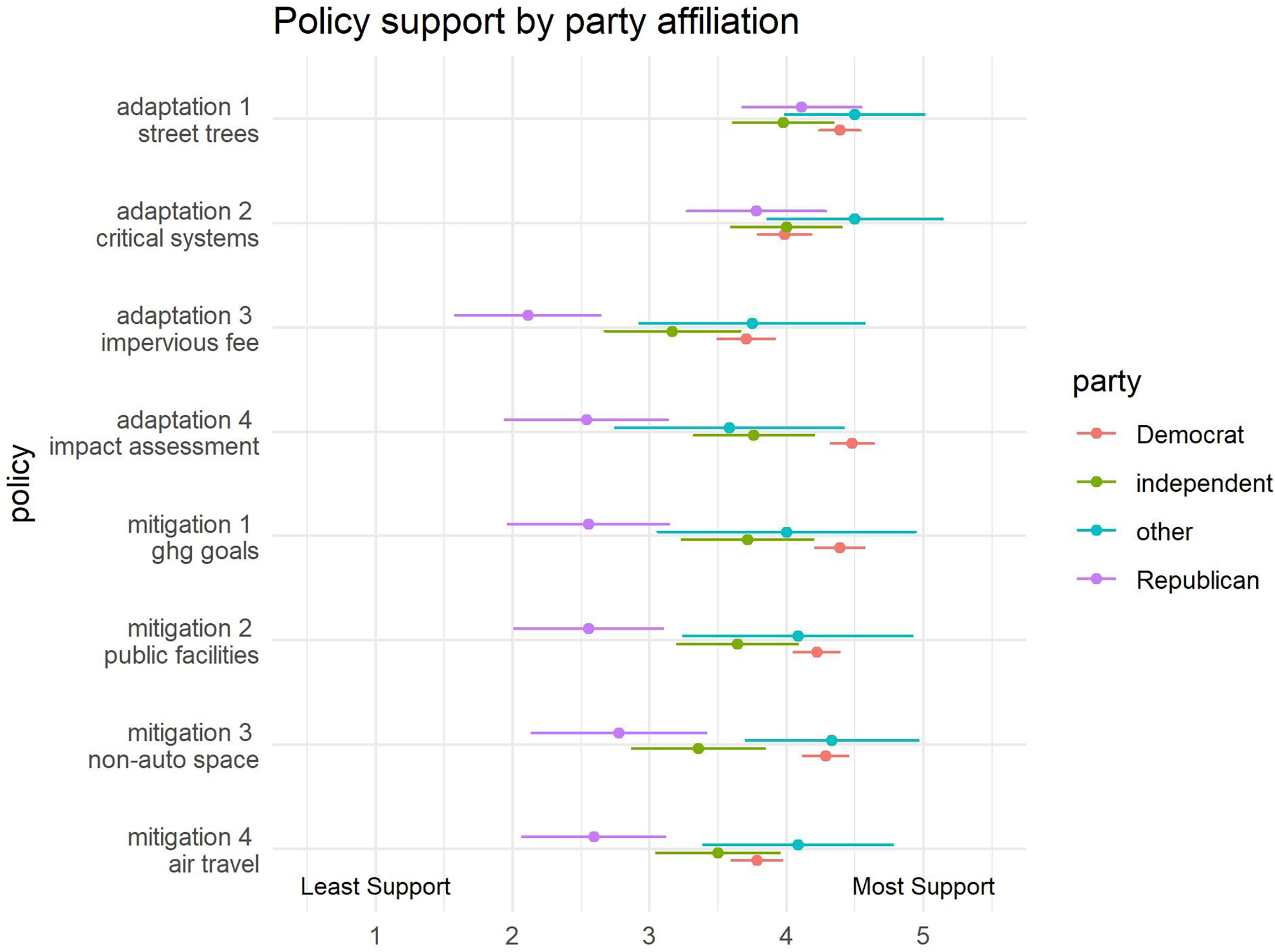
Policy support is provided by elected officials affiliated with Democratic, Republican, independent, and other parties.
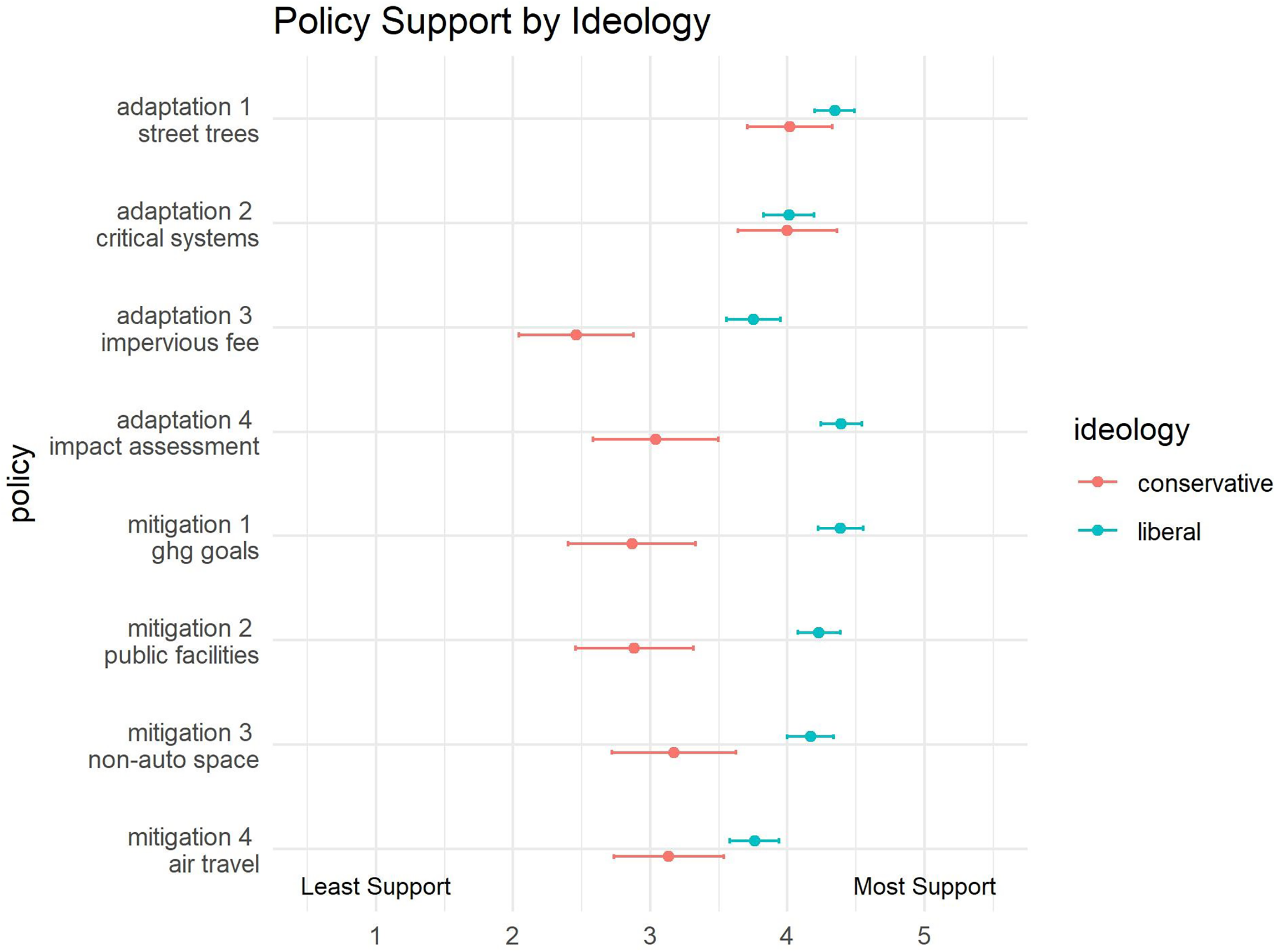
Policy support is provided by elected officials who indicate either a conservative or liberal ideology.
Another factor associated with elected officials’ support of climate policies is their perspective on the role of municipal government in climate policy (Figure 5). Of our sample, 66% agreed that cities should play a leading role in climate change adaptation and mitigation. Taken alone, this perspective was associated with higher mean levels of support for climate policies than being a Democrat or ideologically liberal. Those who agreed that cities play a subordinate role, on the other hand, were less likely to support all policies except critical systems requirements. Those who saw no role for city government in combating climate change generally expressed outright opposition or neutrality towards all policies except street trees.
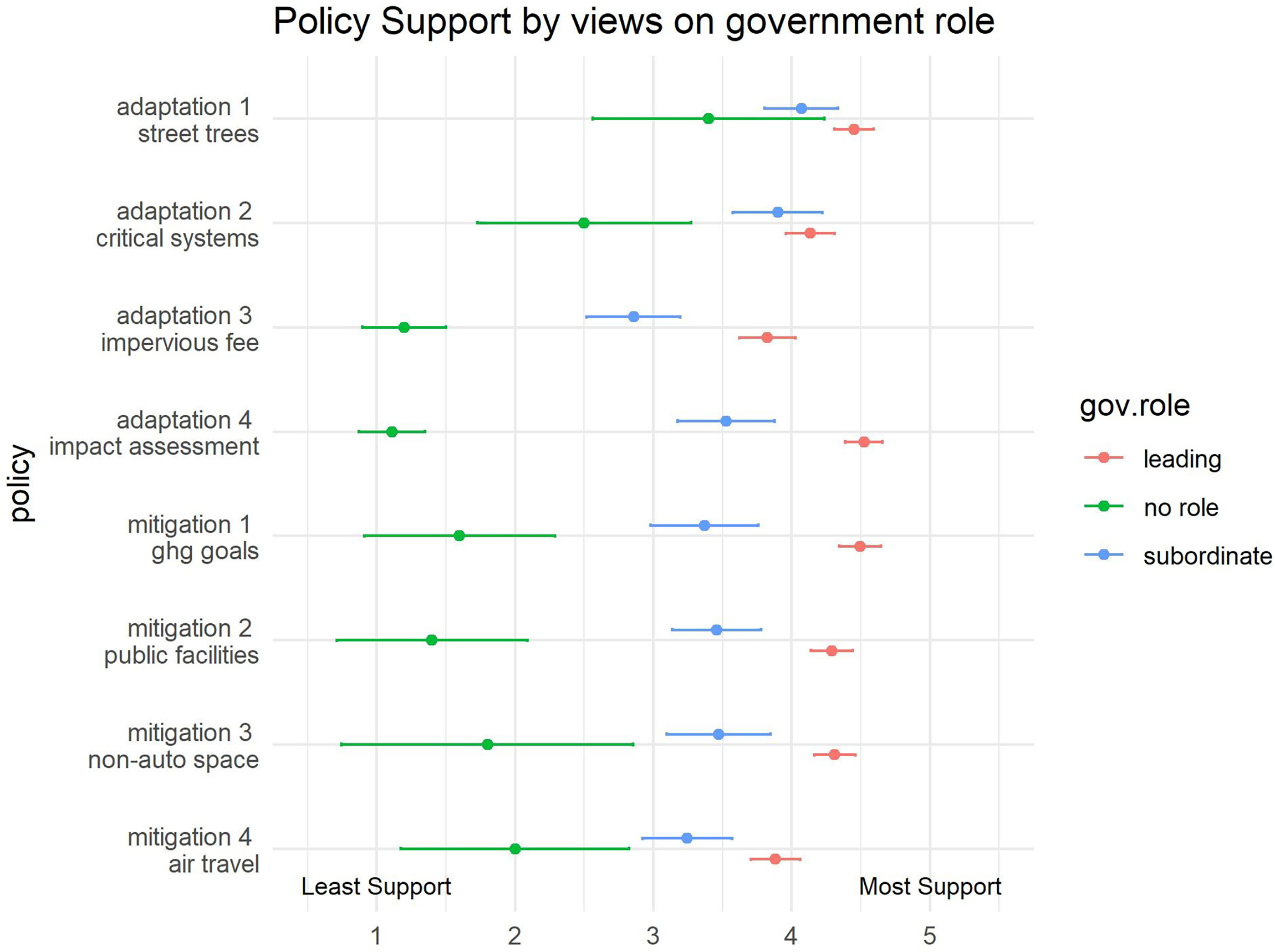
Policy support by elected officials that views cities as having either a leading role, a subordinate role, or no role in addressing climate change.
Socio-demographic factors rarely explain policy positions across the board, though they are statistically significant in explaining some policies. For instance, younger elected officials (<44 years) were more likely to support carbon-neutral public facilities and air travel restrictions. Older elected officials (>65 years) were less likely to support critical systems regulations, carbon-neutral public facilities, and air travel restrictions. Black officials were more likely to support impact assessments and setting greenhouse gas goals.
Gender was the most consistently significant demographic variable (Figure 6). Women were more likely to support impact assessments, greenhouse gas goals, carbon-neutral public facilities, and more non-auto space. Paralleling U.S. women more generally, the women in our sample are more likely to be liberal and Democrats. These results also reflect the growing “eco gender gap” (Brough et al. 2016).
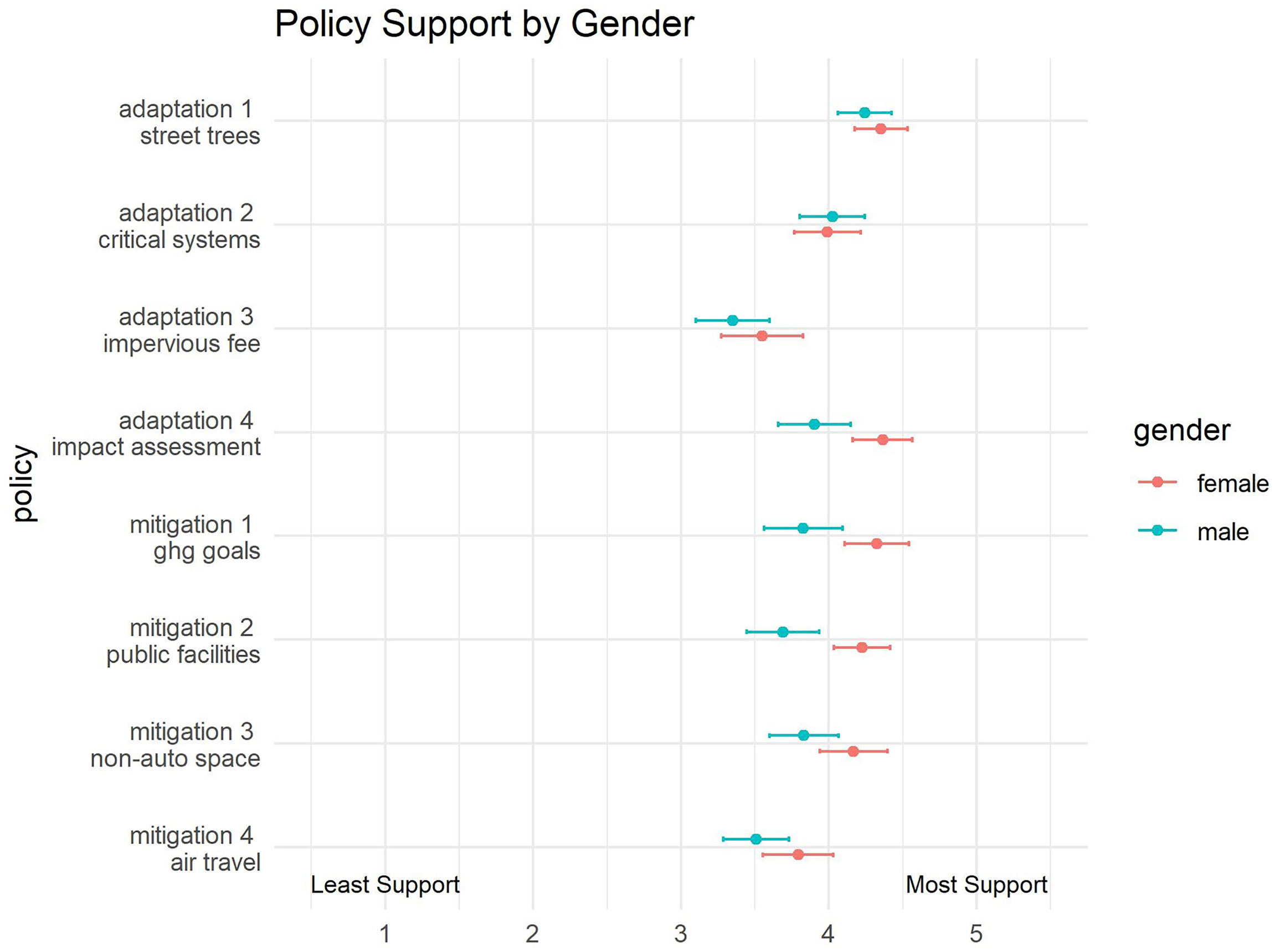
Policy support is provided by elected officials who identify as male or female.
County-level variables generally did not correlate with the propensity to support climate action. Only one of the climate risk variables was significantly associated with propensity to act on climate change (p < .05). Sea level rise risk was associated with a stronger propensity to support greenhouse gas goals and carbon neutral public facilities. These variables were no longer significant, however, when including individual socio-demographic variables.
Uncertainty
Respondents, overall, expressed confidence in their answers. For all the questions that we asked, the majority either somewhat or strongly agreed that they were certain about their answers (Figure 7). In particular, respondents felt that they possessed sufficient information to decide on local ordinances (78%). Similarly, though many agreed that we cannot assess the full impacts of climate change in advance (42%), the vast majority still disagreed with “we should wait and see what those impacts are” (86%).
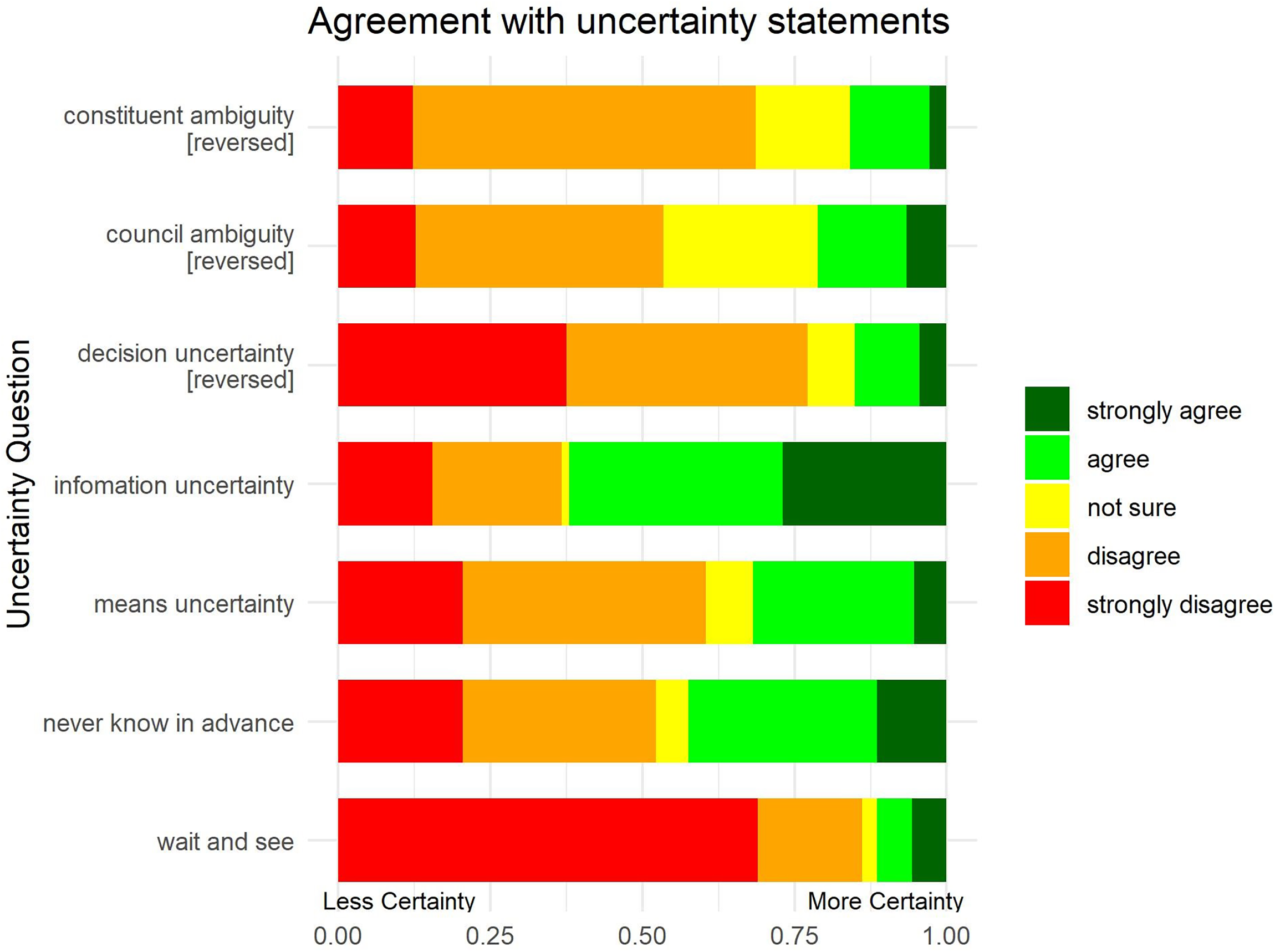
Elected officials' level of agreement with uncertainty statements. In this chart, responses to queries of constituent ambiguity, council ambiguity, and decision uncertainty are reversed to align more and less certain responses.
The responses related to uncertainty indicate a tension between the urgency of combating climate change and the desire to better understand how to combat it. A full 67% (more than any other response) agree that they need more information about local impacts before implementing new local ordinances. Similarly, 33% are unsure of the best policies for adapting their city to climate change. Respondents seemed to distinguish between sufficient information to act—which they believe they already possess—and desiring additional information for improving climate policy.
The ambiguity questions elicited a different pattern of response as they relate to the elected officials’ ability to infer the positions of others. Elected officials felt confident about the policies that their fellow councilors (54%) or constituents (68%) would support. But these two questions also elicited the lowest rates of “strong agreement.” Additionally, these two indicators each scored the highest on “not sure”: 25% and 16%, respectively. This differed from the other responses that tended to be bimodal, with respondents either agreeing or disagreeing. This might reflect the greater difficulties in knowing where others stand as opposed to taking a personal position. This result is particularly interesting since these questions get to the core political concerns of being an elected official. If they cannot be sure of political support, they will not be able to move policies forward.
When asked to indicate their own confidence in assessing impacts or urgency, 62% and 70%, respectively, indicated that they are very confident (Figure 8). It is unsurprising that many should express confidence regarding questions that we asked the officials to reflect on a previously stated position. Yet, this confidence was not distributed equally among the respondents. Those who expressed extreme assessments of impacts or urgency tended to possess greater confidence in their view (Figures 9 and 10). This may reflect the inherent uncertainty of choosing a central Likert score as opposed to taking an endpoint position. Or it might indicate a genuine difficulty that some officials have in establishing their position.
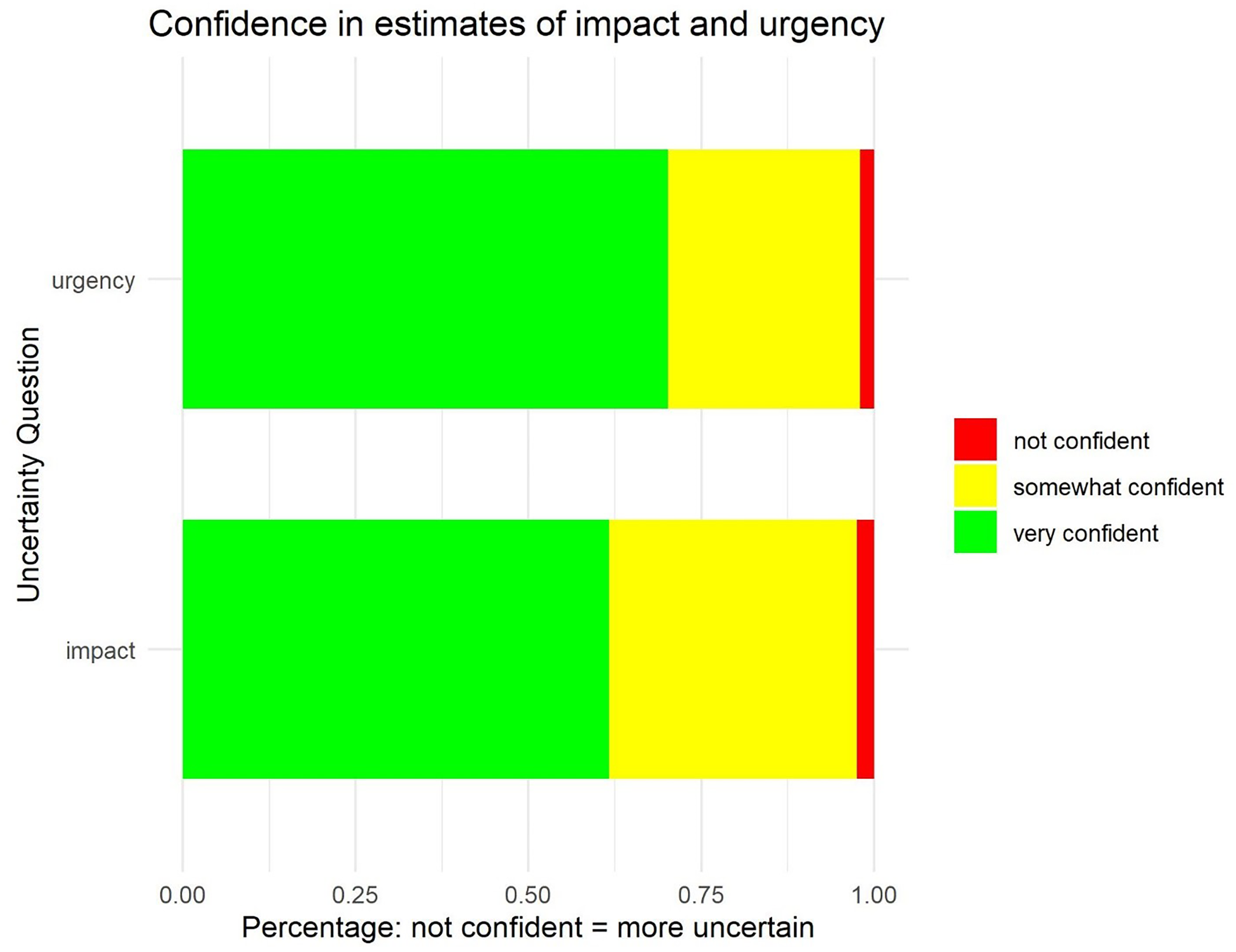
As a follow-up to the previous questions pertaining to the elected officials’ estimate of future climate impacts and urgency of action, the proportion of elected officials who indicated that they were very confident, somewhat confident, or not at all confident with their previous responses.
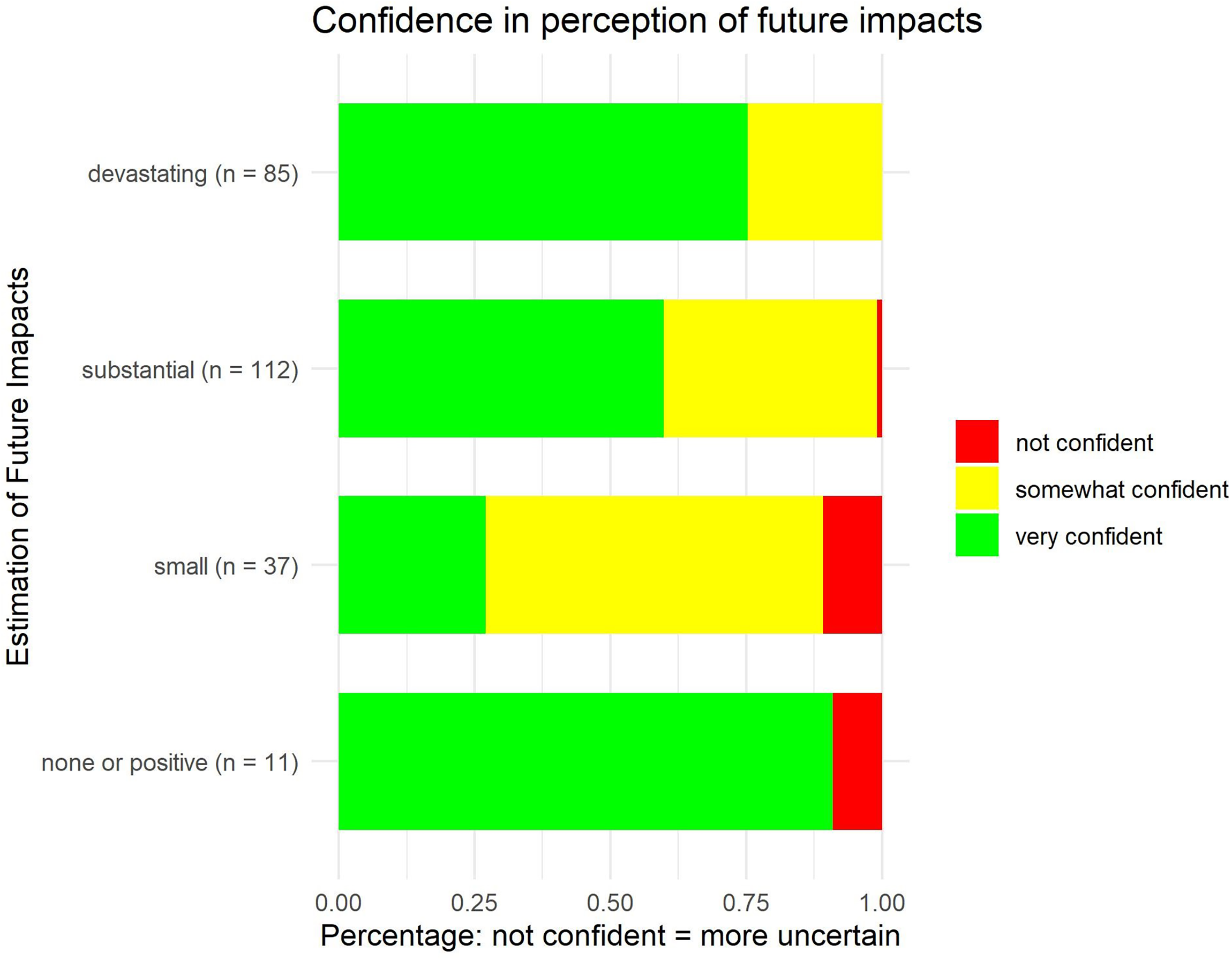
As a follow-up to the previous question asking elected officials to estimate future climate impacts, the proportion of elected officials who indicated that they were very confident, somewhat confident, or not at all confident with their previous responses.
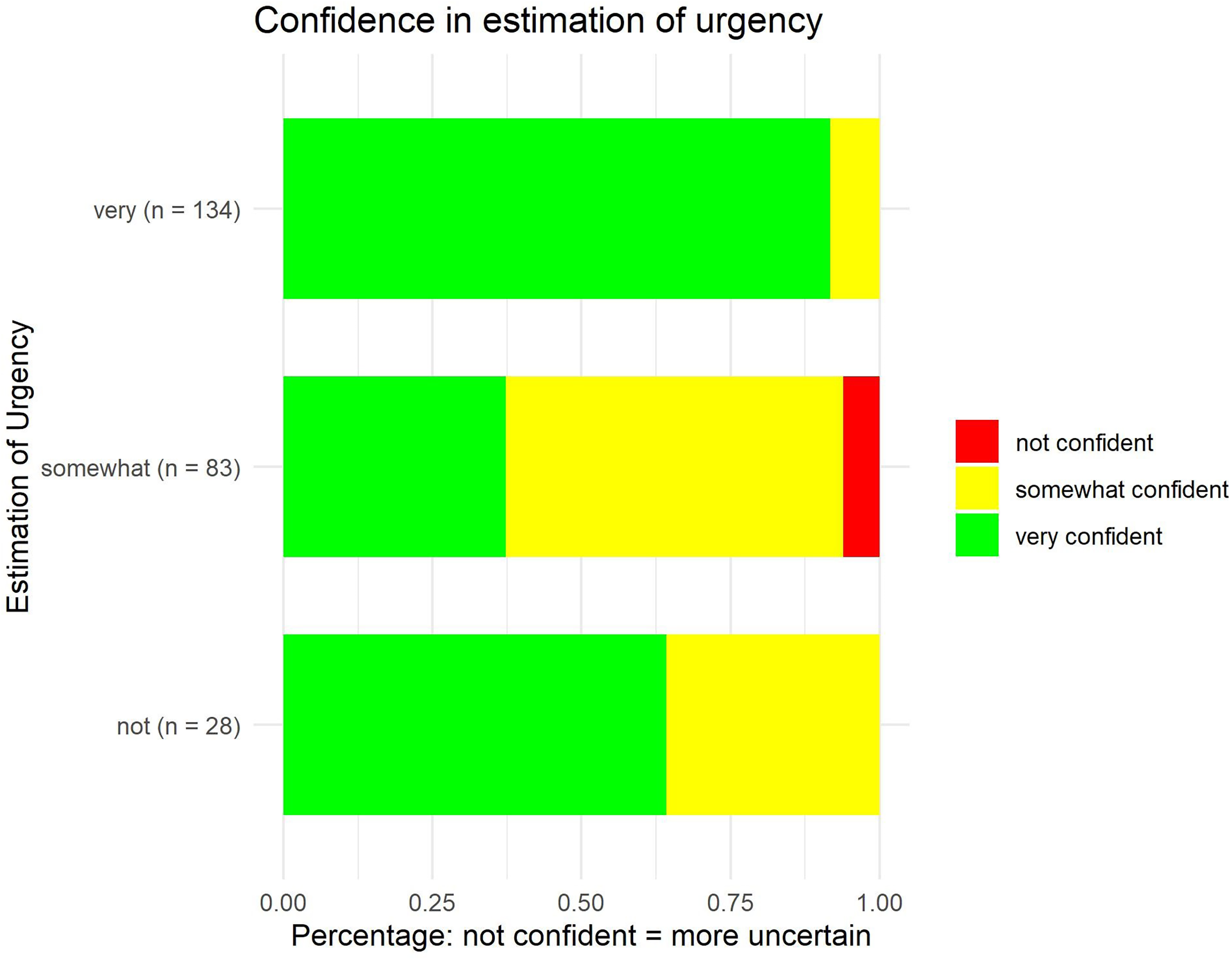
As a follow-up to the previous question asking elected officials to estimate the urgency of climate action, the proportion of elected officials who indicated that they were very confident, somewhat confident, or not at all confident with their previous responses was broken down by their estimation of urgency.
Impacts and Urgency
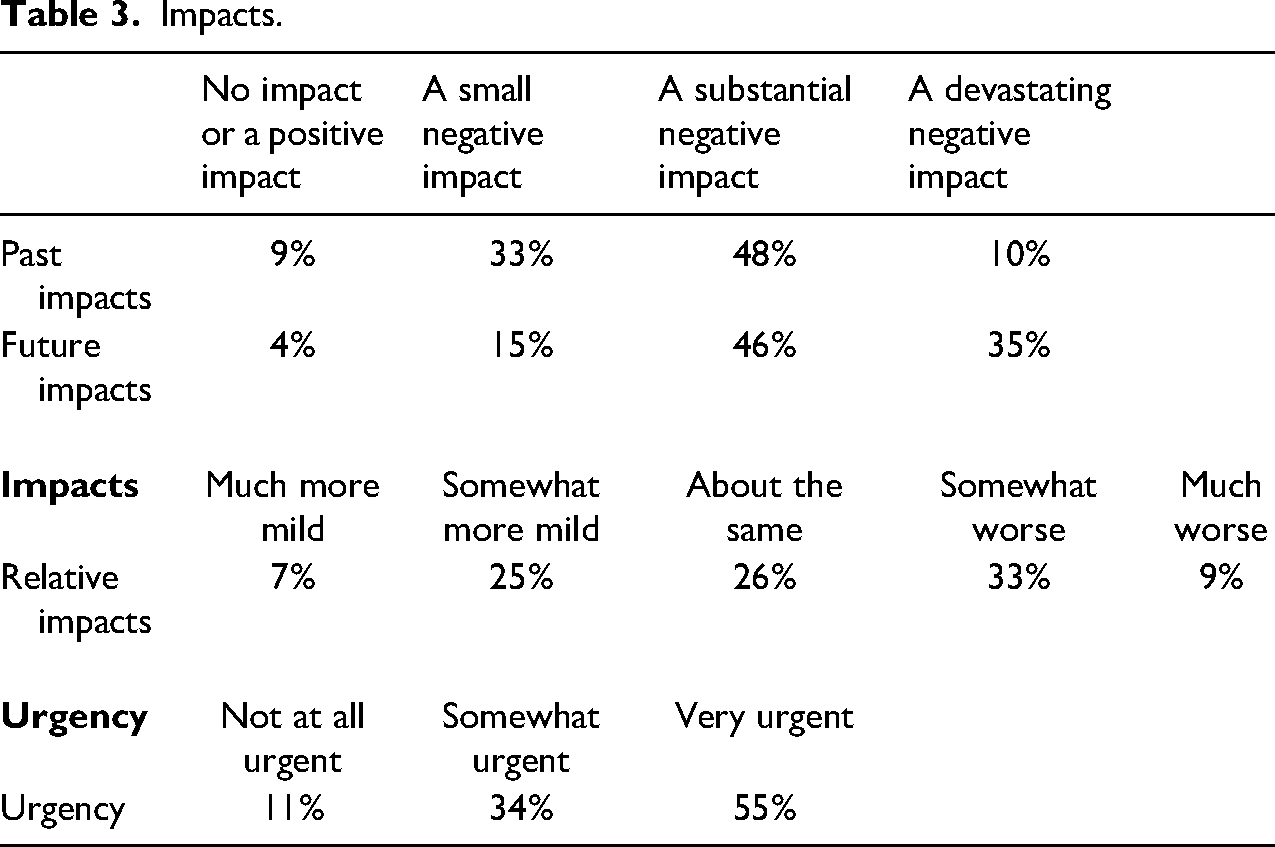
Almost all officials (91%) indicated that climate change has already impacted their communities, and a majority (58%) believed that it has already had a substantial or devastating negative impact. When asked about future impacts, those indicating a substantial or devastating negative impact increased to 81%. Assessments of the impact of climate change in their cities relative to other U.S. cities were balanced. Though a plurality responded that climate change will be worse in their city (42%), a substantial portion believe that the impacts will be about the same (26%), or more mild (32%) (Figure 9).
Finally, most officials agreed that climate change is very urgent (55%). Only 11% assessed climate change as not at all urgent. This aligns with the sentiment that we should act now, even as many respondents agreed that we need more information about policy or impacts (Figure 10 and Table 3). This also aligns with the 77% of officials who expressed a liberal ideology and 64% of officials who indicated that they were members of the Democratic Party.
Impacts.
CFA Results
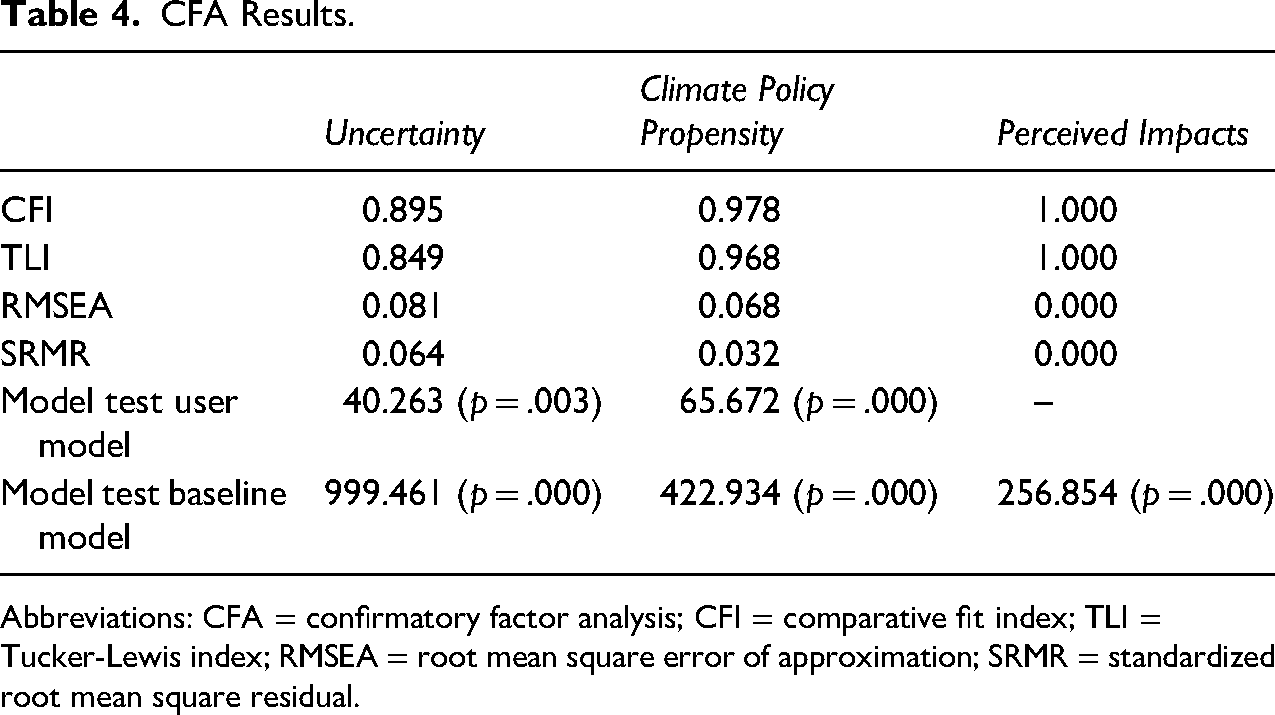
We use confirmatory factor analysis to determine the extent to which our latent variables—uncertainty, climate policy propensity, and perceived impacts—capture consistent constructs. We examined several measures of fit: the comparative fit index (CFI), the Tucker-Lewis index (TLI), the root mean square error of approximation (RMSEA), and the standardized root mean square residual (SRMR). Generally, CFI and TLI should be above 0.9 (moderate fit) or above 0.95 (good fit). The RMSEA and SRMR should be below 0.08 (moderate fit) or 0.06 (good fit) (Kline, 2023).
The
CFA Results.
Abbreviations: CFA = confirmatory factor analysis; CFI = comparative fit index; TLI = Tucker-Lewis index; RMSEA = root mean square error of approximation; SRMR = standardized root mean square residual.
We used the structure of the latent variable to estimate the uncertainty for everyone in the sample. The latent variable has a standard deviation of 0.14 and a median of −0.01. The distribution is skewed to the right (Figure 11), indicating that a few individuals in the sample expressed much greater uncertainty.
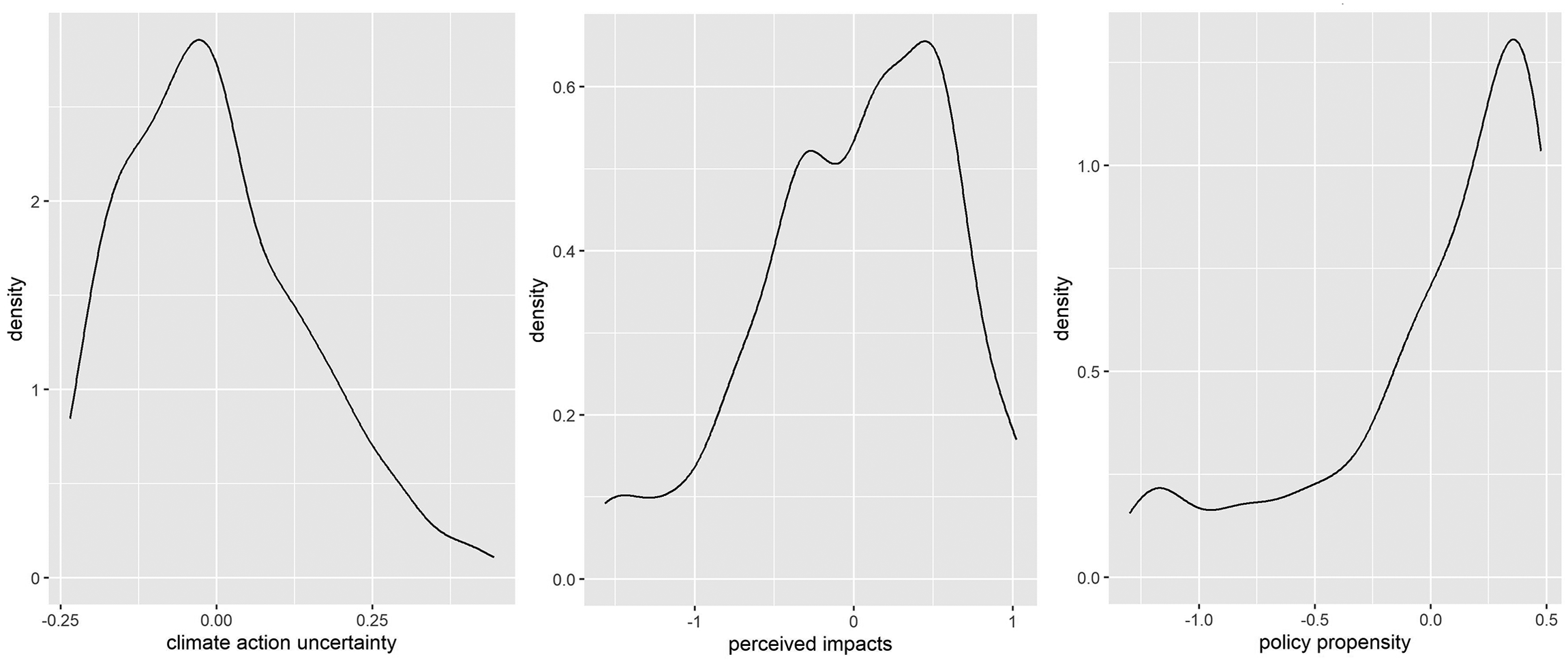
Distribution of climate action uncertainty, policy propensity, and perceived impacts latent variables across all respondents.
The
The policy propensity latent variable is distributed similarly to many of the policy question responses. Policy propensity estimates have a standard deviation of 0.49 and are concentrated at the high end, indicating that respondents generally possess a high intention to pass local climate action, though there is a cluster that has extremely low intention to take climate action. The perceived impacts have a standard deviation of 0.61, indicating the widest spread of any of the latent variables. The variable is also skewed to the left. The similar skews of climate policy propensity and perceived impacts reflect the small portion of officials in our sample who hold deeply conservative views on climate action (Figure 11).
The distribution of uncertainty mirrors the distribution of policy propensity and perceived impacts. A small portion of those sampled are highly uncertain, perceive less impact, and have a lower policy propensity. This matches our a priori expectations and is confirmed by the analysis in the latter sections, establishing those correlations within the SEM model.
SEM Results
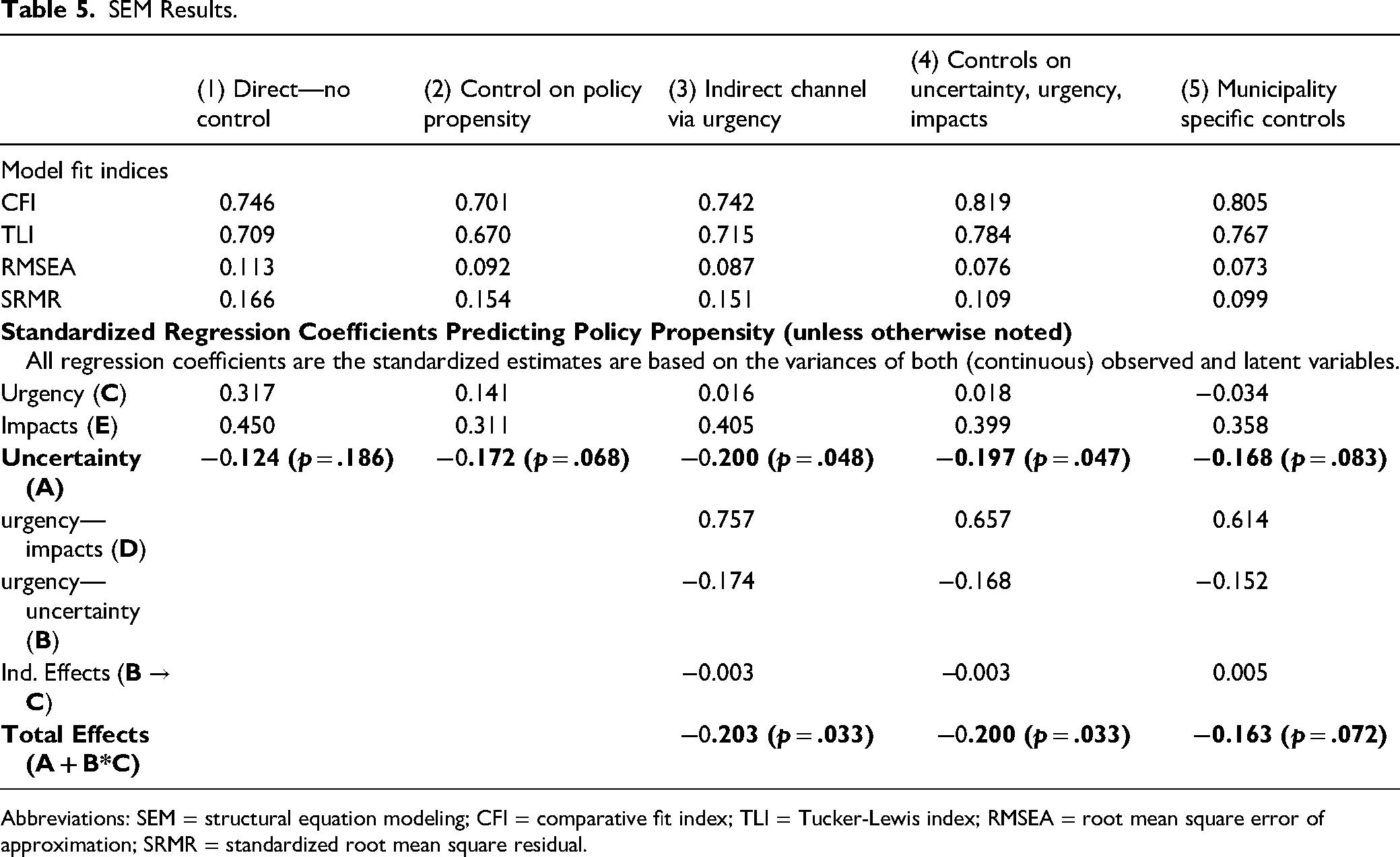
Table 5 includes all five model variants. Adding indirect pathways and control variables to all the latent variables increases our fit. The final model fit is moderate but within the accepted range for SEMs. Adding municipal-specific variables decreases the fit. These city-wide variables may not be a good fit for the populations that the city councilors who represent much of our sample. The standardized coefficient of uncertainty on policy propensity is −0.197. Including indirect effects, the total effect is −0.200.
SEM Results.
Abbreviations: SEM = structural equation modeling; CFI = comparative fit index; TLI = Tucker-Lewis index; RMSEA = root mean square error of approximation; SRMR = standardized root mean square residual.
As latent variables have no observable meaning, it is important to illustrate the meaning of the relationships via examples in the data. To do this, we used the R function lavPredict to determine the predicted uncertainty and policy propensity score for everyone in the sample. The difference between the 25th and 75th percentile uncertainty score is 0.206. Using the unstandardized total effect of uncertainty on policy propensity (−0.568), we determine that moving between these two percentiles would decrease propensity to support a policy by −0.12 points or 0.24 standard deviations. This is equivalent to 9.4% of the distribution. Our finding is that the effects of uncertainty are thus real and pernicious: they significantly decrease the elected official's propensity to support climate action. However, it only represents one of many important variables influencing policy support, including many of the personal characteristics described above (Figure 12).
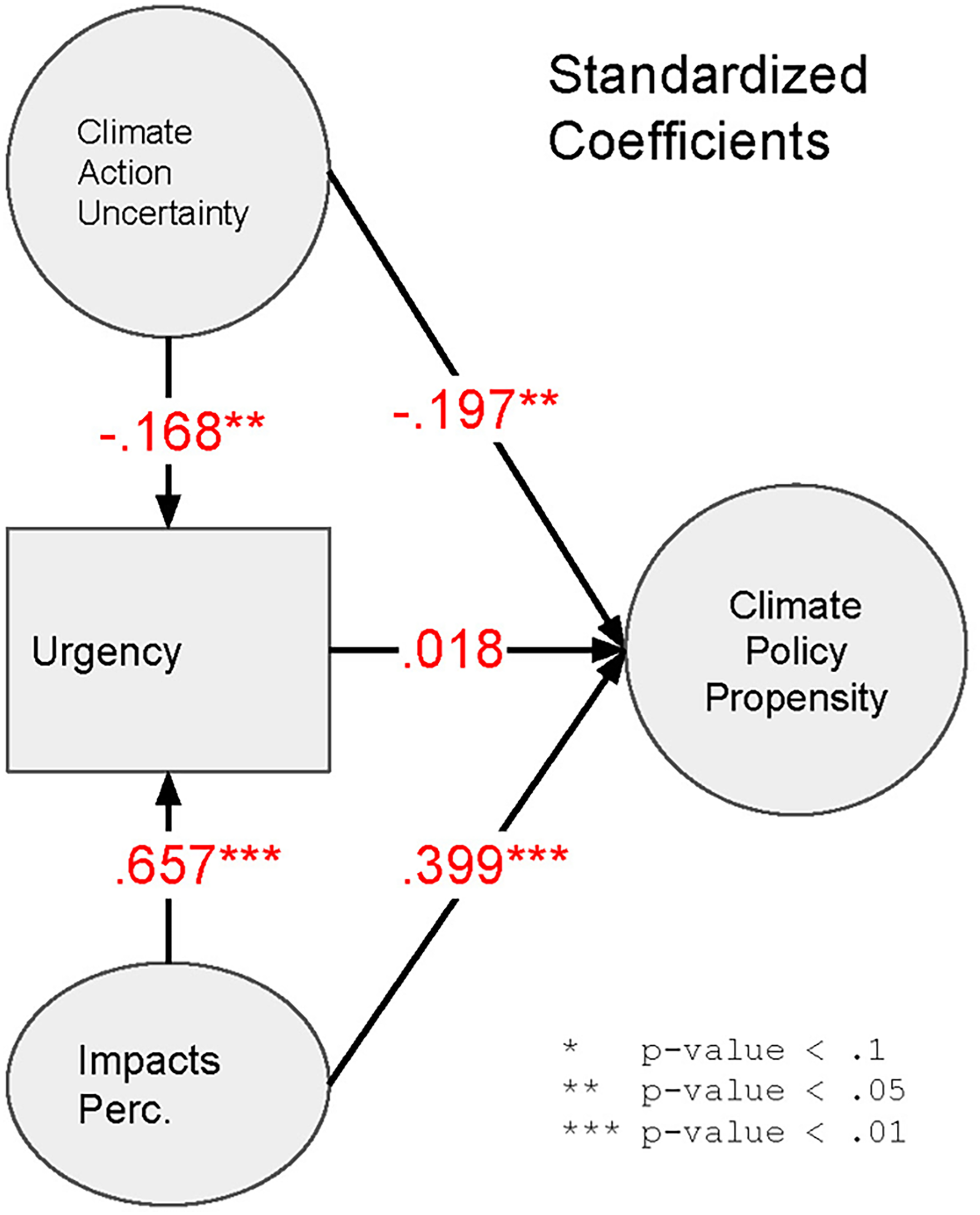
Estimated relationships between climate action uncertainty, urgency, perceived impacts, and climate policy propensity as estimated in the SEM model.
Not all the socio-demographic and political identity covariates that we included were significant in determining policy propensity; nonetheless, we kept several of them in the model because of their general significance in guiding climate policy (Iyengar and Krupenkin 2018) (Table 6). The perception of impacts is strongly correlated with policy propensity, with a standardized coefficient greater than that of uncertainty. This is a strong indication that any attempt to convince elected officials to act on climate change should begin by articulating the impacts. The role of cities in climate change adaptation is also important for policy propensity. Those who saw cities as playing a leading role (n = 157) had a policy propensity of 0.466 points higher than those who saw no role for cities in adapting to climate change. Those who saw a subordinate role fell in between. A similar pattern emerged for the perception of impacts and climate uncertainty.
Covariates.
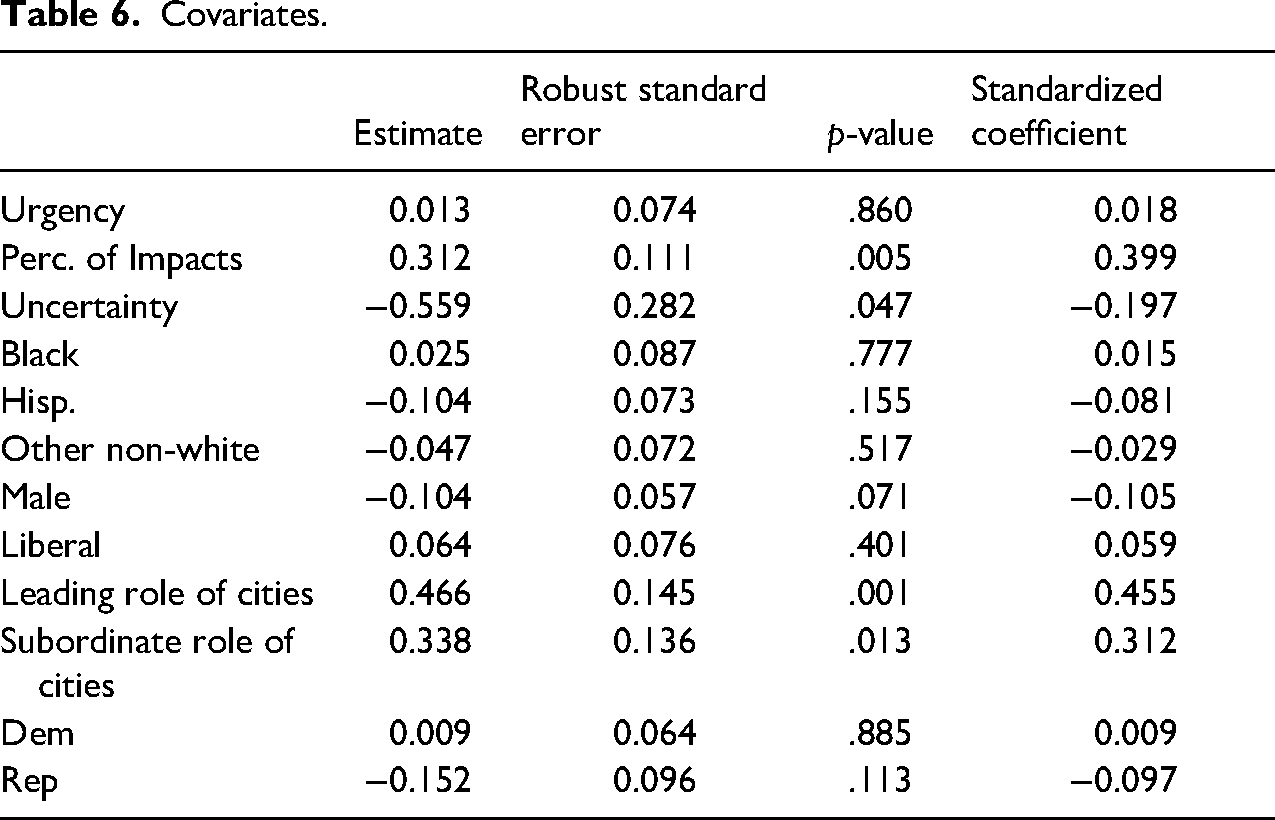
Male officials were less likely to support climate policy and less likely to be uncertain. Race was not significant in determining policy propensity—the lone exception being that Hispanic individuals had a higher perception of impact. Interestingly, none of the political identity variables are significant in determining policy propensity when controlling for other variables. Democrats were more likely, while Republicans were less likely, to perceive a strong climate impact, relative to individuals not affiliated with the two major parties. The signs on the political variables pointed in the expected direction—Republicans are less urgent, less policy supportive, and perceived lower impacts—but the significance may have been limited by the number of Republicans in the sample.
We found no effect of gain or loss framing on the response to uncertainty. For additional results and discussion, see Appendix A.3.
Conclusions
Climate policy is a classic case of policy making under uncertainty. Scientific evidence will never provide precise estimates of local impacts nor the effectiveness of policy solutions. In addition, municipal officials often lack the scientific and policy support infrastructure available at the national and global scale. Council members will necessarily need to make policy choices in a fog of uncertainty. And yet municipal climate policy is not just possible but necessary for reducing our greenhouse gas emissions and adapting to climate impacts. Elected officials should be empowered to act confidently despite inherent uncertainty.
In such circumstances, policy makers can either revert to reference narratives, enhance actions out of precaution, or cautiously slow the pace of action. To determine which effect was most plausible, this study employed an SEM model in a survey of 245 municipal elected officials from cities with more than 100,000 people. Our findings indicate that uncertainty has a pernicious effect on climate action—policy makers who are more uncertain regarding climate impacts and policy are less inclined to take climate action, even when controlling for their sense of urgency, perception of impacts, socio-economic characteristics, and municipal characteristics. This supports our Hypothesis H2 and Carvalho (2007), who found that uncertainty can support arguments for inaction. Though we believe that this is likely causal, our research design prevents us from making strong conclusions. Policy makers who are disinclined to support climate action might be “backfilling” uncertainty.
This assessment of elected officials’ uncertainty was performed in the context of climate policy. However, this is the first study we are aware of that demonstrates that uncertainty can impact degrees of policy support. In that sense, it establishes policy uncertainty as a relevant variable for policy advocates and future research. We argue that there is a good reason to believe that similar uncertainty halts action in a variety of municipal policy spheres. Future research should seek to replicate our results and determine their validity across policy spheres.
With regards to uncertainty surrounding climate change more generally, we see two clear policy implications for advocates and advisors. The first implication is the importance of continuing to assuage policy maker uncertainties regarding climate change impacts. This includes additional research into those impacts which are seen as the most uncertain. Such a research agenda would bridge additional social science research toward understanding how elected officials approach climate policy with scientific research aimed at more precision in their areas of concern.
A second approach is focusing on robust policies—those policies that will promote climate goals no matter the circumstances. It is impossible to fully remove uncertainty related to climate change, but we can be assured that we do have good options for all cases. Emphasizing the co-benefits of policies is another manner of promoting robustness. A policy that makes a city healthier, more just, and ecologically sustainable is worthy of enactment even if it has limited climate impacts.
Affirming Q1, we developed a latent variable to measure climate action uncertainty through a series of questions regarding the location, type, and nature of uncertainty, thus demonstrating that the concept can be defined and measured. The structure of responses reiterated that many of our respondents felt that they knew enough to take action on climate, but that some uncertainties remained in determining the exact policy preferences.
In developing a general measure, we were unable to distinguish which dimensions of climate action uncertainty are most salient and relevant to elected officials. However, future research could tease out potential policy implications. Determining the location of uncertainty—uncertainty surrounding climate change impacts or uncertainty surrounding the most appropriate policies to apply—would inform more specific approaches to addressing the hesitation of elected officials. It may also be important to understand whether ambiguity, rather than lack of information, is the primary holdup in climate action. For elected officials, where constituents and other elected officials stand may be more important than additional science.
In its design and execution, this study has several limitations that provide opportunities for future research. Our sample was sufficient for fitting the SEM model, but a larger sample size would have helped to draw stronger conclusions, especially with respect to the effects of framing. At this point, we cannot support our Hypothesis H3 that loss framing would interact with climate uncertainty to further discourage action. Within our sample of elected officials, our results mirror Gustafson and Rice (2019), who found no effect of loss/gain framing in the general population. In keeping the survey brief to boost the response rate, we did not ask several questions that could have built better measures of uncertainty, perceived impacts, urgency, and policy action. Additional questions could have aided us in distinguishing different natures or locations of uncertainty, and determining which kinds of uncertainty are the most pernicious in slowing policy action.
We additionally wish to emphasize the non-stationarity of our results should they be used to guide future action. All quantitative social science findings are specific to the place and time they are collected—our concepts are socially constructed and embedded in ever-changing relationships. This may be particularly true of how municipal elected officials make decisions. The population that we sampled from no longer exists. Cities can change rapidly in terms of demographics and local business composition. The perspectives of their elected officials are likely to change as well.
A final, essential piece of future policy research is determining the relationship between the propensity to support policies and the actual passage of climate action. Our survey respondents expressed high support for all the policies, but further research would be valuable to link verbal support to actual policy outcomes. While the authors are aware of some of these policies being widely adopted, most of them—selected as stretch goals—have not been broadly implemented. The machinations of urban politics are complex and involve influences beyond the baseline level of councilor support for policies. Political scientists, sociologists, planners, and other disciplines have long argued whether such individual-level factors are key variables relative to larger structural forces at play.
Footnotes
Declaration of Conflicting Interests
The author(s) declared no potential conflicts of interest with respect to the research, authorship, and/or publication of this article.
Funding
The author(s) received no financial support for the research, authorship, and/or publication of this article.
