



Abstract
Research shows that small-sized municipalities, in terms of inhabitants, achieve greater operational benefits from shared service delivery than large municipalities. Still, larger municipalities often engage in a higher number of inter-municipal cooperations than smaller municipalities. This paper investigates why large and small municipalities to engage in shared service delivery with each other by analyzing interview data in six Norwegian center city municipalities and their geographical surrounding municipalities. We outline propositions based on three different types of outcomes related to cooperation between organizations: service performance, strategic benefits, and legitimacy. Results indicate that city and suburban municipalities collaborate for different reasons. While surrounding municipalities cooperate to increase operational size, center city municipalities are instead motivated by spatial needs, regional influence and act in response to pressure from institutionalized environments. These findings support the notion that interorganizational relationships should be considered a mixed-motive situation where main goals and motivation may vary between member organizations.
Introduction
Engaging in inter-municipal cooperation (IMC) is a common strategy for municipalities to produce and provide services. The core argument of cooperation is rather simple: production on a larger scale will lower unit costs leading to lower overall cost which can be used to reduce spending or invest in higher quality (Blåka and Jacobsen 2023). Over the past two decades much research has been devoted to examining whether and to what extent service delivery through intermunicipal collaboration succeeds in obtaining quality improvements and cost reductions (Hulst and Montfort 2007b; Bel and Warner 2015; Teles and Swianiewicz 2018; Bel and Sebo 2021; Elston and Bel 2023). A premise for much of this research is that the main reasons for engaging—or not engaging—in collaborative service production and provision is instrumental and focused on effects at the service level. If the benefits of cooperation (service quality, production costs) are deemed to exceed the costs of cooperation (information costs, coordination costs, risk), then cooperative arrangements will be chosen. In this sense municipalities engage in collaborative efforts based on calculations of costs and benefits concerning the service at hand (Feiock 2013; Kim et al. 2022).
The argument of increasing scale to extract scale benefits is convincing regarding small actors, in our case municipalities. Even though studies of the effects of shared service delivery diverge (Bel and Sebo 2021), several empirical studies indicate that it is the smallest municipalities that have the greatest challenges with obtaining economies of scale (Hülst and Montfort 2007b, 11) and therefore are the ones that first and foremost will benefit from collaboration (Bel and Mur 2009; Bel and Warner 2015, Silvestre et al. 2020; Arntsen, Torjesen and Karlsen 2021; Brandtzæg 2023; Elston, Bel and Wang 2023). In their meta-study Bel and Sebo find “that studies conducted in municipalities with small population sizes tend to find IMC more cost advantageous” (2021, 178). It is therefore rather easy to understand why small municipalities engage in collaborative efforts. It is also reasonable to assume that small municipalities seek collaboration with larger ones to reap benefits from the large resources embedded in larger municipalities, even though the small municipalities will engage in highly asymmetrical relations with power imbalances (see, for instance, Kim et al. 2022).
However, empirical studies show that large municipalities engage in as many, often more, IMCs than smaller ones, at least in Europe (Hulst and Montfort 2007a, Leknes et al. 2013; Jacobsen 2014). Shared service delivery is often an interorganizational relation between a large municipality in terms of population, and its smaller neighbors (Arntsen, Torjesen and Karlsen 2021). This raises a puzzle: if large municipalities can realize economies of scale on their own and may even face extra costs associated with collaborative decision-making and production, then why do they engage in collaborative efforts with smaller ones?
In this paper, we ask the two following questions: (1) What motivates center city municipalities to engage in shared service delivery with surrounding municipalities, and (2) Do center city and surrounding municipalities differ in their motivation?
A central assumption scholars make when studying interorganizational relations is that “actors collaborate to achieve goals that they cannot achieve by acting alone” (Kim et al. 2022, 10). Initially, we expect organizations to engage in cooperation to gain some sort of value (Powell 1990; Barringer and Harrison 2000). Prior research on shared service delivery is often focused on measuring effects linked directly to service production and provision, and thus focus on whether cooperation creates value connected to lower costs and/or higher quality. It is, however, not certain that cost efficiency or increasing product quality are the main goals for all organizations (Scheer, Kumar and Steenkamp 2003; Provan et al. 2008). Scholars have identified a range of factors that drive interorganizational relations in addition to expected economic benefits, such as gaining power to increase external influence and predictability, or legitimacy (Oliver 1990; Babiak 2007). It is old news that organizations vary in their motivations to interact with each other. Almost five decades ago, Schmidt and Kochan (1977, 220) concluded that “interorganizational relationships should be conceptualized as a mixed-motive situation in which each organization behaves in accordance with its own self-interests.” More recent literature echoes this idea by claiming that “actor preferences” are forged in different organizational contexts (Kim et al. 2022, 13). Although the research on interlocal collaboration is growing, little research has yet been devoted to explicitly studying actors’ reasons or rationales for entering a collaborative arrangement. This leaves researchers in the field to state that “(…) too little attention has been given to examining the particular motivations of the decision makers who actually make the decisions about the integration mechanisms to pursue on behalf of the organization” (Kim et al. 2022, 22). In this paper, we reply to this call by empirically examining decision-makers’ motivations for engaging in shared service production and delivery. It also addresses prior calls from new regionalism scholars on the need for research on expected outcomes of collaborative governance in a regional context (Frisken and Norris 2001; Kübler, Schenkel and Leresche 2003) by investigating both center city and surrounding (suburban) municipalities motivations for regional cooperation.
The empirical material consists of an analysis of interview data from higher office officials (46 in all) in six of the largest Norwegian city municipalities and neighboring municipalities who they share services with. The informants were asked questions on why they engage in shared service delivery with each other. We analyze the data through three perspectives on rationales for engaging in intermunicipal collaboration: (1) to increase service performance, (2) as a strategic choice, or (3) as adaptation to expectations from institutionalized environments.
Drivers for IMC: Theoretical Background and Expectations
Shared service delivery may be viewed as an interorganizational relation where participants collaborate to reach some sort of goal. The literature can be described as fragmented, with several disciplines contributing to the field, reflecting the multifaceted nature of relationship formation between organizations, “which often involves a mixture of motives, intentions, and objectives” (Barringer and Harrison 2000, 369). As noted in the Introduction, it seems plausible that small municipalities will be motivated to enter cooperative arrangements by the promises of realizing benefits associated with economy of scale. We may thus expect that internally oriented efficiency motives will be considered crucial by small actors (Oliver 1990). If cooperation is a mean for addressing small-scale problems, this motivation for entering an arrangement for shared service delivery will be less important for large municipalities as they already have reached large enough production scale (Arntsen, Torjesen and Karlsen 2021). To explain large municipalities’ motivation to share services with neighbors we thus must look beyond service level performance. We propose two main motivations, derived from insights from two central streams in organization theory. The first is inspired by resource dependence theory (Pfeffer and Salancik 1978; Hillman, Withers and Collins 2009), and views entering a cooperative arrangement as a strategic choice, to gain access to important external resources that even large municipalities do not control. The second is grounded in neoinstitutionalist theories (Meyer and Rowan 1977; Dimaggio and Powell 1983) stressing that entering a cooperative arrangement can be based on motives to increase legitimacy (Oliver 1990).
Efficiency: Cooperation as a Mean to Increase Service Performance
Shared service delivery is a type of cooperation where productivity and minimizing of cost often dominate research (Klijn 2008). In economic-oriented organizational theory, collaboration often serves as an organizational tool to pool resources across actors into larger production units to improve service performance (Williamson 1981; Oliver 1990).
From an efficiency perspective, we will expect that actors engage in collaborative activities because they expect to realize some (a) economic benefits based on larger scale production (lower marginal cost per extra unit produced), and/or (b) quality benefits (better quality per unit produced without increasing cost). This reasoning originates from economics (Stigler 1958) and focuses coproducing to increase production volume, and thus on extracting scale benefits such as reduced unit costs, waste, or downtime. Another way of improving the service in question by joining forces is the need for stability. Organizations will form relationships if they are too small to handle uncertainty in the environments, such as fluctuations in demand. Oliver (1990, 245) describes this as efficiency motivations defined as “internally, rather than externally, oriented. In this situation, the formation of an IOR is prompted by an organization's attempt to improve its internal input/output ratio.”
However, and as noted earlier, it is first and foremost the smaller municipalities that may envisage cost and quality benefits. Center city municipalities are more likely to be large enough to obtain such benefits on their own and may even experience increased transaction costs linked to sharing competence and service provision with smaller municipalities (Arntsen, Torjesen and Karlsen 2021). From the previous discussion, we set forward our first proposition:
Proposition 1:
Achieving lower costs and higher quality in services will dominate the motivation for collaboration in surrounding municipalities, but will be less important or unimportant in the center city municipalities.
Strategic Outcomes: Cooperation as a Strategic Choice
From the previous section, we deduct that center city municipalities’ motivations for engaging in interorganizational relations lie elsewhere than in goals of extracting benefits of scale at the service level. Within theories of strategic choice, research indicates that large corporations engage in alliances with smaller ones to gain access to, and control over resources they do not possess (Barringer and Harrison 2000; Hillman, Withers and Collins 2009). In the context of local government, the formation of intermunicipal relations may be motivated by an expectation of gaining regional competitive power or ability to challenge or influence higher levels of government. Center city municipalities may thus be motivated to share service delivery with smaller neighboring municipalities to strengthen their position as head of the region and gain national support (Kübler, Schenkel and Leresche 2003), and even to take a place in a global competition for resources between regions (Fontan et al. 2009).
Large cities also take on the role as central nodes in functional regions. Such regions are commonly defined based on commuting between a central node (large municipality) and more peripheral nodes (smaller neighboring municipalities) (Noronha and Goodchild 1992). As costs of living, especially housing, is increasing with the centrality of a household, many decide to live outside the metropolitan area while still working there. Large city municipalities may thus in many instances become dependent on access to areas outside the municipality borders to be able to attract both businesses and people. Engaging in collaborative arrangements with smaller neighboring municipalities may thus be attempts to bind the smaller municipalities closer to the large one. As more municipalities engage in more IMCs, interdependence between them increases, and the more close-knit becomes the web that binds them together (Elston, Rackwitz and Bel 2023). For the large city municipalities, IMC may thus be a way to lay the groundwork for more strategic cooperation and thus reduce risk of breakdown of other regional cooperative arrangements (Zyzak 2017). As Kim et al. (2022, 13) write, collaboration may be a way to signal “(…) credible commitments to partners, something that is (…) critical for building trust and overcoming defection risks.” The driver for shared service delivery will then lie in goals outside the service at hand.
Still looking at research concerning firms’ strategic choice, prior empirical studies underline that smaller organizations have less resources available for strategic planning (Dilts and Prough 1989) and tend to be less aggressive in their strategies (Pleshko and Nickerson 2007). Translated to the municipal context we assume that smaller neighboring municipalities to a lesser extent will display strategic motives for engaging in shared service delivery.
This leads to the second proposition:
Proposition 2:
Motives for collaboration linked to strategic choice will be considered highly important in the center city municipalities and less important in surrounding municipalities.
Legitimacy: Cooperation as Adaption to Expectations from Institutionalized Environments
The ability to pursue its own strategic goals is closely linked to organizations legitimate status (Child 1972; Brown 1998). The term legitimacy refers to “a generalized perception or assumption that the actions of an entity is desirable, proper, or appropriate within some socially constructed system of norms, values, beliefs and definitions” (Suchman 1995, 574). Grounded in neoinstitutional theory, the enhancement of organizational legitimacy may serve as a driving force for entering collaborative arrangements (Oliver 1990). Institutional theorists “view organizational behavior as the product of ideas, values and beliefs—institutional pressures—and propose that organizational behaviors are responses to not only market pressures but to institutional pressures” (Greenwood and Hinings 1996; Jewer and McKay 2012, 558). Oliver (1990) identifies organizational legitimacy as a significant motive in the decision for organizations to interconnect, and scholars of the institutional tradition such as DiMaggio and Powell (1983), Meyer and Rowan (1977), and Tolbert and Zucker (1983) “suggests that institutional environments impose pressures on organizations to justify their activities or outputs. These pressures motivate organizations to increase their legitimacy to appear in agreement with the prevailing norms, rules, beliefs, or expectations of external constituents” (Oliver 1990, 246). In this perspective, engaging in shared service delivery is a way of increasing legitimacy which can originate from an organization's motivation to improve reputation, image, or congruence with prevailing norms and values of society. Which parts of society that constitute an organization’s most important institutionalized environments may differ, but is often theorized as consisting of actors representing regulatory, normative, and cultural-cognitive surroundings that influence the organization (Scott 2013). At its core, legitimacy may enhance an organization's “right to exist and to pursue its affair in its chosen manner” (Knoke 1985, 222).
In the context of local government, intermunicipal service delivery would constitute what Pollitt and Hupe (2011) describe as a “magic concept.” Collaboration, cooperation, and coordination are all concepts that have a strong positive normative character that makes it difficult to disagree with. In this sense collaboration “is thought to be the smart thing to do and the right thing to do” (Stout and Keast 2021, 17). A few empirical studies also indicate that IMC may be more or less “empty” in terms of instrumental results and outcomes and play a more symbolic role in conveying signals of “doing the right thing” to their environments (Jacobsen 2015; Elston and Bel 2023). For instance, in Norway, several white papers have pointed at IMC as the single most important organizational solution for municipalities to overcome present and future challenges (NOU 2023:9 2023; Blåka 2024).
Intermunicipal cooperation is thus treated as a “one size fits all”-solution, regardless of municipality size, geographical dispersion, and task. Cooperation is viewed as a universal solution, no matter what the problem is and where it is located. Cooperation is itself a good. This notion rests both in the eyes of actors external to the municipality like state institutions and neighboring municipalities, as well as in the center municipality itself, creating both an internal and an external pressure to engage in collaborative arrangements (Blåka et al. 2023).
Through an institutional perspective we may thus expect both large municipalities and smaller ones to engage in shared service delivery to act conform with expectation from institutionalized environments, leading us to pose the question:
Proposition 3:
Motives for collaboration linked to institutional pressure will be considered important for both center city and surrounding municipalities.
Through these three propositions we argue, in line with the classical works of Oliver (1990) and Schmidt and Kochan (1977) that interorganizational relations should be considered a mixed motive situation, where in our case larger and smaller sized municipalities collaborate for partially different reasons.
Study Setting and Empirical Strategy
The study was conducted in Norway, which is characterized by a decentralized Scandinavian welfare model in which all municipalities are assigned the same set of statutory tasks, financing system, and legislation, aiming at ensuring equal access to services for all inhabitants (Arntsen, Torjesen and Karlsen 2021, 113). Scandinavian local governments are the administrative level that produces the most services directly aimed at inhabitants. They are mandated to offer a wide range of services caring for their inhabitants “from cradle to grave,” including services such as primary health care, kindergartens, schools, and elderly care. In addition, they are responsible for land-use planning and manage infrastructure like maintenance on municipal-owned roads. They are also responsible for supplying water and sewage, and waste collection for own inhabitants. In Norway the municipal sector's total revenues amounting to around 20% of GDP (Jacobsen 2022). The Norwegian context is a fruitful case for investigating the three propositions outlined previously for four reasons. First, municipalities have a non-differentiated responsibility (often termed as the “generalist principle”), which means that all municipalities, regardless of size have responsibility for the same tasks and functions. Thus, all municipalities are equal vis-a-vis the law, and no municipality can legally force other municipalities into a collaboration. Second, even though there are possibilities for the state to mandate cooperation between municipalities, this possibility is rarely used (Blåka 2024). Engaging in collaborative arrangements is thus a voluntary endeavor based on decisions in each municipality. Third, there is large variation in size (number of inhabitants) between the 357 municipalities in Norway. The mean number of inhabitants is around 15,000 with a median of approximately 5,000 (Blåka 2022). In a comparison of 31 European countries, Norway is placed close to the median in terms of the number of populations in each municipality (Baldersheim and Rose 2016), making it a comparable case with many other European local governments. Fourth, even though participating in an IMC is voluntary, once an IMC is established, the Law on Regional and Local Government regulates what organizational form cooperation can take. As outlined in Bel et al. (2022) cooperation may be organized either by creating a new intermunicipal organization or by member municipalities delegating the execution of a task to a “host”-municipality. Intermunicipal contracting to private actors is not common (Blåka and Jacobsen 2024). Shared service delivery is Norway unifunctional, meaning that municipalities run separate IMCs for each service. For services involving the use of public authority, such as child protection services, the only legal form of cooperation is a host arrangement where participating municipalities delegate tasks to a host municipality (Blåka and Jacobsen 2023). This form of cooperation often takes place between suburban municipalities delegating tasks to a city municipality (Blåka et al. 2023). For other service areas, such as provision of infrastructure and emergency services municipalities are free to choose between delegation or creating an IMC organization. An IMC organization consists of an agreement and a mandated organizational structure that should include a board, a responsible manager, and administrative/service-providing personnel (see Blåka et al. 2023 for a more detailed description). Tasks such as solid waste disposal, water- and sewage management are most frequently organized as IMC organizations (for a more detailed overview see Blåka 2024). Either way, the choice of integration mechanism is limited (Kim et al. 2022), limiting the role of this element when choosing whether to participate in an IMC or not.
The empirical materials 1 we use to investigate the research questions are (1) mappings of the scope of shared service delivery between six large city municipalities and their surrounding municipalities in service areas where IMC is common, and (2) interviews with top-level managers (chief municipal executives—CMEs) and second-level managers in charge of specific service areas (“sektorledere”) in all large city municipalities, and CMEs in their surrounding municipalities (varying from two to four municipalities in each metropolitan area). The informants thus represent highest-ranking administrative officers in Norwegian municipalities. This group of informants was selected on the ground that they, through their formal hierarchical position, have the highest probability of being directly involved in the establishment and design of cooperation and thus represent primary information sources. The center municipalities included in the study is the six largest cities in Norway (apart from the capital Oslo): Bergen, Drammen, Kristiansand, Stavanger, Trondheim, and Tromsø.
The capital Oslo is not included in the analysis. First, it is by far the largest municipality with over 700,000 inhabitants. Second, Oslo has the status as both a municipality and a county, and thus a different role than other Norwegian cities, both in terms of autonomy for regional planning and position as a both regional and national node. It is thus not directly comparable to other cities that all share the same tasks and responsibilities.
To be able to answer the posed question of what motivates both center city—and surrounding municipalities we must understand which municipalities constitute the metropolitan's region. Definitions of urban regions may vary across the literature (Juvkam 2002). One internationally recognized definition of a metropolitan or functional urban area is however the one made by Eurostat by using the city and its commuting zones (Dijkstra and Poelman 2012). Figure 1 displays a map of the six center cities (marked red) and municipalities where minimum 10% of inhabitants commute to the metropolitan municipalities (marked yellow). This constitutes the functional region surrounding each center city municipality.
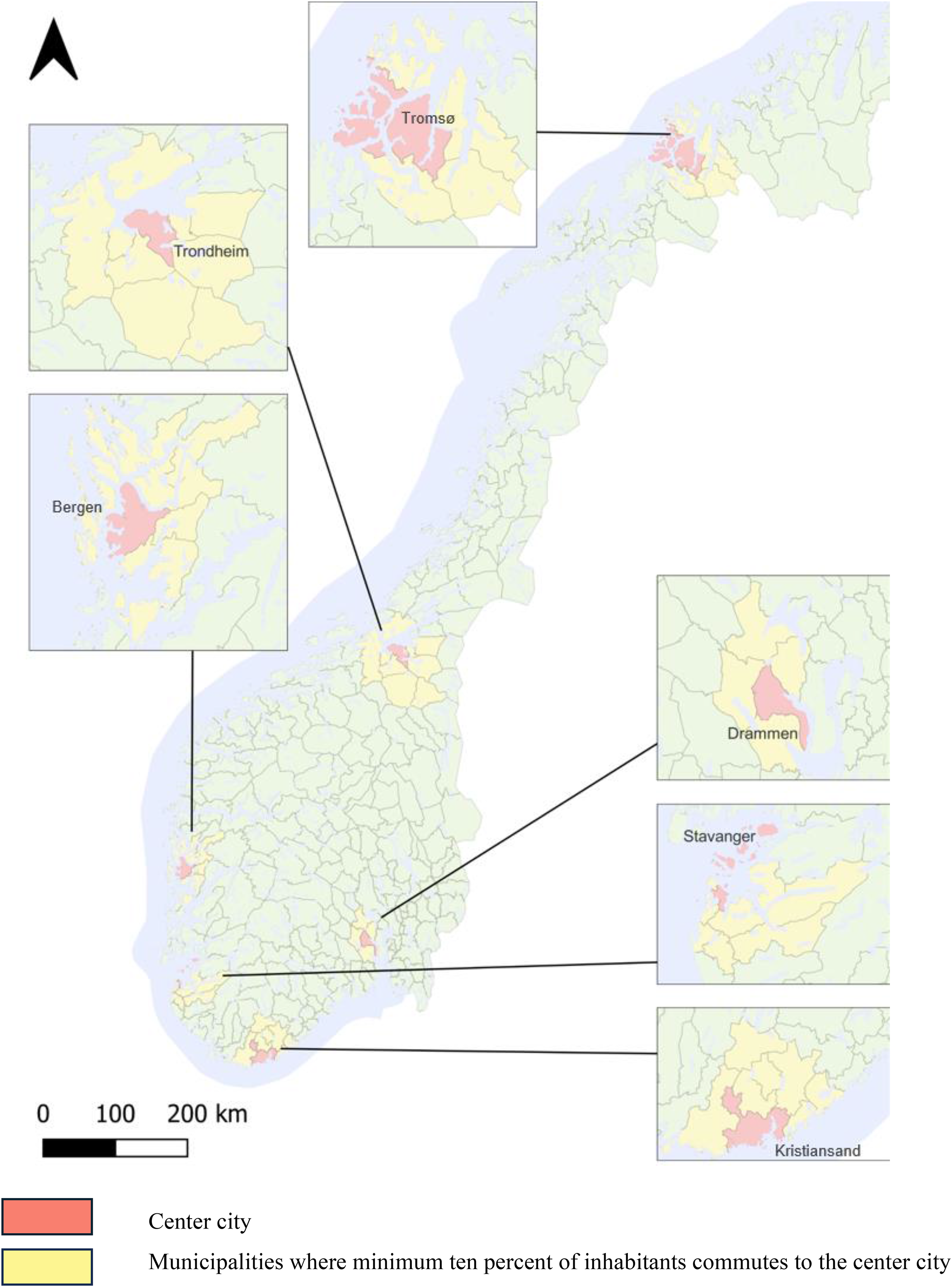
Map over Norway, displaying the functional urban area in each case region, Consists of the city and its commuting zone. Source: Statistics Norway.
To ease any comparison with Norway to other national contexts we provide in Table 1 information on the population sizes in the center cities and their surrounding municipalities.
Number of Inhabitants in Center City and Surrounding Municipalities.
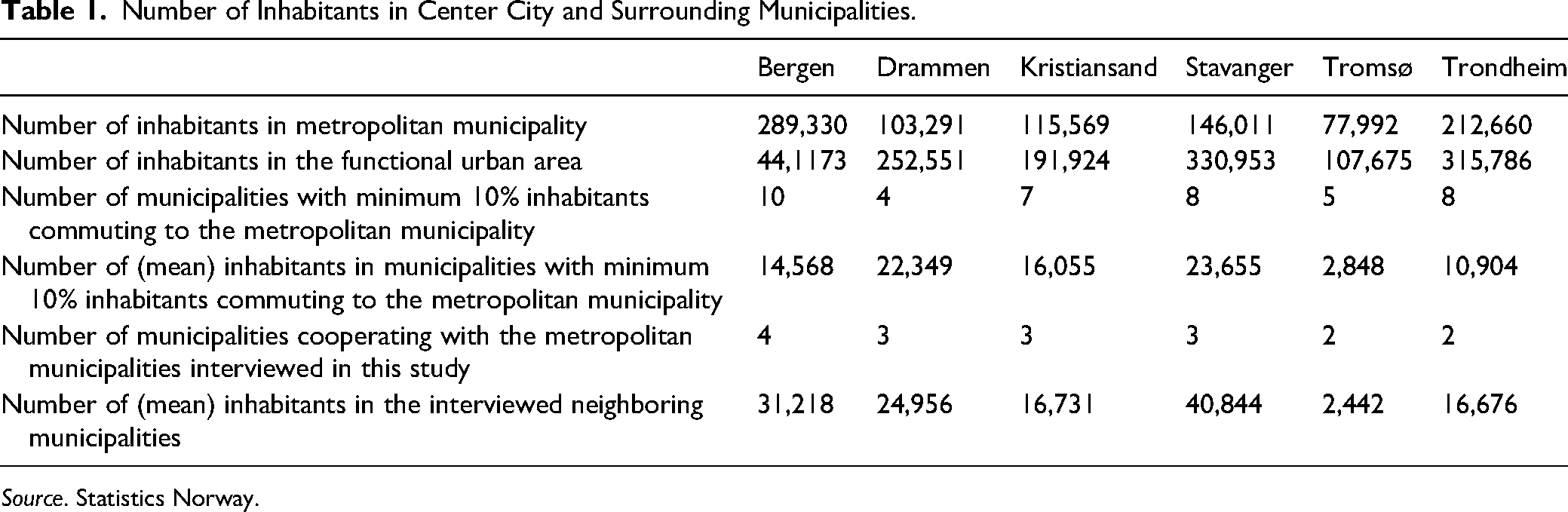
Source. Statistics Norway.
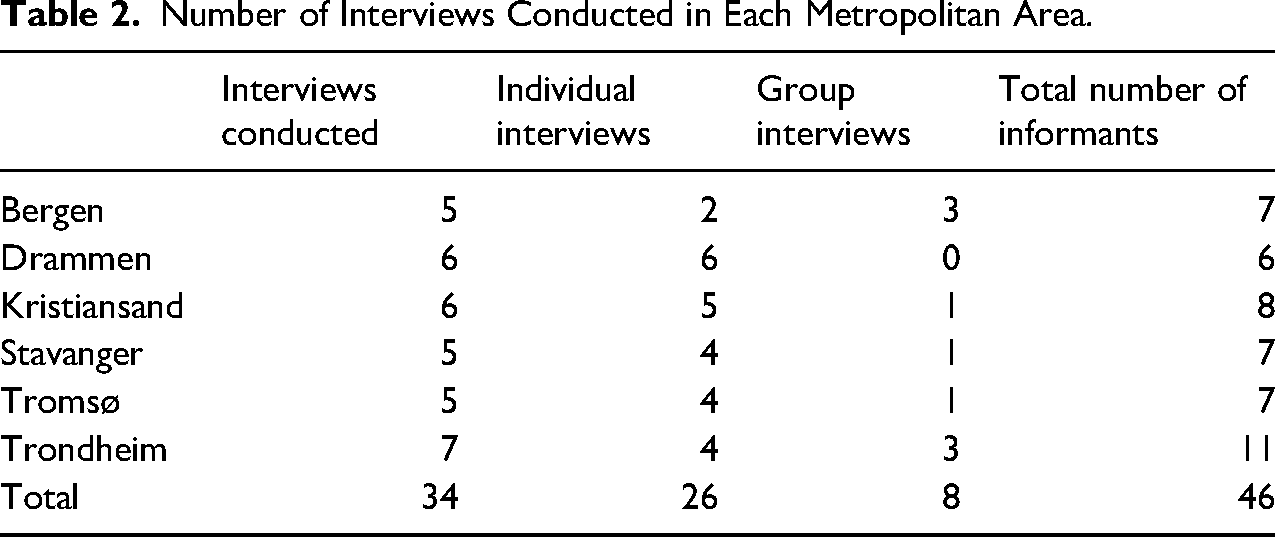
Four authors conducted interviews based on interview guides adapted to the various groups of interviewees. 2 The interviews covered different aspects of drivers for (or against) cooperation, such as roles of the different municipalities, and experience of pros and cons linked to cooperating in each policy area. The data analyzed in this paper were collected as part of a project where several additional topics were studied. The interviews were conducted digitally on Teams in the period September–December 2022 and were recorded on audio tape, transcribed, and then sent to each informant for validation. It was conducted either as individual- or group interviews, depending on the schedules and availability of the informants. As shown in Table 2, 34 interviews with 46 informants from 21 municipalities were conducted in total. Each interview had a length of 30–75 min. Interviews were transcribed. To check for potential differences due to different qualitative approaches we first categorized the material based on whether the interview was conducted as group or individual and looked for differences in the informant's openness, and personal thoughts. The information in both interview forms are characterized by being professional descriptions the informant makes in virtue of being top-level executives. We could thus not detect any systematic differences in information between the two forms of interviews, something that supports that the findings are stable across data collection methods.
Number of Interviews Conducted in Each Metropolitan Area.
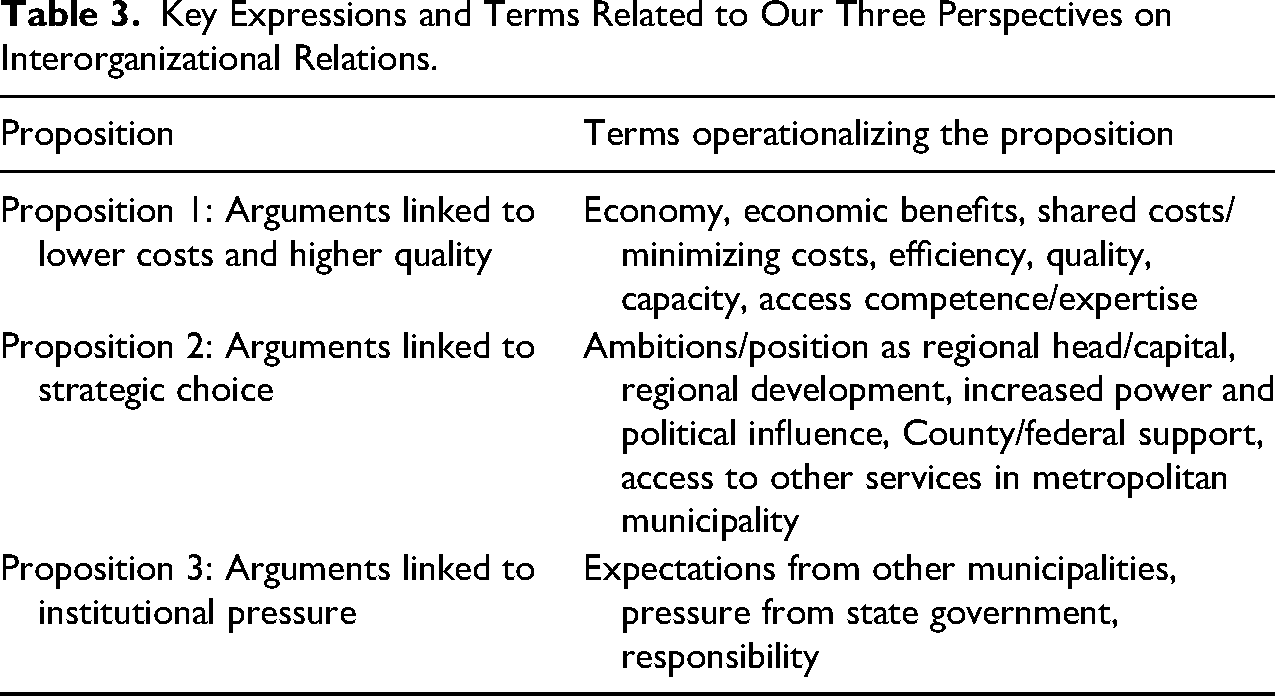
We adopted a deductive category application to systematize and interpret the interview data (Mayring 2004). Three types of motivation constituted the initially deduced categories: (1) efficiency (costs and/or quality), (2) strategic choice, and (3) institutional pressure. In this directed content analysis, guidelines for coding were set by the three propositions derived in the theoretical section (Hsieh and Shannon 2005). One member of the research group conducted the first analysis of all interviews. The initial codes were then distributed to all members of the group, and the group met on two occasions to discuss the coding. Table 3 provides a list of these propositions and the codes operationalizing them.
Key Expressions and Terms Related to Our Three Perspectives on Interorganizational Relations.
Analyses
Norwegian municipalities cooperate on a great number of public services concerning administration, infrastructure, and emergency services. To compare the scope of shared service delivery each metropolitan municipality engages in with its neighbors we have, in Table 4, listed the services where cooperation in general is most widely used (Jones et al. 2021), and indicated with “X” if the metropolitan municipality provide this service in cooperation with one or more neighboring municipalities. The number of members in cooperation with the metropolitan municipality for each service is reported in Table 4.
Scope of Shared Service Delivery in Each Metropolitan Municipality.
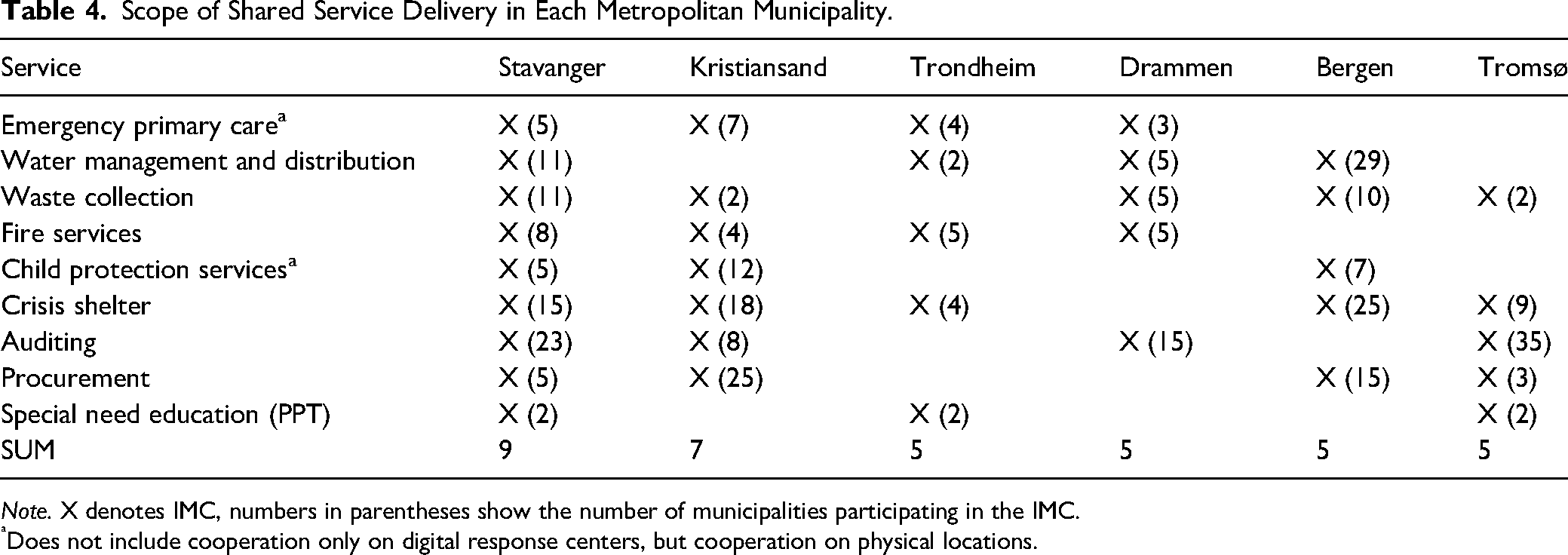
Note. X denotes IMC, numbers in parentheses show the number of municipalities participating in the IMC.
Does not include cooperation only on digital response centers, but cooperation on physical locations.
Table 4 shows that the scope of shared service delivery varies among the cities from nine in Stavanger to five in Bergen, Drammen, Trondheim, and Tromsø. The main explanation for this variation is due to geographical distances, and varying size in surrounding municipalities. Some services such as firefighting, water management, and child protection, are dependent on being in physical proximity to its users. For municipalities with large geographical distances cooperation is difficult. We find the largest geographical distances between municipal centers (town or village halls) in the northern part of Norway (Tromsø). The number of inhabitants in the suburban municipalities in the case regions varies. Some center cities have larger neighbors than others. These municipalities are less dependent on cooperation with the city in question because they to a greater extent than smaller ones manage to achieve critical production sizes alone. This finding coincides with studies that analyze how cooperation intensity differs across policy areas (Brown and Potoski 2003; Aldag, Warner and Bel 2020; Strebel and Bundi 2023) and suggest that the optimum scale of operation differs between service areas (Blåka 2022).
In the following sections, we present results from the interviews. The analyses focus on what drives municipalities to cooperate on the service areas listed in Table 4. We follow the motives or rationales outlined in the previous three propositions, while looking for diverging arguments from metropolitan and neighboring municipalities.
Efficiency Arguments
When asked about the motivation for their municipality's involvement in shared service delivery, our informants from the neighboring municipalities only provided instrumental reasons. They assert that their municipality fully relies on cooperation with the metropolitan municipality to deliver the best possible services to their citizens, and in some cases the ability to deliver services at all: Small municipalities are fully dependent on host municipal cooperation. We are dependent on [name of metropolitan municipality] as an engine and leader in such cooperation.
Furthermore, all our informants from neighboring municipalities highlight internally driven motivations as their key driver, such as providing services in a more cost-effective manner or increasing the capacity or quality of municipal services. They experience that acquiring sufficient personnel and expertise is easier to achieve through IMC than if they were to deliver the services on their own. The following statement from a CME serves as an illustration: We deliver services and solve tasks as far as we can within our own organization and our own resources. But at the same time, we have systematically approached [the metropolitan municipality] for cooperation in the areas we cannot manage on our own. I have already mentioned municipal procurement. In addition, we cooperate on shelter services to children, women and men who are or have been exposed to violence, waste disposal, emergency services, fire and rescue and water management. These are the municipal services in which we have formalized cooperation. It's not that we do not have any competence or capacity at all, but not to a sufficient extent to cover the requirements in a satisfactory manner.
Such motives are not restricted to the smallest neighbor municipalities in our study. Informants from several larger neighboring municipalities give similar reasons. The following statement comes from a CME in a municipality with about 25,000 citizens, a relatively large municipality by Norwegian standards: Cooperation on services where we lack employees and need to ensure capacity, competence and continuity in the organization are particularly interesting to us. That includes administrative tasks and functions such as ICT, salary payments, collection of municipal fees and audit, but also waste disposal, water management and distribution and emergency services.
As the following quote exemplifies, our informants from the metropolitan municipalities also emphasize that their smaller, neighboring municipalities need to cooperate to be able to deliver municipal services: In the future, smaller municipalities, to an even greater extent than today, will need to lean on larger municipalities to solve tasks and deliver several services that their residents expect them to. The way I see it, the smaller municipalities don’t stand a chance without cooperation. They do not have the necessary resources, people nor expertise.
However, the informants do not cite this as a reason why the large municipalities share services with their neighboring municipalities. In contrast, informants from all metropolitan municipalities focus on disadvantages and transaction costs. The following quote from an informant from one of these municipalities underlines this point: In many ways, [our municipality] does well on its own. We don't need to cooperate with other municipalities. Furthermore, inter-municipal cooperation often comes with transaction costs and more work. It also affects the city council's decision-making authority. With inter-municipal cooperation, decision-making authority is shared between several municipalities, with more meetings and more complex decision-making structures.
The informant effectively highlights both administrative and political costs associated with shared service delivery. Another quote from an informant in a metropolitan municipality also emphasizes that these municipalities associate shared service delivery with increased coordination costs leading to more expensive service delivery: If the cooperation runs smoothly, the gains exceed the costs. Some of these service cooperations though… We must acknowledge that they have sky-high transaction costs. We are coordinating ourselves to death. […] With cooperation comes a lot of compensatory work. There are examples where we must give a lot to get the cooperation going, for instance pay twice as much per inhabitant as the other municipalities. That is not a good starting point for regional cooperation. The “big brother” role can be demanding.
The cost of cooperation is in some instances used as arguments for not engaging in shared service delivery by metropolitan municipalities. One of the metropolitan municipalities that engage in the lowest number of cooperations has been reluctant to enter intermunicipal service delivery arrangements with neighboring municipalities based on two types of arguments: rationalizing spending and maximizing service quality on the one hand and securing municipal autonomy on the other: We are a quite modern and advanced municipality with high ambitions, and we think that entering inter-municipal cooperation will hamper our possibilities to achieve our ambitions.
The interview material shows a clear contrast between metropolitan and neighboring municipalities in their way of describing motivations for cooperation. Neighboring municipalities focus on cooperation as a necessity to achieve good (or sufficient) services for own inhabitants. Informants from the metropolitan municipalities, on the other hand, emphasize that they do not really need to cooperate with smaller neighbors to deliver services, and that cooperation often entail increased costs. The exception is the spatially dependent services water supply and sewage management where the metropolitan municipalities are dependent on the location of water resources and recipients. In many metropolitan areas, IMC in large economic sectors like water supply and sewer system can be seen as a natural consequence of the location of water resources and recipients. An informant from a metropolitan municipality describes this as follows: We are dependent on coordinating our infrastructure. We don't have drinking water in [our municipality], so we must obtain it from neighboring municipalities, and those municipalities utilize our purification plant. There are many factors, including resource management, that make it reasonable to cooperate. I believe that land use serves as a significant motivation. There are certain scarce resources, such as coastline, harbor areas, city centers, areas for outdoor activities, and industrial development, where it is beneficial not to be concerned about which side of the municipal border a service is established.
The quote indicates that large municipalities are dependent on resources controlled by the neighboring and smaller municipalities to provide some essential services. Cooperation on such services is not, however, spurred by scale benefit motives, but rather on resource dependency.
Strategic Arguments
For services other than water distribution, we find that a common reason for why metropolitan municipalities engage in collaboration with their neighbors is rooted in motivation that extend beyond the immediate service delivery. This motivation can be attributed to either the pursuit of internal strategic goals linked to the development of the metropolitan municipality as a whole or a sense of responsibility for the development of the whole region.
Strategic goals often manifest as a belief that securing shared service delivery in neighboring municipalities benefits the entire region securing the metropolitan municipalities position as regional capital. Ensuring equal public services across the region is also recognized as a driving force for shared service delivery. This sentiment is exemplified in the following quotation from an informant in one center city: It is important for us to have a good relationship with our neighbors. It's our mission as a regional capital to contribute. We want our entire region to succeed and grow. What's good for the region is good for our municipality. Therefore, it has value to be generous, build relationships and assist our neighboring municipalities whenever we can. From what I understand, and even though it is not necessarily written anywhere, this is also what our top political and administrative leaders wants us to do.
Another strategic argument is that cooperation with municipalities within a functional region helps “unlock” resources from central government. This type of motivation is illustrated in the following quotation from another informant from a center city: Another thing is that it has proven important for us to appear united and proactive regionally to be taken seriously and receive resources from the State. We have achieved quite a lot in terms of state investments, such as the university, concert hall, and major transportation projects. This is because we can show that an entire region wants it, not just one city. I believe that has been crucial.
Metropolitan municipalities also express a need for cooperation with neighboring municipalities. However, this need arises from the imperative to address transboundary problems such as planning for infrastructure or climate change adaption rather than a need to improve their own service offers. The following quote from an informant in a metropolitan municipality underscores this point: For us, it's most important to cooperate on regional development, i.e., business development, land use, infrastructure and transport, climate, and environmental issues. We are less interested in cooperation on public services. However, we participate in inter-municipal service cooperation to maintain and uphold our big city role in the region. […] In the coming years, I think we will to a greater extent emphasize cooperation with the other municipalities within our region.
Thus, the interview data show that all center city municipalities engage in shared service delivery as a deliberate strategic choice and to establish an environment that fosters more strategic collaboration. We did not register in any of the interviews with informants from the neighboring municipalities citations indicating that strategic considerations were relevant.
Legitimacy Arguments
Arguments linked to legitimacy, more specifically institutional pressure or expectations toward the metropolitan municipalities, are present among many of the informants from metropolitan as well as neighboring municipalities. An informant from a metropolitan municipality stated it this way: We [the municipalities in the metropolitan area] are all a part of the same welfare state and responsible for providing good services to our inhabitants. A situation with differences in quality of services between municipalities in the same geographical area is not desirable for the inhabitants nor the municipalities. Consequently, we engage in intermunicipal service provision.
These legitimacy arguments were, however, often intricately interconnected to strategic arguments. Metropolitan municipalities balance a sense of responsibility for adapting to the needs of smaller neighbors on the one hand, with a need for transboundary problem solving and regional development on the other. This duality is exemplified by a quote from an informant in a metropolitan municipality, highlighting both the internally driven motivation to address the cooperation needs of neighboring municipalities and the overarching objective of asserting regional influence: We see a great need for cooperation and coordination in many areas in the region. Our municipality is doing fine, but being the big brother comes with obligations. In contrast to what the smaller municipalities have the capacity to do, we must try to look more holistically at the development in the region. The big cities will also benefit and become better societies if we cooperate. It is important to utilize the resources and power of the big cities in regional cooperation.
The following quote further articulates this duality. It emphasizes that the impetus for taking a leadership role in shared service delivery stems from a convergence of external expectations from institutionalized environments and internal aspirations: We have a mission and a responsibility that exceeds that of the average Norwegian municipality. Because we are a large municipality and a regional capital, we often take on the role of leading inter-municipal cooperation. We have the resources and professional expertise needed, and the smaller municipalities around us often expect us to take on this role. In that sense, we have this role whether we want it or not, so to speak. Initiating cooperation is in line with our ambition to be a regional capital.
The responsibility that metropolitan municipalities experience is corroborated by expectations informants from the neighboring metropolitan municipalities have. This is illustrated by two quotes from chief of administration in neighboring municipalities. The first one underlines the expectation of gaining support: We expect the metropolitan municipality to be generous like a big brother, open minded and also to listen to us.
The second quote underlines that attaining the status of being a regional capital relies on support from the neighbor municipalities. [the metropolitan municipality, our remark] is entirely dependent on getting support from the surrounding areas to become a metropolitan region.
The last two quotes illustrate the point made earlier concerning center cities’ ability to obtain state funding depends on the metropolitan areas’ ability to present themselves as a cohesive and functioning region. In this sense, center cities are dependent on their neighbors wanting to participate in cooperation. Overall, the data indicate that the metropolitan municipalities are motivated to collaborate with their neighbors to gain legitimacy and to adapt to expectations from both neighboring municipalities and national authorities. Neighboring municipalities corroborate this by expressing clear expectations that the metropolitan municipality should take responsibility and both lead and participate in collaboration.
Discussion and Conclusion
The paper started with the following puzzles: (1) What motivates metropolitan municipalities to engage in shared service delivery with neighboring municipalities, and (2) Do metropolitan and surrounding municipalities differ in their motivation? We then derived three perspectives on motivations or rationales for municipalities to enter a collaborative relationship, resulting in three propositions.
As summarized in Table 5, our findings show that arguments for collaboration diverge between metropolitan and neighboring municipalities. Service-related motives (economy and quality) dominate in neighboring municipalities. This was described as the main driver in all cases of surrounding municipalities. Arguments related to strategic choice and institutional pressure are main drivers in the metropolitan municipalities. These motives were described as the most prominent reasons for engaging in cooperative service delivery arrangements in all center city cases and were constant across policy areas. An exception is water management where some center cities depend on localities for surrounding municipalities. Cooperation as a strategic choice is the type of motivation that among informants from all metropolitan municipalities occurs most frequently as a main driver for their involvement in shared service delivery. Institutional pressure is closely intertwined with strategic reasons and occurs quite frequently in our interview data from the center city municipalities. Among informants in neighboring municipalities, concerns about service cost and quality are the single most important drivers for cooperation. Motivation related to strategic choice or pressure from institutionalized environments is not relevant for these municipalities. They do, however, express expectations of being included in such cooperation with the metropolitan municipality.
Drivers for Collaboration.
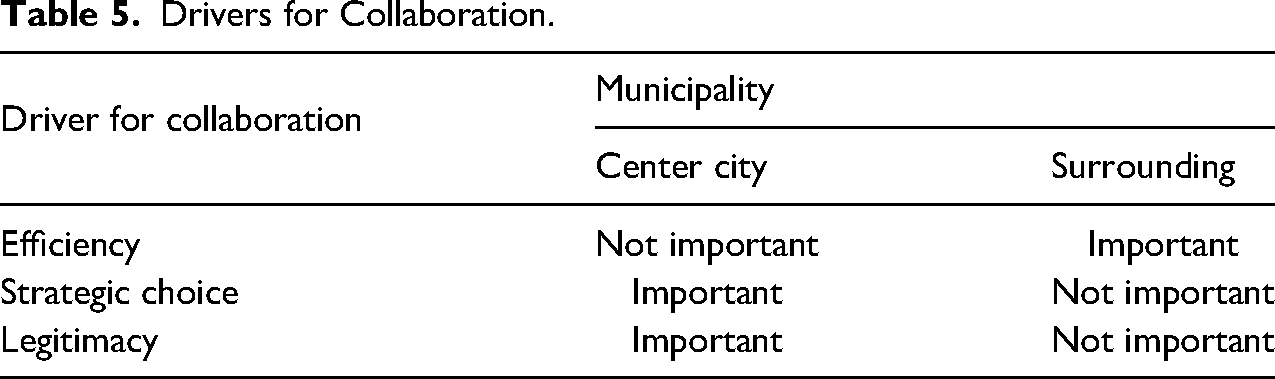
The empirical findings indicate that our first proposition, that achieving lower costs and higher quality in services will dominate the motivation for collaboration in neighboring municipalities but will be less important in the metropolitan municipalities, is supported by our analyses. Our second proposition; that motives for collaboration linked to strategic choice will be considered most important in the metropolitan municipalities and less important in neighboring municipalities is also corroborated. The third proposition; that motives for collaboration linked to institutional pressure will be considered important for both metropolitan and neighboring municipalities is only partially corroborated. Surrounding municipalities do not experience pressure from the environments toward cooperation. They do it because they need to access resources, and not to help neighboring municipalities. Metropolitan municipalities experience pressure from both surrounding municipalities and central government for taking on the role as hub of shared service delivery, while surrounding municipalities do not express the experience of pressure toward cooperation directed at themselves. They do on the other hand express expectations of being included in cooperations with the metropolitan municipalities.
The answer to the two initial research questions is thus that: metropolitan and neighboring municipalities differ in their motivation to collaborate. While neighboring municipalities engage in shared service delivery to increase performance at the service level, metropolitan municipalities collaborate to reach strategic goals and adapt to institutionalized environments. For small municipalities, quality and costs are the most important motives, while this is not a driver for larger municipalities. For the large municipalities, shared service delivery is rather a mean for securing regional leadership to comply with external institutional pressure, and for this, they may even be willing to accept higher costs associated with service production and provision than they could have achieved by providing the services alone. Metropolitan municipalities thus engage in shared service delivery to reach goals that lie outside the actual service. The findings from this study corroborate much research within interorganizational relations in stating that motives for entering a collaborative arrangement differ across participants (Schmidt and Kochan 1977; Oliver 1990).
These findings have implications for both practice and research. Motives for participating in interorganizational relations constitute a key element in understanding what constitutes a benefit for participating actors. Depending on theoretical tradition motivation constitutes “starting conditions” (Ansell and Gash 2008), “contextual elements” (Kim et al. 2022), or “initial conditions” (Bryson, Crosby and Stone 2015) for any collaboration. The finding showing that basic motives may differ between actors even in the same type of collaboration can have important implications for our understanding of goals of collaboration in service delivery. Research on intermunicipal service production and provision should consider that municipalities engage in cooperation with mixed motives, in our case depending on whether they are metropolitan (larger) or a neighbor (smaller). These findings illustrate that shared service delivery would benefit from being studied on broader premises than just measuring performance at the individual service level. This notion contrasts literature on interorganizational service delivery who focus on effects as narrow outputs or products, and their cost and quality at the service level (Klijn 2008). Few studies of intermunicipal service production and provision consider that some actors participate for strategic reasons, for instance increasing interdependence in a region or gaining access to resources. Equally as few studies explicitly confront the possibility that gaining legitimacy is considered an important benefit, and that participation in a collaboration may have a symbolic rather than a purely economic or instrumental character (exceptions are Jacobsen 2015; Elston and Bel 2023). When studying the “success or failure” of collaborative service provision, other effects besides performance at the service level should be considered (Provan and Milward 1995; Provan and Kenis 2008; Kenis and Provan 2009). This study advocates that positive and negative effects of collaboration on both strategic factors and legitimacy should be included in the equation before concluding whether a specific collaborative endeavor is successful or not.
The findings in this study also have implications for practitioners. First, municipal actors should be aware that it may be difficult to obtain a common understanding of the mutual gains of the collaboration because motives for participating differ (Vangen and Huxham 2012). Such lack of a shared understanding may complicate collaborative processes, increase possibilities for conflicts, and—more generally—lead to higher transaction costs as handling conflicts will incur costs associated with bargaining, monitoring, and conflict resolution (Brown and Potoski 2003; Shrestha and Feiock 2011). Second, the findings from this study also nuance our understanding of power imbalances in collaborative arrangements. In IMC, size asymmetry is often forwarded as one of the main obstacles to obtain an equal cooperative climate as large municipalities may use their superior resources to impose their preferred solutions on the smaller collaborating municipalities (Jacobsen 2013, 2017). This study, however, shows that smaller municipalities also may have power over the large ones. On some services, smaller neighboring municipalities control resources of vital interest to the metropolitan center, in our case confined to water supply and sewage management. Furthermore, for a metropolitan region to attain external influence they must show internal cohesion and unity. If smaller surrounding municipalities leave the collaboration, they may inflict great possible damage on the large municipality's role as a regional leader. This ties in with the debate on New Regionalism and metropolitan governance, which stresses the importance of horizontal networks for reducing disparities between the central cities and the suburbs (H. Savitch and Vogel 2009, 112). Showing successful intergovernmental relations to promote equality in life standards for inhabitants in a region may unlock both resources and increased autonomy from central government (Savitch and Vogel 2000).
Managers of collaborative arrangements should be aware the possibility that actors participate based on very different motives and perspectives. Used in a constructive way, this should be presented as a positive element, something that provides the collaboration with a broader basis than just improving quality or reducing costs. Furthermore, managers can use the insights connected to different motives to strengthen the perception of interdependence between the actors, which may have a positive effect on commitment to the collaboration (see for instance Gulati and Singh 1998; Raveendran, Silvestri and Gulati 2020). The findings also advocate the notion that actors possess different types of power (Pfeffer 1992). Managers should identify the different power bases of partners in the cooperation, and use this insight into mitigating conflicts, conducting negotiations, and facilitating collective decisions.
This study provides new empirical ground to the dynamics of cooperation between municipalities in urban areas. It also illustrates the notion that interorganizational relationships should be considered a mixed-motive situation where what is considered as main goals and motivation may vary between member organizations. It also contributes with qualitative in-depth perspectives in a research field that has been largely quantitative oriented (Bel and Sebo 2021).
This study, however, also comes with several limitations. One is that we rely on information about “municipality motives” collected from a few informants from each municipality. The data material consists of top managers’ perspectives of why their own municipality engages in shared service delivery. The analyses thus place itself only at the top level of municipal administration, consequently excluding perspectives of both lower tier professionals and politicians. Second, the study analyzes the relationship between metropolitan and bordering municipalities and does not provide information about the municipalities that does not share borders with metropolitan municipalities. Further investigation in these types of municipalities and informants could display other dynamics and provide avenues for future research. Third, our findings are limited to the Norwegian context. Even though we argue that this context is a fruitful one for studying motives for engaging in collaborations as entering a collaborative arrangement is formally voluntary, it is an empirical question whether the findings in this study will hold validity in other national contexts.
In more theoretical terms, this study has addressed the role of asymmetry in cooperative arrangements. Asymmetry as an antecedent has been central to studies of international relations and alliances (Morrow 1991), strategic alliances between organizations (Bastl, Johnson and Choi 2013), regional studies and urban politics (Vinokurov and Libman 2017), and collaborative governance (Ansell and Gash 2008). However, it has not gained much attention in studies of IMC (Kim et al. 2022). By examining the difference between metropolitan and neighbor municipalities we study size asymmetries, a concept that often translates into measures of power imbalances and interdependence (Pfeffer and Salancik 1978). Treating larger participants as inherently more powerful than smaller ones is almost instinctual. However, this study introduces nuance to this idea by demonstrating that smaller participants also wield power over larger ones due to their control over essential resources. It thus sheds light on the dynamics of “power games,” and how they affect collaborative processes. The phenomenon of asymmetry may be expanded beyond size, to dimensions like economic, political, and historical differences. These are all contextual elements in which cooperative efforts take place (Bryson, Crosby and Stone 2015) and may provide fruitful avenues for future research.
Footnotes
Declaration of Conflicting Interests
The authors declared no potential conflicts of interest with respect to the research, authorship, and/or publication of this article.
Funding
The authors received no financial support for the research, authorship, and/or publication of this article.
