




Abstract
Metropolitan reforms, which include the creation of unified metropolitan governments through municipal mergers and reclassification, are emerging as one strategy to address planning and service delivery challenges in the wake of increasing urbanisation across sub-Saharan Africa. Although metropolitanisation adds service area and mandates, well-functioning secondary cities that are part of a two-tier governance system in South Africa are pursuing metropolitanisation. The case of Mangaung, an early instance of secondary city metropolitanisation, is an opportunity to examine the motivations underlying these reforms, the politics involved and their impacts on urban governance. Mangaung’s political and administrative leadership pursued metropolitanisation to jump scale, attain greater political autonomy vis-à-vis other tiers of government, and obtain fiscal and technical resources available only to metropolitan municipalities in South Africa’s urban municipal hierarchy. Metropolitanisation was no panacea for Mangaung’s governance challenges, however, since it did not resolve the underlying weaknesses in municipal capacity or the regional economy, nor did it address the spatial legacies of apartheid that produced a sprawling metropolitan service area. As other South African secondary cities contemplate metropolitanisation, we recommend revising municipal structures and mandates and strengthening administrative capacities and economies in secondary cities.
Introduction
Increasing urbanisation in sub-Saharan Africa poses many development challenges. Urbanising later than regions in North America and Europe or even parts of the Global South makes these challenges and opportunities unique (Fox and Goodfellow, 2021). Many African countries are reconfiguring urban governance, including the structure and boundaries of local governments and intergovernmental relations, to respond to these challenges (Resnick, 2021). Metropolitan reforms, often entailing territorial reorganisation and the reallocation of national and provincial powers and functions to urban governments, have emerged as one major strategy to transform urban governance in Africa. Although processes governing boundary changes and transformations in intergovernmental relations are similar in North America and Europe, the motivations underlying metropolitan reforms, their constituent politics, and resultant impacts on urban governance differ considerably in sub-Saharan Africa. They equally vary by national and subnational context across sub-Saharan Africa.
Speaking to an emerging literature on the politics of metropolitan reforms in urban Africa (Beall et al., 2015; Goodfellow, 2010; Gore and Gopakumar, 2015), this empirical account of metropolitan reforms in Mangaung, a secondary city in South Africa, enriches narratives on African urbanism. Metropolitan reforms, which integrate cities with their regions through territorial reorganisation to create single-tier local governments, were central to the goal of redressing socio-spatial apartheid in post-apartheid South Africa. In 2001, six metropolitan municipalities (Cape Town, Ekurhuleni, eThekwini, Johannesburg, Nelson Mandela Bay and Tshwane) were established in South Africa. However, in 2011, two secondary cities, Buffalo City and Mangaung, joined this group (see Figure 1), and since then, other secondary cities have vigorously pursued metropolitan reforms (Mkhize, 2021). Metropolitanisation creates substantial service delivery challenges, especially when relatively weak South African local governments are tasked with coordinating administration across multiple nodes and competing needs in sprawling and rapidly growing city-regions (Beall et al., 2015). Despite these administrative challenges, well-functioning secondary city municipalities that are part of a two-tier governance system are pursuing metropolitanisation. The case of Mangaung, one of the first secondary cities to navigate the process of metropolitanisation in South Africa, offers an opportunity to answer the following questions: Why do leaders of secondary cities pursue metropolitan reforms, even as they increase service area and delivery obligations? What are the politics animating these reform processes in secondary cities? And what are the impacts of metropolitan reforms on urban governance in secondary city-regions?
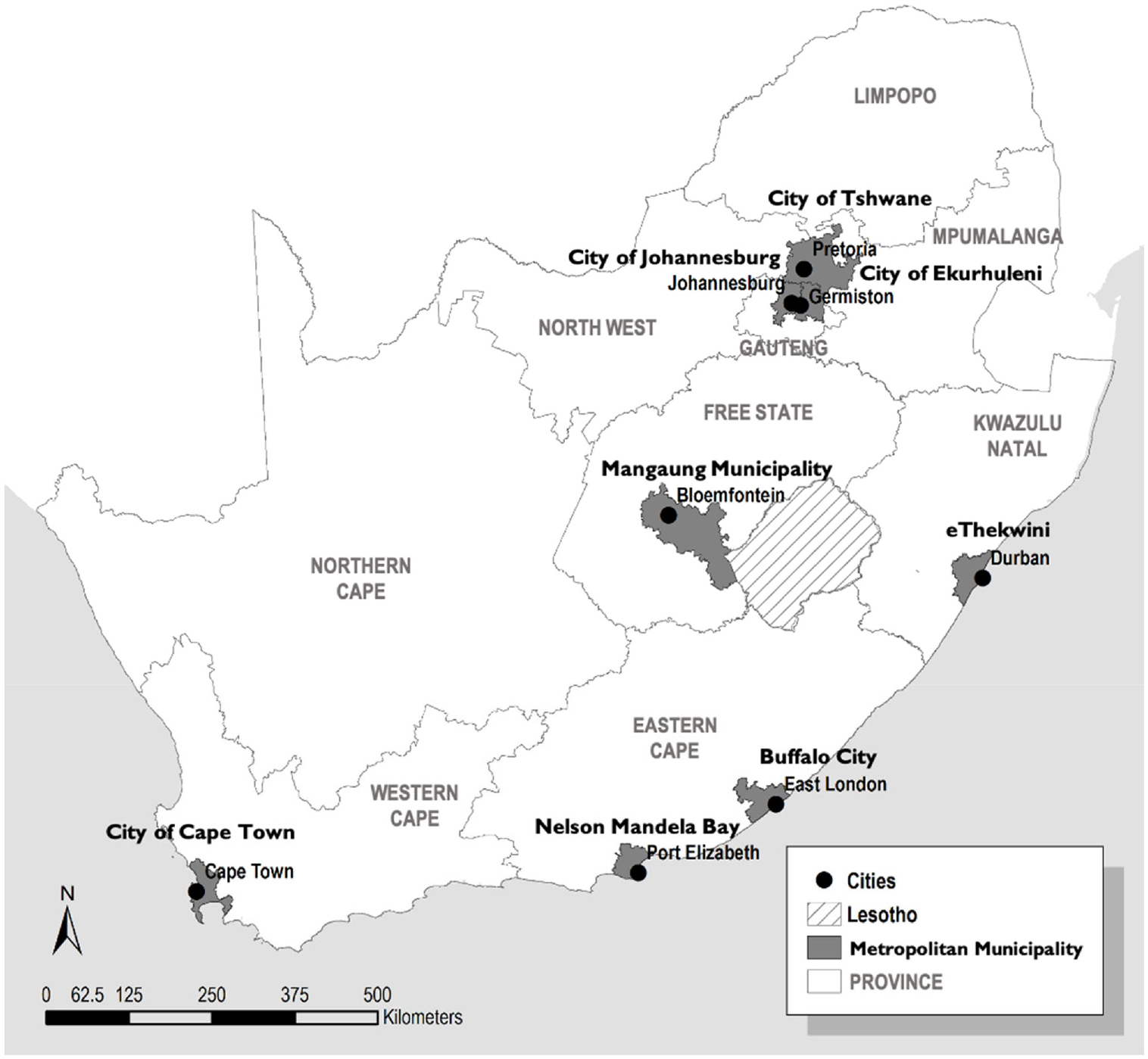
Metropolitan municipalities in South Africa, 2016.
The case of Mangaung suggests that leaders of fast-urbanising secondary cities in countries like South Africa – where urban local governments have differential powers, mandates and functions depending on their size and position in urban political-economic hierarchies – have an incentive to pursue metropolitan reforms. They do so to transform intergovernmental relations, access additional development funds and technical support to improve service delivery, elevate the city-region’s status and improve its competitiveness. However, though relatively uncontested, metropolitanisation is no panacea for improving urban administration or service delivery. It does not address the underlying economic or capacity issues and the spatial legacies of apartheid that complicate governance in these secondary cities. Ironically, metropolitan reforms exacerbated Mangaung’s financial and administrative challenges. As other secondary cities across South Africa and the sub-continent contemplate metropolitanisation and local government restructuring to address the challenges and seize the opportunities presented by increasing urbanisation, Mangaung offers a cautionary tale.
To investigate metropolitan reforms in Mangaung, we conducted in-depth, semi-structured interviews and analysed various documents such as news reports and municipal planning documents. We interviewed 25 purposively sampled key informants in January 2018: four current and former members of South Africa’s Municipal Demarcation Board ; a representative from the National Treasury; six municipal officials and councillors involved in the metropolitanisation process; eight municipal planners and planning consultants who work for the municipality; three businesspeople from local chambers of commerce; and three academics who consult for local governments in South Africa. The businesspeople addressed whether and how elite economic concerns shaped the metropolitanisation process, and the academics addressed the political-economic context of municipal demarcations in South African cities. The authors jointly conducted the interviews, and each interview lasted between 30 minutes and two and a half hours (for a list of cited interviews see Appendix). We also analysed local news articles in English and Afrikaans from 2003 to 2011, when Mangaung was reclassified a metropolitan municipality (or ‘metro’ in this paper), to gain additional insights into the discourses and processes employed in metropolitanisation. The data from interviews, documents and secondary sources were collectively coded and analysed to trace the motives for (and against) metropolitanisation, the challenges and politics involved and the ensuing impacts on governance.
After reviewing the literature on metropolitan reforms to situate Manguang in the African context, we detail the evolution of metropolitan reforms in post-apartheid South Africa to interrogate the basis of recent metropolitan reforms in secondary cities. The article then focuses on the politics and process of metropolitan reform in Mangaung, highlighting how the secondary city context shapes the metropolitanisation process and its impacts. We conclude with recommendations for alternative reform strategies to deal with secondary cities’ particular needs.
Metropolitan reforms and urban governance
Like their counterparts in the Global North, leaders of African cities have pursued metropolitan reforms for various technical-administrative and political reasons. Metropolitan reforms entail the reorganisation of municipal boundaries, reclassification of municipal government categories and the creation of special purpose or single-tier metropolitan governments.
Globally, proponents of unified metropolitan governments argue that they are functionally efficient since they result in scale economies, produce cost savings in service delivery, reduce administrative duplication and allow for bureaucratic specialisation to deliver a wider array of services (Ebinger et al., 2019; Reese, 2004; Slack and Bird, 2013). They further claim that the creation of metropolitan governments enables integrated and coordinated regional planning to maintain economic competitiveness (Boudreau et al., 2007; Brenner, 2003; D’Albergo and Lefèvre, 2018; Tomàs, 2012), manage growth (Purcell, 2001) and reduce sprawl (Laquian, 2005). Opponents of metropolitan reforms argue that large service areas diminish citizen voice compared with more proximate governance structures (Devas, 2005; Slack and Bird, 2013); that there is little evidence of administrative efficiency or cost savings (Tavares, 2018; Vojnovic, 2000); that government restructuring undermines marginal socio-cultural identities (Hamilton, 2000; Terlouw, 2016) and allows certain political-economic interests to dominate development agendas, as documented in metropolitan reform in the Greater Toronto Area (Boudreau et al., 2007; Savitch and Vogel, 2004). Lastly, opponents argue that service delivery and planning functions can be realised through intermunicipal cooperation, hybrid systems of service delivery or the design of special purpose governments that do not dilute citizen voice (Warner, 2013). The global evidence showing the technical-administrative benefits of metropolitan reforms is thus mixed. Despite this, many African countries have pursued metropolitan reforms following the adoption of decentralisation reforms. They have reorganised the boundaries of metropolitan governments and restructured intergovernmental relations for various reasons. For example, the goal of achieving fiscal equity through a common tax base, where taxes were redistributed from white urban cores to functionally linked black townships, guided the first wave of metropolitan reform and municipal boundary demarcations in post-apartheid South Africa (Cameron, 2006).
The Ugandan and Kenyan national governments created autonomous metropolitan governments in their respective capital cities – Kampala and Nairobi – to improve service delivery and foster infrastructure development across the city-region. However, they additionally sought to have greater national oversight of urban affairs. National leaders used reforms to curtail mayoral powers and prevent opposition party mayors from using the city as a launching pad for the national political stage (Gore and Gopakumar, 2015; Gore and Muwanga, 2014; Resnick, 2021). They justified these special government structures by noting that these capital cities bore a higher share of the service burdens in their countries and were struggling to provide services independently. Similarly, in Canada, provincial governments have used metropolitan reorganisation to control vertical intergovernmental relations between the province and city and horizontal relations between the city and suburbs (Boudreau et al., 2007; Tomàs, 2012).
These political attempts at restructuring intergovernmental relations in African cities through metropolitan reforms have faced resistance. Leaders of local municipalities (and kingdoms) in Kampala have contested these metropolitan reforms to avoid ceding their political autonomy, power and resources to the newly created metropolitan authority (Goodfellow, 2010; Gore and Muwanga, 2014). National governments have nevertheless exercised their power and proceeded with metropolitan reforms. These cases from sub-Saharan Africa illustrate how metropolitan reforms operate differently in the Global South, where local governments do not have the same degree of political autonomy or administrative capacity as North American cities. However, the extant African literature on metropolitan reforms is restricted to capital cities and countries characterised by a high degree of urban primacy, where different political-economic elites seek to control the primary city. South Africa, however, is among a handful of African countries where the urban population and political power are distributed in multiple urban centres of varying sizes (Resnick, 2021). South Africa is also unique because municipal governments are constitutionally recognised as an autonomous sphere of government alongside national and provincial governments, with metropolitan municipalities possessing a higher degree of autonomy from their provinces in matters of land use planning, housing, transport and healthcare (Steytler, 2017). Therefore, understanding how and why leaders of South African city governments pursue metropolitan reforms can illuminate whether metropolitanisation is a viable strategy for addressing urban challenges across urban Africa.
The scholarship on metropolitan governance in South Africa has examined the tensions and planning challenges that integrating cities with their peri-urban regions pose (e.g. Beall et al., 2015). However, there has been little discussion of how the practices for integrated city-regional governance, including boundary reorganisation, differ (or not) in smaller, secondary cities, which house 27% of the South African population (SACN, 2021). Although secondary cities possess different powers and mandates than metropolitan cities, they nevertheless confront similar service delivery challenges, but with considerably lower governance capacity. Mangaung demonstrates that leaders of secondary cities thus have an incentive to transform intergovernmental relations, gain access to greater fiscal support from the national government, attain greater political autonomy vis-à-vis regional government structures and get prioritised in national policies. Similar dynamics of municipal reform have been documented in secondary cities and small towns in other large urbanising countries characterised by an unequal distribution of powers and resources across municipal categories, like China (He et al., 2018; Wang and Yeh, 2020) and India (Subramanyam, 2021; van Duijne, 2019), but they are yet to be analysed in South Africa (exceptions include Pieterse, 2021). Mangaung, an early case of metropolitanisation in a secondary city, provides evidence of how the process unfolded, the politics involved and the subsequent impacts on urban governance.
Metropolitan governance inpost-apartheid South Africa
In 1998, the South African Constitution created an independent institution called the Municipal Demarcation Board (MDB) to develop sound criteria for demarcating municipal government boundaries and categorising municipalities. The MDB consists of between seven and fifteen presidentially appointed board members with professional or academic expertise relevant to municipal demarcation who serve five-year terms. Though independent, the Board works closely with the national Department of Cooperative Government and Traditional Affairs (CoGTA), local governments and provincial executive councils while conducting studies or making decisions about boundary or category changes (Mkhize, 2021). The Board has frequently been accused of succumbing to political interference or protests (Mkhize, 2021).
The first MDB had to choose between three ways of demarcating the boundaries of municipalities: a functional approach based on service provision; a socio-economic approach based on daily commuting patterns and an institutional approach based on the administrative and financial capabilities of local government. It intentionally chose to demarcate municipalities based on socio-economic links between interdependent urban-white and rural-black settlements such as employment, spending, amenity usage and commuting patterns to allow for integrated planning and the redistribution of resources (Interview 1; Cameron, 2006). This approach created trade-offs between redressing socio-spatial apartheid and creating administratively viable government structures, which continue to impact municipal governance across all municipal categories.
The Municipal Structures Act (no. 117 of 1998) categorises the country’s 284 municipalities as metropolitan (Category A), local municipality (Category B) and district municipality (Category C), each with different powers, administrative and fiscal resources and mandates. Category A municipalities are single-tier, governing metropolitan regions, with exclusive executive and legislative authority over their municipal area. The ruling party, the African National Congress (ANC), consciously decided to create single-tier governments in metropolitan regions because they felt that two-tier governments would result in fragmented governance, thus reproducing spatial apartheid. The ANC argued that fragmentation would prevent metro-wide planning and redistribution, reducing the economic competitiveness of major metropolitan regions. In practice, this has meant reconciling several competing rationalities and visions in service of the unified city-region (Beall et al., 2015). Category B municipalities are part of a two-tier system. They govern the remaining non-metropolitan towns and cities, including secondary cities and their functionally linked rural hinterland, sharing authority and responsibilities with the district municipality (Category C) under which they fall. Category C municipalities coordinate governance across multiple constituent Category B municipalities. The political leadership created two-tier governments in small cities, towns and rural areas so that districts could handle complex functions like planning and health that incipient local governments would struggle to execute alone (Cameron, 2006).
Of the three categories, Category B is further subdivided to differentiate between the 226 municipalities in this group. Secondary cities form a subset called ‘B1 municipalities’, distinguished by their smaller population size, budget, economic output and more recently, economic function (Marais et al., 2019). For example, the current list subdivides secondary cities into five subcategories: large and semi-diverse, manufacturing, mining, service centre and low Gross Value-Added high population density cities. Like secondary cities in other countries, South African secondary cities also occupy a secondary position in the urban municipal hierarchy. They have less political influence than metros and have historically been neglected by higher tiers of government (Bell and Jayne, 2006; Marais et al., 2016a). The number of secondary city municipalities (B1 category) has increased from 21 in 2011 to 39 in 2018 due to the launch of the Intermediate City Municipalities programme by CoGTA. Mangaung municipality was initially a part of this B1 group until it was recategorised as metropolitan (Category A) in 2011.
The creation of an exclusive category of metropolitan municipalities with definitions of metropolitan areas that are open to interpretation has spurred the pursuit of metropolitan reform in South African secondary cities. The Municipal Structures Act defines metropolitan areas as polycentric conurbations with high population density, complex and diverse economies with multiple business districts, extensive development and strong socio-economic links between the constituent settlements. Being single-tier governments, these metros have not only political autonomy from the district but also access to a separate stream of infrastructure development funds from the National Treasury that does not require provincial approval. For example, the South African National Treasury provides a separate set of grants called the Urban Settlement Development Grant (USDG) to metropolitan municipalities because they concentrate most of the urban population and employment and generate nearly 70% of the country’s GDP. Unlike the Municipal Infrastructure Grants that secondary cities and other local municipalities receive, the USDG does not require provincial approval. In exchange, metros prepare a Built Environment Performance Plan (BEPP) (Interview 2).
In 2001, the MDB created six metropolitan (Category A) municipalities: Cape Town, Ekurhuleni (East Rand), eThekwini (Durban), Greater Johannesburg, Tshwane (Pretoria) and Nelson Mandela Bay (Port Elizabeth). The inclusion of Port Elizabeth, which was relatively smaller in population, in this inaugural list of metros, questioned the ambit of the metropolitan criteria. Subsequently, cities with similar populations demanded inclusion in the exclusive metropolitan club (Interview 1). This, in turn, created a distinct, but informal, municipal category called ‘aspiring metros’, which included city-regions like Mangaung, Buffalo City (East London) and Msunduzi (Pietermaritzburg) that had some characteristics of metropolitan areas but did not meet the prevailing legislative criteria for a metropolitan (Category A) municipality (Cameron, 2006). The label ‘aspiring metro’ kick-started the process of metropolitanisation in these cities. It incentivised these cities to attain the metropolitan criteria and apply for an upgrade to metropolitan status (Interview 3). Since the criteria for what constitutes a ‘metropolitan’ area are open to interpretation, urban political actors in secondary cities and aspirant metros like Mangaung have considerable scope to make their case for reclassification. In interviews, MDB members also noted that the criteria defining metropolitan areas are abstract and lack corresponding measurable indicators that municipalities and ministers can use to self-determine if they qualify for metro status (Interview 3). Mangaung’s leadership, when confronted with financial and administrative difficulties, leveraged these vague criteria to demand recategorisation to metro status.
Making Mangaung Metro
Mangaung municipality, 2001
Mangaung Municipality was established in 2001 as part of the MDB’s ‘wall-to-wall’ demarcation of municipalities across post-apartheid South Africa. It consisted of the main white urban area, Bloemfontein, and the black township of Botshabelo (located 55 km east of Bloemfontein) and the ethnic Tswana town of Thaba Nchu (located 12 km east of Botshabelo) (Marais, 2008). Bloemfontein houses more than half the municipal population, Botshabelo about 30% and Thaba Nchu about 15% (Marais et al., 2016b).
Bloemfontein evolved as a regional community and financial services centre and marketplace for the surrounding farming communities. Given its centrality in the region, it has been the administrative capital of successive subnational governments since 1848: the Orange Free State (OFS) Republic, 1848–1902; the Orange River Colony, 1902–1910 and the OFS Province, 1910–1994, which was renamed the Free State in 1994 (Marais and Twala, 2021). Mangaung’s economy depends on its provincial capital status and its role as a regional service provider for small towns in central South Africa and neighbouring Lesotho. It is an important provincial city that contributes about 31% to the provincial output (Global Insight, 2019). Despite this, its population, population density and economy are substantially smaller than South Africa’s largest metros (see Supplemental Material).
The demarcation of Mangaung Municipality through the merger of Bloemfontein, Botshabelo and Thaba Nchu was in line with the prevailing nationwide demand for ‘one city, one tax base’. It recognised the socio-economic links between these centres and allowed for the redistribution of taxes and capital investments over the integrated region through coordinated planning (Marais et al., 2016b). When established, Mangaung was a Category B municipality that was part of the Motheo District Municipality (Category C) (see Figure 2). This two-tiered municipal structure allowed for the redistribution of taxes and administrative resources from Mangaung, which housed 90% of Motheo’s population, to the small municipalities of Naledi and Mantsopa in Motheo District (see Figure 2), until the reclassification of Mangaung in 2011.
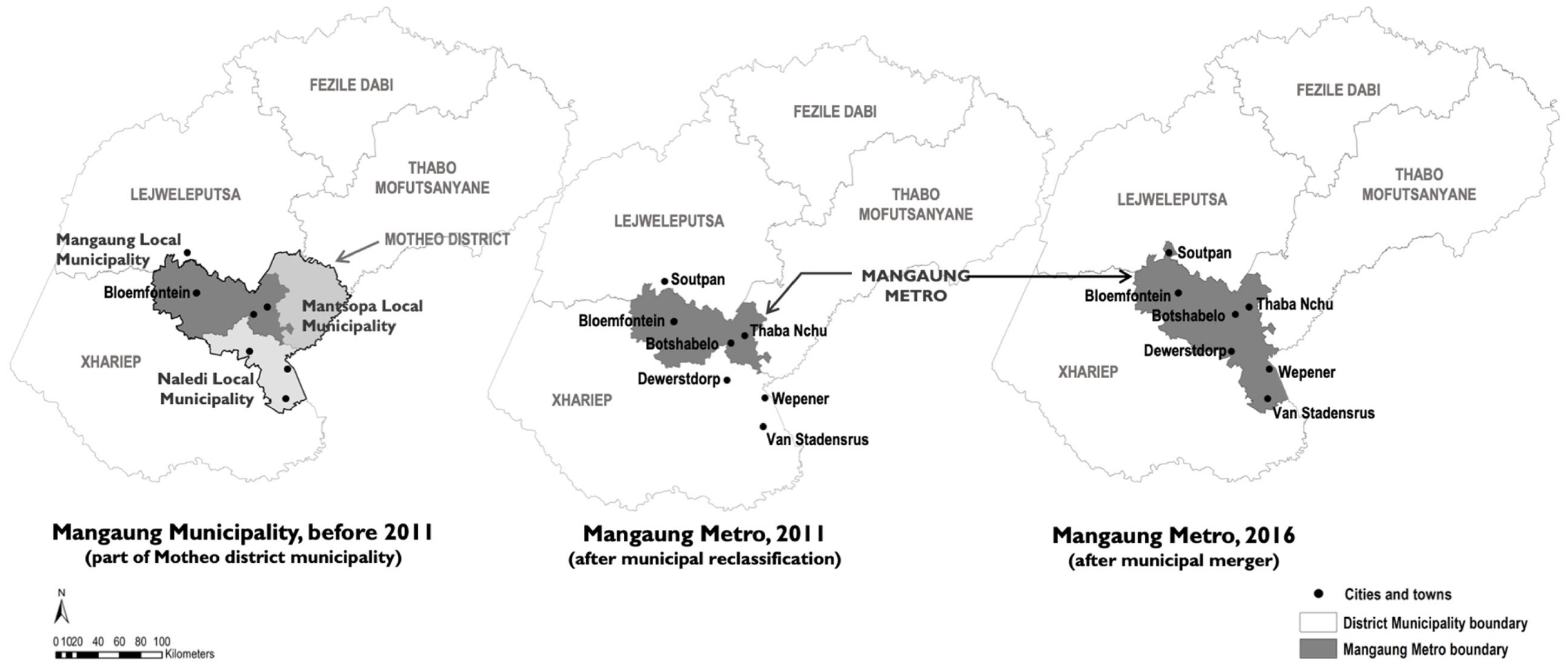
Evolution in Mangaung municipality boundaries from 2001 to 2016.
Mangaung Metropolitan Municipality, 2011
Since earning the moniker ‘aspirant metro’ in 2001, Mangaung’s political and administrative leadership pursued processes that would lead to municipal reclassification as a metropolitan (Category A) municipality. Their efforts gained momentum in 2005–2006 when the city submitted a bid to host matches for the 2010 FIFA World Cup. They planned to use the infrastructure development funds that they would receive for the World Cup to clear service delivery backlogs and demonstrate that their governance ability was on par with the large metros. The ANC-led municipal council also voted to incorporate two neighbouring small towns, Soutpan and Verkeerdevlei, which were then in a different district municipality, to attain the population and income thresholds required to qualify for metro status. Council members from the opposition party, the Democratic Alliance (DA), fiercely opposed this decision.
The ANC’s main motivations for pursuing metropolitanisation were to attract investments and jobs to Mangaung, improve service delivery and reduce crime. Municipal councillors and officials also championed metropolitanisation as it would increase their salaries; metro pay scales were considerably higher. To make their case, Mangaung officials argued they were already performing metro- or district-level functions despite being a Category B municipality (Interview 4). The MDB weighed this in Mangaung’s favour (Brits, 2008). Political leaders in Mangaung also wanted to avoid sharing executive and legislative authority with the mayor of the Motheo District (Category C) municipality and jostling with the other Category B municipalities in their district for political influence over or resources from the district (Interview 1). More recently, leaders of other South African secondary cities have provided similar reasons for seeking metro status (Mkhize, 2021; Pieterse, 2021). One municipal official from Mangaung explained the benefits of metro status saying: There was prestige involved, but it was secondary. The primary issue was, how do we sustain the city into the future? How do we entice people to come and invest in Mangaung? ... [B]ig firms are more likely to invest in a municipality where they know there’s an interest from National Treasury – and that is typically a metropolitan municipality. This is just unfortunately how it works. And we’re still competing with other metropolitan municipalities today to bring investment to Mangaung. I think financial sustainability was our main driver. We had this pressure, and we also knew that it would be easier to market Mangaung as a metropolitan municipality than as a local municipality. ... [W]hen we’re competing against metropolitan municipalities for the very same resources, we’re at a disadvantage if we stay as a local municipality. (Interview 2)
At this time, Mangaung Municipality also confronted fiscal challenges prompting its quest for metro status. In 2006, the municipality lost about 9% of its revenues when the National Treasury abolished the regional services council levies (Joffe, 2007). Municipal officials had to look to alternative sources of municipal finance to support demographic growth in the face of stabilising or deteriorating fiscal, economic and employment conditions (Interview 2). They felt that being reclassified as a metro could help them access the separate stream of funds that the National Treasury has set aside for metropolitan municipalities.
Not all stakeholders were enthusiastic about Mangaung’s metropolitanisation. DA councillors opposed Mangaung’s metropolitanisation proposal, which included the incorporation of debt-ridden small towns to reach the MDB’s unstated population threshold for a metro. They felt that metro status and the proposed merger would unnecessarily increase the municipality’s salary bill. They also rightly foresaw that the creation of Mangaung Metro would lead to the dissolution of Motheo District, adding additional service area, staff and therefore costs to Mangaung (Ons Stad, 2008). They argued that the scale of cross-subsidisation required in the Metro, where taxpaying residents support a mostly indigent population, would be unsustainable without a major economic overhaul (Interviews 5 and 6). ANC councillors argued that the residents of Naledi and Mantsopa, small towns in Motheo District, depended on Mangaung for jobs as well as financial resources and services they received through regional redistribution under the two-tier municipal system and were thus functionally a part of the region that would become Mangaung Metro (Interview 7). They insisted that the reclassification of Mangaung would result in the remaining unincorporated portion of Motheo District becoming administratively unviable on its own, thereby justifying a redrawing of Mangaung’s boundaries (Gericke, 2006). The councillors and staff in these small towns also welcomed the merger to get a salary raise (Dlodlo, 2006).
The Free State provincial government initially supported Mangaung’s metropolitanisation as it was politically prestigious for the province to have a metro as its capital. As soon as the MDB announced Mangaung’s reclassification, however, certain provincial ANC factions opposed metropolitanisation and the inevitable dissolution of Motheo District, fearing they would lose their power in the countryside (Dlodlo, 2010) and that Metro politicians, by virtue of their salary increase, would become their equals (Gericke, 2010). Eventually, the party resolved these conflicts by selecting the provincial premier’s ally to become the executive mayor for the new Metro (Gericke, 2011a).
In 2009, the MDB declared that Mangaung would be a metropolitan municipality (Category A) after the municipal elections in 2011. In making its determination, the MDB noted that Mangaung had sufficient provincial importance and the ability to execute district-level mandates. It also observed that Mangaung lacked the multiple urban cores or density that characterised other metros. Nevertheless, it decided to proceed with metropolitanisation (Interview 1). The MDB, however, reclassified Mangaung without extending its boundaries. They did not want to create a metropolitan municipality with a relatively small economic base and population but a massive service area (Interview 1). As a result of Mangaung’s reclassification, the MDB dissolved Motheo District, adding Naledi to Xhariep District Municipality and Mantsopa to Thabo Mofutsanyane District (see Figure 2). About 90 staff from Motheo were transferred to Mangaung, and the Metro also inherited about 20% of Motheo’s funds (Gericke, 2011c).
Motivating Mangaung’s pursuit of metropolitanisation was a desire to overcome the fiscal and economic disadvantages of being a secondary city and to access funds and political autonomy only available to metros in South Africa’s municipal governance system. Indeed, when Mangaung became a metro, its annual Treasury allocations increased from R240m to nearly R600m (Interview 2). 1 However, Mangaung Metro’s residents also experienced about a 10% increase in tariffs on municipal services (Gericke, 2011b).
Extending Mangaung Metropolitan Municipality’s boundaries, 2016
After 2011, the focus of municipal demarcations in South Africa had shifted from addressing the legacy of apartheid and achieving social justice to creating functional, financially viable municipalities capable of executing their service delivery mandates (Ncube and Monnakgotla, 2017). Under the Back-to-Basics programme, which was introduced in 2014, the National Ministry of Cooperative Governance and Traditional Affairs advocated rescuing dysfunctional, financially weak, debt-ridden small municipalities by merging them with their nearest functional municipality (Ncube and Monnakgotla, 2017). They did so to consolidate management-level positions and achieve cost savings for the National Treasury. This wave of municipal restructuring affected Mangaung Metro.
Based on studies, the MDB merged Naledi Local Municipality (a Category B municipality that includes the small towns of Wepener, Dewetsdorp and Vanstadensrus) and the small town of Soutpan in Masilonyana Local Municipality in Lejweleputsa District with Mangaung Metro to save them from insolvency (see Figure 2). This merger added 3500 km2 and 75,000 residents (of whom approximately 30,000 were living below the poverty line) to Mangaung. It restored some of the regional economic interrelationships between Mangaung and these small towns that had existed prior to Mangaung’s reclassification and Motheo District’s dissolution. The merging of small towns brought significant backlogs in services but didn’t contribute proportionately to Mangaung Metro’s coffers.
Compared with other cases of municipal restructuring in South Africa from this period, the merger of Naledi and Soutpan with Mangaung Metro was relatively uncontested. For instance, in the highly urbanised and developed Gauteng province, opposition parties have resisted the creation of metropolitan municipalities through municipal mergers in secondary cities like Randfontein and Emfuleni. They have argued that the merger of debt-ridden municipalities with well-administered municipalities would merely scale up administrative issues rather than address them, resulting in unviable metropolitan governments. Additionally, they viewed it as political opportunism and a gerrymandering ploy by the incumbent ANC to retain power (Mkhize, 2021; Pieterse, 2021).
Arguments against mergers have also been made in rural areas, including in Limpopo province (Kanyane et al., 2021). Protests have also originated in areas targetted for incorporation into another entity. For example, residents of Vuwani in Limpopo province opposed merging with Collins Chabane Local Municipality because it was dominated by another ethnic group. They were also concerned that the merger would result in municipal offices being located further away, impacting the quality of services (Netswera and Nealer, 2020). The councillors and residents of Naledi and Soutpan, by comparison, welcomed the merger because they thought they would benefit from Mangaung’s economy, planning capacity and financial muscle and enjoy ‘metro-quality’ services and salaries. DA councillors in Mangaung Metro opposed the merger since the merging municipalities were small, nearly bankrupt and had many service backlogs and a small tax base (Interview 8). Additionally, Mangaung had to repay the R4.6m debt that Naledi owed the electric utility, Eskom (Mkhwanazi, 2015). The provincial government supported the merger as it was projected to create R39m in savings for the Free State government. Mangaung administrators noted that mergers were a convenient way for the provincial and federal governments to offload their responsibilities to struggling small municipalities onto metros like Mangaung, which themselves were grappling with new mandates and increased service delivery obligations (Interview 2). Nevertheless, the ANC-led Mangaung council accepted this merger since they had proposed it about a decade ago as part of Mangaung’s metropolitanisation.
Transitional impacts of metropolitanisation in Mangaung
Mangaung’s responsibilities increased with its metro status. As single-tier governments, South African metropolitan municipalities have additional service obligations like appointing a metro police and providing emergency ambulance services, primary healthcare, affordable housing and disaster management, which have financial implications. Mangaung also had to foot a considerably higher salary bill, and the vast expansion of the municipal service area in 2016 added to its service delivery costs.
Although Mangaung received transitional grants to address growing mandates, administrators observed that metro status created unrealistic expectations among elected councillors and their constituents, who acted like the city had access to a ‘pot of gold’ from the National Treasury. Given the vast, sprawling nature of the post-merger metropolitan area under Mangaung’s jurisdiction, 9886 km2, which was in large part a legacy of apartheid, administrators and planners doubted their ability to effectively provide integrated planning and public transport services (another metropolitan obligation) for the entire municipality (Interviews 9 and 10). For context, the next largest metropolitan municipality, Tshwane (Pretoria) with an area of 6298 km2, has nearly three times the number of employees and managers (Stats SA, 2021). One municipal official noted that Mangaung municipality was 60% rural and growing in terms of landmass rather than economic viability (Interview 2). Looking back, a member of the MDB said: ‘The reality is that we have created a rural metro. That is an oxymoron!’ (Interview 7).
Although Mangaung’s obligations and mandates have increased with metropolitanisation and the subsequent merger, its economy and GDP have not grown in tandem. It has a stable economy based largely on government, university and medical services with little short-term potential to attract manufacturing or international investments. However, the National Treasury expects Mangaung to be an engine of growth and make contributions to the national economy on par with Johannesburg, Cape Town and eThekwini (Durban).
To enhance Mangaung’s economic competitiveness, the National Treasury provides technical support through the Cities Support Programme, which is only available to metropolitan municipalities. This programme aims to help Mangaung with institutional strengthening, budgeting and intergovernmental and city-specific planning and creates spaces for Mangaung to interact with and learn from the experiences of the older metros. However, Mangaung and the older metros differ in their planning and institutional capacities. An interviewee from the Cities Support Programme noted that where the bigger metros innovate, Mangaung barely copes (Interview 11). Since the original metros have always operated as single-tier municipalities in the post-apartheid period, they have developed sophisticated, innovative systems of interdepartmental coordination for planning and service provision. In contrast, Mangaung shared responsibilities with the district in a two-tier system until its recent metropolitanisation. Post-metropolitanisation, Mangaung did not gain any specialist planners, administrators or staff with past work experiences in metros; therefore, it is yet to adopt automated systems in many spheres of governance or develop independent competencies in many areas of strategic planning and administration (cf. Ranchod, 2020).
International critiques of metropolitanisation have been borne out in Mangaung too. In addition to imposing additional administrative and fiscal burdens on Mangaung Metro, the merger also reduced political representation for the residents of the merged small towns. With the merger, the number of council seats in Naledi Local Municipality dropped from 13 to 1. The distance between the small towns in Naledi and Bloemfontein – nearly 100 km – makes life difficult for residents seeking local government services that are centralised in the city (Mbongwa, 2017). The merger has also reduced the share of the municipal fiscus for these small towns since Mangaung’s total revenues are spent and redistributed over a much bigger area (Interview 2). Consequently, the pace of upgrading to metro-quality services has slowed across the entire municipality.
By the end of 2019, Mangaung Metro’s financial situation had deteriorated, and the province subsequently appointed an administrator to oversee the Metro’s finances and steer its recovery. Mangaung’s mayor, a close ally of the provincial premier, received a vote of no confidence in 2020 (McCain, 2020), and both are currently facing corruption charges unrelated to her terms as Mangaung’s mayor (Myburgh, 2019). Although Mangaung’s metropolitanisation and the close links between the mayor and premier likely facilitated corruption and state capture, we found no concrete evidence linking the two processes. Nevertheless, metropolitanisation and alterations to municipal government structures played a part in the recent governance crisis in Mangaung because they did not address the factors underlying Mangaung’s financial and administrative challenges in the first place: the shortage of managerial skills, and capacity issues in Mangaung Metro (Marais et al., 2016b; Pieterse, 2021), widespread poverty and unemployment that prevent residents from paying for services, the practice of cadre deployment for filling municipal vacancies (Olver, 2017; Pieterse, 2021), and the legacy of spatial apartheid that has created a sprawling service area. In this context, the creation of the Metro was a quick fix; it merely scaled up and complicated issues the municipality had to address without necessarily augmenting its economic or administrative capacity to do so effectively. When combined with corrupt leadership and possible political interference from the province, it produced a mismanaged metro.
Implications and conclusion
South Africa’s transition to post-apartheid democracy in the context of neoliberalism and globalisation has exacerbated differences and deepened inequalities between the country’s metros and the rural countryside and small towns. Secondary cities like Mangaung, which lie between these two ends of the municipal spectrum, play an essential role in mediating the development of rural regions and small towns by centralising non-farm employment opportunities, amenities and government services (Christiaensen and Todo, 2014). But they do so without the political-economic powers and resources available to their metropolitan counterparts. As secondary cities assume the responsibility for providing services to growing populations in a municipal system that favours metropolitan cities, metropolitan reforms become an important vehicle to obtain additional powers and resources to fulfil expanding mandates and remain economically competitive.
The Mangaung case shows how a secondary city and its dependent rural region used metropolitanisation to jump scale and access the opportunities available only to metros. However, even as the reasons and processes for pursuing metropolitan reforms mirrored those documented in the Global North or elsewhere in Africa (Dube, 2021), our case demonstrates that Mangaung’s secondary city context and the legacies of spatial apartheid uniquely impacted these reforms and their outcomes. In Mangaung’s case, the uncritical conferral of metro status and creation of a large, single-tier municipality imposed substantial pressure on the existing municipal system geared to manage a secondary city. With a history of lower organisational, technical and fiscal capacity than the big metros, Manguang now struggles to implement new mandates for economic development, integrated planning and service provision, which require a high degree of initiative and self-management. The metropolitanisation of Mangaung did not address these underlying weaknesses pertaining to administrative capacity, and neither did it strengthen the regional economy to improve the Metro’s tax base. Our case suggests that metropolitanisation in secondary cities weakens both national policies that seek to accelerate economic growth through metros and those that hope to develop small towns and rural areas.
As other secondary cities follow Mangaung’s lead and pursue metropolitan reforms (Mkhize, 2021), we argue that it is time to revise municipal structures and categories. The policy should align these structures and categories with the distinct functions and needs of secondary cities, which are increasing in number and importance across South Africa (Marais et al., 2019). For instance, South African policymakers could consider creating a separate municipal category for secondary cities. There is considerable variation among Category B municipalities, and the current B1 categorisation is informal. Category B currently includes both prosperous secondary cities governed by healthy municipalities that are capable of delivering their mandates and very small rural towns that depend heavily on their districts (Category C municipalities) for administrative support and service provision. As several members of the MDB noted informally in interviews and scholars have noted elsewhere (Pieterse, 2021), a separate category for secondary cities will enable them to contribute to regional economic development without competing on equal footing with the large metros that carry the national economy. It will also avert scenarios where the metropolitanisation of secondary cities creates ‘leftover’ districts and rural regions that are dysfunctional and economically unviable, necessitating their merger with secondary cities.
Second, the Mangaung case also underscores the importance of strengthening municipal government systems in secondary cities and small towns by investing in the creation of human resource capacity, improved financial management systems and strategic planning capacity. These investments in and of themselves will not prevent state capture or corruption that is currently widespread in many South African municipalities (e.g. Olver, 2017). However, stronger municipal systems combined with distinct policies for secondary cities will suppress demands for metropolitanisation. Third, South African policymakers should also contemplate alternative urban governance arrangements that strengthen district municipalities’ ability to facilitate intermunicipal cooperation and coordination between their constituent Category B municipalities. These arrangements will allow secondary cities to fulfil their regional development role without assuming complete responsibility for their dependent rural regions (Pieterse, 2021).
Finally, Mangaung reveals how local government architectures that privilege certain cities prompt metropolitanisation as secondary cities seek to expand service delivery and maintain economic competitiveness in the face of increasing urbanisation and growing poverty. In contrast to the emerging scholarship on metropolitan reforms in sub-Saharan Africa, we found no evidence suggesting that political elites at the regional (or national) level pursued metropolitanisation to consolidate power (cf. Goodfellow, 2010; Gore and Gopakumar, 2015). However, the recent governance crisis in Mangaung suggests that certain provincial political factions likely leveraged metropolitanisation to amass resources and gain power. Many national and subnational governments across sub-Saharan Africa are tinkering with municipal boundaries and reclassifying municipalities, including Dodoma and Moshi, Tanzania. Future research on metropolitanisation and municipal boundary reorganisation across sub-Saharan Africa needs to distinguish between processes in primate cities and those in secondary cities. The Mangaung case suggests that the power struggles involved in the metropolitanisation of a secondary city are low-profile compared with high-stakes reforms involving multiple actors and agencies in large capital cities. However, for a secondary city, the stakes are much higher in municipal administration and service delivery since metropolitan reforms can induce crippling effects with implications for sustainable urbanisation.
Supplemental Material
sj-docx-1-usj-10.1177_00420980211065895 – Supplemental material for Making Mangaung Metro: The politics of metropolitan reform in a South African secondary city
Supplemental material, sj-docx-1-usj-10.1177_00420980211065895 for Making Mangaung Metro: The politics of metropolitan reform in a South African secondary city by Nidhi Subramanyam and Lochner Marais in Urban Studies
Footnotes
Appendix
Acknowledgements
The authors wish to thank all the informants for their time and perspectives. We are also grateful to the reviewers for their comments which helped to improve the paper. An early version of this paper was presented at the 2018 Annual Conference of the Association of the Collegiate Schools of Planning. Nidhi Subramanyam additionally thanks Mildred Warner and Linda Shi for their comments on earlier drafts of the paper.
Funding
The author(s) disclosed receipt of the following financial support for the research, authorship, and/or publication of this article: The research was supported by the Graduate School and Department of City and Regional Planning, Cornell University.

Supplemental material
Supplemental material for this article is available online.
Notes
References
Supplementary Material
Please find the following supplemental material available below.
For Open Access articles published under a Creative Commons License, all supplemental material carries the same license as the article it is associated with.
For non-Open Access articles published, all supplemental material carries a non-exclusive license, and permission requests for re-use of supplemental material or any part of supplemental material shall be sent directly to the copyright owner as specified in the copyright notice associated with the article.
