



Abstract
Activists and advocates are increasingly inserting themselves into urban governing regimes. Austin, TX offers a powerful example where these actors shifted public transit planning and decision making toward mobility justice—away from the demands of capital and toward everyday transit riders. Using primary source documents and 13 semistructured interviews with key participants, we demonstrate that a multibillion dollar voter-approved public transit expansion plan called Project Connect was undoubtedly shaped by activists and conceptions of mobility justice. Our results illuminate how these actors were able to influence the plan despite the marginalization of similar concerns in the American context. By engaging in the process early, shaping the initial investment plan that was put before voters, influencing project governance, and coalescing around a first-of-its-kind antidisplacement fund, activists created a permanent seat at the decision-making table from which they are able to fight for just processes and outcomes.
Introduction
Transportation planning decisions are inextricably linked to broader questions of urban development. Transportation systems both imbue locations with value by providing access and can signal that some bodies and places are worth less via direct displacement during construction and later during gentrification. These systems have been used to marginalize racialized populations, low-income people, women, queer people, and people with disabilities (Barajas 2021). By providing subpar transportation options, including poor public transit service, to historically marginalized communities, planners have restricted mobility and harmed quality of life for residents (Enright 2019). Market and political forces often seek to use transportation investment in general, and light rail development specifically, to facilitate capital accumulation, disregarding the goal of improving transportation conditions (Zuk et al. 2018). Dense, transit-friendly urban neighborhoods can enhance developer returns and local tax receipts (Mueller and Dooling 2011). Light rail has a particularly distinct history of causing gentrification and displacement in lower-income neighborhoods and racialized communities (Hess 2020; Zuk et al. 2018). Even though the bus remains the backbone of transit systems worldwide, the stigmatization of bus riders, federal funding priorities, and the drive to attract investment has led to bus systems being overlooked and generally underinvested (Pickrell 1992; Rubin, Moore II and Lee 1999; Taylor and Morris 2015).
Stemming the tide of these impacts requires a different type of analysis and approach than agencies typically undertake. Sheller (2018) develops a theory of mobility justice that moves beyond common understandings of “transportation equity” that dominate the literature and practice. Activists and advocates advancing mobility justice goals call attention to transportation's role in facilitating dispossession and displacement, capital accumulation, isolation, surveillance, overpolicing, and inaccessibility, among others (Attoh 2019a; Enright 2019; Untokening Collective 2017). In short, mobility justice moves beyond typical questions of benefit/burden distributions with which agencies are familiar to recognize that establishing differences in mobility and immobility across people and places are a critical function of transportation systems that can only be undone through struggle.
It is against this backdrop that, in 2020, voters in the city of Austin, TX, convincingly approved a $7 billion public transit capital expansion plan called Project Connect to be funded through a local property tax increase. Other similarly sized U.S. regions, including Seattle and Indianapolis, have successfully secured voter-approved tax measures at similar funding levels. But in addition to new light rail, commuter rail, and local bus service expansions, Project Connect also included $300 million dedicated to antidisplacement measures, setting it apart. The coalition that came together to support the project included business, traditional environmental, broad environmental justice, and neighborhood interests. Opposition was largely limited to libertarian and conservative anti-tax organizations.
Project Connect succeeded where past local transit-investment efforts had failed, in part because of the early and meaningful engagement of justice-oriented advocates and activists and the need to build a unified protransit coalition to ensure passage. This coalition became involved in policy and planning discussions far in advance of the ultimate vote at the behest of the implementing agencies because fractures within it had doomed earlier transit ballot initiatives. This early seat at the table allowed them to shape the program to address the unmet needs they voiced during negotiations. Specifically, they were able to influence the initial investment put before voters, including alignments and routes; shape the governance structure of the project; win a first-of-its-kind antidisplacement fund; ensure high-quality worker protections; and fight for an equitable fare structure. While we cannot say that these program elements led to the project's ultimate support from a majority of voters, they certainly would not have been included but for the involvement of justice-oriented actors.
To better understand how activists have affected Project Connect and how they were able to achieve major policy and planning successes, we reviewed primary-source documents and conducted 13 semistructured interviews with activists, advocates, and agency staff. Respondents conveyed the importance of activism in ensuring that concerns related to justice shaped the measure's initial formulation. They also stressed the importance of continued engagement. We also drew on one author's (Karner) experience as an ex-officio member of the community advisory committee established to advise decision makers on Project Connect's equity and justice implications.
This article makes two contributions to the existing literature. First, it provides a rare case where demands expressed by justice-oriented actors were integrated into a major public transit capital expansion plan. More typically, these types of demands are marginalized in the American context. The specific demands and their implementation are noteworthy—gentrification and displacement, mobility, and immobility, are almost never addressed with dedicated funding within a transportation program. In contrast to prior work on rail-based transit and its use as a development tool, advocates in Austin supported Project Connect's rail-heavy elements in part because they were able to win material concessions by pushing the relevant agencies to understand and—in the best case—address the likely impacts of Project Connect implementation. At the same time, they exposed inadequacies in how agencies often consider justice-related impacts and provided an alternative that challenges the very structures and processes that perpetuate injustice (Karner et al. 2020).
Second, the case pushes growth machine and urban regime theory forward. Historically, urban regime work has focused attention on local business elites and elected officials, while neglecting other interest groups. Both theories downplay or ignore the role of bureaucrats and nonprofit advocacy organizations in articulating agendas and mobilizing resources to achieve change (Jones-Correa and Wong 2015; Karner and Duckworth 2019). But since regime theory's initial formulation in the late twentieth century, urban decision making has become more fragmented (Stone 2015). Critical work highlights that spatially uneven development is a feature, not a bug, of unfettered real-estate capitalism and that racialized and low-wealth groups will continue to disproportionately bear its burdens (Stein 2019; Williams 2024). The environmental justice movement that emerged to oppose the disparate environmental burdens faced by Black, brown, and Indigenous people has expanded its agenda to encompass myriad factors that affect quality of life including policing, education, labor practices, transportation infrastructure, access to opportunities, and gentrification and displacement (Kojola and Pellow 2021). Project Connect offers a lens through which this expansion can be viewed, and its promises and limitations reflected upon.
In the remainder of this paper, we discuss and integrate the two literatures on urban regimes and rail transit as a development tool. We argue further that activists and advocates have been largely left out of related regime discussions. In the case of Project Connect, advocates used framings and insights from mobility justice to inform their engagement and had material impacts on outcomes. We subsequently outline our methods before discussing two sets of results. The first involves excavating Austin's transportation history, showing that Project Connect succeeded where other efforts had failed, in part because of the attention to mobility justice issues and coalition building. The second presents our interview results, highlighting specific ways that the final program was shaped by the broad engagement of diverse stakeholders. In our conclusion, we reflect upon the path forward, given headwinds emanating from state government and the real contradictions inherent in fighting gentrification and displacement while leaving real-estate capitalism largely intact.
Urban Regimes, Transportation Planning, and Mobility Justice
To change built, social, or economic environments in urban areas, different interest groups must come together that possess power commensurate with the degree of desired change. In what is commonly termed “regime theory,” informal and lasting partnerships between politicians and business elites are the critical driving forces shaping urban futures (Imbroscio 1997; Stone 1989). Regimes set an agenda, frame relevant issues, and gather resources to pursue and achieve their desired goals. In response to a proliferation of urban regime analyses, Mossberger and Stoker (2001) argue for a tight definition of the concept and enumerate its defining principles with reference to Stone (1989, 1993). These include involvement of both governmental and nongovernmental actors including business interests and potentially special-interest groups, assembling resources necessary to achieve real-world outcomes, a coherent policy agenda, and stability over time—the regime should not represent a temporary coalition.
Stone (1993) puts forward four different regime “types” that he admits “represent simplifications” (p. 18): (1) maintenance regimes focused on perpetuating the status quo, (2) development regimes that pursue a growth-machine agenda (e.g., Logan and Molotch 2007), (3) middle class progressive regimes that center “environmental protection, historic preservation, affordable housing, the quality of design, affirmative action, and linkage funds for various social purposes” (p. 19), and (4) regimes pursuing “lower class” opportunity expansion that Stone (1993) characterizes as “largely hypothetical” (p. 20). He suggests that the last two types of regimes face multiple challenges to both formation and execution of a policy agenda that are simply not present with maintenance or development regimes. Namely, they both require some measure of coercion or constraint on private business, against which those actors will bristle. And to expand opportunities for groups that have experienced systematic and structural harms requires difficult organizational and political work for which there are few immediate returns.
Later assessments of regime theory have revisited some of its underlying assumptions considering broader shifts in American and international politics that have occurred during the first quarter of the twenty-first century. For example, in a retrospective article on regime theory, Stone (2015) offers a shift in one of the regime theory's core tenets, stating that “the concept of an urban regime today seems insufficiently expansive to capture all that is important. In particular, any expectation that inquiry will likely find a stable and cohesive governing coalition is outdated” (p. 109). He further elaborates on the necessity of periodization to account for shifts in the relative power and interests of different groups over time. He also highlights the ascendency of “lower-strata groups” in contrast to his prior dismissal. Importantly, he acknowledges that their influence has proven decisive in some cases, leading to his overall conclusion that the contemporary era is characterized by a “more fluid structure of power [that] makes possible alliances and a level of negotiations rarely found in the years following the Second World War” (p. 113).
While transportation infrastructure is curiously absent from much of the existing work on urban regimes, its terrain offers fertile ground for deploying these revised concepts. Transportation and development potential are intimately linked. This link has been empirically validated using multiple methods and perspectives spanning location choice modeling, hedonic modeling, and lived experience (e.g.; Armstrong and Rodríguez 2006; Seo, Golub and Kuby 2014; Waddell 2002). Land is valuable to the extent that it offers users accessibility—the ability to reach other locations of value. Accessibility is capitalized into land prices and shapes how people make residential and workplace location decisions.
Coalitions of groups with differing interests, including traditional development regimes and modern progressive coalitions, have had their hand in shaping transportation policy and infrastructure. Three examples from across the United States demonstrate that rail transit was seen as a business-friendly alternative to the highways that contributed to white flight and suburbanization. In Atlanta, rail was originally championed by white business elites in an effort to attract suburban residents to downtown (Karner and Duckworth 2019; Kruse 2007). In the Bay Area, business owners and transit advocates took advantage of anti-freeway sentiment and newly available federal funds to help pave the way for the Bay Area Rapid Transit (BART) system in the early 1960s (Healy 2016). In Washington D.C., downtown business supported both rail and freeway projects during the 1960s, but business owners attributed the core's growth in the late 1970s to metro rail development (Schrag 2014).
In the 1980s and 1990s, rail transit enthusiasm shifted from heavy to light rail and streetcars, attending to federal funding preferences and the disruptive nature of heavy-rail construction (Bliss 2020). Starting in cities including San Diego, CA, Portland, OR, Buffalo, NY, and Sacramento, CA, light rail was billed as cost-effective, fast, and high-capacity transit that would bring high ridership and help anchor new, mixed-use, high-density developments (Kain 1990; Pickrell 1992; Rubin, Moore II and Lee 1999). Available evidence suggests that in many cases in both the United States and around the world, light rail and streetcar projects were pursued primarily for their perceived development-inducing effects, rather than their transportation benefits. Related work situates these projects within the broader growth machine literature, providing evidence that growth-oriented actors can easily appropriate progressive and transit-friendly rhetoric to advance their ends (e.g., Lang and Rothenberg 2017; Nielsen 2014). Ramos-Santiago, Brown and Nixon (2016) examined five U.S. streetcar projects using qualitative interviews and document review. They argued that growth-machine considerations were pivotal in all cases. In four out of five, the private sector—including real estate and developer interests—was the pivotal force advocating for the project. In each of the cases, streetcars were intended to symbolize a city's commitment to a relatively declining area and to catalyze redevelopment. A project's transit accessibility benefits were mentioned last and sometimes not at all. King and Fischer (2016) reviewed seven streetcar projects, using the National Transit Database and project grant applications. They showed that transportation benefits were minimal, overall project costs were high, and increased property values likely to accrue to private owners were the major stated project benefit, even while noting that any increases likely depended upon supportive land-use policy implementation as opposed to rail development alone.
Olesen (2020) provides an in-depth case study of a light-rail project in Aalborg, Denmark. He situates light rail as bolstering a specific imaginary of the city as “competitive, attractive, global, [and] world-class” (p. 1816). The alignment seemed to focus on connecting sites of economic interest, rather than those important to everyday transit riders who would benefit most from improved public transit. He notes that the intended riders of the proposed system are “doctors, university staff, students and sports fans—cementing Aalborg's transformation towards a knowledge and culture city” (p. 1823). Ferbrache and Knowles (2017) provide substantial detail and specificity about precisely how rail transit affects spatial imaginaries with reference to existing global systems. For example, they summarize statements embedded within city-produced promotional materials and opinion surveys targeting residents that “demonstrate the international prestige associated with particular light rail in particular cities” (p. 108).
These findings help contextualize precisely why everyday transit riders, who are more likely to be people of color and to be riding the bus (Barajas 2021), generally saw the aggressive pursuit of rail-based transit as a problem: it represented a diversion of funds from modes that serve their needs to a new investment marketed to higher-income white riders with substantial potential to gentrify existing neighborhoods and further deepen the social, class, and racial stigmas of bus ridership without appreciably improving public transit quality or level of service (Golub, Marcantonio and Sanchez 2013; Hamer 1976; Rubin, Moore II and Lee 1999; Schrag 2014). According to Grengs (2005), the turn away from public transit's social goals can be attributed in part to the broader imperatives faced by the neoliberal city, namely the “struggle to compete and remain viable in the network of globalizing cities by cutting costs, reducing social welfare, deregulating business activity, privatizing previously public spaces and activities, and engaging in new forms of social control” (p. 52). Taylor and Morris (2015) provide further empirical evidence on this score, examining socioeconomic differences between bus and rail riders and showing that transit agencies have been devoting ever greater resources to rail at the expense of bus. Brand, Lowe and Hall (2020) discuss the H Street Streetcar (Washington, DC) and the Rampart Streetcar (New Orleans, LA), arguing persuasively that those cases evidence a type of “colorblind transit planning” that actively erases the Black experience while seeking to engender neighborhood change and surplus value that will accrue disproportionately to white residents and property owners.
Accordingly, bus and racial justice advocates opposed and began to fight the redistribution of funds from buses to light rail, including successful lawsuits in the San Francisco Bay area and Los Angeles that used Title VI of the 1964 Civil Rights Act in various ways to argue for disparate impact discrimination based on funding distributions (Attoh 2019a, 2019b; Labor Community Strategy Center 2017). Throughout this period, transportation planning agencies relied on simplistic “transportation equity” analyses that often sought to validate their preferred plans by showing that conditions do not worsen, but did not adequately consider the needs of existing transit riders or redress prior harms (Karner 2021; Karner and Golub 2015).
Affirmatively redressing prior harms is a much higher standard than merely showing that conditions do not worsen (Marcantonio et al. 2017; Martens and Golub 2021). The activities of urban regimes have visited substantial harm upon specific population groups through overpolicing, forced displacement, exposure to environmental and human health harms, and denial of the benefits of urban investments (Dillon and Poston 2021; Pierson et al. 2020; Pulido 2017; Rowangould 2013). Historically and currently, these agendas have affected the extent to which some urban residents are able to move freely or stay in place by shaping distributions of access to destinations and transportation mode availability (Sheller 2018).
Prior efforts to address these concerns through routine transportation planning processes have often led to incremental changes to the types of analyses conducted but rarely to fundamental shifts in decision-making or benefit/burden distributions (Karner et al. 2020; Karner and Marcantonio 2018). Both the Untokening Collective (2017) and Sheller (2018) have offered mobility justice as an alternative framework that can be used to diagnose and address these multifaceted harms. The Untokening Collective (2017) offers concrete recommendations aimed at shifting practitioner perspectives, including “safety is more than protection from cars” (p. 5), pointing at the sense of visceral danger felt by women and trans travelers often subject to harassment in public space (Lubitow, Abelson and Carpenter 2020) and Black travelers facing police intimidation, violence, and murder (e.g., Embrick 2015). Sheller (2018) enumerates multiple different types of justice that are not often considered by transportation planning practitioners or academics including procedural, deliberative, epistemic, and restorative.
These more expansive conceptions of justice have been employed by activists engaging within increasingly fragmented urban regimes, consistent with Stone's (2015) reassessment (Enright 2019; Karner et al. 2020). A plethora of different interest groups have been able to join and exert power within governing coalitions in the context of transportation measures. Karner and Duckworth (2019) describe how civil rights, environmental, labor, and faith-based activists used direct organizing and advocacy alongside traditional regime actors to win passage of the ballot measure required to join the regional public transit authority in a heavily Black and low-income country in the southern Atlanta, GA metropolitan region. In 2016, Los Angeles residents supported Measure M, a perpetual 0.5-cent sales tax increase to fund a laundry list of transportation projects, with approximately 65% going to public transit (Manville 2018). MoveLA, a nonprofit organization, was instrumental in building the broad-based coalition that came together to support the measure, encompassing labor, environmental, business, and justice-oriented actors (Manville 2019). Their work transcends transportation per se to include housing and homelessness, as well as urban design. Enright (2019) offers detailed case studies of mobility justice advocates in Toronto, ON and San Francisco, CA who are leveling more fundamental and destabilizing critiques of existing transportation systems by attempting to decommodify transportation with a goal of engendering a true right to the city for urban residents.
A critical battleground for these coalitions involves voter-approved sales tax or bond measures used to fund transportation improvements. Such measures are needed to circumvent structural issues inherent in common transportation funding mechanisms—namely the declining purchasing power of largely stagnant gasoline taxes (Lederman et al. 2020). Accordingly, voters have approved ballot initiatives across the country that raise revenues to fund major transportation capital investments either by issuing bonds, raising taxes, or a combination of the two approaches (Goldman 2007; Goldman and Wachs 2003; Lederman et al. 2018). Multiple cases indicate that public-transit-dominant project lists can win at the ballot box. These include Project Connect in Austin, Proposition 1 in Seattle, WA; Proposal 3 in Indianapolis, IN; “Choose How You Move” in Nashville, TN, and Measures R and M in Los Angeles, CA. Prior work has established multiple critical factors that affect the likelihood of success for a given measure, including meaningful public engagement, anticipating and neutralizing opposition, quelling anti-tax sentiment, growing a supportive coalition, and developing an inclusive project list, among others (Beale, Bishop and Marley 1996; Haas et al. 2000; Hannay and Wachs 2007; Werbel and Haas 2002). Specific perceived inequities across multiple dimensions—income/class, modal, geographic, and temporal—are often cited by opponents to reduce support for a particular measure (Lederman et al. 2020). If these factors are not attended to, surprising alliances can form that cross traditional political lines to ensure defeat (e.g., Paget-Seekins 2013).
The literature on the motivations for and impacts of rail transit is almost universally disparaging, telling a story of transportation projects pursued not for their transportation benefits but rather for their private gains. How can we explain the success of Austin's Project Connect in this context? Consistent with regime theory, part of the explanation lies in the need for justice-oriented activists and advocates to accomplish key goals and find common cause with government and business actors to support a ballot initiative that would meet multiple different ends simultaneously. And actors from within the implementing agencies clearly thought it critical to understand and address the needs of Austin's justice-oriented activists, given prior failed transit initiatives. To shed light on the give-and-take inherent in the debates surrounding Project Connect and its ultimate impacts, we conducted interviews and reviewed primary sources. The results contribute to expanding the scope of relevant and consequential regime actors. They also demonstrate what is possible when justice-oriented activists engage with other regime actors in good faith. In this case, the engagement may not have been the decisive factor that won majority support. However, it was critical for achieving activist goals related to mobility justice.
Methods and Data: Interviews and Primary Source Review
To interrogate Project Connect's origins and implementation, we reviewed primary-source documents including public agency reports, meeting minutes, and newspaper articles as well as secondary sources relavant to Austin's history. We also conducted 13 semistructured interviews with activists and agency staff. Interviewees were selected to participate based on their likely insights and perspectives regarding the effects of Project Connect on justice outcomes in Austin. We first reached out to conduct interviews with a known group based on their participation in public discussion and debate related to local and regional public transit. After conducting the initial interviews, we used a snowball sampling method to identify others who would be able to contribute further. Out of 25 interview requests, we conducted 13 interviews with 14 participants. Table 1 assigns a number to each interviewee and lists their personal employment sector, whether they serve on a board or commission related to Project Connect, and the date of the interview. We guaranteed respondents anonymity, so we cannot identify their specific employers or positions. In our discussion of the interview results, we use the interview number listed in Table 1 to consistently refer to specific participants.
List of Interview Participants.
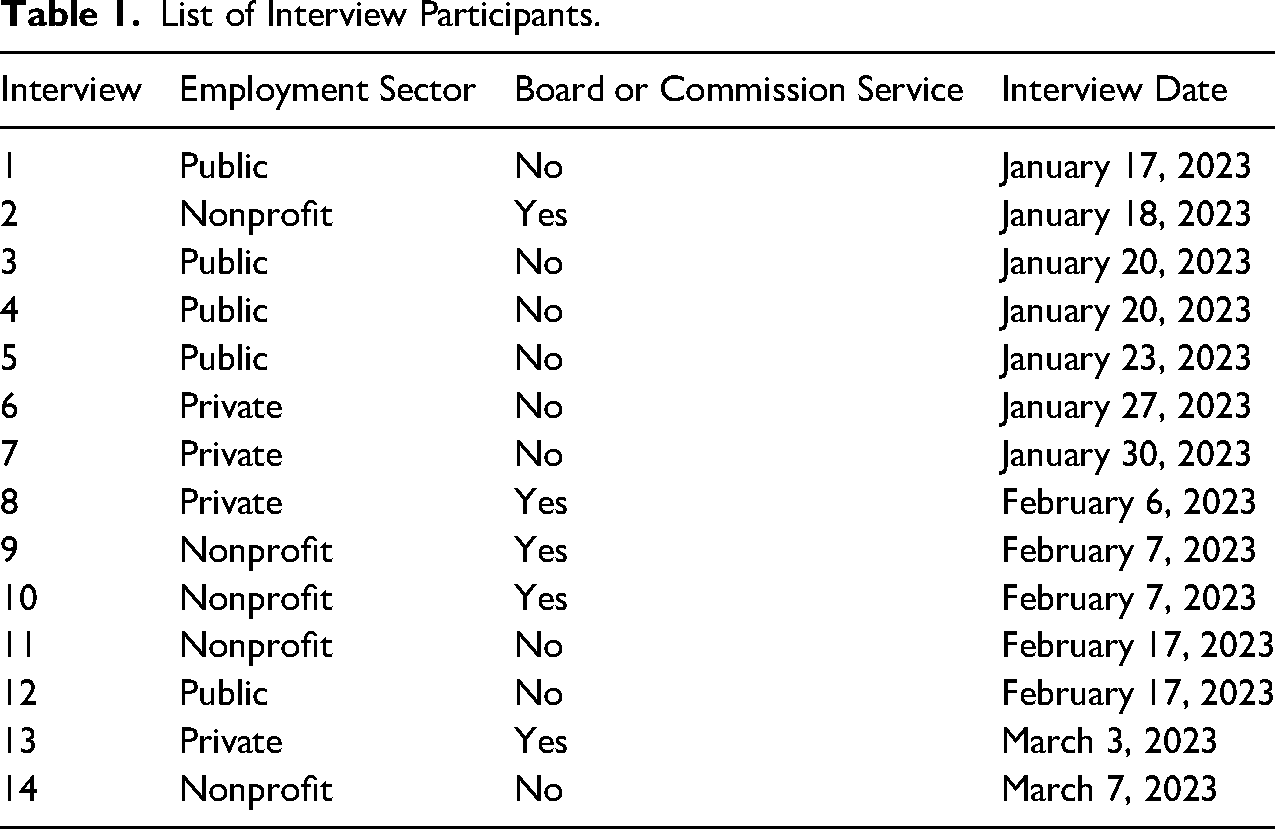
Interviewees represented key parts of the urban regime in Austin, including local government officials, transit agency staff, business interests, traditional environmental justice activists, and activists who collectively represent a new, more comprehensive justice-oriented coalition. Interviewees specialized in a range of topics including transit, multimodal transportation, housing, labor, environmental justice, accessibility planning, equity planning, and economic development. Specific questions were posed according to the interviewee's knowledge and specialty. The guiding questions for the interviews were:
What is your role in Project Connect? What have you and/or other activists done in the past to influence Project Connect? What are you and/or other activists doing now to influence Project Connect? Where do you see yourself and/or other activists getting involved in the future to influence Project Connect?
All participants were 18 years of age or older and able to withdraw from the study at any time. The University of Texas Institutional Review Board granted an exemption for this work. Conversations generally lasted approximately 30 to 45 min. Although two of the interviews occurred in person, the bulk of the conversations took place over Zoom. Interview audio was recorded using Zoom or the authors’ personal devices. Interviews were transcribed using Microsoft Word's transcription tool. We reviewed the transcripts to ensure that they faithfully reproduced the interviews. The findings were formed into an overall narrative and grouped into major themes based on interview responses.
Two results sections follow. The first provides an overview and periodization of Austin's transportation and land-use history, showing that Project Connect sponsors sought to proactively include justice-oriented actors early in the process. This intentional involvement led to a robust inclusion of mobility justice elements in the final plan. While this inclusion may not have led a majority of voters to support the effort, activists and advocates came together to support Project Connect in contrast to prior ballot initiatives where they had always fractured. The second presents our interview results, grouping the findings into key themes that emerged during our discussions with stakeholders. The interviews highlight specific ways that justice-oriented advocates were able to shape the final Project Connect program.
Austin Transportation and Land-Use History and Context
The state capital of Texas, Austin has a history of urban and transportation planning decisions that segregated and marginalized Black and brown communities and limited their social and physical mobility. Leaning heavily on the “separate but equal” doctrine established by the Supreme Court in Plessy v. Ferguson (1896), the city's 1928 master plan recommended concentrating all “colored” services in a “negro district” to be established in East Austin (Koch, Fowler and City of Austin 1928). While not explicitly racial zoning, if Black people wanted access to services, they would have to relocate. By the 1930s, the city's brown population was also increasingly concentrated in East Austin (Tretter and Adams 2012).
The dividing line between east and west Austin was East Avenue. In 1948, the Texas Department of Transportation began purchasing right of way along the corridor to facilitate construction of Interstate 35. By 1962, an at- and above-grade interstate roared and soared through downtown Austin where East Avenue once stood. The freeway's footprint, as the Congress for New Urbanism succinctly put it “… followed long-established racial and economic divides set forth by the city's 1928 Master Plan and 1931 Zoning Map, and became a physical barrier that reinforced those divisions for decades” (CNU 2015). The freeway was a “massive concrete barrier to remind minorities where they belong” (Winkie 2014).
Until the late twentieth century, Austin's economy was primarily built around government and education since it serves as both the state capital and home to the state's flagship University of Texas campus. Tretter (2016) describes Austin's transformation into a “leading center for innovation in the high-technology, knowledge economy” (p. 2) beginning in the 1980s. Gibson and Oden (2019) provide further institutional analysis and context for Austin's emergence as a “major high-tech agglomeration with significant endogenous innovation and entrepreneurial activity” (p. 963). Indeed, between 2000 and 2022, the City of Austin's population grew by almost 50%, increasing from 656,562 to 975,335. 1 As of mid-2024, Austin was the fourth most populous city in Texas and the eleventh most populous in the United States. The population growth rate from 2005 to 2022 averaged about 2% per year. Over the same period, the Austin-Round Rock-Georgetown metropolitan statistical area has consistently been one of the fasting growing regions in the country. 2 As of 2022, its population was 2.3 million people, meaning that the city of Austin accounted for 42% of the regional total.
Figure 1 shows Austin's major highway infrastructure and key public transit routes in the early twenty-first century to provide spatial context for the discussion. The “eastern crescent”—bounded roughly by U.S. highway 183, Interstate 35 and State Highway 71—would continue to house a disproportionate share of the city's Black, brown, and low-wealth people throughout the twentieth century (Tretter 2016). It would also be ground zero for debates about gentrification and displacement and their attendant impacts (Wegmann, Mueller and Way 2018). In a 2012 vote, Austinites elected to transition their city council from entirely at-large representation to a system with 10 districts plus one at-large mayor. This change came after years of complaints about biased council representation (Lawrence 2015). Using 2010 decennial census data, Figure 1 demonstrates the city's persistent residential racial and ethnic segregation. A substantial share of the city's zero-vehicle households were also concentrated within the eastern crescent, yet the area was not well served by CapMetro's marquee transit routes—the two MetroRapid bus lines and the MetroRail Red Line commuter rail.
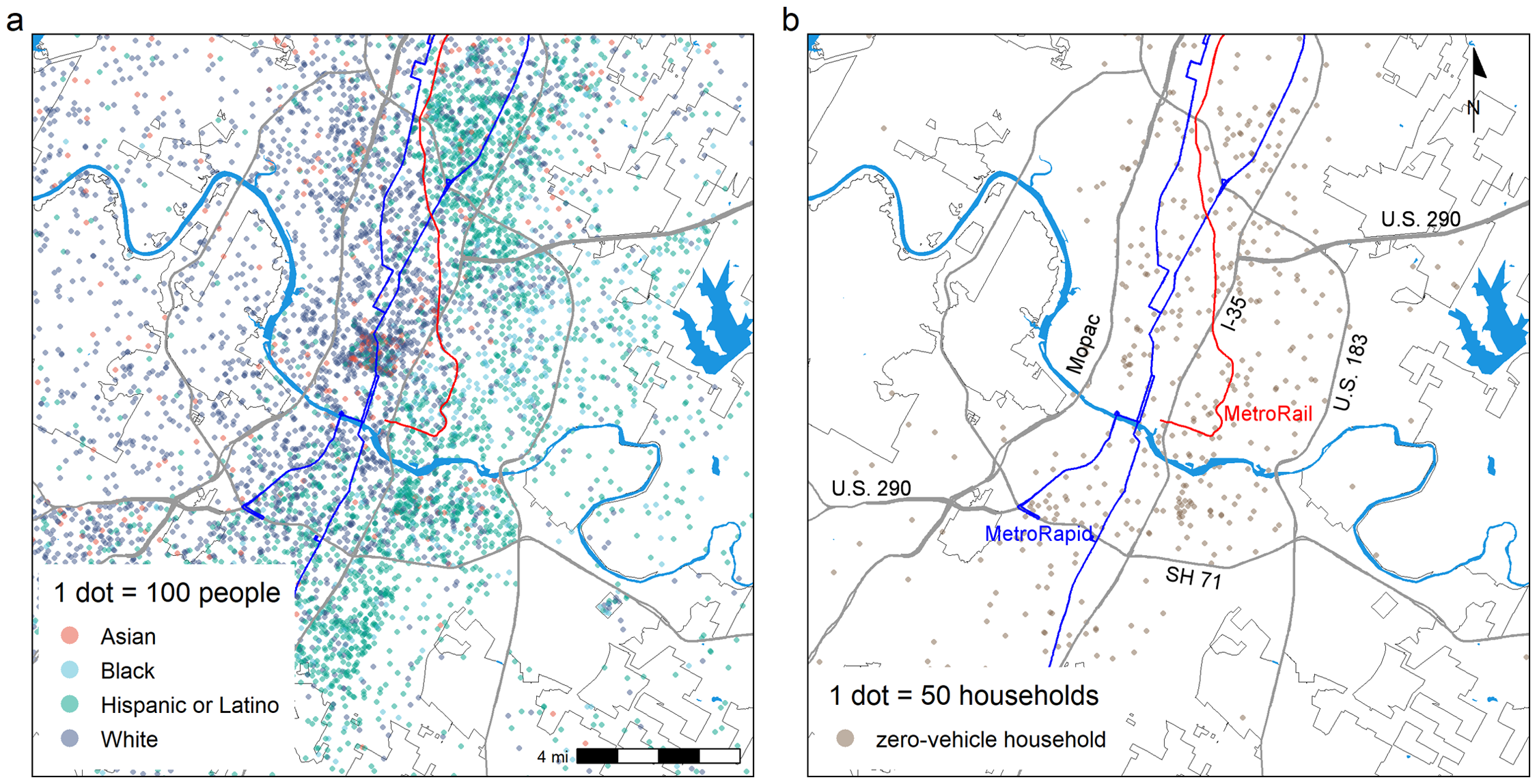
Austin's major highway infrastructure and public transit routes (MetroRail Red Line commuter rail and two MetroRapid bus lines) overlaid atop (a) 2010 decennial census racial/ethnic demographics and (b) 2008–2012 American Community Survey estimates for zero-vehicle household locations.
Public Transit on the Ballot
Alongside Austin's growing highways, a small transit system struggled to compete (Austin History Center 2023; Bryce 2000; Moody 1972). Public transit in Austin received a boost when voters approved a 1% sales tax in 1985 to establish the Capital Metropolitan Transportation Authority (CapMetro) (CapMetro 2022). After taking control of the existing local bus system, the agency enjoyed about a decade of relative normalcy until the board became the subject of multiple federal and state investigations in the late 1990s. Part of the controversy related to changes in the tax rate supporting the agency's operations. It was lowered to 0.75% in 1988 but then increased to a full 1% again in 1995 even though public sentiment was largely against the hike (CapMetro 2010). Although the board claimed that the increase would be used for future light-rail development, they were beset by allegations of illegal ethical violations and self-dealing as well as miscellaneous corruption and mismanagement (Copelin 1996; Copelin and Hott 1997; Texas Comptroller of Public Accounts 1997). In response, the Texas State Legislature passed, and Governor Bush signed, legislation liquidating the entire board, replacing them with a new slate of elected officials (Greenberger 1997).
Ultimately, the legislature effectively required CapMetro to put the question of light rail before voters, leading to a $1.9 billion proposal for two new light-rail lines that would not involve new taxes or bonds (Greenberg et al. and Barrientos 1997; Werbel and Haas 2001). The measure was defeated by approximately 1,800 votes in November 2000 (Daniel 2000). The controversy surrounding the agency and the board likely contributed to generally negative sentiment regarding the proposal. Because the entire CapMetro service area was able to vote, voters tended to favor the measure in central Austin where they were closer to the proposed routes but oppose it in more suburban areas (KUT 90.5 2014a). Werbel and Haas (2001) describe multiple factors that eroded popular support, including robust opposition. Despite proponents outspending those opposed to the plan, organized opposition took advantage of free media exposure via multiple well publicized debates. They also successfully fractured support along racial lines, raising fears about bus system decline among Black voters. The ballot additionally included two lower-cost highway bonds that passed. These put the relatively higher cost of public transit in sharp relief.
In 2004, CapMetro announced their All Systems Go Long Range Transit Plan, which again proposed rail transit along with expanded bus service. A dramatically scaled-down version of the 2000 initiative, CapMetro proposed that a new MetroRail Red Line would be funded with existing revenue and new grants, operate on track that the agency had purchased from the Southern Pacific Transportation Company in 1986, and serve as a starter line to support a future comprehensive rail transit system (CapMetro 2004a; Price 2004). The Red Line is shown in Figure 1. In part because no new taxes or bonds were proposed and the total price tag was low ($60 million), the plan passed with 62% of the vote (CapMetro 2004b). Despite this apparent win for transit service, the 2008 recession caused a severe drop in revenue and cuts to bus service while construction on MetroRail continued, angering bus riders and again eroding public trust in the agency (Cortez 2021).
Another more expansive rail proposal, the $1 billion Rail and Roads Proposition, was defeated in 2014 with 57% of voters opposed (KUT 90.5 2014b). 3 In contrast to the 2000 measure, only City of Austin residents were eligible to vote on the 2014 proposition (City of Austin 2014), ruling out voting geography as a factor in its defeat. Instead, the failure was partially attributed to the plan's late addition to the ballot, which limited time available for voter outreach and education. Additionally, voters voiced concerns that the proposed light-rail route that ran east of the state capitol missed locations with high ridership potential and a high density of destinations. The proposal involved issuing $1 billion in bonds, with $600 million for transit and $400 million for state roads. Importantly, pro-transit support for the proposition was split. A political action committee called “Let's Go Austin” campaigned in favor, while grassroots advocacy organization Austinites for Urban Rail Action (AURA) 4 and political action committee Our Rail were opposed, citing likely low ridership, high operating costs, and the inclusion of highway funding (Austin Monitor 2014). The University of Texas at Austin and other development and business interests favored the eastern alignment for its redevelopment potential, but they could not hide that it made little sense for riders (Tretter 2016).
As ballot initiatives were litigated over the decades, public transit in the eastern crescent continued to languish despite a relatively large transit dependent population. As of 2021, the eastern crescent had a disproportionally high number of residents without access to a car (Figure 1b), yet the area had largely been absent from discussions about transit expansion. The existing MetroRail Red Line, which runs through the east side, was intended to link fast-growing suburbs with the central business district and redevelop portions of the eastern crescent instead of serving its residents (Tretter 2016). The East Riverside Corridor Master Plan, developed in 2009, prioritized light rail implementation and redevelopment over the displacement and gentrification concerns of local residents (Mueller and Dooling 2011).
Shifting Regimes
The history of failed transportation ballot initiatives in Austin demonstrates the power that both progressive and reactionary organizing can have on the shape and success of a specific measure. These groups have demonstrated their ability to achieve substantial local wins over decades, but composition of the governing regime in Austin and its attendant priorities have shifted over time. During the 1960s, it was characterized by a classic prodevelopment growth machine with alignment between the Chamber of Commerce and the Austin City Council. This unified front began to splinter in the 1970s as development began to encroach on wealthy and white west Austin (Swearingen 2010). Save Our Springs, an organization nominally focused on watershed protection, was formed in 1990, and effectively opposed 4,000 acres of proposed westside development citing issues of water quality, habitat loss, and endangered species protection (Save Our Springs Alliance 2023; Tretter 2016).
They argued instead that that development should be located elsewhere in the city. In effect, westside residents traded preservation of their neighborhoods for development concentrated in downtown and on the eastside through a series of measures enacted by “pro-environmental” city councils during this time. The conception of the environment in this case did not encompass the traditional environmental justice understandings of the places where people live, work, play, and pray (Tretter 2013). Much of the existing literature on Austin's environmental movement elides the apparent material benefits that westside residents gained from opposing nearby development—namely the ability to effectively pause change in their own neighborhoods. In this interpretation, environmental concerns are a convenient stand-in for the deeper desire to exclude others from living nearby.
Around the same time, in the eastern crescent, the environmental justice advocacy group People Organized in Defense of the Earth and Her Resources (PODER) was founded. PODER was formed in part to fight various toxic exposures and locally undesirable land uses that were causing significant health problems for the residents living nearby (Tretter 2016). Austin's environmental justice and environmental advocates sometimes found common cause, for example opposing expanded underground petroleum storage facilities during the 1990s. But environmental justice groups opposed funneling all future development to the eastside, putting them in conflict with local environmentalists. In the early 2020s, these groups began to reconfigure again, with prodensity and prodevelopment forces aligning with environmental interests to support further housing development, and neighborhood groups and environmental justice organizations aligned in opposition (Tretter, Mueller and Heyman 2022). This transformation can be seen either as the apotheosis of prodevelopment forces cynically appropriating environmental discourse to further capital accumulation or part of a genuine realization that long-term sustainability requires housing more people in locations with viable alternatives to driving.
Other advocacy organizations have emerged in Austin to address a growing suite of issues touching on economic, social, criminal, and health justice, expanding beyond traditional environmental justice concerns regarding disparate land uses and environmental exposures. Indeed, many of these organizations evidence an abolitionist perspective that sees connections across multiple areas of oppression and attempts to undo the structural conditions that lead to the (re)production of injustice (Pellow 2021; Pulido 2017). For example, the Austin Justice Coalition (AJC) was founded in 2015 in the wake of Michael Brown's murder in Ferguson, MO in 2014. Its stated goal is to enhance quality of life for Black, brown, and poor people. They led a successful effort to reduce Austin Police Department funding in the wake of George Floyd's murder in 2020. A $150 million dollar reduction was unanimously approved by city council, but outlawed the following year by the Texas state legislature (Munce 2021; Venkataramanan 2020). In the lead up to Project Connect, AJC, the newly formed group People United for Mobility Action (PUMA), the Workers Defense Action Fund, Austin Area Urban League, and Planning our Communities came together to form the ATX Mobility Coalition. The coalition supported the passage of Project Connect contingent upon the plan incorporating key mobility justice elements. These justice-oriented actors complexify and diversify what was earlier a much more easily characterized governing regime.
Emergence of Project Connect
After the 2014 proposition failed, the development of high-capacity transit corridors became a major priority articulated within the Austin Strategic Mobility Plan (ASMP). The ASMP was the City of Austin's first comprehensive multimodal transportation plan that included short-, mid-, and long-term projects, programs, initiatives, and investments (City of Austin 2019). It set a goal of achieving a 50% nondrive-alone mode share by 2039. CapMetro began developing Project Connect alongside the city's ASMP effort and the two processes were clearly in conversation with one another.
The ASMP process included a city-level Multimodal Community Advisory Committee (MCAC) established during fall 2016 that provided feedback on the plan as well as advising CapMetro on Project Connect. As the ASMP and Project Connect advanced in tandem, the MCAC helped guide both. The MCAC was composed of environmentalists, business interests, nonprofit representatives, neighborhood interests, housing and transportation advocates, and representatives from city boards, committees, and chambers. It represented a diverse group of interests in Austin, but generally did not include justice-oriented activists. A parallel volunteer group called the Project Connect Ambassador Network (PCAN) was established during spring 2018. At one point PCAN boasted 150 members spanning a multitude of sectors (City of Austin 2020).
By the late 2010s, Project Connect had coalesced into a coherent plan (Jankowski 2018). It included an expansive project list with two new light-rail lines, an additional commuter line, expanded bus rapid transit (BRT) service, new park-and-rides, a downtown transit tunnel, new neighborhood circulators, and improved local bus service (Figure 2). The project was to be funded by an 8.75 cent increase in property taxes per $100 of valuation and include $300 million for antidisplacement efforts. Importantly, the plan also sought to rectify the manifest spatial inequities in transit service between the eastern crescent and the rest of the city through the proposed Green Line commuter rail and new MetroRapid lines.
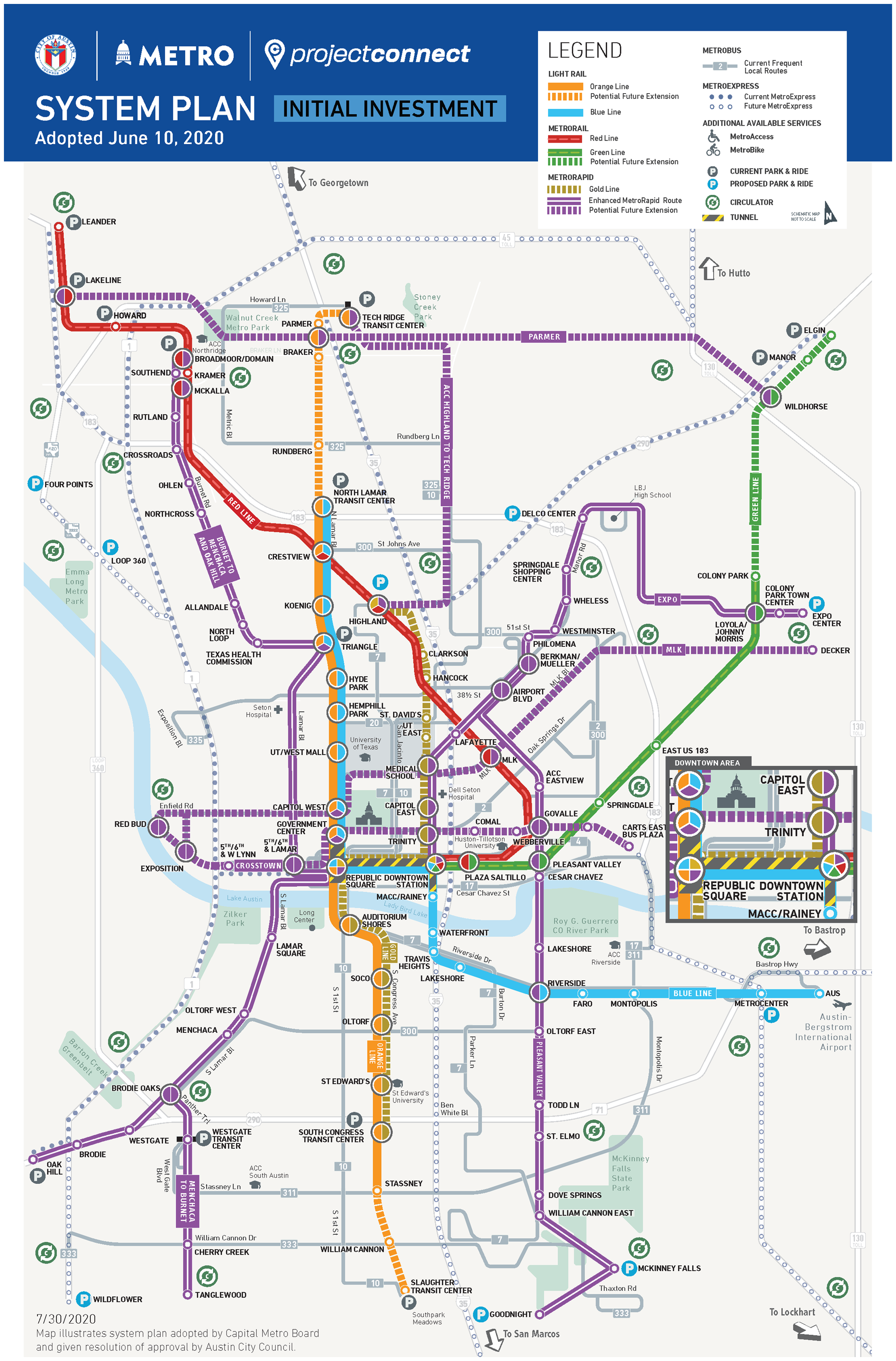
Project Connect initial investment map put before voters in November 2020. Source: Project Connect (2021).
Press coverage at the time emphasized the plan's broad support, noting that business-oriented and economic development organizations including the Austin Chamber of Commerce, the Real Estate Council of Austin, and the Downtown Austin Alliance had endorsed the plan alongside progressive interests including the Travis County Democratic Party, Sierra Club, and Environment Texas, among others (Craver 2020). AJC and Workers Defense Action Fund—a community organization focused on worker and immigrant rights in Texas—also voiced support (Sullivan 2020). A political action committee formed to support Project Connect called Transit Now used the slogan “Reduce Traffic. Fight Climate Change” (Craver 2020). Indeed, supporters’ rhetoric often emphasized the twin goals of mitigating both congestion and climate change. In a televised interview, then-mayor Steve Adler put it this way: “Everybody complains about traffic and congestion. People want us to do something that's real. This is real. This is transformative. It's large” (FOX7 Austin 2020). He also mentioned climate change, traffic safety, job creation, and mobility for essential workers. Austin City Council supported all the plan elements that it was asked to vote on (Craver 2020). Council members Natasha Harper-Madison and Greg Casar, as well as other local elected officials, regularly touted the project's equity-enhancing benefits (Thornton 2020). Harper-Madison specifically cited Project Connect's “meaningful improvements to East Austin, including the far eastern crescent and beyond” including increased bus frequency and overall improvements in access to key destinations (Thornton 2020).
For its part, AURA recognized that congestion mitigation is not a meaningful or realistic goal (e.g., Downs 2004), 5 so they did not discuss congestion in their messaging. Instead, they focused on the necessity of providing modal alternatives and enhancing bus service, stating that Project Connect “is big and bold. It will capture the imagination of Austinites and, when realized, give us a new freedom of access to our city, and an alternative to sitting in traffic” [emphasis added] (AURA 2020). While AURA opposed the 2014 measure, they supported Project Connect in part because it included rail along their preferred Guadalupe-Lamar corridor.
Organized opposition from conservative quarters was limited to one political action committee and one nonprofit organization (King 2020). Their arguments drew from talking points that had been deployed in prior transit-expansion debates and focused on the undesirability of tax increases, the apparent potential for technological innovation to render traditional public transit obsolete, and challenges associated with securing federal funding (Small 2020). Evidently, these arguments failed to catch fire in the way that similar ones had in 2000 and 2014.
While progressive interests were largely unified, there is some evidence that a small group of activists expressed opposition. About a dozen participants organized under the moniker “Progressives Against Project Connect” gathered outside of the Capital Metro headquarters on September 30, 2020 to oppose the plan (Van Oudenaren 2020). Attendees included representatives from PODER as well as a number of unaffiliated residents. They voiced concerns related to Project Connect's intended beneficiaries, arguing that wealthier and whiter riders would see their service improve, as opposed to the low-income riders of color that currently compose the bulk of ridership; the prioritization of rail over bus; gentrification and displacement; the affordability impacts of a tax increase; and potential impacts on broader city services in the event of a cost overrun. Project Connect supporters, including the ATX Mobility Coalition, raised similar issues in the run-up to the vote. It is possible that the press conference attendees thought that expressing vocal opposition would lead the agencies to take their demands more seriously.
In November 2020, Project Connect was put before voters. The measure passed with 58% in favor. During a live press conference during the early morning hours on November 4, 2020, CapMetro board chair Wade Cooper was asked by a reporter, “What do you attribute the victory to?” He responded with the following: I think the reason that we were able to win this year after a couple of losses in the earlier decades is: this was a community-driven plan. We had over 60,000 people participate in the process. This was a collaborative plan. We had over nine joint meetings of our board and the city council board. And so I think we have seen historic efforts to get a plan right. It's a big plan. It's one that will have something for everybody in our community. (CapMetro 2020)
During the same press conference, CapMetro CEO Randy Clarke expressed a similar sentiment, stating “Advocates played an enormous role in getting this program moved forward. Some of them worked for a long, long time, including our PCAN group—the community group that really gave a lot of their time to help shape the future of the city they want to live in” (CapMetro 2020). Clearly, the advocates that had withheld support in 2014 were able to achieve real wins in 2020, as elaborated further below. Other factors also clearly contributed to Project Connect's success—the pressure to provide alternatives to traffic congestion and the resolution of outstanding issues that emerged in prior ballot initiatives, including with the proposed right-of-way. Accordingly, advocacy support may not have been decisive—the measure still could have passed without it—but it resulted in material changes to the program, including some elements that had never before been contemplated as part of a public transit capital expansion plan.
Following the successful passage of Proposition A, three agencies were tasked with various program elements: the Austin Transit Partnership (ATP), CapMetro, and the City of Austin. ATP is an independent agency created to oversee, construct, and implement Project Connect's rail components. The organization is in charge of right-of-way and vehicle acquisition, rail and related infrastructure construction, Project Connect's budget and finances, and interlocal agreements (Austin Transit Partnership 2022). CapMetro will integrate and coordinate existing services with the new Project Connect infrastructure and gradually take control of operations of the project as they come online. They are also responsible for the project's equitable transit-oriented development (ETOD) policy plan, focused on station area planning, which was completed in 2023 (Austin Transit Partnership, City of Austin and CapMetro 2023). Once published, CapMetro passed the policy plan off to the City of Austin to be implemented. The city is also responsible for all land-use-related items, permitting, and other station area and corridor improvements, as well as management of the $300 million in antidisplacement funds (Parra et al. 2022).
Expanding the Governing Regime and Building Power
In this section, we focus on our interview results to describe the specific program elements that justice-oriented activists fought for and won. Project Connect's scale and potential impacts created a strong impetus for these actors to become involved. While we do not have sufficient evidence to say that their support was definitive in securing Proposition A's passage, it was imperative in terms of winning material gains that bolstered long-sought transportation access and antidisplacement goals. One critical lesson that advocates and activists can take away from this case is that making progress on key justice-related issues and ultimately winning broader support for a major capital expansion are possible to achieve simultaneously. The goals pursued by transportation justice activists were apparently not objectionable enough to turn off a broad swath of the electorate.
Expanded conceptions of regime theory provide similar examples where activists and advocates were able to affect multiple critical program elements in different contexts (e.g., Jones-Correa and Wong 2015; Karner and Duckworth 2019; Stone 2015). Like other situations in which transportation equity advocates shaped the overall course of major transportation investments (e.g., Karner and Duckworth 2019; Grengs 2002; Manville 2019), Austin advocates relied on traditional organizing and power-building approaches while also taking advantage of official opportunities for engagement and participation. Below, we rely on our interview results to describe how justice-oriented advocates and activists helped to create a shared vision for the Project Connect alignment and won key concessions related to the overall governing structure for the program, antidisplacement funding, worker protections, and fare policy. Interview numbers given after each quotation refer to the first column in Table 1.
Creating a Shared Vision for Project Connect
Following the failure of previous light rail initiatives in Austin, Project Connect proponents needed to bolster and expand the coalition supporting the project. One interviewee expressed that the 2014 Rails and Roads Proposition failed because the community was never behind the 2014 alignment that followed Interstate 35. That eastern alignment was supported by developers interested in redeveloping state parking structures and cashing in on a proposed medical school and innovation district. In contrast, community members wanted the north–south transit spine to be to the west of the capital, where there was greater potential ridership. Regarding the proposed 2014 transit corridor to the east of the capital, one interview participant who worked on the Project Connect proposal said: This is where the activists, members of the specific neighborhoods, members of specific nonprofit organizations, got very, very loud and didn’t like that the city was not necessarily paying attention to what they were telling them. (Interview 7)
One interviewee who worked to get Project Connect on the ballot feared a repeat of 2014 in which the protransit coalition did not come together. The interviewee said, “we knew that one of the biggest threats is if the progressive vote gets split” (Interview 6) between people who supported transit and people concerned about displacement. To avoid splitting the vote, agency planners and advocates proactively worked together to develop a comprehensive project list, preferred alignments, a new funding mechanism, and policy measures that would advance mobility-justice goals.
Creating a shared vision began with the ASMP process that informed Project Connect. In their capacity as MCAC members, activists and community members were able to influence transit corridor locations. The advocacy groups “… were very involved in defining the alignments” (Interview 7) and “the map was informed by people who need transit the most” (Interview 5). Activists pushed hard to address the discrepancy in transit service between east Austin and the rest of the city. Former city council woman Delia Garza brought it to the attention of city staff that the southeast portion of the city was lacking expanded transit under the plan, partially because the community was excluded from the discussion, leading to the proposed MetroRapid routes serving the eastern crescent shown in Figure 2. Leading up to the Project Connect vote, securing antidisplacement funding was critical for winning the support of progressive activists. According to one participant, “nothing was going to get off the [ground]” (Interview 5) without a robust antidisplacement strategy. We have evidence from one of our interviewees who would later serve on the CAC that supports this contention. They shared that representatives from the relevant public agencies proactively reached out to advocacy organizations to understand what it would take to enroll their support (Interview 9). Those conversations led the advocates to make specific requests related to antidisplacement funding, the community advisory committee (CAC), and performance analyses focused on equity.
Activists and advocates ultimately supported the proposition through in-person events, online forums, and original writing. AJC was particularly active in promoting Project Connect, while also specifically citing mobility justice principles. For example, in a post on medium.com made in September 2020, AJC highlighted multiple tenets of mobility justice and encouraged readers to think beyond transit infrastructure per se (Austin Justice Coalition 2020). They note that mobility justice requires the ability both to move and to stay in place, and evidence multiscalar thinking in referring to the different barriers faced by disabled, trans, women, Black, and brown travelers. Additionally, they correctly foreground the need for meaningful participation in shaping Austin's transit futures.
Influencing Governance Structure
The terms of Project Connect were ultimately spelled out in a “contract with the voters” authored by the City of Austin, ATP, and CapMetro (RESOLUTION NO. 20200807-003 2020). It included a provision to establish a CAC to advise on matters related to equity and displacement. The CAC contains 13 voting members and one ex-officio member. Five of the members were nominated from existing transportation commissions and committees, and the other nine were community members jointly appointed by CapMetro and the city. Members represent diverse geographic areas, demographics, and interests, including representatives from PODER, Austin Justice Coalition, and other City of Austin boards and commissions.
After its formation, the CAC immediately made its presence felt. The committee was vital in shaping the joint powers agreement (JPA) that delineated responsibilities for CapMetro, the City of Austin, and ATP. In the JPA, the CAC successfully advocated for broad oversight and review powers. The JPA states that the CAC: Shall be comprehensively consulted and involved in the process, including being regularly informed in advance of Project Connect-related equity and anti-displacement actions being brought to any of the Parties’ policymaking bodies in a timely manner that allows for informed decision-making so that they can effectively assist staff with community engagement processes and create a space for community members to provide feedback on the program. (CapMetro and City of Austin 2021)
Multiple interviewees saw the activists (and the CAC specifically) as making “sure everyone [is] playing [in] the same sandbox together” (Interview 14). One agency board member said: The CAC's a really important collaborator as a whole… what I love about them is that they are that bridge between the city, CapMetro and ATP. [They’re] at that junction of the three organizations… their scope is broad and a little esoteric… It's wonderful because we're seeing this evolve in real time. Like they're setting up their own charters and saying ‘oh, you know, how do we want to be involved in this thing and what what's the power of our voice and do we have a way to really have a voice at the table?’ So they've been instrumental in shaping the dialogue and inviting … a broader coalition of people to participate… Equity as a whole is so broad and yet so tangible… And so they're helping shape that conversation in a very intelligent way… (Interview 13)
The broad scope of the CAC has allowed them to become involved in many areas related to Project Connect other than displacement, including design, community engagement, TOD, workers’ rights, multimodal integration, safety/policing, fares, and construction impacts.
The CAC was also able to weigh in on and affect agency leadership. After Project Connect was approved by voters, the ATP board and leadership had to be decided. The original JPA stipulated that the executive director of CapMetro and ATP would be the same person, and thus ATP would not be truly independent from CapMetro. The CAC and activists in general saw the joint leadership of CapMetro and ATP as a consolidation of power and called for the structure to be revisited. The ATP board of directors contracted the Eno Center for Transportation in Washington, D.C. to investigate the best leadership model for Project Connect implementation. The Eno report suggested independent leadership for CapMetro and ATP, which the ATP board quickly sought (Austin Justice Coalition 2022). The director of CapMetro at the time, Randy Clark, resigned after the report was released. Clark had held both positions. The CAC and ATX Mobility Coalition were crucial in forcing the leadership change. One CAC member, who spoke in their personal capacity, said: [The CAC] really pushed to make sure that an independent [leadership] thing (happened. (Interview 9)
Another interview participant who worked to pass the Project Connect initiative was more straightforward, saying: Initially, ATP and CapMetro had terrible leadership. The guy who was running CapMetro at the time… is a fucking terrible human being okay? And so quite frankly [our organization] and many of us were involved in the effort to [be] like, “you may move on.” (Interview 6)
By influencing Project Connect's leadership and governance structure, activists have created a permanent seat at the table—the CAC—from which they can affect other areas of the program.
Addressing Displacement With Dedicated Funds
One of the greatest achievements of advocates and activists when it comes to Project Connect is the $300 million antidisplacement fund that was funded as part of the ballot measure. Every interview participant except one discussed the antidisplacement fund, and it has been a major focus for both activists and the implementing agencies. An “extraordinary and unprecedented step” (Interview 6), the antidisplacement funds were accompanied by an “equity tool” to guide allocation. The equity tool was developed by 30 residents or former residents of Austin that had faced or were facing displacement pressures. They were supported by the City of Austin Equity Office (Aguirre et al. 2022). The qualitative tool is used to score projects to be supported by the antidisplacement fund. Based on the score, the CAC makes recommendations to city council, which officially allocates the funds. As of mid-2023, $65 million have already been awarded, and another $75 million are expected to be announced later in 2023 (Truelove 2022).
The double-edged sword of Project Connect lies in its potential to improve transit options for those who most need better service, but also to cause additional displacement in already rapidly gentrifying areas of the city. A version of the project without antidisplacement measures was a nonstarter for activists who saw gentrification and displacement as a major threat to the communities they represent. An interview participant who worked on the project said: In the negotiations with a lot of progressive advocates and equity advocates in the city, that [the anti-displacement funding] was essentially the deal maker. (Interview 6)
City staff, planners, and activists collaborated to create a version of the project proposal that included significant antidisplacement funds. The ATX Mobility Coalition was instrumental in advancing antidisplacement measures as part of Project Connect. The coalition came together and decided that equity and displacement were the two biggest issues with a potential rail plan and pushed to get measures on the ballot to address them. One interviewee who worked on the ASMP said: I do not think that the anti-displacement funding would have been a reality without activists specifically. (Interview 1)
The antidisplacement funding has broad support, even from higher income areas. A representative from an organization in the (higher-income) downtown area said they want to prevent low-income residents from being displaced from downtown and …protect those retailers to ensure that the people who have invested in downtown and the businesses that make downtown unique and keep downtown that unique Austin identity can remain. (Interview 11)
The antidisplacement fund and equity tool represent clear steps to combat the gentrification, displacement, and land speculation that often follows light-rail development. Critically, the money helped bring activists together and was a key concession they were able to win from the city and CapMetro in return for broad support of the overall program. In contrast to more typical transportation equity analyses, addressing gentrification and displacement within a transportation program represents a meaningful translation of mobility justice ideas into practice.
Implementing Worker Protections
Activists have also asserted themselves in struggles to advance the interests of labor. Austin is growing rapidly as increasingly global, mobile, and technology-focused companies and their employees seek the best places to facilitate capital accumulation. Accordingly, numerous construction projects are incipient or ongoing including Project Connect, I-35 expansion, airport expansion, convention center expansion, the construction of the Tesla factory and Samsung plant, and the housing and services to support a ballooning population. A labor advocate we interviewed bluntly noted: There aren't enough workers. There just aren’t enough workers to do all of those things all going on at the same time. (Interview 10)
To attract and maintain construction workers to the Austin region, labor advocates have fought successfully for increased pay and worker protections, enshrined in the JPA and within city council ordinances. These included a $20/hour minimum wage on all Project Connect work, eliminating wage theft, trade and management training, and workforce development.
The fight for workers’ rights as it relates to Project Connect is in its infancy, but the same labor advocate noted that they will fight so that the worker protection and wage package is guaranteed from start to finish. This includes advocating for workers’ rights in any future interlocal agreements, minimum wage increases as inflation impacts the project, and ensuring that worker protections are followed when construction on the project starts. The advocate said: Groups and unions absolutely have to keep fighting every year… every budget, that we make sure that workers are remembered… Our point with worker protections is you have to talk about it every step of the way to make sure it becomes ingrained in the culture of… everything that comes from now on because… you can have a culture of safety or a culture of caring about your workers, or you can set up an institution that from the get go doesn’t have that… We're not afraid to raise hell, because that's what labor and community groups do in Austin when things aren’t going right. (Interview 10)
The situation related to labor protections is fluid. During summer 2023, the Texas Legislature passed the “Texas Regulatory Consistency Act” in a poorly masked effort to exert state power over cities. Deemed the “Death Star Bill” by opponents, it prevents localities from adopting ordinances that go beyond state laws related to a wide variety of topics, including labor and environment (Bailey, Jr. 2023; Creighton 2023; Reader 2023). The worker protections fought for by Project Connect activists are under direct threat from the new law, which hampers cities’ autonomy and ability to self-govern, as well as to enact progressive policies aimed at urban and transportation injustices.
Achieving a Fair Fare Structure
Despite relatively low cost when compared to private vehicle ownership, public transit can still be prohibitively expensive for low-income riders (Perrotta 2017). In July 2022, CapMetro introduced a fare program called Equifare, which allows riders who qualify to receive a reduced fare. Riders qualify if they earn a household income of less than two times the federal poverty level or receive assistance including the Supplemental Nutrition Assistance Program or Medicaid. The program reaches more people than the prior reduced fare option. At the same time, CapMetro introduced fare capping, which ensures that no rider will pay more than the cost of a daily or monthly pass (Newberry 2022). If rail travel were to remain significantly more expensive than bus, low-income riders could be reluctant to ride rail, causing them to take longer bus trips. This would result in higher time or monetary costs for poorer riders. Efforts to make buses, but not rail, free in Boston and Washington, D.C. pose similar problems (Walker 2022).
However, through the determined activism of one specific organization, it appears that bus and rail fares may soon be made equal. The CAC member interviewed, again speaking in their personal capacity, said: The fares one was something that actually [activists] were very involved with, people were very worked up about it. It has largely been resolved, so I think they have a clear indication right now from all three parties that the fares for light rail and buses will be exactly the same. In the project financing scheme that they’ve built in, that is their base thinking. So the financing at this point is all with the idea that the fares will be the same. (Interview 9)
By asking for signatures on a petition to equalize fares and advocacy through the CAC, the specific organization has successfully advocated for equal fares for bus and rail. This does not preclude a future CapMetro board from changing the fare structure, but it is a crucial step to ensuring that people of all incomes can ride both the rail and the bus. The leader of one activist group noted: We’ve been educating bus riders and community at large that this is discriminatory, that we need to make sure that the rail fares equal bus fares…If [Project Connect] is supposed to be about equity, this is degrading in equity when your price is so high that you that you can’t get on the rail… [A] really big issue for us is to make sure that we all can ride the rail. Because if we're all having to pay for that service but not getting the benefits, that's absolutely wrong. (Interview 2)
Activists and advocates in Austin also recognized the class distinction between bus and rail. One activist spoke directly to the fact that rail and bus are perceived differently, and that rail tends to attract whiter and wealthier riders than the bus: I think that was the whole vision of the rail. It was: people didn't want to ride the bus …And when they bought up the rail, their whole angle, if you go through all this stuff, they always say the train was sexy… You know it was a sex thing like this beauty thing versus a bus because the bus has a racial stigma. Because once communities of color won their right to sit wherever the hell they wanted to…nobody wanted to really ride [the bus]… For a long time, the majority of people riding were people of color and now the train comes along…And they made it real nice. You got on the rail … you could do Wi-Fi. They had some tables there. It's quiet. All of this stuff, it has overhead [bins] where you can store things. And you don't see any of this stuff on the bus.” (Interview 2)
By pushing CapMetro to make bus and rail trips the same price, advocates and activists in Austin have made the eventual rail system more accessible to low-income residents and taken a crucial step toward closing the class gap between rail and bus riders.
Conclusions
The Project Connect case provides an example of a unified pro-transit coalition influencing the nature of a major public transit capital expansion program. In contrast to much existing work on urban regimes, the protransit coalition in this case included a broad array of justice-oriented actors operating outside of traditional political, business, or environmental interests. After multiple false starts and failed attempts spanning two decades, the initial vision put before voters in November 2020 finally won substantial support. Activists unified in this case not only because of the project list, geographic equity, right-of-way, or distribution of funding between modes, but because of commitments that public agencies made to address potential negative impacts, including gentrification, displacement, bus network changes, and labor issues. These concerns, highlighted by justice-oriented advocates, were informed by mobility justice principles articulated by both practitioners and scholars. While support from these groups did not guarantee voter approval, their engagement was critical to ensuring that mobility justice principles were reflected in the final plan.
Transit agencies have generally not tried to address secondary land-use effects through their planning and programming activities. While some acknowledge the link between public investment and neighborhood change, CapMetro is the only agency to have put concrete resources in place for mitigation. Despite this step forward, the $300 million antidisplacement fund still embodies major limitations. Principally, it is unlikely that $300 million will be enough to stem the tide of displacement facing the city. In an interview with KXAN, City of Austin Community Displacement Prevention Officer Nefertitti Jackmon said “No… The $300 million dollars are insufficient to meet the rapidly increasing housing costs that Austinites are facing, especially low-income households… I don’t know what the answer is.” Other solutions besides the existing funds are necessary, but Jackmon and other city officials are struggling to identify measures that do not run afoul of state law (Thompson and Rahman 2022). Additionally, as the area median income (AMI) for Austin continues to skyrocket, units available at 80% or 60% AMI will remain unaffordable for a significant portion of the population.
Project Connect is also at risk from the conservative Texas Legislature. In states like Texas, Florida, Nebraska, and Ohio Democratic-led cities are islands of blue in a sea of red, with liberal city governments and conservative state legislatures regularly at odds. The growing antagonism between cities and states encompasses fights over urban issues such as highway expansion, police reform, impact fees, zoning, affordable housing, homelessness, short-term rentals, Uber/Lyft regulation, and transit funding. In Spring 2023, the Texas legislature introduced House Bill 3899, which called into question the legality of Project Connect's funding mechanisms. The bill, which was stopped on a procedural technicality, would have dealt the project a fatal blow (Autullo 2023). Although Project Connect survived, city of Austin officials, activists, and voters will continue to have to be wary and vigilant of state power aimed at stopping progressive urban policies.
The Austin case offers unique insights, but activists and advocates in other regions can also draw valuable lessons. A critical takeaway is the importance of being prepared to collaborate when opportunities arise and securing a seat at the decision-making table. During Project Connect planning, this inclusion was no accident—it was the result of substantial groundwork laid by transportation and mobility justice advocates during earlier transportation ballot initiatives. These activists built organizations, cultivated collective power, and benefitted from Austin's history of progressive activism. Prior struggles, generally receptive decision-makers, and public- and private-sector planners trained to pursue justice-oriented goals all contributed to this success. While not all cities or regions share Austin's history or culture, the experience suggests that constructive, sustained engagement—both in support and opposition—can yield long-term wins as decision-makers come to recognize justice-oriented perspectives as indispensable. In part because transportation advocates had been divided during earlier initiatives, public agencies involved in Project Connect planning recognized the importance of coalescing their support. As a result, these agencies engaged relevant groups early in the process, actively seeking to address their concerns and secure their backing.
Despite threats to Project Connect's success, from determining the alignments to introducing worker protections and demanding an equitable fare structure, the seat at the table created during the lead up to the Proposition A vote and afterwards has been a critical platform for advocacy. Not surprisingly, the demands that advocates have made and continue to make go beyond those that are typically addressed when an agency produces a “transportation equity” analysis. Karner et al. (2020) demonstrate that society-centric approaches more often seek to transform unjust structural conditions rather than merely reforming elements of a fundamentally broken system. Project Connect provides an example where key ideas from the mobility justice literature will be implemented in a real-world setting. Justice-oriented activists involved in the process were not content with a simple analysis showing benefits and burdens, rather, they understood that public transit affects much more than the service provided within an alignment. They did and continue to draw connections between light rail and land use, housing affordability, the bus network, police interactions, as well as other critical transportation policy elements. While the background political-economic forces that drive capital accumulation, uneven development, and spatial inequity persist, public transit advocates and activists in Austin present a powerful example of the potential for mobility justice to shape a region.
Footnotes
Acknowledgments
Many people generously provided their time and feedback to support this work. Liz Mueller and Awais Azhar read the manuscript and provided critical feedback. Participants in my spring 2022 seminar on mobility justice assisted with some of the initial historical work necessary to understand Project Connect and its impacts. Earlier versions of the manuscript were presented at the Urban Affairs Association meeting in 2022 and the Transportation Research Board annual meeting in 2024. We also thank the three anonymous peer reviewers whose deep engagement helped refine and strengthen the article. Finally, we thank our interviewees—without their insights this work would not have been possible.
Declaration of Conflicting Interests
The authors declared no potential conflicts of interest with respect to the research, authorship, and/or publication of this article.
Funding
The authors received no financial support for the research, authorship, and/or publication of this article.
