



Abstract
One of the questions when undertaking comparative research into local politics and processes of collective organization is what frame should be used. In recent decades, many scholars have opted for the urban regime. There is however much debate about the usefulness of this concept for comparative purposes, with the urban regime accused of being theoretically both too narrow as well as too general. In three Dutch case studies, researchers have sought a middle way by applying the urban regime's four building blocks (agenda, coalition, resources, and scheme of cooperation) as a heuristic framework. The results show that this approach has several advantages, especially for comparative purposes, as it provides a clear oversight as to which agendas dominate where and when, and how certain coalitions, resources, and schemes of cooperation align. These benefits however require close attention to certain points: researchers should interpret the building blocks consistently and try to avoid overlap and repetition between them.
Introduction
Should urban regime analysis be buried “with honors” (Sapotichne, Jones, and Wolfe 2007, p. 99), has it already had its “academic funeral” (Lambelet 2017, p. 3), or does it still possess an unchallenged leading position in the field of urban politics (McGovern 2020, p. 1012)? Since Stone's (1989) pioneering work on Atlanta, many scholars have used and discussed the urban regime concept. Especially, regarding its use beyond the post-war US context, the concept has led to discussions about its usefulness. When compared to the concept of governance, the urban regime seems less flexible and therefore less suited for comparative work (Mossberger 2009). However, the urban regime is credited for being much more developed—or arguably less underdeveloped—than the governance concept. “If urban regime analysis is undertheorized because of its dependence on specific cases and the American context … the idea of governance is even more so, because it can be so many things” (Mossberger 2009, 48). In this article, a heuristic framework, derived from the urban regime literature, is central to addressing these problems. This framework focuses on the four urban regime building blocks of agenda, governing coalition, resources, and scheme of cooperation (Stone 2005a) and therefore takes a middle position between a strict interpretation of the urban regime concept and the more general notion of (urban) governance. This framework has been applied in several Dutch case studies.
The central and leading question in this article is: Can a heuristic use of the urban regime building blocks, as used in several Dutch case studies, enhance our knowledge of local collective organization? By collective organization, I mean the formal and informal arrangements that enable cooperation between different governing and non-governing actors to solve societal problems (Mossberger and Stoker 2001; Stoker and Mossberger 1994). In this article, I first explain how the framework relates to different interpretations of the urban regime and urban governance concepts, and what its possible advantages are. The development of both concepts is briefly described. The second part of the article focuses on the Dutch cases.
Looking Back at Urban Regime Development: The Strict and the Open Interpretations
The debate about the use and value of the urban regime concept began with the work of Clarence Stone and his study of local politics in Atlanta (Stone 1989). As such, the theoretical model of what an urban regime requires, especially initially, strongly relates to his Atlanta case. 1 After the publication of Stone's Atlanta research, some scholars started to discuss certain characteristics of this study that are less common in other (mainly non-US) cities, in particular focusing on the role of the private sector and business. This divergence from the original interpretation led to a discussion in the literature about what an urban regime is. The first and central question in this debate concerns the characteristics that constitute an urban regime. In this discussion, a distinction can be made between a strict prescriptive and a more open descriptive interpretation. The strict approach stays close to the characteristics of Stone's Atlanta research, while the open interpretation makes the concept more abstract, reflecting several of Stone's later publications about the urban regime concept. I consider Mossberger and Stoker's characteristics of an urban regime, presented in their 2001 article, and those of Stone as seen in some of his later work, as good representations of these two interpretations (see Table 1).
The Strict and Open Interpretations of the Urban Regime.
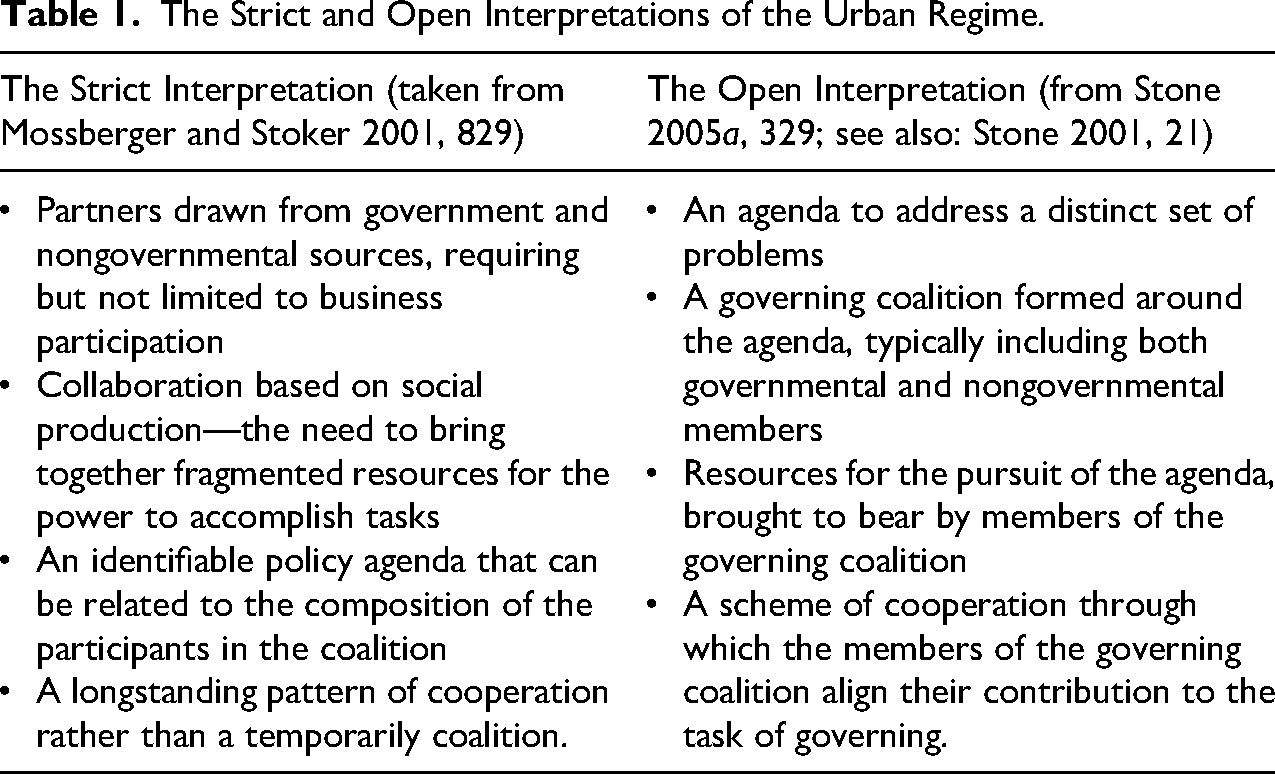
There are other scholars who present their own lists of urban regime characteristics, such as Davies (2003, 256), Holman (2007, 50), John (2001, 50–52), and Sellers (2002, 291) who all lean towards a strict interpretation. 2 The main feature that these scholars have in common, and what characterizes this line of thought, is that they hold the participation of the private sector, mainly business, as an essential characteristic of an urban regime. In the open interpretation, such participation is optional and mainly depends on the content of the agenda.
A second question in the debate is therefore whether business participation is essential to an urban regime. In Stone's assessment of the Atlanta urban regime, a group of top businessmen functioned as an important regime partner. Several, if not most, scholars adopting Stone's concept have looked for a similar private-sector role in (mainly US) local governments, and they have often found one. Several of these local coalitions have therefore been labeled as some form of the urban regime (Van Ostaaijen 2010). A consequence of this is that several scholars began to argue that business participation is not merely a possible component (or outcome) of an urban regime analysis but an integral part of the concept itself (Mossberger and Stoker 2001, 829). Their main argument is that, without business participation, the concept loses its uniqueness and becomes too broad, potentially indistinguishable from the idea of networks or urban governance (Mossberger and Stoker 2001, 832, 825). Others, however, argue that such a close connection to urban governance is necessary to make the concept more internationally applicable (e.g., Pierre 2005, 448). Stone came to take a more open approach and, especially in his later work, seems to revert to viewing the agenda as the most influential determinant of the content of a coalition: “It is a mistake, however, to think of urban regimes as composed of a fixed body of actors, taking on an ever-changing agenda. Instead the question is about who needs to be mobilized in order to take on a given problem effectively … Neither business nor any other group is necessarily a required member of the governing coalition” (Stone 2005a, 313–314).
A third question that has led to the discussion in the urban regime debate concerns an urban regime's durability. Most authors agree that without some durability there is no regime, or at best an emerging regime or a failed regime (Mossberger and Stoker 2001, 830). In this discussion, it is again possible to distinguish between strict and open interpretations. Mossberger and Stoker (2001, 815) for instance criticize Sites (1997), who describes regime change under three consecutive New York mayors, for confusing temporary strategic policy shifts with regime change. Nevertheless, both they and other authors have not been overly forthcoming over the time frame necessary to identify a governing coalition as an urban regime. John and Cole (1998, 399) conclude that an urban regime develops over “several decades” and, even then, it is not always clear whether it can really be labeled as an urban regime (see also: Lambelet 2017, 19). Austin and McCaffrey (2002) do not label the partnerships they identify as urban regimes, even though they mainly discuss partnerships running for 20–50 years. In contrast, there are plenty of articles that describe urban governments that functioned for only a brief period, maybe a few years or a single legislative period (four or six years), and label these as urban regimes. For Stone, the time frame did not seem that relevant. He saw the power of a regime as involving its capacity to determine priorities in a direction-setting agenda. This implies that the basis of an urban regime lies in its competence to implement an agenda, not in its duration.
The Popularity of the Urban Regime Concept
When looking at the practical application of the urban regime concept, the first publications addressing urban regimes that appear after Regime Politics describe urban developments in the United States. Rather than deepening theory on the concept, these articles often demonstrate practical uses of it (e.g., Bennett 1993; Harding 1994). This practical applicability in urban research increased the popularity of the concept. The urban regime quickly became not only a “dominant paradigm” for urban research (Davies 2002, 1) but also a popular tool and a “familiar and popular phrase” (Stoker 1995, 62). In 2005, Pierre noted that “The dominant analytical framework of urban political research in the United States for the past two decades has been urban regime theory” (Pierre 2005, 449). Recently, McGovern continued to assert that regime theory still occupies an unchallenged leading position in the field of urban politics (McGovern 2020, 1012).
The empirical application of the urban regime concept cannot be viewed in isolation from the theoretical discussion. The strict interpretation of the concept has undoubtedly influenced the empirical application. For several scholars working with the concept, urban regime analysis has meant comparing, either explicitly or implicitly, governing coalitions in a specific place at a certain time with a specific and strict interpretation of an urban regime: Stone's Atlanta regime. The conclusion in most of the subsequent publications is that the examined case does not exactly conform with this ideal urban regime type, sometimes leading to proposed changes to the original type or to proposals for new urban regime (sub-)types. Since the turn of century, scholars have proposed at least thirty urban regime variations, 3 and the number is still growing (e.g., Lambelet 2017). Some of these cases only remotely resemble the Atlanta situation. For instance, the regime in Bristol (UK) described by DiGaetano and Klemanski (1993) is characterized by a lack of business participation, and no strong consensus among the partners, but is still labeled as an urban regime. Some scholars have reservations about this. Orr and Stoker (1994), for instance, are concerned that the concept will be used to describe all sorts of urban processes. They argue that misuse of the concept should be prevented by providing a firmer theoretical base, i.e., the list of characteristics in Table 1 (see also Mossberger and Stoker 2001; Stoker 1995; Stoker and Mossberger 1994).
In recent decades, relatively new challenges such as those related to globalization, immigration, the emergence of the post-industrial city, climate change, and the environment have emerged and found their way into urban research (Da Cruz, Rode and McQuarrie 2019; Pierre 2014, 876). These challenges have often led to or demanded different urban governing constellations than those seen in the “Atlanta regime.” It might be that the growing number of dissimilarities between “modern” cities and the constellation and context of the Atlanta urban regime is part of the reason why the number of articles addressing the urban regime concept and its application is slowly decreasing (Figure 1). At the same time, there are articles that make one aware of elements or perspectives that have been somewhat neglected in urban regime analysis, such as the role of race and culture (McGovern 2020; Morel 2018), the role of crises (Keiser 2015; Nickels, Clark and Wood 2020), and the inclusion of the larger public/working class (Camou 2014). For some, these additions mean that the urban regime concept still has a lot to offer in urban research. For others, it leads to the conclusion that the concept is somewhat outdated and that other concepts may be better when studying local processes of collective organization.
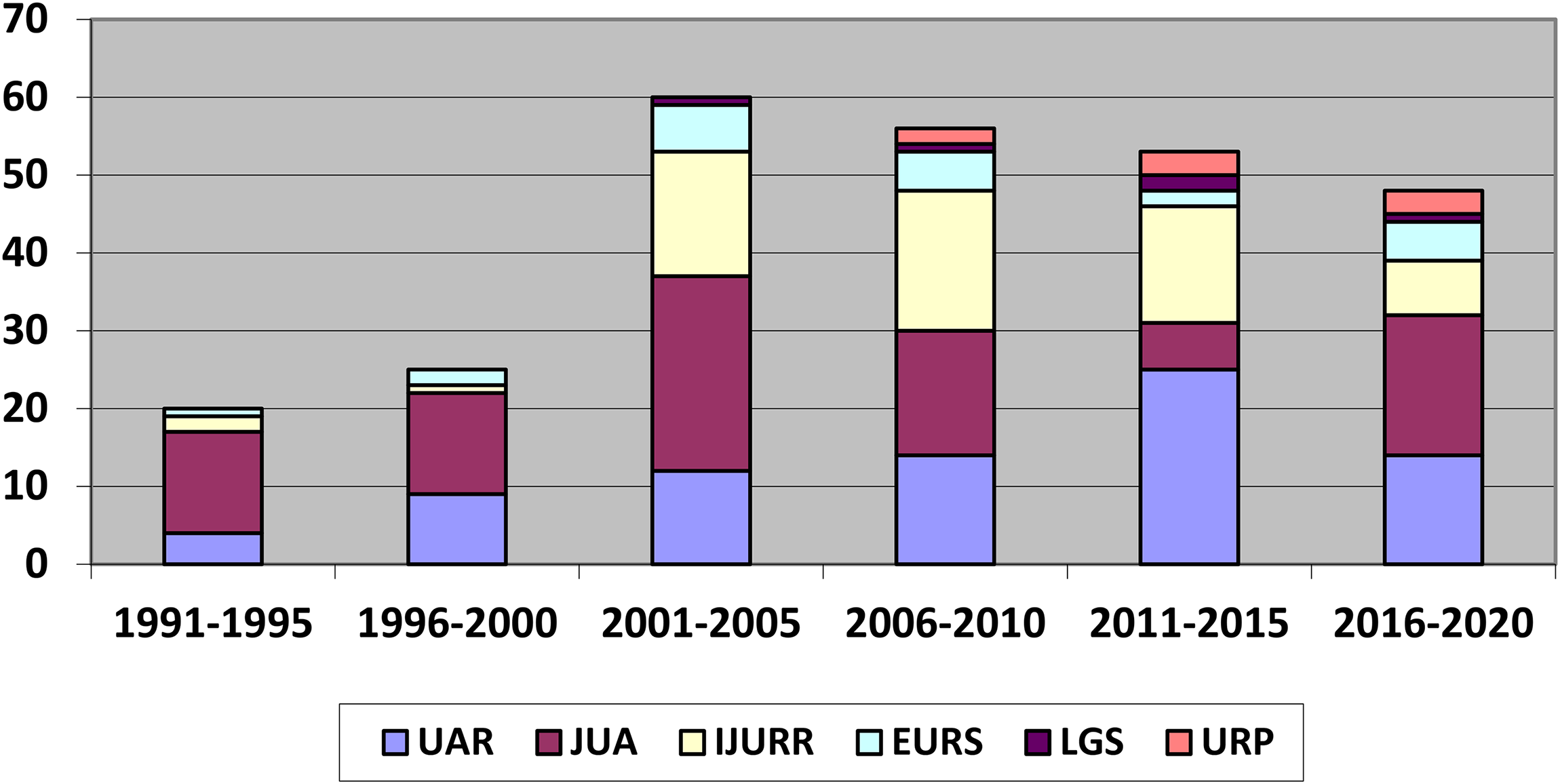
The number of publications including “urban regime” in journals addressing urban or local affairs.
The Rise of Urban Governance as a Conceptual Alternative
With the developments in the urban regime concept, questions emerge as to whether other concepts are perhaps more fruitful for urban research. In the decade following Regime Politics, there were, for instance, comparisons with growth coalitions (Harding 1994) and regulation theory (Lauria 1997), and, more recently, with, for example, American political development (Rast 2015). It is however urban governance that is particularly seen as a competing concept. The term urban governance has become increasingly popular and widely used in research (Figure 2). At their core, however, both concepts seem similar.
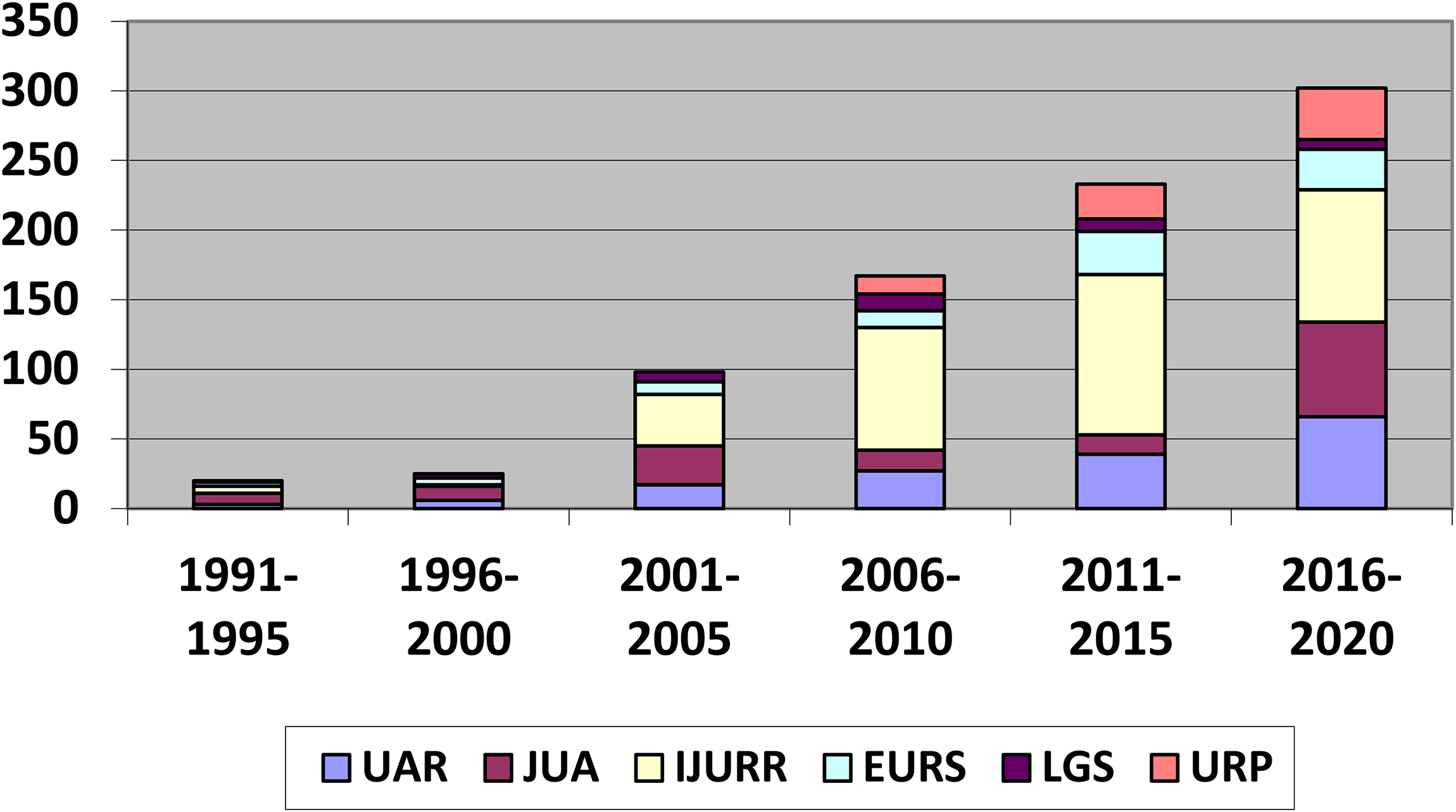
The number of publications including “urban governance” in journals addressing urban or local affairs.
It is hard to provide a universal definition of urban governance. First, this is because the concept of governance has developed in multiple disciplines such as economics, international relations, and politics. As Hendriks (2014, 555) observed, governance “has all the characteristics of a container concept. It contains a lot, and it is hard to tell where it exactly begins and ends.” This leads to the risk that the concept is being used to cover all sorts of practices, something that is also visible in the development of the urban regime. Sometimes, an urban regime is stripped of any theoretical baggage and regarded as something every city has. In this way, it becomes a synonym for any urban coalition or government, hindering a better understanding of the concept (e.g., Painter 1997, 130). Nevertheless, as with the urban regime concept, there are some basic assumptions accepted by most scholars: That governance refers to the “more or less institutionalized … working arrangements that shape productive and corrective capacity in dealing with—urban—issues by multiple (non)governmental parties” (Hendriks 2014, 555–556). Similarly, “Urban governance theory simply asks who controls the resources that are critical to governing and to what extent they can sustain collective action” (Pierre 2014, 867).
The core of urban governance is thus quite similar to that of the urban regime. Pierre (2014, 875) notes that “Urban regime theory and urban governance theory address the complex issue of urban collective action in the absence of formal authority, or with such authority as one of the collaborating partners rather than the locus of power and leadership over the collaboration”. A similar observation is made by Mossberger (2009, 48): “Governance, as a more general concept, clearly shares many of the defining characteristics of urban regime analysis such as governing arrangements that include actors beyond the formal institutions of government, and the need to mobilize resources to achieve the capacity to act. As with regime analysis, power is fragmented and policy-making does not rest solely with the state”. Especially when referring to the urban regime's “iron law”—that, in order for a governing coalition to be viable, it must be able to mobilize resources commensurate with its main policy agenda—there is clear overlap with urban governance (Lambelet 2017, 5).
Other similarities between the two concepts are the role of political entrepreneurship and that power shows itself in results, not in formal authority (Pierre 2014, 874). What Stone calls his social production model of power, and “power to,” is in essence also the core of urban governance. The concepts of urban regime and urban governance thus build on similar assumptions. Both the strict and open understandings of the urban regime are interpretations of these assumptions. The requirements attached to the strict interpretation, following the Atlanta case description in Stone's Regime Politics, can be seen as the most concrete “textbook case of urban governance” (Mossberger 2009; Pierre 2014, 867). The open interpretation falls between the two. This is visualized in Figure 3, based on Lambelet's (2017, 5) “ladder of abstraction.”
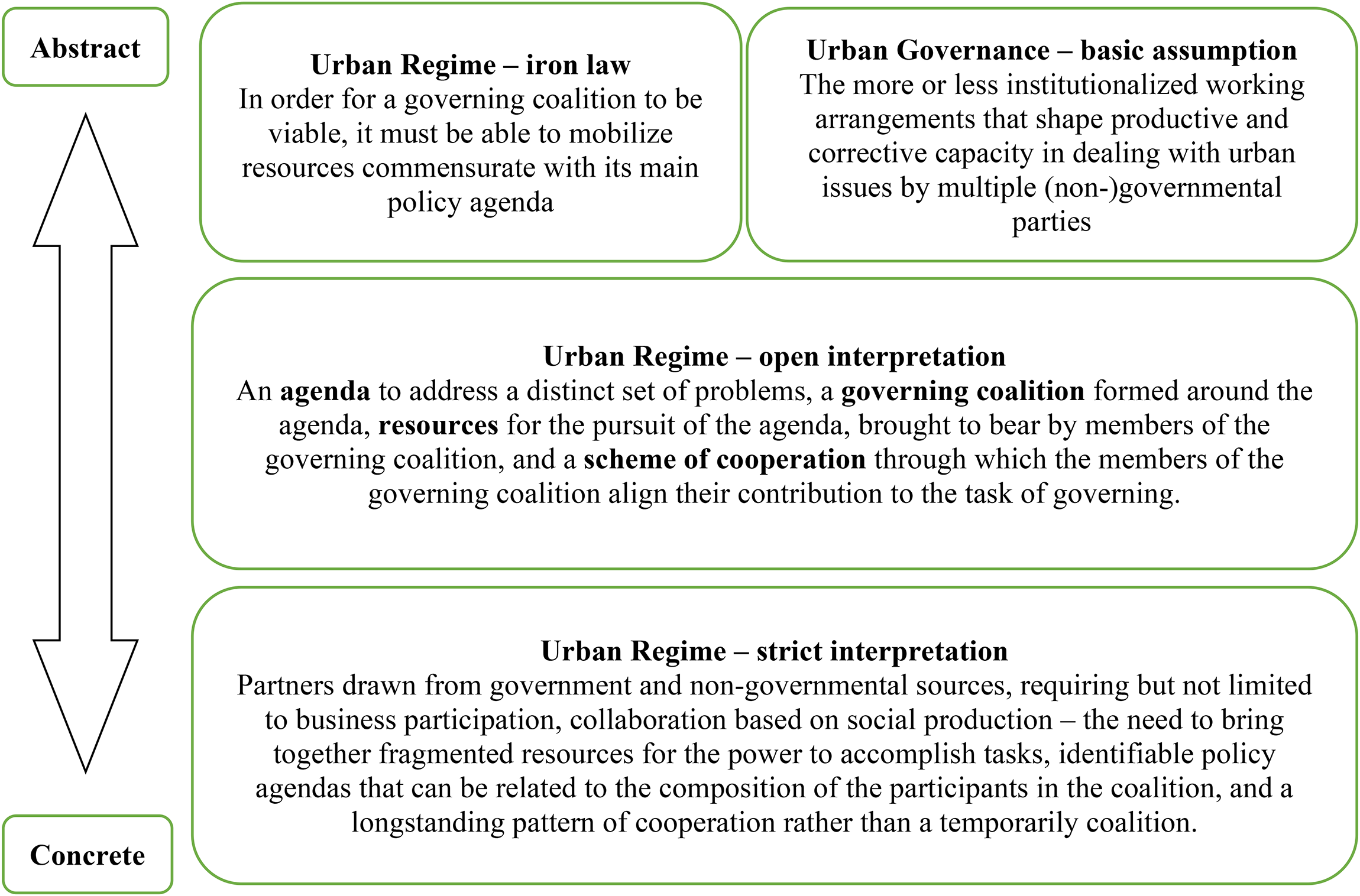
From the abstract to the concrete: The relationship between Urban Governance and the different interpretations of the urban regime (following from Table 1).
The Urban Regime Framework
The heuristic Urban Regime Framework that is central in the analysis of the Dutch cases is grounded in the open interpretation of the urban regime concept (see Table 1 and Figure 3). At the core of this framework are the four urban regime building blocks: Agenda, coalition, resources, and scheme of cooperation (the latter is sometimes also referred to as “mode of alignment”).
The first block, the agenda, is “the set of challenges which policy makers accord priority” (Stone 2005b, 1). However, agendas do not emerge or become a priority spontaneously. Agendas need to be supported by actors to gain priority: “agendas … undergo adjustment as conditions change. But the direction of the adjustment is influenced by the particulars of the network, who composes it, and the concerns they embody” (Stone 2005a, 319–320). The agenda, as it were, is the magnet or the cement that holds the governing coalition together despite internal differences, especially at the beginning when trust among the coalition actors is still being built. The governing coalition implements the agenda. With the various actors working together and learning more about each other, trust develops to reinforce the coalition. The governing coalition can be seen as “the group of actors who come together, in many instances unofficially and tacitly, for the purpose of setting a locality-wide agenda and giving it priority standing (that is, they provide “guiding and steering”)” (Stone 2004, 3). The coalition then brings in resources to implement the agenda. These resources can be tangible, such as money or materials, or intangible, such as knowledge or status (Stoker 1995, 65; Stone 1993, 11). The scheme of cooperation is the way in which the coalition's actors interact with each other (e.g., Stone 2005a, 329). In Atlanta, this was through behind-the-scenes negotiation.
The four building blocks interrelate: When an agenda emerges and a coalition forms around that agenda (sometimes partly creating the agenda itself in the process), the actors in the coalition will possess and use sufficient resources to implement the agenda. By analyzing local government in terms of these four building blocks, it is possible to gain greater insight into how changes in local government take place. For example, if a city experienced a school reform as a failure, it could, by assessing the city's circumstances in terms of the building blocks of the model, maybe conclude that the city lacked resources for the school reform, that the agenda did not become a priority, or that a scheme for cooperation between the necessary actors was never established (based on an example in Stone 2005a, 331).
The building blocks can thus be used as a framework to look at processes of collective organization. That framework is open, meaning there are no fixed positions on how the contents of the four elements should look. Rather, the value of the framework is in the analysis and its outcome. Table 2 shows how this framework can be visualized and lists the questions that should be answered in this form of urban regime analysis.
The Urban Regime Framework and the Main Questions for Regime Analysis.
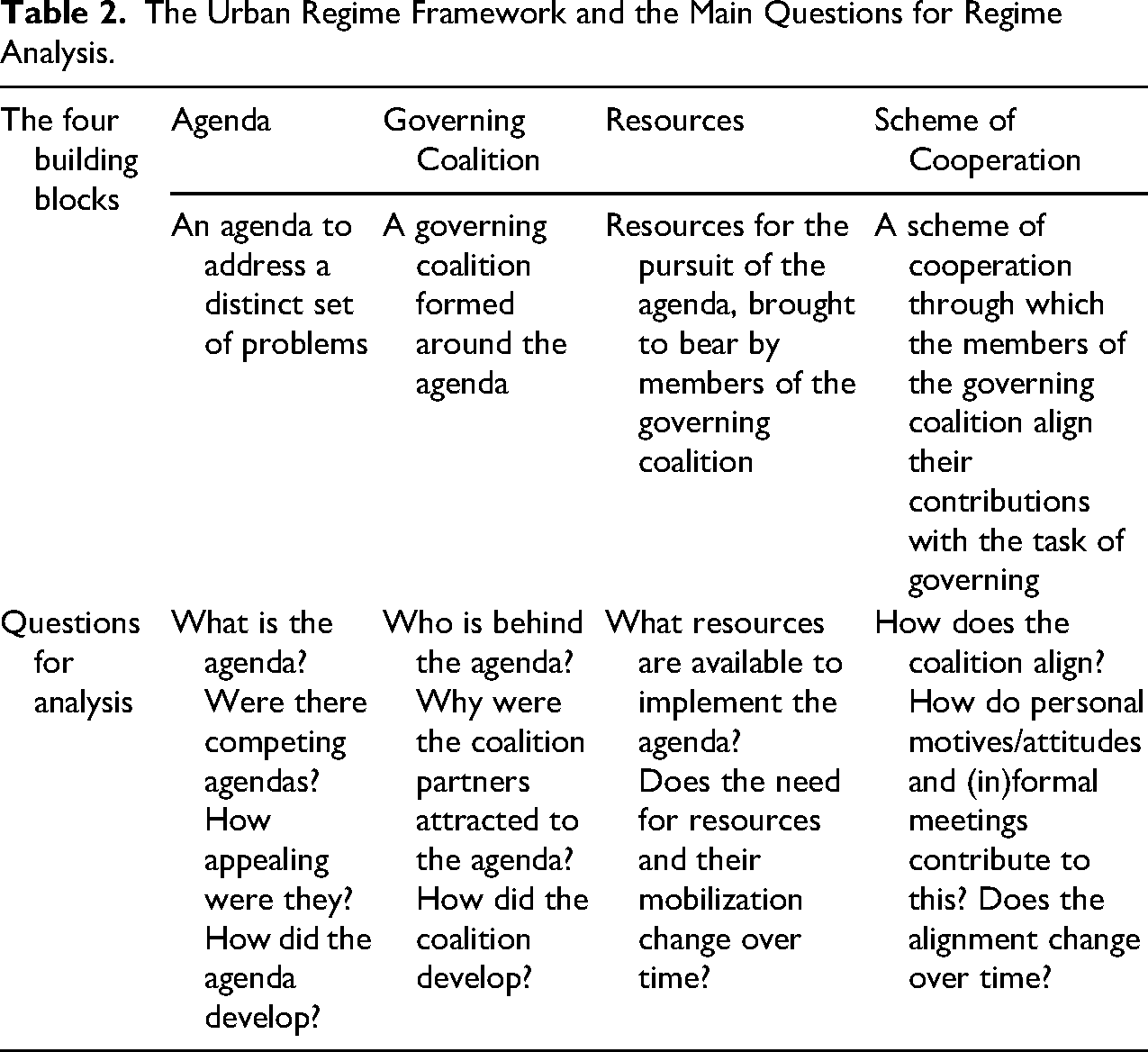
What the Dutch cases have in common is that they use this framework explicitly. The researchers have structured their case descriptions and analyses into different time frames and, for each time frame, they describe the four building blocks separately and try to answer the questions posed in Table 2. Afterward, they discuss whether their case of collective organization followed the general notion (iron law) of the urban regime concept, that is, whether the governing coalition was able to mobilize resources commensurate with its main policy agenda.
Application of the Urban Regime Framework: Introduction to the Cases
Introduction to Dutch Local Governance and Regional Cooperation Practices
The Netherlands has 342 municipalities with an average population of about 50,000 inhabitants. Every Dutch municipality has a representative body, the municipal council, elected by citizens, and a “board of mayor and aldermen,” providing the day-to-day government of the municipality. The mayor is formally appointed by the national government, but the latter will generally follow the preference of the local council. The aldermen are directly elected by the council. Financially, municipalities rely heavily on the national government which is an important actor in financing local governments. This has consequences for their need to align with business: “In Europe [compared to the US], higher levels of fiscal support from central governments, more comprehensive planning controls, more public ownership of municipal land and other factors lessen the need for business involvement as a critical factor for the ‘power to’ achieve development and support local services” (Mossberger 2009, 47). European and Dutch municipalities have nevertheless also increasingly looked for cooperation with other government levels, and private or societal actors to fulfill public goals (e.g., John 2001). In particular, regional cooperation is on the rise. The average Dutch municipality has 33 working arrangements with other municipalities. These can be in a large range of topics, such as infrastructure, youth care, and safety (Van Ostaaijen 2022, 158). However, unlike the municipalities, these regional arrangements lack a directly elected governmental body. The governing boards of these arrangements generally consist of mayors and/or aldermen of the participating municipalities, meaning there is, at best, an indirect democratic legitimacy for these arrangements. Of the three Dutch cases studied, two are concerned with a form of regional government.
Introduction to the Three Dutch Case Studies
The three Dutch cases focus on processes of collective organization: the formal and informal arrangements that enable cooperation between different governing and non-governing actors to solve societal problems (Mossberger and Stoker 2001; Stoker and Mossberger 1994). The studies analyze how this collective organization took place, and whether it was beneficial. One of the cases sought to explain a successful process of collective organization (Rotterdam). One to explain a failed process of collective organization (Arnhem–Nijmegen). The third case adopted a more neutral approach in looking back on how collective organization evolved in two regions witnessing a population decline (Hoeksche Waard and Achterhoek).
The first case deals more specifically with the implementation of a safety policy in the city of Rotterdam (Van Ostaaijen 2010). Rotterdam is the second-largest city in the Netherlands with roughly 600,000 inhabitants. In 2002, Rotterdam's stable political landscape was abruptly disrupted by a new political party “Livable Rotterdam” (LR), an anti-establishment party that captured 34.7% of the votes in the municipal council election. This achievement was preceded by a harsh and polarizing campaign, both from LR, and its leader Pim Fortuyn, as well as its political adversaries. The views of Fortuyn, especially on Islam (a backward culture) and immigration (must be much stricter) gave fuel to his political opponents. The Labor Party, the Christian Democratic Party, and the Liberal Party (at that moment occupying 30 of the 45 municipal council seats) declared that they would not engage with LR in the coalition negotiations after the municipal council election to form a new board of mayor and aldermen. Nevertheless, after the election, the latter two parties did form a political coalition with LR. After this, several of the LR priorities, first and foremost a stricter safety policy, were implemented. The urban regime framework was applied to study this because the rapid changes in safety policy could not be easily explained: how could parties so quickly cooperate after such a polarizing electoral campaign and their apparent unwillingness to work with LR?
The second case deals with building homes in the Arnhem–Nijmegen metropolitan region (Van Ostaaijen and Metze 2012). The metropolitan region of Arnhem–Nijmegen includes about 700,000 inhabitants and is one of the most urbanized regions in the Netherlands. The region possesses a form of regional government, consisting of councilors and aldermen from the participating municipalities. The regional government's main tasks concern infrastructure and housing. The Arnhem–Nijmegen region faced a major housing challenge and, between 2005 and 2010, the municipalities and the regional government agreed to build 26,000 dwellings. However due to various circumstances, primarily the international economic crisis, it became apparent that much less new housing was needed after 2010. The regional government, therefore, tried to convince municipalities to reduce their building plans. Many municipalities however were not convinced they should, leading to resistance to the plans. The urban regime framework was applied to provide lessons on why the post-2010 agenda was much less supported than the initial agenda.
The third case deals with population decline in the Dutch regions of Hoeksche Waard (85,000 inhabitants) and Achterhoek (300,000 inhabitants) (Rutgers 2022; Rutgers-Zoet and Metze 2019). Even though the Dutch population as a whole is growing, there are several regions that face decreasing populations. Those expectations have consequences for the ability to maintain all sorts of facilities, such as schools, companies, and government services. In such regions, regional collaborative initiatives can emerge to counter, or in most cases accommodate, these demographic trends. Such collaborations focus on the quality of life and try to stimulate or improve the housing market, the economy, and all sorts of facilities, from schools to recreation. Two regions that are likely to face a decrease in population are the Achterhoek, in the east of the country, and the Hoeksche Waard, in the west. The urban regime framework was applied because initiating a regional partnership seems a good way to respond to population decline. However, achieving collective action in these regions has not proven easy since this involves allocation issues and more often “sharing losses” rather than dividing profits. The use of the regime framework therefore might provide lessons to help future regions facing similar challenges.
Results
The three case studies share an explicit use of the regime framework (Table 2). As such, the case descriptions are structured in distinct time frames. For each time frame, the building blocks are described separately and answers are sought to the questions posed in Table 2. The three cases thus independently provide information about using the framework. This section starts with a thematic review of the way the urban regime building blocks are handled in the studies and what conclusions can be drawn from that. This will be followed by conclusions regarding regime alignment and why the cases were or were not successful examples of collective organization. Finally, lessons are presented related to the use of the framework in future research.
Agenda
In the Regime Framework, the term “agenda” refers to the set of challenges that policymakers prioritize. Related questions are: What is the agenda? Were there competing agendas? How appealing were they? How did the agenda develop? (Table 2)
The research in Rotterdam covers the period from 1998 to 2008 and describes the emergence of a broad municipal agenda focused on safety. This agenda connects to the feelings of citizens within society who regard low levels of safety as the city's main problem. For instance, in 2001, 20,000 citizens expressed their dissatisfaction in a postcard to the city government, and representatives of sixty neighborhood organizations expressed their concern in a petition to the city government. After the electoral success of LR in 2002, where one-third of the population voted for the new party that declared safety as an important priority, the safety agenda was finalized. The main government document emphasizing this shift in priorities is the municipal board's 2002–2006 program in which the municipality's safety ambitions are presented. For example, the police were given more authority, the use of camera supervision and preventive “stop and search” increased, more supervision was provided in public transportation, extra controls on bars and restaurants were installed, and the approach to dismantling marijuana factories intensified (Tops 2007; Van Ostaaijen 2010). As requested by the mayor, the police and district attorney also provided targets for the way they intended to make Rotterdam safer. These targets were added to the board's program.
In the Arnhem–Nijmegen case, the initial agenda of the regional board was to build more houses. This agenda appealed to the desires of the local municipalities, but also related to a general and broader feeling in society that the historic Dutch problems linked to insufficient housing should finally be solved (Cüsters 2009, 20). After 2010, although houses were still needed, the feeling within the regional government board was that the initial goals should be reduced. Based on scientific data and statistics regarding long-term population and housing developments provided by national agencies, the regional government board tried to convince municipalities to cut back on their construction plans. However, many municipalities that were mainly focusing on their short-term housing problems did not want to scale back construction. They did not think this was in line with their local needs and feared that their citizens would also object. For many municipalities, the new regional agenda was therefore seen as a disappointing change and one they would not automatically adopt.
In the study on the Achterhoek and Hoeksche Waard regions, the researcher describes how, in both areas, agendas were developed around 2010 that aimed to find ways to deal with the expected population decline (Rutgers 2022). The agendas were formulated in a bottom-up way by local societal groups and businesses that were increasingly worried about this expected decline would mean for their services. The agendas start out broad, directed at various themes such as housing, the economy, education, infrastructure, healthcare, vitality, and livability. These led to several decisions, for instance to merge schools or to determine where new housing projects should be established. Over time, the agendas narrowed and economic challenges and perspectives became more dominant. In the Achterhoek, this was fairly explicit, focusing on bringing more “Smart Industry” to the region, thereby reinforcing the economy by using the newest technology. In the Hoeksche Waard, this change was more implicit, with economic projects slowly starting to dominate the agenda. Nevertheless, the reasons for the changes in both regions are quite similar: the participants wanted to move away from what they saw as a negatively formulated agenda (dealing with population decline) towards a more positive focus offering a new perspective in the form of a reinforced economic structure with hopefully more employment as a consequence. In both regions, this agenda was supported by the participants although, for some coalition partners, there was also some unease as they feared that social concerns connected to population decline, such as the maintenance of sports and leisure facilities, would be neglected in favor of focusing on the economy.
When comparing the agendas in the three Dutch cases, one clear similarity is that external circumstances contributed to the formulation of the agenda. While the economic crises can be seen as the most prominent influence in Arnhem–Nijmegen, the other cases equally stem from a clear motivation and necessity. In Rotterdam, the municipality reacted to the growing safety problems in the city, and in the Hoeksche Waard and Achterhoek it was population decline that triggered activity. In the first two cases, this quickly leads to a specific and restricted agenda: the new Rotterdam coalition would mainly focus on improving safety, the Arnhem–Nijmegen coalition on building houses. Only in the Achterhoek and the Hoeksche Waard did the agenda initially start quite broad, focusing on themes such as housing, the economy, education, infrastructure, healthcare, vitality, and livability. The agendas nevertheless narrowed over time, aiming more at economic challenges and perspectives.
Governing Coalition
In the Regime Framework, the governing coalition refers to the coalition formed around the agenda. Related questions are: Who is behind the agenda? Why were the coalition partners attracted to the agenda? How did the coalition develop? (Table 2)
Looking at the Rotterdam governing coalition, the safety agenda was supported by two important changes in its composition. Until 2001, the Labor Party was the dominant party in Rotterdam. Since the Second World War, it had always been the largest political party in both the municipal council as well as on the board of mayor and aldermen. The first change to this Labor Party dominance was the arrival of a new mayor from the Liberal Party in 2001 that, soon after his start, promoted a more coordinated approach towards safety problems. He, however, received no support from the Labor Party-dominated municipal council and board and, as Dutch mayors are appointed by national government and are not directly elected, he lacked the electoral legitimacy to impose his agenda. Subsequently, the electoral victory of LR in 2002 was an important milestone as LR replaced the Labor Party as Rotterdam's largest political party. Now the mayoral efforts to improve safety aligned with a political party that had a strong electoral mandate that was broadly seen as giving a strong sense of urgency to solving the city's safety problems. After this election, the Christian Democratic Party and the Liberal Party joined LR in a political coalition with a majority in the municipal council that supported a more fierce safety policy. This also meant that the aldermen composing the municipal board now came from these three parties and not from the Labor Party anymore. The police and the district attorney then saw extra support and money made available for what was their core task and agreed to work closely with the new coalition. When Fortuyn was murdered in May 2002, this shocked the new governing coalition, especially LR party members. However, at that moment, the new agenda was finalized and the coalition with the mayor as a central actor was functioning. Fortuyn already decided earlier not to be part of the local governing coalition himself as he wanted to devote most of his time to his national political ambitions. This ensured that his passing, even though very shocking for all participants, had no direct consequences for the composition of the coalition.
In Arnhem–Nijmegen, the regional government board took the lead in formulating the house-building agenda prior to 2010 as well as the moderated construction agenda after 2010. The coalition further included the municipalities in the region: their boards of mayors and aldermen, the municipal councils, and civil servants that facilitated all sorts of private partners including construction companies. Not all municipalities were initially enthusiastic with what they sometimes saw as top-down interference in their own tasks but, in general, they enjoyed working on this agenda that clearly connected to wishes in society. Contractors and building constructors were enthusiastic to join the coalition as its agenda fitted their aims well. After 2010, the various coalition partners were less enthusiastic about connecting to the new agenda with reduced construction as promoted by the regional governing board. Most municipalities wanted to keep to their original construction plans and tried to convince the regional governing board that their municipality should be an exception to the general need to cut construction. This distancing from the agenda and from the regional governing board caused increasing tensions within the governing coalition.
The governing bodies in both regions facing population decline comprised local governments, entrepreneurs, and societal organizations. These coalitions started informally: people that knew each other agreed to work more closely. They expressed the view that they could not deal with the challenges of population decline alone. Over time, the composition of the coalitions changed. There are some differences between the regions but, in general, local government participation increased and business participation slightly decreased. This took place in parallel with the agenda focusing more on the economy. Both regions are supported by provincial and national governments, but these governments have remained in the background and did not directly take part in the coalition meetings. Their financial support is valuable, but also caused tensions regarding who in the coalition “owns” this money. Another issue discussed is democratic legitimacy. Especially the participants from the municipalities asked questions regarding who was accountable for the choices made. For instance, if the coalition decided where to merge schools and build homes, and thus where not, how could citizens who opposed those decisions hold the coalition accountable?
When comparing the governing coalitions in the three cases, it seems that the successful ones, those that achieved results, were able to rely on strong governing coalitions, meaning coalitions where the necessary actors supported the agenda. In Rotterdam, democratic legitimacy and money came from the municipal council, while the board, in partnership with the police and district attorney, was able to strengthen the safety policy. In the less successful cases, such strong coalitions were missing. Apart from the fact that, in Arnhem–Nijmegen, the agenda was less coherent and less attractive, the governing coalition was not sufficiently powerful to enforce it, mainly because an important element of the governing coalition—the municipalities—did not fully support it. In the regions facing population decline, the coalitions started out quite broad, but the financial dependence on provincial and national governments caused unease among other partners.
Resources
In the regime framework, “resources” refer to the resources available in pursuing the agenda, brought to bear by members of the governing coalition. Related questions are: What resources are available to implement the agenda? Does the need for resources and their mobilization change over time? (Table 2).
In Rotterdam, the shift in priorities and the new governing coalition meant that important resources could be allocated. This first and foremost meant money: now that the political coalition supporting safety had a majority in the municipal council, it had control over the municipal budget. More than half of the budget for new priorities was directed towards improving safety. This meant 100 million Euros were reallocated between 2002 and 2006. Moreover, the coalition also possessed formal control over the bureaucratic organization and was also able to persuade the police and district attorney to contribute to the agenda. In that way, it not only had access to important municipal assets, such as policymakers and civil servants responsible for improving public order (in the Netherlands, specially trained civil servants can fine citizens for small violations) but also to the formal competences of the police to find and prosecute offenders and criminals.
In Arnhem–Nijmegen, the most important resources that the coalition partners brought to the table were money, professionalism, and competences. In particular, money and formal competences regarding housing construction were important instruments for the regional government board to steer the participating municipalities in the desired direction. The importance of these resources became even more apparent when, around 2010, the national government took some of them away. Although this was a consequence of national political developments, and not directly linked to the Arnhem–Nijmegen region, it nevertheless had a strong effect by weakening the regional government board and has affected the functioning of the entire governing coalition. Many municipalities now felt less need to listen to their regional government and instead tried to implement their own agenda. The regional government board, therefore, had to invest in keeping the coalition together, mainly by resorting to instruments of mutual dependence, such as trying to stimulate a mutual understanding between municipalities and trying to convince the municipalities that the regional agenda would benefit all municipalities in the long run.
In the declining population regions, money was an important resource as well. Both regions mainly needed money and the coalition partners initially held the view that “everybody pays.” This was meant to highlight that everyone, business, society, and government, was connected to and agreed with the agenda. However, in both regions, the contributions from the national government increased, in Hoeksche Waard to about 60%–70% of the total budget and in Achterhoek to the full 100%. This also raised questions as to who was allowed to spend that money. Further, apart from being grateful for this funding, there were also worries that these contributions were intended to gain national influence in the regional initiatives.
When comparing the cases, it becomes clear that resources proved essential in both the successful as well as unsuccessful coalitions. Money was crucial as the most important resource in these forms of collective organization, followed by knowledge and competences. Losing such resources could strongly affect the stability of the coalition, as was shown in Arnhem–Nijmegen. When the regional government board, the most important proponent of the new agenda, lost important financial resources and formal competences, this made successful resistance to the new agenda possible. It seems that a successful governing coalition should therefore be able to provide money. In the Netherlands, this money is often made available by government actors. In Rotterdam—the second-largest Dutch city—the coalition was able to reshuffle its local budget but, in the regional cases, where a one-to-one relationship with a single municipality was absent, the dependence on provincial and national financial resources proved more significant.
Scheme of Cooperation
In the regime framework, the scheme of cooperation refers to the way in which the coalition's actors interact with each other. Related questions are: How does the coalition align? How do personal motives/attitudes and (in)formal meetings contribute to this? Does the alignment change over time? (Table 2).
In Rotterdam, the scheme of cooperation provides a large part of the answer as to why the governing coalition worked. The building of trust and mutual accommodation were central to this process. After the election, most politicians of the established political parties were in shock after the large electoral victory of LR. Nevertheless, LR needed coalition partners as, with 35% of the votes, it did not possess a majority of municipal council seats to enable it to govern alone. LR, and its leader Fortuyn, wanted to work with the Liberal Party and the Christian Democratic Party. Before the elections, Fortuyn was against meetings “behind closed doors,” but now private meetings between the party leaders led to a slow building of trust between the three parties. In these meetings, Fortuyn showed a willingness to support policy proposals from these other parties and provide them with more seats in Rotterdam's main governing body than they could expect based on the electoral results. As justification, Fortuyn explained “to receive trust, you also have to provide it”. LR's former adversaries saw that cooperating with LR could also benefit their own political goals. The Christian Democratic Party for instance received support from LR regarding community-building measures, such as stimulating citizens to take care of their own surroundings. After this initial coalition building, other partners also backed the safety agenda. The national government, the Labor Party (Rotterdam's second largest political party), the police, the district attorney, and the civil service all generally accepted the new agenda. Motivations varied. Several political parties and civil servants did it out of belief in democracy, accepting that if one-third of Rotterdam's citizens voted for this new party, its aims should be realized. Others had a personal belief in or gained from this new agenda, such as the police and the district attorney. Also, the national government included several people supporting the local coalition, partly because of similar political allegiances. That is, from 2002 to 2007, the national counterparts of the local Liberal and Christian Democratic Parties were part of the Dutch national government, as was Fortuyn's national political party for a time in 2002. Equally important was the widespread shock when Fortuyn was murdered in May 2002. This enforced a feeling of unity among the members of the coalition that processed the shock together and were then eager to maintain “his” coalition and “his” agenda. In contrast to the national coalition including Fortuyn's political party that, due to internal differences, fell apart in October 2002, the similar Rotterdam coalition largely held together until the next Rotterdam elections in 2006.
The “scheme of cooperation” in Arnhem–Nijmegen shows that, prior to 2010, there was a well-functioning governing coalition. However, this to an extent was window dressing and in reality, there were many differences between the municipalities within the coalition. These had to do with size (the large municipalities against the small), and also with location. Partly for this reason, the regional board mainly engaged in one-to-one contact with individual municipalities and there were relatively few meetings where all the governing partners would meet and enable a feeling of unity to develop. Before 2010, these differences and the lack of trust did not seem to affect cooperation, mainly because of the abundance of financial resources and the common goal of supporting and facilitating construction. After 2010, municipalities increasingly no longer felt bound by the regional government and instead chose individual strategies to tackle the problems. In the research, it was concluded that the regional government had invested too little in establishing mutual understanding between the municipalities that could have overcome the difficulties when the financial crisis hit.
Looking at the “scheme of cooperation” in the regions addressing population decline—labeled as “structure” in that research—both coalitions started as informal dynamic movements. The people involved at first were mainly from local society and business. Further, they knew each other because they lived close together and shared the same concerns so could identify with each other and develop common plans to tackle the problems linked to the expected population decline. In the Achterhoek, the partners for instance met at “breakfast sessions” to accommodate their often-busy agendas. In the Hoeksche Waard, several meetings took place at one of the participants’ home, with a similar informal character. This informality was considered a strength by most members. The sense of urgency and the common goal also caused the participants to express a strong sense of equality and acknowledge each other's successes. In time, the coalition developed more formal structures, and a governmental and bureaucratic way of working started to dominate the coalitions’ functioning. This to some extent removed the initial informality that appealed to several of the coalition partners. Civil servants become more dominant through working groups and through other bureaucratic forms of support. This led, especially amongst the entrepreneurs, to more discontent, as they had a different view on how to deal with problems. Several of them regretted the development of a more formalized structure and started to criticize the cooperation for mainly talking and little action.
When looking at the scheme of cooperation in the three cases, two things stand out. First, the studies describe the bargaining process between the main actors. In particular, informal meetings proved important in building trust within the governing coalitions. This trust was particularly strong in Rotterdam. Several private meetings between the leaders of the various parties and LR leader Fortuyn's willingness to support his former rivals’ ambitions contributed to this. In the regions facing population decline, the trust decreased from relatively strong when the coalition was starting and operating informally, becoming somewhat weaker when the cooperation became more formalized and bureaucratized, which several of the original participants regretted. In Arnhem–Nijmegen, trust and cooperation was clearly always rather weak: trust between the regional government and the municipalities was never fully established and this led to internal conflicts when the prosperous times disappeared and the economic crisis struck.
Regime Alignment
These three Dutch cases show that, in order to get things done, a viable governing coalition must be able to mobilize resources commensurate with its main policy agenda. In all the instances where successful collective action was delivered (Rotterdam and pre-crisis Arnhem–Nijmegen), the analysis found a fit between the elements. In other words, the successful cases included a governing coalition able to mobilize resources commensurate with its main policy agenda. Conversely, in the less successful cases (post-crisis Arnhem–Nijmegen and, to a lesser extent, the regions facing population decline) such a fit was missing. Here, the form of regime analysis adopted was able to pinpoint the element or building block responsible for the failure. That is, by describing all the elements individually, it was possible to determine in which element, or combination of elements, the failure to achieve a viable governing coalition originated.
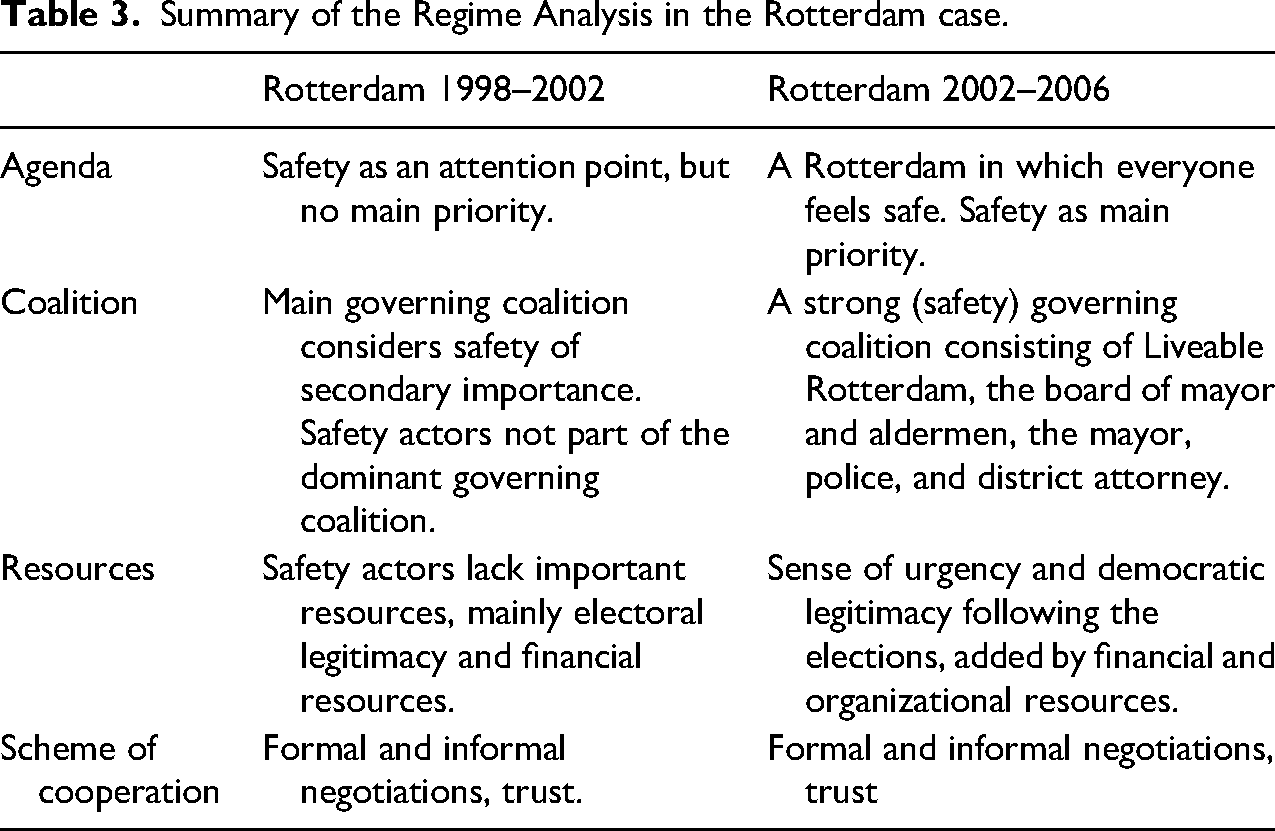
In Rotterdam, the success was stimulated by two main events: the arrival of a new mayor and the electoral victory of a pro-safety party in 2002. Both had direct effects on the resources available. Although, initially, the mayor was not able to direct the necessary financial means, the new political coalition including LR could and, subsequently, more than 100 million Euros was directed to this new agenda. Together with professional resources and competences provided by other coalition partners, such as the police and the district attorney, and the development, mainly through private meetings, of trust between the main actors, a powerful and successful governing coalition was established from 2002 (Table 3).
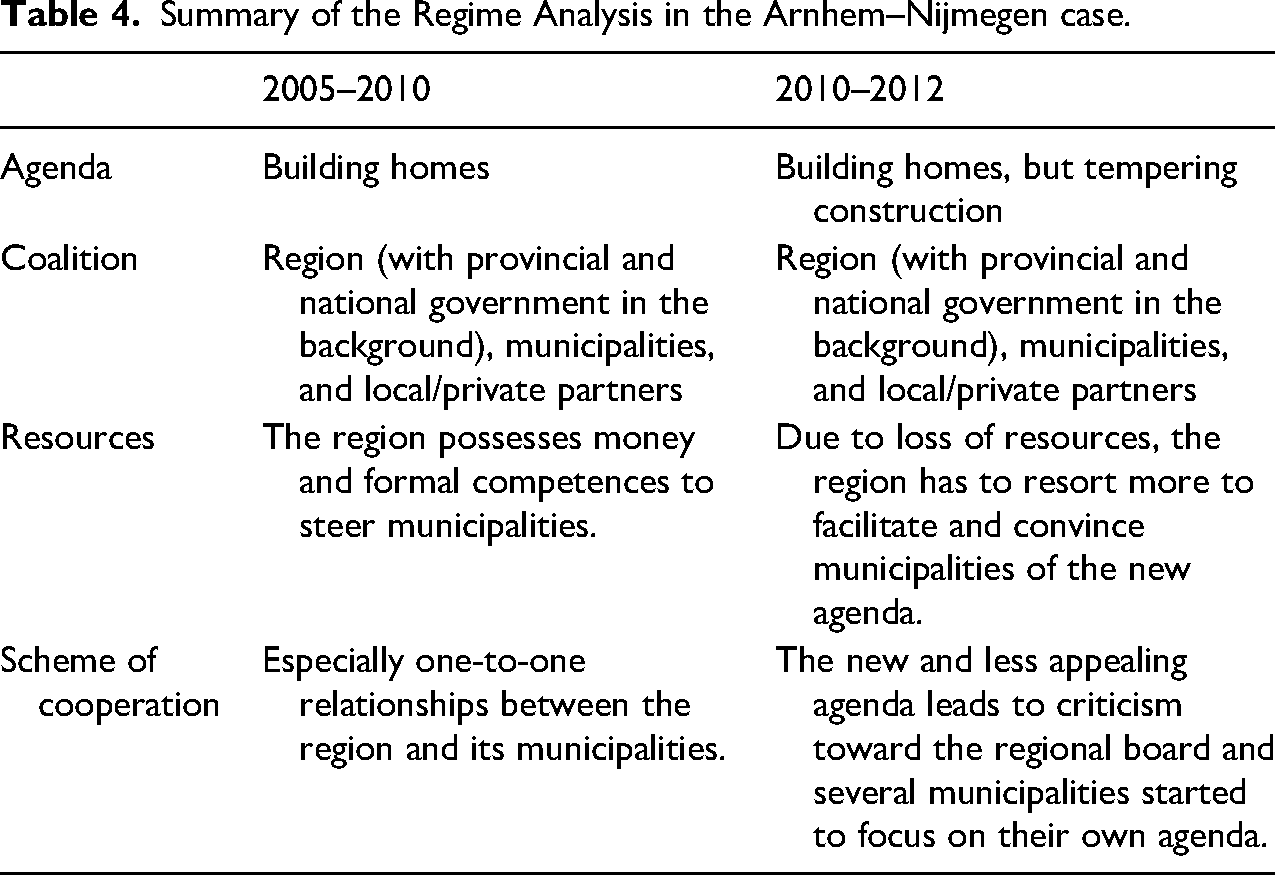
The research in Arnhem–Nijmegen describes the dynamics surrounding two agendas. One to promote building prior to 2010, and one to moderate construction after 2010. Both agendas needed a similar governing coalition that, apart from the regional government board, consisted of the municipalities in the region: their boards of mayors and aldermen, their municipal councils, and civil servants. The most important resources that these coalition partners brought to the table were money, professionalism, and competences. After 2010, the coalition weakened because the regional government had important financial resources taken away by the national government. Municipalities now tried to implement their own agendas rather than complying with the regional board's new desired agenda. The regional government, therefore, had to invest effort in keeping the coalition together, mainly by resorting to instruments of mutual dependence. However, this proved difficult as the differences between the municipalities became more apparent. Before 2010, these differences did not affect cooperation, mainly because of the abundant financial resources and the common goal of facilitating construction. After 2010, these favorable circumstances diminished, and internal tensions rose (Table 4).
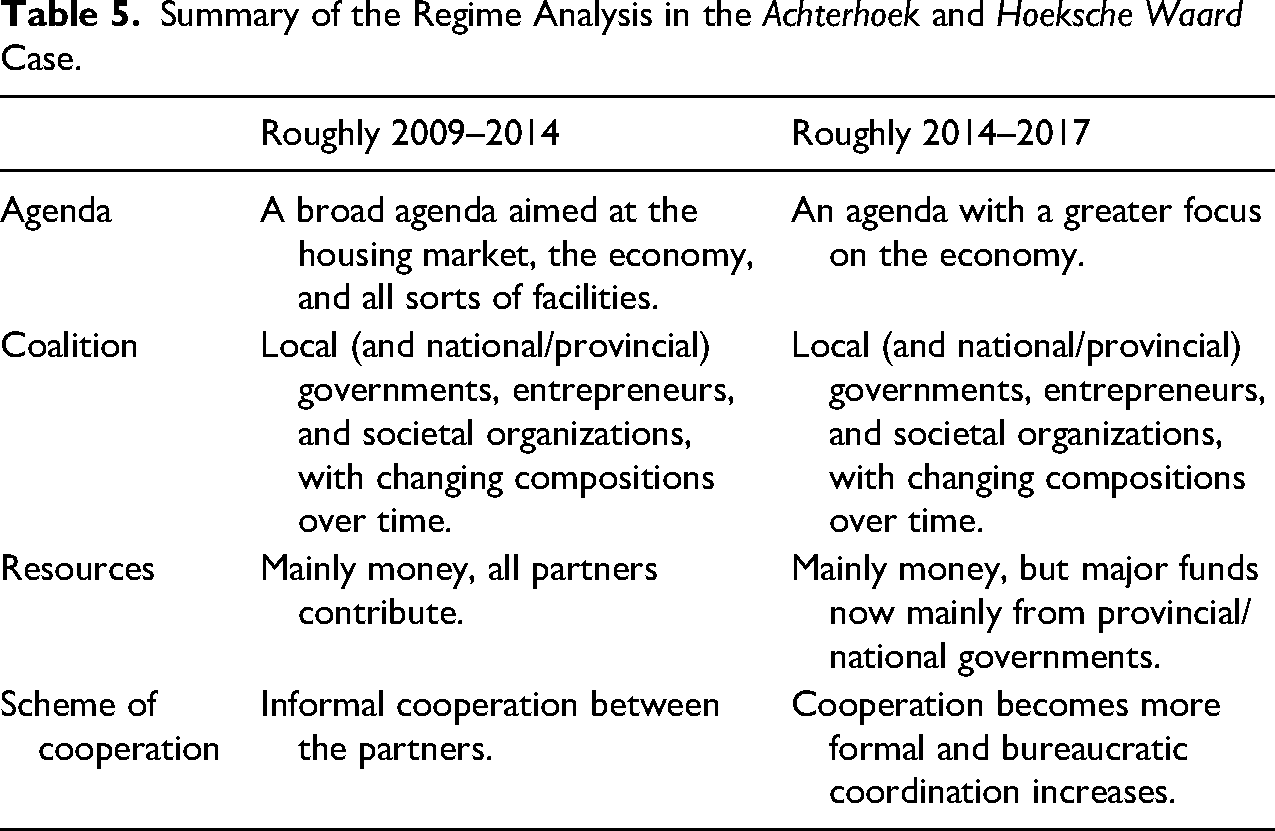
In the Hoeksche Waard and Achterhoek regions, agendas were developed to find ways to deal with the expected population decline. Coalition partners started enthusiastically with a broad agenda that in time became more focused on the economic challenges and perspectives. The governing coalition in both regions comprised local governments, entrepreneurs, and societal organizations. These coalitions started informally: people that knew each other agreed to work more closely together. Later, the cooperation became more formalized. In terms of resources, both regions primarily needed money and the coalition partners initially adhered to the view that “everybody pays.” Over time, national contributions increased and, although this was welcomed, it also raised questions as to who was allowed to spend that money and led to some unease about national influence over the regional coalition. The more formal cooperation also influenced the scheme of cooperation. The initial informality was considered a strength by most members and the subsequent formalization and dominance of civil servants led to greater unease, especially in entrepreneurs who had a different outlook on how to deal with problems and criticized the initiative for mainly talking and little action (Table 5).
Lessons Regarding the Application of the Urban Regime Framework
What makes a comparison between the 3 cases relatively straightforward is that all of them have been constructed in the same way. The analyses of each of the four building blocks is clearly separate in all the studies. By describing all the elements individually, it is possible to determine in which element, or combination of elements, the failure to come to a viable governing coalition originated. Analyzing further cases in the same way, perhaps with even more detail, could reveal that certain agendas dominate in specific time frames or places, that certain governing coalitions fit certain agendas, what the optimum balance is among essential resources such as money, knowledge, and competences, and how trust plays a role in establishing successful governing coalitions.
Nevertheless, some initial observations can be made based on the three Dutch cases studied. In the successful cases, citizens and/or local society played an indirect role in formulating the agenda. In Rotterdam, this was through protest and elections. In Arnhem–Nijmegen, it was mainly the municipalities that advanced the citizens’ wishes for new construction. In the regions facing population decline, it was initially the local society itself that started the agenda. In all three cases, these connections led to agendas that had a significant societal component. This is somewhat at odds with the agendas found in many of the especially early American urban regime studies that focused more on economic development (Mossberger 2009) but does fit well with the more recent urban developments described earlier in this article that also encompass a larger part of local society.
A second observation is that government actors tend to dominate the collective organizational processes. In Rotterdam, this can be explained by the fact that a safety agenda requires predominantly public rather than private action. In the Arnhem–Nijmegen case, the most important role was also filled by the municipalities. In the regions facing population decline, governments and their ways of working also over time started to dominate the coalitions. The main reasons for this seem to be money and competences. In the Dutch governance structure, local governments receive most of their income from the central state, and relatively little from raising their own taxes or public–private cooperation. As such, they do not have a large financial dependence on local private actors. This is a significant difference from that found in American urban regime studies where the need to look for private resources is greater than in Europe (Mossberger 2009). This dependance on national government resources also explains the significant role of the national government in the Dutch coalitions studied. Although the national government does not take part in local coalitions directly, it does have a role in the sense that it is an important provider of money for the local coalitions.
A final observation relates to the “scheme of cooperation” building block. The studies all describe the process of bargaining between the main actors, implicitly or explicitly describing both the formal as well as informal ways of cooperating. Informal ways of cooperation and informal meetings proved especially important in building trust within a governing coalition. These informal meetings generally took place away from the public eye. The Hoeksche Waard, Achterhoek, and Arnhem–Nijmegen cases show that if such informal meetings cease, or never really existed, the stability of a coalition can weaken. However, the functioning of schemes of cooperation does raise questions about democratic legitimacy, as demonstrated in earlier, especially American, urban regime studies as well. If the coalitions include actors that cannot be held accountable by the public, such as through elections, as is the case with private actors, and many of the important decisions are made outside the public eye in informal meetings, how can citizens who are disadvantaged by those decisions hold the coalition accountable?
These insights provide further topics for discussion and thought. Further, the insights certainly do not mean that there are no improvements necessary in the framework used in the analyses. A better development of the framework as well as the way to conceptualize and apply it in future case studies is essential. There is also some overlap in the empirical analyses: for instance, describing the governing coalition comes close to talking about how the coalition cooperates. Based on the framework, these two aspects should be discussed under different building blocks. In practice and in the studies referred to, this has led to some overlap or repetition in the texts. Second, not all researchers interpret the building blocks in the same way. For instance, in reporting the population decline regions, the influence of the provincial government is described under both “agenda” and “resources” (as they provide the most money) but surprisingly not under “governing coalition” (Rutgers 2022)—something that is partly set straight in this article. Such differences will hinder a thorough comparison of multiple cases. On a more detailed note, in one of the studies the “scheme of cooperation” is labeled “structure.” To improve a collective understanding, it would be better to use the original building block labels.
Finally, relating to the central research question in this article, what the cases together show is that, when looking for ways to analyze processes of collective organization, there is a middle course between the broad use of the somewhat abstract urban regime's iron law on the one hand and its strict interpretation on the other. The Dutch case studies show that the urban regime framework can be applied in contexts that are very different from post-war Atlanta but still provide insight into present-day processes of urban governance. At the very least, the framework shows that the urban regime concept can adjust, losing its strict interpretation but not losing the specific urban regime characteristics that set it apart from, and make it more concrete than, concepts such as urban governance. This study shows that in order to compare cases and draw overall conclusions, it is worth explicitly identifying the agenda, coalition, resources, and scheme of cooperation of each case.
Concluding Remarks and Further Study
The aim of this article is to present an Urban Regime Framework that could be used to enhance our knowledge of the collective organization. The heuristic framework presented in this article fits between the strict model of urban regime characteristics and the more general and abstract idea of the urban regime's iron law and notions of urban governance.
This Urban Regime Framework is made up of four central building blocks: agenda, governing coalition, resources, and scheme of cooperation. This article illustrates how that framework has been applied in three Dutch studies and what its advantages are for our understanding of problems of collective organization. However, much work remains to be done. Through a larger number of detailed case studies it will, for instance, become possible to more structurally determine whether governing coalitions in different times and places fundamentally differ in terms of their agenda, the nature of the governing coalition, their use of resources, and the way they organize cooperation.
At the same time, there are several aspects of the urban regime concept and framework that warrant further attention in academic debate and empirical research. Even though the four urban regime building blocks are central to regime analysis, they still seem somewhat theoretically underdeveloped in the urban regime literature. Here, one could benefit from the work of scholars in other fields. For instance, the literature on agenda setting and on leadership could increase our understanding of how, in urban regimes, agendas and coalitions are formed and function.
The “scheme of cooperation” building block might benefit the most from further research. The Atlanta case study, which initiated the urban regime debate, could well have been a unique situation given the composition of its coalition and its agenda, certainly the distinctive way in which the actors aligned is noteworthy. The fact that the Atlanta coalition's scheme of cooperation continues to function in the same way with different individuals becoming involved also shows that “who” governs does not fully explain the process of governing itself. Although regime analysis has the capacity to reveal explanations, there is still much to gain from further research.
Summary of the Regime Analysis in the Rotterdam case.
Summary of the Regime Analysis in the Arnhem–Nijmegen case.
Summary of the Regime Analysis in the Achterhoek and Hoeksche Waard Case.
Footnotes
Acknowledgments

Declaration of Conflicting Interests
The author(s) declared no potential conflicts of interest with respect to the research, authorship, and/or publication of this article.
Funding
The author(s) disclosed receipt of the following financial support for the research, authorship, and/or publication of this article: This work was supported by the Municipality of Rotterdam.
Notes
Correction (February 2024):
Article title has been updated since its original publication.