



Abstract
Refugee integration in small localities poses complex challenges that must be faced through “horizontal” cooperation between local governments, nonpublic and private actors. This article investigates how frequent and how collaborative/conflictual these horizontal governance relations are and whether, and how, they are influenced by political party control of local executives and the local strength of radical right parties (RRPs). Methodologically, we combine quantitative analysis—using a unique dataset of governance interactions across 36 localities, derived from a survey filled in by 185 representatives of nonpublic actors involved in refugee integration governance—and qualitative content analysis of semi-structured interviews conducted with the same interviewees and 68 local policymakers. We show that horizontal governance relations on refugee integration are largely collaborative, but their frequency and quality vary depending on interplays between the type of nonpublic actor involved, local executives’ political affiliation and RRPs’ strength within the municipal legislative body.
Keywords
Introduction
Following the “local turn” in migration studies and the increasing interest of the migration scholarship on local migration policymaking processes, several scholarly works have started to analyze “horizontal governance relations”—i.e., relations between local governments (LGs) and nongovernmental actors such as civil society organizations (CSOs) and the private sector—on the specific issue of migrant or refugee integration (Bazurli and Kaufmann 2023; Lidén, Nyhlén, and Nyhlén 2013). Such interest is in line with broader developments in political science and public administration studies which led to increased scholarly interest on how LGs coordinate complex systems of relations with other governmental authorities and multiple stakeholders to increase their capacity to deal with the local effects of globalization (Agranoff 2018).
Despite the important contribution made by the existing scholarship on horizontal governance relations in the migration policy field, we claim it has three main limitations. First, existing works mostly focus on big cities, and much less attention has been given to relations between LGs and nonpublic actors in small localities, particularly in Europe (for an exception: Semprebon, Marzorati, and Bonizzoni 2023). These localities have been largely under-researched by political scientists, especially outside of the United States (Kumar and Stenberg 2023). However, in the specific field of migration, their importance in policy debates in Europe has increased remarkably in the last decade: while these localities traditionally received less immigration (Caponio and Pettrachin 2021), they have recently started to play a crucial role in European refugee reception and integration, mostly as an effect of dispersal or redistribution schemes for asylum-seekers implemented by national governments during the 2015 European “refugee crisis” (Gauci 2020; Lidén and Nyhlén 2015).
Second, the prevalence of case-study analysis makes it hard to get a clear understanding of how relations between public and nonpublic actors develop and of the nature of these relations (Schiller, Martínez-Ariño, and Bolíbar 2020). Many existing contributions have described positive collaborations between LGs and nonpublic actors (Alexander 2007; Caponio 2010; Schiller 2019), suggesting that these collaborative relations are related to local policymakers’ tendency to adopt pragmatic policymaking approaches aiming at problem-solving (the so-called “local pragmatism thesis”; see Haselbacher and Segarra 2022; Hillmann 2022; Lidén and Nyhlén 2015). Another strand of the literature has instead emphasized conflicts between LGs and nonpublic actors (particularly CSOs) in the field of immigrant integration, which is mainly seen as an effect of the growing politicization of asylum-seeking migration at the local level (Campomori and Ambrosini 2020; Pettrachin 2020).
Third, we still know very little about the drivers of collaborative/conflictual relations between LGs and nonpublic actors (Schiller, Martínez-Ariño, and Bolíbar 2020). For instance, we lack a clear understanding of whether and how local political factors (such as political party control of local government or the presence of anti-immigration parties) are associated with the emergence and development of horizontal governance relations on immigrant integration. The so-called “local pragmatism” thesis suggests that local policymakers tend to adopt nonideological policymaking approaches oriented at problem-solving in this policy field regardless of their political affiliation and strategic considerations (Bolin, Lidén, and Nyhlén 2014; Lidén and Nyhlén 2015). Conversely, other scholars have shown that, in the context of the growing politicization of migration, political party control of local government and the local presence of radical right parties (RRPs) can decisively influence local integration policymaking processes (Moutselos and Schönwälder 2022; Pettrachin 2023a; Semprebon, Marzorati, and Bonizzoni 2023; on RRPs in local government see Paxton 2019, 2023).
This study aims to contribute to these debates on local integration governance in small European localities filling the above-mentioned research gaps. To do so, we aim to answer the following research questions about relations in the refugee integration policy field between local policymakers (more specifically, we focus on elected members of local executives and top-level public administrators
1
) and nongovernmental actors involved in refugee integration governance (henceforth: horizontal governance interactions) in small Western European localities (SWELs):
How frequent and how collaborative are these horizontal governance interactions between local policymakers and different types of nongovernmental actors i.e., CSOs and the private sector? How do the frequency and quality of these horizontal governance interactions vary depending on the political affiliation of local executives and the strength of RRPs in the local legislative body? Why and how do these political factors influence the above-mentioned horizontal governance interactions?
To answer these questions, we adopt a relational approach—i.e., one which “systematically generates and analyses empirical data on actors’ relationships” (Schiller, Martínez-Ariño, and Bolíbar 2020, 2044)—providing the first (to the best of our knowledge) large-N quantitative analysis of local governance interactions related to the integration of humanitarian migrants
2
(henceforth: refugee integration). Such approach is characterized by three important innovative features which further complement existing qualitative works: first, we focus on SWELs rather than big cities; second, we distinguish between horizontal relations involving CSOs and the private sector; third, we focus on both the frequency of horizontal relations and on their “quality”, i.e., on whether these are (perceived by the actors involved to be) collaborative or conflictual.
More specifically, we develop a mixed-methods strategy, combining quantitative and qualitative data. To study horizontal governance relations in SWELs and their drivers, we use a new and unique dataset including quantitative relational data about the frequency and quality of integration-related interactions between local policymakers (i.e., local executives and top-level administrators) and nonpublic actors. Such data were collected through 185 structured interviews filled in by representatives of CSOs (of different types) and actors from the private sector involved in refugee integration governance in 36 SWELs. These localities all had local executives controlled by mainstream political parties and were selected through a rigorous case selection strategy (see Setting below). These data are analyzed applying multi-level regression models. Following Schiller and colleagues’ (2020) approach, to further clarify the findings of our quantitative analyses—and explore our third question—we rely on semistructured interviews conducted with the same 185 nonpublic interviewees and additional interviews conducted with 68 local policymakers in the same localities, analyzed applying qualitative content analysis (Zhang and Wildemuth 2005).
Overall, our analysis produces three main findings about horizontal governance interactions on refugee integration in SWELs controlled by mainstream political parties. First, the article shows that these interactions on refugee integration, overall, are largely collaborative, which supports a view of integration governance as consensual rather than conflictual. Second, interactions between local policymakers and the private sector on refugee integration are more frequent in localities with local executives controlled by progressive parties compared to executives controlled by conservative parties. Our qualitative data suggest that this might be the effect of a more passive approach to refugee integration policymaking of conservative local executives compared to progressive ones (shaped by their different political ideologies and responsiveness to—and perception of—public opinion) and to the fact that public-private collaborations very much rely on the initiative of local policymakers, while CSOs reach out to local policymakers regardless of the political orientation of local executives. Third, the strength of RRPs within the municipal legislative body is associated with the existence of more collaborative relations on refugee integration between local policymakers and actors from the private sector. Our qualitative analysis suggests that this might be an effect of local policymakers’ adaptive strategies vis-à-vis public opinion and the political competition of anti-immigration parties. These findings contribute to existing debates on the relationship between migration governance and politics (Caponio, Talleraas and Schiller, forthcoming).
The article is organized as follows. The second section reviews the existing literature on integration governance in SWELs and describes our hypotheses. The third section describes our methodology. The fourth section illustrates our findings. The conclusion summarizes the key contribution of this article and reflects upon their implications and limitations, suggesting ways forward for future research.
Horizontal Governance Relations in the Integration Policy Field
Two Research Strands on Horizontal Governance Relations
There are two different strands or perspectives in the existing literature on horizontal governance relations at the local level. The first strand, which we call “local pragmatism” strand (for a review see: Schiller 2019; see also: Schammann et al. 2021; Steen 2016), describes CSOs and (to a lesser extent) the private sector as key partners of LGs in the integration policy field, especially with respect to the implementation of integration programs and the delivery of local social services (Dimitriadis et al. 2023). For these scholars, relations between LGs and nonpublic actors emerge in order “to get things done” (Alexander 2007; Penninx and Martiniello 2004), and they are highly collaborative, and characterized by a convergence of aims and purposes (Scholten and Penninx 2016), including in more politically contested areas such as the accommodation of undocumented migrants (Spencer 2018).
A second strand, which we call “local battleground strand,” instead, emphasizes the existence of conflicts between LGs and nonpublic actors, particularly pro-migrant CSOs and nonpublic service providers (Campomori and Ambrosini 2020; Pettrachin 2023b). This strand mostly includes works focusing on the 2015 “refugee crisis,” when asylum-seekers’ dispersal and challenges related to the organization of the reception system led to mobilizations by both extreme right movements and pro-migrant activists (Della Porta 2018). This strand has therefore argued that local migration policymaking should be understood as a “battleground” where two different camps of pro- and anti-migrant actors—each including public and nonpublic actors—interact developing conflictual relations across camps and collaborative relations within each camp (Campomori and Ambrosini 2020; Dimitriadis et al. 2023; Pettrachin 2023b).
While the “local pragmatism” and “local battleground” perspectives move from the assumption that nonpublic actors and LGs develop interactions in the integration policy field, they disagree on the quality of these interactions, which are seen as collaborative or conflictual. In fact, most of the above-mentioned works focus on CSOs, and very rarely consider the private sector. The few existing works that cover local interactions between LGs and the private sector seem to suggest that, while CSOs tend to be more proactive in initiating policymaking interactions and reaching out to local policymakers (Dimitriadis et al. 2023; Semprebon, Marzorati, and Bonizzoni 2023), businesses tend to play a more passive role, particularly in the case of refugee integration (Ioannou 2015; OECD and UNHCR 2018; Wang and Chaudhri 2019). Therefore, we formulate the following hypothesis:
In addition, the “local battleground” perspective stresses the conflictual nature of relations between CSOs and LGs (see Dimitriadis et al. 2023; Haselbacher and Segarra 2022; Pettrachin 2023b; Zamponi 2018). This is arguably related to the increasing politicization of migrant integration at the local level (Della Porta 2018; Haselbacher and Segarra 2022). Zamponi (2018, 119) points out that CSOs involved in local migration governance often combine service provision with “visible and contentious political participation.” The scarce existing literature on the private sector discussed above instead does not report about any conflicts between private actors and LGs. None of the existing works on the “local battleground” refers to local conflicts about migration involving actors from the private sector. Overall, compared to CSOs, the private sector can be expected to take less confrontational approaches with LGs on issues related to refugee integration due to its involvement in the field being often motivated by its own specific interest or by needs to “manifest corporate social responsibility” (Wang and Chaudhri 2019) rather than by ideological motivations. We therefore formulate the following hypothesis:
The Role of Political Factors
Few of the above-mentioned scholarly works have tried to identify the drivers of conflictual or collaborative interactions between public and nonpublic actors in the integration policy field. Most of these studies focus on big cities (for a review: Schiller, Martínez-Ariño, and Bolíbar 2020). The few existing case studies on small localities have particularly emphasized political factors as key drivers of horizontal governance relations. In fact, the “local pragmatism” and “local battleground” perspectives point to very different roles of political factors. The former suggests that local policymakers tend to adopt pragmatic (non-ideological) policymaking approaches on immigrant integration, regardless of their political affiliation and of the political context where they operate (Scholten and Penninx 2016). Conversely, the “local battleground” perspective implies that, because of the growing politicization of migration, policymakers’ strategies and their relations with other local actors on immigrant integration might be decisively influenced by local political dynamics (see e.g., Dimitriadis et al. 2023; Fleischmann and Steinhilper 2017; Pettrachin 2023b). Broader debates in political science have also suggested that political dynamics can decisively influence governance relations, particularly in small localities, due to these localities’ more limited problem-solving capacity, the less diverse network of associations in these localities, and the higher centrality of elected policymakers in policymaking compared to big cities (Baglioni et al. 2007; Eckersley 2017, 80). The prevalence of negative public attitudes to migration in smaller localities (Huijsmans 2023) also suggests a high potential for political factors to influence integration governance.
More specifically, existing case-studies have shown that two political factors can influence policymaking approaches and governance relations in small localities. The first factor is political party control of LGs. A few scholars have observed that LGs with local executives controlled by center-right/conservative parties tend to adopt more passive policymaking approaches compared to LGs with local executives controlled by center-left/progressive parties (Moutselos and Schönwälder 2022; Pettrachin 2023a; Semprebon, Marzorati, and Bonizzoni 2023). Such effect is observed in the literature for both elected members of local executives and top-level public administrators, who are politically nonaligned but tend to be “sensitive” to the political context in which they operate (Nalbandian 2006). We therefore expect the frequency and quality of horizontal governance relations in SWELs to vary depending on political party control of local executives (among mainstream parties):
The second factor that is analyzed in the existing scholarship is the local presence or strength of RRPs. While two studies conducted before 2015 have shown that the strength of RRPs within municipal legislative bodies did not affect local migration policymaking in Sweden and Norway (Bolin, Lidén, and Nyhlén 2014; Steen 2016), some more recent scholarly works have shown that the presence of RRPs in municipal legislative bodies did influence integration policymaking (Oosterlynck et al. 2023). The existing scholarship, however, identifies different types of effects. Some scholars have shown that the local strength of RRPs led local executives to disengage from (or not to engage in) local migration governance (Oosterlynck et al. 2023; Pettrachin 2020; Schenkel, Messerschmidt, and Grossmann 2023; Steen and Røed 2018). Oosterlynch and colleagues (2023) explain that such effect is mainly due to RRPs’ influence on local public debates in local media and on political debates within municipal legislative bodies/assemblies, which affect local agenda-setting and lead LGs to decrease their involvement in activities related to immigrant integration. On the other hand, other scholars have observed a higher involvement of CSOs in integration policy implementation (and a growth in the number of local pro-migrant volunteering associations) in localities with a stronger presence of RRPs, due to a more proactive mobilization of civil society—or “pro-social backlash”—in response to the strong presence of RRPs (Castelli Gattinara and Zamponi 2020; Pulejo 2022). Oosterlynch and colleagues also showed that the passive approach on integration-related issues adopted by local policymakers in Fermo (a small Italian town), due to the strong presence of RRPs, led local policymakers to delegate responsibilities related to immigrant integration to local CSOs, which could possibly result in more frequent horizontal governance relations. Based on these works, we develop two alternative hypotheses about the effect of the local strength of RRPs within municipal legislative bodies on the frequency of horizontal governance relations on refugee integration:
Whether through increased delegation or complete disengagement from integration governance, this literature suggests that a higher local strength of RRPs tends to lead LGs to adopt stricter local migration policies (Gamalerio and Negri 2023). This is likely to increase the potential for conflicts between local policymakers and non-public actors involved in integration governance (Castelli Gattinara and Zamponi 2020). This leads us to formulate the following hypothesis:
Type of Actors and Political Factors
Political party control of local executives and the local strength of RRPs might have a diversified impact on local policymakers’ interactions related to refugee integration with the private sector and CSOs. As already stressed, the existing literature points out that CSOs working on immigrant integration tend to be more proactive in initiating policymaking interactions and reaching out to policymakers regardless of their political affiliation and particularly when the migration issue is highly politicized (Semprebon, Marzorati, and Bonizzoni 2023). None of the reviewed scholarly works has, however, analyzed whether and how the political affiliations of local executives influence horizontal governance relations on immigrant integration with the private sector. Traditionally center-right parties’ positions on migration were assumed to be close to those of the business sector, but Hadj Abdou, Bale, and Geddes (2022, 12) have recently argued that such once privileged relation has recently disappeared as, for these parties, “business interests have become much less potent compared to the concerns of citizens.”
Similarly, very little is still known about how the strength of RRPs might influence integration-related governance interactions between local policymakers and the private sector. Wang and Chaudhri (2019) and Ioannou (2015), as part of broader analyses, suggest that business initiatives to favor refugee integration are less likely to emerge when migration is highly politicized and/or the private sector perceives negative sentiments from public opinion, and even more when the private sector faces both societal pressure and a LG hostile to refugees.
We therefore expect integration-related relations between CSOs and local policymakers to be less affected by changing political circumstances. Conversely, we do expect a stronger effect of both political factors in the case of integration-related relations with the private sector, as the literature suggests that public-private collaborations largely rely on proactive approaches of local policymakers in starting these interactions:
Methodology
Setting
The paper focuses on 36 localities located in seven Western European countries (Austria, Germany, Sweden, The Netherlands, Belgium Spain, Italy) which all received sizeable numbers of asylum-seekers during the so-called 2015 “refugee crisis” (Eurostat 2017). These countries are characterized by different political systems (centralized, semi-federal, federal) and by a different degree of autonomy granted to local authorities, but in all of them LGs play a role in the implementation of integration policies and/or can develop autonomous integration policies (Caponio and Pettrachin 2021).
Individual case-localities were identified through a rigorous “diverse case selection strategy” (Gerring and Cojocaru 2016, 400). Gerring and Cojocaru (2016, 400) define this case selection strategy, that implies “choosing a small basket of diverse cases from a large population of potential cases,” as follows: The chosen cases are diverse if they represent all potential factors (Z), including causal conjunctures, that might explain variation in Y. The assumption is that the true causal factors (X) are to be found among the putative causal factors (Z). (…) For a continuous variable, one must construct cutoff points (based on theoretical understandings of the phenomenon or natural breakpoints in the data), for example, dichotomizing or trichotomizing the variable, and then choosing cases with each discrete value. If one suspects that causal factors interact, then one will look for cases that represent all possible (or actual) intersections of these variables (understood as categorical variables). Two dichotomous variables produce a matrix with four possible cells, for example. (Gerring and Cojocaru 2016, 400)
Data
The quantitative analyses conducted in this article use original survey data collected between November 2021 and February 2022, through a survey filled in by 185 representatives of nonpublic actors involved in local integration governance in the above-mentioned localities. 7 These nonpublic actors include a mix of CSOs involved in local integration governance (nonpublic service providers, pro-migrant NGOs, migrant associations, trade unions, n = 141) 8 and private actors (private companies or employers’ associations, n = 44).
Interviewees were selected based on a criterion of relevance as we aimed to reach within each locality all the key actors involved in integration policymaking or policy implementation (we tried to reach individuals in high-level positions within their organizations). The response rate to the survey was 45%. 9
As part of the survey, interviewees were asked four questions (see Table A01 in the online supplemental materials). First, we asked our interviewees about the frequency of the interactions on immigrant integration that took place in their locality, in 2021, between their organization and (a) elected members of the local executive and (b) top-level (nonelected) public administrators. The frequency was measured on a scale of 0–5: (0) Never; (1) Occasionally (only once, or once a year); (2) 2/3 times per year; (3) Monthly/bimonthly; (4) Weekly (or 2/3 times per month); (5) Daily (or 2/3 times per week). Second, we asked our interviewees to assess the quality of these interactions, measured on a scale of 1–5: (1) Very conflictual; (2) Rather conflictual; (3) Neither conflictual nor collaborative; (4) Rather collaborative; (5) Very collaborative. A missing value was assigned if respondents had previously declared that they had no interactions with local policymakers. Our unit of analysis is therefore the interaction between our interviewees and local policymakers. To the best of our knowledge, this is a unique dataset on policymaking interactions in small localities.
Furthermore, we used several data about the socio-economic, demographic and political context of our thirty-six case-localities (see next section), retrieved from the websites of national statistical offices or of individual municipalities.
The qualitative analysis conducted in the second part of this article instead relies on qualitative semi-structured interviews conducted with the same 185 interviewees and additional sixty-eight interviews with local policymakers in the same case-localities 10 (see Table A19 in the online supplemental materials). During the interview, nonpublic actors were asked to provide more details about their relations with local policymakers, to reflect upon their role in refugee integration governance and upon the factors that influence their activities and involvement in this policy field. Local policymakers were asked to describe their relations with nonpublic actors on refugee integration and about the factors that influence their policymaking activities and relations.
Variables
This subsection describes the variables we use in our quantitative analyses.
Dependent variables. Our two dependent variables are:
– The frequency of interactions between local policymakers (i.e., elected members of local executives and top-level public administrators) and nonpublic actors (“FREQUENCY”), measured on a scale of 0–5 (where 0 = never and 5 = very frequent interactions). To create this variable, we calculated the mean of interviewees’ answers to the questions about the frequency of their interactions with elected members of local executives and top-level public administrators. – The quality of these interactions (“QUALITY”), measured on a scale of 1–5 (where 1 = very conflictual and 5 = very collaborative). To create this variable, we calculated the mean of interviewees’ answers to the questions about the quality of their interactions with elected members of local executives and top-level public administrators. We considered as missing values all the respondents that declared to have no interaction to the frequency question.
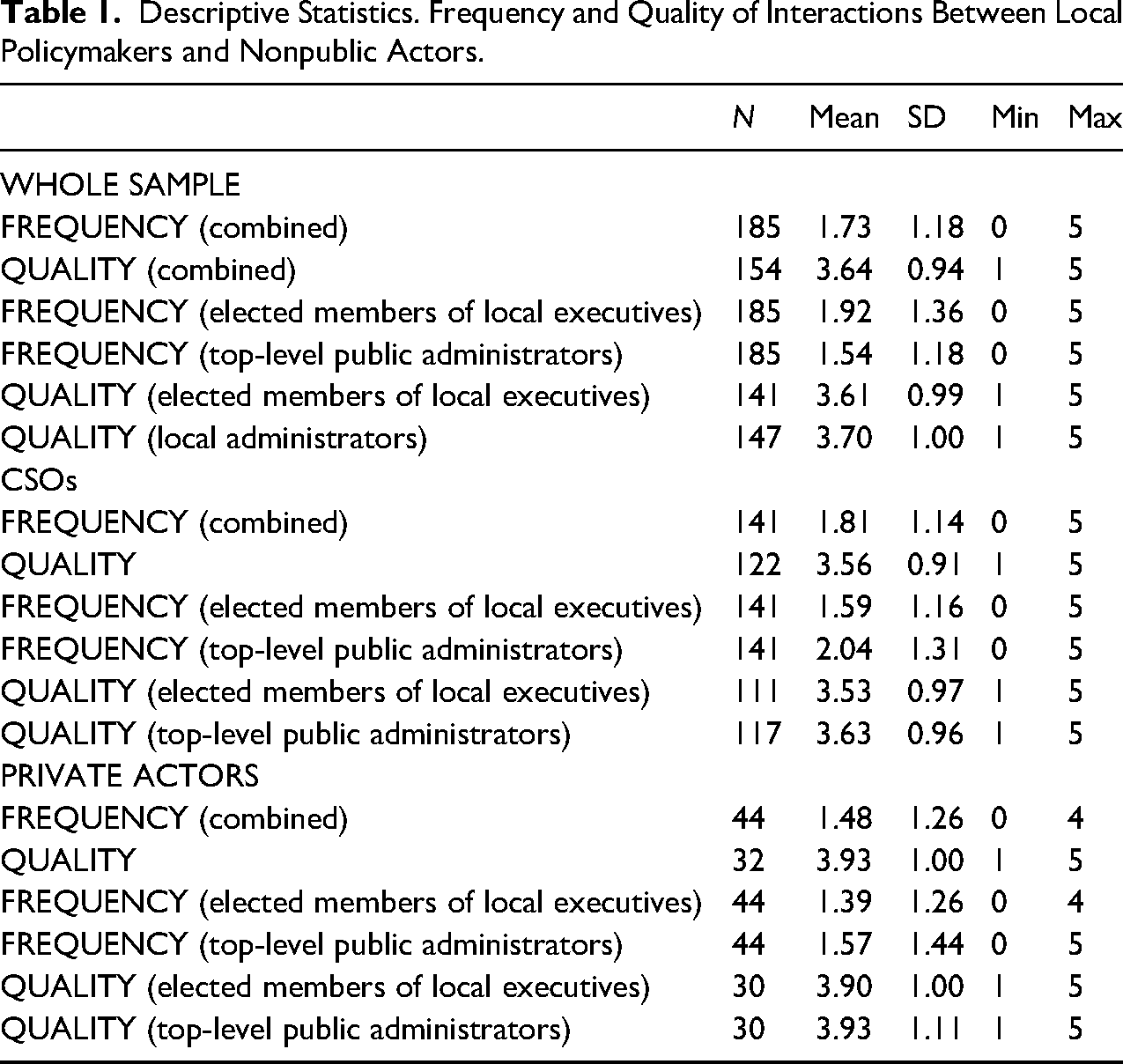
Table 1 illustrates the descriptives for the two dependent variables and the four questions from which the two dependent variables were derived. We calculated the combined means of these two questions for each of our dependent variables, because the individual means were comparable, and the means for each individual question were highly correlated (r = .7, p = .000 for each pair). Overall, respondents have rather infrequent interactions, but interactions are rather collaborative. As the table shows, there are no major differences in respondents’ answers about relations with local executives and local administrators. Table A03 in the online supplemental materials shows the answers’ distribution, sorted for the two separate groups.
Descriptive Statistics. Frequency and Quality of Interactions Between Local Policymakers and Nonpublic Actors.
Main independent variables. Our main independent variables are:
Type of nonpublic actor (“ACTORS”) that indicates whether interviewees are from CSOs (i.e., nonpublic service providers, trade unions, pro-migrant NGOs or migrant organizations) or the private sector (private companies or employers’ associations). Political affiliation of local executives (“POLITICS”). We assessed the political affiliation of local executive bodies (“POLITICS”) using a scale of “progressivism,” where 0 = conservative, 1 = mixed, and 2 = progressive. We labeled as “progressive” local executives controlled by parties affiliated to the Socialists and Democrats or Greens-EFA. We labelled as “conservative” local executives controlled by parties affiliated to the European People's Party. In a few cases, conservative and progressive party coalitions controlling the local executive also include parties affiliated to Renew Europe and local parties.
11
We labelled as “mixed” local executives controlled by a mix of conservative and progressive parties. Overall, thirteen of our case-localities were categorized as conservative, 17 were categorized as progressive, six were categorized as mixed.
12
Local strength of RRPs (“RADICALRIGHT”). In order to establish the local presence of RRPs we looked at the share of seats that RRPs (i.e., parties affiliated to the European Conservatives and Reformists or Identity and Democracy defined as “far-right” by the PopuList 2023) hold in the municipal legislative body. We used the logarithmic version of the variable as its distribution was highly skewed.
Control variables. The following additional independent variables are included in our models to control for other theoretically grounded determinants of local integration policymaking (as done, for instance, by Bolin, Lidén, and Nyhlén 2014). We tried to limit the control variables as much as possible, due to the low number of cases: Number of inhabitants (“SIZE”); Share of non-EU foreign citizens who reside in the locality in 2019 (“DIVERSITY”). In the robustness checks, we also introduced the following control variables: Unemployment rate in the locality in 2019 (“UNEMPLOYMENT”); Index of local autonomy (“AUTONOMY”); Country variables (“COUNTRY FIXED EFFECTS”). See Table A4 in the online supplemental materials for a detailed description of the control variables and Table A5 in the online supplemental materials for the descriptive statistics of all variables.
Analytical Strategy
To answer the research questions and test our hypotheses, we proceeded in two steps.
First, to test our hypotheses, we conducted a set of multilevel linear regression analyses. The analysis of the correlation between the variables in the main models (Table A6 in the online supplemental materials) displays no strong correlation, meaning that no problems of multicollinearity arose. We first ran a model, with the main effects (H1–3) and then two models with the interaction variables needed to test our additional hypotheses (H4 and 5), namely ACTORS*POLITICS and ACTORS*RADICALRIGHT. We did this for both dependent variables “FREQUENCY” and “QUALITY.” We included FREQUENCY as control variable in the model with QUALITY as dependent variable. However, we did not include QUALITY as control variable on the model with FREQUENCY as dependent variable (because this would have meant to exclude the cases for which FREQUENCY is equal to “0”).
We decided to apply a multilevel approach, given the nested structure of our data, composed of 185 interviewees grouped in thirty-six municipalities. The number of municipalities is rather low (N = 36) and this can be potentially problematic in multilevel analysis, but the existing literature confirms that our model should be statistically robust (see Bryan and Jenkins 2016, 19–20). 13 To limit the complexity of the analyses and increase their statistical power, we limited the main models to the three main variables plus SIZE and DIVERSITY as control variables. Nevertheless, we conducted a set of robustness checks (see Appendix in the online supplemental materials). First, we ran the same models with country fixed effects, to control for unobserved countries’ characteristics. Second, we ran the main effect models with the additional control variables UNEMPLOYMENT, AUTONOMY (see previous sub-section). Third, we ran a set of one-level linear regression (OLS), using the cluster option in Stata, which tells the software that the data are clustered. This is not the same of a multi-level model and the estimates of the coefficients are the same as the OLS estimates, but the standard errors consider that the observations within municipalities are not independent. Fourth, we conducted an additional robustness check to see whether the results hold when a multilevel ordinal regression model is run: in the main analyses we treated both FREQUENCY and QUALITY as continuous variables but in fact these variables are only semi-continuous.
The second and final step of our analysis entailed conducting a qualitative content analysis of our interview material (Zhang and Wildemuth 2005), with the support of the Atlas.ti software, to further clarify the mechanisms that explain our quantitative findings, and particularly findings about the interactions between our main independent variables ACTORS, POLITICS, and RADICALRIGHT. 14 This seemed particularly relevant considering the limited literature from which our H4a, H4b, H5a, and H5b were derived.
Findings
In the first part of this section, we are going to present the results of our regression models, starting from the frequency and then moving to the quality of interactions, as well as several additional analyses and robustness checks. In the second part we present our qualitative findings.
Main Regression Models: Frequency of Interactions
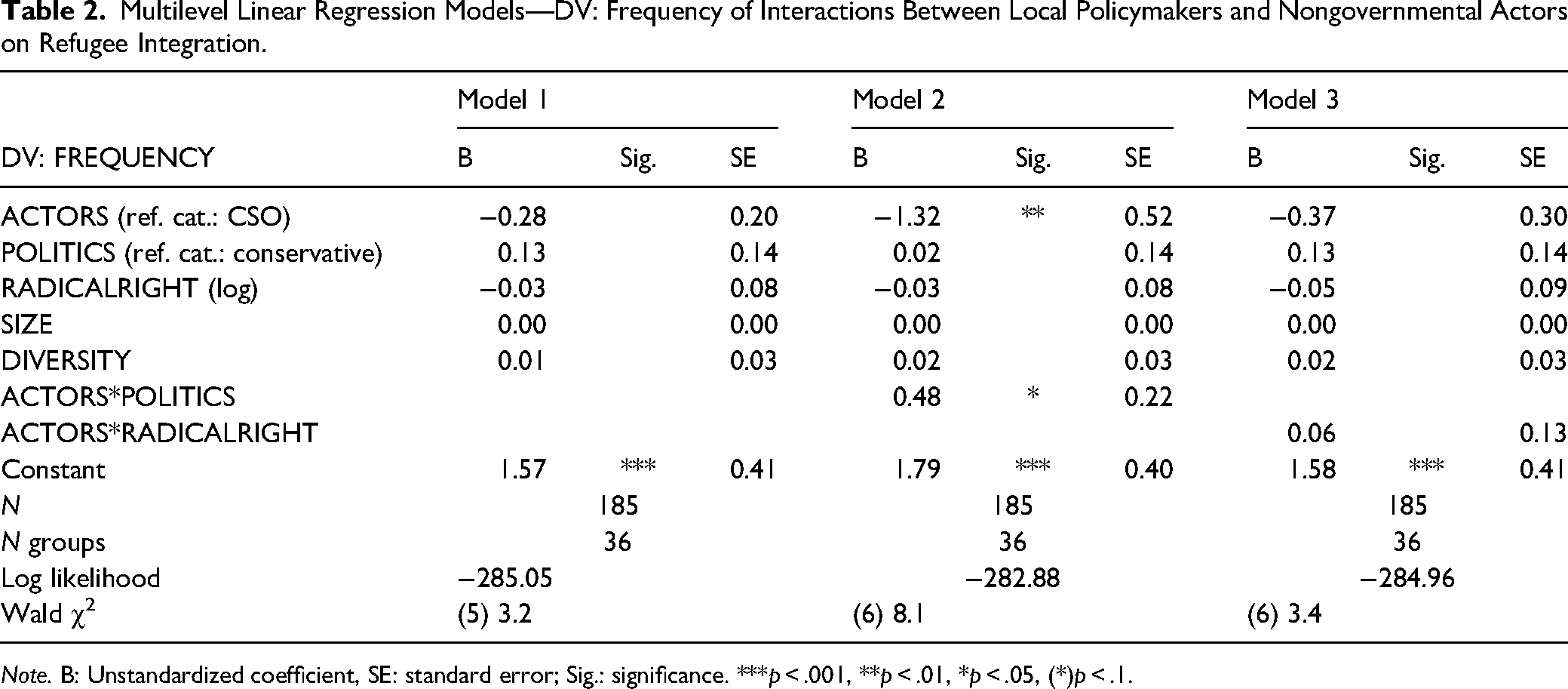
Table 2 shows the multilevel regression models related to the first dependent variable, i.e., the frequency of interactions related to refugee integration between nonpublic actors and local policymakers (FREQUENCY).
Multilevel Linear Regression Models—DV: Frequency of Interactions Between Local Policymakers and Nongovernmental Actors on Refugee Integration.
Note. B: Unstandardized coefficient, SE: standard error; Sig.: significance. ***p < .001, **p < .01, *p < .05, (*)p < .1.
In Model 1, we tested H1a, which predicted more frequent interactions between local policymakers and CSOs compared to interactions between local policymakers and the private sector. As our ACTORS variable is not statistically significant, H1a is rejected. The model also shows that our variables POLITICS and RADICALRIGHT are not significant in this first basic model. This means that, overall, there is no association between the frequency of interactions between local policymakers and nonpublic actors and the political affiliation of local executives, nor with the local strength of RRPs. H2a, H3a-1, and H3a-2 are therefore not confirmed. None of our control variables is statistically significant, meaning that the FREQUENCY variable is not influenced by the size of localities or their experience with cultural diversity (nor by socio-economic characteristics of the locality or their degree of local autonomy, introduced in our robustness checks).
Models 2 and 3 report the results of the interactions between the type of nonpublic actor and the two political variables (the political affiliation of local executives and the strength of RRPs). H4a stated that the association between the political affiliation of local executives and the frequency of horizontal governance interactions is stronger in the case of interactions with the private sector compared to interactions with CSOs. The interaction effect in Model 2 is statistically significant (p = .03). In the model, the main effect of POLITICS, which refers to the association between the political affiliation of the local executive and the frequency of interaction when the actor is a CSO (ACTORS = 0), is not significant. This result suggests that, in the case of governance relations involving CSO, the frequency of interaction is not associated with the political affiliation of local executives. This is also confirmed by Figure 1, which provides a visualization of the predictive margins of the interaction between ACTORS and POLITICS. By contrast, Figure 1 clearly shows that the frequency of the interactions between local policymakers and private actors increases as the political affiliation of the local executive becomes more progressive. The main effect of ACTORS refers to the association of this variable with the quality of interactions when the political affiliation of the local executive is conservative. The significant negative effect (B = −1.32, p = .01) reveals that the private sector tends to have less frequent interactions with local policymakers than CSOs when the local government is conservative (although the confidence intervals partially overlap) but this difference in the frequency of interaction vanishes as the government's political affiliation becomes more progressive. This is also made clear by the two lines moving closer in Figure 1. This is in line with our expectations according to which: (1) interactions between local policymakers and actors from the private sector are more frequent in localities with local executives controlled by progressive parties compared to localities with local executives controlled by conservative parties; and (2) the association between our variables FREQUENCY and POLITICS is not significant in the case of interactions between local policymakers and CSOs. H4a is, therefore, confirmed.
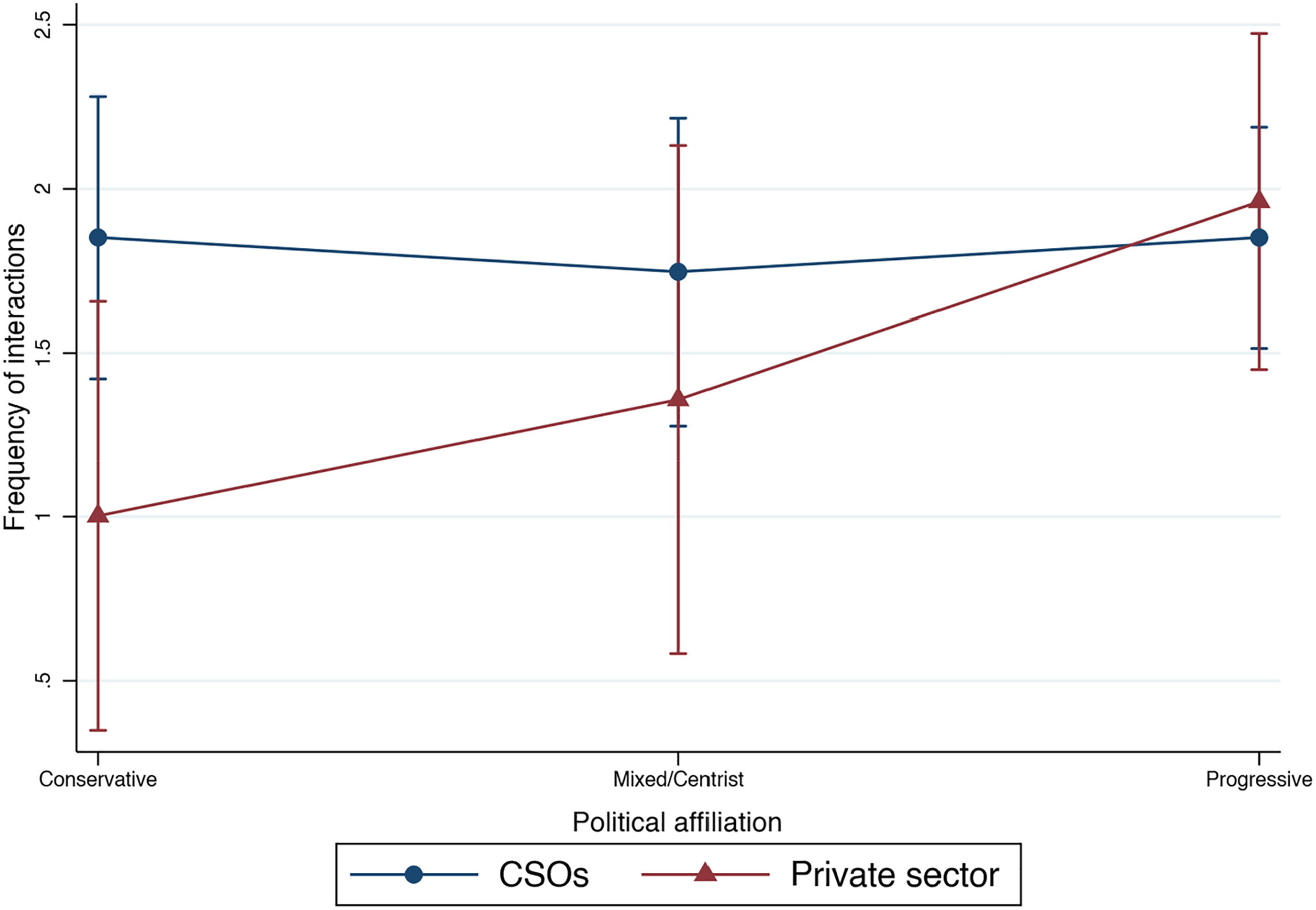
Predictive margins of the interaction ACTORS*POLITICS (linear prediction, fixed portio).
H5a suggested that a similar dynamic might have applied to the case of relations between nonpublic actors and local policymakers of localities characterized by a different strength of RRPs in the municipal legislative body. This is not confirmed by the results as the effect of the interactions between ACTORS and RADICALRIGHT is not significant.
These results are confirmed also by our robustness checks: multilevel linear regression with control variables, multilevel ordinal regression models and linear regression with cluster robustness check (see Table A7 in the online supplemental materials). 15
Main Regression Models: Quality of Interactions
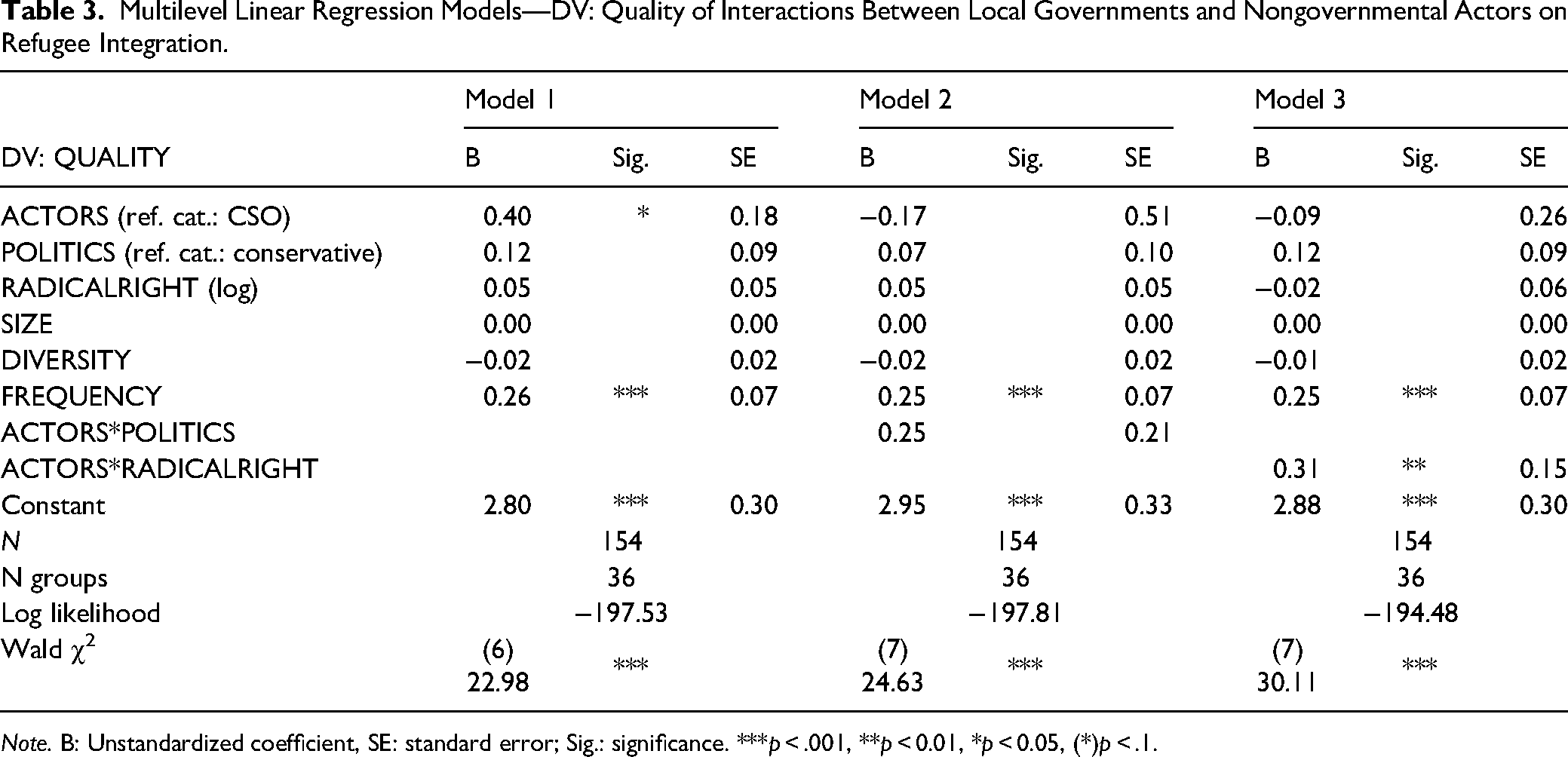
In this subsection, we illustrate the models we developed to examine the association between our main independent variables and our second dependent variable QUALITY, i.e., the quality of horizontal governance interactions (how collaborative or conflictual they are). Table 3 below therefore shows our multilevel regression models related to our second dependent variable.
Multilevel Linear Regression Models—DV: Quality of Interactions Between Local Governments and Nongovernmental Actors on Refugee Integration.
Note. B: Unstandardized coefficient, SE: standard error; Sig.: significance. ***p < .001, **p < 0.01, *p < 0.05, (*)p < .1.
In Model 1 (Table 3) we tested our H1b, according to which we expected relations between local policymakers and the private sector to be more collaborative compared to relations between local policymakers and CSOs. Model 1 shows the results of our main independent variable ACTORS while controlling for several possible confounders. The ACTORS variable is statistically significant, which suggests that actors from the private sector have more collaborative (or less conflictual) interactions with local policymakers than CSOs (B = 0.40; p = .02). Our H1b is therefore confirmed. Furthermore, in this model, the independent variables POLITICS and RADICALRIGHT are not significant, suggesting that, overall, the political affiliation of local executives and the strength of RRPs in the municipal legislative body are not associated with more or less collaborative relations between local policymakers and nonpublic actors. H2b and H3b are therefore rejected. As for previous models, all our control variables are not statistically significant, with the only exception of the FREQUENCY variable, suggesting that, not surprisingly, actors that have collaborative relations interact more frequently.
Models 2 and 3 report the results of the interactions between the type of actors and our political variables. H4b stated that interactions between local policymakers and actors from the private sector are more collaborative in localities with local executives controlled by progressive parties compared to localities with local executives controlled by conservative parties, while the association between FREQUENCY and POLITICS is not significant in the case of interactions between local policymakers and CSOs. This is not confirmed by the results as the effect of the interaction between ACTORS and POLITICS is not significant.
According to H5b, we instead expected interactions between private actors and local policymakers to be more conflictual in localities where RRPs hold a higher share of seats in the municipal legislative body, while this association was not expected to be significant in the case of interactions between local policymakers and CSOs. In our model, the interaction effect between ACTORS and RADICALRIGHT is significant (p = .01), while the main effects of ACTORS and RADICALRIGHT are not. In this model, the main effect of ACTORS, which refers to the association of the variable with the quality of interaction when there is no RRP representation in the municipal legislative body (RADICALRIGHT = 0), is not significant. This means that, in the absence of RRPs, the quality of horizontal governance interactions involving CSOs and private actors does not differ. This is also shown in Figure 2, which provides a visualization of the predictive margins of the interaction between the two variables. Conversely, Figure 2 clearly shows that, when RRPs have a higher share of seats in the municipal legislative body, relations between local policymakers and the private sector are more collaborative than relations between local policymakers and CSOs. In other words, in localities with stronger RRPs, local policymakers and the private sector have more collaborative relations than in localities with weaker (or absent) RRPs. In the model, the main effect of RADICALRIGHT refers to the association between the share of seats for RRPs and the quality of interaction when the actor is a CSO (ACTORS = 0). Although Figure 2 reveals that there is a slight deterioration of relations between local policymakers and CSOs when there is a higher share of RRPs, the fact that the main effect of RADICALRIGHT is not significant suggests that this deterioration is not statistically relevant. Overall, our H5b is therefore confirmed.
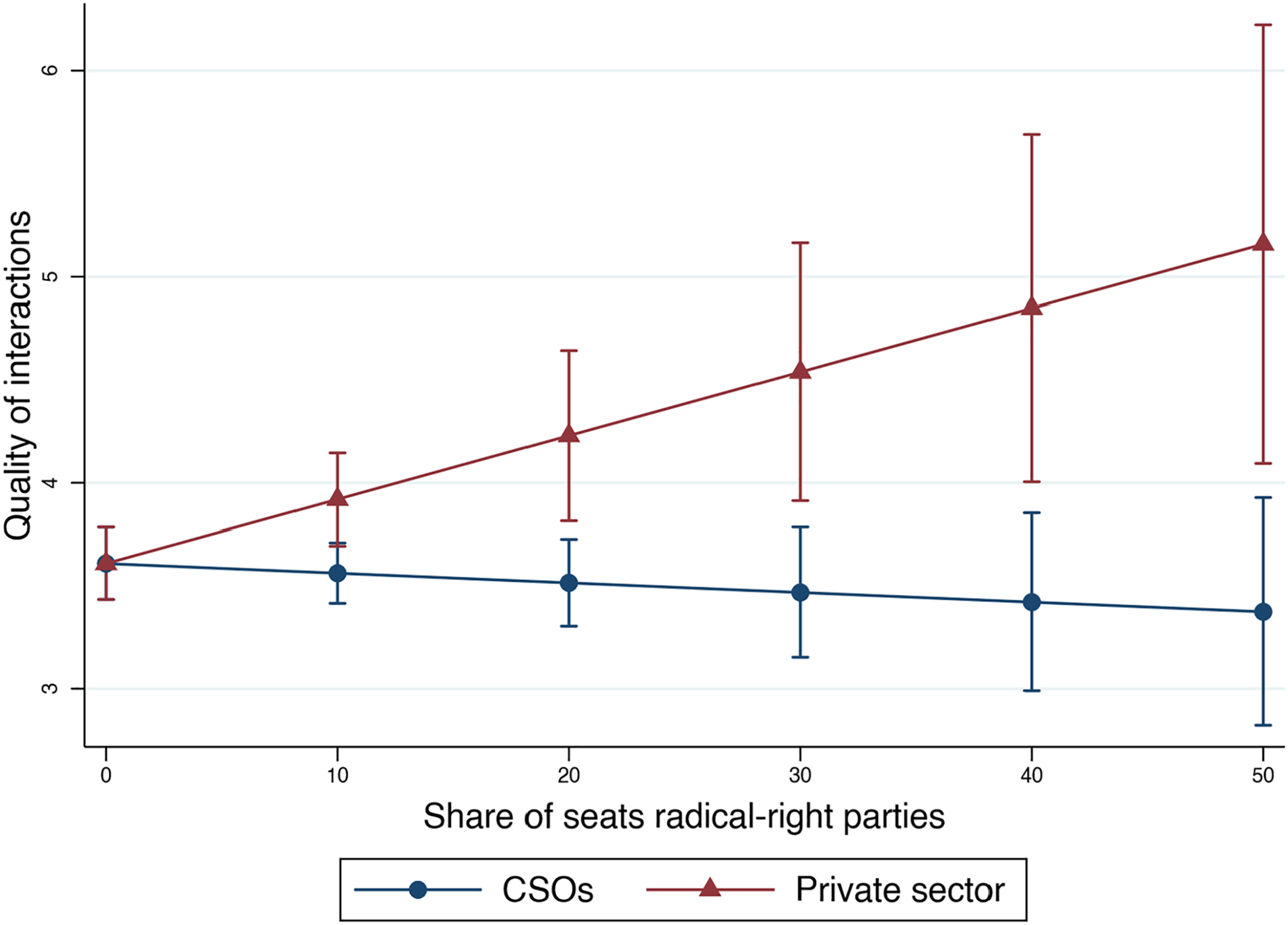
Predictive margins of the interaction ACTORS*RADICALRIGHT (linear prediction, fixed portion).
We also ran a set of robustness checks: multilevel linear regression with control variables, multilevel ordinal regression models and linear regression with cluster robustness check (see Table A6 in the online supplemental materials). All the above-mentioned results are confirmed by these robustness checks.
Additional Regression Analyses
In this sub-section, we present several additional analyses, which: (a) introduce an alternative variable to assess the strength of RRPs based on electoral results of RRPs at the locality level in national elections; (b) differentiate among different types of CSOs; and (c) replicate the main models illustrated above for elected members of local executives and nonelected public administrators (separately).
The local strength of RRPs in national elections. We introduced an alternative variable to assess the local strength of RRPs, assessing the share of votes these parties received in our localities in the last national elections (“RADICALRIGHT_NATIONAL”), which could also potentially affect horizontal governance interactions. As our new variable is correlated with the share of seats held by RRPs in local legislative bodies/assemblies (r = .64, p = .000) we decided to run these additional analyses replacing our variable measuring the local strength of RRPs with the “RADICALRIGHT_NATIONAL” variable (see Tables A11 and A12 in the online supplemental materials). Remarkably, in our models neither the main effect of RADICALRIGHT_NATIONAL nor the interaction of this variable with ACTORS are statistically significant. This holds for both the frequency and the quality of interactions. All the results are confirmed when including all the control variables (results are not reported). This finding suggests the association between RADICALRIGHT, ACTORS, and QUALITY identified in the previous section concerns, specifically, the strength of RRPs in local government and not the electoral strength of RRPs more broadly (i.e., having part of the local population supporting RRPs). 16
Types of actors. In the main analyses, we limited our focus to the comparison between CSOs and actors from the private sector. As the frequency (and quality) of interactions might potentially vary in the case of different types of CSOs (e.g., Schiller, Martínez-Ariño, and Bolíbar 2020), we looked at differences between a wide range of actors: nonpublic service providers, trade unions, pro-migrant organizations, private actors (Tables A13 and A14). 17 We first looked at different types of civil society actors, compared to the private sector (Table A13—Model 1 and Table A14—Model 1 in the online supplemental materials). The main analyses on the frequency of interactions (Table 2) showed that the ACTORS variable was not significant. This additional analysis largely confirms this finding, showing that there are no differences between the private sector and all the other types of organizations, with the exception of nonpublic service providers, which have more frequent interactions with local policymakers than private actors (B = 0.44, p = .04). The main analyses on the quality of interactions (Table 3) showed that actors from the private sector have more collaborative (or less conflictual) interactions with local policymakers than CSOs. This additional analysis reveals that, although all types of CSOs have less collaborative interactions than private actors, this difference is statistically significant only for nonpublic service providers (B = −0.41, p = .03), but not for trade unions and pro-migrant organizations. These results point at possible differences between nonpublic service providers—which are directly funded by the LG to provide services—and the other nonpublic actors (CSOs). Further additional analyses however show no statistical differences in both frequency and quality of interactions between nonpublic service providers and other CSOs (see Table A13—Model 2 and A14—Model 2 in the online supplemental materials). In addition, we also investigated the differences in the frequency and quality of interactions between pro-migrant groups, which primarily do advocacy work (besides also often offering services to migrants; see above), compared to the other CSOs and the private sector. Results of these analyses show that the frequency and quality of horizontal governance interactions involving pro-migrant groups are not different from those involving other CSOs or private actors (see Table A13—Model 3 and A14—Model 3 in the online supplemental materials).
Elected members of local executives and nonelected public administrators. The main analyses were conducted for our main dependent variables which were created calculating average values for answers interviewees provided to two questions related to interactions with elected members of local executives and nonelected public administrators. In this section, we replicate our analyses for each of the two groups separately (see Tables A15–A18, in the online supplemental materials). Results of the analyses conducted for interactions with local executives and local administrators are highly similar to those of the main analyses. As in the main analyses, for both members of local executives and public administrators, there is no significant association between the frequency of interactions and the variables ACTORS, POLITICS, and RADICALRIGHT, nor a significant effect of the interaction between ACTORS and RADICALRIGHT. However, for interactions with public administrators, the coefficient of the variable ACTOR is close to the conventional threshold of statistical significance (B = −0.42, p = .06). The positive interaction between ACTORS and POLITICS is confirmed only for interactions with public administrators (B = 0.62, p = .02), while the coefficient does not fully reach the conventional threshold of statistical significance in the case of interactions with local executives (B = 0.38, p = .1). As in the main analyses, there is a positive association between ACTORS and QUALITY for both elected politicians (B = 0.35, p = .07) and public administrators (B = 0.33, p = .09), although the coefficients do not fully reach the conventional threshold of statistical significance. In addition, the not significant association between the quality of interactions and the variables POLITICS and RADICALRIGHT and of the interaction between ACTORS and POLITICS is confirmed for both members of local executives and public administrators. These analyses confirm the positive effect of the interaction between ACTORS and RADICALRIGHT for both public administrators (B = 0.31. p = .02) and elected politicians (B = 0.31, p = .02).
Understanding the Mechanisms Behind the Influence of Political Factors on Horizontal Governance Interactions: Qualitative Findings
This section illustrates key insights derived from our qualitative analysis, which, as previously mentioned, aims to further clarify the mechanisms that might explain our results about the interactions of our main independent variables ACTORS, RADICALRIGHT, and POLITICS, considering that our fourth and fifth hypotheses were derived from a very limited existing literature. This analysis is still exploratory in nature and cannot make any definitive conclusion about causal relations.
Party control of local government and governance relations involving different types of nonpublic actors. A key finding from the quantitative analyses was that horizontal governance interactions involving the private sector tend to be more frequent in localities with local executives controlled by more progressive parties, while interactions involving CSOs do not vary depending on this political variable. Our qualitative analysis suggests that this might reflect a more proactive approach in integration governance by executives controlled by progressive parties, who more actively seek collaborations with nonpublic actors compared to conservative executives. The effects of this more proactive policymaking approach are more visible in the case of relations with the private sector as most of the public-private collaborations described by our interviewees were initiated by the local executives. For instance, a progressive Swedish elected member of local government explained that starting interactions with the business sector was more difficult, but that after various efforts on the side of the local executive “a few companies finally showed some interest to discuss how to better work together toward solutions that approach newly arrivals/immigrants” (interview 130). This trend does not emerge in the case of relations with CSOs, due to the already discussed tendency of CSOs to reach out to local policymakers regardless of the political affiliation of the local executive: I think that the relationship between civil society and the LG is not optimal, let's say. There is still work to do. Why? I think it's because, maybe we don't have the same sensitivities, so civil society doesn't need voice… the goals aren't the same (…), the LG needs to please everyone and maybe the fact of being seen collaborating with civil society, it can be… I don't know. It's a calculation, so it's a calculation that political parties do, that civil society does not do. Civil society is driven by objectives and convictions. (CSO, locality with local executive controlled by conservative parties, Belgium—interview 206)
This quote also provides a potential explanation for the absence of any association between the political affiliation of local executives and the quality of horizontal interactions on refugee integration. This quote suggests that the higher reluctance of local policymakers of localities controlled by conservative executives in reaching out to nonpublic actors is not necessarily related to the presence of conflicts among them (none of the conservative local policymakers interviewed reported of any conflict with the business sector), but rather to a willingness not to be seen by the public (or their electorate) to engage in initiatives in support of migrants. Our analysis also reveals that, when we asked local policymakers about the key factors that influenced their policymaking activities on refugee integration, public opinion was the factor that was mentioned more often. As an Austrian conservative policymaker put it “we realised that it was not only the FPÖ [radical right] protesting [against migrants], it was also people from our own ranks, also ÖVP party members, also from this side” (Interview 161). The representative of an Austrian pro-migrant group explained that “once elected, local politicians must make compromises and disregard their own values” (interview 166).
The stronger proactiveness in local integration governance of policymakers in localities with executives controlled by more progressive parties (which leads to a higher frequency of interactions with the private sector) might instead be explained by two different factors. First, progressive policymakers seem to perceive public opinion as less hostile to migrants compared to conservative policymakers. Conservative policymakers assess public opinion as much more hostile to refugees than the nonpublic interviewees in the same locality, while no significant difference can be identified in the case of progressive policymakers. Another key factor is party ideology. The top-level administrator responsible for integration in an Austrian locality (with a local executive controlled by progressive parties) that developed strong collaborations with nonpublic actors explained that: Our own values are crucial for the work we do. The way in which the integration issue is being handled is related to the clear position of the majority party [the centre-left SPÖ]. Formally, our office [responsible for immigrant integration] does not have to exist by law. Our office exists at the request of the party, and we implement the party's values, policy-wise. (Top-level administrator, locality with local executive controlled by progressive parties, Austria—interview 55)
First, local policymakers facing strong RRPs seem to need for stronger allies to foster refugee integration and justify inclusive stances on refugee integration. More than a delegation of integration tasks to the private sector (which would have also led to an increase in the frequency of public-private relations, see Oosterlynck et al. 2023), our interviews suggest that collaborations with employers is exploited by local policymakers under pressure from RRPs as part of their communication strategies. This seems to be related to the belief that collaborations with the private sector are less problematic for (elected) policymakers’ public image compared to collaborations with CSOs (see also the first quote reported above): The LG looks for the stage, for the stage it's always nice to seek cooperation, isn't it? (…) [Collaborations with the LG] always end up in the newspaper, with the alderman who pats on the back of the business community (…). After that nothing more happens, you know, it's just for the stage. (Employers’ association, locality with local executive controlled by progressive parties, the Netherlands—interview 134)
Second, the local weakness of RRPs seems to remove incentives for (particularly progressive) local executives to actively develop initiatives and collaborations for refugee inclusion, particularly with the private sector (which tends to be less proactive in reaching out to local policymakers). This is suggested by interviews conducted in a Walloon medium town where RRPs are absent at the local level: There is not really any politicization of the migration issue here. We are somewhat, in quotes, lucky to have had left-wing parties in power for a long time. (…) But this also means that we take the question of integration too little in hand, which is paradoxical. (…) As the question is not really politicized, there is no grip for local politicians. (Top-level Administrator, locality with local executive controlled by progressive parties, Belgium—interview 215)
This quote suggests that the effect might be more broadly related to the political weakness of RRPs in the locality (in Wallonia RRPs are very weak also in higher-level elections) rather than specifically to their absence from local legislative bodies/assemblies but our quantitative findings have not found any association between the frequency and quality of horizontal governance interactions and the electoral strength of RRPs in national elections.
More broadly, our exploratory analysis suggests that localities where RRPs are very strong and localities with no RRPs are characterized by different types of “coalitions” between public and nonpublic actors involved in local integration governance. In localities with no RRPs, interviewed local policymakers very rarely mentioned private actors when illustrating their key local partners in the integration policy field. This is in line with findings of the existing migration scholarship, particularly before the recent politicization of migration, suggesting that private actors and LGs are typically characterized by different approaches to refugee integration policy, with the private sector more interested in facilitating migrants’ economic inclusion (e.g., through trainings and language courses) and LGs more oriented to service provision and social inclusion (see e.g., Buscher 2018). Conversely, interviewed local policymakers in localities with strong RRPs tend to describe the private sector as a key ally or an actor that is part of the same “camp” of the local battleground. Among the others, a progressive elected policymaker in a Dutch locality characterized by a high presence of RRPs highlighted that the LG “worked very well not only with the COA [Central Agency for the Reception of Asylum-Seekers] and with the volunteer organization, but also with employers’ organizations” (interview 145), which are depicted as key partners that develop crucially important integration work. In a German progressive locality with high presence of RRPs a progressive politician reported that the local executive is “highly excited” about a new project they developed with some private companies to provide language courses to refugees, and also described these companies as key partners (interview 253). In a Swedish municipality with a progressive executive and high presence of the RR, an elected politicians (interview 112) reported that the type of initiatives that the local executive developed on integration were mostly driven by elected politicians’ own values and that convergence at the level of ideas and goals was the key element that led to a recent very successful collaboration developed with various local actors including both CSO and private actors, which all worked together to facilitate young refugees’ integration in the labor market.
Conclusion
This article has analyzed horizontal governance interactions in the integration policy field in SWELs (with local executives controlled by mainstream parties), adopting a mixed qualitative and quantitative methodology. It has provided the first (to the best of our knowledge) large-N quantitative analysis of horizontal governance interactions in the integration policy field in SWELs. By focusing on both the frequency and quality of such relations, and analyzing interactions of local policymakers with both CSOs and actors from the private sector, our analysis complements and challenges existing research on local integration policymaking in Europe. Table 4 summarizes our main results.
Summary of the Results.
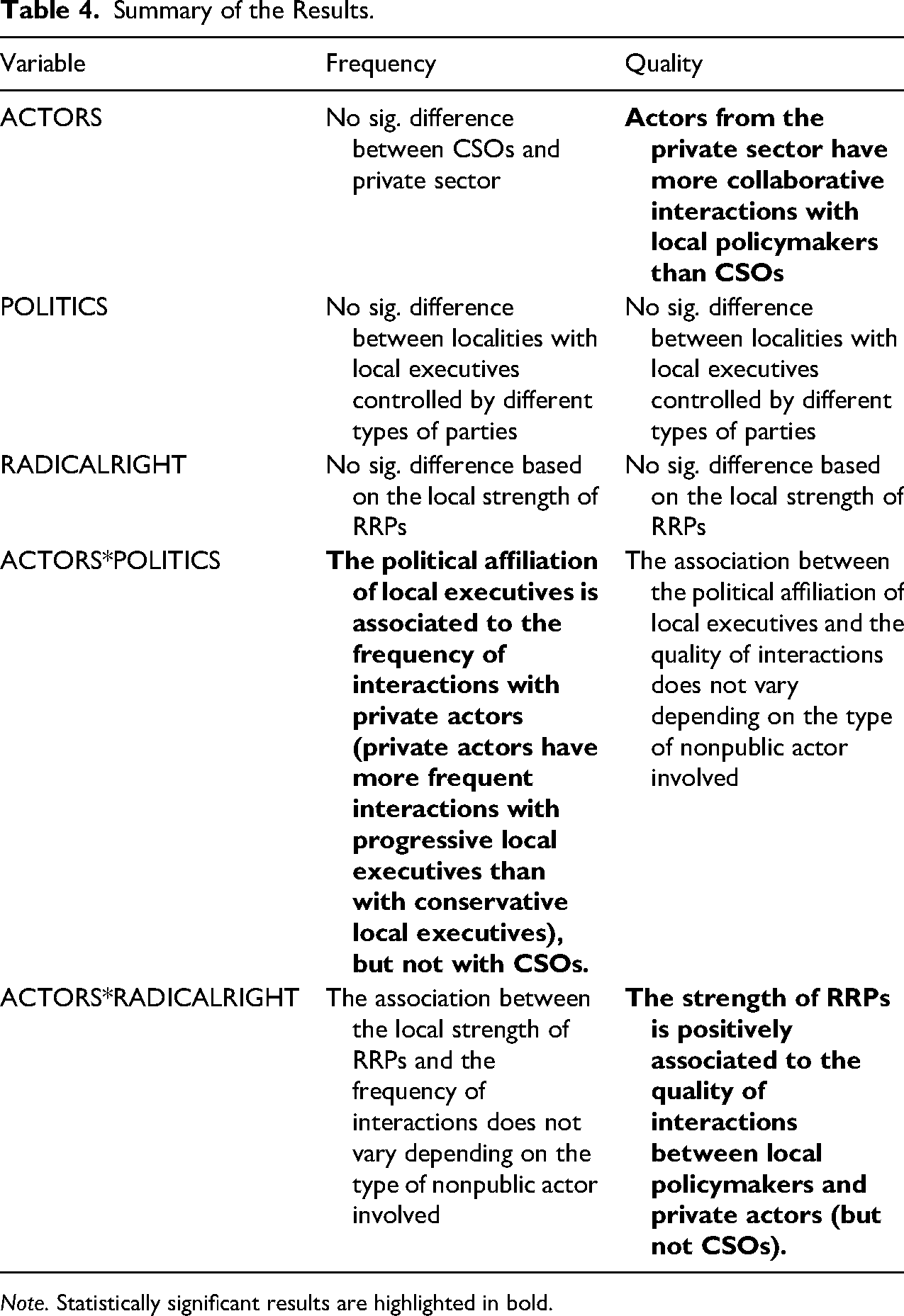
Note. Statistically significant results are highlighted in bold.
This article has shown that, in SWELs with local executives controlled by mainstream parties, horizontal governance interactions related to refugee integration involving the private sector and CSOs are both largely collaborative. This finding connects to insights from the scholarship describing local integration governance as a collaborative endeavor oriented at the solution of complex policy problems (the so-called “local pragmatism thesis”; see also: Agranoff 2018) and partially questions findings of recent works describing the existence of a “battleground” in the migration policy field in SWELs (Campomori and Ambrosini 2020). These results might be related to the intrinsic nature of “integration” policy, which is less politicized and contested than asylum-seekers’ reception policy (analyzed by most of the works that theorized the “local battleground”). Alternatively, this could be related to the lower politicization of the migrant integration issue in the time period analyzed compared to the years of the European “refugee crisis.”
Furthermore, our findings suggest that, overall, actors from the private sector have more collaborative (or less conflictual) interactions related to refugee integration with local policymakers than CSOs. They also suggest that, overall, political factors such as political party control of local executives and the local strength of RRPs are not associated with a different frequency and quality of the interactions between local policymakers and nonpublic actors. However, these political factors are associated with a different frequency and quality of interactions between local policymakers and different types of nonpublic actors (CSOs and actors from the private sector).
Challenging some assumptions of the so-called “local pragmatism thesis” (Scholten and Penninx 2016), this article has shown that interactions between local policymakers and the private sector are more frequent in localities with executives controlled by progressive political parties compared to localities with local executives controlled by conservative parties. Our qualitative analysis has provided some in-depth (exploratory) interpretations of these findings, suggesting that this might due to a more proactive approach to integration policymaking of progressive local policymakers, which becomes more visible when observing relations with the private sector because public-private partnerships are largely promoted by local policymakers, while CSOs tend to mobilize and reach out to local policymakers regardless of the political orientation of local executives. Such a proactive approach seems to be related to local policymakers’ progressive political ideologies and a less pessimistic perception of local public attitudes to immigration. Public opinion instead is the key factor that seems to constrain attempts by local policymakers to develop horizontal governance relations on refugee integration in localities with executives controlled by conservative parties (on the role of perceptions of public opinion see: Pettrachin and Paxton 2022). This finding connects to recent research on center-right parties’ strategies on migration policy at the national level, arguing that the once privileged relation between center-right parties and business on migration issues has recently vanished due to business interests becoming “much less potent compared to the concerns of citizens” (Hadj Abdou, Bale, and Geddes 2022, 12).
Our quantitative analysis has shown that the local strength of RRPs is positively associated to the quality of horizontal governance relations between local policymakers and the private sector. Again, our qualitative analysis suggests some (exploratory) interpretations for this finding: the interviews we conducted suggest that, while facing strong RRPs, local policymakers seem to be inclined to rely on and look at actors from the private sector as key allies in policy implementation and in the public debate on migrant integration.
Overall, these findings suggest that the emergence of horizontal governance interactions in SWELs highly depends on (favorable) political (pre-)conditions, rather than being linked to local policymakers’ willingness to act pragmatically to cope with the complexity of migration challenges. It might be accurate to describe local policymakers in SWELs as pragmatic actors oriented at problem-solving only if one considers that the main “problem to be solved” for local policymakers may not be migrants’ inclusion per se but rather the implications of migrants’ integration for local public opinion. This article also challenges findings of recent research conducted in the United States highlighting the role of local contexts in local immigrant policy (Khan-Welsh, Reese, and Reese 2023), showing that, in the SWELs analyzed, the emergence of (different types of) interactions between local policymakers and nonpublic actors is not related to contextual factors such as localities’ experience with cultural diversity or their socio-economic situation.
Future research should test these findings on a larger number of local cases to establish clearer causal relationships. In particular, the findings of these papers should be complemented by more specific analyses addressing the question of which actors start horizontal governance interactions and testing potential interactions between the political affiliation of local executives and the presence of RRPs in shaping horizontal governance relations. Additional analyses should be done to explore cross-national differences. More studies could further explore the mechanisms identified in our exploratory qualitative analysis, particularly looking at how the emergence of RRPs influences horizontal governance relations over time. Future research should also analyze horizontal governance relations in localities with executives not controlled by mainstream parties (but rather, for instance, by RRPs, or local parties) and should look at the implications of governance interactions for local policymaking processes.
Supplemental Material
sj-docx-1-uar-10.1177_10780874241270050 - Supplemental material for The Political Drivers of Horizontal Governance Relations in Small Localities: Evidence from a Cross-Country and Cross-Locality Study Across Seven Western European Countries
Supplemental material, sj-docx-1-uar-10.1177_10780874241270050 for The Political Drivers of Horizontal Governance Relations in Small Localities: Evidence from a Cross-Country and Cross-Locality Study Across Seven Western European Countries by Andrea Pettrachin and Giacomo Solano in Urban Affairs Review
Footnotes
Acknowledgements
The authors would like to thank Prof. Tiziana Caponio who coordinates the Whole-COMM Consortium and provided important support and constant suggestions during the development of this manuscript. Data used in this article have been collected by researchers working in the Whole-COMM Consortium, including: Dr Irene Ponzo, Dr Eleonora Milazzo, Dr Orlando De Gregorio, Dr Reinhard Schweitzer, Dr Elina Jonitz, Louise Hantson, Hakan Kilic, Dr Isabella Skrivanek, Prof. Birgit Glorius, Dr Friederike Enssle-Reinhardt, Dr Hanne Schneider and Dr Mans Lundstedt.
Declaration of Conflicting Interests
The authors declared no potential conflicts of interest with respect to the research, authorship, and/or publication of this article.
Funding
The authors disclosed receipt of the following financial support for the research, authorship, and/or publication of this article. This work was supported by the H2020 Society (grant number Whole-Comm project—Grant Agreement No 101004714).

Supplemental Material
Supplemental material for this article is available online.
Notes
Author Biographies
References
Supplementary Material
Please find the following supplemental material available below.
For Open Access articles published under a Creative Commons License, all supplemental material carries the same license as the article it is associated with.
For non-Open Access articles published, all supplemental material carries a non-exclusive license, and permission requests for re-use of supplemental material or any part of supplemental material shall be sent directly to the copyright owner as specified in the copyright notice associated with the article.
