




Abstract
Under far-reaching reforms, many cities have delegated core tasks previously delivered by their administrations to independent organisations that they formally own, e.g. municipal companies, or supervise, e.g. municipal trust funds. The coordination of these (as we call them) ‘domestic’ city organisations has proven challenging. Extant literature argues that such coordination is achieved through a mix of various hierarchical, market and network mechanisms. Yet it is unclear how these modes are combined. Addressing this gap, we ask: How do governance modes interact in the hybrid coordination of domestic city organisations? Analysing the case of Vienna, where 100 domestic organisations employ about 60,000 people, we find that while cultural mechanisms, rooted in the network mode, are predominant, they unfold in the shadow of latent structural mechanisms, which are associated with hierarchy and market. In the background, structural mechanisms keep cultural coordination effective, while cultural mechanisms allow structural coordination to remain (generally) hidden. This study aims to contribute to the literature on the governance of public organisations by exploring the relationship between governance modes as well as furthering urban governance studies by applying insights from studies on the coordination of public organisations to the city context.
Introduction
Far-reaching reforms over the past decades under the mantra of New Public Management (NPM) have greatly transformed the organisational arrangements of cities (Harrison and Hoyler, 2014; McCann, 2017; O’Brien and Pike, 2019; amongst many others in this journal). As a consequence, public sectors in general and cities in particular have transformed from ‘centralized and consolidated’ entities to ‘decentralized, structurally devolved, and “autonomizing”’ arenas (Verhoest et al., 2010: 3; see Bouckaert et al., 2010; Lægreid and Rykkja, 2015; Lægreid et al., 2015, 2016). Reflecting these structural transformations, the administrative paradigm has shifted from ‘government’ to ‘governance’, emphasising the delegation of core functions of city administrations to external actors (Brandtner et al., 2017). Accordingly, ‘polycentricity’ (Ostrom, 2010) has become a particular feature of municipalities, where the majority of public services such as public transportation, water supply, healthcare and social welfare are provided on the local level (Kuhlmann and Wollmann, 2019).
Unsurprisingly, this shift has made the issue of coordination, understood as ‘bringing parts into a proper relation’ (see Hood, 2005: 19), a central theme in governance studies. Indeed, scholars often refer to ‘governance’ as the institutional capacity to coordinate (Da Cruz et al., 2019; Peters and Pierre, 2016). Coordination, sometimes called the ‘holy grail’ (Rhodes, 2017) or ‘philosopher’s stone’ (Lægreid et al., 2015) of modern governing, encompasses attempts to make polities more integrated by increasing coherence as well as reducing redundancy, lacunae and contradictions (Bouckaert et al., 2010; Lægreid et al., 2015). Current debates on governance emphasise ‘collaborative’ regimes (Cristofoli et al., 2017) of city administrations with societal actors – such as companies and non-profit organisations – that are involved in policy implementation and service delivery. Yet in continental Europe, the dominant challenges to the inter-organisational coordination of urban administrations lie elsewhere, namely in what we refer to as the ‘domestic’ sphere – the plethora of independent organisations created in the wake of NPM-inspired ‘agency fever’ (Pollitt et al., 2001), which together form organisational ‘landscapes’ (Meyer and Leixnering, 2015). In German cities, for example, an average of 50% of people engaged in municipal tasks are employed outside the primary administration in separate city organisations (Papenfu et al., 2019). We use ‘domestic’ to designate this particular kind of city organisation, i.e. corporate entities fully owned by the city as well as entities under public law for which the city holds supervisory rights similar to ownership (agency ‘type 3’; Van Thiel, 2012). While legally independent, ‘domestic city organisations’ nonetheless ‘belong’ to a city in terms of ownership (i.e. municipal companies) or supervision (e.g. municipal trust funds). The expression ‘domestic’ implies that such entities are integral parts of a city’s organisational ‘household’.
The coordination of domestic city organisations sits between top-down control of internal, administrative units and voluntary cooperation with external actors. With regard to involved mechanisms, it is also located between the governance modes of hierarchy, market and network. Scholars emphasise that such coordination does not occur via a single mode but rather via a hybrid mix of different mechanisms, which may be competing, inconsistent and even contradictory (Denis et al., 2015; Lægreid and Rykkja, 2015; Sarapuu et al., 2014). Coordination remains a somewhat ‘ambiguous’ concept (Lægreid et al., 2015: 928) in governance studies. In particular, it is still a puzzle how different hierarchical, market and network mechanisms are combined and how these modes relate to each other in domestic coordination (Cristofoli et al., 2017; Lægreid et al., 2016). Drawing on the literature of organisation theory and public administration, we aim to address this gap by asking: How do governance modes interact in the hybrid coordination of domestic city organisations?
We investigate this by studying the case of Vienna. With about 100 domestic city organisations and a total of around 90,000 employees, the Austrian capital is a prime example of a structurally devolved city. Vienna’s generally effective coordination is reflected in its top position in global rankings for quality of life, since 2009 taking first place in a list compiled by Mercer and also being named by the Economist as the world’s most liveable city in 2018 and 2019. Addressing the call for in-depth research into the workings of coordination (Lægreid and Rykkja, 2015), our study analyses how structural mechanisms of hierarchy and the market are interwoven with cultural mechanisms usually associated with the network mode. Based on our findings, we make three propositions: First, cultural mechanisms are dominant while structural ones are latent. Second, this latency accounts for a ‘shadow’ of structures that needs to be regularly maintained through demonstrations of power. Finally, cultural and structural mechanisms are mutually dependent: Cultural mechanisms normally stand in for structural coordination, which in isolation would exhaust itself, while structural mechanisms provide the shadow in which cultural coordination thrives.
The remainder of this article is organised as follows: In the next section, we describe our conceptual framework, followed by an outline of the empirical setting and research methods. Then we present our findings and discuss these in the light of existing literature, before offering some concluding remarks.
Conceptual framework
Coordination as integration
In classical organisational theory, coordination is equivalent to the issue of ‘integration’ (Bouckaert et al., 2010; Lægreid et al., 2015). Accordingly, the design of organisational settings requires that differentiation, i.e. the division of labour (‘segmentation of the organizational system into subsystems’), be balanced with integration as ‘the process of achieving unity of effort among the various subsystems’ (Lawrence and Lorsch, 1967: 3–4). ‘[T]he higher the level of differentiation, the greater and more complex the range and forms of integration should be’ (Hinings et al., 2018: 339). From this perspective, the transition from government to governance represents a process of immense structural differentiation, imposing a demand for coordination in order to counterbalance devolution and ensure that cities remain ‘integrated entities’ (Lægreid and Rykkja, 2015: 961). In the wider literature on organisations (Mintzberg, 1983; Powell, 1990) as well as scholarly work on the governance of public organisations (Bouckaert et al., 2010; Lægreid et al., 2015), the discussion of different forms of coordination has focused on three distinct governance modes – hierarchy, market and network.
Hierarchy
This is the traditional coordination mode of public administration. Associated with Weberian bureaucracy and a vertical logic of command-and-control, it builds on formal authority via administrative orders and rules as a basis for interaction. Drawing on the ‘ability to get things done without opposition’, collective goals are set in a vertical top-down manner and coercive power is applied to meet these (Bouckaert et al., 2010: 37). Such power may be exercised in the form of legislation and regulation as well as by other mandates involving imperative objective setting, unilateral decisions and coercion (Börzel and Risse, 2010; Scharpf, 1997; Voets et al., 2015).
Market
The market-oriented ‘restructuring’ of cities (Brenner and Theodore, 2005) has been a key element of ‘neoliberal’ urban reform agendas (Harvey, 1989; for an overview, see Pinson and Journel, 2016). Promoted by NPM-inspired reforms as an alternative coordination mode, the market is a ‘heterarchical’ (i.e. horizontal) counterpart to hierarchy. Rooted in new institutional economics, the focus is on producing desired outcomes through the exchange of products for financial return, with competition as a core element (Lægreid et al., 2015). Organisations are geared towards economic performance through strict budgets, indicators and audits (Bouckaert et al., 2010). Here, bargaining between equal partners is a basic process (Williamson, 1996). Contracts between buyers and sellers specify clear objectives, targets and sanctions if contracted activities are not provided (Van Thiel et al., 2012). By definition, hierarchical mechanisms are diminished in contractual relations, with no one party exerting formal authority (i.e. buyers and sellers are regarded as ‘autonomous’; see Williamson, 1996).
Networks
In contrast to the formal arrangements of hierarchical and market modes, whose mechanisms are termed ‘structural’ in the literature (Lægreid et al., 2015), mechanisms from the network mode build upon informal resources of individuals and are referred to as ‘cultural’. Similar to markets, the network mode functions without the benefit of formal authority (Provan and Kenis, 2008), instead drawing on social mechanisms such as solidarity, trust and mutual cooperation (Hood, 2005; Peters, 2015; Powell, 1990). In organisational research, social systems associated with this third mode of coordination have been referred to as ‘clans’ (Ouchi, 1979). Over the years, a number of studies have been conducted on informal means of coordination in public administration (for overviews, see Bouckaert et al., 2010; Hood, 2005). Broadly speaking, informal cultural patterns are seen to strengthen integration by supplementing and bypassing formal structures. Here, collective action is rooted in shared goals, common norms and values and strong identification and identity. Extant scholarship on the governance of public organisations emphasises the central role of socialisation, which is supposed to eliminate goal incongruence (Hood, 2005; Lægreid and Rykkja, 2015).
Domestic coordination: Hybrid, yet ambiguous
In applying these conceptual perspectives to domestic coordination, we encounter a dilemma: Domestic city organisations cannot be controlled by a hierarchical ‘étatiste approach’ (Peters, 2015) as they are not part of a city’s primary administrative regime. Nevertheless, the regime possesses formal authority in terms of ownership and supervision. While this authority stands in opposition to the modes of market (Williamson, 1996) and network (Provan and Kenis, 2008), NPM-inspired reforms have, however, promoted contractual relations between the core administration and city organisations. At the same time, cultural mechanisms such as mutual trust or shared goals and values (sometimes referred to as ‘soft’ or ‘social’; see Hood, 2005) have become core elements in debates on the governance of public organisations (Meyer et al., 2018; Van Thiel and Yesilkagit, 2011). In end effect, domestic coordination cannot be fully explained by the hierarchical, market or network modes in isolation; rather, it features mechanisms from each.
In discussing alternative practices in the coordination of public organisations, recent literature has abandoned the notion of mutually exclusive coordination modes. Rather, it has been suggested that domestic coordination may involve all three governance modes (Lægreid et al., 2015; Sarapuu et al., 2014; Voets et al., 2015). This reflects recent findings on the hybridisation of urban governance (O’Brien and Pike, 2019); moreover, it echoes earlier governance research arguing that all coordination is a mix of mechanisms from the ‘pure’ modes of hierarchy, market and network (Börzel and Risse, 2010; Mayntz, 2004). The key resource of bureaucracy, i.e. the civil service, is a good example. Commonly associated with structural hierarchy, some of its key characteristics are in fact cultural, thereby relating to the network mode (Hood, 2005). In Weberian bureaucracies, these include a shared official ethos favouring public interest (Meyer et al., 2014), as well as clan features resulting from long careers in the same administration and informal (social) links between individual staff members (Bouckaert et al., 2010).
Normative approaches, in particular, have either identified governance modes with competing administrative paradigms of public administration (‘hierarchy’), NPM (‘market’) and public governance (‘network’, Osborne, 2010), or treated associated mechanisms as alternative forms of ‘joined-up governance’ (Hood, 2005) or ‘whole-of-government’ (Christensen and Lægreid, 2007). More recent studies, however, have identified coordination as hybrid, mixed or multidimensional, involving a shift between modes or drawing on combinations of mechanisms from different modes (Denis et al., 2015; Lægreid et al., 2016; Polzer et al., 2016). The ‘magic’ of domestic coordination thus transcends the idea of a single integrative mode. Rejecting exclusive choices, it demands the dynamic interplay of – sometimes competing, inconsistent and contradictory (Lægreid and Rykkja, 2015) – mechanisms, each rooted in one of the three governance modes (Börzel and Risse, 2010).
This shifting between or mixing of governance modes in order to ensure effective coordination has been referred to as ‘meta-governance’ (Bevir, 2009; Kooiman and Jentoft, 2009). Accordingly, ‘smart’ coordination results from the decision of the ‘meta-governor’, i.e. the administration (Sørensen and Torfing, 2009), when to go ‘hands on’, i.e. adopt a structural approach, and when to go ‘hands off’, i.e. rely on cultural mechanisms (Voets et al., 2015). Addressing ‘urban informality’, a feature usually associated with the network mode of coordination, scholars have recently criticised the simplistic dualism of formal vs. informal, whereby the former is generally viewed as superior to the latter, arguing for a rejection of the simplistic ‘othering’ of informality (Acuto et al., 2019). This argument also holds for the relationship between structural and cultural coordination, where the discounting of cultural mechanisms as non-structural should be replaced by a more nuanced perspective of both dimensions as interrelated in domestic coordination. However, there is still no clear and easy answer (Cristofoli et al., 2017; Voets et al., 2015) to the question: How are structural and cultural mechanisms combined in the coordination of public organisations? In order to open the black box of ambiguous and contested hybrid coordination (Lægreid et al., 2015; see also Lægreid et al., 2016), we must examine the relationship between the governance modes more closely.
In general, the literature on the governance of public organisations has focused on the central government tier, with scarcely any studies considering the urban context (Bjørnå et al., 2017; Van Genugten et al., 2020). Yet cities provide crucial case studies as they constitute particularly ‘dense’ polities (Sassen, 2006), not least in terms of the public tasks they typically fulfil in the continental-European context such as energy supply, health and social care, water provision and public transportation (Kuhlmann and Wollmann, 2019). A significant number of domestic city organisations are required to provide these services. In addition, domestic coordination at the city level may differ considerably from that at the federal level due to the more restricted legislative authority of urban administrations, limiting their options for hierarchical coordination.
Empirical setting, data and method
The empirical context: Vienna
When the Vienna city administration implemented far-reaching NPM reforms in the 1990s and early 2000s, there was strong resistance from politicians and the public to the privatisation of services. As an alternative, the creation of domestic city organisations developed as a core element of so-called Binnenreformen (Bogumil et al., 2007) that became typical for not only Austria and Germany but also continental Europe. In order to make organisational arrangements more business-like, many service-delivering units were hived off from the administrative corpus and established as independent organisations. Covering a wide range of services, an extensive organisational landscape emerged in Vienna, comprising more than 250 separate units (about 100 domestic city organisations and 150 companies of which the city is part-owner) on the first and second subsidiary level. Some of the biggest domestic organisations are the municipal hospitals, 1 the city’s social fund, two holding companies (including the city’s energy and public transportation providers) as well as the tourism agency. As the national capital, Vienna follows Austria’s Rechtsstaat tradition, featuring a robust bureaucratic system that builds on legal procedures and directives as well as a strong professional ethos of civil servants enjoying lifelong tenure (Meyer et al., 2014). Nevertheless, the vast majority of city organisations were established as corporations (and only the minority as entities based in public law), enabling them to operate beyond the legal restrictions that bind public administrations. This diverse institutional background reflects the typical hybridity that the literature attributes to modern urban governance but also considerable ambiguity about the interaction of governance modes in the coordination of city organisations.
In terms of size, the City of Vienna represents a ‘critical case’ (Patton, 2015) that can exemplify central aspects of contemporary urban governance. With an annual budget of more than €16 billion, Vienna’s public administration employs about 30,000 people; a further 60,000 staff work for domestic city organisations in areas such as health and social care, social housing and public transport, together accounting for an additional annual budget of around €5 billion (City of Vienna, 2019). In contrast, the mayor of London oversees a total budget of less than €20 billion for a population almost five times bigger (i.e. 8.9 vs. 1.9 million). While such a comparison between cities is undermined by considerable disparities between administrative models, the figures nonetheless underline why Vienna is a critical case. Since the First World War, the Social-Democratic Party (SPÖ) has dominated the city government, the only exception being during the Austro-fascist and Nazi years of 1934–1945. This makes Vienna an ‘extreme case’ (Seawright and Gerring, 2008) of political stability. We argue that such ‘specialness’ (Siggelkow, 2007) offers particular insights from which it is possible to draw general conclusions. The assumption is that while more contested political settings may be equally hybrid, any observations are likely to be distorted by political ‘noise’. In view of the named features, Vienna presents a good case for studying the interaction of governance modes in the hybrid coordination of city organisations.
In detail, the city administration (Magistrat) of Vienna is structured as a matrix organisation. It is divided into five functional executive groups, each led by an executive director. Executive directors report to the chief executive director (CEO), the city’s highest-ranking civil servant. Further, the administration is divided into seven cross-functional administrative groups, each led by a city councillor. Only a few units do not follow this divisional structure (e.g. the chief executive office and the city’s court of audit). Every administrative group is segmented into departments (60 in total). All department heads report both to their respective city councillor and to the CEO; the directors of the executive groups have the right to issue directives to the department heads. Administrative groups enjoy a certain latitude in dealing with managerial and financial issues. Department-level performance contracts and group-level lump-sum budgets were introduced in 2001 in order to increase management autonomy. Budget overruns are only granted in special cases and require the approval of the finance director (CFO), who holds a hybrid position within the city: s/he leads the financial department while simultaneously acting as executive director of one of the five executive groups. According to its statute, the city’s financial department is the central unit formally responsible for governance tasks not assigned to another department.
Data, method and analysis
We adopted a twofold strategy of data collection for the purpose of triangulation. First, we collected information specifying the composition of the city’s organisational landscape by analysing governance-related documents. These documents also play an important role in urban governance by functioning as boundary objects or ‘actants’ around which relationships establish and events unfold. 2 In our analysis, we drew on legal documents such as acts and directives that regulate administrative coordination (source: government’s legal information system), statutory documents, annual reports and the board composition of city organisations (sources: commercial register and organisations’ websites) as well as audit reports (source: city’s court of audit). This enabled us to create a database of all domestic city organisations on the first and second subsidiary level for the government term of 2010–2015. Second, we supplemented these materials with primary data from interviews with 23 key actors, conducted by the first and second author during the same period. In selecting interviewees, we identified two relevant groups: core officials from the city administration and top executives from city organisations. Specifically, our interviewees included 10 core officials from an administrative group or department as well as from the chief executive office (including the CEO and CFO of the city); a further 11 interviewees were CEOs in a domestic city organisation (assumed to hold positions key to the coordination of city organisations). In order to account for the heterogeneity of city organisations, we selected organisations that differed in size, strategic relevance of the tasks performed and public visibility. In addition, we interviewed the director of the city’s court of audit and the chairperson of the city employees’ labour union. The interviewees were guaranteed full anonymity given the perceived sensitive nature of the shared information.
The semi-structured interviews lasted 60 to 90 minutes. The primary aim was to obtain insights into the governance structures relating to the coordination of domestic city organisations. Therefore, we asked interviewees about the intensity and frequency of contact between the administration and city organisations, their respective counterparts, strategy development, steering and reporting activities, organisational culture, the characteristics of the prevailing system and their individual backgrounds. The interviewees named other relevant interview partners and supplied non-public documentation. The interviews were not tape-recorded to encourage the interviewees to speak openly. However, to ensure the greatest possible accuracy, each interview was conducted by two of the authors, who each took extensive notes (including direct quotes) during and immediately after the session. Afterwards, these notes were compared and consolidated in written interview reports.
To analyse our data and structure our findings, we followed the method suggested by Gioia et al. (2012). In a first step, we inductively identified and then grouped relevant themes from the documents and interview reports, staying close to the original wording. Focusing on similarities and differences, we reduced these themes to 14 first-order concepts. With the governance modes in mind (see conceptual framework), we examined these concepts from a more theoretical angle in a second step, condensing them into six underlying second-order themes. From this, our third step was to distil two aggregate dimensions of domestic coordination: ‘rule of people and culture’ and ‘shadow of structures’ (see data structure in Table 1). The extraction of a more abstract level has been described as an ‘analytic generalization’ technique (Yin, 2013: 321) to address possible issues of validity and generalisation in case study findings. In the following, we organise our findings along this data structure while providing direct quotations from interviewees (denoted by the letters a–w).
Data structure.
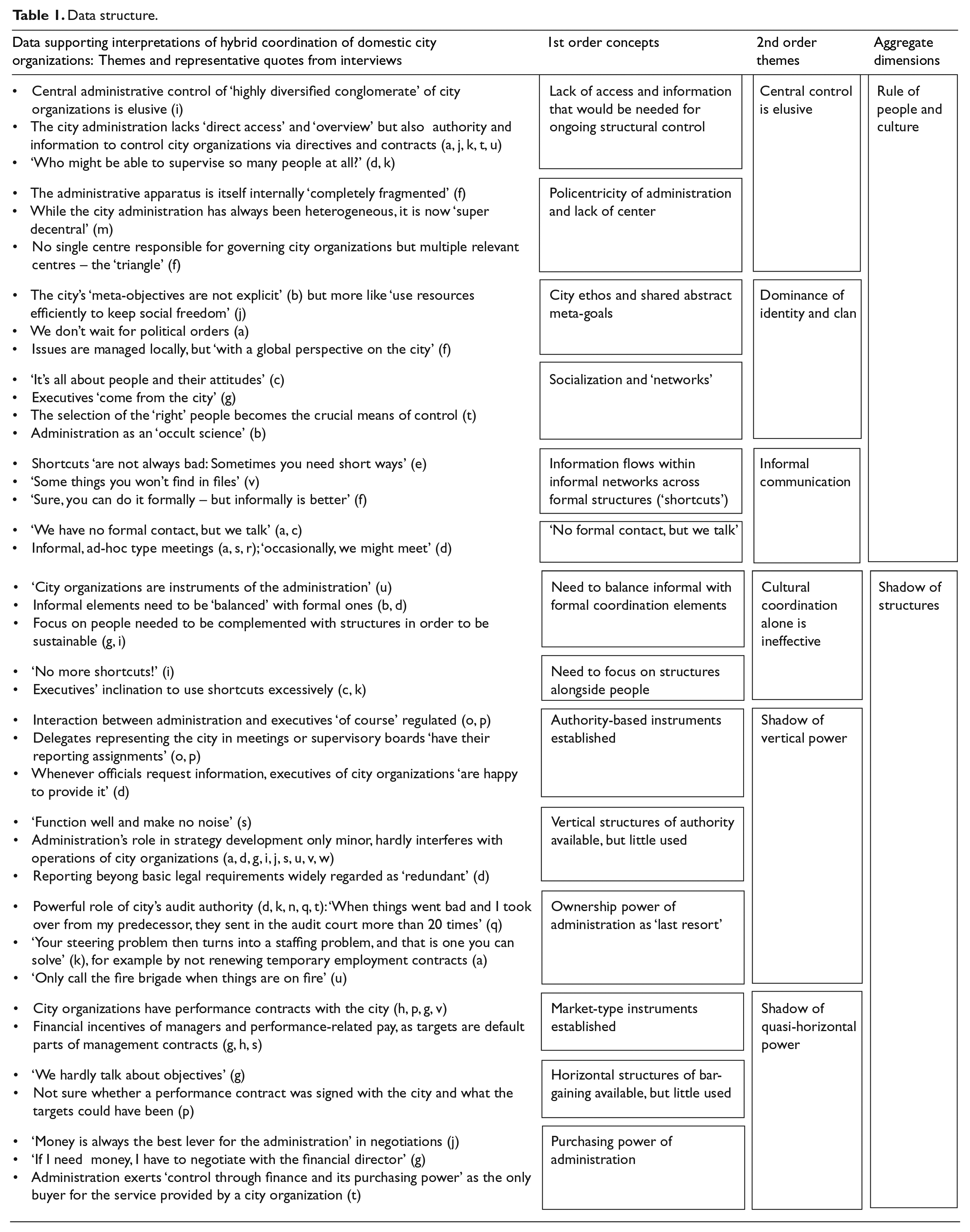
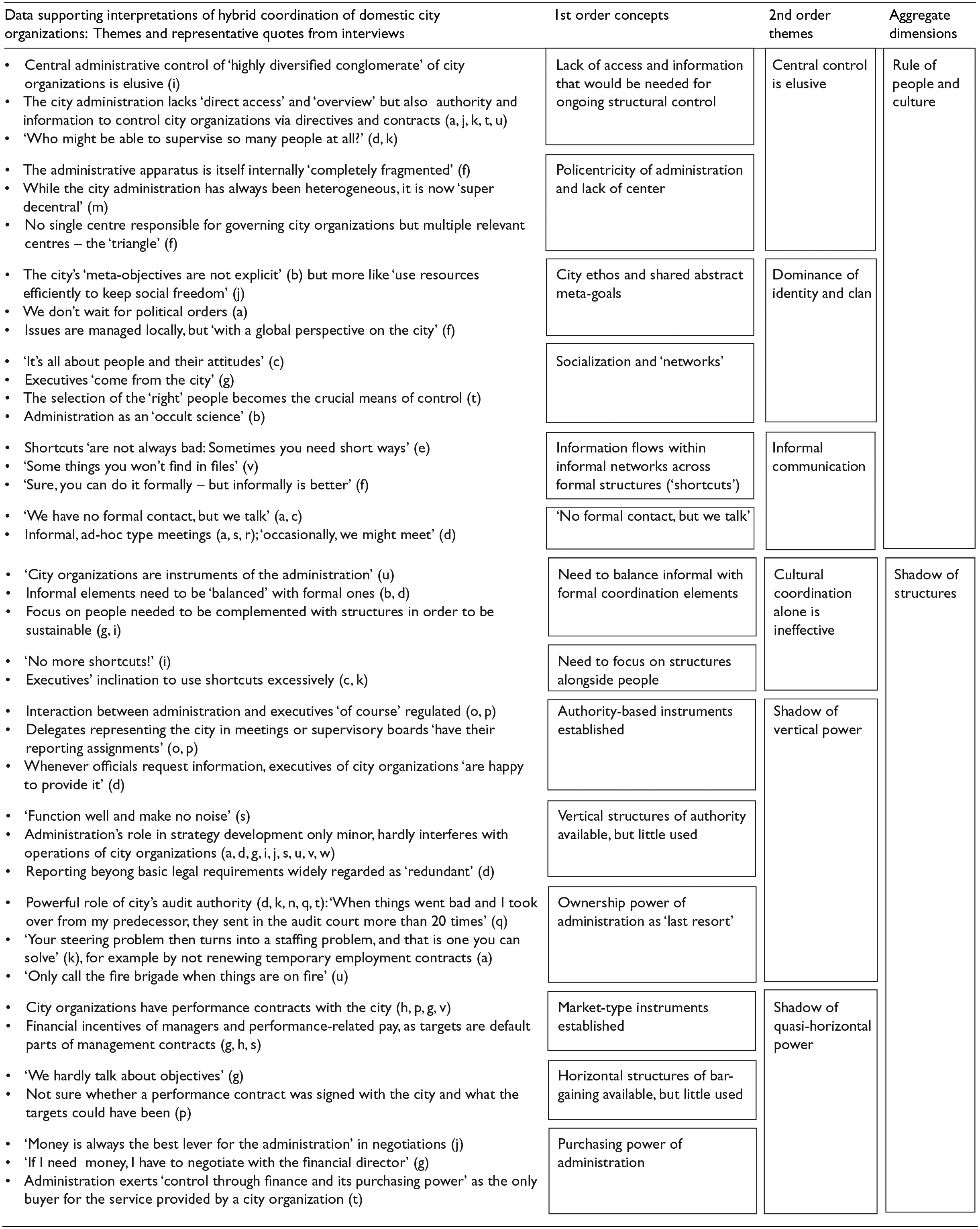
Findings: The rule of people and culture in the shadow of structures
Central control is elusive
According to one experienced official, central administrative control of the ‘highly diversified conglomerate’ of city organisations is ‘elusive’ (interviewee i). Not only does the city administration lack ‘direct access’ and ‘overview’, it is also deficient in the authority and information to control city organisations via directives and contracts (a, j, k, t, u). Therefore, several interviewees referred to the need for alternative mechanisms to facilitate city governance. Considering the size of the city and its organisational landscape, two executives asked rhetorically: ‘Is there actually anyone who could supervise so many people?’ (d, k).
Further, interviewees claimed that the status quo may be perceived as ‘messy’ from a traditional perspective (j), as the administrative apparatus is itself ‘completely fragmented’ internally (f). One experienced interviewee noted that, while the city administration has always been heterogeneous, it was now ‘super decentral’ (m). According to the city’s statute, the coordination of a city organisation is a core task to be performed by either the financial department or another assigned department. However, one official told us that in fact there is no single centre responsible for governing city organisations (f). Rather, there exist multiple relevant centres (the ‘triangle’ as s/he put it). This ‘historically grown’ arrangement (w) involves the respective administrative group, the financial department and the chief executive office, each pushing in different directions regarding service quality, good press, a stable financial position and compliance with administrative guidelines. Regarding her/his counterparts in the administration, one executive said that s/he feels ‘kind of sandwiched between different interests’ (v) due to the administration’s lack of a central unit to align or even oversee all coordination activities (t).
Dominance of identity and clan
Officials shared their impression that the coordinative mechanisms for city organisations differ considerably from a bureaucratic apparatus. The interviewees did not call for centralised, authority-based decision-making, but shared their conviction that many things are better kept at arm’s length. When an experienced executive mentioned that s/he is ‘on common ground’, the city ‘can count on that’ (g), this echoes the implicit, shared ethos of executives and officials, whereby the ‘meta-objectives are not explicit’ (b) but are formulated in ways such as ‘use resources efficiently to maintain social freedom’ (j). The objectives derived from such an ideal for the different tasks performed by city organisations do not have to be formalised at an organisational level; if existent at all, strategies formulated by the administration are rather abstract and vague (a, s). As one executive put it, ‘we don’t wait for political orders’ (a). Echoing this, an official stated that ‘you can expect from well-paid executives that they make decisions rather than take orders’ (u) – things can be managed locally, but ‘with a global perspective on the city’ (f).
Hence, coordination is primarily exercised via individuals rather than structures (p, t, u); and since ‘it’s all about people and their attitudes’ (c), the selection of the ‘right’ people becomes the crucial means of control (t). They should be ‘capable’ and ‘loyal’ to the city and its ethos, as one executive (j) put it, ‘but not obedient: There are situations where you have to say “no”– and you can, more often than one may assume’ (j). Fundamentally, the right people are those that are trusted –‘you couldn’t slip a sheet of paper between us’ (d). One necessary but not sufficient condition frequently applied is that executives ‘come from the city’ (g), i.e. have worked in the city administration before. Recruiting outsiders is seen as potentially risky: ‘We once had someone from outside, an excellent professional – big mistake! It was as if he spoke another language’ (a). Hence, socialisation within the administration is a key requirement for executive appointments; they know how the city ‘works’ and are acquainted with their current counterparts in the administration. ‘After 30 years in the city, you simply know certain things’, one interviewee said, for example ‘whom to call’ (u) and other practicalities (j). Further, ‘if you call the wrong person three times in a certain situation, you will remember that and learn’ (t). This is how one builds networks over time (d, t). Another official called the city administration an ‘occult science’, indicating that fellowship requires secret knowledge and a certain level of personal identification (b).
Informal communication
The benefits of communication ‘shortcuts’ were highlighted. One executive noted that these ‘are not always bad: Sometimes you need shortcuts’ (e). Indeed, informal channels of communication appear important and legitimate, accounting for a substantial informational flow between city officials and executives (e), in particular for ‘things you won’t find in files’ (v). According to another executive (a), important messages seldom come via formal channels, an observation confirmed by one official: ‘Sure, you can do it formally – but informally is better’ (f). An important task of any official, s/he added, is thus to ‘gain access to information through different channels’. This means that executives will ‘of course pick up the phone when the city councillor calls at night’ (r).
These diverse communication channels are rather effective given that officials and executives generally know whom to call. This is reflected in the words of two executives, describing their contact to the chief executive office: ‘We have no formal contact, but we talk’ (a, c). While meetings may therefore be institutionalised formal gatherings (b, g, j, k), in many cases they are more informal and ad hoc in nature (a, s, r; ‘occasionally, we might meet’: d).
Cultural coordination alone is ineffective
Although several officials pointed out that coordination through formal structures was elusive, and hence informal mechanisms such as trust (d, k) were needed, they also emphasised that such mechanisms alone were insufficient. One official (u) reflected that ‘city organisations are instruments of the administration’ and officials should have the authority to use them. Therefore, informal elements need to be ‘balanced’ with formal ones (b, d), and a focus on people must be complemented with structures in order to be sustainable (g, i). The respective (but unofficial) motto was ‘no more shortcuts!’ (with the emphasis on ‘more’: i), particularly addressing executives’ love of speedy measures (c, k).
Shadow of vertical power
When and how officials from the administration and executives from domestic city organisations interact is ‘of course’ (o, p) regulated by various standards and formal manuals. For the administration, this includes the city’s legal constitution as well as procedural rules and the statute. In addition, the status of every city organisation must be ‘legally determined’ (p), i.e. the ownership of private entities or formal supervision of public entities. The domestic city organisations studied here have established all legally stipulated bodies (e.g. supervisory boards), follow binding governance regulations and give proper account of their activities, e.g. through mandatory financial reporting. In addition, officials confirmed that delegates representing the city in shareholder meetings or supervisory boards ‘have their reporting assignments’ (o, p). Whenever officials request information, executives of city organisations ‘are happy to provide it’ (d).
The administration’s main expectation of city organisations was formulated by one executive as to ‘function well and make no noise’ (s). Clearly, executives must know how to handle delicate affairs, ‘when to talk to the city councillor and when to decide on your own’ (a). Indeed, our interviews revealed the decentralised nature of decision-making in city organisations, i.e. the administration plays only a minor role in strategy development and hardly interferes with the operations of city organisations (a, d, g, i, j, s, u, v, w). Often there is no requirement for detailed reporting so that formal reports beyond basic legal requirements are not submitted (k) or are even regarded as ‘redundant’ (d) from a coordinative perspective. In several cases, officials mentioned that they prefer not to receive too many details: ‘Do I really want to know all that?’ (n, q). In many cases, being ‘in the know’ requires appropriate action, often leading to ‘dysfunctionalities’ (q). Another top official echoed this standpoint by quoting a former CEO of Siemens when it faced a series of scandals: ‘If we knew what we know!’– however, adding a question: ‘But what should we do then besides knowing?’ (o).
Yet the status quo is certainly not characterised by an absence of authoritative power. Several interviewees emphasised the powerful role of the city’s audit agency as a coordinative instrument (d, k, n, q, t). As one executive said: ‘When things went bad and I took over from my predecessor, they sent in the audit court more than 20 times’ (r). Such audits also have a powerful admonitory effect, as one official noted: ‘You become more aware’ (n). Moreover, even though they may not be in a position to tell executives what to do, two officials (a, k) noted that they have the authority to replace executives if ‘things go wrong’. ‘Your steering problem then turns into a staffing problem, and that is one you can solve’ (k), for example by simply not renewing the fixed-term contracts of executives (a) or by ending them prematurely. This, however, is only used as a last resort: One should ‘only call the fire brigade where things are on fire’ (u).
Shadow of quasi-horizontal power
In most cases, city organisations have performance contracts with the city (h, p, g, v), foremost perhaps the ÖPNV-Vertrag. This contractual agreement regulates the performance of the public transportation provider, in particular the financial compensation for infrastructure investments, operational support and ‘extra services’ such as the annual ticket priced at €365. In addition, management contracts specify financial incentives for managers and performance-related salaries (g, h, s). However, performance targets do not seem to play a big role in daily coordination, as one executive admitted: ‘We hardly talk about objectives’ (g). One manager was not even sure whether he had signed a performance contract with the city (p). Nevertheless, audits are carried out to assess the achievement of goals.
Bargaining, however, is critical ‘when it comes to money’ (v), as this ‘is always the best lever for the administration’ in negotiations with city organisations (j). The financial department allocates the lump-sum budgets as well as additional grants to help with budget overrides. One interviewee noted that due to the reliance of many city organisations on this funding, they ‘don’t look for trouble with the CFO’ (t), since ‘if I need money, I have to negotiate with the finance director’ (g). Another interviewee emphasised the strength of the administration’s purchasing power, especially vis–vis organisations that could not rely on market revenues (such as transportation, energy etc.): As the sole buyer for the services provided by these organisations, the administration exerts ‘control through funding and its purchasing power’ (t).
In sum, our study finds a particular pattern in the combination of diverse coordinative mechanisms, which is not simply ‘loose’ and context dependent (Sarapuu et al., 2014) but rather follows a more general logic. In the following section, we will discuss our findings in the light of extant literature.
Discussion
Our investigation reveals mechanisms in domestic coordination that relate to both the ‘structural’ and ‘cultural’ dimension of coordination (Lægreid and Rykkja, 2015). Thus we find hierarchical authority-based mechanisms, resulting from ownership or supervisory rights. These include delegating representatives to supervisory boards, far-reaching reporting requirements and the imposing of audits. In addition, we note a number of market-type mechanisms, such as performance contracts, financial incentives and performance-related pay. In terms of cultural mechanisms, which correspond to the network mode, we find a high level of identification with the city’s ethos and meta-goals; similarly, the role of socialisation with the city administration is key. Both factors fuel a shared identity and considerable informal relations between individuals that can bypass formal structures, reflecting the third ‘clan’ or network mode of coordination.
Our case reflects the complex and highly differentiated structures of most modern cities. From an organisational perspective, the identified level of differentiation mirrors a highly diverse set of tasks ranging from health and social care to energy provision, water supply, social housing and public transportation. In order to achieve effective organisation, integrative mechanisms have to overcome the centripetal implications of differentiation, requiring an ‘appropriate balance between any given level of differentiation and the scope and combination of integrative devices’ (Hinings et al., 2018: 339). It is thus no surprise that the coordinative mechanisms for domestic integration are equally complex and diverse. Indeed, we find interplay of mechanisms from all three modes – hierarchy, market and network. Drawing on previous studies on the governance of public organisations, we began with the insight that the coordination of domestic city organisations is hybrid, involving a mixed and ambiguous order of hierarchy, market and network mechanisms (Lægreid and Rykkja, 2015; Lægreid et al., 2015, 2016; Sarapuu et al., 2014). The question of how coordination modes are combined and interlinked is still ‘without a clear answer’ (Cristofoli et al., 2017: 275).
Rule of people and culture, latency of structures
Cultural mechanisms appear more dominant than the structural dimension. This is reflected by officials’ views that central control is elusive: The administration simply lacks authority and information to govern city organisations via directives and contracts. For this reason, people seem more important in domestic coordination than structures. In suggesting that structural mechanisms are used much less frequently than their cultural counterparts, our study echoes previous findings that cultural mechanisms are the ‘efficient secret’ and the ‘most powerful cement’ in the organisational architecture (see Hood, 2005: 32).
Nevertheless, both vertical (hierarchy) and horizontal (market) structural mechanisms are present – a feature of organisational structures that Mayntz (2004), albeit in a different context, described as ‘latency’. While latent structures are used less often than other forms of coordination, they can be easily activated when needed (for example, sacking an executive or renegotiating a service contract). At the same time, our study shows the ineffectiveness of cultural coordination in isolation, whether via people or informal channels of communication: Even if unsuitable as the sole coordinative approach, latent structural instruments need to be established in order to supplement cultural coordination. In the quest for a ‘workable balance’ (Lægreid et al., 2016: 257) between structural and cultural mechanisms, we therefore formulate the following proposition:
While domestic coordination is generally dependent on a rule of people and culture, structural mechanisms of coordination can be described as latent, i.e. they can be activated when needed but are less frequently used than their cultural counterparts.
Demonstrating ‘yes, we can’: Latent structures as the shadow of power
Latent structures are in play not only when activated but also through their suggestive force – an observation that, with a focus on vertical structures, has been described as the ‘shadow of hierarchy’ (Scharpf, 1997: 202). This credible threat that the administration might utilise its structural powers has a significant coordinating effect. Such power is not founded merely on authority (vertical) but also on contractual purchase power (horizontal), both unfolding in the shadow of hierarchy as, of course, the administration can always choose to ‘withdraw its delegation’ (Peters and Pierre, 2016: 110; ‘quasi-market’: Hood, 2005: 33). Mayntz (2004) compared such a powerful shadow with a ‘fleet in being’, which can exert influence without ever leaving port.
Undoubtedly, the administration must keep the threat of using its power (i.e. the shadow) alive by occasionally demonstrating that it is actually ‘able and willing’ (Mensi-Klarbach et al., 2019: 12) to exert its authority and, further, ensure that this is noticed. Structural influence is thus used by the administration from time to time: Management compensation may be cut when performance targets are not met, even if the monitoring of objectives is otherwise fairly irrelevant to coordination; and sometimes executives are sacked. Extending previous insights on the impact of the shadow of hierarchy in coordination (Brandtner et al., 2017; Levelt and Metze, 2014; Peters and Pierre, 2016), we derive a second proposition as follows:
Latent structures represent a shadow of power that needs to be maintained by regular activation.
‘Meta-governance’: Cultural coordination thrives in the shadow of structures
A meta-governance perspective considers the interplay between and combinations of governance modes (Bevir, 2009; Kooiman and Jentoft, 2009). Bridging this perspective with the shadow-of-hierarchy argument and applying it to hybrid coordination, Voets et al. (2015: 981) discussed two alternative strategies which a ‘smart’ administration may choose: ‘hands on’, i.e. building on structural mechanisms, or ‘hands off’, i.e. relying on cultural mechanisms and what we refer to as the shadow of structures. Here we suggest a more nuanced view, namely that cultural and structural mechanisms are not alternative choices but rather mutually dependent dimensions of coordination (Lægreid and Rykkja, 2015). Cultural mechanisms, we argue, work best with a structural fall-back option to keep everybody in line. Structural mechanisms are most effective when they work in the background as unobtrusive but effective shadows; as the default setting for domestic coordination, they would soon exhaust their own capacity (‘elusive’).
Hybrid coordination can be described as a specific configuration of different governance modes, thereby avoiding a more restrictive ‘either-or’ selection (Lægreid et al., 2015; Sarapuu et al., 2014). Considering the meta-governance question of their ‘smart combination’ (Lægreid et al., 2015: 935), we suggest that a sophisticated form of administrative coordination is to reject the false choice between hands-off vs. hands-on strategies (Voets et al., 2015), instead striving to balance mutually-dependent cultural and structural coordinative mechanisms. Of course, this is a delicate undertaking, as an excess of structural coordination may disrupt cultural mechanisms such as trust (see Van Thiel et al., 2012). Our third proposition therefore reads as follows:
In isolation, structural coordination is elusive and cultural coordination ineffective. Yet in combination, cultural mechanisms relieve structural coordination while structural mechanisms provide the shadow in which cultural coordination thrives.
Concluding remarks
Our study opens the black box of hybrid coordination between the core administration and domestic city organisation, as well as shedding light on the interrelations between the governance modes of hierarchy, market and network. By revealing the rule of people and culture in domestic coordination under the shadow of structural power, we elucidate the dilemma of hybrid, yet ambiguous, domestic coordination in the neglected context of cities. This contribution, however, comes with a caveat. While we argue that Vienna is an exemplary case, and that our findings are relevant for other structurally devolved cities, it may be that pluralised domestic city organisations are characteristic of the continental-European tradition, where delegated governance is less associated with private businesses and non-profit initiatives than with legally independent organisations that are owned or supervised by cities. Future research could thus not only take into account the plurality of these organisations, but also apply a comparative perspective across administrative traditions in order to assess the generalisability of our results. Later studies should also extend our focus from domestic coordination to cities’ collaboration with external actors. In addition, scholars could investigate how hybrid urban governance relates to a city’s capacity for resilience, i.e. the ability to deal with external shocks. Here we would expect that the dominance of cultural mechanisms facilitates swift reactions to critical events (Kornberger et al., 2019). Yet the associated lack of cultural diversity may limit the range of likely responses as well as a city’s potential for learning and adaptive change.
We believe that our study adds an organisational perspective to the wider theme of ‘neoliberal’ transformation in urban studies (Harvey, 1989) and its political-economic focus on the market-oriented restructuring of cities (Brenner and Theodore, 2005; for an overview, see Pinson and Journel, 2016). As a central pillar of liberalising reforms, NPM promoted the establishment of independent organisations as a way to replace bureaucracy by business-like arrangements. As our results show, the structural coordination of city organisations does indeed reflect a move towards the market mode. But, paradoxically, it also documents the sustaining of hierarchical coordination, albeit in a modified form: City administrations have discovered not only market-type mechanisms but also novel hierarchy-based instruments such as ownership and ownership-like supervisory rights. So even if the emergence of domestic city organisations results from a liberalising reform agenda, cities like Vienna do not appear lost in a ‘neo-liberal jungle’ (Peck and Tickell, 1994). On the contrary, the introduction of market-type mechanisms seems to have extended cities’ repertoire of structural coordination. Indeed, this has proved critical for the successful balancing of cultural mechanisms.
Footnotes
Declaration of conflicting interests
The author(s) declared no potential conflicts of interest with respect to the research, authorship, and/or publication of this article.
Funding
The author(s) received no financial support for the research, authorship, and/or publication of this article.
