



Abstract
This study examines whether the neighborhood effect on vulnerability to radicalization can be mitigated by the density and diversity of social service organizations. In this study, vulnerability to radicalization is composed of perceived discrimination, distrust of democracy, and authoritarianism. To this end, data from surveys conducted in the three German cities of Dortmund (n = 1,900), Bonn (n = 1,986), and Berlin (n = 2,060) is combined with data on social structure and the size, density, and heterogeneity of local social service organizations at the neighborhood level in hierarchical models. Although the findings show no clear preventive effects of organizational ecology on vulnerability to radicalization, they suggest that local social service organizations are more likely to be effective depending on the extent of local challenges.
Introduction
For a long time, the criminological and urban sociological debate has been concerned with the question of whether there are spatial effects on the behavior of actors in an area, and whether and how they can be demonstrated (Sharkey and Faber 2014; Slater 2013). By the 1990s at the latest, increasingly advanced methods and more sophisticated data access made it possible to provide evidence of such neighborhood effects (Jencks and Mayer 1990). Since then, the debate has become more nuanced, asking both about group differences (Clampet-Lundquist et al. 2011; McAra and McVie 2016) and their influence (Sharkey and Faber 2014). In addition, the topics have broadened to include neighborhood effects on crime (Vogel and South 2016) and health (Nguyen et al. 2023).
Based on the previous research on neighborhood effects, it can be assumed that neighborhood effects exist (Baranyi et al. 2021; Galster and Sharkey 2017). However, it remains unclear why the influence varies in magnitude and between countries, within cities, and between groups. Previous research on neighborhood effects seems to have paid little attention to this: If space always has an effect as an influencing variable, that effect may itself be modifiable. One policy instrument to influence neighborhood effects are social policy measures through local social service organizations (LSSOs). These are, for example, outpatient public as well as non-profit organizations in a neighborhood with at least one full-time professional. LSSOs provide services and experiential spaces that can influence people's norms and thereby mitigate or even prevent neighborhood effects. However, this aspect has been little studied.
A more detailed analysis of the effects is confronted with a prevention paradox. The absence of an intervention, that is, school absenteeism, can hardly be causally attributed to individual policy measures, such as the promotion of LSSOs, because other factors, such as parental behavior or the quality of teaching, are also important. It is more promising to examine attitudinal patterns of those who directly use LSSOs or who live in a disadvantaged neighborhood where there are many or few LSSOs. This is based on the assumption that experience worlds are expanded or restricted by LSSOs, influencing the construction of norms. The effect of LSSOs on norms then extends beyond those individuals who use the social services, such as consulting or youth recreation. This is because those individuals, in turn, interact with family members or friends, so that the behaviors influenced by the work of LSSOs also affect third parties.
The advantage of this research approach is that the influence of both the presence of LSSOs in a neighborhood and the effect of the use of LSSO can be studied. In order to provide the most targeted evidence possible, susceptibility to ideological radicalization is a useful social phenomenon that can be defined relatively precisely. By susceptibility to radicalization, we mean risk factors that are known to increase the likelihood that an individual will become radicalized. Specifically, these risk factors are relative deprivation, expressed in part as perceptions of discrimination, distrust of democracy, and support for authoritarianism (Kurtenbach et al. 2020). Classical studies of neighborhood effects also show that living in a disadvantaged neighborhood affects these items by increasing relative deprivation (Sampson and Bartusch 1998; Wilson 1987). As a result, living in a disadvantaged neighborhood may increase the likelihood that an individual is open to ideological radicalization. However, we hypothesize that LSSO may moderate the outcome of the neighborhood effect on these factors and reduce susceptibility to ideological radicalization. Thus, the study builds on research on both radicalization and neighborhood effects. Radicalization phenomena and processes have already been reliably modeled, meaning that reliable findings are available (e.g., Horgan 2008; Moghaddam 2005; Wiktorowicz 2005). Moreover, recent work points to a nexus between deviant demeanor, spatial disadvantage, and radicalization (Ilian/Sandberg 2019; Rottweiler et al. 2022). That is, living in disadvantaged neighborhoods also increases an individual's vulnerability to radicalization. However, this neighborhood effect may be moderated by LSSOs. Such evidence would represent a significant advance in knowledge in both urban sociology and radicalization research. The extent to which LSSOs in disadvantaged neighborhoods exert a possible moderating effect on neighborhood effects on susceptibility to radicalization needs to be examined, while also controlling for individual aspects. The research question is: Do LSSOs show a moderating association on neighborhood effects on susceptibility to radicalization? At this point, it is important to make a conceptual distinction between the direct measurement of radicalization and susceptibility to radicalization, as the former describes a process in which individuals successively withdraw further and cognitive closure occurs (Moghaddam 2005). Since this point in the radicalization process is difficult to generalize, it is conceptually implausible to assume a moderating relationship between LSSOs here, as the basic prerequisite of voluntary participation by the individual is not clearly given. Therefore, the phenomenon to be explained is susceptibility to radicalization, since a predisposition can be assumed, but no closure processes have been completed.
The analysis must take into account that in Germany, the national context of the study, there is indeed a correlation between the number of LSSOs in a neighborhood and its social stress. In the following, the state of research on neighborhood effects is reviewed. The question is whether the effect of space on vulnerability to ideological radicalization can be modeled in terms of risk factors. In addition, the role of organizations in disadvantaged neighborhoods is discussed and hypotheses derived. Finally, we examine whether the distribution of LSSOs can explain the adoption of ideologically radical beliefs. These relationships are examined in three German cities that exhibit the characteristics of a conservative welfare model (Esping-Anderson 1990). The empirical design is then described, including the three study cities, the data used, and the analysis strategy. The fourth section discusses the empirical results of the multilevel analyses, and the conclusion reflects on the findings. The Supplemental Appendix provides further information on the data used and the scale construction.
State of Research
How Urban Districts Have a Disadvantaging Effect
The fact that neighborhoods affect people's life chances is one of the basic assumptions of sociological urban research and has been used early on, for example, to explain youth violence (e.g., Shaw and McKay 1969). In determining how an influence can come about, there are two central models that run through the state of research and are quite compatible with each other.
First, the socio-ecological approach ascribes particular influence to local conditions, such as widespread poverty or epidemic crime. In this top-down logic, local conditions reproduce themselves by mimicking deviant behaviors and then leading to selective out-migration or the perpetuation of social problems (Sampson 2017, 156). At the same time, interpersonal solidarity is limited and the local community is relatively poorly organized. In the tradition of thought, methodological analyses are mainly multilevel, controlling primarily for the influences of socio-structural characteristics, but also taking into account socio-cultural aspects such as collective efficacy (Sampson et al. 1997).
Second, and almost complementary to this, the perspective is reversed and the behavioral patterns of people in certain types of neighborhoods are examined. Thus, the focus is not so much on the direct influences of poverty, for example, but rather on how people deal with poverty and how they are perceived by others in the same neighborhood. The classic works by Wilson (1987) and Anderson (1999) also follow this line. Both use different empirical approaches to describe how people cope with the challenging living conditions in disadvantaged neighborhoods and thereby form norms that legitimize deviant behavior.
Theoretical assumptions have been incorporated in varying degrees into the classical models explaining neighborhood effects. The network model assumes that neighborhood contacts lead to the learning and adoption of context-specific behaviors (Crane 1991). The role model is similar, but does not presuppose direct contact between actors in the space, but already considers the observation of behavior as a possible influencing factor (Friedrichs and Blasius 2003; Wilson 1987). The relative deprivation model, in turn, captures partial comparison as a cause of disadvantage, as it leads to social shame and desolidarization under conditions of resource scarcity (Nieuwenhuis et al. 2017). The spatial mismatch model, on the other hand, takes an organizational perspective, inferring disadvantage from a disadvantaged neighborhood's inadequate provision of social and public facilities and disconnected links to the labor market (Gobillon et al. 2007). To better distinguish the modes of impact of neighborhoods on individuals, Galster subsequently (2012) distinguished institutional, environmental, social-interactive, and geographic mechanisms. In the context of this study, the relationship between the institutional mechanism, that is, the endowment of a neighborhood with organizations, and the social-interactive mechanism, the effects of an individual's negotiation with his or her social environment, is primarily examined.
In conclusion, urban districts are primarily disadvantaged by the effects of strategies to address both individual and spatially concentrated poverty. In addition to a lack of structural amenities, such as poor housing conditions or inadequate schooling, distrust is generated, which limits one's options for action. Distrust is directed at other people in the same neighborhood (Liu et al. 2023) and at public institutions, including the police (Bradford et al. 2022). Such alienation tendencies can then lead to the rationalization and legitimization of behaviors that may, at least in the short term, lead to overcoming locally accumulated challenges. However, these same behaviors and their consequences sometimes contrast with behaviors preferred outside the disadvantaged neighborhood or within organizations.
Individual Risk Factors and Spatial Influences on Vulnerability to Radicalization
While the literature on neighborhood effects has shown mixed results, for example, on health, income, or educational opportunities, there is a lack of research on whether there are also spatial effects on vulnerability to radicalization. The hypothesis is that living in disadvantaged neighborhoods influences norms that promote vulnerability to radicalization. Thus, if people with the same individual characteristics live in neighborhoods with different socio-structural and socio-cultural profiles, the strength of these individual characteristics is likely to differ. If this follows a systematic pattern, a contextual effect on susceptibility to radicalization can be assumed.
It is therefore necessary to distinguish between individual risk factors for radicalization and spatial influences on these individual characteristics. We do not distinguish between different phenomena, such as religious radicalization or right-wing extremism, but between risk-factors for radicalization that transcend phenomena. Whether and to what extent individual risk factors are more important for a phenomenon such as right-wing extremism should be investigated in further studies. Numerous studies and meta-studies are available on individual characteristics of susceptibility to radicalization (e.g., Gøtzsche-Astrup 2018; Wolfowicz et al. 2020). Three influences can be identified that are repeatedly mentioned with varying degrees of emphasis. The first is an individual's life situation, such as poverty or sense of discrimination. Here, the connections to radicalization phenomena appear to be relatively moderate (Emmelkamp et al. 2020). The postulated relationship is conceptualized on the basis of the assumptions of the theory of relative deprivation (Stouffer 1949) or anomie (Opp 2020). This means that if there is a sense of not having the same resources and opportunities as a comparison group, and one's own life situation, such as unemployment, is used as evidence for this, then the openness to relieving patterns of interpretation, such as radical ideas, increases. These lead to opposition to the disadvantaged group and thus support an openness to ideological and extremist interpretations.
Second, the environment in the form of network contacts is repeatedly cited as a risk or preventive factor influencing susceptibility to radicalization. A distinction must be made between the influence of peers and that of the family. In the literature, peer influence is usually interpreted as a risk factor (Kaczkowski 2020).
Accordingly, deviant network contacts and group dynamics exert influence (Emmelkamp et al. 2020), which is particularly true in advanced radicalization processes. Ideology is thought to be mediated by peers. This is based on the criminological finding of deviant peer group influence, according to which people who are in a network with deviant peers are themselves more susceptible to deviance (Ragan 2020). This finding can, therefore, be applied to the susceptibility to radicalization examined here, since radicalization is seen as a specific form of deviance and criminological findings can therefore be adapted. Thus, exposure to extremists leads to openness to their ideology, and if this is the case within one's peer group, the likelihood that openness will lead to adoption also increases. Family members, in turn, are more likely to play a preventive role, especially in exit processes (Sikkens et al. 2017).
The third influence is activities such as participation in demonstrations and, increasingly important, digital practices. The mechanisms are not specified, but it seems to be a truth effect (Dechêne et al. 2010; Harsher et al. 1977). That is, if a piece of information is received repeatedly and unchallenged, it is accepted as truth. Both protest events and digital forums tend to provide one-sided information, and a one-sided orientation to the information shared there leads to openness to the embedded ideological beliefs.
At the spatial level, there are also two types of characteristics that can influence the aforementioned aspects at the individual level. First, socio-structural factors create an environment in which people experience the consequences of, for example, social inequality. In particular, small-scale concentrated poverty has been shown in various studies on neighborhood effects to have an additional disadvantageous effect, including on behavioral patterns. For example, studies show that growing up in disadvantaged neighborhoods has an impact on labor market participation or disposable income (Chetty et al. 2016; Sampson and Wikström 2008). Experiencing poverty thus increases the risk of relative deprivation, as one's own opportunities are judged to be worse in partial comparisons with people outside the neighborhood.
The second neighborhood feature refers to local infrastructure. Based on the institutional mechanism of the neighborhood effect (Galster 2012), it is the distribution of LSSOs across neighborhoods of a city that matters. Disadvantage would result from not having enough LSSOs, such as neighborhood services, consulting facilities, or outreach work. Consequently, many facilities would counteract disadvantage in a disadvantaged area (Small 2006; Small et al. 2008). However, this also requires that LSSO are used, which is not always the case, or at least not a prerequisite, despite the need (Kissane 2012).
Organizations in Disadvantaged Neighborhoods
The individual and contextual influences outlined above suggest that behaviors are learned in the neighborhood and, at the same time, LSSOs can help mitigate or even prevent the establishment of neighborhood effects in the sense of rationalizing local-specific behaviors. However, this aspect of the prevention of neighborhood effects has received little attention in the urban sociological debate.
In contrast to the disadvantaging effects of particular neighborhoods, a preventive influence may be the presence of experiential environments in which deviant behaviors are not rewarded or rationalized. This, in turn, would imply that neighborhood effects are likely to be less pronounced in neighborhoods with numerous LSSOs than in neighborhoods with a low organizational ecology of LSSOs (Wallace 2015). Organizations would thus offset the effects of resident resource poverty, including by organizations networking and collaborating with each other (Small 2006; Small et al. 2008). If so, this also provides an explanation for why neighborhood effects are less pronounced in European studies than in U.S. work (Musterd 2019). This is because the welfare state model differs in that, in (European) conservative welfare states, in contrast to the (United States) liberal welfare state, where the highest concentration of poverty is in the city, numerous publicly funded institutions are also active. Accordingly, the likelihood of a radicalization process occurring could be reduced by an expanded structure of LSSOs, as more biographical options can be tapped here.
However, the role of LSSOs needs to be explored empirically with much greater precision than has been the case to date. Building also on Small et al.’s (2008) finding that networking between organizations could have a significant effect, the number and accessibility of LSSOs theoretically play an important role, taking into account the local challenges of the neighborhood (Schaible et al. 2021). In addition, the heterogeneity of local LSSOs must be taken into account, as different types of facilities, for example by age or level of need, may also address different levels of disadvantage. This is pointed out, for example, by Wallace (2015), who studied recidivism among offenders in Chicago at the neighborhood level. They conclude that, first, the extent and, second, the change in organizational ecology can affect the likelihood of recidivism among formerly incarcerated offenders. Accordingly, the heterogeneity of an organizational ecology would also be an expression of its performance. This means that the focus is not on a single institution alone, but on the entire organizational ecology (Lune and Olvera 2018).
Hypotheses
The research review supports the central assumption that disadvantaged neighborhoods increase vulnerability to radicalization, but that LSSO reduce disadvantage and thus the risk of vulnerability to radicalization. If this could be demonstrated, it would provide a basis for prevention that considers neighborhood effects alongside efforts to create social heterogeneity. However, based on the cross-sectional data currently available, this causal relationship cannot be fully resolved, so rather than examining directions of effects, we will examine the associations between LSSOs, neighborhoods, and susceptibility to radicalization, which is a first key step in capturing the social dynamics between the aspects examined here.
The following hypotheses, derived from the discussion of the state of research, serve to answer the research question and structure the empirical approach. First, the discussion has highlighted three individual-related influences: relative deprivation, the relationship to the family, and the influence of deviant peers on vulnerability, based on the crime-terror-nexus (Neumann and Basra 2016):
Second, a possible neighborhood effect on susceptibility to radicalization was inferred from the research described.
Another hypothesis in this regard refers to a distant or indirect neighborhood effect in the form of legal cynicism. Based on the literature discussed, legal cynicism is an individually reported measure, but should be seen as a result of disadvantaged neighborhood effects.
Third, the effects of LSSOs or their assumed effects on risk factors for radicalization.
Empirical Design
The theoretical considerations and assumptions are tested on the basis of three analogous, general, and standardized population surveys in the major German cities of Dortmund, Bonn, and Berlin. These three cities were chosen because they exhibit different degrees of social division and because extremist groups are active in all three places, but with different intensities. Thus, cities with different profiles are examined comparatively. The survey asked about socio-demographic characteristics and attitudes toward issues such as neighborhoods, democracy, and social coexistence. The surveys, which take about 25 min to complete, claim to be representative of the city's population in terms of age and gender.
The sample is based on a stratification according to small-scale classification units that are as comparable as possible across cities and offer the possibility of adding data from official statistical offices. The specific names of these divisions vary from city to city, but they represent comparable operationalizations and are explained in more detail below in the descriptive sketch of the study cities. On the basis of these classification units, a simple random sample was drawn from the residential population. The methodological goal here was to achieve a sufficiently large distribution of survey participation across the breakdowns of the cities in order to be able to calculate multilevel models.
The field phase was conducted from September to November 2022. The survey was conducted in a mixed-mode design, both online and by telephone. The response rate for the telephone survey was 28.9% in Dortmund, 10.3% in Bonn, and 9.5% in Berlin. Randomly occurring missing values were replaced by multiple imputation. This was conducted using the missRanger package and R (Wright and Ziegler 2017) before any further calculations were performed on the data, such as factor analysis or index creation. This function uses the Random Forest algorithm to impute missing values in a dataset. This involves making a prediction for each missing specification using the Random Forest procedure and estimating the distribution for the imputed value.
Another circumstance that affected all three surveys was a low response rate in some area divisions, which necessitated the merging of individual areas. This was addressed in a two-step process: First, depending on the city, the next larger classification unit was selected in which an area classification with a response rate of n ≤ 15 was available. This ensured that only spatially adjacent areas were merged. The next step was to identify the most similar areas using indicators from official statistics and applying the Manhattan distance algorithm (Madhulatha 2012). These were then aggregated into larger units. In Dortmund, 40 out of 62, in Bonn 50 out of 65, and in Berlin 55 out of 97 breakdown units were formed in this way. The smallest area divisions in Dortmund and Berlin had a response rate of n = 18 and in Bonn of n = 22 respondents.
Description of the Study Cities
To provide an initial descriptive overview of the samples and study cities, they are described in turn based on socio-demographic characteristics collected and general information about the urban area.
The first study city, Dortmund, is located in the western part of Germany in the Ruhr region. Currently, Dortmund has a reported resident population of 602,713 (as of 2021), which is characterized by a mixture of different groups of origin. The proportion of foreigners is 19.7%, the migration volume is 9.4%, and the proportion of people receiving social benefits (SGB II) is 8.3%. In order to provide a comparable reference level to the other study cities, the classification of the 62 statistical districts was used to stratify the survey. A total of n = 2,075 people were successfully interviewed. Of these, 55.0% identified as female. The average age of the respondents was 47.8 years with a standard deviation of 17.1 years. In terms of education, 21.1% of the participants had a university degree, 34.6% had a Realschulabschluss (secondary school certificate awarded after completion of the 10th grade) or equivalent, and 19.1% had a Hauptschulabschluss (secondary school certificate awarded after completion of the ninth grade) or no school-leaving certificate. Regarding country of birth, 92.7% reported being born in Germany, while 6.7% reported being born in another country. 0.6% did not answer this question. In addition, 21.7% reported that at least one parent was not born in Germany. Regarding current employment, 4.1% of the respondents reported being unemployed or seeking work, while 48.4% reported being employed full-time. Regarding the structure of LSSOs, 772 such establishments were georeferenced for Dortmund (as of 2023). In relation to the total resident population of Dortmund, this corresponds to an average of 1.2 facilities per 1,000 inhabitants, with a district-related minimum of 0.4 and a maximum of 8.0 facilities per 1,000 inhabitants.
The former capital Bonn is located in the southwest of Germany. The city has 335,975 inhabitants (as of 2021) in the Rhineland, of whom n = 2,006 were surveyed. The proportion of foreigners is 17.9%, the migration volume, also in relation to the total population, is 12.2%, and the citywide SGB II rate is 5.3% (as of 2021). The stratification of the survey sample was based on the 65 statistical districts of Bonn. The gender distribution is balanced, with 48.9% of respondents being male. The average age was 51.4 years with a standard deviation of 19.3 years. In terms of education, 36.9% of the respondents had a university degree, 19.2% had a Realschulabschluss, and 12.6% had a Hauptschulabschluss or no school-leaving certificate. Precisely, 89.4% of respondents indicated that they were born in Germany, while 0.3% did not provide this information. When asked dichotomously whether both parents were born in Germany, 73.5% answered yes. In terms of current employment, 2.4% of the respondents reported that they were unemployed or looking for work, while the largest group of participants, 45.5%, stated that they were employed full-time. A total of 486 LSSOs were georeferenced, resulting in a citywide average of 1.4 LSSOs per 1,000 residents, a neighborhood-based minimum of 0.2 establishments, and a maximum of 9.0 LSSOs per 1,000 residents.
The third city studied is Berlin, the capital of Germany, located in the northeast of the country. The city is a major cultural, political, and economic center. Currently, the city has a population of about 3,677,472 people (as of 2021). People of different ethnicities and nationalities live together here, including many immigrants from different parts of Europe and the world. According to official statistics, the proportion of foreigners in Berlin's population is 21.5%. The turnover rate is 8.9%, which is lower than in Dortmund or Bonn. The citywide SGB II rate is 6.6%. In Berlin, the 97 districts were chosen as the geographical reference level, which further subdivides the larger city districts. A total of n = 2,060 persons were interviewed in the standardized survey. Of these, 50.9% assigned themselves to the female gender. The average age of respondents was 43.5 years with a standard deviation of 20.0 years. In the area of the highest reported educational qualification, 26.7% had a university degree. 28.7% had Realschulabschluss or equivalent, while 10.2% had a Hauptschulabschluss or no school-leaving certificate. 84.3% of the respondents stated that they were born in Germany, while 0.8% provided no answer. When asked if both parents were born in Germany, 63.5% answered in the affirmative. There were no respondents who did not answer this question. Regarding current employment, 6.0% of the respondents reported that they were unemployed or looking for work, while the largest group of participants, 42.2%, reported that they were employed full-time. A total of 2,276 LSSOs were georeferenced, which equates to 0.5 facilities per 1,000 inhabitants, with a district-based minimum of 0.1 and a maximum of 1.9.
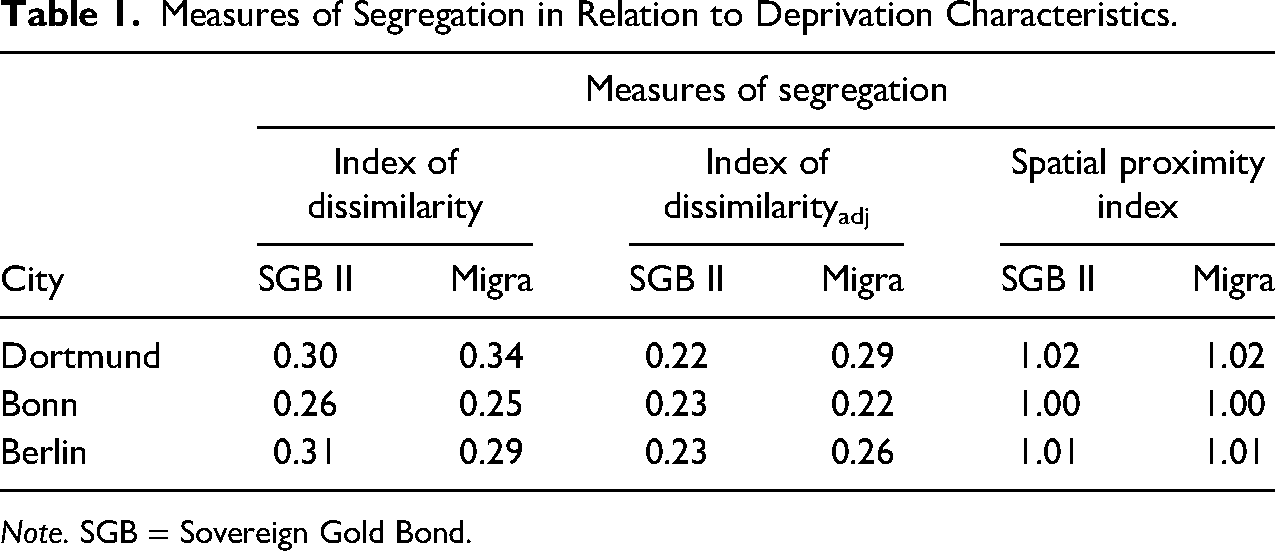
Following this initial descriptive presentation of the three cities under study, the social structure data will be used to discuss the share of unemployed, measured by the SGB II rate, and the share of people with a migration background from Muslim-majority countries. This is done in order to determine the extent to which the cities exhibit tendencies toward segregation. This is significant for the study because, if applicable, the strength of neighborhood effects, as well as the effects of LSSOs, may differ depending on the extent of segregation in each city. In considering established measures of segregation, we refer to Duncan and Duncan's (1955) index of dissimilarity. The index measures the spatial distribution of two characteristics in a given region. Specifically, these items are the unemployment rate as well as the proportion of individuals with citizenship from Muslim-majority countries compared to the respective reference group. A list of the country group can be found in the supplemental material. Both of these characteristics are associated with above-average experiences of deprivation and discrimination in Germany (Wieland and Kober 2023; Zick et al. 2023). They can therefore be used as a proxy measure to examine how segregated the three study cities are with respect to these characteristics. The index has a range of values between 0 and 1, with 0 representing completely equal distribution and 1 representing completely unequal distribution. A value of 1, for example, would mean that all persons with a nationality from a Muslim-majority country live together in a district and are 100% segregated from all other persons who do not have a migration background from a Muslim-majority country.
Looking at the dissimilarity in terms of the distribution of the unemployment rate in the study cities, it can be seen that all three cities have relatively similar values (see Table 1). Dortmund has a value of 0.30, Bonn 0.26, and Berlin 0.31. Since all three values are close to 0.3, this indicates that there is a similar dissimilarity in the distribution of the unemployment rate in all cities and that no significant differences can be identified.
Measures of Segregation in Relation to Deprivation Characteristics.
Note. SGB = Sovereign Gold Bond.
Table 1 also presents the dissimilarity in terms of nationality from Muslim-majority countries. Similar to the distribution of the unemployment rate, a picture of weak to moderate segregation emerges for the share of persons with a migration background from a Muslim-majority country compared to the reference group. However, it is clear that Berlin and Dortmund tend to be more segregated than Bonn. The adjusted index of dissimilarity is calculated analogously to the calculation proposed by Duncan and Duncan (1955), but explicitly takes into account spatial relationships between neighborhoods and is based on the proposal by Morrill (1991).
An alternative for assessing segregation dynamics is White's spatial proximity index (1983). This index is a measure for estimating clustering by comparing the average distance between a characteristic group and the distance to the reference group. It is a weighted average of the mean distance between the feature group and the mean distance between members of the reference group. The resulting value provides an idea of the degree to which a feature is clustered or distributed across neighborhoods. If the spatial proximity index has a value of 1, this indicates that there is no differential clustering between the two groups being compared. This means that the two groups are evenly distributed across the geographic units analyzed. Values greater than 1 indicate that members of one group tend to be closer to each other than to members of the other group, indicating clustering or segregation.
Looking at the values of the spatial proximity index for the study cities, it is striking that there is only a very small clustering for Dortmund and Berlin, both in terms of the unemployment rate and the proportion of people with a migration background from a Muslim-majority country (see Table 1). Bonn, with a value of 1, shows no segregation in terms of the spatial proximity index. In summary, there is no clear evidence of drastic segregation. However, when the values are compared with each other and with the other study cities, there is a tendency for Dortmund to show signs of the strongest segregation in direct comparison with Berlin and Bonn, which should be taken into account when interpreting the multivariate analyses.
Operationalizations
The dependent construct to be explained, susceptibility to radicalization, is measured by 12 attitudinal characteristics (Küchler 2024). The index is based on the assumption that radicalization is a complex process in which individuals or groups adopt an extremist worldview and become willing to advocate or commit acts of extremist violence. However, this process is difficult to capture, as the individuals concerned have a higher threshold of inhibition towards official surveys per se, and it can therefore be assumed that participation is biased. The aim is therefore to start systematically before or at the very beginning of this process, as it can be assumed that these reservations about participating in a survey are not yet so strongly represented here. In a qualitative preliminary study, three dimensions were identified as predisposing factors that make people more susceptible to a radicalization process (Kurtenbach et al. 2020). Second, these findings were quantified and validated using various methods. The index correlates positively with scales that attempt to measure radicalization directly, which is a sign of external validity and proves that the index reflects vulnerability to radicalization, thereby reducing the presumed participation bias of already radicalized individuals (Küchler 2024). These three central dimensions are: perceived experiences of discrimination, distrust of democracy, and authoritarianism, which are conceptually defined. The forms of perceived experiences of discrimination were examined based on individual perceptions of discrimination against two constructed groups: one of German origin and one of non-German origin. 1 The classification, based on socio-demographic information, considered whether both parents were born in Germany. If this was the case, no migration background was assumed. However, if at least one parent or the respondent was not born in Germany, a non-German origin was assumed. Questions focused on perceived discrimination in terms of economic disadvantage, fair treatment in everyday social life, and insults or verbal attacks based on a particular origin. Forms of participants’ distrust of democracy were assessed by asking questions about trust in government institutions, political parties, and politicians in general. The aim was to assess key aspects of the democratic system in Germany, and representative institutions in particular. This approach was closely related to the forms of authoritarianism studied. Specifically, the survey focused on attitudes that supported the desire for centralized and strong political leadership, as well as aspects that favored stricter enforcement through laws and emphasized the importance of respect and obedience to superiors. Each of the three dimensions of the susceptibility to radicalization was measured with four previously validated questions about the concepts outlined. The questions were scored on a 5-point Likert scale. These 12 items were then factor analyzed into the three dimensions described. Assuming that each dimension has equal weight and direction of effect on vulnerability, they were summed to form an index. A higher score on this index indicates greater susceptibility to radicalization. The scale shows high reliability with a Cronbach's alpha of > = 0.80 for the three cities in the study. Figure 1 shows the average susceptibility to radicalization for each city-based unit of analysis.
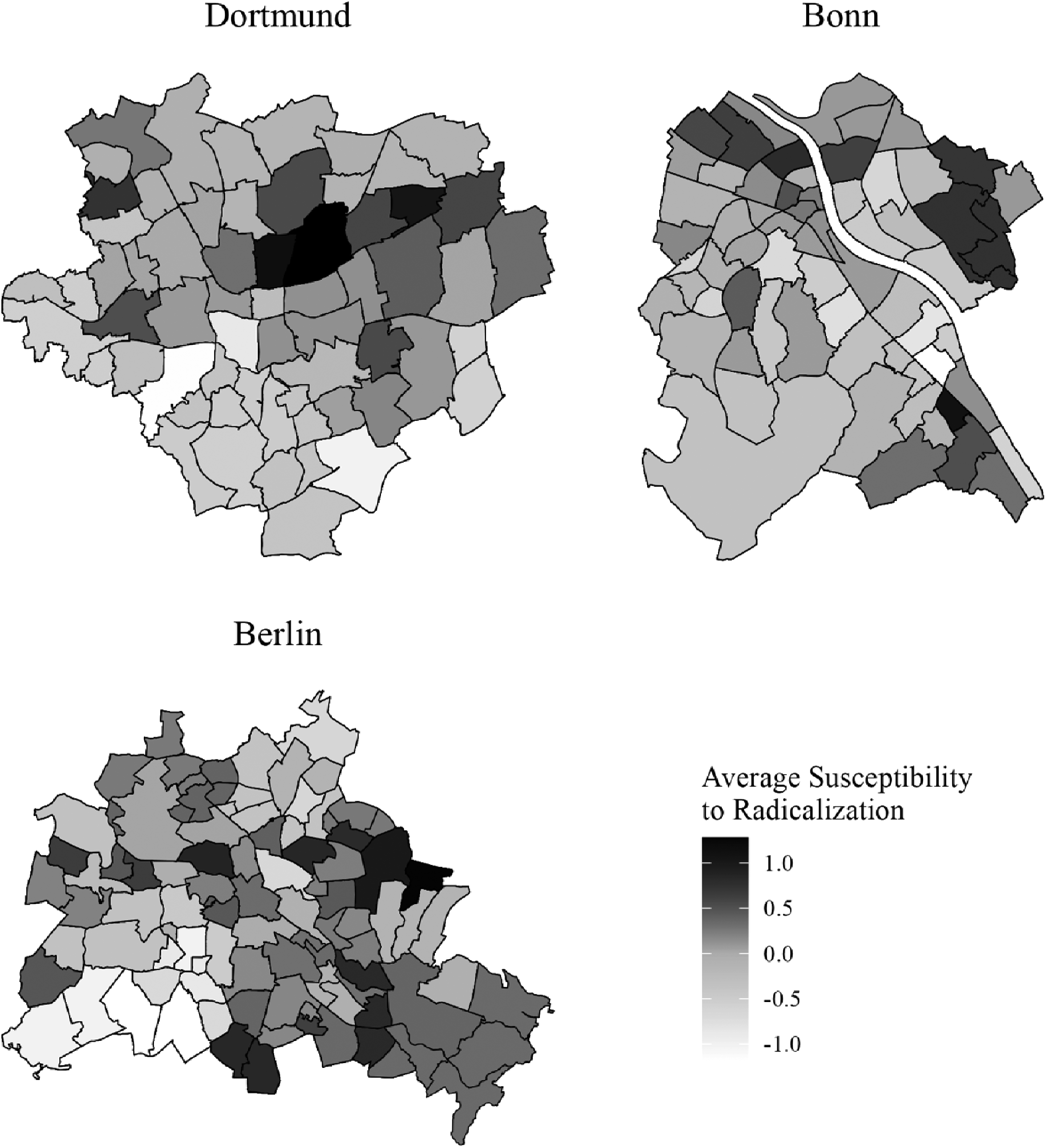
Average susceptibility to radicalization per city-specific breakdown unit.
In the following, we first operationalize the central independent variables. The sense of relative deprivation addressed in H1a is measured by the question on satisfaction with one's own income, that is, the subjectively perceived economic situation of the respondents. The corresponding item is: “All in all, how satisfied are you with your household's income at present?” It was to be answered on a 10-point response scale. In contrast to the supposedly objective measurement of the respondent's monthly net household income, perceived satisfaction takes into account the individual comparison of personal living situations, resulting in a more meaningful measurement (Turley 2002). It should be noted that relative deprivation is a broader sociological phenomenon, of which individual income satisfaction is only one aspect. However, since this subjective satisfaction does not occur in isolation and without the automatic and individual consideration of reference groups such as peers, neighbors, or social averages, it is nevertheless assumed that individual income satisfaction can provide a meaningful indication of relative deprivation.
Attitude toward the family is the central independent variable mentioned in H1b. This indicator is based on two questions that respondents were asked to rate on a 5-point Likert scale. The exact wording of the questions was “In our family, we help and support each other” and “I am proud to be a part of my family.” The two items were combined into a latent factor representing a positive attitude toward the family based on exploratory factor analysis. The Cronbach's alpha of this instrument ranges from 0.78 to 0.85 across the study cities.
The influence of deviant peers assumed in H1c is measured by five questions, which were also summarized by factor analysis. Before the actual questions, a brief introduction was given, explaining that the following questions were aimed at how respondents thought their closest and best friends, on average, felt about the issues. The questions here were: “You have to see how you can get money, no matter what,” “Sometimes forms of violence are justified,” “It's not a problem to buy something from a friend/colleague without knowing where they got it. (Like a cell phone, for example),” “It's okay to throw trash on the ground,” and “It's okay to take drugs once in a while.” These questions are strongly aligned with the operationalization of deviant behavior used by Kurtenbach (2017). The response scale used was preceded by “I think my closest and best friends would agree with the statement…” and included the response options “Strongly agree,” “Somewhat agree,” “Partially agree,” “Somewhat disagree,” and “Totally disagree.” The Cronbach's alpha here is between 0.78 and 0.81 across the cities.
H2a refers to the concentration of poverty in the studied urban units. This socio-structural information is taken from the cities’ official statistics on SGB II, that is, the receipt of social benefits in case of unemployment. The analyses use the SGB II rate, which refers to the percentage of the labor force (aged 15–65) receiving benefits under Book II of the Social Code (SGB II).
H2b refers to legal cynicism (Sampson and Bartusch 1998), which means the loss of trust in the existing legal system and its representatives. Agreement with this norm violation was captured by four statements rated on the familiar 5-point Likert scale: 1. “Laws are there to be broken”; 2. “It's okay to do whatever you want as long as it doesn’t harm anyone”; 3. “People put themselves at a disadvantage if they always follow rules”; 4. “There are no ‘right’ or ‘wrong’ ways to get money, there are only ‘easy’ and ‘hard’ ways.” The reliability of the scale was satisfactory in the three cities, with Cronbach's alpha values between 0.70 and 0.75.
H3a assumes that the LSSO can actually reach people who are more susceptible to radicalization. This contact is measured by the question “Please tell us if you or any of your household members had contact with such an institution.” The respondents were then asked to name a maximum of five LSSOs. The LSSOs mentioned were categorized into four types based on content, namely 1. general consulting services, 2. life stage support services, 3. precarious life support services, and 4. community services. The breakdown of types can be found in the Supplemental Material. Based on this information, binary dummy variables were coded to represent whether the respondents had contact with each LSSO category. In addition, the respondents were asked about their frequency of contact with the LSSOs they named, which was also controlled for in the analyses.
In contrast to the previous hypotheses, H3b does not address individual effects, but refers to the general supply of LSSOs in the neighborhoods studied. These were researched in advance, and the exact composition of the types of LSSO facilities offered can also be found in the Supplemental Material. More specifically, the number of facilities in the urban subdivision unit is related to the number of LSSO per 1,000 inhabitants. The greater this property of the neighborhood, the higher is not only the density of LSSOs, but also theoretically the accessibility for individuals. Following this, H3c refers to the entropy of the supply landscape in a city subdivision. Here, we refer to the Theil index as a measure of entropy (Fossett 2017). This is based on the consideration that LSSOs address different needs and provide experiential spaces depending on their type. A higher diversity of a service landscape is then associated with the expectation that it also offers opportunities to overcome complex individual challenges. The range of values is from 0 to 1, with higher values indicating increased entropy with respect to the differentiated nature of the social services landscape.
In addition to the direct correlations of the predictors on susceptibility to radicalization, we separately tested for possible interaction terms for all of the independent variables that may be associated with the neighborhood. These specific neighborhood variables include SGB II rate, density of supply landscape per 1,000 population, and entropy of supply landscape. For the interaction terms, the binary indicator for each contact with one of the four LSSO types is considered. This is to examine the extent to which the influence of neighborhood deprivation is related to contact with social services and whether or how these dynamics influence susceptibility to radicalization. The interaction terms allow for a more detailed analysis of the complex relationship between the independent variables and susceptibility to radicalization. They allow us to highlight possible moderating effects of neighborhood and to examine how contact with social institutions affects the impact of neighborhood variables. The calculation and analysis of interaction terms thus extends the scope of the study and allows for a more comprehensive view of the relationships between neighborhood characteristics, social contact, and susceptibility to radicalization. In addition, we tested for the interaction of legal cynicism and deviant peer influence with LSSO types at the individual level. Based on the literature, both legal cynicism and deviant peer influence may be a possible result of neighborhood-specific deprivation that we cannot directly control for at the neighborhood level.
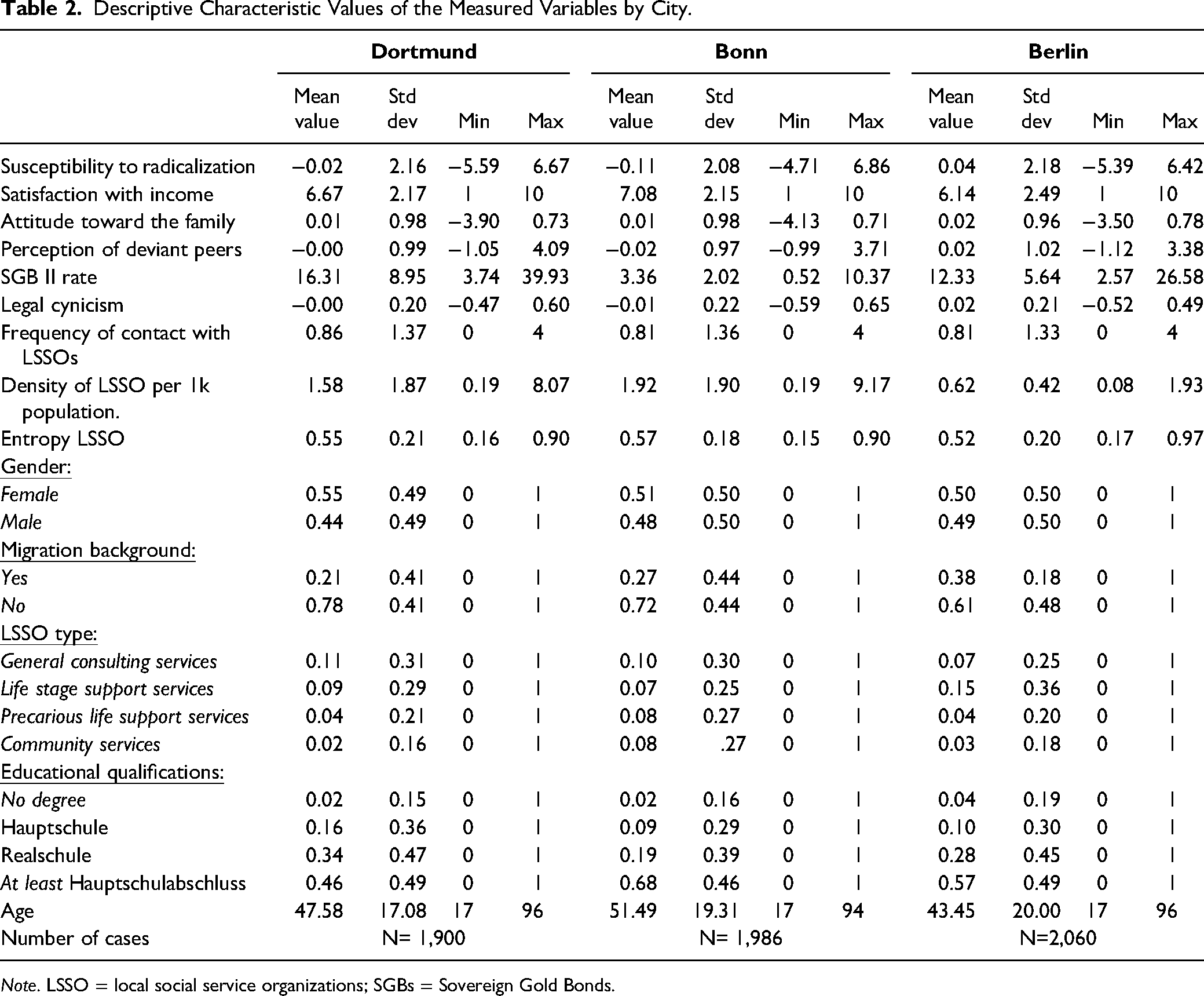
Information on gender, age, migration background, and highest educational attainment were included as control variables. In addition, the percentage of the population that migrates was controlled for on the basis of the city breakdown units. The migration volume is the sum of inflows and outflows from the city area over one year. The information comes from the respective statistical offices of the cities. A summary of the descriptive statistics of all the thematic variables can be found in Table 2, where it should be noted that a reduced number of cases are presented that differ from the descriptions of the city sample presented. This is due to the exclusion of cases for which no SGB II rate could be provided. Table 2 2 thus shows the actual distribution of the variables included in the models.
Descriptive Characteristic Values of the Measured Variables by City.
Note. LSSO = local social service organizations; SGBs = Sovereign Gold Bonds.
Statistical Analysis
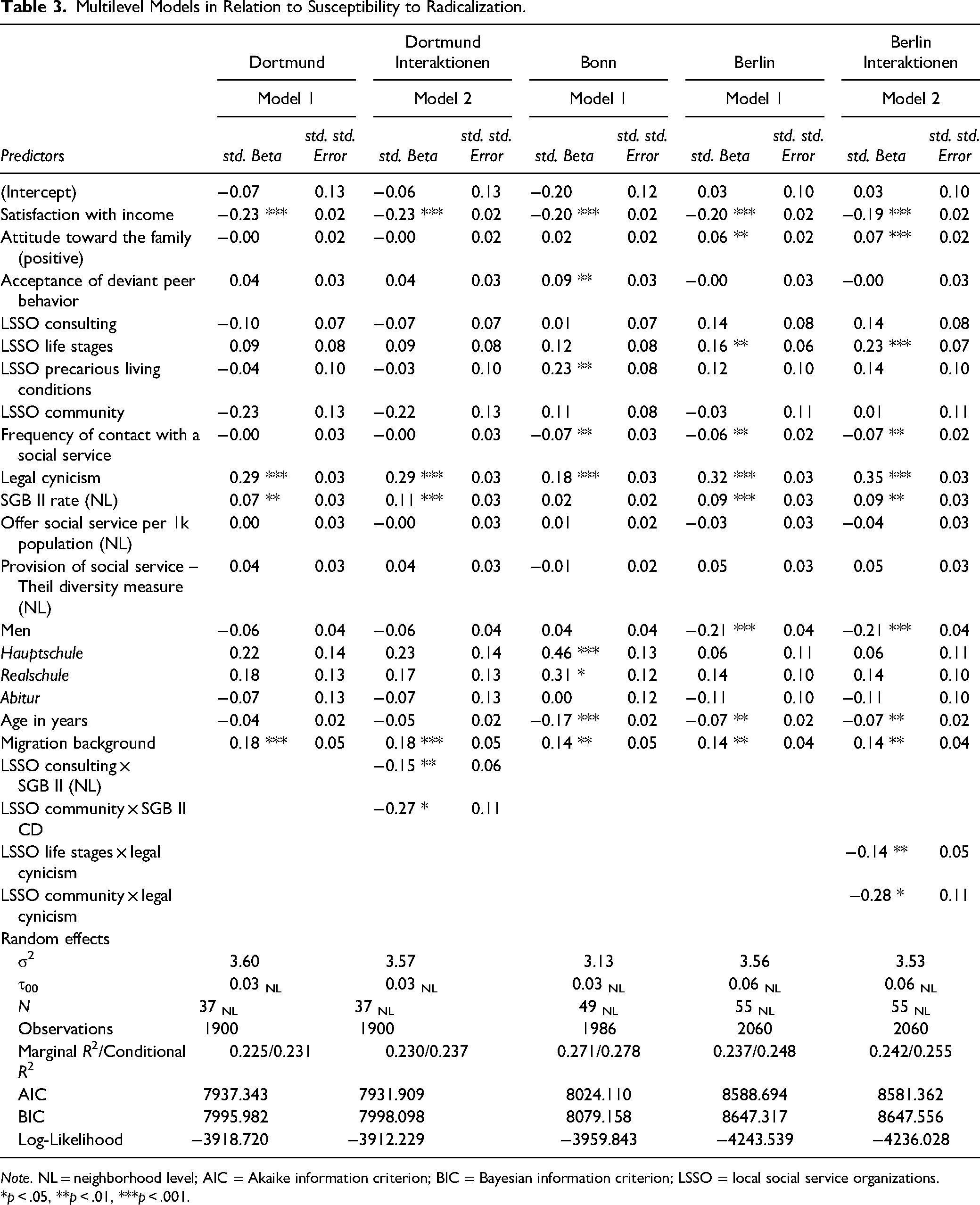
Six random intercept multilevel models were used to analyze the empirical data and test the hypotheses. These models are linear multilevel models based on maximum likelihood estimation. The models estimate the variation in the dependent variable “susceptibility to radicalization” and take into account the specific data structure of the cities, which are divided into different spatial units. This means that the calculated models cluster the standard errors at the level of spatial units (Hox et al. 2017). Prior to the model calculations, all metric variables were z-standardized. In the empty null model, the dependent variable has an intraclass correlation of about 0.04 across all three cities. Accordingly, ∼ 4% of the total variance in the individual process of susceptibility to radicalization is attributable to urban zoning. This variance could theoretically be due to context-specific characteristics or a consequence of residential choice. Model specification involved two modeling exercises for each city. First, the central predictors based on the hypotheses were included along with individual control variables, and second, neighborhood control variables were included along with interaction effects. Table 3 3 shows all models for the three cities studied.
Multilevel Models in Relation to Susceptibility to Radicalization.
Note. NL = neighborhood level; AIC = Akaike information criterion; BIC = Bayesian information criterion; LSSO = local social service organizations.
*p < .05, **p < .01, ***p < .001.
Results
The evaluation of the Akaike information criterion and log-likelihood values as quality criteria in the model evaluation shows that the model quality improves in two cities. However, the Bayesian information criterion in the second models for Dortmund and Berlin is slightly higher after controlling for interactions, which clouds this finding somewhat. Due to concerns about model complexity and statistical power, in this study we stepwise tested all interactions of theoretical interest and included only those that were significant at least at the p < .05 level together in the final model. Bonn has no significant interactions and therefore only the first model is shown. The evaluation of the predictors in the final models across the cities shows a differentiated relationship of the predictors on the dependent variable. In the following, the results of the linear multilevel models are classified and interpreted according to the formulated hypotheses. According to H1a, satisfaction with income has a highly significant (p < .001) and conjectured preventive assoziation on “susceptibility to radicalization” in all three cities. This link is robust in its magnitude and reproducible across cities. In contrast, positive attitudes toward the family show an correlation opposite to the hypothesis: in Dortmund and Bonn, the assoziation is not significant at any acceptable level. In Berlin (std. β = 0.07), on the other hand, a highly significant positive association (p < .001) with susceptibility to radicalization emerges. Thus, this result contradicts the hypothesis in H1b. One explanation for this is city-specific anomalies that are not controlled for in the model, which requires further scientific investigation and is of a more speculative nature here. H1c concerns the influence of the peer group and shows a significant relationship with susceptibility to radicalization only in Bonn, which is rather modest in its effect size (std. β = 0.09, p < .01 in Model 2). Thus, no robust relationship between peer group deviance and radicalization susceptibility can be demonstrated. However, the link found for Bonn is consistent with the theoretical hypothesis.
In evaluating Hypothesis H2a, it should be emphasized that for Dortmund (std. β = 0.11, p < .001) and Berlin (std. β = 0.09, p < .01) there is an increasing relationship between the SGB II rate and susceptibility to radicalization. Only for Bonn is no correlation found at an acceptable level of significance. In summary, H2a can be accepted with the exception of the result for Bonn. The association of legal cynicism for H2b is clearly more consistent with the formulated hypotheses. In each case, the relation to be revealed is extremely robust and significant at the highest level for all cities (p < .001). The exact correlation sizes can be found in Table 3. Regarding the influence of legal cynicism, Berlin shows the strongest relationship with a std. beta of 0.35.
The central independent contact with the LSSO, which is composed of the type of general consulting, life stages support, support in recarious life situations, and community services, shows very heterogeneous city-specific results, which require a differentiated test of Hypothesis H3a: General consulting services is not significantly related to susceptibility to radicalization across cities. The type of LSSO that provides aid in different life stages is positively related to susceptibility to radicalization only in Berlin (Berlin Model 2: std. β = 0.23, p < .001). This does not necessarily mean, for example, that children's and youth facilities, which in this article are assigned to the life stages type, increase susceptibility to radicalization; rather, it can be assumed that access points for professionals have been identified to reach individuals are who currently showing openness to radicalization tendencies. In Bonn this dynamic applies with a similar strength of correlation (std. β = 0.23, p < .001) to services for people in precarious life situations, such as drug help. In Dortmund there is no resilient significant level for any LSSO type. The frequency of contact with an LSSO as a quality indicator has a negative relationship with the susceptibility to radicalization for Bonn and Berlin. In a direct comparison of the three cities, Dortmund has a higher degree of social segregation, suggesting that LSSOs may have a better contact to people with a higher susceptibility to radicalization under conditions of social mixing. This implies that H3a can be confirmed with limitations, but further research is needed to uncover the mechanisms at work here. Neither for H3b, which controls for the effect of LSSO density, nor for H3c, which controls for LSSO diversity, are direct relations found at acceptable levels of significance in the models. However, to get a complete picture for the final evaluation of the hypotheses, the specified interactions must also be considered.
Starting with Dortmund, a significant interaction (std. β = −0.15, p < .01) between contact with the general type of LSSO and the SGB II rate should be emphasized. This means that, for example, if people in a district with a high SGB II rate have contact with the social welfare office, this correlates negatively with reported susceptibility to radicalization (see Figure 2). This result is not found in the other two cities.
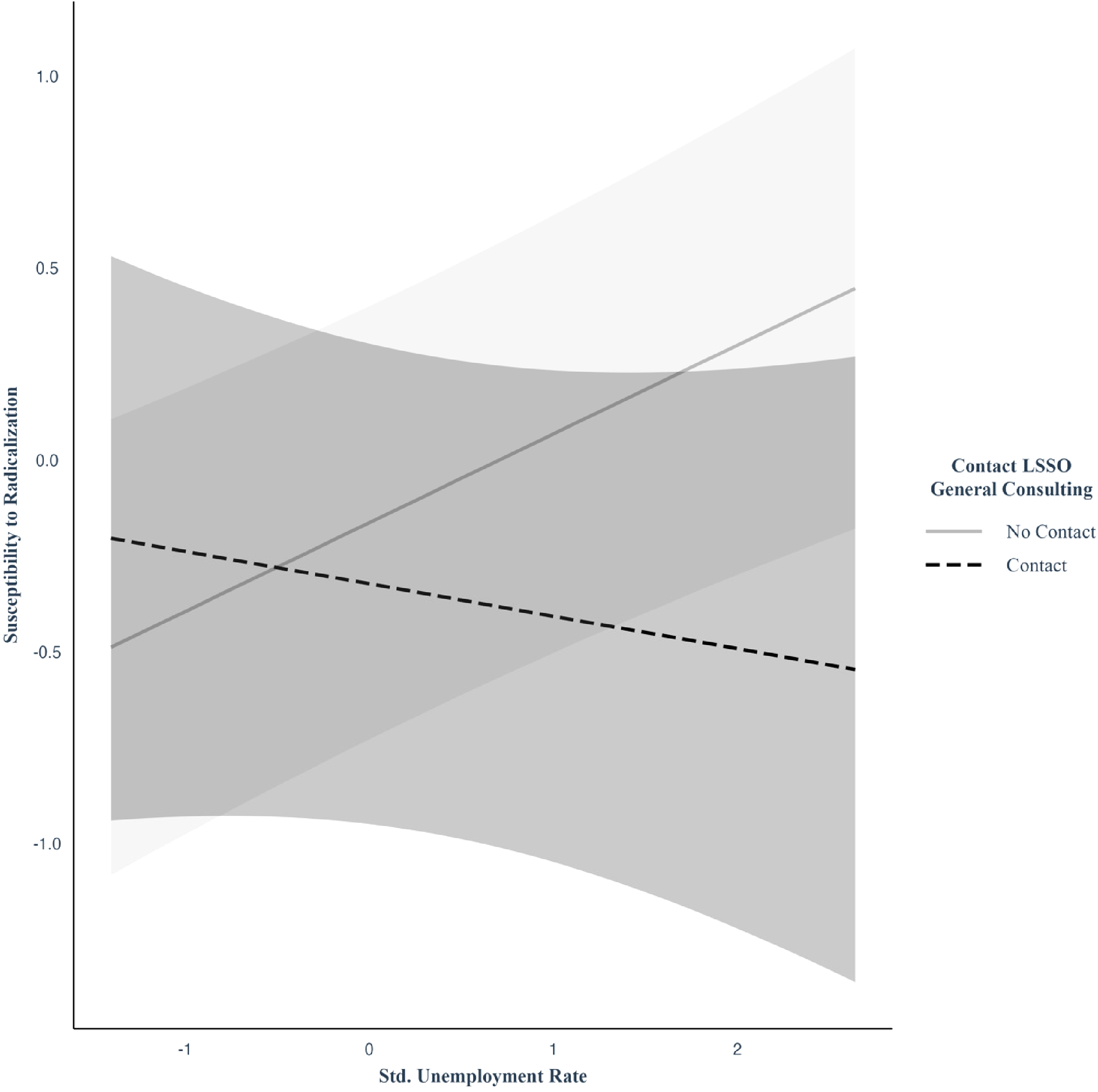
Interaction effect between general consulting-type LSSO and std. SGB II rate for Dortmund.
For the interaction between community type and SGB II rate, a decreasing correlation can also be observed for Dortmund, which is relatively clear in the strength of the result with a std. beta of −0.27 (p < .05) (see Figure 3). Again, this correlation is not found in the other cities. In summary, however, a type-specific association of the LSSO in neighborhoods with increased poverty rates can be identified for Dortmund, which is not found for Bonn and Berlin.
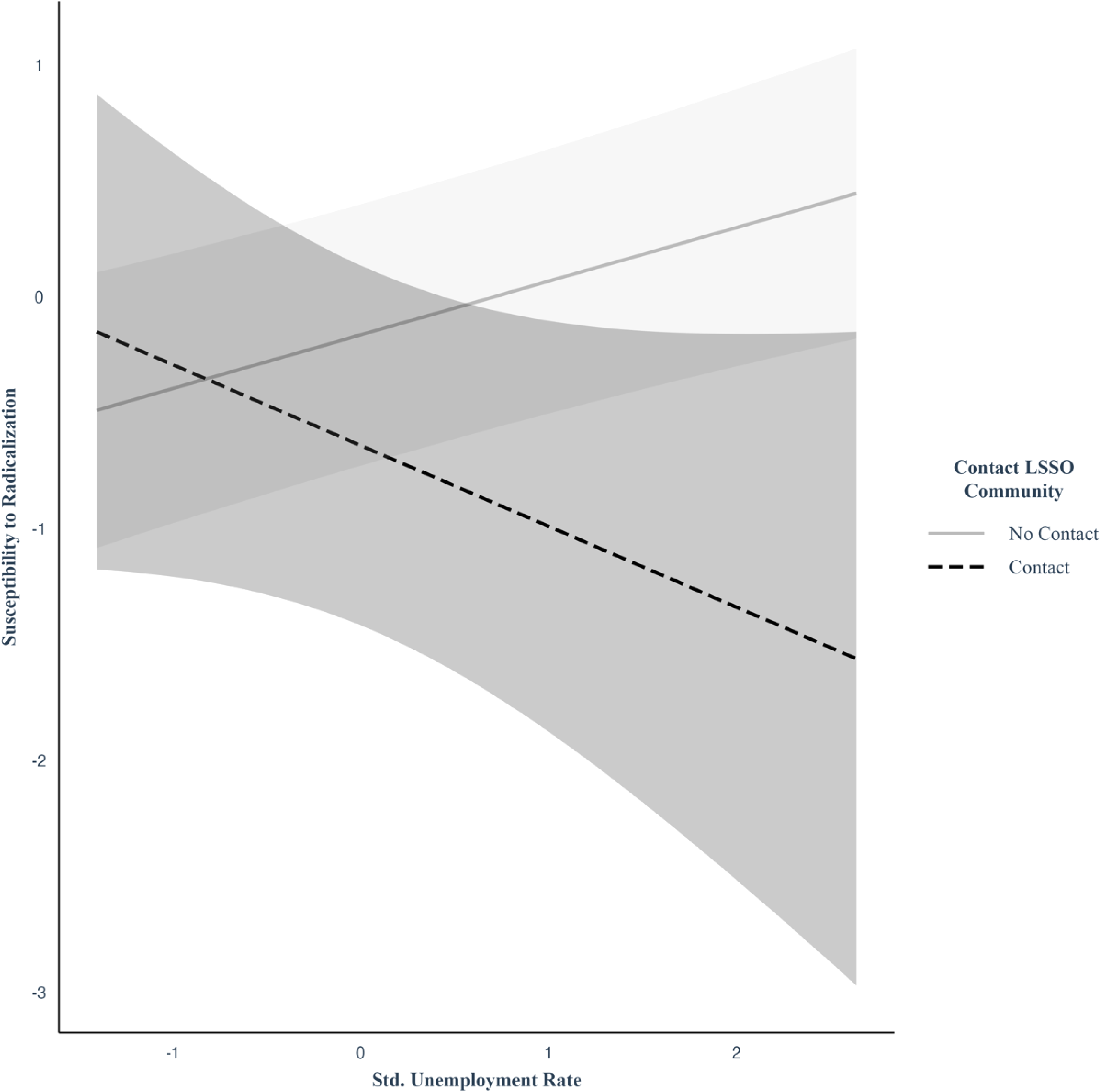
Interaction effect between community-type LSSOs and std. SGB II rate for Dortmund.
Significant correlations also emerge for the interaction between LSSO types and legal cynicism only for Berlin. Thus, the LSSO category of life stages support in areas where respondents report elevated levels of legal cynicism is negatively correlated (std. β = −0.14, p < .01) with susceptibility to radicalization (see Figure 4).
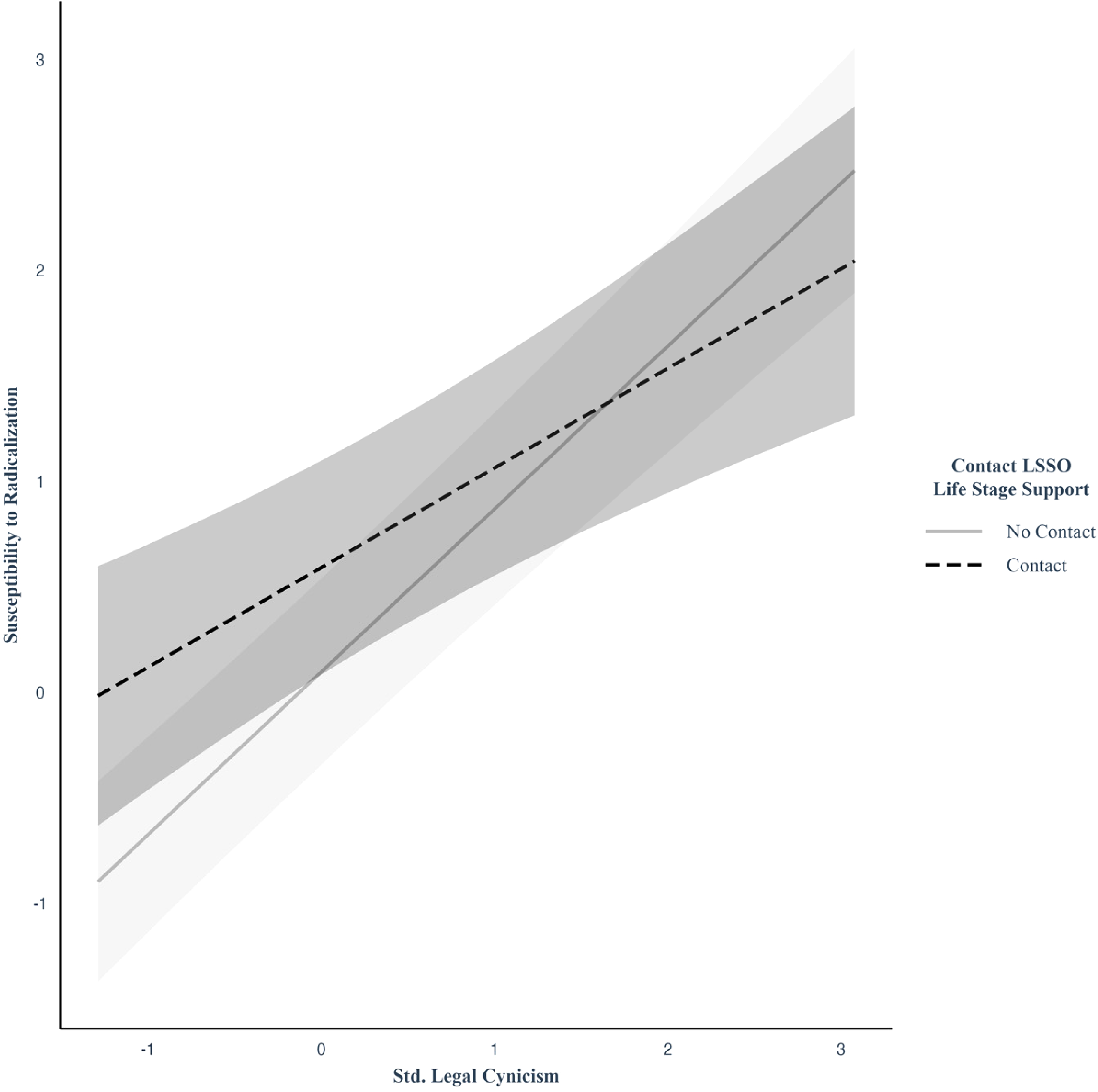
Interaction effect between life stage-type local social service organizations (LSSOs) and std. legal cynicism for Berlin.
A similar, though more pronounced, association can be demonstrated for LSSOs for community services. There is an inverse correlation of −0.28 (p < .05) (see Figure 5). Both results suggest that the aforementioned types of institutions in neighborhoods with elevated attitudinal characteristics related to legalistic cynicism reach individuals who are less susceptible to radicalization.
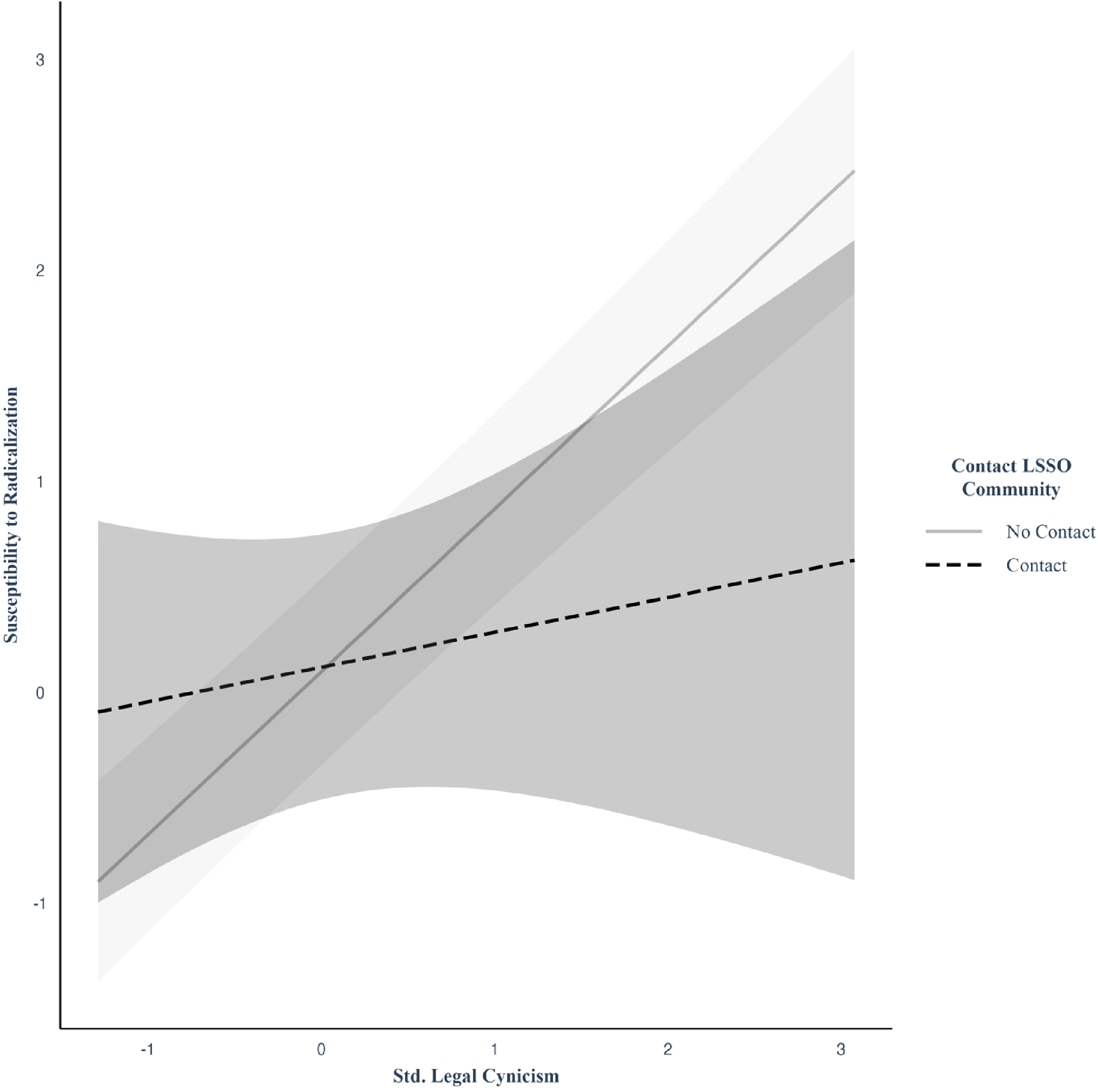
Interaction effect between community-type local social service organizations (LSSOs) and std. legal cynicism for Berlin.
For Bonn, no significant interaction can be demonstrated at an acceptable level when controlling for the covariates used here. The diversity and density of social services in the neighborhoods of the three cities studied also fail to provide a robust significant correlation with regard to susceptibility to radicalization, leaving H3b and H3c entirely unsupported.
The evaluation of the control variables is different: For Berlin (β = −0.21, p < .001), it can be deduced from the overall model that men are significantly less correlated with susceptibility to radicalization than women. To classify the results, it should be noted at this point that susceptibility to radicalization refers to attitudinal characteristics and not to the acceptance of radical or extremist actions. For the latter, a positive correlation for men is frequently reported in the literature. Age, measured in years, also has a significant influence as a presumed preventive factor is age. The older a respondent is, the more negative the correlation with openness to radicalization. This relation is found in all cities, but only in Bonn (β = −0.17, p < .001) and Berlin (β = −0.07, p < .01) the association is significant at an acceptable level. Similarly, a very clear educational link is found only for Bonn: Here, a poor school education in the form of a Hauptschulabschluss (β = 0.46, p < .001) and a medium school education in form of a Realschulabschluss (β = 0.31, p < .05) correlates significantly with susceptibility to radicalization. Migration background has a robust and significant association with the susceptibility to radicalization. This correlation is relatively equally strong across all three cities, see Table 3. An important categorization of this finding is that individuals with migration experience are significantly more likely to report experiencing discrimination as one of the dimension of the susceptibility to radicalization scale. In this respect, it is not surprising that there is a clear correlation here. However, it should not be interpreted in a simplistic way and needs to be placed in the aforementioned context.
The results thus show a very mixed picture in assessing the influence of socio-structural effects, especially when spatially assignable characteristics are taken into account. In particular, there is a lack of cross-city correlations. This finding suggests that the impact of contact with LSSOs varies and therefore no consistent, robust picture can be drawn for all cities. First, an important aspect to consider when discussing this finding is the dynamic nature of the composition of the measure of susceptibility to radicalization. As reported, this scale is based on three key dimensions. This may be an argument for why the significant effects in the aggregate composition index of susceptibility to radicalization partially disappear, as social service interventions typically address individual risk factors, such as distrust of democracy, but cannot represent the entire spectrum. This does not argue against the effectiveness of an intervention, but it does suggest that susceptibility to radicalization is a highly complex phenomenon that can only be substantially influenced by a mix of coordinated services. Second, there is the limitation that individual social institutions are included in the collective categories of LSSO types used. On the one hand, this is unavoidable from a methodological point of view, as otherwise the number of cases per facility would be too small; on the other hand, categories that are too general may dilute the statistical power.
Both points highlight the urgency of further research, especially to test causal hypotheses regarding the influence of social services on strengthening factors that can prevent the susceptibility to radicalization. This does not necessarily require the use of longitudinal designs. Methods such as propensity score matching seem appropriate for testing causality in this area. Another important point, which has received little attention, is the structure of social service provision. This refers not only to the field of activity of the facilities, but especially to their financial resources, the number of professionals, or the promotion of participation in the programs of a facility. A survey of these and other qualitative characteristics of the structure of services that can be located in the district promises to make a substantial contribution to the discussion of prevention, not only of susceptibility to radicalization.
Conclusion and Outlook
The aim of this article was to investigate whether LSSOs have the ability to prevent or mitigate adverse neighborhood effects. Although the exact causal mechanism could not be addressed on the basis of the underlying data, there is evidence that, at least for Dortmund and Berlin, there are clear sociostructurally disadvantaged neighborhood effects that are related to susceptibility to radicalization. Furthermore, the results show that the LSSOs considered here do have the potential to exert a presumed moderating influence on these disadvantaged neighborhood effects in the case of Dortmund. This is a new perspective in neighborhood effects research, which we believe is highly relevant for the development of spatially oriented social policies. Susceptibility to radicalization was examined because there are numerous studies on risk factors in this regard and because it is of outstanding social importance. The three major German cities of Dortmund, Bonn, and Berlin were selected as study cases, also to examine segregation in conjunction with an intervening welfare state, including LSSO funding in distressed neighborhoods. Data from official social structure statistics, survey data, and LSSO processing was used to examine individual, neighborhood, and organizational correlations.
The results show a complex picture, which is summarized below. While satisfaction with income (H1a) acts as putative preventive factors, legal cynicism (H2b) and, counterintuitively, a positive relationship with the family (H1b) are to be interpreted as putative risk factors. For the influence of poverty concentration (H2a), robust results for hypothesis acceptance are found in two of the three cities, suggesting the influence of neighborhood effects. While the association of the types of LSSOs remains unclear and must be seen in the context of each city, the more general finding is that the general frequency of contact with these facilities provides arguments for Hypothesis H3a, although a generalized picture across the three study cities is not possible here. That is, LSSOs have the putative potential to prevent or mitigate risk-increasing neighborhood effects if their services are aligned, but this does not appear to be the structural case based on the interactions. With respect to a single type of facility, Small et al. (2008) were able to demonstrate that when there is also a needs-based network of facilities in disadvantaged neighborhoods, they also have a buffering effect. At the neighborhood level, however, no such coordinating effect is found with respect to complex problem situations such as susceptibility to radicalization. Also, at first glance, neither the density (H3b) of LSSOs nor their heterogeneity (H3c) seem to play a role in preventing susceptibility to radicalization.
Therefore, the answer to the research question of whether LSSOs have the putative possibility to prevent or mitigate neighborhood effects is as follows: with respect to complex social problems such as susceptibility to radicalization, local organizations are likely to be overwhelmed and unable to significantly influence neighborhood effects that promote susceptibility to radicalization, at least directly. However, individual determinants of deprivation can be addressed. If so, close coordination among LSSOs could also prevent complex deprivation.
The results show that the use of LSSOs is not clearly associated with levels of radicalization, and that these correlations are not evenly distributed across the cities studied. When interpreting these results, it is reasonable to conclude that it is the processes within the LSSO that lead to different results. That is, the quality of work varies even among the same types of LSSOs, which in turn explains the variation in the strength of the correlations. At the same time, although we were not able to capture it in the context of this study, it can generally be assumed that the funding of the LSSO, on the one hand, and the challenges that the clients bring with them, on the other hand, may also have an influence on the quality of the work. These are interpretative explanations for the variation in the correlations between contextual characteristics, attendance at LSSOs, and susceptibility to radicalization that should be explored in further studies from the perspective of professionals in LSSOs.
The study shows that the relationship between organizations and space is quite profitable, but complex. LSSOs of various types do not happen to be concentrated where social problems and poverty are concentrated; rather, they are thought to have mitigating or even preventive power, but their ability to deliver is limited, especially when the challenges are complex. Nevertheless, the findings suggest that it does make a difference how large and diverse the organizational ecology is in a disadvantaged neighborhood, but this also depends on the particular challenges in the locality.
This also addresses the three main limitations of this study. First, only immediate relationships could be controlled; the long-term effect of the use of LSSOs was not captured with the available cross-sectional data. Second, susceptibility to radicalization is a clearly identifiable but complex phenomenon, which may theoretically overestimate the performance of LSSOs. Third, only one welfare state model, Germany, was studied, so that a transfer to other welfare state models is only possible on a conceptional level.
This suggests a need for further research. It is essential to investigate the implicitly assumed causal relationships. In particular, there is a need to examine the extent to which the effects of LSSO service use influence the attitudinal characteristics of contact persons. In addition, the putative preventive effect of social services versus neighborhood effects on less complex phenomena, such as the willingness to take a job, should be investigated to better determine the potential of this approach. It also seems useful to conduct contrast studies, that is, analyses of disadvantaged neighborhoods with and without developed organizational ecologies.
In sum, the study shows that disadvantageous neighborhood effects are complex social mechanisms that can be addressed by socio-political services, but their implementation should be both adequately resourced and meaningfully coordinated. However, this does not always seem to be the case for complex sets of problems. Nevertheless, the results show that there is an opportunity to address and presumably prevent or reduce neighborhood effects on the susceptibility to radicalization through LSSOs. Thus, the study of neighborhood effects has taken a step forward, since it is no longer just a matter of detecting them, but also of analyzing how to prevent them.
Supplemental Material
sj-docx-1-uar-10.1177_10780874241259423 - Supplemental material for Prevention of Neighborhood Effects on the Susceptibility to Radicalization: Results of a Comparative Study in Germany
Supplemental material, sj-docx-1-uar-10.1177_10780874241259423 for Prevention of Neighborhood Effects on the Susceptibility to Radicalization: Results of a Comparative Study in Germany by Sebastian Kurtenbach, Armin Küchler and Andreas Zick in Urban Affairs Review
Footnotes
Declaration of Conflicting Interests
The author(s) declared no potential conflicts of interest with respect to the research, authorship, and/or publication of this article.
Funding
The author(s) disclosed receipt of the following financial support for the research, authorship, and/or publication of this article: This work was supported by the Bundesministerium für Bildung und Forschung.

Supplemental Material
Supplemental material for this article is available online.
Notes
Author Biographies
References
Supplementary Material
Please find the following supplemental material available below.
For Open Access articles published under a Creative Commons License, all supplemental material carries the same license as the article it is associated with.
For non-Open Access articles published, all supplemental material carries a non-exclusive license, and permission requests for re-use of supplemental material or any part of supplemental material shall be sent directly to the copyright owner as specified in the copyright notice associated with the article.
